Search Results: "eric"

4 February 2012

Christian Perrier: Debian Installer fully translated into Kannada

I imagine my readers (except those from India) : "Kannada, WTF"? No, this is not about D-I being translated into the variants of English and French spoken with a funny accent in a very big country located north of the United States of America, where they play ice hockey against mooses, wearing red policemen suits, with fur hats and drinking maple syrup. Kannada is the official language of the state of Karnataka, in southern India. The state that has Bangalore, the IT-leading city in India as capital. Kannada is spoken by about 45 million people, roughly the population of Spain. And, since yesterday, thanks to a local group lead by Vikram Vincent, Debian Installer is fully translated to Kannada. As of now, this is the 5th complete language of India along with Gujarati (46M speakers as first language), Hindi (180M, though some references mention 550M), Marathi (68M) and Tamil (62M). Other supported languages of India are Telugu (99% translated, 70M), Bengali (95%, 71M plus 110M in Bangladesh), Punjabi (91%, 28M) and Malayalam (86%, 36M). As you see, translators in India are really incredibly active and the free software community over there deserves some big light. We don't have many opportunities to meet up as traveling is not easy for contributors in India because, among other problems, of visa regulations for Indian citizens in many so-called western countries. So, really, I wanted to thank them again for this work.

28 January 2012

Russ Allbery: Review: Effective Java, Second Edition

Review: Effective Java, Second Edition, by Joshua Bloch
Publisher: Addison-Wesley
Copyright: 2008
Printing: October 2009
ISBN: 0-321-35668-3
Format: Trade paperback
Pages: 319
Guy Steele, in the forward to this book, writes:
Programs, unlike spoken sentences and unlike most books and magazines, are likely to be changed over time. It's typically not enough to produce code that operates effectively and is readily understood by other persons; one must also organize the code so that it is easy to modify. There may be ten ways to write code for some task T. Of those ten ways, seven will be awkward, inefficient, or puzzling. Of the other three, which is most likely to be similar to the code needed for the task T in next year's software release?
Teaching this, as well as how to avoid being awkward, inefficient, or puzzling, is the goal of this book. Clearly communicating effective, idiomatic, and maintainable usage to a newcomer to a programming language is one of the hardest types of programming books to write. Books like this are therefore quite scarce. Most introductory texts do try to communicate some degree of basic usage, but they rarely go far beyond the syntax, and when they do that usage is rarely both well-defended and inobvious. Bloch takes the concept quite far indeed, going deep not only into the Java language but also into object-oriented software construction in general. Effective Java is modeled after Effective C++ by Scott Meyers, a book I've not read (due to the lack of need for C++ in my programming life), but which I've heard a great deal about. This means the book is organized into 78 numbered items, each of which provides specific advice and analysis about one area of Java. Examples include item 16, "Favor composition over inheritance," or item 33, "Use EnumMap instead of ordinal indexing." As you can see, they run the gamut from high-level design principles to specific coding techniques. This sort of book demands a lot of the author. Everyone has a coding style, and everyone can make usage recommendations, but the merits or lack thereof of specific recommendations are often only visible with substantial later experience. More than any other type of programming language book, this sort of usage guide must be written by a language expert with years of experience with both good and bad code in the language. This is where Effective Java shines. Joshua Bloch led the design and implementation of significant portions of the Java core libraries at Sun and is currently the chief Java architect at Google, but even without knowing that background, his expertise is obvious. Every item in this book is backed up with specific examples and justification, and Bloch quotes extensively from the Java core library to illustrate both the advantages of the techniques he describes and the problems that result when they're not followed. This is not an introductory book, which is one of the things that makes it so efficient and concise. It's a book aimed at the intermediate or advanced Java programmer and assumes you already know the language and the basic pitfalls. There are only a few items in here that would be obvious to most experienced programmers, and even there Bloch ties them back to specific issues in Java in ways that are illuminating. I would not have expected to learn something new from a chapter on a hoary old problem like avoiding float and double for precise values, but I did: Bloch discusses the available alternatives within Java and their tradeoffs and then makes useful specific recommendations. If, like me, you're an experienced programmer already but relatively new to Java, you still should not read this book first. You need a general introduction to the language and libraries and a few projects under your belt before you can appreciate it. (I personally started with Thinking in Java by Bruce Eckel and it served me well, although on several points of style Bloch disagrees with advice in Eckel's book, and I find Bloch's arguments convincing.) But I think this is one of the best possible choices for your second book on Java, in large part because Bloch will head off bad design and style decisions that you don't realize you're making and catch them before they become entrenched. I'm glad I read it as soon as I knew the language well enough to absorb it, and it's the sort of book that I'm likely to re-read sections of whenever I work on Java code related to those topics. It's not entirely obvious that you should take my advice about this sort of book, since I'm not a Java expert and don't have those years of experience with it. But I've checked the recommendation with other programmers I know who are experts, and I've never heard anything but praise for it. It's also one of the books recommended in Coders at Work, and Bloch is one of the people interviewed there, which carries a lot of weight with me. And, apart from that, any long-time programmer who cares about their craft builds an internal sense of aesthetics around what a well-written program should look like and finds themselves recognizing a similar sense in other people's code, even in languages with which they're not familiar. Bloch's recommendations and analysis feel right; one can immediately see how they improve maintainability and robustness, and some of the techniques he shows are elegant and beautiful. This is not a general programming book. It's specifically focused on the Java language, and much of it deals with specific suggestions on how to use Java's core libraries and language features. If you're not going to be writing code in Java, I can't really recommend it. But one of the things I loved about it is that, while talking about Java, Bloch also talks about object-oriented software construction: techniques for extending foreign libraries one does not control, API design, and the proper use of inheritance, among other topics.. That advice is some of the best object-oriented software design advice I've ever read. There isn't enough of it to recommend the book to people with no interest in Java, but this book has even made my C and Perl code better, and has helped me grasp the tradeoff between inheritance and composition in a deeper way than I ever had before. It's a lovely side bonus. If you're writing Java, read this book. If you're learning Java, don't read it first, but read it second, and more than once, or alongside a project where you can apply the advice. It's dense and efficient in the information that it conveys, which means there's more in a couple pages here than in thirty or forty pages of some of the sprawling introductory programming books. I did read it cover to cover, which is one of the better ways to get a sense of Bloch's more general advice on software construction, but you'll hit information overload and will want to return to it piecemeal to fully absorb it. And do get the second edition. I'm sure the first edition is available cheap used, but the additions of enums and generics to the Java language are hugely important and provide some of the most elegant and graceful techniques in the book. Rating: 9 out of 10

27 January 2012

Raphaël Hertzog: People Behind Debian: Josselin Mouette, founder of the Debian GNOME team

Josselin Mouette is one the leaders of the pkg-gnome team, he takes sound technical decisions and doesn t fear writing code to work-around upstream issues. He deserves kudos for the work he has put into packaging GNOME over the years. He can also be very sarcastic (sometimes he even enjoys participating to flamewars on debian lists), and there are quite a few topics where we have long agreed to disagree. But this kind of diversity is also what makes Debian a so interesting place Read on to learn more about the pkg-gnome team, its plans for Wheezy, Josselin s opinion on the GNOME 3 switch, and much more. Raphael: Who are you? Josselin: I am a 31 years old Linux systems engineer. I started in life with physics, which I studied at the ENS Lyon. I started a thesis on experimental and numerical models for optoelectronics, but when it became clear that research was not for me, I abandoned it and accepted a job at the CEA, which holds the largest computing center in Europe. Working on these machines has been the most awesome job ever (except for it being near Paris). After that I worked a bit on system monitoring technologies. I am married, currently living in Lyon, and working for EDF (the French historical electricity company) on scientific workstations using Debian. EDF is using Debian on more than a thousand workstations and holds the fastest Debian supercomputer in the world (200 Tflops), which makes it another obvious place for Debian developers. Raphael: How did you start contributing to Debian? Josselin: I discovered Debian in 1999 while studying at the ENS, which is one of the biggest nests of Debian developers while being a small place, it is producing almost one Debian developer per year on average. After wondering for a while what it could be useful for, hacking on a slink snapshot made me think that it was for, well, everything except for gaming. Later, in 2002, when I was working on optoelectronics computing codes, I started to package them for Debian in order to make them easier to install, for us as well as other labs over the world. I started the NM process, and it was going smoothly but also going to take time. However, at that moment, the frozen-bubble game went out and made quite some buzz. Since I knew a guy who knew the game s developer, he asked me to package it. The package found 3 sponsors in a very short time and was fast-tracked into the archive at a speed that was unseen before. After which the NM process was completed very quickly. At that time, I was a heavy WindowMaker user, but I didn t like the direction the project was taking (actually, I wonder if there was one). GNOME was starting to become attractive, but its packaging in Debian was very ineffective, with many inconsistent packages maintained by people who didn t ever talk to each other some of them didn t speak English, and some of them didn t talk at all. Together with awesome people, among which Jordi Mallach, Gustavo Noronha Silva, JHM Dassen, Ross Burton and S bastien Bacher, we started the GNOME team in 2003, introducing consistent packaging practices, and initiating synchronized uploads. Releasing a completely integrated GNOME 2.8 in sarge was a considerable achievement; proving (together with the Perl team) that a team was the best way to maintain large package sets changed the way people work on Debian.
Proving [ ] that a team was the best way to maintain large package sets changed the way people work on Debian.
Raphael: You re one of the most active contributors of the team which is packaging GNOME for Debian. What would you suggest to a new contributor who would like to help the team? Josselin: There are several ways to contact the team, but the recommended one has always been IRC. We hang on #debian-gnome on the OFTC network, so just come around and ask for us. The real question is what you want to do in the team. Of course, most new volunteers want to help packaging the latest and greatest version of GNOME into unstable as soon as possible, but unless they already have Debian background, this is not the easiest task. Since there are already people working on this, the big packages are usually waiting on dependencies. I used to direct newcomers towards bug triage, but it is a tedious task and I m now convinced that our huge bug backlog will never be dealt with. The most useful thing to do for newcomers now is probably to find a GNOME or GNOME-related package that needs improvement or is lagging behind, and simply try to work on it. You can also come and fix the bugs you find annoying. Find a patch on the GNOME bugzilla, or cook it yourself, propose it, and if it s worthy enough you ll soon get commit access.
Our huge bug backlog will never be dealt with.
At this point I feel worth mentioning that if no one answers in 10 minutes, it doesn t mean that no one will answer in 2 hours, so please stay on the channel after asking. Raphael: There s been some controversy about GNOME 3 and the direction that the project is taking. What s your personal stance on GNOME 3? And what s the position of the pkg-gnome team? Josselin: The controversy is not new to GNOME 3, but the large-scale changes made with it have put it more prominently. The criticism usually boils down to a few categories:
  1. General lack of configurability
  2. Strange design decisions
  3. Red Hat centric development
  4. Hardware requirements
  5. Change resistance
The lack of configuration options has been an ongoing criticism since GNOME 2.0 has decided to rip off most of them. Of course, when the control center was redesigned again for 3.0, there was a surge of horrified exclamations from people who missed their favorite buttons. On this topic, I fully concur with GNOME developers. The configuration option that is useful for you is not necessarily useful for someone else. Of course, sometimes developers go a bit too far, but the general direction is right. At work, we found that only a minority of users actually configure anything on their desktops: they just want something that works to launch their applications. Apple and Google have sold millions of devices by making them the simplest possible and without any configuration. Design decisions are, on the contrary, individual decisions, and each of them, while having reasons behind it, can be questioned. I remember seeing a lot of complaints when the OK and Cancel buttons were reversed in dialog boxes, something that nobody questions anymore. GNOME Shell is full of such changes; some are easy to get accustomed with, some others just make eyebrows raise. The most obvious example is the user menu in GNOME 3.2, which contains an entry to configure your Google account, but no entry to shutdown the computer. Both decisions were taken independently, each of them with (good or bad) reasons, but the result is simply ridiculous. The default configuration in Debian will contain an extension to make it a bit better, but on the whole we don t intend to diverge from the upstream design, on which a lot of good work has been done.
On the whole we don t intend to diverge from the upstream design, on which a lot of good work has been done.
Point 3 is more complex. Red Hat being the company spending the most on GNOME, it is obvious that their employees work on making things work for their distribution. An example is the recurring discussions about relying on system services that are currently only implemented by systemd. Since there is a lot of (mostly unjustified) resistance against systemd in Debian, and since it won t work on kFreeBSD anyway, someone needs to develop an alternative implementation of these services for upstart and sysvinit. Everything is in place for someone else to do the job but it has to be done, and this can be frustrating. Especially since it can also be hard to integrate changes needed for other distributions . Hardware requirements are mostly a consequence of the previous criticism: there s hardware that most distributions just don t want to bother supporting. We ve seen it in squeeze with the introduction of a hard dependency on PulseAudio. The Debian GNOME team (together with the Gentoo maintainers) made this dependency optional, carrying heavy patches, in order to cover the cases where it does not work. Now that it has gained more maturity, making this effort obsolete, the new tendency is to require 3D acceleration. For various reasons, it is not available to everyone . On this matter, the position of the Debian GNOME team has always been to support as much different configurations as possible with reasonable effort. Thanks to efforts from the incredible Vincent Untz, upstream supports a so-called fallback mode , which is the GNOME panel from 2.x with a lot of its bugs fixed. We intend to support this mode for as long as reasonably possible in Debian, possibly even after upstream ends up dropping it. However, other applications are going to require 3D because GStreamer is moving to clutter too, affecting video playback performance on non-accelerated systems . For epiphany this is not a problem; only embedded video will be affected. But for totem, this is a major issue; because of that we will probably keep totem 3.0 in wheezy. Finally, there is a natural human tendency to dislike change (I have it too), and it applies a lot to desktop users habits. Needless to say a change of such a scale as introducing GNOME Shell can trigger reactions. However, I don t think it is reasonable, because of this resistance, to keep gnome-panel 2.x in Debian. This would be a lot of work on obsolete technology, and would prevent the upcoming removal of a lot of deprecated libraries. This time is much better spent improving gnome-panel 3.x in Debian and keeping the fallback mode great. One of the change that was made in Debian was to make it easier to find, being available as GNOME Classic directly from the login manager, instead of having to find it in an obscure configuration panel. In all cases, I would recommend to actually try GNOME Shell for a few hours before ditching it. I had never been accustomed to a new environment as quickly ever before.
In all cases, I would recommend to actually try GNOME Shell for a few hours before ditching it.
Having seen several of my GDM patches reverted without a warning, I know we are not finished with carrying patches in Debian packages.
Scientific workstations are a non-trivial example, since there is a measurable effect of using 3D in the window manager on heavy 3D applications.
On the other hand, on accelerated systems, this feature should end up improving performance a lot. Raphael: What are your plans for Debian Wheezy? Josselin: The first goal of the GNOME team is, of course, to provide again a great desktop environment to work on. For wheezy it will probably be based on GNOME 3.4. There also needs to be some work on package management interfaces. Upstream bases everything on PackageKit, but it is not as featureful as the aptdaemon Ubuntu technology. If I have time, I would also like to improve HTTP proxy support, since currently it is based on a stack of terrible hacks. Raphael: If you could spend all your time on Debian, what would you work on? Josselin: Obviously I would like to make GNOME in Debian even better. That would imply working on underneath dependencies (what we now like to call plumbing) to make sure everything is working great. This would also imply working more as GNOME upstream to make it more suitable for our needs. I would also work on large-scale improvements on the distribution, like conditional recommends which I d love to see implemented , or automatic build-dependency generation. I would also work on the installer to make it better for desktops machines. The idea is to automatically install language packs, or glues between two packages when both packages are installed. Raphael: What s the biggest problem of Debian? Josselin: The obvious answer is the same as the one most people you interviewed before gave: not enough members in core teams. A lot of developers join Debian to work on a small number of pet packages, and don t necessarily want to be involved with existing teams. It is probably still not obvious enough that the primary way to start contributing to Debian is to join an existing team. But if there is one thing that is preventing Debian from gaining more momentum now, it is a completely different one: the too short support timeframe. 3 years is really not enough for corporate users. One year to migrate from one version to another is too short, and it is not possible to skip a release. It is definitely possible to change that with reasonable effort: the long-term support after 3 years doesn t have to cover the same perimeter as the short-term one. For example, we could upgrade the kernel to the version in the current stable release, and stop fixing all non-remote security holes. The important thing is to cover the most basic needs: companies are ready to take the risk of having less support if it allows skipping a version, but not the risk of having no support at all. And even more important is to say that you do something. Red Hat says they support a release for 10 years, but of course after 5 years the supported perimeter is extremely small.
3 years [of support] is really not enough for corporate users.
Long-term support will not magically fix all problems in Debian, but it will bring more corporate users into the picture. And with corporate users come paid Debian developers, who can work on critical pieces of the system. Debian was built on the synergy between individuals and companies, and in recent years perhaps as a reaction against what happened with Ubuntu we ve kind of forgot the latter. A lot of individuals have joined the project, and they are actively working, for example, on shortening the release cycle, which goes against the interest of professionals. We should embrace again such users and developers, and that means adapting to the current needs of larger entities. Raphael: You re the maintainer of python-support, a packaging helper that was competing with python-central. Both helpers are now deprecated in favor of dh_python2. Does this mean that the situation of Python in Debian is now sane? Or are there remaining problems? Josselin: dh_python2 (and the Python3 version, dh_python3) has a sane enough design. It fixes a lot of issues in python-central and also python-support, at the expense of somehow reduced functionality for developers. However, just like the previous tools, it merely works around design mistakes in the Python interpreter. For example it is not possible to split binary modules, pure-Python modules and byte-compiled modules in different directory trees, like Perl does although PEP 3147 introduces a way to do so. There is still no sane and standardized way to deal with module versions. There is no difference made between the module (which is a part of language semantics) and the file containing it (an information which depends on the implementation). Developers heavily rely on introspection features and make assumptions based on the implementation, that make it impossible to work around problems with module files. Such problems are not restricted to Python. Those who fought against Ruby gems could tell even worse stories. While introducing GObject introspection packages in Debian (they can be used in JavaScript and Python to provide modules based on GObject libraries), I was pleased to see a clear distinction between file and module, but I was again struck by the fact you are not forced to declare API versions in your Python/JS code. In all cases, there is no reliable way to detect runtime dependencies in a given Python or JavaScript file, which leaves the maintainer to declare them by hand, and of course, often be wrong about them. Add to that the fact that most errors cannot be detected before runtime. For all these reasons, and while still being fond of Python for scripts and prototyping, I ve become really skeptical of using purely interpreted languages to write real applications. Some GNOME developers are moving away from Python and JavaScript, mostly towards Vala; I can only approve of that move and hope the same happens to other projects. Raphael: Is there someone in Debian that you admire for their contributions? Of course there is the never-sleeping, never-stopping, Michael Biebl who can upload a whole GNOME release in a single week-end. But there are a lot of awesome people who make Debian something that simply works. I could talk about Cyril Brulebois from the X strike force, Julien Cristau from the release team, Sjoerd Simons for his sound advice and work on plumbing, Luca Falavigna who is so fast at processing NEW, to quote only a few of those I work with frequently. And of course, Jordi and Sam for their humor.
Thank you to Josselin for the time spent answering my questions. I hope you enjoyed reading his answers as I did. Note that you can find older interviews on http://wiki.debian.org/PeopleBehindDebian.

Subscribe to my newsletter to get my monthly summary of the Debian/Ubuntu news and to not miss further interviews. You can also follow along on Identi.ca, Google+, Twitter and Facebook .

8 comments Liked this article? Click here. My blog is Flattr-enabled.

26 January 2012

Russell Coker: Links January 2012

Cops in Tennessee routinely steal cash from citizens [1]. They are ordered to do so and in some cases their salary is paid from the cash that they take. So they have a good reason to imagine that any large sum of money is drug money and take it. David Frum wrote an insightful article for NY Mag about the problems with the US Republican Party [2]. TreeHugger.com has an interesting article about eco-friendly features on some modern cruise ships [3]. Dan Walsh describes how to get the RSA SecureID PAM module working on a SE Linux system [4]. It s interesting that RSA was telling everyone to turn off SE Linux and shipping a program that was falsely marked as needing an executable stack and which uses netstat instead of /dev/urandom for entropy. Really the only way RSA could do worse could be to fall victim to an Advanced Persistent Attack :-# The Long Now has an interesting summary of a presentation about archive.org [5]. I never realised the range of things that archive.org stores, I will have to explore that if I find some spare time! Jonah Lehrer wrote a detailed and informative article about the way that American high school students receive head injuries playing football[6]. He suggests that it might eventually be the end of the game as we know it. Fran ois Marier wrote an informative article about optimising PNG files [7], optipng is apparently the best option at the moment but it doesn t do everything you might want. Helen Keeble wrote an interesting review of Twilight [8]. The most noteworthy thing about it IMHO is that she tries to understand teenage girls who like the books and movies. Trying to understand young people is quite rare. Jon Masters wrote a critique of the concept of citizen journalism and described how he has two subscriptions to the NYT as a way of donating to support quality journalism [9]. The only comment on his post indicates a desire for biased news (such as Fox) which shows the reason why most US media is failing at journalism. Luis von Ahn gave an interesting TED talk about crowd-sourced translation [10]. He starts by describing CAPTCHAs and the way that his company ReCAPTCHA provides the CAPTCHA service while also using people s time to digitise books. Then he describes his online translation service and language education system DuoLingo which allows people to learn a second language for free while translating text between languages [11]. One of the benefits of this is that people don t have to pay to learn a new language and thus poor people can learn other languages great for people in developing countries that want to learn first-world languages! DuoLingo is in a beta phase at the moment but they are taking some volunteers. Cory Doctorow wrote an insightful article for the Publishers Weekly titles Copyrights vs Human Rights [12] which is primarily about SOPA. Naomi Wolf wrote an insightful article for The Guardian about the Occupy movement, among other things the highest levels of the US government are using the DHS as part of the crackdown [13]. Naomi s claim is that the right-wing and government attacks on the Occupy movement are due to the fact that they want to reform the political process and prevent corruption. John Bohannon gave an interesting and entertaining TED talk about using dance as part of a presentation [14]. He gave an example of using dancerts to illustrate some concepts related to physics and then spoke about the waste of PowerPoint. Joe Sabia gave an amusing and inspiring TED talk about the technology of storytelling [15]. He gave the presentation with live actions on his iPad to match his words, a difficult task to perform successfully. Thomas Koch wrote an informative post about some of the issues related to binary distribution of software [16]. I think the problem is evenm worse than Thomas describes. Related posts:
  1. Links January 2011 Halla Tomasdottir gave an interesting TED talk about her financial...
  2. Links January 2010 Magnus Larsson gave an interesting TED talk about using bacteria...
  3. Links January 2009 Jennifer 8 Lee gave an interesting TED talk about the...

25 January 2012

Russell Coker: SE Linux Status in Debian 2012-01

Since my last SE Linux in Debian status report [1] there have been some significant changes. Policy Last year I reported that the policy wasn t very usable, on the 18th of January I uploaded version 2:2.20110726-2 of the policy packages that fixes many bugs. The policy should now be usable by most people for desktop operations and as a server. Part of the delay was that I wanted to include support for systemd, but as my work on systemd proceeded slowly and others didn t contribute policy I could use I gave up and just released it. Systemd is still a priority for me and I plan to use it on all my systems when Wheezy is released. Kernel Some time between Debian kernel 3.0.0-2 and 3.1.0-1 support for an upstream change to the security module configuration was incorporated. Instead of using selinux=1 on the kernel command line to enable SE Linux support the kernel option is security=selinux. This change allows people to boot with security=tomoyo or security=apparmor if they wish. No support for Smack though. As the kernel silently ignores command line parameters that it doesn t understand so there is no harm in having both selinux=1 and security=selinux on both older and newer kernels. So version 0.5.0 of selinux-basics now adds both kernel command-line options to GRUB configuration when selinux-activate is run. Also when the package is upgraded it will search for selinux=1 in the GRUB configuration and if it s there it will add security=selinux. This will give users the functionality that they expect, systems which have SE Linux activated will keep running SE Linux after a kernel upgrade or downgrade! Prior to updating selinux-basics systems running Debian/Unstable won t work with SE Linux. As an aside the postinst file for selinux-basics was last changed in 2006 (thanks Erich Schubert). This package is part of the new design of SE Linux in Debian and some bits of it haven t needed to be changed for 6 years! SE Linux isn t a new thing, it s been in production for a long time. Audit While the audit daemon isn t strictly a part of SE Linux (each can be used without the other) it seems that most of the time they are used together (in Debian at least). I have prepared a NMU of the new upstream version of audit and uploaded it to delayed/7. I want to get everything related to SE Linux up to date or at least with comparable versions to Fedora. Also I sent some of the Debian patches for the auditd upstream which should reduce the maintenance effort in future. Libraries There have been some NMUs of libraries that are part of SE Linux. Due to a combination of having confidence in the people doing the NMUs and not having much spare time I have let them go through without review. I m sure that I will notice soon enough if they don t work, my test systems exercise enough SE Linux functionality that it would be difficult to break things without me noticing. Play Machine I am now preparing a new SE Linux Play Machine running Debian/Unstable. I wore my Play Machine shirt at LCA so I ve got to get one going again soon. This is a good exercise of the strict features of SE Linux policy, I ve found some bugs which need to be fixed. Running Play Machines really helps improve the overall quality of SE Linux. Related posts:
  1. Status of SE Linux in Debian LCA 2009 This morning I gave a talk at the Security mini-conf...
  2. SE Linux in Debian I have now got a Debian Xen domU running the...
  3. Debian SE Linux Status At the moment I ve got more time to work on...

24 January 2012

Tim Retout: Lenovo X121e 3G with ModemManager

Recently, I tried to get 3G working on my Lenovo ThinkPad X121e - it has an Ericsson F5521gw mobile broadband card. This is supported by ModemManager, but all I got were unknown errors (276 and 272). Searching online, there were very few results (hence this short note) - just previous unrelated Linux kernel issues. I found someone with the same problem on Fedora, but no solution, so I started off by filing a bug report with Debian. Of course, then I found the Arch user who had filed the same bug on Launchpad, and had discovered that resetting the BIOS to its default settings fixes the issue. If only that page mentioned the keywords "Ericsson", or "Lenovo"... So after all that, it was just some weird BIOS issue. I hate hardware.

21 January 2012

Bartosz Feński: Unlock your X without password

Yep it s pretty simple. Just press CTRL+ALT+* (from numerical keyboard). Peter Hutterer, an X.org developer, posted an interesting article about this. And the link to the original blog entry about it.

18 January 2012

Ross Burton: Volunteers Needed!

Those lovely people over at Flickr have finally bitten the bullet and are turning off FlickrAuth in the summer, meaning that all applications that use the Flickr API need to use OAuth. This is something I totally agree with, whilst FlickrAuth works and was clearly an important influence on OAuth, it's a single-service protocol when OAuth has managed to get massive adoption and a huge developer base. The problem I've got is libsocialweb, which has a Flickr module that allows both fetching of your contact's recent photos and uploading images. This uses FlickrAuth so at the end of July will suddenly stop working. I've got enough on my plate at the moment and would love for more people to understand how the entire social spagetti works, so this is a call for a volunteer to work on this, for which I'll obviously be available to offer any guidance and mentoring required. There are two ways of approaching this, the easy way and the slightly harder way. The easy way is to update libsocialweb to use an OAuthProxy instead of a FlickrProxy, and update the module metadata so that Bisho uses the generic OAuth flow instead of a Flickr-specific flow. This should be fairly simple and needs to happen soon so that any distributions that are using libsocialweb don't break in the summer. The harder way is to add Flickr support to gnome-online-accounts, using the Twitter service as an example, and then port the Flickr service in libsocialweb to use gnome-online-accounts to authenticate. I've a proof of concept for the librest-goa integration which will be a useful starting point. This is more of a proof of concept for libsocialweb, we've been looking at moving away from Bisho but haven't done anything substantial yet. Ideally both of these happen, so the current code will continue to work in the future and the GOA work demonstrates how GOA and libsocialweb would work together. So, anyone interested?

13 January 2012

Jon Dowland: vi

As seen on reddit: an old Bill Joy quote often banded about as part of the (largely synthetic) vi-vs.-emacs holy war starts as follows:
vi was written for a world that doesn't exist anymore
The context of that quote is:
I was trying to make it usable over a 300 baud modem. That's also the reason you have all these funny commands. It just barely worked to use a screen editor over a modem. It was just barely fast enough. 9600 baud is faster than you can read. 1200 baud is way slower. So the editor was optimized so that you could edit and feel productive when it was painting slower than you could think.
(source: the register). Furthermore:
unless you decide to get a satellite phone and use it to connect to the Net at 2400 baud, in which case you'll realize that the Net is not usable at 2400 baud.
You don't need anything as esoteric as a satellite phone: a cellular mobile phone will suffice. I've no idea what the effective/equivalent baud rate of GPRS is (or EDGE), but I have a new-found appreciation for vi's design goals having tried to run an SSH session over such a connection.

Raphaël Hertzog: People Behind Debian: Steve McIntyre, debian-cd maintainer, former Debian Project Leader

Steve McIntyre has been contributing to Debian since 1996, 2 years before I joined! But I quickly stumbled upon Steve: in 1999, he was struggling with getting his debian-cd script to produce 2 ISO images (it was the first time that Debian did no longer fit on a single CD), I helped him by rewriting debian-cd with a robust system to split packages on as many ISO images as required. I remember those times very well because Steve was very supportive of my efforts and it was a real pleasure to get this done. His friendly nature probably also explains why he got elected Debian Project Leader twice! Anyway, enough history, check out his interview to learn more about the great work he s doing nowadays. My questions are in bold, the rest is by Steve. Raphael: Who are you? Steve: I m a professional software engineer, 37, living in Cambridge (England) with my new wife Jo. I studied for the EIST degree at the University of Cambridge, then (like many people here, it seems) I just forgot to go home again afterwards and settled here. I spent more of my study time playing with Linux than working on my degree, so I guess I m lucky that it worked and I found a career in that area! Raphael: How did you start contributing to Debian? Steve: During my time in college, I started hacking on software in my free time, using Slackware as my first Linux distribution from the middle of 1994. After encountering more and more problems with Slackware, I was encouraged by a number of friends to make the jump over to Debian and in October 1996 I did. The installation process back then was much harder than anything people see today, but after a long weekend I finally had my Debian system up and running. I was already one of the main upstream developers for the Mikmod music player at that time, so that very same weekend I applied to be a DD so I could maintain it in Debian too. Back then, the NM process was much simpler: I just mailed a key to Bruce and he set me up with an account almost immediately! I then found that Joey Hess had beaten me to it and already packaged Mikmod. Grrr! :-) Raphael: What s your biggest achievement within Debian? Steve: Without a doubt, my proudest achievement within Debian is being elected Project Leader for 2 years by the other developers. It s a great feeling to have earned the trust of your friends and peers, and also a great responsibility to go and help Debian where needed: talking to the press about Debian, assisting wherever problems crop up, etc. The DPL job is certainly a lot of hard work, and I have nothing but respect for anybody who volunteers for it.

It s a great feeling to have earned the trust of your friends and peers.
Elsewhere, I ve been leading the Debian CD team for years too, both doing most of the maintenance of the debian-cd package and producing and testing the regular installation CDs and DVDs that we ship to the world. Again, this is a time-consuming job but it needs doing and it s worthwhile. Raphael: You re currently employed by ARM. What are you working on and are they supportive of your Debian involvement? Steve: The situation within ARM is very interesting; I m employed in PDSW (Processor Division, SoftWare), a new group founded just a couple of years back to help improve the state of software on ARM. Most of the people in the group are working on Free Software at this stage (e.g. toolchains, browsers, Linux kernel), which is lovely. Some of the engineers have also been seconded into a new non-profit company Linaro, which is a collaboration between ARM and a number of other companies investing in core Linux software and tools for ARM-based CPUs. I m one of the ARM engineers in Linaro, and I m a Technical Architect in the Office of the CTO. My role includes looking at future projects for Linaro to help with (e.g. ARM servers), but for the last few months I ve been concentrating on the new armhf architecture in Debian, Ubuntu and elsewhere. armhf is a new architecture in Debian and Ubuntu terms, but it s not strictly a new type of hardware. Instead, it s a new ABI. We have two reasons for doing this work:
  1. It targets the latest version of 32-bit ARM CPUs (v7) and makes better use of the hardware, for better performance. Compare targetting i686 instead of i386, for example. We ll still support the older armel port for the foreseeable future for users with older hardware that can t run armhf.
  2. More importantly: we are standardising on the ABI / compiler options / hardware support for future users.
In the past, there has been a huge amount of specialisation (aka fragmentation) in the ARM Linux environment, and that worked OK for specialised devices that only ever ran the software shipped with them. ARM CPUs are now becoming more and more mainstream, so people will expect to be able to install generic software on their machines. That gives a requirement for a standard base platform, and armhf (arm-linux-gnueabihf in GNU triplet terms) is that standard that we are pushing in the community. Debian, Ubuntu, Fedora, Suse and others are all going to use this, making compatibility possible. I ve been working with a small team of people to make armhf happen, helping where needed: putting together build machines; patching Debian packages directly; discussing and fixing toolchain issues with Ubuntu folks; agreeing ABI specifications with people from Fedora; advising people from other distros bootstrapping their new ARM ports. ARM and Linaro are very supportive of this work, and it s been lovely being sponsored to work directly on Free Software like this. It s work that will directly benefit ARM and its partners (of course!), but it s also helping out more generally too: Debian QA work, cross-build support, bootstrapping efforts, multi-arch. More and more of the ARM market is driven by Free Software, and companies are acknowledging that. I should probably also mention that we re hiring ! :-) Raphael: What are your plans for Debian Wheezy? Steve: There are three main tracks here. Obviously, I m interested in seeing armhf release with Wheezy. We ve just been added to Testing last weekend, so that s going well. We ve got over 90% of the archive built now, and we re mopping up the remaining issues. I m the primary maintainer of cdrkit at this point, but I d prefer to have it go away. Xorriso and the associated software in libisoburn is almost capable of replacing all the aging cdrtools-derived software that we have in Debian, The only missing feature that I m aware of is creating the HFS hybrid filesystems that we use for installations on Mac systems. I ve been talking with the upstream folks about this for some time already, and I m hoping we can finish this soon enough that we can get it into Wheezy. Finally, I ve got the ever-growing wishlist of things for debian-cd. We ve got the beginnings of an automated test suite that Mart n Ferrari has written, but it needs integrating and improving. I want to help get regular weekly/daily/release debian-live builds running on the main CD build machine. There s work needed if we want to make good installation media for the new multi-arch world, too. The Emdebian people are asking for help making CD images The list goes on :-) Raphael: The ARM community seems to be very interested in multi-arch. Can you explain why? Steve: There are a number of reasons for ARM people to be interested in multi-arch; two really stand out for me:
This is potentially the killer app for multi-arch: simply install the libraries for the target architecture [ ], install a simple cross-gcc package [ ] and you re all set.
Raphael: What s the biggest problem of Debian? Steve: For me, Debian s biggest problem has been the same for a long time: we are forever short of enough people to do the work that we re trying to do. That might sound like a weird thing to claim when Debian is one of the largest Free Software projects on the planet, but it s more a statement of just how huge our goals are. Many of the largest things in Debian are developed or controlled by very small teams working very hard, and there s always a risk of losing people due to burnout in those situations.
We are forever short of enough people to do the work that we re trying to do.
Some of the tasks that should be easy given our large membership (e.g. large-scale packaging transitions) can often instead take a very long time. We are fortunate to have more people wanting to join in Debian s work all the time, but we also need to be careful to keep on promoting what we re doing and recruiting new contributors, encouraging them to get more and more involved in core work. Debian gets ever bigger in terms of the size and the number of packages we distribute; we re not currently matching that growth rate elsewhere. Raphael: What motivates you to continue to contribute year after year? Steve: This one is much easier to answer! The thing that first attracted me to Debian was the fact that I could help to develop it, help to decide how things could and should be done within it. Instead of being forced to accept what some corporation decided I could do with my computer, I could change the software to suit my needs and preferences. Alongside that, I could get involved with a strong community of similar people all over the world, all with their own strong opinions about how software should work. I joined in and found it was great fun and very rewarding. That hasn t changed for me in the intervening years, and that s why I m still around. I work on Debian because it helps me to get the OS that I want to use. It seems that lots of people around the world find it useful too, and that s awesome. :-) Raphael: Do you believe that Stefano Zacchiroli will be the first DPL who managed to stay 3 consecutive years on the seat? Would you like him to candidate again? Steve: To be honest, I would be very surprised if Zack stood again for DPL this year. He told me himself that he wasn t planning on it, and I can understand that decision. He s been an awesome DPL in my opinion, and I m glad that he took the job. But: it is also a very difficult and time-consuming task that would be enough to wear down anybody. If Zack does decide to stand again, I would support him 100%. But I know that we also have lots of other good people in Debian who would be ready to take up the challenge next. Raphael: Is there someone in Debian that you admire for their contributions? Steve: There are lots of people I admire in Debian, so many so that I almost don t want to list individuals here for fear of missing people out. But :-) Bdale Garbee has been an inspiration to many of us, for many years. He s technically excellent, a great friend to many of us, an endless source of sage advice and (last but not least) he has some wonderful stories to tell about his experiences over the years. On top of that, he s just cool. :-) Christian Perrier is another exceptional developer, in my eyes he s great at co-ordinating people in translations, working tirelessly to make this very important part of Debian work better and better with every release. He s also a really nice guy and we all love him. I also have to mention Joey Hess here, whether he likes it or not. *grin* He s been responsible for so many good things in Debian over the years, even if he did steal my first package Finally, the teams of people who make sure that Debian is always working: the security team and DSA. The rest of us can choose to take time off from Debian to go and do other things, but these people need to cover things every day. That s a major responsibility, and I salute them for taking on that challenge.
Thank you to Steve for the time spent answering my questions. I hope you enjoyed reading his answers as I did. Note that you can find older interviews on http://wiki.debian.org/PeopleBehindDebian.

Subscribe to my newsletter to get my monthly summary of the Debian/Ubuntu news and to not miss further interviews. You can also follow along on Identi.ca, Google+, Twitter and Facebook.

One comment Liked this article? Click here. My blog is Flattr-enabled.

11 January 2012

Jon Dowland: The Silent Land

I've just finished reading Graham Joyce's haunting The Silent Land: an atmospheric and moving love story set in an Alpine ski resort. Husband and Wife Jake and Zoe head out to the slopes early one morning and are caught in an avalanche. They survive, narrowly, but upon returning to the resort, everything has changed Anyone who has read any quantity of SF or fantasy will probably make an early guess at what's going on, and you'd most likely get it wrong. Even if you know where you're going, the journey is often the point, rather than the destination, and this journey is pretty gripping. I do most of my reading on the train to and from work. I often listen to music when I'm reading and I try to choose things which aren't going to distract my attention from the book too much. Film soundtracks are good; so is classical; so is a lot of Eno's work. For this book I mostly listened to the score from the latest film version of The Girl with the Dragon Tattoo, by Trent Reznor and Atticus Ross. Clocking in at only seven minutes shy of three hours, this is a haunting score that evokes a cold, isolated Swedish winter, and thematically matched the book perfectly. The score is a little less accessible than their previous work, but is rewarding on repeat listen. You can get a free 6-track sampler at the website linked above.

7 January 2012

Jon Dowland: Flow My Tears, the Policeman Said

The Philip K. Dick Collection The Philip K. Dick Collection
I've just finished reading "Flow My Tears, the Policeman Said" by Philip K Dick, one of 13 novels collected in the Library of America's wonderful "The Philip K. Dick Collection" boxed set. This story has never jumped out at me as one to read with any particular urgency, despite the title being a reference to a composition by my namesake. I was reminded about it whilst listening to one of BBC Radio 4's "Great Lives" broadcasts, where Michael Sheen read a passage from the book. As an aside, the "Great Lives" series is a really interesting listen: I particularly enjoyed their episode on Ludwig Wittgenstein. You can get the whole series in podcast form. Back to the book. It features Dick's trademark theme of fractured realities, perhaps more so than in many of his more well-known works such as Ubik or A Scanner Darkly. It also has much better characterisation than I expect from his writing. His female characters remain as always sinister, threatening, mischevious, but they are at least fleshed out. There is a lot more of an exploration of the human condition than usual. Dick wrote that the novel begun as an attempt to explore different varieties of love. I enjoyed the mystery of the weird goings-on whilst they were mysterious, but I felt mildly let down when the explanation was eventually proffered.

6 January 2012

Matthew Garrett: Firmware bugs considered enraging

Part of our work to make it possible to use UEFI Secure Boot on Linux has been to improve our EFI variable support code. Right now this has a hardcoded assumption that variables are 1024 bytes or smaller, which was true in pre-1.0 versions of the EFI spec. Modern implementations allow the maximum variable size to be determined by the hardware, and with implementations using large key sizes and hashes 1024 bytes isn't really going to cut it. My first attempt at this was a little ugly but also fell foul of the fact that sysfs only allows writes of up to the size of a page - so 4KB on most of the platforms we're caring about. So I've now reimplemented it as a filesystem[1], which is trickier but avoids this problem nicely.

Things were almost working fine - I could read variables of arbitrary sizes, and I could write to existing variables. I was just finishing hooking up new variable creation, but in the process accidentally set the contents of the Boot0002 variable to 0xffffffff 0xffffffff 0x00000000. Boot* variables provide the UEFI firmware with the different configured boot devices on the system - they can point either at a raw device or at a bootloader on a device, and they can do so using various different namespaces. They have a defined format, as documented in chapter 9 of the UEFI spec. At boot time the boot manager reads the variables and attempts to boot from them in a configured order as found in the BootOrder variable.

Now, obviously, 0xffffffff 0x00000000 is unlikely to conform to the specification. And when I rebooted the machine, it gave me a flashing cursor and did nothing. Fair enough - I should be able to choose another boot path from the boot manager. Except the boot manager behaves identically, and I get a flashing cursor and nothing else.

I reported this to the EDK2 development list, and Andrew Fish (who invented EFI back in the 90s) pointed me at the code that's probably responsible. It's in the BDS (Boot Device Selection) library that's part of the UEFI reference implementation from Intel, and you can find it here. The relevant function is BdsLibVariableToOption, which is as follows (with irrelevant bits elided):
BdsLibVariableToOption (
  IN OUT LIST_ENTRY                   *BdsCommonOptionList,
  IN  CHAR16                          *VariableName
  )
 
  UINT16                    FilePathSize;
  UINT8                     *Variable;
  UINT8                     *TempPtr;
  UINTN                     VariableSize;
  VOID                      *LoadOptions;
  UINT32                    LoadOptionsSize;
  CHAR16                    *Description;
  //
  // Read the variable. We will never free this data.
  //
  Variable = BdsLibGetVariableAndSize (
              VariableName,
              &gEfiGlobalVariableGuid,
              &VariableSize
              );
  if (Variable == NULL)  
    return NULL;
   
So so far so good - we read the variable from flash and put it in Variable, Variable is now 0xffffffff 0xffffffff 0x00000000. If it hadn't existed we'd have skipped over and continued. VariableSize is 12.
  //
  // Get the option attribute
  //
  TempPtr   =  Variable;
  Attribute =  *(UINT32 *) Variable;
  TempPtr   += sizeof (UINT32);
Attribute is now 0xffffffff and TempPtr points to Variable + 4.
  //
  // Get the option's device path size
  //
  FilePathSize =  *(UINT16 *) TempPtr;
  TempPtr      += sizeof (UINT16);
FilePathSize is 0xffff, TempPtr points to Variable + 6.
  //
  // Get the option's description string size
  //
  TempPtr     += StrSize ((CHAR16 *) TempPtr);
TempPtr points to 0xffff 0x0000, so StrSize (which is basically strlen) will be 4. TempPtr now points to Variable + 10.
  //
  // Get the option's device path
  //
  DevicePath =  (EFI_DEVICE_PATH_PROTOCOL *) TempPtr;
  TempPtr    += FilePathSize;
TempPtr now points to Variable + 65545 (FilePathSize is 0xffff).
  LoadOptions     = TempPtr;
  LoadOptionsSize = (UINT32) (VariableSize - (UINTN) (TempPtr - Variable));
LoadOptionsSize is now 12 - (Variable + 65545 - Variable), or 12 - 65545, or -65533. But it's cast to an unsigned 32 bit integer, so it's actually 4294901763.
  Option->LoadOptions = AllocateZeroPool (LoadOptionsSize);
  ASSERT(Option->LoadOptions != NULL);
We attempt to allocate just under 4GB of RAM. This probably fails - if it does the boot manager exits. This probably means game over. But if it somehow succeeds:
CopyMem (Option->LoadOptions, LoadOptions, LoadOptionsSize);
we then proceed to read almost 4GB of content from uninitialised addresses, and since Variable was probably allocated below 4GB that almost certainly includes all of your PCI space (which is typically still below 4GB) and bits of your hardware probably generate very unhappy signals on the bus and you lose anyway.

So now I have a machine that won't boot, and the clear CMOS jumper doesn't clear the flash contents so I have no idea how to recover from it. And because this code is present in the Intel reference implementation, doing the same thing on most other UEFI machines would probably have the same outcome. Thankfully, it's not something people are likely to do by accident - using any of the standard interfaces will always generate a valid entry, so you could only trigger this when modifying variables by hand. But now I need to set up another test machine.

[1] All code in Linux will evolve until the point where it's implemented as a filesystem.

comment count unavailable comments

Mirco Bauer: Smuxi 0.8.9 "One Giant Leap" Release

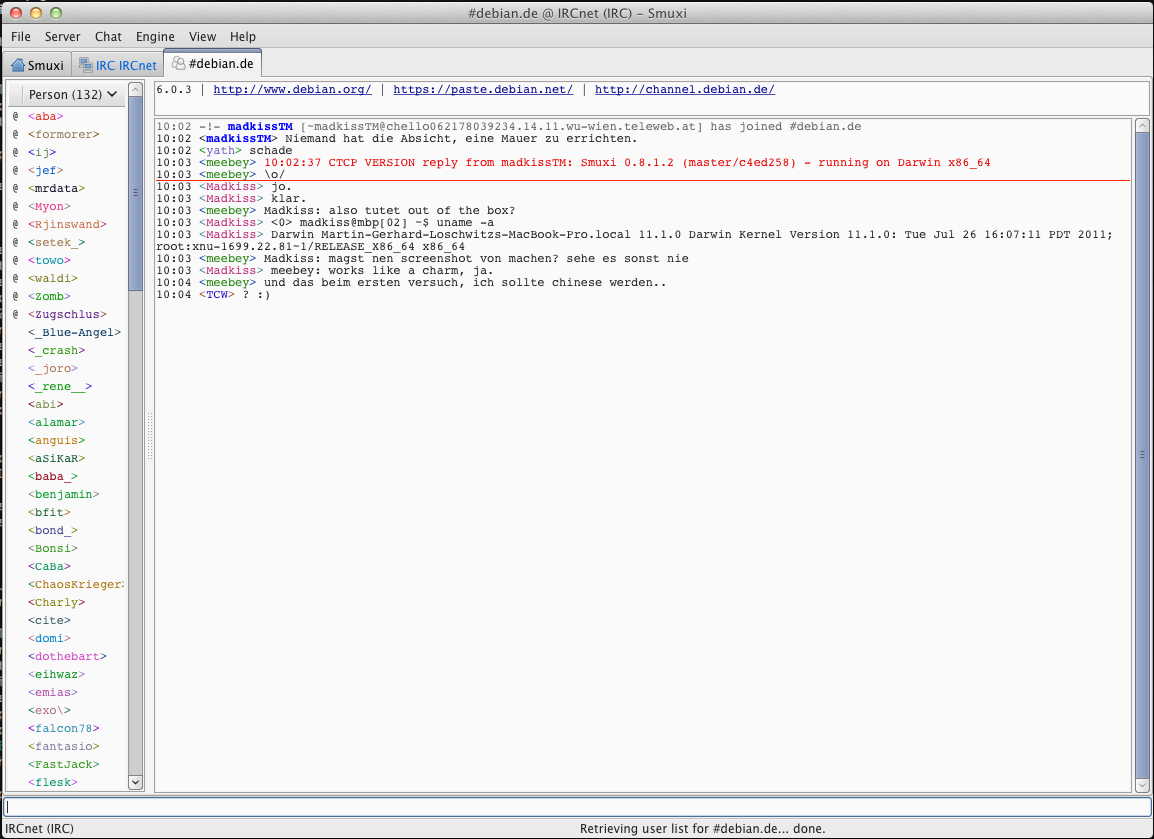
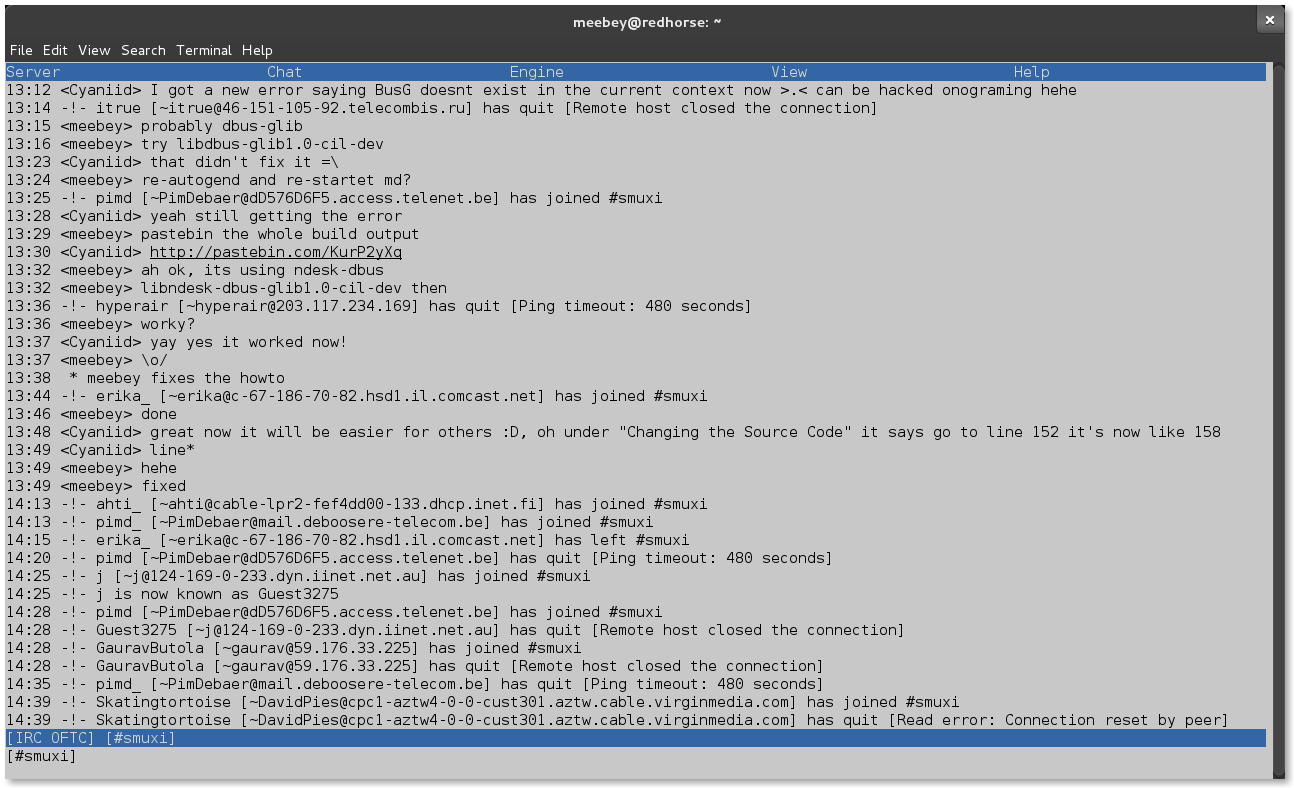
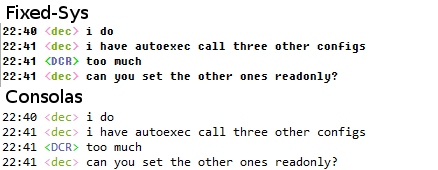
Just in time for 2012 I am very pleased to announce Smuxi 0.8.9 codenamed "One Giant Leap". During the development 56 bug reports and 33 feature requests in 593 commits were worked on making this release a major milestone of the Smuxi project. At the Chaos Communication Congress (28C3) in Berlin I was doing the final development sprint to get 0.8.9 done, which was a very intensive and refreshing experience. Here are the highlights of this release: Development Builds / Rolling Releases After the 0.8 release it became clear that a continious and short development -> test cycle is important to keep the project going quickly. At some point I have received requests if the project is dead while it was more active than ever. The lack of new releases (for about 15 months) lead to this wrong impression. Thus Smuxi can be obtained from development builds now. This includes daily builds for Debian (Squeeze, Wheezy, Sid), Ubuntu (Lucid, Maverick, Natty, Oneiric, Precise) and Windows. Thanks goes to Hannes Tismer for providing the Windows autobuilder and to Canonical for the PPA autobuilder. We invite everyone to use these daily builds to keep track of the latest development of Smuxi. Issues and regressions are fixed in a very short period (usually the same day). Thanks to our users who ran development builds and reported issues which led to many bug fixes prior to this release. On the other hand one of my New Year's resolutions are to "release early, release often" So there should be no nerd left behind... Screenshot of Smuxi 0.8.9 on Mac OS X Mac OS X support With the help of Steven McGrath (Steve[cug]) who created the initial Mac OS X installer for Smuxi we now have official support for Mac OS X. The download page contains the instructions how to obtain and install Smuxi on Mac OS X. This makes the 4th platform where Smuxi can be used on besides Windows, Linux and *BSD. For now Smuxi 0.8.9 doesn't feel as native as it could as it relies on the GTK+ port. We are looking into enhancing the experience though, just stay tuned. Chat History on Disk (Beta) The most exciting feature in this release I think are the "persistent message buffers". With this feature I could solve one of the biggest drawbacks IRC ever had: IRC does not retain any messages you have sent or received. All messages are only relayed to all users. The issue is that if you close your IRC client or even just leave a channel, all your received messages are gone. One workaround in most clients was to create text log files which then contains the chat history, but it is annoying and not user-friendly to open some text file somewhere from your disk to read the history outside of your IRC client. Now with Smuxi 0.8.9 you no longer have this issue, all chat history gets automatically written and read to a message database when you start Smuxi, join channels or open queries! As this feature is not fully stable yet it is not enabled by default. If you want to try it go to: File -> Preferences -> Interface and change "Persistency Type" from "Volatile" to "Persistent", hit OK and restart Smuxi. Now all messages are saved into the database and will automatically be shown. Click here for a screencast of this feature Jabber / XMPP Support (Beta) You probably have friends not on IRC and Twitter, say on Jabber, gTalk or Facebook? This is where the new XMPP engine of Smuxi comes into play. You can send and receive messages to/from them now! The implementation is far from complete, though. It has no buddy list for example and needs only to be treated as a technical preview of what will be coming in future Smuxi releases. Click here for a screencast of this feature Screenshot of Smuxi's Text Interface Text Interface (Alpha) This is the first release that contains a text frontend based on the STFL library. STFL is a library that uses ncurses to draw text based user interface using a markup language (like Glade for GTK+). This frontend is in early alpha state and lacks a lot of interface features and likes to crash. It is still included to attract potential developers who want to enhance this frontend. The frontend can be enabled by passing --enable-frontend-stfl to the configure script and then by executing smuxi-frontend-stfl. NetworkManager Support Everyone with a laptop knows how annoying it can be to suspend and resume when network based applications suddenly go crazy because they have lost the connection and either spew errors or take forever to get back in shape. Smuxi will now detect the network state right away with the help of the new Network Manager support. It automatically reconnects when needed right away for you. Next Generation Internet Support You can now connect to IRC servers using the IPv6 protocol Enhanced Find Group Chat Support Users had real issues to find out how to search for channels, thus Bianca Mix added a neat feature. The /list command will now simply open the Find Group Chat dialog for you. This way everyone used to IRC will find it in no time. Searching for channels on freenode wasn't working correctly, this is now fixed. Smuxi also supports the SAFELIST feature of the IRC protocol now which allows to retrieve a full channel list and do client side search which makes consecutive searches much faster. Enhanced Windows Experience For a long time you could not use Smuxi with the latest GTK# version of 2.12.10 on Windows. The issue was that Smuxi relied on SVG support which 2.12.10 no longer had. Smuxi is no longer using SVG instead it uses pre-scaled PNG images thus it works just fine with GTK# 2.12.10 on Windows now. At the same time the issue that the maximized state of the main window was left when restoring from task bar is fixed with GTK# 2.12.10. Screenshot of Fixed-Sys vs Consolas font Smuxi used by default the FixedSys font on Windows to give it the typical IRC look most people are used to. Since Windows Vista there is a better console-like font available called Consolas. Smuxi will now use the Consolas font instead on Windows Vista or later. Another important enhancement is that Smuxi no longer has issues with multiple GTK+ installs on the same computer, which was getting more common with more popular ported GTK+ applications such as GIMP or Pidgin. SSL for IRC fixed IRC with SSL was only working with the default port of 6697. Thanks to Jo Shields now any port can be used with SSL. Crash Related Issues Desktop notifications could crash Smuxi in case of errors related to the notification system or an absent notification daemon. There was a chance that the crash dialog simply disappeared which made reporting bugs more difficult no longer happens. Rapid use of ctrl+w, /window close (Jimmie Elvenmark) and opening the Find Group Chat dialog on the Smuxi tab do no longer crash. Also number-only network names, /network switch freenode and GTK+ install without SVG support no longer lead into a crash. Enhanced Notice Handling Notices will no longer open query tabs for you instead it will show them on tabs you share with the person who sent it with the server tab as fallback. This also avoids ChanServ, NickServ and spammy IRCop tabs. Twitter fixes Twitter made some changes to their API which broke the Twitter support of Smuxi 0.8. This was taken care of and also a few other issues were solved allowing Smuxi 0.8.9 to work smoothly with Twitter again. Extended Keybindings Smuxi allows now to use the ctrl+tab / ctrl+shift+tab and ctrl+n / ctrl+p keys to switch tabs. The keybindings still work even with a hidden menu bar now. Smuxi Server specific highlights More interactive and much faster synchronization When connecting to a smuxi-server you had to wait till Smuxi finished the synchronization before you could use the interface. Also you could not tell how far the synchronization was and just had to wait till it was completed. With Smuxi 0.8.9 the connect just takes a few seconds and all chats are synchronized in the background with a progress bar so you can use the interface from the first moment on and know how far it is. The speed how much it takes to synchronize all chats also reduced drastictly by 400%! Click here for a screencast of this feature More background communication When using a smuxi-server the interface sometimes had load times like when opening the preferences or when using the nickname completion (Andrew Kannan). These operations are done in the background and no longer blocks the interface. Also when the communication is lost to the smuxi-server the frontend will now automatically reconnect to it in the background. Low Bandwidth Mode When it comes to mobile internet connectivity such as UMTS/HSDPA, Edge and GRPS it can be a real pain to connect to the smuxi-server as it has to transfer all the messages over that. If you just want to ask someone you know then you don't need any old messages to do that. With the "Low Bandwidth Mode" you can now connect to the smuxi-server without loading old messages which makes the connect very quick. You find this option in the engine connect dialog. Stable Protocol Initially I didn't plan to make the protocol of Smuxi stable before the 0.9 release, but as it turned out the 0.8 protocol was good enough to still use it and for that reason Smuxi 0.8.9 is still compatible with 0.8. The 0.8 protocol will see no breakages, instead the next protocol will be on-top or opt-in of the current one. This means future Smuxi versions stay compatible with it. Shutdown Command You can now shutdown the smuxi-server if you like using the /shutdown command. It it safe to use the command, it will do a clean shutdown sequence for you. For example it makes sure all messages are written to disk in the case of enabled persistent message buffers. If you have your smuxi-server daemon monitored (e.g. with runit) it can also automatically be restarted and upgraded this way. Built-in SSH Keyfile Support It is no longer needed to fiddle with the .ssh/config file or pagent to get SSH key authorization working. You can now simply tell Smuxi which SSH keyfile you want to use to connect to your smuxi-server. Updated Translations
  • Catalan (Siegfried-Angel Gevatter Pujals)
  • Danish (Joe Hansen)
  • Finnish (Kalle Kaitala)
  • French (Cl ment Bourgeois)
  • German (Bianca Mix)
  • Italian (Vincenzo Campanella)
  • Portuguese (Americo Monteiro)
  • Spanish (Castilian) (Ricardo A. Hermosilla Carrillo)
New Translations
  • Chinese Simp (Dean Lee)
  • Slovak (Tom Vadina)
  • Swedish (Jimmie Elvenmark)
  • partially Russian (Aleksandr P)
  • partially Turkish (Umut Albayrak)
  • partially Urdu (makki)
Contributors Contributors to this release are the following people:
  • Mirco Bauer (497 commits)
  • Tuukka Hastrup (10 commits)
  • Bianca Mix (10 commits, translations)
  • Cl ment Bourgeois (8 commits, translations)
  • Andrius Bentkus (5 commits)
  • Carlos Mart n Nieto (3 commits)
  • Jimmie Elvenmark (3 commits, translations)
  • Hannes Tismer (1 commit)
  • Jonathan Pryor (1 commit)
  • Jo Shields (1 commit)
  • Siegfried-Angel Gevatter Pujals (translations)
  • Dean Lee (translations)
  • Aleksandr P (translations)
  • Americo Monteiro (translations)
  • Andrew Kannan (translations)
  • Joe Hansen (translations)
  • Kalle Kaitala (translations)
  • makki (translations)
  • Ricardo A. Hermosilla Carrillo (translations)
  • Tom Vadina (translations)
  • Umut Albayrak (translations)
  • Vincenzo Campanella (translations)
Thank you very much for your contributions to Smuxi! After reading this whole pile of text, head over here and grab this smexy stuff!
Posted Sun Jan 1 22:58:29 2012

5 January 2012

Jaldhar Vyas: Jeopardy!: The Post-Mortem

By now hopefully you got a chance to see my Jeopardy! episode so it won't be much of a spoiler to mention that I didn't win. It went like this. I flew into LA on the night of October 31st. The taping was to take place on the next two days. Jeopardy! tapes two weeks of shows, two days a week for a total of 10 episodes. Contestants are randomly chosen for one of those 10 episodes but you don't find out which one you will be on until the last minute. Randomness and secrecy have become become a big part of the production process in games since the quiz show scandals of the 1950s. (Interesting fact: it is a Federal felony to tamper with a TV game show.) There were a group of just under 20 0f us altogether waiting to go on. All very nice people. Here in the New York area one tends to equate very intelligent people with "Type A" personalities but we got on well together. Interspersed between the tapings, we had short practice sessions to familiarize ourselves with the studio setup and this is where I first started getting a little apprehensive. Jeopardy! is not just about general knowledge, there is a physical element too in that you have to buzz in by pressing a button on a stick which is wired up to some producers console. You can't buzz in before Alex has finished reading the question and obviously you can't buzz in if someone is already answering the question. If you buzz at the wrong time, your buzzer locks for 0.75 seconds so just jamming your finger on the button. I didn't even get that far as on the entire first day I failed to buzz in at all despite changing hands, changing grip different ways and other strategies. I was pretty despondent by the second day but then miraculously I managed to get the hang of it. So when I was finally selected (for the 3rd game of that day.) I was back to my usual cool self. I was up against Dave Leach and Nicholas Campiz who were returning after having tied in the previous game. And the game did start well enough. Oh one thing you may notice is that Alex mispronounces my name Jaldhal. I knew he did that once or twice and even mentioned it to a producer but it was only viewing the episode right now that I see he does it consistently. I assumed such things would be fixed up in post-editting but I guess not. Oh well, after living in this country for so many years I've learned to be happy whenever two consonants are more or less in the right place. This particular mispronunciation is actually fairly common, even Indian people have been known to make it. The alternative theory is that Alex couldn't read my horrible handwriting which is also plausible. Anyway, I digress. I started off fairly well. My first mistake was in a category about alcoholic drinks. I answered vermouth when the correct response was gin. In my defense I'm a strict teetoler so none of these words mean anything to me. I also earned the disapproval of my superhero fan son by mistaking Dr. Strange for Dr. Doom. I did get the one about Spiderman villain Dr. Octopus so that mollified him somewhat. The highlight of my evening was strangely enough in a category about books of the Bible. I got a Daily Double. It was a risky move but I have always wanted to make a "true" daily double so I threw caution to the winds and wagered everything I had. To my surprise as much as anyones, got the answer right doubling my score. I was in a pretty good position for the Double Jeopardy but thats when Dave started dominating. If you haven't been watching previous games, Dave Leach is arguably the best player this season. Not only is he smart but he is almost supernaturally fast on the buzzer. You can't see because I kept my hands behind the podium but I again and again I would desperately try to ring in on a question I knew the answer to only to be beaten to the punch by Dave. This caused me to start getting a bit reckless and answering questions where I was less than certain which cost me dearly. One particularly dumb mistake was in a category where all the answers were supposed to start with the letter g. I said compass when I should said gyrocompass but actually I should have left that category alone entirely. By the time Final Jeopardy came around winning was no longer an option as Dave was too far in the lead. I was slightly ahead of Nicholas in 2nd place. This is where I again made a strategic error. My original plan to bet nothing in Final Jeopardy but the category was "1930s Novels" and I liked my chances. The clue was read out and it involved an anti-war novel whose author was blacklisted. I was elated. It had to be "All Quiet on the Western Front" right? The blacklist bit gave me pause as the author Erich Maria Remarque was German and this was obviously a reference to the anti-Communist blacklist in the 1950s USA. But somehow I remembered that he had spent the end of his life in Hollywood or maybe I just convinced myself that it was plausible. Evidently my thought process wasn't too crazy because all three of us came up with the same answer. All three of us were wrong. The correct answer was "Johnny Got His Gun" by Daltan Trumbo. In hindsight I knew this but it illustrates the strange ways the mind works. I knew because the video for Metallicas song "One" from "...And Justice for All" is based on the film adaptation of this book. However in a previous orientation session the lady who is the contestant coordinator for Jeopardy! had mentioned AQOTHWF as anexample of something and this got stuck in my brain crowding out the previously known fact. So when all was said and done I ended up in 3rd place. (I bet big whereas Nicholas was more conservative.) Oh well. Despite not winning I had a blast. I fulfilled my dream of appearing on Jeopardy! I met Alex Trebek. (And I should be receiving an autographed picture of us together soon.) My witty banter was sufficiently witty. I made enough money to cover my travel expenses and still have a nice amount left. And I got to meet lots of interesting and wonderful people. So I'm satisfied.

4 January 2012

Russell Coker: Autism and a Child Beauty Contest

Fenella Wagener wrote an article for the Herald Sun about an Autistic girl who won the best personality award from the controversial new Australian children s beauty pageant [1]. The girl s mother is complaining that an Autistic girl shouldn t win a prize for personality and is critizing the pageant organisers. A beauty contest involves queuing, being quiet, appearing on stage, wearing cosmetics and unusual/uncomfortable clothes. It probably also involves having someone else assist with dressing and applying cosmetics (being touched by another person). These are all things which tend to be difficult or impossible for Autistic kids. So any girl who can get on stage wearing make-up can probably do whatever is required to avoid being obviously excluded from a personality prize. As any such prize has to be largely subjective I don t think it would ever be possible to prove that someone was the correct choice for the winner, it would merely be possible to prove that some candidates excluded themselves. But whether the girl deserved to win isn t the real issue here. I think that beauty pageants should be restricted to adults, merely entering a child in such a contest is bad enough, but making nasty public statements about a child is horrible. If other children made a Facebook page claiming that the girl in question didn t deserve to win a best personality prize it would probably be reported as cyber-bullying. I don t think that publishing the name or photo of the girl in question is in the public interest either. Many news sites that have picked up the story have shown the same lack of journalistic ethics so now the girl has some high traffic sites with her name linked to this story, it seems unlikely that anything good she might do in the near future will get a higher ranking for her name in search engines. So any time she searches for her name on Google (which most people do regularly) she will be reminded that her mother thinks she has some sort of defective personality because she is Autistic. High school is generally bad for almost everyone on the Autism Spectrum. Presumably any parent who would abuse their child by allowing such an article to be published would also send them to a regular school (as opposed to Home Schooling which is probably the only good option for Autistic kids in Australia). I m sure that the standard practice at every high school nowadays is that the kids all use Google to discover things to tease each other about. So in a few years the Herald Sun article will probably be the basis of a high school bullying campaign. The girl in question is only 9, so she s got another 6 or 7 years before she can legally leave her mother. In Australia 16 is the minimum legal age to live without parents and the police won t forcibly return runaway children who are almost 16. The Journalistic Code of Ethics Here is a link to the Australian Media Alliance code of Journalistic Ethics [2]. Section 8 includes Never exploit a person s vulnerability or ignorance of media practice . I think that publishing the name and photograph of a 9yo girl in a way that is likely to lead to bullying in a few years is a clear example of exploiting a vulnerable person. The code of ethics has a guidance clause which says Only substantial advancement of the public interest or risk of substantial harm to people allows any standard to be overridden . Even if it was a proven fact that a beauty pageant was issuing awards to unqualified children there would not be any substantial advancement of the public interest in publishing that. Beauty Contests are Evil The Australian has an article about the same beauty contest by Caroline Overington which quotes adolescent and child psychotherapist Collett Smart calling for government intervention [3]. Catherine Manning has written a good article explaining some of the reasons for opposing child beauty pageants [4]. The American Psychological Association has published a report on the Sexualization of Girls [5], they have lots of references to psychological research which gives a variety of reasons for opposing child beauty contests. IMHO each of the reasons alone should be sufficient to convince people that child beauty pageants are bad. Finally the pictures of contestants who are less than 10yo but made up to look like they are 20+ are rather disturbing. Related posts:
  1. Child Abuse and Censorship In Australia we are currently in the middle of a...
  2. Autism Awareness and the Free Software Community It s Autism Awareness Month April is Autism Awareness month, there...
  3. Autism, Food, etc James Purser wrote Stop Using Autism to Push Your Own...

3 January 2012

Jaldhar Vyas: Watch Me on Jeopardy! This Wednesday

<video controls="controls" poster="http://www.braincells.com/debian/images/jaldhar_jeopardy_howdy.jpg">
<source src="http://www.braincells.com/debian/images/jaldhar_jeopardy_howdy.mpg" type="video/mpeg">
<source src="http://www.braincells.com/debian/images/jaldhar_jeopardy_howdy.ogv" type="video/ogg">
HTML 5 Video does not seem to be supported by your browser. Download the video of my Jeopardy! "Hometown Howdy" here (MPG format) or here (OGG format). </video> Some time ago, I mentioned auditioning for Jeopardy!, Americas top TV quiz show. I didn't hear back from the producers for quite a while so I assumed I hadn't been selected but then suddenly one day in October I got a call inviting me to come out to Sony Studios in Culver City California for a taping in November. I went and it is finally airing now. So if you are in the US or Canada (the show is possibly syndicated elsewhere but I'm not sure) please be sure to watch me on Wednesday, January the 4th. I won't say how well I did until afterwards but I was quite pleased with my performance.

1 January 2012

Russ Allbery: 2011 Book Reading in Review

For the year of 2011, I finished and reviewed 60 books. This is a huge milestone for me; it's the first time since the second year I started doing this that the number of books I read actually increased. This gives me more confidence that I've stabilized the year-by-year decline in my reading. I did that while substantially increasing the amount of time I spent enjoying video games, which was another major goal of the year. Only two books received a 10 out of 10 this year, one fiction and one non-fiction. The novel was Jo Walton's Among Others: the best book I read this year. It's a delightful look at the process of finding a place for oneself in the world and features one of the best protagonists that I've seen. The non-fiction book was Rory Stewart's The Prince of the Marshes, which means that both of Stewart's books that I've read have received 10 ratings. The Prince of the Marshes is his look at his time spent in the provisional government of Iraq after the overthrow of Saddam Hussein. I think it should be required reading for anyone expressing an opinion on what the US and other western powers should or should not have done in Iraq. It lays bare the difficulties, confusion, and frequent stupidity of going into someone else's country and trying to fix it, and I think seriously calls into question whether this sort of international intervention can ever work. Other fiction highlights of the year were Kelley Eskridge's Solitaire, a startling and deep look at identity and social connection, and Mira Grant's Feed, a zombie apocalypse story that completely overcame my deep dislike of zombie apocalypse stories. Feed should have won the Hugo in 2011, despite some unbelievable politics and a bit too much cheering for bloggers. This was the year for excellent protagonists, with all three of my top-rated fiction books featuring unique and memorable characters who left a deep and lasting emotional impact. The two other non-fiction standouts were both a bit dry, but if you have the patience and attention, they reward persistance. Richard Hofstadter's Anti-Intellectualism in American Life is a deserved classic that gave me an eye-opening perspective on the long history of interactions between intellectualism and populism in US politics and culture. David Levering Lewis's God's Crucible is a wonderful history of Islam as it related to Europe and filled in some large gaps in my knowledge of world and religious history. 60 books a year, or five books a month, feels like a comfortable and sustainable level, although I'm going to keep my formal goal at a book a week (52 in the year) to give myself some leeway to either get distracted by video games or by other projects. My reading did concentrate more than usual in science fiction and fantasy this year, and I'd like to add more mainstream fiction and more non-fiction. The full analysis includes some additional personal reading statistics, probably only of interest to me.

31 December 2011

Russell Coker: Links December 2011

Barry Ritholtz wrote an insightful post quoting Federal Reserve Bank of Kansas City President Thomas Hoenig, who warns that the nation s biggest banks are putting the U.S. capitalist society at risk [1]. Big banks oppose capitalism. Glenn Greenwald has written an insightful article for Salon about the modern definition of American excellence being the killing of supposedly bad people without any due process [2]. Mazuma Mobile buys used mobile phones [3]. They can send a post-pack to ship your old mobile to them. This is good for the environment and also saves some money. Sam Varghese has written an informative article about the Trans Pacific Partnership Agreement that will probably end up benefiting US corporations at the expense of Australian citizens [4]. Cory Doctorow has written an informative article for The Guardian about the BBC DRM plans[5]. He received information that was denied in a FOI request which shows how poor the BBC case is and how bad the Ofcom oversight is. Sam Harris has written an insightful blog post about self-defense [6]. He also has many other posts that are worth reading. Aparna Roa gave an interesting TED presentation about her robotic art [7].

Russell Coker: Sociological Images

I ve recently been reading the Sociological Images blog [1]. That site has lots of pictures and videos that are relevant to the study of Sociology (most of which have a major WTF factor) and it s run by people who have Ph.Ds in Sociology so the commentary is insightful. Since reading that I ve started photographing relevant things. woman in straight-jacket advertising energy prices I can t work out the logic behind the above advert for Energy Watch which was on a billboard near Ringwood Station in Melbourne, Australia. The only thing that it clear is that it spreads bad ideas about mental illness and psychiatric treatment. It doesn t make me want to do business with them. Antons full display The above picture is a shop-front for the Antons clothing store (I m not sure if they are a tailor or if they sell ready to wear). It was taken on Lonsdale St, Melbourne where the store apparently used to be, now they are in Melbourne Central. Antons left display, African and Southern EuropeanAntons right display, Northern European and Japanese The above pictures show more detail. Unfortunately the combination of lighting and my camera (Xperia X10 phone camera) wasn t adequate to show the apparent ethnic differences between the two men. It seems that the most likely Australian interpretation of the ethnic groups that are represented are African (maybe Afro-American), Southern-European or maybe American Hispanic, North-Western European, and Japanese. It s good to have mannequins representing the fact that not everyone in Australia is white, but different facial expressions for different races seems a strange choice (admittedly it might be a choice made by mannequin manufacturers). Also the Japanese woman with fan idea is rather outdated. I ve just started reading You May Ask Yourself: An Introduction to Thinking Like a Sociologist (Second Edition) by Dalton Conley. I ve only read the first chapter, but that was good enough that the entire book has to be good enough to recommend.

Next.

Previous.