Search Results: "edd"

6 November 2016

Shirish Agarwal: The long tail in a common s man journey to debconf16 1

I was going to put a technical post but saw the discussion of one of the meetings of the debconf meets and decided to share a novice s travel experience. Before I start here s the discussion log http://meetbot.debian.net/debconf-team/2016/debconf-team.2016-10-20-20.01.log.html and specifically this part which hit me (using fake names for discussion as haven t taken permission from the folks to cite them by name.)
20:36:52 abcd: $100 CAD is a lot for some, but you d only need it if you won t sleep in sponsored accom, which arguably is acceptable.
20:37:04 it would, efgh, fixed sponsorship sum for everybody and allocation of rooms completely decoupled. Hotel gets the money from everybody and the base fee from DebConf.
20:37:15 people who can t afford also have special needs and may be uncomfortable in sharing rooms. That s quite frequently in our community. Managing each case will be much more complicated.
20:37:31 hijk: we could set aside budget for such special needs, for sure.
20:37:43 I m talking about managing each case
20:37:46 hijk: yes, but we ll have the special cases no matter what.
20:37:48 yes, and the special cases need to be catered for regardless of how everybody else is housed
20:38:06 hijk: room allocation already includes this.
20:38:19 people having to expose their personal problems to have us permitting them staying in the hotel
20:38:23 that s just too weird
It just goes on. I dunno whether I m weird or not or the experience I would share is just normal, this I would leave for you to decide. As have shared before, some friends of mine from the free software community had cajoled me last year to apply for debconf bursary (debconf15), which surprisingly got approved, but as it was late and my pre-conceived myths/notions of visas taking a looooong time decided not to go further. Many things take a long time to happen in the Indian bureaucratic maze. For instance have been in a civil case for almost a decade now among other things so know and accept that things take their own sweet time otherwise known as Indian patience  Did the application and again, surprise, surprise this time too I was approved. Luckily, had done the application for bursary early so was a bit positive on the visa-front. There was a goof-up at the embassay but thanks to people at travel.stackexchange.com where I asked quite a few questions, I was a bit informed and travel was relatively hassle-free. Internally though, I was nervous as hell. I had been feeling like a conman or a fraud or being an imposter because I knew before-hand that the project is so huge and had done the mistake of putting up a talk and a workshop where the big guns would be, which again was accepted (not good). The only thing I was thinking of as a saving grace is that there might be some newbies who don t know about the project at all (on Open Day) and hopefully I could help with that but as you will see, even there I was fully inadequate. I live in Pune which is around 3.5 hours from Mumbai (BOM) from where international flights take off. While Pune has an Airport, due to defence considerations, there cannot be much improvement either for domestic or International carriers. There have been attempts to have an exclusive civilian Airport for a long time (almost a decade) and would still take a decade or more. Hence had decided to take an early morning train from Pune to Mumbai, change couple of locals and finally land up at the Mumbai International Airport. Hind-sight as they say is 50:50, while I do have friends in Mumbai, I also found about a homestay which is closer to the Airport and still relatively budget-friendly. Anyways, met few friends but as was paranoid about missing connections found myself in front of the Airport at 20:00 hrs. with about 7 hours + to go before my flight. While there is nothing to do around the airport rather than hanging around, just hung around outside the airport as knew that inside the airport will be chilling and once you go in, you cannot come out or at least it s an inconvenience to the security therein. The International Airport in on three levels, the basement is for vehicles, the first level to receive International and Domestic passengers and the upper-most level exclusively for people flying internationally. This again, came to know when I tried to enter into the ones meant for Domestic and International Passengers coming into the city. Came to the check-in counter at around 02:00 hrs, did the security thing and just had to wait as the flight was of 0400 hrs (from my limited search experience, the cheapest flights are at such times when nobody else (i.e.civilized people) wants to fly). Entered Doha around 5:15 Doha time and saw a much much bigger airport than either the Mumbai International Airport or/and the Delhi International Airport . While I have written some negative stuff about Doha, there were two positives that I am sure, I had forgotten to share a. There were no transit Visa Fees that I had to pay. Most countries and airports I researched have something called transit visa and that can really get expensive, so saved money on that. b. The free ride into the city and back with voluntary tipping the driver or/and guide (approx. 3-4 hours) While the second from what I could tell/know is a gimmick, this is something I wish other countries and airports emulate. There are hotels in the airport and I could have had hotel accommodation if I had booked a slightly more expensive ticket, roughly INR 5k/- each way which would have given me a bit more legroom as well as stay as my layover was more than 24 hours. But this information was known at last minute. Qatar Airways has just a toll-free number and trying more than a few times gave up. They don t have an office in the city. When I reached the check-in counter they said if I had upgraded to Y class I would have had the hotel thing. Changing tickets at the last moment was too expensive and anyways for hotel accommodation for layovers they required at least 24 hours notice. Had to make do with recliners and chairs which are not really comfortable. There were only a couple of waiting rooms on air-side which had a view of the aircraft and hence were a bit more pleasing than those which were on the land-side and were fully blocked without a view. I wish there was a map of the Airport from within the Airport as even with the single terminal it is really easy to get lost. Somehow the day and night went by and took my second flight and reached Cape Town, South Africa. Throughout the journey had been stressed as had to be awake at all times and make sure that nothing gets stolen. Having attendants at toilets were also good so that there is no possibility of any violence there. So it had been 2 days, no shower and no sleep. Later also came to know about Airport Sleeping Pods and shower stalls but these also seem to be less in number, at few airports and there always be a bit of premium attached to them as airports are a monopoly business. Anyways, reached the venue. Throughout the travel there was quite a bit of unnamed fear which I later came to know after seeing Dr. Ramanujan s The Man who knew Infinity . It was/is the fear or unknown, while in the movie it is articulated as fear of crossing seven seas, symbolically it is the fear or unknown. Now while I was dead tired, I still pushed myself as I didn t want to have the effects of jet lag interfere with the normal sleeping and waking patterns. I did freshen myself but didn t allow myself the luxury of the bath-tub as I knew that if I went in, I would not come out that day. Met all the people, learnt who s who, where things are happening etc. and slowly night came. Night came and I was so-looking forward to sleep but sleep was not to be. I later learnt it could be either of the two reasons, it could either have been travel-induced insomnia or/and what is known as the first night effect . It was only on the second day when I was in bath-tub for about 2/3 hours I could feel the tension leaving my body. I finally realized that I am in Cape Town, South Africa and could enjoy and be surprised at seeing birds within few feet of me . Now I don t know whether I m the only weird/paranoid one, I do know that it would not have been easier for me at least for the first night as I was turning and twisting throughout the night. I opened the lights, read for some time hoping for sleep to take over but that didn t work. Tried quite a few things but sleep didn t come. If I had been sleeping with other people I dunno how they would have reacted. I myself am a light sleeper (most of the time) and if I had sleep coming and somebody else acted or been the way I was, I wouldn t been able to sleep. However much you try, whatever is the natural reaction is, will be. There are still some bits to share but that would be in part 2.
Filed under: Miscellenous Tagged: #air-travel, #Debconf16, #paranoia, #sleep

3 November 2016

Simon Josefsson: Why I don t Use 2048 or 4096 RSA Key Sizes

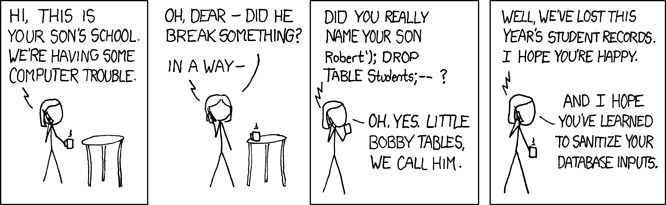
I have used non-standard RSA key size for maybe 15 years. For example, my old OpenPGP key created in 2002. With non-standard key sizes, I mean a RSA key size that is not 2048 or 4096. I do this when I generate OpenPGP/SSH keys (using GnuPG with a smartcard like this) and PKIX certificates (using GnuTLS or OpenSSL, e.g. for XMPP or for HTTPS). People sometimes ask me why. I haven t seen anyone talk about this, or provide a writeup, that is consistent with my views. So I wanted to write about my motivation, so that it is easy for me to refer to, and hopefully to inspire others to think similarily. Or to provoke discussion and disagreement that s fine, and hopefully I will learn something. Before proceeding, here is some context: When building new things, it is usually better to use the Elliptic Curve technology algorithm Ed25519 instead of RSA. There is also ECDSA which has had a comparatively slow uptake, for a number of reasons that is widely available and is a reasonable choice when Ed25519 is not available. There are also post-quantum algorithms, but they are newer and adopting them today requires a careful cost-benefit analysis. First some background. RSA is an asymmetric public-key scheme, and relies on generating private keys which are the product of distinct prime numbers (typically two). The size of the resulting product, called the modulus n, is usually expressed in bit length and forms the key size. Historically RSA key sizes used to be a couple of hundred bits, then 512 bits settled as a commonly used size. With better understanding of RSA security levels, the common key size evolved into 768, 1024, and later 2048. Today s recommendations (see keylength.com) suggest that 2048 is on the weak side for long-term keys (5+ years), so there has been a trend to jump to 4096. The performance of RSA private-key operations starts to suffer at 4096, and the bandwidth requirements is causing issues in some protocols. Today 2048 and 4096 are the most common choices. My preference for non-2048/4096 RSA key sizes is based on the simple and na ve observation that if I would build a RSA key cracker, there is some likelihood that I would need to optimize the implementation for a particular key size in order to get good performance. Since 2048 and 4096 are dominant today, and 1024 were dominent some years ago, it may be feasible to build optimized versions for these three key sizes. My observation is a conservative decision based on speculation, and speculation on several levels. First I assume that there is an attack on RSA that we don t know about. Then I assume that this attack is not as efficient for some key sizes than others, either on a theoretical level, at implementation level (optimized libraries for certain characteristics), or at an economic/human level (decision to focus on common key sizes). Then I assume that by avoiding the efficient key sizes I can increase the difficulty to a sufficient level. Before analyzing whether those assumptions even remotely may make sense, it is useful to understand what is lost by selecting uncommon key sizes. This is to understand the cost of the trade-off. A significant burden would be if implementations didn t allow selecting unusual key sizes. In my experience, enough common applications support uncommon key sizes, for example GnuPG, OpenSSL, OpenSSH, FireFox, and Chrome. Some applications limit the permitted choices; this appears to be rare, but I have encountered it once. Some environments also restrict permitted choices, for example I have experienced that LetsEncrypt has introduced a requirement for RSA key sizes to be a multiples of 8. I noticed this since I chose a RSA key size of 3925 for my blog and received a certificate from LetsEncrypt in December 2015 however during renewal in 2016 it lead to an error message about the RSA key size. Some commercial CAs that I have used before restrict the RSA key size to one of 1024, 2048 or 4096 only. Some smart-cards also restrict the key sizes, sadly the YubiKey has this limitation. So it is not always possible, but possible often enough for me to be worthwhile. Another cost is that RSA signature operations are slowed down. This is because the exponentiation function is faster than multiplication, and if the bit pattern of the RSA key is a 1 followed by several 0 s, it is quicker to compute. I have not done benchmarks, but I have not experienced that this is a practical problem for me. I don t notice RSA operations in the flurry of all of other operations (network, IO) that is usually involved in my daily life. Deploying this on a large scale may have effects, of course, so benchmarks would be interesting. Back to the speculation that leads me to this choice. The first assumption is that there is an attack on RSA that we don t know about. In my mind, until there are proofs that the currently known attacks (GNFS-based attacks) are the best that can be found, or at least some heuristic argument that we can t do better than the current attacks, the probability for an unknown RSA attack is therefor, as strange as it may sound, 100%. The second assumption is that the unknown attack(s) are not as efficient for some key sizes than others. That statement can also be expressed like this: the cost to mount the attack is higher for some key sizes compared to others. At the implementation level, it seems reasonable to assume that implementing a RSA cracker for arbitrary key sizes could be more difficult and costlier than focusing on particular key sizes. Focusing on some key sizes allows optimization and less complex code. At the mathematical level, the assumption that the attack would be costlier for certain types of RSA key sizes appears dubious. It depends on the kind of algorithm the unknown attack is. For something similar to GNFS attacks, I believe the same algorithm applies equally for a RSA key size of 2048, 2730 and 4096 and that the running time depends mostly on the key size. Other algorithms that could crack RSA, such as some approximation algorithms, does not seem likely to be thwarted by using non-standard RSA key sizes either. I am not a mathematician though. At the economical or human level, it seems reasonable to say that if you can crack 95% of all keys out there (sizes 1024, 2048, 4096) then that is good enough and cracking the last 5% is just diminishing returns of the investment. Here I am making up the 95% number. Currently, I would guess that more than 95% of all RSA key sizes on the Internet are 1024, 2048 or 4096 though. So this aspect holds as long as people behave as they have done. The final assumption is that by using non-standard key sizes I raise the bar sufficiently high to make an attack impossible. To be honest, this scenario appears unlikely. However it might increase the cost somewhat, by a factor or two or five. Which might make someone target a lower hanging fruit instead. Putting my argument together, I have 1) identified some downsides of using non-standard RSA Key sizes and discussed their costs and implications, and 2) mentioned some speculative upsides of using non-standard key sizes. I am not aware of any argument that the odds of my speculation is 0% likely to be true. It appears there is some remote chance, higher than 0%, that my speculation is true. Therefor, my personal conservative approach is to hedge against this unlikely, but still possible, attack scenario by paying the moderate cost to use non-standard RSA key sizes. Of course, the QA engineer in me also likes to break things by not doing what everyone else does, so I end this with an ObXKCD.
30 October 2016

Dirk Eddelbuettel: RProtoBuf 0.4.7: Mostly harmless

CRAN requested a release updating any URLs for Omegahat to the (actually working) omegahat.net URL. The RProtoBuf package had this in one code comment (errr...) and on bibfile entry. Oh well -- so that caused this 0.4.7 release which arrived on CRAN today. It contains the requested change, and pretty much nothing else. RProtoBuf provides R bindings for the Google Protocol Buffers ("Protobuf") data encoding and serialization library used and released by Google, and deployed as a language and operating-system agnostic protocol by numerous projects. The NEWS file summarises the release as follows:

Changes in RProtoBuf version 0.4.7 (2016-10-27)
  • At the request of CRAN, two documentation instances referring to the Omegehat repository were updated to http://omegahat.net

CRANberries also provides a diff to the previous release. The RProtoBuf page has an older package vignette, a 'quick' overview vignette, a unit test summary vignette, and the pre-print for the JSS paper. Questions, comments etc should go to the GitHub issue tracker off the GitHub repo.

This post by Dirk Eddelbuettel originated on his Thinking inside the box blog. Please report excessive re-aggregation in third-party for-profit settings.

Dirk Eddelbuettel: drat 0.1.2: Mostly harmless

CRAN requested a release updating any URLs for Omegahat to the (actually working) omegahat.net URL. So that caused this 0.1.2 release which arrived on CRAN yesterday. It contains the requested change along with one or two other mostly minor changes which accumulated since the last release. drat stands for drat R Archive Template, and helps with easy-to-create and easy-to-use repositories for R packages. Since its inception in early 2015 it has found reasonably widespread adoption among R users because repositories is what we use. In other words, friends don't let friends use install_github(). Just kidding. Maybe. Or not. The NEWS file summarises the release as follows:

Changes in drat version 0.1.2 (2016-10-28)
  • Changes in drat documentation
    • The FAQ vignette added a new question Why use drat
    • URLs were made canonical, omegahat.net was updated from .org
    • Several files (README.md, Description, help pages) were edited

Courtesy of CRANberries, there is a comparison to the previous release. More detailed information is on the drat page.

This post by Dirk Eddelbuettel originated on his Thinking inside the box blog. Please report excessive re-aggregation in third-party for-profit settings.

28 October 2016

Jaldhar Vyas: Get Ready For Bikini Season With These n Weird Tricks

It all started last June when my son had his Janoi (Yagnopavita) ceremony -- the ritual by which a Brahmana boy becomes "twice-born" and eligible to study the Vedas. As well as a profound religious experience, it is also an important social occasion with a reception for as many friends and family as can attend. (I think our final guest total was ~250.) This meant new outfits for everyone which might be exciting for some people but not me. I still don't know why I couldn't just keep wearing the khes and pitambar from the puja but no, apparently that's a faux pas. So I relented and agreed to wear my "darbari" suit from my wedding. And it didn't fit. I knew I had gained some weight in the intermediate 17 years but the thing was sitcom levels of too small. I ended up having to purchase a new one, a snazzy (and shiny!) maroon number with gold stripes (or were they black stripes?) Problem having been solved, much was eaten, more weight was gained and then I forgot about the whole thing. Tip 1: Actually Do Something. I have over the years tried to improve my physical condition but it has never gotten very far. For instance I have a treadmill/coatrack and a couple of years ago I began using it in earnest. I got to the point where I actually ran a 10K race without dying. But I did not train systematically and I ended up in some pain which caused me to stop working out for a while and then I never got around to restarting. Diets have also failed because I don't have a clear idea of what and how much I am eating. All I know is that women go into the kitchen and when they come out they have food. By what eldritch process this occurs is a mystery, I just eat whats given to me thankful that the magic happens. Once I was moved to try and help but quickly fell afoul of the lack of well-defined algorithms in Gujarati home cooking.
"How much saffron should I add?"
"this much."
"How much is this much in SI units?"
"You're annoying me. Get out."
Fast forward to March of this year. For my birthday, my wife got me a Fitbit fitness tracker. This is what I had needed all this time. It measure heart rate, distance travelled, time slept and several other pieces of info you can use to really plan a fitness regimen rationally. For example, I was chagrined to learn that sometimes when I'm at the computer, I am so immobile that the fitbit thought I was asleep. So I started planning to taken more frequent breaks. (A recent firmware upgrade has added the ability to nudge to walk atleast 250 paces each daytime hour which is handy for this.) Also by checking my heart rate I discovered that I went on the treadmill I ran too fast thereby stressing my body for little gain and ending up going too slow to get much aerobic effect. Now I can pace myself appropriately for maximum cardiac efficiency without ending up injuring myself and giving up. I also get a little more activity each day by simple changes such as taking the stairs instead of the lift and instead of getting off at the 14th street PATH I go all the way to 34th street and walk down. Tip 2: You must have data in order to see what you did right or wrong and to plan what you need to do moving forward. One caveat about these fitness trackers. They are not anywhere as accurate as a proper checkup from a doctor who specializes in such things. If you want to do any kind of pro or amateur athletics you probably should not rely on them but for the average shlub who just wants to avoid appearing on the news being winched off his sofa by the fire brigade they are good enough. Another practice I began was keeping a food diary. It can be a real eye-opener to see how much you are actually eating. It is probably much more than you thought. I am fortunate that my diet is pretty good to begin with. Vegetarian, (not vegan, Hindus eat dairy products,) mostly home-cooked with fresh ingredients, not fried or processed, and I don't drink alcohol. However there were a few optimizations I could make. I drink a lot of soda; atleast two cans a day. I really ought to stop altogether but in lieu of that I have atleast switched from Coke to Coke Zero thereby saving a lot of empty calories. I now eat 4 rotlis with my dinner instead of six. We as a family eat more green vegetables instead of potatos, skim milk instead of whole fat, canola oil instead of corn oil, and less rice and don't slather ghee on everything quite so much. One entirely new practice I've adopted that may seem faddish but works for me is intermittent fasting. The idea is to steadily train your body to need less food by eating all your days allowed amount pf calories during a 6-8 hour window and not eating at all during the remaining time. It's hard to get used to for many people but I fast atleast 2-3 times a month for religious reasons anyway so I adapted pretty quickly. The fitbit tells me how many calories I am expending and how many I can eat to maintain a healthy level of weight loss but other than that I don't bother with "food groups" or specific diets such as paleo, or low-carb etc. As long as what you eat is reasonably balanced and you are burning more calories than you are adding, it should be enough for weight loss. Indeed from the end of March to now, I've lost 3 stones (20Kg) even with the occasional "cheat" day. Tip 3: All published diets are bullshit without scientifically proven efficacy. Don't bother with them. Experiment instead and see what works for you and your metabolism. As long as you are getting all the proper nutrients (you shouldn't need a supplement unless you have an actual medical condition.) and you have a net calorie deficit, it's all good. If you eat food you enjoy, you are more likely to stick to your diet. The proper amount of sleep is one area of a healthy lifestyle I am still doing poorly in and the reasons are not all raven-related. I have always had problems with insomnia and was once actually diagnosed with sleep apnea. Losing weight has helped a lot but the fitbit is still reporting that I toss and turn a lot during the night. And that's when I'm in bed in the first place. I stay up much too late which can also lead to subsidiary bad behaviours such as midnight snacking. It's something I need to work on. Tip 4: Stop blogging at all hours of the night, It's not doing you any good. So that's what I'm doing. Moving forward, I need to deal with the sleep thing and I would also like to start some program of strength-training, I'm doing ok in terms of aerobic exercise but from what I've read, you also have to build up muscles to keep weight loss permanent. The difficulty is that it would involve joining a gym and then actually going to that gym so I've put it off for now. The immediate threat is Diwali (and Thanksgiving and Christmas...) My wife bought 4 lbs of sweets today and I can feel their presence in the fridge calling to me.

26 October 2016

Dirk Eddelbuettel: Rblpapi 0.3.5

A new release of Rblpapi is now on CRAN. Rblpapi provides a direct interface between R and the Bloomberg Terminal via the C++ API provided by Bloomberg Labs (but note that a valid Bloomberg license and installation is required). This is the sixth release since the package first appeared on CRAN last year. This release brings new functionality via new (getPortfolio()) and extended functions (getTicks()) as well as several fixes:

Changes in Rblpapi version 0.3.5 (2016-10-25)
  • Add new function getPortfolio to retrieve portfolio data via bds (John in #176)
  • Extend getTicks() to (optionally) return non-numeric data as part of data.frame or data.table (Dirk in #200)
  • Similarly extend getMultipleTicks (Dirk in #202)
  • Correct statement on timestamp for getBars (Closes issue #192)
  • Minor edits to a few files in order to either please R(-devel) CMD check --as-cran, or update documentation

Courtesy of CRANberries, there is also a diffstat report for the this release. As always, more detailed information is on the Rblpapi page. Questions, comments etc should go to the issue tickets system at the GitHub repo.

This post by Dirk Eddelbuettel originated on his Thinking inside the box blog. Please report excessive re-aggregation in third-party for-profit settings.

24 October 2016

Dirk Eddelbuettel: Word Marathon Majors: Five Star Finisher!

A little over eight years ago, I wrote a short blog post which somewhat dryly noted that I had completed the five marathons constituting the World Marathon Majors. I had completed Boston, Chicago and New York during 2007, adding London and then Berlin (with a personal best) in 2008. The World Marathon Majors existed then, but I was not aware of a website. The organisation was aiming to raise the profile of the professional and very high-end aspect of the sport. But marathoning is funny as they let somewhat regular folks like you and me into the same race. And I always wondered if someone kept track of regular folks completing the suite... I have been running a little less the last few years, though I did get around to complete the Illinois Marathon earlier this year (only tweeted about it and still have not added anything to the running section of my blog). But two weeks ago, I was once again handing out water cups at the Chicago Marathon, sending along two tweets when the elite wheelchair and elite male runners flew by. To the first, the World Marathon Majors account replied, which lead me to their website. Which in turn lead me to the Five Star Finisher page, and the newer / larger Six Star Finisher page now that Tokyo has been added. And in short, one can now request one's record to be added (if they check out). So I did. And now I am on the Five Star Finisher page! I don't think I'll ever surpass that as a runner. The table header and my row look like this: Table header Dirk Eddelbuettel If only my fifth / sixth grade physical education teacher could see that---he was one of those early running nuts from the 1970s and made us run towards / around this (by now enlarged) pond and boy did I hate that :) Guess it did have some long lasting effects. And I casually circled the lake a few years ago, starting much further away from my parents place. Once you are in the groove for distance... But leaving that aside, running has been fun and I with some luck I may have another one or two marathons or Ragnar Relays left. The only really bad part about this is that I may have to get myself to Tokyo after all (for something that is not an ISM workshop) ...

This post by Dirk Eddelbuettel originated on his Thinking inside the box blog. Please report excessive re-aggregation in third-party for-profit settings.

22 October 2016

Dirk Eddelbuettel: RcppArmadillo 0.7.500.0.0

armadillo image A few days ago, Conrad released Armadillo 7.500.0. The corresponding RcppArmadillo release 0.7.500.0.0 is now on CRAN (and will get into Debian shortly). Armadillo is a powerful and expressive C++ template library for linear algebra aiming towards a good balance between speed and ease of use with a syntax deliberately close to a Matlab. RcppArmadillo integrates this library with the R environment and language--and is widely used by (currently) 274 other packages on CRAN. Changes in this release relative to the previous CRAN release are as follows:

Changes in RcppArmadillo version 0.7.500.0.0 (2016-10-20)
  • Upgraded to Armadillo release 7.500.0 (Coup d'Etat)
    • Expanded qz() to optionally specify ordering of the Schur form
    • Expanded each_slice() to support matrix multiplication

Courtesy of CRANberries, there is a diffstat report. More detailed information is on the RcppArmadillo page. Questions, comments etc should go to the rcpp-devel mailing list off the R-Forge page.

This post by Dirk Eddelbuettel originated on his Thinking inside the box blog. Please report excessive re-aggregation in third-party for-profit settings.

21 October 2016

Iain R. Learmonth: PATHspider 1.0.0 released!

In today s Internet we see an increasing deployment of middleboxes. While middleboxes provide in-network functionality that is necessary to keep networks manageable and economically viable, any packet mangling whether essential for the needed functionality or accidental as an unwanted side effect makes it more and more difficult to deploy new protocols or extensions of existing protocols. For the evolution of the protocol stack, it is important to know which network impairments exist and potentially need to be worked around. While classical network measurement tools are often focused on absolute performance values, PATHspider performs A/B testing between two different protocols or different protocol extensions to perform controlled experiments of protocol-dependent connectivity problems as well as differential treatment. PATHspider is a framework for performing and analyzing these measurements, while the actual A/B test can be easily customized. Late on the 21st October, we released version 1.0.0 of PATHspider and it s ready for production use (whatever that means for Internet research software). Our first real release of PATHspider was version 0.9.0 just in time for the presentation of PATHspider at the 2016 Applied Networking Research Workshop co-located with IETF 96 in Berlin earlier this year. Since this release we have made a lot of changes and I ll talk about some of the highlights here (in no particular order):
Switch from twisted.plugin to straight.plugin While we anticipate that some plugins may wish to use some features of Twisted, we didn t want to have Twisted as a core dependency for PATHspider. We found that straight.plugin was not just a drop-in replacement but it simplified the way in which 3rd-party plugins could be developed and it was worth the effort for that alone.

Library functions for the Observer PATHspider has an embedded flow-meter (think something like NetFlow but highly customisable). We found that even with the small selection of plugins that we had we were duplicating code across plugins for these customisations of the flow-meter. In this release we now provide library functions for common needs such as identifying TCP 3-way handshake completions or identifying ICMP Unreachable messages for flows.

New plugin: DSCP We ve added a new plugin for this release to detect breakage when using DiffServ code points to achieve differentiated services within a network.

Plugins are now subcommands Using the subparsers feature of argparse, all plugins including 3rd-party plugins will now appear as subcommands to the PATHspider command. This makes every plugin a first-class citizen and makes PATHspider truly generalised. We have an added benefit from this that plugins can also ask for extra arguments that are specific to the needs of the plugin, for example the DSCP plugin allows the user to select which code point to send for the experimental test.

Test Suite PATHspider now has a test suite! As the size of the PATHspider code base grows we need to be able to make changes and have confidence that we are not breaking code that another module relies on. We have so far only achieved 54% coverage of the codebase but we hope to improve this for the next release. We have focussed on the critical portions of data collection to ensure that all the results collected by PATHspider during experiments is valid.

DNS Resolver Utility Back when PATHspider was known as ECNSpider, it had a utility for resolving IP addresses from the Alexa top 1 million list. This utility has now been fully integrated into PATHspider and appears as a plugin to allow for repeated experiments against the same IP addresses even if the DNS resolver would have returned a different addresss.

Documentation Documentation is definitely not my favourite activity, but it has to be done. PATHspider 1.0.0 now ships with documentation covering commandline usage, input/output formats and development of new plugins.
If you d like to check out PATHspider, you can find the website at https://pathspider.net/. Debian packages will be appearing shortly and will find their way into stable-backports within the next 2 weeks (hopefully). Current development of PATHspider is supported by the European Union s Horizon 2020 project MAMI. This project has received funding from the European Union s Horizon 2020 research and innovation programme under grant agreement No 688421. The opinions expressed and arguments employed reflect only the authors view. The European Commission is not responsible for any use that may be made of that information.

Dirk Eddelbuettel: anytime 0.0.4: New features and fixes

A brand-new release of anytime is now on CRAN following the three earlier releases since mid-September. anytime aims to convert anything in integer, numeric, character, factor, ordered, ... format to POSIXct (or Date) objects -- and does so without requiring a format string. See the anytime page for a few examples. With release 0.0.4, we add two nice new features. First, NA, NaN and Inf are now simply skipped (similar to what the corresponding Base R functions do). Second, we now also accept large numeric values so that, _e.g., anytime(as.numeric(Sys.time()) also works, effectively adding another input type. We also have squashed an issue reported by the 'undefined behaviour' sanitizer, and the widened the test for when we try to deploy the gettz package get missing timezone information. A quick example of the new features:
anydate(c(NA, NaN, Inf, as.numeric(as.POSIXct("2016-09-01 10:11:12"))))
[1] NA           NA           NA           "2016-09-01"
The NEWS file summarises the release:

Changes in anytime version 0.0.4 (2016-10-20)
  • Before converting via lexical_cast, assign to atomic type via template logic to avoid an UBSAN issue (PR #15 closing issue #14)
  • More robust initialization and timezone information gathering.
  • More robust processing of non-finite input also coping with non-finite values such as NA, NaN and Inf which all return NA
  • Allow numeric POSIXt representation on input, also creating proper POSIXct (or, if requested, Date)

Courtesy of CRANberries, there is a comparison to the previous release. More information is on the anytime page. For questions or comments use the issue tracker off the GitHub repo.

This post by Dirk Eddelbuettel originated on his Thinking inside the box blog. Please report excessive re-aggregation in third-party for-profit settings.

18 October 2016

Dirk Eddelbuettel: gettz 0.0.2

Release 0.0.2 of gettz is now on CRAN. gettz provides a possible fallback in situations where Sys.timezone() fails to determine the system timezone. That can happen when e.g. the file /etc/localtime somehow is not a link into the corresponding file with zoneinfo data in, say, /usr/share/zoneinfo. Windows is now no longer excluded, though it doesn't do anything useful yet. The main use of the package is still for Linux. For questions or comments use the issue tracker off the GitHub repo.

This post by Dirk Eddelbuettel originated on his Thinking inside the box blog. Please report excessive re-aggregation in third-party for-profit settings.

16 October 2016

Dirk Eddelbuettel: Rcpp now used by 800 CRAN packages

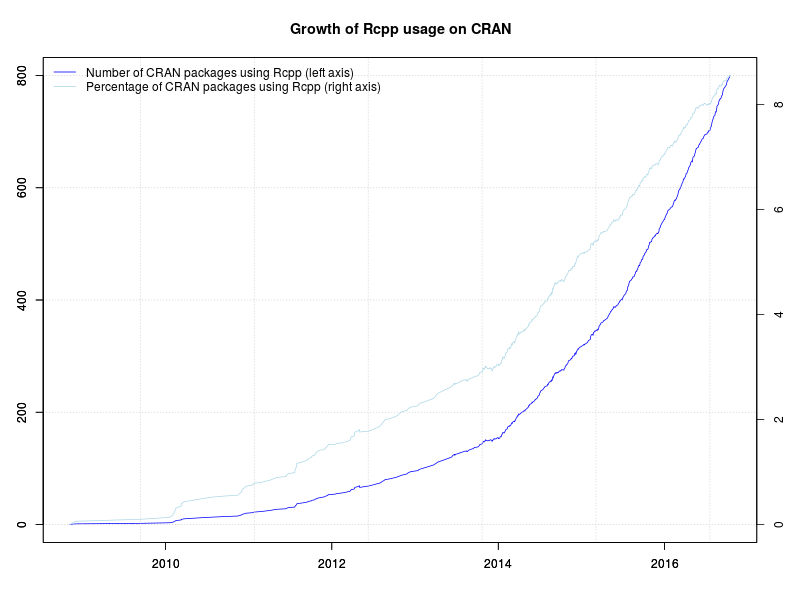
800 Rcpp packages A moment ago, Rcpp hit another milestone: 800 packages on CRAN now depend on it (as measured by Depends, Imports and LinkingTo declarations). The graph is on the left depicts the growth of Rcpp usage over time. The easiest way to compute this is to use the reverse_dependencies_with_maintainers() function from a helper scripts file on CRAN. This still gets one or false positives of packages declaring a dependency but not actually containing C++ code and the like. There is also a helper function revdep() in the devtools package but it includes Suggests: which does not firmly imply usage, and hence inflates the count. I have always opted for a tighter count with corrections. Rcpp cleared 300 packages in November 2014. It passed 400 packages in June of last year (when I only tweeted about it), 500 packages less than a year ago in late October, 600 packages this March and 700 packages this July. The chart extends to the very beginning via manually compiled data from CRANberries and checked with crandb. The next part uses manually saved entries. The core (and by far largest) part of the data set was generated semi-automatically via a short script appending updates to a small file-based backend. A list of packages using Rcpp is kept on this page. Also displayed in the graph is the relative proportion of CRAN packages using Rcpp. The four per-cent hurdle was cleared just before useR! 2014 where I showed a similar graph (as two distinct graphs) in my invited talk. We passed five percent in December of 2014, six percent July of last year, seven percent just before Christmas and eight percent this summer. 800 user packages is staggeringly large and humbling number. This puts more than some responsibility on us in the Rcpp team as we continue to keep Rcpp as performant and reliable as it has been. At the rate we are going, the big 1000 may be hit before we all meet again for useR! 2017. And with that a very big Thank You! to all users and contributors of Rcpp for help, suggestions, bug reports, documentation or, of course, code.

This post by Dirk Eddelbuettel originated on his Thinking inside the box blog. Please report excessive re-aggregation in third-party for-profit settings.

Dirk Eddelbuettel: tint 0.0.3: Tint Is Not Tufte

The tint package, whose name stands for Tint Is Not Tufte , on CRAN offers a fresh take on the excellent Tufte-style for html and pdf presentations. It marks a milestone for me: I finally have a repository with more "stars" than commits. Gotta keep an eye on the big prize... Kidding aside, and as a little teaser, here is what the pdf variant looks like:
This release corrects one minor misfeature in the pdf variant. It also adds some spit and polish throughout, including a new NEWS.Rd file. We quote from it the entries for the current as well as previous releases:

Changes in tint version 0.0.3 (2016-10-15)
  • Correct pdf mode to no use italics in table of contents (#9 fixing #8); also added color support for links etc
  • Added (basic) Travis CI support (#10)

Changes in tint version 0.0.2 (2016-10-06)
  • In html mode, correct use of italics and bold
  • Html function renamed to tintHtml Roboto fonts with (string) formats and locales; this allow for adding formats; (PRs #6 and #7)
  • Added pdf mode with new function tintPdf(); added appropriate resources (PR #5)
  • Updated resource files

Changes in tint version 0.0.1 (2016-09-24)
  • Initial (non-CRAN) release to ghrr drat

Courtesy of CRANberries, there is a comparison to the previous release. More information is on the tint page. For questions or comments use the issue tracker off the GitHub repo.

This post by Dirk Eddelbuettel originated on his Thinking inside the box blog. Please report excessive re-aggregation in third-party for-profit settings.

15 October 2016

Dirk Eddelbuettel: anytime 0.0.3: Extension and fixes

anytime arrived on CRAN with releases 0.0.1 and 0.0.2 about a month ago. anytime aims to convert anything in integer, numeric, character, factor, ordered, ... format to POSIXct (or Date) objects. Release 0.0.3 brings a bugfix for Windows (where for dates before the epoch of 1970-01-01, accessing the tm_isdst field for daylight savings would crash the session) and a small (unexported) extension to test format strings. This last feature plays well the ability to add format strings which we added in 0.0.2. The NEWS file summarises the release:

Changes in Rcpp version 0.0.3 (2016-10-13)
  • Added (non-exported) helper function testFormat()
  • Do not access tm_isdst on Windows for dates before the epoch (pull request #13 fixing issue #12); added test as well

Courtesy of CRANberries, there is a comparison to the previous release. More information is on the anytime page. For questions or comments use the issue tracker off the GitHub repo.

This post by Dirk Eddelbuettel originated on his Thinking inside the box blog. Please report excessive re-aggregation in third-party for-profit settings.

13 October 2016

Dirk Eddelbuettel: Seinfeld streak at GitHub: Round Three

Two years ago in this post I reference the Seinfeld Streak used in an even earlier post of regular updates to to the Rcpp Gallery:
This is sometimes called Jerry Seinfeld's secret to productivity: Just keep at it. Don't break the streak.
and showed the this first chart of GitHub streaking
github activity october 2013 to october 2014
Last year a follow-up appeared in this post:
github activity october 2014 to october 2015
And as it is that time again, here is this year's version:
github activity october 2015 to october 2016
Special thanks go to Alessandro Pezz for the Chrome add-on GithubOriginalStreak.

This post by Dirk Eddelbuettel originated on his Thinking inside the box blog. Please report excessive re-aggregation in third-party for-profit settings.

9 October 2016

Ben Armstrong: Annual Hike with Ryan: Salt Marsh Trail, 2016

Once again, Ryan Neily and I met last month for our annual hike. This year, to give our aging knees a break, we visited the Salt Marsh Trail for the first time. For an added level of challenge and to access the trail by public transit, we started with the Shearwater Flyer Trail and finished with the Heritage Trail. It was a perfect day both for hiking and photography: cool with cloud cover and a refreshing coastal breeze. The entire hike was over 25 km and took the better part of the day to complete. Good times, great conversations, and I look forward to visiting these beautiful trails again!
Salt Marsh trail hike, 2016. Click to start the slideshow.Salt Marsh trail hike, 2016. Click to start the slideshow.
We start here, on the Shearwater flyer trail.We start here, on the Shearwater flyer trail.
Couldn t ID this bush. The berries are spectacular! A pond to the side of the trail. Different angle for dramatic lighting effect. Rail bridge converted to foot bridge. Cranberries! Reviewing our progress. From the start Map of the Salt Marsh trail ahead. Off we go again! First glimpse through the trees. Appreciating the cloud cover today. Salt-marshy grasses. Never far from rocks in NS. Rocks all laid out in stripes. Lunch & selfie time. Ryan attacking his salad. Vantage point. A bit of causeway coast. Plenty of eel grass. Costal flora. We head for the bridge next. Impressed by the power of the flow beneath. Snapping more marsh shots. Ripples. Gulls, and if you squint, a copter. More ripples. Swift current along this channel. Until it broadens out and slows down. Nearly across. Heron! Sorry it s so tiny. Heron again, before I lost it. Ducks at the head of the Atlantic View trail where we rested and then turned back. Attempt at artsy. Nodding ladies tresses on the way back. Several of them. Sky darkening, but we still have time. A lonely wild rose. The last gasp of late summer. Back across the marshes. A short breather on the Heritage Trail.
Here s the Strava record of our hike:
Facebooktwittergoogle_plusredditpinterestlinkedinmail

7 October 2016

Dirk Eddelbuettel: tint 0.0.2: Tint Is Not Tufte

The tint package is now on CRAN. Its name stands for Tint Is Not Tufte and it offers a fresh take on the excellent Tufte-style html (and now also pdf) presentations. As a little teaser, here is what the html variant looks like:
and the full underlying document is available too. For questions or comments use the issue tracker off the GitHub repo.

This post by Dirk Eddelbuettel originated on his Thinking inside the box blog. Please report excessive re-aggregation in third-party for-profit settings.

5 October 2016

Dirk Eddelbuettel: RcppGSL 0.3.1

A new version of RcppGSL in now on CRAN and in Debian. The RcppGSL package provides an interface from R to the GNU GSL using our Rcpp package. This release is one that entirely focused on maintenance. CRAN asked us to change on aspect relative to vignettes, and we added a few more small updates related entirely to packaging. In other words, no user-facing changes. The NEWS file entries follows below:

Changes in version 0.3.1 (2016-10-02)
  • The unit test driver was updated and simplified, (by request of CRAN) no longer leaves files in '/tmp', and removes two unexported (and unused) test helper functions (PR #10)
  • Switched to run.sh for Travis (PR #11)
  • Use canonical CRAN URLs in README.md
  • Restored 'boxed' display of code in vignette (PR #12)

Courtesy of CRANberries, a summary of changes to the most recent release is available. More information is on the RcppGSL page. Questions, comments etc should go to the issue tickets at the GitHub repo.

This post by Dirk Eddelbuettel originated on his Thinking inside the box blog. Please report excessive re-aggregation in third-party for-profit settings.

3 October 2016

Shirish Agarwal: Using JOSM and gpx tracks

This would be a longish post. I had bought a Samsung Galaxy J-5/500 just a few days before Debconf16 which I had written about a bit earlier as well. As can be seen in the specs there isn t much to explore other than A-GPS. There were a couple of temperature apps. which I wanted to explore before buying the smartphone but as there were budget constraints and there weren t any good budget smartphones with environmental sensors built-in had to let go of those features. I was looking for a free app. which would have OSM support and came across osmand . I was looking for an app. which would have support for OSM and support for the gpx format. I was planning to use osmand in South Africa but due to the over-whelming nature of meeting people, seeing places and just being didn t actually get the time and place to try it. Came back home and a month and a half passed. In-between I had done some simple small tracks but nothing major. This week-end I got the opportunity as I got some free data balance from my service provider (a princely 50 MB) as well an opportunity to go about 40 odd kms. from the city. I had read about osmand and was looking if the off-line method worked or not from the webpage Works online (fast) or offline (no roaming charges when you are abroad) So armed with a full battery I started the journey which took about an hour and half even though technically it was a holiday. On the way back, got a different route and recorded that as well. The app. worked flawlessly. I was able to get the speed of the vehicle and everything. The only thing I haven t understood till date is how to select waypoints but other than that I got the whole route on my mobile. What was cool to see that on most roads, at least through the app. there were speed limits. Now I don t know from where the data was getting there. Most city roads had 65 and some roads had 55 at the maximum. I am assuming that it was at km/hr as also shared later. Just for fun I also looked at the gpx file after copying it from mobile to hdd (an extract) https://paste.debian.net/853231/ While it s not a complete extract, What was interesting for me to note here is the time was in UTC . What was also interesting is that in the gpx tracks I also saw some entries about speed as can be seen in the paste above. Although it doesn t say whether it was in km/hr or mph, I believe it probably is km/hr. as that is the unit I defined in the app. Anyways, the next step was trying to see which tool was good enough to show me the tracks with tiles underneath and labels of places, paths etc. I tried three tools 1. jmapviewer this didn t work at all.
2. gnome-maps this worked remarkably well but has numerous gtk3.0 warnings [shirish@debian] - [~/osmand] - [10149]
[$] gnome-maps 2016-10-01_08-11_Sat.gpx
(gnome-maps:21017): Gtk-WARNING **: Theme parsing error: gtk.css:63:28: The :prelight pseudo-class is deprecated. Use :hover instead. (gnome-maps:21017): Gtk-WARNING **: Theme parsing error: gtk.css:73:35: The :prelight pseudo-class is deprecated. Use :hover instead. (gnome-maps:21017): Gtk-WARNING **: Theme parsing error: application.css:14:30: The style property GtkButton:image-spacing is deprecated and shouldn't be used anymore. It will be removed in a future version (gnome-maps:21017): Gtk-WARNING **: Theme parsing error: application.css:15:31: The style property GtkWidget:interior-focus is deprecated and shouldn't be used anymore. It will be removed in a future version (gnome-maps:21017): Gdk-WARNING **: /build/gtk+3.0-Tod2iD/gtk+3.0-3.22.0/./gdk/x11/gdkwindow-x11.c:5554 drawable is not a native X11 window (gnome-maps:21017): Gdk-WARNING **: /build/gtk+3.0-Tod2iD/gtk+3.0-3.22.0/./gdk/x11/gdkwindow-x11.c:5554 drawable is not a native X11 window (gnome-maps:21017): Gdk-WARNING **: /build/gtk+3.0-Tod2iD/gtk+3.0-3.22.0/./gdk/x11/gdkwindow-x11.c:5554 drawable is not a native X11 window (gnome-maps:21017): Gdk-WARNING **: /build/gtk+3.0-Tod2iD/gtk+3.0-3.22.0/./gdk/x11/gdkwindow-x11.c:5554 drawable is not a native X11 window (gnome-maps:21017): Gdk-WARNING **: /build/gtk+3.0-Tod2iD/gtk+3.0-3.22.0/./gdk/x11/gdkwindow-x11.c:5554 drawable is not a native X11 window (gnome-maps:21017): Gdk-WARNING **: /build/gtk+3.0-Tod2iD/gtk+3.0-3.22.0/./gdk/x11/gdkwindow-x11.c:5554 drawable is not a native X11 window (gnome-maps:21017): Gtk-WARNING **: GtkClutterOffscreen 0x4c4f3f0 is drawn without a current allocation. This should not happen. (gnome-maps:21017): Gtk-WARNING **: GtkImage 0x4ed4140 is drawn without a current allocation. This should not happen. Now I m not sure whether all of those are gtk3+ issues or me running them under Debian MATE. I know that there are issues with mate and gtk3+ as had been told/shared a few times in p.d.o. Anyways, one of the issues I encountered is that gnome-maps doesn t work in offline-mode, saw https://bugzilla.gnome.org/show_bug.cgi?id=708799 . Also saw ~/.cache/champlain/osm-mapquest and the listing underneath is gibberish in the sense you don t know what it meant to do
[shirish@debian] - [~/.cache/champlain/osm-mapquest] - [10163]
[$] ll -h
drwx------ 6 shirish shirish 4.0K Jun 11 2015 10
drwx------ 26 shirish shirish 4.0K Oct 24 2014 11
drwx------ 10 shirish shirish 4.0K Jun 11 2015 12
drwx------ 11 shirish shirish 4.0K Jun 11 2015 13
drwx------ 12 shirish shirish 4.0K Jun 11 2015 14
drwx------ 12 shirish shirish 4.0K Jun 11 2015 15
drwx------ 27 shirish shirish 4.0K Oct 24 2014 16
drwx------ 25 shirish shirish 4.0K Oct 24 2014 17
drwx------ 4 shirish shirish 4.0K Mar 4 2014 3
drwx------ 5 shirish shirish 4.0K Mar 4 2014 8
drwx------ 9 shirish shirish 4.0K Mar 29 2014 9
What was/is interesting to see things like this maybe imagery offset As I was in a moving vehicle, it isn t easy to know if the imagery is at fault or was it app. , sensor of my mobile ? Did see http://learnosm.org/en/josm/correcting-imagery-offset/ but as can be seen that requires more effort from my side. The last tool proved to be the most problematic 3. JOSM Getting the tracks into josm which was easily done. While firing up josm came across https://josm.openstreetmap.de/ticket/13735 which I subsequently filed. One of the other first things which has been a major irritant for a long time is JOSM is, for a lack of better term, ugly. See the interface, especially the one having preferences, all cluttered look and specifically see the plugins corner/tab josm-preferences-plugin tab The part about it being ugly, I dunno but have seen most java apps are a bit ugly. It is a bit generalist I know but that has been my experience with whatever little java apps. I have used. I don t know what the reasons for that are, maybe because java is known/rumoured to use lot of memory which seems true in my case as well OR it doesn t have toolkits like gtk3+ or qt quick, although have to say that the looks have improved from before when I used it last some years ago
[shirish@debian] - [~] - [10340]
[$] ps -eo size,pid,user,command awk ' hr=$1/1024 ; printf("%13.6f Mb ",hr) for ( x=4 ; x<=NF ; x++ ) printf("%s ",$x) print "" ' grep josm
0.324219 Mb /bin/sh /usr/bin/josm
419.468750 Mb /usr/lib/jvm/java-8-openjdk-amd64/bin/java -Djosm.restart=true -Djava.net.useSystemProxies=true -jar /usr/share/josm/josm.jar
This is when I m just opening josm and have not added any tracks or done any work. Now I wanted to explore the routing in good amount of detail on josm. This was easily said than done. When trying to get imagery I got the Download area too large issue/defect . Multiple tries didn t get me anywhere. Then hunting on the web came across the continous-download plugin which is part of the plugin infrastructure . This I found to be a very good tool. It downloads the tiles and puts them in ~/.josm/cache/tiles
[shirish@debian] - [~/.josm/cache/tiles] - [10147]
[$] ll -h
total 28M
-rw-r--r-- 1 shirish shirish 28M Oct 2 02:13 TMS_BLOCK_v2.data
-rw-r--r-- 1 shirish shirish 290K Oct 3 12:59 TMS_BLOCK_v2.key
-rw-r--r-- 1 shirish shirish 4 Oct 3 12:59 WMS_BLOCK_v2.key
-rw-r--r-- 1 shirish shirish 4 Oct 3 12:59 WMTS_BLOCK_v2.key
While unfortunately I cannot see this/make sense of it I m guessing it is some sort of database with key and data files. What did become apparent is that the OSM needs lots more love if it is to become something which can be used everyday. At the end I had to change the open-source gpx track file to a Google map kml file to be able to make sense as there are whole areas which need to be named, numbered etc. One of the newbie mistakes that I did was trying to use the slippy map in josm (using Openstreetmap/Mapnik at the back-end) to move/pan using the left-hand mouse button. It took me quite sometime to figure out that it is with right-hand mouse button that you can make the slippy map pan. This is different from almost all maps, gnome-maps uses the traditional left-hand button, Google maps also uses the same. I have filed it in upstream as https://josm.openstreetmap.de/ticket/13751 . So at least, in these rounds it is gnome-maps which has kind of won even though it doesn t do any of the things that josm claims to do. I am sure there might be some interesting tricks and tips that people might have to share about mapping
Filed under: Miscellenous Tagged: #Debconf16, #GNOME-MAPS, #JOSM, OSM

1 October 2016

Dirk Eddelbuettel: RcppAnnoy 0.0.8

An new version 0.0.8 of RcppAnnoy, our Rcpp-based R integration of the nifty Annoy library by Erik, is now on CRAN. Annoy is a small, fast, and lightweight C++ template header library for approximate nearest neighbours. This release pulls in a few suggested changes which had piled up since the last release. Changes in this version are summarized here:

Changes in version 0.0.8 (2016-10-01)
  • New functions getNNsByItemList and getNNsByVectorList, by Michael Phan-Ba in #12
  • Added destructor (PR #14 by Michael Phan-Ba)
  • Extended templatization (PR #11 by Dan Dillon)
  • Switched to run.sh for Travis (PR #17)
  • Added test for admissible value to addItem (PR #18 closing issue #13)

Courtesy of CRANberries, there is also a diffstat report for this release.

This post by Dirk Eddelbuettel originated on his Thinking inside the box blog. Please report excessive re-aggregation in third-party for-profit settings.

Next.

Previous.