Search Results: "angel"

10 March 2010

John Goerzen: Numerous Updates

It s been awhile since I ve posted some family/home updates, so here they are, sorta random-like Jacob is 3.5 now, and Oliver is about 8 months old at this point. Jacob Jacob has a few trends going on lately: pretending to be a cat, and inventing new games to play. He has one game he likes to play with me called tunnels and slippers. He will have me sit on the couch, put my feet up on the footstool, and crawl on top of my legs. He ll want me to bounce him, then he can crawl underneath the tunnel. The slippers part came because he started to steal my slippers one time during winter. He d struggle furiously to get it off, then shriek with delight as he ran away, listing to my indignation at having a cold foot now. Then I was supposed to run after him, pick him up in the air, and get the slipper back. Here he is, trying to steal a slipper while I happened to be holding a camera: img_2345.jpg He s said quite a few memorable quotes this winter: Dec. 8: Jacob looked outside this morning and yelled, WOW! Look at that! , ran across the room and yelled, MOM! WOW! There is snow outside this window too! WOW! Snow is ALL OVER THE PLACE! January: When told his grandparents were going back to Indiana: The kitty doesn t like that. (the pretending to be a cat thing) The next morning when he remembered they were gone: Oh. My kitty is so very sad now. February: My name is kitty. Jacob Cat! March: I didn t realize the basketball could go so far! He s been starting to make his first attempts at sounding out words. He s been interested in 2- and 3-digit numbers, trying to figure out how to tell time, and asking me the German words for all sorts of things. (And showing some disappointment with my German vocabulary.) Jacob talks about Oliver as a sweet baby, and is often very caring about him. Jacob wants to make sure Oliver has *plenty* of toys. Though there have been some times when Jacob has pushed Oliver over. Here s the Christmas photo of the two of them: img_2367r And another: img_2357.jpg Jacob has also started to pick up an interest in singing: his favorite song is one that he made up, and it goes Engine, engine, passenger car I still sing a song to Jacob at bedtime each night, but Home On the Range doesn t cut it anymore. No, now I have a make up a song on the spot on a topic of Jacob s choosing each night. Last night he chose a song about the ceiling light and the smoke detector. Other nights, it s been about his toy butterfly, his night light, various smoke detectors (that s a popular one), or something from his day. Oliver img_2371.jpg Oliver recently has started being able to sit up by himself. He can also scoot all over the room. I think he s saying dad , but Terah disagrees and thinks he s just babbling. Her case wasn t helped the day I asked him, Are you saying Dad? He got a big smile after the question and laughed at me. He loves playing peek-a-boo, playing with us or playing by himself. Oliver has been eating the mashed-up baby food for awhile. Terah recently gave him a rice puff, and he put it in his mouth but wasn t sure what to do with it. He has been taking quite an interest in watching the rest of us eat, though, and sits at the table with us in his high chair.

Dirk Eddelbuettel: Rcpp 0.7.8

Version 0.7.8 of the Rcpp R / C++ interface classes is now on CRAN and in Debian. As of right now. Debian has already built packages for eight more architectures; and CRAN has built the Windows binary. Oh, and cran2deb had Debian packages for 'testing' before I was done with the blog entry. This is a minor feature release based on a over three weeks of changes that are summarised below in the extract from the NEWS file. Some noteworthy highlights are The full NEWS entry for this release follows:
0.7.8   2010-03-09
    o	All vector classes are now generated from the same template class
    	Rcpp::Vector<int rtype="RTYPE"> where RTYPE is one of LGLSXP, RAWSXP, STRSXP,
    	INTSXP, REALSXP, CPLXSXP, VECSXP and EXPRSXP. typedef are still 
    	available : IntegerVector, ... All vector classes gain methods 
    	inspired from the std::vector template : push_back, push_front, 
    	erase, insert
    	
    o	New template class Rcpp::Matrix<rtype> deriving from 
    	Rcpp::Vector<rtype>. These classes have the same functionality
    	as Vector but have a different set of constructors which checks
    	that the input SEXP is a matrix. Matrix<rtype> however does/can not
    	guarantee that the object will allways be a matrix. typedef 
    	are defined for convenience: Matrix<intsxp> is IntegerMatrix, etc...
    	
    o	New class Rcpp::Row<int rtype="RTYPE"> that represents a row of a matrix
    	of the same type. Row contains a reference to the underlying 
    	Vector and exposes a nested iterator type that allows use of 
    	STL algorithms on each element of a matrix row. The Vector class
    	gains a row(int) method that returns a Row instance. Usage 
    	examples are available in the runit.Row.R unit test file
    	
    o	New class Rcpp::Column<int rtype="RTYPE"> that represents a column of a 
    	matrix. (similar to Rcpp::Row<int rtype="RTYPE">). Usage examples are 
    	available in the runit.Column.R unit test file
    o	The Rcpp::as template function has been reworked to be more 
    	generic. It now handles more STL containers, such as deque and 
    	list, and the genericity can be used to implement as for more
    	types. The package RcppArmadillo has examples of this
    o   new template class Rcpp::fixed_call that can be used in STL algorithms
	such as std::generate.
    o	RcppExample et al have been moved to a new package RcppExamples;
        src/Makevars and src/Makevars.win simplified accordingly
    o	New class Rcpp::StringTransformer and helper function 
    	Rcpp::make_string_transformer that can be used to create a function
    	that transforms a string character by character. For example
    	Rcpp::make_string_transformer(tolower) transforms each character
    	using tolower. The RcppExamples package has an example of this.
        
    o	Improved src/Makevars.win thanks to Brian Ripley
    o	New examples for 'fast lm' using compiled code: 
        - using GNU GSL and a C interface
        - using Armadillo (http://arma.sf.net) and a C++ interface
        Armadillo is seen as faster for lack of extra copying
    o	A new package RcppArmadillo (to be released shortly) now serves 
        as a concrete example on how to extend Rcpp to work with a modern 
	C++ library such as the heavily-templated Armadillo library
    o	Added a new vignette 'Rcpp-introduction' based on a just-submitted 
        overview article on Rcpp
As always, even fuller details are in the ChangeLog on the Rcpp page which also leads to the downloads, the browseable doxygen docs and zip files of doxygen output for the standard formats. A local directory has source and documentation too. Questions, comments etc should go to the rcpp-devel mailing list off the R-Forge page

Update: Two links corrected.

9 March 2010

John Goerzen: Review: The Future of Faith by Harvey Cox

I know I ve been on something of a religion streak on the blog of late, and this will be the last such post for awhile. I first hear of Harvey Cox s book The Future of Faith during an excellent hour-long interview with NPR s Diane Rehm. It was intriguing enough that I bought the Kindle edition of the book and read it. The title of the book is both very accurate and rather misleading. A lot of the book and, to me, the most fascinating parts of it focus on the history of faith. Cox s repeated point is that we are only now regaining a notion of faith that the earliest Christians had, and it is a notion that happens to be compatible with modern science and incompatible with fundamentalism and intolerance in all its stripes. Throughout this post, it should be understood that quotes or passages are from the book. Cox is so quotable that a good chunk of this review will be showing you some of his quotes, with a bit of discussion around them. I very much enjoyed this book, and highly recommend it. Faith vs. Belief
It is true that for many people faith and belief are just two words for the same thing. But they are not the same and it is important to clarify the difference. Faith is about deep-seated confidence. In everyday speech we usually apply it to people we trust or the values we treasure a matter of what the Hebrews spoke of as the heart. Belief, on the other hand, is more like opinion. We often use the term to express a degree of uncertainty We can believe something to be true without it making much difference to us, but we place our faith only in something that is vital for the way we live.
This is an important distinction, and if you stop and think about it, Cox is arguing with a common notion about faith almost from page 1. Faith isn t about intellectual assent to a set of propositions. It s about what we hold dear, what we think works for us in life. Creeds
Creeds are clusters of beliefs. But Christianity is not a history of creeds. It is the story of a people of faith who sometimes cobbled together creeds out of beliefs. It is also the history of equally faithful people who questioned, altered, and discarded those same creeds But both the doctrinal canons and the architectural constructions are means to an end. Making either the defining element warps the underlying reality of faith.
Cox here reinforces the point that Christianity isn t about believing certain statements, and it isn t even about a literal (or not) reading of the Bible. It s what C. S. Lewis talked about as the inward transformation in onesself. Creeds, such as the Nicene Creed, are rather irrelevant to him. Cox separates the history of Christianity into three periods: the age of faith, stretching from the time of Jesus only a few centuries until Constantine; the age of belief, stretching from Constantine until the 20th century; and the age of the spirit, now dawning. During the age of faith, their sharing in the living Spirit of Christ united Christians with each other, and faith meant hope and assurance in the dawning of a new era of freedom, healing, and compassion that Jesus had demonstrated. Cox makes the point that doctrinal questions just weren t all that important back then, and though differences existed, they weren t considered to be fundamental to the religion. Confidence in Christ was their primary orientation, and hope for his [earthly] Kingdom their motivating drive. Further, he argues that the age of the spirit is a return to this earlier age, albeit with modern twists.
Christianity is growing faster than it ever has before, but mainly outside the West and in movements that accent spiritual experience, discipleship, and hope; pay scant attention to creeds; and flourish without hierarchies. We are now witnessing the beginning of a post-Constantinian era.
Cox describes a person that described himself as a practicing Christian, not always a believing one. He suggests that the belief/non-believer statement is a disservice to Christianity and to other religions. He then quoted a Catholic bishop as saying: The line between belief and unbelief runs through the middle of each one of us, including myself, a bishop of the church. In other words, The experience of the divine is displacing theories about it. Faith and Belief in Bible reading
Creation myths such as the first chapters of Genesis were not primarily composed to answer the how or when questions. They are not scientific accounts, even though their poetical language, when read literally (which is always a mistake), may sound that way. Rather, they grapple with the linked mysteries of both why there is a universe and what our place in it is They are more like lyrical cantatas, symphonies of symbols through which humans have tried to make sense of their place in the world This is where the distinction between faith and belief is vital. These stories are literally not to be believed. They are, rather, artifacts human beings have crafted to try to wring some meaning from the mystery. They are not themselves the mystery.
I liken this to Michael Crichton s novel Jurassic Park. If you were to read it 1000 years in the future, it might not have been conveniently shelved above the word fiction. Would a reader in the future know that it was not meant to be a literal description of facts? I think sometimes we make this mistake when we read the Bible. Note, though, that although we all understand that Jurassic Park wasn t meant to be a literal description of facts, it seems to have been valued by quite a large part of society. And it didn t even address big mysteries. Cox argues against ridding ourselves of the creation myths, suggesting that they are an important reminder that we are similar to humans who grappled with the same big questions centuries ago as we do today.
The ill-advised transmuting of symbols into a curious kind of facts has created an immense obstacle to faith for many thoughtful people. Instead of helping them confront the great mystery, it has effectively prevented them from doing so the objective knowledge science rightly insists on is not the only kind of knowledge human beings need Faith, although it is evoked by the mystery that surrounds us, is not the mystery itself.
Constantine and the Age of Belief
One of the most devastating blunders made by the church, especially as the Age of Belief began, was to insist that the Spirit is present only in believers.
Cox spends a lot of time covering the very interesting topic of how and why the church moved to the Age of Belief. His central thesis is that money, power, and prestige were primarily responsible, and that an unrighteous collusion between bishops and Constantine, each using Christianity for their own purposes, finally made it happen. This is very interesting stuff, but this post is too long already, so I will not spend a lot of time on it. I found the Council of Nicea to be particularly interesting, considering that the Nicean Creed came about partially by exile or execution of those Christians that disagreed with it. Cox also points out that there never was a single early Christianity ; there were many, and the idea of heresy was unknown.
The time is ripe to retrieve the term Way for Christianity and followers of the Way for Christians. It is at once more accurate, more original, and more contemporary than believers.
To the future Cox describes attending a meeting of the church in Hong Kong in 2003, and uses it as a metaphor for the future of faith:
Their idea of interfaith dialogue was to work with their fellow Asians of whatever religion to advance the Kingdom that Jesus had inspired them, as Christians, to strive for, regardless of what the others called it. They were neither fundamentalist nor modernist. They seemed more attuned to the element of mystery at the core of Christianity and to its vision of justice. They were also clearly impatient with many of the disputes that preoccupy the different wings of the American churches.
Conclusion I found this book to be both enlightening and informative. I highly recommend it, even if you disagree with some of Cox s conclusions. It is a fascinating view into how the world s largest religion evolved over the years, and a candid look at the mistakes it has made in that time.

7 March 2010

Gunnar Wolf: Authoral rights in the editorial world seminar

I must confess I don't remember who I got this invitation from. Anyway, if you are in the right geographic area, you might be interested. I will try to participate: This is a year-long seminar that will be held the second Thursday every month at Fonoteca Nacional (a place I have wanted to visit for a long time!), in Barrio de Santa Catarina, Coyoac n. Among the organizers they have Creative Commons Mexico. Free entrance (but limited space - so they ask interested people to confirm their presence by mail to bvallarta@conaculta.gob.mx). [update] I went with Pooka to the first session. We arrived almost 1hr late (due to me mistaking the schedule :-/ ) but it was interesting. Of course, quite biased towards the Google viewpoints, but interesting. We got the program for the next sessions So, mostly for myself to keep handy, here it goes:
Date Title Speakers
2010-03-11 Google and copyright Manuel Tamez, Hugo Contreras, Mar a Fernanda Mendoza
2010-04-08 Generalities about rights on intelectual property Jes s Parets, Guillermo Sol rzano, Jorge Mier y Concha
2010-05-13 Copyright's nature and competent authorites Carmen Arteaga, Luis Schmidt, C sar Callejas
2010-06-10 Moral and patrimonial rights Guillermo Pous, Eduardo de la Parra, Ram n Ob n
2010-07-08 Reproduction rights for audible material lvaro Hegewisch, scar Javier Solorio, Marco Antonio Morales, Jos Ram n C rdeno
2010-08-12 Licenses and patrimonial right transmission. Works for hire, works done under laboral relationship, or carried out in official service Dolores Franco, Jes s Mej a, Ra l Pastor
2010-09-09 Limits to explotation rights and literary plagiarism Carmen Arteaga, Juan Ram n Ob n, Jorge Mier y Concha, C sar Callejas
2010-10-14 Copyright in a digital setting Jes s Parets, Gast n Esquivel
2010-11-11 Law-regulated intelectual property rights Rosalba Elizalde, Salvador Ortega, Gast n Esquivel, Manrique Moheno
2010-12-09 International protection and collective gestive societies Horacio Rangel, Luis Schmidt, Jes s Mej a

1 March 2010

Diego Escalante Urrelo: GNOMEs in Chile

Update March 1st, 24 UTC: Reynaldo Verdejo is ok, the list is complete! Update March 1st, 16 UTC: Alejandro Vald s, Fabi n Arias, Carlos R os Vera and Germ n P o-Caama o have been in contact with others in Chile. :) Probably by now some of you know or are worried about the situation in Chile. I m not chilean nor in Chile but I ve been following closely due to the considerable number of good friends I have there, most of them related to GNOME.
From The Big Picture (AP Photo/Roberto Candia) Juan Carlos Inostroza (blog down) suggested I publish the list of GNOME/Free Software people in Chile that has reported since the earthquake and are fine, here it goes: Known, found and good: Not know, nor found, we presume good but without cellphones: If you have been in contact with any of them, leave a comment, send a DM in twitter (@diegoe) and etc. List is not complete, I probably forgot someone, please remind me. Will update if I get news from anyone.

28 February 2010

Jordi Mallach: Tinyproxy 1.8

A while ago, I was asked to recompile Tinyproxy to enable transparent proxying support, which was not being compiled in etch's Debian package. As it tends to happen, once I got the source and looked into doing a quick rebuild with --enable-transparent-proxy, I noticed the package was in such a bad shape, that I couldn't just leave it like that, so I found myself doing a few more changes, which mostly involved updating the packaging so it didn't suck a lot, and splitting the Debian patches so things could be sent upstream or dropped when new versions appeared. However, even if Ed had asked me to go ahead and take over the package, this was meant to be a one-day effort, and soon I had forgotten about Tinyproxy, except for the ocassional bug mail getting through the PTS. It also didn't help that Tinyproxy had been pretty much dead upstream for years. So lately, a few bug reports were reporting a gasp new major Tinyproxy release, after 7 years of basically nothing. OMG, what do I see, there's a Git repo! And an upstream Bugzilla! Somehow, feeling I owed Ed a reply to his unanswered request, I went ahead and tagged tinyproxy 1.6.3-3.2 in collab-maint, and started working on the new version. Adding myself to Uploaders, and getting rid of the make no unnecessary changes vetto, I rewrote most of the packaging. And for a change, I looked for and found a #tinyproxy channel on IRC and told muks and obnox that the days of Tinyproxy's stay in the Debian/Ubuntu limbo were over.
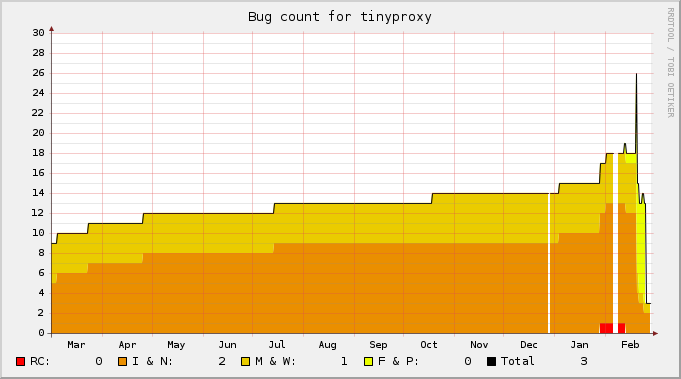
They were happy to get a few bugs and patches forwareded upstream, and asked me why all of this hadn't happened before. Pitty is that a few longstanding issues were well known in Debian but not so obvious for the new upstream maintainers, and are present in 1.8.0. Hopefully all will be dealt with in 1.8.1 or the next major version. The lesson is: if you work on an apparently abandoned package, after cleaning the mess in your NMU, try to spend 15 more minutes trying to contact upstream (if available), pointing them at the patch tracker and our list of bugs: chances are many are still useful. Also, contact the Debian maintainer, and if they ask you to take over, at least post a RFA so someone else can. If you're a Tinyproxy user, I'd be happy to hear if the current package in Debian unstable works for you. If you were having weird issues with 1.6.x, chances are 1.8 will fix them. The package can be installed on stable with no extra dependencies, so if you're feeling adventurous, go ahead and upgrade.

Siegfried Gevatter: Zeitgeist Data-Source Registry

This post is about an upcoming feature in Zeitgeist 0.3.3 and is so far only available in checkouts from trunk or our PPA. It is expected to be released within the next weeks. Some weeks ago I implemented a new feature in Zeitgeist and I figured I d drop some lines about it. I m talking about a data-source registry. You may be wondering, what the hell is that even, a data-source? . So Zeitgeist is a database, a global event log, but it doesn t do any magic indexing or monitoring by itself; the information it logs needs to come from somewhere be it applications sending it to Zeitgeist themselves, daemons, plugins for applications, etc. Any such entity is called a data-source . Having a register of all data-sources interacting with Zeitgeist provides some benefits, like for example:
Screenshot of tools/gtk/zeitgeist-data-sources-gtk.py

Prototype of a data-source management user-interface

More details When they register, data-sources will need to provide the following information: an unique ID, a name (may be localized), a description (may be localized) and optionally a template specifying what sort of events it logs. Additionally, the last timestamp the data-source was seen by Zeitgeist, whether it is running right now and whether it is enabled will also be available. It is important to note that registration is not compulsory; while it is highly encouraged for data-sources to use it, is it still possible to anonymously insert information into Zeitgeist (for example from a shell script). The event template is also only informational, and will not be enforced by Zeitgeist at this time. Avoiding duplicates from GTK Recently Used You may know that zeitgeist-datahub provides basic support for applications which have no direct Zeitgeist support but do use GTK s RecentManager, which is not as detailed as we would like, but it is better than nothing. However, until now we had a problem: when applications had support for both, GTK s Recently Used and Zeitgeist (be it native or as an extension), it was possible for duplicate events to be inserted or other sorts of conflicts between both data-sources. Now that we have the information from the registry available, we ve been able to solve this modifying our Recently Used data-source to ignore any events concerning applications which already have another data-source logging the same types of events.

In case you don t care at all about what I m talking here and you just want to see fancy interfaces, go check this out. Related posts:
  1. Zeitgeist is out!
  2. Introduction to Zeitgeist 0.2 s API
  3. Zeitgeist Hackfest (II)

No comments
Siegfried-Angel Gevatter Pujals, 2010. Permalink License Post tags: , ,

27 February 2010

Michael Banck: 27 Feb 2010

Debconf11 This evening, the final decision on which city will host Debconf11 next year will be taken. For the last half year, mostly Andreas Barth, Jan-Marek Glogowski and I have been working hard to make the Munich bid as good as possible. One thing we wanted to make clear from the beginning was that we would go for a conference in the city center - not some conference center in some nearby village or in an industrial area far away from where the city life happens. It was not easy, since the german-wide decision, we had to reshuffle venue plans a couple of times. In the end, thanks to Jan-Marek, we managed to get an excellent venue offer. Our bid consits mostly of: The biggest strong points about Munich are, in my opintion: It the end, it seems Banja Luka seems to have the stronger bid, especially due to their 150000 EUR governemnt sponsorship. We will see who wins, I believe we did the best we could.

20 February 2010

John Goerzen: Is the Roman Emperor Still Your God?

In ancient Rome, the Imperial cult was the worship of the Roman emperor as a god. It came to be at roughly the same time as Christianity. In the cult of the emperor, Caesar was revered as a deity. According to Harvey Cox, This was what we might today call a civil religion it had its holidays, processions, and holy sites throughout the empire. Adherence to it was required of all of the emperor s subjects, wherever they lived and whatever other deities they also worshiped. It was the religious and ideological mucilage that held the far-flung empire together. Perhaps you see where this is going. There was a certain group that found the imperial cult, well, repugnant. They felt their own goals bringing their god s peace and justice to the world were incompatible with this sort of devotion to a human institution, and the very institution that had killed their leader at that. Their reaction went like this:
Regarding worship of the emperor, Christians responded with an unequivocal no. They claimed that Jesus Christ was God s kyrios ( anointed one in Greek), but since kyrios was one of the titles attributed to Caesar, they refused to participate in the imperial cult. They were willing to pray for the emperor and for his health, but they stubbornly refused to pray to him or offer ritual tribute. They recognized that one could not be a follower of Jesus while also honoring a rival to the loyalty their faith in him and his Kingdom required; therefore, not even one pinch of incense on the imperial altar. This defiance of the political religion of the empire, which led their critics to brand them subversive, landed many of them in arenas with salivating lions. Harvey Cox in The Future of Faith
Now, you may be wondering, why am I asking if anyone still worships the emperor of a long-extinct empire? I maintain that this practice is still alive and well, just under a different name. I have been interested in some of the debates about American institutions that choose to perform neither the national anthem nor the pledge of allegiance. Many of these institutions are Mennonite, and their reason for not participating in these two particular acts mirrors that of the early Christians refusing to worship Caesar: namely, their goal is to bring about God s peaceful and just kingdom on earth, and no country, no human institution at all, can ever command greater loyalty than that cause. Moreover, the American national anthem is a particularly violent one, celebrating the taking of life right there at the beginning. Not completely compatible with the ethics of a church trying to bring about a more peaceful world, right? It is from that basis that many Mennonites, and our institutions, do not perform the national anthem or say the pledge of allegiance. For myself, when the national anthem is being performed, I will stand out of respect for those around me for whom the moment is important, but I do not sing. I am deeply appreciative that the United States, like many other countries, makes it legal to do this. I am heartened by the fact that I do not risk a confrontation with the lions over my religious stance today. Goshen College, a Mennonite institution, recently decided to go back on a century of history (which goes back farther than the anthem itself, which was only adopted in 1931) and will now be performing the anthem, followed by a prayer, before select sporting events. And by so doing, they fail both to act in accordance with the way of Christ, and to be a patriot. They fail to act for peace and justice by playing an anthem that supports and glorifies war and violence. And they fail to be patriotic. Patriotism and nationalism are different things. It s easy to be nationalistic to get up there and sing a song that everyone wants you to sing. It is far more difficult to be patriotic. Being patriotic in the United States means using the freedoms we have to improve our country. Goshen ought to use its freedom to not observe the national anthem as a way to try to draw a line in the sand against violence, to suggest that our anthem fails to adequately recognize the character of the American people and who we want to be, and to suggest a better alternative. After all, those people who are venerated today as patriots anyone from Martin Luther to Thomas Jefferson to Martin Luther King stood up to their fallible human governments to seek positive change. Instead of a route both religious and patriotic, Goshen College has chosen one that is neither. I am deeply disappointed that 300 phone calls have apparently cowed their leadership. What have we come to when our ancestors braved the lions, and we give up our principles over the fear of bad publicity? Ah, Goshen, perhaps you are thinking that you could spare a few pinches of incense for Caesar after all?

17 February 2010

Wouter Verhelst: Local kernels

LC_ALL=C debian/rules debian/control
md5sum --check debian/control.md5sum --status   \
		/usr/bin/make -f debian/rules debian/control-real
make[1]: Entering directory  /home/wouter/debian/other-peoples-source/linux-2.6-2.6.32'
chmod +x debian/bin/gencontrol.py
debian/bin/gencontrol.py
Traceback (most recent call last):
  File "debian/bin/gencontrol.py", line 331, in <module>
    Gencontrol()()
  File "debian/bin/gencontrol.py", line 14, in __init__
    self.process_changelog()
  File "debian/bin/gencontrol.py", line 305, in process_changelog
    (distribution, version))
RuntimeError: Can't upload to unstable with a version of 2.6.32-8~local1
make[1]: *** [debian/control-real] Error 1
make[1]: Leaving directory  /home/wouter/debian/other-peoples-source/linux-2.6-2.6.32'
make: *** [debian/control] Error 2
The issue at hand was that I'd created a version of '2.6.32-8~local1', to document that I'd locally branched version 2.6.32-7 with that one config option turned on, but that my version should not be deemed larger than 2.6.32-8 (signalled by the ~ and whatever follows that). However, something somewhere in the Debian kernel build system (I was unable to figure out what, exactly) disliked that version number and told me I could not upload to unstable with that version. So it borked, and told me I had to fix my version. Well, no, I don't want to do that. Instead, I wanted to disable that check somehow. Turns out that isn't too hard; gencontrol.py not only checks the version number, it also checks the target distribution. So if you don't want to upload to unstable, you just need to tell the tool that:
-linux-2.6 (2.6.32-8~local1) unstable; urgency=low
+linux-2.6 (2.6.32-8~local1) local; urgency=low
Simple, but you'd need to know.

15 February 2010

John Goerzen: Review: Linux IM Software

I ve been looking at instant messaging and chat software lately. Briefly stated, I connect to Jabber and IRC networks from at least three different computers. I don t like having to sign in and out on different machines. One of the nice features about Jabber (XMPP) is that I can have clients signing in from all over the place and it will automatically route messages to the active one. If the clients are smart enough, that is. Gajim I have been using Gajim as my primary chat client for some time now. It has a good feature set, but has had a history of being a bit buggy for me. It used to have issues when starting up: sometimes it would try to fire up two copies of itself. It still has a bug when being fired up from a terminal: if you run gajim & exit, it will simply die. You have to wait a few seconds to close the terminal you launched it from. It has also had issues with failing to reconnect properly after a dropped network connection and generating spurious resource already in use errors. Upgrades sometimes fix bugs, and sometimes introduce them. The latest one I ve been dealing with is its auto-idle support. Sometimes it will fail to recognize that I am back at the machine. Even weirder, sometimes it will set one of my accounts to available status, but not the other. So much for my complaints about Gajim; it also has some good sides. It has excellent multi-account support. You can have it present your multiple accounts as separate sections in the roster, or you can have them merged. Then, say, all your contacts in a group called Friends will be listed together, regardless of which account you use to contact them. The Jabber protocol (XMPP) permits you to connect from multiple clients. Each client specifies a numeric priority for its connection. When someone sends you a message, it will be sent to the connection with the highest priority. The obvious feature, then, is to lower your priority when you are away (or auto-away due to being idle), so that you always get IMs at the device you are actively using. Gajim supports this via letting you specify timeouts that get you into different away states, and using the advanced configuration editor, you can also set the priority that each state goes to. So, if Gajim actually recognized your idleness correctly, this would be great. I do also have AIM and MSN accounts which I use rarely. I run Jabber gateways to each of these on my server, so there is no need for me to use a multiprotocol client. That also is nice because then I can use a simple Jabber client on my phone, laptop, whatever and see all my contacts. Gajim does not support voice or video calls. Due to an apparent bug in Facebook, the latest Gajim release won t connect to Facebook servers, but there is a patch that claims to fix it. Psi Psi is another single-protocol Jabber client, and like Gajim, it runs on Linux, Windows, and MacOS. Psi has a nicer GUI than Gajim, and is more stable. It is not quite as featureful, and one huge omission is that it doesn t support dropping priority on auto-away (though it, weirdly, does support a dropped priority when you manually set yourself away). Psi doesn t support account merging, so it always shows my contacts from one account separately from those from another. I like having the option in Gajim. There is a fork of Psi known variously as psi-dev or psi-plus or Psi+. It adds that missing priority feature and some others. Unfortunately, I ve had it crash on me several times. Not only that, but the documentation, wiki, bug tracker, everything is available only in Russian. That is not very helpful to me, unfortunately. Psi+ still doesn t support account merging. Both branches of Psi support media calling. Kopete Kopete is a KDE multiprotocol instant messenger client. I gave it only about 10 minutes of time because it is far from meeting my needs. It doesn t support adjustable priorities that I can tell. It also doesn t support XMPP service discovery, which is used to do things like establish links to other chat networks using a Jabber gateway. It also has no way to access ejabberd s send message to all online users feature (which can be accessed via service discovery), which I need in emergencies at work. It does offer multimedia calls, but that s about it. Update: A comment pointed out that Kopete can do service discovery, though it is in a very non-obvious place. However, it still can t adjust priority when auto-away, so I still can t use it. Pidgin Pidgin is a multiprotocol chat client. I have been avoiding it for years, with the legitimate fear that it was jack of all trades, master of none. Last I looked at it, it had the same limitations that Kopete does. But these days, it is more capable. It supports all those XMPP features. It supports priority dropping by default, and with a plugin, you can even configure all the priority levels just like with Gajim. It also has decent, though not excellent, IRC protocol support. Pidgin supports account merging and in fact, it doesn t support any other mode. You can, for instance, tell it that a given person on IRC is the same as a given Jabber ID. That works, but it s annoying because you have to manually do it on every machine you re running Pidgin on. Worse, they used to support a view without merged accounts, but don t anymore, and they think that s a feature. Pidgin does still miss some nifty features that Gajim and Psi both have. Both of those clients will not only tell you that someone is away, but if you hover over their name, tell you how long someone has been away. (Gajim says away since , while Pidgin shows last status at . Same data either way.) Pidgin has the data to show this, but doesn t. You can manually find it in the system log if you like, but unhelpfully, it s not on the log for an individual person. Also, the Jabber protocol supports notifications while in a chat: The contact is typing , paying attention to a conversation, or closed the chat window. Psi and Gajim have configurable support for these; you can send whatever notifications your privacy preferences say. Pidgin, alas, removed that option, and again they see this as a feature. Pidgin, as a result, makes me rather nervous. They keep removing useful features. What will they remove next? It is difficult to change colors in Pidgin. It follows the Gtk theme, and there is a special plugin that will override some, but not all, Gtk options. Empathy Empathy supports neither priority dropping when away nor service discovery, so it s not usable for me. Its feature set appears sparse in general, although it has a unique desktop sharing option. Update: this section added in response to a comment. On IRC I also use IRC, and have been using Xchat for that for quite some time now. I tried IRC in Pidgin. It has OK IRC support, but not great. It can automatically identify to nickserv, but it is under-documented and doesn t support multiple IRC servers for a given network. I ve started using xchat with the bip IRC proxy, which makes connecting from multiple machines easier.

Christine Spang: a foray into emacs

This spring I'm taking a class that does all its programming assignments in MIT Scheme. The last time I had to write Scheme for class, we used PLT Scheme, and thus the DrScheme editor. This time, with that option out, I've decided to do the assignments in Emacs. It is, after all, an editor built out of lisp. I've used vim for the last five years or so. Some people ask me why this is so I do go to MIT after all, where Emacs was originally written. The answer to that is simply that Debian got to me first, and at the time at least, the people I knew there used vim. I've heard Emacs is good, but up until this point every time I've tried it I've thrown it down in frustration and then couldn't figure out how to exit the damn thing. This time I was more determined, and made it through the initial hump of being completely useless at the editor. Here are a few of my observations so far, after mucking around for a couple days over a period of about two weeks: I'm pretty sure at this point that I'm still trying to bend emacs into being vim with different keybindings instead of figuring out how emacs wants to be used. It's also difficult to compare and contrast between the two editors in that my .vimrc contains years of tweaks and customizations whereas my .emacs started out as a clean slate. There are two things I'm doing to try to mentally separate emacs from vim, to avoid my fingers' muscle memory from becoming confused:
  1. I'm always using emacs in an X window with dark-on-light text, whereas I always use vim in a terminal with light-on-dark text.
  2. I'm only writing scheme in emacs. No other languages so far.
I'm planning to keep working on these programming assignments in emacs, despite it being annoying slower than I would be in vim. Tips and pointers for improving my experience are welcome.

14 February 2010

Dirk Eddelbuettel: Rcpp 0.7.7

Version 0.7.7, a shiny new bug fix release of Rcpp, our set of R / C++ interface classes, just arrived on CRAN and in Debian. The Language class had a real bug leading to this new release just two days after 0.7.6.
0.7.7	2010-02-14
    o	new template classes Rcpp::unary_call and Rcpp::binary_call
    	that facilitates using R language calls together 
    	with STL algorithms.
    	
    o	fixed a bug in Language constructors taking a string as their
    	first argument. The created call was wrong.
As always, even fuller details are in the ChangeLog on the Rcpp page which also leads to the downloads, the browseable doxygen docs and zip files of doxygen output for the standard formats. Questions, comments etc should go to the rcpp-devel mailing list off the R-Forge page

13 February 2010

Dirk Eddelbuettel: Rcpp 0.7.6

The new 0.7.6 release of Rcpp, our set of R / C++ interface classes, is now at CRAN and Debian. This comes just a few days after 0.7.5 as we had made a mistake in Makefile.win which is now fixed. A few other things sneaked in while were at it, see the snippet from the NEWS file below or look at Romain's blog where he highlights named-based indexing in vectors and the addition of iterator as well as begin() and end() members that now allow the use of STL algorithms on our R objects which is nifty. The changes are summarised below in the NEWS file snippet, more details are in the ChangeLog as well.
0.7.6   2010-02-12
    o   SEXP_Vector (and ExpressionVector and GenericVector, a.k.a List) now
	have methods push_front, push_back and insert that are templated
    o   SEXP_Vector now has int- and range-valued erase() members
    o   Environment class has a default constructor (for RInside)
    o   SEXP_Vector_Base factored out of SEXP_Vector (Effect. C++ #44)
    o   SEXP_Vector_Base::iterator added as well as begin() and end()
        so that STL algorithms can be applied to Rcpp objects
    o   CharacterVector gains a random access iterator, begin() and end() to
	support STL algorithmsl; iterator dereferences to a StringProxy
    o   Restore Windows build; successfully tested on 32 and 64 bit;
    o   Small fixes to inst/skeleton files for bootstrapping a package
    o   RObject::asFoo deprecated in favour of Rcpp::as<foo>
As always, even fuller details are in the ChangeLog on the Rcpp page which also leads to the downloads, the browseable doxygen docs and zip files of doxygen output for the standard formats. Questions, comments etc should go to the rcpp-devel mailing list off the R-Forge page

9 February 2010

Dirk Eddelbuettel: Rcpp 0.7.5

A new release of our Rcpp R / C++ interface classes is now out, the version number is 0.7.5. It comes on the heels of the release 0.7.4 and keeps with our semi-frantic schedule of releases every ten or so days going. The package is now on CRAN and Debian, and mirrors start to get the new versions. As before, my local page provides more details and Romain's blog is always worth watching too. The changes are summarised below in the NEWS file snippet, more details are in the ChangeLog as well.
0.7.5	2010-02-08
    o 	wrap has been much improved. wrappable types now are :
    	- primitive types : int, double, Rbyte, Rcomplex, float, bool
    	- std::string
    	- STL containers which have iterators over wrappable types:
    	  (e.g. std::vector<t>, std::deque<t>, std::list<t>, etc ...). 
    	- STL maps keyed by std::string, e.g std::map<std::string>
    	- classes that have implicit conversion to SEXP
    	- classes for which the wrap template if fully or partly specialized
    	This allows composition, so for example this class is wrappable: 
    	std::vector< std::map<std::string> > (if T is wrappable)
    	
    o 	The range based version of wrap is now exposed at the Rcpp::
    	level with the following interface : 
    	Rcpp::wrap( InputIterator first, InputIterator last )
    	This is dispatched internally to the most appropriate implementation
    	using traits
    o	a new namespace Rcpp::traits has been added to host the various
    	type traits used by wrap
    o 	The doxygen documentation now shows the examples
    o 	A new file inst/THANKS acknowledges the kind help we got from others
    o	The RcppSexp has been removed from the library.
    
    o 	The methods RObject::asFoo are deprecated and will be removed
    	in the next version. The alternative is to use as<foo>.
    o	The method RObject::slot can now be used to get or set the 
    	associated slot. This is one more example of the proxy pattern
    	
    o	Rcpp::VectorBase gains a names() method that allows getting/setting
    	the names of a vector. This is yet another example of the 
    	proxy pattern.
    	
    o	Rcpp::DottedPair gains templated operator<< and operator>> that 
    	allow wrap and push_back or wrap and push_front of an object
    	
    o	Rcpp::DottedPair, Rcpp::Language, Rcpp::Pairlist are less
    	dependent on C++0x features. They gain constructors with up
    	to 5 templated arguments. 5 was choosed arbitrarily and might 
    	be updated upon request.
    	
    o	function calls by the Rcpp::Function class is less dependent
    	on C++0x. It is now possible to call a function with up to 
    	5 templated arguments (candidate for implicit wrap)
    	
    o	added support for 64-bit Windows (thanks to Brian Ripley and Uwe Ligges)
As always, even fuller details are in the ChangeLog on the Rcpp page which also leads to the downloads, the browseable doxygen docs and zip files of doxygen output for the standard formats. Questions, comments etc should go to the rcpp-devel mailing list off the R-Forge page

6 February 2010

John Goerzen: The Big-Publisher Ebook Scam

There s been a lot written about the Amazon vs. Macmillan dust-up. I ve seen a lot of posts by people that work for publishers saying that there are costs to making a book, and that $9.99 just won t cut it for an ebook. They say that publishers invest in typesetting, editing, selection, art, and various stages of quality control. All of that is true. Too bad they aren t doing it with ebooks. I ve had some books published, and while the process varies from publisher to publisher, the editing process usually involves technical editors (people that check my facts), copy editors (people that help the writing and grammar), cover designers, and QC staff. Often I will see PDFs or printed pages at the final stage, and at that point can catch things like bad table formatting or lines split at inopportune places. My point here is that there s a lot of editing going on, and there are many pairs of eyeballs looking at the printed page before it goes to the presses. In the year or so since I ve owned my Kindle, I can absolutely guarantee you that this process is not happening with ebooks. Most of the time, it is quite obvious that nobody has even looked at the finished product. Some intern has whipped up a quick conversion from whatever typesetting software they use, give it a quick glance, and call it good. One of my own books, Real World Haskell, is available in Kindle form. O Reilly took better than average care of that process, but even so, I certainly didn t approve screenshots before it went out like I did for paper (not that I d have had time after the paper project was done anyway.) From memory, some of the flaws I m aware of: In some of these cases, it is quite obvious that a human didn t even bother to look at the result. Harper Collins got a huge black eye after their LOTR fiasco, and still took quite a long time to fix it. Now, if the publishers were actually going to put as much care into the quality of their ebooks as they do into the quality of their paper books, then sure, I d pay almost the cost of a paperback. But very few of them are doing that. It is quite obvious to me usually by the end of the first chapter of a book whether anybody even looked at the result of their conversion. Bottom line: If they re going to sell me an inferior product, don t expect me to pay near full price. If they can get their act together on quality, only then would they have room to start arguing for higher prices. If all you re going to do with the ebook is run the paper version through some buggy filter, you haven t incurred much additional cost, and it is plainly visible to all. Note: I would like to say that Lonely Planet and O Reilly have done good jobs with the tools available, and while their results aren t perfect, they have done a good job working with rendering their sometimes very complex print layouts for a Kindle.

1 February 2010

Dirk Eddelbuettel: Rcpp 0.7.4

Yesterday, and about nine days after release 0.7.3 of Rcpp (a set of R / C++ interface classes), Romain and I released version 0.7.4. It has been uploaded to CRAN and Debian, and mirrors should already have new versions. As before, my local page is also available for downloads and some more details. The release once again combines a number of necessary fixes with numerous new features: Post-release, I also reworked the doxygen setup slightly so that all examples are now browseable, and the whole documentation is now searchable as well. Lastly, we had a remaining Windows build issue. Also, Brian Ripley and Uwe Ligges kindly sent us a small patch supporting the new Windows 64-bit builds using the new MinGW 64-bit compiler for Windows -- so release 0.7.5 may follow in due course. The NEWS file entry for release 0.7.4 is as follows:
0.7.4	2010-01-30
    o	matrix matrix-like indexing using operator() for all vector 
    	types : IntegerVector, NumericVector, RawVector, CharacterVector
    	LogicalVector, GenericVector and ExpressionVector. 
    o	new class Rcpp::Dimension to support creation of vectors with 
    	dimensions. All vector classes gain a constructor taking a 
    	Dimension reference.
    o	an intermediate template class "SimpleVector" has been added. All
    	simple vector classes are now generated from the SimpleVector 
    	template : IntegerVector, NumericVector, RawVector, CharacterVector
    	LogicalVector.
    o	an intermediate template class "SEXP_Vector" has been added to 
    	generate GenericVector and ExpressionVector.
    o	the clone template function was introduced to explicitely
    	clone an RObject by duplicating the SEXP it encapsulates.
    o	even smarter wrap programming using traits and template
        meta-programming using a private header to be include only
        RcppCommon.h
    o 	the as template is now smarter. The template now attempts to 
    	build an object of the requested template parameter T by using the
    	constructor for the type taking a SEXP. This allows third party code
    	to create a class Foo with a constructor Foo(SEXP) to have 
    	as<foo> for free.
    o	wrap becomes a template. For an object of type T, wrap<t> uses
    	implicit conversion to SEXP to first convert the object to a SEXP
    	and then uses the wrap(SEXP) function. This allows third party 
    	code creating a class Bar with an operator SEXP() to have 
    	wrap for free.
    o	all specializations of wrap :  wrap<double>, wrap< vector<double> >
    	use coercion to deal with missing values (NA) appropriately.
    o	configure has been withdrawn. C++0x features can now be activated
    	by setting the RCPP_CXX0X environment variable to "yes".
    o	new template r_cast<int> to facilitate conversion of one SEXP
    	type to another. This is mostly intended for internal use and 
    	is used on all vector classes
    o	Environment now takes advantage of the augmented smartness
    	of as and wrap templates. If as<foo> makes sense, one can 
    	directly extract a Foo from the environment. If wrap<bar> makes
    	sense then one can insert a Bar directly into the environment. 
    	Foo foo = env["x"] ;  /* as<foo> is used */
	Bar bar ;
	env["y"] = bar ;      /* wrap<foo> is used */    	
    o	Environment::assign becomes a template and also uses wrap to 
    	create a suitable SEXP
    o	Many more unit tests for the new features; also added unit tests
        for older API
As always, even fuller details are in the ChangeLog on the Rcpp page which also leads to the downloads, the browseable doxygen docs and zip files of doxygen output for the standard formats. Questions, comments etc should go to the rcpp-devel mailing list off the R-Forge page

31 January 2010

Thorsten Glaser: Hello, Debian!

I got an eMail tonight. I guess this means I can say hello officially now. (Everything else is details, waiting and fixing some bugs and technicalities, or so.) Thanks to everyone involved, I learned a lot already. Oh, and I had a look into madduck's book (the old sarge edition, which I got for free recently) and found a nice graphic explaining what non-native english speakers (I even had latin first, and 3 programming languages!) don't, from the Debian constitution. Congratulations XTaran for making it as well, even visible on the website already! Please don't file an "Please package mksh R39b" bug again, I am aware there's a new version ;-) as I'm upstream too. I'm just short of time at the moment, and I'd like to put out high-quality packages. Besides, the webpage needs fixing first (while the checksums and the changelog for the release are there, no proper announcement is yet, and I'd like, for this version, to add a "upgrading caveats" section, since due to bugfixes and better standards compliance some scripts need to be updated; some of the pdksh behaviour favoured Bourne over POSIX even!

29 January 2010

Siegfried Gevatter: Confession

My dear Ubuntu, I think the time has come that I make a confession. You may be wondering why I haven t spent much time with you those last months, and you have the right to know. The case is, I have another one. She s called Debian. No, it s not because of you. It s also not because of your parents; while they aren t perfect, they are great in many ways and I certainly don t want to run away from then. Just wait and let me explain this. You surely remember that I spent a week with her some time ago? Well, now that I want to join Debian s family, I decided that after all that wasn t much time to get to know here, so I gave her another chance, and with this second experience I fell in love with her unstable character. Ubuntu, you are really extraordinary, and I m still telling anyone who wants to listen about your wonders, but you just can t appease my desire for trying out new things as well as Debian does. Now, this doesn t mean we won t see each other anymore. I ll still take you with me whenever I travel, and I ll continue helping you with the household. In fact, all this wouldn t signify a big change at all, if it wasn t that at the same time I also decided to refocus most of my efforts on raising children, which is what really reduced the time I spent helping you. So, while currently I m not seeing you as much as before, I hope you all the best, and I ll still try to help you advance, be it indirectly (1, 2) or, while probably to a lesser degree, continuing with direct contributions. By the way, hello Planet Debian!
3 comments
Siegfried-Angel Gevatter Pujals, 2010. Permalink License Post tags:

Siegfried Gevatter: Confession

My dear Ubuntu, I think the time has come that I make a confession. You may be wondering why I haven t spent much time with you those last months, and you have the right to know. The case is, I have another one. She s called Debian. No, it s not because of you. It s also not because of your parents; while they aren t perfect, they are great in many ways and I certainly don t want to run away from then. Just wait and let me explain this. You surely remember that I spent a week with her some time ago? Well, now that I want to join Debian s family, I decided that after all that wasn t much time to get to know here, so I gave her another chance, and with this second experience I fell in love with her unstable character. Ubuntu, you are really extraordinary, and I m still telling anyone who wants to listen about your wonders, but you just can t appease my desire for trying out new things as well as Debian does. Now, this doesn t mean we won t see each other anymore. I ll still take you with me whenever I travel, and I ll continue helping you with the household. In fact, all this wouldn t signify a big change at all, if it wasn t that at the same time I also decided to refocus most of my efforts on raising children, which is what really reduced the time I spent helping you. So, while currently I m not seeing you as much as before, I hope you all the best, and I ll still try to help you advance, be it indirectly (1, 2) or, while probably to a lesser degree, continuing with direct contributions. By the way, hello Planet Debian!
4 comments
Siegfried-Angel Gevatter Pujals, 2010. Permalink License Post tags: , ,

Next.

Previous.
