Search Results: "ed"

13 February 2014

Steve Kemp: Secure your rsync shares, please.

Recently I started doing a internet-wide scan for rsync servers, thinking it might be fun to write a toy search-engine/indexer. Even the basics such as searching against the names of exported shares would be interesting, I thought. Today I abandoned that after exploring some of the results, (created with zmap), because there's just too much private data out there, wide open IP redacted for obvious reason:
shelob ~ $ rsync  rsync://xx.xx.xx.xx/
ginevra        	Ginevra backup
krsna          	Alberto Laptop Backup
franziska      	Franz Laptop Backup
genoveffa      	Franz Laptop Backup 2
Some nice shares there. Lets see if they're as open as they appear to be:
shelob ~ $ rsync  rsync://xx.xx.xx.xx/ginevra/home/
drwxrwsr-x        4096 2013/10/30 13:42:29 .
drwxr-sr-x        4096 2009/02/03 10:32:27 abl
drwxr-s---       12288 2014/02/12 20:05:22 alberto
drwxr-xr-x        4096 2011/12/13 17:12:46 alessandra
drwxr-sr-x       20480 2014/02/12 22:55:01 backup
drwxr-xr-x        4096 2008/10/03 14:51:29 bertacci
..
Yup. Backups of /home, /etc/, and more. I found numerous examples of this, along with a significant number of hosts that exported "www" + "sql", as a pair, and a large number of hosts that just exported "squid/". I assume they must be some cpanel-like system, because I can't understand why thousands of people would export the same shares with the same comments otherwise. I still would like to run the indexer, but with so much easy content to steal, well I think the liability would kill me. I considered not posting this, but I suspect "bad people" already know..,

Erich Schubert: Google Summer of Code 2014 - not participating

Google Summer of Code 2014 is currently open for mentoring organizations to register. I've decided to not apply for GSoC with my data mining open source project ELKI anymore.

John Goerzen: Backing up every few minutes with simplesnap

I ve written a lot lately about ZFS, and one of its very nice features is the ability to make snapshots that are lightweight, space-efficient, and don t hurt performance (unlike, say, LVM snapshots). ZFS also has zfs send and zfs receive commands that can send the content of the snapshot, or a delta between two snapshots, as a data stream similar in concept to an amped-up tar file. These can be used to, for instance, very efficiently send backups to another machine. Rather than having to stat() every single file on a filesystem as rsync has to, it sends effectively an intelligent binary delta which is also intelligent about operations such as renames. Since my last search for backup tools, I d been using BackupPC for my personal systems. But since I switched them to ZFS on Linux, I ve been wanting to try something better. There are a lot of tools out there to take ZFS snapshots and send them to another machine, and I summarized them on my wiki. I found zfSnap to work well for taking and rotating snapshots, but I didn t find anything that matched my criteria for sending them across the network. It seemed par for the course for these tools to think nothing of opening up full root access to a machine from others, whereas I would much rather lock it down with command= in authorized_keys. So I wrote my own, called simplesnap. As usual, I wrote extensive documentation for it as well, even though it is very simple to set up and use. So, with BackupPC, a backup of my workstation took almost 8 hours. (Its incremental might take as few as 3 hours) With ZFS snapshots and simplesnap, it takes 25 seconds. 25 seconds! So right now, instead of backing up once a day, I back up once an hour. There s no reason I couldn t back up every 5 minutes, in fact. The data consumes less space, is far faster to manage, and doesn t require a nightly hours-long cleanup process like BackupPC does zfs destroy on a snapshot just takes a few seconds. I use a pair of USB disks for backups, and rotate them to offsite storage periodically. They simply run ZFS atop dm-crypt (for security) and it works quite well even on those slow devices. Although ZFS doesn t do file-level dedup like BackupPC does, and the lz4 compression I ve set ZFS to use is less efficient than the gzip-like compression BackupPC uses, still the backups are more space-efficient. I am not quite sure why, but I suspect it s because there is a lot less metadata to keep track of, and perhaps also because BackupPC has to store a new copy of a file if even a byte changes, whereas ZFS can store just the changed blocks. Incidentally, I ve packaged both zfSnap and simplesnap for Debian and both are waiting in NEW.

Craig Small: Google doesn t get SPF

Someone has decided to use my email address for a spam source. They have even used google to relay it which, given Googles current policies seems like a winning idea. I keep getting emails from Google s servers with header lines like this:
X-Original-Authentication-Results: mx.google.com; spf=hardfail (google.com: domain of csmall@small.dropbear.id.au does not designate 66.80.26.66 as permitted sender)
You don t say? You mean even though my SPF records do not include some dodgy server in California, even though Google knows I don t include this in my SPF records well we will let the email go through anyhow. SPF records mean that s where my email comes from. If the record has a -all at the end of it, like mine do, then it means don t accept it from anywhere else. The hardfail means Google sees the -all and still does nothing about it.

12 February 2014

Andrew Pollock: [life] Day 16, BJJ, wood working and kinetic sand

It's been quite a busy, varied day today. Lot's of fun as usual. Zoe has a dentist appointment tomorrow morning, so we went to the Thursday offering of her Brazilian Jiu-Jitsu class instead, and skipped Playgroup. We biked over extra early this morning, to make sure we were on time. There were two other kids in the class today, a 3 year old boy and a 2 and a half year old girl. The class went really well. We biked home the scenic way again, and grabbed a BBQ chicken for lunch along the way. The box of kinetic sand that I'd ordered was sitting on the doorstep. That still left us with about 45 minutes to kill before lunch, so I thought I'd start on making a second miniature clothes line with Zoe. Bunnings were selling these little kids safety sets at half price because they were a deleted product, and the set came with proper fitting eye protection, hearing protection and some gloves. The gloves are currently too big, but the glasses and hearing protection is great. I introduced her to the power drill and the hand saw. She liked drilling, and marking, but mostly was happy just watching. We managed to make most of the top of the clothes line before lunch, and then I whipped up some chicken quesadillas for lunch. We had a few disruptions during quiet time, so Zoe didn't nap. After quiet time, we did a mix of cleaning up the house a bit, some more wood working, and some self-directed play. After that, Zoe's friend Mackensie and her little sister came over for a play date after her Kindergarten class. She goes to the same Kindergarten as Zoe, but in the second half of the week. Mackensie's mum brought me a coffee, and we had some afternoon tea, and then I busted out the kinetic sand. It was a real hit with all the girls, as well as the adults. A very good product. That kept them occupied for a while. Zoe had found a Wallace and Gromit DVD while we were cleaning up, and she hasn't watched it for a while, so she was very keen to watch it. I told her she could watch it after Mackensie went home, and so we've kicked back on the couch to watch that while we wait for Sarah to arrive.

Matthias Klumpp: AppStream/Listaller FOSDEM slides

FOSDEM is over, and it has been a great time! I talked to many people (thanks to full devrooms ;-) Graph Databases and Config management was crazy, JavaScript as well ) and there might be some cool new things to come soon, which we discussed there :-)
I also got some good and positive feedback on the projects I work on, and met many people from Debian, Kubuntu, KDE and GNOME (haven t seen some of them for almost 3 years) one of the best things of being at FOSDEM is, that you not only see people of your own kind for example, for me as Debian developer it was great to see Fedora people and discuss things with them, something which rarely happens at Debian conferences. Also, having GNOME and KDE closely together again (litterally, their stands were next to each other ) is something I missed since the last Desktop Summit in 2011. My talks were also good, except for the beamer-slides-technical-error at the beginning, which took quite some time (I blame KScreen ;-) ). In case you re interested in the slides, here they are: slides for FOSDEM 14 AppStream/Listaller talks. The slides can likely be understood without the talk, they are way too detailed (usually I only show images on slides, but that doesn t help people who can t see the talk ^^) I hope I can make it to FOSDEM 15 as well I ve been there only once, but it already is my favourite FOSS-conference (and I love Belgian waffles) ;-)

Christoph Berg: ci.debian.net on DDPO

More and more packages are getting autopkgtest aka DEP-8 testsuites these days. Thanks to Antonio Terceiro, there is ci.debian.net" running the tests. Last weekend, I've added a "CI" column on DDPO that shows the current test results for your packages. Enjoy, and add tests to your packages!

Mario Lang: Roughly 1500 source packages have possibly broken links in debian/control

There are currently roughly 1500 source packages in Debian which possibly (very likely actually) do have broken URLs in debian/control. While it is quite useful that we have VCS information and Homepage URLs in the Packages file these days, we also created a rather big source of bitrot. These URLs are typically paste-and-forget. Sure, people occasionally catch the fact that a homepage or VCS has moved, especially if they are active and in good contact with their upstreams. However, there are also other cases...
DUCK to the rescue! My coworker Simon Kainz has worked on a service that helps at least to track which URLs are currently broken. We've initially discussed some way to make this a part of Lintian, which is what I would have prefered. However, for good reasons, Lintian doesn't want to call out to the net by default, so these checks would likely not get run by many developers anyway. So Simon ended up creating DUCK - the Debian Url ChecKer which actually goes out to the net and verifies that all the Vcs-* and Homepage fields of debian/control are actually reachable. The frontend allows developers to search for packages they maintain, to quickly see if they have any URLs which are possibly broken. There is a slight chance of temporary network problems of course, so what DUCK does is to show the status of checks in the last few days, so that you quickly see if you are dealing with a typical false positive. First of all, thanks to Simon! I think DUCK is an excellent project for a future NM candidate. I actually already wanted to advocate him for DD, but we ended up on a website which suggested that new contributors should start by applying for DM these days, and only later go for DD. I find that actually quite strange, especially in Simons case, but well, we did not feel like argueing. Secondly, and thats also very important: whats needed to improve the overall quality of URLs in the package system is your attention! You can easily search for email addresses of maintainers or uploaders. Team members can create a bookmark entry that checks for problems in all packages maintained by the teams they are a member of. You just need to actually visit these pages from time to time. It would probably not be well received if we filed all these bugs at once :-). So we need you to care, since we don't want to generate too much noise regarding "just these broken URLs". Or are they? If your vcs fields are broken, debcheckout will not work properly. Which defeats the purpose of debcheckout. If your homepage URL is broken, packages.d.o will also have a wrong link. 1500 packages with broken URLs. Don't you think we can do better then that?

Dirk Eddelbuettel: RInside 0.2.11

A new release 0.2.11 of RInside is now on CRAN. RInside provides a set of convenience classes which facilitate embedding of R inside of C++ applications and programs, using the classes and functions provided by the Rcpp R and C++ integration package. This release, the first in fourteen months, fixes one important initialization issue created by the recent Rcpp 0.11.0 release, adds a few other changes related to that release and improves a number of small points such as new or improved examples. The NEWS extract below has more details.
Changes in RInside version 0.2.11 (2014-02-11)
  • Updated for Rcpp 0.11.0:
    • Updated initialization by assigning global environment via pointer only after R itself has been initialized with special thanks to Kevin Ushey for the fix
    • Updated DESCRIPTION with Imports: instead of Depends:
    • Added correspondiing importFrom(Rcpp, evalCpp) to NAMESPACE
    • Noted in all inst/examples/*/Makefile that Rcpp no longer requires a library argument, but left code for backwards compatibility in case 0.11.0 is not yet installed.
  • Added --vanilla --slave to default arguments for R initialization
  • Added a few more explicit #include statements in the qt example which Qt 5.1 now appears to require with thanks to Spencer Behling for the patch
  • Added new MPI example with worker functions and RInside instance, kindly contributed by Nicholas Pezolano and Martin Morgan
CRANberries also provides a short report with changes from the previous release. More information is on the RInside page. Questions, comments etc should go to the rcpp-devel mailing list off the Rcpp R-Forge page.

This post by Dirk Eddelbuettel originated on his Thinking inside the box blog. Please report excessive re-aggregation in third-party for-profit settings.

Andrew Pollock: [life] Day 15, Wet 'n' Wild

I'm reserving the Wednesdays that Zoe doesn't have Kindergarten for longer excursions. Yesterday, we used it to go to Wet 'n' Wild. Zoe loves the place. She's been asking to go since last week. We've been three times now, the first time with friends, and twice by ourselves. I bought discounted VIP Passes for Zoe and I last year when they became available, so it makes going to Seaworld, Wet 'n' Wild or Movie World a no-brainer. So far Zoe's been to Seaworld twice too, once with me and once with Sarah. I'm saving Movie World for when it's too cold to go to Wet 'n' Wild any more. I've shifted my weekly chiropractic adjustment to 8am to help keep the day clear. Zoe came with me for that, and then we jumped in the car and headed down, running a couple of errands along the way, since the theme park doesn't open until 10am. We got there a little before it opened, so I used the extra time to apply sunscreen to Zoe and get her changed, and we got into the park pretty quickly. Zoe's only currently tall enough for Buccaneer Bay, the kid's play area, which is a shallow pool with a bunch of small slides in it, the giant wave pool, and Calypso Beach, which just involves floating around on an inflatable tube. We started, as usual, at Bucanneer Bay, then moved onto the wave pool for a bit, and then had some lunch and then lazed around at Calypso Beach. This was the first time we'd been in the wave pool for a wave cycle. I hadn't realised that they did it on a cycle. Last time and this time, when we jumped in, it was right at the end of a cycle, and it takes a while before they start it up again. Zoe thought jumping over the waves was pretty cool. This time at Calypso Beach, Zoe was quite confident fooling around in a kids tube by herself. She also figured out the water was only 0.8m deep, and was happy standing up and spinning around in her tube. We did about 3 laps of the course there. My cousin lives about 12 minutes from Wet 'n' Wild, and we usually drop in to visit her and her four kids on the way back. We've often stayed the night for a sleepover when it's a weekend. We hung out at their place for a little while afterwards, and then headed home. Zoe had a good nap in the car on the way home, and we were home slightly late for Sarah to pick her up.

Don Armstrong: Working with Org-mode: Committing Changes Everywhere

I'm a huge fan of Org-mode, and I keep all of my org-mode files in git repositories which are under myrepos control. However, because I often make lots of changes to my agenda and notes, I hate having to manually visit each individual project and make changes to it. [And it's also annoying when I forget to commit a specific change and then have to try to get my laptop and desktop back into sync.] Luckily, myrepos can easily run a command in parallel in all of the repositories! The following "update_org_files" command will update all of my org-file containing repositories in parallel:
#!/bin/bash
ORG_GREP='-e .org$ -e .org_archive$ -e .org_done$'
if [ "x$1" == "xdoit" ]; then
    if git status --porcelain -z   grep -z '^ M'   grep -zq $ORG_GREP; then
        git status --porcelain -z   grep -z '^ M'   grep -z $ORG_GREP   \
            sed -z 's/^ M//g'   \
            xargs -0 git commit -m'update org files'
        git push;
    fi; 
else
    emacsclient -n -e '(org-save-all-org-buffers)' >/dev/null 2>&1
    mr -d ~ -j5 run update_org_files doit;
fi;
An updated version of this lives in my git repository

11 February 2014

Jonathan McDowell: Choosing a new laptop

Recently I've been thinking about getting a new laptop. I have this rule that a laptop should last me at least 3 years (ideally more) and my old laptop was bought in September 2010. So for the past few months I've been trying to work out if there's something suitable on the market that is a good replacement (last time I didn't manage to find something that ticked all the boxes, but did pretty well for the price I paid). To start with I decided to track my laptops over time - largely because one of my concerns was about the size of a replacement, because I have a significant leaning towards subnotebooks. In the end the reason I decided to upgrade was for some extra CPU grunt; my old machine had a tendency to get pretty hot under any sort of load.
DateModelCPUScreenRAMStorageW (mm)H (mm)D (mm)WeightCost
1991Amstrad PPC 640DNEC V30 8MHz9" 640x200 non-backlit green LCD640k2 x 3.5" FDD45023010010kg???
August 1997Compaq Aero 4/33c486sx337.8" 640x480 CSTN LCD4MB80MB260190431.6kg???
July 2002Compaq Evo N200P-III 700MHz10.4" 1024x768 TFT192MB20GB251198201.1kg 939.99
August 2005Toshiba Portege R200Pentium M 753 1.2GHz12.1" 1024x768 TFT1280MB60GB286229201.29kg 1313.58
September 2008Asus EEE 901Atom N270 1.6GHz8.9" 1024x600 TFT2GB4GB + 16GB SSD248175231.1kg 299.99
September 2010Acer Aspire 1830TCore-i5 470UM 1.33GHz11.6" 1366x768 TFT8GB500GB284203281.4kg$699.99 (~ 480)
The EEE didn't actually replace the Toshiba, but I mention it for completeness. It was actually the only machine I moved to the US with, but after about a month of it as my primary machine I realized it wasn't an option for day to day use - though it was fantastic as a machine to throw in an overnight bag, especially when coupled with a 3G dongle. I wasn't keen on significantly increasing the size of my laptop. There are a number of decent 13" Ultrabook options out there, and I looked at a few of them, but nothing grabbed me as being worth the increase in size. Also I wanted something better than the Acer - one of the major problems was finding something smaller than 13" that had 8G RAM, let alone more. There's a significant trend towards everything soldered in for the smaller/slimmer notebooks, which makes some sense but means that the base spec had better be right. Much to my surprise the Microsoft Surface Pro 2 looked like an option. It comes with an i5-4300U processor (at least since around Christmas 2013), and the 256/512G SSD models have 8G RAM. Screen resolution is an attractive true HD (1920x1080) and the 10" display means it's smaller than the Aspire. Unfortunately the keyboard lets it down. It's fine given a flat surface, but not great if you want to support the whole thing on your lap. Which is something I tend to do with my laptop, whether that's on the sofa, or in bed, or on a bus/train. Another option was the Sony Vaio Pro 11. This is a pretty sweet laptop (I managed to get to play with one at a Sony store in the US). Super slim and light. 8GB RAM. True HD screen. However I have bad memories of the build quality of the older Vaios and the fact that there was /no/ user replaceable parts put me off - it's a safe bet that a laptop battery is going to need replaced in a 3 year lifespan. What I managed to find, and purchase, was a Dell Latitude E7240. I admit that the Dell brand made me wary - while I've not had any issue with their desktops I didn't associated their laptops as being particularly high quality. Mind you, I could say the same for Acer and I've been very pleased with the Aspire (if they'd had a more up to date model I'd have bought it). I bought the E7240 with the Core-i5 4300U (so the same as the Surface Pro 2) and True HD touch screen. It has a replaceable battery, expandable RAM (up to 16G) and the storage is an mSATA SSD. It also came with a built in 3G card. At 12.5" it's a little bigger than my old machine, but I decided that was a reasonable idea given the higher resolution. I'm typing this article on it now, having finally completed the setup and migration of the data from the old laptop to it this evening. More details once I've been using it for a little bit I think.

Erich Schubert: Debian chooses systemd as default init

It has been all over the place. The Debian CTTE has chosen systemd over upstart as default init system by chairman call. This decision was overdue, as it was pretty clear that the tie will not change, and thus it will be up to chairman. There were no new positions presented, and nobody was being convinced of a different preference. The whole discussion had been escalating, and had started to harm Debian. Some people may not want to hear this, but another 10 ballots and options would not have changed this outcome. Repating essentially the same decision (systemd, upstart, or "other things nobody prefers") will do no good, but turn out the same result, a tie. Every vote counting I saw happen would turn out this tie. Half of the CTTE members prefer systemd, the other half upstart. The main problems, however, are these: So please, everybody get back to work now. If there ever is enough reason to overturn this decision, there are formal ways to do this, and there are people in the CTTE (half of the CTTE, actually) that will take care of this. Until then, live with the result of a 0.1 votes lead for systemd. Instead of pursuing a destructive hate campaign, why not improve your favorite init system instead. Oh, and don't forget about the need to spell out a policy for init system support requirements of packages.

Sylvestre Ledru: Hello Planet Mozilla

Hello Planet Mozilla I started as a new employee a few weeks ago. I am working as Release Manager for the next releases of Firefox (both on desktop + android).
As a start, Lukas and I will be working on Firefox 29 (no pressure at all to start with Australis + Firefox account).
I grew up with the first versions of Netscape, followed the Phoenix/Firebird adventures and I have been a supporter of Firefox since then.
I am glad to join such an important project, especially in the perspective of the recent privacy scandals. I think that Mozilla is in the best position to communicate to the public, to denounce certain activities and provides technologies to bypass them. Besides that, let me introduce myself. I have been in free software for almost a decade.
My previous work as working on Scilab (from Inria to Scilab Enterprises) where I stayed for almost 8 years. Over the years, I worked on various development (C, C++, Java, Python, Scilab, etc), user experience, roadmap definition, release management, R and D / customer project management, management, board member, etc. During this period, I learnt tons of things from coding, release and product management, QA, etc. In parallel, I worked part time at IRILL, a free software research center (hosted by Inria). I was involved as community management ie organizing event like GNU Hacker meeting, FOSDEM, Euro LLVM, etc and recording them. I had the chance to meet plenty of people from the FLOSS world (including folks from Mozilla who suggested me to join the adventure). I am also involved in two communities: Debian and LLVM. The first one is Debian. I started to contribute in Debian to get Scilab properly packaged. 7 years
after, I am now maintaining
important packages
like LLVM, Clang, libedit, emscripten (!) or BLAS/LAPACK, treasurer of the French representative association and organizing the French mini Debian Conference (Debconf) / Meetup. For the last couple of years, I contributed to LLVM, Clang and LLDB. I participated to the release 3.3 and 3.4. My technical contributions were mainly driven by the packaging, the nightly Debian/Ubuntu packages and also by the rebuild of the Debian archive using Clang (instead of gcc). And when I am not behind my laptop, I am teaching scuba diving with my girlfriend or hiking, mountaineering, ski touring, climbing, etc. Yeh, I am a bit hyperactive.

Andrew Pollock: [life] Day 14, Kindergarten and a make up swim class

Zoe woke up pretty early today, at around 5:30am. I also officially became a Xoogler at some point overnight. I used this transition as the opportunity to move from my Nexus 4 to my Nexus 5, so I could have a clean start on a phone that had never had work credentials on it. I started that process before breakfast, and mostly had a usable phone by the time we biked to Kindergarten. Zoe was a bit more like her usual clingy self at drop off today, so I spent a bit longer getting her settled. I got home and pretty much spent the rest of the day sorting out my phone. I can say many good things about Android, but seamless device migration isn't one of them. I'll probably factory reset my Nexus 4 tomorrow. I biked back to Kindergarten to pick up Zoe, and sure enough, she was fast asleep again. It turned out that she'd gone down about 30 minutes later today, so she was deeply asleep, and didn't take too kindly to being woken up. She was very sad, and it took forever just to leave the Kindergarten. We were well and truly the last ones out. Then she saw Megan having a trial tennis lesson at the tennis courts on the way to the bike, and wanted to do that too, and we burned some more time, while I tried to talk her out of that. Zoe had a make up swim class today to cover the one she'd missed on Saturday when she went down to Canberra with Sarah. That was at 3:15pm. We were a tad late for it. Weekday swim classes are much quieter than the weekend ones, so I used the opportunity to talk to one of the swim school staff about progressing Zoe to the next level. They conducted an assessment on the spot, and graduated her! She's moving from "Platypus" to "Octopus", starting next week. The class time options were pretty crappy though, something like 11:45am on Saturday, or a late afternoon weekday. We've opted for a weekday class after Kindergarten for the rest of this quarter and will try and get an earlier Saturday class next quarter. There's a reasonable gap between the end of Kindergarten and the start of swim class, so I'll have to figure out how best to use that time. I might make our library visit in between, even though it means a bit of back and forth. The upside is Saturday mornings are now wide open. We had a celebratory ice cream when we got home from swim class, and went out for a babyccino after dinner. I think it's important to celebrate achievements. I managed to get Zoe to bed slightly early tonight in light of her reduced nap time, but she just woke up briefly at 10:30pm. She seems to be particularly sensitive to mosquitoes, and has a bite on her forehead, right at the hairline, and it was giving her some grief. I gave her some antihistamine and she's gone back to bed fairly easily. Fingers crossed she sleeps okay for the rest of the night.

Dirk Eddelbuettel: RcppSMC 0.1.2

Late last week, and just before leaving to participate in this crazy thing, I managed to get a new version of RcppSMC onto CRAN. RcppSMC combines the SMCTC template classes for Sequential Monte Carlo and Particle Filters (Johansen, 2009, JSS) with the Rcpp package for R/C++ Integration (Eddelbuettel and Francois, 2011, JSS) and thereby allows for easier and more direct access from R to the computational core of the Sequential Monte Carlo algorithm. This release regroups a few minor changes we accumulated over the last few months, but was triggered by the Rcpp 0.11.0 release last week. The NEWS entry is below:
Changes in RcppSMC version 0.1.2 (2014-02-06)
  • Updated for Rcpp 0.11.0 with explicit importFrom in NAMESPACE and corresponding versioned Imports: in DESCRIPTION; also removed linking instruction from src/Makevars as no it is longer needed with this new Rcpp version
  • Addded GitHub / Travis CI support
  • Use more portable dev.new() rather than x11() in pfLinearBS.R
  • Applied some corrections to pfNonlinBS.R example
  • Converted NEWS to NEWS.Rd
Courtesy of CRANberries, there is also a diffstat report relative to the previous release. As always, more detailed information is on the RcppSMC page,

This post by Dirk Eddelbuettel originated on his Thinking inside the box blog. Please report excessive re-aggregation in third-party for-profit settings.

10 February 2014

Bits from Debian: skyrocketing how-can-i-help popcon count

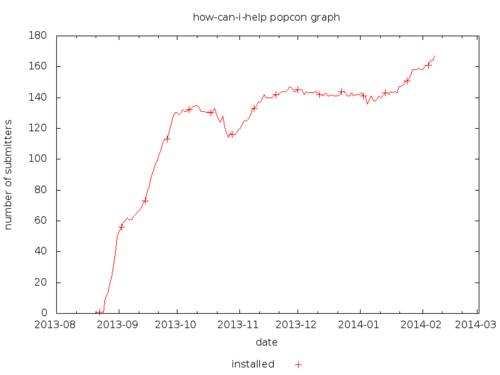
This is a repost from Stefano Zacchiroli's post how-can-i-help by Lucas Nussbaum is one of the best things that happened in the area of attracting contributions to Debian in quite a while. It can be used both as a standalone tool to list opportunities for contributing to Debian which are related to your installed packages, and as an APT hook (which is also the default configuration) that at each upgrade will inform you of new contribution opportunities. how-can-i-help is great for newbies who are looking for ways to give back to Debian which are a good match for their skills: among other things, how-can-i-help shows bugs tagged "gift" related to packages you use. how-can-i-help is also great for experienced developers, as it allows them to find out, in a timely manner, that packages they use are in dire need of help: RC bugs, pending removals, adoptions needed, requests for sponsor, etc. (As highly unscientific evidence: I've noticed a rather quick turnover of RFA/O/ITA bugs on packages installed on my machine. I suspect how-can-i-help is somehow responsible for that, due to the fact that it increases awareness of ongoing package issues directly with the people using them.) So, if you haven't yet, please apt-get install how-can-i-help RIGHT NOW. I daresay that we should aim at installing how-can-i-help by default on all Debian machines, but that might be an ambitious initial goal. In the meantime I'll settle for making how-can-i-help's popcon count skyrocket. As of today, it looks like this: Alt how-can-i-help popularity contest graph 10/02/2014 which is definitely too low for my taste. Please spread the word about how-can-i-help. And let's see what we can collectively do to that graph. how-can-i-help is just a tiny teeny helper, but I'm convinced it can do wonders in liberating dormant contributions to the Debian Project.

Matthew Garrett: IBM's remote firmware configuration protocol

I spent last week looking into the firmware configuration protocol used on current IBM system X servers. IBM provide a tool called ASU for configuring firmware settings, either in-band (ie, running on the machine you want to reconfigure) or out of band (ie, running on a remote computer and communicating with the baseboard management controller - IMM in IBM-speak). I'm not a fan of using vendor binaries for this kind of thing. They tend to be large (ASU is a 20MB executable) and difficult to script, so I'm gradually reimplementing them in Python. Doing that was fairly straightforward for Dell and Cisco, both of whom document their configuration protocol. IBM, on the other hand, don't. My first plan was to just look at the wire protocol, but it turns out that it's using IPMI 2.0 to communicate and that means that the traffic is encrypted. So, obviously, time to spend a while in gdb.

The most important lesson I learned last time I did this was "Check whether the vendor tool has a debug option". ASU didn't mention one in its help text and there was no sign of a getopt string, so this took a little longer - but nm helpfully showed a function called DebugLog and setting a breakpoint on that in gdb showed it being called a bunch of the time, so woo. Stepping through the function revealed that it was checking the value of a variable, and looking for other references to that variable in objdump revealed a -l argument. Setting that to 255 gave me rather a lot of output. Nearby was a reference to --showsptraffic, and passing that as well gave me output like:

BMC Sent: 2e 90 4d 4f 00 06 63 6f 6e 66 69 67 2e 65 66 69
BMC Recv: 00 4d 4f 00 21 9e 00 00

which was extremely promising. 2e is IPMI-speak for an OEM specific command, which seemed pretty plausible. 4d 4f 00 is 20301 in decimal, which is the IANA enterprise number for IBM's system X division (this is required by the IPMI spec, it wasn't an inspired piece of deduction on my behalf). 63 6f 6e 66 69 67 2e 65 66 69 is ASCII for config.xml. That left 90 and 06 to figure out. 90 appeared in all of the traces, so it appears to be the command to indicate that the remaining data is destined for the IMM. The prior debug output indicated that we were in the QuerySize function, so 06 presumably means query the size. And this is supported by the response - 00 (a status code), 4d 4f 00 (the IANA enterprise number again, to indicate that the responding device is speaking the same protocol as you) and 21 9e 00 00 - or, in rational endianness, 40481, an entirely plausible size.

Once I'd got that far the rest started falling into place fairly quickly. 01 rather than 06 indicated a file open request, returning a four byte file handle of some description. 02 was read, 03 was write and 05 was close. Hacking this together with pyghmi meant I could open a file and read it. Success!

Well, kind of. I was getting back a large blob of binary. The debug trace showed calls to an EfiDecompress function, so on a whim I tried just decompressing it using the standard UEFI compression format. Shockingly, it worked and now I had a 345K XML blob and presumably many more problems than I'd previously had. Parsing the XML was fairly straightforward, and now I could retrieve the full set of config options, along with the default, current and possible values for them.

Making changes was pretty much just the reverse of this. A small XML blob containing the new values is compressed and written to asu_update.efi. One of the elements is a random identifier, which will then appear in another file called config_log along with a status. Just keep re-reading this until the value changes to CM_DONE and we're good.

The in-band configuration appears to be identical, but rather than sending commands over the wire they're send through the system's IPMI controller directly. Yes, this does mean that it's sending compressed XML through a single io port. Yes, I'd rather be drinking.

I've documented the protocol here and hope to be able to release this code before too long - right now I'm trying to nail down the interface a little, but it's broadly working.

comment count unavailable comments

Mario Lang: Neurofunkcasts

I have always loved Drum and Bass. In 2013 I rediscovered my love for Darkstep and Neurofunk, and found that these genres have developed quite a lot in the recent years. Some labels like Black Sun Empire and Evol Intent produce mixes/sets on a regular basis as podcasts these days. This article aggregates some neurofunk podcasts I like a lot, most recent first. Enjoy 33 hours and 57 minutes of fun with dark and energizing beats. Thanks to BSE Contrax and Evol Intent for providing such high quality sets. You can also see the Python source for the program that was used to generate this page.

Stefano Zacchiroli: apt-get install how-can-i-help

skyrocketing how-can-i-help popcon count how-can-i-help by Lucas Nussbaum is one of the best things that happened in the area of attracting contributions to Debian in quite a while. It can be used both as a standalone tool to list opportunities for contributing to Debian which are related to your installed packages, and as an APT hook (which is also the default configuration) that at each upgrade will inform you of new contribution opportunities. how-can-i-help is great for newbies who are looking for ways to give back to Debian which are a good match for their skills: among other things, how-can-i-help shows bugs tagged "gift" related to packages you use. how-can-i-help is also great for experienced developers, as it allows them to find out, in a timely manner, that packages they use are in dire need of help: RC bugs, pending removals, adoptions needed, requests for sponsor, etc. (As highly unscientific evidence: I've noticed a rather quick turnover of RFA/O/ITA bugs on packages installed on my machine. I suspect how-can-i-help is somehow responsible for that, due to the fact that it increases awareness of ongoing package issues directly with the people using them.) So, if you haven't yet, please apt-get install how-can-i-help RIGHT NOW. I daresay that we should aim at installing how-can-i-help by default on all Debian machines, but that might be an ambitious initial goal. In the meantime I'll settle for making how-can-i-help's popcon count skyrocket. As of today, it looks like this:
how-can-i-help popularity contest graph, 10/02/2014
which is definitely too low for my taste. Please spread the word about how-can-i-help. And let's see what we can collectively do to that graph. how-can-i-help is just a tiny teeny helper, but I'm convinced it can do wonders in liberating dormant contributions to the Debian Project.

Next.

Previous.