Search Results: "ron"

10 December 2005

Andrew Pollock: [life/americania] Three weeks

I've been so busy, I haven't had time to blog. Rather than putting it off any longer, I'll just dump what I can remember. Last Wednesday, Sarah arrived after her holiday in Singapore, and from all accounts, had a great time. Photos as well. Sticking with the whirlwind theme, the next day, we had a "building warming" party at work for the new building we'd moved into the week before Michael and I started. The next night we had the work Christmas party, which blew the socks off any work Christmas party I'd ever been to before, and then on Saturday night we went to a party in San Francisco that we'd been invited to. On a life in general front, I'm still waiting for a Social Security number. The lack of one makes life a bit difficult for a lot of things. It also turns out that Sarah's work permit will take about 90 days to approve, so she's going to be a lady of leisure for the next few months. I've finally been issued with a work mobile phone (or "cell phone" as they call them), and so can stop roaming and paying through the nose for the privilege. We've found somewhere to live. We take possession of a 2 bedroom townhouse (split-level) in a complex in Mountain View that is 3 miles from work on the 18th. The rent is $1725 a month, which is a bit better than we were expecting. The complex we're renting in does have shared laundries, which we'd not too keen on before getting over here, but they're quite modern and secure, and there's a laundry block close to our townhouse, so hopefully it won't be too bad. The whole place had been renovated about 5 years ago, so it's all in good condition. We could have rented a 3 bedroom apartment (single level) in the same complex for about $125 a month more, but we're trying to actually make some money while we're over here... Driving on the other side of the road becomes fairly "normal" after about a week of doing it regularly. Sarah's adapted fine. Lane placement is the hardest thing, because your body's used to being in a certain spot on the road, and it's all different sitting on the other side of the car. We've managed to open a rudimentary bank account, even with my lack of Social Security number. Unfortunately I can't get paid until I have an SSN. Upside of that is that if it doesn't happen until next year, I presumably won't have to worry about income tax for this US financial year. Downside is kind of obvious... By far one of the stranger things of everyday life here is the lighting situation in the average residence. Lamps are all the rage, to the point that light switches don't exist in some rooms (notably bedrooms). Take where we're currently living for example. There's a light switch at the bottom of the stairs, there's one at the top. There's a bank of four in the living room, two of which control lights in the kitchen, and one the hallway. The last one controls a lamp in the corner of the living room, which is connected to a power socket (or power point as we'd call it). The bedroom with the attached bathroom (en suite) has two bedside lamps, and that is the sole source of light. The bathroom attached has light switches, and the walk-in robe has a light switch. It's so weird. So walking into a darkened bedroom involves walking all the way in, and fumbling around with a lamp. It's often easier to turn on the light in the wardrobe so you can see what you're doing first. I can't think of any reason for it, except tradition. It's not like they're avoiding wiring the walls or the ceiling, because it's done partially already. The bedroom has a ceiling fan, but where in Australia, there'd be a knob on the wall near the light switch to control it, it has a little chain you yank on. To add to the strangeness, there are two switches on the wall, one of which seems to allow you to turn off the ceiling fan if it's already been switched on by pulling the chain. The townhouse we're renting has a similar lamp dependency, so we're going to be making a trip to Ikea for some lamps it would seem. That's about everything I can recollect right now... Oh, I should point out that I'm really loving it over here.

9 December 2005

Junichi Uekawa: Chasing down the reason why elserv no longer loads.

I was investigating elserv breakage with emacs-snapshot package, since wysihtml depends on functioning elserv, and the bugreport had been idle for 3 months.325449.I've found out that elserv.el is the one causing the error message.The expression (push ?\ decoded) no longer seems to work with emacs-snapshot, and (push ?\\ decoded) seems to work instead.This same code is used in muse-el and emacs-wiki in cgi.el.Hmm..This was wrong, I found out.(push ?\decoded) is the right solution.?\is a space escaped with a backslash and emacs22 didn't like the next token being without a whitespace.

8 December 2005

Martin F. Krafft: False advertising

I stayed at the Hilton hotel in Vienna during a business trip. Fortunately, I didn't have to pay for the room, because 190 EUR for a night is way above my budget. The hotel advertised "Hi-Speed Internet Access" for all clients. Good. Given the mere average room I had, this would be the least for me to expect for this immense price. Unfortunately, "Hi-Speed Internet Access" only means that the hotel is a "HotSpot" of a local telecommunications provider. Poor clerks, just get told to smile and proudly announce "Hi-Speed" in every room, when reality turns out to be just another money making scheme. The provider's price list states 2 EUR for 15 Minutes of access. However, the hotel clerk informed me later that it was not possible to purchase time directly, I would have to go via the hotel -- at 6 EUR for half an hour. Rip off. It turns out I actually needed the 'Net, so I bit the bullet and tried to log in, after paying the 6 EUR. However, the only thing I got to see was an OSCP error from Firefox, after being redirected to the login page on first web access. I have not investigated, but OSCP possibly uses a separate non-port-80 connection, which of course is blocked before login, so it didn't work. Finding out that Firefox is unable to whitelist single sites in terms of OSCP verification, I quickly got tired and demanded my money back -- which of course was "not possible because the system does not allow us to cancel an existing subscription". I find it very alarming that such "business conduct" seems to be widely accepted, or has even become a standard by now. Consumers are being ripped off on all fronts, and those in politics dedicated to protect the consumers have the bribery money so far up their rear ends that it exercises control over their small brains. The one lesson I learned from this: the sooner I find the time to set up a DNS tunnel, the better.

Martin F. Krafft: When in Vienna, do as the Viennese do

I wish that Americans, when travelling outside of their country, would show at least the effort of adapting to the local culture, and not assume that their conduct is welcome everywhere. It would make it easier (for me at least) to respect their presence in days of the negative omnipresence of the Excited States of America in the media. Vienna is a city with strong cultural values and tradition. Tourists wearing jumpers to bars (or not taking their cowboy hats off), being loud and obnoxious in the streets, yawning loud and openly while talking, or making fun of locals in traditional clothing don't help the reputation. I assume those knowing me to be able to place the above in the right light. I know and respect many Americans. But those generally try to do as the locals do.

MJ Ray: Business Truths

I smiled at "Things I thought" from Bagel Belly Blog more than I have for a while. Much truth there. The Bagel Belly is back on form. Sam Hocevar asks "Is there a task organiser that does not suck?" which I think is interesting - the program is not the organiser. The user is the organiser. The program can only help (or hinder!) not organise. Sometimes obvious is just plain wrong. I used to think it was obvious to answer my messages at the start of the day. I found I lost whole chunks of the day that way. For me, long reading is usually an evening activity, so I guess my mind associated it with going to sleep afterwards. I didn't notice that reading personal email is fine, when I reply to a high proportion of it and act on it. That starts my day with action and I continue being active through the day. Reading mailing lists and newsgroups isn't fine, as I read most of that and don't reply. I switched to reading only personal email in the morning and leaving lists and newsgroups until later in the day, unless there's something obviously interesting. It's made a big difference. Is there a need to rethink email? Bob Geldof rails against emails:
"Geldof said he dreaded seeing lots of e-mails in his inbox, as they imposed an agenda on him, and disrupted his own plans for the day."
This doesn't surprise me in general (is there a less likely email fan?) but does he have a point? Over time, I've moved to treating emails as letters, essays or at least office memos. It's easy to treat them as conversations, but they are not, in so many ways. You can say things in conversations that will haunt you if you ever write them down. In conversation, people accept that sometimes you'll make comments without proper review and reflection, but it's assumed that you have considered your emails, even though most people don't seem to. This is part of why I think the Debian private email "declassification" proposal is unethical if applied to past messages. People didn't expect to have such a wide audience. Similar musings from techdirt, the Register, the Inquirer and Business Week Maybe see also thread patterns from see shy jo which could help you skip though low priority email sooner, and Online forum usage and other addictions, from Steve Pavlina. I wondered if the problems were new to online. Forums can be a bit like newspapers, but while you get a whole day to read a newspaper and there's one hell of a lag on the letters page, you can get a forum update by clicking at any time (even though new editions may be smaller) and your talk-back appears instantly on most forums. - Then someone reminded me about "news junkies" who buy all the newspapers and watch or listen to rolling news. Maybe this isn't a new problem. How was it solved in the past?

John Goerzen: Underwear Rotation

Well. I discovered this evening that my underwear has been rotated for me for the last three years. My wife and I were innocently discussing her tendency to make organized piles of things. Then this conversation happened: Terah: And I also rotate your underwear. Me: (laughing) Really? Terah: Of course. Me: (laughing uncontrollably for awhile...) So does it get rotated every 6,000 miles like tires or what? Terah: (pretending not to get the joke) No! Me: Why do you rotate it? Terah: So it all gets worn evenly. But you mess up the plan because you don't always take underwear from the front left pile first! Besides, you wouldn't want any underwear to be left out. Me: (just understand that I'm laughing pretty much this entire time...) How long have you been doing this? Terah: Since I started doing our laundry. (That would be since we moved to Kansas 3 years ago; I did our laundry before that.) Me: So do you rotate your own underwear? Terah: Oh, of course, I've been rotating mine for years. Me: How many years? Terah: Hmm, about 11. Me: So do you have a specific rotation plan? Terah: Yes! Each week, the 2nd-row right pile moves to the 1st-row left pile, the first row middle pile moves right, and the 1st-row right pile moves up. The left two piles on the 2nd row never rotate. (Initially, I wrote: "Each week, the 2nd row-left pile moves down to the front-row left, and everything else moves around, except the third row, which doesn't fit as well and never goes in the rotation." But Terah reviewed this before I posted it, and said: "There is no third row. You don't even know how many rows of underwear you have!!" Terah says that what I've written now still isn't quite right, but it's close. I guess I may never understand all the theory behind proper underwear rotation.) Me: So is there a set number of pairs in each pile? Terah: Yes. Three. But sometimes you mess that up because you throw away worn out underwear. Me: So what all gets rotated? Terah: Well, your underwear, my underwear, bath towels, kitchen towels, your t-shirts, and I used to rotate my socks but I don't anymore. I probably rotated them for about 9 years. Me: So I'm supposed to start taking underwear from the front-left pile each week. What happens after I have used three pair? Terah: Well, you move to the front center, then front right, then you go to the back right and work your way back left, making a circle. Me: This is great. I'm going to have to blog about it. I think I should take a picture of my underwear drawer and post it. Terah: But why are you laughing so hard? It's not really funny.

7 December 2005

Paul van Tilburg: Arrival In Edinburgh

The flight to Edinburgh went just fine. I believe it’s my first time flying 10 minutes ahead of schedule because everyone was already in the plane. I left on 12:35 CET, landed on 12:35 GMT, so no time lost :). After arriving I was dying for something to eat (which I took with me in my coat but it wasn’t really reachable in the plane). So I ate, got some money and took a taxi to the Heriot-Watt University campus. The university campus Main reception of the Heriot-Watt University I got dropped off on the campus at the main reception. There I was able to store my luggage and I was kindly directed to the Mountbatten building, home of the school of MACS. There I met Fairouz Kamareddine and two of my direct colleagues: Manuel Maarek and Krzysztof Retel. Fairouz quickly arranged that I got registered as a HW(Heriot-Watt) student, got my MACS account, the accommodation, etc. The Thomson Hall where I live in With keys, luggage and instructions I took off to the Lord Thomson Hall to find my room. At 17:00 I was completely settled in already. I met my (all Chinese) four kitchmates (yes, it’s a strange word) and went back to the university refectory for dinner. My room is a quite small, at least, smaller than I am used to (about half the area), but it has a bathroom (with shower), gets cleaned weekly and all the heating is included… so I am not complaining. I must say that the people on campus are very nice. I can ask anyone if I need to know something and I always get help or a kind reply. There are really a lot of foreign students here (about 25%) who all share the same fate.

Jesus Climent: Crappy electronic music.

Well, I believe that is what, lately, I listen to most of the time.

Wouter Verhelst: Belpic 2.40

When I had almost finished packaging belpic 2.3.13.full, I contacted upstream to notify them of this fact, also mentioning that I'd replaced their build system (which used simple makefiles with many bugs) with an autotools-based one. To which I got the reply that they'd already prepared a belpic 2.40 in the mean time (available at readers.eid.belgium.be), and that they'd switched to SCons as their build system in the mean time. Since I'd spent quite some time on 2.3.13.full already by that time, I decided to continue to prepare that package, and focus on 2.40 afterwards Now of course I'm happy that they chose to use something different from plain buggy MakeFiles. I'm less happy that they chose something based on python, a language which I haven't liked, ever, and don't know much about either, but, well. That's their choice, right? I'm also less happy with the fact that it doesn't properly clean up after itself (requiring me to do ugly stuff in my debian/rules clean target), and that it doesn't work. Grmbl. The build currently fails on a file that hasn't changed, because it can't find a symbol which is defined in a file in the same directory that hasn't changed, either. When I rerun the gcc call with the -save-temps argument and review the preprocessed source, I see that that include file is mentioned, but not included. Something is clearly wrong here. Guess I'll have to start learning python... hrmpf. If you care, belpic is the software required to read out the information and keys in a Belgian electronic ID card. Not of much use if you don't need to read Belgian ID cards, though :-)

Radu Spineanu: Mailman madness

A couple of days ago, a client decided that he wanted one click unsubscribe for all his mailing lists. We used mailman and from what i found googling about it, this is mostly an idea in the minds of the developers. Unfortunately i could not wait until Mailman 3 or 10 appeared. I had to implement it this week.

Actually in the end, the result was pretty simple to do, even though it's rather basic. The idea was that the client did not like the mailman web interface, and wanted to integrate it with his own website (just basic subscribe unsubscribe features).

So i wrote a small patch (3 or so lines) to mailman, that adds a new field to decorate called %(hash) that is the users password crypted.

The interface between the web address in the mail and mailman is done through a directory where requests are placed. For example when a user clicks a link, a php script does some basic checking and places a file in $client_web/list_requests, or a global requests directory. The idea for this part was to be very easy for the user to implement.

Another small python script looks (through cron) in those directories, checks hashes in case of unsubscribing, and procceses the requests.

Kai Hendry: Why are Web forums so popular?

It began with a bug, that led to Sam Trenholme’s response, that got my thinking: Why are Web forums so popular?

8<-8<-8<-8<-8<-8<-8<-8<-8<
to just the US-ASCII character set; that comes off to me as ludditeism.
This is the same attitude as the Usenet users who think HTML in a Usenet
post is some kind of mortal sin. There is a reason web boards have
effectively killed Usenet…but I’m digressing.
I assumed it was because people want to be sysops of their own “board” on their own server. HTML in messages is just plain stupid. Most MUAs can’t render Unicode or wrap text properly. To render HTML correctly you need a beast! Or am I wrong? Most Web forum posts don’t seem to use HTML that much … The only “Web” interface to Usenet seems to be Google Groups. Are there any other? One could be sick of seeing the omnipresent G in the tab or not being able to style the interface. Perhaps some people just don’t like the idea of their messages on Usenet. It is a little scary to think some messages could be around for, well forever. Could it be the spam on Usenet? Though I don’ t see much of it on Google Groups. With Web forums the barrier to entry is pretty low to the comparable mailing list, which is pretty hard to join and contribute to. Perhaps Google is doing a bad job of incorporating Groups results into Web search results. How many times have I been searching for something and ended up on some “Ask an Expert” type Web forum. OMG. Web forums probably win because of the easy-going community aspect. I recall now a friend’s testimony of being flamed by some (RTFM) jerk after some innocent post on Usenet. It seems a little odd though that you have to create this little social islands for piece of mind. Perhaps it’s only natural.

6 December 2005

Joey Hess: ending the tyranny of unix permissions

In Debian, we work on developing a unix-style operating system, and when the project was getting started, the obvious way to deal with delegating powers to various people was naturaly to use standard unix permmissions on our master server. So the list administrators were the only people who could write to the list configs and archives, the BTS admins were the only ones who could write to the BTS, the archive admins were the only ones who could manipulate the archive, the build daemon admins were the only ones who could modify various bits of that stuff, etc. As time went on, these services were split off to seprate machines and in some cases access to the machine running a service was limited to the maintainers of that service, again in a way that would be familiar to unix admins everywhere. But as time went on and things like revision control systems became available, Debian also began to make some choices that didn't involve unix permission or host based security. The best example of this is the Debian bug tracking system, which allows anyone to manipulate any bug status in any way without any authentication at all. It works because the BTS keeps a record of all changes, and informs interested parties about changes, so vandalism or accidents can be reverted. Aside from spam, vandalism in the BTS is such a rare problem that I cannot think of an example. Thus the Debin BTS partakes somewhat of the WikiNature, although it predates the wiki by a long time. The archive itself only uses unix permissions at its core, while the upper layers do not partake of them: Any maintainer can upload any package and superscede data in the archive automatically, although actual unix write permissions are very limited. The archive administrators use archives of old versions of packages, automated checks, and forced manual review of certian classes of packages (such as NEW) to limit this so that Developers don't make messes. Social norms are used to avoid other problems. The Debian website is in an interesting period in its history. It's been maintained in a way that mostly avoids unix permissions for a long time, by keeping it in CVS and building it automatically. However, for reasons that I suspect have never been adequately explored, not all Debian developers can commit, you have to be in the webwml group. Though gaining access to the webwml groupo is trivial for any Debian developer. But the most interesting thing is that Debian now also has an official wiki, which is open to editing by all, and that increasingly it is used for at least the more fluid and development-based website stuff. For example, the debian-installer home page is a thin stub giving the essential information and links, and mostly linking to the wiki for the rest. The debian-installer project itself occupys another point on the scale between locked down unix permissions and free modification by all. People have to get an alioth account and demonstrate basic competance to get debian-installer write access, but don't need to be Debian developers or spend more than an hour or so to get access. Once you have access, you can change anything in svn (and everything is in svn) we don't limit write access to parts of the project. We avoid malicious commits through patch review. I could give many more examples of subsystems in Debian that exist at different point in the spectrum between locked down unix permissions and a wiki. There seems to be a definite pull toward moving away from unix permissions, once ways can be found to do so that are secure or that allow bad changes to be reverted (and blame properly assigned). Cases of moving in the other direction are rare (one case of this is the further locking down of the Debian archive server and BTS server after the server compromise last year). Anyway, the point of this is that, if you survey the parts of dealing with the project where Debian developers feel most helpless and unempowered, the parts that are over and over again the subject of heated discussions and complaints, you will find that those are the parts of the project where unix permissions still hold sway. This can range from simple cases such as a cron job that only one person can look at and modify[1], to various data files that could perhaps be kept in svn, but aren't, all the way through to stuff like the Debian keyring. I would love to see a full list developed, although many of the things that remain are obscure little corners like certian blacklists in the BTS, bits of the buildd infrastructure that only a half dozen people know about, etc. The challenge, then is to find ways to open things up to everyone, without throwing security out the window. It has to be done a piece at time, and some of the pieces that are left are the ones most resistant to this change. I hope that people can keep this progression away from unix permissions in mind while working on Debian infrastructure. (If I ever ran for Debian Project Leader (which I won't), this would be one of the areas that I would be sure to investigate basing my platform on. Speaking of which, it's nearly election season again, isn't it?)
[1] The best solution I have found to this common problem so far is simply to keep the cron job in svn with everything else, and if someone modifies it, review it and update it via semi-automated means (some simple command). There are probably better ways to do it.

MJ Ray: Safe Cycling Quiz Considered Harmful

The local BUG linked to a safe cycling quiz. I had a few problems with it because it needs javascript as well as the disclosed cookie requirement: PHP could do this without both, so I think it's slightly bad programming; but eventually I went through the questions. I was rather surprised to score only just over 50%. After reviewing the questions, it turns out that it's not because I do things seriously wrong: it's more that the question-setter seems a bit militantly anti-car and assumes that cycle lanes and cycleways won't be built to the national standard. To be fair, most are substandard, but I assumed the examples in the test questions were OK, in the absence of other information. I also disagree about the message sent by moving right on the approach to a narrow. It seems to make some drivers think you're going to make a right turn using the island as a refuge, so they move to undertake, which is really dangerous. They shouldn't overtake too near the island if your normal road position is good.

Martin 'Joey' Schulze: Why I joined LinuxTag

In 1999 I went to LinuxTag as a Debian representative after the project has received an offer to staff a booth there. I took over the maintenance and organised the first Debian meeting in Germany. I also gave two talks during this event, one of them was even repeated on the second day. We've had a lot of fun and since this was the first meeting of Debian affiliated people in Germany, it was very interesting to connect faces to mail addresses and to learn more about the people behind a name. This LinuxTag was the last such event that took place at the University Kaiserslautern. Free projects such as KDE and Debian have been offered a booth in one building from which one could reach the lecture rooms, while company booths were located in the Mensa building with their own professional booths. It was a warm weekend and the Jolt people have supported us with cool and caffeined drinks. We had the opportunity to use a lecture room for sleeping with other project members. Klaus Knopper was supporting the network and supervised the security team, and hence, had the unfortunate job to move away all project members from their booths, out of the building or into the lecture room. I've heard, that he had a hard time, and still believes that Debian people don't need sleep. I guess we should have moved him into the lecture room for a sleep instead. This '99 LinuxTag was quite a real success. It took place at the rise of the dot com era and all people were happy about the event. There were about 7,000 visitors in total on both days. The city of Kaiserslautern has called the university several times since there were no free hotel rooms anymore. Former events happened more or less unnoticed by locals, but not anymore in 1999. After the show was over, we dismantled the booth, moved away our own equipment and left the place. However, I made the "mistake" to notice that the LinuxTag people, who have provided us such a great opportunity, still had work to do since they had to dismantle the booth system and clean the ground floor. My biggest "mistake" was that I didn't run away and have a nice evening but decided to help and ask other booth members who were still around to do the same. Having cleaned up the location quite fast was not the only result. Oliver Zendel, who was in charge of talking to the community and who offered Debian the booth, spoke to me afterwards and wondered whether I would be interested to join the team. Well, I knew how to organise stuff, can talk to people, know quite some people in the community, the LinuxTag people were a cool team, so why not. So for the event in 2000 I was in charge of the projects exhibition. In 2000 we also had to move out of the university of Kaiserslautern since 7,000 visitors were already too much for that small university and city. That's why we eventually moved to the Stuttgart fair. That was an interesting experience. It was also interesting to see how such an event can be organised by a team of friends and how the acceptance in the business world was. In Stuttgart we were able to use a small office (max. 15m ) for the entire team as working space. Two computers were installed which we were allowed to touch but not to install a real system on. Hence, Klaus brought Knoppix CDs. This was the first time that I learned about the Knoppix Live CD. Together with my notebook we've had three desks and could work. However, today I really wonder how this could have worked with so many people, but apparently it really did. Due to the need and my experience in both talking to the press and being the press I joined the LinuxTag press team and even held the final press conference, while my colleague held the opening press conference. So after all projects were happy, the show went fine and most of the office jobs were done, I prepared a press release together with others and maintained the final conference. This was also the first time LinuxTag has organised a business congress as a special extra program for business representatives. It was also the time I experienced the need for several supporters for various tasks. In that year, a dozen supporters were paid as "security" who also drove the shopping for us. Hence, I already acquired some people who supported us as volunteers. That was also the time when Benny joined the team. In 2000 the exhibition boomed and there were a lot of large dot com company booths, which was very nice because LinuxTag arose from a students association and became more and more professional, a platform for both companies and projects. It was organised just like a Free Software project and worked non-commercially. Despite several flame wars and disputes, which seem to be normal, it was organised by friends who believed of a higher goal. It was very nice and gave me a warm feeling when looking at what we have achieved. However, I had nothing to do with commercial interests, income, acquisition, invoices etc., so I may have missed a lot. This year, LinuxTag was planned to take place in one exhibition hall, but there were so many companies interested in running a booth that a second exhibition hall was later rented as well. That's why there were two adjacent halls instead of one large location. In 2001 we were using a different exhibition hall, a larger one due to the strong demand in 2000, but still at the Stuttgart fair. This time I was also in charge of the supporters and already dispatched jobs during the event. From time to time I also maintained the shuttle service to the airport to pick up speakers or take back speakers, which I've also done in 2000. This time we've had a larger office in which all of use fit and which was a nice working atmosphere. We were also able to provide more booth space to Free Software projects. In that year I've automatically taken over the office and communication with the outside world, collecting and distribution information. I don't think this was planned, but it just happened since I was able to do the job besides my other obligations. I also gave a talk about Debian, even though others in the team considered me insane for doing that as well. With a lot of help by the local user group, we were able to offer project members a cheap sleeping opportunity. The LUG acquired a gym hall during the night an cooked in the student's office "Hellblaues Nilpferd". After I've picked up Hans Reiser I went there for a snack with him before dumping him at the hotel. It was a nice atmosphere. One of the lead people for this effort, Hubert Kai er, was suddenly overtaken by death two weeks ago. In 2002 LinuxTag moved to Karlsruhe and thus to a new fair where everything had to start again from zero. We had to get acquainted with the local company and their representatives and learn how the new fairground works. The fairground was more interesting since there was a large open area between the conference site and the exhibition hall. Looking at past years, it was used by visitors. Thanks a lot to Jochen Topf from GUUG and members of the local user group KaLUG a lot of community events happened during LinuxTag. They maintained an Internet caf in the conference building and organised the legendary KaLUG party which has become a regular LinuxTag event. In addition to that I've also worked more and more and took over more areas where I noticed help was needed and that I could manage it. So it happened that I took over more work at and before LinuxTag which finally resulted in two months of work were I don't remember a day on which I've worked less than 8 hours for LinuxTag in 2005. In 2002 I worked on the coding marathon and delegated the tasks and support during LinuxTag to two other people, so it will run independent of me. Since I was the first of the team to arrive in Karlsruhe, I also built up the office and the storage. Due to the large distance I had to leave Oldenburg the day before I want to arrive in Karlsruhe, so that I was at the fairground at last at 10 o'clock on Sunday morning. Before the event a lot of issues had to be negotiated with various parties, which required quite a lot of work. Until 2004 the entire team was working in their spare time without getting paid for their LinuxTag work. The higher goal was the impulse and all of us had neglected one issue or another that wasn't important for LinuxTag. We've had some external service providers at least since 2002. The acquisition became a difficult task for students who liked to work until the morning and get up at lunch time, since many companies expect a partner that is available for them from 9 to 5. That's why Charter was eventually hired and this year ergomedia. For press work newthinking was hired. This year the social event was also organised by them. However, having two people from the board of directors being paid by the association for their LinuxTag work from April, and external service providers that were also paid, was something I considered problematic if not unfair, looking at how other people commit to LinuxTag and don't get a monetary compensation. Several people still worked a lot on LinuxTag in their spare time and had to live from something as well. It caused resentment in the team.

Jaldhar Vyas: foss.in 2005

I've come back from foss.in in Bangalore, India which I attended as a representative of the Debian project. Foss.in is the event formerly known as Linux Bangalore. It has broadened out to cover all aspects of Free and Open Source Software and is the largest such event in South Asia. I'm told almost 3000 people attended this year. I arrived on the morning of Monday the 28th. The conference organizers put up myself and other speakers at the guesthouse of the Indian Institute of Science. The accomodations were spartan but comfortable. They got considerably less spartan by the next day which was when I figured how the hot water tap worked. I shared my room with Kartik Mistry of Gujarati l10n fame. The first day of the conference was on Tuesday the 29th. The conference was taking place for the first time in a new venue, in several large canvas tents in the grounds of the Bangalore Palace. There were some technical difficulties; when we arrived on site in the morning, there was a line of people atleast several hundred long, waiting to register. Undoubtedly, some of them must have given up and gone home, but the fact that so many people persevered is a testament to the high level of energy surrounding the event. The talks began late too but everyone I spoke to seemed to take it goodnaturedly. I had planned to give two talks. One my standard half-hour "What is Debian?" song and dance. If you went to Debian Day at Helsinki, you already know what that's about and a 90 minute workshop on "Creating Debian Packages." Both were scheduled for Tuesday afternoon. Owing to the earlier delays, the first of these which was slated for 2:30pm didn't start until 4pm. The organizers actually asked me to roll both talks up into one supertalk which was not a problem for me. However, I made one fatal mistake. At lunch time I had noticed one of the food stalls was selling an inviting-smelling cheese pizza. Now, I've been to India enough times to know, "phirangis" simply don't eat dairy-based food in India unless they have some time to acclimatize to it first. I even said as much as I was eating the pizza. Somehow I rationalized that the cheese was pasteurized and well-cooked so the rule wouldn't apply to me but boy was I wrong. I first noticed signs of distress three-quarters of the way through "What is Debian?" I struggled valiantly to the end but then had to excuse myself to head off to the latrines and perform a hard reset of my gastro-intestinal tract. A couple of minutes of vomitting later, though a bit wobbly, I felt well enough to return and start talking about creating Debian packages. I didn't have slides for this one, I just used my laptop to show the innards of binary and source packages, all the various files in the debian directory, debhelper, debconf, and the lifecycle of package maintainence. Unfortunately wi-fi didn't seem to be stretching as far as my location so I couldn't show such nifty things as apt-get source and pbuilder but hopefully my descriptions of these things were impressive enough. There were lots of good questions from the sizable audience and I think we went over 90 minutes. Apart from some BOFs, I didn't really have any formal commitments for the rest of the conference so I spent it holding court at a table in the expo area. I was constantly busy demoing Debian, answering questions, and signing keys. I met Vaidhyanathan Mayilarangam who is a Debian developer, though inactive at the moment. He is going to start getting involved again soon. On Saturday the 3rd, I met the two currently active DDs, Ramakrishnan Muthukrishnan, and Ganesan Rajagopal. Throughout the days of the conference I also met many other figures on the Indian Free Software scene and made a lot of new contacts. That's it for now; in future blog entries I'll write about some of my impressions of the prospects and problems of Debian and Free Software in India. It remains for me to thank: Branden for authorizing funds for my plane ticket, Atul Chitnis and the other organizers and staff of foss.in, Mahesh Pai and Prasad Kadambi who assisted me in navigating Bangalore, and all the other friends of Debian, new and old, I met during my trip.

John Goerzen: Aunt Viola's Conspiracy

Yesterday, I told you about Aunt Viola, choir director at our church for many years, about 50 years ago. Today, I'd like to tell you what she did in church last week. In our community, the song Nun Ist Sie Erschienen is a traditional Christmas hymn. Even though our church services have been in English since the 60s, and the song isn't in any current hymnal, it's still sung around Christmas. (There is a photocopy of this song with each hymnal.) Some of us wish it were sung a little more often. Our church, like many Mennonite churches, has a sharing time during the service. People share what's going on in their lives -- joys or concerns, or whatever it may be. Last Sunday, the first day of advent, the hymn wasn't in the bulletin. The sermon that day was on surprises (very fitting). At the end of sharing time, one of the older people in our church got the mic and said something like "I feel like singing Nun Ist Sie Erschienen, so we're going to right now!" Aunt Viola had been in on this -- she had checked with the organist in advance. So it was all set. Aunt Viola sprung up and somehow got to the front of the sanctuary very quickly (she is in her 80s), ready to direct the congregation! And it was great. I like the song too. It was one of my grandfather's favorites (he played it wonderfully on harmonica) and we sang it (in English) at our wedding. After church, I asked Aunt Viola how long it had been since she had directed for a song. She didn't know -- "a very long time". But she said that if I ever wanted to request a song during sharing time, she'd be happy to direct again! I think I might have to one of these days.

5 December 2005

Joachim Breitner: Debian Quiz

I took the Debian Quiz, and scored 32 of 37 (86.5%) right. The quiz told me that my answer to Question 2 is wrong, but I still think it is rigt: It does not matter how it is pronounced. When talking to Germans about it, I usually pronounce it German, and I think this is ok.

Martin F. Krafft: Drugs and the law

It is my strong belief that the law should diversify more when it comes to drugs and their use. In particular, the law should differentiate between
  • drugs that are dangerous to the taker, or can cause long-term damages, such as physical or mental addictions. This class would be primarily made up of the so-called hard drugs: opiates, entactogens, inhalants, steroids, sedatives, and stimulants.
  • drugs that cause hightened awareness and give the taker the ability to approach life, society, or any sort of philosophical question from different angles. In places, these are referred to as intellectual drugs: hallucinogens and (some) herbals.
If the law differentiates this way, each country could make it explicit whether it tries to protect the individual (which it should), or whether it protects the equilibrium of society (which could be considered fascist). Important: this is all about use of a drug. Cultivation, dealing, and related acts must be under separate and harsher legislation. The black-white approach taken by most governments these days really just pisses me off. Who are they to decide what an individual may do (or not) with his/her own body, assuming no harm comes to third parties? PS: No, I am not a junkie. I just get annoyed when someone is jailed for smoking pot or eating magic mushrooms in the forest. Especially if you know and respect that someone. NP: Mono, Under a Pipal Tree

John Goerzen: Aunt Viola's Choir

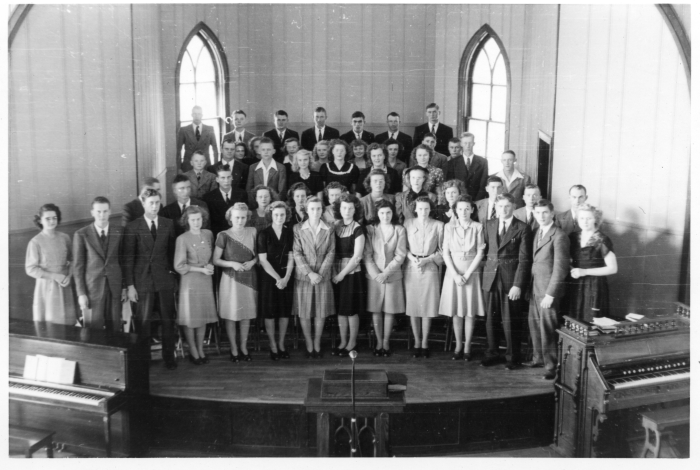
Terah and I are in the adult choir at church. The current choir director's aunt, Viola, is also in the choir. So she is Aunt Viola to quite a few people. Aunt Viola was the director of the choir herself for many years, back in the "old" church. That church was torn down to make room for a new building in 1965. Not long ago, I heard from someone that she was looking for a picture of the old choir. She thought it was in the church archives, but nobody could find it. But I happened to have a copy. Another person that was in the choir had given it to me to scan for a book project a few weeks before. So I uploaded it and ordered an 8x10 print for Aunt Viola. Terah and I sat behind Viola and her husband the next Sunday. As people were visiting before church started, I handed over the envelope and told her there was a little surprise in it. She opened the envelope, and knew right away what it was. And was she ever excited to have it! It made us very happy to have made her day. She was talking about it for the rest of the day -- actually, for a few weeks. So here it is, the choir of Tabor Mennonite Church in 1946. Aunt Viola is on the far right in the front row.

Aigars Mahinovs: Another bug has pissed me enough to start debuggin...

Another bug has pissed me enough to start debugging. This time it is Totem-xine crashing on startup in Ubuntu dapper.

The first thing is that you cann't rebuild totem from sources multiple time after ubuntu patches - ubuntu uses dpatch to patch something in automake files and after the build has been run, the unpatch fails thus preventing a rebuild, doh! Worked around that by removing that patch. (Bug not reported yet)

After installing totem-gstreamer, my main suspect is the change to the statusbar, that look very recent. Could it be that Totem developers forgot a critical fix to the xine backend? Could it be that the treat xine backend as a ... second class citizen? To what? To that GStreamer? I tried to use GStreamer, I really did, but there are a few tiny issues: 1) it doesn't open even half the files that xine does, 2) within 5 minutes of a movie audio-video can easily get out of sync by 5 seconds. I have never seen A-V sync in xine. Ever. I love telling our Windows using frends that my movies "just work" with totem-xine, please do not take that away!

Anyway - back to the bug we go.

As we have a clean crash, I recompiled totem with debugging symbols ("DEB_BUILD_OPTS=nostrip,noopt debuild -us -uc") and run with gdb. When totem crashed, I got the code line, where it happened:
(totem:4608): GLib-GObject-WARNING **: invalid cast from   ' to  TotemTimeLabel'

Program received signal SIGSEGV, Segmentation fault.
0x08068659 in totem_time_label_set_time (label=0x8199a60, time=0, length=0) at totem-time-label.c:69
69 if (time / 1000 == label->priv->time / 1000

Now, that is interesting, lets see, what we have here - time is an int, so no segfaults from there, but label is a TotemTimeLabel. Hmm, that error now makes sense. And when we take a look at label->priv, it appears to be a pointer to TotemTimeLabelPrivate with an address of 0xffffffff. That's the problem, now we only need to backtrace trough the program and find the bug that is causing that.

Well all looks pretty nice - there is a "tick" event in the player that calls the time update. Not really clear, why there is such a discrepance between GtkLabel and TotemTimeLabel or why this structure is not inicialized in time. More strange is that gstreamer backend never calls this function. Wierd. Let's see what happens if I just return from it without doing anything. Does not help - now statusbar is crashing.

Let's try it from another angle - it worked before. Nothing much in totem changed since release of breezy. Installing the version from breezy, it works fine. Recompiling the version from breezy on dapper - crashes. Ouch! It looks like xine backend of totem has not been ported to that new crazy Gnome 2.12 thingie, like gstreamer backend was. Strange - that is a backend, it should not be dependent on the frontend, no? Anyway, it is not something I can do - I will have to install the breezy version, hack some dependencies to make it no conflict with one optional library and then file a critical bug on totem for breaking the xine backend.

But even that will have to wait 'till tomorrow, sleep is of the essence, anywere.

Next.

Previous.