Dimitri John Ledkov: Debian 9.0 code name announced - Zurg!
It really does have a good ring to it, and lovely strong brand image! I like it =)
 |
| Zurg - Debian 9.0 code name |
|
| Zurg - Debian 9.0 code name |
~/.ssh/id_rsa), since
file system access is not enough to steal your key anymore. Instead, you ll
need remote code execution.
To use this software, first make sure your TPM is enabled in the BIOS. In my
ThinkPad X200 from 2008, the TPM is called Security Chip .
Afterwards, claim ownership of your TPM using tpm_takeownership -z
(from the tpm-tools package) and enter a password. You will
not need to enter this password for every SSH authentication
later (but you may choose to set a separate password for that).
Then, install simple-tpm-pk11, create a key, set it as your
PKCS11Provider and install the public key on the host(s) where you want to use
it:
mkdir ~/.simple-tpm-pk11
stpm-keygen -o ~/.simple-tpm-pk11/my.key
echo key my.key > ~/.simple-tpm-pk11/config
echo -e "\nHost *\n    PKCS11Provider libsimple-tpm-pk11.so" >> ~/.ssh/config
ssh-keygen -D libsimple-tpm-pk11.so   ssh shell.example.com tee -a .ssh/authorized_keys
You ll now be able to ssh into shell.example.com without having the key for that on your file system :-). In case you have any feedback about/troubles with the software, please feel free to contact Thomas directly.
 Today was my "clean the house" day. I also had a chiropractic adjustment
first thing, and a massage before lunch.
I biked to Kindergarten to pick up Zoe, and found her holding court with a
bunch of her classmates, giving a show and tell session about the Cinderella
snow globe and echidna plush toy she'd taken to Kindergarten. The kids were
taking turns to raise their hand and ask questions. I was out of earshot, so
I couldn't really make out what was being said, but it all looked very cute
from where I was standing. She didn't have a nap today.
Sarah's going down to Tasmania until early next month, hiking, and so I've
got Zoe for the next 12 nights. This is the longest she will have been away
from her mother by quite a significant amount. On top of this, she's been
doing rather poorly at bedtime with me the last few nights I've had her. I
wanted to try and minimise the emotional impact for both of us as much as
possible, so I wanted to make an Advent-style calendar to count down the
number of sleeps until Mummy got back.
After we got home from Kindergarten, we drove over to Officeworks to pick up some bits
and pieces. It ended up being quite a long outing because it took a while
for me to figure out how to convince the self-service photo printing kiosk
to actually print photos.
Zoe parked herself in the kid's colouring area, and she was quite happy
there while I went looking for a few things, but after a while wandered off
to find me and we spent some time looking for each other. I was pretty
impressed with how well she went looking for me. She didn't freak out, and
was just wandering around the store looking for me. We had a talk about
staying put. Then we called grandma from the carpark to wish her a happy
birthday before we headed home.
That ended up being quite a lengthy outing, and I started dinner as soon
as we got home. Bedtime actually went quite smoothly tonight for a change.
No idea if the poster or the lack of a nap helped or not.
 In cycling, a ride's Training Stress Score is a function of that ride's duration, average power and the intensity of the ride relative to the rider's capability. This Slowtwitch article provides a good overview on how intensity and TSS is calculated on a bike.
However, having TSS values for other sports allows a multisport athelete to take into consideration the physiological cost of activities in different sports. This is achieved by ensuring, say, 50 TSS on the bike "counts" the same as a 50 TSS run.
This can be used to simply determine the length, intensity and scheduling of the athletes next workout (to ensure adequate recovery) regardless of the combination of sports, or to identify the athlete's long-term tolerance to and targets for training load using metrics such as Chronic Training Load.
To make this possible when using Strava, I wrote a Chrome extension that estimates the TSS score of a run from its Grade Adjusted Pace distribution:

The "TSS (estimated)" value is calculated by the extension.
 Writing this because there seems to be no correct documentation on the
relevant google websites and it turns out to be non-trivial. Our goal
here is to unsubscribe from a ordinary google group.
Mails from the google group contain the quoted footer:
--
You received this message because you are subscribed to the Google
Groups "FOO" group.
To unsubscribe from this group and stop receiving emails from it, send
an email to FOO+unsubscribe@googlegroups.com.
Visit this group at http://groups.google.com/group/FOO
For more options, visit https://groups.google.com/groups/opt_out.
From: FOO <FOO+unsubconfirm@googlegroups.com>
Subject: Unsubscribe request for FOO [ EJzZjpgFhDHd9seTdRA0 ]
To: Christoph Egger <christoph@example.com>
Date: Tue, 18 Feb 2014 18:55:24 +0000 (38 minutes, 53 seconds ago)
 [Leave This Group]
Visit Go
[Start] your own group, [visit] the help center, or [report]
abuse.
Hello christoph@example.com,
We have received your request to unsubscribe from FOO. In order for us to complete the request, please reply to this email or visit the following confirmation URL:
http://groups.google.com/group/FOO/subscribe
If you have questions related to this or any other Google Group, visit the Help Center at http://groups.google.com/support/.
Thanks,
Google Groups
 The XDG Basedirectory specification proposes default homedir folders for the categories DATA (~/.local/share), CONFIG (~/.config) and CACHE (~/.cache). One category however is missing: STATE. This category has been requested several times but nothing happened.
 Debian Women is proud to announce that it will hold a MiniDebConf in Barcelona on 15-16 March
2014, where Debian enthusiasts from far and wide will gather to talk about
the latest Debian changes and the Debian community, as well as to meet new and
old friends.
The MiniDebConf is fast approaching, be sure to make your travel
arrangements! It is going to be an exciting event, in a beautiful venue, in one
of the most famous European cities!
Schedule
A draft
schedule (still subject to some last minute changes) is already available.
The list of talks promises two days packed with great talks!
If you have an exciting idea for a talk, but missed the deadline, please
get in touch with us,
we might still have a slot for you.
Crowd-funding
We are still raising funds to cover the costs of running the conference and
to offer travel sponsorship to people who can't pay for it. Please, consider donating any amount you
can, everything helps!
Sponsorship
If you want to attend the conference, but are unable to cover the costs.
Please contact us! We don't have a big budget, but we will make our best
to help. Naturally, priority will be given to participants who have an
accepted talk.
About this MiniDebConf
We want to have a MiniDebConf with both talks and social events,
to which everyone in Debian is invited but where the speakers in
the talks are all people who identify themselves as female. We
consider this important to
 I really like to read code written by different people.
I've always been the type of learner that can cover a lot of ground by looking
at examples. A few of the programming tricks I acquired over time have definitely
been learnt by reading programs written by other people. There are of course
cases of disagrement with coding style (lets put that very mildly), so not every
project is fun to read. But I tend to find projects I like enough to actually
look at their source code.
Now, if you get into this habit, there is also the occasional spotting of a bug.
Many are really cosmetic, like typos in comments or documentation.
Others are maybe more serious, who knows what can happen if you read a few
lines of code written by someone you have never met in person.
This is one of the original arguments of open source and free software.
It basically goes like: "People will read your code and report problems."
I know that happens, but I also know that there are cases of people finding
relatively minor things during a small code review, which they don't
report, or which get lost in some developers INBOX.
I remember waiting months to see memory corruption fixes for a particular
project I submitted by email to actually appear in the development repository.
In some cases you really need to track your patches and prod someone to
remind them about your contribution if need be.
True, some of these issues are probably minor enough to not really
hurt if they get lost, but I have a feel that a lot of minor things also
sort of add up.
This is where GitHub comes into play. We have had project hosting services since
at least a decade now, but none of them (to my experience) have ever made it so
easy for all involved parties to submit and merge changes into projects.
Pull requests are just amazing. Well, at least for me, they are
since a few months. I have a sort of mixed hate-love relationship
with GitHub when it comes to a topic that is very important to me,
Accessibility.
The last project hosting site I really liked for their simple web interface
(read, still usable with Lynx) was Google Code. That was in the days when
Google still seemed to care about such things. These days, their newer services
are next to unusable to me (with the tools I prefer). SourceForge
was always a catastrophy. Many things were cumbersome to do, because
the site is so loaded with links to all sorts of things I never need.
However, at the time I was using it, all the things I really needed did work.
GitHub is a different beast, in a different era of the internet.
While I can read project pages and a few basic things perfectly fine,
some parts of the GitHub site are simply unusable for no particular reason.
For instance, I can edit (some of my) preferences and even save them.
But I can not star a project, nor can I follow other developers.
Invoking these links gives me a 404, which seems to indicate that
some JavaScript (read, client side code execution) is required which my
browser does not perform. However, I really wonder why. Because something like
"I want to star this project" will eventually have to end up as a
request on the server anyway, so it seems technically unnecessary to
rely on Javascript for such an operation to succeed.
Luckily, these days, hip projects do have an API. An GitHub is no exception.
I want to emphasis that an API alone is not an accessibility fix,
since you rarely have the time to implement a clinet for a random API, just to
get access to a service you want to use. Sometimes you do, and
an API is a great enabler in such situations, but a reference client
with a rich feature-set is much better. I have to admit that I haven't
evaluated any of the possible alternatives, but one client
I found for GitHub's API did really boost my productivity in the last year.
I am talking about Hub. It is a simple wrapper around Git that adds
a few and enhances some other git commands.
Most importantly, hub fork will fork the current checkout on GitHub,
and hub pull-request allows you to quickly (and I really mean quickly!)
open a pull request for some commits you've just done to your fork of some project.
This is very helpful, and very accessible. While it does not
solve all my accessibility problems with GitHub, it at least
enables me to take part in the GitHub workflow. I can easily
fork projects and submit pull reuqests for changes I did.
And that is what I did, at least a bit, in roughly the past year.
I am not sure exactly, but I think it was spring when someone made me
aware of Hub. One approach would be to check my GitHub
activity graph, but I probably don't have to mention that it is not
accessible.
Here is a list of some of my contributions to open source projects
on GitHub since I discovered a good client for the GitHub API:
I really like to read code written by different people.
I've always been the type of learner that can cover a lot of ground by looking
at examples. A few of the programming tricks I acquired over time have definitely
been learnt by reading programs written by other people. There are of course
cases of disagrement with coding style (lets put that very mildly), so not every
project is fun to read. But I tend to find projects I like enough to actually
look at their source code.
Now, if you get into this habit, there is also the occasional spotting of a bug.
Many are really cosmetic, like typos in comments or documentation.
Others are maybe more serious, who knows what can happen if you read a few
lines of code written by someone you have never met in person.
This is one of the original arguments of open source and free software.
It basically goes like: "People will read your code and report problems."
I know that happens, but I also know that there are cases of people finding
relatively minor things during a small code review, which they don't
report, or which get lost in some developers INBOX.
I remember waiting months to see memory corruption fixes for a particular
project I submitted by email to actually appear in the development repository.
In some cases you really need to track your patches and prod someone to
remind them about your contribution if need be.
True, some of these issues are probably minor enough to not really
hurt if they get lost, but I have a feel that a lot of minor things also
sort of add up.
This is where GitHub comes into play. We have had project hosting services since
at least a decade now, but none of them (to my experience) have ever made it so
easy for all involved parties to submit and merge changes into projects.
Pull requests are just amazing. Well, at least for me, they are
since a few months. I have a sort of mixed hate-love relationship
with GitHub when it comes to a topic that is very important to me,
Accessibility.
The last project hosting site I really liked for their simple web interface
(read, still usable with Lynx) was Google Code. That was in the days when
Google still seemed to care about such things. These days, their newer services
are next to unusable to me (with the tools I prefer). SourceForge
was always a catastrophy. Many things were cumbersome to do, because
the site is so loaded with links to all sorts of things I never need.
However, at the time I was using it, all the things I really needed did work.
GitHub is a different beast, in a different era of the internet.
While I can read project pages and a few basic things perfectly fine,
some parts of the GitHub site are simply unusable for no particular reason.
For instance, I can edit (some of my) preferences and even save them.
But I can not star a project, nor can I follow other developers.
Invoking these links gives me a 404, which seems to indicate that
some JavaScript (read, client side code execution) is required which my
browser does not perform. However, I really wonder why. Because something like
"I want to star this project" will eventually have to end up as a
request on the server anyway, so it seems technically unnecessary to
rely on Javascript for such an operation to succeed.
Luckily, these days, hip projects do have an API. An GitHub is no exception.
I want to emphasis that an API alone is not an accessibility fix,
since you rarely have the time to implement a clinet for a random API, just to
get access to a service you want to use. Sometimes you do, and
an API is a great enabler in such situations, but a reference client
with a rich feature-set is much better. I have to admit that I haven't
evaluated any of the possible alternatives, but one client
I found for GitHub's API did really boost my productivity in the last year.
I am talking about Hub. It is a simple wrapper around Git that adds
a few and enhances some other git commands.
Most importantly, hub fork will fork the current checkout on GitHub,
and hub pull-request allows you to quickly (and I really mean quickly!)
open a pull request for some commits you've just done to your fork of some project.
This is very helpful, and very accessible. While it does not
solve all my accessibility problems with GitHub, it at least
enables me to take part in the GitHub workflow. I can easily
fork projects and submit pull reuqests for changes I did.
And that is what I did, at least a bit, in roughly the past year.
I am not sure exactly, but I think it was spring when someone made me
aware of Hub. One approach would be to check my GitHub
activity graph, but I probably don't have to mention that it is not
accessible.
Here is a list of some of my contributions to open source projects
on GitHub since I discovered a good client for the GitHub API:
To "pedestal" an aerobar means to elevate the bars above the basebar using risers instead of using headset spacers:
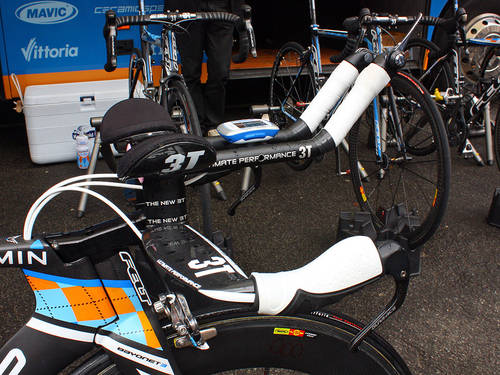
David Millar, 2010 Giro d'Italia.
 So, assuming you currently have a bike that uses headset spacers, what would be the effect on your position if you were to replace, say, a 10mm headset spacer with a 10mm armrest riser?
First, let us consider the effect of removing the headset spacer. The crucial insight is that removing a 10mm spacer will not lower the stack height ie. the vertical distance relative to the bottom bracket by 10mm.
This is because spacers are not oriented perpendicular to the ground; they are stacked along the steerer tube at the head tube angle of the frame. We will assume a head tube angle of 72.5 degrees.
We can calculate that removing a 10mm spacer will reduce the stack height by:
sin(72.5 ) 10mm = 9.54mm... and by the same argument it will also increase the effective reach ie. the horizontal distance relative to the bottom bracket by:
cos(72.5 ) 10mm = 3.01mmNext, let us consider the impact of adding the riser. These are oriented perpendicular to the ground, so its addition makes no further change to the reach. However, we can now calculate the overall change in stack height:
stack = -(sin(72.5 ) 10mm) + 10mm = 0.46mmWe can then repeat the calculation for any length of replacement:
| Replacement (mm) | stack (mm) | reach (mm) |
|---|---|---|
| 10 | +0.46 | +3.01 |
| 20 | +0.93 | +6.01 |
| 30 | +1.39 | +9.02 |
| 40 | +1.85 | +12.0 |
| 50 | +2.31 | +15.0 |
| 60 | +2.78 | +18.0 |
 A couple of days ago, AO3 reached
1 million fanworks in 14,353 fandoms.
The AO3 is an archive of fanfiction for multiple fandoms, founded and run by a non-profit organization,
Organization for Transformative Works with the aim of
"providing access to and preserving the history of fanworks and fan culture in its myriad forms."
The code behind AO3 is open source, their servers
run Debian and they even have a
Diversity Statement! How cool is that? :)
And, well, there's also the fact that...
"[...] the Archive is one of a very small number of open-source projects founded and largely staffed by women, another contribution fans have made to the internet as a whole. Many women who were not previously involved in technology have learned new skills in the name of fannish activities, and the AO3 is proud to stand as a shining example of this growth."So, congratulations AO3!
 I wrote in a previous post that
Youtube changed their way of delivering videos, with the use of
Dynamic Adaptive Streaming over HTTP. On top of that, they
started serving both the audio and the video in separate streams, which
meant trouble for downloader tools like
youtube-dl.
As I mentioned in that previous post:
What does this mean in practical terms for users of youtube-dl? Well, if you wanted to download videos in resolutions like the 480p (format 35) that I mentioned, then you will probably have to change your way of doing things, until a more automated solution is in place. You will have to download both the audio and the video and, then, "combine" them (that is, multiplex them) to create one "normal" video file with both the audio and the video.And latter, I wrote:
Otherwise, to download 480p videos (which I do for lectures and so on with other projects of mine, like edx-dl) I have to call youtube-dl twice: once for format 135 and another for format 140, since the old(...) Well, now, we don't have this problem anymore: The new release offormat 35 files are much smaller than the lower resolution 360p files (due to the former being encoded in High profile vs. the latter being encoded in Constrained Baseline profile).
youtube-dl brings us many goodies, including that it is
possible to automatically combine/merge/multiplex audio and video formats
that Youtube now offers separately (See the previous comments about separate
audio and video).
Now, if you want a 480p video in H.264 format, High profile, with 128kbps
AAC audio (this used to be Youtube's format 35), you can specify format -f
135+140 on the command-line and it will download both the audio, the video
and multiplex it with ffmpeg (or avconv, depending on what you have
installed).
Besides being convenient, this automatic downloading and merging makes it
unnecessary to write scripts to, say, retrieve all the videos in a playlist
that contains a lot of lectures (see one example here, taught by
Benedict Gross).
Version 2014.02.17 of youtube-dl will be soon in your favorite mirror of
the Debian archives.
 I've updated my markdown-pastebin site, to be a little cleaner, and to avoid spidering issues.
Previously every piece of uploaded text received an incrementing integer to describe it - which meant it was trivially easy for others to see how many pieces of text had been uploaded, and to spider all past uploads (unless the user deleted them).
Now each fresh paste receives a random UUID to describe it, and this means spidering is no longer feasible.
I've also posted the source code to Gitub so folk can report bugs, fork, etc:
That source code now includes a Dockerfile which allows you to quickly and easily build your own container running this wonderful service, and launch it without worrying about trashing your server ;)
Anyway other than the user-interface overhaul it is still as functional, or not, as it used to be!
 Enrico and me have just started a census on Debian Services floating around, and we want YOU to participate!
 MicroPeak Approved for NAR Contests
The NAR Contest Board has approved
MicroPeak for use in contests
requiring a barometric altimeter starting on the 1st of April,
2014. You can read the announcement message on the contestRoc Yahoo
message board here:
Contest Board Approves New Altimeter
The message was sent out on the 30th of January, but there is a 90 day
waiting period after the announcement has been made before you can use
MicroPeak in a contest, so the first date approved for contest flights
is April 1. After that date, you should see MicroPeak appear in
Appendix G of the pink book,
which lists the altimeters approved for contest use
Thanks much to the NAR contest board and all of the fliers
who helped get MicroPeak ready for this!
Today was another Kindergarten day. Zoe was complaining about being sweaty
before we even left the house this morning, so I gave her the choice of going
by car or by bike, and she chose car, which was fine by me. It's been stinking
hot the last few days. Summer is going out with a bang.
Drop off went pretty smoothly. It was another morning where she was happy to
have me hang out with her for a little bit, and then I was allowed to leave
without any issues.
I decided to use this Monday as a Debian day as planned. I mostly ran into a snag with my
email setup, but I did manage to do some bug triage and upload one package.
It had been hot all day, and I was feeling sapped by it, so I picked up Zoe in
the car as well. I was surprised to find she wasn't asleep and hadn't had a nap
at all. She seemed in good spirits despite this. Megan's Dad has quit his job,
so I don't need to pick her up any more on Mondays and Wednesdays. We dropped
by the post office to check my PO box on the way home. Zoe enjoyed peering
through the mailbox into the post office.
Today's TV diversion was to build a rocket ship out of one of the big moving
boxes I've kept aside from the move back. Zoe had great fun blinging up the
inside and outside with various craft "gems", and drew a bunch of aliens on the
outside. I could have quite easily strung this out until Sarah arrived to pick
her up, but I let her watch a little bit of TV right at the end.
It was a pretty good afternoon. I liked how Zoe ran with the rocket ship idea
and added her own embellishments all by herself.
After Sarah picked up Zoe I went for a run. I'd intended to do 10km, but the
heat took it out of me, and I lacked the willpower, so I stopped at 5km. After
that I had the sweatiest yoga class yet.
Sarah had her training course again today, so she dropped Zoe around to me to
take to Kindergarten. She apparently had a disrupted night's sleep and was a
bit emotional this morning. She wasn't cooperative, so we ended up having to
drive to Kindergarten instead of take the bike.
Drop off itself went pretty well. She just wanted to sit in a teacher's lap,
and was otherwise fine.
I'm still working through the long tail of document collation for my tax
return. I spent most of the day sorting through poorly filed papers. I ended up
refiling a bunch of them.
I biked to Kindergarten for pickup. My preferred route seems to take me about
13 minutes, door to door. Zoe was still napping today, but woke up pretty well.
The hairdresser I take Zoe to does free fringe trims in between haircuts, so we
dropped in there on the way home to get a fringe trim. They have a little
fenced off children's play area in the corner, and she always likes to have a
play. We probably spent 15 minutes there after the fringe trim. I had to
use some creative imaginative play to encourage her to leave (Cowie called to
ask her to come home and give her a cuddle). Before she left, she had to pack
all her toys away again, which I was very impressed by.
Once we got home, I was able to use the box rocket as a TV diversion again, and
we made a steering wheel for it, and she put more bling on the outside, and
also used some water colours to paint it. The water colours didn't work
terribly well on the cardboard.
After that, we drilled the hole in the base for the second clothes line I made
and glued the pole into it, and then Zoe watched a little bit of TV. Sarah
finished her course early today. I'm just waiting for my girlfriend to get here
and we're going to hang out with my cousin who is having round four of
chemotherapy today, and drive her home afterwards.
(Or "Today's yak shaving exercise")
I'm trying to get back into some Debian work today, which involved trying to
send an email from my laptop, relayed through daedalus, which is in
a colo facility.
Then I started shaving my yak.
daedalus rejected the email, because the relay attempt wasn't
authenticated. It wasn't authenticated because Exim on my laptop wasn't
happy about the Diffie-Hellman parameters Sendmail on daedalus was
advertising, and had failed STARTTLS, and like a sensible person, I only
allow encrypted authentication. Along the way, I figured I'd need to address
the fact that the host certificate has expired long ago (truth is, I
probably just needed to fix the Diffie-Hellman parameters file), but my
whole CA certificate expired over a year ago.
I couldn't find the encrypted USB key with my CA on it, so I decided to cut
my losses and start from scratch. It's good to see OpenSSL hasn't got any
more user friendly with time. I futzed around and generated a new CA key and
certificate, a new CSR for Sendmail, signed it, did the appropriate
sacrifices, and confirmed that STARTTLS now worked using OpenSSL
s_client.
Still couldn't send an email. Still had some bleating in the Exim logs:
2014-02-17 11:29:26 1WFD1M-00086p-KI TLS error on connection to daedalus.andrew.net.au [203.33.60.161] (gnutls_handshake): The Diffie-Hellman prime sent by the server is not acceptable (not long enough).Back on daedalus, /etc/mail/tls/sendmail-common.prm has been an empty file since time immemorial. I managed to find something in Google's cache suggesting I should put something in it with
openssl dhparam -out /etc/mail/tls/sendmail-common.prm -2 1024
I initially went for 4096 bits, because it must be better, right? I'm still
waiting for the key generation to come back, while I'm writing this. At
least it warned me in advance it was going to take a long time. How
thoughtful. What would be more thoughtful was verifying the write permission
to the file before the long operation so it could fail fast, rather. Sigh. I
ended up giving up on 4096 and sticking with 1024, because I was getting
old waiting.
Yak shaved, I can send mail from my laptop now.
Next.