Search Results: "zed"

12 December 2016

Dirk Eddelbuettel: RcppCCTZ 0.1.0

A new version 0.1.0 of RcppCCTZ arrived on CRAN this morning. It brings a number of new or updated things, starting with new upstream code from CCTZ as well as a few new utility functions. CCTZ is a C++ library for translating between absolute and civil times using the rules of a time zone. In fact, it is two libraries. One for dealing with civil time: human-readable dates and times, and one for converting between between absolute and civil times via time zones. It requires only a proper C++11 compiler and the standard IANA time zone data base which standard Unix, Linux, OS X, ... computers tend to have in /usr/share/zoneinfo. RcppCCTZ connects this library to R by relying on Rcpp. A nice example is the helloMoon() function (based on an introductory example in the CCTZ documentation) showing the time when Neil Armstrong took a small step, relative to local time in New York and Sydney:
R> library(RcppCCTZ)
R> helloMoon(verbose=TRUE)
1969-07-20 22:56:00 -0400
1969-07-21 12:56:00 +1000
                   New_York                      Sydney 
"1969-07-20 22:56:00 -0400" "1969-07-21 12:56:00 +1000" 
R> 
The new formating and parsing functions are illustrated below with default arguments for format strings and timezones. All this can be customized as usual.
R> example(formatDatetime)
frmtDtR> now <- Sys.time()
frmtDtR> formatDatetime(now)            # current (UTC) time, in full precision RFC3339
[1] "2016-12-12T13:21:03.866711+00:00"
frmtDtR> formatDatetime(now, tgttzstr="America/New_York")  # same but in NY
[1] "2016-12-12T08:21:03.866711-05:00"
frmtDtR> formatDatetime(now + 0:4)     # vectorised
[1] "2016-12-12T13:21:03.866711+00:00" "2016-12-12T13:21:04.866711+00:00" "2016-12-12T13:21:05.866711+00:00"
[4] "2016-12-12T13:21:06.866711+00:00" "2016-12-12T13:21:07.866711+00:00"
R> example(parseDatetime)
prsDttR> ds <- getOption("digits.secs")
prsDttR> options(digits.secs=6) # max value
prsDttR> parseDatetime("2016-12-07 10:11:12",        "%Y-%m-%d %H:%M:%S");   # full seconds
[1] "2016-12-07 04:11:12 CST"
prsDttR> parseDatetime("2016-12-07 10:11:12.123456", "%Y-%m-%d %H:%M:%E*S"); # fractional seconds
[1] "2016-12-07 04:11:12.123456 CST"
prsDttR> parseDatetime("2016-12-07T10:11:12.123456-00:00")  ## default RFC3339 format
[1] "2016-12-07 04:11:12.123456 CST"
prsDttR> now <- trunc(Sys.time())
prsDttR> parseDatetime(formatDatetime(now + 0:4))               # vectorised
[1] "2016-12-12 07:21:17 CST" "2016-12-12 07:21:18 CST" "2016-12-12 07:21:19 CST"
[4] "2016-12-12 07:21:20 CST" "2016-12-12 07:21:21 CST"
prsDttR> options(digits.secs=ds)
R>
Changes in this version are summarized here:

Changes in version 0.1.0 (2016-12-11)
  • Synchronized with CCTZ upstream.
  • New parsing and formating helpers for Datetime vectors
  • New parsing and formating helpers for (two) double vectors representing full std::chrono nanosecond resolutions
  • Updated documentation and examples.

We also have a diff to the previous version thanks to CRANberries. More details are at the RcppCCTZ page; code, issue tickets etc at the GitHub repository.

This post by Dirk Eddelbuettel originated on his Thinking inside the box blog. Please report excessive re-aggregation in third-party for-profit settings.

7 December 2016

Jonas Meurer: On CVE-2016-4484, a (securiy)? bug in the cryptsetup initramfs integration

On CVE-2016-4484, a (security)? bug in the cryptsetup initramfs integration On November 4, I was made aware of a security vulnerability in the integration of cryptsetup into initramfs. The vulnerability was discovered by security researchers Hector Marco and Ismael Ripoll of CyberSecurity UPV Research Group and got CVE-2016-4484 assigned. In this post I'll try to reflect a bit on

What CVE-2016-4484 is all about Basically, the vulnerability is about two separate but related issues:

1. Initramfs rescue shell considered harmful The main topic that Hector Marco and Ismael Ripoll address in their publication is that Debian exits into a rescue shell in case of failure during initramfs, and that this can be triggered by entering a wrong password ~93 times in a row. Indeed the Debian initramfs implementation as provided by initramfs-tools exits into a rescue shell (usually a busybox shell) after a defined amount of failed attempts to make the root filesystem available. The loop in question is in local_device_setup() at the local initramfs script In general, this behaviour is considered as a feature: if the root device hasn't shown up after 30 rounds, the rescue shell is spawned to provide the local user/admin a way to debug and fix things herself. Hector Marco and Ismael Ripoll argue that in special environments, e.g. on public computers with password protected BIOS/UEFI and bootloader, this opens an attack vector and needs to be regarded as a security vulnerability:
It is common to assume that once the attacker has physical access to the computer, the game is over. The attackers can do whatever they want. And although this was true 30 years ago, today it is not. There are many "levels" of physical access. [...] In order to protect the computer in these scenarios: the BIOS/UEFI has one or two passwords to protect the booting or the configuration menu; the GRUB also has the possibility to use multiple passwords to protect unauthorized operations. And in the case of an encrypted system, the initrd shall block the maximum number of password trials and prevent the access to the computer in that case.
While Hector and Ismael have a valid point in that the rescue shell might open an additional attack vector in special setups, this is not true for the vast majority of Debian systems out there: in most cases a local attacker can alter the boot order, replace or add boot devices, modify boot options in the (GNU GRUB) bootloader menu or modify/replace arbitrary hardware parts. The required scenario to make the initramfs rescue shell an additional attack vector is indeed very special: locked down hardware, password protected BIOS and bootloader but still local keyboard (or serial console) access are required at least. Hector and Ismael argue that the default should be changed for enhanced security:
[...] But then Linux is used in more hostile environments, this helpful (but naive) recovery services shall not be the default option.
For the reasons explained about, I tend to disagree to Hectors and Ismaels opinion here. And after discussing this topic with several people I find my opinion reconfirmed: the Debian Security Team disputes the security impact of the issue and others agree. But leaving the disputable opinion on a sane default aside, I don't think that the cryptsetup package is the right place to change the default, if at all. If you want added security by a locked down initramfs (i.e. no rescue shell spawned), then at least the bootloader (GNU GRUB) needs to be locked down by default as well. To make it clear: if one wants to lock down the boot process, bootloader and initramfs should be locked down together. And the right place to do this would be the configurable behaviour of grub-mkconfig. Here, one can set a password for GRUB and the boot parameter 'panic=1' which disables the spawning of a rescue shell in initramfs. But as mentioned, I don't agree that this would be sane defaults. The vast majority of Debian systems out there don't have any security added by locked down bootloader and initramfs and the benefit of a rescue shell for debugging purposes clearly outrivals the minor security impact in my opinion. For the few setups which require the added security of a locked down bootloader and initramfs, we already have the relevant options documented in the Securing Debian Manual: After discussing the topic with initramfs-tools maintainers today, Guilhem and me (the cryptsetup maintainers) finally decided to not change any defaults and just add a 'sleep 60' after the maximum allowed attempts were reached. 2. tries=n option ignored, local brute-force slightly cheaper Apart from the issue of a rescue shell being spawned, Hector and Ismael also discovered a programming bug in the cryptsetup initramfs integration. This bug in the cryptroot initramfs local-top script allowed endless retries of passphrase input, ignoring the tries=n option of crypttab (and the default of 3). As a result, theoretically unlimited attempts to unlock encrypted disks were possible when processed during initramfs stage. The attack vector here was that local brute-force attacks are a bit cheaper. Instead of having to reboot after max tries were reached, one could go on trying passwords. Even though efficient brute-force attacks are mitigated by the PBKDF2 implementation in cryptsetup, this clearly is a real bug. The reason for the bug was twofold:
  • First, the condition in setup_mapping() responsible for making the function fail when the maximum amount of allowed attempts is reached, was never met:
    setup_mapping()
     
      [...]
      # Try to get a satisfactory password $crypttries times
      count=0                              
    while [ $crypttries -le 0 ] [ $count -lt $crypttries ]; do export CRYPTTAB_TRIED="$count" count=$(( $count + 1 )) [...] done if [ $crypttries -gt 0 ] && [ $count -gt $crypttries ]; then message "cryptsetup: maximum number of tries exceeded for $crypttarget" return 1 fi [...]
    As one can see, the while loop stops when $count -lt $crypttries. Thus the second condition $count -gt $crypttries is never met. This can easily be fixed by decreasing $count by one in case of a successful unlock attempt along with changing the second condition to $count -ge $crypttries:
    setup_mapping()
     
      [...]
      while [ $crypttries -le 0 ]   [ $count -lt $crypttries ]; do
          [...]
          # decrease $count by 1, apparently last try was successful.
          count=$(( $count - 1 ))
          [...]
      done
      if [ $crypttries -gt 0 ] && [ $count -ge $crypttries ]; then
          [...]
      fi
      [...]
     
    
    Christian Lamparter already spotted this bug back in October 2011 and provided a (incomplete) patch, but back then I even managed to merge the patch in an improper way, making it even more useless: The patch by Christian forgot to decrease $count by one in case of a successful unlock attempt, resulting in warnings about maximum tries exceeded even for successful attemps in some circumstances. But instead of adding the decrease myself and keeping the (almost correct) condition $count -eq $crypttries for detection of exceeded maximum tries, I changed back the condition to the wrong original $count -gt $crypttries that again was never met. Apparently I didn't test the fix properly back then. I definitely should do better in future!
  • Second, back in December 2013, I added a cryptroot initramfs local-block script as suggested by Goswin von Brederlow in order to fix bug #678692. The purpose of the cryptroot initramfs local-block script is to invoke the cryptroot initramfs local-top script again and again in a loop. This is required to support complex block device stacks. In fact, the numberless options of stacked block devices are one of the biggest and most inglorious reasons that the cryptsetup initramfs integration scripts became so complex over the years. After all we need to support setups like rootfs on top of LVM with two separate encrypted PVs or rootfs on top of LVM on top of dm-crypt on top of MD raid. The problem with the local-block script is that exiting the setup_mapping() function merely triggers a new invocation of the very same function. The guys who discovered the bug suggested a simple and good solution to this bug: When maximum attempts are detected (by second condition from above), the script sleeps for 60 seconds. This mitigates the brute-force attack options for local attackers - even rebooting after max attempts should be faster.

About disclosure, wording and clickbaiting I'm happy that Hector and Ismael brought up the topic and made their argument about the security impacts of an initramfs rescue shell, even though I have to admit that I was rather astonished about the fact that they got a CVE assigned. Nevertheless I'm very happy that they informed the Security Teams of Debian and Ubuntu prior to publishing their findings, which put me in the loop in turn. Also Hector and Ismael were open and responsive when it came to discussing their proposed fixes. But unfortunately the way they advertised their finding was not very helpful. They announced a speech about this topic at the DeepSec 2016 in Vienna with the headline Abusing LUKS to Hack the System. Honestly, this headline is missleading - if not wrong - in several ways:
  • First, the whole issue is not about LUKS, neither is it about cryptsetup itself. It's about Debians integration of cryptsetup into the initramfs, which is a compeletely different story.
  • Second, the term hack the system suggests that an exploit to break into the system is revealed. This is not true. The device encryption is not endangered at all.
  • Third - as shown above - very special prerequisites need to be met in order to make the mere existance of a LUKS encrypted device the relevant fact to be able to spawn a rescue shell during initramfs.
Unfortunately, the way this issue was published lead to even worse articles in the tech news press. Topics like Major security hole found in Cryptsetup script for LUKS disk encryption or Linux Flaw allows Root Shell During Boot-Up for LUKS Disk-Encrypted Systems suggest that a major security vulnerabilty was revealed and that it compromised the protection that cryptsetup respective LUKS offer. If these articles/news did anything at all, then it was causing damage to the cryptsetup project, which is not affected by the whole issue at all. After the cat was out of the bag, Marco and Ismael aggreed that the way the news picked up the issue was suboptimal, but I cannot fight the feeling that the over-exaggeration was partly intended and that clickbaiting is taking place here. That's a bit sad.

1 December 2016

Daniel Pocock: Using a fully free OS for devices in the home

There are more and more devices around the home (and in many small offices) running a GNU/Linux-based firmware. Consider routers, entry-level NAS appliances, smart phones and home entertainment boxes. More and more people are coming to realize that there is a lack of security updates for these devices and a big risk that the proprietary parts of the code are either very badly engineered (if you don't plan to release your code, why code it properly?) or deliberately includes spyware that calls home to the vendor, ISP or other third parties. IoT botnet incidents, which are becoming more widely publicized, emphasize some of these risks. On top of this is the frustration of trying to become familiar with numerous different web interfaces (for your own devices and those of any friends and family members you give assistance to) and the fact that many of these devices have very limited feature sets. Many people hail OpenWRT as an example of a free alternative (for routers), but I recently discovered that OpenWRT's web interface won't let me enable both DHCP and DHCPv6 concurrently. The underlying OS and utilities fully support dual stack, but the UI designers haven't encountered that configuration before. Conclusion: move to a device running a full OS, probably Debian-based, but I would consider BSD-based solutions too. For many people, the benefit of this strategy is simple: use the same skills across all the different devices, at home and in a professional capacity. Get rapid access to security updates. Install extra packages or enable extra features if really necessary. For example, I already use Shorewall and strongSwan on various Debian boxes and I find it more convenient to configure firewall zones using Shorewall syntax rather than OpenWRT's UI. Which boxes to start with? There are various considerations when going down this path:
  • Start with existing hardware, or buy new devices that are easier to re-flash? Sometimes there are other reasons to buy new hardware, for example, when upgrading a broadband connection to Gigabit or when an older NAS gets a noisy fan or struggles with SSD performance and in these cases, the decision about what to buy can be limited to those devices that are optimal for replacing the OS.
  • How will the device be supported? Can other non-technical users do troubleshooting? If mixing and matching components, how will faults be identified? If buying a purpose-built NAS box and the CPU board fails, will the vendor provide next day replacement, or could it be gone for a month? Is it better to use generic components that you can replace yourself?
  • Is a completely silent/fanless solution necessary?
  • Is it possibly to completely avoid embedded microcode and firmware?
  • How many other free software developers are using the same box, or will you be first?
Discussing these options I recently started threads on the debian-user mailing list discussing options for routers and home NAS boxes. A range of interesting suggestions have already appeared, it would be great to see any other ideas that people have about these choices.

30 November 2016

Carl Chenet: My Free Software activities in November 2016

My Monthly report for Novembre 2016 gives an extended list of what were my Free Software related activities during this month. Personal projects: Journal du hacker: The Journal du hacker is a frenck-speaking Hacker News-like website dedicated to the french-speaking Free and Open source Software community. logo-journal-du-hacker That s all folks! See you next month!

28 November 2016

Michal &#268;iha&#345;: phpMyAdmin security issues

You might wonder why there is so high number of phpMyAdmin security announcements this year. This situations has two main reasons and I will comment a bit on those. First of all we've got quite a lot of attention of people doing security reviews this year. It has all started with Mozilla SOS Fund funded audit. It has discovered few minor issues which were fixed in the 4.6.2 release. However this was really just the beginning of the story and the announcement has attracted quite some attention to us. In upcoming weeks the security@phpmyadmin.net mailbox was full of reports and we really struggled to handle such amount. Handling that amount actually lead to creating more formalized approach to handling them as we clearly were no longer able to deal with them based on email only. Anyway most work here was done by Emanuel Bronshtein, who is really looking at every piece of our code and giving useful tips to harden our code base and infrastructure. Second thing which got changed is that we release security announcements for security hardening even when there might not be any practical attack possible. Typical example here might be PMASA-2016-61, where using hash_equals is definitely safer, but even if the timing attack would be doable here, the practical result of figuring out admin configured allow/deny rules is usually not critical. Many of the issues also cover quite rare setups (or server misconfigurations, which we've silently fixed in past) like PMASA-2016-54 being possibly caused by server executing shell scripts shipped together with phpMyAdmin. Overall phpMyAdmin indeed got safer this year. I don't think that there was any bug that would be really critical, on the other side we've made quite a lot of hardenings and we use current best practices when dealing with sensitive data. On the other side, I'm pretty sure our code was not in worse shape than any similarly sized projects with 18 years of history, we just become more visible thanks to security audit and people looked deeper into our code base. Besides security announcements this all lead to generic hardening of our code and infrastructure, what might be not that visible, but are important as well:

Filed under: Debian English phpMyAdmin SUSE 0 comments

25 November 2016

Julian Andres Klode: Starting the faster, more secure APT 1.4 series

We just released the first beta of APT 1.4 to Debian unstable (beta here means that we don t know any other big stuff to add to it, but are still open to further extensions). This is the release series that will be released with Debian stretch, Ubuntu zesty, and possibly Ubuntu zesty+1 (if the Debian freeze takes a very long time, even zesty+2 is possible). It should reach the master archive in a few hours, and your mirrors shortly after that. Security changes APT 1.4 by default disables support for repositories signed with SHA1 keys. I announced back in January that it was my intention to do this during the summer for development releases, but I only remembered the Jan 1st deadline for stable releases supporting that (APT 1.2 and 1.3), so better late than never. Around January 1st, the same or a similar change will occur in the APT 1.2 and 1.3 series in Ubuntu 16.04 and 16.10 (subject to approval by Ubuntu s release team). This should mean that repository provides had about one year to fix their repositories, and more than 8 months since the release of 16.04. I believe that 8 months is a reasonable time frame to upgrade a repository signing key, and hope that providers who have not updated their repositories yet will do so as soon as possible. Performance work APT 1.4 provides a 10-20% performance increase in cache generation (and according to callgrind, we went from approx 6.8 billion to 5.3 billion instructions for my laptop s configuration, a reduction of more than 21%). The major improvements are: We switched the parsing of Deb822 files (such as Packages files) to my perfect hash function TrieHash. TrieHash which generates C code from a set of words is about equal or twice as fast as the previously used hash function (and two to three times faster than gperf), and we save an additional 50% of that time as we only have to hash once during parsing now, instead of during look up as well. APT 1.4 marks the first time TrieHash is used in any software. I hope that it will spread to dpkg and other software at a later point in time.vendors. Another important change was to drop normalization of Description-MD5 values, the fields mapping a description in a Packages files to a translated description. We used to parse the hex digits into a native binary stream, and then compared it back to hex digits for comparisons, which cost us about 5% of the run time performance. We also optimized one of our hash functions the VersionHash that hashes the important fields of a package to recognize packages with the same version, but different content to not normalize data to a temporary buffer anymore. This buffer has been the subject of some bugs (overflow, incompleteness) in the recent past, and also caused some slowdown due to the additional writes to the stack. Instead, we now pass the bytes we are interested in directly to our CRC code, one byte at a time. There were also some other micro-optimisations: For example, the hash tables in the cache used to be ordered by standard compare (alphabetical followed by shortest). It is now ordered by size first, meaning we can avoid data comparisons for strings of different lengths. We also got rid of a std::string that cannot use short string optimisation in a hot path of the code. Finally, we also converted our case-insensitive djb hashes to not use a normal tolower_ascii(), but introduced tolower_ascii_unsafe() which just sets the lowercase bit ( 0x20) in the character. Others For a more complete overview of all changes, consult the changelog.
Filed under: Debian, Ubuntu

18 November 2016

Dirk Eddelbuettel: Rcpp 0.12.8: And more goodies

Yesterday the eighth update in the 0.12.* series of Rcpp made it to the CRAN network for GNU R where the Windows binary has by now been generated too; the Debian package is on its way as well. This 0.12.8 release follows the 0.12.0 release from late July, the 0.12.1 release in September, the 0.12.2 release in November, the 0.12.3 release in January, the 0.12.4 release in March, the 0.12.5 release in May, the 0.12.6 release in July, and the 0.12.7 release in September --- making it the twelveth release at the steady bi-montly release frequency. While we are keeping with the pattern, we have managed to include quite a lot of nice stuff in this release. None of it is a major feauture, though, and so we have not increased the middle number. Among the changes this release are (once again) much improved exception handling (thanks chiefly to Jim Hester), better large vector support (by Qiang), a number of Sugar extensions (mostly Nathan, Qiang and Dan) and beginnings of new DateVector and DatetimeVectors classes, and other changes detailed below. We plan to properly phase in the new date(time) classes. For now, you have to use a #define such as this one in Rcpp.h which remains commented-out for now. We plan to switch this on as the new default no earlier than twelve months from now. Rcpp has become the most popular way of enhancing GNU R with C or C++ code. As of today, 843 packages on CRAN depend on Rcpp for making analytical code go faster and further. That is up by eightyfour packages, or a full ten percent, just since the last release in early September! Again, we are lucky to have such a large group of contributors. Among them, we have invited Nathan Russell to the Rcpp Core team given his consistently excellent pull requests (as well as many outstanding Stackoverflow answers for Rcpp). More details on changes are below.

Changes in Rcpp version 0.12.8 (2016-11-16)
  • Changes in Rcpp API:
    • String and vector elements now use extended R_xlen_t indices (Qiang in PR #560)
    • Hashing functions now return unsigned int (Qiang in PR #561)
    • Added static methods eye(), ones(), and zeros() for select matrix types (Nathan Russell in PR #569)
    • The exception call stack is again correctly reported; print methods and tests added too (Jim Hester in PR #582 fixing #579)
    • Variatic macros no longer use a GNU extensions (Nathan in PR #575)
    • Hash index functions were standardized on returning unsigned integers (Also PR #575)
  • Changes in Rcpp Sugar:
    • Added new Sugar functions rowSums(), colSums(), rowMeans(), colMeans() (PR #551 by Nathan Russell fixing #549)
    • Range Sugar now used R_xlen_t type for start/end (PR #568 by Qiang Kou)
    • Defining RCPP_NO_SUGAR no longer breaks the build. (PR #585 by Daniel C. Dillon)
  • Changes in Rcpp unit tests
    • A test for expression vectors was corrected.
    • The constructor test for datetime vectors reflects the new classes which treats Inf correctly (and still as a non-finite value)
  • Changes in Rcpp Attributes
    • An 'empty' return was corrected (PR #589 fixing issue #588, and with thanks to Duncan Murdoch for the heads-up)
  • Updated Date and Datetime vector classes:
    • The DateVector and DatetimeVector classes were renamed with a prefix old; they are currently typedef'ed to the existing name (#557)
    • New variants newDateVector and newDatetimeVector were added based on NumericVector (also #557, #577, #581, #587)
    • By defining RCPP_NEW_DATE_DATETIME_VECTORS the new classes can activated. We intend to make the new classes the default no sooner than twelve months from this release.
    • The capabilities() function can also be used for presence of this feature

Thanks to CRANberries, you can also look at a diff to the previous release. As always, even fuller details are on the Rcpp Changelog page and the Rcpp page which also leads to the downloads page, the browseable doxygen docs and zip files of doxygen output for the standard formats. A local directory has source and documentation too. Questions, comments etc should go to the rcpp-devel mailing list off the R-Forge page.

This post by Dirk Eddelbuettel originated on his Thinking inside the box blog. Please report excessive re-aggregation in third-party for-profit settings.

16 November 2016

Shirish Agarwal: The long tail in a common s man journey to debconf16 2

This is an extension of part 1 which I shared few days ago. This would be a longish one so please bear. First of all somebody emailed me this link so in the future a layover at Doha Airport will be a bit expensive from before, approx INR 700/- added to the ticket costs Moving on, Let me share an experience I shared one of the last few days I had while I was in Cape Town
Singer singing some great oldies from 60's , 70's till 90's.

Singer singing some great oldies from 60 s , 70 s till 90 s.

I had booked a place near Long Street, Cape Town using Bernelle s help. What I had not known at that time that near Long Street there are free walking tours every couple of hours. I took part in all the tours and those were nice experiences. Where they start the walk, there was the gentleman pictured above. I was amazed by this gentleman s rich voice. He strummed lot of classics from the 60 s, 70 s till the 90 s . I had two coffees and thought I was at a premium rock concert. It was a bitter-sweet experience for me because I could see that he has such prodigious talent and still he had to struggle to survive to make ends meet. I did my 2 bit but wish I could have done something more. Side note Before I forget there is one trick of feh which I use to view images without it getting very high-resolution (especially on my low-end systems) [shirish@debian] - [/run/user/1000/gvfs/mtp:host=%5Busb%3A001%2C006%5D/Card/DCIM/Camera] - [4621]
[$] feh -g 1350x1000 .
This actually makes it far far easier to traverse through the 1000 odd photos of the trip that I have in my personal archive without doing any sort of conversion methodology. Btw, it took me time but finally was able to create an album at gallery.debconf.org . Haven t been able to upload photos as came across an error which I have shared at https://lists.debconf.org/lurker/message/20161113.215659.fce58823.en.html Moving on, here s the funny story/experience I wanted to share could have been arrested ;) What happened was this. This is from the Doha Airport. I had seen big buggies (ones similar to golf carts) which was ferrying people from end of the concourse to the other. I had been walking the whole day and even with the horizontal escalators and everything, it takes a toll. I was half-tired, half-sleepy and saw a buggy stationed. From behind it looked like the buggies I had seen. As there was no place to park my behind there, I entered into the buggy and sat there. Around 15-20 minutes later a Doha cop in another buggy came to me and asked me if something had happened ? I had no clue what he was talking about. He told/shared/asked me in friendly tone whether I had committed a crime or wanted to report a crime. When I replied in negative to both, he asked then why I was sitting there. I replied it was for stretching my legs and it was the buggy which was being used to transport people from A. to B. He gently told me I had entered into the wrong one and it was actually a cop buggy. I couldn t believe it. He did go his own way as he saw I was dead-tired. After 10-15 minutes, half-believingly I came out of the buggy and to my shock the gentleman was right. There was nothing to do but solder on to find a spot in this big airport. I shared this with few friends and family and managed to elicit few laughs hence sharing. The somewhat sad one was I had met a couple with a baby. Now as shared before, Most Airports including the Doha Airport is Air-Conditioned/Climate-Controlled and is probably in mid-20 s so it was more than cold for me. The couples with the baby were from Asian sub-continent. From their clothes and the way they were, they were not very well off. I do remember them sharing that they had a death in the family and hence were going. I didn t know at that point in time that there was something called bereavement fares and if they were able to take opportunity of those tickets. But this is besides the point . The issue was that their baby had been running a high-fever and the A/C was making matters worse. I had seen a pharmacy but no clinic in the airport. It was much later I came across http://dohahamadairport.com/airport-guide/facilities-services/medical-emergencies but as can be seen on the web-page it doesn t tell whether the services are chargeable or not. I assume it would be paid, although in some of the developed/industrialized countries it is rumoured not to be for simple ailments such as the baby was going through. Have no idea if that s true or not. I also don t know how it equates with travel insurance as well as most travel insurance is also supposed to help you in situations like these. I was concerned as it was a baby and babies as all know are very very fragile. If anybody has an idea or had similar experience would like to know specifically related to International Airport environment as it has transit issues unlike in domestic airports where I don t think it would be a bit more easy. Now coming to my own inadequacies/lack of foresight which I had mentioned I will share, I had asked/queried and got to lead a Debian-installation workshop on the Open Debian Day. I had done a few earlier and had installed it a few times on my system and for my friends, relatives and some clients. The only bad experiences I had were to do with UEFI but even those in the jessie releases had got resolved quite a bit, so was pretty confident. The day before the Installfest was to happen, Mensah Nyarko Yaa Dufie (one full name) of Ghana approached me to install Debian on her system. I had some older version of the Debian DVD either 8.1 or 8.3 and had known that 8.5 had been released just a few days back. Had seen pretty fast internet (as far as downloading Debian DVD) is concerned hence asked her to wait a bit while I downloaded the newest image. I sha256summed it to make sure that the image was bit-to-bit perfect. Now I hadn t bought a pen drive/disk from India as I was under the impression that in such conferences, pen drives should not be an issue. I had asked Bernelle privately before via e-mail as well and she had assured me that some pen-drives would be available. She gave me a handful of HP pen drives. The pen drives as we came know during our usage were somewhat flaky. It would pop out/lose connection even with the slightest nudge to the lappy. Somehow I was able to transfer the image to the usb disk. As people say hindsight is 50:50 maybe it was not such a smart move on my part to download the big DVD image and maybe I should have got the netinstall iso . Be careful, the link I have just shared is of the old version, if you have good web link and want to try the newest stable netinstall head to cdimage.debian.org . Apart from that goof-up I dunno (still) of anyway to know if a copy from an .iso image to usb was successful or not and did it do correctly I did the following command sudo dd if=/path_to/debian-dvd.iso of=/dev/usb-mount-point which is usually /dev/sdb on all of my systems . Her system was a brand new HP (don t remember the model details) which she had bought just a few weeks/months before debconf. We tried a few times but it failed at installing the boot-loader stage. I asked Ritesh Raj Saraff (a friend and DD) and while he had some ideas, none of them worked. Ritesh later pointed out Steve McIntyre and shared he is part of the Debian-Installer team. At that point in time, I had no clue who Steve McIntyre was otherwise I probably would not have approached him. He quickly acquiesced to my request and shared that he would be there for the workshop. With load of my mind little bit, I apologized to mensah and asked her to be at the workshop the following day. I had no clue what was wrong at this point in time, whether it was the iso image in the usb disk or a UEFI issue. This also wasn t good for my confidence but as somebody from the Debian-Installer team was there, I was somewhat relaxed. Next day, some more people came for the Installfest. While I had made 2-3 copies, clearly it was not enough as more people came. I was in a frenzy and asked Deven Bansod, Keerthana Krishnan, Prabaharan Jaminy (the whole GSOC and Outreachy attendees) to volunteer to help out in making more iso images on usb disks. I introduced mensah to Steve McIntyre and we tried 2-3 times to get debian installed on the system but it didn t move from the same place. Ritesh shared that dd had a memory leak and hence cat was a better way to do it. So we did

$ cat debian.iso > /dev/sdb
and soon other machines had debian sporting on their desktops. But mensa s lappy wouldn t get move from the boot-loader stage. Suddenly Steve had the bright idea (light bulb moment) that maybe the .iso is corrupted/usb disk is bad or something is incomplete. We started on another usb disk. Now this is where I have a query While I don t want to compare, in Ubuntu there was an image self-checking mechanism where probably behind the scenes (backend) the checksums published in a file are compared with checksums generated by apps. which are on the .iso image. While it does extend your time, the end result is you know if there is some issue on the decompressed image on the usb disk. AFAIK we don t have anything similar. The only two things I know is the wiki page and of course the various checksums of the image as shared at http://cdimage.debian.org/debian-cd/8.6.0/amd64/iso-cd/ or http://cdimage.debian.org/debian-cd/8.6.0/amd64/iso-dvd/ If anybody knows of any movement or a bug in the BTS which I can follow for the above issue please let me know. This time Steve was able to install it without any issues. I asked him whether he had to make some specific FAT/Ex-FAT/NTFS partitions as some new UEFI-based lappies need one or more but he replied in the negative. While mensa did get her debian install, the GUI didn t come while command-prompt was available. Then Steve added backports to the sources.list, got the new kernel, new Intel/Nvidia drivers (think it was one of those hybrid models IIRC) and she was able to boot into GNOME-Debian. I didn t saw any bug-reports about checksumming state of the applications before installation but did couple of reports about badblocks support and memory checking and from action on both bug-reports it is also need of the hour (although the earlier one has been marked as won t fix :(). In this whole thing, I liked/appreciated the way Steve handled things, I intuitively understood/knew that he wasn t just part of the Debian-installer team but someone better. I can t explain it but it was there. A little investigation in the evening and it turned out that he had been Debian Project Leader for two consecutive years (2008 and 2009) . In hindsight it probably was a good thing I didn t know that before otherwise I probably wouldn t have interacted with him and it would have been my loss. To have been the DPL and still being so humble while technically being so proficient, I was amazed and didn t know what to make of it. Here i.e. in India, if somebody wins even the mohalla elections (neighbourhood elections) the person carries a big chip on her/is shoulder not just till he is on the seat but even beyond, and here was an example of a previous DPL asking time from one of the developers in a video if it s possible in the next couple of days. Lastly,last week have able to report 2 bugs upstream. The first one is of youtube-dl . It s somewhat complicated hence will not go there atm. The second and more surprising one was from nano our esteemed text-editor- Hopefully the bug will be fixed once a new version comes.
Filed under: Miscellenous Tagged: #buggy, #cop, #Debconf16, #doha airport, #Installfest, #nano, #singer, #youtube-dl, travel

Bits from Debian: Debian Contributors Survey 2016

The Debian Contributor Survey launched last week! In order to better understand and document who contributes to Debian, we (Mathieu ONeil, Molly de Blanc, and Stefano Zacchiroli) have created this survey to capture the current state of participation in the Debian Project through the lense of common demographics. We hope a general survey will become an annual effort, and that each year there will also be a focus on a specific aspect of the project or community. The 2016 edition contains sections concerning work, employment, and labour issues in order to learn about who is getting paid to work on and with Debian, and how those relationships affect contributions. We want to hear from as many Debian contributors as possible whether you've submitted a bug report, attended a DebConf, reviewed translations, maintain packages, participated in Debian teams, or are a Debian Developer. Completing the survey should take 10-30 minutes, depending on your current involvement with the project and employment status. In an effort to reflect our own ideals as well as those of the Debian project, we are using LimeSurvey, an entirely free software survey tool, in an instance of it hosted by the LimeSurvey developers. Survey responses are anonymous, IP and HTTP information are not logged, and all questions are optional. As it is still likely possible to determine who a respondent is based on their answers, results will only be distributed in aggregate form, in a way that does not allow deanonymization. The results of the survey will be analyzed as part of ongoing research work by the organizers. A report discussing the results will be published under a DFSG-free license and distributed to the Debian community as soon as it's ready. The raw, disaggregated answers will not be distributed and will be kept under the responsibility of the organizers. We hope you will fill out the Debian Contributor Survey. The deadline for participation is: 4 December 2016, at 23:59 UTC. If you have any questions, don't hesitate to contact us via email at:

15 November 2016

Antoine Beaupr : The Turris Omnia router: help for the IoT mess?

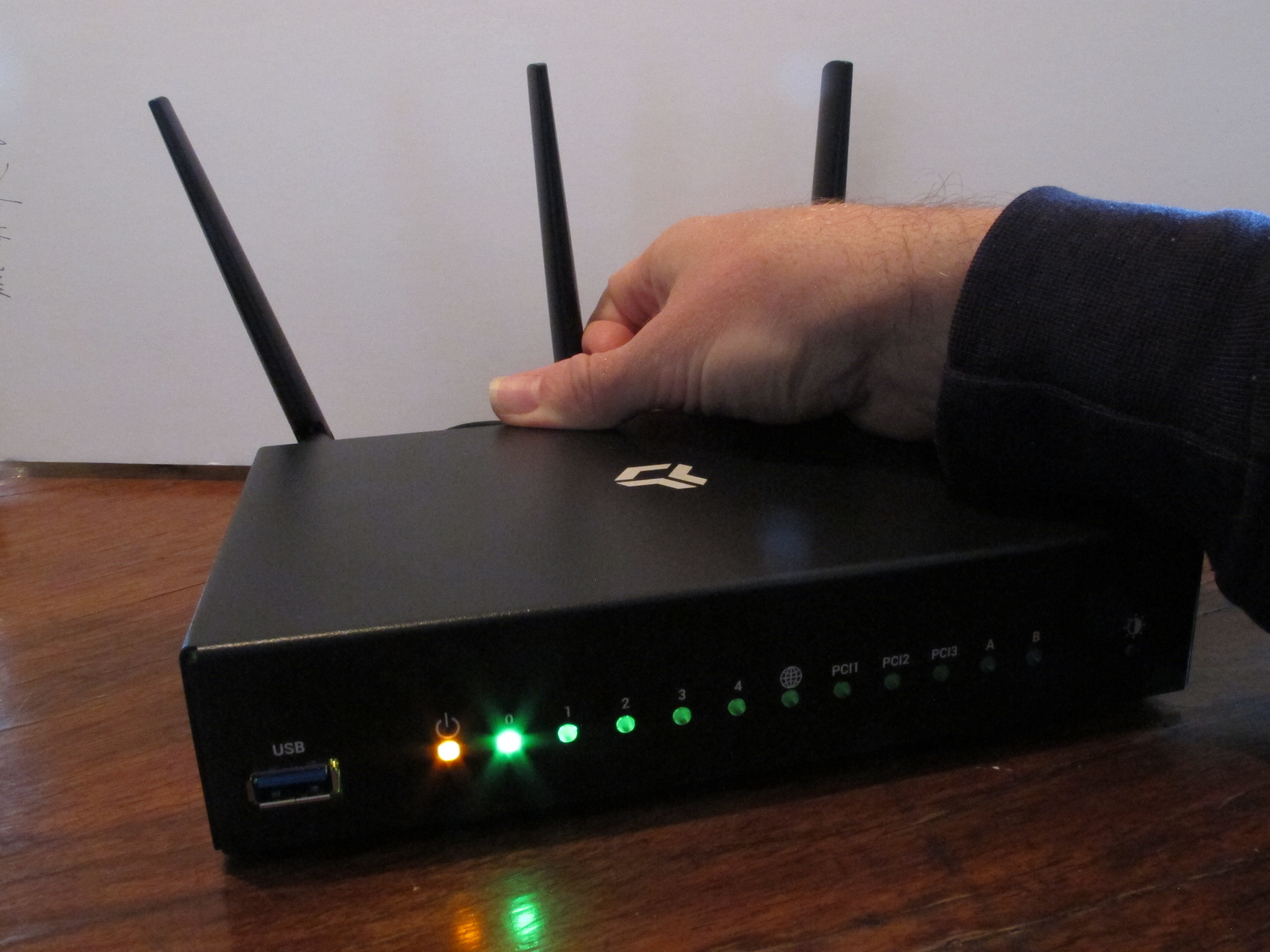
The Turris Omnia router is not the first FLOSS router out there, but it could well be one of the first open hardware routers to be available. As the crowdfunding campaign is coming to a close, it is worth reflecting on the place of the project in the ecosystem. Beyond that, I got my hardware recently, so I was able to give it a try.

A short introduction to the Omnia project The Turris Omnia Router The Omnia router is a followup project on CZ.NIC's original research project, the Turris. The goal of the project was to identify hostile traffic on end-user networks and develop global responses to those attacks across every monitored device. The Omnia is an extension of the original project: more features were added and data collection is now opt-in. Whereas the original Turris was simply a home router, the new Omnia router includes:
  • 1.6GHz ARM CPU
  • 1-2GB RAM
  • 8GB flash storage
  • 6 Gbit Ethernet ports
  • SFP fiber port
  • 2 Mini-PCI express ports
  • mSATA port
  • 3 MIMO 802.11ac and 2 MIMO 802.11bgn radios and antennas
  • SIM card support for backup connectivity
Some models sold had a larger case to accommodate extra hard drives, turning the Omnia router into a NAS device that could actually serve as a multi-purpose home server. Indeed, it is one of the objectives of the project to make "more than just a router". The NAS model is not currently on sale anymore, but there are plans to bring it back along with LTE modem options and new accessories "to expand Omnia towards home automation". Omnia runs a fork of the OpenWRT distribution called TurrisOS that has been customized to support automated live updates, a simpler web interface, and other extra features. The fork also has patches to the Linux kernel, which is based on Linux 4.4.13 (according to uname -a). It is unclear why those patches are necessary since the ARMv7 Armada 385 CPU has been supported in Linux since at least 4.2-rc1, but it is common for OpenWRT ports to ship patches to the kernel, either to backport missing functionality or perform some optimization. There has been some pressure from backers to petition Turris to "speedup the process of upstreaming Omnia support to OpenWrt". It could be that the team is too busy with delivering the devices already ordered to complete that process at this point. The software is available on the CZ-NIC GitHub repository and the actual Linux patches can be found here and here. CZ.NIC also operates a private GitLab instance where more software is available. There is technically no reason why you wouldn't be able to run your own distribution on the Omnia router: OpenWRT development snapshots should be able to run on the Omnia hardware and some people have installed Debian on Omnia. It may require some customization (e.g. the kernel) to make sure the Omnia hardware is correctly supported. Most people seem to prefer to run TurrisOS because of the extra features. The hardware itself is also free and open for the most part. There is a binary blob needed for the 5GHz wireless card, which seems to be the only proprietary component on the board. The schematics of the device are available through the Omnia wiki, but oddly not in the GitHub repository like the rest of the software.

Hands on I received my own router last week, which is about six months late from the original April 2016 delivery date; it allowed me to do some hands-on testing of the device. The first thing I noticed was a known problem with the antenna connectors: I had to open up the case to screw the fittings tight, otherwise the antennas wouldn't screw in correctly. Once that was done, I simply had to go through the usual process of setting up the router, which consisted of connecting the Omnia to my laptop with an Ethernet cable, connecting the Omnia to an uplink (I hooked it into my existing network), and go through a web wizard. I was pleasantly surprised with the interface: it was smooth and easy to use, but at the same time imposed good security practices on the user. Install wizard performing automatic updates For example, the wizard, once connected to the network, goes through a full system upgrade and will, by default, automatically upgrade itself (including reboots) when new updates become available. Users have to opt-in to the automatic updates, and can chose to automate only the downloading and installation of the updates without having the device reboot on its own. Reboots are also performed during user-specified time frames (by default, Omnia applies kernel updates during the night). I also liked the "skip" button that allowed me to completely bypass the wizard and configure the device myself, through the regular OpenWRT systems (like LuCI or SSH) if I needed to. The Omnia router about to rollback to latest snapshot Notwithstanding the antenna connectors themselves, the hardware is nice. I ordered the black metal case, and I must admit I love the many LED lights in the front. It is especially useful to have color changes in the reset procedure: no more guessing what state the device is in or if I pressed the reset button long enough. The LEDs can also be dimmed to reduce the glare that our electronic devices produce. All this comes at a price, however: at \$250 USD, it is a much higher price tag than common home routers, which typically go for around \$50. Furthermore, it may be difficult to actually get the device, because no orders are being accepted on the Indiegogo site after October 31. The Turris team doesn't actually want to deal with retail sales and has now delegated retail sales to other stores, which are currently limited to European deliveries.

A nice device to help fight off the IoT apocalypse It seems there isn't a week that goes by these days without a record-breaking distributed denial-of-service (DDoS) attack. Those attacks are more and more caused by home routers, webcams, and "Internet of Things" (IoT) devices. In that context, the Omnia sets a high bar for how devices should be built but also how they should be operated. Omnia routers are automatically upgraded on a nightly basis and, by default, do not provide telnet or SSH ports to run arbitrary code. There is the password-less wizard that starts up on install, but it forces the user to chose a password in order to complete the configuration. Both the hardware and software of the Omnia are free and open. The automatic update's EULA explicitly states that the software provided by CZ.NIC "will be released under a free software licence" (and it has been, as mentioned earlier). This makes the machine much easier to audit by someone looking for possible flaws, say for example a customs official looking to approve the import in the eventual case where IoT devices end up being regulated. But it also makes the device itself more secure. One of the problems with these kinds of devices is "bit rot": they have known vulnerabilities that are not fixed in a timely manner, if at all. While it would be trivial for an attacker to disable the Omnia's auto-update mechanisms, the point is not to counterattack, but to prevent attacks on known vulnerabilities. The CZ.NIC folks take it a step further and encourage users to actively participate in a monitoring effort to document such attacks. For example, the Omnia can run a honeypot to lure attackers into divulging their presence. The Omnia also runs an elaborate data collection program, where routers report malicious activity to a central server that collects information about traffic flows, blocked packets, bandwidth usage, and activity from a predefined list of malicious addresses. The exact data collected is specified in another EULA that is currently only available to users logged in at the Turris web site. That data can then be turned into tweaked firewall rules to protect the overall network, which the Turris project calls a distributed adaptive firewall. Users need to explicitly opt-in to the monitoring system by registering on a portal using their email address. Turris devices also feature the Majordomo software (not to be confused with the venerable mailing list software) that can also monitor devices in your home and identify hostile traffic, potentially leading users to take responsibility over the actions of their own devices. This, in turn, could lead users to trickle complaints back up to the manufacturers that could change their behavior. It turns out that some companies do care about their reputations and will issue recalls if their devices have significant enough issues. It remains to be seen how effective the latter approach will be, however. In the meantime, the Omnia seems to be an excellent all-around server and router for even the most demanding home or small-office environments that is a great example for future competitors.
Note: this article first appeared in the Linux Weekly News.

13 November 2016

Petter Reinholdtsen: Coz profiler for multi-threaded software is now in Debian

The Coz profiler, a nice profiler able to run benchmarking experiments on the instrumented multi-threaded program, finally made it into Debian unstable yesterday. Llu s Vilanova and I have spent many months since I blogged about the coz tool in August working with upstream to make it suitable for Debian. There are still issues with clang compatibility, inline assembly only working x86 and minimized JavaScript libraries. To test it, install 'coz-profiler' using apt and run it like this:
coz run --- /path/to/binary-with-debug-info
This will produce a profile.coz file in the current working directory with the profiling information. This is then given to a JavaScript application provided in the package and available from a project web page. To start the local copy, invoke it in a browser like this:
sensible-browser /usr/share/coz-profiler/viewer/index.htm
See the project home page and the USENIX ;login: article on Coz for more information on how it is working.

Daniel Pocock: Are all victims of French terrorism equal?

Some personal observations about the terrorist atrocities around the world based on evidence from Wikipedia and other sources The year 2015 saw a series of distressing terrorist attacks in France. 2015 was also the 30th anniversary of the French Government's bombing of a civilian ship at port in New Zealand, murdering a photographer who was on board at the time. This horrendous crime has been chronicled in various movies including The Rainbow Warrior Conspiracy (1989) and The Rainbow Warrior (1993). The Paris attacks are a source of great anxiety for the people of France but they are also an attack on Europe and all civilized humanity as well. Rather than using them to channel more anger towards Muslims and Arabs with another extended (yet ineffective) state of emergency, isn't it about time that France moved on from the evils of its colonial past and "drains the swamp" where unrepentant villains are thriving in its security services? Fran ois Hollande and S gol ne Royal. Royal's brother G rard Royal allegedly planted the bomb in the terrorist mission to New Zealand. It is ironic that Royal is now Minister for Ecology while her brother sank the Greenpeace flagship. If Fran ois and S gol ne had married (they have four children together), would G rard be the president's brother-in-law or terrorist-in-law? The question has to be asked: if it looks like terrorism, if it smells like terrorism, if the victim of that French Government attrocity is as dead as the victims of Islamic militants littered across the floor of the Bataclan, shouldn't it also be considered an act of terrorism? If it was not an act of terrorism, then what is it that makes it differ? Why do French officials refer to it as nothing more than "a serious error", the term used by Prime Minister Manuel Valls during a recent visit to New Zealand in 2016? Was it that the French officials felt it was necessary for Libert , galit , fraternit ? Or is it just a limitation of the English language that we only have one word for terrorism, while French officials have a different word for such acts carried out by those who serve their flag? If the French government are sincere in their apology, why have they avoided releasing key facts about the atrocity, like who thought up this plot and who gave the orders? Did the soldiers involved volunteer for a mission with the code name Op ration Satanique, or did any other members of their unit quit rather than have such a horrendous crime on their conscience? What does that say about the people who carried out the orders? If somebody apprehended one of these rogue employees of the French Government today, would they be rewarded with France's highest honour, like those tourists who recently apprehended an Islamic terrorist on a high-speed train? If terrorism is such an absolute evil, why was it so easy for the officials involved to progress with their careers? Would an ex-member of an Islamic terrorist group be able to subsequently obtain US residence and employment as easily as the French terror squad's commander Louis-Pierre Dillais? When you consider the comments made by Donald Trump recently, the threats of violence and physical aggression against just about anybody he doesn't agree with, is this the type of diplomacy that the US will practice under his rule commencing in 2017? Are people like this motivated by a genuine concern for peace and security, or are these simply criminal acts of vengence backed by political leaders with the maturity of schoolyard bullies?

12 November 2016

Wouter Verhelst: New Toy: Nikon D7200

Last month, I was abroad with my trusty old camera, but without its SD cards. Since the old camera has an SD only slot, which does not accept SDHC (let alone SDXC) cards, I cannot use it with cards larger than 2GiB. Today, such cards are not being manufactured anymore. So, I found myself with a few options:

  1. Forget about the camera, just don't take any photos. Given the nature of the trip, I did not fancy this option.
  2. Go on eBay or some such, and find a second-hand 2GiB card.
  3. Find a local shop, and buy a new camera body.
While option 2 would have worked, the lack of certain features on my old camera had meant that I'd been wanting to buy a new camera body for a while, but it just hadn't happened yet; so I decided to go with option 3. The Nikon D7200 is the latest model in the Nikon D7xxx series of cameras, a DX-format ("APS-C") camera that is still fairly advanced. Slightly cheaper than the D610, the cheapest full-frame Nikon camera (which I considered for a moment until I realized that two of my three lenses are DX-only lenses), it is packed with a similar amount of features. It can shoot photos at shutter speeds of 1/8000th of a second (twice as fast as my old camera), and its sensor can be set to ISO speeds of up to 102400 (64 times as much as the old one) -- although for the two modes beyond 25600, the sensor is switched to black-and-white only, since the amount of color available in such lighting conditions is very very low already. A camera which is not only ten years more recent than the older one, but also is targeted at a more advanced user profile, took some getting used to at first. For instance, it took a few days until I had tamed the camera's autofocus system, which is much more advanced than the older one, so that it would focus on the things I wanted it to focus on, rather than just whatever object happens to be closest. The camera shoots photos at up to twice the resolution in both dimensions (which combines to it having four times the amount of megapixels as the old body), which is not something I'm unhappy about. Also, it does turn out that a DX camera with a 24 megapixel sensor ends up taking photos with a digital resolution that is much higher than the optical resolution of my lenses, so I don't think more than 24 megapixels is going to be all that useful. The builtin WiFi and NFC communication options are a nice touch, allowing me to use Nikon's app to take photos remotely, and see what's going through the lens while doing so. Additionally, the time-lapse functionality is something I've used already, and which I'm sure I'll be using again in the future. The new camera is definitely a huge step forward from the old one, and while the price over there was a few hundred euros higher than it would have been here, I don't regret buying the new camera. The result is nice, too: DSC_1012 All in all, I'm definitely happy with it.

9 November 2016

Russ Allbery: Some thoughts on the US elections

I apparently am not going to get anything done today until I write this. Some thoughts, in no particular order. I don't have any profound conclusions. I'm honestly pretty upset. And pretty scared. But we have to talk to each other. And we have to listen to each other. And we have to persaude each other. And we have to be willing to be persuaded. And please go tell someone this morning that you have their back.

7 November 2016

Reproducible builds folks: Reproducible Builds: week 80 in Stretch cycle

What happened in the Reproducible Builds effort between Sunday October 30 and Saturday November 5 2016: Upcoming events Reproducible work in other projects Bugs filed Reviews of unreproducible packages 81 package reviews have been added, 14 have been updated and 43 have been removed in this week, adding to our knowledge about identified issues. 3 issue types have been updated: 1 issue type has been removed: 1 issue type has been updated: Weekly QA work During of reproducibility testing, some FTBFS bugs have been detected and reported by: diffoscope development buildinfo.debian.net development tests.reproducible-builds.org Reproducible Debian: Misc. Also with thanks to Profitbricks sponsoring the "hardware" resources, Holger created a 13 core machine with 24GB RAM and 100GB SSD based storage so that Ximin can do further tests and development on GCC and other software on a fast machine. This week's edition was written by Chris Lamb, Ximin Luo, Vagrant Cascadian, Holger Levsen and reviewed by a bunch of Reproducible Builds folks on IRC.

6 November 2016

Shirish Agarwal: The long tail in a common s man journey to debconf16 1

I was going to put a technical post but saw the discussion of one of the meetings of the debconf meets and decided to share a novice s travel experience. Before I start here s the discussion log http://meetbot.debian.net/debconf-team/2016/debconf-team.2016-10-20-20.01.log.html and specifically this part which hit me (using fake names for discussion as haven t taken permission from the folks to cite them by name.)
20:36:52 abcd: $100 CAD is a lot for some, but you d only need it if you won t sleep in sponsored accom, which arguably is acceptable.
20:37:04 it would, efgh, fixed sponsorship sum for everybody and allocation of rooms completely decoupled. Hotel gets the money from everybody and the base fee from DebConf.
20:37:15 people who can t afford also have special needs and may be uncomfortable in sharing rooms. That s quite frequently in our community. Managing each case will be much more complicated.
20:37:31 hijk: we could set aside budget for such special needs, for sure.
20:37:43 I m talking about managing each case
20:37:46 hijk: yes, but we ll have the special cases no matter what.
20:37:48 yes, and the special cases need to be catered for regardless of how everybody else is housed
20:38:06 hijk: room allocation already includes this.
20:38:19 people having to expose their personal problems to have us permitting them staying in the hotel
20:38:23 that s just too weird
It just goes on. I dunno whether I m weird or not or the experience I would share is just normal, this I would leave for you to decide. As have shared before, some friends of mine from the free software community had cajoled me last year to apply for debconf bursary (debconf15), which surprisingly got approved, but as it was late and my pre-conceived myths/notions of visas taking a looooong time decided not to go further. Many things take a long time to happen in the Indian bureaucratic maze. For instance have been in a civil case for almost a decade now among other things so know and accept that things take their own sweet time otherwise known as Indian patience  Did the application and again, surprise, surprise this time too I was approved. Luckily, had done the application for bursary early so was a bit positive on the visa-front. There was a goof-up at the embassay but thanks to people at travel.stackexchange.com where I asked quite a few questions, I was a bit informed and travel was relatively hassle-free. Internally though, I was nervous as hell. I had been feeling like a conman or a fraud or being an imposter because I knew before-hand that the project is so huge and had done the mistake of putting up a talk and a workshop where the big guns would be, which again was accepted (not good). The only thing I was thinking of as a saving grace is that there might be some newbies who don t know about the project at all (on Open Day) and hopefully I could help with that but as you will see, even there I was fully inadequate. I live in Pune which is around 3.5 hours from Mumbai (BOM) from where international flights take off. While Pune has an Airport, due to defence considerations, there cannot be much improvement either for domestic or International carriers. There have been attempts to have an exclusive civilian Airport for a long time (almost a decade) and would still take a decade or more. Hence had decided to take an early morning train from Pune to Mumbai, change couple of locals and finally land up at the Mumbai International Airport. Hind-sight as they say is 50:50, while I do have friends in Mumbai, I also found about a homestay which is closer to the Airport and still relatively budget-friendly. Anyways, met few friends but as was paranoid about missing connections found myself in front of the Airport at 20:00 hrs. with about 7 hours + to go before my flight. While there is nothing to do around the airport rather than hanging around, just hung around outside the airport as knew that inside the airport will be chilling and once you go in, you cannot come out or at least it s an inconvenience to the security therein. The International Airport in on three levels, the basement is for vehicles, the first level to receive International and Domestic passengers and the upper-most level exclusively for people flying internationally. This again, came to know when I tried to enter into the ones meant for Domestic and International Passengers coming into the city. Came to the check-in counter at around 02:00 hrs, did the security thing and just had to wait as the flight was of 0400 hrs (from my limited search experience, the cheapest flights are at such times when nobody else (i.e.civilized people) wants to fly). Entered Doha around 5:15 Doha time and saw a much much bigger airport than either the Mumbai International Airport or/and the Delhi International Airport . While I have written some negative stuff about Doha, there were two positives that I am sure, I had forgotten to share a. There were no transit Visa Fees that I had to pay. Most countries and airports I researched have something called transit visa and that can really get expensive, so saved money on that. b. The free ride into the city and back with voluntary tipping the driver or/and guide (approx. 3-4 hours) While the second from what I could tell/know is a gimmick, this is something I wish other countries and airports emulate. There are hotels in the airport and I could have had hotel accommodation if I had booked a slightly more expensive ticket, roughly INR 5k/- each way which would have given me a bit more legroom as well as stay as my layover was more than 24 hours. But this information was known at last minute. Qatar Airways has just a toll-free number and trying more than a few times gave up. They don t have an office in the city. When I reached the check-in counter they said if I had upgraded to Y class I would have had the hotel thing. Changing tickets at the last moment was too expensive and anyways for hotel accommodation for layovers they required at least 24 hours notice. Had to make do with recliners and chairs which are not really comfortable. There were only a couple of waiting rooms on air-side which had a view of the aircraft and hence were a bit more pleasing than those which were on the land-side and were fully blocked without a view. I wish there was a map of the Airport from within the Airport as even with the single terminal it is really easy to get lost. Somehow the day and night went by and took my second flight and reached Cape Town, South Africa. Throughout the journey had been stressed as had to be awake at all times and make sure that nothing gets stolen. Having attendants at toilets were also good so that there is no possibility of any violence there. So it had been 2 days, no shower and no sleep. Later also came to know about Airport Sleeping Pods and shower stalls but these also seem to be less in number, at few airports and there always be a bit of premium attached to them as airports are a monopoly business. Anyways, reached the venue. Throughout the travel there was quite a bit of unnamed fear which I later came to know after seeing Dr. Ramanujan s The Man who knew Infinity . It was/is the fear or unknown, while in the movie it is articulated as fear of crossing seven seas, symbolically it is the fear or unknown. Now while I was dead tired, I still pushed myself as I didn t want to have the effects of jet lag interfere with the normal sleeping and waking patterns. I did freshen myself but didn t allow myself the luxury of the bath-tub as I knew that if I went in, I would not come out that day. Met all the people, learnt who s who, where things are happening etc. and slowly night came. Night came and I was so-looking forward to sleep but sleep was not to be. I later learnt it could be either of the two reasons, it could either have been travel-induced insomnia or/and what is known as the first night effect . It was only on the second day when I was in bath-tub for about 2/3 hours I could feel the tension leaving my body. I finally realized that I am in Cape Town, South Africa and could enjoy and be surprised at seeing birds within few feet of me . Now I don t know whether I m the only weird/paranoid one, I do know that it would not have been easier for me at least for the first night as I was turning and twisting throughout the night. I opened the lights, read for some time hoping for sleep to take over but that didn t work. Tried quite a few things but sleep didn t come. If I had been sleeping with other people I dunno how they would have reacted. I myself am a light sleeper (most of the time) and if I had sleep coming and somebody else acted or been the way I was, I wouldn t been able to sleep. However much you try, whatever is the natural reaction is, will be. There are still some bits to share but that would be in part 2.
Filed under: Miscellenous Tagged: #air-travel, #Debconf16, #paranoia, #sleep

3 November 2016

Simon Josefsson: Why I don t Use 2048 or 4096 RSA Key Sizes

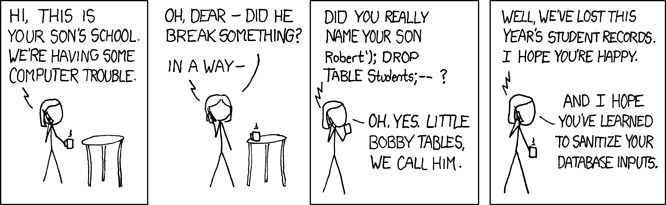
I have used non-standard RSA key size for maybe 15 years. For example, my old OpenPGP key created in 2002. With non-standard key sizes, I mean a RSA key size that is not 2048 or 4096. I do this when I generate OpenPGP/SSH keys (using GnuPG with a smartcard like this) and PKIX certificates (using GnuTLS or OpenSSL, e.g. for XMPP or for HTTPS). People sometimes ask me why. I haven t seen anyone talk about this, or provide a writeup, that is consistent with my views. So I wanted to write about my motivation, so that it is easy for me to refer to, and hopefully to inspire others to think similarily. Or to provoke discussion and disagreement that s fine, and hopefully I will learn something. Before proceeding, here is some context: When building new things, it is usually better to use the Elliptic Curve technology algorithm Ed25519 instead of RSA. There is also ECDSA which has had a comparatively slow uptake, for a number of reasons that is widely available and is a reasonable choice when Ed25519 is not available. There are also post-quantum algorithms, but they are newer and adopting them today requires a careful cost-benefit analysis. First some background. RSA is an asymmetric public-key scheme, and relies on generating private keys which are the product of distinct prime numbers (typically two). The size of the resulting product, called the modulus n, is usually expressed in bit length and forms the key size. Historically RSA key sizes used to be a couple of hundred bits, then 512 bits settled as a commonly used size. With better understanding of RSA security levels, the common key size evolved into 768, 1024, and later 2048. Today s recommendations (see keylength.com) suggest that 2048 is on the weak side for long-term keys (5+ years), so there has been a trend to jump to 4096. The performance of RSA private-key operations starts to suffer at 4096, and the bandwidth requirements is causing issues in some protocols. Today 2048 and 4096 are the most common choices. My preference for non-2048/4096 RSA key sizes is based on the simple and na ve observation that if I would build a RSA key cracker, there is some likelihood that I would need to optimize the implementation for a particular key size in order to get good performance. Since 2048 and 4096 are dominant today, and 1024 were dominent some years ago, it may be feasible to build optimized versions for these three key sizes. My observation is a conservative decision based on speculation, and speculation on several levels. First I assume that there is an attack on RSA that we don t know about. Then I assume that this attack is not as efficient for some key sizes than others, either on a theoretical level, at implementation level (optimized libraries for certain characteristics), or at an economic/human level (decision to focus on common key sizes). Then I assume that by avoiding the efficient key sizes I can increase the difficulty to a sufficient level. Before analyzing whether those assumptions even remotely may make sense, it is useful to understand what is lost by selecting uncommon key sizes. This is to understand the cost of the trade-off. A significant burden would be if implementations didn t allow selecting unusual key sizes. In my experience, enough common applications support uncommon key sizes, for example GnuPG, OpenSSL, OpenSSH, FireFox, and Chrome. Some applications limit the permitted choices; this appears to be rare, but I have encountered it once. Some environments also restrict permitted choices, for example I have experienced that LetsEncrypt has introduced a requirement for RSA key sizes to be a multiples of 8. I noticed this since I chose a RSA key size of 3925 for my blog and received a certificate from LetsEncrypt in December 2015 however during renewal in 2016 it lead to an error message about the RSA key size. Some commercial CAs that I have used before restrict the RSA key size to one of 1024, 2048 or 4096 only. Some smart-cards also restrict the key sizes, sadly the YubiKey has this limitation. So it is not always possible, but possible often enough for me to be worthwhile. Another cost is that RSA signature operations are slowed down. This is because the exponentiation function is faster than multiplication, and if the bit pattern of the RSA key is a 1 followed by several 0 s, it is quicker to compute. I have not done benchmarks, but I have not experienced that this is a practical problem for me. I don t notice RSA operations in the flurry of all of other operations (network, IO) that is usually involved in my daily life. Deploying this on a large scale may have effects, of course, so benchmarks would be interesting. Back to the speculation that leads me to this choice. The first assumption is that there is an attack on RSA that we don t know about. In my mind, until there are proofs that the currently known attacks (GNFS-based attacks) are the best that can be found, or at least some heuristic argument that we can t do better than the current attacks, the probability for an unknown RSA attack is therefor, as strange as it may sound, 100%. The second assumption is that the unknown attack(s) are not as efficient for some key sizes than others. That statement can also be expressed like this: the cost to mount the attack is higher for some key sizes compared to others. At the implementation level, it seems reasonable to assume that implementing a RSA cracker for arbitrary key sizes could be more difficult and costlier than focusing on particular key sizes. Focusing on some key sizes allows optimization and less complex code. At the mathematical level, the assumption that the attack would be costlier for certain types of RSA key sizes appears dubious. It depends on the kind of algorithm the unknown attack is. For something similar to GNFS attacks, I believe the same algorithm applies equally for a RSA key size of 2048, 2730 and 4096 and that the running time depends mostly on the key size. Other algorithms that could crack RSA, such as some approximation algorithms, does not seem likely to be thwarted by using non-standard RSA key sizes either. I am not a mathematician though. At the economical or human level, it seems reasonable to say that if you can crack 95% of all keys out there (sizes 1024, 2048, 4096) then that is good enough and cracking the last 5% is just diminishing returns of the investment. Here I am making up the 95% number. Currently, I would guess that more than 95% of all RSA key sizes on the Internet are 1024, 2048 or 4096 though. So this aspect holds as long as people behave as they have done. The final assumption is that by using non-standard key sizes I raise the bar sufficiently high to make an attack impossible. To be honest, this scenario appears unlikely. However it might increase the cost somewhat, by a factor or two or five. Which might make someone target a lower hanging fruit instead. Putting my argument together, I have 1) identified some downsides of using non-standard RSA Key sizes and discussed their costs and implications, and 2) mentioned some speculative upsides of using non-standard key sizes. I am not aware of any argument that the odds of my speculation is 0% likely to be true. It appears there is some remote chance, higher than 0%, that my speculation is true. Therefor, my personal conservative approach is to hedge against this unlikely, but still possible, attack scenario by paying the moderate cost to use non-standard RSA key sizes. Of course, the QA engineer in me also likes to break things by not doing what everyone else does, so I end this with an ObXKCD.
Jan Wagner: Container Orchestration Thoughts

Container Orchestration ThoughtsSince some time everybody (read developer) want to run his new microservice stacks in containers. I can understand that building and testing an application is important for developers.
One of the benefits of containers is, that developer (in theory) can put their new version of applications into production on their own. This is the point where operations is affected and operations needs to evaluate, if that might evolve into better workflow. For yolo^WdevOps people there are some challenges that needs to be solved, or at least mitigated, when things needs to be done in large(r) scale.

Orchestration Engine Running Docker, which is actual the most preferred container solution, on a single host with docker command line client is something you can do, but there you leave the gap between dev and ops.

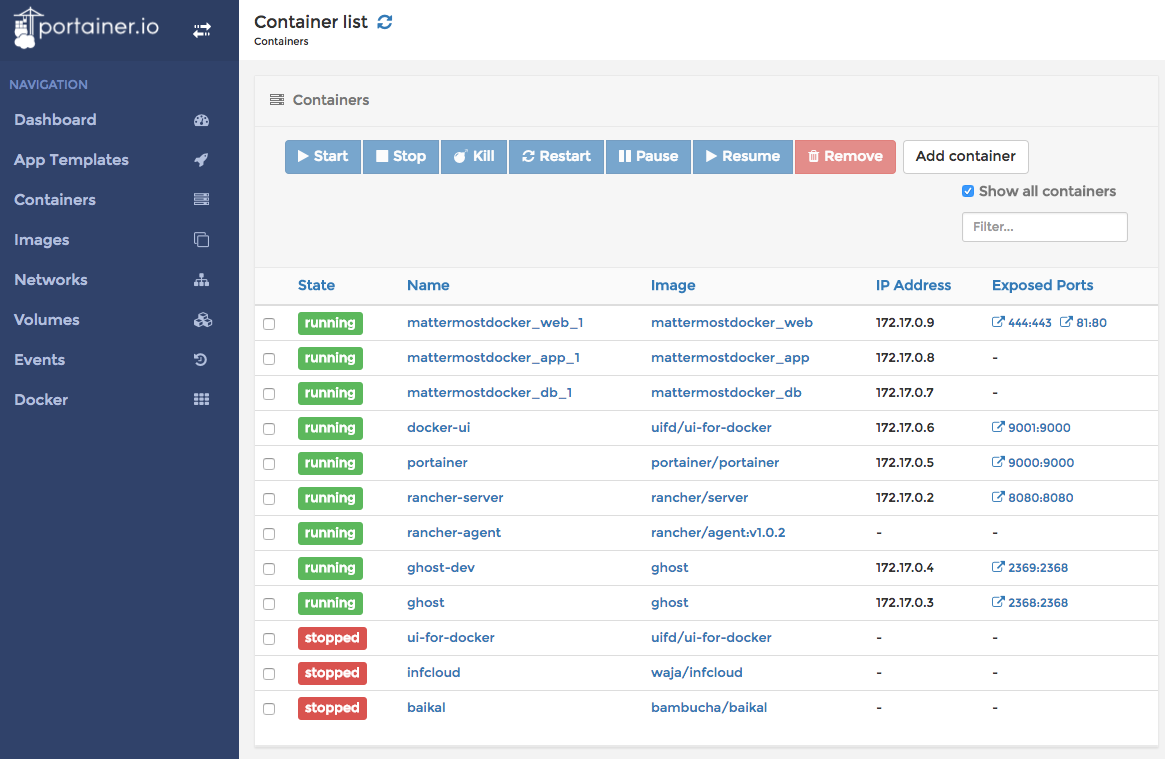
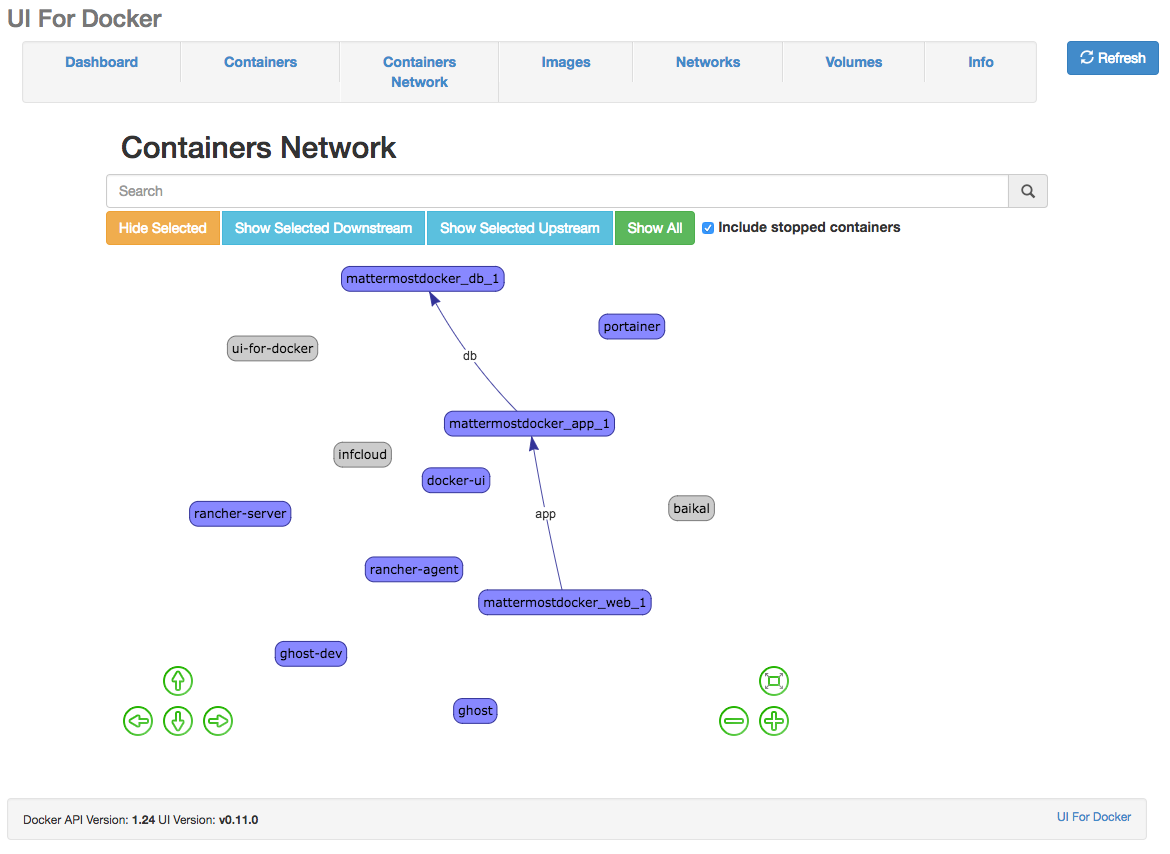
UI For Docker Since some time there is UI For Docker available for visualizing and managing containers on a single docker node. It's pretty awesome and the best feature so far is the Container Network view, which also shows the linked container. Container Orchestration Thoughts

Portainer Portainer is pretty new and it can be deployed as easy as UI For Docker. But the (first) great advantage: it can handle Docker Swarm. Beside that it has many other great features. Container Orchestration Thoughts

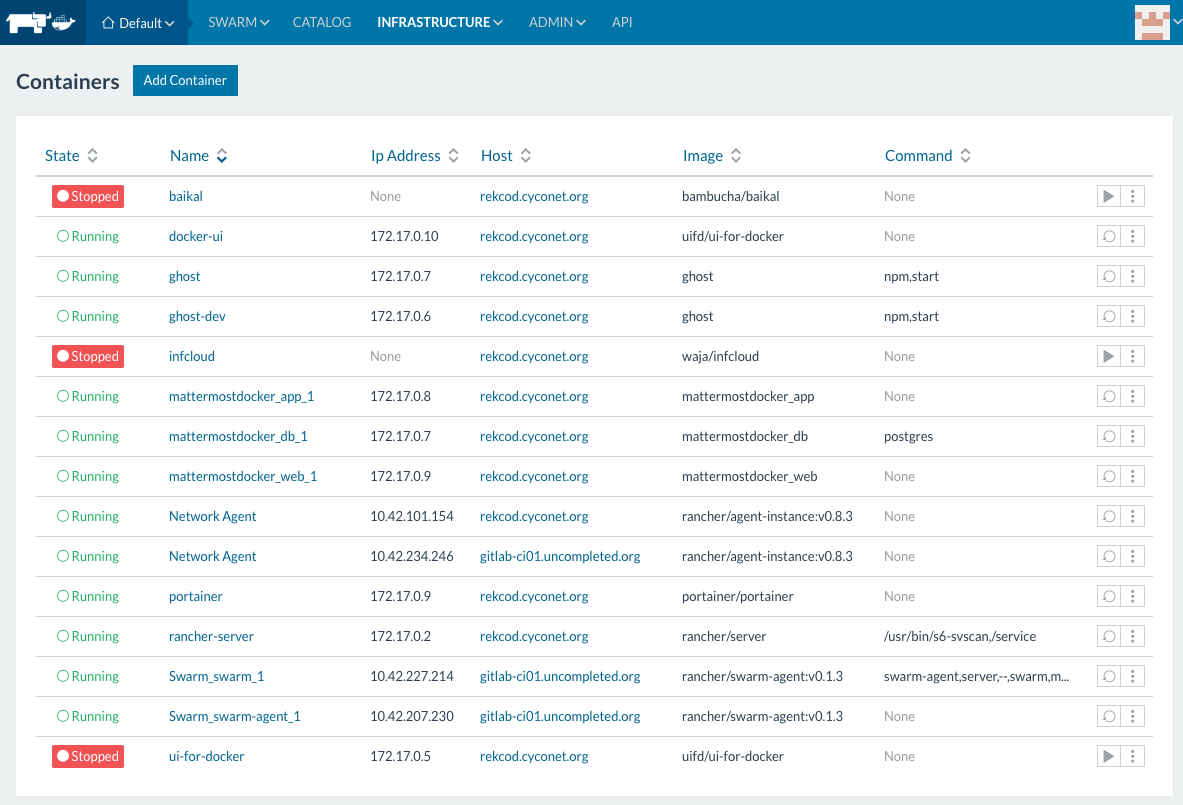
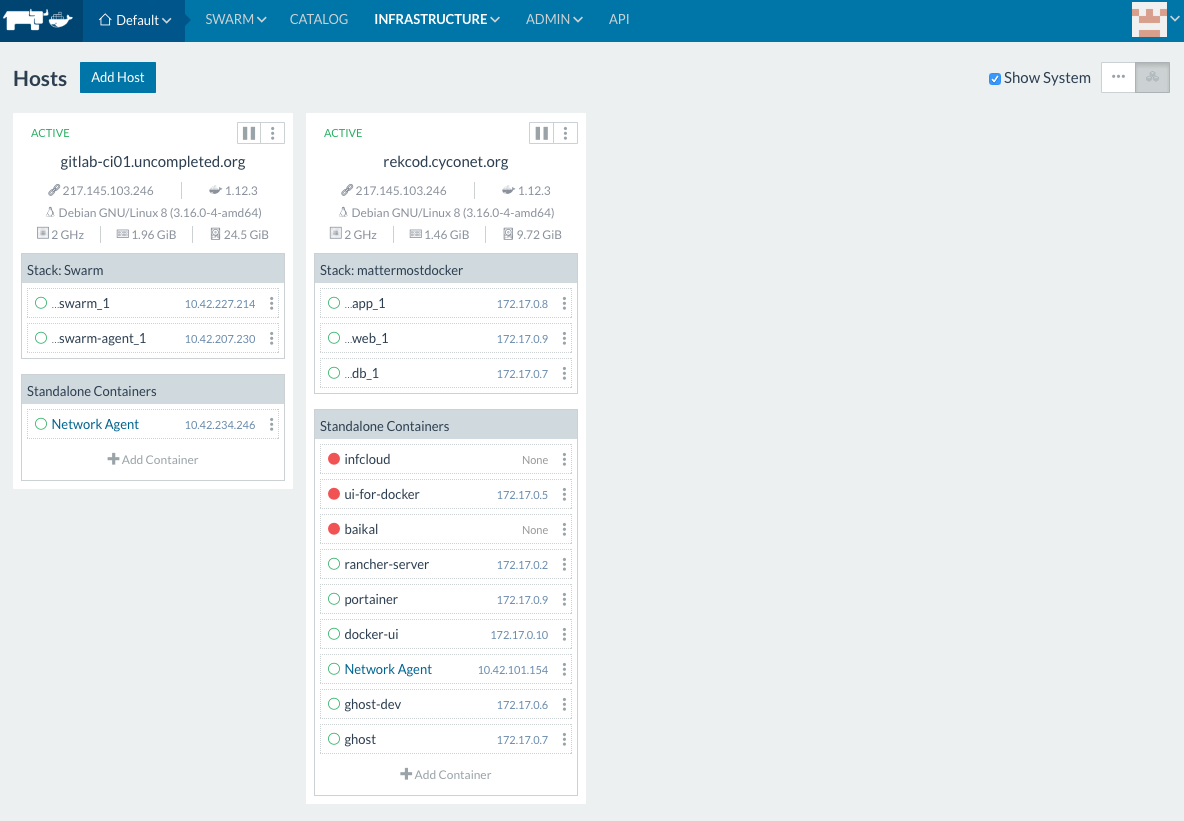
Rancher Rancher describes themselves as 'container management platform' that 'supports and manages all of your Kubernetes, Mesos, and Swarm clusters'. This is great because this are all of the relevant docker cluster orchestrations at the market actually. Container Orchestration Thoughts For the use cases, we are facing, Kubernetes and Mesos seems both like bloated beasts. Usman Ismail has written a really good comparison of Orchestration Engine options which goes into details. Container Orchestration Thoughts

Docker Swarm As there is actually no clear defacto standard/winner of the (container) orchestration wars, I would prevent to be in a vendor lock-in situation (yet). Docker swarm seems to be evolving and is getting more nice features other competitors doesn't provide.
Due the native integration into the docker framework and great community I believe Docker Swarm will be the Docker Orchestration of the choice on the long run. This should be supported by Rancher 1.2 which is not released yet.
From this point of view it looks very reasonable that Docker Swarm in combination with Rancher (1.2) might be a good strategy to maintain your container farms in the future. If you think to put Docker Swarm into production in the actual state, I recommend to read Docker swarm mode: What to know before going live on production by Panjamapong Sermsawatsri.

Persistent Storage While it is a best practice to use data volume container these days, providing persistent storage across multiple hosts for shared volumes seems to be tricky. In theory you can mount a shared-storage volume as a data volume and there are several volume plugins which supports shared storage. For example you can use the convoy plugin which gives you:
  • thin provisioned volumes
  • snapshots of volumes
  • backup of snapshots
  • restore volumes
As backend you can use:
  • Device Mapper
  • Virtual File System(VFS)/Network File System(NFS)
  • Amazon Elastic Block Store(EBS)
The good thing is, that convoy is integrated into Rancher. For more information I suggest to read Setting Up Shared Volumes with Convoy-NFS, which also mentions some limitations. If you want test Persistent Storage Service, Rancher provides some documentation. Actually I did not evaluate shared-storage volumes yet, but I don't see a solution I would love to use in production (at least on-premise) without strong downsides. But maybe things will go further and there might be a great solution for this caveats in the future.

Keeping base images up-to-date Since some time there are many projects that tries to detect security problems in your container images in several ways.
Beside general security considerations you need to deal somehow with issues in your base images that you build your applications on. Of course, even if you know you have a security issue in your application image, you need to fix it, which depends on the way how you based your application upon.

Ways to base your application image
  • You can build your application image entire from scratch, which leaves all the work to your development team and I wouldn't recommend it that way.
  • You also can create one (or more) intermediate image(s) that will be used by your development team.
  • The development team might ground their work on images in public available or private (for example the one bundled to your gitlab CI/CD solution) registries.

Whats the struggle with the base image? If you are using images being not (well) maintained by other people, you have to wait for them to fix your base image. Using external images might also lead into trust problems (can you trust those people in general?).
In an ideal world, your developers have always fresh base images with fixed security issues. This can probably be done by rebuilding every intermediate image periodically or when the base image changes.

Paradigm change Anyway, if you have a new application image available (with no known security issues), you need to deploy it to production. This is summarized by Jason McKay in his article Docker Security: How to Monitor and Patch Containers in the Cloud:
To implement a patch, update the base image and then rebuild the application image. This will require systems and development teams to work closely together.
So patching security issues in the container world changes workflow significant. In the old world operation teams mostly rolled security fixes for the base systems independent from development teams.
Now hitting containers the production area this might change things significant.

Bringing updated images to production Imagine your development team doesn't work steady on a project, cause the product owner consider it feature complete. The base image is provided (in some way) consistently without security issues. The application image is build on top of that automatically on every update of the base image.
How do you push in such a scenario the security fixes to production? From my point of view you have two choices:
  • Let the development team require to test the resulting application image and put it into production
  • Push the new application image without review by the development team into production
The first scenario might lead into a significant delay until the fixes hit production created by the probably infrequent work of the development team. The latter one brings your security fixes early to production by the notable higher risk to break your application. This risk can be reduced by implementing massive tests into CI/CD pipelines by the development team. Rolling updates provided by Docker Swarm might also reduce the risk of ending with a broken application. When you are implementing an update process of your (application) images to production, you should consider Watchtower that provides Automatic Updates for Docker Containers.

Conclusion Not being a product owner or the operations part of an application that is facing a widely adopted usage that would compensate the actual tradeoffs we are still facing I tend not to move large scale production projects into a container environment.
This means not that this might be a bad idea for others, but I'd like to sort out some of the caveats before. I'm still interested to put smaller projects into production, being not scared to reimplement or move them on a new stack.
For smaller projects with a small number of hosts Portainer looks not bad as well as Rancher with the Cattle orchestration engine if you just want to manage a couple of nodes. Things are going to be interesting if Rancher 1.2 supports Docker swarm cluster out of the box. Let's see what the future will bring us to the container world and how to make a great stack out of it.

Update I suggest to read Docker in Production: A History of Failure and the answer Docker in Production: A retort to understand the actual challenges when running Docker in larger scale production environments.

2 November 2016

Reproducible builds folks: Reproducible Builds: week 79 in Stretch cycle

What happened in the Reproducible Builds effort between Sunday October 23 and Saturday October 29 2016: Upcoming events The second Reproducible Builds World Summit will be held from December 13th-15th in Berlin! See the link for more details. Other events: Introduction to Reproducible Builds - Vagrant Cascadian will be presenting at the SeaGL.org Conference In Seattle, USA on November 12th, 2016. Reproducible Debian Hackathon - A small hackathon organized in Boston, USA on December 3rd and 4th. If you are interested in attending, contact Valerie Young - spectranaut in the #debian-reproducible IRC channel on irc.oftc.net. IRC meeting The next IRC meeting will be held on 2016-11-01 at 18:00 UTC. The meeting after that will be held on 2016-11-15 at 18:00 UTC. Reproducible work in other projects Ximin Luo has had his fix to bug 77985 accepted into GCC. This is needed to be able to write test cases for patches to make GCC produce debugging symbols that are reproducible regardless of the build path. There was continued discussion on the mailing list regarding our build path proposals. It has now been decided to use an environment variable SOURCE_PREFIX_MAP instead of the older proposal SOURCE_ROOT_DIR. This would be similar to GCC's existing -fdebug-prefix-map option, which allows for better disambiguation between paths from different packages. mandoc's makewhatis is now reproducible. It is used by all the BSDs, including FreeBSD, as well as Alpine Linux and Void Linux. Packages reviewed and fixed, and bugs filed Chris Lamb: Reiner Herrmann: Reviews of unreproducible packages 145 package reviews have been added, 608 have been updated and 94 have been removed in this week, adding to our knowledge about identified issues. 3 issue types have been updated: Weekly QA work During of reproducibility testing, some FTBFS bugs have been detected and reported by: tests.reproducible-builds.org Debian: General: diffoscope development Misc. This week's edition was written by Ximin Luo, Chris Lamb and Holger Levsen and reviewed by a bunch of Reproducible Builds folks on IRC.

Rapha&#235;l Hertzog: My Free Software Activities in October 2016

My monthly report covers a large part of what I have been doing in the free software world. I write it for my donors (thanks to them!) but also for the wider Debian community because it can give ideas to newcomers and it s one of the best ways to find volunteers to work with me on projects that matter to me. Debian LTS Last month I started to work on tiff3 but had not enough time to complete an update, it turns out the issues were hairy enough that nobody else picked up the package. So this month I started again with tiff3 and tiff and I ended up spending my 13h on those two packages. I filed bugs for issues that were not yet reported to the BTS (#842361 for CVE-2016-5652, #842046 for CVE-2016-5319/CVE-2016-3633/CVE-2015-8668). I marked many CVE as not affecting tiff3 as this source package does not ship the tools (the tiff source package does). Since upstream decided to drop many tools instead of fixing the corresponding security issues, I opted to remove the tools as well. Before doing this, I looked up reverse dependencies of libtiff-tools to ensure that none of the tools removed are used by other packages (the maintainer seems to agree too). I backported upstream patches for CVE-2016-6223 and CVE-2016-5652. But the bulk of the time, I spent on CVE-2014-8128, CVE-2015-7554 and CVE-2016-5318. I believe they are all variants of the same problem and upstream seems to agree since he opened a sort of meta-bug to track them. I took inspiration from a patch suggested in ticket #2499 and generalized it a bit by trying to add the tag data for all tags manipulated by the various tools. It was a tiresome process as there are many tags used in multiple places. But in the end, it works as expected. I can no longer reproduce any of the segfaults with the problematic files. I asked for review/test on the mailing list but did not get much feedback. I m going to upload the updated packages soon. Distro Tracker I noticed a sudden raise in the number of email addresses being automatically unsubscribed from the Debian Package Tracker and I got a few request of bounces. It turns out the BTS has been relaying lots of spam with executables files and those are bounced by Google (and not silently discarded). This is all very unfortunate the spam flood is unlikely to stop soon and I can t expect Google to change either, so I had little choice except trying to make the bounce handler smarter. That s what I did: I have a list of regular expression that will discard a bounce. In other words, once matched the bounce won t count towards the limit that triggers the automatic unsubscription. Misc Debian work Bugs filed. In #839403, I suggest the possibility to set the default pin priority for a source in the sources.list file directly. In #840436 I ask the selenium-firefoxdriver maintainer to do what is required to get this non-free package auto-built. Packaging. I sponsored puppet-lint 2.0.2-0.1 and I reviewed the rozofs package (wihch I just sponsored into experimental for a start). Publicity. I m maintaining the Debian account on Twitter and Facebook. I have been using twitterfeed.com up to now but it s closing down. I followed their recommendations and switched to dlvr.it to automatically post entries out of the micronews.debian.org feed. In #841165, I reported that the chroots created by sbuild-createchroot are lacking the usual IPv6 entries created by netbase. In #841503, I report a very common cryptsetup upgrade failure that I saw multiple times (both in Debian and in Kali). Thanks See you next month for a new summary of my activities.

No comment Liked this article? Click here. My blog is Flattr-enabled.

Next.

Previous.