Search Results: "rul"

22 August 2014

Russell Coker: Men Commenting on Women s Issues

A lecture at LCA 2011 which included some inappropriate slides was followed by long discussions on mailing lists. In February 2011 I wrote a blog post debunking some of the bogus arguments in two lists [1]. One of the noteworthy incidents in the mailing list discussion concerned Ted Ts o (an influential member of the Linux community) debating the definition of rape. My main point on that issue in Feb 2011 was that it s insensitive to needlessly debate the statistics. Recently Valerie Aurora wrote about another aspect of this on The Ada Initiative blog [2] and on her personal blog. Some of her significant points are that conference harassment doesn t end when the conference ends (it can continue on mailing lists etc), that good people shouldn t do nothing when bad things happen, and that free speech doesn t mean freedom from consequences or the freedom to use private resources (such as conference mailing lists) without restriction. Craig Sanders wrote a very misguided post about the Ted Ts o situation [3]. One of the many things wrong with his post is his statement I m particularly disgusted by the men who intervene way too early without an explicit invitation or request for help or a clear need such as an immediate threat of violence in womens issues . I believe that as a general rule when any group of people are involved in causing a problem they should be involved in fixing it. So when we have problems that are broadly based around men treating women badly the prime responsibility should be upon men to fix them. It seems very clear that no matter what scope is chosen for fixing the problems (whether it be lobbying for new legislation, sociological research, blogging, or directly discussing issues with people to change their attitudes) women are doing considerably more than half the work. I believe that this is an indication that overall men are failing. Asking for Help I don t believe that members of minority groups should have to ask for help. Asking isn t easy, having someone spontaneously offer help because it s the right thing to do can be a lot easier to accept psychologically than having to beg for help. There is a book named Women Don t Ask which has a page on the geek feminism Wiki [4]. I think the fact that so many women relate to a book named Women Don t Ask is an indication that we shouldn t expect women to ask directly, particularly in times of stress. The Wiki page notes a criticism of the book that some specific requests are framed as complaining , so I think we should consider a complaint from a woman as a direct request to do something. The geek feminism blog has an article titled How To Exclude Women Without Really Trying which covers many aspects of one incident [5]. Near the end of the article is a direct call for men to be involved in dealing with such problems. The geek feminism Wiki has a page on Allies which includes Even a blog post helps [6]. It seems clear from public web sites run by women that women really want men to be involved. Finally when I get blog comments and private email from women who thank me for my posts I take it as an implied request to do more of the same. One thing that we really don t want is to have men wait and do nothing until there is an immediate threat of violence. There are two massive problems with that plan, one is that being saved from a violent situation isn t a fun experience, the other is that an immediate threat of violence is most likely to happen when there is no-one around to intervene. Men Don t Listen to Women Rebecca Solnit wrote an article about being ignored by men titled Men Explain Things to Me [7]. When discussing women s issues the term Mansplaining is often used for that sort of thing, the geek feminism Wiki has some background [8]. It seems obvious that the men who have the greatest need to be taught some things related to women s issues are the ones who are least likely to listen to women. This implies that other men have to teach them. Craig says that women need space to discover and practice their own strength and their own voices . I think that the best way to achieve that goal is to listen when women speak. Of course that doesn t preclude speaking as well, just listen first, listen carefully, and listen more than you speak. Craig claims that when men like me and Matthew Garrett comment on such issues we are making women s spaces more comfortable, more palatable, for men . From all the discussion on this it seems quite obvious that what would make things more comfortable for men would be for the issue to never be discussed at all. It seems to me that two of the ways of making such discussions uncomfortable for most men are to discuss sexual assault and to discuss what should be done when you have a friend who treats women in a way that you don t like. Matthew has covered both of those so it seems that he s doing a good job of making men uncomfortable I think that this is a good thing, a discussion that is comfortable and palatable for the people in power is not going to be any good for the people who aren t in power. The Voting Aspect It seems to me that when certain issues are discussed we have a social process that is some form of vote. If one person complains then they are portrayed as crazy. When other people agree with the complaint then their comments are marginalised to try and preserve the narrative of one crazy person. It seems that in the case of the discussion about Rape Apology and LCA2011 most men who comment regard it as one person (either Valeria Aurora or Matthew Garrett) causing a dispute. There is even some commentary which references my blog post about Rape Apology [9] but somehow manages to ignore me when it comes to counting more than one person agreeing with Valerie. For reference David Zanetti was the first person to use the term apologist for rapists in connection with the LCA 2011 discussion [10]. So we have a count of at least three men already. These same patterns always happen so making a comment in support makes a difference. It doesn t have to be insightful, long, or well written, merely I agree and a link to a web page will help. Note that a blog post is much better than a comment in this regard, comments are much like conversation while a blog post is a stronger commitment to a position. I don t believe that the majority is necessarily correct. But an opinion which is supported by too small a minority isn t going to be considered much by most people. The Cost of Commenting The Internet is a hostile environment, when you comment on a contentious issue there will be people who demonstrate their disagreement in uncivilised and even criminal ways. S. E. Smith wrote an informative post for Tiger Beatdown about the terrorism that feminist bloggers face [11]. I believe that men face fewer threats than women when they write about such things and the threats are less credible. I don t believe that any of the men who have threatened me have the ability to carry out their threats but I expect that many women who receive such threats will consider them to be credible. The difference in the frequency and nature of the terrorism (and there is no other word for what S. E. Smith describes) experienced by men and women gives a vastly different cost to commenting. So when men fail to address issues related to the behavior of other men that isn t helping women in any way. It s imposing a significant cost on women for covering issues which could be addressed by men for minimal cost. It s interesting to note that there are men who consider themselves to be brave because they write things which will cause women to criticise them or even accuse them of misogyny. I think that the women who write about such issues even though they will receive threats of significant violence are the brave ones. Not Being Patronising Craig raises the issue of not being patronising, which is of course very important. I think that the first thing to do to avoid being perceived as patronising in a blog post is to cite adequate references. I ve spent a lot of time reading what women have written about such issues and cited the articles that seem most useful in describing the issues. I m sure that some women will disagree with my choice of references and some will disagree with some of my conclusions, but I think that most women will appreciate that I read what women write (it seems that most men don t). It seems to me that a significant part of feminism is about women not having men tell them what to do. So when men offer advice on how to go about feminist advocacy it s likely to be taken badly. It s not just that women don t want advice from men, but that advice from men is usually wrong. There are patterns in communication which mean that the effective strategies for women communicating with men are different from the effective strategies for men communicating with men (see my previous section on men not listening to women). Also there s a common trend of men offering simplistic advice on how to solve problems, one thing to keep in mind is that any problem which affects many people and is easy to solve has probably been solved a long time ago. Often when social issues are discussed there is some background in the life experience of the people involved. For example Rookie Mag has an article about the street harassment women face which includes many disturbing anecdotes (some of which concern primary school students) [12]. Obviously anyone who has lived through that sort of thing (which means most women) will instinctively understand some issues related to threatening sexual behavior that I can t easily understand even when I spend some time considering the matter. So there will be things which don t immediately appear to be serious problems to me but which are interpreted very differently by women. The non-patronising approach to such things is to accept the concerns women express as legitimate, to try to understand them, and not to argue about it. For example the issue that Valerie recently raised wasn t something that seemed significant when I first read the email in question, but I carefully considered it when I saw her posts explaining the issue and what she wrote makes sense to me. I don t think it s possible for a man to make a useful comment on any issue related to the treatment of women without consulting multiple women first. I suggest a pre-requisite for any man who wants to write any sort of long article about the treatment of women is to have conversations with multiple women who have relevant knowledge. I ve had some long discussions with more than a few women who are involved with the FOSS community. This has given me a reasonable understanding of some of the issues (I won t claim to be any sort of expert). I think that if you just go and imagine things about a group of people who have a significantly different life-experience then you will be wrong in many ways and often offensively wrong. Just reading isn t enough, you need to have conversations with multiple people so that they can point out the things you don t understand. This isn t any sort of comprehensive list of ways to avoid being patronising, but it s a few things which seem like common mistakes. Anne Onne wrote a detailed post advising men who want to comment on feminist blogs etc [13], most of it applies to any situation where men comment on women s issues.

19 August 2014

Julien Danjou: Tracking OpenStack contributions in GitHub

I've switched my Git repositories to GitHub recently, and started to watch my contributions statistics, which were very low considering I spend my days hacking on open source software, especially OpenStack.
OpenStack hosts its Git repositories on its own infrastructure at git.openstack.org, but also mirrors them on GitHub. Logically, I was expecting GitHub to track my commits there too, as I'm using the same email address everywhere. It turns out that it was not the case, and the help page about that on GitHub describes the rule in place to compute statistics. Indeed, according to GitHub, I had no relations to the OpenStack repositories, as I never forked them nor opened a pull request on them (OpenStack uses Gerrit). Starring a repository is enough to build a relationship between a user and a repository, so this is was the only thing needed to inform GitHub that I have contributed to those repositories. Considering OpenStack has hundreds of repositories, I decided to star them all by using a small Python script using pygithub.
And voil , my statistics are now including all my contributions to OpenStack!

17 August 2014

Jamie McClelland: Getting to know systemd

Update 2014-08-20: apcid needs tweaking. See update section below. Somehow both my regular work laptop and home entertainment computers (both running Debian Jessie) were switched to systemd without me noticing. Judging from by dpkg.log it may have happened quite a while ago. I'm pretty sure that's a compliment to the backwards compatibility efforts made by the systemd developers and a criticism of me (I should be paying closer attention to what's happening on my own machines!). In any event, I've started trying to pay more attention now - particularly learning how to take advantage of this new software. I'll try to keep this blog updated as I learn. For now, I have made a few changes and discoveries. First - I have a convenient bash wrapper I use that both starts my OpenVPN client to a samba server and then mounts the drive. I only connect when I need to and rarely do I properly disconnect (the OpenVPN connection does not start automatically). So, I've written the script to carefully check if my openvpn connection is present and either restart or start depending on the results. I had something like this:
if ps -eFH   egrep [o]penvpn; then
  sudo /etc/init.d/openvpn restart
else
  sudo /etc/init.d/openvpn start
fi
One of the advertised advantages of systemd is the ability to more accurately detect if a service is running. So, first I changed this to:
if systemctl -q is-active openvpn.service; then
  sudo systemctl restart openvpn.service
else
  sudo systemctl start openvpn.service
fi
However, after reviewing the man page I realized I can shorten if further to simply:
  sudo systemctl restart openvpn.service
According to the man page, restart means:
Restart one or more units specified on the command line. If the units are not
running yet, they will be started.
After discovering this meaning for "restart" in systemd, I tested and realized that "restart" works the same way for openvpn using the old sysv style init system. Oh well. At least there's a man page and a stronger guarantee that it will work with all services, not just the ones that happen to respect that convention in their init.d scripts. The next step was to disable openvpn on start up. I confess, I never bothered to really learn update-rc.d. Everytime I read the manpage I ended up throwing up my hands and renaming symlinks by hand. In the case of openvpn I had previously edited /etc/default/openvpn to indicate that "none" of the virtual private networks should be started. Now, I've returned that file to the default configuration and instead I ran:
systemctl disable openvpn.service
UPDATES 2014-08-20: I've recently noticed strange behavior when I wake my laptop. Seems to sometimes go right back to sleep. After doing some digging I traced the problem to some customizations I have made to my laptop's acpid behavior combined with systemd taking over some apci events. Up to now, I have created my own /etc/acpi files so I have full control over the acpi events. In particular, I don't want my laptop to suspend when I close the lid. I only want it to suspend when I press the suspend key. And, when it does suspend, I want it to run my own personal suspend script so I can do things like lock the screen and restart tint2. I've found that systemd launches it's own acpi event monitoring that ignores my /etc/acpid rules (the systemd "unit" that monitors events is called acpid.socket which exists in addition to acpid.service). The systemd reaction to events is controlled by the systemd-logind.service which has a configuration file: /etc/systemd/logind.conf. By default, systemd-logind.service will put my laptop to sleep when the lid is closed and when the suspend button is pushed. systemd seems to get the signal first, putting the laptop to sleep. After I wake it up, acpid gets the signal - so it goes right back to sleep. Reading man logind.conf helps. I was able to restore my desired behavior by adding these lines to /etc/systemd/logind.conf:
HandleSuspendKey=ignore
HandleLidSwitch=ignore
Then: sudo systemctl restart systemd-logind.service.

14 August 2014

Gregor Herrmann: RC bugs 2014/13 - 2014/33

perl 5.20 got uploaded to debian unstable a few minutes ago; be prepared for some glitches when upgrading sid machines/chroots in the next days, while all 557 reverse dependencies are rebuilt via binNMUs. how does this relate to this blog post's title? it does, since during the last weeks I was mostly trying to help with the preparation of this transition. & we managed to fix quite a few bugs while they were not bumped to serious yet, otherwise the list below would be a bit longer :) anyway, here are the the RC bugs I've worked on in the last 20 or so weeks: p.s.: & now, go & enjoy the new perl 5.20 features :)

11 August 2014

Cyril Brulebois: Mark a mail as read across maildirs

Problem Discussions are sometimes started by mailing a few different mailing lists so that all relevant parties have a chance to be aware of a new topic. It s all nice when people can agree on a single venue to send their replies to, but that doesn t happen every time. Case in point, I m getting 5 copies of a bunch of mails, through the following debian-* lists: accessibility, boot, cd, devel, project. Needless to say: Reading, or marking a given mail as read once per maildir rapidly becomes a burden. Solution I know some people use a duplicate killer at procmail time (hello gregor) but I d rather keep all mails in their relevant maildirs. So here s mark-read-everywhere.pl which seems to do the job just fine for my particular setup: all maildirs below ~/mails/* with the usual cur, new, tmp subdirectories. Basically, given a mail piped from mutt, compute a hash on various headers, look at all new mails (new subdirectories), and mark the matching ones as read (move to the nearby cur subdirectories, and change suffix from , to ,S). Mutt key binding (where X is short for cross post):
macro index X "<pipe-message>~/bin/mark-as-read-everywhere.pl<enter>"
This isn t pretty or bulletproof but it already started saving time! Now to wonder: was it worth the time to automate that?

Cyril Brulebois: How to serve Perl source files

I noticed a while ago a Perl script file included on my blog wasn t served properly, since the charset wasn t announced and web browsers didn t display it properly. The received file was still valid UTF-8 (hello, little character), at least! First, wrong intuition Reading Apache s /etc/apache2/conf.d/charset it looks like the following directive might help:
AddDefaultCharset UTF-8
but comments there suggest reading the documentation! And indeed that alone isn t sufficient since this would only affect text/plain and text/html. The above directive would have to be combined with something like this in /etc/apache2/mods-enabled/mime.conf:
AddType text/plain .pl
Real solution To avoid any side effects on other file types, the easiest way forward seems to avoid setting AddDefaultCharset and to associate the UTF-8 charset with .pl files instead, keeping the text/x-perl MIME type, with this single directive (again in /etc/apache2/mods-enabled/mime.conf):
AddCharset UTF-8 .pl
Looking at response headers (wget -d) we re moving from:
Content-Type: text/x-perl
to:
Content-Type: text/x-perl; charset=utf-8
Conclusion Nothing really interesting, or new. Just a small reminder that tweaking options too hastily is sometimes a bad idea. In other news, another Perl script is coming up soon. :)

10 August 2014

Cyril Brulebois: Why is my package blocked?

A bit of history: A while ago udeb-producing packages were getting frozen on a regular fashion, when a d-i release was about to be cut. While I wasn t looking at the time, I can easily understand the reasons behind that: d-i is built upon many components, it takes some time to make sure it s basically in shape for a release, and it s very annoying when a regression sneaks in right before the installation images get built. I took over d-i release maintenance in May 2012 and only a few uploads happened before the wheezy freeze. I was only discovering the job at the time, and I basically released whatever was in testing then. The freeze began right after that (end of June), so I started double checking things affecting d-i (in addition to or instead of the review performed by other release team members), and unblocking packages when changes seemed safe, or once they were tested. A few uploads happened after the wheezy release and there s already a Jessie Alpha 1 release. I was about to release Jessie Beta 1 after some fair bits of testing, a debian-installer upload, and the only remaining bits were: building installation images (hello Steve), and of course communication (mail announce and website update). Unfortunately a new upstream release reached testing in the meanwhile, breaking the installer in several ways. I ll give details below, of course not because I want to point finger at the maintainer, but to illustrate the ramifications that a single package s migrating to testing can induce. Since I d like to avoid such experience in the future, I ll probably reintroduce the old method and freeze all udeb-producing packages during next d-i releases. So you know why it might happen. Your next question might be: What to do when your package is getting caught in that net? . In that case, please get in touch with both debian-release@ and debian-boot@ asking for an unblock. I ll then review your particular package, and either let it migrate to testing, or delay it until after the release. Update: official announcement.

8 August 2014

Ian Wienand: Bash arithmetic evaluation and errexit trap

In the "traps for new players" category:
count=0
things="0 1 0 0 1"
for i in $things;
do
   if [ $i == "1" ]; then
       (( count++ ))
   fi
done
echo "Count is $ count "
Looks fine? I've probably written this many times. There's a small gotcha:
((expression))
The expression is evaluated according to the rules described below under ARITHMETIC EVALUATION. If the value of the expression is non-zero, the return status is 0; otherwise the return status is 1. This is exactly equivalent to let "expression".
When you run this script with -e or enable errexit -- probably because the script has become too big to be reliable without it -- count++ is going to return 0 (post-increment) and per above stop the script. A definite trap to watch out for!

6 August 2014

Julian Andres Klode: Configuring an OpenWRT Router as a repeater for a FRITZ!Box with working Multicast

Since some time, those crappy Fritz!Box devices do not support WDS anymore, but rather a proprietary solution created by AVM. Now what happens if you have devices in another room that need/want wired access (like TVs, Playstations) or if you want to extend the range of your network? Buying another Fritz!Box is not very cost efficient What I did was to buy a cheap TP-Link TL-WR841N (can be bought for 18 euros) and installed OpenWRT on it. Here s how I configured it to act as a WiFi bridge. Basic overview: You configure OpenWRT into station mode (that is, as a WiFi client) and use relayd to relay between the WiFi network and your local network. You also need igmpproxy to proxy multicast packages between those networks, other UPnP stuff won t work. I did this on the recent Barrier Braker RC2. It should work on older versions as well, but I cannot promise it (I did not get igmpproxy to work in Attitude Adjustment, but that was probably my fault). Note: I don t know if it works with IPv6, I only use IPv4. You might want to re-start (or start) services after the steps, or reboot the router afterwards. Configuring WiFi connection to the FRITZ!Box Add to: /etc/config/network
config interface 'wwan'
	option proto 'dhcp'
(you can use any other name you want instead of wwan, and a static IP. This will be your uplink to the Fritz!Box) Replace wifi-iface in: /etc/config/wireless:
config wifi-iface
	option device 'radio0'
	option mode 'sta'
	option ssid 'FRITZ!Box 7270'
	option encryption 'psk2'
	option key 'PASSWORD'
	option network 'wwan'
(adjust values as needed for your network) Setting up the pseudo-bridge First, add wwan to the list of networks in the lan zone in the firewall. Then add a forward rule for the lan network (not sure if needed). Afterwards, configure a new stabridge network and disable the built-in DHCP server. Diff for /etc/config/firewall
@@ -10,2 +10,3 @@ config zone
 	list network 'lan'
+	list network 'wwan'
 	option input 'ACCEPT'
@@ -28,2 +29,7 @@ config forwarding
 
+# Not sure if actually needed
+config forwarding
+	option src 'lan'
+	option dest 'lan'
+
 config rule
Add to /etc/config/network
config interface 'stabridge'
	option proto 'relay'
	option network 'lan wwan'
	option ipaddr '192.168.178.26'
(Replace 192.168.178.26 with the IP address your OpenWRT router was given by the Fritz!Box on wlan0) Also make sure to ignore dhcp on the lan interface, as the DHCP server of the FRITZ!Box will be used: Diff for /etc/config/dhcp
@@ -24,2 +24,3 @@ config dhcp 'lan'
        option ra 'server'
+       option ignore '1'
Proxying multicast packages For proxying multicast packages, we need to install igmpproxy and configure it: Add to: /etc/config/firewall
# Configuration for igmpproxy
config rule
	option src      lan
	option proto    igmp
	option target   ACCEPT
config rule
	option src      lan
	option proto    udp
	option dest     lan
	option target   ACCEPT
(OpenWRT wiki gives a different 2nd rule now, but this is the one I currently use) Replace /etc/config/igmpproxy with:
config igmpproxy
	option quickleave 1
config phyint
	option network wwan
	option direction upstream
	list altnet 192.168.178.0/24
config phyint
	option network lan
	option direction downstream
	list altnet 192.168.178.0/24
(Assuming Fritz!Box uses the 192.168.178.0/24 network) Don t forget to enable the igmpproxy script:
# /etc/init.d/igmpproxy enable
Optional: Repeat the WiFi signal If you want to repeat your WiFi signal, all you need to do is add a second wifi-iface to your /etc/config/wireless.
config wifi-iface
	option device 'radio0'
	option mode 'ap'
	option network 'lan'
	option encryption 'psk2+tkip+ccmp'
	option key 'PASSWORD'
	option ssid 'YourForwardingSSID'
Known Issues If I was connected via WiFi to the OpenWRT AP and switch to the FRITZ!Box AP, I cannot connect to the OpenWRT router for some time. The igmpproxy tool writes to the log about changing routes. Future Work I ll try to get the FRITZ!Box replaced by something that runs OpenWRT as well, and then use OpenWRT s WDS support for repeating; because the FRITZ!Box 7270v2 is largely crap loading a page in its web frontend takes 5 (idle) 20 seconds (1 download), and it s WiFi speed is limited to about 20 Mbit/s in WiFi-n mode (2.4 GHz (or 5 GHz, does not matter), 40 MHz channel). It seems the 7270 has a really slow CPU.
Filed under: OpenWRT

5 August 2014

Hideki Yamane: one init system rules all...

At a linuxfoundation blog "A Haiku Poem Dedicated to Systemd" says...
List-units, start, stop
enable and disable
goodbye to init
But I prefer is
Systemd: All your process are belong to us
or

WE ARE THE SYSTEMD:
You will be assimilated - logging/dhcp/ntp... Resistance is futile


30 July 2014

Bits from Debian: Jessie will ship Linux 3.16

The Debian Linux kernel team has discussed and chosen the kernel version to use as a basis for Debian 8 'jessie'. This will be Linux 3.16, due to be released in early August. Release candidates for Linux 3.16 are already packaged and available in the experimental suite. If you maintain a package that is closely bound to the kernel version - a kernel module or a userland application that depends on an unstable API - please ensure that it is compatible with Linux 3.16 prior to the freeze date (5th November, 2014). Incompatible packages are very likely to be removed from testing and not included in 'jessie'.
  1. My kernel module package doesn't build on 3.16 and upstream is not interested in supporting this version. What can I do?
    The kernel team might be able to help you with forward-porting, but also try Linux Kernel Newbies or the mailing list(s) for the relevant kernel subsystem(s).
  2. There's an important new kernel feature that ought to go into jessie, but it won't be in 3.16. Can you still add it?
    Maybe - sometimes this is easy and sometimes it's too disruptive to the rest of the kernel. Please contact the team on the debian-kernel mailing list or by opening a wishlist bug.
  3. Will Linux 3.16 get long term support from upstream?
    The Linux 3.16-stable branch will not be maintained as a longterm branch at kernel.org. However, the Ubuntu kernel team will continue to maintain that branch, following the same rules for acceptance and review, until around April 2016. Ben Hutchings is planning to continue maintenance from then until the end of regular support for 'jessie'.

29 July 2014

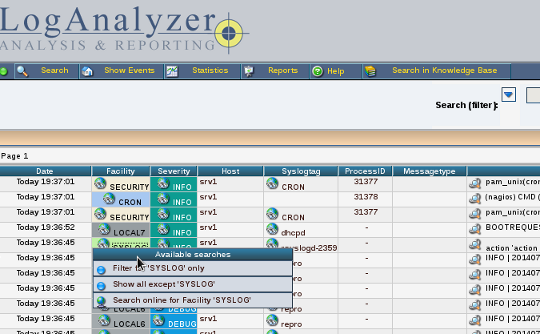
Daniel Pocock: Pruning Syslog entries from MongoDB

I previously announced the availability of rsyslog+MongoDB+LogAnalyzer in Debian wheezy-backports. This latest rsyslog with MongoDB storage support is also available for Ubuntu and Fedora users in one way or another. Just one thing was missing: a flexible way to prune the database. LogAnalyzer provides a very basic pruning script that simply purges all records over a certain age. The script hasn't been adapted to work within the package layout. It is written in PHP, which may not be ideal for people who don't actually want LogAnalyzer on their Syslog/MongoDB host. Now there is a convenient solution: I've just contributed a very trivial Python script for selectively pruning the records. Thanks to Python syntax and the PyMongo client, it is extremely concise: in fact, here is the full script:
#!/usr/bin/python
import syslog
import datetime
from pymongo import Connection
# It assumes we use the default database name 'logs' and collection 'syslog'
# in the rsyslog configuration.
with Connection() as client:
    db = client.logs
    table = db.syslog
    #print "Initial count: %d" % table.count()
    today = datetime.datetime.today()
    # remove ANY record older than 5 weeks except mail.info
    t = today - datetime.timedelta(weeks=5)
    table.remove( "time":  "$lt": t  , "syslog_fac":   "$ne" : syslog.LOG_MAIL  )
    # remove any debug record older than 7 days
    t = today - datetime.timedelta(days=7)
    table.remove( "time":  "$lt": t  , "syslog_sever": syslog.LOG_DEBUG )
    #print "Final count: %d" % table.count()
Just put it in /usr/local/bin and run it daily from cron. Customization Just adapt the table.remove statements as required. See the PyMongo tutorial for a very basic introduction to the query syntax and full details in the MongoDB query operator reference for creating more elaborate pruning rules. Potential improvements
  • Indexing the columns used in the queries
  • Logging progress and stats to Syslog

LogAnalyzer using a database backend such as MongoDB is very easy to set up and much faster than working with text-based log files

Russell Coker: Happiness and Lecture Questions

I just attended a lecture about happiness comparing Australia and India at the Australia India Institute [1]. The lecture was interesting but the questions were so bad that it makes a good case for entirely banning questions from public lectures. Based on this and other lectures I ve attended I ve written a document about how to recognise worthless questions and cut them off early [2]. As you might expect from a lecture on happiness there were plenty of stupid comments from the audience about depression, as if happiness is merely the absence of depression. Then they got onto stupidity about suicide. One question claimed that Australia has a high suicide rate, Wikipedia however places Australia 49th out of 110 countries, that means Australia is slightly above the median for suicide rates per country. Given some of the dubious statistics in the list (for example the countries claiming to have no suicides and the low numbers reported by some countries with extreme religious policies) I don t think we can be sure that Australia would be above the median if we had better statistics. Another question claimed that Sweden had the highest suicide rate in Europe, while Greenland, Belgium, Finland, Austria, France, Norway, Denmark, Iceland, and most of Eastern Europe are higher on the list. But the bigger problem in regard to discussing suicide is that the suicide rate isn t about happiness. When someone kills themself because they have a terminal illness that doesn t mean that they were unhappy for the majority of their life and doesn t mean that they were any unhappier than the terminally ill people who don t do that. Some countries have a culture that is more positive towards suicide which would increase the incidence, Japan for example. While people who kill themselves in Japan are probably quite unhappy at the time I don t think that there is any reason to believe that they are more unhappy than people in other countries who only keep living because suicide is considered to be wrong. It seems to me that the best strategy when giving or MCing a lecture about a potentially contentious topic is to plan ahead for what not to discuss. For a lecture about happiness it would make sense to rule out all discussion of suicide, anti-depressants, and related issues as they aren t relevant to the discussion and can t be handled in an appropriate manner in question time.

23 July 2014

Tanguy Ortolo: GNU/Linux graphic sessions: suspending your computer

Major desktop environments such as Xfce or KDE have a built-in computer suspend feature, but when you use a lighter alternative, things are a bit more complicated, because basically: only root can suspend the computer. There used to be a standard solution to that, using a D-Bus call to a running daemon upowerd. With recent updates, that solution first stopped working for obscure reasons, but it could still be configured back to be usable. With newer updates, it stopped working again, but this time it seems it is gone for good:
$ dbus-send --system --print-reply \
            --dest='org.freedesktop.UPower' \
            /org/freedesktop/UPower org.freedesktop.UPower.Suspend
Error org.freedesktop.DBus.Error.UnknownMethod: Method "Suspend" with
signature "" on interface "org.freedesktop.UPower" doesn't exist
The reason seems to be that upowerd is not running, because it no longer provides an init script, only a systemd service. So, if you do not use systemd, you are left with one simple and stable solution: defining a sudo rule to start the suspend or hibernation process as root. In /etc/sudoers.d/power:
%powerdev ALL=NOPASSWD: /usr/sbin/pm-suspend, \
                        /usr/sbin/pm-suspend-hybrid, \
                        /usr/sbin/pm-hibernate
That allows members of the powderdev group to run sudo pm-suspend, sudo pm-suspend-hybrid and sudo pm-hibernate, which can be used with a key binding manager such as your window manager's or xbindkeys. Simple, efficient, and contrary to all that ever-changing GizmoKit and whatsitd stuff, it has worked and will keep working for years.

22 July 2014

Russell Coker: Public Lectures About FOSS

Eventbrite I ve recently started using the Eventbrite Web site [1] and the associated Eventbrite Android app [2] to discover public events in my area. Both the web site and the Android app lack features for searching (I d like to save alerts for my accounts and have my phone notify me when new events are added to their database) but it is basically functional. The main issue is content, Eventbrite has a lot of good events in their database (I ve got tickets for 6 free events in the next month). I assume that Eventbrite also has many people attending their events, otherwise the events wouldn t be promoted there. At this time I haven t compared Eventbrite to any similar services, Eventbrite events have taken up much of my available time for the next 6 weeks (I appreciate the button on the app to add an entry to my calendar) so I don t have much incentive to find other web sites that list events. I would appreciate comments from users of competing event registration systems and may write a post in future comparing different systems. Also I have only checked for events in Melbourne, Australia as I don t have any personal interest in events in other places. For the topic of this post Eventbrite is good enough, it meets all requirements for Melbourne and I m sure that if it isn t useful in other cities then there are competing services. I think that we need to have free FOSS events announced through Eventbrite. We regularly have experts in various fields related to FOSS visiting Melbourne who give a talk for the Linux Users of Victoria (and sometimes other technical groups). This is a good thing but I think we could do better. Most people in Melbourne probably won t attend a LUG meeting and if they did they probably wouldn t find it a welcoming experience. Also I recommend that anyone who is looking for educational things to do in Melbourne visit the Eventbrite web site and/or install the Android app. Accessible Events I recently attended an Eventbrite event where a professor described the work of his research team, it was a really good talk that made the topic of his research accessible to random members of the public like me. Then when it came to question time the questions were mostly opinion pieces disguised as questions which used a lot of industry specific jargon and probably lost the interest of most people in the audience who wasn t from the university department that hosted the lecture. I spent the last 15 minutes in that lecture hall reading Wikipedia and resisted the temptation to load an Android game. Based on this lecture (and many other lectures I ve seen) I get the impression that when the speaker or the MC addresses a member of the audience by name (EG John Smith has a question ) then it s strongly correlated with a low quality question. See my previous post about the Length of Conference Questions for more on this topic [3]. It seems to me that when running a lecture everyone involved has to agree about whether it s a public lecture (IE one that is for any random people) as opposed to a society meeting (which while free for anyone to attend in the case of a LUG is for people with specific background knowledge). For a society meeting (for want of a better term) it s OK to assume a minimum level of knowledge that rules out some people. If 5% of the audience of a LUG don t understand a lecture that doesn t necessarily mean it s a bad lecture, sometimes it s not possible to give a lecture that is easily understood by those with the least knowledge that also teaches the most experienced members of the audience. For a public lecture the speaker has to give a talk for people with little background knowledge. Then the speaker and/or the MC have to discourage or reject questions that are for a higher level of knowledge. As an example of how this might work consider the case of an introductory lecture about how an OS kernel works. When one of the experienced Linux kernel programmers visits Melbourne we could have an Eventbrite event organised for a lecture introducing the basic concepts of an OS kernel (with Linux as an example). At such a lecture any questions about more technical topics (such as specific issues related to compilers, drivers, etc) could be met with we are having a meeting for more technical people at the Linux Users of Victoria meeting tomorrow night or we are having coffee at a nearby cafe afterwards and you can ask technical questions there . Planning Eventbrite Events When experts in various areas of FOSS visit Melbourne they often offer a talk for LUV. For any such experts who read this post please note that most lectures at LUV meetings are by locals who can reschedule, so if you are only in town for a short time we can give you an opportunity to speak at short notice. I would like to arrange to have some of those people give a talk aimed at a less experienced audience which we can promote through Eventbrite. The venue for LUV talks (Melbourne University 7PM on the first Tuesday of the month) might not work for all speakers so we need to find a sponsor for another venue. I will contact Linux companies that are active in Melbourne and ask whether they would be prepared to sponsor the venue for such a talk. The fallback option would be to have such a lecture at a LUV meeting. I will talk to some of the organisers of science and technology events advertised on Eventbrite and ask why they chose the times that they did. Maybe they have some insight into which times are best for getting an audience. Also I will probably get some idea of the best times by just attending many events and observing the attendance. I think that the aim of an Eventbrite event is to attract delegates who wouldn t attend other meetings, so it is a priority to choose a suitable time and place. Finally please note that while I am a member of the LUV committee I m not representing LUV in this post. My aim is that community feedback on this post will help me plan such events. I will discuss this with the LUV committee after I get some comments here. Please comment if you would like to give such a public lecture, attend such a lecture, or if you just have any general ideas.

21 July 2014

Ian Campbell: sunxi-tools now available in Debian

I've recently packaged the sunxi tools for Debian. These are a set of tools produce by the Linux Sunxi project for working with the Allwinner "sunxi" family of processors. See the package page for details. Thanks to Steve McIntyre for sponsoring the initial upload. The most interesting component of the package are the tools for working with the Allwinner processors' FEL mode. This is a low-level processor mode which implements a simple USB protocol allowing for initial programming of the device and recovery which can be entered on boot (usually be pressing a special 'FEL button' somewhere on the device). It is thanks to FEL mode that most sunxi based devices are pretty much unbrickable. The most common use of FEL is to boot over USB. In the Debian package the fel and usb-boot tools are named sunxi-fel and sunxi-usb-boot respectively but otherwise can be used in the normal way described on the sunxi wiki pages. One enhancement I made to the Debian version of usb-boot is to integrate with the u-boot packages to allow you to easily FEL boot any sunxi platform supported by the Debian packaged version of u-boot (currently only Cubietruck, more to come I hope). To make this work we take advantage of Multiarch to install the armhf version of u-boot (unless your host is already armhf of course, in which case just install the u-boot package):
# dpkg --add-architecture armhf
# apt-get update
# apt-get install u-boot:armhf
Reading package lists... Done
Building dependency tree       
Reading state information... Done
The following NEW packages will be installed:
  u-boot:armhf
0 upgraded, 1 newly installed, 0 to remove and 1960 not upgraded.
Need to get 0 B/546 kB of archives.
After this operation, 8,676 kB of additional disk space will be used.
Retrieving bug reports... Done
Parsing Found/Fixed information... Done
Selecting previously unselected package u-boot:armhf.
(Reading database ... 309234 files and directories currently installed.)
Preparing to unpack .../u-boot_2014.04+dfsg1-1_armhf.deb ...
Unpacking u-boot:armhf (2014.04+dfsg1-1) ...
Setting up u-boot:armhf (2014.04+dfsg1-1) ...
With that done FEL booting a cubietruck is as simple as starting the board in FEL mode (by holding down the FEL button when powering on) and then:
# sunxi-usb-boot Cubietruck -
fel write 0x2000 /usr/lib/u-boot/Cubietruck_FEL/u-boot-spl.bin
fel exe 0x2000
fel write 0x4a000000 /usr/lib/u-boot/Cubietruck_FEL/u-boot.bin
fel write 0x41000000 /usr/share/sunxi-tools//ramboot.scr
fel exe 0x4a000000
Which should result in something like this on the Cubietruck's serial console:
U-Boot SPL 2014.04 (Jun 16 2014 - 05:31:24)
DRAM: 2048 MiB
U-Boot 2014.04 (Jun 16 2014 - 05:30:47) Allwinner Technology
CPU:   Allwinner A20 (SUN7I)
DRAM:  2 GiB
MMC:   SUNXI SD/MMC: 0
In:    serial
Out:   serial
Err:   serial
SCSI:  SUNXI SCSI INIT
Target spinup took 0 ms.
AHCI 0001.0100 32 slots 1 ports 3 Gbps 0x1 impl SATA mode
flags: ncq stag pm led clo only pmp pio slum part ccc apst 
Net:   dwmac.1c50000
Hit any key to stop autoboot:  0 
sun7i# 
As more platforms become supported by the u-boot packages you should be able to find them in /usr/lib/u-boot/*_FEL. There is one minor inconvenience which is the need to run sunxi-usb-boot as root in order to access the FEL USB device. This is easily resolved by creating /etc/udev/rules.d/sunxi-fel.rules containing either:
SUBSYSTEMS=="usb", ATTR idVendor =="1f3a", ATTR idProduct =="efe8", OWNER="myuser"
or
SUBSYSTEMS=="usb", ATTR idVendor =="1f3a", ATTR idProduct =="efe8", GROUP="mygroup"
To enable access for myuser or mygroup respectively. Once you have created the rules file then to enable:
# udevadm control --reload-rules
As well as the FEL mode tools the packages also contain a FEX (de)compiler. FEX is Allwinner's own hardware description language and is used with their Android SDK kernels and the fork of that kernel maintained by the linux-sunxi project. Debian's kernels follow mainline and therefore use Device Tree.

Francois Marier: Creating a modern tiling desktop environment using i3

Modern desktop environments like GNOME and KDE involving a lot of mousing around and I much prefer using the keyboard where I can. This is why I switched to the Ion tiling window manager back when I interned at Net Integration Technologies and kept using it until I noticed it had been removed from Debian. After experimenting with awesome for 2 years and briefly considering xmonad , I finally found a replacement I like in i3. Here is how I customized it and made it play nice with the GNOME and KDE applications I use every day.

Startup script As soon as I log into my desktop, my startup script starts a few programs, including: Because of a bug in gnome-settings-daemon which makes the mouse cursor disappear as soon as gnome-settings-daemon is started, I had to run the following to disable the offending gnome-settings-daemon plugin:
dconf write /org/gnome/settings-daemon/plugins/cursor/active false

Screensaver In addition, gnome-screensaver didn't automatically lock my screen, so I installed xautolock and added it to my startup script:
xautolock -time 30 -locker "gnome-screensaver-command --lock" &
to lock the screen using gnome-screensaver after 30 minutes of inactivity. I can also trigger it manually using the following shortcut defined in my ~/.i3/config:
bindsym Ctrl+Mod1+l exec xautolock -locknow

Keyboard shortcuts While keyboard shortcuts can be configured in GNOME, they don't work within i3, so I added a few more bindings to my ~/.i3/config:
# volume control
bindsym XF86AudioLowerVolume exec /usr/bin/pactl set-sink-volume @DEFAULT_SINK@ -- '-5%'
bindsym XF86AudioRaiseVolume exec /usr/bin/pactl set-sink-volume @DEFAULT_SINK@ -- '+5%'
# brightness control
bindsym XF86MonBrightnessDown exec xbacklight -steps 1 -time 0 -dec 5
bindsym XF86MonBrightnessUp exec xbacklight -steps 1 -time 0 -inc 5
bindsym XF86AudioMute exec /usr/bin/pactl set-sink-mute @DEFAULT_SINK@ toggle
# show battery stats
bindsym XF86Battery exec gnome-power-statistics
to make volume control, screen brightness and battery status buttons work as expected on my laptop. These bindings require the following packages:

Keyboard layout switcher Another thing that used to work with GNOME and had to re-create in i3 is the ability to quickly toggle between two keyboard layouts using the keyboard. To make it work, I wrote a simple shell script and assigned a keyboard shortcut to it in ~/.i3/config:
bindsym $mod+u exec /home/francois/bin/toggle-xkbmap

Suspend script Since I run lots of things in the background, I have set my laptop to avoid suspending when the lid is closed by putting the following in /etc/systemd/login.conf:
HandleLidSwitch=lock
Instead, when I want to suspend to ram, I use the following keyboard shortcut:
bindsym Ctrl+Mod1+s exec /home/francois/bin/s2ram
which executes a custom suspend script to clear the clipboards (using xsel), flush writes to disk and lock the screen before going to sleep. To avoid having to type my sudo password every time pm-suspend is invoked, I added the following line to /etc/sudoers:
francois  ALL=(ALL)  NOPASSWD:  /usr/sbin/pm-suspend

Window and workspace placement hacks While tiling window managers promise to manage windows for you so that you can focus on more important things, you will most likely want to customize window placement to fit your needs better.

Working around misbehaving applications A few applications make too many assumptions about window placement and are just plain broken in tiling mode. Here's how to automatically switch them to floating mode:
for_window [class="VidyoDesktop"] floating enable
You can get the Xorg class of the offending application by running this command:
xprop   grep WM_CLASS
before clicking on the window.

Keeping IM windows on the first workspace I run Pidgin on my first workspace and I have the following rule to keep any new window that pops up (e.g. in response to a new incoming message) on the same workspace:
assign [class="Pidgin"] 1

Automatically moving workspaces when docking Here's a neat configuration blurb which automatically moves my workspaces (and their contents) from the laptop screen (eDP1) to the external monitor (DP2) when I dock my laptop:
# bind workspaces to the right monitors
workspace 1 output DP2
workspace 2 output DP2
workspace 3 output DP2
workspace 4 output DP2
workspace 5 output DP2
workspace 6 output eDP1
You can get these output names by running:
xrandr --display :0   grep " connected"
Finally, because X sometimes fail to detect my external monitor when docking/undocking, I also wrote a script to set the displays properly and bound it to the appropriate key on my laptop:
bindsym XF86Display exec /home/francois/bin/external-monitor

Junichi Uekawa: Trying android wear SDK using my LG G watch.

Trying android wear SDK using my LG G watch. I didn't have the permissions to access the usb device, and I had to update the udev rules. It wasn't clear what the right way was, and existing Android devices look like audio or camera, not really consistent.

18 July 2014

Mario Lang: Croudsourced accessibility: Self-made digital menus

Something straight out from the real world: Menu cards in restaurants are not nice to deal with if you are blind. It is an old problem we grow used to ignoring over time, but still something that can be quite nagging. There are a lot of psychological issues involved in this one. Of course, you can ask for the menu to be read out to you by the staff. While they usually do their best, you end up missing out on some things most of the time. First of all, depending on the current workload in the restaurant, the staff will usually try to cut some time and not read everything to you. What they usually do is to try to understand what type of meal you are interested in, and just read the choices from that category to you. While this can be considered a service in some situations (human preprocessing), there are situations were you will definitely miss a highlight on the menu that you would have liked to choose if you knew that it was there. And even if the staff decides to read the complete menu to you (which is rare), you are confronted with the 7-things-in-my-head-at-once problem. It is usually rather hard to decide amongst a list of more then 7 items, because our short-term memory is sort of limited. What the sighted restaurant goers do, is to skip back and forth between the available options, until they hit a decisive moment. True, that can take a while, but it is definitely a lot easier if you can perform "random access reads" to the list of choices yourself. However, if someone presents a substantial number of choices to you in a row, as sequential speech, you loose the random access ability. You either remember every choice from the beginning and do your choosing mentaully (if you do have extraordinary mental abilities), or you end up asking the staff to read previous items aloud again. This can work, but usually it doesn't. At some point, you do not want to bother the staff anymore, and you even start to feel stupid for asking again and again, while this is something totally normal to every sighted person, just that "they" do their "random access browsing" on their own, so "they" have no need to feel bad about how long it takes them to decide, minus the typical social pressure that arises after a a certain time for everyone, at least if you are dining in a group. In very rare cases, you happen to meet staff that is truly "awake", doing their best to not let you feel that they might be pressed on time, and really taking as much time as necessary to help you make the perfect decision. This is rare, but if it happens, it is almost a magical moment. One of these moments, where there are no "artificial" barriers between humans doing communcation. Anyway, I am drifting away. The perfect solution to this problem is to provide random access browsing of a restaurant menu with the help of digital devices. Trying to make braille menus available in all restaurants is a goal which is not realistically reachable. Menus go out of date, and need changing. And getting a physical braille copy updated and reprinted is considerably more involved as with digital media. Restaurant owners will also likely not see the benefit to rpvide a braille card for a very small circle of customers. With a digital online menu, that is a completely different story. These days, almost every blind person in at least my social circles owns an iOS (or similar) device. These devices have speech synthesis and web browsers. Of course, some restaurants especially in urban areas do already have a menu online. I have found them manually with google and friends sometimes in the past, which has already given me the ability to actually sit back, and really comfortably choose amongst the available offerings myself, without having to bother a human, and without having to feel bad about (ab)using their time. However, the case where a restaurant really has their menu online is rather rare still in the area where I am. And, it can be tedious to google for a restaurant website. Sometimes, the website itself is just marginally accessible, which makes it even more frustrating to get a relaxed dinner-experience. I have discovered a location-based solution for the restaurant-menu problem recently. Foursquare offers the ability to provide a direct link to the menu in a restaurant-entry. I figured, since all you need to do is write a single webpage where the (common) menu items are listed per restaurant, that I could begin to create restaurant menus for my favourite locations, on my own. Well, not quite, but almost. I will sometimes need help from others to get the menu digitized, but that's just a one-time piece of work I hopefully can outsource :-). Once the actual content is in my INBUX, I create a nice HTML page listing the menu in a rather speech-based browser friendly way. I have begun to do this today, with the menu of a restaurant just about 500 meters away from my apartment. Unterm goldenen Dachl now has a menu online, and the foursquare change request to publish the corresponsing URL is already pending. I don't fully understand how the Foursquare change review process works yet, but I hope the URL should be published in the upcoming days/weeks. I am using Foursquare because it is the backend of a rather popular mobile navigation App for blind people, called Blindsquare. Blindsquare lets you comfortably use Open Street Map and Foursquare data to get an overview of your surroundingds. If a food place has a menu entry listed in Foursquare, Blindsquare conveniently shows it to you and opens a browser if you tap it. So there is no need to actually search for the restaurant, you can just use the location based search of Blindsquare to discover the restaurant entry and its menu link directly from within Blindsquare. Actually, you could even find a restaurant by accident, and with a little luck, find the menu for it by location, without even knowing how the restaurant is called. Isn't that neat? Yeah, that's how it is supposed to work, that's as much independence as you can get. And, it is, as the title suggests, croudsourced accessibility. Becuase while it is nice if a restaurant owner cares to publish their menu themselves, if they haven't, you can do it yourself. Either as a user of assistive technologies, to scratch your own itch. Or as a friend of a person with a need for assistive technologies. Next time you go to lunch with your blind friend, consider making available the menu to them digitally in advance, instead of reading it. Other people will likely thank you for that, and you have actually achieved something today. And if you happne to put a menu online, make sure to submit a change request to Foursquare. Many blind people are using blindsquare these days, which makes it super-easy for them to discover the menu.

16 July 2014

Dirk Eddelbuettel: Introducing RcppParallel: Getting R and C++ to work (some more) in parallel

A common theme over the last few decades was that we could afford to simply sit back and let computer (hardware) engineers take care of increases in computing speed thanks to Moore's law. That same line of thought now frequently points out that we are getting closer and closer to the physical limits of what Moore's law can do for us. So the new best hope is (and has been) parallel processing. Even our smartphones have multiple cores, and most if not all retail PCs now possess two, four or more cores. Real computers, aka somewhat decent servers, can be had with 24, 32 or more cores as well, and all that is before we even consider GPU coprocessors or other upcoming changes. And sometimes our tasks are embarassingly simple as is the case with many data-parallel jobs: we can use higher-level operations such as those offered by the base R package parallel to spawn multiple processing tasks and gather the results. I covered all this in some detail in previous talks on High Performance Computing with R (and you can also consult the Task View on High Performance Computing with R which I edit). But sometimes we can't use data-parallel approaches. Hence we have to redo our algorithms. Which is really hard. R itself has been relying on the (fairly mature) OpenMP standard for some of its operations. Luke Tierney's (awesome) keynote in May at our (sixth) R/Finance conference mentioned some of the issues related to OpenMP. One which matters is that OpenMP works really well on Linux, and either not so well (Windows) or not at all (OS X, due the usual issue with the gcc/clang switch enforced by Applem but the good news is that the OpenMP toolchain is expected to make it to OS X is some more performant form "soon"). R is still expected to make wider use of OpenMP in future versions. Another tool which has been around for a few years, and which can be considered to be equally mature is the Intel Threaded Building Blocks library, or TBB. JJ recently started to wrap this up for use by R. The first approach resulted in a (now superseded, see below) package TBB. But hardware and OS issues bite once again, as the Intel TBB is not really building that well for the Windows toolchain used by R (and based on MinGW). (And yes, there are two more options. But Boost Threads requires linking which precludes easy use as e.g. via our BH package. And C++11 with its threads library (based on Boost Threads) is not yet as widely available as R and Rcpp which means that it is not a real deployment option yet.) Now, JJ, being as awesome as he is, went back to the drawing board and integrated a second threading toolkit: TinyThread++, a small header-only library without further dependencies. Not as feature-rich as Intel Threaded Building Blocks, but at least available everywhere. So a new package RcppParallel, so far only on GitHub, wraps around both TinyThread++ and Intel Threaded Building Blocks and offers a consistent interface available on all platforms used by R. Better still, JJ also authored several pieces demonstrating this new package for the Rcpp Gallery: All four are interesting and demonstrate different aspects of parallel computing via RcppParallel. But the last article is key. Based on a question by Jim Bullard, and then written with Jim, it shows how a particular matrix distance metric (which is missing from R) can be implemented in a serial manner in both R, and also via Rcpp. The key implementation, however, uses both Rcpp and RcppParallel and thereby achieves a truly impressive speed gain as the gains from using compiled code (via Rcpp) and from using a parallel algorithm (via RcppParallel) are multiplicative! Between JJ's and my four-core machines the gain was between 200 and 300 fold---which is rather considerable. For kicks, I also used a much bigger machine at work which came in at an even larger speed gain (but gains become clearly sublinear as the number of cores increases; there are however some tuning parameters). So these are exciting times. I am sure there will be lots more to come. For now, head over to the RcppParallel package and start playing. Further contributions to the Rcpp Gallery are not only welcome but strongly encouraged.

Next.

Previous.