
Search Results: "reg"

29 October 2022

Dirk Eddelbuettel: littler 0.3.17 on CRAN: Maintenance

max-heap image The eighteenth release of littler as a CRAN package just landed, following in the now sixteen year history (!!) as a package started by Jeff in 2006, and joined by me a few weeks later. littler is the first command-line interface for R as it predates Rscript. It allows for piping as well for shebang scripting via #!, uses command-line arguments more consistently and still starts faster. It also always loaded the methods package which Rscript only started to do in recent years. littler lives on Linux and Unix, has its difficulties on macOS due to yet-another-braindeadedness there (who ever thought case-insensitive filesystems as a default were a good idea?) and simply does not exist on Windows (yet the build system could be extended see RInside for an existence proof, and volunteers are welcome!). See the FAQ vignette on how to add it to your PATH. A few examples are highlighted at the Github repo, as well as in the examples vignette. This release, coming just a few weeks since the last release in August, heeds to clang-15 a updates one signature to a proper interface. It also contains one kindly contributed patch updating install2.r (and installBioc.r) to cope with a change in R-devel. The full change description follows.

Changes in littler version 0.3.17 (2022-10-29)
  • Changes in package
    • An internal function prototype was updated for clang-15.
  • Changes in examples
    • The install2.r and installBioc. were updated for an update in R-devel (Tatsuya Shima and Dirk in #104).

My CRANberries service provides a comparison to the previous release. Full details for the littler release are provided as usual at the ChangeLog page, and also on the package docs website. The code is available via the GitHub repo, from tarballs and now of course also from its CRAN page and via install.packages("littler"). Binary packages are available directly in Debian as well as soon via Ubuntu binaries at CRAN thanks to the tireless Michael Rutter. Comments and suggestions are welcome at the GitHub repo. If you like this or other open-source work I do, you can now sponsor me at GitHub.

This post by Dirk Eddelbuettel originated on his Thinking inside the box blog. Please report excessive re-aggregation in third-party for-profit settings.

Russ Allbery: California general election

As usual with these every-two-year posts, probably of direct interest only to California residents. Maybe the more obscure things we're voting on will be a minor curiosity to people elsewhere. Apologies to Planet Debian readers for the explicitly political post because I'm too lazy to change my blog software to do more fine-grained post classification. For what it's worth, most of the discussion here will be about the more fiddly and nuanced things we vote on, not on the major hot-button proposition. As in 2020, I'm only going to cover the ballot propositions, as all of the state-wide and most of the district races are both obvious to me and boring to talk about. The hyperlocal races are more interesting this year, but the number of people who would care and who are also reading this blog is essentially nonexistent, so I won't bother writing them up. This year, everything except Proposition 1 is an initiative (not put on the ballot by the legislature), which means I default to voting against them because they're usually poorly-written. Proposition 1: YES. Adds reproductive rights to the California state constitution. I'm fairly sure everyone reading this has already made up their mind on this topic and certainly nothing will ever change my mind, so I'll leave it at that. Proposition 26: YES. This mushes two different things together in an unhelpful way: allowing sports betting at some racetracks, and allowing a wider variety of gambling on tribal lands. I have no strong opinion about the former (I'll get into that more with the next proposition). For the latter, my starting point is that Native American tribes are and should be treated like independent governments with their own laws (which is what we promised them by treaty and then have systematically and maliciously betrayed ever since). I am not a citizen of any of the tribes and therefore fundamentally I should not get a say on this. I'm not a big fan of gambling or of the companies they're likely to hire to run casinos, but it should be their land and their decision. Proposition 27: NO. This, on the other hand, is about on-line sports betting outside of tribal lands, and looks to be a lot more about corruption and corporate greed. I am fairly dubious that outlawing gambling in general is that good of an idea. I think the harms are overstated given the existence of even wilder forms of gambling (crypto and financial derivatives) that are perfectly legal, and I'm always suspicious of attempting to solve social problems with police and prohibition systems. If there were a ballot proposition to simply legalize gambling in California, I'd have to think hard about that. But this is not that. This requires companies that want to offer on-line gambling to pay substantial up-front costs (which will restrict this to only huge gambling companies). In return, they are allowed entry into what is essentially a state-constructed partial monopoly. As usual, there's a typical vice tax deal attached where those companies are taxed to fund some program (in this case, homeless services and mental health treatment), but these sorts of taxes tend to be regressive in effect. We could just tax richer people like me to pay for those services instead. I'm also dubious that the money for homelessness will be used to build housing, which is what we need to do to address the problem. Proposition 28: YES. Sets aside money for art and music funding in public and charter schools. This is a reluctant yes because this sort of law should not be done via proposition; it should be done through a normal legislative process that balances all of the priorities for school funding. But despite the broken process by which this was put forward, it seems like a reasonable law and no one is opposing it, so okay, fine. Proposition 29: NO. The attempt to force all dialysis clinics to have licensed doctors on site is back again. Everything about the way dialysis health care is provided in California makes me angry. We should have a state health care system similar to the NHS. We should open dialysis clinics based on the number of people requiring dialysis in that area. Every one of them should be unionized. We absolutely should not allow for-profit companies to have primary responsibility for basic life-saving medical care like dialysis. But this proposition does not solve any of those problems, and what it claims to do is false. It claims that by setting credential requirements on who has to be on-site at a dialysis clinic, the clinics will become safer. This is simply not true, for all of the reasons discussed in Still Not Safe. This is not how safety works. The safest person to do dialysis is someone with extensive experience in performing dialysis, who has seen all the problems and has an intuition for what to watch out for. That has less to do with credentials than with good training specifically in dialysis, apprenticeship, and practice, not to mention reasonable hours and good pay so that the workers are not stressed. Do I think the private dialysis clinics are likely doing a good job with this? Hah. (Do I think dialysis clinics run by large medical non-profits would do a good job with this? Also hah.) But this would enshrine into law a fundamentally incorrect solution to the problem that makes dialysis more expensive without addressing any of the other problems with the system. It's the same tactic that was used on abortion clinics, with the same bogus argument that having people with specific credentials on-site would make them safer. It was false then and it's still false now. I would agree with better regulation of dialysis clinics, but this specific regulation is entirely wrong-headed. Also, while this isn't an overriding factor, I get annoyed when the same proposition shows up again without substantial changes. For matters of fundamental rights, okay, sure. But for technical regulation fixes like this one, the proponents should consider taking no for an answer and trying a different approach. Like going to the legislature, which is where this kind of regulation should be designed anyway. Proposition 30: YES. Raises taxes on the personal income of extremely rich Californians (over $2 million in income in one year) to fund various climate change mitigation programs. This is another reluctant yes vote, because once again this shouldn't be done by initiative and should be written properly by the legislature. I also don't like restricting tax revenue to particular programs, which reduce budget flexibilty to no real purpose. It's not important to me that these revenues go to these specific programs, although the programs seem like good ones to fund. But the reality remains that wealthy Silicon Valley executives are undertaxed and the only way we can ever manage to raise taxes is through voting for things like this, so fine. Proposition 31: NO. The Calfornia legislature banned the sale of flavored vape products. If NO beats YES on this proposition, that ban will be overturned. Drug prohibition has never, ever worked, and yet we keep trying it over and over again in the hope that this time we'll get a different outcome. As usual, the pitch in favor of this is all about the children, specifically the claim that flavored tobacco products are only about increasing their appeal to kids because... kids like candy? Or something? I am extremely dubious of this argument; it's obvious to me from walking around city streets that adults prefer the flavored products as well and sale to kids is already prohibited and unchanged by this proposition. I don't like vaping. I wish people would stop, at least around me, because the scent is obnoxious and the flavored stuff is even more obnoxious, even apart from whatever health problems it causes. But I'm never going to vote for drug prohibition because drug prohibition doesn't work. It just creates a black market and organized crime and makes society overall worse. Yes, the tobacco companies are some of the worst corporations on the planet, and I hope they get sued into oblivion (and ideally prosecuted) for all the lying they do, but I'm still not going to vote for prohibition. Even the best kind of prohibition that only outlaws sale and not possession. Also, secondarily but still significant, bans like this just frustrate a bunch of people and burn good will and political capital, which we should be trying to preserve to tackle far more important problems. The politics of outlawing people's pleasures for their own good are not great. We have a lot of serious problems to deal with; maybe let's not pick fights we don't have to.

Dirk Eddelbuettel: gettz 0.0.5 on CRAN: Maintenance

A minor routine update 0.0.5 of gettz arrived on CRAN overnight. gettz provides a possible fallback in situations where Sys.timezone() fails to determine the system timezone. That happened when e.g. the file /etc/localtime somehow is not a link into the corresponding file with zoneinfo data in, say, /usr/share/zoneinfo. Since the package was written (in the fall of 2016), R added a similar extended heuristic approach itself. This release updates a function signature to satisfy the more stringent tests by clang-15, updates the GitHub Action checkout code to suppress a nag, and changes a few remaining http documentation links to https. As with the previous releses: No functional changes, no new code, or new features. Courtesy of my CRANberries, there is a comparison to the previous release. More information is on the gettz page. For questions or comments use the issue tracker off the GitHub repo. If you like this or other open-source work I do, you can now sponsor me at GitHub.

This post by Dirk Eddelbuettel originated on his Thinking inside the box blog. Please report excessive re-aggregation in third-party for-profit settings.

28 October 2022

Antoine Beaupr : Debating VPN options

In my home lab(s), I have a handful of machines spread around a few points of presence, with mostly residential/commercial cable/DSL uplinks, which means, generally, NAT. This makes monitoring those devices kind of impossible. While I do punch holes for SSH, using jump hosts gets old quick, so I'm considering adding a virtual private network (a "VPN", not a VPN service) so that all machines can be reachable from everywhere. I see three ways this can work:
  1. a home-made Wireguard VPN, deployed with Puppet
  2. a Wireguard VPN overlay, with Tailscale or equivalent
  3. IPv6, native or with tunnels
So which one will it be?

Wireguard Puppet modules As is (unfortunately) typical with Puppet, I found multiple different modules to talk with Wireguard.
module score downloads release stars watch forks license docs contrib issue PR notes
halyard 3.1 1,807 2022-10-14 0 0 0 MIT no requires firewall and Configvault_Write modules?
voxpupuli 5.0 4,201 2022-10-01 2 23 7 AGPLv3 good 1/9 1/4 1/61 optionnally configures ferm, uses systemd-networkd, recommends systemd module with manage_systemd to true, purges unknown keys
abaranov 4.7 17,017 2021-08-20 9 3 38 MIT okay 1/17 4/7 4/28 requires pre-generated private keys
arrnorets 3.1 16,646 2020-12-28 1 2 1 Apache-2 okay 1 0 0 requires pre-generated private keys?
The voxpupuli module seems to be the most promising. The abaranov module is more popular and has more contributors, but it has more open issues and PRs. More critically, the voxpupuli module was written after the abaranov author didn't respond to a PR from the voxpupuli author trying to add more automation (namely private key management). It looks like setting up a wireguard network would be as simple as this on node A:
wireguard::interface   'wg0':
  source_addresses => ['2003:4f8:c17:4cf::1', '149.9.255.4'],
  public_key       => $facts['wireguard_pubkeys']['nodeB'],
  endpoint         => 'nodeB.example.com:53668',
  addresses        => [ 'Address' => '192.168.123.6/30', , 'Address' => 'fe80::beef:1/64' ,],
 
This configuration come from this pull request I sent to the module to document how to use that fact. Note that the addresses used here are examples that shouldn't be reused and do not confirm to RFC5737 ("IPv4 Address Blocks Reserved for Documentation", 192.0.2.0/24 (TEST-NET-1), 198.51.100.0/24 (TEST-NET-2), and 203.0.113.0/24 (TEST-NET-3)) or RFC3849 ("IPv6 Address Prefix Reserved for Documentation", 2001:DB8::/32), but that's another story. (To avoid boostrapping problems, the resubmit-facts configuration could be used so that other nodes facts are more immediately available.) One problem with the above approach is that you explicitly need to take care of routing, network topology, and addressing. This can get complicated quickly, especially if you have lots of devices, behind NAT, in multiple locations (which is basically my life at home, unfortunately). Concretely, basic Wireguard only support one peer behind NAT. There are some workarounds for this, but they generally imply a relay server of some sort, or some custom registry, it's kind of a mess. And this is where overlay networks like Tailscale come in.

Tailscale Tailscale is basically designed to deal with this problem. It's not fully opensource, but pretty close, and they have an interesting philosophy behind that. The client is opensource, and there is an opensource version of the server side, called headscale. They have recently (late 2022) hired the main headscale developer while promising to keep supporting it, which is pretty amazing. Tailscale provides an overlay network based on Wireguard, where each peer basically has a peer-to-peer encrypted connexion, with automatic key rotation. They also ship a multitude of applications and features on top of that like file sharing, keyless SSH access, and so on. The authentication layer is based on an existing SSO provider, you don't just register with Tailscale with new account, you login with Google, Microsoft, or GitHub (which, really, is still Microsoft). The Headscale server ships with many features out of that:
  • Full "base" support of Tailscale's features
  • Configurable DNS
    • Split DNS
    • MagicDNS (each user gets a name)
  • Node registration
    • Single-Sign-On (via Open ID Connect)
    • Pre authenticated key
  • Taildrop (File Sharing)
  • Access control lists
  • Support for multiple IP ranges in the tailnet
  • Dual stack (IPv4 and IPv6)
  • Routing advertising (including exit nodes)
  • Ephemeral nodes
  • Embedded DERP server (AKA NAT-to-NAT traversal)
Neither project (client or server) is in Debian (RFP 972439 for the client, none filed yet for the server), which makes deploying this for my use case rather problematic. Their install instructions are basically a curl bash but they also provide packages for various platforms. Their Debian install instructions are surprisingly good, and check most of the third party checklist we're trying to establish. (It's missing a pin.) There's also a Puppet module for tailscale, naturally. What I find a little disturbing with Tailscale is that you not only need to trust Tailscale with authorizing your devices, you also basically delegate that trust also to the SSO provider. So, in my case, GitHub (or anyone who compromises my account there) can penetrate the VPN. A little scary. Tailscale is also kind of an "all or nothing" thing. They have MagicDNS, file transfers, all sorts of things, but those things require you to hook up your resolver with Tailscale. In fact, Tailscale kind of assumes you will use their nameservers, and have suffered great lengths to figure out how to do that. And naturally, here, it doesn't seem to work reliably; my resolv.conf somehow gets replaced and the magic resolution of the ts.net domain fails. (I wonder why we can't opt in to just publicly resolve the ts.net domain. I don't care if someone can enumerate the private IP addreses or machines in use in my VPN, at least I don't care as much as fighting with resolv.conf everywhere.) Because I mostly have access to the routers on the networks I'm on, I don't think I'll be using tailscale in the long term. But it's pretty impressive stuff: in the time it took me to even review the Puppet modules to configure Wireguard (which is what I'll probably end up doing), I was up and running with Tailscale (but with a broken DNS, naturally). (And yes, basic Wireguard won't bring me DNS either, but at least I won't have to trust Tailscale's Debian packages, and Tailscale, and Microsoft, and GitHub with this thing.)

IPv6 IPv6 is actually what is supposed to solve this. Not NAT port forwarding crap, just real IPs everywhere. The problem is: even though IPv6 adoption is still growing, it's kind of reaching a plateau at around 40% world-wide, with Canada lagging behind at 34%. It doesn't help that major ISPs in Canada (e.g. Bell Canada, Videotron) don't care at all about IPv6 (e.g. Videotron in beta since 2011). So we can't rely on those companies to do the right thing here. The typical solution here is often to use a tunnel like HE's tunnelbroker.net. It's kind of tricky to configure, but once it's done, it works. You get end-to-end connectivity as long as everyone on the network is on IPv6. And that's really where the problem lies here; the second one of your nodes can't setup such a tunnel, you're kind of stuck and that tool completely breaks down. IPv6 tunnels also don't give you the kind of security a VPN provides as well, naturally. The other downside of a tunnel is you don't really get peer-to-peer connectivity: you go through the tunnel. So you can expect higher latencies and possibly lower bandwidth as well. Also, HE.net doesn't currently charge for this service (and they've been doing this for a long time), but this could change in the future (just like Tailscale, that said). Concretely, the latency difference is rather minimal, Google:
--- ipv6.l.google.com ping statistics ---
10 packets transmitted, 10 received, 0,00% packet loss, time 136,8ms
RTT[ms]: min = 13, median = 14, p(90) = 14, max = 15
--- google.com ping statistics ---
10 packets transmitted, 10 received, 0,00% packet loss, time 136,0ms
RTT[ms]: min = 13, median = 13, p(90) = 14, max = 14
In the case of GitHub, latency is actually lower, interestingly:
--- ipv6.github.com ping statistics ---
10 packets transmitted, 10 received, 0,00% packet loss, time 134,6ms
RTT[ms]: min = 13, median = 13, p(90) = 14, max = 14
--- github.com ping statistics ---
10 packets transmitted, 10 received, 0,00% packet loss, time 293,1ms
RTT[ms]: min = 29, median = 29, p(90) = 29, max = 30
That is because HE.net peers directly with my ISP and Fastly (which is behind GitHub.com's IPv6, apparently?), so it's only 6 hops away. While over IPv4, the ping goes over New York, before landing AWS's Ashburn, Virginia datacenters, for a whopping 13 hops... I managed setup a HE.net tunnel at home, because I also need IPv6 for other reasons (namely debugging at work). My first attempt at setting this up in the office failed, but now that I found the openwrt.org guide, it worked... for a while, and I was able to produce the above, encouraging, mini benchmarks. Unfortunately, a few minutes later, IPv6 just went down again. And the problem with that is that many programs (and especially OpenSSH) do not respect the Happy Eyeballs protocol (RFC 8305), which means various mysterious "hangs" at random times on random applications. It's kind of a terrible user experience, on top of breaking the one thing it's supposed to do, of course, which is to give me transparent access to all the nodes I maintain. Even worse, it would still be a problem for other remote nodes I might setup where I might not have acess to the router to setup the tunnel. It's also not absolutely clear what happens if you setup the same tunnel in two places... Presumably, something is smart enough to distribute only a part of the /48 block selectively, but I don't really feel like going that far, considering how flaky the setup is already.

Other options If this post sounds a little biased towards IPv6 and Wireguard, it's because it is. I would like everyone to migrate to IPv6 already, and Wireguard seems like a simple and sound system. I'm aware of many other options to make VPNs. So before anyone jumps in and says "but what about...", do know that I have personnally experimented with:
  • tinc: nice, automatic meshing, used for the Montreal mesh, serious design flaws in the crypto that make it generally unsafe to use; supposedly, v1.1 (or 2.0?) will fix this, but that's been promised for over a decade by now
  • ipsec, specifically strongswan: hard to configure (especially configure correctly!), harder even to debug, otherwise really nice because transparent (e.g. no need for special subnets), used at work, but also considering a replacement there because it's a major barrier to entry to train new staff
  • OpenVPN: mostly used as a client for [VPN service][]s like Riseup VPN or Mullvad, mostly relevant for client-server configurations, not really peer-to-peer, shared secrets or TLS, kind of an hassle to maintain, see also SoftEther for an alternative implementation
All of those solutions have significant problems and I do not wish to use any of those for this project. Also note that Tailscale is only one of many projects laid over Wireguard to do that kind of thing, see this LWN review for others (basically NetbBird, Firezone, and Netmaker).

Future work Those are options that came up after writing this post, and might warrant further examination in the future.
  • Meshbird, a "distributed private networking" with little information about how it actually works other than "encrypted with strong AES-256"
  • Nebula, "A scalable overlay networking tool with a focus on performance, simplicity and security", written by Slack people to replace IPsec, docs, runs as an overlay for Slack's 50k node network, only packaged in Debian experimental, lagging behind upstream (1.4.0, from May 2021 vs upstream's 1.6.1 from September 2022), requires a central CA, Golang, I'm in "wait and see" mode for now
  • n2n: "layer two VPN", seems packaged in Debian but inactive
  • ouroboros: "peer-to-peer packet network prototype", sounds and seems complicated
  • QuickTUN is interesting because it's just a small wrapper around NaCL, and it's in Debian... but maybe too obscure for my own good
  • unetd: Wireguard-based full mesh networking from OpenWRT, not in Debian
  • vpncloud: "high performance peer-to-peer mesh VPN over UDP supporting strong encryption, NAT traversal and a simple configuration", sounds interesting, not in Debian
  • Yggdrasil: actually a pretty good match for my use case, but I didn't think of it when starting the experiments here; packaged in Debian, with the Golang version planned, Puppet module; major caveat: nodes exposed publicly inside the global mesh unless configured otherwise (firewall suggested), requires port forwards, alpha status

Conclusion Right now, I'm going to deploy Wireguard tunnels with Puppet. It seems like kind of a pain in the back, but it's something I will be able to reuse for work, possibly completely replacing strongswan. I have another Puppet module for IPsec which I was planning to publish, but now I'm thinking I should just abort that and replace everything with Wireguard, assuming we still need VPNs at work in the future. (I have a number of reasons to believe we might not need any in the near future anyways...)

Shirish Agarwal: Shantaram, The Pyramid, Japan s Hikikomori & Backpack

Shantaram I know I have been quite behind in review of books but then that s life. First up is actually not as much as a shocker but somewhat of a pleasant surprise. So, a bit of background before I share the news. If you have been living under a rock, then about 10-12 years ago a book called Shantaram was released. While the book is said to have been released in 2003/4 I got it in my hand around 2008/09 or somewhere around that. The book is like a good meal, a buffet. To share the synopsis, Lin a 20 something Australian guy gets involved with a girl, she encourages him to get into heroin, he becomes a heroin user. And drugs, especially hard drugs need constant replenishment, it is a chemical thing. So, to fund those cravings, he starts to steal, rising to rob a bank and while getting away shoots a cop who becomes dead. Now either he surrenders or is caught is unclear, but he is tortured in the jail. So one day, he escapes from prison, lands up at home of somebody who owes him a favor, gets some money, gets a fake passport and lands up in Mumbai/Bombay as it was then known. This is from where the actual story starts. And how a 6 foot something Australian guy relying on his street smartness and know how the transformation happens from Lin to Shantaram. Now what I have shared is perhaps just 5% of the synopsis, as shared the real story starts here. Now the good news, last week 4 episodes of Shantaram were screened by Apple TV. Interestingly, I have seen quite a number people turning up to buy or get this book and also sharing it on Goodreads. Now there seems to have been some differences from the book to TV. Now I m relying on 10-12 year back memory but IIRC Khaderbhai, one of the main characters who sort of takes Lin/Shantaram under his wing is an Indian. In the series, he is a western or at least looks western/Middle Eastern to me. Also, they have tried to reproduce 1980s in Mumbai/Bombay but dunno how accurate they were  My impression of that city from couple of visits at that point in time where they were still more tongas (horse-ridden carriages), an occasional two wheelers and not many three wheelers. Although, it was one of the more turbulent times as lot of agitation for worker rights were happening around that time and a lot of industrial action. Later that led to lot of closure of manufacturing in Bombay and it became more commercial. It would be interesting to know whether they shot it in actual India or just made a set somewhere in Australia, where it possibly might have been shot. The chawl of the book needs a bit of arid land and Australia has lots of it. It is also interesting as this was a project that had who s who interested in it for a long time but somehow none of them was able to bring the project to fruition, the project seems to largely have an Australian cast as well as second generations of Indians growing in Australia. To take names, Amitabh Bacchan, Johnny Depp, Russel Crowe each of them wanted to make it into a feature film. In retrospect, it is good it was not into a movie, otherwise they would have to cut a lot of material and that perhaps wouldn t have been sufficient. Making it into a web series made sure they could have it in multiple seasons if people like it. There is a lot between now and 12 episodes to even guess till where it would leave you then. So, if you have not read the book and have some holidays coming up, can recommend it. The writing IIRC is easy and just flows. There is a bit of action but much more nuance in the book while in the web series they are naturally more about action. There is also quite a bit of philosophy between him and Kaderbhai and while the series touches upon it, it doesn t do justice but then again it is being commercially made. Read the book, see the series and share your thoughts on what you think. It is possible that the series might go up or down but am sharing from where I see it, may do another at the end of the season, depending on where they leave it and my impressions. Update A slight update from the last blog post. Seems Rishi Sunak seems would be made PM of UK. With Hunt as chancellor and Rishi Sunak, Austerity 2.0 seems complete. There have been numerous articles which share how austerity gives rises to fascism and vice-versa. History gives lot of lessons about the same. In Germany, when the economy was not good, it was all blamed on the Jews for number of years. This was the reason for rise of Hitler, and while it did go up by a bit, propaganda by him and his loyalists did the rest. And we know and have read about the Holocaust. Today quite a few Germans deny it or deny parts of it but that s how misinformation spreads. Also Hitler is looked now more as an aberration rather than something to do with the German soul. I am not gonna talk more as there is still lots to share and that actually perhaps requires its own blog post to do justice for the same.

The Pyramid by Henning Mankell I had actually wanted to review this book but then the bomb called Shantaram appeared and I had to post it above. I had read two-three books before it, but most of them were about multiple beheadings and serial killers. Enough to put anybody into depression. I do not know if modern crime needs to show crime and desperation of and to such a level. Why I and most loved and continue to love Sherlock Holmes as most stories were not about gross violence but rather a homage to the art of deduction, which pretty much seems to be missing in modern crime thrillers rather than grotesque stuff. In that, like a sort of fresh air I read/am reading the Pyramid by Henning Mankell. The book is about a character made by Monsieur Henning Mankell named Kurt Wallender. I am aware of the series called Wallender but haven t yet seen it. The book starts with Wallender as a beat cop around age 20 and on his first case. He is ambitious, wants to become a detective and has a narrow escape with death. I wouldn t go much into it as it basically gives you an idea of the character and how he thinks and what he does. He is more intuitive by nature and somewhat of a loner. Probably most detectives IRL are, dunno, have no clue. At least in the literary world it makes sense, in real world think there would be much irony for sure. This is speculation on my part, who knows. Back to the book though. The book has 5 stories a sort of prequel one could say but also not entirely true. The first case starts when he is a beat cop in 1969 and he is just a beat cop. It is a kind of a prequel and a kind of an anthology as he covers from the first case to the 1990s where he is ending his career sort of. Before I start sharing about the stories in the book, I found the foreword also quite interesting. It asks questions about the interplay of the role of welfare state and the Swedish democracy. Incidentally did watch couple of videos about a sort of mixed sort of political representation that happens in Sweden. It uses what is known as proportional representation. Ironically, Sweden made a turn to the far right this election season. The book was originally in Swedish and were translated to English by Ebba Segerberg and Laurie Thompson. While all the stories are interesting, would share the last three or at least ask the questions of intrigue. Of course, to answer them you would need to read the book  So the last three stories I found the most intriguing. The first one is titled Man on the Beach. Apparently, a gentleman goes to one of the beaches, a sort of lonely beach, hails a taxi and while returning suddenly dies. The Taxi driver showing good presence of mind takes it to hospital where the gentleman is declared dead on arrival. Unlike in India, he doesn t run away but goes to the cafeteria and waits there for the cops to arrive and take his statement. Now the man is in his early 40s and looks to be fit. Upon searching his pockets he is found to relatively well-off and later it turns out he owns a couple of shops. So then here are the questions ? What was the man doing on a beach, in summer that beach is somewhat popular but other times not so much, so what was he doing there? How did he die, was it a simple heart attack or something more? If he had been drugged or something then when and how? These and more questions can be answered by reading the story Man on the Beach . 2. The death of a photographer Apparently, Kurt lives in a small town where almost all the residents have been served one way or the other by the town photographer. The man was polite and had worked for something like 40 odd years before he is killed/murdered. Apparently, he is murdered late at night. So here come the questions a. The shop doesn t even stock any cameras and his cash box has cash. Further investigation reveals it is approximate to his average takeout for the day. So if it s not for cash, then what is the motive ? b. The body was discovered by his cleaning staff who has worked for almost 20 years, 3 days a week. She has her own set of keys to come and clean the office? Did she give the keys to someone, if yes why? c. Even after investigation, there is no scandal about the man, no other woman or any vices like gambling etc. that could rack up loans. Also, nobody seems to know him and yet take him for granted till he dies. The whole thing appears to be quite strange. Again, the answers lie in the book. 3. The Pyramid Kurt is sleeping one night when the telephone rings. The scene starts with a Piper Cherokee, a single piston aircraft flying low and dropping something somewhere or getting somebody from/on the coast of Sweden. It turns and after a while crashes. Kurt is called to investigate it. Turns out, the plane was supposed to be destroyed. On crash, both the pilot and the passenger are into pieces so only dental records can prove who they are. Same day or a day or two later, two seemingly ordinary somewhat elderly women, spinsters, by all accounts, live above the shop where they sell buttons and all kinds of sewing needs of the town. They seem middle-class. Later the charred bodies of the two sisters are found :(. So here come the questions a.Did the plane drop something or pick something somebody up ? The Cherokee is a small plane so any plane field or something it could have landed up or if a place was somehow marked then could be dropped or picked up without actually landing. b. The firefighter suspects arson started at multiple places with the use of petrol? The question is why would somebody wanna do that? The sisters don t seem to be wealthy and practically everybody has bought stuff from them. They weren t popular but weren t also unpopular. c. Are the two crimes connected or unconnected? If connected, then how? d. Most important question, why the title Pyramid is given to the story. Why does the author share the name Pyramid. Does he mean the same or the original thing? He could have named it triangle. Again, answers to all the above can be found in the book. One thing I also became very aware of during reading the book that it is difficult to understand people s behavior and what they do. And this is without even any criminality involved in. Let s say for e.g. I die in some mysterious circumstances, the possibility of the police finding my actions in last days would be limited and this is when I have hearing loss. And this probably is more to do with how our minds are wired. And most people I know are much more privacy conscious/aware than I am.

Japan s Hikikomori Japan has been a curious country. It was more or less a colonizer and somewhat of a feared power till it dragged the U.S. unnecessarily in World War 2. The result of the two atom bombs and the restitution meant that Japan had to build again from the ground up. It is also in a seismically unstable place as they have frequent earthquakes although the buildings are hardened/balanced to make sure that vibrations don t tear buildings apart. Had seen years ago on Natgeo a documentary that explains all that. Apart from that, Japan was helped by the Americans and there was good kinship between them till the 1980s till it signed the Plaza Accord which enhanced asset price bubbles that eventually burst. Something from which they are smarting even today. Japan has a constitutional monarchy. A somewhat history lesson or why it exists even today can be found here. Asset price bubbles of the 1980s, more than 50 percent of the population on zero hour contracts and the rest tend to suffer from overwork. There is a term called Karoshi that explains all. An Indian pig-pen would be two, two and a half times larger than a typical Japanese home. Most Japanese live in micro-apartments called konbachiku . All of the above stresses meant that lately many young Japanese people have become Hikikomori. Bloomberg featured about the same a couple of years back. I came to know about it as many Indians are given the idea of Japan being a successful country without knowing the ills and issues it faces. Even in that most women get the wrong end of the short stick i.e. even it they manage to find jobs, it would be most back-breaking menial work. The employment statistics of Japan s internal ministry tells its own story.

If you look at the data above, it seems that the between 2002 and 2019, the share of zero hour contracts has increased while regular work has decreased. This also means that those on the bottom of the ladder can no longer afford a home. There is and was a viral video called Lost in Manboo that went viral few years ago. It is a perfect set of storms. Add to that the Fukushima nuclear incident about which I had shared a few years ago. While the workers are blamed but all design decisions are taken by the management. And as was shown in numerous movies, documentaries etc. Interestingly, and somewhat ironically, the line workers knew the correct things to do and correct decisions to take unlike the management. The shut-ins story is almost a decade or two decades old. It is similar story in South Korea but not as depressive as the in Japan. It is somewhat depressive story but needed to be shared. The stories shared in the bloomberg article makes your heart ache

Backpacks In and around 2015, I had bought a Targus backpack, very much similar to the Targus TSB194US-70 Motor 16-inch Backpack. That bag has given me a lot of comfort over the years but now has become frayed the zip sometimes work and sometimes doesn t. Unlike those days there are a bunch of companies now operating in India. There are eight different companies that I came to know about, Aircase, Harrisons Sirius, HP Oddyssey, Mokobara, Artic Hunter, Dell Pro Hybrid, Dell Roller Backpack and lastly the Decathlon Quechua Hiking backpack 32L NH Escape 500 . Now of all the above, two backpacks seem the best, the first one is Harrisons Sirius, with 45L capacity, I don t think I would need another bag at all. The runner-up is the Decathlon Quecha Hiking Backpack 32L. One of the better things in all the bags is that all have hidden pockets for easy taking in and out of passport while having being ant-theft. I do not have to stress how stressful it is to take out the passport and put it back in. Almost all the vendors have made sure that it is not a stress point anymore. The good thing about the Quecha is that they are giving 10 years warranty, the point to be asked is if that is does the warranty cover the zip. Zips are the first thing that goes out in bags.That actually has what happened to my current bag. Decathlon has a store in Wakad, Pune while I have reached out to the gentleman in charge of Harrisons India to see if they have a reseller in Pune. So hopefully, in next one week I should have a backpack that isn t spilling with things all over the place, whichever I m able to figure out.

Dirk Eddelbuettel: RcppAnnoy 0.0.20 on CRAN: Maintenance

annoy image Another minor maintenance release, now at version 0.0.20, of RcppAnnoy has arrived on CRAN. RcppAnnoy is the Rcpp-based R integration of the nifty Annoy library by Erik Bernhardsson. Annoy is a small and lightweight C++ template header library for very fast approximate nearest neighbours originally developed to drive the Spotify music discovery algorithm. This release only contains internal changes to please, respectively clang-15 and (macOS) Xcode 14 (one of which PRed upstream too). No changes in package functionality. Detailed changes follow.

Changes in version 0.0.20 (2022-10-27)
  • Minor tweaks to appease clang-15 and Xcode 14

Courtesy of my CRANberries, there is also a diffstat report for this release. If you like this or other open-source work I do, you can sponsor me at GitHub.

This post by Dirk Eddelbuettel originated on his Thinking inside the box blog. Please report excessive re-aggregation in third-party for-profit settings.

26 October 2022

Dirk Eddelbuettel: RQuantLib 0.4.17 on CRAN: Maintenance

A new release 0.4.17 of RQuantLib arrived at CRAN earlier today, and has been uploaded to Debian as well. QuantLib is a very comprehensice free/open-source library for quantitative finance; RQuantLib connects it to the R environment and language. The release of RQuantLib comes five months after the previous maintenance, and brings a somewhat humurous upgrade from a default C++ standard of C++11 to C++14. We waited so long for C++11 to become available for R (which happened eventually when g++ 4.9 was no longer the default on Windows) and now it has become a constraint!! QuantLib 1.28, released today actually switched to C++14 as a minimum required. R also supports this as the default, but we still had C++11 hardwired so this quick maintenance release does away with that.

Changes in RQuantLib version 0.4.17 (2022-10-25)
  • Switch compilation to C++14 which is required by QuantLib 1.28 and, while standard with R 4.2.*, may be needed for R 4.1.*

Courtesy of my CRANberries, there is also a diffstat report for the this release. As always, more detailed information is on the RQuantLib page. Questions, comments etc should go to the new rquantlib-devel mailing list. Issue tickets can be filed at the GitHub repo. If you like this or other open-source work I do, you can now sponsor me at GitHub.

This post by Dirk Eddelbuettel originated on his Thinking inside the box blog. Please report excessive re-aggregation in third-party for-profit settings.

25 October 2022

Arturo Borrero Gonz lez: Netfilter Workshop 2022 summary

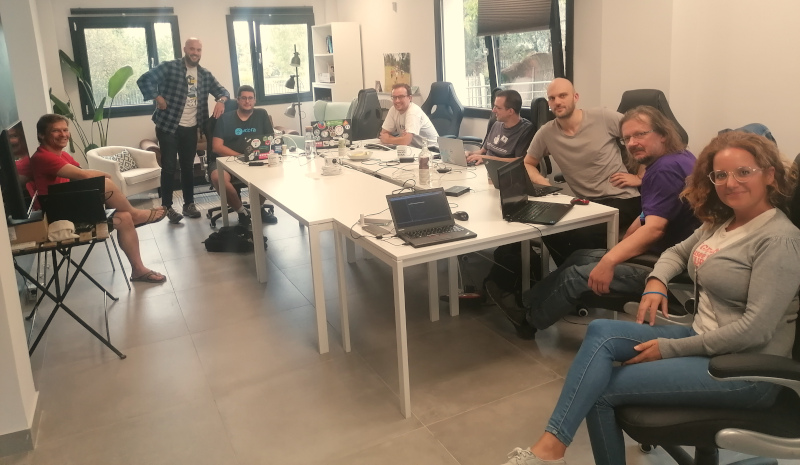
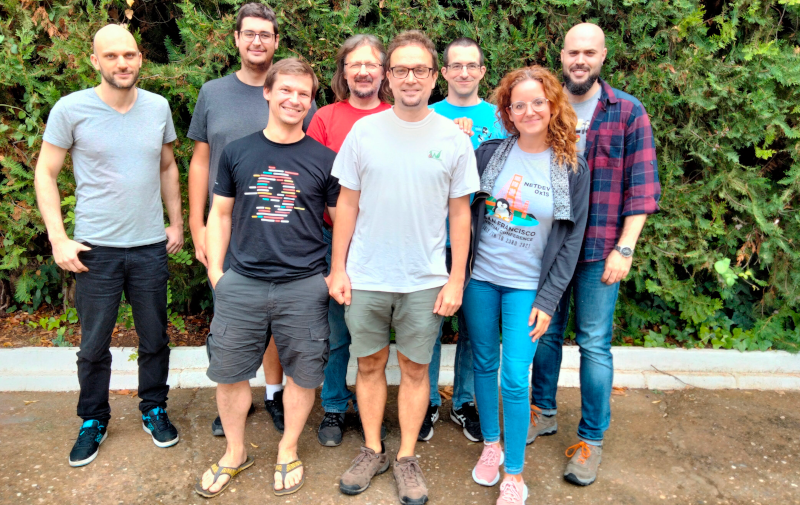
Netfilter logo This is my report from the Netfilter Workshop 2022. The event was held on 2022-10-20/2022-10-21 in Seville, and the venue was the offices of Zevenet. We started on Thursday with Pablo Neira (head of the project) giving a short welcome / opening speech. The previous iteration of this event was in virtual fashion in 2020, two years ago. In the year 2021 we were unable to meet either in person or online. This year, the number of participants was just eight people, and this allowed the setup to be a bit more informal. We had kind of an un-conference style meeting, in which whoever had something prepared just went ahead and opened a topic for debate. In the opening speech, Pablo did a quick recap on the legal problems the Netfilter project had a few years ago, a topic that was settled for good some months ago, in January 2022. There were no news in this front, which was definitely a good thing. Moving into the technical topics, the workshop proper, Pablo started to comment on the recent developments to instrument a way to perform inner matching for tunnel protocols. The current implementation supports VXLAN, IPIP, GRE and GENEVE. Using nftables you can match packet headers that are encapsulated inside these protocols. He mentioned the design and the goals, that was to have a kernel space setup that allows adding more protocols by just patching userspace. In that sense, more tunnel protocols will be supported soon, such as IP6IP, UDP, and ESP. Pablo requested our opinion on whether if nftables should generate the matching dependencies. For example, if a given tunnel is UDP-based, a dependency match should be there otherwise the rule won t work as expected. The agreement was to assist the user in the setup when possible and if not, print clear error messages. By the way, this inner thing is pure stateless packet filtering. Doing inner-conntracking is an open topic that will be worked on in the future. Pablo continued with the next topic: nftables automatic ruleset optimizations. The times of linear ruleset evaluation are over, but some people have a hard time understanding / creating rulesets that leverage maps, sets, and concatenations. This is where the ruleset optimizations kick in: it can transform a given ruleset to be more optimal by using such advanced data structures. This is purely about optimizing the ruleset, not about validating the usefulness of it, which could be another interesting project. There were a couple of problems mentioned, however. The ruleset optimizer can be slow, O(n!) in worst case. And the user needs to use nested syntax. More improvements to come in the future. Next was Stefano Brivio s turn (Red Hat engineer). He had been involved lately in a couple of migrations to nftables, in particular libvirt and KubeVirt. We were pointed to https://libvirt.org/firewall.html, and Stefano walked us through the 3 or 4 different virtual networks that libvirt can create. He evaluated some options to generate efficient rulesets in nftables to instrument such networks, and commented on a couple of ideas: having a null matcher in nftables set expression. Or perhaps having kind of subsets, something similar to a view in a SQL database. The room spent quite a bit of time debating how the nft_lookup API could be extended to support such new search operations. We also discussed if having intermediate facilities such as firewalld could provide the abstraction levels that could make developers more comfortable. Using firewalld also may have the advantage that coordination between different system components writing ruleset to nftables is handled by firewalld itself and developers are freed of the responsibility of doing it right. Next was Fernando F. Mancera (Red Hat engineer). He wanted to improve error reporting when deleting table/chain/rules with nftables. In general, there are some inconsistencies on how tables can be deleted (or flushed). And there seems to be no correct way to make a single table go away with all its content in a single command. The room agreed in that the commands destroy table and delete table should be defined consistently, with the following meanings: This topic diverted into another: how to reload/replace a ruleset but keep stateful information (such as counters). Next was Phil Sutter (Netfilter coreteam member and Red Hat engineer). He was interested in discussing options to make iptables-nft backward compatible. The use case he brought was simple: What happens if a container running iptables 1.8.7 creates a ruleset with features not supported by 1.8.6. A later container running 1.8.6 may fail to operate. Phil s first approach was to attach additional metadata into rules to assist older iptables-nft in decoding and printing the ruleset. But in general, there are no obvious or easy solutions to this problem. Some people are mixing different tooling version, and there is no way all cases can be predicted/covered. iptables-nft already refuses to work in some of the most basic failure scenarios. An other way to approach the issue could be to introduce some kind of support to print raw expressions in iptables-nft, like -m nft xyz. Which feels ugly, but may work. We also explored playing with the semantics of release version numbers. And another idea: store strings in the nft rule userdata area with the equivalent matching information for older iptables-nft. In fact, what Phil may have been looking for is not backwards but forward compatibility. Phil was undecided which path to follow, but perhaps the most common-sense approach is to fall back to a major release version bump (2.x.y) and declaring compatibility breakage with older iptables 1.x.y. That was pretty much it for the first day. We had dinner together and went to sleep for the next day. The room The second day was opened by Florian Westphal (Netfilter coreteam member and Red Hat engineer). Florian has been trying to improve nftables performance in kernels with RETPOLINE mitigations enabled. He commented that several workarounds have been collected over the years to avoid the performance penalty of such mitigations. The basic strategy is to avoid function indirect calls in the kernel. Florian also described how BPF programs work around this more effectively. And actually, Florian tried translating nf_hook_slow() to BPF. Some preliminary benchmarks results were showed, with about 2% performance improvement in MB/s and PPS. The flowtable infrastructure is specially benefited from this approach. The software flowtable infrastructure already offers a 5x performance improvement with regards the classic forwarding path, and the change being researched by Florian would be an addition on top of that. We then moved into discussing the meeting Florian had with Alexei in Zurich. My personal opinion was that Netfilter offers interesting user-facing interfaces and semantics that BPF does not. Whereas BPF may be more performant in certain scenarios. The idea of both things going hand in hand may feel natural for some people. Others also shared my view, but no particular agreement was reached in this topic. Florian will probably continue exploring options on that front. The next topic was opened by Fernando. He wanted to discuss Netfilter involvement in Google Summer of Code and Outreachy. Pablo had some personal stuff going on last year that prevented him from engaging in such projects. After all, GSoC is not fundamental or a priority for Netfilter. Also, Pablo mentioned the lack of support from others in the project for mentoring activities. There was no particular decision made here. Netfilter may be present again in such initiatives in the future, perhaps under the umbrella of other organizations. Again, Fernando proposed the next topic: nftables JSON support. Fernando shared his plan of going over all features and introduce programmatic tests from them. He also mentioned that the nftables wiki was incomplete and couldn t be used as a reference for missing tests. Phil suggested running the nftables python test-suite in JSON mode, which should complain about missing features. The py test suite should cover pretty much all statements and variations on how the nftables expression are invoked. Next, Phil commented on nftables xtables support. This is, supporting legacy xtables extensions in nftables. The most prominent problem was that some translations had some corner cases that resulted in a listed ruleset that couldn t be fed back into the kernel. Also, iptables-to-nftables translations can be sloppy, and the resulting rule won t work in some cases. In general, nft list ruleset nft -f may fail in rulesets created by iptables-nft and there is no trivial way to solve it. Phil also commented on potential iptables-tests.py speed-ups. Running the test suite may take very long time depending on the hardware. Phil will try to re-architect it, so it runs faster. Some alternatives had been explored, including collecting all rules into a single iptables-restore run, instead of hundreds of individual iptables calls. Next topic was about documentation on the nftables wiki. Phil is interested in having all nftables code-flows documented, and presented some improvements in that front. We are trying to organize all developer-oriented docs on a mediawiki portal, but the extension was not active yet. Since I worked at the Wikimedia Foundation, all the room stared at me, so at the end I kind of committed to exploring and enabling the mediawiki portal extension. Note to self: is this perhaps https://www.mediawiki.org/wiki/Portals ? Next presentation was by Pablo. He had a list of assorted topics for quick review and comment. Following this, a new topic was introduced by Stefano. He wanted to talk about nft_set_pipapo, documentation, what to do next, etc. He did a nice explanation of how the pipapo algorithm works for element inserts, lookups, and deletion. The source code is pretty well documented, by the way. He showed performance measurements of different data types being stored in the structure. After some lengthly debate on how to introduce changes without breaking usage for users, he declared some action items: writing more docs, addressing problems with non-atomic set reloads and a potential rework of nft_rbtree. After that, the next topic was kubernetes & netfilter , also by Stefano. Actually, this topic was very similar to what we already discussed regarding libvirt. Developers want to reduce packet matching effort, but also often don t leverage nftables most performant features, like sets, maps or concatenations. Some Red Hat developers are already working on replacing everything with native nftables & firewalld integrations. But some rules generators are very bad. Kubernetes (kube-proxy) is a known case. Developers simply won t learn how to code better ruleset generators. There was a good question floating around: What are people missing on first encounter with nftables? The Netfilter project doesn t have a training or marketing department or something like that. We cannot force-educate developers on how to use nftables in the right way. Perhaps we need to create a set of dedicated guidelines, or best practices, in the wiki for app developers that rely on nftables. Jozsef Kadlecsik (Netfilter coreteam) supported this idea, and suggested going beyond: such documents should be written exclusively from the nftables point of view: stop approaching the docs as a comparison to the old iptables semantics. Related to that last topic, next was Laura Garc a (Zevenet engineer, and venue host). She shared the same information as she presented in the Kubernetes network SIG in August 2020. She walked us through nftlb and kube-nftlb, a proof-of-concept replacement for kube-proxy based on nftlb that can outperform it. For whatever reason, kube-nftlb wasn t adopted by the upstream kubernetes community. She also covered latest changes to nftlb and some missing features, such as integration with nftables egress. nftlb is being extended to be a full proxy service and a more robust overall solution for service abstractions. In a nutshell, nftlb uses a templated ruleset and only adds elements to sets, which is exactly the right usage of the nftables framework. Some other projects should follow its example. The performance numbers are impressive, and from the early days it was clear that it was outperforming classical LVS-DSR by 10x. I used this opportunity to bring a topic that I wanted to discuss. I ve seen some SRE coworkers talking about katran as a replacement for traditional LVS setups. This software is a XDP/BPF based solution for load balancing. I was puzzled about what this software had to offer versus, for example, nftlb or any other nftables-based solutions. I commented on the highlighs of katran, and we discussed the nftables equivalents. nftlb is a simple daemon which does everything using a JSON-enabled REST API. It is already packaged into Debian, ready to use, whereas katran feels more like a collection of steps that you need to run in a certain order to get it working. All the hashing, caching, HA without state sharing, and backend weight selection features of katran are already present in nftlb. To work on a pure L3/ToR datacenter network setting, katran uses IPIP encapsulation. They can t just mangle the MAC address as in traditional DSR because the backend server is on a different L3 domain. It turns out nftables has a nft_tunnel expression that can do this encapsulation for complete feature parity. It is only available in the kernel, but it can be made available easily on the userspace utility too. Also, we discussed some limitations of katran, for example, inability to handle IP fragmentation, IP options, and potentially others not documented anywhere. This seems to be common with XDP/BPF programs, because handling all possible network scenarios would over-complicate the BPF programs, and at that point you are probably better off by using the normal Linux network stack and nftables. In summary, we agreed that nftlb can pretty much offer the same as katran, in a more flexible way. Group photo Finally, after many interesting debates over two days, the workshop ended. We all agreed on the need for extending it to 3 days next time, since 2 days feel too intense and too short for all the topics worth discussing. That s all on my side! I really enjoyed this Netfilter workshop round.
Russ Allbery: Review: A Spaceship Repair Girl Supposedly Named Rachel

Review: A Spaceship Repair Girl Supposedly Named Rachel, by Richard Roberts
Publisher: Mystique Press
Copyright: 2022
ISBN: 1-63789-763-4
Format: Kindle
Pages: 353
Rachel had snuck out of the house to sit on the hill, to write and draw in rare peace and quiet, when a bus fell out of the sky like a meteor and plowed into the ground in front of her. This is quickly followed by a baffling encounter with a seven-foot-tall man with a blunderbuss, two misunderstandings and a storytelling lie, and a hurried invitation to get into the bus and escape before they're both infected by math. That's how Rachel discovers that she's able to make on-the-fly repairs to bicycle-powered spaceships, and how she ends up at the Lighthouse of Ceres. The title comes from Rachel's initial hesitation to give her name, which propagates through the book to everyone she meets as certainty that Rachel isn't really her name. I enjoyed this running gag way more than I expected to. I don't read enough young adult and middle-grade books to be entirely clear on the boundaries, but this felt very middle-grade. It has a headlong plot, larger-than-life characters, excitingly imaginative scenery (such as a giant space lighthouse dwarfing the asteroid that it's attached to), a focus on friendship, and no romance. This is, to be clear, not a complaint. But it's a different feel than my normal fare, and there were a few places where I was going one direction and the book went another. The conceit of this book is that Earth is unique in the solar system in being stifled by the horrific weight of math, which infects anyone who visits and makes the routine wonders of other planets impossible. Other planets have their own styles and mythos (Saturn is full of pirates, the inhabitants of Venus are space bunnies with names like Passionfruit Nectar Ecstasy), but throughout the rest of the solar system, belief, style, and story logic reign supreme. That means Rachel's wild imagination and reflexive reliance on tall tales makes her surprisingly powerful. The first wild story she tells, to the man who crashed on earth, shapes most of the story. She had written in her sketchbook that it was the property of the Witch Queen of Eloquent Verbosity and Grandiose Ornamentation, and when challenged on it, says that she stole it to cure her partner. Much to her surprise, everyone outside of Earth takes this completely seriously. Also much to her surprise, her habit of sketching spaceships and imaginative devices makes her a natural spaceship mechanic, a skill in high demand. Some of the story is set on Ceres, a refuge for misfits with hearts of gold. That's where Rachel meets Wrench, a kobold who is by far my favorite character of the book and the one relationship that I thought had profound emotional depth. Rachel's other adventures are set off by the pirate girl Violet (she's literally purple), who is the sort of plot-provoking character that I think only works in middle-grade fiction. By normal standards, Violet's total lack of respect for other people's boundaries or consent would make her more of a villain. Here, while it often annoys Rachel, it's clear that both Rachel and the book take Violet's steamroller personality in good fun, more like the gentle coercion between neighborhood friends trying to pull each other into games. I still got rather tired of Violet, though, which caused me a few problems around the middle of the book. There's a bit of found family here (some of it quite touching), a lot of adventures, a lot of delightful spaceship repair, and even some more serious plot involving the actual Witch Queen of Charon. There is a bit of a plot arc to give some structure to the adventures, but this is not the book to read if you're looking for complex plotting or depth. I thought the story fell apart a bit at the tail end, with a conflict that felt like it was supposed to be metaphorical and then never resolved for me into something concrete. I was expecting Rachel to eventually have to do more introspection and more direct wrestling with her identity, but the resolution felt a bit superficial and unsatisfying. Reading this as an adult, I found it odd but fun. I wanted more from the ending, and I was surprised that Roberts does not do more to explain to the reader why Rachel does not regret leaving Earth and her family behind. It feels like something Rachel will have to confront eventually, but this is not the book for it. Instead we get some great friendships (some of which I agreed with wholeheartedly, and some of which I found annoying) and an imaginative, chaotic universe that Rachel takes to like a fish to water. The parts of the story focused on her surprising competence (and her delight in her own competence) were my favorites. The book this most reminds me of is Norton Juster's The Phantom Tollbooth. It is, to be clear, nowhere near as good as The Phantom Tollbooth, which is a very high bar, and it's not as focused on puns. But it has the same sense of internal logic and the same tendency to put far more weight on belief and stories than our world does, and to embrace the resulting chaos. I'm not sure this will be anyone's favorite book (although I'm also not the target age), but I enjoyed reading it. It was a great change of pace after Nona the Ninth. Recommended if you're in the mood for some space fantasy that doesn't take itself seriously. Rating: 7 out of 10

Dirk Eddelbuettel: nanotime 0.3.7 on CRAN: Enhancements

A new version of our nanotime package arrived at CRAN today as version 0.3.7. nanotime relies on the RcppCCTZ package (as well as the RcppDate package for additional C++ operations) and offers efficient high(er) resolution time parsing and formatting up to nanosecond resolution, and the bit64 package for the actual integer64 arithmetic. Initially implemented using the S3 system, it has benefitted greatly from a rigorous refactoring by Leonardo who not only rejigged nanotime internals in S4 but also added new S4 types for periods, intervals and durations. This release adds a few more operators, plus some other fixes, that were contributed in several PRs by Trevor Davis. The NEWS snippet has the full details.

Changes in version 0.3.7 (2022-10-23)
  • Update mkdocs for material docs generator (Dirk in #102)
  • Use inherits() instead comparing to class() (Trevor Davis in #104)
  • Set default arguments in nanoduration() (Trevor Davis in #105)
  • Add as.nanoduration.difftime() support (Trevor Davis in #106)
  • Add +/- methods for nanotime and difftime objects (Trevor Davis in #110 closing #108, #107)

Thanks to my CRANberries there is also a diff to the previous version. More details and examples are at the nanotime page; code, issue tickets etc at the GitHub repository and all documentation is provided at the nanotime documentation site. If you like this or other open-source work I do, you can now sponsor me at GitHub.

This post by Dirk Eddelbuettel originated on his Thinking inside the box blog. Please report excessive re-aggregation in third-party for-profit settings.

23 October 2022

Dirk Eddelbuettel: RDieHarder 0.2.4 on CRAN: Packaging Updates

An new version 0.2.4 of the random-number generator tester RDieHarder (based on the DieHarder suite developed / maintained by Robert Brown with contributions by David Bauer and myself along with other contributors) is now on CRAN. This release comes ten months after the previous release 0.2.3. It is once more related to R and requested CRAN changes as clang-15 brings additional warnings concerning -Wstrict-prototyping. This make use of C more solid, but it was a metric ton of work (see pull request #8). Thanks to CRANberries, you can also look at the most recent diff. If you like this or other open-source work I do, you can now sponsor me at GitHub.

This post by Dirk Eddelbuettel originated on his Thinking inside the box blog. Please report excessive re-aggregation in third-party for-profit settings.

20 October 2022

Dirk Eddelbuettel: qlcal 0.0.3 on CRAN: Maintenance and Updates

The third release of the still pretty new qlcal package arrivied at CRAN today. qlcal is based on the calendaring subset of QuantLib. It is provided (for the R package) as a set of included files, so the package is self-contained and does not depend on an external QuantLib library (which can be demanding to build). qlcal covers over sixty country / market calendars and can compute holiday lists, its complement (i.e. business day lists) and much more. This release fixes a small bug affecting one function, brings calendar updates from QuantLib 1.27 and 1.28, and applies a little bit of polish to appease clang++-15.

Changes in version 0.0.3 (2022-10-19)
  • Correct the isBusinessDay() functionality (Fixes #2)
  • Update Australia and Saudi Arabia calendars from QuantLib 1.27
  • Update United Kingdom calendar from QuantLib 1.28
  • Convert one source file to utf-8 to appease clang-15

See the project page and package documentation for more details, and more examples. If you like this or other open-source work I do, you can now sponsor me at GitHub.

This post by Dirk Eddelbuettel originated on his Thinking inside the box blog. Please report excessive re-aggregation in third-party for-profit settings.

Dirk Eddelbuettel: RcppQuantuccia 0.1.1 on CRAN: Maintenance

A minor release of RcppQuantuccia arrived on CRAN today. RcppQuantuccia started from the Quantuccia header-only subset / variant of QuantLib which it brings it to R. This project validated the idea of making the calendaring functionality of QuantLib available in a more compact and standalone project which we now do with qlcal which can be seen as a successor to this. This release merely updates a source file to proper encoding as clang++-15 would otherwise warn. The complete list changes for this release follows.

Changes in version 0.1.1 (2022-10-19)
  • Minor code reorganization splitting off calendars.cpp
  • Convert the Argentinian calendar sources files as utf-8 to appease clang++-15
  • Advertise the qlcal package as an alternative

Courtesy of CRANberries, there is also a diffstat report relative to the previous release. More information is on the RcppQuantuccia page. Issues and bugreports should go to the GitHub issue tracker. If you like this or other open-source work I do, you can now sponsor me at GitHub.

This post by Dirk Eddelbuettel originated on his Thinking inside the box blog. Please report excessive re-aggregation in third-party for-profit settings.

18 October 2022

Dirk Eddelbuettel: RcppSimdJson 0.1.8 on CRAN: Maintenance

The RcppSimdJson package was just updated to release 0.1.8 today. RcppSimdJson wraps the fantastic and genuinely impressive simdjson library by Daniel Lemire and collaborators. Via very clever algorithmic engineering to obtain largely branch-free code, coupled with modern C++ and newer compiler instructions, it results in parsing gigabytes of JSON parsed per second which is quite mindboggling. The best-case performance is faster than CPU speed as use of parallel SIMD instructions and careful branch avoidance can lead to less than one cpu cycle per byte parsed; see the video of the talk by Daniel Lemire at QCon. This release simply changes one statement to not trigger a warning under clang++-14. The very short NEWS entry for this release follows.

Changes in version 0.1.8 (2022-10-18)
  • Use the ' ' operator instead of ' ' on a set of booleans to appease 'clang-14'.

Courtesy of my CRANberries, there is also a diffstat report for this release. For questions, suggestions, or issues please use the issue tracker at the GitHub repo. If you like this or other open-source work I do, you can now sponsor me at GitHub.

This post by Dirk Eddelbuettel originated on his Thinking inside the box blog. Please report excessive re-aggregation in third-party for-profit settings.

Dirk Eddelbuettel: digest 0.6.30 on CRAN: More Package Maintenance

Release 0.6.30 of the digest package arrived at CRAN earlier today, and was just uploaded to Debian as well. digest creates hash digests of arbitrary R objects (using the md5, sha-1, sha-256, sha-512, crc32, xxhash32, xxhash64, murmur32, spookyhash, and blake3 algorithms) permitting easy comparison of R language objects. It is a mature and widely-used as many tasks may involve caching of objects for which it provides convenient general-purpose hash key generation to quickly identify the various objects. This release contains two tiny changes on old standard C code to appease the new / upcoming clang-15 release now used by CRAN in their forward-looking checks. My CRANberries provides the usual summary of changes to the previous version. For questions or comments use the issue tracker off the GitHub repo. If you like this or other open-source work I do, you can now sponsor me at GitHub.

This post by Dirk Eddelbuettel originated on his Thinking inside the box blog. Please report excessive re-aggregation in third-party for-profit settings.

16 October 2022

Colin Watson: Reproducible man-db databases

I ve released man-db 2.11.0 (announcement, NEWS), and uploaded it to Debian unstable. The biggest chunk of work here was fixing some extremely long-standing issues with how the database is built. Despite being in the package name, man-db s database is much less important than it used to be: most uses of man(1) haven t required it in a long time, and both hardware and software improvements mean that even some searches can be done by brute force without needing prior indexing. However, the database is still needed for the whatis(1) and apropos(1) commands. The database has a simple format - no relational structure here, it s just a simple key-value database using old-fashioned DBM-like interfaces and composing a few fields to form values - but there are a number of subtleties involved. The issues tend to amount to this: what does a manual page name mean? At first glance it might seem simple, because you have file names that look something like /usr/share/man/man1/ls.1.gz and that s obviously ls(1). Some pages are symlinks to other pages (which we track separately because it makes it easier to figure out which entries to update when the contents of the file system change), and sometimes multiple pages are even hard links to the same file. The real complications come with whatis references . Pages can list a bunch of names in their NAME section, and the historical expectation is that it should be possible to use those names as arguments to man(1) even if they don t also appear in the file system (although Debian policy has deprecated relying on this for some time). Not only does that mean that man(1) sometimes needs to consult the database, but it also means that the database is inherently more complicated, since a page might list something in its NAME section that conflicts with an actual file name in the file system, and now you need a priority system to resolve ambiguities. There are some other possible causes of ambiguity as well. The people working on reproducible builds in Debian branched out to the related challenge of reproducible installations some time ago: can you take a collection of packages, bootstrap a file system image from them, and reproduce that exact same image somewhere else? This is useful for the same sorts of reasons that reproducible builds are useful: it lets you verify that an image is built from the components it s supposed to be built from, and doesn t contain any other skulduggery by accident or design. One of the people working on this noticed that man-db s database files were an obstacle to that: in particular, the exact contents of the database seemed to depend on the order in which files were scanned when building it. The reporter proposed solving this by processing files in sorted order, but I wasn t keen on that approach: firstly because it would mean we could no longer process files in an order that makes it more efficient to read them all from disk (still valuable on rotational disks), but mostly because the differences seemed to point to other bugs. Having understood this, there then followed several late nights of very fiddly work on the details of how the database is maintained. None of this was conceptually difficult: it mainly amounted to ensuring that we maintain a consistent well-order for different entries that we might want to insert for a given database key, and that we consider the same names for insertion regardless of the order in which we encounter files. As usual, the tricky bit is making sure that we have the right data structures to support this. man-db is written in C which is not very well-supplied with built-in data structures, and originally much of the code was written in a style that tried to minimize memory allocations; this came at the cost of ownership and lifetime often being rather unclear, and it was often difficult to make changes without causing leaks or double-frees. Over the years I ve been gradually introducing better encapsulation to make things easier to follow, and I had to do another round of that here. There were also some problems with caching being done at slightly the wrong layer: we need to make use of a trace of the chain of links followed to resolve a page to its ultimate source file, but we were incorrectly caching that trace and reusing it for any link to the same file, with incorrect results in many cases. Oh, and after doing all that I found that the on-disk representation of a GDBM database is insertion-order-dependent, so I ended up having to manually reorganize the database at the end by reading it all in and writing it all back out in sorted order, which feels really weird to me coming from spending most of my time with PostgreSQL these days. Fortunately the database is small so this takes negligible time. None of this is particularly glamorous work, but it paid off:
# export SOURCE_DATE_EPOCH="$(date +%s)"
# mkdir emptydir disorder
# disorderfs --multi-user=yes --shuffle-dirents=yes --reverse-dirents=no emptydir disorder
# export TMPDIR="$(pwd)/disorder"
# mmdebstrap --variant=standard --hook-dir=/usr/share/mmdebstrap/hooks/merged-usr \
      unstable out1.tar
# mmdebstrap --variant=standard --hook-dir=/usr/share/mmdebstrap/hooks/merged-usr \
      unstable out2.tar
# cmp out1.tar out2.tar
# echo $?
0

Vincent Fourmond: Tutorial: analysis of multiwavelength fast kinetics data

The purpose of this post is to demonstrate a first approach to the analysis of multiwavelength kinetic data, like those obtained using stopped-flow data. To practice, we will use data that were acquired during the stopped flow practicals of the MetBio summer school from the FrenchBIC. During the practicals, the student monitored the reaction of myoglobin (in its Fe(III) state) with azide, which yields a fast and strong change in the absorbance spectrum of the protein, which was monitored using a diode array. The data is publicly available on zenodo. Aims of this tutorial The purpose of this tutorial is to teach you to use the free softwareQSoas to run a simple, multiwavelength exponential fit on the data, and to look at the results. This is not a kinetics lecture, so that it will not go in depth about the use of the exponential fit and its meaning. Getting started: loading the file First, make sure you have a working version of QSoas, you can download them (for free) there. Then download the data files from zenodo. We will work only on the data file Azide-1.25mm_001.dat, but of course, the purpose of this tutorial is to enable you to work on all of them. The data files contain the time evolution of the absorbance for all wavelengths, in a matrix format, in which each row correpond to a time point and each column to a wavelength. Start QSoas, and launch the command:
QSoas> load /comments='"'
Then, choose the Azide-1.25mm_001.dat data file. This should bring up a horizontal red line at the bottom of the data display, with X values between about 0 and 2.5. If you zoom on the red line with the mouse wheel, you'll realize it is data. The /comments='"' part is very important since it allows the extraction of the wavelength from the data. We will look at what it means another day. At this stage, you can look at the loaded data using the command:
QSoas> edit
You should have a window looking like this:
The rows each correspond to a data point displayed on the window below. The first column correspond to the X values, the second the Y values, and all the other ones to extra Y columns (they are not displayed by default). What is especially interesting is the first row, which contains a nan as the X value and what is obviously the wavelength for all the Y values. To tell that QSoas should take this line as the wavelength (which will be the perpendicular coordinate, the coordinate of the other direction of the matrix), first close the edit window and run:
QSoas> set-perp /from-row=0
Splitting and fitting Now, we have a single dataset containing a lot of Y columns. We want to fit all of them simultaneously with a (mono) exponential fit. For that, we first need to split the big matrix into a series of X,Y datasets (because fitting only works on the first Y). This is possible by running:
QSoas> expand /style=red-to-blue /flags=kinetics
Your screen should now look like this:
You're looking at the kinetics at all wavelengths at the same time (this may take some time to display on your computer, it is after all a rather large number of data points). The /style=red-to-blue is not strictly necessary, but it gives the red to blue color gradient which makes things easier to look at (and cooler !). The /flags=kinetics is there to attach a label (a flag) to the newly created datasets so we can easily manipulate all of them at the same time. Then it's time to fit, with the following command:
QSoas> mfit-exponential-decay flagged:kinetics
This should bring up a new window. After resizing it, you should have something that looks like this:
The bottom of the fit window is taken by the parameters, each with two checkboxes on the right to set them fixed (i.e. not determined by the fitting mechanism) and/or global (i.e. with a single value for all the datasets, here all the wavelengths). The top shows the current dataset along with the corresponding fit (in green), and, below, the residuals. You can change the dataset by clicking on the horizontal arrows or using Ctrl+PgUp or Ctrl+PgDown (keep holding it to scan fast). See the Z = 728.15 showing that QSoas has recognized that the currently displayed dataset corresponds to the wavelength 728.15. The equation fitted to the data is: $$y(x) = A_\infty + A_1 \times \exp -(x - x_0)/\tau_1$$ In this case, while the \(A_1\) and \(A_\infty\) parameters clearly depend on the wavelength, the time constant of evolution should be independent of wavelength (the process happens at a certain rate regardless of the wavelength we're analyzing), so that the \(\tau_1\) parameter should be common for all the datasets/wavelengths. Just click on the global checkbox at the right of the tau_1 parameter, make sure it is checked, and hit the Fit button... The fit should not take long (less than a minute), and then you end up with the results of the fits: all the parameters. The best way to look at the non global parameters like \(A_1\) and \(A_\infty\) is to use the Show Parameters item from the Parameters menu. Using it and clicking on A_inf too should give you a display like this one:
The A_inf parameter corresponds to the spectum at infinite time (of azide-bound heme), while the A_1 parameter corresponds to the difference spectrum between the initial (azide-free) and final (azide-bound) states. Now, the fit is finished, you can save the parameters if you want to reload them in a later fit by using the Parameters/Save menu item or export them in a form more suitable for plotting using Parameters/Export (although QSoas can also display and the parameters saved using Save). This concludes this first approach to fitting the data. What you can do is How to read the code above All the lines starting by QSoas> in the code areas above are meant to be typed into the QSoas command line (at the bottom of the window), and started by pressing enter at the end. You must remove the QSoas> bit. The other lines (when applicable) show you the response of QSoas, in the terminal just above the command-line. You may want to play with the QSoas tutorial to learn more about how to interact with QSoas. About QSoas QSoas is a powerful open source data analysis program that focuses on flexibility and powerful fitting capacities. It is released under the GNU General Public License. It is described in Fourmond, Anal. Chem., 2016, 88 (10), pp 5050 5052. Current version is 3.1. You can freely (and at no cost) download its source code or precompiled versions for MacOS and Windows there. Alternatively, you can clone from the GitHub repository.
Contact: find my email address there, or contact me on LinkedIn.

14 October 2022

Shirish Agarwal: Dowry, Racism, Railways

Dowry Few days back, had posted about the movie Raksha Bandhan and whatever I felt about it. Sadly, just couple of days back, somebody shared this link. Part of me was shocked and part of me was not. Couple of acquaintances of mine in the past had said the same thing for their daughters. And in such situations you are generally left speechless because you don t know what the right thing to do is. If he has shared it with you being an outsider, how many times he must have told the same to their wife and daughters? And from what little I have gathered in life, many people have justified it on similar lines. And while the protests were there, sadly the book was not removed. Now if nurses are reading such literature, how their thought process might be forming, you can tell :(. And these are the ones whom we call for when we are sick and tired :(. And I have not taken into account how the girls/women themselves might be feeling. There are similar things in another country but probably not the same, nor the same motivations though although feeling helplessness in both would be a common thing. But such statements are not alone. Another gentleman in slightly different context shared this as well
The above is a statement shared in a book recommended for CTET (Central Teacher s Eligibility Test that became mandatory to be taken as the RTE (Right To Education) Act came in.). The statement says People from cold places are white, beautiful, well-built, healthy and wise. And people from hot places are black, irritable and of violent nature. Now while I can agree with one part of the statement that people residing in colder regions are more fair than others but there are loads of other factors that determine fairness or skin color/skin pigmentation. After a bit of search came to know that this and similar articulation have been made in an idea/work called Environmental Determinism . Now if you look at that page, you would realize this was what colonialism is and was all about. The idea that the white man had god-given right to rule over others. Similarly, if you are fair, you can lord over others. Seems simplistic, but yet it has a powerful hold on many people in India. Forget the common man, this thinking is and was applicable to some of our better-known Freedom fighters. Pune s own Bal Gangadhar Tilak The Artic Home to the Vedas. It sort of talks about Aryans and how they invaded India and became settled here. I haven t read or have access to the book so have to rely on third-party sources. The reason I m sharing all this is that the right-wing has been doing this myth-making for sometime now and unless and until you put a light on it, it will continue to perpetuate  . For those who have read this blog, do know that India is and has been in casteism from ever. They even took the fair comment and applied it to all Brahmins. According to them, all Brahmins are fair and hence have god-given right to lord over others. What is called the Eton boy s network serves the same in this casteism. The only solution is those idea under limelight and investigate. To take the above, how does one prove that all fair people are wise and peaceful while all people black and brown are violent. If that is so, how does one count for Mahatma Gandhi, Martin Luther King Junior, Nelson Mandela, Michael Jackson the list is probably endless. And not to forget that when Mahatma Gandhiji did his nonviolent movements either in India or in South Africa, both black and brown people in millions took part. Similar examples of Martin Luther King Jr. I know and read of so many non-violent civl movements that took place in the U.S. For e.g. Rosa Parks and the Montgomery Bus Boycott. So just based on these examples, one can conclude that at least the part about the fair having exclusive rights to being fair and noble is not correct. Now as far as violence goes, while every race, every community has had done violence in the past or been a victim of the same. So no one is and can be blameless, although in light of the above statement, the question can argumentated as to who were the Vikings? Both popular imagination and serious history shares stories about Vikings. The Vikings were somewhat nomadic in nature even though they had permanent settlements but even then they went on raids, raped women, captured both men and women and sold them at slaves. So they are what pirates came to be, but not the kind Hollywood romanticizes about. Europe in itself has been a tale in conflict since time immemorial. It is only after the formation of EU that most of these countries stopped fighting each other From a historical point perspective, it is too new. So even the part of fair being non-violent dies in face of this evidence. I could go on but this is enough on that topic.

Railways and Industrial Action around the World. While I have shared about Railways so many times on this blog, it continues to fascinate me that how people don t understand the first things about Railways. For e.g. Railways is a natural monopoly. What that means is and you can look at all and any type of privatization around the world, you will see it is a monopoly. Unlike the road or Skies, Railways is and would always be limited by infrastructure and the ability to have new infrastructure. Unlike in road or Skies (even they have their limits) you cannot run train services on a whim. At any particular point in time, only a single train could and should occupy a stretch of Railway network. You could have more trains on one line, but then the likelihood of front or rear-end collisions becomes a real possibility. You also need all sorts of good and reliable communications, redundant infrastructure so if one thing fails then you have something in place. The reason being a single train can carry anywhere from 2000 to 5000 passengers or more. While this is true of Indian Railways, Railways around the world would probably have some sort of similar numbers.It is in this light that I share the below videos.
To be more precise, see the fuller video
Now to give context to the recording above, Mike Lynch is the general secretary at RMT. For those who came in late, both UK and the U.S. have been threatened by railway strikes. And the reason for the strikes or threat of strikes is similar. Now from the company perspective, all they care is to invest less and make the most profits that can be given to equity shareholders. At the same time, they have freezed the salaries of railway workers for the last 3 years. While the politicians who were asking the questions, apparently gave themselves raise twice this year. They are asking them to negotiate at 8% while inflation in the UK has been 12.3% and projected to go higher. And it is not only the money. Since the 1980s when UK privatized the Railways, they stopped investing in the infrastructure. And that meant that the UK Railway infrastructure over period of time started getting behind and is even behind say Indian Railways which used to provide most bang for the buck. And Indian Railways is far from ideal. Ironically, most of the operators on UK are nationalized Railways of France, Germany etc. but after the hard Brexit, they too are mulling to cut their operations short, they have too  There is also the EU Entry/Exit system that would come next year. Why am I sharing about what is happening in UK Rail, because the Indian Government wants to follow the same thing, and fooling the public into saying we would do it better. What inevitably will happen is that ticket prices go up, people no longer use the service, the number of services go down and eventually they are cancelled. This has happened both in Indian Railways as well as Airlines. In fact, GOI just recently announced a credit scheme just a few days back to help Airlines stay afloat. I was chatting with a friend who had come down to Pune from Chennai and the round-trip cost him INR 15k/- on that single trip alone. We reminisced how a few years ago, 8 years to be precise, we could buy an Air ticket for 2.5k/- just a few days before the trip and did it. I remember doing/experiencing at least a dozen odd trips via air in the years before 2014. My friend used to come to Pune, almost every weekend because he could afford it, now he can t do that. And these are people who are in the above 5-10% of the population. And this is not just in UK, but also in the United States. There is one big difference though, the U.S. is mainly a freight carrier while the UK Railway Operations are mostly passenger based. What was and is interesting that Scotland had to nationalize their services as they realized the Operators cannot or will not function when they were most needed. Most of the public even in the UK seem to want a nationalized rail service, at least their polls say so. So, it would definitely be interesting to see what happens in the UK next year. In the end, I know I promised to share about books, but the above incidents have just been too fascinating to not just share the news but also share what I think about them. Free markets function good where there is competition, for example what is and has been happening in China for EV s but not where you have natural monopolies. In all Railway privatization, you have to handover the area to one person, then they have no motivation. If you have multiple operators, then there would always be haggling as to who will run the train and at what time. In either scenario, it doesn t work and raises prices while not delivering anything better  I do take examples from UK because lot of things are India are still the legacy of the British. The whole civil department that was created in 1953 is/was a copy of the British civil department at that time and it is to this day. P.S. Just came to know that the UK Chancellor Kwasi Kwarteng was just sacked as UK Chancellor. I do commend Truss for facing the press even though she might be dumped a week later unlike our PM who hasn t faced a single press conference in the last 8 odd years.

https://www.youtube.com/watch?v=oTP6ogBqU7of The difference in Indian and UK politics seems to be that the English are now asking questions while here in India, most people are still sleeping without a care in the world. Another thing to note Minidebconf Palakkad is gonna happen 12-13th November 2022. I am probably not gonna go but would request everyone who wants to do something in free software to attend it. I am not sure whether I would be of any use like this and also when I get back, it would be an empty house. But for people young and old, who want to do anything with free/open source software it is a chance not to be missed. Registration of the same closes on 1st of November 2022. All the best, break a leg  Just read this, beautifully done.

13 October 2022

Dirk Eddelbuettel: GitHub Streak: Round Nine

Eight years ago I referenced the Seinfeld Streak used in an earlier post of regular updates to to the Rcpp Gallery:
This is sometimes called Jerry Seinfeld s secret to productivity: Just keep at it. Don t break the streak.
and then showed the first chart of GitHub streaking 366 days:
github activity october 2013 to october 2014github activity october 2013 to october 2014
And seven years ago a first follow-up appeared in this post about 731 days:
github activity october 2014 to october 2015github activity october 2014 to october 2015
And six years ago we had a followup at 1096 days
github activity october 2015 to october 2016github activity october 2015 to october 2016
And five years ago we had another one marking 1461 days
github activity october 2016 to october 2017github activity october 2016 to october 2017
And four years ago another one for 1826 days
github activity october 2017 to october 2018github activity october 2017 to october 2018
And three years ago another one bringing it to 2191 days
github activity october 2018 to october 2019github activity october 2018 to october 2019
And two years ago another one bringing it to 2557 days
github activity october 2019 to october 2020github activity october 2019 to october 2020
And last year another one bringing it to 2922 days
github activity october 2020 to october 2021github activity october 2020 to october 2021
And as today is October 12 here is the newest one from 2021 to 2022 one bringing it 3287 days:
github activity october 2021 to october 2022github activity october 2021 to october 2022
As always, special thanks go to Alessandro Pezz for the Chrome add-on GithubOriginalStreak. If you like this or other open-source work I do, you can now sponsor me at GitHub.

This post by Dirk Eddelbuettel originated on his Thinking inside the box blog. Please report excessive re-aggregation in third-party for-profit settings.

9 October 2022

Sergio Talens-Oliag: Shared networking for Virtual Machines and Containers

This entry explains how I have configured a linux bridge, dnsmasq and iptables to be able to run and communicate different virtualization systems and containers on laptops running Debian GNU/Linux. I ve used different variations of this setup for a long time with VirtualBox and KVM for the Virtual Machines and Linux-VServer, OpenVZ, LXC and lately Docker or Podman for the Containers.

Required packagesI m running Debian Sid with systemd and network-manager to configure the WiFi and Ethernet interfaces, but for the bridge I use bridge-utils with ifupdown (as I said this setup is old, I guess ifupdow2 and ifupdown-ng will work too). To start and stop the DNS and DHCP services and add NAT rules when the bridge is brought up or down I execute a script that uses:
  • ip from iproute2 to get the network information,
  • dnsmasq to provide the DNS and DHCP services (currently only the dnsmasq-base package is needed and it is recommended by network-manager, so it is probably installed),
  • iptables to configure NAT (for now docker kind of forces me to keep using iptables, but at some point I d like to move to nftables).
To make sure you have everything installed you can run the following command:
sudo apt install bridge-utils dnsmasq-base ifupdown iproute2 iptables

Bridge configurationThe bridge configuration for ifupdow is available on the file /etc/network/interfaces.d/vmbr0:
# Virtual servers NAT Bridge
auto vmbr0
iface vmbr0 inet static
    address         10.0.4.1
    network         10.0.4.0
    netmask         255.255.255.0
    broadcast       10.0.4.255
    bridge_ports    none
    bridge_maxwait  0
    up              /usr/local/sbin/vmbridge $ IFACE  start nat
    pre-down        /usr/local/sbin/vmbridge $ IFACE  stop nat
Warning: To use a separate file with ifupdown make sure that /etc/network/interfaces contains the line:
source /etc/network/interfaces.d/*
or add its contents to /etc/network/interfaces directly, if you prefer.
This configuration creates a bridge with the address 10.0.4.1 and assumes that the machines connected to it will use the 10.0.4.0/24 network; you can change the network address if you want, as long as you use a private range and it does not collide with networks used in your Virtual Machines all should be OK. The vmbridge script is used to start the dnsmasq server and setup the NAT rules when the interface is brought up and remove the firewall rules and stop the dnsmasq server when it is brought down.

The vmbridge scriptThe vmbridge script launches an instance of dnsmasq that binds to the bridge interface (vmbr0 in our case) that is used as DNS and DHCP server. The DNS server reads the /etc/hosts file to publish local DNS names and forwards all the other requests to the the dnsmasq server launched by NetworkManager that is listening on the loopback interface. As this server already does catching we disable it for our server, with the added advantage that, if we change networks, new requests go to the new resolvers because the DNS server handled by NetworkManager gets restarted and flushes its cache (this is useful if we connect to a new network that has internal DNS servers that are configured to do split DNS for internal services; if we use this model all requests get the internal address as soon as the DNS server is queried again). The DHCP server is configured to provide IPs to unknown hosts for a sub range of the addresses on the bridge network and use fixed IPs if the /etc/ethers file has a MAC with a matching hostname on the /etc/hosts file. To make things work with old DHCP clients the script also adds checksums to the DHCP packets using iptables (when the interface is not linked to a physical device the kernel does not add checksums, but we can fix it adding a rule on the mangle table). If we want external connectivity we can pass the nat argument and then the script creates a MASQUERADE rule for the bridge network and enables IP forwarding. The script source code is the following:
/usr/local/sbin/vmbridge
#!/bin/sh
set -e
# ---------
# VARIABLES
# ---------
LOCAL_DOMAIN="vmnet"
MIN_IP_LEASE="192"
MAX_IP_LEASE="223"
# ---------
# FUNCTIONS
# ---------
get_net()  
  NET="$(
    ip a ls "$ BRIDGE " 2>/dev/null   sed -ne 's/^.*inet \(.*\) brd.*$/\1/p'
  )"
  [ "$NET" ]   return 1
 
checksum_fix_start()  
  iptables -t mangle -A POSTROUTING -o "$ BRIDGE " -p udp --dport 68 \
    -j CHECKSUM --checksum-fill 2>/dev/null   true
 
checksum_fix_stop()  
  iptables -t mangle -D POSTROUTING -o "$ BRIDGE " -p udp --dport 68 \
    -j CHECKSUM --checksum-fill 2>/dev/null   true
 
nat_start()  
  [ "$NAT" = "yes" ]   return 0
  # Configure NAT
  iptables -t nat -A POSTROUTING -s "$ NET " ! -d "$ NET " -j MASQUERADE
  # Enable forwarding (just in case)
  echo 1 >/proc/sys/net/ipv4/ip_forward
 
nat_stop()  
  [ "$NAT" = "yes" ]   return 0
  iptables -t nat -D POSTROUTING -s "$ NET " ! -d "$ NET " \
    -j MASQUERADE 2>/dev/null   true
 
do_start()  
  # Bridge address
  _addr="$ NET%%/* "
  # DNS leases (between .MIN_IP_LEASE and .MAX_IP_LEASE)
  _dhcp_range="$ _addr%.* .$ MIN_IP_LEASE ,$ _addr%.* .$ MAX_IP_LEASE "
  # Bridge mtu
  _mtu="$(
    ip link show dev "$ BRIDGE "  
      sed -n -e '/mtu/   s/^.*mtu \([0-9]\+\).*$/\1/p  '
  )"
  # Compute extra dnsmasq options
  dnsmasq_extra_opts=""
  # Disable gateway when not using NAT
  if [ "$NAT" != "yes" ]; then
    dnsmasq_extra_opts="$dnsmasq_extra_opts --dhcp-option=3"
  fi
  # Adjust MTU size if needed
  if [ -n "$_mtu" ] && [ "$_mtu" -ne "1500" ]; then
    dnsmasq_extra_opts="$dnsmasq_extra_opts --dhcp-option=26,$_mtu"
  fi
  # shellcheck disable=SC2086
  dnsmasq --bind-interfaces \
    --cache-size="0" \
    --conf-file="/dev/null" \
    --dhcp-authoritative \
    --dhcp-leasefile="/var/lib/misc/dnsmasq.$ BRIDGE .leases" \
    --dhcp-no-override \
    --dhcp-range "$ _dhcp_range " \
    --domain="$ LOCAL_DOMAIN " \
    --except-interface="lo" \
    --expand-hosts \
    --interface="$ BRIDGE " \
    --listen-address "$ _addr " \
    --no-resolv \
    --pid-file="$ PIDF " \
    --read-ethers \
    --server="127.0.0.1" \
    $dnsmasq_extra_opts
  checksum_fix_start
  nat_start
 
do_stop()  
  nat_stop
  checksum_fix_stop
  if [ -f "$ PIDF " ]; then
    kill "$(cat "$ PIDF ")"   true
    rm -f "$ PIDF "
  fi
 
do_status()  
  if [ -f "$ PIDF " ] && kill -HUP "$(cat "$ PIDF ")"; then
    echo "dnsmasq RUNNING"
  else
    echo "dnsmasq NOT running"
  fi
 
do_reload()  
  [ -f "$ PIDF " ] && kill -HUP "$(cat "$ PIDF ")"
 
usage()  
  echo "Uso: $0 BRIDGE (start stop [nat]) status reload"
  exit 1
 
# ----
# MAIN
# ----
[ "$#" -ge "2" ]   usage
BRIDGE="$1"
OPTION="$2"
shift 2
NAT="no"
for arg in "$@"; do
  case "$arg" in
  nat) NAT="yes" ;;
  *) echo "Unknown arg '$arg'" && exit 1 ;;
  esac
done
PIDF="/var/run/vmbridge-$ BRIDGE -dnsmasq.pid"
case "$OPTION" in
start) get_net && do_start ;;
stop) get_net && do_stop ;;
status) do_status ;;
reload) get_net && do_reload ;;
*) echo "Unknown command '$OPTION'" && exit 1 ;;
esac
# vim: ts=2:sw=2:et:ai:sts=2

NetworkManager ConfigurationThe default /etc/NetworkManager/NetworkManager.conf file has the following contents:
[main]
plugins=ifupdown,keyfile
[ifupdown]
managed=false
Which means that it will leave interfaces managed by ifupdown alone and, by default, will send the connection DNS configuration to systemd-resolved if it is installed. As we want to use dnsmasq for DNS resolution, but we don t want NetworkManager to modify our /etc/resolv.conf we are going to add the following file (/etc/NetworkManager/conf.d/dnsmasq.conf) to our system:
/etc/NetworkManager/conf.d/dnsmasq.conf
[main]
dns=dnsmasq
rc-manager=unmanaged
and restart the NetworkManager service:
$ sudo systemctl restart NetworkManager.service
From now on the NetworkManager will start a dnsmasq service that queries the servers provided by the DHCP servers we connect to on 127.0.0.1:53 but will not touch our /etc/resolv.conf file.

Configuring systemd-resolvedIf we start using our own name server but our system has systemd-resolved installed we will no longer need or use the DNS stub; programs using it will use our dnsmasq server directly now, but we keep running systemd-resolved for the host programs that use its native api or access it through /etc/nsswitch.conf (when libnss-resolve is installed). To disable the stub we add a /etc/systemd/resolved.conf.d/disable-stub.conf file to our machine with the following content:
# Disable the DNS Stub Listener, we use our own dnsmasq
[Resolve]
DNSStubListener=no
and restart the systemd-resolved to make sure that the stub is stopped:
$ sudo systemctl restart systemd-resolved.service

Adjusting /etc/resolv.confFirst we remove the existing /etc/resolv.conf file (it does not matter if it is a link or a regular file) and then create a new one that contains at least the following line (we can add a search line if is useful for us):
nameserver 10.0.4.1
From now on we will be using the dnsmasq server launched when we bring up the vmbr0 for multiple systems:
  • as our main DNS server from the host (if we use the standard /etc/nsswitch.conf and libnss-resolve is installed it is queried first, but the systemd-resolved uses it as forwarder by default if needed),
  • as the DNS server of the Virtual Machines or containers that use DHCP for network configuration and attach their virtual interfaces to our bridge,
  • as the DNS server of docker containers that get the DNS information from /etc/resolv.conf (if we have entries that use loopback addresses the containers that don t use the host network tend to fail, as those addresses inside the running containers are not linked to the loopback device of the host).

TestingAfter all the configuration files and scripts are in place we just need to bring up the bridge interface and check that everything works:
$ # Bring interface up
$ sudo ifup vmbr0
$ # Check that it is available
$ ip a ls dev vmbr0
4: vmbr0: <NO-CARRIER,BROADCAST,MULTICAST,UP> mtu 1500 qdisc noqueue state DOWN
          group default qlen 1000
    link/ether 0a:b8:ef:b8:07:6c brd ff:ff:ff:ff:ff:ff
    inet 10.0.4.1/24 brd 10.0.4.255 scope global vmbr0
       valid_lft forever preferred_lft forever
$ # View the listening ports used by our dnsmasq servers
$ sudo ss -tulpan   grep dnsmasq
udp UNCONN 0 0  127.0.0.1:53     0.0.0.0:* users:(("dnsmasq",pid=1733930,fd=4))
udp UNCONN 0 0  10.0.4.1:53      0.0.0.0:* users:(("dnsmasq",pid=1705267,fd=6))
udp UNCONN 0 0  0.0.0.0%vmbr0:67 0.0.0.0:* users:(("dnsmasq",pid=1705267,fd=4))
tcp LISTEN 0 32 10.0.4.1:53      0.0.0.0:* users:(("dnsmasq",pid=1705267,fd=7))
tcp LISTEN 0 32 127.0.0.1:53     0.0.0.0:* users:(("dnsmasq",pid=1733930,fd=5))
$ # Verify that the DNS server works on the vmbr0 address
$ host www.debian.org 10.0.4.1
Name: 10.0.4.1
Address: 10.0.4.1#53
Aliases:
www.debian.org has address 130.89.148.77
www.debian.org has IPv6 address 2001:67c:2564:a119::77

Managing running systemsIf we want to update DNS entries and/or MAC addresses we can edit the /etc/hosts and /etc/ethers files and reload the dnsmasq configuration using the vmbridge script:
$ sudo /usr/local/sbin/vmbridge vmbr0 reload
That call sends a signal to the running dnsmasq server and it reloads the files; after that we can refresh the DHCP addresses from the client machines or start using the new DNS names immediately.

Next.

Previous.