The Combatants
In the red corner, weighing in at nah, I m not going to do that schtick.
The plaintiff in the case is Alegeus Technologies, LLC, a Delaware Corporation that, according to their filings, is a leading provider of a business-tobusiness, white-label funding and payment platform for healthcare carriers and third-party administrators to administer consumer-directed employee benefit programs .
Not being subject to the US bonkers health care system, I have only a passing familiarity with the sorts of things they do, but presumably it involves moving a lot of money around, which is sometimes important.
The defendant is DigiCert, a CA which, based on analysis I ve done previously, is the second-largest issuer of WebPKI certificates by volume.
The History
According to a recently opened Mozilla CA bug, DigiCert found an issue in their domain control validation workflow, that meant it may have been possible for a miscreant to have certificates issued to them that they weren t legitimately entitled to.
Given that validating domain names is basically the YOU HAD ONE JOB! of a CA, this is a big deal.
The CA/Browser Forum Baseline Requirements (BRs) (which all CAs are required to adhere to, by virtue of their being included in various browser and OS trust stores), say that revocation is required within 24 hours when [t]he CA obtains evidence that the validation of domain authorization or control for any Fully Qualified Domain Name or IP address in the Certificate should not be relied upon (section 4.9.1.1, point 5).
DigiCert appears to have at least tried to do the right thing, by opening the above Mozilla bug giving some details of the problem, and notifying their customers that their certificates were going to be revoked.
One may quibble about how fast they re doing it, but they re giving it a decent shot, at least.
A complicating factor in all this is that, only a touch over a month ago, Google Chrome announced the removal of another CA, Entrust, from its own trust store program, citing a pattern of compliance failures, unmet improvement commitments, and the absence of tangible, measurable progress in response to publicly disclosed incident reports .
Many of these compliance failures were failures to revoke certificates in a timely manner.
One imagines that DigiCert would not like to gain a reputation for tardy revocation, particularly at the moment.
The Legal Action
Now we come to Alegeus Technologies.
They ve opened a civil case whose first action is to request the issuance of a Temporary Restraining Order (TRO) that prevents DigiCert from revoking certificates issued to Alegeus (which the court has issued).
This is a big deal, because TROs are legal instruments that, if not obeyed, constitute contempt of court (or something similar) and courts do not like people who disregard their instructions.
That means that, in the short term, those certificates aren t getting revoked, despite the requirement imposed by root stores on DigiCert that the certificates must be revoked.
DigiCert is in a real rock / hard place situation here: revoke and get punished by the courts, or don t revoke and potentially (though almost certainly not, in the circumstances) face removal from trust stores (which would kill, or at least massively hurt, their business).
The reasons that Alegeus gives for requesting the restraining order is that [t]o
Reissue and Reinstall the Security Certificates, Alegeus must work with and
coordinate with its Clients, who are required to take steps to rectify the
certificates. Alegeus has hundreds of such Clients. Alegeus is generally
required by contract to give its clients much longer than 24 hours notice
before executing such a change regarding certification.
In the filing, Alegeus does acknowledge that DigiCert is a voluntary member of the Certification Authority Browser Forum (CABF), which has bylaws stating that certificates with an issue in their domain validation must be revoked within 24 hours.
This is a misstatement of the facts, though.
It is the BRs, not the CABF bylaws, that require revocation, and the BRs apply to all CAs that wish to be included in browser and OS trust stores, not just those that are members of the CABF.
In any event, given that Alegeus was aware that DigiCert is required to revoke certificates within 24 hours, one wonders why Alegeus went ahead and signed agreements with their customers that required a lengthy notice period before changing certificates.
What complicates the situation is that there is apparently a Master Services Agreement (MSA) that states that it constitutes the entire agreement between the parties and that MSA doesn t mention certificate revocation anywhere relevant.
That means that it s not quite so cut-and-dried that DigiCert does, in fact, have the right to revoke those certificates.
I d expect a lot of update to your Master Services Agreement emails to be going out from DigiCert (and other CAs) in the near future to clarify this point.
Not being a lawyer, I can t imagine which way this case might go, but there s one thing we can be sure of: some lawyers are going to able to afford that trip to a tropical paradise this year.
The Security Issues
The requirement for revocation within 24 hours is an important security control in the WebPKI ecosystem.
If a certificate is misissued to a malicious party, or is otherwise compromised, it needs to be marked as untrustworthy as soon as possible.
While revocation is far from perfect, it is the best tool we have.
In this court filing, Alegeus has claimed that they are unable to switch certificates with less than 24 hours notice (due to contractual SLAs ).
This is a pretty big problem, because there are lots of reasons why a certificate might need to be switched out Very Quickly.
As a practical example, someone with access to the private key for your SSL certificate might decide to use it in a blog post.
Letting that sort of problem linger for an extended period of time might end up being a Pretty Big Problem of its own.
An organisation that cannot respond within hours to a compromised certificate is playing chicken with their security.
The Takeaways
Contractual obligations that require you to notify anyone else of a certificate (or private key) changing are bonkers, and completely antithetical to the needs of the WebPKI.
If you have to have them, you re going to want to start transitioning to a private PKI, wherein you can do whatever you darn well please with revocation (or not).
As these sorts of problems keep happening, trust stores (and hence CAs) are going to crack down on this sort of thing, so you may as well move sooner rather than later.
If you are an organisation that uses WebPKI certificates, you ve got to be able to deal with any kind of certificate revocation event within hours, not days.
This basically boils down to automated issuance and lifecycle management, because having someone manually request and install certificates is terrible on many levels.
There isn t currently a completed standard for notifying subscribers if their certificates need premature renewal (say, due to needing to be revoked), but the ACME Renewal Information Extension is currently being developed to fill that need.
Ask your CA if they re tracking this standards development, and when they intend to have the extension available for use.
(Pro-tip: if they say we ll start doing development when the RFC is published , run for the hills; that s not how responsible organisations work on the Internet).
The Givings
If you ve found this helpful, consider shouting me a refreshing beverage.
Reading through legal filings is thirsty work!
Combining BGP confederations and AS override can potentially
create a BGP routing loop, resulting in an indefinitely expanding AS path.
BGP confederation is a technique used to reduce the number of iBGP sessions
and improve scalability in large autonomous systems (AS). It divides an AS into
sub-ASes. Most eBGP rules apply between sub-ASes, except that next-hop, MED, and
local preferences remain unchanged. The AS path length ignores contributions
from confederation sub-ASes. BGP confederation is rarely used and BGP route
reflection is typically preferred for scaling.
AS override is a feature that allows a router to replace the ASN of a
neighbor in the AS path of outgoing BGP routes with its own. It s useful when
two distinct autonomous systems share the same ASN. However, it interferes with
BGP s loop prevention mechanism and should be used cautiously. A safer
alternative is the allowas-in directive.1
In the example below, we have four routers in a single confederation, each in
its own sub-AS. R0 originates the 2001:db8::1/128 prefix. R1, R2, and
R3 forward this prefix to the next router in the loop.
BGP routing loop using a confederation
The router configurations are available in a Git repository. They are
running Cisco IOS XR. R2 uses the following configuration for BGP:
The session with R3 uses both as-override and next-hop-self directives.
The latter is only necessary to make the announced prefix valid, as there is no
IGP in this example.2
Here s the sequence of events leading to an infinite AS path:
R1 selects it as the best path, forwarding it to R2 with AS
path (64501 64500).
R2 selects it as the best path, forwarding it to R3 with AS
path (64500 64501 64502).
R3 selects it as the best path. It would forward it to R1 with AS path
(64503 64502 64501 64500), but due to AS override, it substitutes R1 s
ASN with its own, forwarding it with AS path (64503 64502 64503 64500).
R1 accepts the prefix, as its own ASN is not in the AS path. It compares
this new prefix with the one from R0. Both (64500) and (64503 64502
64503 64500) have the same length because confederation sub-ASes don t
contribute to AS path length. The first tie-breaker is the router ID.
R0 s router ID (1.0.0.4) is higher than R3 s (1.0.0.3). The new
prefix becomes the best path and is forwarded to R2 with AS path (64501
64503 64501 64503 64500).
R2 receives the new prefix, replacing the old one. It selects it as the
best path and forwards it to R3 with AS path (64502 64501 64502 64501
64502 64500).
R3 receives the new prefix, replacing the old one. It selects it as the
best path and forwards it to R0 with AS path (64503 64502 64503 64502
64503 64502 64500).
R1 receives the new prefix, replacing the old one. Again, it competes with
the prefix from R0, and again the new prefix wins due to the lower router
ID. The prefix is forwarded to R2 with AS path (64501 64503 64501 64503
64501 64503 64501 64500).
A few iterations later, R1 views the looping prefix as follows:4
RP/0/RP0/CPU0:R1#showbgpipv6u2001:db8::1/128bestpath-compare
BGP routing table entry for 2001:db8::1/128Last Modified: Jul 28 10:23:05.560 for 00:00:00Paths: (2 available, best #2) Path #1: Received by speaker 0 Not advertised to any peer (64500) 2001:db8::1:0 from 2001:db8::1:0 (1.0.0.4), if-handle 0x00000000 Origin IGP, metric 0, localpref 100, valid, confed-external Received Path ID 0, Local Path ID 0, version 0 Higher router ID than best path (path #2) Path #2: Received by speaker 0 Advertised IPv6 Unicast paths to peers (in unique update groups): 2001:db8::2:1 (64503 64502 64503 64502 64503 64502 64503 64502 64503 64502 64503 64502 64503 64502 64503 64502 64503 64502 64503 64502 64503 64502 64503 64502 64503 64502 64503 64502 64503 64502 64503 64502 64503 64502 64503 64502 64503 64502 64503 64502 64503 64502 64503 64502 64503 64502 64503 64502 64503 64502 64503 64502 64503 64502 64503 64502 64503 64502 64503 64502 64503 64502 64503 64502 64503 64502 64503 64502 64503 64502 64503 64502 64503 64502 64503 64502 64503 64502 64503 64502 64503 64502 64503 64502 64503 64502 64503 64502 64503 64502 64503 64502 64503 64502 64503 64502 64503 64502 64503 64502 64503 64502 64500) 2001:db8::4:0 from 2001:db8::4:0 (1.0.0.3), if-handle 0x00000000 Origin IGP, metric 0, localpref 100, valid, confed-external, best, group-best Received Path ID 0, Local Path ID 1, version 37 best of AS 64503, Overall best
There s no upper bound for an AS path, but BGP messages have size limits (4096
bytes per RFC 4271 or 65535 bytes per RFC 8654). At some
point, BGP updates can t be generated. On Cisco IOS XR, the BGP process crashes
well before reaching this limit.5
The main lessons from this tale are:
never use BGP confederations under any circumstances, and
be cautious of features that weaken BGP routing loop detection.
When using BGP confederations with Cisco IOS XR, use
allowconfedas-in instead. It s available since IOS XR 7.11.
Using BGP confederations is already inadvisable. If you don t use the
same IGP for all sub-ASes, you re inviting trouble! However, the scenario
described here is also possible with an IGP.
When an AS path segment is composed of ASNs from a confederation, it
is displayed between parentheses.
By default, IOS XR paces eBGP updates. This is controlled by the
advertisement-interval directive. Its default value is 30 seconds for eBGP
peers (even in the same confederation). R1 and R2 set this value to 0,
while R3 sets it to 2 seconds. This gives some time to watch the AS path
grow.
This is CSCwk15887. It only happens when using as-override on an
AS path with a too long AS_CONFED_SEQUENCE. This should be fixed around
24.3.1.
This week our family suffered another loss with my brother in-law. We will miss him dearly. On our way down to Phoenix to console our nephew that just lost his dad our car blew up. Last week we were in a roll over accident that totaled our truck and left me with a broken arm. We are now in great need of a new vehicle. Please consider donating to this fund: https://gofund.me/033eb25d . Kubuntu is out of money and I am between work packages with the project . We are 50 miles away from the closest town for supplies, essentials such as water requires a vehicle.
I have had bad years before ( covid ) in which I lost my beloved job at Blue Systems. I made a vow to myself to never let my personal life affect my work again. I have so far kept that promise to myself and without further ado I present to you my work.
Kubuntu:
Many SRUs awaiting verification stage including the massive apparmor policy bug.
sddm fix for the black screen on second boot has passed verification and should make .1 release.
See Debian for the qt6 Plasma / applications work.
Debian:
qtmpv in NEW
arianna in NEW
kamera uploading today
kcharselect Experimental
Tokodon Done, but needs qtmpv to pass NEW
Gwenview WIP needs kamera, kio-extras
kio-extras WIP
KDE Snaps:
Please note: for the most part the Qt6 snaps are in edge except the few in the project that are heavily tested. Please help test the edge snaps so I can promote them.
Elisa
Okular
Konsole ( please note this is a confined terminal for the project and not very useful except to ssh to the host system )
Kwrite
Gwenview
Kate ( classic )
Gcompris
Alligator
Ark
Blinken
Bomber
Bovo
Calindori
Digikam
Dragon
Falkon
Filelight
WIP Snaps or MR s made
KSpacedual
Ksquares
KSudoku
KTuberling
Kubrick
lskat
Palapeli
Kajongg
Kalzium
Kanagram
Kapman
Katomic
KBlackBox
KBlocks
KBounce
KBreakOut
KBruch
Please note that 95% of the snaps are free-time work. The project covers 5. I am going as fast as I can between Kubuntu/Debian and the project commitments. Not to mention I have only one arm! My GSOC student is also helping which you can read all about here: https://soumyadghosh.github.io/website/interns/gsoc-2024/gsoc-week-3-week-7/
There is still much work to do in Kubuntu to be Plasma 6 ready for Oracular and they are out of funds. I will still continue my work regardless, but please consider donating until we can procure a consistent flow of funding : https://kubuntu.org/donate/
Thank you for reading and have a blessed day!
DebConf24, the 25th annual
Debian Developer Conference, is taking place in
Busan, Republic of Korea from July 28th to August 4th, 2024.
Debian contributors from all over the world have come together at Pukyong
National University, Busan, to participate and work in a conference exclusively
ran by volunteers.
Today the main conference starts with around 340 expected attendants and over 100
scheduled activities, including 45-minute and 20-minute talks, Bird of a Feather
("BoF") team meetings, workshops, a job fair, as well as a variety
of other events.
The full schedule is updated each
day, including activities planned ad-hoc by attendees over the course of the
conference.
If you would like to engage remotely, you can follow the video streams
available from the DebConf24 website for the
events happening in the three talk rooms: Bada, Somin and Pado.
Or you can join the conversations happening inside the talk rooms via the
OFTC IRC network in the
#debconf-bada,
#debconf-somin, and
#debconf-pado channels.
Please also join us in the #debconf channel for
common discussions related to DebConf.
You can also follow the live coverage of news about DebConf24 provided by our
micronews service or the @debian profile on
your favorite social network.
DebConf is committed to a safe and welcoming environment for all participants.
Please see our Code of Conduct page
for more information on this.
Debian thanks the commitment of numerous sponsors to support DebConf24,
particularly our Platinum Sponsors: Proxmox, Infomaniak and
Wind River.
Yay, crypto!
DebCamp has started, and in a couple of days, we will fully be in DebConf24
mode!
As most of you know, an important part that binds Debian together is our
cryptographic identity assurance, and that is in good measure tightened by the
Continuous Key-Signing Parties we hold at DebConfs and other Debian and Free
Software gatherings.
As I have done during (most of) the past DebConfs, I have prepared a set of
pseudo-social maps to help you find where you are in the OpenPGP mesh of our
conference. Naturally, Web-of-Trust maps should be user-centered, so find your
own at:
https://people.debian.org/~gwolf/dc24_ksp/
The list is now final and it will not receive any modifications (I asked
for them some days
ago); if your
name still appears on the list and you don t want to be linked to the DC24 KSP
in the future, tell me and I ll remove it from future versions of the list
(but it is part of the final DC24
file, as its checksum
is already final)
Speaking of which!
If you are to be a part of the keysigning, get the final DC24
file and, on a device
you trust, check its SHA256 by running:
Make sure the resulting number matches the one I m presenting. If it doesn t,
ensure your copy of the file is not corrupted (i.e. download again). If it still
doess not match, notify me immediately.
Does any of the above confuse you? Please come to (or at least, follow the
stream for) my session on DebConf opening day, Continuous Key-Signing Party
introduction,
10:30 Korean time; I will do my best to explain the details to you.
PS- I will soon provide a simple, short PDF that will probably be mass-printed
at FrontDesk so that you can easily track your KSP progress.
On the 18th of May I blogged about my new 5120*2160 monitor [1]. One thing I noted was that one Netflix movie had run in an aspect ratio that used all space on the monitor. I still don t know if the movie in question was cropped in a letterbox manner but other Netflix shows in full screen mode don t extend to both edges. Also one movie I downloaded as in 3840*1608 resolution which is almost exactly the same aspect ratio as my monitor. I wonder if some company is using 5120*2160 screens for TVs, 4K and FullHD are rumoured to be cheaper than most other resolutions partly due to TV technology being used for monitors. There is the Anamorphic Format of between 2.35:1 and 2.40:1 [2] which is a close match for the 2.37:1 of my new monitor.
I tried out the HDMI audio on a Dell laptop and my Thinkpad Yoga Gen3 and found it to be of poor quality, it seemed limited to 2560*1440, at this time I m not sure how much of the fault is due to the laptops and how much is due to the monitor. The monitor docs state that it needs HDMI version 2.1 which was released in 2017 and my Thinkpad Yoga Gen3 was released in 2018 so probably doesn t have that. The HDMI cable in question did 4K resolution on my previous monitor so it should all work at a minimum of 4K resolution.
The switching between inputs is a problem. If I switch between DisplayPort for my PC and HDMI for a laptop the monitor will usually timeout before the laptop establishes a connection and then switch back to the DisplayPort input. So far I have had to physically disconnect the input source I don t want to use. The DisplayPort switch that I ve used doesn t seem designed to work with resolutions higher than 4K.
I ve bought a new USB-C dock which is described as doing 8K which means that as my Thinkpad is described as supporting 5120 2880@60Hz over USB-C I should be able to get 5120*2160 without any problems, however for unknown reasons I only get 4K. For work I m using a Dell Latitude 7400 2in1 that s apparently only capable of 4096*2304 @24 Hz which is less pixels than 5120*2160 and it will also only do 4K resolution. But for both those cases it s still a significant improvement over 2560*1440. I tested with a Dell Latitude 7440 which gave the full 5120*2160 resolution, I was unable to find specs on what the maximum resolution of the 7440 is. I also have bought DisplayPort switch rated at 8K resolution. I got a switch that doesn t also do USB because the ones that do 8K resolution and USB are about $70. The only KVM switch I saw for 8K resolution at a reasonable price was one designed for switching between two laptops and there doesn t seem to be any adaptors to convert from regular DisplayPort to USB-C alternative mode so that wasn t viable. Currently I have the old KVM switch used for USB only (for keyboard and mouse) and the new switch which only does DisplayPort. So I have two buttons to push when switching between input sources which isn t too bad.
It seems that for PCs resolutions with more pixels than 4K are as difficult and inconvenient now as 4K was 6 years ago when I started doing it. If you want higher than 4K resolution to just work at this time then you need Apple hardware.
The monitor has a series of modes for different types of output, I ve found standard to be good for text and movie to be good for watching movies/TV and for playing RTS games. I previously wrote about how to use ddcutil to use a monitor as a KVM switch [3], unfortunately I can t do this with the new monitor as the time that the monitor waits for a good signal on a new input after changing is shorter than the time taken for Linux on the laptops I m using to enable HDMI output. I ve found the following commands to do the basics.
# get display mode
ddcutil getvcp DC
# set standard mode
ddcutil setvcp DC 0
# set movie mode
ddcutil setvcp DC 03
Now that I have that going the next thing I want to do is to have it switch between standard and movie modes when I switch keyboard focus.
The Akismet WordPress anti-spam plugin has changed it s policy to not run on sites that have adverts which includes mine. Without it I get an average of about 1 spam comment per hour and the interface for removing spam takes more mouse actions than desired. For email spam it s about the same volume half of which is messages with SpamAssassin scores high enough to go into the MaybeSpam folder (that I go through every few weeks) and half of which goes straight to my inbox. But fortunately moving spam to a folder where I can later use it to train Bayesian classification is a much faster option on PC and is also something I can do from my phone MUA.
As an experiment I have configured my blog to only take comments from registered users. It will be interesting to see how many spammers make it through that and to also see feedback from genuine people. People who can t comment can tell me about it via the contact methods listed here [1].
I previously wrote about other ways of dealing with hostile comments [2]. Blogging seems to be less popular nowadays so a Planet specific forum doesn t seem a viable option. It s a pity, I think that YouTube and Facebook have taken over from blogs and that s not a good thing.
My work on overhauling dhcpcd as the prime replacement for ISC's discontinued DHCP client is done. The package has achieved stability, both upstream and at Debian. The only remaining points are bug #1038882 to swap the Priorities of isc-dhcp-client and dhcpcd-base in the repository's override, and swaping ifupdown's search order to put dhcpcd first.
Meanwhile, ifupdown's de-facto maintainer prompted me to sollicit opinions on which of the 4 ifupdown implementations should ship with a minimal installation for Trixie. This, in turn, re-opened the debate of what should be Debian's default network configuation framework (see the thread starting with this post).
networkd
Given how most Debian ports (except for Hurd) ship with systemd, which includes a disabled networkd by standard, many people in the thread feel that this should become the default network configuration tool for minimal installations. As it happens, most of my hosts fit that scenario, so I figured that I would give another go at testing networkd on one host.
I used the following minimalistic /etc/systemd/network/dhcp.network:
[Match]
Name=en* wl*
[Network]
DHCP=yes
This correctly configured IPv4 via DHCP, with the small caveat that it doesn't update /etc/resolv.conf without installing resolvconf or systemd-resolved.
However, networkd's default IPv6 settings really are not suitable for public consumption. The key issues (see Bug #1076432):
Temporary addresses are not enabled by default. Worse, the setting is ignored if it was enabled by sysctl during bootup. This is a major privacy issue. Adding IPv6PrivacyExtensions=yes to the above exposed another issue: instead of using the fe80 address generated by the kernel, networkd adds a new one.
Networkd uses EUI64 addresses by default. This is another major privacy issue, since EUI64 addresses are forensically traceable to the interface's MAC address. Worse, the setting is ignored if stable-privacy was enabled by sysctl during bootup. To top it all, networkd does stable-privacy using systemd's time-proven brain-dead approach of reinventing the wheel: instead of merely setting the kernel's address generation mode to 3 and letting it configure the secret address, it expects the secret address to be spelled out in the systemd unit.
Conclusion: networkd works well enough for someone configuring an IPv4-only network from 20 years ago, but is utterly inadequate for IPv6 or dual-stack installations, doubly so on a software distribution that claims to care about privacy and network security.
Here comes the 3rd article of the 5-episode blog post series on Polis, written by Guido Berh rster, member of staff at my company Fre(i)e Software GmbH.Enjoy also this read on Guido's work on Polis,
Mike
Table of Contents of the Blog Post Series
Issues extending Polis and adjusting our goals (this article)
Creating (a) new frontend(s) for Polis
Current status and roadmap
Polis - Issues extending Polis and adjusting our Goals
After the initial implementation of limited branding support, user
feedback and the involvement of an UX designer lead to the conclusion that we
needed more far-reaching changes to the user interface in order to reduce
visual clutter, rearrange and improve UI elements, and provide better
integration with the websites in which conversations are embedded.
Challenges when visualizing Data in Polis
Polis visualizes groups using a spatial projection of users based on
similarities in voting behavior and places them in two to five groups
using a clustering algorithm.
During our testing and evaluation users were rarely able to interpret the
visualization and often intuitively made incorrect assumptions e.g. by
associating the filled area of a group with its significance or size. After
consultation with a member of the Multi-Agent Systems (MAS) Group at the
University of Groningen we chose to temporarily replace the visualization
offered by Polis with simple bar charts representing agreement or disagreement
with statements of a group or the majority. We intend to revisit this and
explore different forms of visualization at a later point in time.
The different factors playing into the weight attached to statements which
determine the pseuodo-random order in which they are presented for voting
( comment routing ) proved difficult to explain to stakeholders and users and
the admission of the ad-hoc and heuristic nature of the used algorithm1 by
Polis authors lead to the decision to temporarily remove this feature.
Instead, statements should be placed into three groups, namely
metadata questions,
seed statements,
and participant statements
Statements should then be sorted by group but in a fully randomized order
within the group so that metadata questions would be presented before seed
statements which would be presented before participant s statements. This
simpler method was deemed sufficient for the scale of our pilot projects,
however we intend to revisit this decision and explore different methods of
comment routing in cooperation with our scientific partners at a later point
in time.
An evaluation of the requirements for implementing mandatory authentication and
adding support for additional authentication methods to Polis showed that
significant changes to both the administration and participation frontend were
needed due to a lack of an abstraction layer or extension mechanism and the
current authentication providers being hardcoded in many parts of the code
base.
A New Frontend is born: Particiapp
Based on the implementation details of the participation frontend, the invasive
nature of the changes required, and the overhead of keeping up with active
upstream development it became clear that a different, more flexible approach
to development was needed. This ultimately lead to the creation of
Particiapp, a new Open Source project providing the building blocks and
necessary abstraction layers for rapid protoyping and experimentation with
different fontends which are compatible with but independent from Polis.
Small, Christopher T., Bjorkegren, Michael, Erkkil , Timo, Shaw, Lynette and Megill, Colin (2021). Polis: Scaling deliberation by mapping high dimensional opinion spaces. Recerca. Revista de Pensament i An lisi, 26(2), pp. 1-26.
The recent issue of Windows security software killing computers has reminded me about the issue of management software for Dell systems. I wrote policy for the Dell management programs that extract information from iDRAC and store it in Linux. After the break I ve pasted in the policy. It probably needs some changes for recent software, it was last tested on a PowerEdge T320 and prior to that was used on a PowerEdge R710 both of which are old hardware and use different management software to the recent hardware. One would hope that the recent software would be much better but usually such hope is in vain. I deliberately haven t submitted this for inclusion in the reference policy because it s for proprietary software and also it permits many operations that we would prefer not to permit.
The policy is after the break because it s larger than you want on a Planet feed. But first I ll give a few selected lines that are bad in a noteworthy way:
sys_admin means the ability to break everything
dac_override means break Unix permissions
mknod means a daemon creates devices due to a lack of udev configuration
sys_rawio means someone didn t feel like writing a device driver, maintaining a device driver for DKMS is hard and getting a driver accepted upstream requires writing quality code, in any case this is a bad sign.
self:lockdown is being phased out, but used to mean bypassing some integrity protections, that would usually be related to sys_rawio or similar.
dev_rx_raw_memory is bad, reading raw memory allows access to pretty much everything and execute of raw memory is something I can t imagine a good use for, the Reference Policy doesn t use this anywhere!
dev_rw_generic_chr_files usually means a lack of udev configuration as udev should do that.
storage_raw_write_fixed_disk shouldn t be needed for this sort of thing, it doesn t do anything that involves managing partitions.
Now without network access or other obvious ways of remote control this level of access while excessive isn t necessarily going to allow bad things to happen due to outside attack. But if there are bugs in the software there s nothing to stop it from giving the worst results.
The best thing that Dell could do for their customers is to make this free software and allow the community to fix some of these issues.
Here is dellsrvadmin.te:
Leonardo and I are happy to
announce the release of another maintenance release 0.1.3 of our dtts package
which has been on CRAN for a
good two years now.
dtts
builds upon our nanotime
package as well as the beloved data.table to bring
high-performance and high-resolution indexing at the
nanosecond level to data frames. dtts aims to
offers the time-series indexing versatility of xts (and zoo) to the immense
power of data.table while
supporting highest nanosecond resolution.
This release contains two nice and focussed contributed pull
requests. Tomas Kalibera, who
as part of R Core looks after everything concerning R on Windows, and
then some, needed an adjustment for pending / upcoming R on Windows
changes for builds with LLVM which is what Arm-on-Windows uses. We
happily obliged: neither Leonardo nor I see much of
Windows these decades. (Easy thing to say on a day like today with its
crowdstrike
hammer falling!) Similarly, Michael Chirico supplied a
PR updating one of our tests to an upcoming change at data.table which we are of
course happy to support.
The short list of changes follows.
Changes in version 0.1.3
(2024-07-18)
Windows builds use localtime_s with LLVM (Tomas
Kalibera in #16)
Tests code has been adjusted for an upstream change in data.table tests for all.equal (Michael
Chirico in #18 addressing
#17)
Another thing to note is that include_directories adds both the source
directory and corresponding build directory to include path, so you don't
have to care.
It seems that I have to care after all.
Thankfully there is an implicit_include_directories setting
that can turn this off if needed.
Its documentation is not as easy to find as I'd like (kudos to Kangie on IRC),
and hopefully this blog post will make it easier for me to find it in the
future.
The Rcpp Core Team is once again pleased to announce a new release
(now at 1.0.13) of the Rcpp package.
It arrived on CRAN earlier
today, and has since been uploaded to Debian. Windows and macOS builds
should appear at CRAN in the next few days, as will builds in different
Linux distribution and of course r2u should catch up
tomorrow too. The release was uploaded last week, but not only does Rcpp always gets flagged because of the
grandfathered .Call(symbol) but CRAN also found two packages
regressing which then required them to take five days to get back to
us. One issue was known; another
did not reproduce under our tests against over 2800 reverse dependencies
leading to the eventual release today. Yay. Checks are good and
appreciated, and it does take time by humans to review them.
This release continues with the six-months January-July cycle started
with release
1.0.5 in July 2020. As a reminder, we do of course make interim
snapshot dev or rc releases available via the Rcpp drat repo as well as
the r-universe page and
repo and strongly encourage their use and testing I run my systems
with these versions which tend to work just as well, and are also fully
tested against all reverse-dependencies.
Rcpp has long established itself
as the most popular way of enhancing R with C or C++ code. Right now,
2867 packages on CRAN depend on
Rcpp for making analytical code go
faster and further, along with 256 in BioConductor. On CRAN, 13.6% of
all packages depend (directly) on Rcpp, and 59.9% of all compiled packages
do. From the cloud mirror of CRAN (which is but a subset of all CRAN
downloads), Rcpp has been downloaded
86.3 million times. The two published papers (also included in the
package as preprint vignettes) have, respectively, 1848 (JSS, 2011) and 324 (TAS, 2018)
citations, while the the book (Springer useR!,
2013) has another 641.
This release is incremental as usual, generally preserving existing
capabilities faithfully while smoothing our corners and / or extending
slightly, sometimes in response to changing and tightened demands from
CRAN or R standards. The move towards a
more standardized approach for the C API of R leads to a few changes;
Kevin did most of the PRs for this. Andrew Johnsom also provided a very
nice PR to update internals taking advantage of variadic templates.
The full list below details all changes, their respective PRs and, if
applicable, issue tickets. Big thanks from all of us to all
contributors!
Changes in
Rcpp release version 1.0.13 (2024-07-11)
Changes in Rcpp API:
Set R_NO_REMAP if not already defined (Dirk in #1296)
Add variadic templates to be used instead of generated code
(Andrew Johnson in #1303)
Count variables were switches to size_t to avoid
warnings about conversion-narrowing (Dirk in #1307)
Rcpp now avoids the usage of the (non-API) DATAPTR function when
accessing the contents of Rcpp Vector objects where possible. (Kevin in
#1310)
Rcpp now emits an R warning on out-of-bounds Vector accesses.
This may become an error in a future Rcpp release. (Kevin in #1310)
Switch VECTOR_PTR and STRING_PTR to new
API-compliant RO variants (Kevin in #1317 fixing #1316)
Changes in Rcpp Deployment:
Small updates to the CI test containers have been made (#1304)
The Initial Encounter:
I recently started to work with Nginx to explore the requirements on how to
configure a then so called server block. It s quite different than within
Apache. But there are a tons of good websites out there which do explain the
different steps and options quite well. I also realized quickly that I need to
be able to configure my Nginx setups in a way so the content is delivered
through https with some automatic redirection from http URLs.
Let s install Nginx
Installing Nginx
$ sudo apt update
$ sudo apt install nginx
Checking your Web Server
We can check now nginx service is active or inactive
Output
  nginx.service - A high performance web server and a reverse proxy server
     Loaded: loaded (/lib/systemd/system/nginx.service; enabled; vendor preset: enabled)
     Active: active (running) since Tue 2024-02-12 09:59:20 UTC; 3h ago
       Docs: man:nginx(8)
   Main PID: 2887 (nginx)
      Tasks: 2 (limit: 1132)
     Memory: 4.2M
        CPU: 81ms
     CGroup: /system.slice/nginx.service
              2887 nginx: master process /usr/sbin/nginx -g daemon on; master_process on;
              2890 nginx: worker process
Now we successfully installed nginx and it in running state.
How To Secure Nginx with Let s Encrypt on Debian 12
In this documentation, you will use Certbot to obtain a free SSL certificate
for Nginx on Debian 12 and set up your certificate.
Certbot is now ready to use, but in order for it to automatically configure
SSL for Nginx, we need to verify some of Nginx s configuration.
Step 2 Confirming Nginx s Configuration
Certbot needs to be able to find the correct server block in your Nginx
configuration for it to be able to automatically configure SSL. Specifically,
it does this by looking for a server_name directive that matches the domain you
request a certificate for. To check, open the configuration file for your
domain using nano or your favorite text editor.
Fillup above data your project wise and then save the file, quit your editor,
and verify the syntax of your configuration edits.
$ sudo nginx -t
Step 3 Obtaining an SSL Certificate
Certbot provides a variety of ways to obtain SSL certificates through
plugins. The Nginx plugin will take care of reconfiguring Nginx and reloading
the config whenever necessary. To use this plugin, type the following command
line.
$ sudo certbot --nginx -d example.com
The configuration will be updated, and Nginx will reload to pick up the new
settings. certbot will wrap up with a message telling you the process was
successful and where your certificates are stored.
Output
IMPORTANT NOTES:
 - Congratulations! Your certificate and chain have been saved at:
   /etc/letsencrypt/live/example.com/fullchain.pem
   Your key file has been saved at:
   /etc/letsencrypt/live/example.com/privkey.pem
   Your cert will expire on 2024-05-12. To obtain a new or tweaked
   version of this certificate in the future, simply run certbot again
   with the "certonly" option. To non-interactively renew *all* of
   your certificates, run "certbot renew"
 - If you like Certbot, please consider supporting our work by:
   Donating to ISRG / Let's Encrypt:   https://letsencrypt.org/donate
   Donating to EFF:                    https://eff.org/donate-le
Your certificates are downloaded, installed, and loaded. Next check the
syntax again of your configuration.
$ sudo nginx -t
If you get an error, reopen the server block file and check for any typos or
missing characters. Once your configuration file s syntax is correct, reload
Nginx to load the new configuration.
$ sudo systemctl reload nginx
Try reloading your website using https:// and notice your browser s security
indicator. It should indicate that the site is properly secured, usually with
a lock icon.
While I was living in Argentina, we (my family) found ourselves checking for
weather forecasts almost constantly weather there can be quite unexpected,
much more so that here in Mexico. So it took me a bit of tinkering to come up
with a couple of simple scripts to show the weather forecast as part of my
Waybar setup. I haven t cared to share
with anybody, as I believe them to be quite trivial and quite dirty.
But today, V ctor was asking for some slightly-related
things, so here I go. Please do
remember I warned: Dirty.
I am using OpenWeather s open
API. I had to register to get an APPID, and it
allows me for up to 1,000 API calls per day, more than plenty for my uses, even
if I am logged in at my desktops at three different computers (not an uncommon
situation). Having that, I set up a file named /etc/get_weather/, that
currently reads:
# Home, Mexico City
LAT=19.3364
LONG=-99.1819
# # Home, Paran , Argentina
# LAT=-31.7208
# LONG=-60.5317
# # PKNU, Busan, South Korea
# LAT=35.1339
#LONG=129.1055
APPID=SomeLongRandomStringIAmNotSharing
Then, I have a simple script, /usr/local/bin/get_weather, that fetches the
current weather and the forecast, and stores them as /run/weather.json and
/run/forecast.json:
#!/usr/bin/bashCONF_FILE=/etc/get_weather
if[-e"$CONF_FILE"];then."$CONF_FILE"else
echo"Configuration file $CONF_FILE not found"exit 1
fi
if[-z"$LAT"-o-z"$LONG"-o-z"$APPID"];then
echo"Configuration file must declare latitude (LAT), longitude (LONG) "echo"and app ID (APPID)."exit 1
fi
CURRENT=/run/weather.json
FORECAST=/run/forecast.json
wget -q"https://api.openweathermap.org/data/2.5/weather?lat=$ LAT&lon=$ LONG&units=metric&appid=$ APPID"-O"$ CURRENT"
wget -q"https://api.openweathermap.org/data/2.5/forecast?lat=$ LAT&lon=$ LONG&units=metric&appid=$ APPID"-O"$ FORECAST"
This script is called by the corresponding systemd service unit, found at
/etc/systemd/system/get_weather.service:
[Unit]
Description=Get the current weather
[Service]
Type=oneshot
ExecStart=/usr/local/bin/get_weather
And it is run every 15 minutes via the following systemd timer unit,
/etc/systemd/system/get_weather.timer:
[Unit]
Description=Get the current weather every 15 minutes
[Timer]
OnCalendar=*:00/15:00
Unit=get_weather.service
[Install]
WantedBy=multi-user.target
(yes, it runs even if I m not logged in, wasting some of my free API
calls but within reason)
Then, I declare a "custom/weather" module in the desired position of my
~/.config/waybar/waybar.config, and define it as:
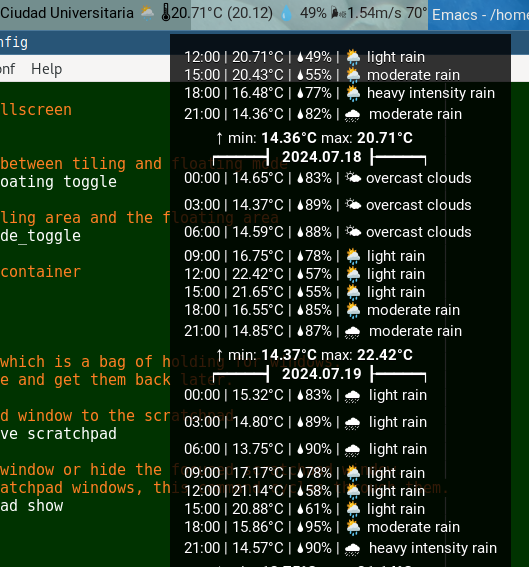
This script basically morphs a generic weather JSON description into another set
of JSON bits that display my weather in the way I prefer to have it displayed
as:
#!/usr/bin/rubyrequire'json'Sources=:weather=>'/run/weather.json',:forecast=>'/run/forecast.json'Icons='01d'=>' ',# d day'01n'=>' ',# n night'02d'=>' ','02n'=>' ','03d'=>' ','03n'=>' ','04d'=>' ','04n'=>' ','09d'=>' ','10n'=>' ','10d'=>' ','13d'=>' ','50d'=>' 'ret='text':nil,'tooltip':nil,'class':'weather','percentage':100# Current weather report: Main text of the modulebeginweather=JSON.parse(open(Sources[:weather],'r').read)loc_name=weather['name']icon=Icons[weather['weather'][0]['icon']]' '+f['weather'][0]['icon']+f['weather'][0]['main']temp=weather['main']['temp']sens=weather['main']['feels_like']hum=weather['main']['humidity']wind_vel=weather['wind']['speed']wind_dir=weather['wind']['deg']portions=portions[:loc]=loc_nameportions[:temp]='%s %2.2f C (%2.2f)'%[icon,temp,sens]portions[:hum]=' %2d%%'%humportions[:wind]=' %2.2fm/s %d '%[wind_vel,wind_dir]ret['text']=[:loc,:temp,:hum,:wind].mappportions[p] .join(' ')rescue=>errret['text']='Could not process weather file (%s %s: %s)'%[Sources[:weather],err.class,err.to_s]end# Weather prevision for the following hours/daysbegincast=[]forecast=JSON.parse(open(Sources[:forecast],'r').read)min=''max=''day=Time.now.strftime('%Y.%m.%d')by_day=forecast['list'].each_with_indexdof,iby_day[day] =[]time=Time.at(f['dt'])time_lbl='%02d:%02d'%[time.hour,time.min]icon=Icons[f['weather'][0]['icon']]' '+f['weather'][0]['icon']+f['weather'][0]['main']by_day[day]<<f['main']['temp']iftime.hour==0min='%2.2f'%by_day[day].minmax='%2.2f'%by_day[day].maxcast<<' min: <b>%s C</b> max: <b>%s C</b>'%[min,max]day=time.strftime('%Y.%m.%d')cast<<' <b>%04d.%02d.%02d</b> '%[time.year,time.month,time.day]endcast<<'%s %2.2f C %2d%% %s %s'%[time_lbl,f['main']['temp'],f['main']['humidity'],icon,f['weather'][0]['description']]endcast<<' min: <b>%s</b> C max: <b>%s C</b>'%[min,max]ret['tooltip']=cast.join("\n")rescue=>errret['tooltip']='Could not process forecast file (%s %s)'%[Sources[:forecast],err.class,err.to_s]end# Print out the result for Waybar to processputsret.to_json
The end result? Nothing too stunning, but definitively something I find useful
and even nicely laid out:
Do note that it seems OpenWeather will return the name of the closest available
meteorology station with (most?) recent data for my home, I often get Ciudad
Universitaria, but sometimes Coyoac n or even San ngel Inn.
Lomiri Weather App goes Open Meteo
In Ubuntu Touch / Lomiri, Maciej Sopy o has updated Lomiri's Weather App to operate against a different weather forecast provider (Open Meteo). Additionally, the new implementation is generic and pluggable, so other weather data providers can be added-in later.
Big thanks to Maciej for working on this just in time (the previous implementation's API has recently been EOL'ed and is not available anymore to Ubuntu Touch / Lomiri users).
Lomiri Weather App - new Meteorological Terms part of the App now
While the old weather data provider implementation obtained all the meteorological information as already localized strings from the provider, the new implementation requires all sorts of weather conditions being translated within the Lomiri Weather App itself.
The meteorological terms are probably not easy to translate for the usual software translator, so special help might be required here.
Call for Translations: Lomiri Weather App
So, if you feel entitled to help here, please join the Hosted Weblate service [1] and start working on Lomiri Weather App.
Thanks a lot!
light+love
Mike Gabriel (aka sunweaver)
[1] https://hosted.weblate.org/
[2] https://hosted.weblate.org/projects/lomiri/lomiri-weather-app/
After the VoLTE saga [1] and the problems with battery life on the PinePhonePro [2] (which lasted 4 hours while idle with the screen off in my last test a few weeks ago) I m running a Galaxy Note 9 [3] with the default Samsung OS as my daily driver.
I don t think that many people will be rushing out to buy a 2018 phone regardless of my review. For someone who wants a phone of such age (which has decent hardware and a low price) then good options are the Pixel phones which are all supported by LineageOS.
I recommend not buying this phone due to the fact that it doesn t have support for VoLTE with LineageOS (and presumably any other non-Samsung Android build) and doesn t have support from any other OS. The One Plus 6/6T has Mobian support [4] as well as LineageOS support and is worth considering.
The Note 9 still has capable hardware by today s standards. A 6.4 display is about as big as most people want in their pocket and 2960 1440 resolution in that size (516dpi) is probably as high as most people can see without a magnifying glass. The model I m using has 8G of RAM which is as much as the laptop I was using at the start of this year. I don t think that many people will have things that they actually want to do on a phone which needs more hardware than this. The only hardware feature in new phones which beats this is the large folding screen in some recent phones, but $2500+ (the price of such phones in Australia) is too much IMHO and the second hand market for folding phones is poor due to the apparently high incidence of screens breaking.
The Note 9 has the Dex environment for running as a laptop if you connect it to a USB-C dock. It can run nicely with a 4K monitor with USB keyboard and mouse. The UI is very similar to that of older versions of Windows.
The Samsung version of Android seems mostly less useful than the stock Google version or the LineageOS version. The Samsung keyboard flags words such as gay as spelling errors and it can t be uninstalled even when you install a better keyboard app. There is a Bixby button on the side of the phone to launch the Bixby voice recognition app which can t be mapped to any useful purpose, The Google keyboard has a voice dictation option which I will try out some time but that s all I desire in terms of voice recognition. There are alerts about Samsung special deals and configuration options including something about signing in to some service and having it donate money to charity, I doubt that any users want such features. Apart from Dex the Samsung Android build is a good advert for LineageOS.
The screen has curved sides for no good reason. This makes it more difficult to make a protective phone case as a case can t extend beyond the screen at the sides and therefore if it s dropped and hits an edge (step, table, etc) then the glass can make direct contact with something. Also the curved sides reflect sunlight in all directions, this means that the user has to go to more effort to avoid reflecting the sun into their eyes and that a passenger can more easily reflect sunlight into the eyes of a car driver. It s an impressive engineering feat to make a curved touch-screen but it doesn t do any good for users.
The stylus is good as always and the screen is AMOLED so it doesn t waste much power when in dark mode. There is a configuration option to display a clock all the time when the screen is locked because that apparently doesn t use much power. I haven t felt inclined to enable the always on screen but it s a nice feature for those who like such things.
The VoLTE implementation is apparently a bit unusual so it s not supported by LineageOS and didn t work on Droidian for the small amount of time that Droidian supported it.
Generally this phone is quite nice hardware it s just a pity that it demonstrates all of the downsides to buying a non-Pixel phone.
I just got one of those utterly funny spam messages And yes, I recognize
everybody likes building a name for themselves. But some spammers are downright
silly.
I just got the following mail:
From: Hermine Wolf <hwolf850@gmail.com>
To: me, obviously
Date: Mon, 15 Jul 2024 22:18:58 -0700
Subject: Make sure that your manuscript gets indexed and showcased in the prestigious Scopus database soon.
Message-ID: <CAEZZb3XCXSc_YOeR7KtnoSK4i3OhD=FH7u+A5xSMsYvhQZojQA@mail.gmail.com>
This message has visual elements included. If they don't display, please
update your email preferences.
*Dear Esteemed Author,*
Upon careful examination of your recent research articles available online,
we are excited to invite you to submit your latest work to our esteemed
journal, '*WULFENIA*'. Renowned for upholding high standards of excellence
in peer-reviewed academic research spanning various fields, our journal is
committed to promoting innovative ideas and driving advancements in
theoretical and applied sciences, engineering, natural sciences, and social
sciences. 'WULFENIA' takes pride in its impressive 5-year impact factor of
*1.000* and is highly respected in prestigious databases including the
Science Citation Index Expanded (ISI Thomson Reuters), Index Copernicus,
Elsevier BIOBASE, and BIOSIS Previews.

*Wulfenia submission page:*
[image: research--check.png][image: scrutiny-table-chat.png][image:
exchange-check.png][image: interaction.png]
.
Please don't reply to this email

We sincerely value your consideration of 'WULFENIA' as a platform to
present your scholarly work. We eagerly anticipate receiving your valuable
contributions.
*Best regards,*
Professor Dr. Vienna S. Franz
Who cares what Wulfenia is about? It s about you, my stupid Wolf cousin!
DocKnot is my static web site generator, with some additional features for
managing software releases.
This release fixes some bugs in the newly-added conversion of text to HTML
that were due to my still-incomplete refactoring of that code. It still
uses some global variables, and they were leaking between different
documents and breaking the formatting. It also fixes consistency problems
with how the style parameter in *.spin files was interpreted, and
fixes some incorrect docknot update-spin behavior.
You can get the latest version from CPAN or from the
DocKnot distribution page.
 It s not often that a company is willing to make a sworn statement to a court about how its IT practices are incompatible with the needs of the Internet, but when they do it s popcorn time.





 My work on overhauling dhcpcd as the prime replacement for ISC's discontinued DHCP client is done. The package has achieved stability, both upstream and at Debian. The only remaining points are bug #1038882 to swap the Priorities of isc-dhcp-client and dhcpcd-base in the repository's override, and swaping ifupdown's search order to put dhcpcd first.
Meanwhile, ifupdown's de-facto maintainer prompted me to sollicit opinions on which of the 4 ifupdown implementations should ship with a minimal installation for Trixie. This, in turn, re-opened the debate of what should be Debian's default network configuation framework (see the thread starting with
 Here comes the 3rd article of the 5-episode blog post series on Polis, written by Guido Berh rster, member of staff at my company Fre(i)e Software GmbH.
Enjoy also this read on Guido's work on Polis,

 The Rcpp Core Team is once again pleased to announce a new release
(now at 1.0.13) of the

 I am using
 Do note that it seems OpenWeather will return the name of the closest available
meteorology station with (most?) recent data for my home, I often get Ciudad
Universitaria, but sometimes Coyoac n or even San ngel Inn.
 Who cares what Wulfenia is about? It s about you, my stupid Wolf cousin!