Search Results: "bab"

29 March 2020

Sven Hoexter: Looking into Envertech Enverbridge EVB 202 SetID tool

Disclaimer: I'm neither an experienced programmer nor proficient in reverse engineering, but I like at least to try to figure out how things work. Sometimes the solution is so easy, that even I manage to find it, still take this with a grain of salt. I lately witnessed the setup of an Envertech EnverBridge ENB-202 which is kind of a classic Chinese IoT device. Buy it, plug it in, use some strange setup software, and it will report your PV statistics to a web portal. The setup involved downloading a PE32 Windows executable, with an UI that basically has two input boxes and a sent button. You've to input the serial number(s) of your inverter boxes and the ID of your EnverBridge. That made me interested in what this setup process really looks like. The EnverBridge device itself has on one end a power plug, which is also used to communicate with the inverter via some Powerline protocol, and a network plug with a classic RJ45 end you plug into your network. If you power it up it will request an IPv4 address via DHCP. That brings us to the first oddity, the MAC address is in the BC:20:90 prefix which I could not find in the IEEE lists. Setting Up the SetID Software You can download the Windows software in a Zipfile, once you unpack it you end up with a Nullsoft installer .exe. Since this is a PE32 executable we've to add i386 as foreign architecture to install the wine32 package.
dpkg --add-architecture i386
apt update
apt install wine32:i386
wget http://www.envertec.com/uploads/bigfiles/Set%20ID.zip
unzip Set\ ID.zip
wine Set\ ID.exe
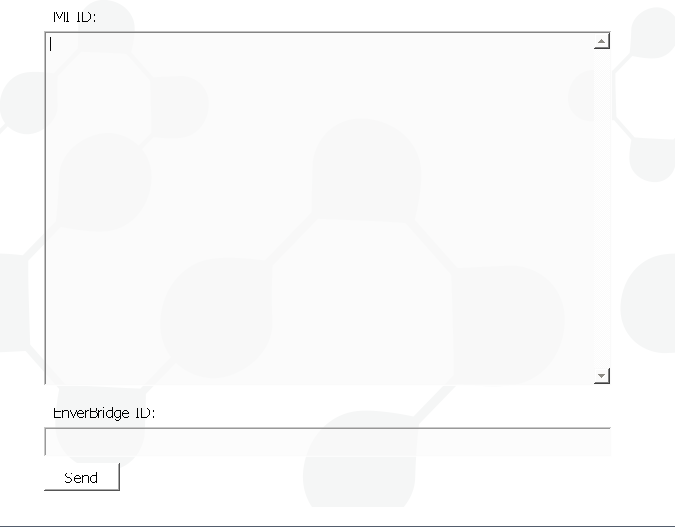
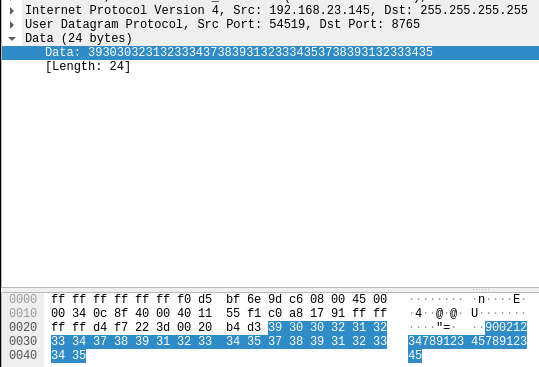
The end result is an installation in ~/.wine/drive_c/Program Files/SetID which reveals that this software is build with Qt5 according to the shipped dll's. The tool itself is in udpCilentNow.exe, and looks like this: Envertech SetID software The Network Communication To my own surprise, the communication is straight forward. A single UDP paket is sent to the broadcast address (255.255.255.255) on port 8765. Envertech SetID udp paket in wireshark I expected some strange binary protocol, but the payload is just simple numbers. They're a combination of the serial numbers of the inverter and the ID of the Enverbridge device. One thing I'm not 100% sure about are the inverter serial numbers, there are two of them, but on the inverter I've seen the serial numbers are always the same. So the payload is assembled like this: If you've more inverter the serials are just appended in the same way. Another strange thing is that the software does close to no input validation, they only check that the inverter serials start with CN and then just extract char 9 to 16. The response from the EnverBridge is also a single UDP paket to the broadcast address on port 8764, with exactly the same content we've sent. Writing a Replacement My result is probably an insult for all proficient Python coders, but based on a bit of research and some cut&paste programming I could assemble a small script to replicate the function of the Windows binary. I guess the usefulness of this exercise was mostly my personal entertainment, though it might help some none Windows users to setup this device. Usage is also very simple:
./enverbridge.py -h
Usage: enverbridge.py [options] MIIDs
Options:
  -h, --help         show this help message and exit
  -b BID, --bid=BID  Serial Number of your EnverBridge
./enverbridge.py -b 90087654 CN19100912345678 CN19100912345679

This is basically 1:1 the behaviour of the Windows binary, though I tried to add a bit more validation then the original binary and some more error messages. I also assume the serial numbers are also always the same so I take only one as the input, and duplicate it for the paket data.

26 March 2020

Axel Beckert: Pictures in pure HTML with chafa and aha

I recently stumbled upon chafa, a tool to display pictures, especially color pictures on your ANSI text terminal, e.g. inside an xterm. And I occasionally use aha, the Ansi HTML Adapter to convert a colorful terminal content into HTML to show off terminal screenshots without the requirement of a picture so that it also works in e.g. text browsers or for blinds. Combining chafa and aha: Examples A moment ago I had the thought what would happen if I feed the output of chafa into aha and expected nothing really usable. But I was surprised by the quality of the outcome.
looks like this after chafa -w 9 -c full -s 160x50 DSCN4692.jpg aha -n:


Checking the Look in Text Browsers It even looks not that bad in elinks as far as I know the only text browser which supports CSS and styles:
In Lynx and Links 2, the text composing the image is displayed only in black and white, but you at least can recognise the edges in the picture:
Same Functionality in One Tool? I knew there was a tool which did this in one step. Seems to have been png2html. Tried to play around with it, too, but neither really understood how to use it (seems to require a text file for the characters to be used why?) nor did I really got it working. It always ran until I aborted it and it never filled the target file with any content. Additionally, png2html insists on one character per pixel, requiring to first properly resize the image before converting to HTML. The Keyboard in the Pictures Oh, and btw., the displayed keyboard is my Zlant. The Zlant is a 40% uniform staggered mechanical keyboard. Currently, only Zlant PCBs are available at 1UP Keyboards (USA), i.e. no complete kits. It is shown with the SA Vilebloom key cap set, currently available at MechSupply (UK).

25 March 2020

Raphaël Hertzog: Freexian s report about Debian Long Term Support, February 2020

A Debian LTS logo Like each month, here comes a report about the work of paid contributors to Debian LTS. Individual reports In February, 226 work hours have been dispatched among 14 paid contributors. Their reports are available: Evolution of the situation February began as rather calm month and the fact that more contributors have given back unused hours is an indicator of this calmness and also an indicator that contributing to LTS has become more of a routine now, which is good. In the second half of February Holger Levsen (from LTS) and Salvatore Bonaccorso (from the Debian Security Team) met at SnowCamp in Italy and discussed tensions and possible improvements from and for Debian LTS. The security tracker currently lists 25 packages with a known CVE and the dla-needed.txt file has 21 packages needing an update. Thanks to our sponsors New sponsors are in bold.

No comment Liked this article? Click here. My blog is Flattr-enabled.

23 March 2020

Dima Kogan: org-babel for documentation

So I just gave a talk at SCaLE 18x about numpysane and gnuplotlib, two libraries I wrote to make using numpy bearable. With these two, it's actually quite nice! Prior to the talk I overhauled the documentation for both these projects. The gnuplotlib docs now have a tutorial/gallery page, which is interesting-enough to write about. Check it out! Mostly it is a sequence of Clearly you want the plots in the documentation to correspond to the code, so you want something to actually run each code snippet to produce each plot. Automatically. I don't want to maintain these manually, and periodically discover that the code doesn't make the plot I claim it does or worse: that the code barfs. This is vaguely what Jupyter notebooks do, but they're ridiculous, so I'm doing something better: That's it. The git repo is hosted by github, which has a rudimentary renderer for .org documents. I'm committing the .svg files, so that's enough to get rendered documentation that looks nice. Note that the usual workflow is to use org to export to html, but here I'm outsourcing that job to github; I just make the .svg files, and that's enough. Look at the link again: gnuplotlib tutorial/gallery. This is just a .org file committed to the git repo. github is doing its normal org->html thing to display this file. This has drawbacks too: github is ignoring the :noexport: tag on the init section at the end of the file, so it's actually showing all the emacs lisp goop that makes this work (described below!). It's at the end, so I guess this is good-enough. Those of us that use org-mode would be completely unsurprised to hear that the talk is also written as .org document. And the slides that show gnuplotlib plots use the same org-babel system to render the plots. It's all oh-so-nice. As with anything as flexible as org-babel, it's easy to get into a situation where you're bending it to serve a not-quite-intended purpose. But since this all lives in emacs, you can make it do whatever you want with a bit of emacs lisp. I ended up advising a few things (mailing list post here). And I stumbled on an (arguable) bug in emacs that needed working around (mailing list post here). I'll summarize both here.

Handling large Local Variables blocks
The advises I ended up with ended up longer than emacs expected, which made emacs not evaluate them when loading the buffer. As I discovered (see the mailing list post) the loading code looks for the string Local Variables in the last 3000 bytes of the buffer only, and I exceeded that. Stefan Monnier suggested a workaround in this post. Instead of the normal Local Variables block at the end:
Local Variables:
eval: (progn ... ...
             ... ...
             LONG chunk of emacs-lisp
      )
End:
I do this:
(progn ;;local-config
   lisp lisp lisp
   as long as I want
)
Local Variables:
eval: (progn (re-search-backward "^(progn ;;local-config") (eval (read (current-buffer))))
End:
So emacs sees a small chunk of code that searches backwards through the buffer (as far back as needed) for the real lisp to evaluate. As an aside, this blog is also an .org document, and the lisp snippets above are org-babel blocks that I'm not evaluating. The exporter knows to respect the emacs-lisp syntax highlighting, however.

Advises
OK, so what was all the stuff I needed to tell org-babel to do specially here? First off, org needed to be able to communicate to the Python session the name of the file to write the plot to. I do this by making the whole plist for this org-babel snippet available to python:
;; THIS advice makes all the org-babel parameters available to python in the
;; _org_babel_params dict. I care about _org_babel_params['_file'] specifically,
;; but everything is available
(defun dima-org-babel-python-var-to-python (var)
  "Convert an elisp value to a python variable.
  Like the original, but supports (a . b) cells and symbols
"
  (if (listp var)
      (if (listp (cdr var))
          (concat "[" (mapconcat #'org-babel-python-var-to-python var ", ") "]")
        (format "\"\"\"%s\"\"\"" var))
    (if (symbolp var)
        (format "\"\"\"%s\"\"\"" var)
      (if (eq var 'hline)
          org-babel-python-hline-to
        (format
         (if (and (stringp var) (string-match "[\n\r]" var)) "\"\"%S\"\"" "%S")
         (if (stringp var) (substring-no-properties var) var))))))
(defun dima-alist-to-python-dict (alist)
  "Generates a string defining a python dict from the given alist"
  (let ((keyvalue-list
         (mapcar (lambda (x)
                   (format "%s = %s, "
                           (replace-regexp-in-string
                            "[^a-zA-Z0-9_]" "_"
                            (symbol-name (car x)))
                           (dima-org-babel-python-var-to-python (cdr x))))
                 alist)))
    (concat
     "dict( "
     (apply 'concat keyvalue-list)
     ")")))
(defun dima-org-babel-python-pass-all-params (f params)
  (cons
   (concat
    "_org_babel_params = "
    (dima-alist-to-python-dict params))
   (funcall f params)))
(unless
    (advice-member-p
     #'dima-org-babel-python-pass-all-params
     #'org-babel-variable-assignments:python)
  (advice-add
   #'org-babel-variable-assignments:python
   :around #'dima-org-babel-python-pass-all-params))
So if there's a :file plist key, the python code can grab that, and write the plot to that filename. But I don't really want to specify an output file for every single org-babel snippet. All I really care about is that each plot gets a unique filename. So I omit the :file key entirely, and use this advice to generate one for me:
;; This sets a default :file tag, set to a unique filename. I want each demo to
;; produce an image, but I don't care what it is called. I omit the :file tag
;; completely, and this advice takes care of it
(defun dima-org-babel-python-unique-plot-filename
    (f &optional arg info params)
  (funcall f arg info
           (cons (cons ':file
                       (format "guide-%d.svg"
                               (condition-case nil
                                   (setq dima-unique-plot-number (1+ dima-unique-plot-number))
                                 (error (setq dima-unique-plot-number 0)))))
                 params)))
(unless
    (advice-member-p
     #'dima-org-babel-python-unique-plot-filename
     #'org-babel-execute-src-block)
  (advice-add
   #'org-babel-execute-src-block
   :around #'dima-org-babel-python-unique-plot-filename))
This uses the dima-unique-plot-number integer to keep track of each plot. I increment this with each plot. Getting closer. It isn't strictly required, but it'd be nice if each plot had the same output filename each time I generated it. So I want to reset the plot number to 0 each time:
;; If I'm regenerating ALL the plots, I start counting the plots from 0
(defun dima-reset-unique-plot-number
    (&rest args)
    (setq dima-unique-plot-number 0))
(unless
    (advice-member-p
     #'dima-reset-unique-plot-number
     #'org-babel-execute-buffer)
  (advice-add
   #'org-babel-execute-buffer
   :after #'dima-reset-unique-plot-number))
Finally, I want to lie to the user a little bit. The code I'm actually executing writes each plot to an .svg. But the code I'd like the user to see should use the default output: an interactive, graphical window. I do that by tweaking the python session to tell the gnuplotlib object to write to .svg files from org by default, instead of using the graphical terminal:
;; I'm using github to display guide.org, so I'm not using the "normal" org
;; exporter. I want the demo text to not contain the hardcopy= tags, but clearly
;; I need the hardcopy tag when generating the plots. I add some python to
;; override gnuplotlib.plot() to add the hardcopy tag somewhere where the reader
;; won't see it. But where to put this python override code? If I put it into an
;; org-babel block, it will be rendered, and the :export tags will be ignored,
;; since github doesn't respect those (probably). So I put the extra stuff into
;; an advice. Whew.
(defun dima-org-babel-python-set-demo-output (f body params)
  (with-temp-buffer
    (insert body)
    (beginning-of-buffer)
    (when (search-forward "import gnuplotlib as gp" nil t)
      (end-of-line)
      (insert
       "\n"
       "if not hasattr(gp.gnuplotlib, 'orig_init'):\n"
       "    gp.gnuplotlib.orig_init = gp.gnuplotlib.__init__\n"
       "gp.gnuplotlib.__init__ = lambda self, *args, **kwargs: gp.gnuplotlib.orig_init(self, *args, hardcopy=_org_babel_params['_file'] if 'file' in _org_babel_params['_result_params'] else None, **kwargs)\n"))
    (setq body (buffer-substring-no-properties (point-min) (point-max))))
  (funcall f body params))
(unless
    (advice-member-p
     #'dima-org-babel-python-set-demo-output
     #'org-babel-execute:python)
  (advice-add
   #'org-babel-execute:python
   :around #'dima-org-babel-python-set-demo-output))
)
And that's it. The advises in the talk are slightly different, in uninteresting ways. Some of this should be upstreamed to org-babel somehow. Now entirely clear which part, but I'll cross that bridge when I get to it.

22 March 2020

Sylvestre Ledru: Some clang rebuild results (8.0.1, 9.0.1 & 10rc2)

As part of the LLVM release cycle, I am continuing rebuilding the Debian archive with clang instead of gcc to evaluate potential regressions. Processed results are available on the website: https://clang.debian.net/status.php - Now includes some fancy graphs to show the evolution
Raw logs are published on github: https://github.com/opencollab/clang.debian.net/tree/master/logs Since my last blog post on the subject (August 2017), Clang is more and more present in the tech ecosystem. It is now the compiler used to build Firefox and Chrome upstream binaries on all the supported architectures/operating systems. More architectures are supported, it has a new linker (lld), a new hybrid IR (MLIR), a lot of checkers in clang-tidy, cross-language linking with Rust, etc.

Results
Now, about Debian results, we rebuilt using 8.0.1, 9.0.1 and 10.0rc2. Results are pretty similar to what we had with previous versions: between 4 to 5% of packages are failing when gcc is replaced by clang.
Some clang rebuild results (8.0.1, 9.0.1 & 10rc2)

Even if most of the software are still using gcc as compiler, we can see that clang has a positive effect on code quality. With many different kinds of errors and warnings found clang over the years, we noticed a steady decline of the number of errors. For example, the number of incorrect C/C++ main declarations has been decreasing years after years:
Some clang rebuild results (8.0.1, 9.0.1 & 10rc2)

Errors found
The biggest offender is still the qmake changes which doesn't allow the used workaround (replacing /usr/bin/gcc by /usr/bin/clang) - about 250 errors. Most of these packages would probably compile fine with clang. More on the Qt bug tracker. The workaround proposed in the bug isn't applicable for us as we use the dropped-in replacement of the
The second error is still some differences in symbol generation. Unlike gcc, it seems that clang doesn't generate some symbols (or adds some). As a bunch of Debian packages are checking the list of symbols in the library (for ABI management), the build fails on purpose. For example, with libcec, the symbol _ZN10P8PLATFORM14CConditionImplD1Ev@Base 3.1.0 isn't generated anymore. I am not expecting this to be a big deal: the generated libraries probably works most of the time. More on C++ symbol management in Debian.

Current status
As previously said in a blog post, I don't think there is a strong intensive to go away from gcc for most of the Linux distributions. The big reason for BSD was the license (even if the move to the Apache 2 license wasn't received positively by some of them).
While the LLVM/clang ecosystem clearly won the tooling battle, as a C/C++ compiler, gcc is still an excellent compiler which supports more architecture and more languages.
In term of new warnings and checks, as the clang community moved the efforts in clang-tidy (which requires more complex tooling), out of the box, gcc provides a better experience (as example, see the Firefox meta bug to build with -Werror with the default warnings using gcc 9, gcc 10 and clang trunk for example).

Next steps
I see some potential next steps to decrease the number of failure:
  • Workaround the Qt/Qmake issue
  • Fix the objective-c header include issues (echo "#include <objc/objc.h>" > foo.m && clang -c foo.m is currently failing)
  • Identify why clang generates more/less symbols that gcc in the library and try to fix that
  • Rebuild the archive with clang-7 - Seems that I have some data problem

Many thanks to Lucas Nussbaum for the rebuilds.

Sylvestre Ledru: Some clang rebuild results (8.0.1, 9.0.1 & 10rc2)

As part of the LLVM release cycle, I am continuing rebuilding the Debian archive with clang instead of gcc to evaluate potential regressions. Processed results are available on the website: https://clang.debian.net/status.php - Now includes some fancy graphs to show the evolution
Raw logs are published on github: https://github.com/opencollab/clang.debian.net/tree/master/logs Since my last blog post on the subject (August 2017), Clang is more and more present in the tech ecosystem. It is now the compiler used to build Firefox and Chrome upstream binaries on all the supported architectures/operating systems. More architectures are supported, it has a new linker (lld), a new hybrid IR (MLIR), a lot of checkers in clang-tidy, cross-language linking with Rust, etc.

Results
Now, about Debian results, we rebuilt using 8.0.1, 9.0.1 and 10.0rc2. Results are pretty similar to what we had with previous versions: between 4 to 5% of packages are failing when gcc is replaced by clang.
Some clang rebuild results (8.0.1, 9.0.1 &amp; 10rc2)

Even if most of the software are still using gcc as compiler, we can see that clang has a positive effect on code quality. With many different kinds of errors and warnings found clang over the years, we noticed a steady decline of the number of errors. For example, the number of incorrect C/C++ main declarations has been decreasing years after years:
Some clang rebuild results (8.0.1, 9.0.1 &amp; 10rc2)

Errors found
The biggest offender is still the qmake changes which doesn't allow the used workaround (replacing /usr/bin/gcc by /usr/bin/clang) - about 250 errors. Most of these packages would probably compile fine with clang. More on the Qt bug tracker. The workaround proposed in the bug isn't applicable for us as we use the dropped-in replacement of the compiler.
The second error is still some differences in symbol generation. Unlike gcc, it seems that clang doesn't generate some symbols (or adds some). As a bunch of Debian packages are checking the list of symbols in the library (for ABI management), the build fails on purpose. For example, with libcec, the symbol _ZN10P8PLATFORM14CConditionImplD1Ev@Base 3.1.0 isn't generated anymore. I am not expecting this to be a big deal: the generated libraries probably works most of the time. More on C++ symbol management in Debian.
I reported this bug upstream a while back: https://bugs.llvm.org/show_bug.cgi?id=30441

Current status
As previously said in a blog post, I don't think there is a strong intensive to go away from gcc for most of the Linux distributions. The big reason for BSD was the license (even if the move to the Apache 2 license wasn't received positively by some of them).
While the LLVM/clang ecosystem clearly won the tooling battle, as a C/C++ compiler, gcc is still an excellent compiler which supports more architecture and more languages.
In term of new warnings and checks, as the clang community moved the efforts in clang-tidy (which requires more complex tooling), out of the box, gcc provides a better experience (as example, see the Firefox meta bug to build with -Werror with the default warnings using gcc 9, gcc 10 and clang trunk for example).

Next steps
I see some potential next steps to decrease the number of failure:
  • Workaround the Qt/Qmake issue
  • Fix the objective-c header include issues (echo "#include <objc/objc.h>" > foo.m && clang -c foo.m is currently failing)
  • Identify why clang generates more/less symbols that gcc in the library and try to fix that
  • Rebuild the archive with clang-7 - Seems that I have some data problem

Many thanks to Lucas Nussbaum for the rebuilds.

18 March 2020

Antoine Beaupr : How can I trust this git repository?

Join me in the rabbit hole of git repository verification, and how we could improve it.

Problem statement As part of my work on automating install procedures at Tor, I ended up doing things like:
git clone REPO
./REPO/bootstrap.sh
... something eerily similar to the infamous curl pipe bash method which I often decry. As a short-term workaround, I relied on the SHA-1 checksum of the repository to make sure I have the right code, by running this both on a "trusted" (ie. "local") repository and the remote, then visually comparing the output:
$ git show-ref master
9f9a9d70dd1f1e84dec69a12ebc536c1f05aed1c refs/heads/master
One problem with this approach is that SHA-1 is now considered as flawed as MD5 so it can't be used as an authentication mechanism anymore. It's also fundamentally difficult to compare hashes for humans. The other flaw with comparing local and remote checksums is that we assume we trust the local repository. But how can I trust that repository? I can either:
  1. audit all the code present and all the changes done to it after
  2. or trust someone else to do so
The first option here is not practical in most cases. In this specific use case, I have audited the source code -- I'm the author, even -- what I need is to transfer that code over to another server. (Note that I am replacing those procedures with Fabric, which makes this use case moot for now as the trust path narrows to "trust the SSH server" which I already had anyways. But it's still important for my fellow Tor developers who worry about trusting the git server, especially now that we're moving to GitLab.) But anyways, in most cases, I do need to trust some other fellow developer I collaborate with. To do this, I would need to trust the entire chain between me and them:
  1. the git client
  2. the operating system
  3. the hardware
  4. the network (HTTPS and the CA cartel, specifically)
  5. then the hosting provider (and that hardware/software stack)
  6. and then backwards all the way back to that other person's computer
I want to shorten that chain as much as possible, make it "peer to peer", so to speak. Concretely, it would eliminate the hosting provider and the network, as attackers.

OpenPGP verification My first reaction is (perhaps perversely) to "use OpenPGP" for this. I figured that if I sign every commit, then I can just check the latest commit and see if the signature is good. The first problem here is that this is surprisingly hard. Let's pick some arbitrary commit I did recently:
commit b3c538898b0ed4e31da27fc9ca22cb55e1de0000
Author: Antoine Beaupr  <anarcat@debian.org>
Date:   Mon Mar 16 14:37:28 2020 -0400
    fix test autoloading
    pytest only looks for file names matching  test  by default. We inline
    tests inside the source code directly, so hijack that.
diff --git a/fabric_tpa/pytest.ini b/fabric_tpa/pytest.ini
new file mode 100644
index 0000000..71004ea
--- /dev/null
+++ b/fabric_tpa/pytest.ini
@@ -0,0 +1,3 @@
+[pytest]
+# we inline tests directly in the source code
+python_files = *.py
That's the output of git log -p in my local repository. I signed that commit, yet git log is not telling me anything special. To check the signature, I need something special: --show-signature, which looks like this:
commit b3c538898b0ed4e31da27fc9ca22cb55e1de0000
gpg: Signature faite le lun 16 mar 2020 14:37:53 EDT
gpg:                avec la clef RSA 7B164204D096723B019635AB3EA1DDDDB261D97B
gpg: Bonne signature de  Antoine Beaupr  <anarcat@orangeseeds.org>  [ultime]
gpg:                 alias  Antoine Beaupr  <anarcat@torproject.org>  [ultime]
gpg:                 alias  Antoine Beaupr  <anarcat@anarc.at>  [ultime]
gpg:                 alias  Antoine Beaupr  <anarcat@koumbit.org>  [ultime]
gpg:                 alias  Antoine Beaupr  <anarcat@debian.org>  [ultime]
Author: Antoine Beaupr  <anarcat@debian.org>
Date:   Mon Mar 16 14:37:28 2020 -0400
    fix test autoloading
    pytest only looks for file names matching  test  by default. We inline
    tests inside the source code directly, so hijack that.
Can you tell if this is a valid signature? If you speak a little french, maybe you can! But even if you would, you are unlikely to see that output on your own computer. What you would see instead is:
commit b3c538898b0ed4e31da27fc9ca22cb55e1de0000
gpg: Signature made Mon Mar 16 14:37:53 2020 EDT
gpg:                using RSA key 7B164204D096723B019635AB3EA1DDDDB261D97B
gpg: Can't check signature: No public key
Author: Antoine Beaupr  <anarcat@debian.org>
Date:   Mon Mar 16 14:37:28 2020 -0400
    fix test autoloading
    pytest only looks for file names matching  test  by default. We inline
    tests inside the source code directly, so hijack that.
Important part: Can't check signature: No public key. No public key. Because of course you would see that. Why would you have my key lying around, unless you're me. Or, to put it another way, why would that server I'm installing from scratch have a copy of my OpenPGP certificate? Because I'm a Debian developer, my key is actually part of the 800 keys in the debian-keyring package, signed by the APT repositories. So I have a trust path. But that won't work for someone who is not a Debian developer. It will also stop working when my key expires in that repository, as it already has on Debian buster (current stable). So I can't assume I have a trust path there either. One could work with a trusted keyring like we do in the Tor and Debian project, and only work inside that project, that said. But I still feel uncomfortable with those commands. Both git log and git show will happily succeed (return code 0 in the shell) even though the signature verification failed on the commits. Same with git pull and git merge, which will happily push your branch ahead even if the remote has unsigned or badly signed commits. To actually verify commits (or tags), you need the git verify-commit (or git verify-tag) command, which seems to do the right thing:
$ LANG=C.UTF-8 git verify-commit b3c538898b0ed4e31da27fc9ca22cb55e1de0000
gpg: Signature made Mon Mar 16 14:37:53 2020 EDT
gpg:                using RSA key 7B164204D096723B019635AB3EA1DDDDB261D97B
gpg: Can't check signature: No public key
[1]$
At least it fails with some error code (1, above). But it's not flexible: I can't use it to verify that a "trusted" developer (say one that is in a trusted keyring) signed a given commit. Also, it is not clear what a failure means. Is a signature by an expired certificate okay? What if the key is signed by some random key in my personal keyring? Why should that be trusted?

Worrying about git and GnuPG In general, I'm worried about git's implementation of OpenPGP signatures. There has been numerous cases of interoperability problems with GnuPG specifically that led to security, like EFAIL or SigSpoof. It would be surprising if such a vulnerability did not exist in git. Even if git did everything "just right" (which I have myself found impossible to do when writing code that talks with GnuPG), what does it actually verify? The commit's SHA-1 checksum? The tree's checksum? The entire archive as a zip file? I would bet it signs the commit's SHA-1 sum, but I just don't know, on the top of my head, and neither do git-commit or git-verify-commit say exactly what is happening. I had an interesting conversation with a fellow Debian developer (dkg) about this and we had to admit those limitations:
<anarcat> i'd like to integrate pgp signing into tor's coding practices more, but so far, my approach has been "sign commits" and the verify step was "TBD" <dkg> that's the main reason i've been reluctant to sign git commits. i haven't heard anyone offer a better subsequent step. if torproject could outline something useful, then i'd be less averse to the practice. i'm also pretty sad that git remains stuck on sha1, esp. given the recent demonstrations. all the fancy strong signatures you can make in git won't matter if the underlying git repo gets changed out from under the signature due to sha1's weakness
In other words, even if git implements the arcane GnuPG dialect just so, and would allow us to setup the trust chain just right, and would give us meaningful and workable error messages, it still would fail because it's still stuck in SHA-1. There is work underway to fix that, but in February 2020, Jonathan Corbet described that work as being in a "relatively unstable state", which is hardly something I would like to trust to verify code. Also, when you clone a fresh new repository, you might get an entirely different repository, with a different root and set of commits. The concept of "validity" of a commit, in itself, is hard to establish in this case, because an hostile server could put you backwards in time, on a different branch, or even on an entirely different repository. Git will warn you about a different repository root with warning: no common commits but that's easy to miss. And complete branch switches, rebases and resets from upstream are hardly more noticeable: only a tiny plus sign (+) instead of a star (*) will tell you that a reset happened, along with a warning (forced update) on the same line. Miss those and your git history can be compromised.

Possible ways forward I don't consider the current implementation of OpenPGP signatures in git to be sufficient. Maybe, eventually, it will mature away from SHA-1 and the interface will be more reasonable, but I don't see that happening in the short term. So what do we do?

git evtag The git-evtag extension is a replacement for git tag -s. It's not designed to sign commits (it only verifies tags) but at least it uses a stronger algorithm (SHA-512) to checksum the tree, and will include everything in that tree, including blobs. If that sounds expensive to you, don't worry too much: it takes about 5 seconds to tag the Linux kernel, according to the author. Unfortunately, that checksum is then signed with GnuPG, in a manner similar to git itself, in that it exposes GnuPG output (which can be confusing) and is likely similarly vulnerable to mis-implementation of the GnuPG dialect as git itself. It also does not allow you to specify a keyring to verify against, so you need to trust GnuPG to make sense of the garbage that lives in your personal keyring (and, trust me, it doesn't). And besides, git-evtag is fundamentally the same as signed git tags: checksum everything and sign with GnuPG. The difference is it uses SHA-512 instead of SHA-1, but that's something git will eventually fix itself anyways.

kernel patch attestations The kernel also faces this problem. Linus Torvalds signs the releases with GnuPG, but patches fly all over mailing list without any form of verification apart from clear-text email. So Konstantin Ryabitsev has proposed a new protocol to sign git patches which uses SHA256 to checksum the patch metadata, commit message and the patch itself, and then sign that with GnuPG. It's unclear to me what this solves, if anything, at all. As dkg argues, it would seem better to add OpenPGP support to git-send-email and teach git tools to recognize that (e.g. git-am) at least if you're going to keep using OpenPGP anyways. And furthermore, it doesn't resolve the problems associated with verifying a full archive either, as it only attests "patches".

jcat Unhappy with the current state of affairs, the author of fwupd (Richard Hughes) wrote his own protocol as well, called jcat, which provides signed "catalog files" similar to the ones provided in Microsoft windows. It consists of a "gzip-compressed JSON catalog files, which can be used to store GPG, PKCS-7 and SHA-256 checksums for each file". So yes, it is yet again another wrapper to GnuPG, probably with all the flaws detailed above, on top of being a niche implementation, disconnected from git.

The Update Framework One more thing dkg correctly identified is:
<dkg> anarcat: even if you could do exactly what you describe, there are still some interesting wrinkles that i think would be problems for you. the big one: "git repo's latest commits" is a loophole big enough to drive a truck through. if your adversary controls that repo, then they get to decide which commits to include in the repo. (since every git repo is a view into the same git repo, just some have more commits than others)
In other words, unless you have a repository that has frequent commits (either because of activity or by a bot generating fake commits), you have to rely on the central server to decide what "the latest version" is. This is the kind of problems that binary package distribution systems like APT and TUF solve correctly. Unfortunately, those don't apply to source code distribution, at least not in git form: TUF only deals with "repositories" and binary packages, and APT only deals with binary packages and source tarballs. That said, there's actually no reason why git could not support the TUF specification. Maybe TUF could be the solution to ensure end-to-end cryptographic integrity of the source code itself. OpenPGP-signed tarballs are nice, and signed git tags can be useful, but from my experience, a lot of OpenPGP (or, more accurately, GnuPG) derived tools are brittle and do not offer clear guarantees, and definitely not to the level that TUF tries to address. This would require changes on the git servers and clients, but I think it would be worth it.

Other Projects

OpenBSD There are other tools trying to do parts of what GnuPG is doing, for example minisign and OpenBSD's signify. But they do not integrate with git at all right now. Although I did find a hack] to use signify with git, it's kind of gross...

Golang Unsurprisingly, this is a problem everyone is trying to solve. Golang is planning on hosting a notary which would leverage a "certificate-transparency-style tamper-proof log" which would be ran by Google (see the spec for details). But that doesn't resolve the "evil server" attack, if we treat Google as an adversary (and we should).

Python Python had OpenPGP going for a while on PyPI, but it's unclear if it ever did anything at all. Now the plan seems to be to use TUF but my hunch is that the complexity of the specification is keeping that from moving ahead.

Docker Docker and the container ecosystem has, in theory, moved to TUF in the form of Notary, "a project that allows anyone to have trust over arbitrary collections of data". In practice however, in my somewhat limited experience, setting up TUF and image verification in Docker is far from trivial.

Android and iOS Even in what is possibly one of the strongest models (at least in terms of user friendliness), mobile phones are surprisingly unclear about those kind of questions. I had to ask if Android had end-to-end authentication and I am still not clear on the answer. I have no idea of what iOS does.

Conclusion One of the core problems with everything here is the common usability aspect of cryptography, and specifically the usability of verification procedures. We have become pretty good at encryption. The harder part (and a requirement for proper encryption) is verification. It seems that problem still remains unsolved, in terms of usability. Even Signal, widely considered to be a success in terms of adoption and usability, doesn't properly solve that problem, as users regularly ignore "The security number has changed" warnings... So, even though they deserve a lot of credit in other areas, it seems unlikely that hardcore C hackers (e.g. git and kernel developers) will be able to resolve that problem without at least a little bit of help. And TUF seems like the state of the art specification around here, it would seem wise to start adopting it in the git community as well. Update: git 2.26 introduced a new gpg.minTrustLevel to "tell various signature verification codepaths the required minimum trust level", presumably to control how Git will treat keys in your keyrings, assuming the "trust database" is valid and up to date. For an interesting narrative of how "normal" (without PGP) git verification can fail, see also A Git Horror Story: Repository Integrity With Signed Commits.

16 March 2020

Ulrike Uhlig: Deconstructing the term control freak

Control freaks. You may have called people like this. Or you may have been called one yourself. Maybe you got angry. Or, on the contrary, you felt like being a control freak is a feature, because who would notice all these little details that are not exactly perfect if not you? This post is an attempt to deconstruct the term. Etymological considerations Control - from latin contra- rotulus - refers to the copy of an account register as a means of verification of the original register. So control is about keeping track, not making mistakes, i.e. it's about doing a perfect calculation. The meaning of control in our society is linked to authority, or to policing like in crowd control. What English calls an inspector, is a Kontrolleur in German or contr leur in French. The word is also linked to manufacturing, as in quality control. We also talk about being in control, which is linked to the desire of being autonomous, to be able to act on one's own account. Being in control can also designate a need to preserve one's own integrity: if I have integrity (in the sense of feeling whole), I can self-determine, which is the most fundamental requirement for having one's own identity. Freak - refers to someone who does not fit the norm. Calling someone a freak is per se problematic, because it blames a person for being atypical, abnormal. Freak is a word that, while pointing a finger at difference, at the same time denies people the right to be different and diverse. People can reappropriate such words to make it clear that not fitting the norm is a wanted expression of their diversity we can see that if we follow the history of the word queer for an example. Types of control freaking To me, being a control freak is mostly a feature, if it's about controlling my own life and my own effectiveness. Control freaking becomes troublesome when it's about controlling other people's effectiveness. And it becomes highly problematic when it's about controlling other people's lives. Controlling one's own life Having control over one's own life is a basic human need. In particular people who are part of minorities, people who face discrimination and oppression every day have an increased need for self-determination, and the need to see their existence and their identity acknowledged and accepted by the rest of the world. Too often do we experience that other people (generally the ones with privilege, or not facing the same oppression) try to own the narrative over our lives (1)(2). Calling this control freakish is missing the point, and is probably a sign of looking at it from a perspective of privilege. Controlling one's own effectiveness People produce things. People write code, make ceramics, or write texts, for example. People have a need to control their own effectiveness: they set up routines, product tests, documentation. This type of control is a feature, and can help to release better software, better texts, or perfectly burnt clay pots ultimately controlling one's own effectiveness helps to learn from one's mistakes and to improve routines over time. The grey zone The grey zone describes the zone in between wanting to control one's own effectiveness and wanting to control other people's effectiveness. Here we could situate the type of control freak who does not delegate tasks to others for fear of seeing them done differently then they had expected them to be done. This can be harmful particularly to the person who does not delegate: they can get overworked or burnt out. This type of control freakism might be linked to perfectionism. Controlling other people's effectiveness When we work with other people, our own effectiveness might get in the way of other people's effectiveness, or vice versa. Indeed, it happens - not only in work contexts - that people find themselves in setups in which mutual responsibilities and autonomies conflict with one another because one person is dependent on the other for making decisions or moving things forward as they see fit. (There is generally a relation of dependency between two conflicting parties that is worth looking at (3).) Add to this the fact that, when delegating a task, some people have a hard time also delegating the responsibility and autonomy needed to resolve the task. They lack trust that another person can also do the work, or want that person to do the work exactly in the same way they would do it. (In some cases this can be related to Founder's Syndrome and can result in organizations staying stuck with one or a small group of founders holding knowledge and power, and preventing the organization from growing. Page 11 in the booklet "Working with conflict in our groups" describes how such an informal hierarchy can come into being in grassroot groups.) The (perfectly valid) need behind this type of control freaking could be to make sure that a group of people builds a successful product, releases a fact-checked documentary, or creates a publication without mistakes. But controlling other people's effectiveness as a strategy to satisfy this need can create a non-cooperative climate in which people do not meet each other on eye level, but are dependent on each other, experience a lack autonomy, a break of boundaries, or sometimes feel authority to be overexerted. Acknowledging the need to build a good product, it is possible to create the appropriate strategies to guarantee that the involved people can meet each other on eye level: for example by clearly defining and documenting role-responsibility-accountability along with appropriate decision making processes, or by distributing leadership ( you should totally click on that link!), by looking at inclusive leadership models, by learning from past mistakes, by instating feedback cycles, by making boundaries between the direction of an organization and the day-to-day work clear. An organization I work with has the rule that people can make decisions for themselves if the decision only affects their work, while decisions that affect a team should be made with the team, and decisions that affect the organization as a whole need to be made at the organizational level. They call that a no-brainer, but in organizations with traditional hierarchies, or in grown grassroot environments that have never clearly defined and assigned responsibilities and accountabilities (aka "functional roles") this is not so obvious at all. Controlling someone else's life This type of control freak does not only desire to control their own life but for a reason or another wants to know and control what other people do, think (especially about the control freak), decide, or how they live. In some cases, this type of control freak might even want to force upon others things they should do as a way to be accepted by the control freak. It's what we call narcissism, harassment, abuse. It is unacceptable. Conclusion In summary, the distinctions I came up with in this post describe the boundaries along which control freakism takes hold of someone else's effectiveness or life and ultimately prevents them from self-determining. In German we have the word bergriffig which describes that someone is infringing someone else's boundaries they are over - grabbing, seizing, grasping, taking hold of. Which type of control freak are you, if any?

(1) Like when a West-Berliner in a round of 15 East Germans arrogantly talks about the time when the wall came down and tells the story that he could not go shopping between Thursdays and Sundays because the East Germans bought too many products in the supermarkets while this event marked an unimaginable rift in the biographies of 17 million East Germans, 15 of whom are sitting right in front of him. Thirty years after 1989, many of us are finally starting to question this publicly ( links in German language).

(2) Women experience it similary regularly, see Men Explain Things to me, a book by Rebecca Solnit.

(3) By the way, rather than having "recruited the wrong person" conflict may intrinsically arise as part of certain work relationships, simply due to the inter-dependencies of roles or workers, like in a delivery chain.

12 March 2020

Julien Danjou: One year of Mergify

One year of MergifyIt has been close to a year now that I've incorporated my new company, Mergify. I've been busy, and I barely wrote anything about it so far. Now is an excellent time to take a break and reflect a bit on what happened during those last 12 months.
One year of Mergify

What problem does Mergify solve?Mergify is a powerful automation engine for GitHub pull requests. It allows you to automate everything and especially merging. You write rules, and it handles the rest.
One year of MergifyExample of rule matching returned in GitHub checks
For example, let's say you want your pull request to be merged, e.g., once your CI passes and the pull request has been approved. You just write such a rule, and our engine merges the pull request as soon as it's ready.We also deal with more advanced use cases. For instance, we provide a merge queue so your pull requests are merged serially and tested by your CI one after another avoiding any regression in your code.Our goal is to make pull request management and automation easy. You can use your bot to trigger a rebase of your pull requests, or a backport to a different branch, just with a single comment.
One year of MergifySome people like to make bots talk to each other.

A New AdventureMergify is the first company that I ever started. I did run some personal businesses before, created non-profit organizations, built FOSS projects but I never created a company from scratch, even less with an associate.Indeed, I've chosen to build the company with my old friend Mehdi. We've known each others for 7 years now, and have worked together all that time on different open-source projects. Having worked with each other for so long has probably been a critical factor in the success of our venture so far.I had little experience sharing the founding seats with someone, and tons of reading seemed to indicate that it would be a tough ride. Picking the right business partner(s) can be a hard task. Luckily, after working so much time together, Mehdi and I both know our strengths and weaknesses well enough to be able to circumvent them. On the other hand, we both have similar backgrounds as software engineers. That does not help to cover all the hats you need to wear when building a company. Over time, we found arrangements to cover most of those equally between us.We don't have any magical advice to give on this. As in every relationship, communication is the key, and the #1 factor of success.

Getting UsersI don't know if we got lucky, but we got users and customers pretty early. We used a few cooperative projects as guinea pigs first, and they were brave enough to try our service and give us feedback. No repository has been harmed during this first phase!Then, as soon as we managed to get our application on the GitHub Marketplace, we saw a steady number of users coming to us.This has been fantastic as it allowed us to get feedback rapidly. We set up a form asking users for feedback after they used Mergify for a couple of weeks. What we hear is that users were happy, that the documentation was confusing and that some features were buggy or missing. We planned all of those ideas as our future work in our roadmap, using the principles we described a few months ago.
How we handle our roadmap for Mergify
Whatever you re building a company, a product, or a house a time comes where you need planning. Pushing random buttons to move forward does not work anymore. You need to take a step back to
One year of Mergify
If you're curious, you can read this article.
We tried various strategies to get new users, but so far, organic growth has been our #1 way of onboarding new users. Like many small startups out there, we're not that good at marketing and executing strategies.We provide our service for free for open-source projects We are now powering many organizations, such as Mozilla, Amazon Web Services, Ceph and Fedora.

Working with GitHubWorking with GitHub has been complicated. When you build an application for a marketplace, your business is entirely dependent on the platform you develop for both in terms of features and quality of service.In our case, we hit quite many bugs with GitHub. Their support has mostly been fast to answer, but some significant issues are still opened months later. The truth is that the GitHub API could deserve more love and care from GitHub. For example, their GraphQL API is a work in progress for years and miss out many essential features.
One year of MergifyGitHub service status is not always green.
We dealt and still deal with all those issues. It obviously impacts our operations and decreases our overall velocity. We regularly have to find new ways to sidestep GitHub limitations.You have no idea how we wished for GitHub to be open-source. The idea of not having access to their code and understand how it works is so frustrating that we publish our engine as an open-source project. That allows all of our users to see how it works and even propose enhancements.
One year of Mergify

Automate all the wayWe're a tiny startup, and we decided to bootstrap our company. We never took any funding. From the beginning, it has been clear to us that we had to think and act like we had no resources. We're built around a scarcity mindset. Every decision we make is based on the assumption that we basically are very limited in terms of money and time.We basically act like any wrong choice we do could (virtually) kill the company. We only do what is essential, we ship fast, and we automate everything.For example, we have built our whole operation about CI/CD systems, and pushing any new fix or feature in production is done in a matter of minutes. It's not uncommon for us to push a fix from our phone, just by reviewing some code or editing a file.

GrowthWe're extremely happy with our steady growth and more users using our service. We now manage close to 30k repositories and merge 15k pull requests per month for our users.That's a lot of mouse clicks saved!If you want to try Mergify yourself, it's a single click log-in using your GitHub account. Check it out!

Russell Coker: Coronavirus and Work

Currently the big news issue is all about how to respond to Coronavirus. The summary of the medical situation is that it s going to spread exponentially (as diseases do) and that it has a period of up to 6 days of someone being infectious without having symptoms. So you can get a lot of infected people in an area without anyone knowing about it. Therefore preventative action needs to be taken before there s widespread known infection. Governments seem disinterested in doing anything about the disease before they have proof of widespread infection. They won t do anything until it s too late. I finished my last 9-5 job late last year and hadn t got a new one since then. Now I m thinking of just not taking any work that requires much time spend outside home. If you don t go to a workplace there isn t a lot you have to do that involves leaving home. Shopping is one requirement for leaving home, but the two major supermarket chains in my area (Coles and Woolworths) both offer home delivery for a small price so that covers most shopping. Getting groceries delivered means that they will usually come from the store room not the shop floor so wouldn t have anyone coughing or sneezing on them. If you are really paranoid (which I aren t at the moment) then you could wear rubber gloves to bring the delivery in and then wash everything before using it. It seems that many people have similar ideas to me, normally Woolworths allows booking next-day delivery, now you have to book at least 5 days (3 business days) in advance. If anyone needs some Linux work done from remote then let me know. Otherwise I ll probably spend the next couple of months at home doing Debian coding and watching documentaries on Netflix.

11 March 2020

Axel Beckert: Backup over Tor with BackupPC

I have a Raspberry Pi at my parents home. They have internet access via some ISP using Carrier Grade NAT (CGN). Hence their home router is not reachable via IPv4 from the outside, they do have IPv6 and the devices can also be made accessible via IPv6 via the local router. Did that, was able to access my Raspberry Pi over IPv6 and SSH from the outside. So doing backup of that Raspberry Pi with BackupPC from the outside was a walk in the park. Unfortunately the IPv6 prefix seems to change occasionally and the router only allows to configure explicit IPv6 addresses in firewall rules so after a prefix change the configured rules no more match the devices IPv6 addresses. Meh. So there were multiple possibilities to work around these restrictions and access a devices behind the router: Enabling a Tor Hidden Service for port 22 is a no-brainer and was done most quickly (actually it already was in place as I already suspected that an IPv6 prefix change might happen) and I so far was too lazy to replace it with something more proper. But my backup was relying on direct SSH access via IPv6. So I needed to get that working over Tor, too. Here s what was needed for the host named sherpa (named after the Fiberfab Sherpa) to be backed up via Tor: That s it basically. Of course you also need to have the SSH public host key in the .ssh/known_hosts file also for the .onion hostname. And the Tor Hidden Service needs to be configured on the target device. But that s left as exercise for the reader. There s a lot of documentation about that on the internet, including slides and video recordings of talks and live demos I gave about this topic in German. Ah, and in case you might think that s unfair and misuse of the resources of the Tor Project: No, I explicitly asked and they said more or less any additional traffic helps to make it more difficult to analyse Tor traffic or to track Tor users and is hence welcome. Addendum: The last direct full backup of that Raspberry Pi (5.5 GB) took around 32 minutes. The first full backup over Tor (8.7 GB) took 341 minutes. Seems much slower, but there might be other factors as well: Most backups which ran last night were running at only 0.85 MB/s to 1 MB/s, probably because too many backups were running in parallel after a recent backup server downtime with file system check the backup server was probably the bottleneck. The backup of the Raspberry Pi over Tor ran at 0.42 MB/s, so about half the speed of the other backups. (Will probably add some more notes if I have more statistics over time.)

Antoine Beaupr : Font changes

I have worked a bit on the fonts I use recently. From the main font I use every day in my text editor and terminals to this very website, I did a major and (hopefully) thoughtful overhaul of my typography, in the hope of making things easier to use and, to be honest, just prettier.

Editor and Terminal: Fira mono This all started when I found out about the Jetbrains Mono font. I found the idea of ligatures fascinating: the result is truly beautiful. So I do what I often do (sometimes to the despair of some fellow Debian members) and filed a RFP to document my research. As it turns out, Jetbrains Mono is not free enough to be packaged in Debian, because it requires proprietary tools to build. I nevertheless figured I could try another font so I looked at other monospace alternatives. I found the following packages in debian: Those are also "programmer fonts" that caught my interest but somehow didn't land in Debian yet: Because Fira code had ligatures, i ended up giving it a shot. I really like the originality of the font. See, for example, how the @ sign looks when compared to my previous font, Liberation Mono:
A dark terminal window showing the prompt '[SIGPIPE]anarcat@angela:~(master)$' in the Liberation Mono font Liberation Mono
A dark terminal window showing the prompt '[SIGPIPE]anarcat@angela:~(master)$' in the Fira mono font Fira Mono
Interestingly, a colleague (thanks ahf!) pointed me to the Practical Typography post "Ligatures in programming fonts: hell no", which makes the very convincing argument that ligatures are downright dangerous to programming environment. In my experiences with the fonts, it was also not always giving the result I would expect. I also remembered that the Emacs Haskell mode would have this tendency of inserting crazy syntactic sugar like this in source code without being asked, which I found extremely frustrating. Besides, Emacs doesn't support ligatures, unless you count such horrendous hacks which hack at the display time. That's because Emacs' display layer is not based on a modern rendering library like Pango but some scary legacy code that very few people understand. On top of the complexity of the codebase, there is also resistance in including a modern font. So I ended up using Fira mono everywhere I use fixed-width fonts, even though it's not packaged in Debian. That involves the following configuration in my .Xresources (no, I haven't switched to Wayland):
! font settings
Emacs*font: Fira mono
rofi*font: Fira mono 12
! Symbola is to get emojis to display correctly, apt install fonts-symbola
!URxvt*font: xft:Monospace,xft:Symbola
URxvt*font: xft:Fira mono,xft:Symbola
I also dropped this script in ~/.local/share/fonts/download.sh, for lack of a better way, to download all the fonts I'm interested in:
#!/bin/sh
set -e
set -u
wget --no-clobber --continue https://practicaltypography.com/fonts/charter.zip
unzip -u charter.zip
wget --no-clobber --continue https://github.com/adobe-fonts/source-serif-pro/releases/download/3.001R/source-serif-pro-3.001R.zip
unzip -u source-serif-pro-3.001R.zip
wget --no-clobber --continue https://github.com/adobe-fonts/source-sans-pro/releases/download/3.006R/source-sans-pro-3.006R.zip
unzip -u source-sans-pro-3.006R.zip
wget --no-clobber --continue https://github.com/adobe-fonts/source-code-pro/releases/download/2.030R-ro%2F1.050R-it/source-code-pro-2.030R-ro-1.050R-it.zip
unzip -u source-code-pro-2.030R-ro-1.050R-it.zip
wget --no-clobber --continue -O Fira-4.202.zip https://github.com/mozilla/Fira/archive/4.202.zip   true
unzip -u Fira-4.202.zip
Update: I forgot to mention one motivation behind this was to work around a change in the freetype interpreter, discussed in bug 866685 and my upgrades documentation.

Website: Charter That "hell no" article got me interested in the Practical Typography web book, which I read over the weekend. It was an eye opener and I realized I had already some of those concepts implanted; in fact it's probably after reading the Typography in ten minutes guide that I ended up trying Fira sans a few years ago. I have removed that font since then, however, after realising it was taking up an order of magnitude more bandwidth space than the actual page content. I really loved the book, so much that I actually bought it. I liked the concept of it, the look, and the fact that it's a living document. There's a lot of typography work I would need to do on this site to catchup with the recommendations from Matthew Butterick. Switching fonts is only one part of this, but it's something I was excited to work on. So I sat down and reviewed the free fonts Butterick recommends and tried out a few. I ended up settling on Charter, a relatively old (in terms of computing) font designed by Matthew Carter (of Verdana fame) in 1987. Charter really looks great and is surprisingly small. While a single version of Fira varies between 96KiB (Fira Sans Condensed) and 308KiB (Fira Sans Medium Italic), Charter is only 28KiB! While it's still about as large as most of my articles, I found it was a better compromise and decided to make the jump. This site is now in Serif, which is a huge change for me. The change was done with the following CSS:
h1, h2, h3, h4, h5, body  
    /* 
     * Charter: Butterick's favorite, freely available, found on https://practicaltypography.com/free-fonts.html
     * Palatino: Mac OS
     * Palatino Linotype: Windows
     * Noto serif: Android, packaged in Debian
     * Liberation serif: Linux fallback
     * Serif: fallback
     */
    font-family: Charter, Palatino, "Palatino Linotype", "Noto serif", "Liberation serif", serif;
    /* Charter is available from https://practicaltypography.com/charter.html under the liberal Bitstream license */
 
I have also decided to outline headings by making them slanted, using the beautiful italic version of Charter:
h1, h2, h3, h4, h5  
    font-style: italic;
 
I also made the point size larger, if the display is large enough:
/* enlarge body point size for charter for larger displays */
@media (min-device-width: 750px)  
    body  
        font-size: 20px;
        line-height: 1.3; /* default in FF is ~1.48 */
     
 
Modern display (including fonts) have a much higher resolution and the point size on my website was really getting too small to be readable. This, in turn, required a change to the max-width:
#content  
    /* about 2.5 alphabets with charter */
    max-width: 35em;
 
I have kept the footers and "UI" elements in sans-serif though, and kept those aligned on operating system defaults or "system fonts":
/* some hacking at typefaces to get some fresh zest in here
 * fallbacks from:
 * https://en.wikipedia.org/wiki/List_of_typefaces_included_with_Microsoft_Windows
 * https://en.wikipedia.org/wiki/List_of_typefaces_included_with_macOS
 */
.navbar, .footer  
    /*
     * Avenir: Mac, quite different but should still be pretty
     * Gill sans: Mac, Windows, somewhat similar to Avenir (indulge me)
     * Noto sans: Android, packaged in Debian
     * Open sans: Texlive extras AKA Linux, packaged in Debian
     * Fira sans: Mozilla's Firefox OS
     * Liberation sans: Linux fallback
     * Helvetica: general fallback
     * Sans-serif: fallback
     */
    font-family: Avenir, "Gill sans", "Noto sans", "Open sans", "Fira sans", "Liberation sans", Helvetica, sans-serif;
    /* Fira is available from https://github.com/mozilla/Fira/ under the SIL Open Font License */
    /* alternatively, just use system fonts for "controls" instead:
    font-family: -apple-system, BlinkMacSystemFont, "Segoe UI", "Roboto", "Oxygen", "Ubuntu", "Cantarell", "Fira Sans", "Droid Sans", "Helvetica Neue", sans-serif;
    gitlab uses: -apple-system, BlinkMacSystemFont, "Segoe UI", Roboto, "Noto Sans", Ubuntu, Cantarell, "Helvetica Neue", sans-serif, "Apple Color Emoji", "Segoe UI Emoji", "Segoe UI Symbol", "Noto Color Emoji"
    */
 
I've only done some preliminary testing of how this will look like. Although I tested on a few devices (my phone, e-book tablet, an iPad, and of course my laptop), I fully expect things to break on your device. Do let me know if things look better or worse. For future comparison, my site is well indexed in the Internet Wayback Machine and can be used to look at the site before the change. For example, compare the previous article here with its earlier style. The changes to the theme are of course available in my custom ikiwiki bootstrap theme (see in particular commits 0bca0fb7 and d1901fb8), as usual. Enjoy, and let me know what you think! PS: I considered just setting the Charter font in CSS and not adding it as a @font-face. I'm still considering that option and might do so if the performance cost is too big. The Fira mono font is actually set like this for the preformatted sections of the site, but because it's more common (and it's too big) I haven't added it as a font-face. You might want to download the font locally to benefit from the full experience as well. PPS: As it turns out, an earlier version of this post featured exactly that: a non-webfont version of Charter, which works fine if you have a good Charter font available. But it looks absolutely terrible if, like many Linux users, you have the nasty bitmap font shipped with xfonts-100dpi and xfonts-75dpi. So I fixed the webfont and it's unlikely this site will be able to load reasonably well in Linux until those packages are removed or bitmap font rendering is disabled.

6 March 2020

Reproducible Builds: Reproducible Builds in February 2020

Welcome to the February 2020 report from the Reproducible Builds project. One of the original promises of open source software is that distributed peer review and transparency of process results in enhanced end-user security. However, whilst anyone may inspect the source code of free and open source software for malicious flaws, almost all software today is distributed as pre-compiled binaries. This allows nefarious third-parties to compromise systems by injecting malicious code into ostensibly secure software during the various compilation and distribution processes. The motivation behind the reproducible builds effort is to provide the ability to demonstrate these binaries originated from a particular, trusted, source release: if identical results are generated from a given source in all circumstances, reproducible builds provides the means for multiple third-parties to reach a consensus on whether a build was compromised via distributed checksum validation or some other scheme. In this month s report, we cover:

If you are interested in contributing to the project, please visit our Contribute page on our website.

Media coverage & upstream news Omar Navarro Leija, a PhD student at the University Of Pennsylvania, published a paper entitled Reproducible Containers that describes in detail the workings of a new user-space container tool called DetTrace:
All computation that occurs inside a DetTrace container is a pure function of the initial filesystem state of the container. Reproducible containers can be used for a variety of purposes, including replication for fault-tolerance, reproducible software builds and reproducible data analytics. We use DetTrace to achieve, in an automatic fashion, reproducibility for 12,130 Debian package builds, containing over 800 million lines of code, as well as bioinformatics and machine learning workflows.
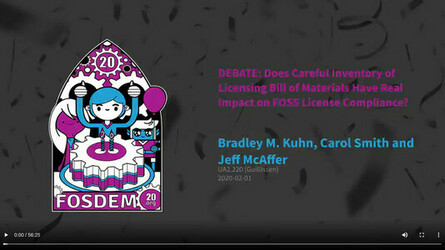
There was also considerable discussion on our mailing list regarding this research and a presentation based on the paper will occur at the ASPLOS 2020 conference between March 16th 20th in Lausanne, Switzerland. The many virtues of Reproducible Builds were touted as benefits for software compliance in a talk at FOSDEM 2020, debating whether the Careful Inventory of Licensing Bill of Materials Have Impact of FOSS License Compliance which pitted Jeff McAffer and Carol Smith against Bradley Kuhn and Max Sills. (~47 minutes in). Nobuyoshi Nakada updated the canonical implementation of the Ruby programming language a change such that filesystem globs (ie. calls to list the contents of filesystem directories) will henceforth be sorted in ascending order. Without this change, the underlying nondeterministic ordering of the filesystem is exposed to the language which often results in an unreproducible build. Vagrant Cascadian reported on our mailing list regarding a quick reproducible test for the GNU Guix distribution, which resulted in 81.9% of packages registering as reproducible in his installation:
$ guix challenge --verbose --diff=diffoscope ...
2,463 store items were analyzed:
  - 2,016 (81.9%) were identical
  - 37 (1.5%) differed
  - 410 (16.6%) were inconclusive
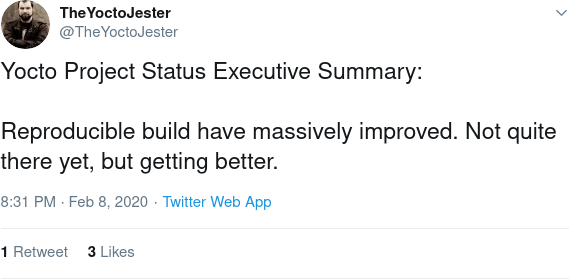
Jeremiah Orians announced on our mailing list the release of a number of tools related to cross-compilation such as M2-Planet and mescc-tools-seed. This project attemps a full bootstrap of a cross-platform compiler for the C programming language (written in C itself) from hex, the ultimate goal being able to demonstrate fully-bootstrapped compiler from hex to the GCC GNU Compiler Collection. This has many implications in and around Ken Thompson s Trusting Trust attack outlined in Thompson s 1983 Turing Award Lecture. Twitter user @TheYoctoJester posted an executive summary of reproducible builds in the Yocto Project: Finally, Reddit user tofflos posted to the /r/Java subreddit asking about how to achieve reproducible builds with Maven and Chris Lamb noticed that the Linux kernel documentation about reproducible builds of it is available on the kernel.org homepages in an attractive HTML format.

Distribution work

Debian Chris Lamb created a merge request for the core debian-installer package to allow all arguments and options from sources.list files (such as [check-valid-until=no] , etc.) in order that we can test the reproducibility of the installer images on the Reproducible Builds own testing infrastructure. (#13) Thorsten Glaser followed-up to a bug filed against the dpkg-source component that was originally filed in late 2015 that claims that the build tool does not respect permissions when unpacking tarballs if the umask is set to 0002. Matthew Garrett posted to the debian-devel mailing list on the topic of Producing verifiable initramfs images as part of a wider conversation on being able to trust the entire software stack on our computers. 59 reviews of Debian packages were added, 30 were updated and 42 were removed this month adding to our knowledge about identified issues. Many issue types were noticed and categorised by Chris Lamb, including:

openSUSE In openSUSE, Bernhard M. Wiedemann published his monthly Reproducible Builds status update as well as provided the following patches:

Software development

diffoscope diffoscope is our in-depth and content-aware diff-like utility that can locate and diagnose reproducibility issues. It is run countless times a day on our testing infrastructure and is essential for identifying fixes and causes of nondeterministic behaviour. Chris Lamb made the following changes this month, including uploading version 137 to Debian:
  • The sng image utility appears to return with an exit code of 1 if there are even minor errors in the file. (#950806)
  • Also extract classes2.dex, classes3.dex from .apk files extracted by apktool. (#88)
  • No need to use str.format if we are just returning the string. [ ]
  • Add generalised support for ignoring returncodes [ ] and move special-casing of returncodes in zip to use Command.VALID_RETURNCODES. [ ]

Other tools disorderfs is our FUSE-based filesystem that deliberately introduces non-determinism into directory system calls in order to flush out reproducibility issues. This month, Vagrant Cascadian updated the Vcs-Git to specify the debian packaging branch. [ ] reprotest is our end-user tool to build same source code twice in widely differing environments and then checks the binaries produced by each build for any differences. This month, versions 0.7.13 and 0.7.14 were uploaded to Debian unstable by Holger Levsen after Vagrant Cascadian added support for GNU Guix [ ].

Project documentation & website There was more work performed on our documentation and website this month. Bernhard M. Wiedemann added a Java Gradle Build Tool snippet to the SOURCE_DATE_EPOCH documentation [ ] and normalised various terms to unreproducible [ ]. Chris Lamb added a Meson.build example [ ] and improved the documentation for the CMake [ ] to the SOURCE_DATE_EPOCH documentation, replaced anyone can with anyone may as, well, not everyone has the resources, skills, time or funding to actually do what it refers to [ ] and improved the pre-processing for our report generation [ ][ ][ ][ ] etc. In addition, Holger Levsen updated our news page to improve the list of reports [ ], added an explicit mention of the weekly news time span [ ] and reverted sorting of news entries to have latest on top [ ] and Mattia Rizzolo added Codethink as a non-fiscal sponsor [ ] and lastly Tianon Gravi added a Docker Images link underneath the Debian project on our Projects page [ ].

Upstream patches The Reproducible Builds project detects, dissects and attempts to fix as many currently-unreproducible packages as possible. We endeavour to send all of our patches upstream where appropriate. This month, we wrote a large number of such patches, including: Vagrant Cascadian submitted patches via the Debian bug tracking system targeting the packages the Civil Infrastructure Platform has identified via the CIP and CIP build depends package sets:

Testing framework We operate a fully-featured and comprehensive Jenkins-based testing framework that powers tests.reproducible-builds.org. This month, the following changes were made by Holger Levsen: In addition, Mattia Rizzolo added an Apache web server redirect for buildinfos.debian.net [ ] and reverted the reshuffling of arm64 architecture builders [ ]. The usual build node maintenance was performed by Holger Levsen, Mattia Rizzolo [ ][ ] and Vagrant Cascadian.

Getting in touch If you are interested in contributing to the Reproducible Builds project, please visit our Contribute page on our website. However, you can get in touch with us via:

This month s report was written by Bernhard M. Wiedemann, Chris Lamb and Holger Levsen. It was subsequently reviewed by a bunch of Reproducible Builds folks on IRC and the mailing list.

4 March 2020

Noah Meyerhans: Daily VM image builds are available from the cloud team

Did you know that the cloud team generates daily images for buster, bullseye, and sid? They re available for download from cdimage.debian.org and are published to Amazon EC2 and Microsoft Azure. This is done both to exercise our image generation infrastructure, and also to facilitate testing of the actual images and distribution in general. I ve often found it convenient to have easy access to a clean, up-to-date, disposable virtual machine, and you might too. Please note that these images are intended for testing purposes, and older ones may be removed at any time in order to free up various resources. You should not hardcode references to specific images in any tools or configuration. If you re downloading an image for local use, you ll probably want one of the nocloud images. They have an empty root password (the security ramifications of this should be obvious, so please be careful!), and don t rely on any cloud service for configuration. You can use the qcow2 images with QEMU on any Linux system, or retrieve the raw images for use with another VMM. If you want to use the images on Amazon EC2, you can identify the latest nightly build using the AWS CLI as follows:
# Select the most recent bullseye image for arm64 instance types:
$ aws ec2 describe-images --owner 903794441882 \
--region us-east-1 --output json \
--query "Images[?Architecture=='arm64']   [?starts_with(Name, 'debian-11-')]   max_by([], &Name)"
 
"Architecture": "arm64",
"CreationDate": "2020-03-04T05:31:12.000Z",
"ImageId": "ami-056a2fe946ef98607",
"ImageLocation": "903794441882/debian-11-arm64-daily-20200304-189",
"ImageType": "machine",
"Public": true,
"OwnerId": "903794441882",
"State": "available",
"BlockDeviceMappings": [
 
"DeviceName": "/dev/xvda",
"Ebs":  
"Encrypted": false,
"DeleteOnTermination": true,
"SnapshotId": "snap-0d7a569b159964d87",
"VolumeSize": 8,
"VolumeType": "gp2"
 
 
],
"Description": "Debian 11 (daily build 20200304-189)",
"EnaSupport": true,
"Hypervisor": "xen",
"Name": "debian-11-arm64-daily-20200304-189",
"RootDeviceName": "/dev/xvda",
"RootDeviceType": "ebs",
"SriovNetSupport": "simple",
"VirtualizationType": "hvm"
 
# Similarly, select the most recent sid amd64 AMI:
$ aws ec2 describe-images --owner 903794441882 \
--region us-east-1 --output json \
--query "Images[?Architecture=='x86_64']   [?starts_with(Name, 'debian-sid-')]   max_by([], &Name)"
 
"Architecture": "x86_64",
"CreationDate": "2020-03-04T05:13:58.000Z",
"ImageId": "ami-00ec9272298ca9059",
"ImageLocation": "903794441882/debian-sid-amd64-daily-20200304-189",
"ImageType": "machine",
"Public": true,
"OwnerId": "903794441882",
"State": "available",
"BlockDeviceMappings": [
 
"DeviceName": "/dev/xvda",
"Ebs":  
"Encrypted": false,
"DeleteOnTermination": true,
"SnapshotId": "snap-07c3fad3ff835248a",
"VolumeSize": 8,
"VolumeType": "gp2"
 
 
],
"Description": "Debian sid (daily build 20200304-189)",
"EnaSupport": true,
"Hypervisor": "xen",
"Name": "debian-sid-amd64-daily-20200304-189",
"RootDeviceName": "/dev/xvda",
"RootDeviceType": "ebs",
"SriovNetSupport": "simple",
"VirtualizationType": "hvm"
 
If you re using Microsoft Azure images, you can inspect the images with az vm image list and az vm image show, as follows:
$ az vm image list -o table --publisher debian --offer debian-sid-daily --location westeurope --all   sort -k 5   tail
debian-sid-daily Debian sid-gen2 Debian:debian-sid-daily:sid-gen2:0.20200228.184 0.20200228.184
debian-sid-daily Debian sid Debian:debian-sid-daily:sid:0.20200229.185 0.20200229.185
debian-sid-daily Debian sid-gen2 Debian:debian-sid-daily:sid-gen2:0.20200229.185 0.20200229.185
debian-sid-daily Debian sid Debian:debian-sid-daily:sid:0.20200301.186 0.20200301.186
debian-sid-daily Debian sid-gen2 Debian:debian-sid-daily:sid-gen2:0.20200301.186 0.20200301.186
debian-sid-daily Debian sid Debian:debian-sid-daily:sid:0.20200302.187 0.20200302.187
debian-sid-daily Debian sid-gen2 Debian:debian-sid-daily:sid-gen2:0.20200302.187 0.20200302.187
debian-sid-daily Debian sid Debian:debian-sid-daily:sid:0.20200303.188 0.20200303.188
debian-sid-daily Debian sid-gen2 Debian:debian-sid-daily:sid-gen2:0.20200303.188 0.20200303.188
Offer Publisher Sku Urn Version
$ az vm image show --location westeurope --urn debian:debian-sid-daily:sid:latest
 
"automaticOsUpgradeProperties":  
"automaticOsUpgradeSupported": false
 ,
"dataDiskImages": [],
"hyperVgeneration": "V1",
"id": "/Subscriptions/428325bd-cc87-41f1-b0d8-8caf8bb80b6b/Providers/Microsoft.Compute/Locations/westeurope/Publishers/debian/ArtifactTypes/VMImage/Offers/debian-sid-daily/Skus/sid/Versions/0.20200303.188",
"location": "westeurope",
"name": "0.20200303.188",
"osDiskImage":  
"operatingSystem": "Linux",
"sizeInBytes": 32212255232,
"sizeInGb": 30
 ,
"plan": null,
"tags": null
 
More information about cloud computing with Debian is available on the wiki.

2 March 2020

Jonathan Carter: Free Software activities for 2020-02

Belgians This month started off in Belgium for FOSDEM on 1-2 February. I attended FOSDEM in Brussels and wrote a separate blog entry for that. The month ended with Belgians at Tammy and Wouter s wedding. On Thursday we had Wouter s bachelors and then over the weekend I stayed over at their wedding venue. I thought that other Debianites might be interested so I m sharing some photos here with permission from Wouter. It was the only wedding I ve been at where nearly everyone had questions about Debian! I first met Wouter on the bus during the daytrip on DebConf12 in Nicaragua, back then I ve eagerly followed the Debianites on Planet Debian for a while so it was like meeting someone famous. Little did I know that 8 years later, I d be at his wedding back in my part of the world. If you went to DebConf16 in South Africa, you might remember Tammy, who have done a lot of work for DC16 including most of the artwork, bunch of website work, design on the badges, bags, etc and also did a lot of organisation for the day trips. Tammy and Wouter met while Tammy was reviewing the artwork in the video loops for the DebConf videos, and then things developed from there. Wouter s Bachelors Wouter was blindfolded and kidnapped and taken to the city center where we prepared to go on a bike tour of Cape Town, stopping for beer at a few places along the way. Wouter was given a list of tasks that he had to complete, or the wedding wouldn t be allowed to continue

Wouter s tasks
Wouter s props, needed to complete his tasks
Bike tour leg at Cape Town Stadium.
Seeking out 29 year olds.
Wouter finishing his lemon and actually seemingly enjoying it.
Reciting South African national anthem notes and lyrics.
The national anthem, as performed by Wouter (I was actually impressed by how good his pitch was).
The Wedding Friday afternoon we arrived at the lodge for the weekend. I had some work to finish but at least this was nicer than where I was going to work if it wasn t for the wedding.
Accommodation at the lodge
When the wedding co-ordinators started setting up, I noticed that there were all these swirls that almost looked like Debian logos. I asked Wouter if that was on purpose or just a happy accident. He said Hmm! I haven t even noticed that yet! , didn t get a chance to ask Tammy yet, so it could still be her touch.
Debian swirls everywhere
I took a canoe ride on the river and look what I found, a paddatrapper!
Kyle and I weren t the only ones out on the river that day. When the wedding ceremony started, Tammy made a dramatic entrance coming in on a boat, standing at the front with the breeze blowing her dress like a valkyrie.
A bit of digital zoomage of previous image.

Time to say the vows.

Just married. Thanks to Sue Fuller-Good for the photo.

Except for one character being out of place, this was a perfect fairy tale wedding, but I pointed Wouter to https://jonathancarter.org/how-to-spell-jonathan/ for future reference so it s all good.

Congratulations again to both Tammy and Wouter. It was a great experience meeting both their families and friends and all the love that was swirling around all weekend.

Debian Package Uploads 2020-02-07: Upload package calamares (3.2.18-1) to Debian unstable. 2020-02-07: Upload package python-flask-restful (0.3.8-1) to Debian unstable. 2020-02-10: Upload package kpmcore (4.1.0-1) to Debian unstable. 2020-02-16: Upload package fracplanet (0.5.1-5.1) to Debian unstable (Closes: #946028). 2020-02-20: Upload package kpmcore (4.1.0-2) to Debian unstable. 2020-02-20: Upload package bluefish (2.2.11) to Debian unstable. 2020-02-20: Upload package gdisk (1.0.5-1) to Debian unstable. 2020-02-20: Accept MR#6 for gamemode. 2020-02-23: Upload package tanglet (1.5.5-1) to Debian unstable. 2020-02-23: Upload package gamemode (1.5-1) to Debian unstable. 2020-02-24: Upload package calamares (3.2.19-1) to Debian unstable. 2020-02-24: Upload package partitionmanager (4.1.0-1) to Debian unstable. 2020-02-24: Accept MR#7 for gamemode. 2020-02-24: Merge MR#1 for calcoo. 2020-02-24: Upload package calcoo (1.3.18-8) to Debian unstable. 2020-02-24: Merge MR#1 for flask-api. 2020-02-25: Upload package calamares (3.2.19.1-1) to Debian unstable. 2020-02-25: Upload package gnome-shell-extension-impatience (0.4.5-4) to Debian unstable. 2020-02-25: Upload package gnome-shell-extension-harddisk-led (19-2) to Debian unstable. 2020-02-25: Upload package gnome-shell-extension-no-annoyance (0+20170928-f21d09a-2) to Debian unstable. 2020-02-25: Upload package gnome-shell-extension-system-monitor (38-2) to Debian unstable. 2020-02-25: Upload package tuxpaint (0.9.24~git20190922-f7d30d-1~exp3) to Debian experimental.

Debian Mentoring 2020-02-10: Sponsor package python-marshmallow-polyfield (5.8-1) for Debian unstable (Python team request). 2020-02-10: Sponsor package geoalchemy2 (0.6.3-2) for Debian unstable (Python team request). 2020-02-13: Sponsor package python-tempura (2.2.1-1) for Debian unstable (Python team request). 2020-02-13: Sponsor package python-babel (2.8.0+dfsg.1-1) for Debian unstable (Python team request). 2020-02-13: Sponsor package python-pynvim (0.4.1-1) for Debian unstable (Python team request). 2020-02-13: Review package ledmon (0.94-1) (Needs some more work) (mentors.debian.net request). 2020-02-14: Sponsor package citeproc-py (0.3.0-6) for Debian unstable (Python team request). 2020-02-24: Review package python-suntime (1.2.5-1) (Needs some more work) (Python team request). 2020-02-24: Sponsor package python-babel (2.8.0+dfsg.1-2) for Debian unstable (Python team request). 2020-02-24: Sponsor package 2048 (0.0.0-1~exp1) for Debian experimental (mentors.debian.net request). 2020-02-24: Review package notcurses (1.1.8-1) (Needs some more work) (mentors.debian.net request). 2020-02-25: Sponsor package cloudpickle (1.3.0-1) for Debian unstable (Python team request).

Debian Misc 2020-02-12: Apply Planet Debian request and close MR#21. 2020-02-23: Accept MR#6 for ToeTally (DebConf Video team upstream). 2020-02-23: Accept MR#7 for ToeTally (DebConf Video team upstream).

Russell Coker: Amazon Prime and Netflix

I ve been trying both Amazon Prime and Netflix. I signed up for the month free of Amazon Prime to watch Good Omens and Picard . Good Omens is definitely worth the effort of setting up the month free of Amazon Prime and is worth the month s subscription if you have used your free month in the past and Picard is ok. Content Amazon Prime has a medium amount of other content, I m now paying for a month of Amazon Prime mainly because there s enough documentaries to take a month. For reference there are plenty of good ones about war and about space exploration. There are also some really rubbish documentaries, for example a 2 part documentary about the Magna Carta where the second part starts with Grover Norquist claiming that the Magna Carta is justification for not having any taxes (the first part seemed ok). Netflix has a lot of great content. A big problem with Netflix is that there aren t good ways of searching and organising the content you want to watch. It would be really nice if Netflix could use some machine learning for recommendations and recommend shows based on what I ve liked and also what I ve disliked. On both Netflix and Amazon when you view the details of a show it gives a short list of similar shows which is nice. With Amazon I have no complaints about that. But with Netflix the content library is so great that you get lost in a maze of links. On the Android tablet interface for Netflix it shows 12 similar shows in a grid and on the web interface it s a row of 20 shows with looped scrolling. Then as you click a different show you get another list of 12/20 shows which will usually have some overlap with the previous one. It would be nice if you could easily swipe left on shows you don t like to avoid having them repeatedly presented to you. On Netflix I ve really enjoyed the Altered Carbon series (which is significantly more violent than I anticipated), Black Mirror (the episode written by Trent Reznor and starring Miley Cyrus is particularly good), and Love Death and Robots . Overall I currently rate Love Death and Robots as in many ways the best series I ve ever watched because the episodes are all short and get straight to the point. One advantage of online video is that they don t need to pad episodes out or cut them short to fit a TV time slot, they can use as much time as necessary to tell the story. Watch List Having a single row of shows to watch is fine for the amount of content that Amazon has, but for the Netflix content you can easily get 100 shows on your watch list and it would be good to be able to search my watch list by genre (it s a drag to flick through dozens of icons of war documentaries when I m in the mood for an action movie as the icons are somewhat similar). As well as a list of shows you selected to watch Netflix has a list of shows that have been recently watched with no way to edit it which is separate from the list of shows selected to watch. So if you watch 5 minutes of a show and decide that it sucks then it stays on the list until you have partially watched 10 other shows recently. For my usage the recently watched list is the most important thing as I m watching some serial shows and wouldn t want to go through the 100 shows on my watch list to find them. If I ve decided that a movie sucked after watching a bit of it I don t want to be reminded of it by seeing the icon every time I use Netflix for the next month. Amazon has only a single watch next list for shows that you have watched recently and shows that you selected as worth watching. It allows editing the list which is nice, but then Amazon also often keeps shows on the list when you have finished watching them and removed them from the to watch setting. Amazon s watch list is also generally buggy, at one time it decided that a movie was no longer available in my region but didn t let me remove it from the list. Quality Apparently the Netflix web interface on Linux only allows 720p video while the Amazon web interface on all platforms is limited to 720p. In any case my Internet connection is probably only good enough for 1080p at most. I haven t noticed any quality differences between Netflix and Amazon Prime. Multiple Users Netflix allows you to create profiles for multiple users with separate watch lists which is very handy. They also don t have IP address restrictions so it s a common practice for people to share a Netflix account with relatives. If you try to use Netflix when the maximum number of sessions for your account is in use it will show a list of what the other people on your account are watching (so if you share with your parents be careful about that). Amazon doesn t allow creating multiple profiles, but the content isn t that great. The trend in video streaming is for proprietary content to force users to subscribe to a service. So sharing an Amazon Prime account with a few people so you want watch the proprietary content would make sense. Watching Patterns Sometimes when I m particularly distracted I can t focus on one show for any length of time. Both Amazon and Netflix (and probably all other online streaming services) allow me to skip between shows easily. That s always been a feature of YouTube, but with YouTube you get recommended increasingly viral content until you find yourself watching utter rubbish. At least with Amazon and Netflix there is a minimum quality level even if that is reality TV. Conclusion Amazon Prime has a smaller range of content and some really rubbish documentaries. I don t mind the documentaries about UFOs and other fringe stuff as it s obvious what it is and you can avoid it. A documentary that has me watching for an hour before it s revealed to be a promo for Grover Norquist is really bad, did the hour of it that I watched have good content or just rubbish too? Netflix has a huge range of content and the quality level is generally very high. If you are going to watch TV then subscribing to Netflix is probably a good idea. It s reasonably cheap, has a good (not great) interface, and has a lot of content including some great original content. For Amazon maybe subscribe for 1 month every second year to binge watch the Amazon proprietary content that interests you.

20 November 2017

Jonathan Carter: New powerline goodies in Debian

About powerline Powerline does some font substitutions that allow additional theming for terminal applications such as tmux, vim, zsh, bash and more. The powerline font has been packaged in Debian for a while now, and I ve packaged two powerline themes for vim and zsh. They re currently only in testing, but once my current todo list on packages look better, I ll upload them to stretch-backports. For vim, vim-airline vim-airline is different from previous vim powerline plugins in that it doesn t depend om perl or python, it s purely implemented in vim config files. Demo Here s a gif from the upstream site, they also demo various themes on there that you can get in Debian by installing the vim-airlines-themes package. Vim Airline demo gif How to enable Install the vim-airline package, and add the following to your .vimrc file:
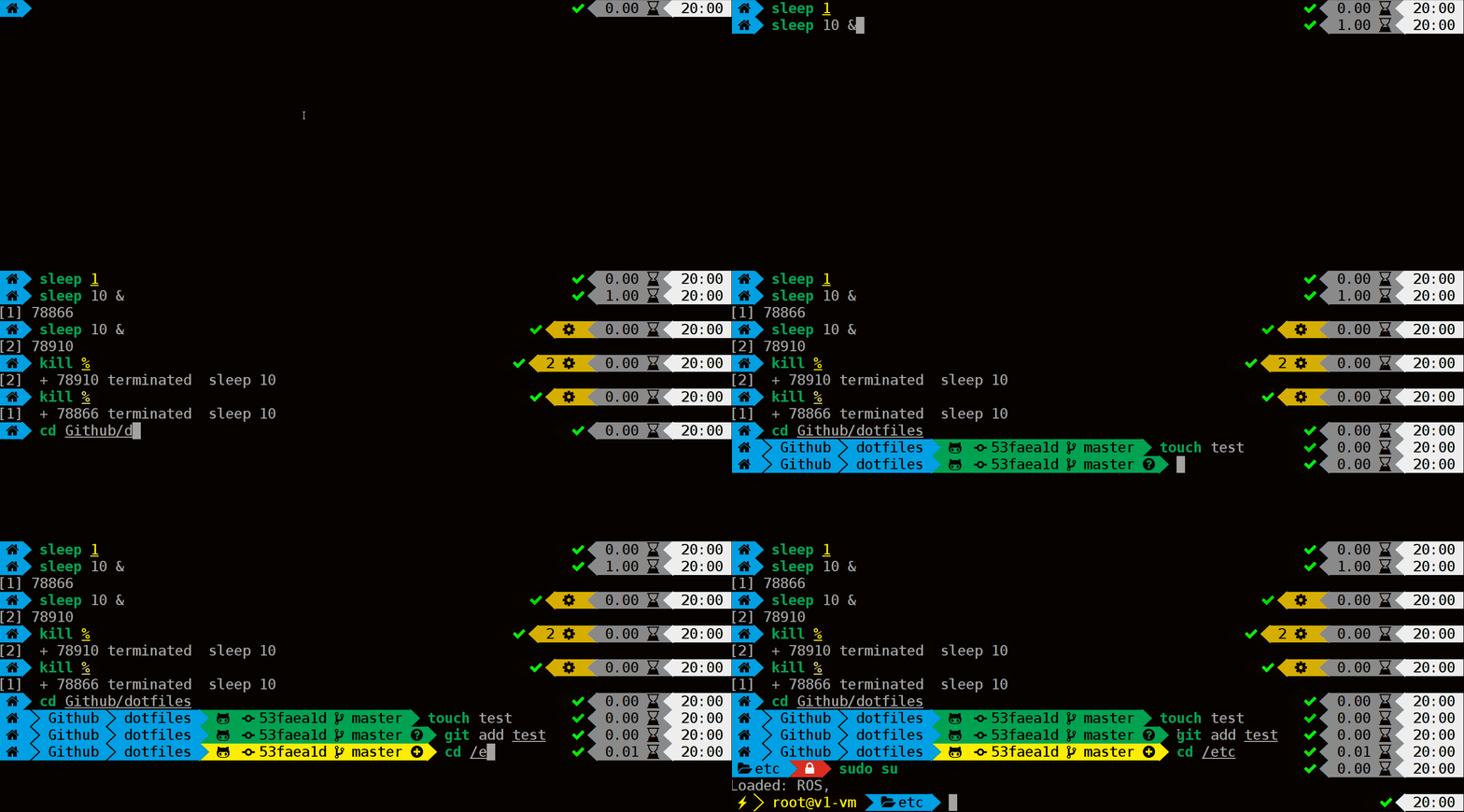
" Vim Airline theme
let g:airline_theme='powerlineish'
let g:airline_powerline_fonts = 1
let laststatus=2
The vim-airline-themes package contains additional themes that can be defined in the snippet above. For zsh, powerlevel9k Demo Here s a gif from upstream that walks through some of its features. You can configure it to display all kinds of system metrics and also information about VCS status in your current directory. Powerline demo gif Powerlevel9k has lots of options and features. If you re interested in it, you should probably take a look at their readme file on GitHub for all the details. How to enable Install the zsh-theme-powerlevel9k package and add the following to your to your .zshrc file.
source /usr/share/powerlevel9k/powerlevel9k.zsh-theme

18 November 2017

Russ Allbery: Free software log (October 2017)

I've not been taking the time to write these promptly in part because I've not found the time to do much free software work. Thankfully, November will at least contain some work-sponsored work (on a package that isn't widely used yet, but maybe we can make it appealing enough). Anyway, that's for next month. For October, the only thing I have to report is refreshing the signing key for my personal Debian repository (generating a new key for the new release) and finally updating the distributions to move stretch to stable, jessie to oldstable, and create the new testing distribution (buster). If for some strange reason you're using my personal repositories (there probably isn't much reason just at the moment), be sure to upgrade eyrie-keyring, since I'm going to switch signing over to the new key shortly.

17 November 2017

Jonathan Carter: I am now a Debian Developer

It finally happened On the 6th of April 2017, I finally took the plunge and applied for Debian Developer status. On 1 August, during DebConf in Montr al, my application was approved. If you re paying attention to the dates you might notice that that was nearly 4 months ago already. I was trying to write a story about how it came to be, but it ended up long. Really long (current draft is around 20 times longer than this entire post). So I decided I d rather do a proper bio page one day and just do a super short version for now so that someone might end up actually reading it. How it started In 1999 no wait, I can t start there, as much as I want to, this is a short post, so In 2003, I started doing some contract work for the Shuttleworth Foundation. I was interested in collaborating with them on tuXlabs, a project to get Linux computers into schools. For the few months before that, I was mostly using SuSE Linux. The open source team at the Shuttleworth Foundation all used Debian though, which seemed like a bizarre choice to me since everything in Debian was really old and its boot-floppies installer program kept crashing on my very vanilla computers.

SLUG (Schools Linux Users Group) group photo. SLUG was founded to support the tuXlab schools that ran Linux.

My contract work then later turned into a full-time job there. This was a big deal for me, because I didn t want to support Windows ever again, and I didn t ever think that it would even be possible for me to get a job where I could work on free software full time. Since everyone in my team used Debian, I thought that I should probably give it another try. I did, and I hated it. One morning I went to talk to my manager, Thomas Black, and told him that I just don t get it and I need some help. Thomas was a big mentor to me during this phase. He told me that I should try upgrading to testing, which I did, and somehow I ended up on unstable, and I loved it. Before that I used to subscribe to a website called freshmeat that listed new releases of upstream software and then, I would download and compile it myself so that I always had the newest versions of everything. Debian unstable made that whole process obsolete, and I became a huge fan of it. Early on I also hit a problem where two packages tried to install the same file, and I was delighted to find how easily I could find package state and maintainer scripts and fix them to get my system going again. Thomas told me that anyone could become a Debian Developer and maintain packages in Debian and that I should check it out and joked that maybe I could eventually snap up highvoltage@debian.org . I just laughed because back then you might as well have told me that I could run for president of the United States, it really felt like something rather far-fetched and unobtainable at that point, but the seed was planted :) Ubuntu and beyond

Ubuntu 4.10 default desktop Image from distrowatch

One day, Thomas told me that Mark is planning to provide official support for Debian unstable. The details were sparse, but this was still exciting news. A few months later Thomas gave me a CD with just warty written on it and said that I should install it on a server so that we can try it out. It was great, it used the new debian-installer and installed fine everywhere I tried it, and the software was nice and fresh. Later Thomas told me that this system is going to be called Ubuntu and the desktop edition has naked people on it. I wasn t sure what he meant and was kind of dumbfounded so I just laughed and said something like Uh ok . At least it made a lot more sense when I finally saw the desktop pre-release version and when it got the byline Linux for Human Beings . Fun fact, one of my first jobs at the foundation was to register the ubuntu.com domain name. Unfortunately I found it was already owned by a domain squatter and it was eventually handled by legal. Closer to Ubuntu s first release, Mark brought over a whole bunch of Debian developers that was working on Ubuntu over to the foundation and they were around for a few days getting some sun. Thomas kept saying Go talk to them! Go talk to them! , but I felt so intimidated by them that I couldn t even bring myself to walk up and say hello. In the interest of keeping this short, I m leaving out a lot of history but later on, I read through the Debian packaging policy and really started getting into packaging and also discovered Daniel Holbach s packaging tutorials on YouTube. These helped me tremendously. Some day (hopefully soon), I d like to do a similar video series that might help a new generation of packagers. I ve also been following DebConf online since DebConf 7, which was incredibly educational for me. Little did I know that just 5 years later I would even attend one, and another 5 years after that I d end up being on the DebConf Committee and have also already been on a local team for one.

DebConf16 Organisers, Photo by Jurie Senekal.

It s been a long journey for me and I would like to help anyone who is also interested in becoming a Debian maintainer or developer. If you ever need help with your package, upload it to https://mentors.debian.net and if I have some spare time I ll certainly help you out and sponsor an upload. Thanks to everyone who have helped me along the way, I really appreciate it!

Rapha&#235;l Hertzog: Freexian s report about Debian Long Term Support, October 2017

A Debian LTS logoLike each month, here comes a report about the work of paid contributors to Debian LTS. Individual reports In October, about 197 work hours have been dispatched among 13 paid contributors. Their reports are available: Evolution of the situation The number of sponsored hours increased slightly to 183 hours per month. With the increasing number of security issues to deal with, and with the number of open issues not really going down, I decided to bump the funding target to what amounts to 1.5 full-time position. The security tracker currently lists 50 packages with a known CVE and the dla-needed.txt file 36 (we re a bit behind in CVE triaging apparently). Thanks to our sponsors New sponsors are in bold.

No comment Liked this article? Click here. My blog is Flattr-enabled.

Next.

Previous.