Search Results: "will"

9 April 2009

Mike Hommey: SSH through jump hosts

I often need to connect to a server with ssh from another server because I don t have direct access. I even gave a small configuration example to use such jump hosts using ProxyCommands. A while ago, I got fed up to have to add new entries for each host I wanted to join with a jump server, especially when I only need these entries sporadicly, and decided to write a generic configuration. I ended up with this setup:
Host *%*
ProxyCommand ssh $(echo %h cut -d%% -f1) nc -w1 $(echo %h cut -d%% -f2) %p
The trick here is that you can use subshell expansions in a ProxyCommand. So, when I ssh to host1%host2 , the first subshell expansion returns host1 and the second host2 , this setup ends up being the equivalent of :
Host host1%host2
ProxyCommand ssh host1 nc -w1 host2 %p
which is quite similar to the setup from my previous post. Later on, I came up with an even more powerful implementation:
Host *%*
ProxyCommand ssh $(echo %h awk -F%% ' OFS="%%"; NF--; print $0 ') nc $(echo %h awk -F%% ' print $NF ') %p
Here, the first awk splits at the % characters and returns all fields except the last one, and the second awk returns only the last field. As a consequence, sshing to host1%host2%host3%host4 will have the first subshell expansion return host1%host2%host3 and the second host4 . The setup will then be equivalent to:
Host host1%host2%host3%host4
ProxyCommand ssh host1%host2%host3 nc -w1 host4 %p
The ssh in the ProxyCommand will, in turn, trigger the rule again so that the result is that host4 will be contacted from host3, which is contacted from host2 that we contacted from host1. In the meanwhile, I decided % was not that nice a separator, and switched to using /, which also allows for a nicer setup with the same recursive effect:
Host */*
ProxyCommand ssh $(dirname %h) nc -w1 $(basename %h) %p
Finally, since some remote hosts don t have nc installed, I usually copy it in my $HOME on these servers and changed my setup to:
Host */*
ProxyCommand ssh $(dirname %h) PATH=.:\$PATH nc -w1 $(basename %h) %p

The main drawback of this method is that the more jump hosts you use, the more your ssh traffic is encapsulated (recursively) in other ssh traffic. The advantage, though, is that you don t need to forward an agent onto untrusted servers to use ssh key authentication on any of the jump or final servers, nor to forward X11 or tunnel multiple times.

Martin Meredith: My Boss, with a little help, starts the conversion to Linux

Ok, so at work, pretty much the whole company uses Windows, of some sort. The web team, however, are pretty adamant that they use the best tools available for them, and we use Ubuntu because of this (because it s the easiest option that we all have the same distro, and as long as it s Linux, we don t mind) Anyway, at the moment we re working through the process of moving all our internal business applications from Visual Basic.NET (urgh!) to PHP + a web based app. The Product Owner for this is one of the bosses, who currently uses Windows Vista. He has, however, seen us all using Ubuntu and it s got him interested in using it. He s said that he wants to try using Ubuntu, and see whether he can get his work done on that, and slowly transition to it, as obviously, he needs to be able to use Windows for the .NET stuff (which sadly, doesn t work well under WINE). So, we set him up a Virtual Machine, and he got to grips with what he was doing, great. Except for the fact that he had to allocate memory to it, switching back and forth between windows and Ubuntu was a pain. He eventually gave up on this idea, and got a spare machine, a spare monitor, and set it up next to his machine. Still, however, it was a bit of a pain, he d have to switch position on his desk, start using a different keyboard and mouse, and i was all a bit of hassle. Recently, we ve gotten a big screen (which isn t actually that big!) for the Web Team to monitor the servers, our order download service, etc etc. We were showing our manager some of the stuff we could do with it, and he asked the question So, how do you control it - to which my response was to move my mouse off of the edge of my screen, and onto the big screen. So is that a third monitor? he asked. No I replied, it s another machine. Enter Synergy So this is the point where I explained to our manager exactly what synergy is. Trying to explain it however, is a bit of a hassle, so I ll try my best here. Synergy is an application that allows you to control another machine s keyboard and mouse from your own PC. It s a bit of a mix between a KVM switch, and Remote Desktop, but it doesn t require extra hardware, and you dont have to relay the video across the network to show it on your screen too. At this point, our boss got a glint in his eye Does it work in Windows? he asked. At this point, I didn t realise that he had a seperate machine for Ubuntu. I told him it did anyway, but I wasn t too sure whether it worked with Vista Lets give it a go anyway So we went over to his machine, and I installed quicksynergy on his ubuntu box, while he downloaded the Windows installer for Synergy. 5 minutes later, he was grinning like a maniac as he moved his mouse from one machine to another. Now he s happily using Ubuntu without any hassle, it s just a third screen to him - with different stuff on it. I think the moral here is, there are different ways to get people to be able to use Linux, and Synergy is one of those great tools that enable people to use Linux without having all the hassle that comes with switching over. I think also, a quote from m manager sums it up.
This is one of the best things I ve seen all year. I thought it d take forever to setup, but it was so quick. I can be so much more productive now
I hope that this will be one of the turning points for my manager, and we ll have another convert by the end of the year

Mohammed Sameer: Bye fglrx...

Thanks to all the hard work by the fglrx packaging team, DRI, MESA, Xorg, Radeon,... etc people!

I've been using fglrx with my laptop since I've had it:

01:00.0 VGA compatible controller: ATI Technologies Inc Radeon Mobility X1400

And to the people behind the Debian packaging..
* xserver-xorg-video-radeon from testing.
* libdrm-intel1 and libdrm2 from unstable
* libgl1-mesa-dri and libgl1-mesa-glx from experimental

vader:~# apt-get --purge remove fglrx-driver fglrx-kernel-src fglrx-kernel-2.6.26-1-686 fglrx-sourceReading package lists... Done
Building dependency tree
Reading state information... Done

The following packages will be REMOVED:
fglrx-driver* (9-2-2)
fglrx-kernel-2.6.26-1-686* (9-2-2+2.6.26-13)
fglrx-kernel-src* (9-2-2)
fglrx-source* (9-2-2)
0 upgraded, 0 newly installed, 4 to remove and 17 not upgraded.
After this operation, 38.8MB disk space will be freed.
Do you want to continue [Y/n]?

I probably lost the ability to suspend and resume but I don't usually do it with that laptop.

Now let's hope my lapop at work will be adapted easily too :)

UPDATE: Seems you lose OpenGL 2.0 if you use the free driver. If you are doing OpenGL stuff like me then you are in trouble ;- read more

MJ Ray: Switched over to LLU and ADSL-2+

A couple of months ago, I switched over to ThePhoneCoop s LLU package. The new service is good so far. The ADSL is blazingly fast (I wonder if it will remain so good) and the main drawbacks so far are a lack of reverse DNS (currently escalating that one up through tech support) and a slightly noisy dialling tone on the phone. I was initially switched to a dynamic IP address (which was a change I wasn t told about in advance), but got a static on request so we could restrict the VPNs a bit more. As usual, LUGgers were a source of help when it looked like going a bit wrong. Thanks to oddbloke for positive feedback about Buffalo routers (they work fine with OpenWRT, but not tried ADSL). Big thanks to Noodles for pointing out that the Buffalo router I linked wasn t an ADSL router, despite being listed as such, that the only ADSL chipset to have full open source support is the AR7 (but the wifi is dodgy) and that the Broadcom chipsets have 2.6 support but maybe with a binary blob. I m still not sure if a new router is necessary. The infernal Belkin seems to be working, but it s disconnecting and rebooting a lot more often. I seem to be on the TalkTalk/CPW network - anyone know of problems with Belkin routers? I ve not seen anything yet. Also, who else has unbundled and how was it for you?

8 April 2009

Eddy Petrișor: About the protests in Moldavian Republic

Many people in the western world are completely unaware that in the Moldavian Republic there is an ongoing protest against the current Communist Party which is at power after the parliamentary elections held on Sunday. The protestants accuse the Communists of election fraud and there are numerous reports of dead people being recorded as voters, people which, by religion, chose not to vote, and other several people which couldn't have voted.

Tuesday the protests took a violent turn, apparently "aided" by some instigators which were reported to be seen as recording the protesters, taking notes and, generally, not fitting the picture. During the day the national television broadcasted absolutely no information on the events, and aired documentaries, cartoons and no news on any of the protests. To me, this looked very much alike what the Romanian Television aired during the Romanian Revolution in December '89 when during the fights in the streets of Bucharest the Television aired no images from the centre of Bucharest.

But, back to Moldavia, at the end of the day, sadly, the Parliament and Presidency buildings were devastated, making it easy for the Communist leaders to produce some disinformation propaganda based on real footage.

Yet again, sadly, but it seems under the protection of some of the aforementioned instigators, the flags of the EU and Romania were waved at the highest levels of the Parliament building during the time the protesters allegedly took over that building (there were several reports that the Police forces actually simply let them in, without actually needing/being forced to do that; also the passivity of the policemen seen in the footage from Romanian televisons was obvious).

As many Moldavian students live and study in Romania, some of them wanted to go home and take part at the protests happening in Chi in u. To their surprise, many of them were denied the right to enter their home country. Many, if not all, Romanian journalists were also denied access in the country accusing alternatively technical issues, lack of proper papers (although only the passport or the ID card was officially required), lack of safety, or simply refusing without reason.


Today, the Moldavian president Voronin, accused Romania as being behind the manifestations in Chi in u, Moldova's capital and said it will declare as a persona non grata the Ambasador of Romania in Moldova, and thus forcing him to leave Moldova within 24 hours. He went even further and said that visas will be required from now on for Romanian nationals. As soon as this was announced, it was one of the most invoked reasons by the Moldavian customs as a rejection reason, although, according to Moldavian Embassy officials in Romania, no rules or procedure were known for the release of visas for Romanian nationals.

Also, during Wenesday, Moldavian crossing points were opened and closed alternatively but incosistently accros the entire border for Moldavian nationals. Romanian nationals were denied in most cases (although some Romanian truck drivers were reported as allowed to cross). At some point during the day the Moldavian officials from the customs told the Moldavian students awating at the border that they are offered access on the condition they go direclty home with the buses provided by the Moldavian customs and were warned that going to Chi in u wasn't a smart choice for them. Some of the information from students which managed to enter their home country suggested that is advisable to not enter the country since they were going to be denied of the right to leave the country later, when they were to return to Romania to their studies (after Easter).

What's sadder is that the Moldavian voting system is built in such a way that the vote counting, in the end is done by Government officials behind closed doors, inside a Ministry. OTOH, the international official observed the things which happend in public, but did not see any of the dead voter lists (since they were not present when those votes were casted), and declared the vote as mostly legal and without major or significant incidents.


According to the media, before the elections, the Communists were credited with 35-37% of the votes in an independent poll, while in the exit poll conducted by the Communists themselves they were credited with 42-45% of the votes. In the end the last official partial results credited them with approximately 51% of the votes.

About Vladimir Voronin, it is a known fact that he has double citizenship, Moldavian and Russian and is a reserve general within the Russian Army and currently has a pretty nice pension from the Russian state.


All I can say is that, although the Moldavians' desire to have a real democracy is a legal and reasonable request, the western world chose, due to the international circumstances, to look the other way around and not to incommodate Russia in any way. Moreover, to accuse Romania to have unionist desires an act upon those desires is planly stupid since now Romania is part of the EU and Moldova uniting with Romania is simply impossible now, since Moldavia's economy would sunk even more the fragile and regressing Romanian economy and Romania would instantly fail the EU requirements which would mean disaster for us.

Mike Hommey: Detecting per-process namespaces

Back with per-process namespaces. This time, I will give several methods to more or less reliably detect their use, some requiring root access, some not. We will, though, limit ourselves to mount namespaces , that is, not PID, UTS or network namespaces. The first method, which is based on the contents of /proc/pid/mounts should work on any kernel supporting namespaces (since 2.4.19):
$ md5sum /proc/[0-9]*/mounts awk -F [ /]* ns[$1] = ns[$1] ? ns[$1] , $3 : $3 END for (n in ns) print n, ns[n]
/proc/[0-9]* is used instead of /proc/* to avoid listing self, too. The awk script displays a summary : a md5 sum followed by the PID of all processes which /proc/self/mounts file has this md5 sum.
This method relies on the fact that the /proc/pid/mounts files may be different between namespaces, even when the same mount points are used because the ordering may differ. This method is obviously unreliable, except when all namespaces have different mount points. During my tests, it has been reliable to detect whether a process uses the same namespace as the init process, but different processes with different namespaces were reliably listed together as having the same namespace. The next method, based on the contents of /proc/pid/mountinfo will work on any kernel implementing this file (since 2.6.26):
$ md5sum /proc/[0-9]*/mountinfo awk -F [ /]* ns[$1] = ns[$1] ? ns[$1] , $3 : $3 END for (n in ns) print n, ns[n]
The script is essentially the same, only pointing at mountinfo instead of mounts.
This method is quite reliable, as /proc/pid/mountinfo does contain different information even when no mount point was changed within a namespace. Unfortunately, chrooted processes can have a different content while not being in a separate namespace. I ve not investigated further, but you may be able to spot chrooted processes by comparing /proc/pid/mountinfo and /proc/pid/mounts. Both the above methods can be executed as unprivileged user, which alleviates the fact they are not totally reliable. The last method, on the other hand, is reliable, but requires root privileges, and cgroup filesystem support in the kernel (since 2.6.24).
$ mkdir -p /dev/cgroup/ns
$ mount -t cgroup -o ns /dev/cgroup/ns
$ find /dev/cgroup/ns -name tasks xargs -l1 sed ':a;N;s/\n/,/g;ta'
The output here is a group of PID on separate lines for separate namespaces. The sed one-liner replaces all carriage returns in the tasks files with a comma.
You don t actually need root privileges for the last command, if the cgroup filesystem is already mounted. But there has been no normalization as to where the cgroup filesystems should be mounted yet, and they aren t mounted by default on most GNU/Linux distributions, I believe. Cgroups (Control groups) allow to put sets of processes together to give them special behaviour (cpu provisioning, memory limitations, namespaces, etc.). They also allow to do so in a hierarchical way, such that a cgroup can inherit the properties of its parent cgroup. As its name and the way it is mounted indicates, our /dev/cgroup/ns is specialized for namespaces cgroups. The directory itself contains a few files, most notably a tasks file containing a list of processes in the current set/cgroup (in our case, namespace). It also contains a subdirectory for each child namespace. Each of these subdirectories is similarly structured, so that it also contains a tasks list and possible subdirectories for its own children. This means that not only can you spot different namespaces, but you can also spot how they relate to each other. There are a few glitches, though. As with other cgroups subsystems, you can create new cgroups by creating a directory in the cgroup filesystem, but it happens not to create a new namespace in the case of the namespace subsystem. With all the kind of namespaces that now exist in Linux, this is not a big surprise, but there doesn t seem to be neither a feedback in the cgroup filesystem to know what kind of namespace is involved, nor a control to force creation of a really separate namespace. You also can t move processes from one mount namespace into another by writing a PID in the tasks file in a given namespace ; that just gives an Operation not permitted error. On the other hand, contrary to the second method, chrooted processes are not separated out. I will investigate further cgroups with PID, UTS and network namespaces and will post my findings.

David Welton: New LangPop.com stats, open source bits and pieces

I released some new statistics on LangPop.com. There are some new things:
  • The normalized results are now user configurable - you can put in your own weights for the various data sources (such as Amazon, Craigslist, and so on), and see how the results change.
  • Freshmeat.net fiddled with their web site, and statistics are not going to be available this month. Hopefully they will be able to correct the problem soon.
  • On the other hand, I wrote some code to grab the data from Ohloh, so there's something new to look at while we wait for Freshmeat to come back on line.
So there is a fair amount going on. Hopefully Freshmeat will come back soon, and I can also add a few fixes to the IRC statistics which I've been thinking about. In the process of doing the above, I also managed to do some open source work, albeit of a minor nature:
  • I updated LangPop.com to use the Flotr Javascript chart library instead of Plotr. So I also updated my Ruby code to integrate it. It's a fairly thin layer at this point, but it does what I need. It's available here: http://github.com/davidw/chartr/tree/master
  • I did some hacking on the Simile Timeline code, (used here on LangPop.com), correcting a bug, and also creating a system to install the whole thing with a simple command. Normally, it's kind of difficult to just use the Simile code on your own site, so I created an (admittedly hacky) way of making it easier to install. That code is here: http://github.com/davidw/standalone-timeplot/tree/master
Oh, yeah, and we moved from Innsbruck, Austria back to Padova, Italy!

John Goerzen: Goodbye

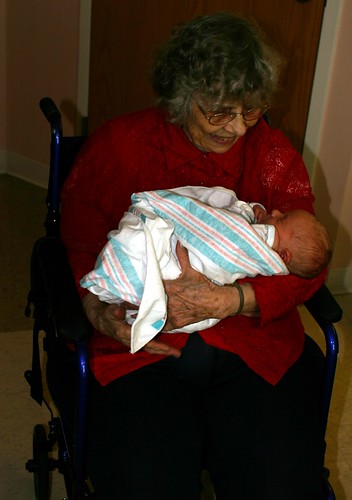
Jacob has lately been telling us gate gamma kassen so sick (Great Grandma Klassen is so sick), after his visit to the hospital, and it s true. Today started normal enough, but by 2:45 I got an email from my mom, saying that grandma had taken yet another turn for the worse; her pulse was racing, her temperature feverish, and her breathing shallow and difficult. The last grandchild that was going to be there made it, and got the last flicker of recognition from grandma. I wrapped some things up at work. Then I made the short drive from work to the nursing home, and got there just after 4. I went in to her room there, and it was full of family. Two of her children were singing her favorite hymns. I can never forget my uncle s deep bass voice as he stood at her bedside, holding her arm, while my aunt patted her head, both of them singing. Grandma s only remaining sibling, her younger brother Melvin, sat on the other side of the bed, looking on. Grandma s white table and chairs, which were in grandma and grandpa s house as long as I can remember, and followed grandma through all of the four other places she lived in the last years of her life, were in her room at the nursing home too. It always felt like home to be with grandma and those familiar things that she always took with her. Despite what was happening, I was glad she was back at home. My uncle motioned me over to her bedside, and I took her hand for a few minutes. It felt cold and weak; for the first time, she didn t grab my hand at all. A nurse came in to check oxygen saturation, but the machine wasn t able to get a reading due to poor circulation to her hand. She wasn t able to get a heart rate either because the heart was racing so fast. She discussed briefly whether the family wanted them to continue giving her oxygen, and they decided that they would, for her comfort. My uncle and aunt kept singing. I blew my nose and dabbed at my eyes, and there were hugs all around. And just a few minutes later, grandma peacefully stopped breathing, maybe 20 minutes after I had arrived. They went to get the nurse, who came back to listen to grandma s heart again, though we knew what she would find. She took the stethoscope off, and she almost lost her composure, but managed to say you can turn the oxygen off now. Several people gave grandma a last hug. After a few minutes with just the family, they told the nurses to go ahead and call the funeral home. That set off a lot of activity making arrangements for the next few days, funeral plans, and the like. I stepped back into grandma s room a few times, while the family was in the sitting area right outside it discussing. I looked around at the family photos on the wall, the old table and chairs, the recliner. Now, these are the things that were grandma s. It didn t feel like home anymore. Terah and Jacob were stuck at home Terah s car was at the mechanic for repair today. I called to give her the news. She wanted to come to be with the family, but I didn t really want to leave. She tried calling some friends to see if they could give her a lift to the mechanic, but not one of them was available. I talked to her again and suggested she just call the mechanic. She wasn t even halfway through describing the situation when he interrupted with, We ll have it at your place right away! Well, I don t expect you to have to do that, or you could certainly wait until you close. Nope, this isn t your average community, we ll bring it right over. You should be there. Grandma has enjoyed a simple life and had requested a simple death: no extraordinary measures at the end of life, no embalming either. So, by law, the burial must happen within 24 hours of death, and will be tomorrow. After all the arrangements, people realized nobody had supper yet. We went to the quickest available option pizza and ate there. It was paid for out of grandma s remaining money the last meal of so many that she provided for her family over the years. It was a happy meal. As I drove home, NPR news was on the radio. There were the same stories we hear all the time: the economy, the mideast, the president. Normally I m interested, but today I shut it off. Today is different. Tomorrow, for the second time in four years, I will help carry a grandparent s casket a few days before Easter. I ll end tonight with this photo. It was taken soon after Jacob was born. Grandma came to the hospital and held him. That smile sums her up perfectly. img_4965r.jpg

Obey Arthur Liu: Google Summer of Code at Debian: Update, need mentors!

A quick update before the big one about the 2009 Google Summer of Code. I believe we had a great recruitment drive this year and we have a very good set of proposals to work with. We d like to thank everyone involved for their help. We re now ranking out student applications. I promised elsewhere that I ll send out our shortlist of projects once Google sends us our preliminary slot allocation today but I misread the thread on the -mentors list and that count will only happen on Thursday, so we ll have to wait a bit more. That shortlist would only include projects, but not individual students. The idea is to give a heads up to everyone before committing to a group of projects and students. It is very important to inform the community as it increases visibility of the students work, giving them more help and support (and also avoids duplicating existing not yet publicized work!). As far as mentors go, we should have all of our approximately 14 planned projects covered, except for 2. I m posting them here in case you could mentor or help find mentors for those projects. (The wiki pages are not really up to date, so please come on IRC and ask clarifications, see below) Finish Petr Rockai s Adept 3.0 and bring a Qt4 Package Manager to Debian, with a different interface paradigm than Aptitude-gtk.
Petr said he would provide help with the existing codebase but can t mentor. Sune Vuorela from Debian KDE is ready to help with Qt4 related issues. Build Debian tools to create Debian images for Amazon EC2 and the free Eucalyptus implementation. Packaging of the Eucalyptus hosting framework is also possible.
For this project, we already have on board to help: Charles Plessy from Debian Med, Eric Hammond, developer of the existing vmbuilder Ubuntu tool for EC2 and Chris Grzegorczyk and Rich Wolski, from the Eucalyptus team. Plenty of people to get help from. Mentoring is a great experience! See this for what it entails. If we still can t find a mentor by the end of the week, I ll blast an announcement over at debian-devel@l.d.o along with the project shortlist. In the meantime, don t forget to idle on #debian-soc on irc.debian.org.

7 April 2009

Jon Dowland: zte mf622

I'm currently waiting for my ADSL to be setup and so I've borrowed my mum's "three" 3G mobile broadband USB dongle. The device is a "ZTE MF622" and getting this working in Linux apparently used to be a bit of a nightmare. However, with Debian Lenny and 2.6.26-1-amd64 it is trivial: you plug it in, it appears as a USB mass storage device; wait a little bit and it disappears and comes back as some USB serial devices. You can then chat to /dev/ttyUSB0 (or whatever the first ttyUSB device belonging to the dongle is). There's a working wvdial configuration at http://ubuntuforums.org/archive/index.php/t-665332.html, reproduced here for convenience:
[Dialer Defaults]
Init2 = ATZ
Init3 = ATQ0 V1 E1 S0=0 &C1 &D2 +FCLASS=0
Stupid Mode = 1
Modem Type = Analog Modem
ISDN = 0
Phone = *99#
Modem = /dev/ttyUSB0
Username = user
Dial Command = ATDT
Password = pass
Baud = 460800
IF you don't want to use wvdial there are bare ppp scripts at http://hillj.co.uk/2008/01/31/how-to-get-online-with-three-mobile-uk-and-linux-ubuntu/, although I haven't tested these. Whilst researching this I stumbled across several examples of more extreme ways of getting the initial switchover to work, including http://blog.ufsoft.org/zte-mf622-usb-modem-under-linux#extended which includes a udev snippet that forcefully calls rmmod and modprobe. This will totally fail if you are using usb-storage or usb-serial for anything else, which is probably not the case for the majority of people trying to get this to work at the time they are trying, but there are several examples out there of people complaining that their USB has failed since trying these instructions. We are often accused of having a problem of missing documentation in the free software world. I'm wondering if this is one example of where we have bad, damaging documentation. How can we deal with that? Incidentally, for those whose devices won't automatically switch over to the serial device, there's a program usb-modeswitch (currently in sid) that can do the job for you. There are apparently hacks in the usb-storage Linux kernel module that special-case the switchover for some Huawei devices. I couldn't find anything in there for the ZTE device.

Gunnar Wolf: map $_->destroy $home->windows; waitfor(NewWindows->arrive) && $home->build_windows;

I live in a 55 year old house. That's not something to be worried about, of course, but it does mean that my house needs major maintenance works to continue to be in good shape. This week, said major maintenance jobs began. We are in the process of replacing all of the windows - It might sound a bit scary by today standards... But if you have ever been here... Well, this house was built in a very different era, when the newly built University City lied several kilometers South of the city border and land was cheap here. Most houses in the area were built for University teachers (this particular house was for twenty years home to Marcos Moshinsky, Mexico's most important Physicist who, coincidentially, passed away last week; Dr. Moshinsky was my father's teacher and mentor). Anyway, we just started the window teardown process. The workers are going quite faster than I expected. Still, I am worried about the waitfor(). As anybody who has come to this house will know, we live on a very busy avenue. Even 30 years ago, when my parents moved here, they installed double glasses on every window - But did some mistakes (i.e. we have some broken glasses which are unchangeable for practical purposes). This time we decided to buy from an established vendor for this kind of windows. Double-glass windows are common in colder regions - But here, they are quite rare. Strange, being this a noisy city... So we researched a bit, and found a vendor with good quality - Multivi, in Puebla. What we didn't count on... Is that they were so informal. We paid in late December and were told delivery would take around two months... And we are still waiting, this time pressing them for a commitment. After all, we are already lacking several windows, and... Well, around May we start having rains. We DEFINITIVELY don't want to be stuck without windows by May! Anyway... I recently sent out a semi-VAC anouncement to debian-private. And this is extensive to any project I am related to: The next days I will be paying more attention to whatever needs to be done at home. Please don't expect prompt replies to mail from me (yes, as if I usually replied promptly...) I do have network access, but not much computer time.

Luk Claes: luk: will do some signing runs for puccini (i386 buildd) for some days while phil is away

luk's status on Tuesday, 07-Apr-09 17:53:02 UTC

Manoj Srivastava: Manoj: Not your father's kernel-package

A few hours ago, a new version of kernel-package was uploaded to experimental. This is a major change,and I would appreciate it if folks took it out for a spin, kicked the tires, and provide feedback about where this version is lacking. This is only part of the way along in this development cycle. I would like to add a debug-info separation, either in a different directory than / in the image packages, or a separate package by itself. I would also like to create an overlay directory for /usr/share/kernel-package/, so people can inject code or override the defaults for kernel-package easily. I am also willing to make any changes to standardize the handling of hook scripts for kernel packages in Debian.

Table of Contents

./debian/ is ephemeral
make-kpkg removes and re-creates ./debian on every invocation. This started as an exercise to protect ourselves from the upstream builddep functionality, that randomly cleaned out ./debian whether or not it had created it, effectively making it impossible to run dpkg-buildpackage easily (which is ok, if all you care about is the image package) This does make the kernel-package far more nimble; we now offer less surprise to users who did not expect stampts that the kernel-packagge used to not do duplicate work. Now, if you edit a couple of files in the kernel source, and run make-kpkg, the kernel will build as expected. There are no more version mismatch errors, and the kernel version can be modified using localconfig as one desires. With this, kernel-package can routinely be used to build kernels out of the git tree. The con is that we no longer cater to official kernels, or to anyone who expected content in ./debian to persist. At some point, there are plans to implement an overlay directory that will shadow /usr/share/kernel-package/ruleset, but that is not yet implemented. In any case, the kernel team in Debian regards kernel-package to be broken, and have been bad mouthing it and deprecating it for a few years now, so this will not be a loss for them.

Get rid of the facility to patch kernel sources
The patch the kernel facility was adding complexity, and failing to provide the flexibility required for a generic patching facility. It used to be useful at one point, but in the modern parlance, witht he widespread use of distribute version control systems, and various facilities to manage source and patch them, the built in version was clunky. This means the --added-patches option of make-kpkg is gone, the work-around is to prepare the kernel sources before calling make-kpkg.

Remove special case code for official kernels
For the longest tine (well, ever since Herbert Xu too over building kernel images from me), kernel-package has carried specal case code for official images. This has caused some problems, recently, since the need to preserve ./debian has caused no end of problems when the version changed out from under ./debian, or when people wanted to edit a file and expected kernel-package to do a minimal recompile. However, sometime in the Etch release cycle, the kernel team deprecated kernel-package as the means of building official kernels. They have recently started saying they think kernel-package is broken, and have their own recommendation for how to build kernel packages. Therefore, a full release cycle later, we can get rid of the special case rules used for official packages. Also, this allows us to drop ./debian at the drop of a hat, and recreate it with an version that reflects the current state of the kernel sources.

Header package no longer create symbolic links in /usr/src
Instead, ship an example shell script that replicates the old behaviour. This script can then be deployed on the target machines, and could be a part of a locally created kernel configuration package, if one needs to deploy the same behavior across a cluster of machines.

The postinst no longer manipulates symlinks
This is a shift from previous behaviour. Any symbolic link manipulation must now be done with hook scripts in /etc/kernel/*.d directories. Firstly, modern boot loaders scan the boot directory for kernel images, and the user no longer has to code in the path to the symbolic links that the kernel image package used to manipulate. Secondly, hardcoding the behaviour into the postinst made for a very rigid policy; and user wanted more flexibility than that. There is an example shipped with the package that shows a more flexible scheme that kept two symbolic links for version 2.4 kernels, and two symbolic links for 2.6 kernels; it can be easily modified to keep two links for 2.9 kernels and two links for 2.8 kernels, or one of each, or whatever the user wants.

Image postinst no longer runs a boot loader
Please note that this was already the case for grub, one of the more popular boot loaders. Now that we have a mechanism for running arbitrary scripts when the image packages are manipulated, we can stop embedding the boot loader actions in the package itself. This means that lilo, elilo, etc will no longer be run directly by the post install script, and all the code related to detecting the boot loader, managing the configuration, and adding bits about bootloader documentation is all removed from the postinst. This allows the image package to be more flexible, since the end user is no longer restricted to the actions encoded in the image package. This is a fairly large change. It also opens the door for the user to easily use non-standard bootloaders, if they so desire.

The image postinst no longer creates an initramfs
Instead, there are example scripts provided that will perform the task. These scripts will work for official kernel images as well. The initramfs scripts provided work with the make-kpkg images as well as the official images, and are thus better than the script shipped with initramfs-tools themselves, as they offer a super set of functionality. This also demonstrates how the posts install script communicates with the initramfs creation scripts so that no initramfs is generated in case you do not want it.

DebConf team: DebConf9 CfP will end soon (Posted by Holger Levsen)

This blog post is mostly a test to see the engine is still working :-) But I don t think it hurts to mention that the deadline for registration and for submitting talks and workshops is in 8 days, so hurry up, if you haven t already! Of course you can also register later, but then you won t get sponsored and maybe won t get a timeslot for your proposal. That s all for now, stay tuned for more!

6 April 2009

Gustavo Noronha Silva: W7K+ g3s l10n s5t

Or WebKitGTK+ gains localization support ! Continuing our quest to finish off old bugs, and plug the bigger and more visible missing holes in functionality, a lot of work went into making WebKitGTK+ l10n-capable. This work has been committed today. This means we will now be able to translate things like dialogs, context menus, form elements, and any other string that makes sense to translate and is generated by WebKitGTK+.
Epiphany showing off WebKitGTK+\'s localization
Don t be fooled by the fact that the context menu is talking about spell checking, by the way. This is still something we do not support, and is only there because Epiphany doesn t override WebKitGTK+ s default context menus. I know that diegoe is working on it, though.

Francesco P. Lovergine: Current tasks for DebianGis

I'm still waiting some clarificatons by HDF team about their HDF5 roadmap with SONAMEs and libraries name. It seems they partially learned to manage libtool properly to follow C API changes, but still some oddities are present, such as using the same names for MPI and serial flavors. I will probably have to again diverge from upstream names, which is generally something I don't like, as in the case of GDAL. A summary document about HDF5 plans is due in a brief also.
When finished with HDF updates, I will concentrate on a couple of new beasts which still are lacking in DebianGis and are of so much interest, that are Ossim and the CNES Orfeo Toolbox. In the meantime I would hope that debian-science team will define a squeeze-related policy for MPI.

As always, I'm still worried of the low level of activities in the DebianGis team, which is a constant since years. Unfortunately, this is a situation I see quite common also in many other teams, but I still don't see a right way to improve the status of the team to avoid an almost one-man show. Also I would like to see again Qgis in main, but I'm still waiting for feed-backs by past/current contributors to my last qgis-dev list and off-lists polls.

David Moreno: Rubx: Twitter's Ruby shell

rubxRubx, also known as Ruby Boobie, is a nice spoiled girlie bot that runs on Twitter. She listens when you talk to her and when you do, it'll better be with Ruby: She will interpret your tweet in Ruby and reply to you with what your code returns. How does it work? You send a message to her:
@rubx "The day I was born it was a " << Time.local(1984, "aug", 8).strftime("%A")
And @rubx will reply:
@damog "The day I was born it was a Wednesday"
Go see more about her (examples, FAQ, etc) on axiombox.com/rubx or on her Twitter profile. As we tested the hack, a bunch of people started interacting with Rubx too, some people calling her Twitter Line Interface Ruby Interpreter! :). See what other people has tried with her here.

MJ Ray: Cooperatives in the New York Times

NCBA invites you to pick the Monday, April 6th edition of the New York Times to check out the front section for a very special advertorial on cooperative business. NCBA will receive a copy of the Advertorial to place on its Web Site on Monday and we will distribute a link so you can post it on yours in the next edition of the eNews. However, we hope that you ll let everyone at your cooperative know to pick up the Monday New York Times as everyone in the cooperative community should be proud to be part of this national effort to promote cooperative awareness.
These are challenging times for all businesses, but cooperatives are well-placed to weather the storm. I ll report back from our Bristol co-ops event later or tomorrow.

Biella Coleman: Does the patent system make you queasy?

Great research opportunity for PhD Students out there.
Peer to Patent Summer Research Fellowship
New York Law School
Summer 2009 Background
Peer to Patent is the groundbreaking program developed by New York Law School and run in cooperation with the U.S. Patent and Trademark Office and the United Kingdom Intellectual Property Office, along with the assistance of a number of private stakeholders. It harnesses the power of citizen-experts to assist patent examiners by searching for, identifying, and annotating prior art relevant to pending patent applications. A first Peer to Patent pilot was launched in June 2007. During the first year the project participants (peer reviewers) assisted in the prior art searches on 40 patent applications, generating 173 items of prior art. These items of prior art were the basis of rejection in over ten of the patent applications considered. In June 2008 the pilot was continued for a second year, and was recently extended to encompass a pilot program in the United Kingdom. Research Issue
Although Peer to Patent has attracted over 350 active peer reviewers, the project team has little or no idea as to the motivations that cause these individuals voluntarily to contribute their substantial time to the project. The average reviewer spent approximately six hours searching and annotating individual patent applications. The project team also does not fully understand the best means for attracting additional peer reviewers to the project. In order for the project to scale to larger volumes of applications, both of these points need to be understood and addressed. More generally and theoretically, the motivations of citizens in producing material for governmental use are not well-understood. This fellowship seeks to provide an account of this sort of activity, as well as generate a design for a controlled study of incentive mechanisms for these sorts of activities. Research Activity
The selected fellow will conduct interviews among a meaningful number of currently active peer reviewers to elicit their motivations for participating in the project and contributing their time. The fellow will review the non-profit motivation literature to provide a number of alternative methods of reward to determine whether any or all of them would induce the participants to continue their participation, increase their participation, encourage others to participate, or cease their participation altogether. Potential rewards may include: (a) basic recognition; (b) monetary interest; (c) cash awards; (d) prominent public recognition; (e) some other form of reward; or (f) no reward whatsoever. The fellow will develop a survey to be conducted among a wider segment of active and potential peer reviewers to test for validation of the data gathered in the initial sampling. From the results of the initial sampling, literature review, and survey, the fellow will develop findings on which to base an incentive program to attract and retain peer reviewers. The fellow will develop an experimental design to test the efficacy of each of these incentive possibilities. Term
The fellowship will commence on or about June 1, 2009 and will continue until on or about August 31, 2009. The fellowship is a full time position for the three months stipulated; but this is open to negotiation for an exceptional candidate.
Compensation The fellow will receive a monthly stipend of $3,000 (based on full time work status). Job Qualification
It is expected that the fellow will be pursuing (ABD) or have completed a PhD in psychology, economics, policy, or communications; or some other relevant field involving the motivation of content producers. Application Deadline April 30, 2009. Application Procedure
Applicants should send (1) a letter of application detailing their qualification for the position, (2) a resum , and (3) a list of three referees, to: Ms Naomi Allen Administrator, Institute for Information Law & Policy New York Law School 57 Worth Street New York NY 10013 Naomi.Allen@nyls.edu Questions relating to the scope and nature of the fellowship can be directed to: Prof. Mark Webbink,
Director, Center for Patent Innovations
New York Law School
mhwebbink@yahoo.com Prof. Dan Hunter
Director, Institute for Information Law & Policy
New York Law School
dhunter@nyls.edu New York Law School is an equal opportunity employer that encourages excellence through diversity. Women and minority candidates are encouraged to apply.

Next.

Previous.