Search Results: "will"

12 April 2009

Jonathan McDowell: Adventures with an Intel G41 and KMS

I bought a new machine recently; for the flat at present with the aim of it becoming an upgrade for the media box once my lease is up. Nothing spectacular; E5200 Dual Core Pentium at 2.5Ghz, MSI G41M-FIDP mobo and 4G of OCZ DDR2 800. I don't need that much, but for 30 how could I resist? Total price, including the extra postage tax to NI and a small case, 200 from eBuyer. I had an existing HD I could use and also managed to find a spare DVD writer too.

I did a 64 bit lenny install from the multiarch netinst CD. There was a slight issue with partman getting confused at one point but I couldn't reproduce it so it might well have been user error. Network, graphics, sound all detected fine out of the box.

Anyway. Part of the reason for a G41 based board is that it's a fairly recent Intel chipset but slightly cheaper than the cutting edge G45. And Intel have been pretty good about getting decent support for their chipsets, both in X for 2D and Mesa for 3D. Unfortunately the X support in lenny isn't great; the driver (2.3.2) works, but I found I needed to disable acceleration for it to be reliable. And I wanted to take advantage of what the chipset could offer.

Helpfully there was a push of various shiny new bits of X into unstable last week, including libdrm 2.4.5 and xserver-xorg-video-intel 2.6.3. So I thought I'd give that a try. I don't want to track unstable on this box as it'll have pretty dire connectivity (Orange 3G at best). Testing may be a possibility but I'd need to sort out a way of pulling the updates via a USB stick on a better connected box - pretty sure I've seen things about doing this in the past so will have to investigate. For the moment I added an entry for unstable, set pinning to prefer lenny and told aptitude to install xserver-xorg-video-intel and mesa from unstable. While I can't possibly recommend this unless you're confident about being able to repair any resulting mess yourself I found it went quite smoothly and didn't pull in nearly as much new stuff as I feared.

The newer X/Mesa packages alone weren't enough. The PCI IDs for the G41 aren't yet in mainline kernels, let alone the 2.6.26 variant in stable. So I compiled up 2.6.29.1 with this patch and figured I'd enable Kernel Mode Setting at the same time. 2 reboots later (when setting KMS you don't want to enable the intelfb driver, but you do still need to enable the "Console on Framebuffer" option. Ooops.) and I had a shiny X install proclaiming OpenGL 2 hardware acceleration support and Xv. Plus switching between X and a text console was pretty damn smooth. Rockin'

On the whole I'm quite impressed, though I am seeing occasional freezes with Xine and Xv output - not sure what it's tickling as mplayer seems to be ok and I can't actually get any error output when it happens. Will try and hook it up to the network and see if I can still login that way at some point. For the moment it's still perfectly usable aside from that.

11 April 2009

Benjamin Mako Hill: American Gothic and the Free Culture Imperative

About a year ago, I read American Gothic by Steven Biel and the book has left a surprising lasting impression on me. The book describes the background, history, and life of "American Gothic: America's most famous painting" by Grant Wood. Even if you don't recognize the name "American Gothic", you are likely to recognize the picture or the scene. The book is a serious and -- as far as I can tell -- reasonably comprehensive treatment of the subject that is interesting, insightful at points, and a breeze to read. Thumbnail of the American Gothic Painting Of course, the book is not actually about the painting that hangs in the Art Institute of Chicago -- although it will certainly teach you more than you probably ever wanted to know about that painting, its subjects, its settings, etc. The book is really the story of how that paining has been received, understood, and used. Nearly half of the book focuses on examples of people who have remixed, reworked, reimagined, and reproduced the painting in myriad forms, formats, settings, and ways. The book contains scores of photographs of celebrities posing in American Gothic style settings, dozens of political cartoons based on the paintings, images of talk shows, magazine covers, Broadway plays, product advertisements, toys, gifts, kitch, and more, done up in recognizeable representations of the basic American Gothic form. There is a very incomplete of references to American Gothic in popular culture at Wikipedia that can give a tiny taste of what is out there. The last chapter of the book is devoted to these "parodies" and there's some brief talk of issues around copyright and control of the image. Wood's sister Nan was the owner of the copyright for much of the second half of the twentieth century and is also the woman in the painting. She famously charged several makers of more lurid take-offs with defamation and successfully blocked a number of remixes. In 1988, Nan transferred ownership to the Visual Artists and Galleries Association (VAGA) which will hold the copyright until 2025. VAGA also claims "rights of publicity" in Nan's image which will last until 2060. VAGA takes a very expansive view of its copyright claims and argues that it has both veto power and royalty rights to any recognizably similar work. For example, VAGA does not want the American Gothic image used in alcohol advertisements and has successfully had such ads pulled. Biel's book contains no reference to the amount of money made from licensing the work but one can only conclude that it must be massive. VAGA blocked a plan by Iowa to use the picture on the back of the Iowa state quarter due to licensing disagreements; instead Iowa used a different Wood painting that was clearly in the public domain. What struck me most about Biel's book is related to just how deeply ingrained in American culture the American Gothic image has become. The book cites simple surveys that show that almost every American recognizes the painting (although only a small fraction know the painting's name or who painted it). The thousands of parodies that the book documents are testament to the fact that the painting has become a way of representing something essential about American culture and its values. But in a strange way, the painting's popularity and incessant reuse has also made it part of the culture that it so effectively captured. We can think of culture as a set of shared values and references that help us related to each other and to communicate. Just like idioms in language, culture helps us communicate more effectively, certainly, but also lets us communicate messages that would not be communicable otherwise. When Out Magazine, Coors, or any of several dozen others replace the figures in American Gothic with a gay or lesbian couple, they are succinctly sending a message about homosexual relationships and American traditional values that could not be made any other way. In this way, American Gothic -- both the painting and Biel's book -- represent a strong argument for free culture. If American Society has infused American Gothic with so much value, how can it be fair to let one person or organization own it? Are they not owning an essential mode through which a society can relate, experience, and communicate? I can't help but conclude that it shouldn't matter if VAGA does not like alcohol, advertisements, homosexuality, or wants to make a some money every time someone makes a cartoon parody. These are trivial concerns next to the importance of our society's need to communicate about these issues. If doing so requires the use of a shared cultural reference in VAGA's painting, I find it hard to justify VAGA's position of control. We need to be able to reproduce and reimagine American Gothic because it has become part of us. It's a striking example of the way that art becomes culture and the reason that truly free culture is the only appropriate response. We can't afford to let our experience of the world and each other -- to let ourselves at a very fundamental level -- be owned and controlled.

Mike Hommey: Following up on SSH through jump hosts

I got interesting comments on my previous post about SSH through jump hosts, that made me think a bit. The first one of them suggested to use a syntax that unfortunately doesn t work on anything other than zsh, but had the nice idea to add a login for each jump server. Sadly, this only works when there is only one hop, for reasons similar to those we will explore below. The second one suggested / would not be so good a separator, because it would fail in svn+ssh urls and such, which is a good point that I didn t think of only by lack of such use case. The simplicity of the resulting configuration was nice enough. This decided me to take a shot at implementing something that would allow adding both login and port number for each jump server. The first implementation detail to set was which characters to use for login, port number and hop separators. I chose respectively % (@ is unfortunately impossible to use because ssh would take it, leaving out any hop before the character), : (pretty standard) and + (not allowed in DNS, and not too illogical as such a separator, I thought). The result can look like dark magic when you are not savvy with sed and regular expressions:
Host *+*
ProxyCommand ssh $(echo %h sed 's/+[^+]*$//;/+/! s/%%/@/;s/:/ -p / ;s/\([^+%%]*\)%%\([^+]*\)$/\2 -l \1/ ) PATH=.:\$PATH nc -w1 $(echo %h sed s/^.*+//;/:/!s/$/ %p/;s/:/ / )
The syntax you can use to connect through jump hosts is the following:
ssh login1%host1:port1+login2%host2:port2+host3:port3 -l login3
We ll see further down why we can t put a login for the final destination host. Or if you want to skip the boring implementation details, you can also skip to the end, where a slightly more compact version lies: while writing this post, I got some optimization ideas. Let me try to split the sed syntax to make it a little more understandable:
s/+[^+]*$//; # Remove all characters starting from the last + in the string (i.e. keep the n - 1 first hops)
/+/! # If the string doesn t contain a + after the previous command (i.e. there is only one hop remaining), do the following, otherwise, skip until the closing curly brace
s/%%/@/; # Replace % with @ (% is doubled because of the ProxyCommand)
s/:/ -p / # Replace : with -p . Combined with the previous command, we rewrite login%host:port as login@host -p port
;
s/\([^+%%]*\)%%\([^+]*\)$/\2 -l \1/ # Rewrite hop1+hop2+login%lasthop as hop1+hop2+lasthop -l login
The second sed goes like this:
s/^.*+//; # Remove everything up to the last occurrence of + in the string (i.e. only keep the last hop)
/:/! # If there is no : in the string, do the following, otherwise, skip the next statement
s/$/ %p/;
# Add %p at the end of the line
s/:/ / # Replace : with . These last three instructions prepare a host port combination for use with nc.
Let s see what the ProxyCommand looks like for some examples, skipping PATH setting and nc option for better readability:
host1+host2
ssh host1 nc host2 %p
login1%host1+host2:port2
ssh login1@host1 nc host2 port2
login1%host1:port1+host2:port2
ssh login1@host1 -p port1 nc host2 port2
Now, maybe you start to see why we can t put a login on the last hop: not only does it make no sense for nc, but also the main ssh process that runs the ProxyCommand and will actually talk to the remote host won t have any knowledge of it. From the above examples, it also appears obvious why we replace login%host:port with login@host -p port : so that the ssh command in the ProxyCommand gets the proper arguments for login and port. Note we could also replace with host -p port -l login for the same effect. With even more hops, this is what happens:
host1+host2+host3
ssh host1+host2 nc host3 %p
login1%host1:port1+host2:port2+host3
ssh login1%host1:port1+host2:port2 nc host3 %p
Each of these ProxyCommands will trigger another ProxyCommand quite looking like our first few examples. In the first hops, if we d just replace all % with @ , in cases where logins are given everywhere, we d end up with a ProxyCommand like the following:
ssh login%host1+login%host2 nc host3 %p
As we saw above, we can t use a login on the last hop, which means this ProxyCommand wouldn t work as expected and is why we have to rewrite login1%host1+login2%hop2 as login%host1+host2 -l login2 with the last instruction in the first sed. In the end, this is what happens:
login1%host1+login2%host2+host3
ssh login1%host1+host2 -l login2 nc host3 %p
login1%host1:port1+login2%host2:port2+host3:port3
ssh login1%host1:port1+host2:port2 -l login2 nc host3 %p
In this last example, you see the :port2 part is not changed into -p port2 . Actually, it would still work with the latter form : the ProxyCommand ssh login1%host1:port1+host2 -p port2 -l login2 would itself have ssh login1@host1 -p port1 nc host2 %p as ProxyCommand, in which %p would be replaced by port2, given as argument to -p. Based on this and with further small optimizations, we can slightly shorten our ProxyCommand to the following :
Host *+*
ProxyCommand ssh $(echo %h sed 's/+[^+]*$//;s/\([^+%%]*\)%%\([^+]*\)$/\2 -l \1/;s/:/ -p / ) PATH=.:\$PATH nc -w1 $(echo %h sed s/^.*+//;/:/!s/$/ %p/;s/:/ / )
sed instructions decryption is left as an exercise to the reader ;). Update : modified the shortened version to fix the issue spotted in the comments.

Neil Williams: Thanks, Debian.

Hmm, this is a little story of how to break Xorg in Sid and then use Squeeze to fix it. :-)

I never liked having extraneous packages, so I don't like xserver-xorg-video-all - I just want xserver-xorg-video-foo (nv in the case of the laptop in question). So the latest upgrade from Sid wanted to bring in all the video (and input) packages and I tried to work around it. Hmm. Turns out, I could use -o Apt::Get::Download-Only=true and dpkg --force-depends -i to get the packages I wanted. The thing is, one of the modules needs to be installed for the dependency on xserver-xorg-video-all to be met by a Provides. It's the Provides that has changed. So I installed xserver-xorg-video-nv by force and logged out. Oops. No X.

Various other hacks later, I tried to build xserver-xorg-video-vga (which I thought was probably the missing one) only for the build to fail on amd64. Brokenness. Hmm. (it doesn't build in a pbuilder chroot either, bug filed.)

I've always run a pure Sid install but I know people who mix Sid and Squeeze, so I added a Squeeze source and started doing a lot of apt-get install xserver-xorg-video-foo/testing - again concentrating on just the video packages I need. Aha! X restarted - umm, but the mouse didn't move and the keyboard did nothing in X, only in the existing terminal. Repeat process with xserver-xorg-input-all/testing and I'm back in a working X. Phew.

My own fault, I know (I shouldn't have forced the package installations, should have just waited for the complete dependency chain to be available), but it's nice to get out of this mess so easily.

Christine Spang: continued world domination

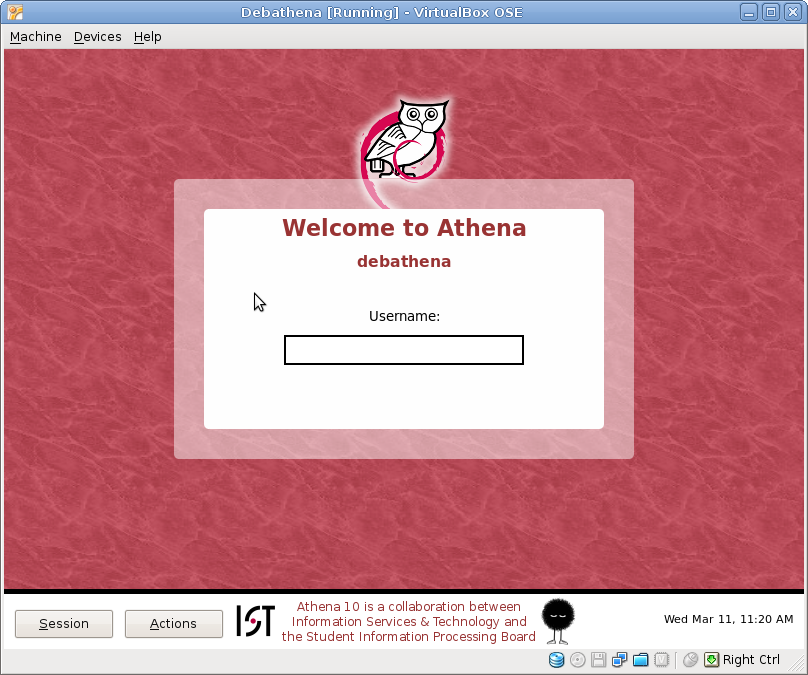
Debathena Beta was rolled out to something along the lines of 10% of formerly RHEL-based computing cluster machines about a month ago. I talked about the plans for this some time ago, and it's exciting to see it actually occurring on vaguely the intended schedule. Now I can tool on campus on Debian (well, almost), and thanks to a generous application of magic**, I can even install any package in Ubuntu's universe repository on cluster machines if I need it (the machine will be restored to a good state on session logout). Rock on.

** I hear it involves schroot and LVM snapshots, but at any rate it appears to be approximately indistinguishable from magic.

Jeff Bailey: Creationism Museum

On our move down to California, Angie, Leif and I stopped by the Creationism Museum. I mentioned this a couple of Augusts ago. Unfortunately, I didn't want to post about it without having the pictures, and I've only just finally got around to uploading them. I suck, news at 11.

http://picasaweb.google.com/kaladron/CreationismMuseum

We went with Stephanie, and had a great time. We got there a bit late, so didn't get to see the floor show and stuff, but we did get a chance to see the exhibits. The people there were a little reminiscent of the TV show Circle Square, where the people were just a little too friendly, and blinked just a little too rarely.

How we heard about the creationism museum was from an Interview on CBC, where the guy who opened the museum talked about how they were trying to show a different interpretation of the results of archaelogical digs, and how they saw this as a religion, and that science is just another religion. We were a bit shocked when we got to the US to discover that the guy is somewhat less rational there, claiming that what they're doing is good pure science, etc.

The premise is an interesting one: They start with the literal truth of the bible and then interpret everything against that backdrop. The argument is a vaguely reasonable one: Scientists do this all the time using what they've learned in school. They've learned that the universe is billions of years old, and therefore will do carbon dating a certain way, etc. If you start with the bible saying that the universe is 6000-odd years old, then results wind up getting interpreted differently.

The key to most of how the world wound up the way it is is apparently tied up in two major events: First, the story with the apple (Sorry I'm a little light on details, I didn't grow up Christian) caused people to start eating meat and wearing clothes.

Aside of the moment, my in-laws have a great fridge magnet from restoringeden.org: "God's original plan was to hang out in a garden with some naked vegetarians"

The second big event was the great flood, which killed all the dinosaurs, caused turbulence, moved continents around, and some other stuff.

Amusingly enough, when looking for a link to the CBC review, I found a review of a complaint about the interview: http://www.cbc.ca/ombudsman/ombudsmanweb/39.htm

Anyhow, had a great time. Enjoy the photos. =)

Biella Coleman: Help Me Find This


Help Me Find This, originally uploaded by the biella.
A long while back, I wrote a blog entry about debconf4, which became fodder for a section in my dissertation, and which will be published as a stand alone article this summer or fall in Anthropological Quarterly. I am including a number of images, most of which are mine or taken from the Debconf Gallery but I have a few images of unknown source/origin and it would be great to help me find it. The first is the photo pictured above, which I uploaded to my flickr page. Someone sent it to me a long time ago and all I know that it is from one of the Dutch Hacker Conferences, possibly HIP. Does anyone know where I can find a copy on the web? Seen it before? Are the kid pictured in the photo? Think you are the kid pictured in the photo? Sort of look like the kid pictured in the photo? Know of a service where you can upload a photo on a page and it will locate other copies?? Know of another similarly awesome photo? The second picture is of two Debian developers Gustavo and Jonas dancing at Debconf. I can t seem to locate it in the gallery and I am not sure who took it but I would love to find out to get permission to use it in the piece. Finally: do you have any pictures (in the gallery on not) that capture the joy of conferencing that you would not mind published either in this article or my book? If yes, feel free to send any along!

Chris Lamb: Installing FogBugz the Debian way

Yeah, proprietary software is bad, but let's at least install it the Debian way. The following walkthrough assumes Debian lenny.
#!/bin/sh
set -e
for PEAR_PKG in Auth_SASL HTTP_Client Mail_Mime XML_Tree
do
        PKG_TEMP=$(mktemp -d)
        cd $ PKG_TEMP 
        pear download $ PEAR_PKG 
        dh-make-pear $ PEAR_PKG *.tgz
        cd $(find -mindepth 1 -type d   head -n1)
        dpkg-buildpackage -uc -us -rfakeroot
        sudo dpkg -i ../*.deb
        rm -rf $ PKG_TEMP 
done
$ sudo ./install.sh
/***************************************\
*            FogBugz 6 Setup
\***************************************/
--    Checking for required tools
 +      found mono 1.9.1
[..]

Russell Coker: The AP and Copyright on the Web

The New York Times has an article about the Associated Press (AP) trying to gain more control over material that it distributes [1]. The article is not clear on the details. One noteworthy fact is that the AP apparently don t like search engines showing snippets of their articles. This should however be an issue for the organisations that license the AP content and redistribute it (newspapers etc), they can use a robots.txt file on their web server to prevent search engines from showing snippets of their content - then once their traffic drops dramatically they can threaten to boycott AP if they can t do things properly. Speaking for myself the majority of the articles I read on major news sites come from Google results, if they stop Google from indexing AP content then I will read a lot less of it. The end of the article says that there is some sort of battle in Europe between Google and newspapers. Has Google stopped respecting robots.txt? How can this be a problem, if someone copies the entire article you can sue them and you can ask Google not to index your site. That should cover it. The AP will be going after sites that copy large portions of articles, but this is not news at all. I often see web sites copy my blog content in ways that breach the license terms. As I m not well equipped to deal with such people I usually try to find an instance of the same splog (spam blog) copying articles from a major news site and report it to employees of the news organisation. They can often get the splogs shut down, sometimes rather quickly. They are apparently after SEO, they want to get the top entries in search engines for their articles and not have a site that paraphrases the article or quotes it. I don t think that my blog posts which paraphrase and quote from mainstream media articles are likely to do that, but the newspapers have to deal with the fact that when Slashdot and other popular sites reference their articles then they will lose on SEO. They should be happy that they can win most of the time. Brendan Scott has a rather harsh take on this [2] which he unfortunately has not explained in any detail. The people who write the news articles for AP get paid for their work and then AP needs to get paid to run a viable business - which is in the public interest. It may be that the AP are doing something really bad, but the New York Times article that Brendan cites doesn t seem to support any such claim.

Christian Perrier: First KDE4 impressions

I finally more or less completed my switch to KDE4. Thanks the great great KDE maintenance team we have. Simultaneously, X.org packages were updated so possible problems may have ben triggerred by it more than KDE, though. At first glance, this new KDE is nice and has great improvements but generally speaking painfully slow..:-) So, I began deactivating again all visual effects so that my poor old Dell X1 survives the upgrade. I was also greatly annoyed by losing the "Terminal sessions" which I was very actively using with Konsole. No more "Terminal Sessions" menu in my task bar to connect to various hosts over the network. Bleh. I have to redo everything with Konsole's "profiles". Also sucking a lot is the default setting for fonts in Konsole (antialiased fonts). It makes scrolling painfully slooooooow. I just deactivated this and it's much much much better. I also lost my old mail notification utility (Korn). It is still working but having it running leaves a kio_mbox process eating all my CPU. Actually, korn is still something from KDE3, so I might expect it to be rebuilt for KDE4, hopefully. I never found anything as good as it in the gazillion of mail notification utilities we have. Maybe my dear Lazyweb will help. I'm still left with weird keyboard behaviour which is hard to identify. Apparently the delay before key repetition starts when one leaves a finger on a key has changed in some way and despite my attempts to restore this in the adequate KDE thing, it doesn't change that much. I suspect some weird interaction with X.org stuff. Such "minor" details are very annoying as they interfere with year of (bad) typing habits. In general, as a very old KDE user (I adopted it back in 2001 or so because of Kbabel), I'm somewhat happy with that upgrade but it will take time to be used to all the new concepts (ah, these "Plasmoids" thing...) and also restore the overall speed of my machine...:-)

Dirk Eddelbuettel: New Garmin Forerunner

Going for a run--or a race--almost always meant grabbing the GPS and often also meant setting a target pace and distance. For the last four and a half years, this was measured by a Garmin Forerunner 201. That's the large rectangular model in the original "brick" form factor. I've come to love the device. Training is great because the distance log, as well as the pacing, keeps you honest. Racing is probably better because it helps a lot with the pacing (but then I also had PRs in race where I had forgotten the GPS at home). But there is a downside. This model sometimes takes forever to find tracking, and has interference / weak signal problems when it is cloudy or moist. But worst of all, it just bonks out in the 'urban jungle' downtown where it drops signals too easily. And now after all these years the display had some minor damage, the strap didn't really hold anymore, and it was generally time for something new. On Tuesday it even lost a quarter mile when we were going for a short but really fast three miler. But then a few days prior I had followed fellow Debian marathoner Christian and used my birthday at the end of this month (as well as the upcoming Boston Marathon) as an excuse for conspicuous comsumption. After some price comparison, I ordered a factory reconditioned Garmin Forerunner 405 from this web discounter at a nice rebate to the regular price. It arrived this afternoon, seemingly shining new and I have been fiddling with it for the last little while. This device features wireless data transfer to a usbstick. This meant booting the laptop in windoze for the first time in years to load the 'client software' after which data transfer proceeded. The Garmin Connect site has very slick presentation and aggregation of the data. The trouble is of course how to get the data there when running Linux... Christian had mentioned the garmin-forerunner-tools package. Unfortunately, this seems to really be written for the Forerunner 305 models as it doesn't see the device at all. Some more googling lead to this page and the gant tarball. All still fairly raw, but with some prodding in the settings of the 405 ('pairing' set to 'on', 'force send' set to 'yes'; which may have to be reset each time ?) I got my two xml files off the gps watch. Yay. We'll see what mode I will settle one. With the 201 and its ancient serial port, I basically just dropped the run and training histories which their fairly limited data collections. Last but not least, fellow Oak Park runner Peter Sagal had a humorous Runner's World column on the whole GPS geekyness. If he'd only known how to pair it with programming geekyness...

Andrew McMillan: DAViCal 0.9.6.3 released

After far too long (too many holidays away from my keyboard :-) I've released DAViCal 0.9.6.3 and AWL 0.36. This is mostly a stability release, fixing all those little niggles that might only affect a few corner cases, but it frees me up now to concentrate on adding more functionality for a 0.9.7 release in due course. Hopefully this will be the last in the 0.9.6.x series. More information in the DAViCal release notes on the wiki. There are quite a few changes to the AWL libraries which this release depends on, but most of those changes have been driven by my Work Request Management System and Capital APMS projects, rather than from DAViCal.

10 April 2009

Daniel Leidert: (WW) AllowEmtpyInput is on, devices using drivers kbd or mouse will be disabled.

Maybe you will observe a changed mouse and keyboard behaviour after updating X.org recently in Debian Sid. Then you will probably discover the warning mentioned in the title in your X.org server log /var/log/Xorg.0.log. The very short and dirty solution to get things working for the moment is to put this into your /etc/X11/xorg.conf:
Section "ServerLayout"
    Option "AutoAddDevices" "off"
EndSection
See the first entry in /usr/share/doc/xserver-xorg/NEWS.Debian.gz and follow the mentioned links for more information. However, the above solution should only be a temporary workaround: Try to migrate things (I will post changes for my system asap).

Kapil Paranjape: Controvertialism

Rahul Basu pointed out an article by the eminent scientist Freeman Dyson. In the past Dyson has raised a number of interesting questions and has been thought-provoking, but it is difficult to read him when he writes like this. I have re-phrased what he has said (debunking climatologists) and turned it into an argument against the Large Hadron Collider so that we can see how obnoxious it sounds.1
My first heresy says that all the fuss about the Higgs particle is grossly exaggerated. Here I am opposing the holy brotherhood of high energy physicists and the crowd of deluded citizens who believe that the world is predicted by the standard model. Of course, they say, I have no degree in physics and I am therefore not qualified to speak. But I have studied the standard model and I know what it can do. The model solves the equations of gauge theory in the simplest cases, and it does a very good job of describing the interactions of the known particles. It does a very poor job of describing how mass arises and the chemistry and the biology of phenomena we see everyday. It does not begin to describe the real world that we live in. The real world is muddy and messy and full of things that we do not yet understand. It is much easier for a scientist to sit in an air-conditioned building and run computer models, than to put on a lab coat and measure what is really happening in the complex phenomena of compounds and materials. That is why the high enery physicists end up believing their own models.
The rest of the article can then be similarly re-phrased but I will just summarise it as:
There is no reason for the rest of the world to believe the high energy physicists and squander billions of dollars into following their proposed unique solution to the questions of physics.
Of course, there is a good chance that Dyson will agree with the above point of view as well! The problem with controversialists'' like Dyson is that they believe that taking extreme positions helps clarify issues. Unfortunately, extremists are a-dime-a-dozen in today's world. I suppose I should clarify that I accept neither the extreme position on climatology nor the one on the LHC!

  1. My friend is a high energy physics theorist!

Eddy Petrișor: Is Romania part of the European Union?

This is a really slim and really incomplete description of the events turning really bad for Romania and severely bad for Moldavian civilians.
Are we living in a parallel world? What interests would Romania have to ever consider that it would be involved in this? Moldavia is the poorest country in Europe, has huge problems with justice, corruption, criminal activity, social security, border security (Transdnistria) and other issues which Romania does NOT want to import since we're already in a bad position by ourselves!


WHAT THE HELL IS EU DOING? Romania is a member of the EU and it seems all the attacks against Romania are not addressed in any way by the EU, on the contrary, EU members either assist passively, look the other way or even allow us to understand that indeed they think Romania is involved.

MJ Ray: Do Some Good on Good Friday

Bloggers Unite for Earth Day
from BloggersUnite resources It s Good Friday and even if you don t believe the stories, maybe you d like to do some good today. Here are some things you might want to support:-

Obey Arthur Liu: Google Summer of Code 2009: Debian s Shortlist

Copy of http://lists.debian.org/debian-devel/2009/04/msg00421.html. Hi folks, We have been pretty busy these past few weeks with the whole Google Summer of Code 2009 student application process.
I can say that we have this year a very good set of proposals and I d like to thank all the students and mentors for this. I am going to present to you our shortlist of projects that we would like to be funded and believe we can reasonably manage to get funded. As always, remember that the number of slots is not final yet at this point so we can t promise anything. The first preliminary slot count given today was *10* (same as last year) and we hope to get *2* more (as we did last year). This shortlist is alphabetically ordered because we don t want to reveal the current internal rankings. I am inviting you to debate what you think is cool, what is useful, what is important to Debian, maybe give us pointers to resources or people that could be helpful for the projects. We will try to alter our current rankings to reflect the zeitgeist in Debian, while taking into account the personal information that we have about each student involved. The deadline for any modification is on the 15th, so get everything in by the 14th. The final selected projects will be announced by Google April 20th, ~12 noon PDT / 19:00 UTC. We ll have another announcement then. Three proposals need or may need a mentor, I indicated it. For more information about the projects or mentoring and how to talk to us directly, scroll down past the list. Debian s Shortlist : - Aptitude Package Management History Tracking
- Automatic Debug Packages Creation and Handling
- Debbugs Web UI: Amancay Strikes Back
- Control Files Parsing/Editing Library/Qt4-Debconf Qt4-Perl bindings
- Debian-Installer Support for GNU/kFreeBSD
- KDE/Qt4 Adept 3.0 Package Manager
- Large Scientific Dataset Package Management
- MIPS N32 ABI Port
- MTD Embedded Onboard flash Partitioning and Installation
- On-demand Cloud Computing with Amazon EC2 and Eucalyptus Integration
- Port back update-manager to Debian and all Derivatives
- Debian Autobuilding Infrastructure Rewrite And the details: Aptitude Package Management History Tracking Student: Cristian Mauricio Porras Duarte, Mentor: Daniel Burrows Aptitude currently does not track actions that the user has performed beyond a single session of the program. One of the most frequent requests from users is to find out when they made a change to a package, or why a package was changed; we want to store this information and expose it in the UI in convenient locations. As a side effect, this might also provide some ability to revert past changes. Automatic Debug Packages Creation and Handling Student: Emilio Pozuelo Monfort, Mentor: Marc Brockschmidt This proposal aims at providing debug binary packages for the packages in the Debian archive in an automatic manner, moving them away from the official Debian archive to an special one. This has the benefits of providing thousands of debug packages without any work needed from the developers, for all the architectures, without bloating
the archive. Debbugs Web UI: Amancay Strikes Back Student: Diego Escalante Urrelo, Mentor: Margarita Manterola The Amancay project aims to be a new read/write web frontend to Debian s BTS; allowing DDs and contributors to easily interact with bugs via an intuitive yet powerful interface, enabling new workflows and creating new contribution opportunities like triaging while upholding reporting quality. Control Files Parsing/Editing Library/Qt4-Debconf Qt4-Perl bindings Student: Jonathan Yu, Mentor: (probably) Dominique Dumont see below This project proposes a common library for parsing and manipulating Debian Control files, including control, copyright and changelog. Main ideas include validating and parsing of these files, with both Strict and Quirks modes for the parser. The second idea is a new frontend for Debconf using Qt4 (for which Perl bindings will be written). Debian-Installer Support for GNU/kFreeBSD Student: Luca Favatella, Mentor: Aurelien Jarno GNU/kFreeBSD is currently using a hacked version of the FreeBSD installer combined with crosshurd as its own installer. While this works more or less correctly for standard installations (read: the exact same installation as in the documentation), it does not allow any changes in the installation process except the hard disk partitioning. This project is about porting debian-installer on GNU/kFreeBSD, and to a bigger extent, make debian-installer less Linux dependant. KDE/Qt4 Adept 3.0 Package Manager Student: Mateusz Marek, Mentor: NEEDS MENTOR, see below. Finish Adept 3.0, a fully integrated package manager for Qt4/KDE4. Adept is currently the only viable path to a Debian native package manager on KDE that would support modern features such as tags, indexed search or good conflict resolving. With Aptitude-gtk still in development and only available for GTK+ and (K)PackageKit having fundamental problems, Debian needs this project to stay in control of its package management on KDE after much neglect in the recent years. Large Scientific Dataset Package Management Student: Roy Flemming Hvaara, Mentor: Charles Plessy Large public datasets, like databases for bioinformatics are typically too big and too volatile to fit the traditional source/binary packaging scheme of Debian. There are some programs that are distributed in Debian, like blast and emboss, that can index specialised databases, but Debian lacks a tool to install or update the datasets they need and keep their indexing in sync. MIPS N32 ABI Port Student: Sha Liu, Mentor: Anthony Fok This project first focuses on creating a new MIPS N32 ABI port for Debian. Different from O32 and N64, N32 is an address model which has most 64-bit capabilities but using 32-bit data structures to save space and process time. A second focus will be given on making such a mipsn32el arch fully optimized for the Loongson 2F CPU which gains more and more popularity in subnotebooks/netbooks in many countries. MTD Embedded Onboard flash Partitioning and Installation Student: Per Andersson, Mentor: Wookey Many embedded devices have MTD onboard flash as persistent storage like the Kurobox Pro NAS, the Neo Freerunner, the Sheeva Plug or the OLPC. With MTD flash being so popular and with increases in capacity, support for MTD partition/installation would make Debian even more interesting to a wide range of of devices, making it one step closer to being universal. On-demand Cloud Computing with Amazon EC2 and Eucalyptus Integration Student: David Wendt Jr, Mentor: (probably) Steffen Moeller see below In many academic fields, as well as commercial industries, people use clusters to distribute tasks among multiple machines. Many times this is done by packaging a whole operating system disk image, uploading it onto the cluster, and having the cluster run it in a VM. This project intends to make it easier for Debian to distribute prepared disk images templates like they distribute CD images now, for the users to recreate or customise these templates with Debian packages and for administrators to host such clusters with Debian. Port back update-manager to Debian and all Derivatives Student: Stephan Peijnik, Mentor: Michael Vogt The project would involve taking the distribution-(Ubuntu-)specific update-manager code, analyzing it, and creating a package with just its core functionality, decoupling the distribution-specific parts and thus making the core code extensible by distribution-specific add-ons. This in turn would remove the need of porting update-manager to Debian with every upstream release. An additional optional goal would be replacing the synaptics-backend with a python-apt based one. Debian Autobuilding Infrastructure Rewrite Student: Philipp Kern, Mentor: Luk Claes Rewrite the software that currently runs the Debian autobuilding infrastructure in a way that makes it more maintainable and robust. It will use Python as its programming language and PostgreSQL for the database backend. By harmonizing buildds, many build failures can be prevented and wasteful workload on buildd volunteers can be reduced. On mentoring: Petr Rockai, the original developer of Adept has offered help to anyone willing to adopt Adept. Sune Vuorela has offered help for any Qt4 and KDE related issues. *We really need a mentor here*. The student is quite competent but Google dictates that we provide a mentor to handle student management. Dominique Dumont, although not DD, has signaled interest in mentoring this, although it hasn t been confirmed yet. Sune Vuorela has offered to help co-mentor for the Qt4-Debconf and Qt4-Perl bindings part. Steffen Moeller has signaled interest in mentoring this, although it hasn t been formally confirmed yet. Charles Plessy of the Debian Med team will provide help for use cases related issues. Eric Hammond, developer of the original vmbuilder image creation tool and maintainer of a set of Debian and Ubuntu images will provide help for Amazon EC2 and image creation issues. Chris Grzegorczyk from the Eucalyptus team will provide help for Eucalyptus and Eucalyptus/Debian integration issues. Contacting us: Considering the tight schedule, most stuff happens live on IRC: #debian-soc on irc.debian.org You can also consult our wiki page for some additional information:
<http://wiki.debian.org/SummerOfCode2009> We have a mailing-list at:
<http://lists.alioth.debian.org/mailman/listinfo/soc-coordination> Keep this discussion on debian-devel@lists.debian.org while cc-ing soc-coordination@lists.alioth.debian.org. This thread is for debian-devel primarily.

Russell Coker: Fixing the Correct Network Bottleneck

The latest news in the Australian IT industry is the new National Broadband Network (NBN) plan [1]. It will involve rolling out Fiber To The Home for 90% of the population, the plan is that it will cost the government $43,000,000,000 making it the biggest government project. Kevin Rudd used Twitter to say Just announced biggest ever investment in Australian broadband - really exciting, infrastructure for the future [2]. Now whenever someone says that a certain quantity of a resource is enough you can expect someone to try and refute that claim by mentioning that Bill Gates supposedly stated that 640K is enough when referring to the RAM limits of the original IBM PC. As an aside, it s generally believed that Bill Gates actually didn t claim that 640K would be enough RAM, Wikiquote has him claiming to have never said any such thing [3]. He did however say that he had hoped that it would be enough for 10 years. I think that I needed that disclaimer before stating that I think that broadband speeds in Australia are high enough at the moment. In any computer system you will have one or more resources that will be limited and will be bottlenecks that limit the overall performance. Adding more of other resources will often make no difference to performance that a user might notice. On the machine I m using right now to browse the web the bottleneck is RAM. A combination of bloated web pages and memory inefficient web browsers uses lots of memory, I have 1.5G of RAM and currently there is 1.3G of swap in use and performance suffers because of it. It s not uncommon for the machine to page enough that the mouse cursor is not responsive while browsing the web. My options for getting faster net access on this machine are to add more RAM (it can t take more than 2G - so that doesn t gain much), to use more memory efficient web browsers and X server, and to simply buy a new machine. Dell is currently selling desktop machines with 2G of RAM, as they are 64bit systems and will therefore use more memory than 32bit systems for the same tasks they will probably give less performance than my 32bit machine with 1.5G of RAM for my usage patterns. Also the latest EeePC [4] ships with 1G of RAM as standard and is limited to a maximum of 2G, I think that this is typical of Netbook class systems. I don t use my EeePC for any serious work, but I know some people who do. Does anyone have suggestions on memory efficient web browsers for Linux? I m currently using Konqueror and Iceweasel (Firefox). Maybe the government could get a better return on their investment by spending a small amount of money sponsoring the development of free web browsers. A million dollars spent on optimising Firefox seems likely to provide good performance benefits for everyone. My wife s web browsing experience is bottlenecked by the speed of the video hardware in her machine (built-in video on a Dell PowerEdge T105 which is an ATI ES1000). The recent dramatic price reductions of large TFT monitors seem likely to make video performance more of an issue, and also increases the RAM used by the X server. Someone who has reasonably good net access at the moment will have an ADSL2+ connection and a computer that is equivalent to a low-end new Dell machine (which is more powerful than the majority of systems in use). In that case the bottleneck will be in the PC used for web browsing if you are doing anything serious (EG having dozens of windows open, including PDFs and other files that are commonly loaded from the web). If however a machine was used for simply downloading web pages with large pictures in a single session then FTTH would provide a real benefit. Downloading movies over the net would also benefit a lot from FTTH. So it seems to me that browsing the web for research and education (which involves cross-referencing many sites) would gain more of a benefit from new hardware (which will become cheap in a few years) while porn surfing and downloading movies would gain significantly from FTTH. The NBN will have the potential to offer great bi-directional speeds. The ADSL technology imposes a limit on the combination of upload and download speeds, and due to interference it s apparently technically easier to get a high download speed. But the upload speeds could be improved a lot by using different DSLAMS. Being able to send out data at a reasonable speed (20Mbit/s or more) has the potential to significantly improve the use of the net in Australia. But if the major ISPs continue to have terms of service prohibiting the running of servers then that won t make much difference to most users. Finally there s the issue of International data transfer which is slow and expensive. This is going to keep all affordable net access plans limited to a small quota (20G of downloads per month or less). It seems to me that the best way of spending taxpayer money to improve net access would be to provide better connectivity to the rest of the world through subsidised International links. Brendan makes an interesting point that the NBN is essentially a subsidy to the entertainment industry and that copyright law reform should be a higher priority [5].

9 April 2009

Manoj Srivastava: Manoj: kernel-package: Add support for kernel image debug package

A new version of kernel-package in Incoming at the time of writing adds support for creating a package which contains the Linux kernel debug image. This means the debugging information for the modules in the kernel image package, and the uncompressed vmlinux image. This builds on suggestions and code from Troy Heber, Theodore Y. Ts o, and Dann Frazier. As support for kexec/kdump support becomes more real, it will be very useful to be able to build kernels that have debugging information available, but not necessarily to install the debugging information on every single client system. The .ko object files are stripped of the debugging information before they are placed in the standard linux-image installation package. However, before that, a copy of the vmlinux and unstripped .ko files are saved in a debuginfo package, and everything except for the debugging information is removed from them using objcopy --keep-only-debug. This means that if someone ends up with a crash dump, they can send it to a support engineer and only the support engineer needs to install the debuginfo package and use the crash utility to debug the crash dump. It s also useful for developers, since the debuginfo information can be stored somewhere outside of /lib for storing its debug information, for example. This is useful for keeping the size of the root partition small, for those who keep / separate from /usr. The locations used are compatible also with SystemTap, which provides free software infrastructure to simplify the gathering of information about the running Linux system. This assists diagnosis of a performance or functional problem. SystemTap eliminates the need for the developer to go through the tedious and disruptive instrument, recompile, install, and reboot sequence that may be otherwise required to collect data. Also, I had to clear out some FUD about kernel-package from the ircbot dpkg on the OFTC Debian IRC channel, since someone had implied that kernel-package was some how obsolete. As can be seen, it is being actively developed, and features are being added apace.

Next.

Previous.