Search Results: "ag"

17 July 2013

Peter Eisentraut: Tricky shell local variables

I have a word of warning against improper use of local in shell functions. If you are using shell functions, you might want to declare some variables local to the shell function. That is good. The basic syntax for that is
local a b c
In some shells, you can also combine the local declaration and assignment, like this:
local foo=$1
local bar=$2
(The Debian policy even explicitly allows it.) This is somewhat dangerous. Bare shell assignment like
foo=$bar
does not perform word splitting, so the above is safe even if there are spaces in $bar. But the local command does perform word splitting (because it can take multiple arguments, as in the first example), so the seemingly similar
local foo=$bar
is not safe. This can be really confusing when you add local to existing code and it starts breaking. You can avoid this, of course, by always quoting everything to like
local foo="$bar"
but overquoting isn't always desirable, because it can make code less readable when commands are nested, like
local foo="$(otherfunc "other arg")"
(Nesting is legal and works fine in this case, however.) I suggest using local only for declaring variables, and using separate assignment statements. That way, all assignments are parsed in the same way.

16 July 2013

Joachim Breitner: Real World Haskell Applications

Today I held a lightning talk at the Karlsruhe Functional Programmer s Group, where I presented Real World Haskell applications, i.e. programs that are written in Haskell, are somewhat mature and well-known and have non-programmers as their target group. Here is the (surely subjective) list that I have come up (also see the slides): There is also an impressive list of industrial users that use Haskell without talking about it much, but that does not work well to show off that you can do any kind of application in Haskell. If I missed anything important, let me know!

Joachim Breitner: Ultimate Tic Tac Toe is always won by X

The blog Math with Bad Drawings recently featured an article about Ultimate Tic Tac Toe, a variant of Tic Tac Toe where each of the nine fields is a separate game of Tic Tac Toe. To mark a field of the large game as your, you have to win the small game therein. If you chose a field in the small game, this position determines the small field that the other play may play next. See the linked article for a full explanation. As far as I know, the question of who wins this game was open; at least nothing definite was known on Hacker News or on the Board Games StackExchange site. We discussed this a bit in our office, and my coworker Denis Lohner came up with what seems to be a winning strategy. Update: Not surprising, but with these variants of the rule, the winning strategy was already known.
Strategy Assume Denis ( ) plays against me ( ). Like most suggestions for a winning strategy for the first player, Denis (X) starts with the middle:


Now I have to put my in the center field of the center game. No matter where I place it, Denis will send me back ot the middle, until one field of the center game is free. Doing this eight times inevitably puts us in a position like this:


The only way I can influence the game is by chosing which I place last; this determines where Denis goes now. But (and please verify that carefully) it will not matter: The only thing required from that field is that there is a second field that, together with the center, forms a row (or column or diagonal); all fields satisfy that. Assume I placed the top-left last, and Denis has to go there. He will send me to that field:


Now the game of the first field is repeated: Whereever I send him, he will send me back. This works great for all fields but the middle field. The middle field is special: When I send him there, he has the free choice. He will pick the bottom-right game. In any case we will end up in this situation: I won the center game; I likely have a few in the top-left game. To be precise: I have a there if and only if the he has a in the top-left corner of the corresponding game. He also has the diagonal of the lower-right game. For example:


I have to put my mark in the lower-right game now. From now on, whereever I go, he will send me to either to the top-left or bottom-right game. I can do nothing about it (I cannot send him to the diagonal any more, and whereever I send him there is at least one of the top-left or bottom-right fields fee), so he wil easily win all the other games by getting the diagonal. Eventually, he wins the whole game with the bottom row or the right column:


This is not a formal proof yet, but hopefully close enough to convince you, or alternatively allow you to precisely describe how you can prevent losing against Denis strategy.

Gunnar Wolf: Open Repositories 2013 #OR2013 Charlottetown, P.E.I., Canada

I just came back home from the Open Repositories 2013 conference, in Charlottetown, Prince Edward Island, Canada; a conference on Open Access publishing, digital repositories, preservation strategies... It was quite an interesting conference, and gave me the opportunity to meet several interesting people. Mostly worthy of note, I spent some good time with the team behind the EPrints software, which powers my institute's repository, and with whom I expect to do some work trying to get EPrints more in shape to be considered as uploadable to Debian. I presented a (very non-technical) talk titled RAD-UNAM: Genesis and evolution of a repository administrators group, describing the experiences we have had at our group in UNAM setting up a federated repository (link to the talk in the OR2013 site). It was a very good experience as well as a nice trip. Oh And if you come over to my blog, you will see here the photos I took during the week of a very nice, little Canadian city.

Dirk Eddelbuettel: RProtoBuf 0.3.0

A new release of RProtoBuf -- now at version 0.3.0 -- arrived earlier on CRAN. RProtoBuf provides GNU R bindings for the Google Protobuf data encoding library used and released by Google. Murray added a lot of new features which merited the increase in the minor number. The NEWS file entry follows below:
Changes in RProtoBuf version 0.3 (2013-07-13)
  • Added support for Protocol Buffer extensions through the new getExtension and setExtension methods for Message objects, and added top-level extensions to the descriptor pool.
  • Added more user-friendly show() methods for Messages, Descriptors, and other RProtoBuf objects. A common source of confusion on the mailing lists is to confuse Messages and Descriptors. The new show() methods succinctly display more information about e.g. the number of set fields in a message to make it a little clearer to users what type of object they are working with.
  • Added has method for EnumDescriptor objects to test existance of a named constant in an enumeration, and fix a bug in the length method for these objects.
  • Added a number method for EnumValueDescriptor objects to return the number of a named enumeration constant directly.
  • Improved documentation and unit tests.
CRANberries also provides a diff to the previous release 0.2.6. More information is at the RProtoBuf page which has a draft package vignette, a 'quick' overview vignette and a unit test summary vignette. Questions, comments etc should go to the rprotobuf mailing list off the RProtoBuf page at R-Forge.

15 July 2013

Matthew Garrett: How XMir and Mir fit together

Mir is Canonical's new display server. It fulfils a broadly similar role to Wayland and Android's Surfaceflinger, in that it takes final responsibility for getting pixels onto the screen. XMir is an X server that runs on top of Mir. It permits applications that know how to speak the X protocol but don't know how to speak to Mir (ie, approximately all of them at present) to run in a Mir-based environment.

For Ubuntu 13.10, Canonical are proposing to use Mir by default. This doesn't mean that most applications will be using Mir, though - instead, the default session will run XMir as a full-screen client and a normal X environment will be run on that. This lets Canonical deploy Mir without forcing anyone to update their applications, allowing them to take a gradual approach. By 14.10, Canonical expect the default Unity session to be a Mir client rather than an X client. In theory it will then be possible to run an Ubuntu system without any X applications at all, leaving XMir to do nothing other than run legacy applications.

Of course, this requires a certain amount of replumbing. X would normally be responsible for doing things like setting up the screen and pushing the pixels out to the hardware, but this is now handled by Mir instead. Where a native X server would allocate a framebuffer in video memory and render into it, XMir asks Mir for a window corresponding to the size of the screen and renders into that and then simply asks Mir to display it. This step is actually more interesting than it sounds.

Unless you're willing to throw lots of CPU at them, unaccelerated graphics are slow. Even if you are, you're going to end up consuming more power for the same performance, so XMir would be impractical if it didn't provide access to accelerated hardware graphics functions. It makes use of the existing Xorg accelerated X drivers to do this, which is as simple as telling the drivers to render into the window that XMir requested from Mir rather than into the video framebuffer directly. In other words, when displaying through XMir, you're using exactly the same display driver stack as you would be if you were using Xorg. In theory you'd expect identical performance - in practice there's a 10-20% performance hit right now, but that's being actively worked on. Fullscreen 3D apps will also currently take a hit due to there being no support for skipping compositing, which is being fixed. XMir should certainly be capable of performing around as well as native X, but there's no reason for it to be any faster.

The output drivers aren't the only part of the stack. XMir still needs some way to get input events. You might naively expect that Mir would forward input events to XMir, but the current state of affairs is that XMir loads the existing X input drivers which in turn open the input devices themselves. This explains why XMir currently shows two cursors[1] - the first cursor is the Mir cursor that's being driven by the input events Mir is receiving, while the second is the cursor being drawn by XMir in response to the input events that it's receiving[2].

The final main piece of duplicated functionality is output management. In the case where X is its own display server, it can simply ask the kernel to program the outputs. XMir can't do that, so would have to ask Mir to do it instead. Sadly, that functionality's not implemented yet. Running xrandr on Xmir gives:
Screen 0: minimum 320 x 320, current 1366 x 768, maximum 8192 x 8192
XMIR-1 connected primary 1366x768+0+0 (normal left inverted right x axis y axis) 0mm x 0mm
   XMIR mode of death[3]   60.0*+
which translates as "I have a screen that can be any size from 320x320 to 8192x8192, and have one output of unknown physical size that can only display 1366x768 at 60Hz". Other than the 1366x768, the result will be identical no matter how many outputs you have - XMir currently has no support for configuring multiple displays, and will always report 60Hz. It also has no support for placing monitors into any kind of DPMS state.

Obviously, this is still software under active development. There's three months from now until until Ubuntu is due to release with this functionality enabled by default, and the only significant missing features are xrandr and DPMS support. As long as Mir exposes interfaces for controlling those, they shouldn't be a problem to implement. To most users, the transition from native Xorg to XMir should be completely invisible.

Which is kind of the problem. What benefits does the user gain from using XMir on Mir rather than native Xorg?

Features? XMir is a total of around 1000 lines of code on top of Xorg. It implements no functionality that isn't present in Xorg.

Performance? XMir effectively is Xorg - it's the same code running the same drivers. It's not going to be any faster. At the moment it's actually slower, but that's probably fixable.

Security? Again, XMir is effectively Xorg. It still runs as root. It has the same privileges. There's no security benefit to using XMir instead of Xorg.

Like I said, the transition should be completely invisible - no drawbacks, but no benefits. What it does do is get Mir deployed on a larger number of systems, which means Canonical can both get wider testing of the basic Mir functionality and argue that the number of deployed Mir systems means hardware vendors should support it. Users won't see any of the benefits until Unity transitions to being a native Mir client, which is slated for 14.10 next year.

As a PR move, it's pretty great. The public perception is that Mir has gone from not existing to being sufficient to run a full desktop environment in very little time, and it's natural to compare it to Wayland which has been in development for longer and still isn't running a fully featured desktop session. The problem with that perception is that Mir is doing very little at the moment. It's setting an output mode (by asking the kernel to), allocating a window for XMir to draw into and then pushing that window onto the screen whenever XMir tells it that it's changed. This isn't advanced display server functionality, it's the bare minimum that a display server could possibly do[4]. Which is a shame, because Mir is significantly more functional than that, it's just not being used to do anything we couldn't already do.

In summary: XMir on Mir in Ubuntu provides no user benefits and isn't a compelling technology demo. Mir itself will permit a range of additional features, but isn't slated to be running a user session itself until 14.10. The only obvious benefit to Canonical in shipping XMir on Mir is to gain additional testing, which makes using it in 14.04, a supposedly stable and long term release, a somewhat surprising choice.

[1] Although this is in the process of being fixed
[2] This also explains why, on systems with a trackpoint and a touchpad, only the trackpoint moves the Mir cursor while both move the XMir cursor. The X touchpad driver has put the touchpad in absolute mode, which means it's now reporting events that Mir currently ignores.
[3] "XMIR mode of death" is hardcoded into XMir. I'm really hoping it's a Regular Show reference.
[4] So why hasn't anyone done this with Wayland? Mostly because, as described above, there's no technical benefit in doing so. Wayland does have an X server for compatibility purposes, and if you wanted you could run it as a full screen client and run an entire session underneath it. But you'd gain nothing by doing so. The Wayland X server is intended for running individual clients rather than an entire X session. Run an X client under Wayland and it'll pop up in its own individual window and managed by your Wayland session's window manager, just like it would under X. XMir currently has no support for this "rootless" mode - right now if you want to run X apps under Mir, you'll need to launch an entire X session with its own window manager.

comment count unavailable comments

Rob Bradford: Clutter & Cogl Wayland update

Lots of us over at Intel towers are working hard to bring you a great new Wayland powered experience. Cogl and Clutter have now been updated to work with the latest Wayland master. You need to compile master Cogl with: ./configure --enable-wayland-egl-platform=yes --enable-gl And then to run any applications using Cogl on Wayland you need to setup the environment variable COGL_RENDERER=egl_wayland then you can run cogl-crate! For Clutter you need to compile Clutter master with: ./configure --enable-wayland-backend You also need to set an environment variable to choose the Clutter backend too in this case it s CLUTTER_BACKEND=wayland (and you need to set COGL_RENDERER too) then you can run test-actors! Or just look at the video below :-) <iframe allowfullscreen="allowFullScreen" frameborder="0" height="300" mozallowfullscreen="mozallowfullscreen" src="http://player.vimeo.com/video/33734847?title=0&amp;byline=0&amp;portrait=0" webkitallowfullscreen="webkitAllowFullScreen" width="400"></iframe> Direct Vimeo link! A big kudos needs to go to Robert Bragg, Neil Roberts and Emmanuele Bassi for helping make this happen. The Clutter client side support is basically complete so i ve now moved onto working on GTK and MX watch this space for updates!

Rob Bradford: Wayland & Weston 1.2.0 is out

The latest release of the Wayland protocol and support library along with the Weston compositor is now out. For the GNOME community this release is particularly interesting: At GUADEC i ll be speaking about the current state of the Wayland project and plans going forward. If you have a particular topic or question you d like me to cover please let me know in the comments.

Daniel Pocock: Linux init-systems

Several value-added init systems have emerged in recent times. Most notably, Upstart has become the default on Ubuntu while systemd is now default in Fedora. Let's not forget the crusade to move beyond traditional init was given a big boost back in 2005 by Sun's introduction of SMF on Solaris 10 some years before the main Linux solutions gained prominence. Debian is currently debating whether to use one of these alternatives as a default. My own position on the matter is not decided, but I do feel that some of the debates are asking the wrong questions. Some of the most interesting issues here are likely to have ramifications for other distributions. My experience with systemd I've come across systemd in my efforts to package reSIProcate on Fedora. One of the challenges I came across was trying to both create a /var/run/repro directory and telling systemd to launch the process as a non-root user. I tried using the ExecStartPre directive in the systemd manifest to invoke mkdir. Unfortunately, it runs as the non-root user too and could not create the PID directory. The conventional init script doesn't suffer this problem. In the end, I have patched the repro binary to start as root and drop privileges itself, but that was only when it became apparent that we need to do that for WebRTC support (listening on port 443). While most daemons have the ability to drop privileges, there will be edge cases like this that need more than just a systemd manifest. Maintainers who encounter such issues may have to give feedback to the systemd and Upstart upstreams and give them the opportunity to provide generalized solutions. Then again, the most generalized solution would be another scripting language and then we'd be back where we started. The reason to change and the reason not to Some people have argued that Debian should change simply because other distributions did so. This is not a compelling technical argument alone. The fragmentation of init-alternatives is not something that makes upstreams excited either. It would be interesting to see if Upstart and systemd could agree on a common manifest format - maybe even a format that could be parsed by a wrapper from SysV init. Then Debian wouldn't really have to give up support for kFreeBSD and other non-Linux kernel efforts. A slight alternative to this approach would be using a system like cmake to read a single service XML manifest and spit out permutations readable by each of the different init schemes. It has also been well argued that the simple and well known solution of scripts is much less complicated to understand and maintain and is extremely stable. Wishlist items for all distributions While I don't know which solution is the best, one thing I do believe is that if there is a change and if it is going to be disruptive to maintainers and users then it should aim to bring in as many benefits as possible to offset the pain and encourage people to support the migration effort. Some of the potential road-map items are not only possible for Debian but could also become part of other platforms. Here are some of the issues that came to my mind:
  • Better support for starting multiple instances of a single process
  • Support for distributed solutions, for example, making sure that process A only starts on host 1 after process B on host 2
  • Support for clustering, for example, making sure that at least 2 instances of process A are running across 3 hosts.
  • Automated integration with monitoring and fault recovery systems: for example, can Nagios (or another tool) automatically detect whether a particular process should be running and whether it is running? Given that init-replacements typically need to start processes in the correct order, can they share that dependency information with Nagios to avoid manual/duplicated dependency mappings? Can Nagios restart the process without any manual scripting? Can this all be enabled for all processes on a given system in a plug-and-play manner?
  • Scheduler interaction: can and should any of the above, particularly the dependency mappings, be integrated with scheduling? For example, should some cron jobs be deferred when MySQL is down?
What other potential improvements do people feel to be worthwhile?

14 July 2013

Matt Zimmerman: Liberty and justice for all, but not in equal measure

200302020-001 As Americans we might like to believe that the US legal system is intended to protect all of our citizens. Unfortunately, it doesn t protect us all equally, and in fact disproportionately fails to protect the most vulnerable. We re surrounded by instances of injustice related to gender, race and other axes of social privilege, and the machinations of law are not exempt. The state of Florida has recently provided an especially stark example in the application of its self-defense laws in two cases: Marissa Alexander and George Zimmerman. This example is notable because although there were many similarities between the cases, the outcomes were very different. Alexander s case was tried in May 2012 , Zimmerman s in July 2013, both prosecuted by Florida state s attorney Angela Corey. Both cases involved the use of firearms which were legally purchased and carried, and their owners were trained in their use. Both prosecutions cast the defendant as the aggressor, who could have avoided the confrontation. Both of the encounters were with unarmed persons. Both defenses were based on Florida self-defense laws, which include stand your ground laws justifying the use of deadly force without the obligation to retreat. Both shooters admitted to firing a single shot with the intent of defending themselves. Beyond those similarities, each case had its own unique circumstances. The events of Alexander s case took place in her home. Her altercation was with her husband, Rico Gray Sr., who was under a restraining order following a conviction for domestic battery which put Alexander in the hospital. After Gray threatened to kill her, Alexander retrieved a handgun from her car, returned to confront him, firing once. She was arrested and charged the same day. She had had no prior criminal record. A jury deliberated for just 12 minutes before convicting her. A judge sentenced her to 20 years in prison, in accord with mandatory minimums specified by law. Gray, previously sentenced to probation for his earlier conviction, remains free. Zimmerman,_George_-_Seminole_County_MugZimmerman s shot was fired in his neighborhood, in an altercation with a teenager, Trayvon Martin, who was a guest in the community and walking by himself. The two were not acquainted. Zimmerman called police from his car, claiming that Martin appeared suspicious, and began to follow him. Some of the facts of their encounter remain in dispute, but that Zimmerman fired his gun is not in question. Afterward, Zimmerman was detained by police, questioned and released the same night without being arrested or charged. Following a public outcry, a new investigation was launched and two months later he was arrested and charged. He had been previously arrested and charged with assaulting a police officer, but the charges were later dropped. After 16 hours of deliberation, the jury found Zimmerman not guilty, and he is free today. The most striking difference between the two cases is where each defendant aimed their gun: George Zimmerman shot Trayvon Martin in the chest and killed him, while Marissa Alexander fired at a wall and injured no one. Alexander, a black woman, is in prison for scaring her abusive husband away, while Zimmerman, who killed a young black man, walks free. Alexander and Martin s families have lost a mother and a son. The outcomes for the people involved in these cases could not be more different. Regardless of the merits of the relevant laws themselves, their radically unequal application is deeply troubling. What does this tell us about the relative value of these human lives, as weighed by the judicial system?
The Florida criminal justice system has sent two clear messages today. One is that if women who are victims of domestic violence try to protect themselves, the Stand Your Ground Law will not apply to them. [...] The second message is that if you are black, the system will treat you differently. - U.S. Rep. Corrine Brown
References

Dirk Eddelbuettel: Go home, Feedly, you're drunk!

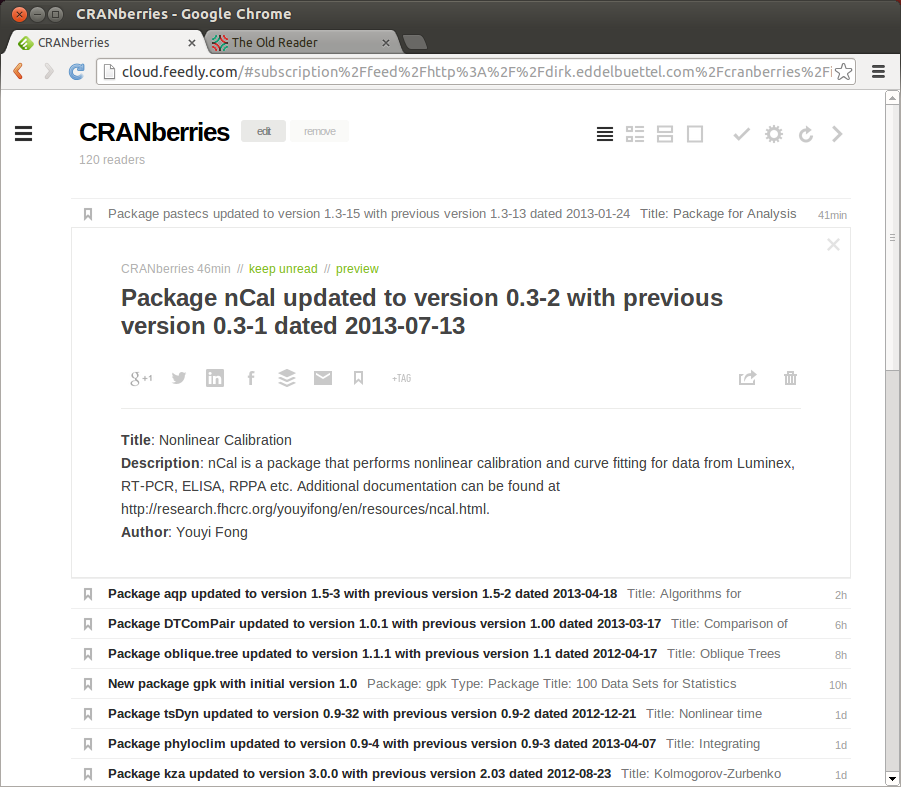
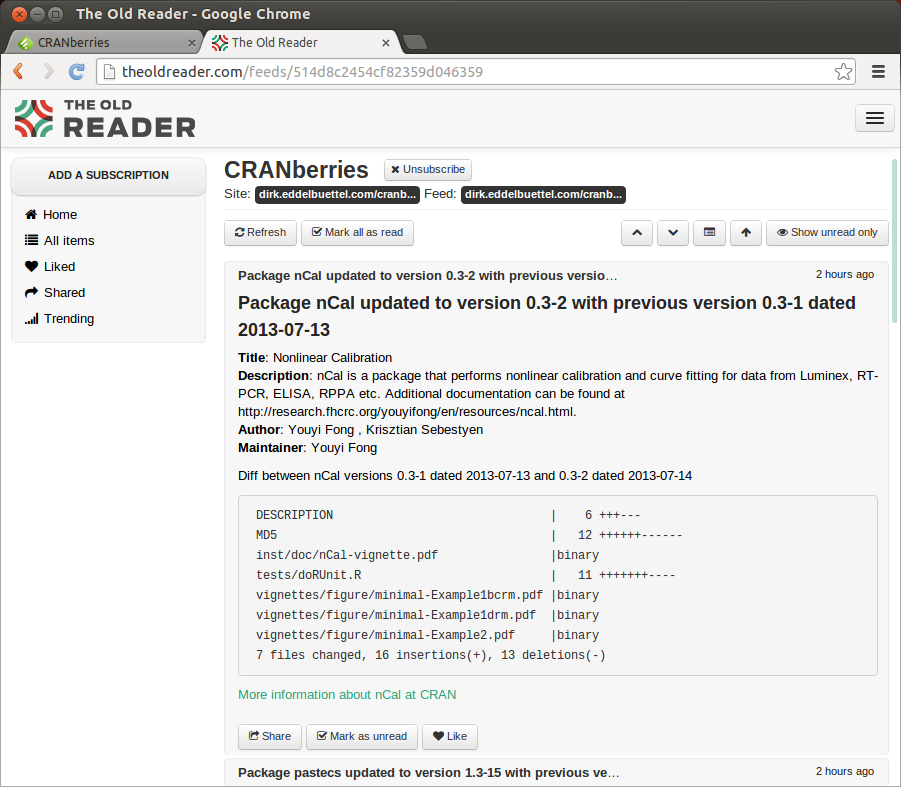
With the demise of Google Reader, many of us have scrambled to find alternatives which cover many/most of the features we were used to. For me, synchronised access from web and mobile counts quite high, and I want the (Android) mobile experience to be pretty pleasant too. So with that, and like many other folks, I had shifted over to Feedly. And before I carry on, let me say that Feedly actually does pretty well. They handled the onslaught of new users; they also listened and changed their UI a little to be more compact and Reader-alike And most importantly, it mostly just works. Until it doesn't. Around the time Feedly shifted folks to their own cloud-based backend, posts from my very own CRANberries aggregator of CRAN package changes for R started to show only truncated posts. See this screenshot from reading Feedly: Feedly truncates the CRANberries post and compare it with this one from TheOldReader: OldReader shows the full CRANberries post which contains the diffstat output, nicely marked up and all. Now, it so happens that I am the creator of the very RSS feed I am consuming here, and I wrote it so that I could read the very diffstat output that is now missing. And I know full well that neither the code, nor the hosting (on my own box), nor any other aspect changed. Before confirming this via TheOldReader, I looked at the RSS output, and I tried other frontend and apps --- and it became clear that the bug seems to be at the Feedly cloud storage level. And trying to be a good sport, I submitted a bug report / suggestion, but to no avail (apart from two other chiming in that they see this elsewhere too). Given that I am the coder behind the feed that is displayed in a truncated manner, I am aware that I am using a code stack that is stale (the original Blosxom static web generator) yet which has not posed another problem anywhere in the decade I used it. Nor does the CRANberries feed pose a problem when aggregated and viewed via the TheOldReader code path, or for that matter via Planet R which also carries (parts of) CRANberries. So for now, I have to either pivot out of the CRANberries RSS reading in Feedly and go directly to the webpage (fine, but cumbersome and in need of a working connection) or use a second subscription mechanism. I appreciate what the TheOldReader folks are doing---presumably with a minor fraction of the resources available to Feedly---and may hang with them for now. But it would be awfully nice if Feedly could sleep off its hangover and fix this. In which case I'd be much happier recommending its service.

Gregor Herrmann: RC bugs 2013/28

this week(end) I was more in the "RC bug fix flow" than in the last weeks, & here are the results:

Michael Stapelberg: Systemd support in Debian packages: how to help

Sometimes, people show up in our IRC channel #debian-systemd or on our mailing list pkg-systemd-maintainers@lists.alioth.debian.org and ask how they can help. This blog post answers that question. First of all, whatever you end up doing, please coordinate with us first! Saying hi in our IRC channel or on our mailing list and explaining what you intend to do is all we ask for. In the past, people have filed bug reports with service files that are not idiomatic, and we really need to avoid that. Currently, our biggest task is to add/improve systemd support to individual Debian packages, and this is where we can use a lot of help. We have a dashboard which contains two lists:
  1. Packages that ship a service file, but don t use dh-systemd yet.
    These need to be updated to get proper maintscripts (e.g. deb-systemd-helper enable/disable calls, possibly start/stop/restart calls).
  2. Packages that ship an init script but no service file yet.
    These need a service file plus dh-systemd support.
Adding a service file and dh-systemd support After you picked a service from the second list in our dashboard, first double-check that there is no bug filed against it yet (the dashboard might be a few hours behind). Then, search for a service file, either upstream or in other distributions such as Arch Linux, Fedora, Gentoo, etc. In case there is no service file yet, write one. Please carefully test the service file (e.g. does starting/stopping/restarting and reloading work) and send it to us for review. Be careful to avoid obvious regressions from the sysvinit init script. That is, don t just write a very simplistic service file that breaks a use-case which formerly worked. If in doubt, ask pkg-systemd-maintainers or chose a different package to work on. Afterwards, add systemd support by using the dh-systemd helper, see https://wiki.debian.org/Systemd/Packaging. The last step is to file a proper bug report against the package that uses our usertag and CCs pkg-systemd-maintainers. See http://bugs.debian.org/714190 for an example. Replacing custom maintscripts with dh-systemd Check if the package currently has any direct systemctl calls in its maintscripts and remove them if so (see http://bugs.debian.org/713853 for an example). Follow https://wiki.debian.org/Systemd/Packaging to add systemd support using the dh-systemd helper. Check whether the maintscripts look good and generate a debdiff to highlight the differences between the old and the new version:
debdiff --controlfiles=ALL OLD_amd64.changes NEW_amd64.changes
Then file a bug report which uses our usertag and CCs pkg-systemd-maintainers. See http://bugs.debian.org/713853 for an example. Thanks! Thank you for helping us and Debian in general!

Michael Stapelberg: How many packages does Debian Code Search contain?

The German computer magazine c't has covered Debsources in its most recent edition (c't 16/2013). In that article, they also state:
Debsources integriert auch eine Code-Suche, allerdings werden lediglich die
Quellen des Unstable-Zweigs durchsucht, der zirka ein Drittel des Quellcodes
von Debsources ausmacht.
This loosely translates to:
Debsources also integrates a code search engine, but it only searches the
sources of the unstable tree, which makes up for roughly one third of the
sources that Debsources covers.
I suspect the author of the article arrived at this conclusion because Debsources talks about 400 GiB of source code, whereas Debian Code Search talks about 130 GiB of source code. However, it still struck me as odd and giving the wrong impression. I thought that packages don t differ that much between stable, testing and unstable. So I fired up psql and pounded UDD until it revealed how many packages are different between stable, testing and unstable: Conclusion So, in conclusion, Debian Code Search covers 74% of wheezy, testing and unstable. Debsources also covers contrib and non-free, which explains the higher disk usage. In particular, there might be big blobs in non-free that account for a lot of disk space. Also, Debsources keeps sources around for a few weeks whereas Debian Code Search only keeps the most recent snapshot. Query
SELECT
  COUNT(*)
FROM
  (SELECT
     migrations.source,
     sources.version AS stable_version,
     testing_version,
     unstable_version
   FROM sources
   LEFT JOIN migrations
   USING (source)
   WHERE sources.release = 'wheezy') AS x
WHERE
  regexp_replace(stable_version::text, E'-([0-9.]+)$', '') = regexp_replace(testing_version::text, E'-([0-9.]+)$', '');

Niels Thykier: Britney excuses out of date

In my previous post, I explained about the age excuse in Britney. In this post, I will cover the slightly more tricky out of date excuse. A simple example of excuse is:
out of date on mipsel: blinken (from 4:4.8.4-1)
In this simple case, Britney simply states that the binary blinken on mipsel has not yet been rebuilt. Generally, the presence of an excuse like this is sufficient to stop testing migration. The exception to this rule is if the architecture has been marked as not keeping up . At the moment we do not have any such architectures. The tricky part of an out of date -excuse is that Britney simply identifies a symptom and not a cause. In the excuse above, it is not possible to determine if the build failed on that architecture or simply has not finished yet. But the part that probably confuses the most, is when Britney lists binaries no longer built from that source:
out of date on i386: libfsoframework0 (from 0.11.0-1.1)
This case actually happens quite often and is (usually) a sign of a transition has been started. The part that confuses many is that the build-state of their package will be Installed (as in It was built successfully and has been uploaded to the archive ). From there they tend to conclude Britney is broken , where The excuse information is a bit unhelpful might be more accurate. Caveats:
  1. If the source package has not yet been built on that architecture, these old binaries are interleaved into the regular list of out of date -binaries.
  2. The list of excuses are updated twice a day (and there is also a delay between its update and the PTS picking it up). Thus, if the build-state of your package for that architecture has been Installed for less than 24 hours, you may just want double check before jumping to conclusions.
The problem is that the binary still has reverse dependencies in unstable, so it cannot migrate to testing. When the last reverse dependency has been updated, the FTP masters will usually semi-automatically decruft your package and the excuse will disappear. On the other hand, if the binary still has reverse dependencies, you probably started a transition. In that case, your package will be stuck in unstable until all the reverse dependencies are ready (or, at least, rebuilt to use the replacement package). Generally, it is good if the Release Team was involved before you did this (see this page ). In summary, if your package has Out of date on [architecture] in its excuses it can be one (or more) of:

Lisandro Dami&aacute;n Nicanor P&eacute;rez Meyer: My experiences with KMail2 in Debian

Thanks to the Qt/KDE team, specially to Maxy who has done most of the packaging and uploading, sid users are now enjoying KDE 4.10.5, including the new KDE PIM stuff that we have held out for the Wheezy release.

I started using KMail2 (inside Kontact) a few days after Wheezy's release, getting it from experimental. And I have to admit that I really like it, just like with KMail1.

But my upgrade did have some bumps on the road, so I'm sharing them here so you can now how I solved them.

Mail import worked as we were waiting: it did work. So it was really useful to hold back Kmail1 until this really worked.

Now, I had a problem with my hard disk: whenever KMail started, it would start accessing it without pause. There where two reasons (for what I could test, I haven't looked at the source to really see if there was some other oddity) for this: I had a nepomuk/virtuoso DB created quite some time ago and initial mail indexing.

The initial mail indexing takes lots of time. For 1GB of DIMAP I had to wait like 5 hours (yes, 5 hours) on a 5600 rpm disk to let it fully finish. My desktop machine, with a faster hard drive, took a little less.

As far as people told me, that should have been enough, but my disk kept crawling. So I remembered someone from the team saying something about people with early-created nepomuk/virtuoso databases will have some speed issues. Mine where more than that, buy trying was worth the shot.

I had nepomuk disabled since I tried it the first version due to this exact problem. So I closed my KDE session and removed the nepomuk/virtuoso data:

rm -r ~/.kde/share/apps/nepomuk/

Then I logged back in KDE and waited (again) the 5 hours to let nepomuk re index my mail, this time totally finishing after 5 hours. Starting from that point, I get some one or two minutes of disk trashing some times I log in (not always), but it's actually not that bad. And I heard that in KDE 4.11 this has been improved a lot, so I should see a better behavior from that point on.

Please understand that this was my trial-and-error fix, it may be possible that someone comes with a better solution :-)

Paul Tagliamonte: ftp* and me

As some of y all may have heard, I ve joined the nav^Wftp-team. It s quite a big step for me, and a bit of a time commitment, but I really do believe in the work the ftp team is doing. I ve got quite a lot of work ahead of me (over 300 packages in NEW), but I m happy to help. See y all in NEW!

Dirk Eddelbuettel: Slides from Rcpp talk in Sydney

The Sydney Users of R Forum (SURF) were kind enough to host me two days (well, three with the traveling ...) ago for an hour-long talk on Rcpp. Apparently, it set a new attendance record for this R user group. My thanks to Louise and Eugene for hosting a terrific meeting, and taking me out for a bite and drink afterwards. I have now put up my slides on my talks / presentations page for anyone else to peruse.

Nicolas Dandrimont: Bootstrapping fedmsg for Debian

As you might (or might not) know, this summer, I have taken on mentoring of a GSoC project by Simon Chopin (a.k.a. laarmen) which goal is to bring fedmsg, the Fedora Infrastructure message bus, to Debian. Most of the work I ll be talking about here is Simon s work, please send all the praise towards him (I can take the blame, though). What is this about? As the project proposal states, the idea is to provide Debian with a unified, real-time, and open mechanism of communication between its services. This communication bus would allow anyone, anywhere, to start consuming messages and reacting to events happening in Debian s infrastructure: When we told upstream about our plan of adapting fedmsg to work on Debian, they were thrilled. And they have been very supportive of the project. How is the project going? Are you excited? I know I m excited. yep, he's excited too Well, the general idea was easy enough, but the task at hand is a challenge. First of all, fedmsg has a lot of (smallish) dependencies, most of them new to Debian. Thanks to Simon s work during the bonding period, and thanks to paultag s careful reviews, the first batch of packages (the first dependency level, comprising kitchen, bunch, m2ext, grapefruit, txws, txzmq and stomper) is currently sitting in the NEW queue. The four remaining packages (fabulous, moksha.common, moksha.hub and fedmsg proper) are mostly ready, waiting in the Debian Python Module Team SVN repository for a review and sponsorship. While we re waiting for the packages to trickle into Debian, Simon is not twiddling his thumbs. Work has taken place on a few fronts: fedmsging mentors.debian.net Package backports mentors.debian.net was chosen because I m an admin and could do the integration quickly. That involved backporting the eleven aforementioned packages, plus zeromq3 and python-zmq (that only have TCP_KEEPALIVE on recent versions), to wheezy, as that s what the mentors.d.n host is running. (Also, python-zmq needs a new-ish cython to build so I had to backport that too). Thankfully, those were no-changes backports, that were easily scripted, using a pbuilder hook to allow the packages to depend on previously built packages. I have made a wheezy package repository available here. It s signed with my GnuPG key, ID 0xB8E5087766475AAF, which should be fairly well connected. Code changes After Simon s initial setup of debexpo (which is not an easy task), the code changes have been fairly simple (yes, this is just a proof of concept). You can see them on top of the live branch on debexpo s sources. I finally had the time to make them live earlier this week, and mentors.debian.net has been sending messages on Debian s fedmsg bus ever since. Deployment mentors.d.n sends its messages on five endpoints, tcp://mentors.debian.net:3000 through tcp://mentors.debian.net:3004. That is one endpoint per WSGI worker, plus one for the importer process(es). You can tap in directly, by following the instructions below. debmessenger Debmessenger is the stop-gap email-to-fedmsg bridge that Simon is developing. The goal is to create some activity on the bus without disrupting or modifying any infrastructure service. It s written in hy, and it leverages the existing Debian-related python modules to do its work, using inotify to react when a mail gets dropped in a Maildir. Right now, it s supposed to understand changes mails (received from debian-devel-changes) and bugs mail (from debian-bugs-dist). I ll work on deploying an instance of debmessenger this weekend, to create some more traffic on the bus. Reliability of the bus I suggested using fedmsg as this was something that already existed, and that solved a problem identical to the one we wanted to tackle (open interconnection of a distribution s infrastructure services). Reusing a piece of infrastructure that already works in another distro means that we can share tools, share ideas, and come up with solutions that we might not have considered when working alone. The drawback is that we have to either adapt to the tool s idiosyncrasies, or to adapt the tool to our way of working. One of the main points raised by DSA when the idea of using fedmsg was brought up, was that of reliability. Debian s infrastructure is spread in datacenters (and basements :D ) all over the world, and thus faces different challenges than Fedora s infrastructure, which is more tightly integrated. Therefore, we have to ensure that a critical consumer (say, a buildd) doesn t miss any message it would need for its operation (say, that a package got accepted). There has been work upstream, to ensure that fedmsg doesn t lose messages, but we need to take extra steps to make sure that a given consumer can replay the messages it has missed, should the need arise. Simon has started a discussion on the upstream mailing list, and is working on a prototype replay mechanism. Obviously, we need to test scenarios of endpoints dropping off the grid, hence the work on getting some activity on the bus. How can I take a look? a.k.a. Another one rides the bus A parisian bus built in 1932 (Picture Yves-Laurent Allaert, CC-By-SA v2.5 / GFDL v1.2 license) So, the bus is pretty quiet right now, as only two kinds of events are triggering messages: a new upload to mentors.debian.net, and a new comment on a package there. Don t expect a lot of traffic. However, generating some traffic is easy enough: just login to mentors.d.n, pick a package of mine (not much choice there), or a real package you want to review, and leave a comment. poof, a message appears. For the lazy Join #debian-fedmsg on OFTC, and look for messages from the debmsg bot. Current example output:

01:30:25 <debmsg> debexpo.voms-api-java.upload (unsigned) --
02:03:16 <debmsg> debexpo.ocamlbricks.comment (unsigned) --
(definitely needs some work, but it s a start) Listening in by yourself You need to setup fedmsg. I have a repository of wheezy packages and one of sid packages, signed with my GnuPG key, ID 0xB8E5087766475AAF. You can add them to a file in /etc/apt/sources.list.d like this:
deb http://perso.crans.org/dandrimont/fedmsg-<sid wheezy>/ ./
Then, import my GnuPG key into apt (apt-key add), update your sources (apt-get update), and install fedmsg (apt-get install python-fedmsg). The versions are << to anything real, so you should get the real thing as soon as it hits the archive. Finally, in /etc/fedmsg.d/endpoints.py, you can comment-out the Fedora entries, and add a Debian entry like this:
    "debian": [
        "tcp://fedmsg.olasd.eu:9940",
    ],
fedmsg.olasd.eu runs a fedmsg gateway connected to the mentors.d.n endpoints, and thus forwards all the mentors messages. It ll be connected to debmessenger as soon as it s running too. To actually see mesages, disable validate_signatures in /etc/fedmsg.d/ssl.py, setting it to False. The Debian messages aren t signed yet (it s on the roadmap), and we don t ship the Fedora certificates so we can t authenticate their messages either. Finally, you can run fedmsg-tail --really-pretty in a terminal. As soon as there s some activity, you should get that kind of output (color omitted):
 
  "i": 1, 
  "msg":  
    "version": "2.0.9-1.1", 
    "uploader": "Emmanuel Bourg <ebourg@apache.org>"
   , 
  "topic": "org.debian.dev.debexpo.voms-api-java.upload", 
  "username": "expo", 
  "timestamp": 1373758221.491809
 
Enjoy real-time updates from your favorite piece of infrastructure! What s next? While Simon continues working on reliability, and gets started on message signing according to his schedule, I ll take a look at deploying the debmessenger bridge, and making the pretty-printer outputs useful for our topics. There will likely be some changes to the messages sent by debexpo, as we got some feedback from the upstream developers about making them work in the fedmsg tool ecosystem (datanommer and datagrepper come to mind). You can tune in to Simon s weekly reports on the soc-coordination list, and look at the discussions with upstream on the fedora messaging-sig list. You can also catch us on IRC, #debian-soc on OFTC. We re also hanging out on the upstream channel, #fedora-apps on freenode.

13 July 2013

Michael Stapelberg: Survey answers part 3: systemd is not portable and what this means for our ports

This blog post is the third of a series of posts dealing with the results of the Debian systemd survey. I intend to give a presentation at DebConf 2013, too, so you could either read my posts, or watch the talk, or both :-). The second-biggest concern in the survey results was that systemd is not portable to non-Linux systems, for example Debian GNU/kFreeBSD or Debian GNU/HURD. For convenience, I will from now on write kFreeBSD when I really mean all non-Linux ports. systemd not being portable is not an arbitrary decision Some people seem to think that the systemd upstream is just hostile to users of other operating systems when they hear that systemd is not portable. However, keep in mind that Lennart, Kay and other contributors have considerable experience with writing portable software such as Avahi and PulseAudio. The decision to only support Linux in systemd was thus not taken lightly. systemd s design requires many kernel features and certain semantics (e.g. procfs is not enough, /proc/$PID/exe needs to be supported), which are currently only available on Linux. Point 15 of Lennart s blog post 0pointer.de/blog/projects/the-biggest-myths.html contains an incomplete list of these features. Maintaining portable code increases complexity Since systemd is written in C, the canonical way to write portable code is by using conditional compilation, for example with ifdef statements. That makes the code harder to understand and reason about, but more importantly it blows up the test matrix. It also requires any new change to be tested on all supported systems, which is not feasible for most contributors. I think everybody agrees keeping complexity low is a good thing. What are the implications for our non-Linux ports? We, the Debian project, have two realistic options in my point of view:
  1. We stay with sysvinit, the least common denominator, forever.
  2. We use a modern init system such as systemd on Debian GNU/Linux.
In case we go with the first option, Debian will diverge more and more from virtually every other Linux distribution. This also means we are stuck with the limited features and capabilities that sysvinit has. A modern operating system needs to be able to adapt to a changing environment and the once static world in which sysvinit was developed has become much more dynamic. In our opinion, the only reasonable choice is the latter option: use systemd on Debian GNU/Linux. How will this work? For individual maintainers, this means they need to support two init systems. Luckily, systemd service files are usually really simple, but there still is additional maintenance work such as testing whether your service actually starts when using systemd. We think this maintenance overhead is justified due to the advantages a modern init system brings. Of course, not every maintainer can arrange it to install systemd and test his/her package. You are invited to contact us at pkg-systemd-maintainers@lists.alioth.debian.org at any time and we can help you out. Furthermore, automation can be introduced (and we have a proof of concept) to make it easier to spot mistakes and perform some simple tests, such as whether the service can be started. A concern that was voiced is that as sysvinit usage decreases, the init scripts would bit-rot and stop working at some point. If that happens, we rely on the users to file appropriate bug reports. This is no different from the situation today it is not feasible for maintainers to test every single combination of features all the time. Ports are different and that diversity is good The FreeBSD kernel and the Linux kernel are different, and each kernel provides distinct features that the other kernel does not have. As an example, Linux provides cgroups, which are heavily used by systemd. The FreeBSD kernel in turn offers the packet filter pf , which is not available on Linux. There certainly is value in having common infrastructure. But there also is value in providing the best features that each platform has to offer in case of Linux, that is clearly systemd as an init system IMO. Conclusion systemd is not portable because it relies on features only the Linux kernel provides an example is cgroups, which systemd uses to track processes in a reliable way. Not embracing these features and staying with sysvinit indefinitely is not a viable option if Debian wants to remain relevant for today s demands. In the short term, the migration to systemd will cause additional maintenance effort for individual package maintainers, but it will pay off in the long term.

Next.

Previous.