Search Results: "ed"

10 March 2014

Matthew Garrett: The simple things in life

I've spent a while trying to make GPU switching work more reliably on Apple hardware, and got to the point where my Retina MBP now comes up with X running on Intel regardless of what the firmware wanted to do (test patches here. But in the process I'd introduced an additional GPU switch which added another layer of flicker to the boot process. I spent some time staring at driver code and poking registers trying to figure out how I could let i915 probe EDID from the panel without switching the display over and made no progress at all.

And then I realised that nouveau already has all the information that i915 wants, and maybe we could just have the Switcheroo code hand that over instead of forcing i915 to probe again. Sigh.

comment count unavailable comments

9 March 2014

Dirk Eddelbuettel: RQuantLib 0.3.12

A new bug-fix / maintenance release RQuantLib 0.3.12 is now on CRAN and in Debian. While adding the plugin feature, I was too optmistic about finding the quantlib-config script. This is now tested more carefully. A few things related to building with Rcpp were updated as well now that Rcpp 0.11.0 is out. Thanks to CRANberries, there is also a diff to the previous release 0.3.11. Full changelog details, examples and more details about this package are at my RQuantLib page.

This post by Dirk Eddelbuettel originated on his Thinking inside the box blog. Please report excessive re-aggregation in third-party for-profit settings.

DebConf team: DebConf15 Location and DebConf13 Final Report (Posted by Richard RichiH Hartmann)

DebConf15 to be hosted in Germany In their last meeting, the DebConf committee decided that DebConf15, the 16th annual Debian Conference, will be hosted in Germany. Thanks to the Belgian and Swedish teams; we are looking forward to their renewed bids for future DebConfs! The German team expects to announce details about location and date in the coming months. A dedicated (English-language) mailing list has been created for the organization and interested people are welcome to subscribe and join the discussion. DebConf13 Final Report available Furthermore, the 32-page final report for last year s DebConf in Vaumarcus, Switzerland, is now available here. Many thanks to all the authors who contributed to the report!

Wouter Verhelst: Accepted for LOADays 2014

My talk proposal for LOADays 2014 has been accepted. That makes the fifth consecutive time I'll be speaking there. I like this little event; it's small but always seems to come with some good content. And as someone who's ended up being a system administrator for most of my career, I can always find something interesting to talk about. This time around, my talk will be about debian-installer automation. I plan to explain a bit how d-i is structured internally so as to help people understand better how things work, and will then run a little demo on how we used preseeding to install the 45 laptops for FOSDEM with (almost) no user input. I've also decided to use libreoffice impress this time around, so I can try out the impress remote. Let's see how it goes. See you there?

Lisandro Damián Nicanor Pérez Meyer: Porting Qt 4 apps to Qt 5: an example with QAntenna

As a followup for my previous blog post, I decided to port QAntenna to Qt 5. Here's my experience.

First of all, I ran Qt 5's qmake:

qmake -qt5

Then I just ran make:

make

The first error that appeared was that QFileDialog does not has a setFilters() method. I couldn't find this on on the C++ API change page but looking at the class' documentation I found it was renamed to setSectionsMovable(). Fine, let's just change that and continue compiling.

The next errors came all from the same class QHeaderView. This time the changes are documented in the above linked page, so it was a matter to replace setMovable() with setSectionsMovable() and setResizeMode() with setSectionResizeMode(). Fixed, let's continue.

The following error turned out to be the last one: toAscii() has been deprecated in favor of toLatin1(). Once this was fixed voil , QAntenna is running with Qt 5.

Easy, wasn't it?

I have just pushed the new version to Debian unstable.

8 March 2014

Lisandro Damián Nicanor Pérez Meyer: Does your app use Qt4? You better start porting it to Qt5

As you might know, Qt 4 is now in bug-fixes-only maintenance mode. This means that only bug fixes are allowed to be pushed to Qt 4's repository, but no new features.

On the other hand, Qt 5 is already here. Porting existing apps from Qt 4 to Qt 5 is actually easier than it was to port Qt 3 stuff to Qt 4. Take a look at this Qt project's wiki page for more info. Also pay attention at the links at the bottom of it under "Recommended Reading".

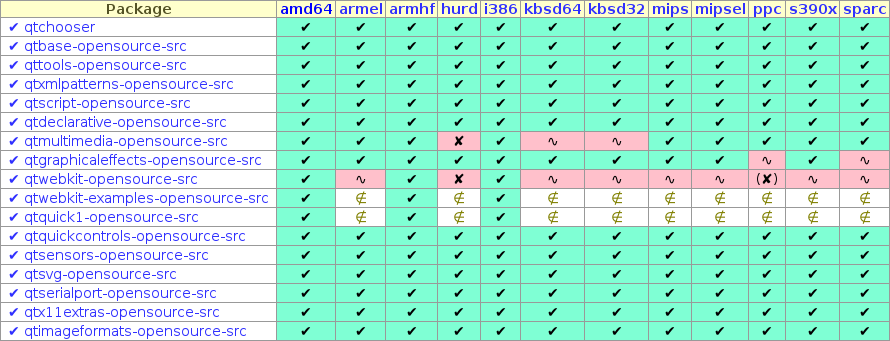
Some time ago I blogged about the 5.2.0 status in Debian experimental. We currently have it in testing with a much better status:


And we also have 5.2.1 in experimental with an even better status:

Note: qttools is FTBFS in armhf just because of some symbols changes, it will be fixed on the next upload.
Don't be afraid of getting it from experimental! Take a look at this blog post to know how to compile with Qt 5 in Debian.

BonusI have also uploaded Qt Creator built against Qt 5 to experimental. I plan to push it to unstable with Qt 5.2.1.

Richard Hartmann: Panem et congress s

There's a German joke about Germans:
Q: How can you find Germans abroad?
A: You stand outside a bakery and wait until someone starts cussing.

I am constantly reminded of this joke, abroad and back home, as we do tend to take our bread seriously... As an additional data point supporting this, the German local team just spent 20 minutes discussing bread. I somehow doubt you could make an off-hand comment about bread and garner much interest in most communities; in a German one, this works. In mildly related news, this is what bits.debian.org will pick up soon: During the DebConf committee meeting, it has been decided that the 16th annual Debian Conference, DebConf15, will be held in Germany next year. Thanks to the Belgian and Swedish teams; we are looking forward to their renewed bids for future DebConfs! Specifics as to location and date are still being nailed down and we will keep Debian as a whole informed about our progress. A dedicated (English-language) mailing list has been created for the organization and we welcome interested people to subscribe and join the discussion.

Paul Tagliamonte: Donate to MediaGoblin!

If you re the sort that cares about federation, the MediaGoblin project is for you!

MediaGoblin is a media hosting platform, where you can post all sorts of things, like video, images or even 3d models. It s a nice replacement for things like Flickr, and YouTube, and super easy to set up.

If I wasn t such a lazy person, I d have uploaded it to Debian, but alas. Soon. Soon!

It s an official GNU project, and it s maintainer, Chris is a totally awesome guy, and MediaGoblin is really important work.


If you feel the urge to support federation on the web, Support MediaGoblin! Help us take back the net!

Dirk Eddelbuettel: RcppArmadillo 0.4.100.2.1

Conrad made a first bug-fix release 4.100.2 for Armadillo, his templated C++ library for linear algebra, yesterday. See below for details on the the small set of changes. This was quickly wrapped up in a new RcppArmadillo release 0.4.100.2.1 release. I also added some first steps towards turning C++11 on. This can be used now with a pre-release of R 3.1.0, and can be generally activated once R 3.1.0 is released on April 10.
Changes in RcppArmadillo version 0.4.100.2 (2014-03-07)
  • Upgraded to Armadillo release Version 4.100.2
    • fix for handling null vectors by normalise()
    • fix for memory handling by sparse matrices
  • Correct use of [[ depends()]] in skeleton example file
  • Prepare src/Makevars for C++11 support from R 3.1.0 by defining USE_CXX11 which is currently commented out
  • In the Armadillo configuration, turn on C++11 support if USE_CXX11 is defined
Courtesy of CRANberries, there is also a diffstat report for the most recent release As always, more detailed information is on the RcppArmadillo page. Questions, comments etc should go to the rcpp-devel mailing list off the R-Forge page.

This post by Dirk Eddelbuettel originated on his Thinking inside the box blog. Please report excessive re-aggregation in third-party for-profit settings.

Andrew Shadura: Process isolation support in start-stop-daemon

Yesterday I played with LXC a bit, and I liked it, as LXC provides a very lightweight isolation of processes, much like enchanced chroot. However, I realised, I don t always need the chroot-like part of LXC, sometimes what I need is just to make sure the process is unable to see the other processes and talk to them in any other way except the filesystem, but I don t want a whole separate root file system for that. LXC provides a simple utility, lxc-unshare, which uses Linux-specific clone(2) call to run a process with new PID, IPC and other namespaces. However, this utility can t be used for running forking daemons, as the container is destroyed when its PID 1 exits. That s why I decided to add the support for process isolation to start-stop-daemon. I was careful enough to introduce minimal changes to it to make sure they can be merged back to the version as shipped with dpkg, and at the same time be buildable separately from the rest of it. Speaking of building, by the way, this version of start-stop-daemon uses mk-configure, a light-weight autotools replacement, as its build system. What I added, from a user s perspective, is a single --isolate option. When run with this option, start-stop-daemon calls clone(2) just before configuring the environment of a process it s going to run. The cloned process runs in a new namespace, and immediately remounts /proc, /dev/shm and /dev/mqueue. Then it forks, and a forked process executes the daemon. The parent process, which is PID 1 in the new PID namespace, uses waitpid(2) to monitor its child processes. As soon as its very first child exits, it talks via a pipe to the process outside of the container, so that it knows the container has a forked daemon and it needs to detach. In any case, the container s PID 1 does waitpid(2) in a loop, checking the process list every time a child terminates. As soon as it s left alone or a SIGTERM is received, it exits. The code is published at Bitbucket.

Martín Ferrari: Fun with the Linux desktop

Or, "Why 2014 will NOT be the year of Linux in the desktop". So, it happens that my mum (66 yo) has been a Debian user for over a year now. With highs and lows, she manages to do what she needs; sometimes I need to intervene. Today I thought I could send her a quick email explaining how to download using BitTorrent, because of reasons. So, as I was writing, I realised that in many torrent sites, you only get a magnet link these days. No problem! Click on the magnet link, at it should work automagically. Then I remembered: it works on my computer, because I've spent a couple of hours some time ago researching how to make FireFox work with magnet links, creating a custom script, etc. I hoped that by now this must have been solved, at least in Debian unstable. Wrong again. I created a new user in my computer, launched IceWeasel/FireFox and boom: I get a dialog asking me to select a program, not from a list of desktop applications, taken from one of the gazillion sources where applications are defined, but just from any place on the file system! (At least, now you don't need to go tweaking with the hidden FireFox configuration editor). I was very angry at the brainiac at Mozilla who thought it was a great idea to ignore the host system and do their own MIMEtype handling. And then, tried Chromium to see what would happen... And I get first a scary message telling me that it is going to use the super-obscure xdg-open program to open my link, and that it could harm my computer! It was followed by another very helpful dialog telling me something like:
Unable to detect the URI-scheme of "magnet:?xt=urn:btih:diePh6iengei4quaep4shai8ahshahnae9 oolahtetheir2bohmu1eelaChui1ohdahruegh4wief6PusahDae4ho oshahjoogai7bae9shuvei9shufeX4boog8neichi3OoDee5ei9Uori c6aingairepon9gok8Mee7uRahphah4EucoopheiYin4xe4lahn0goh"
Then the real fun started... I starting looking around to understand how this is supposed to work, I wanted to provide a patch! So, it turns out that if you add some values to GConf this should work. So, try to find where would that be. Read about GConf schemas, default and mandatory values, and their 10 possible locations. Find that Azureus provides an schema, use that to create one for Transmission. Then find that in fact, Transmission was providing defaults, which are not the same but work the same, and that they had an error there: yes, problem found! (#741069) No! It turns out that the Gnome desktop does not use that any more, and now they scan the .desktop (who knows in which of the 100 directory tress where .destop files are present) files for MIME handlers, and the transmission-gtk.desktop file had that correctly. So why does it not work? Well, it turns out that if I used gvfs-open instead of xdg-open, it did work! The thing is, I am running XFCE here, which is GTK based, but it is not Gnome: instead of gvfs-open, I was getting exo-open, which is it's brain-dead cousin, and can't do anything but files, email and web. It is fecking 2014, and we still don't have a sensible, unified way to select preferred applications. We still have incompatible, duplicated, incomplete, competing implementations. We have FreeDesktop doing one thing to try and unify criteria, which is then ignored or mis-implemented up and down by some desktops and applications. Some days I get really angry at the Free Software world. PS: I guess I will tell mum to copy&paste the links from the browser to the torrent client, but not today. I have already lost 4 hours of sleep on this.

Russell Coker: Less Work

I previously wrote about the idea of a Basic Income for Australia [1], that post was mainly to show how it could be introduced with little real change. That is not because I don t think that we need real changes, but because we should consider the various changes separately as much as possible. In terms of how society works I think that we need to move from the current model where most people are expected to work most of the time and the people who don t work are treated badly to encourage them to work for low wages. I think that we should aim as a society to have less time spent doing paid work which means more people working part time (maybe 6 months a year, 3 or 4 days a week, or other ways of doing less than 40 hours a week * ~45 weeks) and more people who aren t doing paid work. The idea of 100% employment is the cause of many jokes about the Soviet Union. I don t know how much truth is behind the jokes about needless work being done to fulfill Soviet plans, but regardless of the accuracy I think we should take such things as an idea of what not to do in our society. The Broken Window Fallacy is an example of the Soviet production problem in supposedly capitalist societies. Here are some of my ideas for decreasing the amount of needless work without decreasing anyone s quality of life in fact most of these make things better for most people. The War on Drugs The easiest way to reduce needless employees is to end the war on drugs . During the course of the war the drug use has steadily increased and the amount of law enforcement energy devoted to it has also increased. Some estimates claim that 50% of law enforcement is devoted to it. Also some of the hospital budget is related to drug use. I think that we should allow adults to consume any drug that they wish (not just tobacco, alcohol, caffeine, and other popular drugs) and apply the same laws regarding product quality to all of them. That will reduce the violence related to drugs, reduce the health impact (it s usually poor quality control that causes medical problems), and allow law enforcement to concentrate on crimes that hurt other people. Treating drug addiction as a medical problem has been shown to be the most effective way of reducing drug use, reducing violent crime, and reducing the health impact of drug use. Other Crime Issues Gary Slutkin s TED talk about treating violence as a contagious disease has some interesting ideas for reducing violence in the community [2]. Implementing those ideas on a wide scale seems to have the potential for reducing law enforcement and medical work. Generally I think we should aim to have as few laws as possible. Whenever adults want to do things that don t hurt other people they should be permitted to do so. There should also be an aim for laws to be consistent and easy to understand. Ideally there would be a single database with all laws in some form of hypertext (maybe some type of Wiki) so that any citizen can discover all implications of the laws that affect them. Health More money should be spent on preventing people getting sick. One problem we have in recent times is silly people refusing to get their children vaccinated because they take medical advice from a playboy model instead of doctors. I think that as a society we need to do more to protect children from stupid things that their parents do and that reducing the amount of medical work is the least of the reasons for doing so. Another problem is the quality of food. The big supermarket chains are pushing prices down which reduces food quality. The excessive use of anti-biotics is a serious threat to world health that is driven by the low price of meat. Robots Rodney Brooks gave an interesting TED talk about robotics [2]. He showed how robots can be programmed/trained and talked about the factory workers who want their children to do anything other than factory work. Work that can be done by robots should be done by robots so that people can do better things. Travel One problem that we have in Australia is rent-seeking companies being permitted to establish toll roads. To make such toll roads profitable (which is guaranteed by corrupt politicians) they close roads that might be used to bypass the toll roads. This creates needless traffic congestion (wasted work time driving). Also running toll roads involves employing people to collect the tolls and take legal action against people who don t pay. I believe that toll roads shouldn t exist, this will reduce the number of needless workers and make everything more efficient. Also as a matter of principle I believe that the government should own and control every monopoly in the country. Currently in Australia most adults own cars, this involves a lot of work in car maintenance. Even when not being used a car needs to be maintained for safety. When people drive to work instead of using public transport their travel time counts as work. While time spent on a train, tram, or bus isn t leisure time it s a lesser degree of work than driving a car. You can read a book, play phone games, or do other recreational activities when on public transport. Car sharing companies are taking off in urban areas, this allows some people to avoid owning a car and some families to own fewer cars. We also need more government investment in public transport including more routes, greater passenger capacity, and more service late at night. We also need to encourage companies not to have employees working from 9 to 5 to reduce the peak demand for public transport. A short term tax incentive would do some good in this regard, if companies were to encourage their employees to work different hours for a year then it might change the norms for work enough to permanently break the 9-5 concept. I believe that all land-based mass public transport (buses, trams, and trains) should be free. That would remove the need to pay people to collect fares and fine people who don t have tickets, and also remove the work time involved in buying tickets. Not requiring tickets would also decrease the time needed to get on and off public transport which would improve the speed of public transport and reduce disruption to traffic. One simulation of traffic in New York City showed that collecting fares on buses slowed down traffic enough to impose costs on all workers that were greater than the fares collected so it would be cheaper overall for people in NYC to have free buses paid by the government. I don t think that Melbourne has congestion similar to NYC and even Sydney might not have the same economic issues. But I still think that we should have free transport for the convenience of everyone. Google has been doing some interesting research into cars that are driven by computer, their prototypes have been shown to work well in practice but have not been approved for real use. Trains and trams are easier to drive because there is no steering so it seems that they would be good options for the first implementation of computer driven public transport. Robot trams would allow more regular service late at night and thus make the network more useful. Stop Buying Rubbish A significant waste of resources is the commercial events of Christmas, Valentine s day, and Easter. A lot of marketing money is spent to encourage people to buy rubbish for other people in celebration of such events. I think that Christmas presents for children are a good thing and that even the trivial things (crackers and party hats) are OK, but adults don t need it. Valentine s day is OK for people who are in relationships, but coercing single people to rush to find someone so that they aren t single on that day is bad for everyone. Most Easter and Valentine s chocolate is rubbish, cheap and nasty chocolate in fancy wrappings. Buy a small quantity of good chocolate instead of a large quantity of rubbish. There s a big market for knick-nacks for adults outside of those holidays too. Stands at trade shows usually give away junk to delegates, some of it has enough value to be taken home but really it s mostly rubbish. If you can t sell your stuff without giving away freebies then giving away plastic toys or cheap chocolate isn t going to make it sell. Any Other Ideas? Does anyone have other ideas about how to reduce the amount of work required to sustain our society? Suggestions for improvements that suit other countries are welcome too, while I m mostly thinking about Australia while writing this I m interested in ways of making things better all around the world.

Dirk Eddelbuettel: RcppEigen 0.3.2.1.0 and 0.3.2.1.1

Shortly after I prepared the bug-fix / maintenance release 0.3.2.0.3 of RcppEigen, the code based was updated to the recent Eigen release 3.2.1 by Doug Bates. I wrapped this up in release 0.3.2.1.0 of RcppEigen. The next day, Brian Ripley noticed a build failure on Solaris; and followed up with a better ifdef test for one problematic line which now also addresses the equally irrelevant Unix variants of HP, SGI, and AIX (IBM). May it help someone ... In any event, this constituted release 0.3.2.1.1. The NEWS entries for both follow.
Changes in RcppEigen version 0.3.2.1.1 (2014-03-06)
  • Better ifdef on one directory entry feature, with thanks to Brian Ripley.
Changes in RcppEigen version 0.3.2.1.0 (2014-03-03)
  • Updated to version 3.2.0 of Eigen
Courtesy of CRANberries, there are diffstat reports for the most recent release and preceding release. Questions, comments etc about RcppEigen should go to the rcpp-devel mailing list off the R-Forge page.

This post by Dirk Eddelbuettel originated on his Thinking inside the box blog. Please report excessive re-aggregation in third-party for-profit settings.

Andrew Pollock: [life] Day 38, BJJ, Science Friday and a play date

Zoe wound up in my bed at some ungodly hour, but then we both slept in until 7am, which was nice. Mum and Dad were coming around at 8:30am to come watch Zoe's Brazilian Jiu-Jitsu class, so we got up, made some porridge in the Thermomix and got ready. Zoe decided she didn't feel like going to BJJ class by bike, so we all piled into our car and drove over. Zoe had a good class, and Mum took her uniform home afterwards to take up the legs a bit, which will be good. They stayed for lunch, and we reviewed photos from our Coochie and Melbourne trips, and I made some fresh guacamole in Thermomix to go with the chicken quesadillas I made for lunch. After lunch they went home, and Zoe declined to take a nap, so we read some stories in the hammock, and then we did our Science Friday experiment, one that was suggested to me by a friend on Facebook. It was nice and easy, just put some milk in a tray, drop in a few drops of food colouring and then touch them with a cotton bud soaked in detergent. The detergent breaks up the fat in the milk and the colour drops go flying all over the place. Zoe really enjoyed swirling all the colours around with the cotton buds and we repeated the experiment a few times. She then wanted to see what would happen if we put some glue in, so wanting to encourage her scientific curiosity, we tried it, and nothing interesting happened. Zoe had a play date at her friend Mackensie's house, which was just down the road in Balmoral. We biked over to her place and the girls had a lovely afternoon playing. Sarah came and picked up Zoe from there. I dropped in on some former neighbours who happened to move two doors down from Mackensie, and had just had a second child, and then headed home to prepare for a dinner and board game night with my girlfriend and some of my neighbours.

Benjamin Mako Hill: V-Day

My friend Noah mentioned the game VVVVVV. I was confused because I thought he was talking about the visual programming language vvvv. I went to Wikipedia to clear up my confusion but ended up on the article on VVVVV which is about the Latin phrase vi veri universum vivus vici meaning, by the power of truth, I, while living, have conquered the universe . There is no Wikipedia article on VVVVVVV. That would be ridiculous.

7 March 2014

Steve Kemp: Time to get back to my roots: Perl

Today I wrote a perl Test::RemoteServer module:
#!/usr/bin/perl -w -I.
use strict;
use warnings;
use Test::More tests => 4;
use Test::RemoteServer;
#
#  Ping Tests
#
ping_ok( "192.168.0.1",       "Website host is up: IPv4" );
ping6_ok( "www.steve.org.uk", "Website host is up: IPv6" );
#
#  Socket tests
#
socket_open( "ipv4.steve.org.uk", "2222", "OpenSSH is running" );
socket_closed( "ipv4.steve.org.uk", "22", "OpenSSH is not available on :22" );
I can see a lot of value in defining tests that are carried out against remote hosts - even if they're more basic than the kind of comprehensive testing you'd get via Custodian, Nagios, etc. Being able to run "make test" and remotely probe services is cool. Unfortunately I suspect the new-hotness is to couple the testing with your Chef, Puppet, CFengine, Slaughter, Ansible, etc, policies. That way you have two things: Coming to CPAN in the near future anyway, I can throw it up on Github in advance if there is any interest..

Keith Packard: glamor-hacking

Brief Glamor Hacks Eric Anholt started writing Glamor a few years ago. The goal was to provide credible 2D acceleration based solely on the OpenGL API, in particular, to implement the X drawing primitives, both core and Render extension, without any GPU-specific code. When he started, the thinking was that fixed-function devices were still relevant, so that original code didn t insist upon modern OpenGL features like GLSL shaders. That made the code less efficient and hard to write. Glamor used to be a side-project within the X world; seen as something that really wasn t very useful; something that any credible 2D driver would replace with custom highly-optimized GPU-specific code. Eric and I both hoped that Glamor would turn into something credible and that we d be able to eliminate all of the horror-show GPU-specific code in every driver for drawing X text, rectangles and composited images. That hadn t happened though, until now. Fast forward to the last six months. Eric has spent a bunch of time cleaning up Glamor internals, and in fact he s had it merged into the core X server for version 1.16 which will be coming up this July. Within the Glamor code base, he s been cleaning some internal structures up and making life more tolerable for Glamor developers. Using libepoxy A big part of the cleanup was a transition all of the extension function calls to use his other new project, libepoxy, which provides a sane, consistent and performant API to OpenGL extensions for Linux, Mac OS and Windows. That library is awesome, and you should use it for everything you do with OpenGL because not using it is like pounding nails into your head. Or eating non-tasty pie. Using VBOs in Glamor One thing he recently cleaned up was how to deal with VBOs during X operations. VBOs are absolutely essential to modern OpenGL applications; they re really the only way to efficiently pass vertex data from application to the GPU. And, every other mechanism is deprecated by the ARB as not a part of the blessed core context . Glamor provides a simple way of getting some VBO space, dumping data into it, and then using it through two wrapping calls which you use along with glVertexAttribPointer as follows:
pointer = glamor_get_vbo_space(screen, size, &offset);
glVertexAttribPointer(attribute_location, count, type,
              GL_FALSE, stride, offset);
memcpy(pointer, data, size);
glamor_put_vbo_space(screen);
glamor_get_vbo_space allocates the specified amount of VBO space and returns a pointer to that along with an offset , which is suitable to pass to glVertexAttribPointer. You dump your data into the returned pointer, call glamor_put_vbo_space and you re all done. Actually Drawing Stuff At the same time, Eric has been optimizing some of the existing rendering code. But, all of it is still frankly terrible. Our dream of credible 2D graphics through OpenGL just wasn t being realized at all. On Monday, I decided that I should go play in Glamor for a few days, both to hack up some simple rendering paths and to familiarize myself with the insides of Glamor as I m getting asked to review piles of patches for it, and not understanding a code base is a great way to help introduce serious bugs during review. I started with the core text operations. Not because they re particularly relevant these days as most applications draw text with the Render extension to provide better looking results, but instead because they re often one of the hardest things to do efficiently with a heavy weight GPU interface, and OpenGL can be amazingly heavy weight if you let it. Eric spent a bunch of time optimizing the existing text code to try and make it faster, but at the bottom, it actually draws each lit pixel as a tiny GL_POINT object by sending a separate x/y vertex value to the GPU (using the above VBO interface). This code walks the array of bits in the font and checking each one to see if it is lit, then checking if the lit pixel is within the clip region and only then adding the coordinates of the lit pixel to the VBO. The amazing thing is that even with all of this CPU and GPU work, the venerable 6x13 font is drawn at an astonishing 3.2 million glyphs per second. Of course, pure software draws text at 9.3 million glyphs per second. I suspected that a more efficient implementation might be able to draw text a bit faster, so I decided to just start from scratch with a new GL-based core X text drawing function. The plan was pretty simple:
  1. Dump all glyphs in the font into a texture. Store them in 1bpp format to minimize memory consumption.
  2. Place raw (integer) glyph coordinates into the VBO. Place four coordinates for each and draw a GL_QUAD for each glyph.
  3. Transform the glyph coordinates into the usual GL range (-1..1) in the vertex shader.
  4. Fetch a suitable byte from the glyph texture, extract a single bit and then either draw a solid color or discard the fragment.
This makes the X server code surprisingly simple; it computes integer coordinates for the glyph destination and glyph image source and writes those to the VBO. When all of the glyphs are in the VBO, it just calls glDrawArrays(GL_QUADS, 0, 4 * count). The results were encouraging :
1: fb-text.perf
2: glamor-text.perf
3: keith-text.perf
       1                 2                           3                 Operation
------------   -------------------------   -------------------------   -------------------------
   9300000.0      3160000.0 (     0.340)     18000000.0 (     1.935)   Char in 80-char line (6x13) 
   8700000.0      2850000.0 (     0.328)     16500000.0 (     1.897)   Char in 70-char line (8x13) 
   6560000.0      2380000.0 (     0.363)     11900000.0 (     1.814)   Char in 60-char line (9x15) 
   2150000.0       700000.0 (     0.326)      7710000.0 (     3.586)   Char16 in 40-char line (k14) 
    894000.0       283000.0 (     0.317)      4500000.0 (     5.034)   Char16 in 23-char line (k24) 
   9170000.0      4400000.0 (     0.480)     17300000.0 (     1.887)   Char in 80-char line (TR 10) 
   3080000.0      1090000.0 (     0.354)      7810000.0 (     2.536)   Char in 30-char line (TR 24) 
   6690000.0      2640000.0 (     0.395)      5180000.0 (     0.774)   Char in 20/40/20 line (6x13, TR 10) 
   1160000.0       351000.0 (     0.303)      2080000.0 (     1.793)   Char16 in 7/14/7 line (k14, k24) 
   8310000.0      2880000.0 (     0.347)     15600000.0 (     1.877)   Char in 80-char image line (6x13) 
   7510000.0      2550000.0 (     0.340)     12900000.0 (     1.718)   Char in 70-char image line (8x13) 
   5650000.0      2090000.0 (     0.370)     11400000.0 (     2.018)   Char in 60-char image line (9x15) 
   2000000.0       670000.0 (     0.335)      7780000.0 (     3.890)   Char16 in 40-char image line (k14) 
    823000.0       270000.0 (     0.328)      4470000.0 (     5.431)   Char16 in 23-char image line (k24) 
   8500000.0      3710000.0 (     0.436)      8250000.0 (     0.971)   Char in 80-char image line (TR 10) 
   2620000.0       983000.0 (     0.375)      3650000.0 (     1.393)   Char in 30-char image line (TR 24)
This is our old friend x11perfcomp, but slightly adjusted for a modern reality where you really do end up drawing billions of objects (hence the wider columns). This table lists the performance for drawing a range of different fonts in both poly text and image text variants. The first column is for Xephyr using software (fb) rendering, the second is for the existing Glamor GL_POINT based code and the third is the latest GL_QUAD based code. As you can see, drawing points for every lit pixel in a glyph is surprisingly fast, but only about 1/3 the speed of software for essentially any size glyph. By minimizing the use of the CPU and pushing piles of work into the GPU, we manage to increase the speed of most of the operations, with larger glyphs improving significantly more than smaller glyphs. Now, you ask how much code this involved. And, I can truthfully say that it was a very small amount to write:
 Makefile.am             2 
 glamor.c                5 
 glamor_core.c           8 
 glamor_font.c         181 ++++++++++++++++++++
 glamor_font.h          50 +++++
 glamor_priv.h          26 ++
 glamor_text.c         472 +++++++++++++++++++++++++++++++++++++++++++++++++++++
 glamor_transform.c      2 
 8 files changed, 741 insertions(+), 5 deletions(-)
Let s Start At The Very Beginning The results of optimizing text encouraged me to start at the top of x11perf and see what progress I could make. In particular, looking at the current Glamor code, I noticed that it did all of the vertex transformation with the CPU. That makes no sense at all for any GPU built in the last decade; they ve got massive numbers of transistors dedicated to performing precisely this kind of operation. So, I decided to see what I could do with PolyPoint. PolyPoint is absolutely brutal on any GPU; you have to pass it two coordinates for each pixel, and so the very best you can do is send it 32 bits, or precisely the same amount of data needed to actually draw a pixel on the frame buffer. With this in mind, one expects that about the best you can do compared with software is tie. Of course, the CPU version is actually computing an address and clipping, but those are all easily buried in the cost of actually storing a pixel. In any case, the results of this little exercise are pretty close to a tie the CPU draws 190,000,000 dots per second and the GPU draws 189,000,000 dots per second. Looking at the vertex and fragment shaders generated by the compiler, it s clear that there s room for improvement. The fragment shader is simply pulling the constant pixel color from a uniform and assigning it to the fragment color in this the simplest of all possible shaders:
uniform vec4 color;
void main()
 
       gl_FragColor = color;
 ;
This generates five instructions:
Native code for point fragment shader 7 (SIMD8 dispatch):
   START B0
   FB write target 0
0x00000000: mov(8)          g113<1>F        g2<0,1,0>F                        align1 WE_normal 1Q  ;
0x00000010: mov(8)          g114<1>F        g2.1<0,1,0>F                      align1 WE_normal 1Q  ;
0x00000020: mov(8)          g115<1>F        g2.2<0,1,0>F                      align1 WE_normal 1Q  ;
0x00000030: mov(8)          g116<1>F        g2.3<0,1,0>F                      align1 WE_normal 1Q  ;
0x00000040: sendc(8)        null            g113<8,8,1>F
                render ( RT write, 0, 4, 12) mlen 4 rlen 0        align1 WE_normal 1Q EOT  ;
   END B0
As this pattern is actually pretty common, it turns out there s a single instruction that can replace all four of the moves. That should actually make a significant difference in the run time of this shader, and this shader runs once for every single pixel. The vertex shader has some similar optimization opportunities, but it only runs once for every 8 pixels with the SIMD format flipped around, the vertex shader can compute 8 vertices in parallel, so it ends up executing 8 times less often. It s got some redundant moves, which could be optimized by improving the copy propagation analysis code in the compiler. Of course, improving the compiler to make these cases run faster will probably make a lot of other applications run faster too, so it s probably worth doing at some point. Again, the amount of code necessary to add this path was tiny:
 Makefile.am             1 
 glamor.c                2 
 glamor_polyops.c      116 ++++++++++++++++++++++++++++++++++++++++++++++++++--
 glamor_priv.h           8 +++
 glamor_transform.c    118 +++++++++++++++++++++++++++++++++++++++++++++++++++++
 glamor_transform.h     51 ++++++++++++++++++++++
 6 files changed, 292 insertions(+), 4 deletions(-)
Discussion of Results These two cases, text and points, are probably the hardest operations to accelerate with a GPU and yet a small amount of OpenGL code was able to meet or beat software easily. The advantage of this work over traditional GPU 2D acceleration implementations should be pretty clear this same code should work well on any GPU which offers a reasonable OpenGL implementation. That means everyone shares the benefits of this code, and everyone can contribute to making 2D operations faster. All of these measurements were actually done using Xephyr, which offers a testing environment unlike any I ve ever had build and test hardware acceleration code within a nested X server, debugging it in a windowed environment on a single machine. Here s how I m running it:
$ ./Xephyr  -glamor :1 -schedMax 2000 -screen 1024x768 -retro
The one bit of magic here is the -schedMax 2000 flag, which causes Xephyr to update the screen less often when applications are very busy and serves to reduce the overhead of screen updates while running x11perf. Future Work Having managed to accelerate 17 of the 392 operations in x11perf, it s pretty clear that I could spend a bunch of time just stepping through each of the remaining ones and working on them. Before doing that, we want to try and work out some general principles about how to handle core X fill styles. Moving all of the stipple and tile computation to the GPU will help reduce the amount of code necessary to fill rectangles and spans, along with improving performance, assuming the above exercise generalizes to other primitives. Getting and Testing the Code Most of the changes here are from Eric s glamor-server branch:
git://people.freedesktop.org/~anholt/xserver glamor-server
The two patches shown above, along with a pair of simple clean up patches that I ve written this week are available here:
git://people.freedesktop.org/~keithp/xserver glamor-server
Of course, as this now uses libepoxy, you ll need to fetch, build and install that before trying to compile this X server. Because you can try all of this out in Xephyr, it s easy to download and build this X server and then run it right on top of your current driver stack inside of X. I d really like to hear from people with Radeon or nVidia hardware to know whether the code works, and how it compares with fb on the same machine, which you get when you elide the -glamor argument from the example Xephyr command line above.

Russell Coker: Depression

Andrew Solomon gave an interesting TED talk about depression [1]. I ve had problems with depression at various times through my life, about 18 months ago I recognised it as depression after reading a list of depression symptoms on the Beyond Blue site. I think that they have changed their site recently they now have an interactive checklist for depression on their web site [2] (or maybe I just missed the interactive part last time). There is a strong correlation between Autism and depression, this is noted both in research and described on the web, Elspeth s article on Bluehackers is a good description of this [3]. Her experiences differ from mine in some ways, but it s within the common range of experiences you see described on Autism forums etc. Depression is getting more widely known, organisations such as Beyond Blue and Bluehackers are doing good work in spreading information to people who might be depressed and people who know them. The general advice is to see a psychologist, which is good advice for average people. Alexithymia and Choice of Psychologists One problem with such advice is that it doesn t apply so well to people with alexithymia (read the Wikipedia page) [4], that means most people on the Autism Spectrum. The Wikipedia page says psychosomatic illness or substance abuse is frequently exacerbated should these individuals enter psychotherapy . Based on people I know and accounts I ve read on the Internet I expect that anyone on the Autism Spectrum who sees a psychologist that doesn t specialise in Autism (which means most psychologists) will get a result that s about the opposite of what one might desire. In theory a psychologist could recognise someone as being possibly on the Autism Spectrum and refer them to an expert for assessment, but I haven t heard of that happening to an adult. I think that most people who have some degree of alexithymia will avoid psychologists, without ever seeing one you can just know that it s going to be unpleasant. So while you wouldn t want someone who has alexithymia to visit a random psychologist in practice that shouldn t happen too often as such people will be more likely to reject any advice about seeing a psychologist. My page of Autism self-diagnosis tests has a link to an Alexithymia test [5]. If you get a high score on that test (or if taking the test seems too unpleasant) then it s best to see a psychologist who specialises in Autism. Such psychologists are usually happy to work for people who don t quite meet the Autism diagnostic criteria, but they may strongly recommend an Autism assessment so that they can determine the best strategies for treatment. In terms of addressing such problems it seems that the best thing we can do is try and reduce the stigma associated with Autism. The vast majority of people on the Autism Spectrum have little in common with Rain Man. Many of the so-called Autism advocacy organisations make things worse by implying that everyone who is Autistic is unable to live an independent life which helps them in fundraising but doesn t help us.

Vincent Fourmond: Removing the background of an image

While in the process of polishing up a paper, I had to draw figures using a well-known proprietary program for drawing chemical formula whose name I will not write down, out of decency (but you know which one it is anyway). I'm using the mac version (yes, no version for Linux) which has a neat glitch in that the "Save As" button does not work at all: no way to export your chemical formula as a SVG/PDF/PNG picture or whatever ! So I resorted to the neat Print as PDF feature of macintosh. I had to edit the resulting PDF files by hand as some of the colors were wrong (great !), and when I tried to include the PDF, I realized they had a white background... No way !So I dug in ImageMagick's convert documentation, and came up with the following code that converts the PDF file into a PNG with a transparent background:
convert -density 600 figure.pdf -channel alpha \
  -fx '((r == 1 && g == 1 && b == 1) ? 0 : 1)' figure.png
There are still some few points that look white but are probably not that white (due to antialiased rendering of the PDF file ?). There are many more things that can be done using the -fx operator, this page was helpful to me !Edit: while the alpha channel seems to be on by default for PDF files, it is not necessarily the case for all images. If the above doesn't work, try adding -alpha Set before the -fx bit.

Next.

Previous.