Search Results: "ag"

6 August 2013

Craig Small: Careful with apache upgrades

You might (or not if you don t visit) notice all my websites were down. A rushed apt-get dist-upgrade and I found two problems:
  1. PHP5 got removed, which is bad if you run a wordpress site that uses PHP to run
  2. The apache configuration has changed.
Yes, the NEWS entries did warn me, if I read them fully. Yes, I didn t read them enough. Apache now ignores configuration files that don t end in .conf To give a completely non-theoretical example, if you have your virtual hosts in files such as /etc/apache2/sites-enabled/enc.com.au then this will not be recognised and your sites will show the default It works page. Stuff that doesn t fall in the usual places where website stuff should go, which for my setup is a lot of things, will also be denied as the developers have tightened up the rules around what is permitted. Pretty simple to fix with a few <Directory blah> clauses. This isn t a criticism of the Debian apache developers. They do an awesome job of keeping the package workable, flexible but secure which isn t easy. Now it s all back working, I actually agree with the changes they have made. It is just that the latest changes are, well, tricky so be forewarned.

Ian Wienand: Running cloud images locally

Fedora and Ubuntu both provide compact cloud images that are useful for spinning up small VM's quickly (much quicker than installing from a huge ISO or even net-install). Both these pages have single-click buttons to simply launch the VM's at Amazon, which is very cool. However, you may have reason to use them "offline" with a local KVM (outside of EC2 or OpenStack) for testing, or on a plane, etc. I didn't find a lot of information on this (although it is all available once you know what you're looking for). So here's my quick guide for the complete newbie. Firstly, download your image of choice and put it in /var/lib/libvirt/images. Open up virt-manager and you can create your new VM via "import existing image". You can try booting it, but the problem you'll hit is the images have no default password or way to log-in because, very sensibly, you're expected to inject that. Booting you'll see cloud-init attempting to contact 169.254.169.254 to collect the meta-data to initalize the VM; eventually it will time out and you're left at a login prompt you can't log in at. cloud-init does many things and is very flexible with lots of different plugins to initialise images in various ways. The particular one we're interested in is the No cloud plugin. This will look for data from a locally attached CD drive, which works very easily for this scenario. Now that you know that's what you're looking for, the instructions are fairly clear; I'll repeat them just for clarity. Firstly you want to create a minimal meta-data file that has a host-name and an instance-id:
$ cat meta-data
instance-id: iid-local01;
local-hostname: myhost;
Modifying the instance-id will signal to cloud-init that it should run again because something changed. This is also where you can put static IP address data; see the documentation. Secondly, create a user-data file that has the commands to enable password login; set a password, and inject your ssh public key so you can easily log-in:
$ cat user-data
#cloud-config
password: mypassword
ssh_pwauth: True
chpasswd:   expire: False  
ssh_authorized_keys:
  - ssh-rsa ... foo@foo.com (insert ~/.ssh/id_rsa.pub here)
Note for new players: that #cloud-config isn't an optional comment, it's a directive. If you leave it out, you'll probably see a little something about Unhandled non-multipart userdata starting... and your changes won't apply. Insert those two into files into an iso:
$ genisoimage -output init.iso -volid cidata -joliet -rock user-data meta-data
Then copy init.iso into /var/lib/libvirtd/images as well, and connect that as a virtual-cd drive to your virtual-machine created from the image. When you boot you should see some output as it injects your key. It should get an address via DHCP and then you should be able to log-in with fedora or ubuntu users. Then you can start getting more complicated with things like static addresses, package installations, running commands, etc by reading the documentation.

Daniel Pocock: DebConf next week, free real-time communications session

DebConf13 is just about to get under way. While last year's event involved an exciting visit to Nicaragua, this year it is right here in Switzerland making it very convenient for many of those in the very populous community of free software enthusiasts across western Europe.
A long queue has already formed on the freeway going north from Italy into Switzerland's Gotthard Tunnel: did somebody put Debian's 20th birthday party on a social networking site? The big invitation On the final day of DebConf, Saturday 17 August, there is an afternoon track dedicated to the topic of free real-time communications. While DebConf is traditionally aimed at the Debian Developer community, real-time communications, by definition, requires cross-platform collaboration in order to succeed and it is a particularly hot topic thanks to recent revelations about communications privacy. Therefore, there is a wider invitation for visitors to attend this session, please just remember to register your details here, it is free (and private). To get a feel for the topic, please see the video of the Free, Open and Secure Communications panel from FOSDEM 2013 Seeing Switzerland
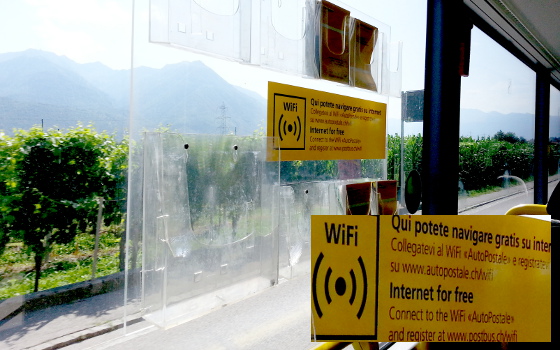
Who said Switzerland is expensive? Swiss Postbus is offering free wifi now Please see some of my previous blogs about Swiss travel for videos and pictures if you are looking for ideas for your time in .ch

5 August 2013

Thomas Goirand: Why using Mailman when MLMMJ is available?

Daniel Pocock just wrote a blog post about how to setup mailman for virtual hosting. Well, it strikes me that mailman is a bad solution, for many reasons. First, it imposes you to use @lists.example.com lists instead of @example.com. I m not sure if that is mandatory, but at least I ve seen only mailman setups done this way. At least, it is how mostly everyone does the setup. I think that s really ugly. Any mailbox should be fine, IMO. What I found particularly lame about Mailman, is that these issues (plus the ones which Daniel listed) have been known for YEARS, though nobody came up with a patch to fix it. And it s really not hard. Why do I know it? Well, because I ve been using MLMMJ for years without such troubles. The current situation where everyone is with mailman is really LAME. Not only MLMMJ is better because it is easier to install and supports virtual hosting out of the box, but also it is written in C and is much faster than Mailman. MLMMJ has been used in high traffic lists like for SUSE and Gentoo. The fact that some major sites decided to do the switch isn t a proof that MLMMJ is perfect, but is a good indication that it at least works well without too much trouble. Also, with mailman, you have to use the subject lines to control your list subscriptions and send command to it. No need to do that with MLMMJ, because everything is controled with the mailbox extension. For example, mylist+subscribe@example.com can be used to subscribe (instead of mylist-requests@lists.example.com, then fill-in the subject line with mailman). So, if you don t like some of the (bad) limitations of Mailman, would like to test something faster, and easier to setup, have a try with MLMMJ (see mlmmj.org for more details, and see the README.Debian inside my package).

Ian Wienand: Skipping bash history for command-lines starting with space

I was recently reading about a case where part of the evidence appears to be a deleted bash history-file. From what I gather, the accused says that the removal was a clean-up job to remove inadvertently stored passwords rather than an attempt to hide nefarious activity. What had managed to pass me by in 15 or so years of using bash but not reading man bash properly is the HISTCONTROL variable. If it is set to ignorespace then commands entered with a leading-space will not be stored in the history. Like all the best discoveries I found this only by accident on a machine where it was turned on. It's been quite useful in keeping my history pruned. However, not usually for security reasons around hiding passwords passwords on the command-line have other problems and I'm sure any security person would tell you not to use them just from a defense-in-depth perspective. That said, from a "keeping ctrl-r reversi-search useful" point-of-view it's often helpful; for example I've mostly trained my fingers to <space>rm -rf because I'm sure I'm not the only one who has deleted the wrong thing via a history-recall-combined-with-typing-to-fast scenario. So, HISTCONTROL=ignoreboth (which also ignores duplicates) is certainly a useful one to slip into your .bashrc. At least it would be one-less thing to explain to the FBI!

Sylvestre Ledru: Switch to OpenJDK 7

As announcement on debian-devel-announce, I just uploaded java-common version 0.49. This version changes the default version of OpenJDK to version 7. That means that packages depending on default-jdk/default-jre will be now built with OpenJDK 7 (instead of the 6) and also that the java/javac commands will be providing Java 7.
I also used the opportunity of this upload to update the Java policy.

Wouter Verhelst: Hard disk partition pregap and grub2

A week or so back, I was at a customer to upgrade his server to wheezy. This server had originally been installed, not as squeeze but as something older, and was installed using an LVM-on-mdraid setup. Booting off such a setup (without a /boot partition outside of the raid/LVM) is certainly possible with several boot loaders, including grub2; however, it was having issues in this particular instance, producing an error message along the likes of:
/sbin/grub2-setup: warn: Your embedding area is unusually small. core.img won't fit in it..
It took me a while to figure out what that meant, but the Internet to the rescue:
Disk /dev/sda: 160.0 GB, 160041885696 bytes
255 heads, 63 sectors/track, 19457 cylinders, total 312581808 sectors
Units = sectors of 1 * 512 = 512 bytes
Sector size (logical/physical): 512 bytes / 512 bytes
I/O size (minimum/optimal): 512 bytes / 512 bytes
Disk identifier: 0x000b3c3b
   Device Boot      Start         End      Blocks   Id  System
/dev/sda1   *        2048   312580095   156289024   83  Linux
That partition starts at the 2048th block, resulting in a 1MiB gap before the first partition. The older default was to start on the 63rd block, for a pregap of just short of 32KiB. Unfortunately, the only way to fix this issue without ugly hacks (such as the chainloading suggested in this fedora forum thread) is to repartition. Luckily, thanks to the magic of LVM, this isn't difficult (if a little involved). Steps:
pvmove -v /dev/md0
vgreduce -a
mdadm -S /dev/md0
(...repartition the hard disks that make up /dev/md0...)
mdadm -C /dev/md0 (... other options required to recreate /dev/md0 on the desired RAID level...)
pvcreate /dev/md0
vgextend /dev/vg /dev/md0
... and then rinse, repeat for md1. At that point, installing grub will work as usual. An alternative (since we were using RAID1) could have been to remove one disk from the RAID array, repartition it, create a new RAID1 array in degraded mode, pvmove over to that, destroy the original array, and add the second disk to the new array. This would probably be a better idea when you only have one RAID array, for instance, or when you have more than one array and have more data than fits on a single array. However, that wasn't the case here (at least not after a resize2fs -M call followed by an appropriate lvresize one), and so I thought that not reducing redundancy, even if only temporarily, was a better move.

Daniel Pocock: Effectively supporting virtual domains with Mailman

When I first decided to run my own list server, I was well aware of the popularity of Mailman but I was deterred from using it by the complexity of setting up virtual hosts. In particular, 99% of the software I use for servers is packaged. Whenever I choose a new piece of software, using something that is packaged and supported is high on my list of priorities. Mailman's distribution tarball and the packages built from it only have limited support for virtual hosting. My own objective is to host lists for open source projects. As some of these projects don't have dedicated budgets, it is particularly important to find lightweight, low-maintenance solutions. Furthermore, it is important that those solutions don't detract from the time I want to invest in the projects themselves. I've developed some scripts to solve the problem: to start using them quickly, please see the README file. Here I provide a more detailed overview of the logic behind this approach. Mailman's limitations and workarounds For me, the biggest limitation of Mailman is that the site list is always linked to a single domain, which has to be chosen arbitrarily from the list of domains being hosted. Although it is not emphasized in the documentation, there is also the inconvenience of having all the lists from potentially unrelated projects appearing together on Mailman's main index page. Another limitation is that each list name must be globally unique across all domains. Some existing workarounds exist but they have limitations too. There is a virtual domain patch, but it is not clear how this handles the site list or the site index page. There is also the postfix-to-mailman script distributed by Debian and Ubuntu: using a transport-based solution looks elegant at first, but when you realise that you need to whitelist the addresses (to ensure messages are rejected at ingress rather than bounced), it becomes just as much work to maintain as the alternatives it aims to avoid: Mailman's authors do not endorse this approach. Experimenting with Sympa Deterred by Mailman's limitations, I initially went with Sympa and that seemed to run quite well for a number of years. In particular, it supports full virtual hosting out-of-the-box and all this is standard in the convenient Debian packages. From time-to-time, users have complained about the use of JavaScript in the web UI, but that was not something I could immediately resolve. However, when I upgraded to Debian 7 (wheezy), more serious problems appeared. Initially, the web UI (used for subscribing or browsing the archives) was completely broken. Anybody accessing the site would be given a download of the wws binary rather than the page that was supposed to be generated by the binary. I discovered errors about this in Apache's error.log and tried installing libapache2-mod-fcgid. The problem was resolved, but from then on, my whole web server became unstable and at least once every day I would have to restart the Apache process or it would become inaccessible. I put the details into a bug report and after not getting any feedback, decided to go and have another look at Mailman. A closer look at Mailman Looking at Mailman again, it appeared that the only way to achieve a relatively "pure" virtual hosting solution would be to run multiple installations of Mailman in different directory trees. Initially, I hoped this could be done by sharing copies of the binaries and just creating replicas of the structure under /var/lib/mailman. Looking under the hood, I discovered that the paths were compiled into the binaries and could not be easily overriden. It appears that this limitation could be overcome with some trivial patches to read directory names from the environment. The main aims of using shared binaries are disk space efficiency and also being able to benefit from security updates for the binary packages. However, if I had to patch the binaries, then I wouldn't be able to benefit from the security update packages anyway. So, it became inevitable that I would have to build binaries from source one way or another: either with a patch or by building multiple copies of each binary, each hardcoded with a different path. Putting it into practice Looking over the Mailman architecture, there are four things to be replicated for each installation:
  • init script to start a standalone qrunner per domain
  • cron jobs
  • CGI configuration from Apache (easily isolated by using a different ScriptAlias inside each Apache <VirtualHost>
  • Invocation of the Mailman binary from the mailer's aliases file
The init scripts and crontabs can be easily generated from a template (I used Debian's copies of these files as a base for that). Some of the Apache configuration can be handled by putting wildcards in the <Directory> specifications and the rest can be easily cut-and-pasted into <VirtualHost> definitions. Based on all of the above, all I had to do was run Mailman's configure script and make once for each virtual domain. I've scripted the whole process - my script is available here Managing the aliases file One particular limitation of my mailer (Postfix) is that the Mailman message processor can't be invoked directly from a rule in the virtual alias map. Scripts like this can only be invoked from the normal /etc/aliases file. This problem is not unique to Mailman: for Sympa, I also had to deal with this. The most common solution is to use the virtual file to translate all the virtual list addresses into very verbose usernames within the local domain:
Address Mapped to
widget-users@lists.example.org lists.example.org-widget-users@my-local-domain
The local part, lists.example.org-widget-users can then be used in the regular /etc/aliases file. This approach is described in the Sympa documentation and also in one of the virtual domain patches for Mailman. I've included a script for generating these alias mappings in the repository with my other scripts for building virtual Mailman installations. It would also be possible to patch Mailman itself to generate such files dynamically when new lists are created. Conclusion and next steps Using the techniques described and these small scripts, I successfully built independent virtual hosts for two of my domains, lists.lumicall.org and lists.dynalogin.org on a single mail host. Notice how each of them has the appearance of a clean, standalone Mailman installation? Going forward, I believe it would not be hard for the 2.x branch of Mailman to support this approach to virtual hosting with three changes:
  • Allowing the binaries to take their directory tree name from an environment variable or command line option or by inspecting argv[0] to discover their own location,
  • Generating the aliases file in the more verbose format and
  • Providing some convenient init script and crontab that iterates over all the domains

4 August 2013

Dirk Eddelbuettel: RcppArmadillo 0.3.900.7

A bug-fix release 3.900.7 of Armadillo was provided by Conrad a few days ago. It has been rolled into a new RcppArmadillo release 0.3.900.7 which, after a brief delay, is now on CRAN and in Debian. The main bug fix is a change in the in-place version of reshape(). This in turn caused the CRAN package Amelia to fail, but some diligent debugging by Conrad (which was much appreciated) revealed that the error was in fact in RcppArmadillo where we did not set the matrix flag properly in the constructor. The corresponding one-character fix had been made in this release. Another package exhibiting an issue is unmarked. It needs to make the target variable of reshape a matrix object in a handful of places. I sent the authors a small patch addressing this but have not yet heard back. The complete list of changes is below. In the meantime, I have also done some work on a new as() and wrap() converters for sparse matrices; a first implementation is in SVN.
Changes in RcppArmadillo version 0.3.900.7 (2013-08-02)
  • Upgraded to Armadillo release Version 3.900.7 (Bavarian Sunflower)
    • minor fix for inplace reshape()
    • minor corrections for compilation issues under GCC 4.8+ and MSVC
  • Corrected setting of vec_stats in intialization of row, vector and matrix objects
  • The inline package is no longer used in the examples and unit tests which have all been converted to using Rcpp attributes
Courtesy of CRANberries, there is also a diffstat report for the most recent release As always, more detailed information is on the RcppArmadillo page. Questions, comments etc should go to the rcpp-devel mailing list off the R-Forge page.

Gergely Nagy: Going to DebConf13

Going to DebConf13! Like two years ago, I will be at DebConf, due in a week, and like two years ago, I will be giving a tutorial on packaging for beginners. I have a few neat things in store, which will make it worth attending, even if you happen to be past your first few packages.

Francois Marier: Debugging Gearman configuration

Gearman is a queuing system that has been in Debian for a long time and is quite reliable. I ran into problems however when upgrading a server from Debian squeeze to wheezy however. Here's how I debugged my Gearman setup.

Log verbosity First of all, I started by increasing the verbosity level of the daemon by adding --verbose=INFO to /etc/default/gearman-job-server (the possible values of the verbose option are in the libgearman documentation) and restarting the daemon:
/etc/init.d/gearman-job-server restart
I opened a second terminal to keep an eye on the logs:
tail -f /var/log/gearman-job-server/gearman.log

Listing available workers Next, I registered a very simple worker:
gearman -w -f mytest cat
and made sure it was connected properly by telneting into the Gearman process:
telnet localhost 4730
and listing all currently connected workers using the workers command (one of the commands available in the Gearman TEXT protocol). There should be an entry similar to this one:
30 127.0.0.1 - : mytest
Because there are no exit or quit commands in the TEXT protocol, you need to terminate the telnet connection like this:
  1. Press Return
  2. Press Ctrl + ]
  3. Press Return
  4. Type quit at the telnet prompt and press Return.
Finally, I sent some input to the simple worker I setup earlier:
echo "hi there"   gearman -f mytest
and got my input repeated on the terminal:
hi there

Gearman bug I traced my problems down to this error message when I sent input to the worker:
gearman: gearman_client_run_tasks : connect_poll(Connection refused)
getsockopt() failed -> libgearman/connection.cc:104
It turns out that it is a known bug that was fixed upstream but still affects Debian wheezy and some versions of Ubuntu. The bug report is pretty unhelpful since the work-around is hidden away in the comments of this "invalid" answer: be explicit about the hostname and port number in both gearman calls. So I was able to make it work like this:
gearman -w -h 127.0.0.1 -p 4730 -f mytest cat    
echo "hi there"   gearman -h 127.0.0.1 -p 4730 -f mytest
where the hostname matches exactly what's in /etc/default/gearman-job-server.

Steve Kemp: TAB completion is hard

I've spent the past few days overhauling the TAB-completion which is included in lumail. Completing a single token is easy, if there is only one match, and you limit yourself to completing at the start of a line. But doing real completion is hard. Consider the case where you want to complete something like this:
unread_message_colour("re[TAB]
Clearly completing the first part "unread_[TAB]" is simple. But to complete "re" to "red" you need to split up your input line into tokens so that you can recognize a quote as a valid completion point. Similarly you need to split on "(" to allow:
-- show the path to the editor
msg(edit[TAB]
To allow this to be changed/controlled by the user I defined completion_chars() which contains: SPACE, QUOTE, "(", etc. I'm pleased with the user-callback for offering completion suggestions, my own is pretty basic and just includes all user-defined functions as well as an address book. The latter allows steve.org.uk[TAB] to complete to: "Steve Kemp" <steve@steve.org.uk> - because we allow matches anywhere in the completion string, rather than just prefix-matching. I struggled with resolving ambiguities, but now that is handled correctly too. Press "TAB" when there are multiple choices available and you can graphically TAB-through the available choices, or press Esc to cancel. In conclusion I've spent a few days fighting with user-interface stuff and now the mail-client is better, but I've still to tackle RFC 2047 header decoding because that is really hard!

Ond&#345;ej &#268;ert&iacute;k: How to support both Python 2 and 3

I'll start with the conclusion: making backwards incompatible version of a language is a terrible idea, and it was bad a mistake. This mistake was somewhat corrected over the years by eventually adding features to both Python 2.7 and 3.3 that actually allow to run a single code base on both Python versions --- which, as I show below, was discouraged by both Guido and the official Python documents (though the latest docs mention it)... Nevertheless, a single code base fixes pretty much all the problems and it actually is fun to use Python again. The rest of this post explains my conclusion in great detail. My hope is that it will be useful to other Python projects to provide tips and examples how to support both Python 2 and 3, as well as to future language designers to keep languages backwards compatible. When Python 3.x got released, it was pretty much a new language, backwards incompatible with Python 2.x, as it was not possible to run the same source code in both versions. I was extremely unhappy about this situation, because I simply didn't have time to port all my Python code to a new language. I read the official documentation about how the transition should be done, quoting:
You should have excellent unit tests with close to full coverage.
  1. Port your project to Python 2.6.
  2. Turn on the Py3k warnings mode.
  3. Test and edit until no warnings remain.
  4. Use the 2to3 tool to convert this source code to 3.0 syntax. Do not manually edit the output!
  5. Test the converted source code under 3.0.
  6. If problems are found, make corrections to the 2.6 version of the source code and go back to step 3.
  7. When it's time to release, release separate 2.6 and 3.0 tarballs (or whatever archive form you use for releases).
I've also read Guido's blog post, which repeats the above list and adds an encouraging comment:
Python 3.0 will break backwards compatibility. Totally. We're not even aiming for a specific common subset.
In other words, one has to maintain a Python 2.x code base, then run 2to3 tool to get it converted. If you want to develop using Python 3.x, you can't, because all code must be developed using 2.x. As to the actual porting, Guido says in the above post:
If the conversion tool and the forward compatibility features in Python 2.6 work out as expected, steps (2) through (6) should not take much more effort than the typical transition from Python 2.x to 2.(x+1).
So sometime in 2010 or 2011 I started porting SymPy, which is now a pretty large code base (sloccount says over 230,000 lines of code, and in January 2010 it said almost 170,000 lines). I remember spending a few full days on it, and I just gave up, because it wasn't just changing a few things, but pretty fundamental things inside the code base, and one cannot just do it half-way, one has to get all the way through and then polish it up. We ended up using one full Google Summer of Code project for it, you can read the final report. I should mention that we use metaclasses and other things, that make such porting harder. Conclusion: this was definitely not "the typical transition from Python 2.x to 2.(x+1)". Ok, after months of hard work by a lot of people, we finally have a Python 2.x code base that can be translated using the 2to3 tool and it works and tests pass in Python 3.x. The next problem is that Python 3.x is pretty much like a ghetto -- you can use it as a user, but you can't develop in it. The 2to3 translation takes over 5 minutes on my laptop, so any interactivity is gone. It is true that the tool can cache results, so the next pass is somewhat faster, but in practice this still turns out to be much much worse than any compilation of C or Fortran programs (done for example with cmake), both in terms of time and in terms of robustness. And I am not even talking about pip issues or setup.py issues regarding calling 2to3. What a big mess... Programming should be fun, but this is not fun. I'll be honest, this situation killed a lot of my enthusiasm for Python as a platform. I learned modern Fortran in the meantime and with admiration I noticed that it still compiles old F77 programs without modification and I even managed to compile a 40 year old pre-F77 code with just minimal modifications (I had to port the code to F77). Yet modern Fortran is pretty much a completely different language, with all the fancy features that one would want. Together with my colleagues I created a fortran90.org website, where you can compare Python/NumPy side by side with modern Fortran, it's pretty much 1:1 translation and a similar syntax (for numerical code), except that you need to add types of course. Yet Fortran is fully backwards compatible. What a pleasure to work with! Fast forward to last week. A heroic effort by Sean Vig who ported SymPy to single code base (#2318) was merged. Earlier this year similar pull requests by other people have converted NumPy (#3178, #3191, #3201, #3202, #3203, #3205, #3208, #3216, #3223, #3226, #3227, #3231, #3232, #3235, #3236, #3237, #3238, #3241, #3242, #3244, #3245, #3248, #3249, #3257, #3266, #3281, #3191, ...) and SciPy (#397) codes as well. Now all these projects have just one code base and it works in all Python versions (2.x and 3.x) without the need to call the 2to3 tool. Having a single code base, programming in Python is fun again. You can choose any Python version, be it 2.x or 3.x, and simply submit a patch. The patch is then tested using Travis-CI, so that it works in all Python versions. Installation has been simplified (no need to call any 2to3 tools and no more hacks to get setup.py working). In other words, this is how it should be, that you write your code once, and you can use any supported language version to run it/compile it, or develop in. But for some reason, this obvious solution has been discouraged by Guido and other Python documents, as seen above. I just looked up the latest official Python docs, and that one is not upfront negative about a single code base. But it still does not recommend this approach as the one. So let me fix that: I do recommend a single code base as the solution. The newest Python documentation from the last paragraph also mentions
Regardless of which approach you choose, porting is not as hard or time-consuming as you might initially think.
Well, I encourage you to browse through the pull requests that I linked to above for SymPy, NumPy or SciPy. I think it is very time consuming, and that's just converting from 2to3 to single code base, which is the easy part. The hard part was to actually get SymPy to work with Python 3 (as I discussed above, that took couple months of hard work), and I am pretty sure it was pretty hard to port NumPy and SciPy as well. The docs also says:
It /single code base/ does lead to code that is not entirely idiomatic Python
That is true, but our experience has been, that with every Python version that we drop, we also delete lots of ugly hacks from our code base. This has been true for dropping support for 2.3, 2.4 and 2.5, and I expect it will also be true for dropping 2.6 and especially 2.7, when we can simply use the Python 3.x syntax. So not a big deal overall. To sum this blog post up, as far as I am concerned, pretty much all the problems with supporting Python 2.x and 3.x are fixed by having a single code base. You can read the pull requests above to see how to implemented things (like metaclasses, and other fancy stuff...). Python is still quite the same language, you write your code, you use a Python version of your choice and things will just work. Not a big deal overall. The official documentation should be fixed to recommend this approach, and deprecate the other approaches. I think that Python is great and I hope it will be used more in the future.
Written with StackEdit.


3 August 2013

Steve Langasek: Network services and Upstart

So Debian bug #710747 led to an interesting discussion the other night on IRC which made me realize there are a lot of people who have yet to understand why sysvinit needs replacing. I can't speak to whether upstart solves this bug in particular. The tftpd-hpa package in Ubuntu (and in Debian experimental) does have an upstart job, and I have used tftpd-hpa on systems whose network interfaces are managed entirely with NetworkManager, and I have not seen this bug; but I can't say that this is more than coincidence. However, I can speak to how upstart provides facilities that address the general problem of starting services that require a working network connection to be present before they start up. Traditionally on Linux systems, init scripts could assume that the network connection is up before starting any services for the target runlevel. With LSB dependencies, you could also express this as
Required-Start:    $network
The trouble with both of these approaches is that they assume that there is a single point in time, early in the boot of the system, when the "network" is up. This was an ok assumption 15 years ago, when the Linux kernel initialized all devices serially and all our network configuration was static. But nowadays, you simply cannot rely on systems booting in such a way that the network is fully up shortly after boot - or in a way that you can block the system boot waiting for the network to be up. If all of our services would cope gracefully with being started without the network, this would be a non-issue. Unfortunately, not all network services are written in such a way as to work without a network; nor do they all cope with dynamic changes to interfaces or addresses. While it would be better if these services were written more robustly, since there's no shortage of daemons written this way, it's convenient that upstart provides tools for coping with this behavior in the meantime. Here's a real (simplified) example of an upstart job for a service that needs to wait for a non-loopback interface before it starts:
start on (local-filesystems and net-device-up IFACE!=lo)
stop on runlevel [!2345]
expect fork
respawn
exec nmbd -D
Now, you might also have a service that you only want to start up when a particular network device comes up. This is easily expressed in upstart, and might look like this hypothetical job:
start on net-device-up IFACE=wlan0
stop on net-device-down IFACE=wlan0
expect daemon
respawn
exec mydaemon
If you need to restart a daemon whenever the set of active network connections changes, that's less straightforward. Upstart doesn't have the notion of a 'restart' rule, so you would need two jobs to handle this - one for the daemon itself that starts on the first network connection, and a second job to trigger a restart of the daemon when the network status changes. For the tftpd-hpa case in the abovementioned bug, this might look like:
$ cat /etc/init/tftpd-hpa.conf
start on runlevel [2345]
stop on runlevel [!2345]
expect fork
respawn
script
        if [ -f $ DEFAULTS  ]; then
                . $ DEFAULTS 
        fi
        exec /usr/sbin/in.tftpd --listen  --user $ TFTP_USERNAME  --address $ TFTP_ADDRESS  $ TFTP_OPTIONS  $ TFTP_DIRECTORY 
end script
$ cat /etc/init/tftpd-hpa-restart.conf
start on net-device-up
task
instance $IFACE
script
        status tftpd-hpa   grep -q start/   stop
        restart tftpd-hpa
end script
For this case, upstart doesn't provide quite so great an advantage. It's nice to be able to use upstart natively for both pieces, but you can do the same thing with an init script plus an if-up.d script for ifupdown, which is what maintainers do today. I think adding a restart on stanza to upstart in the future to address this would be a good idea. Though in any event, this is far simpler to do with upstart than with any if-up.d script I've ever seen for managing an initscript-based service. Between the more friendly declarative syntax, and the enhanced semantics for expressing when to run (or restart) a job, upstart offers clear advantages over other init systems.

EvolvisForge blog: Nicht Hardlink, sondern ?

TANSTA softlink . ITYM: symlink(7) Actually, there s link (also hardlink ) and symbolic link (short symlink ). (Oh, and reparse points, but let s not get there, lest we mention *.lnk files ) Inspired by a posting on the klibc mailing list.

R&#233;mi Vanicat: Xorg and special keys

Xorg and special keys: one solution for keycode>255 An historic I've buy an IR receiver, and an universal controller to control my multimedia computer, my TV, my ADSL box and my 2.1 Home cinema. I've been pleased to see that my universal controller do now more control than the remote that was sold with my IR receiver. But a lot of those control didn't work with Xorg, so I had to find someway to use them. At first, my logs where spamed with line like:
imon 4-4:1.0: imon_incoming_packet: unknown keypress, code 0x100000e
(imon is the real builder of the IR receiver). I looked for this on the internet and found So I waited, and Linux 3.10 was released, and the Debian Kernel Team did include it in debian sid, so I could easily use it. But some command was still unrecognized as key by Xorg, so I had to find how to let X know them. Reading documentation on internet, and trying some command lead nowhere: the kernel did in fact understood very well the command, but X did ignore them. After two day of trying to understood XKB, I found this bug: those key was unavailable to X and XKB because their keycode was bigger than 255. The first solution to this problem is this patch, but I prefer to use standard tool. I finally found that udev can remap key, hence my solution: The Solution To use key that have keycode bigger than 255, you need to have keycode smaller than 255. keycode are determined by a map in the kernel, that udev can set when the receiver is plugged. You need a keymap. input-kbd from the input-utils package will list the available scancode, and their current keycode (to know the number of your input device, use lsinput):
% sudo input-kbd 6
0x100007f = 106  # KEY_RIGHT
0x1000080 = 105  # KEY_LEFT
0x1007f00 = 108  # KEY_DOWN
0x1008000 = 103  # KEY_UP
0x1010000 = 272  # BTN_LEFT
0x1010080 = 272  # BTN_LEFT
0x1020000 = 273  # BTN_RIGHT
0x1020080 = 273  # BTN_RIGHT
0x200001e = 513  # KEY_NUMERIC_1
0x200001f = 514  # KEY_NUMERIC_2
(There is more, I just cut it there). Putting this in some file (say keymap), editing it, and running sudo input-kbd -f keymap 6 should change the kernel mapping. But it don't. It's not a problem, because the best solution is to use udev. Wrote a keyboard mapping in say /etc/udev/imon:
0x200001e  KP1
0x200001f  KP2
0x2000020  KP3
0x2000021  KP4
0x2000022  KP5
0x2000023  KP6
0x2000024  KP7
0x2000025  KP8
0x2000026  KP9
0x2000027  KP0
0x2800000  MENU
0x288795b7 PAGEDOWN
0x289395b7 PAGEUP
You then need to tell udev to load this mapping, with /etc/udev/rules.d/96-local-keymap.rules:
ACTION=="remove", GOTO="mykeyboard_end"
KERNEL!="event*", GOTO="mykeyboard_end"
ENV ID_INPUT_KEY =="", GOTO="mykeyboard_end"
SUBSYSTEMS=="bluetooth", GOTO="mykeyboard_end"
SUBSYSTEMS=="usb", IMPORT builtin ="usb_id"
ENV ID_VENDOR =="15c2", ENV ID_MODEL_ID =="0042", RUN+="keymap $name /etc/udev/imon"
LABEL="mykeyboard_end"
You will need to adapt 15c2 and 0042 to you own remote. I've found those using lsusb
Bus 004 Device 014: ID 15c2:0042 SoundGraph Inc.
I could now use xkb to further refine the way those key are used by xorg...

Daniel Leidert: Setting up a network buildd with pbuilder, ccache, inoticoming and NFS

I recently bought an N54L HP microserver, which shall act as a build-daemon (buildd) for Debian packaging. The idea of my workflow is the following:
  1. do the maintenance tasks locally, usually using svn-buildpackage, quilt etc.pp
  2. build a source package locally
  3. upload the source to an incoming directory on the server
  4. watch this incoming directory and start a build process as soon as a package is uploaded
  5. put the result into an accessible directory
  6. support different vendors (debian, ubuntu)
  7. support different releases (experimental, unstable, stable, oldstable)
  8. support different architectures (amd64, i386)
  9. speed up the build process
Setting up the building environmentMy first idea was to use sbuild as described in several places. However I went with pbuilder for a long time having a setup I personally like. So I decided to stay with it. I reduce the time and work to update the configure files by using
  • one central file /etc/pbuilderrc.inc defining all the common/shared settings and
  • small configure files defining vendor, release, architecture and mirrors
Here are the relevant parts of my central configure snippet:

[..]
EXTRAPACKAGES="apt-utils debconf debconf-utils libfile-fcntllock-perl"
[..]
BASETGZ="/var/cache/pbuilder/base.$DISTRIBUTION.$ARCHITECTURE.tgz"
APTCACHE="/var/cache/pbuilder/aptcache/$DISTRIBUTION/$ARCHITECTURE/"
BUILDRESULT="/var/cache/pbuilder/result/$DISTRIBUTION/$ARCHITECTURE/"
[..]
case "$VENDOR" in
ubuntu)
MIRRORSITE="http://archive.ubuntu.com/ubuntu"
COMPONENTS="main restricted universe multiverse"
OTHERMIRROR="\
deb http://de.archive.ubuntu.com/ubuntu $DISTRIBUTION main restricted universe multiverse \
deb http://archive.ubuntu.com/ubuntu $DISTRIBUTION-updates main restricted universe multiverse \
deb http://security.ubuntu.com/ubuntu $DISTRIBUTION-security main restricted universe multiverse \
"
;;
*)
MIRRORSITE="http://ftp.debian.org/debian"
COMPONENTS="main contrib non-free"
OTHERMIRROR="\
deb http://ftp.de.debian.org/debian $DISTRIBUTION main contrib non-free \
"
;;
esac
[..]
DEBBUILDOPTS="-us -uc -j2"
AUTO_DEBSIGN=no
USE_PDEBUILD_INTERNAL=yes
[..]
You get the main idea, right? Create own files and directories for each architecture, release and vendor. Further I only want to pull build related packages into the build environment, not into the server environment. So I enabled USE_PDEBUILD_INTERNAL. I don't want to sign anything on the buildd itself and use both cores. That's what DEBBUILDOPTS and AUTO_DEBSIGN are used for. Further I saw some warnings reported during build processes. I therefor install the packages mentioned in EXTRAPACKAGES to every build enviroment. The following are the configure files for the unstable amd64 (default) and the stable i386 build environments:

VENDOR="debian"
DISTRIBUTION="sid"
ARCHITECTURE="amd64"

. /etc/pbuilderrc.inc

VENDOR="debian"
DISTRIBUTION="wheezy"
ARCHITECTURE="i386"

. /etc/pbuilderrc.inc

OTHERMIRROR+="\
deb http://security.debian.org $DISTRIBUTION/updates main contrib non-free \
"
Now to not having to update all of these environments manually there is a small parallelized script /usr/local/sbin/update-pbuilder-chroots:

#!/bin/sh

t=$(tempfile -p .upc. -s .list) exit 1

cat > $t << EOF
/etc/pbuilderrc.amd64.sid
/etc/pbuilderrc.i386.sid
/etc/pbuilderrc.amd64.wheezy
/etc/pbuilderrc.i386.wheezy
/etc/pbuilderrc.amd64.squeeze
/etc/pbuilderrc.i386.squeeze
EOF

parallel /usr/sbin/pbuilder update --override-config --configfile :::: $t tee -a /var/log/pbuilder.log

rm -f $t

exit 0
The script will make sure, that every change to the configuration file(s) will be considered (--override-config) and is run once a week via cron. The default build environment is updated on a daily base without this restriction:

@reboot root rm -rf /var/cache/pbuilder/build/*/ >> /dev/null 2>&1
@daily root test -x /usr/sbin/pbuilder && /usr/sbin/pbuilder update --configfile /etc/pbuilderrc.amd64.sid tee -a /var/log/pbuilder.log >> /dev/null 2>&1
@weekly root test -x /usr/local/sbin/update-pbuilder-chroots && /usr/local/sbin/update-pbuilder-chroots >> /dev/null 2>&1
Speeding up the build processSometimes it is necessary to recompile a package. The tool to speed up this process is ccache, which can be easily integrated into pbuilder by setting CCACHEDIR in /etc/pbuilderrc.inc. It acts like a cache for compiled files and avoids recompilation in several buildd runs.

CCACHEDIR=/var/cache/pbuilder/ccache
It is also possible to use a TMPFS for BUILDPLACE to speed up the build process itself. In this case APTCACHEHARDLINK must be disabled. Well, yeah, I don't do this.Watch an incoming directory and start the build processNot much to say about this except that the user nobody is used to run the pbuilder command. Therefor it is necessary to mention this in /etc/sudoers to allow him to do this via sudo command:

Defaults env_keep = "DH_OPTIONS DH_VERBOSE DEB_BUILD_OPTIONS DH_OPTIONS MAKEFLAGS CC CXX CPP F77 F90"
[..]
nobody ALL=NOPASSWD:/usr/sbin/pbuilder
The first line is only necessary, if a pbuilder command is started with one of these environmental variables set. This can be useful when e.g. debugging a build failure with a future gcc version that is not yet the default or when debugging a clang build issue or when creating non-stripped binary packages for creating a backtrace (BTW: When there is a common repository of all debugging symbols created?).Now to start the build process, I created an incoming directory with mods 777 at /var/cache/pbuilder/incoming/ and use inoticoming to watch it. This is started during boot via cron. The following shows the entry for the default unstable amd64 build environment:

@reboot root /usr/bin/inoticoming --logfile /var/log/inoticoming.log --pid-file /var/run/inoticoming.pid /var/cache/pbuilder/incoming --chdir /var/cache/pbuilder/incoming --suffix .dsc --stderr-to-log --stdout-to-log /bin/su -c '/usr/bin/sudo /usr/sbin/pbuilder build --autocleanaptcache ' nobody \;
Done. That's how the basic buildd works.Getting the resultsThe pbuilder BUILDRESULT directory with mods 777 is shared via NFS mount to the workstation. After successfully building the package, debsign and dput can be used as usual.Setting up the workstationI use svn-buildpackage for most of my packages. Because pbuilder won't download source tarballs on demand by default (maybe via hook?), the tarball must always be included building the source package, which then gets uploaded via dput to the buildd. This is considered in the command listed in svn-builder in ~/.svn-buildpackage.conf (note, below shows my personal layout):

svn-builder=debuild --post-dpkg-buildpackage-hook=\"dput -f buildd /usr/local/src/packages/$PACKAGE/%p_%v_source.changes\" --no-lintian -d -sa -us -uc -S
svn-override=origDir=/usr/local/src/packages/$PACKAGE
svn-override=buildArea=/usr/local/src/packages/$PACKAGE
[..]
The host buildd has been added to ~/.dput.cf:

[buildd]
fqdn = mybuildd
login = mylogin
method = scp
incoming = /var/cache/pbuilder/incoming
allow_unsigned_uploads = 1
run_lintian = 0
Done. Now the svn-buildpackage command will create a source package including the source tarball and upload it to the buildd, where the package building starts right after the upload.ConclusionsThis is the main setup which works nicely for the default build environment so far. On the TODO list is to extend this setup so I can easily deal with all the architectures and releases (point 6..8 at the beginning).

Russell Coker: Religious Conversion

Today I was in the center of Melbourne and I saw two stands run by Muslims advocating their faith. They had a selection of DVDs and brochures to give away and seemed friendly enough for anyone who wanted a chat. I think that this is a good thing, if the majority of the Australian population would think of the Muslim minority as people who give away DVDs rather than as potential suicide bombers then it would be a great benefit for society. Then I saw a Christian stand which had placards indicating that Jesus loves Muslims, which is fine. One of the workers on that stand then gleefully told me that there had been a Muslim stand in that area but the Muslims departed when they arrived. It would be good if advocates for the various religions could work together to promote positive things that they all agree on (generally related to being nice to other people). When they seem to be essentially bullying other religious groups into leaving the area they aren t making a good case for a kind and caring god. The Christian who was so happy about the Muslims departing then tried to convert me. He started by talking about a mobile phone not being able to appear from nothing which was the start of an utterly stupid argument about creationism. That was stupid firstly because it s obvious that evolution doesn t apply to consumer electronics, if I leave a phone lying on top of another phone overnight I m not going to get some little phones appearing as a result. But the bigger stupidity is in even promoting creationism in the first place. Advocating creationism is essentially claiming that god is so incapable that ze can t manage an evolutionary process. An all-seeing all-knowing god of infinite intelligence could just create a plasma cloud that will form into a solar system and evolve life. People who argue for creationism don t believe in a capable god, they believe in a being that resembles a god in the way a magician resembles someone who can actually perform magic. Arguing for creationism is arguing for a limited being which probably isn t worthy of worship (why worship space aliens who are probably only a few thousand years ahead of us). Regardless of the scientific evidence (which is strongly in favor of evolution) just logically thinking about the issue in regard to what a being with infinite powers might actually do suggests that ze could just as easily create or evolve all life and probably wouldn t care about what we believe. Genesis should be taken as metaphor because it s obvious that nothing that s taught in a year 7 science class could be taught to your typical stone age goat-herd, but even if it was taken literally it s not specified as a required belief (as opposed to a belief in a single god, repenting sins, and other beliefs which are required). The greatest stupidity however is the fact that even if it made any sense to promote creationism it wouldn t make sense to do so immediately. Any time you want to convert someone to a set of beliefs it s a good strategy to start with the ones which will seem least wacky. I can have have a conversation with Christians about positive things which we generally agree on such as donating to charity and trying to do good things in various ways. But when they start with the stupid stuff I walk away. When the weather is better I plan to interview representatives of the various religious groups who are trying to convert people on the street and rate them according to how wacky they are. I ll be a little limited in my ability to review them by the total lack of any right to free speech in Australia (our laws are much the same as those in the UK). But I should still be able to give them a reasonable review.

Richard Hartmann: Death of a slowly demising platform

Let's assume you have been running a platform for over a decade. Let's assume you used to be one of the cornerstones, one of the central pillars, maybe even part of the very foundation FLOSS was built upon. Let's assume you slept through several major shifts and stopped innovating a long time ago (along with your other large sister project, owned by the same people). Let's assume you realize all this. You then try and get your act together, work over your feature set, create a UI that's easy and pleasant to use, encourage collaboration, visualize important data, and otherwise revamp yourself, start innovating again and regain your status of a platform which really matters. Or you just do this and call it a day.

Paul Tagliamonte: Hy: The survival guide

One of my new favorite languages is a peppy little lisp called hy. I like it a lot since it's a result of a hilarious idea I had while talking with some coworkers over mexican food. Since I'm the most experienced Hypster on the planet, I figured I should write a survival guide. This will go a lot easier if you already know Lisp, but you can get away with quite a bit of Python. The Tao of Hy We don't have many rules (yet), but we do have quite a bit of philosophy. The collective Hyve Mind has spent quite a bit of time working out Hy's internals, and we do spend a bit of time looking at how the language feels . The following is a brief list of some of the design decisions we've picked out.
  1. Look like a lisp, DTRT with it (e.g. dashes turn to underscores, earmuffs turn to all-caps.)
  2. We're still Python. Most of the internals translate 1:1 to Python internals.
  3. Use unicode everywhere.
  4. Tests or it doesn't exist.
  5. Fix the bad decisions in Python 2 when we can (see true_division)
  6. When in doubt, defer to Python.
  7. If you're still unsure, defer to Clojure
  8. If you're even more unsure, you're fucked (see also: defer to Common Lisp)
Naturally, this doesn't cover everything, but if you can drop into that mindset, things start to make quite a bit of sense. The Style of Hy Although I am perhaps the least qualified person to do so (I still don't write idiomatic Lisp all the time), I'm going to set up a few ground-rules when it comes to idiomatic Hy code. We borrow quite a bit of syntax from Common Lisp and Clojure, so again, feel free to defer to either if you're not working on Hy internals. I prefer the Clojure Style Guidelines myself. As such, these are what we will defer to in the case that the Hy style is undefined. Clojure-isms Hy has quite a few Clojure-isms that I rather prefer, such as the threading macro, and dot-notation (for accessing methods on an Object), which I would rather see used throught the hylands.
;; good:
(with [fd (open "/etc/passwd")]
    (print (.readlines fd)))
;; bad:
(with [fd (open "/etc/passwd")]
    (print (fd.readlines)))
Some other hy devs very much disagree, and there's nothing syntactically invalid about the latter, and it will continue to be supported (in fact, it makes some things easier!), but it will not be considered for Hy internal code. We also very much encourage use of the threading macro throughout code where it makes sense.
;; good:
(import [sh [cat grep]])
(-> (cat "/usr/share/dict/words") (grep "-E" "tag$"))
;; bad:
(import [sh [cat grep]])
(grep (cat "/usr/share/dict/words") "-E" "tag$")
However, do use it when it helps aid in clarity, like all things, there are cases where it makes a mess out of something that ought to not be futzed with. Python-isms In addition to stealing quite a bit of syntax from Clojure, I'm going to take a few Python rules from PEP8 that apply to Hy as well. These are taken because PEP8 is a really great set of rules, and Hy code ends up pretty, well, Pythonic. The following are a collection of Pythonic rules that explicitly apply to Hy code. Trailing spaces is a huge one. Never ever ever shall it be OK to have trailing spaces on internal Hy code. For they suck. As with Python, you shall always double-space module-level definitions if seperated with a newline. All public functions must always contain docstrings. Inline comments shall be two spaces from the end of the code, if they are inline comments. They must always have a space between the comment character and the start of the comment. Hy-isms Indentation shall be two spaces, except where matching the indentation of the previous line.
;; good (and prefered):
(defn fib [n]
  (if (<= n 2)
      n
      (+ (fib (- n 1)) (fib (- n 2)))))
;; still OK:
(defn fib [n]
  (if (<= n 2) n (+ (fib (- n 1)) (fib (- n 2)))))
;; still OK:
(defn fib [n]
  (if (<= n 2)
    n
    (+ (fib (- n 1)) (fib (- n 2)))))
;; Stupid as hell
(defn fib [n]
    (if (<= n 2)
            n
      (+ (fib (- n 1)) (fib (- n 2)))))
Parens must never be alone, sad, all by their lonesome on their own line.
;; good (and prefered):
(defn fib [n]
  (if (<= n 2)
      n
      (+ (fib (- n 1)) (fib (- n 2)))))
;; Stupid as hell
(defn fib [n] 
    (if (<= n 2)
      n
      (+ (fib (- n 1)) (fib (- n 2)))
    )
)  ; GAH, BURN IT WITH FIRE
Don't use S-Expression syntax where vector syntax is really required. For instance, the fact that:
;; bad (and evil)
(defn foo (x) (print x))
(foo 1)
works is just because the compiler isn't overly strict. In reality, the correct syntax in places such as this is:
;; good (and prefered):
(defn foo [x] (print x))
(foo 1)
Notice This guide is, above all, a guide. This is also only truely binding for working on Hy code internally. This post is also super subject to change in the future, whenever I can be bothered to ensure that we have more of the de facto rules written down.

Next.

Previous.