Search Results: "willi"

5 July 2007

Benjamin Mako Hill: DRM-FREE

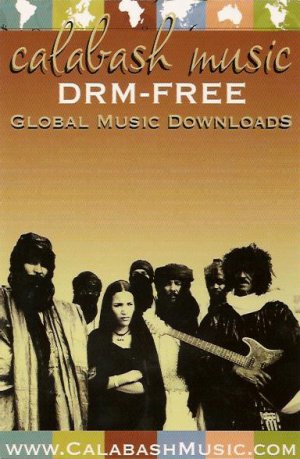
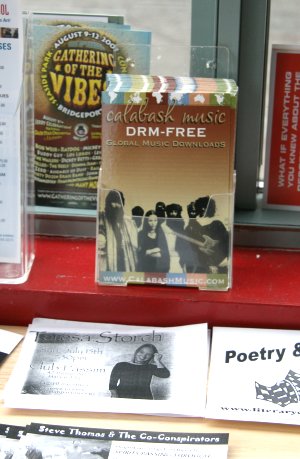
Just a couple years ago, music and technology companies would advertise their DRM schemes. While these technologies only served to prevent users of computers and consumer electronics devices from doing things, the media and technologies companies tried to spin it positively. Think of all the wonderful media that the music, film, and publishing industries will be willing to distribute to you at the click of a button, they said. All they asked for in return is the keys to your computer and the legal right to attack and sue you if you try to take control. As everyone who purchased iTunes music and made the mistake of buying a non-Apple DAP incapable of reading Apple DRMed music knows, DRM is a bad deal for consumers. Users are always better off with an unencumbered media file. In all the excitement over major label content, some consumers didn't see this immediately. With time though, the inconvenience of a computer that does the Apple and the RIAA wants over what you want hit home. This, combined with activist projects like the FSF's Defective By Design, have turned the tide. The DRM label that used to be a badge of honor is now a stigma that smart companies are going out of their way to avoid. This past weekend, I saw this flier from Calabash Music in the crepe store across the street: /copyrighteous/images/calabash_drm_table.jpg /copyrighteous/images/calabash_music_flyer.jpg The store served a general, non-technical audience. DRM-FREE, it turns out, is a good way to sell music. Not just to geeks but to any consumer who has been stymied unfairly by DRM or knows someone who has. That, it turns out, is a whole lot people. Consumers know what DRM is and they know don't like it. As consumers learn more about DRM, they want to avoid it. Seeing this, the companies that produce DRM are looking for ways to escape. The Apple/EMI deal seems to be an attempt to protect market share that the use of DRM is threatening. Others, like HBO's Bob Zitter, are disingenuously attempting to escape the stigma of DRM by simply rebranding the technology. Of course, DRM suffers from a much more fundemental problem than bad branding. The problem with DRM is that consumers don't like what it does and are only sometimes willing to suffer through it when not given the choice. Increasingly often, as with in the example of the flier I found, consumers have a choice. Things don't look good for DRM. For DRM opponents, the self-defeating nature of the technology is our greatest ally.

3 July 2007

Paul van Tilburg: Ruby D-Bus 0.2.0

Arnaud and I finally managed to release Ruby D-Bus “Almost live from DebConf 7” 0.2.0. The release was planned for DebConf 7. However, I didn’t manage to get it ready in between all the talks, meetings, and other social stuff. Ruby D-Bus is an implementation of the D-Bus protocol in pure Ruby. After starting the development in February, it soon became apparent that several other projects were out there with about the same goal, such as Pure Ruby DBUS and R-Bus. Our approach is to have an API that is close to the old Ruby D-Bus bindings. While the other, similar projects seem to have a slightly different goal, we still invite them to come to some sort of merging so that no duplicate effort is put into three or four separate projects with almost the same result. The 0.2.0 release is our first real public release. We have a large subset of the features working and documented. The main focus of this release was to improve the API documentation and the tutorial. The 0.2.0 release is a release for exploratory purposes. We invite everyone interested to have a look at the API and inner works and provide us with feedback and/or patches. This means that the API can still change a bit over time based on feedback and tweaks performed by ourselves. So don’t built a big application on it just yet if you’re not willing to make some changes later on. For more information, see our project (Trac) page.

Neil Williams: DebConf7 keysigning

I've generated a springgraph of the DebConf7 keysigning keyring after refreshing the keys today. Thumbnails are available now. Click the thumbnail to see the full image. I've tried to correlate the thumbnails so that the overall area is similar.

For some reason, the images don't show via my blog.

For comparison, the springgraph before DebConf:

http://gnupg.neil.williamsleesmill.me.uk/ksp-spring.png

(The main image is much larger - may be best to wget it and view it locally.)


http://gnupg.neil.williamsleesmill.me.uk/ksp-spring-thumb.png


The change after DebConf:

http://gnupg.neil.williamsleesmill.me.uk/afterksp.png


http://gnupg.neil.williamsleesmill.me.uk/afterksp-thumb.png

(a much smaller final image).

2 July 2007

Neil Williams: deb-gview remote .deb viewer

This isn't new, I just thought it was worth noting because it is useful to show an example of a packaging principle when sponsoring new maintainers etc.

deb-gview has been extended via GnomeVFS to view the contents of any .deb in the archive without having to install the package and without having to separately download the .deb itself. Either copy the link address and load the .deb on the command line or configure your browser to use deb-gview as a helper for .deb files (right click a .deb and select open with... or similar). Then just double click on any text file within the .deb to view it. Also works with manpages and images inside the .deb, other filetypes can be supported via a config file. Supports viewing a .deb for any architecture, not just your own (useful to see if the autobuilders have really done what you expected with generated files).

e.g. when advising on using README.Debian, it was useful to give a simple URL to allow the user to easily see the format:

$ sudo apt-get install deb-gview
$ deb-gview http://ftp.uk.debian.org/debian/pool/main/g/gpe-shield/gpe-shield_0.9-1_amd64.deb

The URL itself comes from viewing the package on packages.debian.org, clicking any architecture and right clicking the name of whichever mirror you want to use (or configure the browser as above).

Also supports .changes files so you can view all .deb files within a build or view the packages in the incoming queue direct from a d.d.p.o page.

The advantages over debc / dpkg -c dpkg -I are:


Using GnomeVFS means using a few Gnome libraries but even for non-Gnome users, this shouldn't be too much of a burden.

1 July 2007

David Welton: 10 Years of Debian

I'm not sure of the exact date - if my memory serves me correctly, it was sometime during the summer of 1997 - I was given an account on Debian's server (located, at the time, in Beaverton, Oregon). I didn't go on to upload my first package until October of that year, as I had landed my first programming job at the same time, at CKS Partners. The "new maintainer process" in those days consisted of Klee Dienes calling me up and checking that I was a real person, had a pgp key, and wasn't completely clueless. It was a very different project in many ways than it is today - much smaller, much more informal, and of course much less well known in the world at large. Some elements were in place, though - my recollection is that the "flame friendly" atmosphere, while perhaps not quite as accentuated as it at times appears today, was firmly in place even back then. In '98, '99', and 2000, the Linux world was an exciting place to be. I still recall reading about the database companies deciding to release their products on Linux, reading The Cathedral and the Bazaar, and going to one of the first big commercial Linux conferences, in San Jose, in early 1999. Debian was well poised to take advantage of Linux's growth, too. Under Bruce Perens' leadership, several key elements of Debian had been put in place, like the social contract and free software guidelines. Fortuitously, Jason Gunthorpe was working on apt in that time period as well, which was another key element in Debian's success. One of the things I've always admired about Debian in the open source world is that it is in some ways a "stepping stone" project, meaning that it's a good way for people to start getting involved with free software, to get their toes wet "giving something back", without already being an expert hacker. It's easier to maintain a package of code, if you're willing to put in the time and attention to details, than to, say, write a new kernel module, or some other piece of critical C code. I've seen a number of people take this route - they get started with Debian, and as they go, learn more about the packages they work with, and perhaps even get involved with them "upstream", as they acquire skills and knowledge. By no means is everyone in Debian in that situation, though - there are some really first rate hackers, who tend to be the small core of people that really make Debian zing along. Indeed, being an autodidact in the world of computers, outside of one very forgettable term of C++ at Lane Community College, has given me an immense appreciation for the enormous opportunities open source affords in terms of learning - and especially hands-on learning. How many other fields let you work from anywhere in the world with an internet connection, with anyone else who is interested in the same subject, at whatever time you want, with tools that you can download entirely for free? It's really an intoxicating sensation realizing that you can do anything you want if you are willing to put the time in to learn how. The learning opportunities are one of the many things I'm grateful to Debian for. These days, I'm really not involved much with Debian anymore. I mostly run Ubuntu, which I think has perhaps improved on some of the social aspects of Debian (although Mark's zillions of dollars certainly play a large role, too). In terms of free software, I don't have as much time, and dedicate more of it to my own projects like Hecl. I still love the idea of open source software, but I'm also older and wiser (or more cynical?), and must face the reality that without scarcity, you have nothing to trade with others for things like food. Due to my lack of activity, perhaps I should resign, but ... I really don't want to, and who knows, maybe I'll have more time, and an "itch to scratch" at some point in the future. Who knows what the next ten years hold for Debian?

28 June 2007

Steve McIntyre: Slowly recovering...

Debconf's over for another year - people have gone their separate ways, taking their newly-shared sense of purpose (and germs!) back home with them. Speaking for the organising team, I think we can justifiably be proud of ourselves - we seem to have pulled off a Debconf! Not everything worked perfectly or quite as we expected/wanted, but in the end I don't think we had any major issues. Fundamentally, it seems that all the attendees enjoyed themselves immensely and lots of productive work and socialising happened. That's the important bit! Thanks to all of you that turned up and helped us to make the conference a success this year, especially the volunteers who dived in to fetch, carry, man the front desk, run the cameras, organise the day trip, etc. And also (of course) to the sponsors who paid for the event - we love you all! The orga team still have some small bits to finish up before we declare things completely finished, though. We've still got some bits and pieces left in Edinburgh yet, waiting to be returned to their respective owners. And we're going to make a start on the post-conference report shortly. That's a place where conference attendees can help us again - we're looking for short write-ups of your experiences at the conference and a good selection of photos to give an impression of how things went. If you're able/willing to help, please mail the debconf-team list. Thank you and goodnight.

MJ Ray: Online Banking with GNU/Linux, Firefox-based browsers or Free Software: 2007-06-28

Problems reported on ingdirect.es:
"I get a message in Firefox to the effect that the web page is NOT a secure site, even though the address bar shows the URL as https...??? THIS is the URL on the pop up. THIS is the URL of the bank's opening page. Access de clientes is the link to log in."
I didn't see the cause at a glance... anyone? Does this work with GNU/Linux or not? Also spotted a D+Cglug subscriber reporting problems on UK HSBCnet - anyone willing to confirm or reject that? Comment form at the bottom of the list.

27 June 2007

Neil Williams: UK politics

I usually don't foray into this topic but I'm unsure whether this is something that others simply haven't noticed or whether everyone else is just being nice to the new UK PM and the new deputy leader of the governing political party.

Gordon Brown: GB
Harriet Harmann: HH

Is it just me or doesn't that just lend itself to being shortened to: GBH ?
(Grevious Bodily Harm in UK court speak) - the repetition of harm in Harmann almost qualifies as a recursive acronym!

Neil Williams: back home

Not just back home but with a working internet connection too - at least within the constricted definition of "working" that apply to my ridiculous BT line. 1.1 miles from the exchange by car (I have to drive passed it twice a day), 5.2 miles line length. Ugh?

Initially, a (presumably) stale connection was giving me about 5kb every hour. (No kidding - it took 2 hours to load the ISP webpage in Lynx.) Really annoying because it would cause things like apt and ssh to just timeout every single time.

Still, after waiting on the line for 25minutes, the ISP tech support was able to identify the problem and cause the login to be reset.

Just completed the keysigning caff process (so lots of people are about to get lots of caff mail) and now I can actually get back to my packages. Yippee!

26 June 2007

Jonathan McDowell: Nice guy EDI

I've spent the last week and a bit in Edinburgh, at DebConf7. I found it took me a couple of days to adjust for some reason, but after I'd managed to lose all sense of time everything went much better. I'll probably spend the next week recovering and catching up with real life. I have to say I don't feel I achieved a whole lot while I was there. When I went to my first DebConf (DebConf4, in Brazil) I spent a lot of time hacking and making progress on things. I didn't manage to do so well in Finland, nor this year. I'm not sure that's entirely what DebConf is about though. I saw a lot of people; the UK crowd who turn up to most things, people I hadn't seen since Finland, and those who I hadn't see since Brazil (and must try harder to see more often). And of course several names I was able to put to faces. This is a really useful part of such events - I find it's much easier to deal with people online once I've met them in real life and have an idea where they're coming from. Having said I didn't achieve much I did many to leave with a lot of things in my personal todo list. I had the calendar conversation a couple of times again, at greater length, resulting in being told that I should just do it. So I need to think about a proper design. I started looking at Just Writing Code, but the problem is such that I believe a more rigorous approach is required. Another item was ARM hacking; I sat in on the ARM BOF and caught the end of the Emdebian stuff, as well as talking to Wookey and Neil Williams quite a bit about it. Wookey's convinced me that working on mainline Balloon2 support is still useful, even if everyone is more interested in Balloon3. And I thought a bit about starting to do some AM work again, assuming I can find enough time to do a decent job of it. Mao was sadly lacking; I got a couple of games in, but not the number I'd come to expect from previous DebConfs. I think the trick is to find Marga sooner... In addition to the travel to Edinburgh we ended up with a daytrip to the Isle of Bute - thanks to Patty Langasek for organising this. We managed not to lose anyone, and had a visit to a public loo from 1898. Post DebConf a bunch of us ended up in Solva for a party to celebrate Daniel and Rob's civil partnership. It was well worth the travelling, and good to see people who hadn't been at DebConf. Finally, on the way back home, we detoured via Stonehenge. Anyway. Now I'm back home, Katherine's turned up for a bit and hopefully I'll manage to do some of my todo list. See y'all next year in Argentina, assuming I can find the funds.

25 June 2007

Miriam Ruiz: Classifying games for children

Parents and educators should be aware about what kind of games their children play. In the current state, this means that the parents must be gamers themselves to know about that, because there’s no way of knowing whether a game includes sex, violence, sexism, etc. until you play it. The idea is to provide a way of classifying games so that parents can know in advance whether the game involves certain culture-dependent controversial stuff, and being able to use that when considering what games they want their children to play, or what games they want to play themselves. Not that I’m the proper one to make the classification myself, but it should be done by teachers and educators, who I think are the best suited for this kind of task. In any case I’m willing to lead and coordinate the project, with the support of just some Spanish teachers for the moment. I hope that in the future teachers of other cultures will like to get involved too and the system can evolve to a multicultural one. The result should be as culturally independent as possible, but that would only be possible if members of different cultures help. There’s no way to provide a totally objective classification of moral stuff, so instead of trying to make the classification as aseptic as possible, it might make more sense to make it the other way round: trying to have all the different possible points of view, even when some of them might not even fit my own beliefs. Links:

24 June 2007

Jose Carlos Garcia Sogo: iPhone and the corporate environment

Enrique Dans writes about the "The Coming Battle: Apple's iPhone vs. Corporate IT Departments". He makes an interesting point on how this new gadget can be a point of friction between managers of IT departments and their employees using this kind of gadgets, usually corporate executives. Syncing the database with RIM devices, or redirecting email accounts (iPhone is not capable of using corporate Blackberry or MS Exchange servers), can be a problem in corporate world. If you read those articles, they blame iPhone for not supporting all these enterprise-class software.
Incompatible technology has become an increasing problem for businesses as hand-held email and phone devices are evolving into minicomputers that can do such things as download music, take pictures and surf the Web. In the past, businesses have been unwilling to support certain devices, like those with cameras, for instance, because of concerns employees could use them to document company secrets. ... A business email system can use a popular email standard known as IMAP to sync with an iPhone. While many large companies have the ability to activate IMAP, they have chosen not to because they are worried about exposing their mail servers to the public.
Basically, IT departments are blaming iPhone for not supporting their competition systems, and they are not requiring all them (and themselves) to be using standards, which were just designed to avoid this kind of problems. They are afraid. No more comments.

23 June 2007

John Goerzen: This week's discovery: mpix.com

Back in 2000, I started to get back into photography. I bought a Canon Elan IIe 35mm SLR camera, some lenses, and a flash. I took color photos various places, and then bought some standard Kodak T-Max black and white film. I shot some photos, and then tried to get this film processed.

Turns out it's not terribly easy to pay someone to process black and white film. Very few of the local photo places will do it. The place I usually used was willing to send it off to Kodak for me. Lacking a darkroom at home, and any interest in doing darkroom work myself, I sent it off to Kodak.

Kodak processed my film just fine, but the prints they made were terrible. It looked as if their enlarger was seriously out of focus. Everything was fuzzy on the prints. The local shop agreed to send them back for re-printing. On try 2, they were somewhat better but not much.

Now, B&W photos should normally be sharper than color photos, so this was nanoying.

I kept looking, and nobody locally could print B&W photos. I even tried one roll of B&W C-41 film (that's color-process film that takes photos in black and white). It stank about as much as I thought it would. I did eventually find one local lab that could take B&W negatives and, via a digital process, print the photos on color paper. They came out far more crisp than Kodak's processing on real B&W paper!

Now, 7 years later, I've been shooting some photos with my Canon Digital Rebel XTi digital SLR camera that I want to print in black and white. There are any number of color labs that I can send them off to, and get results as sharp as one would expect from a color photo. I'd been doing that with reasonable results. But I wasn't satisfied with "reasonable", so I searched some B&W groups on Flickr to see what people were doing to make B&W prints from a digital source.

It was there that I learned of mpix.com, the online service of the USA's largest pro photo lab. They offer printing on true B&W photo paper from digital (or film) sources. They're a pro lab, so they ought to do this really well. They of course also do color printing. Plus all the other things you'd expect from a pro lab, such as red-eye removal, glasses glare removal, color retouching, choice of photo paper, etc.

I sent off my first order for B&W prints to them yesterday. I can't wait to see how they turn out. I'm excited -- I think they'll be great.

22 June 2007

Edd Dumbill: Collecting minimal user information

Web applications are in constant competition for a user's attention. Unlike shrink-wrap software, there's often no captive audience, and web apps must gently guide and woo users to help them to the best experience of the software. This is particularly true when considering the problem of collecting personal details from a user. Collect too little information, and your app might not be able to function effectively. Collect too much information, and you raise the barrier for participation with your application. Users may either not be bothered, be alarmed at the apparent intrusion into their privacy, or fill out bogus information.  One size doesn't fit all
I originally stumbled on the issue in the development of Expectnation. The amount of information a conference speaker needs to give the organizers is significantly more than that of, say, a reviewer. An organizer will often want postal and phone details for a speaker, which are largely irrelevant to the review process. All conferences and events rely on the willingess of participants, so the path to participation needs to be as frictionless as possible.
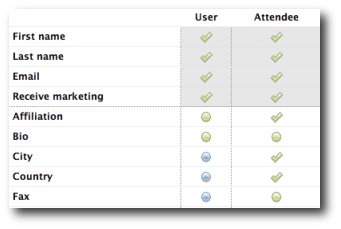
Thus, a one-size-fits-all personal details form didn't make sense for us. At best, we could have simply made more fields optional, but that would result in missing information that we really did need. Another solution would be to provide a dedicated personal details form per user type, e.g. different forms for speakers and reviewers. This is a non-starter, however, as users can take on many roles within a conference. So, we had a problem on our hands: different levels of interaction with our application requires different levels of personal information. We also had a second problem, which is that not all events and organizers want the same level of information. For example, a user group event is unlikely to need the same amount of information from speakers as an academic conference. Thus we have two axes on which the amount of information required varies: by role, and by event.  Our solution: progressive disclosure We concluded that we wanted to adhere to two principles in the collection of user information for Expectnation: The first objective was achieved by constructing a matrix of information items against user role, with the possible values of required, optional, unused for each item. We then achieved the second objective by allowing this matrix to be varied over each event. We've named this concept "progressive disclosure." What this means in practice is that a user is only ever asked for the information required to fulfil the roles they have within Expectnation. If they take on another role, they are asked for the additional information at that point, and not before. Implementation concerns Expectnation user disclosure editing
Extract from disclosure level editing UI It would be untrue to say that progressive disclosure is simple to implement. A user in our system will have disclosure requirements that are the union of all of their roles in all of the events they attend. Within Ruby on Rails, this means the conventional validation logic is useless to us, as it only deals with static requirements. Secondly, disclosure requirements are expensive to compute, so we need to cache them, with the inevitable addition of issues such as cache invalidation. Beyond the data model issues, the user interface issues are, if anything, more troublesome. From an end-user's point of view, the difficulty arises when we need extra information from them, and presenting this in a way that makes sense. From the event organizer's point of view, we have the challenge of presenting a controlling user interface for rather a complex concept. Organizers must be able to change the level of required information either globally, or per-event. We opted for a grid presentation, an extract from which is shown in the screenshot in this article. Over time we'll be able to see how effective this interface is, and what we can do to improve it. Finally, we have chosen sensible defaults for all disclosure levels, as the best result would be that organizers have little need to reconfigure the settings in the first place. Making it look easy Because Expectnation is a general application for organizing events, rather than targetting one specific one, we've had to construct a framework for minimizing user information collection, as opposed to simple implementation of known scenarios. At the end of the day we have added a fairly complicated subsystem and an extra degree of complexity to our codebase. However, the result from the user's point of view is increased simplicity and a streamlined experience. Every time you embark on something that wide-reaching and complex, you have to ask yourself whether the feature is really worth it. In this case, though, the answer is a resounding "yes". The user is the most important factor in our software, and making their life easier in an unobtrusive manner is a priority.

20 June 2007

Neil Williams: dpkg filtering

This started as an Emdebian idea but it is growing into a more all-purpose option. The requirement is to be able to filter packages during installation or cross-building so that manpages, infopages, documentation (including changelogs, copyright and readme etc.) and translation files for unsupported locales are omitted. When installing, the files would simply not appear on the filesystem or in the dpkg status information. When building, the files would disappear from the package completely (hence the role of filtering in Emdebian). The intention is that embedded systems can have empty /usr/share/man/ /usr/share/info/ and /usr/share/doc directories and a much reduced number of translation files in /usr/share/locale - the default would be only the translation files for languages that are supported on that machine, via 'dpkg-reconfigure locales'. Initially, only the narrow filters needed by Emdebian were considered - discussions at DebConf7 have shown how this can be easily extended to support arbitrary filters - necessarily the risks of using such optional filters would be made clear to the users in the manpage etc. - so that any file in any package could be omitted from the install process and the package file lists as well as during the preparation of packages for embedded devices.

Filters would be glob patterns held in a file in /etc/ (possibly /etc/dpkg/filters.d/) and would include the option to exclude files en-masse and specifically include some files that may otherwise be excluded in specific circumstances. The same filters could be used when building packages for embedded usage as well as installing Debian packages on systems where space is a problem. The main benefit of this filtering for Emdebian is that it makes it much easier to isolate the package changes needed to make the package cross-compilable from the changes needed to remove stuff that embedded devices don't need but which Debian Policy requires. This in turn makes Emdebian patches more useful to Debian maintainers when bugs are filed on their packages about a failed cross-build.

So far, it's taken up most of my hacking time in DebConf. Ian Jackson, Enrico Zini and Wookey have all helped improve the original ideas during that time. Prototype code is mostly complete but the extended filtering support will now have to wait until after DebConf. I'm hopeful that the patch will be accepted, once it is ready.

If this seems strange or unnecessary, just compare the disc usage of /usr/share/doc (which you can control) with /usr/share/locale/ (which you cannot currently control) or view the baobab images from my current laptop installation.

19 June 2007

Scott James Remnant: Slippery Slopes

One of the most interesting thing about slippery slopes is how you never seem to be standing at the top of them, looking down. The slope seems fine at the top, and it’s only once you start down it that you realise this could end up with some broken limbs. When Ubuntu was formed, Debian were having a debate about how to treat GFDL documentation. It was their opinion that the GFDL was inherently non-free, and they’ve since taken steps to remove all such licensed documentation from their main distribution. We took a more pragmatic approach, and decided that it maintained the spirit of freedom, and thus we continue to this day to ship that documentation in our main distribution. A similar discussion resulted in the handling of data files such as graphics, icons, fonts, etc. We decided that such things didn’t necessarily need to ship with corresponding source code, as frequently they don’t have any such thing or when they do, it’s just as easy to modify the data file directly. The slope didn’t seem at all slippery back then. Then came the issue of firmware, binary blobs in the kernel which are uploaded into a flash (or similar) chip in the hardware. Could we distribute these? On one hand, these blobs have always existed, they just used to be in ROM in the hardware; the move to firmware doesn’t change that. On the other hand, they’re machine code and if we had the source, we could improve the hardware as well. And what if we didn’t distribute them? Our users would be stuck without being able to use some fairly (to them) critical parts of their computer. In the end, the argument that firmware isn’t inherently any less free on the disk than in the ROM won, so we opted to continue to ship it. Perhaps that slope is a bit slippery, but we’ve got a good foothold. Of course, at that point somebody notices the binary “Hardware Access Layer” in the Atheros WiFi card driver. It’s not firmware, it’s run on the host processor, and is separate to “comply with FCC law”. (The ipw3495 driver has a binary daemon that allegedly performs the same legal function). Again, if we don’t distribute that, a large section of laptop users will not be able to use their WiFi cards. A compromise was reached; because the driver is necessary we’d ship it, but in a special restricted component that makes it absolutely clear that it’s not completely free. Users could choose to remove that component and any packages from it, to keep their system untainted. Ok, foothold wasn’t as strong as we thought; tumbled a bit, but we’re definitely on solid ground now! That’s what we thought, anyway. Unfortunately it seems that there’s a point a little bit lower down the slope which has a fantastic vista. The views from there are just incredible, people are saying, much prettier than where we are now. The only trouble is that we’re not sure there’s a foothold down there, if we try for the better view, we could end up broken at the bottom. I’m talking, of course, about the NVIDIA binary X driver. (Some reports/blogs/etc. indicate we’re also considering the ATI fglrx driver, this isn’t true – that driver doesn’t support AIGLX, so it’s not being considered.) We’ve shipped this driver in our restricted section, but not enabled it by default. It’s been there for people who want it to switch on, if they know how, but the default driver has always been the free (albeit obfuscated) one in the Xorg distribution. The problem is that users do not need this driver, they can get decent enough 2D graphics support from the free(ish) driver. In the long term, they may even get decent 3D graphics support from the nouveau driver effort. What’s the problem then? Simple, other operating systems use the 3D GPU to make the desktop seriously beautiful. If Linux doesn’t catch up and do the same, then we’ll be considered obsolete again. And just to drive the point home, some of our Linux friends shipped similar support in their last releases. They don’t enable the NVIDIA binary driver, but this means that a large percentage of their user base can’t get the bling without manual hackery. We needed a way to catch up with both the commerical operating systems and other Linux distributions; we have a policy of not doing our own software development, but only packaging what others have developed, so the only way for us to get ahead was to package something that others wouldn’t. Which brings us back to the NVIDIA binary driver. If we install that by default, we’ll be bringing a 3D desktop to more people. And we’ll gain a step ahead of the other distributions. Will our users care? To be brutally honest, I think the answer is no! In fact, I suspect our users will largely love us for this decision. Most probably already install the NVIDIA driver anyway, because they think it’s better, or because (sadly, like me) they have a card combination not supported by the free one. Will this make any difference to the effort to get NVIDIA to free up the driver, or at least the specs? Sorry, but to be honest again, I don’t think it’ll make one little difference. Linux distributions have been refusing to install it for years, and yet NVIDIA haven’t budged in their position. Perhaps a new tactic is required. Maybe if we do install it, we’ll be more likely to be chosen by OEMs as we can actually support the hardware they install. Then later, we may be able to actually affect their decision as to what hardware they install, and maybe then NVIDIA will pay attention. Will this change the perception of Ubuntu in the Linux developer community? I’m not sure about this one, I think that those who already feel strongly about the distribution of binary drivers are probably already pretty grumpy at us distributing things like the Atheros and ipw3495 drivers. I suspect this will change the opinion of a lot of people who’ve been on the fence until now, probably equal in both directions. Will we be able to sleep at night? Despite all of the above, personally I still think that installing and using the nvidia driver by default, when the nv driver would do, is the wrong decision. If the nv driver doesn’t work, I’m willing to accept the nvidia driver being used; provided that there’s some message informing the user what’s happened, why it has happened, and which alternate graphics cards they can purchase if they aren’t willing to accept a non-free binary driver. If the nv driver is good enough for 2D, I would prefer that we instead disabled the 3D desktop effects for this group of users (by default). A similar message could explain why this is disabled, again which alternate graphics cards provide this by default, but also provide a button for the user to enable it if they wish. While we should make the correct moral decision for the defaults, we shouldn’t stand in the way of users who wish to make a different decision for themselves. Later as the nouveau driver becomes stable, we may be able to activate 3D support for nvidia users by default. I think that preserves our current foothold, we’d only activate it if there is no free alternative. Where there is, we’d be educating users about why they may wish to consider alternatives to NVIDIA in future, while at the same time not getting too much in their way if they want to see the better view down the slope. Unfortunately it’s not my decision, and I suspect that the lure of the bling will win out. With any luck, we’ll find a foothold there, and the fallout of doing so won’t be too bad. I’m just worried that once we compromise on this, we’ll start compromising on other things … would we replace Firefox with a non-free web browser that rendered web pages “better”? The slippery slope only gets steeper from here on …
16 June 2007

Neil Williams: Arrived in EDI

OK, after fighting with the Edinburgh traffic / roadworks, I'm finally in-situ and online. Just going to go and find the venue, get badge, etc., ready for the full start tomorrow. (My first DebConf!)

13 June 2007

Biella Coleman: Oprah collecting health insurance stories

I promise to write about something else very soon, but I have to post this given what I have just written. Ms Oprah is seeking Healthcare Insurance Company Experiences
Tell us about an experience you had with your healthcare insurance company. Please write in only if you are willing to appear on national television.
I am sure my story is babycakes compared to the scary stuff that is actually happening out in the so-called “Land of the Free.” Like people being denied some cancer treatment, them dying, and then some of the head honchos feasting on their major organs, but hey, I submitted anyway.

8 June 2007

Ian Murdock: Where do I download OpenSolaris ?

Quick poll: What do you think of when you hear the name “OpenSolaris”? It’s an operating system? The community version of Solaris? Right? Not quite. Like Linux, OpenSolaris is a kernel. Except that it’s more than a kernel. Or, rather, more than a kernel but not quite a complete operating system. Are you confused yet? This comment from a recent Register article sums up the problem quite nicely:
If you go to the OpenSolaris web site, all bright eyed and eager to download a new operating system, you will walk away in bitter disappointment. Sure, it says the word “open” in two dozen languages on the web page, but when you go hunting for an installer disk to download, suddenly you are cast into a maze. Nevada builds? What the hell is Nevada? Oh, it’s what they’re calling the OpenSolaris code base. You’ll need to download these components and build them. Well, how do I install it? Oh, you can’t do that, you need to have a Solaris machine up already to build on. But you can get started if you go to Sun’s site and download their Solaris Express Enterprise Pro Champion Edition (after dutifully registering), and then enjoy that pleasant install experience. And when that’s done, you still have the work ahead of you of getting ON (what the hell is that? Oh, OS and Network. Sorry, I don’t work at Sun) built and updated. Did I miss anything? We haven’t gotten to packages to make the system usable yet.
Now, I’m willing to wager most of you reading this have probably heard about DTrace, ZFS, Zones, and the other great stuff Solaris has to offer, not to mention that Solaris is about as enterprise grade as they come, having been at the heart of the data center longer than many of the alternatives have even existed. And don’t forget about more mundane but critical things like backward compatibility, where Solaris has excelled for a very long time. But how many of you have actually experienced this great stuff first hand? How many hands go down if you’re under 30 and don’t remember the Sun workstation—i.e., you’re one of the many for whom Linux = Unix for as long as you’ve been in the computer business? How many of you would take Solaris for a spin if doing so was as easy as, say, downloading the latest version of Ubuntu and installing it? In other words, with all the buzz about making Solaris more familiar to Linux users, it turns out the widest part of the familiarity gap isn’t even technological. So, how do we bridge it? We need to make “OpenSolaris” something you can touch, something you can “Download Now!” and run on your laptop to try out the latest and greatest from the OpenSolaris community. We need to clearly articulate the link between Solaris and OpenSolaris in ways the industry understands—namely, that OpenSolaris is the rapidly moving version that delivers the latest innovations, and that Solaris is the enterprise-grade, supported-for-many-years, backward-compatibility- guaranteed version for the data center. Furthermore, the link needs to be more than just “OpenSolaris as upstream for Solaris”. Given how many more copies of Fedora and Ubuntu are running in the world than the enterprise Linuxes, there is significant opportunity here if we can get the model right. In short, to make OpenSolaris (and, by extension, Solaris) more familiar to Linux users, the first thing we need to do is make it a “distro” in the Linux sense of the word. After all, when people say they know “Linux”, that’s what they’re talking about—how many people really care about the Linux kernel underneath? What they care about is the GNU tools, the desktop, the development environment, and all the other things their favorite distro bundles—and the package system that holds it all together. There’s no reason in the world why (Open)Solaris can’t deliver those same things. Oh yeah, and DTrace, ZFS, Zones, enterprise grade security/scalability/performance/etc., backward compatibility, etc. too. Put this way, it’s easy to imagine what OpenSolaris needs to look like. That’s why the issues here are not primarily technological. This is the essence of the Project Indiana you’ve read so much about in the past several weeks. Our goal is to create a binary distribution of OpenSolaris that simultaneously delivers what people have come to expect from “Linux” alongside the great stuff that make Solaris unique. What comes next? We’re working that out in real time. If you’re interested in following along, participating, or just giving us your two cents, I encourage you to join the indiana-discuss mailing list we just created. We’re particularly interested in hearing from you if you consider yourself a “Linux user” and have been interested in taking Solaris for a spin but, for whatever reason, have considered the gap too wide. What would it take to get you running Solaris?

Next.

Previous.