Search Results: "tb"

30 September 2020

Paul Wise: FLOSS Activities September 2020

Focus This month I didn't have any particular focus. I just worked on issues in my info bubble.

Changes

Issues

Review

Administration
  • Debian wiki: unblock IP addresses, approve accounts

Communication

Sponsors The gensim, cython-blis, python-preshed, pytest-rerunfailures, morfessor, nmslib, visdom and pyemd work was sponsored by my employer. All other work was done on a volunteer basis.

Utkarsh Gupta: FOSS Activites in September 2020

Here s my (twelfth) monthly update about the activities I ve done in the F/L/OSS world.

Debian
This was my 21st month of contributing to Debian. I became a DM in late March last year and a DD last Christmas! \o/ I ve been busy with my undergraduation stuff but I still squeezed out some time for the regular Debian work. Here are the following things I did in Debian this month:

Uploads and bug fixes:

Other $things:
  • Attended the Debian Ruby team meeting. Logs here.
  • Mentoring for newcomers.
  • FTP Trainee reviewing.
  • Moderation of -project mailing list.
  • Sponsored trace-cmd for Sudip, ruby-asset-sync for Nilesh, and mariadb-mysql-kbs for William.

RuboCop::Packaging - Helping the Debian Ruby team! \o/ This Google Summer of Code, I worked on writing a linter that could flag offenses for lines of code that are very troublesome for Debian maintainers while trying to package and maintain Ruby libraries and applications! Whilst the GSoC period is over, I ve been working on improving that tool and have extended that linter to now auto-correct these offenses by itself! \o/
You can now just use the -A flag and you re done! Boom! The ultimate game-changer! Here s a quick demo for this feature: A few quick updates on RuboCop::Packaging: I ve also spent a considerable amount of time in raising awareness about this and in more general sense, about downstream maintenance.
As a result, I raised a bunch of PRs which got really good response. I got all of the 20 PRs merged upstream, fixing these issues.

Debian (E)LTS
Debian Long Term Support (LTS) is a project to extend the lifetime of all Debian stable releases to (at least) 5 years. Debian LTS is not handled by the Debian security team, but by a separate group of volunteers and companies interested in making it a success. And Debian Extended LTS (ELTS) is its sister project, extending support to the Jessie release (+2 years after LTS support). This was my twelfth month as a Debian LTS and third month as a Debian ELTS paid contributor.
I was assigned 19.75 hours for LTS and 15.00 hours for ELTS and worked on the following things:
(for LTS, I over-worked for 11 hours last month on the survey so only had 8.75 hours this month!)

LTS CVE Fixes and Announcements:

ELTS CVE Fixes and Announcements:
  • Issued ELA 274-1, fixing CVE-2020-11984, for uwsgi.
    For Debian 8 Jessie, these problems have been fixed in version 2.0.7-1+deb8u3.
  • Issued ELA 275-1, fixing CVE-2020-14363, for libx11.
    For Debian 8 Jessie, these problems have been fixed in version 2:1.6.2-3+deb8u4.
  • Issued ELA 278-1, fixing CVE-2020-8184, for ruby-rack.
    For Debian 8 Jessie, these problems have been fixed in version 1.5.2-3+deb8u4.
  • Also worked on updating the version of clamAV from v0.101.5 to v0.102.4.
    This was a bit tricky package to work on since it involved an ABI/API change and was more or less a transition. Super thanks to Emilio for his invaluable help and him taking over the package, finishing, and uploading it in the end.

Other (E)LTS Work:
  • Front-desk duty from 31-08 to 06-09 and from 28-09 onward for both LTS and ELTS.
  • Triaged apache2, cryptsetup, nasm, node-bl, plinth, qemu, rsync, ruby-doorkeeper, and uwsgi.
  • Marked CVE-2020-15094/symfony as not-affected for Stretch.
  • Marked CVE-2020- 9490,11993 /apache2 as ignored for Stretch.
  • Marked CVE-2020-8244/node-bl as no-dsa for Stretch.
  • Marked CVE-2020-24978/nasm as no-dsa for Stretch.
  • Marked CVE-2020-25073/plinth as no-dsa for Stretch.
  • Marked CVE-2020-15094/symfony as not-affected for Jessie.
  • Marked CVE-2020-14382/cryptsetup as not-affected for Jessie.
  • Marked CVE-2020-14387/rsync as not-affected for Jessie.
  • Auto EOL ed ark, collabtive, linux, nasm, node-bl, and thunderbird for Jessie.
  • Use mktemp instead of tempfile in bin/auto-add-end-of-life.sh.
  • Attended the fifth LTS meeting. Logs here.
  • General discussion on LTS private and public mailing list.

Until next time.
:wq for today.

Bastian Blank: Booting Debian on ThinkPad X13 AMD

Running new hardware is always fun. The problems are endless. The solutions not so much. So I've got a brand new ThinkPad X13 AMD. It features an AMD Ryzen 5 PRO 4650U, 16GB of RAM and a 256GB NVME SSD. The internal type identifier is 20UF. It runs the latest firmware as of today with version 1.09. So far I found two problems with it: Disable Secure Boot The system silently fails to boot a signed shim and grub from an USB thumb drive. I used on of the Debian Cloud images, which should properly work in this setup and do on my other systems. The only fix I found was to disable Secure Boot alltogether. Select Linux in firmware Running a Linux 5.8 with default firmware setting produces ACPI errors on each key press.
ACPI BIOS Error (bug): Could not resolve symbol [\_SB.PCI0.GPP3], AE_NOT_FOUND (20200528/psargs-330)
ACPI Error: Aborting method \_SB.GPIO._EVT due to previous error (AE_NOT_FOUND) (20200528/psparse-529)
This can be "fixed" by setting a strategic setting inside the firmware:
Config > Power > Sleep State to Linux

29 September 2020

Mike Gabriel: UBports: Packaging of Lomiri Operating Environment for Debian (part 03)

Before and during FOSDEM 2020, I agreed with the people (developers, supporters, managers) of the UBports Foundation to package the Unity8 Operating Environment for Debian. Since 27th Feb 2020, Unity8 has now become Lomiri. Recent Uploads to Debian related to Lomiri Over the past 4 months I worked on the following bits and pieces regarding Lomiri in Debian: The next two big projects / packages ahead are lomiri-ui-toolkit and qtmir. Credits Many big thanks go to Marius and Dalton for their work on the UBports project and being always available for questions, feedback, etc. Thanks to Ratchanan Srirattanamet for providing some of his time for debugging some non-thread safe unit tests (currently unsure, what package we actually looked at...). Thanks for Florian Leeber for being my point of contact for topcis regarding my cooperation with the UBports Foundation. Previous Posts about my Debian UBports Team Efforts

Vincent Bernat: Speeding up bgpq4 with IRRd in a container

When building route filters with bgpq4 or bgpq3, the speed of rr.ntt.net or whois.radb.net can be a bottleneck. Updating many filters may take several tens of minutes, depending on the load:
$ time bgpq4 -h whois.radb.net AS-HURRICANE   wc -l
909869
1.96s user 0.15s system 2% cpu 1:17.64 total
$ time bgpq4 -h rr.ntt.net AS-HURRICANE   wc -l
927865
1.86s user 0.08s system 12% cpu 14.098 total
A possible solution is to run your own IRRd instance in your network, mirroring the main routing registries. A close alternative is to bundle IRRd with all the data in a ready-to-use Docker image. This also has the advantage of easy integration into a Docker-based CI/CD pipeline.
$ git clone https://github.com/vincentbernat/irrd-legacy.git -b blade/master
$ cd irrd-legacy
$ docker build . -t irrd-snapshot:latest
[ ]
Successfully built 58c3e83a1d18
Successfully tagged irrd-snapshot:latest
$ docker container run --rm --detach --publish=43:43 irrd-snapshot
4879cfe7413075a0c217089dcac91ed356424c6b88808d8fcb01dc00eafcc8c7
$ time bgpq4 -h localhost AS-HURRICANE   wc -l
904137
1.72s user 0.11s system 96% cpu 1.881 total
The Dockerfile contains three stages:
  1. building IRRd,1
  2. retrieving various IRR databases, and
  3. assembling the final container with the result of the two previous stages.
The second stage fetches the databases used by rr.ntt.net: NTTCOM, RADB, RIPE, ALTDB, BELL, LEVEL3, RGNET, APNIC, JPIRR, ARIN, BBOI, TC, AFRINIC, ARIN-WHOIS, and REGISTROBR. However, it misses RPKI.2 Feel free to adapt! The image can be scheduled to be rebuilt daily or weekly, depending on your needs. The repository includes a .gitlab-ci.yaml file automating the build and triggering the compilation of all filters by your CI/CD upon success.

  1. Instead of using the latest version of IRRd, the image relies on an older version that does not require a PostgreSQL instance and uses flat files instead.
  2. Unlike the others, the RPKI database is built from the published RPKI ROAs. They can be retrieved with rpki-client and transformed into RPSL objects to be imported in IRRd.

28 September 2020

Vincent Bernat: Syncing RIPE, ARIN and APNIC objects with a custom Ansible module

Internet is split into five regional Internet registry: AFRINIC, ARIN, APNIC, LACNIC and RIPE. Each RIR maintains an Internet Routing Registry. An IRR allows one to publish information about the routing of Internet number resources.1 Operators use this to determine the owner of an IP address and to construct and maintain routing filters. To ensure your routes are widely accepted, it is important to keep the prefixes you announce up-to-date in an IRR. There are two common tools to query this database: whois and bgpq4. The first one allows you to do a query with the WHOIS protocol:
$ whois -BrG 2a0a:e805:400::/40
[ ]
inet6num:       2a0a:e805:400::/40
netname:        FR-BLADE-CUSTOMERS-DE
country:        DE
geoloc:         50.1109 8.6821
admin-c:        BN2763-RIPE
tech-c:         BN2763-RIPE
status:         ASSIGNED
mnt-by:         fr-blade-1-mnt
remarks:        synced with cmdb
created:        2020-05-19T08:04:58Z
last-modified:  2020-05-19T08:04:58Z
source:         RIPE
route6:         2a0a:e805:400::/40
descr:          Blade IPv6 - AMS1
origin:         AS64476
mnt-by:         fr-blade-1-mnt
remarks:        synced with cmdb
created:        2019-10-01T08:19:34Z
last-modified:  2020-05-19T08:05:00Z
source:         RIPE
The second one allows you to build route filters using the information contained in the IRR database:
$ bgpq4 -6 -S RIPE -b AS64476
NN = [
    2a0a:e805::/40,
    2a0a:e805:100::/40,
    2a0a:e805:300::/40,
    2a0a:e805:400::/40,
    2a0a:e805:500::/40
];
There is no module available on Ansible Galaxy to manage these objects. Each IRR has different ways of being updated. Some RIRs propose an API but some don t. If we restrict ourselves to RIPE, ARIN and APNIC, the only common method to update objects is email updates, authenticated with a password or a GPG signature.2 Let s write a custom Ansible module for this purpose!

Notice I recommend that you read Writing a custom Ansible module as an introduction, as well as Syncing MySQL tables for a more instructive example.

Code The module takes a list of RPSL objects to synchronize and returns the body of an email update if a change is needed:
- name: prepare RIPE objects
  irr_sync:
    irr: RIPE
    mntner: fr-blade-1-mnt
    source: whois-ripe.txt
  register: irr

Prerequisites The source file should be a set of objects to sync using the RPSL language. This would be the same content you would send manually by email. All objects should be managed by the same maintainer, which is also provided as a parameter. Signing and sending the result is not the responsibility of this module. You need two additional tasks for this purpose:
- name: sign RIPE objects
  shell:
    cmd: gpg --batch --user noc@example.com --clearsign
    stdin: "  irr.objects  "
  register: signed
  check_mode: false
  changed_when: false
- name: update RIPE objects by email
  mail:
    subject: "NEW: update for RIPE"
    from: noc@example.com
    to: "auto-dbm@ripe.net"
    cc: noc@example.com
    host: smtp.example.com
    port: 25
    charset: us-ascii
    body: "  signed.stdout  "
You also need to authorize the PGP keys used to sign the updates by creating a key-cert object and adding it as a valid authentication method for the corresponding mntner object:
key-cert:  PGPKEY-A791AAAB
certif:    -----BEGIN PGP PUBLIC KEY BLOCK-----
certif:    
certif:    mQGNBF8TLY8BDADEwP3a6/vRhEERBIaPUAFnr23zKCNt5YhWRZyt50mKq1RmQBBY
[ ]
certif:    -----END PGP PUBLIC KEY BLOCK-----
mnt-by:    fr-blade-1-mnt
source:    RIPE
mntner:    fr-blade-1-mnt
[ ]
auth:      PGPKEY-A791AAAB
mnt-by:    fr-blade-1-mnt
source:    RIPE

Module definition Starting from the skeleton described in the previous article, we define the module:
module_args = dict(
    irr=dict(type='str', required=True),
    mntner=dict(type='str', required=True),
    source=dict(type='path', required=True),
)
result = dict(
    changed=False,
)
module = AnsibleModule(
    argument_spec=module_args,
    supports_check_mode=True
)

Getting existing objects To grab existing objects, we use the whois command to retrieve all the objects from the provided maintainer.
# Per-IRR variations:
# - whois server
whois =  
    'ARIN': 'rr.arin.net',
    'RIPE': 'whois.ripe.net',
    'APNIC': 'whois.apnic.net'
 
# - whois options
options =  
    'ARIN': ['-r'],
    'RIPE': ['-BrG'],
    'APNIC': ['-BrG']
 
# - objects excluded from synchronization
excluded = ["domain"]
if irr == "ARIN":
    # ARIN does not return these objects
    excluded.extend([
        "key-cert",
        "mntner",
    ])
# Grab existing objects
args = ["-h", whois[irr],
        "-s", irr,
        *options[irr],
        "-i", "mnt-by",
        module.params['mntner']]
proc = subprocess.run("whois", *args, capture_output=True)
if proc.returncode != 0:
    raise AnsibleError(
        f"unable to query whois:  args ")
output = proc.stdout.decode('ascii')
got = extract(output, excluded)
The first part of the code setup some IRR-specific constants: the server to query, the options to provide to the whois command and the objects to exclude from synchronization. The second part invokes the whois command, requesting all objects whose mnt-by field is the provided maintainer. Here is an example of output:
$ whois -h whois.ripe.net -s RIPE -BrG -i mnt-by fr-blade-1-mnt
[ ]
inet6num:       2a0a:e805:300::/40
netname:        FR-BLADE-CUSTOMERS-FR
country:        FR
geoloc:         48.8566 2.3522
admin-c:        BN2763-RIPE
tech-c:         BN2763-RIPE
status:         ASSIGNED
mnt-by:         fr-blade-1-mnt
remarks:        synced with cmdb
created:        2020-05-19T08:04:59Z
last-modified:  2020-05-19T08:04:59Z
source:         RIPE
[ ]
route6:         2a0a:e805:300::/40
descr:          Blade IPv6 - PA1
origin:         AS64476
mnt-by:         fr-blade-1-mnt
remarks:        synced with cmdb
created:        2019-10-01T08:19:34Z
last-modified:  2020-05-19T08:05:00Z
source:         RIPE
[ ]
The result is passed to the extract() function. It parses and normalizes the results into a dictionary mapping object names to objects. We store the result in the got variable.
def extract(raw, excluded):
    """Extract objects."""
    # First step, remove comments and unwanted lines
    objects = "\n".join([obj
                         for obj in raw.split("\n")
                         if not obj.startswith((
                                 "#",
                                 "%",
                         ))])
    # Second step, split objects
    objects = [RPSLObject(obj.strip())
               for obj in re.split(r"\n\n+", objects)
               if obj.strip()
               and not obj.startswith(
                   tuple(f" x :" for x in excluded))]
    # Last step, put objects in a dict
    objects =  repr(obj): obj
               for obj in objects 
    return objects
RPSLObject() is a class enabling normalization and comparison of objects. Look at the module code for more details.
>>> output="""
... inet6num:       2a0a:e805:300::/40
... [ ]
... """
>>> pprint( k: str(v) for k,v in extract(output, excluded=[]) )
 '<Object:inet6num:2a0a:e805:300::/40>':
   'inet6num:       2a0a:e805:300::/40\n'
   'netname:        FR-BLADE-CUSTOMERS-FR\n'
   'country:        FR\n'
   'geoloc:         48.8566 2.3522\n'
   'admin-c:        BN2763-RIPE\n'
   'tech-c:         BN2763-RIPE\n'
   'status:         ASSIGNED\n'
   'mnt-by:         fr-blade-1-mnt\n'
   'remarks:        synced with cmdb\n'
   'source:         RIPE',
 '<Object:route6:2a0a:e805:300::/40>':
   'route6:         2a0a:e805:300::/40\n'
   'descr:          Blade IPv6 - PA1\n'
   'origin:         AS64476\n'
   'mnt-by:         fr-blade-1-mnt\n'
   'remarks:        synced with cmdb\n'
   'source:         RIPE' 

Comparing with wanted objects Let s build the wanted dictionary using the same structure, thanks to the extract() function we can use verbatim:
with open(module.params['source']) as f:
    source = f.read()
wanted = extract(source, excluded)
The next step is to compare got and wanted to build the diff object:
if got != wanted:
    result['changed'] = True
    if module._diff:
        result['diff'] = [
            dict(before_header=k,
                 after_header=k,
                 before=str(got.get(k, "")),
                 after=str(wanted.get(k, "")))
            for k in set((*wanted.keys(), *got.keys()))
            if k not in wanted or k not in got or wanted[k] != got[k]]

Returning updates The module does not have a side effect. If there is a difference, we return the updates to send by email. We choose to include all wanted objects in the updates (contained in the source variable) and let the IRR ignore unmodified objects. We also append the objects to be deleted by adding a delete: attribute to each them them.
# We send all source objects and deleted objects.
deleted_mark = f" 'delete:':16 deleted by CMDB"
deleted = "\n\n".join([f" got[k].raw \n deleted_mark "
                       for k in got
                       if k not in wanted])
result['objects'] = f" source \n\n deleted "
module.exit_json(**result)

The complete code is available on GitHub. The module supports both --diff and --check flags. It does not return anything if no change is detected. It can work with APNIC, RIPE and ARIN. It is not perfect: it may not detect some changes,3 it is not able to modify objects not owned by the provided maintainer4 and some attributes cannot be modified, requiring to manually delete and recreate the updated object.5 However, this module should automate 95% of your needs.

  1. Other IRRs exist without being attached to a RIR. The most notable one is RADb.
  2. ARIN is phasing out this method in favor of IRR-online. RIPE has an API available, but email updates are still supported and not planned to be deprecated. APNIC plans to expose an API.
  3. For ARIN, we cannot query key-cert and mntner objects and therefore we cannot detect changes in them. It is also not possible to detect changes to the auth mechanisms of a mntner object.
  4. APNIC do not assign top-level objects to the maintainer associated with the owner.
  5. Changing the status of an inetnum object requires deleting and recreating the object.

25 September 2020

Russell Coker: Bandwidth for Video Conferencing

For the Linux Users of Victoria (LUV) I ve run video conferences on Jitsi and BBB (see my previous post about BBB vs Jitsi [1]). One issue with video conferences is the bandwidth requirements. The place I m hosting my video conference server has a NBN link with allegedly 40Mb/s transmission speed and 100Mb/s reception speed. My tests show that it can transmit at about 37Mb/s and receive at speeds significantly higher than that but also quite a bit lower than 100Mb/s (around 60 or 70Mb/s). For a video conference server you have a small number of sources of video and audio and a larger number of targets as usually most people will have their microphones muted and video cameras turned off. This means that the transmission speed is the bottleneck. In every test the reception speed was well below half the transmission speed, so the tests confirmed my expectation that transmission was the only bottleneck, but the reception speed was higher than I had expected. When we tested bandwidth use the maximum upload speed we saw was about 4MB/s (32Mb/s) with 8+ video cameras and maybe 20 people seeing some of the video (with a bit of lag). We used 3.5MB/s (28Mb/s) when we only had 6 cameras which seemed to be the maximum for good performance. In another test run we had 4 people all sending video and the transmission speed was about 260KB/s. I don t know how BBB manages the small versions of video streams. It might reduce the bandwidth when the display window is smaller. I don t know the resolutions of the cameras. When you start sending video in BBB you are prompted for the quality with medium being default. I don t know how different camera hardware and different choices about quality affect bandwidth. These tests showed that for the cameras we had available a small group of people video chatting a 100/40 NBN link (the fastest Internet link in Australia that s not really expensive) a small group of people can be all sending video or a medium size group of people can watch video streams from a small group. For meetings of the typical size of LUV meetings we won t have a bandwidth problem. There is one common case that I haven t yet tested, where there is a single video stream that many people are watching. If 4 people are all sending video with 260KB/s transmission bandwidth then 1 person could probably send video to 4 for 65KB/s. Doing some simple calculations on those numbers implies that we could have 1 person sending video to 240 people without running out of bandwidth. I really doubt that would work, but further testing is needed.

23 September 2020

Russell Coker: Qemu (KVM) and 9P (Virtfs) Mounts

I ve tried setting up the Qemu (in this case KVM as it uses the Qemu code in question) 9P/Virtfs filesystem for sharing files to a VM. Here is the Qemu documentation for it [1].
VIRTFS="-virtfs local,path=/vmstore/virtfs,security_model=mapped-xattr,id=zz,writeout=immediate,fmode=0600,dmode=0700,mount_tag=zz"
VIRTFS="-virtfs local,path=/vmstore/virtfs,security_model=passthrough,id=zz,writeout=immediate,mount_tag=zz"
Above are the 2 configuration snippets I tried on the server side. The first uses mapped xattrs (which means that all files will have the same UID/GID and on the host XATTRs will be used for storing the Unix permissions) and the second uses passthrough which requires KVM to run as root and gives the same permissions on the host as on the VM. The advantages of passthrough are better performance through writing less metadata and having the same permissions in host and VM. The advantages of mapped XATTRs are running KVM/Qemu as non-root and not having a SUID file in the VM imply a SUID file in the host. Here is the link to Bonnie++ output comparing Ext3 on a KVM block device (stored on a regular file in a BTRFS RAID-1 filesystem on 2 SSDs on the host), a NFS share from the host from the same BTRFS filesystem, and virtfs shares of the same filesystem. The only tests that Ext3 doesn t win are some of the latency tests, latency is based on the worst-case not the average. I expected Ext3 to win most tests, but didn t expect it to lose any latency tests. Here is a link to Bonnie++ output comparing just NFS and Virtfs. It s obvious that Virtfs compares poorly, giving about half the performance on many tests. Surprisingly the only tests where Virtfs compared well to NFS were the file creation tests which I expected Virtfs with mapped XATTRs to do poorly due to the extra metadata. Here is a link to Bonnie++ output comparing only Virtfs. The options are mapped XATTRs with default msize, mapped XATTRs with 512k msize (I don t know if this made a difference, the results are within the range of random differences), and passthrough. There s an obvious performance benefit in passthrough for the small file tests due to the less metadata overhead, but as creating small files isn t a bottleneck on most systems a 20% to 30% improvement in that area probably doesn t matter much. The result from the random seeks test in passthrough is unusual, I ll have to do more testing on that. SE Linux On Virtfs the XATTR used for SE Linux labels is passed through to the host. So every label used in a VM has to be valid on the host and accessible to the context of the KVM/Qemu process. That s not really an option so you have to use the context mount option. Having the mapped XATTR mode work for SE Linux labels is a necessary feature. Conclusion The msize mount option in the VM doesn t appear to do anything and it doesn t appear in /proc/mounts, I don t know if it s even supported in the kernel I m using. The passthrough and mapped XATTR modes give near enough performance that there doesn t seem to be a benefit of one over the other. NFS gives significant performance benefits over Virtfs while also using less CPU time in the VM. It has the issue of files named .nfs* hanging around if the VM crashes while programs were using deleted files. It s also more well known, ask for help with an NFS problem and you are more likely to get advice than when asking for help with a virtfs problem. Virtfs might be a better option for accessing databases than NFS due to it s internal operation probably being a better map to Unix filesystem semantics, but running database servers on the host is probably a better choice anyway. Virtfs generally doesn t seem to be worth using. I had hoped for performance that was better than NFS but the only benefit I seemed to get was avoiding the .nfs* file issue. The best options for storage for a KVM/Qemu VM seem to be Ext3 for files that are only used on one VM and for which the size won t change suddenly or unexpectedly (particularly the root filesystem) and NFS for everything else.

22 September 2020

Russ Allbery: Review: Unconquerable Sun

Review: Unconquerable Sun, by Kate Elliott
Series: Sun Chronicles #1
Publisher: Tor
Copyright: 2020
ISBN: 1-250-19725-2
Format: Kindle
Pages: 526
Sun is the daughter and heir of the mercurial Queen-Marshal Eirene, ruler of the Republic of Chaonia. Chaonia, thanks to Eirene and her ancestors, has carved out a fiercely independent position between the Yele League and the Phene Empire. Sun's father, Prince Jo o, is one of Eirene's three consorts, all chosen for political alliances to shore up that fragile position. Jo o is Gatoi, a civilization of feared fighters and supposed barbarians from outside Chaonia who normally ally with the Phene, which complicates Sun's position as heir. Sun attempts to compensate for that by winning battles for the Republic, following in the martial footsteps of her mother. The publisher's summary of this book is not great (I'm a huge fan of Princess Leia, but that is... not the analogy that comes to mind), so let me try to help. This is gender-swapped Alexander the Great in space. However, it is gender-swapped Alexander the Great in space with her Companions, which means the DNA of this novel is half space opera and half heist story (without, to be clear, an actual heist, although there are some heist-like maneuvers). It's also worth mentioning that Sun, like Alexander, is not heterosexual. The other critical thing to know before reading, mostly because it will get you through the rather painful start, is that the most interesting viewpoint character in this book is not Sun, the Alexander analogue. It's Persephone, who isn't introduced until chapter seven. Significant disclaimer up front: I got a reasonably typical US grade school history of Alexander the Great, which means I was taught that he succeeded his father, conquered a whole swath of the middle of the Eurasian land mass at a very young age, and then died and left his empire to his four generals who promptly divided it into four uninteresting empires that no one's ever heard of, and that's why Rome is more important than Greece. (I put in that last bit to troll one specific person.) I am therefore not the person to judge the parallels between this story and known history, or to notice any damage done to Greek pride, or to pick up on elements that might cause someone with a better grasp of that history to break out in hives. I did enough research to know that one scene in this book is lifted directly out of Alexander's life, but I'm not sure how closely the other parallels track. Yele is probably southern Greece and Phene is probably Persia, but I'm not certain even of that, and some of the details don't line up. If I had to hazard a guess, I'd say that Elliott has probably mangled history sufficiently to make it clear that this isn't intended to be a retelling, but if the historical parallels are likely to bother you, you may want to do more research before reading. What I can say is that the space opera setup, while a bit stock, has all the necessary elements to make me happy. Unconquerable Sun is firmly in the "lost Earth" tradition: The Argosy fleet fled the now-mythical Celestial Empire and founded a new starfaring civilization without any contact with their original home. Eventually, they invented (or discovered; the characters don't know) the beacons, which allow for instantaneous travel between specific systems without the long (but still faster-than-light) journeys of the knnu drive. More recently, the beacon network has partly collapsed, cutting off the characters' known world from the civilization that was responsible for the beacons and guarded their secrets. It's a fun space opera history with lots of lost knowledge to reference and possibly discover, and with plot-enabling military choke points at the surviving beacons that link multiple worlds. This is all background to the story, which is the ongoing war between Chaonia and the Phene Empire mixed with cutthroat political maneuvering between the great houses of the Chaonian Republic. This is where the heist aspects come in. Each house sends one representative to join the household of the Queen-Marshal and (more to the point for this story) another to join her heir. Sun has encouraged the individual and divergent talents of her Companions and their cee-cees (an unfortunate term that I suspect is short for Companion's Companion) and forged them into a good working team. A team that's about to be disrupted by the maneuverings of a rival house and the introduction of a new team member whom no one wants. A problem with writing tactical geniuses is that they often aren't good viewpoint characters. Sun's tight third-person chapters, which is a little less than half the book, advance the plot and provide analysis of the interpersonal dynamics of the characters, but aren't the strength of the story. That lies with the interwoven first-person sections that follow Persephone, an altogether more interesting character. Persephone is the scion of the house that is Sun's chief rival, but she has no interest in being part of that house or its maneuverings. When the story opens, she's a cadet in a military academy for recruits from the commoners, having run away from home, hidden her identity, and won a position through the open entrance exams. She of course doesn't stay there; her past catches up with her and she gets assigned to Sun, to a great deal of mutual suspicion. She also is assigned an impeccably dressed and stunningly beautiful cee-cee, Tiana, who has her own secrets and who was my favorite character in the book. Somewhat unusually for the space opera tradition, this is a book that knows that common people exist and have interesting lives. It's primarily focused on the ruling houses, but that focus is not exclusive and the rulers do not have a monopoly on competence. Elliott also avoids narrowing the political field too far; the Gatoi are separate from the three rival powers, and there are other groups with traditions older than the Chaonian Republic and their own agendas. Sun and her Companions are following a couple of political threads, but there is clearly more going on in this world than that single plot. This is exactly the kind of story I think of when I think space opera. It's not doing anything that original or groundbreaking, and it's not going to make any of my lists of great literature, but it's a fun romp with satisfyingly layered bits of lore, a large-scale setting with lots of plot potential, and (once we get through the confusing and somewhat tedious process of introducing rather too many characters in short succession) some great interpersonal dynamics. It's the kind of book in which the characters are in the middle of decisive military action in an interstellar war and are also near-teenagers competing for ratings in an ad hoc reality TV show, primarily as an excuse to create tactical distractions for Sun's latest scheme. The writing is okay but not great, and the first few chapters have some serious infodumping problems, but I thoroughly enjoyed the whole book and will pre-order the sequel. One Amazon review complained that Unconquerable Sun is not a space opera like Hyperion or Use of Weapons. That is entirely true, but if that's your standard for space opera, the world may be a disappointing place. This is a solid entry in a subgenre I love, with some great characters, sarcasm, competence porn, plenty of pages to keep turning, a few twists, and the promise of more to come. Recommended. Followed by the not-yet-published Furious Heaven. Rating: 7 out of 10

21 September 2020

Jonathan McDowell: Mainline Linux on the MikroTik RB3011

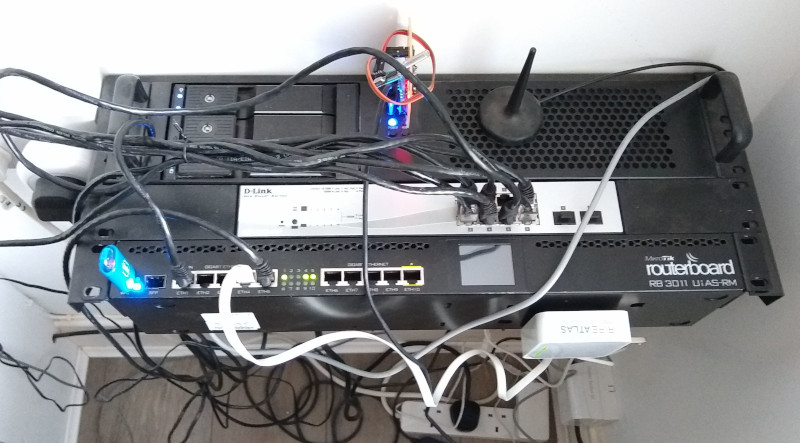
I upgraded my home internet connection to fibre (FTTP) last October. I m still on an 80M/20M service, so it s no faster than my old VDSL FTTC connection was, and as a result for a long time I continued to use my HomeHub 5A running OpenWRT. However the FTTP ONT meant I was using up an additional ethernet port on the router, and I was already short, so I ended up with a GigE switch in use as well. Also my wifi is handled by a UniFi, which takes its power via Power-over-Ethernet. That mean I had a router, a switch and a PoE injector all in close proximity. I wanted to reduce the number of devices, and ideally upgrade to something that could scale once I decide to upgrade my FTTP service speed. Looking around I found the MikroTik RB3011UiAS-RM, which is a rack mountable device with 10 GigE ports (plus an SFP slot) and a dual core Qualcomm IPQ8064 ARM powering it. There s 1G RAM and 128MB NAND flash, as well as a USB3 port. It also has PoE support. On paper it seemed like an ideal device. I wasn t particularly interested in running RouterOS on it (the provided software), but that s based on Linux and there was some work going on within OpenWRT to add support, so it seemed like a worthwhile platform to experiment with (what, you expected this to be about me buying an off the shelf device and using it with only the supplied software?). As an added bonus a friend said he had one he wasn t using, and was happy to sell it to me for a bargain price. RB3011 router in use I did try out RouterOS to start with, but I didn t find it particularly compelling. I m comfortable configuring firewalling and routing at a Linux command line, and I run some additional services on the router like my MQTT broker, and mqtt-arp, my wifi device presence monitor. I could move things around such that they ran on the house server, but I consider them core services and as a result am happier with them on the router. The first step was to get something booting on the router. Luckily it has an RJ45 serial console port on the back, and a reasonably featured bootloader that can manage to boot via tftp over the network. It wants an ELF binary rather than a plain kernel, but Sergey Sergeev had done the hard work of getting u-boot working for the IPQ8064, which mean I could just build normal u-boot images to try out. Linux upstream already had basic support for a lot of the pieces I was interested in. There s a slight fudge around AUTO_ZRELADDR because the network coprocessors want a chunk of memory at the start of RAM, but there s ongoing discussions about how to handle this cleanly that I m hopeful will eventually mean I can drop that hack. Serial, ethernet, the QCA8337 switches (2 sets of 5 ports, tied to different GigE devices on the processor) and the internal NOR all had drivers, so it was a matter of crafting an appropriate DTB to get them working. That left niggles. First, the second switch is hooked up via SGMII. It turned out the IPQ806x stmmac driver didn t initialise the clocks in this mode correctly, and neither did the qca8k switch driver. So I need to fix up both of those (Sergey had handled the stmmac driver, so I just had to clean up and submit his patch). Next it turned out the driver for talking to the Qualcomm firmware (SCM) had been updated in a way that broke the old method needed on the IPQ8064. Some git archaeology figured that one out and provided a solution. Ansuel Smith helpfully provided the DWC3 PHY driver for the USB port. That got me to the point I could put a Debian armhf image onto a USB stick and mount that as root, which made debugging much easier. At this point I started to play with configuring up the device to actually act as a router. I make use of a number of VLANs on my home network, so I wanted to make sure I could support those. Turned out the stmmac driver wasn t happy reconfiguring its MTU because the IPQ8064 driver doesn t configure the FIFO sizes. I found what seem to be the correct values and plumbed them in. Then the qca8k driver only supported port bridging. I wanted the ability to have a trunk port to connect to the upstairs switch, while also having ports that only had a single VLAN for local devices. And I wanted the switch to handle this rather than requiring the CPU to bridge the traffic. Thankfully it s easy to find a copy of the QCA8337 datasheet and the kernel Distributed Switch Architecture is pretty flexible, so I was able to implement the necessary support. I stuck with Debian on the USB stick for actually putting the device into production. It makes it easier to fix things up if necessary, and the USB stick allows for a full Debian install which would be tricky on the 128M of internal NAND. That means I can use things like nftables for my firewalling, and use the standard Debian packages for things like collectd and mosquitto. Plus for debug I can fire up things like tcpdump or tshark. Which ended up being useful because when I put the device into production I started having weird IPv6 issues that turned out to be a lack of proper Ethernet multicast filter support in the IPQ806x ethernet device. The driver would try and setup the multicast filter for the IPv6 NDP related packets, but it wouldn t actually work. The fix was to fall back to just receiving all multicast packets - this is what the vendor driver does. Most of this work will be present once the 5.9 kernel is released - the basics are already in 5.8. Currently not queued up that I can think of are the following: Overall I consider the device a success, and it s been entertaining getting it working properly. I m running a mostly mainline kernel, it s handling my house traffic without breaking a sweat, and the fact it s running Debian makes it nice and easy to throw more things on it as I desire. However it turned out the RB3011 isn t as perfect device as I d hoped. The PoE support is passive, and the UniFi wants 802.1af. So I was going to end up with 2 devices. As it happened I picked up a cheap D-Link DGS-1210-10P switch, which provides the PoE support as well as some additional switch ports. Plus it runs Linux, so more on that later

Russ Allbery: Review: Lower Ed

Review: Lower Ed, by Tressie McMillan Cottom
Publisher: The New Press
Copyright: 2017
Printing: 2018
ISBN: 1-62097-472-X
Format: Kindle
Pages: 217
Lower Ed (subtitled The Troubling Rise of For-Profit Colleges in the New Economy) is the first book by sociologist Tressie McMillan Cottom. (I previously reviewed her second book, the excellent essay collection Thick.) It is a deep look at the sociology of for-profit higher education in the United States based on interviews with students and executives, analysis of Wall Street filings, tests of the admissions process, and her own personal experiences working for two of the schools. One of the questions that McMillan Cottom tries to answer is why students choose to enroll in these institutions, particularly the newer type of institution funded by federal student loans and notorious for being more expensive and less valuable than non-profit colleges and universities. I was hesitant to read this book because I find for-profit schools depressing. I grew up with the ubiquitous commercials, watched the backlash develop, and have a strongly negative impression of the industry, partly influenced by having worked in traditional non-profit higher education for two decades. The prevailing opinion in my social group is that they're a con job. I was half-expecting a reinforcement of that opinion by example, and I don't like reading infuriating stories about people being defrauded. I need not have worried. This is not that sort of book (nor, in retrospect, do I think McMillan Cottom would approach a topic from that angle). Sociology is broader than reporting. Lower Ed positions for-profit colleges within a larger social structure of education, credentialing, and changes in workplace expectations; takes a deep look at why they are attractive to their students; and humanizes and complicates the motives and incentives of everyone involved, including administrators and employees of for-profit colleges as well as the students. McMillan Cottom does of course talk about the profit motive and the deceptions surrounding that, but the context is less that of fraud that people are unable to see through and more a balancing of the drawbacks of a set of poor choices embedded in institutional failures. One of my metrics for a good non-fiction book is whether it introduces me to a new idea that changes how I analyze the world. Lower Ed does that twice. The first idea is the view of higher education through the lens of risk shifting. It used to be common for employers to hire people without prior job-specific training and do the training in-house, possibly through an apprenticeship structure. More notably, once one was employed by a particular company, the company routinely arranged or provided ongoing training. This went hand-in-hand with a workplace culture of long tenure, internal promotion, attempts to avoid layoffs, and some degree of mutual loyalty. Companies expected to invest significantly in an employee over their career and thus also had an incentive to retain that employee rather than train someone for a competitor. However, from a purely financial perspective, this is a risk and an inefficiency, similar to the risk of carrying a large inventory of parts and components. Companies have responded to investor-driven focus on profits and efficiency by reducing overhead and shifting risk. This leads to the lean supply chain, where no one pays for parts to sit around in warehouses and companies aren't caught with large stockpiles of now-useless components, but which is more sensitive to any disruption (such as from a global pandemic). And, for employment, it leads to a desire to hire pre-trained workers, retain only enough workers to do the current amount of work, and replace them with new workers who already have appropriate training rather than retrain them. The effect of the corporate decision to only hire pre-trained employees is to shift the risk and expense of training from the company to the prospective employee. The individual has to seek out training at their own expense in the hope (not guarantee) that at the conclusion of that training they will get or retain a job. People therefore turn to higher education to both provide that training and to help them decide what type of training will eventually be valuable. This has a long history with certain professional fields (doctors and lawyers, for example), but the requirements for completing training in those fields are relatively clear (a professional license to practice) and the compensation reflects the risk. What's new is the shift of training risk to the individual in more mundane jobs, without any corresponding increase in compensation. This, McMillan Cottom explains, is the background for the growth in demand for higher education in general and the the type of education offered by for-profit colleges in particular. Workers who in previous eras would be trained by their employers are now responsible for their own training. That training is no longer judged by the standards of a specific workplace, but is instead evaluated by a hiring process that expects constant job-shifting. This leads to increased demand by both workers and employers for credentials: some simple-to-check certificate of completion of training that says that this person has the skills to immediately start doing some job. It also leads to a demand for more flexible class hours, since the student is now often someone older with a job and a family to balance. Their ongoing training used to be considered a cost of business and happen during their work hours; now it is something they have to fit around the contours of their life because their employer has shifted that risk to them. The risk-shifting frame makes sense of the "investment" language so common in for-profit education. In this job economy, education as investment is not a weird metaphor for the classic benefits of a liberal arts education: broadened perspective, deeper grounding in philosophy and ethics, or heightened aesthetic appreciation. It's an investment in the literal financial sense; it is money that you spend now in order to get a financial benefit (a job) in the future. People have to invest in their own training because employers are no longer doing so, but still require the outcome of that investment. And, worse, it's primarily a station-keeping investment. Rather than an optional expenditure that could reap greater benefits later, it's a mandatory expenditure to prevent, at best, stagnation in a job paying poverty wages, and at worst the disaster of unemployment. This explains renewed demand for higher education, but why for-profit colleges? We know they cost more and have a worse reputation (and therefore their credentials have less value) than traditional non-profit colleges. Flexible hours and class scheduling explains some of this but not all of it. That leads to the second perspective-shifting idea I got from Lower Ed: for-profit colleges are very good at what they focus time and resources on, and they focus on enrolling students. It is hard to enroll in a university! More precisely, enrolling in a university requires bureaucracy navigation skills, and those skills are class-coded. The people who need them the most are the least likely to have them. Universities do not reach out to you, nor do they guide you through the process. You have to go to them and discover how to apply, something that is often made harder by the confusing state of many university web sites. The language and process is opaque unless other people in your family have experience with universities and can explain it. There might be someone you can reach on the phone to ask questions, but they're highly unlikely to proactively guide you through the remaining steps. It's your responsibility to understand deadlines, timing, and sequence of operations, and if you miss any of the steps (due to, for example, the overscheduled life of someone in need of better education for better job prospects), the penalty in time and sometimes money can be substantial. And admission is just the start; navigating financial aid, which most students will need, is an order of magnitude more daunting. Community colleges are somewhat easier (and certainly cheaper) than universities, but still have similar obstacles (and often even worse web sites). It's easy for people like me, who have long professional expertise with bureaucracies, family experience with higher education, and a support network of people to nag me about deadlines, to underestimate this. But the application experience at a for-profit college is entirely different in ways far more profound than I had realized. McMillan Cottom documents this in detail from her own experience working for two different for-profit colleges and from an experiment where she indicated interest in multiple for-profit colleges and then stopped responding before signing admission paperwork. A for-profit college is fully invested in helping a student both apply and get financial aid, devotes someone to helping them through that process, does not expect them to understand how to navigate bureaucracies or decipher forms on their own, does not punish unexpected delays or missed appointments, and goes to considerable lengths to try to keep anyone from falling out of the process before they are enrolled. They do not expect their students to already have the skills that one learns from working in white-collar jobs or from being surrounded by people who do. They provide the kind of support that an educational institution should provide to people who, by definition, don't understand something and need to learn. Reading about this was infuriating. Obviously, this effort to help people enroll is largely for predatory reasons. For-profit schools make their money off federal loans and they don't get that money unless they can get someone to enroll and fill out financial paperwork (and to some extent keep them enrolled), so admissions is their cash cow and they act accordingly. But that's not why I found it infuriating; that's just predictable capitalism. What I think is inexcusable is that nothing they do is that difficult. We could being doing the same thing for prospective community college students but have made the societal choice not to. We believe that education is valuable, we constantly advocate that people get more job training and higher education, and yet we demand prospective students navigate an unnecessarily baroque and confusing application process with very little help, and then stereotype and blame them for failing to do so. This admission support is not a question of resources. For-profit colleges are funded almost entirely by federally-guaranteed student loans. We are paying them to help people apply. It is, in McMillan Cottom's term, a negative social insurance program. Rather than buffering people against the negative effects of risk-shifting of employers by helping them into the least-expensive and most-effective training programs (non-profit community colleges and universities), we are spending tax dollars to enrich the shareholders of for-profit colleges while underfunding the alternatives. We are choosing to create a gap that routes government support to the institution that provides worse training at higher cost but is very good at helping people apply. It's as if the unemployment system required one to use payday lenders to get one's unemployment check. There is more in this book I want to talk about, but this review is already long enough. Suffice it to say that McMillan Cottom's analysis does not stop with market forces and the admission process, and the parts of her analysis that touch on my own personal experience as someone with a somewhat unusual college path ring very true. Speaking as a former community college student, the discussion of class credit transfer policies and the way that institutional prestige gatekeeping and the desire to push back against low-quality instruction becomes a trap that keeps students in the for-profit system deserves another review this length. So do the implications of risk-shifting and credentialism on the morality of "cheating" on schoolwork. As one would expect from the author of the essay "Thick" about bringing context to sociology, Lower Ed is personal and grounded. McMillan Cottom doesn't shy away from including her own experiences and being explicit about her sources and research. This is backed up by one of the best methodological notes sections I've seen in a book. One of the things I love about McMillan Cottom's writing is that it's solidly academic, not in the sense of being opaque or full of jargon (the text can be a bit dense, but I rarely found it hard to follow), but in the sense of being clear about the sources of knowledge and her methods of extrapolation and analysis. She brings her receipts in a refreshingly concrete way. I do have a few caveats. First, I had trouble following a structure and line of reasoning through the whole book. Each individual point is meticulously argued and supported, but they are not always organized into a clear progression or framework. That made Lower Ed feel at times like a collection of high-quality but somewhat unrelated observations about credentials, higher education, for-profit colleges, their student populations, their business models, and their relationships with non-profit schools. Second, there are some related topics that McMillan Cottom touches on but doesn't expand sufficiently for me to be certain I understood them. One of the big ones is credentialism. This is apparently a hot topic in sociology and is obviously important to this book, but it's referenced somewhat glancingly and was not satisfyingly defined (at least for me). There are a few similar places where I almost but didn't quite follow a line of reasoning because the book structure didn't lay enough foundation. Caveats aside, though, this was meaty, thought-provoking, and eye-opening, and I'm very glad that I read it. This is a topic that I care more about than most people, but if you have watched for-profit colleges with distaste but without deep understanding, I highly recommend Lower Ed. Rating: 8 out of 10

20 September 2020

Russell Coker: Links September 2020

MD5 cracker, find plain text that matches MD5 hash [1]. Debian Quick Image Baker Debian VM images for various architectures [2]. Insightful article on Scientific American about how dental and orthodontic problems are caused by our modern lifestyle [3]. Cory Doctorow wrote an insightful article for Locus Magazine about Intellectual Property [4]. He makes the case that we are losing our rights due to changes in the legal system that benefits corporations. Anarcat has an informative blog post about how to stop people using your Mailman installation to attack others [5]. Since version 1:2.1.27-1 the Debian package of Mailman has created a SUBSCRIBE_FORM_SECRET by default on install, but any installation upgraded from an older version of the Debian package won t have it.

19 September 2020

Vincent Bernat: Syncing NetBox with a custom Ansible module

The netbox.netbox collection from Ansible Galaxy provides several modules to update NetBox objects:
- name: create a device in NetBox
  netbox_device:
    netbox_url: http://netbox.local
    netbox_token: s3cret
    data:
      name: to3-p14.sfo1.example.com
      device_type: QFX5110-48S
      device_role: Compute Switch
      site: SFO1
However, if NetBox is not your source of truth, you may want to ensure it stays in sync with your configuration management database1 by removing outdated devices or IP addresses. While it should be possible to glue together a playbook with a query, a loop and some filtering to delete unwanted elements, it feels clunky, inefficient and an abuse of YAML as a programming language. A specific Ansible module solves this issue and is likely more flexible.

Notice I recommend that you read Writing a custom Ansible module as an introduction, as well as Syncing MySQL tables for a first simpler example.

Code The module has the following signature and it syncs NetBox with the content of the provided YAML file:
netbox_sync:
  source: netbox.yaml
  api: https://netbox.example.com
  token: s3cret
The synchronized objects are:
  • sites,
  • manufacturers,
  • device types,
  • device roles,
  • devices, and
  • IP addresses.
In our environment, the YAML file is generated from our configuration management database and contains a set of devices and a list of IP addresses:
devices:
  ad2-p6.sfo1.example.com:
     datacenter: sfo1
     manufacturer: Cisco
     model: Catalyst 2960G-48TC-L
     role: net_tor_oob_switch
  to1-p6.sfo1.example.com:
     datacenter: sfo1
     manufacturer: Juniper
     model: QFX5110-48S
     role: net_tor_gpu_switch
# [ ]
ips:
  - device: ad2-p6.example.com
    ip: 172.31.115.18/21
    interface: oob
  - device: to1-p6.example.com
    ip: 172.31.115.33/21
    interface: oob
  - device: to1-p6.example.com
    ip: 172.31.254.33/32
    interface: lo0.0
# [ ]
The network team is not the sole tenant in NetBox. While adding new objects or modifying existing ones should be relatively safe, deleting unwanted objects can be risky. The module only deletes objects it did create or modify. To identify them, it marks them with a specific tag, cmdb. Most objects in NetBox accept tags.

Module definition Starting from the skeleton described in the previous article, we define the module:
module_args = dict(
    source=dict(type='path', required=True),
    api=dict(type='str', required=True),
    token=dict(type='str', required=True, no_log=True),
    max_workers=dict(type='int', required=False, default=10)
)
result = dict(
    changed=False
)
module = AnsibleModule(
    argument_spec=module_args,
    supports_check_mode=True
)
It contains an additional optional arguments defining the number of workers to talk to NetBox and query the existing objects in parallel to speedup the execution.

Abstracting synchronization We need to synchronize different object types, but once we have a list of objects we want in NetBox, the grunt work is always the same:
  • check if the objects already exist,
  • retrieve them and put them in a form suitable for comparison,
  • retrieve the extra objects we don t want anymore,
  • compare the two sets, and
  • add missing objects, update existing ones, delete extra ones.
We code these behaviours into a Synchronizer abstract class. For each kind of object, a concrete class is built with the appropriate class attributes to tune its behaviour and a wanted() method to provide the objects we want. I am not explaining the abstract class code here. Have a look at the source if you want.

Synchronizing tags and tenants As a starter, here is how we define the class synchronizing the tags:
class SyncTags(Synchronizer):
    app = "extras"
    table = "tags"
    key = "name"
    def wanted(self):
        return  "cmdb": dict(
            slug="cmdb",
            color="8bc34a",
            description="synced by network CMDB") 
The app and table attributes defines the NetBox objects we want to manipulate. The key attribute is used to determine how to lookup for existing objects. In this example, we want to lookup tags using their names. The wanted() method is expected to return a dictionary mapping object keys to the list of wanted attributes. Here, the keys are tag names and we create only one tag, cmdb, with the provided slug, color and description. This is the tag we will use to mark the objects we create or modify. If the tag does not exist, it is created. If it exists, the provided attributes are updated. Other attributes are left untouched. We also want to create a specific tenant for objects accepting such an attribute (devices and IP addresses):
class SyncTenants(Synchronizer):
    app = "tenancy"
    table = "tenants"
    key = "name"
    def wanted(self):
        return  "Network": dict(slug="network",
                                description="Network team") 

Synchronizing sites We also need to synchronize the list of sites. This time, the wanted() method uses the information provided in the YAML file: it walks the devices and builds a set of datacenter names.
class SyncSites(Synchronizer):
    app = "dcim"
    table = "sites"
    key = "name"
    only_on_create = ("status", "slug")
    def wanted(self):
        result = set(details["datacenter"]
                     for details in self.source['devices'].values()
                     if "datacenter" in details)
        return  k: dict(slug=k,
                        status="planned")
                for k in result 
Thanks to the use of the only_on_create attribute, the specified attributes are not updated if they are different. The goal of this synchronizer is mostly to collect the references to the different sites for other objects.
>>> pprint(SyncSites(**sync_args).wanted())
 'sfo1':  'slug': 'sfo1', 'status': 'planned' ,
 'chi1':  'slug': 'chi1', 'status': 'planned' ,
 'nyc1':  'slug': 'nyc1', 'status': 'planned' 

Synchronizing manufacturers, device types and device roles The synchronization of manufacturers is pretty similar, except we do not use the only_on_create attribute:
class SyncManufacturers(Synchronizer):
    app = "dcim"
    table = "manufacturers"
    key = "name"
    def wanted(self):
        result = set(details["manufacturer"]
                     for details in self.source['devices'].values()
                     if "manufacturer" in details)
        return  k:  "slug": slugify(k) 
                for k in result 
Regarding the device types, we use the foreign attribute linking a NetBox attribute to the synchronizer handling it.
class SyncDeviceTypes(Synchronizer):
    app = "dcim"
    table = "device_types"
    key = "model"
    foreign =  "manufacturer": SyncManufacturers 
    def wanted(self):
        result = set((details["manufacturer"], details["model"])
                     for details in self.source['devices'].values()
                     if "model" in details)
        return  k[1]: dict(manufacturer=k[0],
                           slug=slugify(k[1]))
                for k in result 
The wanted() method refers to the manufacturer using its key attribute. In this case, this is the manufacturer name.
>>> pprint(SyncManufacturers(**sync_args).wanted())
 'Cisco':  'slug': 'cisco' ,
 'Dell':  'slug': 'dell' ,
 'Juniper':  'slug': 'juniper' 
>>> pprint(SyncDeviceTypes(**sync_args).wanted())
 'ASR 9001':  'manufacturer': 'Cisco', 'slug': 'asr-9001' ,
 'Catalyst 2960G-48TC-L':  'manufacturer': 'Cisco',
                           'slug': 'catalyst-2960g-48tc-l' ,
 'MX10003':  'manufacturer': 'Juniper', 'slug': 'mx10003' ,
 'QFX10002-36Q':  'manufacturer': 'Juniper', 'slug': 'qfx10002-36q' ,
 'QFX10002-72Q':  'manufacturer': 'Juniper', 'slug': 'qfx10002-72q' ,
 'QFX5110-32Q':  'manufacturer': 'Juniper', 'slug': 'qfx5110-32q' ,
 'QFX5110-48S':  'manufacturer': 'Juniper', 'slug': 'qfx5110-48s' ,
 'QFX5200-32C':  'manufacturer': 'Juniper', 'slug': 'qfx5200-32c' ,
 'S4048-ON':  'manufacturer': 'Dell', 'slug': 's4048-on' ,
 'S6010-ON':  'manufacturer': 'Dell', 'slug': 's6010-on' 
The device roles are defined like this:
class SyncDeviceRoles(Synchronizer):
    app = "dcim"
    table = "device_roles"
    key = "name"
    def wanted(self):
        result = set(details["role"]
                     for details in self.source['devices'].values()
                     if "role" in details)
        return  k: dict(slug=slugify(k),
                        color="8bc34a")
                for k in result 

Synchronizing devices A device is mostly a name with references to a role, a model, a datacenter and a tenant. These references are declared as foreign keys using the synchronizers defined previously.
class SyncDevices(Synchronizer):
    app = "dcim"
    table = "devices"
    key = "name"
    foreign =  "device_role": SyncDeviceRoles,
               "device_type": SyncDeviceTypes,
               "site": SyncSites,
               "tenant": SyncTenants 
    remove_unused = 10
    def wanted(self):
        return  name: dict(device_role=details["role"],
                           device_type=details["model"],
                           site=details["datacenter"],
                           tenant="Network")
                for name, details in self.source['devices'].items()
                if  "datacenter", "model", "role"  <= set(details.keys()) 
The remove_unused attribute is a safety implemented to fail if we have to delete more than 10 devices: this may be the indication there is a bug somewhere, unless one of your datacenter suddenly caught fire.
>>> pprint(SyncDevices(**sync_args).wanted())
 'ad2-p6.sfo1.example.com':  'device_role': 'net_tor_oob_switch',
                             'device_type': 'Catalyst 2960G-48TC-L',
                             'site': 'sfo1',
                             'tenant': 'Network' ,
 'to1-p6.sfo1.example.com':  'device_role': 'net_tor_gpu_switch',
                             'device_type': 'QFX5110-48S',
                             'site': 'sfo1',
                             'tenant': 'Network' ,
[ ]

Synchronizing IP addresses The last step is to synchronize IP addresses. We do not attach them to a device.2 Instead, we specify the device names in the description of the IP address:
class SyncIPs(Synchronizer):
    app = "ipam"
    table = "ip-addresses"
    key = "address"
    foreign =  "tenant": SyncTenants 
    remove_unused = 1000
    def wanted(self):
        wanted =  
        for details in self.source['ips']:
            if details['ip'] in wanted:
                wanted[details['ip']]['description'] = \
                    f" details['device']  (and others)"
            else:
                wanted[details['ip']] = dict(
                    tenant="Network",
                    status="active",
                    dns_name="",        # information is present in DNS
                    description=f" details['device'] :  details['interface'] ",
                    role=None,
                    vrf=None)
        return wanted
There is a slight difficulty: NetBox allows duplicate IP addresses, so a simple lookup is not enough. In case of multiple matches, we choose the best by preferring those tagged with cmdb, then those already attached to an interface:
def get(self, key):
    """Grab IP address from NetBox."""
    # There may be duplicate. We need to grab the "best".
    results = super(Synchronizer, self).get(key)
    if len(results) == 0:
        return None
    if len(results) == 1:
        return results[0]
    scores = [0]*len(results)
    for idx, result in enumerate(results):
        if "cmdb" in result.tags:
            scores[idx] += 10
        if result.interface is not None:
            scores[idx] += 5
    return sorted(zip(scores, results),
                  reverse=True, key=lambda k: k[0])[0][1]

Getting the current and wanted states Each synchronizer is initialized with a reference to the Ansible module, a reference to a pynetbox s API object, the data contained in the provided YAML file and two empty dictionaries for the current and expected states:
source = yaml.safe_load(open(module.params['source']))
netbox = pynetbox.api(module.params['api'],
                      token=module.params['token'])
sync_args = dict(
    module=module,
    netbox=netbox,
    source=source,
    before= ,
    after= 
)
synchronizers = [synchronizer(**sync_args) for synchronizer in [
    SyncTags,
    SyncTenants,
    SyncSites,
    SyncManufacturers,
    SyncDeviceTypes,
    SyncDeviceRoles,
    SyncDevices,
    SyncIPs
]]
Each synchronizer has a prepare() method whose goal is to compute the current and wanted states. It returns True in case of a difference:
# Check what needs to be synchronized
try:
    for synchronizer in synchronizers:
        result['changed']  = synchronizer.prepare()
except AnsibleError as e:
    result['msg'] = e.message
    module.fail_json(**result)

Applying changes Back to the skeleton described in the previous article, the last step is to apply the changes if there is a difference between these states. Each synchronizer registers the current and wanted states in sync_args["before"][table] and sync_args["after"][table] where table is the name of the table for a given NetBox object type. The diff object is a bit elaborate as it is built table by table. This enables Ansible to display the name of each table before the diff representation:
# Compute the diff
if module._diff and result['changed']:
    result['diff'] = [
        dict(
            before_header=table,
            after_header=table,
            before=yaml.safe_dump(sync_args["before"][table]),
            after=yaml.safe_dump(sync_args["after"][table]))
        for table in sync_args["after"]
        if sync_args["before"][table] != sync_args["after"][table]
    ]
# Stop here if check mode is enabled or if no change
if module.check_mode or not result['changed']:
    module.exit_json(**result)
Each synchronizer also exposes a synchronize() method to apply changes and a cleanup() method to delete unwanted objects. Order is important due to the relation between the objects.
# Synchronize
for synchronizer in synchronizers:
    synchronizer.synchronize()
for synchronizer in synchronizers[::-1]:
    synchronizer.cleanup()
module.exit_json(**result)

The complete code is available on GitHub. Compared to using netbox.netbox collection, the logic is written in Python instead of trying to glue Ansible tasks together. I believe this is both more flexible and easier to read, notably when trying to delete outdated objects. While I did not test it, it should also be faster. An alternative would have been to reuse code from the netbox.netbox collection, as it contains similar primitives. Unfortunately, I didn t think of it until now.

  1. In my opinion, a good option for a source of truth is to use YAML files in a Git repository. You get versioning for free and people can get started with a text editor.
  2. This limitation is mostly due to laziness: we do not really care about this information. Our main motivation for putting IP addresses in NetBox is to keep track of the used IP addresses. However, if an IP address is already attached to an interface, we leave this association untouched.

Russell Coker: Burning Lithium Ion Batteries

I had an old Nexus 4 phone that was expanding and decided to test some of the theories about battery combustion. The first claim that often gets made is that if the plastic seal on the outside of the battery is broken then the battery will catch fire. I tested this by cutting the battery with a craft knife. With every cut the battery sparked a bit and then when I levered up layers of the battery (it seems to be multiple flat layers of copper and black stuff inside the battery) there were more sparks. The battery warmed up, it s plausible that in a confined environment that could get hot enough to set something on fire. But when the battery was resting on a brick in my backyard that wasn t going to happen. The next claim is that a Li-Ion battery fire will be increased with water. The first thing to note is that Li-Ion batteries don t contain Lithium metal (the Lithium high power non-rechargeable batteries do). Lithium metal will seriously go off it exposed to water. But lots of other Lithium compounds will also react vigorously with water (like Lithium oxide for example). After cutting through most of the center of the battery I dripped some water in it. The water boiled vigorously and the corners of the battery (which were furthest away from the area I cut) felt warmer than they did before adding water. It seems that significant amounts of energy are released when water reacts with whatever is inside the Li-Ion battery. The reaction was probably giving off hydrogen gas but didn t appear to generate enough heat to ignite hydrogen (which is when things would really get exciting). Presumably if a battery was cut in the presence of water while in an enclosed space that traps hydrogen then the sparks generated by the battery reacting with air could ignite hydrogen generated from the water and give an exciting result. It seems that a CO2 fire extinguisher would be best for a phone/tablet/laptop fire as that removes oxygen and cools it down. If that isn t available then a significant quantity of water will do the job, water won t stop the reaction (it can prolong it), but it can keep the reaction to below 100C which means it won t burn a hole in the floor and the range of toxic chemicals released will be reduced. The rumour that a phone fire on a plane could do a China syndrome type thing and melt through the Aluminium body of the plane seems utterly bogus. I gave it a good try and was unable to get a battery to burn through it s plastic and metal foil case. A spare battery for a laptop in checked luggage could be a major problem for a plane if it ignited. But a battery in the passenger area seems unlikely to be a big problem if plenty of water is dumped on it to prevent the plastic case from burning and polluting the air. I was not able to get a result that was even worthy of a photograph. I may do further tests with laptop batteries.

18 September 2020

Sven Hoexter: Avoiding the GitHub WebUI

Now that GitHub released v1.0 of the gh cli tool, and this is all over HN, it might make sense to write a note about my clumsy aliases and shell functions I cobbled together in the past month. Background story is that my dayjob moved to GitHub coming from Bitbucket. From my point of view the WebUI for Bitbucket is mediocre, but the one at GitHub is just awful and painful to use, especially for PR processing. So I longed for the terminal and ended up with gh and wtfutil as a dashboard. The setup we have is painful on its own, with several orgs and repos which are more like monorepos covering several corners of infrastructure, and some which are very focused on a single component. All workflows are anti GitHub workflows, so you must have permission on the repo, create a branch in that repo as a feature branch, and open a PR for the merge back into master. gh functions and aliases
# setup a token with perms to everything, dealing with SAML is a PITA
export GITHUB_TOKEN="c0ffee4711"
# I use a light theme on my terminal, so adjust the gh theme
export GLAMOUR_STYLE="light"
#simple aliases to poke at a PR
alias gha="gh pr review --approve"
alias ghv="gh pr view"
alias ghd="gh pr diff"
### github support functions, most invoked with a PR ID as $1
#primary function to review PRs
function ghs  
    gh pr view $ 1 
    gh pr checks $ 1 
    gh pr diff $ 1 
 
# very custom PR create function relying on ORG and TEAM settings hard coded
# main idea is to create the PR with my team directly assigned as reviewer
function ghc  
    if git status   grep -q 'Untracked'; then
        echo "ERROR: untracked files in branch"
        git status
        return 1
    fi
    git push --set-upstream origin HEAD
    gh pr create -f -r "$(git remote -v   grep push   grep -oE 'myorg-[a-z]+')/myteam"
 
# merge a PR and update master if we're not in a different branch
function ghm  
    gh pr merge -d -r $ 1 
    if [[ "$(git rev-parse --abbrev-ref HEAD)" == "master" ]]; then
        git pull
    fi
 
# get an overview over the files changed in a PR
function ghf  
    gh pr diff $ 1    diffstat -l
 
# generate a link to a commit in the WebUI to pass on to someone else
# input is a git commit hash
function ghlink  
    local repo="$(git remote -v   grep -E "github.+push"   cut -d':' -f 2   cut -d'.' -f 1)"
    echo "https://github.com/$ repo /commit/$ 1 "
 
wtfutil I have a terminal covering half my screensize with small dashboards listing PRs for the repos I care about. For other repos I reverted back to mail notifications which get sorted and processed from time to time. A sample dashboard config looks like this:
github_admin:
  apiKey: "c0ffee4711"
  baseURL: ""
  customQueries:
    othersPRs:
      title: "Pull Requests"
      filter: "is:open is:pr -author:hoexter -label:dependencies"
  enabled: true
  enableStatus: true
  showOpenReviewRequests: false
  showStats: false
  position:
    top: 0
    left: 0
    height: 3
    width: 1
  refreshInterval: 30
  repositories:
    - "myorg/admin"
  uploadURL: ""
  username: "hoexter"
  type: github
The -label:dependencies is used here to filter out dependabot PRs in the dashboard. Workflow Look at a PR with ghv $ID, if it's ok ACK it with gha $ID. Create a PR from a feature branch with ghc and later on merge it with ghm $ID. The $ID is retrieved from looking at my wtfutil based dashboard. Security Considerations The world is full of bad jokes. For the WebUI access I've the full array of pain with SAML auth, which expires too often, and 2nd factor verification for my account backed by a Yubikey. But to work with the CLI you basically need an API token with full access, everything else drives you insane. So I gave in and generated exactly that. End result is that I now have an API token - which is basically a password - which has full power, and is stored in config files and environment variables. So the security features created around the login are all void now. Was that the aim of it after all?

17 September 2020

Russell Coker: Dell BIOS Updates

I have just updated the BIOS on a Dell PowerEdge T110 II. The process isn t too difficult, Google for the machine name and BIOS, download a shell script encoded firmware image and GPG signature, then run the script on the system in question. One problem is that the Dell GPG key isn t signed by anyone. How hard would it be to get a few well connected people in the Linux community to sign the key used for signing Linux scripts for updating the BIOS? I would be surprised if Dell doesn t employ a few people who are well connected in the Linux community, they should just ask all employees to sign such GPG keys! Failing that there are plenty of other options. I d be happy to sign the Dell key if contacted by someone who can prove that they are a responsible person in Dell. If I could phone Dell corporate and ask for the engineering department and then have someone tell me the GPG fingerprint I ll sign the key and that problem will be partially solved (my key is well connected but you need more than one signature). The next issue is how to determine that a BIOS update works. What you really don t want is to have a BIOS update fail and brick your system! So the Linux update process loads the image into something (special firmware RAM maybe) and then reboots the system and the reboot then does a critical part of the update. If the reboot doesn t work then you end up with the old version of the BIOS. This is overall a good thing. The PowerEdge T110 II is a workstation with an NVidia video card (I tried an ATI card but that wouldn t boot for unknown reasons). The Nouveau driver has some issues. One thing I have done to work around some Nouveau issues is to create a file ~/.config/plasma-workspace/env/nouveau-broken.sh (for KDE sessions) with the following contents:
export LIBGL_ALWAYS_SOFTWARE=1
I previously wrote about using this just for Kmail to stop it crashing [1]. But after doing that I still had other problems with video and disabling all GL on the NVidia card was necessary. The latest problem I ve had is that even when using that configuration things don t go well. When I run the reboot command I end up with a kernel message about the GPU not responding and then it doesn t reboot. That means that the BIOS update doesn t apply, a hard reboot signals to the system that the new BIOS wasn t good and I end up with the old BIOS again. I discovered that disabling sddm (the latest xdm program in Debian) from starting on boot meant that a reboot command would work. Then I ran the BIOS update script and it s reboot command worked and gave a successful BIOS update. So I ve gone from a 2013 BIOS to a 2018 BIOS! The update list says that some CVEs have been addressed, but the spectre-meltdown-checker doesn t report any fewer vulnerabilities.

15 September 2020

Russell Coker: More About the PowerEdge R710

I ve got the R710 (mentioned in my previous post [1]) online. When testing the R710 at home I noticed that sometimes the VGA monitor I was using would start flickering when in some parts of the BIOS setup, it seemed that the horizonal sync wasn t working properly. It didn t seem to be a big deal at the time. When I deployed it the KVM display that I had planned to use with it mostly didn t display anything. When the display was working the KVM keyboard wouldn t work (and would prevent a regular USB keyboard from working if they were both connected at the same time). The VGA output of the R710 also wouldn t work with my VGA->HDMI device so I couldn t get it working with my portable monitor. Fortunately the Dell front panel has a display and tiny buttons that allow configuring the IDRAC IP address, so I was able to get IDRAC going. One thing Dell really should do is allow the down button to change 0 to 9 when entering numbers, that would make it easier to enter 8.8.8.8 for the DNS server. Another thing Dell should do is make the default gateway have a default value according to the IP address and netmask of the server. When I got IDRAC going it was easy to setup a serial console, boot from a rescue USB device, create a new initrd with the driver for the MegaRAID controller, and then reboot into the server image. When I transferred the SSDs from the old server to the newer Dell server the problem I had was that the Dell drive caddies had no holes in suitable places for attaching SSDs. I ended up just pushing the SSDs in so they are hanging in mid air attached only by the SATA/SAS connectors. Plugging them in took the space from the above drive, so instead of having 2*3.5 disks I have 1*2.5 SSD and need the extra space to get my hand in. The R710 is designed for 6*3.5 disks and I m going to have trouble if I ever want to have more than 3*2.5 SSDs. Fortunately I don t think I ll need more SSDs. After booting the system I started getting alerts about a fault in one SSD, with no detail on what the fault might be. My guess is that the SSD in question is M.2 and it s in a M.2 to regular SATA adaptor which might have some problems. The data seems fine though, a BTRFS scrub found no checksum errors. I guess I ll have to buy a replacement SSD soon. I configured the system to use the nosmt kernel command line option to disable hyper-threading (which won t provide much performance benefit but which makes certain types of security attacks much easier). I ve configured BOINC to run on 6/8 CPU cores and surprisingly that didn t cause the fans to be louder than when the system was idle. It seems that a system that is designed for 6 SAS disks doesn t need a lot of cooling when run with SSDs. Update: It s a R710 not a T710. I mostly deal with Dell Tower servers and typed the wrong letter out of habit.

14 September 2020

Russ Allbery: Review: Who Do You Serve, Who Do You Protect?

Review: Who Do You Serve, Who Do You Protect?, edited by Maya Schenwar, et al.
Editor: Maya Schenwar
Editor: Joe Macar
Editor: Alana Yu-lan Price
Publisher: Haymarket Books
Copyright: June 2016
ISBN: 1-60846-684-1
Format: Kindle
Pages: 250
Who Do You Serve, Who Do You Protect? is an anthology of essays about policing in the United States. It's divided into two sections: one that enumerates ways that police are failing to serve or protect communities, and one that describes how communities are building resistance and alternatives. Haymarket Books (a progressive press in Chicago) has made it available for free in the aftermath of the George Floyd killing and resulting protests in the United States. I'm going to be a bit unfair to this book, so let me start by admitting that the mismatch between it and the book I was looking for is not entirely its fault. My primary goal was to orient myself in the discussion on the left about alternatives to policing. I also wanted to sample something from Haymarket Books; a free book was a good way to do that. I was hoping for a collection of short introductions to current lines of thinking that I could selectively follow in longer writing, and an essay collection seemed ideal for that. What I had not realized (which was my fault for not doing simple research) is that this is a compilation of articles previously published by Truthout, a non-profit progressive journalism site, in 2014 and 2015. The essays are a mix of reporting and opinion but lean towards reporting. The earliest pieces in this book date from shortly after the police killing of Michael Brown, when racist police violence was (again) reaching national white attention. The first half of the book is therefore devoted to providing evidence of police abuse and violence. This is important to do, but it's sadly no longer as revelatory in 2020, when most of us have seen similar things on video, as it was to white America in 2014. If you live in the United States today, while you may not be aware of the specific events described here, you're unlikely to be surprised that Detroit police paid off jailhouse informants to provide false testimony ("Ring of Snitches" by Aaron Miguel Cant ), or that Chicago police routinely use excessive deadly force with no consequences ("Amid Shootings, Chicago Police Department Upholds Culture of Impunity" by Sarah Macaraeg and Alison Flowers), or that there is a long history of police abuse and degradation of pregnant women ("Your Pregnancy May Subject You to Even More Law Enforcement Violence" by Victoria Law). There are about eight essays along those lines. Unfortunately, the people who excuse or disbelieve these stories are rarely willing to seek out new evidence, let alone read a book like this. That raises the question of intended audience for the catalog of horrors part of this book. The answer to that question may also be the publication date; in 2014, the base of evidence and example for discussion had not been fully constructed. This sort of reporting is also obviously relevant in the original publication context of web-based journalism, where people may encounter these accounts individually through social media or other news coverage. In 2020, they offer reinforcement and rhetorical evidence, but I'm dubious that the people who would benefit from this knowledge will ever see it in this form. Those of us who will are already sickened, angry, and depressed. My primary interest was therefore in the second half of the book: the section on how communities are building resistance and alternatives. This is where I'm going to be somewhat unfair because the state of that conversation may have been different in 2015 than it is now in 2020. But these essays were lacking the depth of analysis that I was looking for. There is a human tendency, when one becomes aware of an obvious wrong, to simply publicize the horrible thing that is happening and expect someone to do something about it. It's obviously and egregiously wrong, so if more people knew about it, certainly it would be stopped! That has happened repeatedly with racial violence in the United States. It's also part of the common (and school-taught) understanding of the Civil Rights movement in the 1960s: activists succeeded in getting the violence on the cover of newspapers and on television, people were shocked and appalled, and the backlash against the violence created political change. Putting aside the fact that this is too simplistic of a picture of the Civil Rights era, it's abundantly clear at this point in 2020 that publicizing racist and violent policing isn't going to stop it. We're going to have to do something more than draw attention to the problem. Deciding what to do requires political and social analysis, not just of the better world that we want to see but of how our current world can become that world. There is very little in that direction in this book. Who Do You Serve, Who Do You Protect? does not answer the question of its title beyond "not us" and "white supremacy." While those answers are not exactly wrong, they're also not pushing the analysis in the direction that I wanted to read. For example (and this is a long-standing pet peeve of mine in US political writing), it would be hard to tell from most of the essays in this book that any country besides the United States exists. One essay ("Killing Africa" by William C. Anderson) talks about colonialism and draws comparisons between police violence in the United States and international treatment of African and other majority-Black countries. One essay talks about US military behavior oversees ("Beyond Homan Square" by Adam Hudson). That's about it for international perspective. Notably, there is no analysis here of what other countries might be doing better. Police violence against out-groups is not unique to the United States. No one has entirely solved this problem, but versions of this problem have been handled with far more success than here. The US has a comparatively appalling record; many countries in the world, particularly among comparable liberal democracies in Europe, are doing far better on metrics of racial oppression by agents of the government and of law enforcement violence. And yet it's common to approach these problems as if we have to develop a solution de novo, rather than ask what other countries are doing differently and if we could do some of those things. The US has some unique challenges, both historical and with the nature of endemic violence in the country, so perhaps such an analysis would turn up too many US-specific factors to copy other people's solutions. But we need to do the analysis, not give up before we start. Novel solutions can lead to novel new problems; other countries have tested, working improvements that could provide a starting framework and some map of potential pitfalls. More fundamentally, only the last two essays of this book propose solutions more complex than "stop." The authors are very clear about what the police are doing, seem less interested in why, and are nearly silent on how to change it. I suspect I am largely in political agreement with most of the authors, but obviously a substantial portion of the country (let alone its power structures) is not, and therefore nothing is changing. Part of the project of ending police violence is understanding why the violence exists, picking apart the motives and potential fracture lines in the political forces supporting the status quo, and building a strategy to change the politics. That isn't even attempted here. For example, the "who do you serve?" question of the book's title is more interesting than the essays give it credit. Police are not a monolith. Why do Black people become police officers? What are their experiences? Are there police forces in the United States that are doing better than others? What makes them different? Why do police act with violence in the moment? What set of cultural expectations, training experiences, anxieties, and fears lead to that outcome? How do we change those factors? Or, to take another tack, why are police not held accountable even when there is substantial public outrage? What political coalition supports that immunity from consequences, what are its fault lines and internal frictions, and what portions of that coalition could be broken off, pealed away, or removed from power? To whom, institutionally, are police forces accountable? What public offices can aspiring candidates run for that would give them oversight capability? This varies wildly throughout the United States; political approaches that work in large cities may not work in small towns, or with county sheriffs, or with the FBI, or with prison guards. To treat these organizations as a monolith and their motives as uniform is bad political tactics. It gives up points of leverage. I thought the best essays of this collection were the last two. "Community Groups Work to Provide Emergency Medical Alternatives, Separate from Police," by Candice Bernd, is a profile of several local emergency response systems that divert emergency calls from the police to paramedics, mental health experts, or social workers. This is an idea that's now relatively mainstream, and it seems to be finding modest success where it has been tried. It's more of a harm mitigation strategy than an attempt to deal with the root problem, but we're going to need both. The last essay, "Building Community Safety" by Ejeris Dixon, is the only essay in this book that is pushing in the direction that I was hoping to read. Dixon describes building an alternative system that can intervene in violent situations without using the police. This is fascinating and I'm glad that I read it. It's also frustrating in context because Dixon's essay should be part of a discussion. Dixon describes spending years learning de-escalation techniques, doing hard work of community discussion and collective decision-making, and making deep investment in the skills required to handle violence without calling in a dangerous outside force. I greatly admire this approach (also common in parts of the anarchist community) and the people who are willing to commit to it. But it's an immense amount of work, and as Dixon points out, that work often falls on the people who are least able to afford it. Marginalized communities, for whom the police are often dangerous, are also likely to lack both time and energy to invest in this type of skill training. And many people simply will not do this work even if they do have the resources to do it. More fundamentally, this approach conflicts somewhat with division of labor. De-escalation and social work are both professional skills that require significant time and practice to hone, and as much as I too would love to live in a world where everyone knows how to do some amount of this work, I find it hard to imagine scaling this approach without trained professionals. The point of paying someone to do this work as their job is that the money frees up their time to focus on learning those skills at a level that is difficult to do in one's free time. But once you have an organized group of professionals who do this work, you have to find a way to keep them from falling prey to the problems that plague the police, which requires understanding the origins of those problems. And that's putting aside the question of how large the residual of dangerous crime that cannot be addressed through any form of de-escalation might be, and what organization we should use to address it. Dixon's essay is great; I wouldn't change anything about it. But I wanted to see the next essay engaging with Dixon's perspective and looking for weaknesses and scaling concerns, and then the next essay that attempts to shore up those weaknesses, and yet another essay that grapples with the challenging philosophical question of a government monopoly on force and how that can and should come into play in violent crime. And then essays on grass-roots organizing in the context of police reform or abolition, and on restorative justice, and on the experience of attempting police reform from the inside, and on how to support public defenders, and on the merits and weaknesses of focusing on electing reform-minded district attorneys. Unfortunately, none of those are here. Overall, Who Do You Serve, Who Do You Protect? was a disappointment. It was free, so I suppose I got what I paid for, and I may have had a different reaction if I read it in 2015. But if you're looking for a deep discussion on the trade-offs and challenges of stopping police violence in 2020, I don't think this is the place to start. Rating: 3 out of 10

13 September 2020

Jonathan Carter: Wootbook / Tongfang laptop

Old laptop I ve been meaning to get a new laptop for a while now. My ThinkPad X250 is now 5 years old and even though it s still adequate in many ways, I tend to run out of memory especially when running a few virtual machines. It only has one memory slot, which I maxed out at 16GB shortly after I got it. Memory has been a problem in considering a new machine. Most new laptops have soldered RAM and local configurations tend to ship with 8GB RAM. Getting a new machine with only a slightly better CPU and even just the same amount of RAM as what I have in the X250 seems a bit wasteful. I was eyeing the Lenovo X13 because it s a super portable that can take up to 32GB of RAM, and it ships with an AMD Ryzen 4000 series chip which has great performance. With Lenovo s discount for Debian Developers it became even more attractive. Unfortunately that s in North America only (at least for now) so that didn t work out this time.

Enter Tongfang I ve been reading a bunch of positive reviews about the Tuxedo Pulse 14 and KDE Slimbook 14. Both look like great AMD laptops, supports up to 64GB of RAM and clearly runs Linux well. I also noticed that they look quite similar, and after some quick searches it turns out that these are made by Tongfang and that its model number is PF4NU1F. I also learned that a local retailer (Wootware) sells them as the Wootbook. I ve seen one of these before although it was an Intel-based one, but it looked like a nice machine and I was already curious about it back then. After struggling for a while to find a local laptop with a Ryzen CPU and that s nice and compact and that breaks the 16GB memory barrier, finding this one that jumped all the way to 64GB sealed the deal for me. This is the specs for the configuration I got:

This configuration cost R18 796 ( 947 / $1122). That s significantly cheaper than anything else I can get that even starts to approach these specs. So this is a cheap laptop, but you wouldn t think so by using it.
I used the Debian netinstall image to install, and installation was just another uneventful and boring Debian installation (yay!). Unfortunately it needs the firmware-iwlwifi and firmare-amd-graphics packages for the binary blobs that drives the wifi card and GPU. At least it works flawlessly and you don t need an additional non-free display driver (as is the case with NVidia GPUs). I haven t tested the graphics extensively yet, but desktop graphics performance is very snappy. This GPU also does fancy stuff like VP8/VP9 encoding/decoding, so I m curious to see how well it does next time I have to encode some videos. The wifi upgrade was nice for copying files over. My old laptop maxed out at 300Mbps, this one connects to my home network between 800-1000Mbps. At this speed I don t bother connecting via cable at home. I read on Twitter that Tuxedo Computers thinks that it s possible to bring Coreboot to this device. That would be yet another plus for this machine. I ll try to answer some of my own questions about this device that I had before, that other people in the Debian community might also have if they re interested in this device. Since many of us are familiar with the ThinkPad X200 series of laptops, I ll compare it a bit to my X250, and also a little to the X13 that I was considering before. Initially, I was a bit hesitant about the 14 form factor, since I really like the portability of the 12.5 ThinkPad. But because the screen bezel is a lot smaller, the Wootbook (that just rolls off the tongue a lot better than the PF4NU1F ) is just slightly wider than the X250. It weighs in at 1.1KG instead of the 1.38KG of the X250. It s also thinner, so even though it has a larger display, it actually feels a lot more portable. Here s a picture of my X250 on top of the Wootbook, you can see a few mm of Wootbook sticking out to the right.
Card Reader One thing that I overlooked when ordering this laptop was that it doesn t have an SD card reader. I see that some variations have them, like on this Slimbook review. It s not a deal-breaker for me, I have a USB card reader that s very light and that I ll just keep in my backpack. But if you re ordering one of these machines and have some choice, it might be something to look out for if it s something you care about. Keyboard/Touchpad On to the keyboard. This keyboard isn t quite as nice to type on as on the ThinkPad, but, it s not bad at all. I type on many different laptop keyboards and I would rank this keyboard very comfortably in the above average range. I ve been typing on it a lot over the last 3 days (including this blog post) and it started feeling natural very quickly and I m not distracted by it as much as I thought I would be transitioning from the ThinkPad or my mechanical desktop keyboard. In terms of layout, it s nice having an actual Insert button again. This is things normal users don t care about, but since I use mc (where insert selects files) this is a welcome return :). I also like that it doesn t have a Print Screen button at the bottom of my keyboard between alt and ctrl like the ThinkPad has. Unfortunately, it doesn t have dedicated pgup/pgdn buttons. I use those a lot in apps to switch between tabs. At leas the Fn button and the ctrl buttons are next to each other, so pressing those together with up and down to switch tabs isn t that horrible, but if I don t get used to it in another day or two I might do some remapping. The touchpad has en extra sensor-button on the top left corner that s used on Windows to temporarily disable the touchpad. I captured it s keyscan codes and it presses left control + keyscan code 93. The airplane mode, volume and brightness buttons work fine. I do miss the ThinkPad trackpoint. It s great especially in confined spaces, your hands don t have to move far from the keyboard for quick pointer operations and it s nice for doing something quick and accurate. I painted a bit in Krita last night, and agree with other reviewers that the touchpad could do with just a bit more resolution. I was initially disturbed when I noticed that my physical touchpad buttons were gone, but you get right-click by tapping with two fingers, and middle click with tapping 3 fingers. Not quite as efficient as having the real buttons, but it actually works ok. For the most part, this keyboard and touchpad is completely adequate. Only time will tell whether the keyboard still works fine in a few years from now, but I really have no serious complaints about it. Display The X250 had a brightness of 172 nits. That s not very bright, I think the X250 has about the dimmest display in the ThinkPad X200 range. This hasn t been a problem for me until recently, my eyes are very photo-sensitive so most of the time I use it at reduced brightness anyway, but since I ve been working from home a lot recently, it s nice to sometimes sit outside and work, especially now that it s spring time and we have some nice days. At full brightness, I can t see much on my X250 outside. The Wootbook is significantly brighter even (even at less than 50% brightness), although I couldn t find the exact specification for its brightness online. Ports The Wootbook has 3x USB type A ports and 1x USB type C port. That s already quite luxurious for a compact laptop. As I mentioned in the specs above, it also has a full-sized ethernet socket. On the new X13 (the new ThinkPad machine I was considering), you only get 2x USB type A ports and if you want ethernet, you have to buy an additional adapter that s quite expensive especially considering that it s just a cable adapter (I don t think it contains any electronics). It has one hdmi port. Initially I was a bit concerned at lack of displayport (which my X250 has), but with an adapter it s possible to convert the USB-C port to displayport and it seems like it s possible to connect up to 3 external displays without using something weird like display over usual USB3.

Overall remarks When maxing out the CPU, the fan is louder than on a ThinkPad, I definitely noticed it while compiling the zfs-dkms module. On the plus side, that happened incredibly fast. Comparing the Wootbook to my X250, the biggest downfall it has is really it s pointing device. It doesn t have a trackpad and the touchpad is ok and completely usable, but not great. I use my laptop on a desk most of the time so using an external mouse will mostly solve that. If money were no object, I would definitely choose a maxed out ThinkPad for its superior keyboard/mouse, but the X13 configured with 32GB of RAM and 128GB of SSD retails for just about double of what I paid for this machine. It doesn t seem like you can really buy the perfect laptop no matter how much money you want to spend, there s some compromise no matter what you end up choosing, but this machine packs quite a punch, especially for its price, and so far I m very happy with my purchase and the incredible performance it provides. I m also very glad that Wootware went with the gray/black colours, I prefer that by far to the white and silver variants. It s also the first laptop I ve had since 2006 that didn t come with Windows on it. The Wootbook is also comfortable/sturdy enough to carry with one hand while open. The ThinkPads are great like this and with many other brands this just feels unsafe. I don t feel as confident carrying it by it s display because it s very thin (I know, I shouldn t be doing that with the ThinkPads either, but I ve been doing that for years without a problem :) ). There s also a post on Reddit that tracks where you can buy these machines from various vendors all over the world.

Russell Coker: Setting Up a Dell T710 Server with DRAC6

I ve just got a Dell T710 server for LUV and I ve been playing with the configuration options. Here s a list of what I ve done and recommendations on how to do things. I decided not to try to write a step by step guide to doing stuff as the situation doesn t work for that. I think that a list of how things are broken and what to avoid is more useful. BIOS Firstly with a Dell server you can upgrade the BIOS from a Linux root shell. Generally when a server is deployed you won t want to upgrade the BIOS (why risk breaking something when it s working), so before deployment you probably should install the latest version. Dell provides a shell script with encoded binaries in it that you can just download and run, it s ugly but it works. The process of loading the firmware takes a long time (a few minutes) with no progress reports, so best to plug both PSUs in and leave it alone. At the end of loading the firmware a hard reboot will be performed, so upgrading your distribution while doing the install is a bad idea (Debian is designed to not lose data in this situation so it s not too bad). IDRAC IDRAC is the Integrated Dell Remote Access Controller. By default it will listen on all Ethernet ports, get an IP address via DHCP (using a different Ethernet hardware address to the interface the OS sees), and allow connections. Configuring it to be restrictive as to which ports it listens on may be a good idea (the T710 had 4 ports built in so having one reserved for management is usually OK). You need to configure a username and password for IDRAC that has administrative access in the BIOS configuration. Web Interface By default IDRAC will run a web server on the IP address it gets from DHCP, you can connect to that from any web browser that allows ignoring invalid SSL keys. Then you can use the username and password configured in the BIOS to login. IDRAC 6 on the PowerEdge T710 recommends IE 6. To get a ssl cert that matches the name you want to use (and doesn t give browser errors) you have to generate a CSR (Certificate Signing Request) on the DRAC, the only field that matters is the CN (Common Name), the rest have to be something that Letsencrypt will accept. Certbot has the option --config-dir /etc/letsencrypt-drac to specify an alternate config directory, the SSL key for DRAC should be entirely separate from the SSL key for other stuff. Then use the --csr option to specify the path of the CSR file. When you run letsencrypt the file name of the output file you want will be in the format *_chain.pem . You then have to upload that to IDRAC to have it used. This is a major pain for the lifetime of letsencrypt certificates. Hopefully a more recent version of IDRAC has Certbot built in. When you access RAC via ssh (see below) you can run the command racadm sslcsrgen to generate a CSR that can be used by certbot. So it s probably possible to write expect scripts to get that CSR, run certbot, and then put the ssl certificate back. I don t expect to use IDRAC often enough to make it worth the effort (I can tell my browser to ignore an outdated certificate), but if I had dozens of Dells I d script it. SSH The web interface allows configuring ssh access which I strongly recommend doing. You can configure ssh access via password or via ssh public key. For ssh access set TERM=vt100 on the host to enable backspace as ^H. Something like TERM=vt100 ssh root@drac . Note that changing certain other settings in IDRAC such as enabling Smartcard support will disable ssh access. There is a limit to the number of open sessions for managing IDRAC, when you ssh to the IDRAC you can run racadm getssninfo to get a list of sessions and racadm closessn -i NUM to close a session. The closessn command takes a -a option to close all sessions but that just gives an error saying that you can t close your own session because of programmer stupidity. The IDRAC web interface also has an option to close sessions. If you get to the limits of both ssh and web sessions due to network issues then you presumably have a problem. I couldn t find any documentation on how the ssh host key is generated. I Googled for the key fingerprint and didn t get a match so there s a reasonable chance that it s unique to the server (please comment if you know more about this). Don t Use Graphical Console The T710 is an older server and runs IDRAC6 (IDRAC9 is the current version). The Java based graphical console access doesn t work with recent versions of Java. The Debian package icedtea-netx has has the javaws command for running the .jnlp command for the console, by default the web browser won t run this, you download the .jnlp file and pass that as the first parameter to the javaws program which then downloads a bunch of Java classes from the IDRAC to run. One error I got with Java 11 was Exception in thread Timer-0 java.util.ServiceConfigurationError: java.nio.charset.spi.CharsetProvider: Provider sun.nio.cs.ext.ExtendedCharsets could not be instantiated , Google didn t turn up any solutions to this. Java 8 didn t have that problem but had a connection failed error that some people reported as being related to the SSL key, but replacing the SSL key for the web server didn t help. The suggestion of running a VM with an old web browser to access IDRAC didn t appeal. So I gave up on this. Presumably a Windows VM running IE6 would work OK for this. Serial Console Fortunately IDRAC supports a serial console. Here s a page summarising Serial console setup for DRAC [1]. Once you have done that put console=tty0 console=ttyS1,115200n8 on the kernel command line and Linux will send the console output to the virtual serial port. To access the serial console from remote you can ssh in and run the RAC command console com2 (there is no option for using a different com port). The serial port seems to be unavailable through the web interface. If I was supporting many Dell systems I d probably setup a ssh to JavaScript gateway to provide a web based console access. It s disappointing that Dell didn t include this. If you disconnect from an active ssh serial console then the RAC might keep the port locked, then any future attempts to connect to it will give the following error:
/admin1-> console com2
console: Serial Device 2 is currently in use
So far the only way I ve discovered to get console access again after that is the command racadm racreset . If anyone knows of a better way please let me know. As an aside having racreset being so close to racresetcfg (which resets the configuration to default and requires a hard reboot to configure it again) seems like a really bad idea. Host Based Management
deb http://linux.dell.com/repo/community/ubuntu xenial openmanage
The above apt sources.list line allows installing Dell management utilities (Xenial is old but they work on Debian/Buster). Probably the packages srvadmin-storageservices-cli and srvadmin-omacore will drag in enough dependencies to get it going. Here are some useful commands:
# show hardware event log
omreport system esmlog
# show hardware alert log
omreport system alertlog
# give summary of system information
omreport system summary
# show versions of firmware that can be updated
omreport system version
# get chassis temp
omreport chassis temps
# show physical disk details on controller 0
omreport storage pdisk controller=0
RAID Control The RAID controller is known as PERC (PowerEdge Raid Controller), the Dell web site has an rpm package of the perccli tool to manage the RAID from Linux. This is statically linked and appears to have different versions of libraries used to make it. The command perccli show gives an overview of the configuration, but the command perccli /c0 show to give detailed information on controller 0 SEGVs and the kernel logs a vsyscall attempted with vsyscall=none message. Here s an overview of the vsyscall enmulation issue [2]. Basically I could add vsyscall=emulate to the kernel command line and slightly reduce security for the system to allow system calls from perccli that are called from old libc code to work, or I could run code from a dubious source as root. Some versions of IDRAC have a racadm raid command that can be run from a ssh session to perform RAID administration remotely, mine doesn t have that. As an aside the help for the RAC system doesn t list all commands and the Dell documentation is difficult to find so blog posts from other sysadmins is the best source of information. I have configured IDRAC to have all of the BIOS output go to the virtual serial console over ssh so I can see the BIOS prompt me for PERC administration but it didn t accept my key presses when I tried to do so. In any case this requires downtime and I d like to be able to change hard drives without rebooting. I found vsyscall_trace on Github [3], it uses the ptrace interface to emulate vsyscall on a per process basis. You just run vsyscall_trace perccli and it works! Thanks Geoffrey Thomas for writing this! Here are some perccli commands:
# show overview
perccli show
# help on adding a vd (RAID)
perccli /c0 add help
# show controller 0 details
perccli /c0 show
# add a vd (RAID) of level RAID0 (r0) with the drive 32:0 (enclosure:slot from above command)
perccli /c0 add vd r0 drives=32:0
When a disk is added to a PERC controller about 525MB of space is used at the end for RAID metadata. So when you create a RAID-0 with a single device as in the above example all disk data is preserved by default except for the last 525MB. I have tested this by running a BTRFS scrub on a disk from another system after making it into a RAID-0 on the PERC.

Next.

Previous.