Search Results: "pm"

1 April 2020

Russ Allbery: Review: A Grand and Bold Thing

Review: A Grand and Bold Thing, by Ann Finkbeiner
Publisher: Free Press
Copyright: August 2010
ISBN: 1-4391-9647-8
Format: Kindle
Pages: 200
With the (somewhat excessively long) subtitle of An Extraordinary New Map of the Universe Ushering In a New Era of Discovery, this is a history of the Sloan Digital Sky Survey. It's structured as a mostly chronological history of the project with background profiles on key project members, particularly James Gunn. Those who follow my blog will know that I recently started a new job at Vera C. Rubin Observatory (formerly the Large Synoptic Survey Telescope). Our goal is to take a complete survey of the night sky several times a week for ten years. That project is the direct successor of the Sloan Digital Sky Survey, and its project team includes many people who formerly worked on Sloan. This book (and another one, Giant Telescopes) was recommended to me as a way to come up to speed on the history of this branch of astronomy. Before reading this book, I hadn't understood how deeply the ready availability of the Sloan sky survey data had changed astronomy. Prior to the availability of that survey data, astronomers would develop theories and then try to book telescope time to make observations to test those theories. That telescope time was precious and in high demand, so was not readily available, and was vulnerable to poor weather conditions (like overcast skies) once the allocated time finally arrived. The Sloan project changed all of that. Its output was a comprehensive sky survey available digitally whenever and wherever an astronomer needed it. One could develop a theory and then search the Sloan Digital Sky Survey for relevant data and, for at least some types of theories, test that theory against the data without needing precious telescope time or new observations. It was a transformational change in astronomy, made possible by the radical decision, early in the project, to release all of the data instead of keeping it private to a specific research project. The shape of that change is one takeaway from this book. The other is how many problems the project ran into trying to achieve that goal. About a third of the way into this book, I started wondering if the project was cursed. So many things went wrong, from institutional politics through equipment failures to software bugs and manufacturing problems with the telescope mirror. That makes it all the more impressive how much impact the project eventually had. It's also remarkable just how many bad things can happen to a telescope mirror without making the telescope unusable. Finkbeiner provides the most relevant astronomical background as she tells the story so that the unfamiliar reader can get an idea of what questions the Sloan survey originally set out to answer (particularly about quasars), but this is more of a project history than a popular astronomy book. There's enough astronomy here for context, but not enough to satisfy curiosity. If you're like me, expect to have your curiosity piqued, possibly resulting in buying popular surveys of current astronomy research. (At least one review is coming soon.) Obviously this book is of special interest to me because of my new field of work, my background at a research university, and because it features some of my co-workers. I'm not sure how interesting it will be to someone without that background and personal connection. But if you've ever been adjacent to or curious about how large-scale science projects are done, this is a fascinating story. Both the failures and problems and the way they were eventually solved is different than how the more common stories of successful or failed companies are told. (It helps, at least for me, that the shared goal was to do science, rather than to make money for a corporation whose fortunes are loosely connected to those of the people doing the work.) Recommended if this topic sounds at all interesting. Rating: 7 out of 10

31 March 2020

Pau Garcia i Quiles: Uyuni 2020.03 released with enhanced Debian support!

Uyuni is a configuration and infrastructure management tool that saves you time and headaches when you have to manage and update tens, hundreds or even thousands of machines. Uyuni is a fork of Spacewalk that leverages Salt, Cobbler and containers to modernize it. Uyuni is the upstream for SUSE Manager (the main difference is support: with SUSE Manager you get it from SUSE; with Uyuni you get it from the community) and our development and feature discussion is done in the open. Last week we released Uyuni 2020.03, with much improved Debian support, coming from the community: we have got client tools (both the Salt stack and the traditional stack) for Debian 9 and 10, and bootstrapping support! In addition to that, Uyuni 2020.03 brings many other new features: While this version of Uyuni provides a much better experience for Debian sysadmins, we still have a lot of room for improvement: Do you want to help us with development, or just with feedback? Join our community on IRC, Gitter or the mailing lists. And check our user documentation, developer documentation and presentations. We are also participating in Google Summer of Code 2020. Hurry up and submit a proposal to provide Uyuni for Debian, and/or enhance Debian support!

Chris Lamb: Free software activities in March 2020

Here is my monthly update covering what I have been doing in the free software world during March 2020 (previous month): In addition, I did even more hacking on the Lintian static analysis tool for Debian packages, including:
Reproducible builds One of the original promises of open source software is that distributed peer review and transparency of process results in enhanced end-user security. However, whilst anyone may inspect the source code of free and open source software for malicious flaws, almost all software today is distributed as pre-compiled binaries. This allows nefarious third-parties to compromise systems by injecting malicious code into ostensibly secure software during the various compilation and distribution processes. The motivation behind the Reproducible Builds effort is to ensure no flaws have been introduced during this compilation process by promising identical results are always generated from a given source, thus allowing multiple third-parties to come to a consensus on whether a build was compromised. The initiative is proud to be a member project of the Software Freedom Conservancy, a not-for-profit 501(c)(3) charity focused on ethical technology and user freedom. Conservancy acts as a corporate umbrella allowing projects to operate as non-profit initiatives without managing their own corporate structure. If you like the work of the Conservancy or the Reproducible Builds project, please consider becoming an official supporter. This month, I: In our tooling, I also made the following changes to diffoscope, our in-depth and content-aware diff utility that can locate and diagnose reproducibility issues, including preparing and uploading version 138 to Debian: The Reproducible Builds project also operates a fully-featured and comprehensive Jenkins-based testing framework that powers tests.reproducible-builds.org. This month, I reworked the web-based package rescheduling tool to:
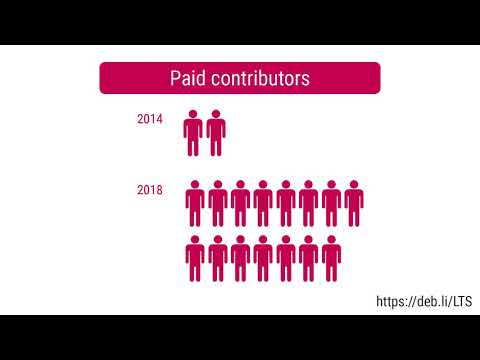
Debian LTS This month I have worked 18 hours on Debian Long Term Support (LTS) and 8 hours on its sister Extended LTS project. You can find out more about the Debian LTS project via the following video:
Debian Uploads For the Debian Privacy Maintainers team I requested that the pyptlib package be removed from the archive (#953429) as well as uploading onionbalance (0.1.8-6) to fix test failures under Pytest 3.x (#953535) and a new upstream release of nautilus-wipe. Finally, I sponsored an upload of bilibop (0.6.1) on behalf of Yann Amar.

24 March 2020

Russ Allbery: Review: Lost in Math

Review: Lost in Math, by Sabine Hossenfelder
Publisher: Basic
Copyright: June 2018
ISBN: 0-465-09426-0
Format: Kindle
Pages: 248
Listening to experts argue can be one of the better ways to learn about a new field. It does require some basic orientation and grounding or can be confusing or, worse, wildly misleading, so some advance research or Internet searches are warranted. But it provides some interesting advantages over reading multiple popular introductions to a field. First, experts arguing with each other are more precise about their points of agreement and disagreement because they're trying to persuade someone who is well-informed. The points of agreement are often more informative than the points of disagreement, since they can provide a feel for what is uncontroversial among experts in the field. Second, internal arguments tend to be less starry-eyed. One of the purposes of popularizations of a field is to get the reader excited about it, and that can be fun to read. But to generate that excitement, the author has a tendency to smooth over disagreements and play up exciting but unproven ideas. Expert disagreements pull the cover off of the uncertainty and highlight the boundaries of what we know and how we know it. Lost in Math (subtitled How Beauty Leads Physics Astray) is not quite an argument between experts. That's hard to find in book form; most of the arguments in the scientific world happen in academic papers, and I rarely have the energy or attention span to read those. But it comes close. Hossenfelder is questioning the foundations of modern particle physics for the general public, but also for her fellow scientists. High-energy particle physics is facing a tricky challenge. We have a solid theory (the standard model) which explains nearly everything that we have currently observed. The remaining gaps are primarily at very large scales (dark matter and dark energy) or near phenomena that are extremely difficult to study (black holes). For everything else, the standard model predicts our subatomic world to an exceptionally high degree of accuracy. But physicists don't like the theory. The details of why are much of the topic of this book, but the short version is that the theory does not seem either elegant or beautiful. It relies on a large number of measured constants that seem to have no underlying explanation, which is contrary to a core aesthetic principle that physicists use to judge new theories. Accompanying this problem is another: New experiments in particle physics that may be able to confirm or disprove alternate theories that go beyond the standard model are exceptionally expensive. All of the easy experiments have been done. Building equipment that can probe beyond the standard model is incredibly expensive, and thus only a few of those experiments have been done. This leads to two issues: Particle physics has an overgrowth of theories (such as string theory) that are largely untethered from experiments and are not being tested and validated or disproved, and spending on new experiments is guided primarily by a sense of scientific aesthetics that may simply be incorrect. Enter Lost in Math. Hossenfelder's book picks up a thread of skepticism about string theory (and, in Hossenfelder's case, supersymmetry as well) that I previously read in Lee Smolin's The Trouble with Physics. But while Smolin's critique was primarily within the standard aesthetic and epistemological framework of particle physics, Hossenfelder is questioning that framework directly. Why should nature be beautiful? Why should constants be small? What if the universe does have a large number of free constants? And is the dislike of an extremely reliable theory on aesthetic grounds a good basis for guiding which experiments we fund?
Do you recall the temple of science, in which the foundations of physics are the bottommost level, and we try to break through to deeper understanding? As I've come to the end of my travels, I worry that the cracks we're seeing in the floor aren't really cracks at all but merely intricate patterns. We're digging in the wrong places.
Lost in Math will teach you a bit less about physics than Smolin's book, although there is some of that here. Smolin's book was about two-thirds physics and one-third sociology of science. Lost in Math is about two-thirds sociology and one-third physics. But that sociology is engrossing. It's obvious in retrospect, but I hadn't thought before about the practical effects of running out of unexplained data on a theoretical field, or about the transition from more data than we can explain to having to spend billions of dollars to acquire new data. And Hossenfelder takes direct aim at the human tendency to find aesthetically appealing patterns and unified explanations, and scores some palpable hits.
I went into physics because I don't understand human behavior. I went into physics because math tells it how it is. I liked the cleanliness, the unambiguous machinery, the command math has over nature. Two decades later, what prevents me from understanding physics is that I still don't understand human behavior. "We cannot give exact mathematical rules that define if a theory is attractive or not," says Gian Francesco Giudice. "However, it is surprising how the beauty and elegance of a theory are universally recognized by people from different cultures. When I tell you, 'Look, I have a new paper and my theory is beautiful,' I don't have to tell you the details of my theory; you will get why I'm excited. Right?" I don't get it. That's why I am talking to him. Why should the laws of nature care what I find beautiful? Such a connection between me and the universe seems very mystical, very romantic, very not me. But then Gian doesn't think that nature cares what I find beautiful, but what he finds beautiful.
The structure of this book is half tour of how physics judges which theories are worthy of investigation and half personal quest to decide whether physics has lost contact with reality. Hossenfelder approaches this second thread with multiple interviews of famous scientists in the field. She probes at their bases for preferring one theory over another, at how objective those preferences can or should be, and what it means for physics if they're wrong (as increasingly appears to be the case for supersymmetry). In so doing, she humanizes theory development in a way that I found fascinating. The drawback to reading about ongoing arguments is the lack of a conclusion. Lost in Math, unsurprisingly, does not provide an epiphany about the future direction of high-energy particle physics. Its conclusion, to the extent that it has one, is a plea to find a way to put particle physics back on firmer experimental footing and to avoid cognitive biases in theory development. Given the cost of experiments and the nature of humans, this is challenging. But I enjoyed reading this questioning, contrarian take, and I think it's valuable for understanding the limits, biases, and distortions at the edge of new theory development. Rating: 7 out of 10

17 March 2020

Norbert Preining: Brave broken (on Debian?)

Update a few hours later: an update came in, version 1.7.62, which fixed this misbehavior!!!! I have been using the Brave browser now for many months without any problem, in particular I use the -dev version, which is rather on the edge of development. Unfortunately, either due to Linux kernel changes (I am using the latest stable kernel, at the moment 5.5.9) or due to Brave changes, the browser has become completely unusable: CPU spikes consistently to 100% and more, and the dev browser tries to upload crash reports every 5sec. The problem is shown in the kernel log as
traps: brave[36513] trap invalid opcode ip:55d4e0cb1895 sp:7ffc4b08ff00 error:0 in brave[55d4dfe01000+78e5000]
I have checked older versions, as well as beta versions, all of them exhibit the same problem. I have disabled all extensions, without any change in behavior. I also have reported this problem in the Brave community forum, without any answer. This means, for now I have to switch back to Firefox, which works smoothly.

16 March 2020

Bits from Debian: Official communication channels for Debian

From time to time, we get questions in Debian about our official channels of communication and questions about the Debian status of who may own similarly named websites. The main Debian website www.debian.org is our primary medium of communication. Those seeking information about current events and development progress in the community may be interested in the Debian News section of the Debian website. For less formal announcements, we have the official Debian blog Bits from Debian, and the Debian micronews service for shorter news items. Our official newsletter Debian Project News and all official announcements of news or project changes are dual posted on our website and sent to our official mailing lists debian-announce or debian-news. Posting to those mailing lists is restricted. We also want to take the opportunity to announce how the Debian Project, or for short, Debian is structured. Debian has a structure regulated by our Constitution. Officers and delegated members are listed on our Organizational Structure page. Additional teams are listed on our Teams page. The complete list of official Debian members can be found on our New Members page, where our membership is managed. A broader list of Debian contributors can be found on our Contributors page. If you have questions, we invite you to reach the press team at press@debian.org.

Matthias Klumpp: Maintain release info easily in MetaInfo/Appdata files

This article isn t about anything new , like the previous ones on AppStream it rather exists to shine the spotlight on a feature I feel is underutilized. From conversations it appears that the reason simply is that people don t know that it exists, and of course that s a pretty bad reason not to make your life easier  Mini-Disclaimer: I ll be talking about appstreamcli, part of AppStream, in this blogpost exclusively. The appstream-util tool from the appstream-glib project has a similar functionality check out its help text and look for appdata-to-news if you are interested in using it instead. What is this about? AppStream permits software to add release information to their MetaInfo files to describe current and upcoming releases. This feature has the following advantages: The disadvantage of all this, is that humans have to maintain the release information. Also, people need to write XML for this. Of course, once humans are involved with any technology, things get a lot more complicated. That doesn t mean we can t make things easier for people to use though. Did you know that you don t actually have to edit the XML in order to update your release information? To make creating and maintaining release information as easy as possible, the appstreamcli utility has a few helpers built in. And the best thing is that appstreamcli, being part of AppStream, is available pretty ubiquitously on Linux distributions. Update release information from NEWS data The NEWS file is a not very well defined textfile that lists user-visible changes worth mentioning per each version. This maps pretty well to what AppStream release information should contain, so let s generate that from a NEWS file! Since the news format is not defined, but we need to parse this somehow, the amount of things appstreamcli can parse is very limited. We support a format in this style:
Version 0.2.0
~~~~~~~~~~~~~~
Released: 2020-03-14
Notes:
 * Important thing 1
 * Important thing 2
Features:
 * New/changed feature 1
 * New/changed feature 2 (Author Name)
 * ...
Bugfixes:
 * Bugfix 1
 * Bugfix 2
 * ...
Version 0.1.0
~~~~~~~~~~~~~~
Released: 2020-01-10
Features:
 * ...
When parsing a file like this, appstreamcli will allow a lot of errors/ imperfections and account for quite a few style and string variations. You will need to check whether this format works for you. You can see it in use in appstream itself and libxmlb for a slightly different style. So, how do you convert this? We first create our NEWS file, e.g. with this content:
Version 0.2.0
~~~~~~~~~~~~~~
Released: 2020-03-14
Bugfixes:
 * The CPU no longer overheats when you hold down spacebar
Version 0.1.0
~~~~~~~~~~~~~~
Released: 2020-01-10
Features:
 * Now plays a "zap" sound on every character input
For the MetaInfo file, we of course generate one using the MetaInfo Creator. Then we can run the following command to get a preview of the generated file: appstreamcli news-to-metainfo ./NEWS ./org.example.myapp.metainfo.xml - Note the single dash at the end this is the explicit way of telling appstreamcli to print something to stdout. This is how the result looks like:
<?xml version="1.0" encoding="utf-8"?>
<component type="desktop-application">
  [...]
  <releases>
    <release type="stable" version="0.2.0" date="2020-03-14T00:00:00Z">
      <description>
        <p>This release fixes the following bug:</p>
        <ul>
          <li>The CPU no longer overheats when you hold down spacebar</li>
        </ul>
      </description>
    </release>
    <release type="stable" version="0.1.0" date="2020-01-10T00:00:00Z">
      <description>
        <p>This release adds the following features:</p>
        <ul>
          <li>Now plays a "zap" sound on every character input</li>
        </ul>
      </description>
    </release>
  </releases>
</component>
Neat! If we want to save this to a file instead, we just exchange the dash with a filename. And maybe we don t want to add all releases of the past decade to the final XML? No problem too, just pass the --limit flag as well: appstreamcli news-to-metainfo --limit=6 ./NEWS ./org.example.myapp.metainfo.tmpl.xml ./result/org.example.myapp.metainfo.xml That s nice on its own, but we really don t want to do this by hand The best way to ensure the MetaInfo file is updated, is to simply run this command at build time to generate the final MetaInfo file. For the Meson build system you can achieve this with a code snippet like below (but for CMake this shouldn t be an issue either you could even make a nice macro for it there):
ascli_exe = find_program('appstreamcli')
metainfo_with_relinfo = custom_target('gen-metainfo-rel',
    input : ['./NEWS', 'org.example.myapp.metainfo.xml'],
    output : ['org.example.myapp.metainfo.xml'],
    command : [ascli_exe, 'news-to-metainfo', '--limit=6', '@INPUT0@', '@INPUT1@', '@OUTPUT@']
)
In order to also translate releases, you will need to add this to your .pot file generation workflow, so (x)gettext can run on the MetaInfo file with translations merged in. Release information from YAML files Since parsing a no structure, somewhat human-readable file is hard without baking an AI into appstreamcli, there is also a second option available: Generate the XML from a YAML file. YAML is easy to write for humans, but can also be parsed by machines.The YAML structure used here is specific to AppStream, but somewhat maps to the NEWS file contents as well as MetaInfo file data. That makes it more versatile, but in order to use it, you will need to opt into using YAML for writing news entries. If that s okay for you to consider, read on! A YAML release file has this structure:
---
Version: 0.2.0
Date: 2020-03-14
Type: development
Description:
- The CPU no longer overheats when you hold down spacebar
- Fixed bugs ABC and DEF
---
Version: 0.1.0
Date: 2020-01-10
Description:  -
  This is our first release!
  Now plays a "zap" sound on every character input
As you can see, the release date has to be an ISO 8601 string, just like it is assumed for NEWS files. Unlike in NEWS files, releases can be defined as either stable or development depending on whether they are a stable or development release, by specifying a Type field. If no Type field is present, stable is implicitly assumed. Each release has a description, which can either be a free-form multi-paragraph text, or a list of entries. Converting the YAML example from above is as easy as using the exact same command that was used before for plain NEWS files: appstreamcli news-to-metainfo --limit=6 ./NEWS.yml ./org.example.myapp.metainfo.tmpl.xml ./result/org.example.myapp.metainfo.xml If appstreamcli fails to autodetect the format, you can help it by specifying it explicitly via the --format=yaml flag. This command would produce the following result:
<?xml version="1.0" encoding="utf-8"?>
<component type="console-application">
  [...]
  <releases>
    <release type="development" version="0.2.0" date="2020-03-14T00:00:00Z">
      <description>
        <ul>
          <li>The CPU no longer overheats when you hold down spacebar</li>
          <li>Fixed bugs ABC and DEF</li>
        </ul>
      </description>
    </release>
    <release type="stable" version="0.1.0" date="2020-01-10T00:00:00Z">
      <description>
        <p>This is our first release!</p>
        <p>Now plays a "zap" sound on every character input</p>
      </description>
    </release>
  </releases>
</component>
Note that the 0.2.0 release is now marked as development release, a thing which was not possible in the plain text NEWS file before. Going the other way Maybe you like writing XML, or have some other tool that generates the MetaInfo XML, or you have received your release information from some other source and want to convert it into text. AppStream also has a tool for that! Using appstreamcli metainfo-to-news <metainfo-file> <news-file> you can convert a MetaInfo file that has release entries into a text representation. If you don t want appstreamcli to autodetect the right format, you can specify it via the --format=<text yaml> switch. Future considerations The release handling is still not something I am entirely happy with. For example, the release information has to be written and translated at release time of the application. For some projects, this workflow isn t practical. That s why issue #240 exists in AppStream which basically requests an option to have release notes split out to a separate, remote location (and also translations, but that s unlikely to happen). Having remote release information is something that will highly likely happen in some way, but implementing this will be a quite disruptive, if not breaking change. That is why I am holding this change back for the AppStream 1.0 release. In the meanwhile, besides improving the XML form of release information, I also hope to support a few more NEWS text styles if they can be autodetected. The format of the systemd project may be a good candidate. The YAML release-notes format variant will also receive a few enhancements, e.g. for specifying a release URL. For all of these things, I very much welcome pull requests or issue reports. I can implement and maintain the things I use myself best, so if I don t use something or don t know about a feature many people want I won t suddenly implement it or start to add features at random because they may be useful . That would be a recipe for disaster. This is why for these features in particular contributions from people who are using them in their own projects or want their new usecase represented are very welcome.

11 March 2020

Markus Koschany: My Free Software Activities in February 2020

Welcome to gambaru.de. Here is my monthly report (+ the first week in March) that covers what I have been doing for Debian. If you re interested in Java, Games and LTS topics, this might be interesting for you. Debian Games Debian Java Misc Debian LTS This was my 48. month as a paid contributor and I have been paid to work 10 hours on Debian LTS, a project started by Rapha l Hertzog. In that time I did the following: ELTS Extended Long Term Support (ELTS) is a project led by Freexian to further extend the lifetime of Debian releases. It is not an official Debian project but all Debian users benefit from it without cost. The current ELTS release is Debian 7 Wheezy . This was my 21. month and I have been paid to work 8 hours on ELTS. Thanks for reading and see you next time.

8 March 2020

Lisandro Dami n Nicanor P rez Meyer: Qt 4 removed from Debian Sid (unstable)

The day has finally arrived: Qt 4 is no longer part of Debian unstable. It's gone.

Thanks should go to many people. You know who you are, and I really appreciate the support and time you put into this. **Thanks**

7 March 2020

Fran ois Marier: Fixing MariaDB InnoDB errors after upgrading to MythTV 30

After upgrading to MythTV 30 and MariaDB 10.3.18 on Debian buster, I noticed the following errors in my logs:
Jan 14 02:00:05 hostname mysqld[846]: 2020-01-14  2:00:05 62 [Warning] InnoDB: Cannot add field  rating  in table  mythconverg . internetcontentarticles  because after adding it, the row size is 8617 which is greater than maximum allowed size (8126) for a record on index leaf page.
Jan 14 02:00:05 hostname mysqld[846]: 2020-01-14  2:00:05 62 [Warning] InnoDB: Cannot add field  playcommand  in table  mythconverg . videometadata  because after adding it, the row size is 8243 which is greater than maximum allowed size (8126) for a record on index leaf page.
The root cause is that the database is using an InnoDB row format that cannot handle the new table sizes. To fix it, I put the following in alter_tables.sql:
ALTER TABLE archiveitems ROW_FORMAT=DYNAMIC;
ALTER TABLE bdbookmark ROW_FORMAT=DYNAMIC;
ALTER TABLE callsignnetworkmap ROW_FORMAT=DYNAMIC;
ALTER TABLE capturecard ROW_FORMAT=DYNAMIC;
ALTER TABLE cardinput ROW_FORMAT=DYNAMIC;
ALTER TABLE channel ROW_FORMAT=DYNAMIC;
ALTER TABLE channelgroup ROW_FORMAT=DYNAMIC;
ALTER TABLE channelgroupnames ROW_FORMAT=DYNAMIC;
ALTER TABLE channelscan ROW_FORMAT=DYNAMIC;
ALTER TABLE channelscan_channel ROW_FORMAT=DYNAMIC;
ALTER TABLE channelscan_dtv_multiplex ROW_FORMAT=DYNAMIC;
ALTER TABLE codecparams ROW_FORMAT=DYNAMIC;
ALTER TABLE credits ROW_FORMAT=DYNAMIC;
ALTER TABLE customexample ROW_FORMAT=DYNAMIC;
ALTER TABLE diseqc_config ROW_FORMAT=DYNAMIC;
ALTER TABLE diseqc_tree ROW_FORMAT=DYNAMIC;
ALTER TABLE displayprofilegroups ROW_FORMAT=DYNAMIC;
ALTER TABLE displayprofiles ROW_FORMAT=DYNAMIC;
ALTER TABLE dtv_multiplex ROW_FORMAT=DYNAMIC;
ALTER TABLE dtv_privatetypes ROW_FORMAT=DYNAMIC;
ALTER TABLE dvdbookmark ROW_FORMAT=DYNAMIC;
ALTER TABLE dvdinput ROW_FORMAT=DYNAMIC;
ALTER TABLE dvdtranscode ROW_FORMAT=DYNAMIC;
ALTER TABLE eit_cache ROW_FORMAT=DYNAMIC;
ALTER TABLE filemarkup ROW_FORMAT=DYNAMIC;
ALTER TABLE gallery_directories ROW_FORMAT=DYNAMIC;
ALTER TABLE gallery_files ROW_FORMAT=DYNAMIC;
ALTER TABLE gallerymetadata ROW_FORMAT=DYNAMIC;
ALTER TABLE housekeeping ROW_FORMAT=DYNAMIC;
ALTER TABLE inputgroup ROW_FORMAT=DYNAMIC;
ALTER TABLE internetcontent ROW_FORMAT=DYNAMIC;
ALTER TABLE internetcontentarticles ROW_FORMAT=DYNAMIC;
ALTER TABLE inuseprograms ROW_FORMAT=DYNAMIC;
ALTER TABLE iptv_channel ROW_FORMAT=DYNAMIC;
ALTER TABLE jobqueue ROW_FORMAT=DYNAMIC;
ALTER TABLE jumppoints ROW_FORMAT=DYNAMIC;
ALTER TABLE keybindings ROW_FORMAT=DYNAMIC;
ALTER TABLE keyword ROW_FORMAT=DYNAMIC;
ALTER TABLE livestream ROW_FORMAT=DYNAMIC;
ALTER TABLE logging ROW_FORMAT=DYNAMIC;
ALTER TABLE music_albumart ROW_FORMAT=DYNAMIC;
ALTER TABLE music_albums ROW_FORMAT=DYNAMIC;
ALTER TABLE music_artists ROW_FORMAT=DYNAMIC;
ALTER TABLE music_directories ROW_FORMAT=DYNAMIC;
ALTER TABLE music_genres ROW_FORMAT=DYNAMIC;
ALTER TABLE music_playlists ROW_FORMAT=DYNAMIC;
ALTER TABLE music_radios ROW_FORMAT=DYNAMIC;
ALTER TABLE music_smartplaylist_categories ROW_FORMAT=DYNAMIC;
ALTER TABLE music_smartplaylist_items ROW_FORMAT=DYNAMIC;
ALTER TABLE music_smartplaylists ROW_FORMAT=DYNAMIC;
ALTER TABLE music_songs ROW_FORMAT=DYNAMIC;
ALTER TABLE music_stats ROW_FORMAT=DYNAMIC;
ALTER TABLE music_streams ROW_FORMAT=DYNAMIC;
ALTER TABLE mythlog ROW_FORMAT=DYNAMIC;
ALTER TABLE mythweb_sessions ROW_FORMAT=DYNAMIC;
ALTER TABLE networkiconmap ROW_FORMAT=DYNAMIC;
ALTER TABLE oldfind ROW_FORMAT=DYNAMIC;
ALTER TABLE oldprogram ROW_FORMAT=DYNAMIC;
ALTER TABLE oldrecorded ROW_FORMAT=DYNAMIC;
ALTER TABLE people ROW_FORMAT=DYNAMIC;
ALTER TABLE phonecallhistory ROW_FORMAT=DYNAMIC;
ALTER TABLE phonedirectory ROW_FORMAT=DYNAMIC;
ALTER TABLE pidcache ROW_FORMAT=DYNAMIC;
ALTER TABLE playgroup ROW_FORMAT=DYNAMIC;
ALTER TABLE powerpriority ROW_FORMAT=DYNAMIC;
ALTER TABLE profilegroups ROW_FORMAT=DYNAMIC;
ALTER TABLE program ROW_FORMAT=DYNAMIC;
ALTER TABLE programgenres ROW_FORMAT=DYNAMIC;
ALTER TABLE programrating ROW_FORMAT=DYNAMIC;
ALTER TABLE recgrouppassword ROW_FORMAT=DYNAMIC;
ALTER TABLE recgroups ROW_FORMAT=DYNAMIC;
ALTER TABLE record ROW_FORMAT=DYNAMIC;
ALTER TABLE record_tmp ROW_FORMAT=DYNAMIC;
ALTER TABLE recorded ROW_FORMAT=DYNAMIC;
ALTER TABLE recordedartwork ROW_FORMAT=DYNAMIC;
ALTER TABLE recordedcredits ROW_FORMAT=DYNAMIC;
ALTER TABLE recordedfile ROW_FORMAT=DYNAMIC;
ALTER TABLE recordedmarkup ROW_FORMAT=DYNAMIC;
ALTER TABLE recordedprogram ROW_FORMAT=DYNAMIC;
ALTER TABLE recordedrating ROW_FORMAT=DYNAMIC;
ALTER TABLE recordedseek ROW_FORMAT=DYNAMIC;
ALTER TABLE recordfilter ROW_FORMAT=DYNAMIC;
ALTER TABLE recordingprofiles ROW_FORMAT=DYNAMIC;
ALTER TABLE recordmatch ROW_FORMAT=DYNAMIC;
ALTER TABLE scannerfile ROW_FORMAT=DYNAMIC;
ALTER TABLE scannerpath ROW_FORMAT=DYNAMIC;
ALTER TABLE schemalock ROW_FORMAT=DYNAMIC;
ALTER TABLE settings ROW_FORMAT=DYNAMIC;
ALTER TABLE storagegroup ROW_FORMAT=DYNAMIC;
ALTER TABLE tvchain ROW_FORMAT=DYNAMIC;
ALTER TABLE tvosdmenu ROW_FORMAT=DYNAMIC;
ALTER TABLE upnpmedia ROW_FORMAT=DYNAMIC;
ALTER TABLE user_permissions ROW_FORMAT=DYNAMIC;
ALTER TABLE user_sessions ROW_FORMAT=DYNAMIC;
ALTER TABLE users ROW_FORMAT=DYNAMIC;
ALTER TABLE videocast ROW_FORMAT=DYNAMIC;
ALTER TABLE videocategory ROW_FORMAT=DYNAMIC;
ALTER TABLE videocollection ROW_FORMAT=DYNAMIC;
ALTER TABLE videocountry ROW_FORMAT=DYNAMIC;
ALTER TABLE videogenre ROW_FORMAT=DYNAMIC;
ALTER TABLE videometadata ROW_FORMAT=DYNAMIC;
ALTER TABLE videometadatacast ROW_FORMAT=DYNAMIC;
ALTER TABLE videometadatacountry ROW_FORMAT=DYNAMIC;
ALTER TABLE videometadatagenre ROW_FORMAT=DYNAMIC;
ALTER TABLE videopart ROW_FORMAT=DYNAMIC;
ALTER TABLE videopathinfo ROW_FORMAT=DYNAMIC;
ALTER TABLE videosource ROW_FORMAT=DYNAMIC;
ALTER TABLE videotypes ROW_FORMAT=DYNAMIC;
ALTER TABLE weatherdatalayout ROW_FORMAT=DYNAMIC;
ALTER TABLE weatherscreens ROW_FORMAT=DYNAMIC;
ALTER TABLE weathersourcesettings ROW_FORMAT=DYNAMIC;
and then ran it like this:
mysql -umythtv -pPassword1 mythconverg < alter_tables.sql

Matthias Klumpp: Introducing the MetaInfo Creator

This year s FOSDEM conference was a lot of fun one of the things I always enjoy most about this particular conference (besides having some of the outstanding food you can get in Brussels and meeting with friends from the free software world) is the ability to meet a large range of new people who I wouldn t usually have interacted with, or getting people from different communities together who otherwise would not meet in person as each bigger project has their own conference (for example, the amount of VideoLAN people is much lower at GUADEC and Akademy compared to FOSDEM). It s also really neat to have GNOME and KDE developers within reach at the same place, as I care about both desktops a lot. An unexpected issue This blog post however is not about that. It s about what I learned when talking to people there about AppStream, and the outcome of that. Especially when talking to application authors but also to people who deal with larger software repositories, it became apparent that many app authors don t really want to deal with the extra effort of writing metadata at all. This was a bit of a surprise to me, as I thought that there would be a strong interest for application authors to make their apps look as good as possible in software catalogs. A bit less surprising was the fact that people apparently don t enjoy reading a large specification, reading a long-ish intro guide with lots of dos and don ts or basically reading any longer text at all before being able to create an AppStream MetaInfo/AppData file describing their software. Another common problem seems to be that people don t immediately know what a reverse-DNS ID is, the format AppStream uses for uniquely identifying each software component. So naturally, people either have to read about it again (bah, reading!  ) or make something up, which occasionally is wrong and not the actual component-ID their software component should have. The MetaInfo Creator It was actually suggested to me twice that what people really would like to have is a simple tool to put together a MetaInfo file for their software. Basically a simple form with a few questions which produces the final file. I always considered this a nice to have, but not essential feature, but now I was convinced that this actually has a priority attached to it. So, instead of jumping into my favourite editor and writing a bunch of C code to create this make MetaInfo file form as part of appstreamcli, this time I decided to try what the cool kids are doing and make a web application that runs in your browser and creates all metadata there. So, behold the MetaInfo Creator! If you click this link, you will end up at an Angular-based web application that will let you generate MetaInfo/AppData files for a few component-types simply by answering a set of questions. The intent was to make this tool as easy to use as possible for someone who basically doesn t know anything about AppStream at all. Therefore, the tool will: For the Meson feature, the tool simply can not generate a use this and be done script, as each Meson snippet needs to be adjusted for the individual project. So this option is disabled by default, but when enabled, a few simple Meson snippets will be produced which can be easily adjusted to the project they should be part of. The tool currently does not generate any release information for a MetaInfo file at all, This may be added in future. The initial goal was to have people create any MetaInfo file in the first place, having projects also ship release details would be the icing on the cake. I hope people find this project useful and use it to create better MetaInfo files, so distribution repositories and Flatpak repos look better in software centers. Also, since MetaInfo files can be used to create an inventory of software and to install missing stuff as-needed, having more of them will help to build smarter software managers, create smaller OS base installations and introspect what software bundles are made of easily. I welcome contributions to the MetaInfo Creator! You can find its source code on GitHub. This is my first web application ever, the first time I wrote TypeScript and the first time I used Angular, so I d bet a veteran developer more familiar with these tools will cringe at what I produced. So, scratch that itch and submit a PR!  Also, if you want to create a form for a new component type, please submit a patch as well. C developer s experience notes for Angular, TypeScript, NodeJS This section is just to ramble a bit about random things I found interesting as a developer who mostly works with C/C++ and Python and stepped into the web-application developer s world for the first time. For a project like this, I would usually have gone with my default way of developing something for the web: Creating a Flask-based application in Python. I really love Python and Flask, but of course using them would have meant that all processing would have had to be done on the server. One the one hand I could have used libappstream that way to create the XML, format it and validate it, but on the other hand I would have had to host the Python app on my own server, find a place at Purism/Debian/GNOME/KDE or get it housed at Freedesktop somehow (which would have taken a while to arrange) and I really wanted to have a permanent location for this application immediately. Additionally, I didn t want people to send the details of new unpublished software to my server. TypeScript I must say that I really like TypeScript as a language compared to JavaScript. It is not really revolutionary (I looked into Dart and other ways to compile $stuff to JavaScript first), but it removes just enough JavaScript weirdness to be pleasant to use. At the same time, since TS is a superset of JS, JavaScript code is valid TypeScript code, so you can integrate with existing JS code easily. Picking TS up took me much less than an hour, and most of its features you learn organically when working on a project. The optional type-safety is a blessing and actually helped me a few times to find an issue. It being so close to JS is both a strength and weakness: On the one hand you have all the JS oddities in the language (implicit type conversion is really weird sometimes) and have to basically refrain from using them or count on the linter to spot them, but on the other hand you can immediately use the massive amount of JavaScript code available on the web. Angular The Angular web framework took a few hours to pick up there are a lot of concepts to understand. But ultimately, it s manageable and pretty nice to use. When working at the system level, a lot of complexity is in understanding how the CPU is processing data, managing memory and using the low-level APIs the operating system provides. With the web application stuff, a lot of the complexity for me was in learning about all the moving parts the system is comprised of, what their names are, what they are, and what works with which. And that is not a flat learning curve at all. As C developer, you need to know how the computer works to be efficient, as web developer you need to know a bunch of different tools really well to be productive. One thing I am still a bit puzzled about is the amount of duplicated HTML templates my project has. I haven t found a way to reuse template blocks in multiple components with Angular, like I would with Jinja2. The documentation suggests this feature does not exist, but maybe I simply can t find it or there is a completely different way to achieve the same result. NPM Ecosystem The MetaInfo Creator application ultimately doesn t do much. But according to GitHub, it has 985 (!!!) dependencies in NPM/NodeJS. And that is the bare minimum! I only added one dependency myself to it. I feel really uneasy about this, as I prefer the Python approach of having a rich standard library instead of billions of small modules scattered across the web. If there is a bug in one of the standard library functions, I can submit a patch to Python where some core developer is there to review it. In NodeJS, I imagine fixing some module is much harder. That being said though, using npm is actually pretty nice there is a module available for most things, and adding a new dependency is easy. NPM will also manage all the details of your dependency chain, GitHub will warn about security issues in modules you depend on, etc. So, from a usability perspective, there isn t much to complain about (unlike with Python, where creating or using a module ends up as a fight the system event way too often and the question which random file do I need to create now to achieve what I want? always exists. Fortunately, Poetry made this a bit more pleasant for me recently). So, tl;dr for this section: The web application development excursion was actually a lot of fun, and I may make more of those in future, now that I learned more about how to write web applications. Ultimately though, I enjoy the lower-level software development and backend development a bit more. Summary Check out the MetaInfo Creator and its source code, if you want to create MetaInfo files for a GUI application, console application, addon or service component quickly.

6 March 2020

Reproducible Builds: Reproducible Builds in February 2020

Welcome to the February 2020 report from the Reproducible Builds project. One of the original promises of open source software is that distributed peer review and transparency of process results in enhanced end-user security. However, whilst anyone may inspect the source code of free and open source software for malicious flaws, almost all software today is distributed as pre-compiled binaries. This allows nefarious third-parties to compromise systems by injecting malicious code into ostensibly secure software during the various compilation and distribution processes. The motivation behind the reproducible builds effort is to provide the ability to demonstrate these binaries originated from a particular, trusted, source release: if identical results are generated from a given source in all circumstances, reproducible builds provides the means for multiple third-parties to reach a consensus on whether a build was compromised via distributed checksum validation or some other scheme. In this month s report, we cover:

If you are interested in contributing to the project, please visit our Contribute page on our website.

Media coverage & upstream news Omar Navarro Leija, a PhD student at the University Of Pennsylvania, published a paper entitled Reproducible Containers that describes in detail the workings of a new user-space container tool called DetTrace:
All computation that occurs inside a DetTrace container is a pure function of the initial filesystem state of the container. Reproducible containers can be used for a variety of purposes, including replication for fault-tolerance, reproducible software builds and reproducible data analytics. We use DetTrace to achieve, in an automatic fashion, reproducibility for 12,130 Debian package builds, containing over 800 million lines of code, as well as bioinformatics and machine learning workflows.
There was also considerable discussion on our mailing list regarding this research and a presentation based on the paper will occur at the ASPLOS 2020 conference between March 16th 20th in Lausanne, Switzerland. The many virtues of Reproducible Builds were touted as benefits for software compliance in a talk at FOSDEM 2020, debating whether the Careful Inventory of Licensing Bill of Materials Have Impact of FOSS License Compliance which pitted Jeff McAffer and Carol Smith against Bradley Kuhn and Max Sills. (~47 minutes in). Nobuyoshi Nakada updated the canonical implementation of the Ruby programming language a change such that filesystem globs (ie. calls to list the contents of filesystem directories) will henceforth be sorted in ascending order. Without this change, the underlying nondeterministic ordering of the filesystem is exposed to the language which often results in an unreproducible build. Vagrant Cascadian reported on our mailing list regarding a quick reproducible test for the GNU Guix distribution, which resulted in 81.9% of packages registering as reproducible in his installation:
$ guix challenge --verbose --diff=diffoscope ...
2,463 store items were analyzed:
  - 2,016 (81.9%) were identical
  - 37 (1.5%) differed
  - 410 (16.6%) were inconclusive
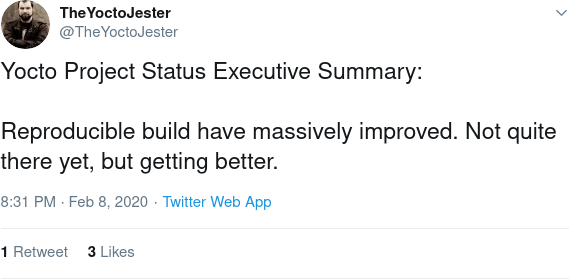
Jeremiah Orians announced on our mailing list the release of a number of tools related to cross-compilation such as M2-Planet and mescc-tools-seed. This project attemps a full bootstrap of a cross-platform compiler for the C programming language (written in C itself) from hex, the ultimate goal being able to demonstrate fully-bootstrapped compiler from hex to the GCC GNU Compiler Collection. This has many implications in and around Ken Thompson s Trusting Trust attack outlined in Thompson s 1983 Turing Award Lecture. Twitter user @TheYoctoJester posted an executive summary of reproducible builds in the Yocto Project: Finally, Reddit user tofflos posted to the /r/Java subreddit asking about how to achieve reproducible builds with Maven and Chris Lamb noticed that the Linux kernel documentation about reproducible builds of it is available on the kernel.org homepages in an attractive HTML format.

Distribution work

Debian Chris Lamb created a merge request for the core debian-installer package to allow all arguments and options from sources.list files (such as [check-valid-until=no] , etc.) in order that we can test the reproducibility of the installer images on the Reproducible Builds own testing infrastructure. (#13) Thorsten Glaser followed-up to a bug filed against the dpkg-source component that was originally filed in late 2015 that claims that the build tool does not respect permissions when unpacking tarballs if the umask is set to 0002. Matthew Garrett posted to the debian-devel mailing list on the topic of Producing verifiable initramfs images as part of a wider conversation on being able to trust the entire software stack on our computers. 59 reviews of Debian packages were added, 30 were updated and 42 were removed this month adding to our knowledge about identified issues. Many issue types were noticed and categorised by Chris Lamb, including:

openSUSE In openSUSE, Bernhard M. Wiedemann published his monthly Reproducible Builds status update as well as provided the following patches:

Software development

diffoscope diffoscope is our in-depth and content-aware diff-like utility that can locate and diagnose reproducibility issues. It is run countless times a day on our testing infrastructure and is essential for identifying fixes and causes of nondeterministic behaviour. Chris Lamb made the following changes this month, including uploading version 137 to Debian:
  • The sng image utility appears to return with an exit code of 1 if there are even minor errors in the file. (#950806)
  • Also extract classes2.dex, classes3.dex from .apk files extracted by apktool. (#88)
  • No need to use str.format if we are just returning the string. [ ]
  • Add generalised support for ignoring returncodes [ ] and move special-casing of returncodes in zip to use Command.VALID_RETURNCODES. [ ]

Other tools disorderfs is our FUSE-based filesystem that deliberately introduces non-determinism into directory system calls in order to flush out reproducibility issues. This month, Vagrant Cascadian updated the Vcs-Git to specify the debian packaging branch. [ ] reprotest is our end-user tool to build same source code twice in widely differing environments and then checks the binaries produced by each build for any differences. This month, versions 0.7.13 and 0.7.14 were uploaded to Debian unstable by Holger Levsen after Vagrant Cascadian added support for GNU Guix [ ].

Project documentation & website There was more work performed on our documentation and website this month. Bernhard M. Wiedemann added a Java Gradle Build Tool snippet to the SOURCE_DATE_EPOCH documentation [ ] and normalised various terms to unreproducible [ ]. Chris Lamb added a Meson.build example [ ] and improved the documentation for the CMake [ ] to the SOURCE_DATE_EPOCH documentation, replaced anyone can with anyone may as, well, not everyone has the resources, skills, time or funding to actually do what it refers to [ ] and improved the pre-processing for our report generation [ ][ ][ ][ ] etc. In addition, Holger Levsen updated our news page to improve the list of reports [ ], added an explicit mention of the weekly news time span [ ] and reverted sorting of news entries to have latest on top [ ] and Mattia Rizzolo added Codethink as a non-fiscal sponsor [ ] and lastly Tianon Gravi added a Docker Images link underneath the Debian project on our Projects page [ ].

Upstream patches The Reproducible Builds project detects, dissects and attempts to fix as many currently-unreproducible packages as possible. We endeavour to send all of our patches upstream where appropriate. This month, we wrote a large number of such patches, including: Vagrant Cascadian submitted patches via the Debian bug tracking system targeting the packages the Civil Infrastructure Platform has identified via the CIP and CIP build depends package sets:

Testing framework We operate a fully-featured and comprehensive Jenkins-based testing framework that powers tests.reproducible-builds.org. This month, the following changes were made by Holger Levsen: In addition, Mattia Rizzolo added an Apache web server redirect for buildinfos.debian.net [ ] and reverted the reshuffling of arm64 architecture builders [ ]. The usual build node maintenance was performed by Holger Levsen, Mattia Rizzolo [ ][ ] and Vagrant Cascadian.

Getting in touch If you are interested in contributing to the Reproducible Builds project, please visit our Contribute page on our website. However, you can get in touch with us via:

This month s report was written by Bernhard M. Wiedemann, Chris Lamb and Holger Levsen. It was subsequently reviewed by a bunch of Reproducible Builds folks on IRC and the mailing list.

2 March 2020

Petter Reinholdtsen: Nikita version 0.5 released - updated free software archive API server

Today, after many months of development, a new release of Nikita Noark 5 core project was finally announced on the project mailing list. The Nikita free software solution is an implementation of the Norwegian archive standard Noark 5 used by government offices in Norway. These were the changes in version 0.5 since version 0.4, see the email link above for links to a demo site: If free and open standardized archiving API sound interesting to you, please contact us on IRC (#nikita on irc.freenode.net) or email (nikita-noark mailing list). As usual, if you use Bitcoin and want to show your support of my activities, please send Bitcoin donations to my address 15oWEoG9dUPovwmUL9KWAnYRtNJEkP1u1b.

Jonathan Carter: Free Software activities for 2020-02

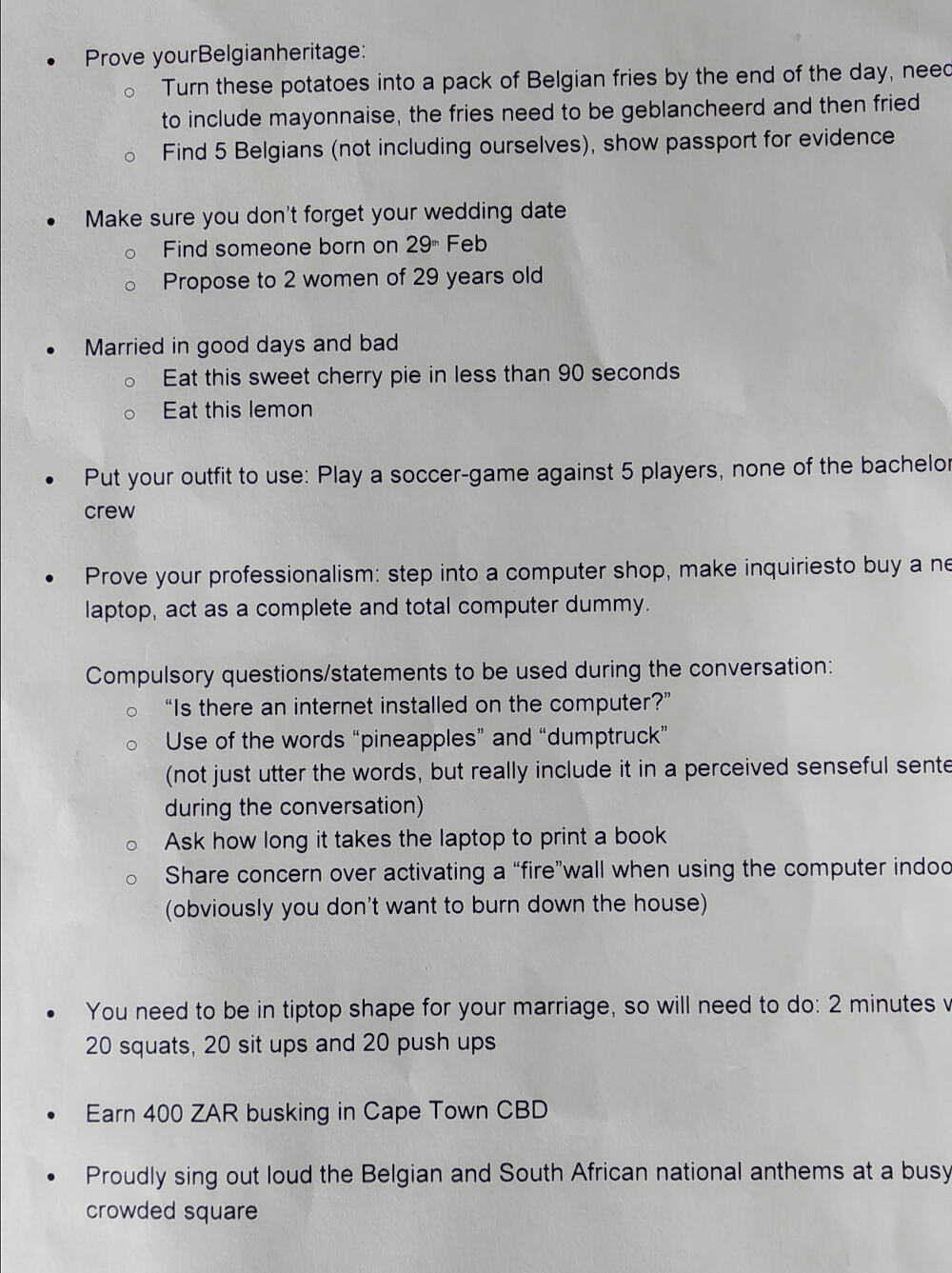
Belgians This month started off in Belgium for FOSDEM on 1-2 February. I attended FOSDEM in Brussels and wrote a separate blog entry for that. The month ended with Belgians at Tammy and Wouter s wedding. On Thursday we had Wouter s bachelors and then over the weekend I stayed over at their wedding venue. I thought that other Debianites might be interested so I m sharing some photos here with permission from Wouter. It was the only wedding I ve been at where nearly everyone had questions about Debian! I first met Wouter on the bus during the daytrip on DebConf12 in Nicaragua, back then I ve eagerly followed the Debianites on Planet Debian for a while so it was like meeting someone famous. Little did I know that 8 years later, I d be at his wedding back in my part of the world. If you went to DebConf16 in South Africa, you might remember Tammy, who have done a lot of work for DC16 including most of the artwork, bunch of website work, design on the badges, bags, etc and also did a lot of organisation for the day trips. Tammy and Wouter met while Tammy was reviewing the artwork in the video loops for the DebConf videos, and then things developed from there. Wouter s Bachelors Wouter was blindfolded and kidnapped and taken to the city center where we prepared to go on a bike tour of Cape Town, stopping for beer at a few places along the way. Wouter was given a list of tasks that he had to complete, or the wedding wouldn t be allowed to continue

Wouter s tasks
Wouter s props, needed to complete his tasks

Bike tour leg at Cape Town Stadium.

Seeking out 29 year olds.

Wouter finishing his lemon and actually seemingly enjoying it.
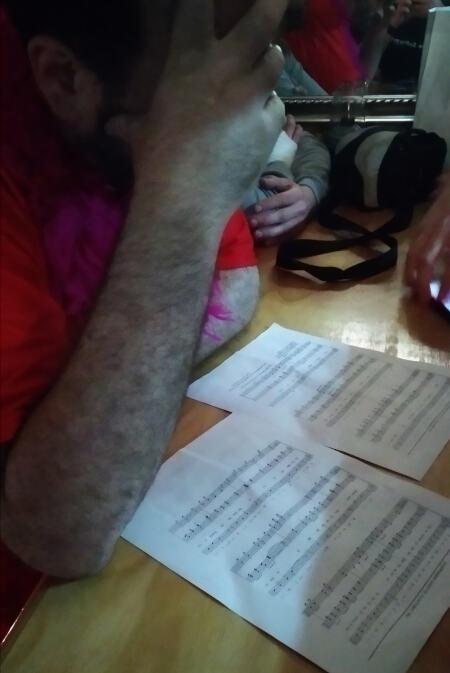
Reciting South African national anthem notes and lyrics.

The national anthem, as performed by Wouter (I was actually impressed by how good his pitch was).
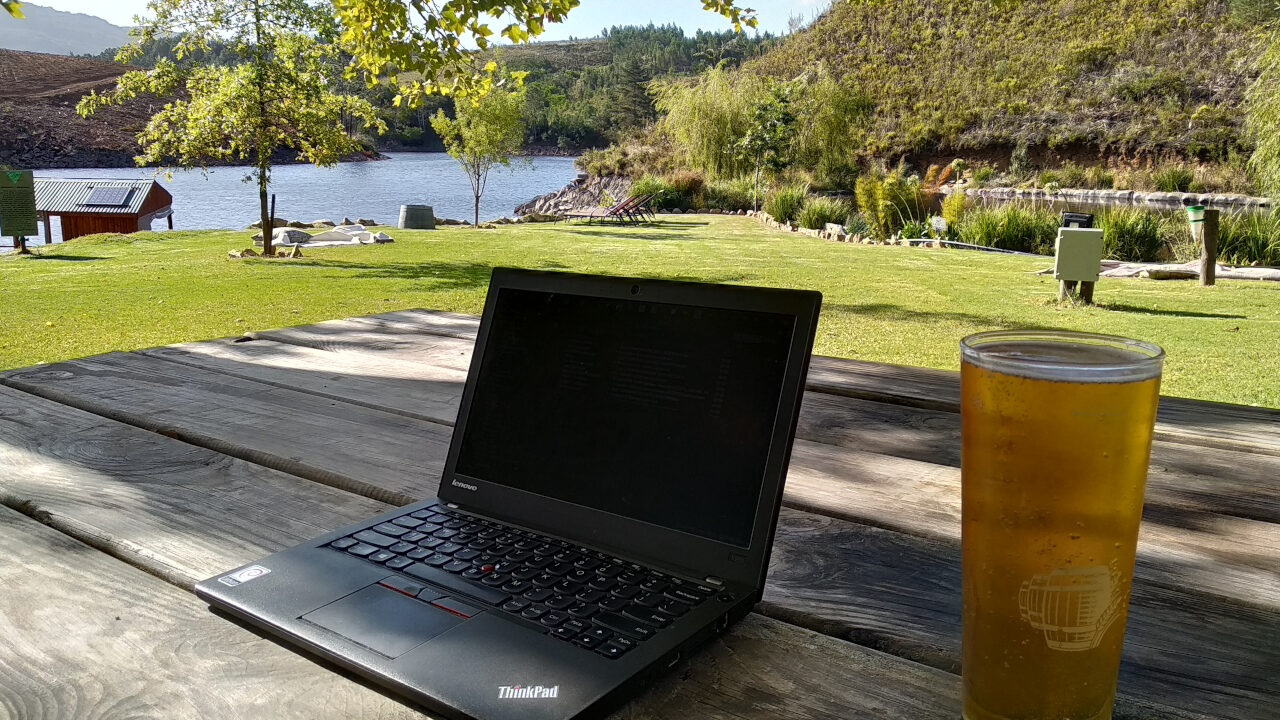
The Wedding Friday afternoon we arrived at the lodge for the weekend. I had some work to finish but at least this was nicer than where I was going to work if it wasn t for the wedding.
Accommodation at the lodge
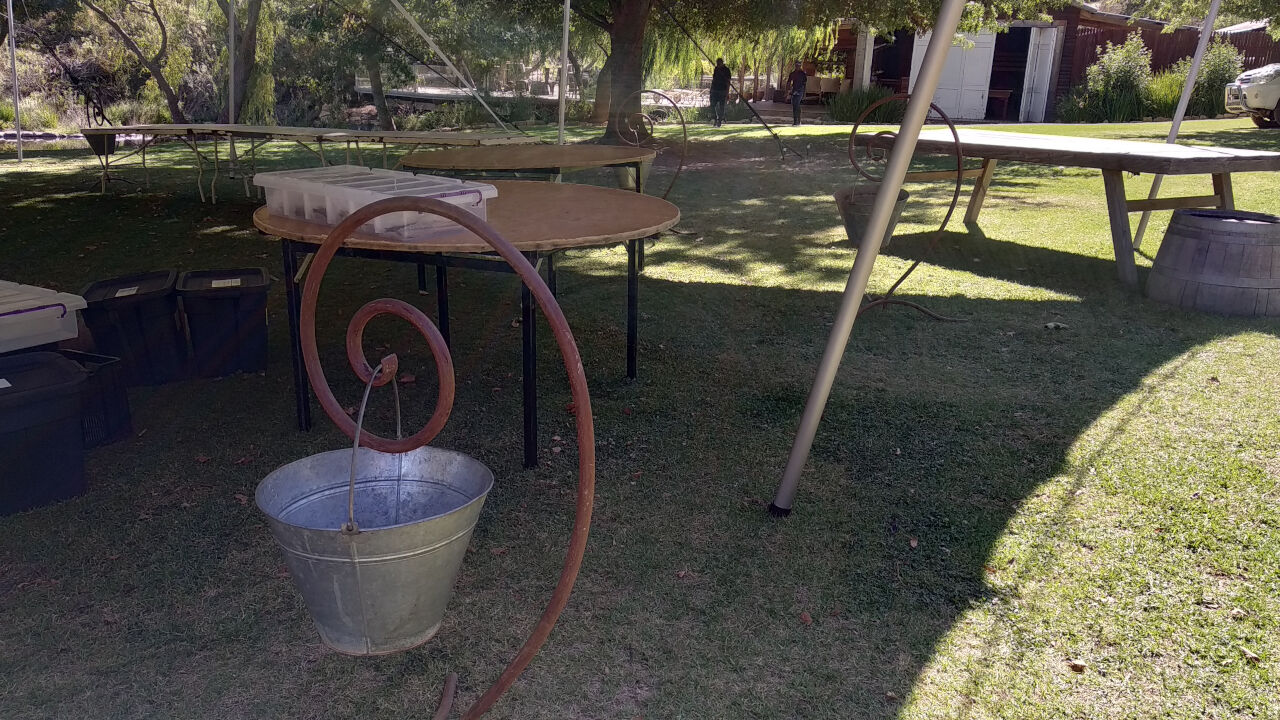
When the wedding co-ordinators started setting up, I noticed that there were all these swirls that almost looked like Debian logos. I asked Wouter if that was on purpose or just a happy accident. He said Hmm! I haven t even noticed that yet! , didn t get a chance to ask Tammy yet, so it could still be her touch.
Debian swirls everywhere
I took a canoe ride on the river and look what I found, a paddatrapper!

Kyle and I weren t the only ones out on the river that day. When the wedding ceremony started, Tammy made a dramatic entrance coming in on a boat, standing at the front with the breeze blowing her dress like a valkyrie.
A bit of digital zoomage of previous image.

Time to say the vows.

Just married. Thanks to Sue Fuller-Good for the photo.

Except for one character being out of place, this was a perfect fairy tale wedding, but I pointed Wouter to https://jonathancarter.org/how-to-spell-jonathan/ for future reference so it s all good.

Congratulations again to both Tammy and Wouter. It was a great experience meeting both their families and friends and all the love that was swirling around all weekend.

Debian Package Uploads 2020-02-07: Upload package calamares (3.2.18-1) to Debian unstable. 2020-02-07: Upload package python-flask-restful (0.3.8-1) to Debian unstable. 2020-02-10: Upload package kpmcore (4.1.0-1) to Debian unstable. 2020-02-16: Upload package fracplanet (0.5.1-5.1) to Debian unstable (Closes: #946028). 2020-02-20: Upload package kpmcore (4.1.0-2) to Debian unstable. 2020-02-20: Upload package bluefish (2.2.11) to Debian unstable. 2020-02-20: Upload package gdisk (1.0.5-1) to Debian unstable. 2020-02-20: Accept MR#6 for gamemode. 2020-02-23: Upload package tanglet (1.5.5-1) to Debian unstable. 2020-02-23: Upload package gamemode (1.5-1) to Debian unstable. 2020-02-24: Upload package calamares (3.2.19-1) to Debian unstable. 2020-02-24: Upload package partitionmanager (4.1.0-1) to Debian unstable. 2020-02-24: Accept MR#7 for gamemode. 2020-02-24: Merge MR#1 for calcoo. 2020-02-24: Upload package calcoo (1.3.18-8) to Debian unstable. 2020-02-24: Merge MR#1 for flask-api. 2020-02-25: Upload package calamares (3.2.19.1-1) to Debian unstable. 2020-02-25: Upload package gnome-shell-extension-impatience (0.4.5-4) to Debian unstable. 2020-02-25: Upload package gnome-shell-extension-harddisk-led (19-2) to Debian unstable. 2020-02-25: Upload package gnome-shell-extension-no-annoyance (0+20170928-f21d09a-2) to Debian unstable. 2020-02-25: Upload package gnome-shell-extension-system-monitor (38-2) to Debian unstable. 2020-02-25: Upload package tuxpaint (0.9.24~git20190922-f7d30d-1~exp3) to Debian experimental.

Debian Mentoring 2020-02-10: Sponsor package python-marshmallow-polyfield (5.8-1) for Debian unstable (Python team request). 2020-02-10: Sponsor package geoalchemy2 (0.6.3-2) for Debian unstable (Python team request). 2020-02-13: Sponsor package python-tempura (2.2.1-1) for Debian unstable (Python team request). 2020-02-13: Sponsor package python-babel (2.8.0+dfsg.1-1) for Debian unstable (Python team request). 2020-02-13: Sponsor package python-pynvim (0.4.1-1) for Debian unstable (Python team request). 2020-02-13: Review package ledmon (0.94-1) (Needs some more work) (mentors.debian.net request). 2020-02-14: Sponsor package citeproc-py (0.3.0-6) for Debian unstable (Python team request). 2020-02-24: Review package python-suntime (1.2.5-1) (Needs some more work) (Python team request). 2020-02-24: Sponsor package python-babel (2.8.0+dfsg.1-2) for Debian unstable (Python team request). 2020-02-24: Sponsor package 2048 (0.0.0-1~exp1) for Debian experimental (mentors.debian.net request). 2020-02-24: Review package notcurses (1.1.8-1) (Needs some more work) (mentors.debian.net request). 2020-02-25: Sponsor package cloudpickle (1.3.0-1) for Debian unstable (Python team request).

Debian Misc 2020-02-12: Apply Planet Debian request and close MR#21. 2020-02-23: Accept MR#6 for ToeTally (DebConf Video team upstream). 2020-02-23: Accept MR#7 for ToeTally (DebConf Video team upstream).

29 February 2020

Chris Lamb: Free software activities in February 2020

Here is my monthly update covering what I have been doing in the free software world during February 2020 (previous month): For the Tails privacy-oriented operating system, I uploaded the following packages to Debian:
Reproducible builds One of the original promises of open source software is that distributed peer review and transparency of process results in enhanced end-user security. However, whilst anyone may inspect the source code of free and open source software for malicious flaws, almost all software today is distributed as pre-compiled binaries. This allows nefarious third-parties to compromise systems by injecting malicious code into ostensibly secure software during the various compilation and distribution processes. The motivation behind the Reproducible Builds effort is to provide the ability to demonstrate these binaries originated from a particular trusted source release: if identical results are generated from a given source in all circumstances, reproducible builds provides the means for multiple third-parties to reach a consensus on whether a build was compromised via distributed checksum validation or some other scheme. The initiative is proud to be a member project of the Software Freedom Conservancy, a not-for-profit 501(c)(3) charity focused on ethical technology and user freedom. Conservancy acts as a corporate umbrella allowing projects to operate as non-profit initiatives without managing their own corporate structure. If you like the work of the Conservancy or the Reproducible Builds project, please consider becoming an official supporter. This month, I: In our tooling, I also made the following changes to diffoscope, our in-depth and content-aware diff utility that can locate and diagnose reproducibility issues, including uploading version 137 to Debian:
Debian I submitted a Request for Package (RFP) bug for hsd, a blockchain-based top-level domain DNS protocol implementation that underpins Handshake and worked on some initial packaging. (#952472)
Debian LTS This month I have worked 18 hours on Debian Long Term Support (LTS) and 12 hours on its sister Extended LTS project. You can find out more about the project via the following video:
Uploads Finally, I made a non-maintainer upload of adminer (4.7.6-1) on behalf of Alexandre Rossi.

23 November 2017

Sean Whitton: Using Propellor to provision your Debian development laptop

sbuild is a tool used by those maintaining packages in Debian, and derived distributions such as Ubuntu. When used correctly, it can catch a lot of categories of bugs before packages are uploaded. It does this by building the package in a clean environment, and then running the package through the Lintian, piuparts, adequate and autopkgtest tools. However, configuring sbuild so that it makes use of all of these tools is cumbersome. In response to this complexity, I wrote a module for the Propellor configuration management system to prepare a system such that a user can just go ahead and run the sbuild(1) command. This module is useful on one s development laptop if you need to reinstall your OS, you don t have to look up the instructions for setting up sbuild again. But it s also useful on throwaway build boxes. I can instruct propellor to provision a new virtual machine to build packages with sbuild, and all the different tools mentioned above will be connected together for me. I just uploaded Propellor version 5.1.0 to Debian unstable. The version overhauls the API and internals of the Sbuild module to take better advantage of Propellor s design. I won t get into those details in this post. What I d like to do is demonstrate how you can set up sbuild on your own machines, using Propellor. Getting started with Propellor apt-get install propellor, and then propellor --init. You ll be offered two setups, options A and B. I suggest starting with option B. If you never use Propellor for anything other than provisioning sbuild, you can stick with option B. If this tutorial makes you want to check out more features of Propellor, you might consider switching to option A and importing your old configuration. Open ~/.propellor/config.hs. You will see something like this:
-- The hosts propellor knows about.
hosts :: [Host]
hosts =
        [ mybox
        ]
-- An example host.
mybox :: Host
mybox = host "mybox.example.com" $ props
        & osDebian Unstable X86_64
        & Apt.stdSourcesList
        & Apt.unattendedUpgrades
        & Apt.installed ["etckeeper"]
        & Apt.installed ["ssh"]
        & User.hasSomePassword (User "root")
        & File.dirExists "/var/www"
        & Cron.runPropellor (Cron.Times "30 * * * *")
You ll want to customise this so that it reflects your computer. My laptop is called iris, so I might replace the above with this:
-- The hosts propellor knows about.
hosts :: [Host]
hosts =
        [ iris
        ]
-- My laptop.
iris :: Host
iris = host "iris.silentflame.com" $ props
        & osDebian Testing X86_64
The list of lines beginning with & are the properties of the host iris. Here, I ve removed all properties except the osDebian property, which informs propellor that iris runs Debian testing and has the amd64 architecture. The effect of this is that Propellor will not try to change anything about iris. In this tutorial, we are not going to let Propellor configure anything about iris other than setting up sbuild. (The osDebian property is a pure info property, which means that it tells Propellor information about the host to which other properties might refer, but it doesn t itself change anything about iris.) Telling Propellor to configure sbuild First, add to the import lines at the top of config.hs the lines:
import qualified Propellor.Property.Sbuild as Sbuild
import qualified Propellor.Property.Schroot as Schroot
to enable use of the Sbuild module. Here is the full config for iris, which I ll go through line-by-line:
-- The hosts propellor knows about.
hosts :: [Host]
hosts =
        [ iris
        ]
-- My laptop.
iris :: Host
iris = host "iris.silentflame.com" $ props
        & osDebian Testing X86_64
        & Apt.useLocalCacher
        & sidSchrootBuilt
        & Sbuild.usableBy (User "spwhitton")
        & Schroot.overlaysInTmpfs
        & Cron.runPropellor (Cron.Times "30 * * * *")
  where
        sidSchrootBuilt = Sbuild.built Sbuild.UseCcache $ props
                & osDebian Unstable X86_64
                & Sbuild.update  period  Daily
                & Sbuild.useHostProxy iris
Running Propellor to configure your laptop propellor iris.silentflame.com. In this configuration, you don t need to worry about whether the hostname iris.silentflame.com actually resolves to your laptop. However, it must be possible to ssh root@localhost. This should be enough that spwhitton can:
$ sbuild -A --run-lintian --run-autopkgtest --run-piuparts foo.dsc
Further configuration It is easy to add new schroots; for example, for building backports:
        ...
        & stretchSchrootBuilt
        ...
  where
        ...
        stretchSchrootBuilt = Sbuild.built Sbuild.UseCcache $ props
                & osDebian (Stable "stretch") X86_64
                & Sbuild.update  period  Daily
                & Sbuild.useHostProxy iris
You can also add additional properties to configure your chroot. Perhaps on your LAN you need sbuild to install packages via https, and you already have an apt cacher available. You can replace the apt-cacher-ng configuration like this:
  where
        sidSchrootBuilt = Sbuild.built Sbuild.UseCcache $ props
                & osDebian Unstable X86_64
                & Sbuild.update  period  Daily
                & Apt.mirror "https://foo.mirror/debian/"
                & Apt.installed ["apt-transport-https"]
Thanks Thanks to Propellor s author, Joey Hess, for help navigating Propellor s type system while performing the overhaul included in version 5.1.0. Also for a conversation at DebConf17 which enabled this work by clearing some misconceptions of mine.

20 November 2017

Reproducible builds folks: Reproducible Builds: Weekly report #133

Here's what happened in the Reproducible Builds effort between Sunday November 5 and Saturday November 11 2017: Upcoming events On November 17th Chris Lamb will present at Open Compliance Summit, Yokohama, Japan on how reproducible builds ensures the long-term sustainability of technology infrastructure. We plan to hold an assembly at 34C3 - hope to see you there! LEDE CI tests Thanks to the work of lynxis, Mattia and h01ger, we're now testing all LEDE packages in our setup. This is our first result for the ar71xx target: "502 (100.0%) out of 502 built images and 4932 (94.8%) out of 5200 built packages were reproducible in our test setup." - see below for details how this was achieved. Bootstrapping and Diverse Double Compilation As a follow-up of a discussion on bootstrapping compilers we had on the Berlin summit, Bernhard and Ximin worked on a Proof of Concept for Diverse Double Compilation of tinycc (aka tcc). Ximin Luo did a successful diverse-double compilation of tinycc git HEAD using gcc-7.2.0, clang-4.0.1, icc-18.0.0 and pgcc-17.10-0 (pgcc needs to triple-compile it). More variations are planned for the future, with the eventual aim to reproduce the same binaries cross-distro, and extend it to test GCC itself. Packages reviewed and fixed, and bugs filed Patches filed upstream: Patches filed in Debian: Patches filed in OpenSUSE: Reviews of unreproducible packages 73 package reviews have been added, 88 have been updated and 40 have been removed in this week, adding to our knowledge about identified issues. 4 issue types have been updated: Weekly QA work During our reproducibility testing, FTBFS bugs have been detected and reported by: diffoscope development Mattia Rizzolo uploaded version 88~bpo9+1 to stretch-backports. reprotest development reproducible-website development theunreproduciblepackage development tests.reproducible-builds.org in detail Misc. This week's edition was written by Ximin Luo, Bernhard M. Wiedemann, Chris Lamb and Holger Levsen & reviewed by a bunch of Reproducible Builds folks on IRC & the mailing lists.

18 November 2017

Matthieu Caneill: MiniDebconf in Toulouse

I attended the MiniDebconf in Toulouse, which was hosted in the larger Capitole du Libre, a free software event with talks, presentation of associations, and a keysigning party. I didn't expect the event to be that big, and I was very impressed by its organization. Cheers to all the volunteers, it has been an amazing week-end! Here's a sum-up of the talks I attended. Du logiciel libre la monnaie libre Speaker: lo s The first talk I attended was, translated to English, "from free software to free money". lo s compared the 4 freedoms of free software with money, and what properties money needs to exhibit in order to be considered free. He then introduced 1, a project of free (as in free speech!) money, started in the region around Toulouse. Contrary to some distributed ledgers such as Bitcoin, 1 isn't based on an hash-based proof-of-work, but rather around a web of trust of people certifying each other, hence limiting the energy consumption required by the network to function. YunoHost Speaker: Jimmy Monin I then attended a presentation of YunoHost. Being an happy user myself, it was very nice to discover the future expected features, and also meet two of the developers. YunoHost is a Debian-based project, aimed at providing all the tools necessary to self-host applications, including email, website, calendar, development tools, and dozens of other packages. Premiers pas dans l'univers de Debian Speaker: Nicolas Dandrimont For the first talk of the MiniDebConf, Nicolas Dandrimont introduced Debian, its philosophy, and how it works with regards to upstreams and downstreams. He gave many details on the teams, the infrastructure, and the internals of Debian. Trusting your computer and system Speaker: Jonas Smedegaard Jonas introduced some security concepts, and how they are abused and often meaningless (to quote his own words, "secure is bullshit"). He described a few projects which lean towards a more secure and open hardware, for both phones and laptops. Automatiser la gestion de configuration de Debian avec Ansible Speaker: J r my Lecour J r my, from Evolix, introduced Ansible, and how they use it to manage hundreds of Debian servers. Ansible is a very powerful tool, and a huge ecosystem, in many ways similar to Puppet or Chef, except it is agent-less, using only ssh connections to communicate with remote machines. Very nice to compare their use of Ansible with mine, since that's the software I use at work for deploying experiments. Making Debian for everybody Speaker: Samuel Thibault Samuel gave a talk about accessibility, and the general availability of the tools in today's operating systems, including Debian. The lesson to take home is that we often don't do enough in this domain, particularly when considering some issues people might have that we don't always think about. Accessibility on computers (and elsewhere) should be the default, and never require complex setups. Retour d'exp rience : mise jour de milliers de terminaux Debian Speaker: Cyril Brulebois Cyril described a problem he was hired for, an update of thousands of Debian servers from wheezy to jessie, which he discovered afterwards was worse than initially thought, since the machines were running the out-of-date squeeze. Since they were not always administered with the best sysadmin practices, they were all exhibiting different configurations and different packages lists, which raised many issues and gave him interesting challenges. They were solved using Ansible, which also had the effect of standardizing their system administration practices. Retour d'exp rience : utilisation de Debian chez Evolix Speaker: Gr gory Colpart Gr gory described Evolix, a company which manages servers for their clients, and how they were inspired by Debian, for both their internal tools and their practices. It is very interesting to see that some of the Debian values can be easily exported for a more open and collaborative business. Lightning talks To close the conference, two lightning talks were presented, describing the switch from Windows XP to Debian in an ecologic association near Toulouse; and how snapshot.debian.org can be used with bisections to find the source of some regressions. Conclusion A big thank you to all the organizers and the associations who contributed to make this event a success. Cheers!

17 November 2017

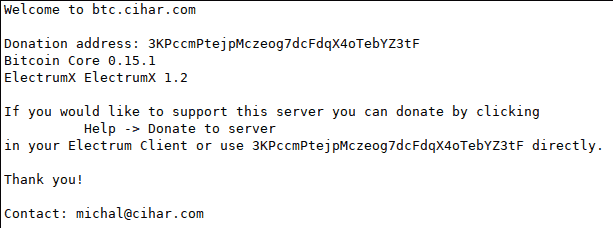
Michal &#268;iha&#345;: Running Bitcoin node and ElectrumX server

I've been tempted to run own ElectrumX server for quite some. First attempt was to run this on Turris Omnia router, however that turned out to be impossible due to memory requirements both Bitcoind and ElectrumX have. This time I've dedicated host for this and it runs fine: Electrum connecting to btc.cihar.com The server runs Debian sid (probably it would be doable on stretch as well, but I didn't try much) and the setup was pretty simple. First we need to install some things - Bitcoin daemon and ElectrumX dependencies:
# Bitcoin daemon, not available in stretch
apt install bitcoind
# We will checkout ElectrumX from git
apt install git
# ElectrumX deps
apt install python3-aiohttp
# Build environment for ElectrumX deps
apt install build-essentials python3-pip libleveldb-dev
# ElectrumX deps not packaged in Debian
pip3 install plyvel pylru
# Download ElectrumX sources
su - electrumx -c 'git clone https://github.com/kyuupichan/electrumx.git'
Create users which will run the services:
adduser bitcoind
adduser electrumx
Now it's time to prepare configuration for the services. For Bitcoin it's quite simple - we need to configure RPC interface and enable transaction index in /home/bitcoind/.bitcoin/bitcoin.conf:
txindex=1
listen=1
rpcuser=bitcoin
rpcpassword=somerandompassword
The ElectrumX configuration is quite simple as well and it's pretty well documented. I've decided to place it in /etc/electrumx.conf:
COIN=BitcoinSegwit
DB_DIRECTORY=/home/electrumx/.electrumx
DAEMON_URL=http://bitcoin:somerandompassword@localhost:8332/
TCP_PORT=50001
SSL_PORT=50002
HOST=::
DONATION_ADDRESS=3KPccmPtejpMczeog7dcFdqX4oTebYZ3tF
SSL_CERTFILE=/etc/letsencrypt/live/btc.cihar.com/fullchain.pem
SSL_KEYFILE=/etc/letsencrypt/live/btc.cihar.com/privkey.pem
REPORT_HOST=btc.cihar.com
BANNER_FILE=banner
I've decided to control both services using systemd, so it's matter of creating pretty simple units for that. Actually the Bitcoin one closely matches the one I've used on Turris Omnia and the ElectrumX the one they ship, but there are some minor changes. Systemd unit for ElectrumX in /etc/systemd/system/electrumx.service:
[Unit]
Description=Electrumx
After=bitcoind.target
[Service]
EnvironmentFile=/etc/electrumx.conf
ExecStart=/home/electrumx/electrumx/electrumx_server.py
User=electrumx
LimitNOFILE=8192
TimeoutStopSec=30min
[Install]
WantedBy=multi-user.target
And finally systemd unit for Bitcoin daemon in /etc/systemd/system/bitcoind.service:
[Unit]
Description=Bitcoind
After=network.target
[Service]
ExecStart=/usr/bin/bitcoind
User=bitcoind
TimeoutStopSec=30min
Restart=on-failure
RestartSec=30
[Install]
WantedBy=multi-user.target
Now everything should be configured and it's time to start up the services:
# Enable services so that they start on boot 
systemctl enable electrumx.service bitcoind.service
# Start services
systemctl start electrumx.service bitcoind.service
Now you have few days time until Bitcoin fetches whole blockchain and ElectrumX indexes that. If you happen to have another Bitcoin node running (or was running in past), you can speedup the process by copying blocks from that system (located in ~/.bitcoin/blocks/). Only get blocks from sources you trust absolutely as it might change your view of history, see Bitcoin wiki for more information on the topic. There is also magnet link in the ElectrumX docs to download ElectrumX database to speed up this process. This should be safe to download from untrusted source. The last think I'd like to mention is resources usage. You should have at least 4 GB of memory to run this, 8 GB is really preferred (both services consume around 4GB). On disk space, Bitcoin currently consumes 170 GB and ElectrumX 25 GB. Ideally all this should be running on the SSD disk. You can however offload some of the files to slower storage as old blocks are rarely accessed and this can save some space on your storage. Following script will move around 50 GB of blockchain data to /mnt/btc/blocks (use only when Bitcoin daemon is not running):
 1
 2
 3
 4
 5
 6
 7
 8
 9
10
11
#!/bin/sh
set -e
DEST=/mnt/btc/blocks
cd ~/.bitcoin/blocks/
find . -type f \( -name 'blk00[0123]*.dat' -o -name 'rev00[0123]*dat' \)   sed 's@^\./@@'   while read name ; do
        mv $name $DEST/$name
        ln -s $DEST/$name $name
done
Anyway if you would like to use this server, configure btc.cihar.com in your Electrum client. If you find this howto useful, you can send some Satoshis to 3KPccmPtejpMczeog7dcFdqX4oTebYZ3tF.

Filed under: Crypto Debian English

15 November 2017

Kees Cook: security things in Linux v4.14

Previously: v4.13. Linux kernel v4.14 was released this last Sunday, and there s a bunch of security things I think are interesting: vmapped kernel stack on arm64
Similar to the same feature on x86, Mark Rutland and Ard Biesheuvel implemented CONFIG_VMAP_STACK for arm64, which moves the kernel stack to an isolated and guard-paged vmap area. With traditional stacks, there were two major risks when exhausting the stack: overwriting the thread_info structure (which contained the addr_limit field which is checked during copy_to/from_user()), and overwriting neighboring stacks (or other things allocated next to the stack). While arm64 previously moved its thread_info off the stack to deal with the former issue, this vmap change adds the last bit of protection by nature of the vmap guard pages. If the kernel tries to write past the end of the stack, it will hit the guard page and fault. (Testing for this is now possible via LKDTM s STACK_GUARD_PAGE_LEADING/TRAILING tests.) One aspect of the guard page protection that will need further attention (on all architectures) is that if the stack grew because of a giant Variable Length Array on the stack (effectively an implicit alloca() call), it might be possible to jump over the guard page entirely (as seen in the userspace Stack Clash attacks). Thankfully the use of VLAs is rare in the kernel. In the future, hopefully we ll see the addition of PaX/grsecurity s STACKLEAK plugin which, in addition to its primary purpose of clearing the kernel stack on return to userspace, makes sure stack expansion cannot skip over guard pages. This stack probing ability will likely also become directly available from the compiler as well. set_fs() balance checking
Related to the addr_limit field mentioned above, another class of bug is finding a way to force the kernel into accidentally leaving addr_limit open to kernel memory through an unbalanced call to set_fs(). In some areas of the kernel, in order to reuse userspace routines (usually VFS or compat related), code will do something like: set_fs(KERNEL_DS); ...some code here...; set_fs(USER_DS);. When the USER_DS call goes missing (usually due to a buggy error path or exception), subsequent system calls can suddenly start writing into kernel memory via copy_to_user (where the to user really means within the addr_limit range ). Thomas Garnier implemented USER_DS checking at syscall exit time for x86, arm, and arm64. This means that a broken set_fs() setting will not extend beyond the buggy syscall that fails to set it back to USER_DS. Additionally, as part of the discussion on the best way to deal with this feature, Christoph Hellwig and Al Viro (and others) have been making extensive changes to avoid the need for set_fs() being used at all, which should greatly reduce the number of places where it might be possible to introduce such a bug in the future. SLUB freelist hardening
A common class of heap attacks is overwriting the freelist pointers stored inline in the unallocated SLUB cache objects. PaX/grsecurity developed an inexpensive defense that XORs the freelist pointer with a global random value (and the storage address). Daniel Micay improved on this by using a per-cache random value, and I refactored the code a bit more. The resulting feature, enabled with CONFIG_SLAB_FREELIST_HARDENED, makes freelist pointer overwrites very hard to exploit unless an attacker has found a way to expose both the random value and the pointer location. This should render blind heap overflow bugs much more difficult to exploit. Additionally, Alexander Popov implemented a simple double-free defense, similar to the fasttop check in the GNU C library, which will catch sequential free()s of the same pointer. (And has already uncovered a bug.) Future work would be to provide similar metadata protections to the SLAB allocator (though SLAB doesn t store its freelist within the individual unused objects, so it has a different set of exposures compared to SLUB). setuid-exec stack limitation
Continuing the various additional defenses to protect against future problems related to userspace memory layout manipulation (as shown most recently in the Stack Clash attacks), I implemented an 8MiB stack limit for privileged (i.e. setuid) execs, inspired by a similar protection in grsecurity, after reworking the secureexec handling by LSMs. This complements the unconditional limit to the size of exec arguments that landed in v4.13. randstruct automatic struct selection
While the bulk of the port of the randstruct gcc plugin from grsecurity landed in v4.13, the last of the work needed to enable automatic struct selection landed in v4.14. This means that the coverage of randomized structures, via CONFIG_GCC_PLUGIN_RANDSTRUCT, now includes one of the major targets of exploits: function pointer structures. Without knowing the build-randomized location of a callback pointer an attacker needs to overwrite in a structure, exploits become much less reliable. structleak passed-by-reference variable initialization
Ard Biesheuvel enhanced the structleak gcc plugin to initialize all variables on the stack that are passed by reference when built with CONFIG_GCC_PLUGIN_STRUCTLEAK_BYREF_ALL. Normally the compiler will yell if a variable is used before being initialized, but it silences this warning if the variable s address is passed into a function call first, as it has no way to tell if the function did actually initialize the contents. So the plugin now zero-initializes such variables (if they hadn t already been initialized) before the function call that takes their address. Enabling this feature has a small performance impact, but solves many stack content exposure flaws. (In fact at least one such flaw reported during the v4.15 development cycle was mitigated by this plugin.) improved boot entropy
Laura Abbott and Daniel Micay improved early boot entropy available to the stack protector by both moving the stack protector setup later in the boot, and including the kernel command line in boot entropy collection (since with some devices it changes on each boot). eBPF JIT for 32-bit ARM
The ARM BPF JIT had been around a while, but it didn t support eBPF (and, as a result, did not provide constant value blinding, which meant it was exposed to being used by an attacker to build arbitrary machine code with BPF constant values). Shubham Bansal spent a bunch of time building a full eBPF JIT for 32-bit ARM which both speeds up eBPF and brings it up to date on JIT exploit defenses in the kernel. seccomp improvements
Tyler Hicks addressed a long-standing deficiency in how seccomp could log action results. In addition to creating a way to mark a specific seccomp filter as needing to be logged with SECCOMP_FILTER_FLAG_LOG, he added a new action result, SECCOMP_RET_LOG. With these changes in place, it should be much easier for developers to inspect the results of seccomp filters, and for process launchers to generate logs for their child processes operating under a seccomp filter. Additionally, I finally found a way to implement an often-requested feature for seccomp, which was to kill an entire process instead of just the offending thread. This was done by creating the SECCOMP_RET_ACTION_FULL mask (n e SECCOMP_RET_ACTION) and implementing SECCOMP_RET_KILL_PROCESS. That s it for now; please let me know if I missed anything. The v4.15 merge window is now open!

2017, Kees Cook. This work is licensed under a Creative Commons Attribution-ShareAlike 3.0 License.
Creative Commons License

Next.

Previous.