Search Results: "nate"

11 March 2022

Dirk Eddelbuettel: dtts 0.1.0 on CRAN: New Package

Leonardo and I are thrilled to announce the first CRAN release of dtts. The dtts package builds on top of both our nanotime package and the well-loved and widely-used data.table package by Matt, Arun, Jan, and numerous collaborators. In a very rough nutshell, you can think of dtts as combining both these potent ingredients to produce something not-entirely-unlike the venerable xts package by our friends Jeff and Josh but using highest-precision nanosecond increments rather than not-quite-microseconds or dates. The package is still somewhat rare and bare: it is mostly just alignment operators. But because of the power and genius of data.table not all that much more is needed because data.table gets us fifteen years of highly refined, tuned and tested code for data slicing, dicing, and aggregation. To which we now humbly add nanosecond-resolution indexing and alignment. The package had been simmering for some time, and does of course take advantage of (a lot of) earlier work by Leonardo on his ztsdb project. We look forward to user feedback and suggestions at the GitHub repo. If you like this or other open-source work I do, you can now sponsor me at GitHub.

This post by Dirk Eddelbuettel originated on his Thinking inside the box blog. Please report excessive re-aggregation in third-party for-profit settings.

9 March 2022

Jonathan Dowland: Broken webcam aspect ratio

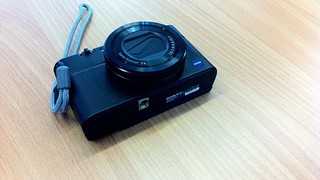
picture of my Sony RX100-III camera Sony RX100-III, relegated to a webcam
Sometimes I have remote meetings with Google Meet. Unlike the other video-conferencing services that I use (Bluejeans, Zoom), my video was stretched out of proportion under Google Meet with Firefox. I haven't found out why this was happening, but I did figure out a work-around. Thanks to Daniel Silverstone, Rob Kendrick, Gregor Herrmann and Ben Allen for pointing me in the right direction! Hardware The lovely Sony RX-100 mk3 that I bought in 2015 has spent most of its life languishing unused. During the Pandemic, once I was working from home all the time, I decided to press-gang it into service as a better-quality webcam. Newer models of this camera the mark 4 onwards have support for a USB mode called "PC Remote", which effectively makes them into webcams. Unfortunately my mark 3 does not support this, but it does have HDMI out, so I picked up a cheap "HDMI to USB Video Capture Card" from eBay. Video modes
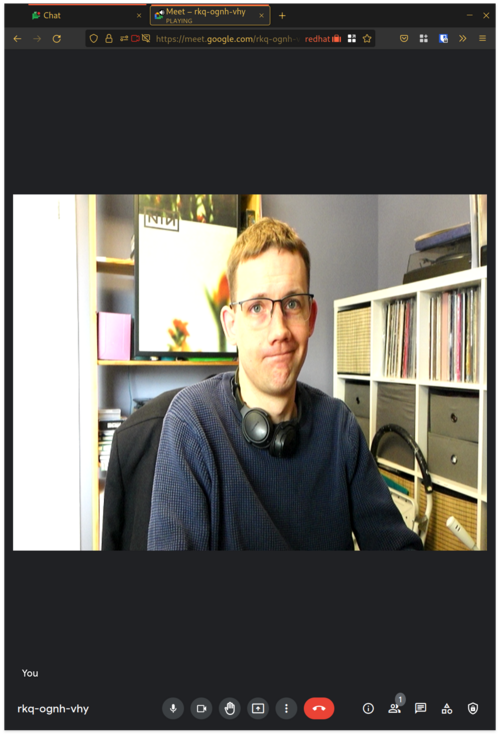
Before: wrong aspect ratio Before: wrong aspect ratio
This device offers a selection of different video modes over a webcam interface. I used qv4l2 to explore the different modes. It became clear that the camera was outputting a signal at 16:9, but the modes on offer from the dongle were for a range of different aspect ratios. The picture for these other ratios was not letter or pillar-boxed, but stretched to fit. I also noticed that the modes which had the correct aspect ratio were at very low framerates: 1920x1080@5fps, 1360x768@8fps, 1280x720@10fps. It felt to me that I would look unnatural at such a low framerate. The most promising mode was close to the right ratio, 720x480 and 30 fps. Software
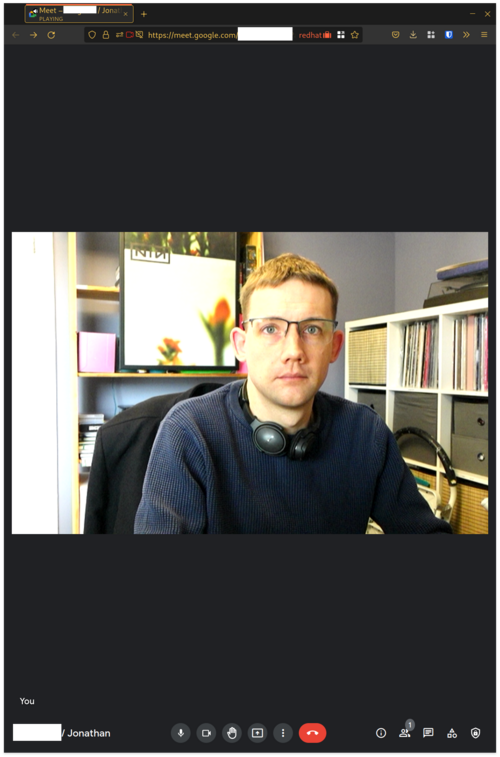
After: corrected aspect ratio After: corrected aspect ratio
My initial solution is to use the v4l2loopback kernel module, which provides a virtual loop-back webcam interface. I can write video data to it from one process, and read it back from another. Loading it as follows:
modprobe v4l2loopback exclusive_caps=1
The option exclusive_caps configures the module into a mode where it initially presents a write-only interface, but once a process has opened a file handle, it then switches to read-only for subsequent processes. Assuming there are no other camera devices connected at the time of loading the module, it will create /dev/video0.1 I experimented briefly with OBS Studio, the very versatile and feature-full streaming tool, which confirmed that I could use filters on the source video to fix the aspect ratio, and emit the result to the virtual device. I don't otherwise use OBS, though, so I achieve the same result using ffmpeg:
fmpeg -s 720x480 -i /dev/video1 -r 30 -f v4l2 -vcodec rawvideo \
    -pix_fmt yuyv422 -s 720x405 /dev/video0
The source options are to select the source video mode I want. The codec and pixel formats are to match what is being emitted (I determined that using ffprobe on the camera device). The resizing is triggered by supplying a different size to the -s parameter. I think that is equivalent to explicitly selecting a "scale" filter, and there might be other filters that could be used instead (to add pillar boxes for example). This worked just as well. In Google Meet, I select the Virtual Camera, and Google Meet is presented with only one video mode, in the correct aspect ratio, and no configurable options for it, so it can't misbehave. Future I'm planning to automate the loading (and unloading) of the module and starting the ffmpeg process in response to the real camera device being plugged or unplugged, using systemd events and services. (I don't leave the camera plugged in all the time due to some bad USB behaviour I've experienced if I do so.) If I get that working, I will write a follow-up.

  1. you can request a specific device name/number with another module option.

Dirk Eddelbuettel: RcppRedis 0.2.0: Major Updates

A new major release of RcppRedis arrived on CRAN today. RcppRedis is one of several packages connecting R to the fabulous Redis in-memory datastructure store (and much more). RcppRedis does not pretend to be feature complete, but it may do some things faster than the other interfaces, and also offers an optional coupling with MessagePack binary (de)serialization via RcppMsgPack. The package has carried production loads for several years now. This release integrates support for pub/sub, a popular messaging pattern in which one or more clients can subscribe to one or more channels . Whenever a client instances publishes, the Redis server immediately updates all clients listening on the given channel. This pattern is fairly common to transmit data to listeners. A there is a bit more to explain about this, I also added a brand-new vignette describing pub/sub with RcppRedis, along with another introductory vignette about Redis itself. We blogged about this exciting new feature and its particular use for market monitoring in R4 #36 recently too. The pub/sub feature was available in package rredis by Bryan Lewis and has now been ported over by Bryan in a truly elegant yet compact implementation. We placed the code for the pub/sub examples, both for a single symbol (SP 500) as well as for a set of (futures) symbols, into a new examples/ subdirectory. Other changes in this release are the removal of the build-dependency on Boost (or, rather, my BH package), an update to the included hiredis library (used if no system-wide version is found), and an updated to the UCRT build for R. That last one is a bit of a sore spot and nobody at CRAN deemed it necessary to tell me they were waiting for me to make this change; communication with the CRAN team can still be challenging (and I am being generous here). Anyway, the package is now on CRAN so all is well now, at long last. The detailed changes list follows.

Changes in version 0.2.0 (2022-03-08)
  • Two simple C++11 features remove needs for BH and lexical_cast() (Dirk in #45 addressing #44).
  • Redis pub/sub is now supported (Dirk in #43, Bryan in #46).
  • Bryan Lewis is now a coauthor.
  • Added pub/sub examples for single and multiple Globex symbols.
  • The included hiredis sources have been updated to release 1.0.2.
  • Two vignettes have been added to introduce Redis and to described a live market-monitoring application included in directory pubsub/.
  • The UCRT build was updated per a suggestion by Tomas.

Courtesy of CRANberries, there is also a diffstat report for this release. More information is on the RcppRedis page. If you like this or other open-source work I do, you can now sponsor me at GitHub.

This post by Dirk Eddelbuettel originated on his Thinking inside the box blog. Please report excessive re-aggregation in third-party for-profit settings.

6 March 2022

Dirk Eddelbuettel: nanotime 0.3.6 on CRAN: Updates

Leonardo and I are pleased to another update to our nanotime package bringing it to version 0.3.6 which landed on CRAN earlier today. nanotime relies on the RcppCCTZ package (as well as the RcppDate package for additional C++ operations) and offers efficient high(er) resolution time parsing and formatting up to nanosecond resolution, and the bit64 package for the actual integer64 arithmetic. Initially implemented using the S3 system, it has benefitted greatly from a rigorous refactoring by Leonardo who not only rejigged nanotime internals in S4 but also added new S4 types for periods, intervals and durations. This release corrects subsetting with %in% operator, integrates it better fit in the mixed S3/S4 setup, fixes a negative period parse, and updates class comparisons to rely on inherits(). The NEWS snippet has the full more details.

Changes in version 0.3.6 (2022-03-06)
  • Fix incorrect subsetting with operator %in% (Leonardo in #100 fixing #99).
  • Fix incorrect parsing for negative nanoperiod (Leonardo in #100 fixing #96).
  • Test for class via inherits() (Dirk).

Thanks to my CRANberries there is also a diff to the previous version. More details and examples are at the nanotime page; code, issue tickets etc at the GitHub repository and all documentation is provided at the nanotime documentation site. If you like this or other open-source work I do, you can now sponsor me at GitHub.

This post by Dirk Eddelbuettel originated on his Thinking inside the box blog. Please report excessive re-aggregation in third-party for-profit settings.

5 March 2022

Thorsten Alteholz: My Debian Activities in February 2022

FTP master This month I accepted 484 and rejected 73 packages. The overall number of packages that got accepted was 495. The overall number of rejected packages was 76, which is about 15% of the uploads to NEW. While most of the maintainers do a great job when creating their debian/copyright, others are a bit lax. Unfortunately those people seem to be more enthusiastic when fighting for changes in NEW processing or even removing NEW. One argument in discussions about NEW is that the copyright verification of packages can be done by the community after accepting the packages in the archive.
Last month I did not get any hint that such checks have been done by anybody. As the past already showed several times, this community based checks simply do not exist. So in the end poorly maintained copyright information will rot in the archive and I am not sure that this really corresponds with the Debian Social Contract. Debian LTS This was my ninety-second month that I did some work for the Debian LTS initiative, started by Raphael Hertzog at Freexian. This month my all in all workload has been 40h. During that time I did LTS and normal security uploads of: Unfortunately salsa went down at the end of the month, so several planned uploads did not happen and have to be delayed to March. I also continued to work on security support for golang packages. Further I worked on packages in NEW on security-master and injected missing sources. Last but not least I did some days of frontdesk duties. Debian ELTS This month was the forty-fourth ELTS month. During my allocated time I uploaded: Further I worked on cyrus-sasl but did not do an upload yet. Last but not least I did some days of frontdesk duties. Debian Printing As announced last month I uploaded a new version of cups. Altogether I uploaded new upstream versions or improved packaging of: Debian Astro This month I uploaded new upstream versions or improved packaging of: Other stuff This month I uploaded new upstream versions or improved packaging of:

4 March 2022

Abiola Ajadi: Outreachy-And it s a wrap!

Outreachy Wrap-up Project Improve Debian Continuous Integration UX
Project Link: https://www.outreachy.org/outreachy-december-2021-internship-round/communities/debian/#improve-debian-continuous-integration-ux
Code Repository: https://salsa.debian.org/ci-team/debci
Mentors: Antonio Terceiro, Paul Gevers and Pavit Kaur

About the project Debci exist to make sure packages work currently after an update, How it does this is by testing all of the packages that have tests written in them to make sure it works and nothing is broken This project entails making improvements to the platform to make it easier to use and maintain.

Deliverables of the project:
  • Package landing page displaying pending jobs
  • web frontend: centralize job listings in a single template
  • self-service: request test form forgets values when validation fails
  • Improvement to status

Work done

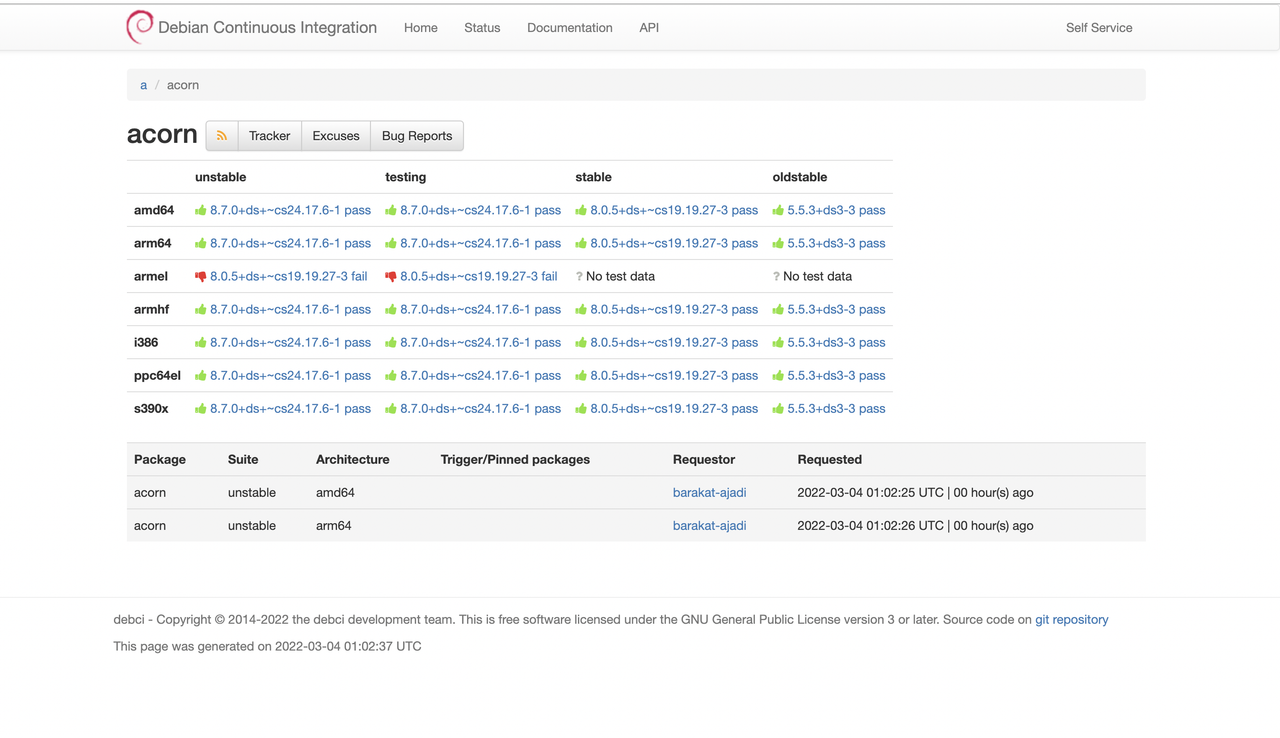
Package landing page displaying pending jobs Previously, Jobs that were pending were not displayed on the package page. Working on this added a feature to display pending jobs on package landing. Working on this task made it known that the same block of codes was repeated in different files which led to the next task Screenshot-2022-03-04-at-02-03-06.png Merge request
web frontend: centralize job listings in a single template Jobs are listed in various landings such as status packages, Status alerts, status failing, History, and so on. The same Code was repeated in these pages to list the jobs, I worked on refactoring it and created a single template for job listing so it can be used anywhere it s needed. I also wrote a test for the feature I added.
Merge request
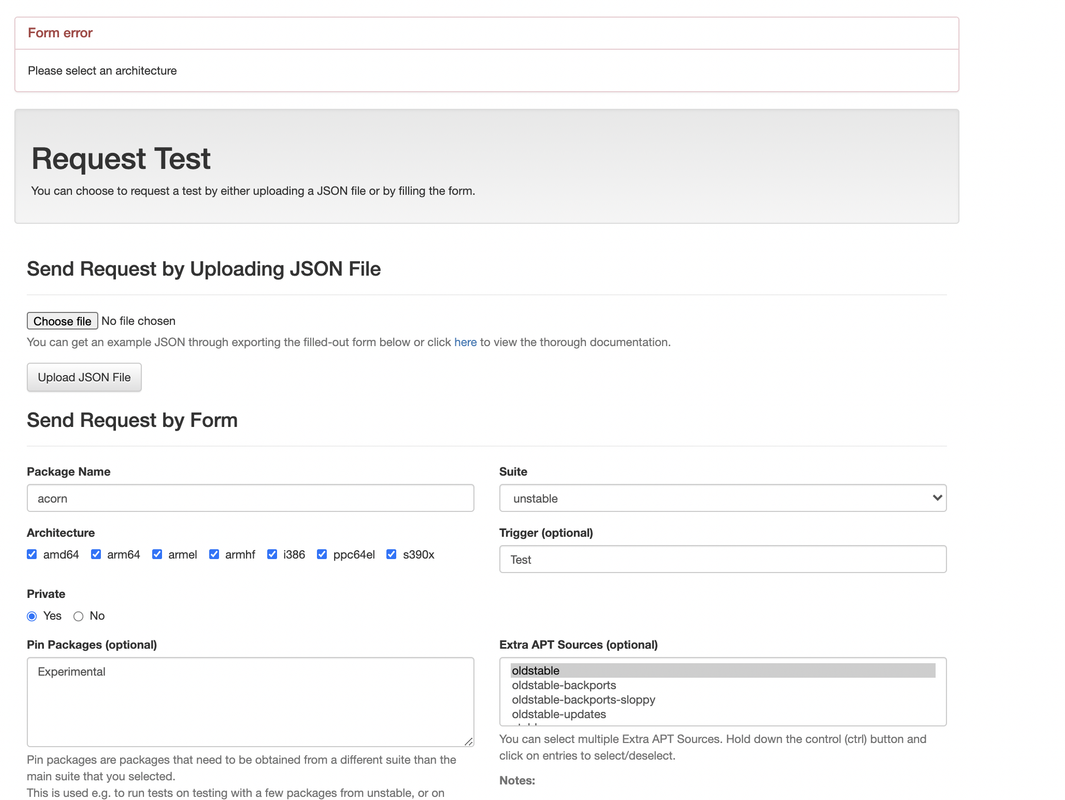
self service: request test form forgets values when validation fails When one tries to request for a test and it fails with an error, originally the form does not remember the values that were typed in the package name, suite field et. c. This fix ensures the form remembers the values inputted even when it throws an error. Image of request test page N/B: The form checks all architecture on the load of the page
merge request
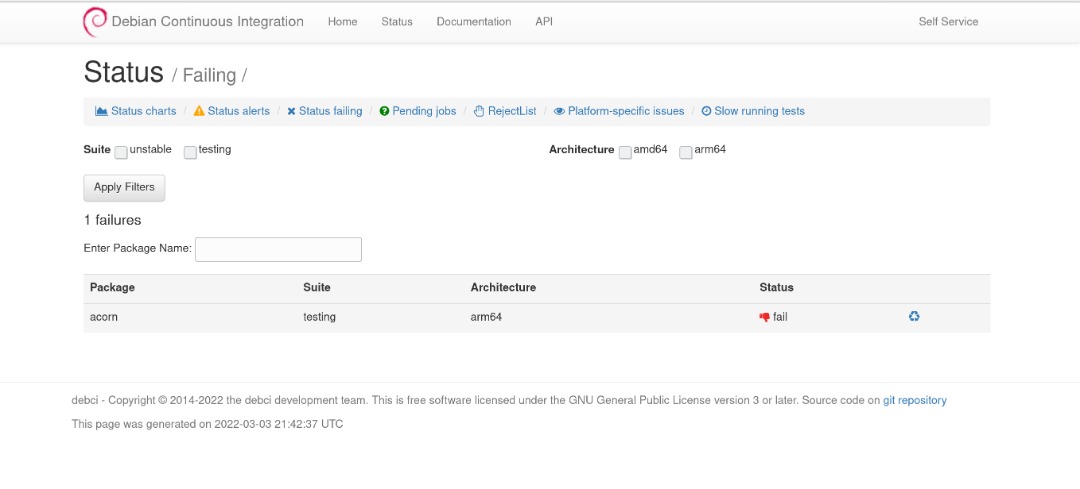
Improvement to status Originally the Status pages were rendered as static HTML pages but I converted these pages to be generated dynamically, I wrote endpoints for each page. Since most of the status pages have a list of jobs I modified it to use the template I created for job-listing. Previously, the status pages had a mechanism to filter such as All, Latest 50 et.c which wasn t paginated. I removed this mechanism added a filter by architecture and suites to these pages and also add pagination. Last but not the least, I wrote tests for these implementations carried out on the status page. Image of Status failing page merge request:
first task
second task

Major take-aways I learnt a lot during my internship but most importantly I learnt how to:
  • write Tests in Ruby and how writing tests is an important aspect of software development
  • maintain good coding practice, Paying attending to commit messages, Indentation et.c are good areas I developed in writing code.
  • make contributions in Ruby Programming Language.

Acknowledgement I can not end this without saying thank you to my mentors Antonio Terceiro, Paul Gevers, and Pavit Kaur for their constant support and guidance throughout the entire duration of this Internship. It has been a pleasure Interacting and learning from everyone.

Review Outreachy has helped me feel more confident about open-source, especially during the application phase. I had to reach out to the community I was interested in and ask questions on how to get started. The informal chats week was awesome I was able to build my network and have interesting conversations with amazing individuals in open-source. To round up, Always ask questions and do not be afraid of making a mistake, as one of the outreachy blog post topics says Everyone struggles!, but never give up!

3 March 2022

Jamie McClelland: LVM Cache Surprises

By far the biggest LVM Cache surprise is just how well it works. Between 2010 and 2020, my single, biggest and most consistent headache managing servers at May First has been disk i/o. We run a number of physical hosts with encrypted disks, with each providing a dozen or so sundry KVM guests. And they consume a lot of disk i/o. This problem kept me awake at night and made me want to put my head on the table and cry during the day as I monitored the output of vmstat 1 and watched each disk i/o death spiral unfold. We tried everything. Turned off fsck s, turned off RAID monthly checks. Switched to less intensive backup systems. Added solid state drives and tried to stragically distribute them to our database partitions and other read/write heavy services. Added tmpfs file systems where it was possible. But, the sad truth was: we simply did not have the resources to pay for the infrastructure that could support the disk i/o our services demanded. Then, we discovered LVM caching (cue Hallelujah). We starting provisioning SSD partitions to back up our busiest spinning disk logical volumes and presto. Ten years of agony gone like a poof of smoke! I don t know which individuals are responsible for writing the LVM caching code but if you see this: THANK YOU! Your contributions to the world are noticed, appreciated and have had an enormous impact on at least one individual.

Some surprises

Filters For the last two years, with the exception of one little heart attack, LVM caches have gone very smoothly. Then, last week we upgraded 13 physical servers straight through from stretch to bullseye. It went relatively smoothly for the first half of our servers (the old ones hosting fewer resources). But, after rebooting our first server with lvm caching going on, we noticed that the cached disk wasn t accessible. No problem, we reasoned. We ll just uncache it. Except that didn t work either. We tried every argument we could find on the Internet but lvm insisted that the block device from the SSD volume group (that provides the caching device) was not available. Running pvs showed an unknown device and vgs reported similar errors. Now I started to panic a bit. There was a clean shutdown of the server, so surely all the data had been flushed to the disk. But, how can we get that data? We started a restore from backup process because we really thought that data was gone for ever. Then we had a really great theory: the caching logical volume comes from the SSD volume group, which gets decrypted after the spinning disk volume group. Maybe there s a timing issue? When the spinning disk volume group comes online, the caching logical volume is not yet available. So, we booted into busybox, and manually decrypted the SSD volume first, followed by the spinning disk volume. Alas, no dice. Now that we were fully desperate, we decided to restore the lvm configuration file for the entire spinning disk volume group. This felt kinda risky since we might be damaging all the currently working logical volumes, but it seemed like the only option we had. The main problem was that busybox didn t seem to have the lvm config tool we needed to restore the configuration from our backup (I think it might be there but it was late and we couldn t figure it out). And, our only readily available live install media was a Debian stretch disk via debirf. Debian stretch is pretty old and we really would have preferred to have the most modern tools available, but we decided to go with what we had. And, that was a good thing, because as soon as we booted into stretch and decrypted the disks, the lvm volume suddenly appeared, happy as ever. We uncached it and booted into the host system and there it was. We went to bed confused but relieved. The next morning my co-worker figured it out: filtering. During the stretch days we occassionally ran into an annoying problem: the logical volumes from guests would suddenly pop up on the host. This was mostly annoying but also it made possible some serious mistakes if you accidentally took a volume from a guest and used it on the host. The LVM folks seemed to have noticed this problem and introduced a new default filter that tries to only show you the devices that you should be seeing. Unfortunately for us, this new filter removed logical volumes from the list of available physical volumes. That does make sense for most people. But, not for us. It sounds a bit weird, but our setup looks like this:
  • One volume group derived from the spinning disks
  • One volume group derived from the SSD disks
Then we carve out logical volumes from each for each guest. Once we discovered LVM caching, we carved out SSD logical volumes to be used as caches for the spinning logical volumes. In restrospect, if we could start over, we would probably do it differently. In any event, once we discovered the problem, we used the handy configuration options in lvm.conf to tweak the filters to include our cache disks and once again, everything is back to working.

Saturated SSDs The other surprise seems unrelated to the upgrade. We have a phsyical server that has been suffering from disk i/o problems despite our use of LVM caching. Our answer, of course, was to add more LVM caches to the spinning logical volumes that seemed to be suffering. But somehow this was making things even worse. Then, we finally just removed the LVM caches from all the spinning disks and presto, disk i/o problems seemed to go away. What? Isn t that the opposite of what s supposed to happen? We re still trying to figure this one out, but it seems that our SSDs are saturated, in which case adding them as a caching volume really is going to make things worse. We re still not sure why they are saturated when none of the SSDs on our other hosts are saturated, but a few theories include:
  • They are doing more writing and/or it s a different kind of writing. I m still not sure I quite have the right tool to compare this host with other hosts. And, this host is our only MySQL network database server, hosting hundreds of GBs of database - all writing/reading direclty onto the SSDs.
  • They are broken or substanard SSDs (smartctl doesn t uncover any problems but maybe it s a bad model?)
I ll update this post as we learn more but welcome any suggestions in the comments. Update: 2022-03-07 Two more possible causes:
  • Our use of the write back feature: LVM cache has a nice feature that caches writes to smooth out writes to the underlying disk. Maybe our disks are simply writing more then can be handled and not using write back is our solution. This server supports a guest with an unusually large disk.
  • Maybe we haven t allocated a big enough LVM cache for the given volume so the contents are constantly being ejected?

John Goerzen: Tools for Communicating Offline and in Difficult Circumstances

Note: this post is also available on my website, where it will be updated periodically. When things are difficult maybe there s been a disaster, or an invasion (this page is being written in 2022 just after Russia invaded Ukraine), or maybe you re just backpacking off the grid there are tools that can help you keep in touch, or move your data around. This page aims to survey some of them, roughly in order from easiest to more complex.

Simple radios Handheld radios shouldn t be forgotten. They are cheap, small, and easy to operate. Their range isn t huge maybe a couple of miles in rural areas, much less in cities but they can be a useful place to start. They tend to have no actual encryption features (the privacy features really aren t.) In the USA, options are FRS/GMRS and CB.

Syncthing With Syncthing, you can share files among your devices or with your friends. Syncthing essentially builds a private mesh for file sharing. Devices will auto-discover each other when on the same LAN or Wifi network, and opportunistically sync. I wrote more about offline uses of Syncthing, and its use with NNCP, in my blog post A simple, delay-tolerant, offline-capable mesh network with Syncthing (+ optional NNCP). Yes, it is a form of a Mesh Network! Homepage: https://syncthing.net/

Briar Briar is an instant messaging service based around Android. It s IM with a twist: it can use a mesh of Bluetooh devices. Or, if Internet is available, Tor. It has even been extended to support the use of SD cards and USB sticks to carry your messages. Like some others here, it can relay messages for third parties as well. Homepage: https://briarproject.org/

Manyverse and Scuttlebutt Manyverse is a client for Scuttlebutt, which is a sort of asynchronous, offline-friendly social network. You can use it to keep in touch with your family and friends, and it supports syncing over Bluetooth and Wifi even in the absence of Internet. Homepages: https://www.manyver.se/ and https://scuttlebutt.nz/

Yggdrasil Yggdrasil is a self-healing, fully end-to-end Encrypted Mesh Network. It can work among local devices or on the global Internet. It has network services that can egress onto things like Tor, I2P, and the public Internet. Yggdrasil makes a perfect companion to ad-hoc wifi as it has auto peer discovery on the local network. I talked about it in more detail in my blog post Make the Internet Yours Again With an Instant Mesh Network. Homepage: https://yggdrasil-network.github.io/

Ad-Hoc Wifi Few people know about the ad-hoc wifi mode. Ad-hoc wifi lets devices in range talk to each other without an access point. You just all set your devices to the same network name and password and there you go. However, there often isn t DHCP, so IP configuration can be a bit of a challenge. Yggdrasil helps here.

NNCP Moving now to more advanced tools, NNCP lets you assemble a network of peers that can use Asynchronous Communication over sneakernet, USB drives, radios, CD-Rs, Internet, tor, NNCP over Yggdrasil, Syncthing, Dropbox, S3, you name it . NNCP supports multi-hop file transfer and remote execution. It is fully end-to-end encrypted. Think of it as the offline version of ssh. Homepage: https://nncp.mirrors.quux.org/

Meshtastic Meshtastic uses long-range, low-power LoRa radios to build a long-distance, encrypted, instant messaging system that is a Mesh Network. It requires specialized hardware, about $30, but will tend to get much better range than simple radios, and with very little power. Homepages: https://meshtastic.org/ and https://meshtastic.letstalkthis.com/

Portable Satellite Communicators You can get portable satellite communicators that can send SMS from anywhere on earth with a clear view of the sky. The Garmin InReach mini and Zoleo are two credible options. Subscriptions range from about $10 to $40 per month depending on usage. They also have global SOS features.

Telephone Lines If you have a phone line and a modem, UUCP can get through just about anything. It s an older protocol that lacks modern security, but will deal with slow and noisy serial lines well. XBee SX radios also have a serial mode that can work well with UUCP.

Additional Suggestions It is probably useful to have a Linux live USB stick with whatever software you want to use handy. Debian can be installed from the live environment, or you could use a security-focused distribution such as Tails or Qubes.

References This page originated in my Mastodon thread and incorporates some suggestions I received there. It also formed a post on my blog.

2 March 2022

Fran ois Marier: Ways to refer to locahost in Chromium

The filter rules preventing websites from portscanning the local machine have recently been tightened in Brave. It turns out there are a surprising number of ways to refer to the local machine in Chromium. localhost and friends 127.0.0.1 is the first address that comes to mind when thinking of the local machine. localhost is typically aliased to that address (via /etc/hosts), though that convention is not mandatory. The IPv6 equivalent is [::1]. 0.0.0.0 0.0.0.0 is not a routable address, but that's what's used to tell a service to bind (listen) on all network interfaces. In Chromium, it resolves to the local machine, just like 127.0.0.1. The IPv6 equivalent is [::].

DNS-based Of course, another way to encode these numerical URLs is to create A / AAAA records for them under a domain you control. I've done this under my personal domain: For these to work, you'll need to:
  • Make sure you can connect to IPv6-only hosts, for example by connecting to an appropriate VPN if needed.
  • Put nameserver 8.8.8.8 in /etc/resolv.conf since you need a DNS server that will not filter these localhost domains. (For example, Unbound will do that if you use private-address: 127.0.0.0/8 in the server config.)
  • Go into chrome://settings/security and disable Always use secure connections to make sure the OS resolver is used.
  • Turn off the chrome://flags/#block-insecure-private-network-requests flag since that security feature (CORS-RFC1918) is designed to protect against these kinds of requests.
127.0.0.0/8 subnet Technically, the entire 127.0.0.0/8 subnet can used to refer to the local machine. However, it's not a reliable way to portscan a machine from a web browser because it only catches the services that listen on all interfaces (i.e. 0.0.0.0). For example, on my machine, if I nmap 127.0.0.1, I get:
PORT     STATE SERVICE   VERSION
22/tcp   open  ssh       OpenSSH 8.2p1
25/tcp   open  smtp      Postfix smtpd
whereas if I nmap 127.0.1.25, I only get:
PORT   STATE SERVICE VERSION
22/tcp open  ssh     OpenSSH 8.2p1
That's because I've got the following in /etc/postfix/main.cf:
inet_interfaces = loopback-only
which I assume is explicitly binding 127.0.0.1. Nevertheless, it would be good to get that fixed in Brave too.

1 March 2022

Abiola Ajadi: Career Interest!

Hi, Welcome back. In this blog, I will be discussing my career interests and what I plan to pursue after my internship.

What comes next after the internship After working a while with Debci project, I was able to learn better software development practices and love the open source community. I will love to build my career path around open-source.

What I am looking for Prior to starting my internship, I have worked as a front-end developer with react and javascript. During my internship with Debci I learn Ruby and also how to write tests . I am also passionate about community which is one of my core-values, I build and organize communities. I am looking for opportunities in areas of front-end development, Ruby, React. i am also open to opportunities in developer relations/community management where i can be part of building or managing a community, Interacting with developers, meeting new people. I am based in lagos, Nigeria and can work remotely, but also open to relocation. You can connect with me on linkedin

25 February 2022

Dirk Eddelbuettel: It was twenty years ago today

that I made my first upload to CRAN as demonstrated by the very bottom of the ChangeLog file of the RQuantLib package:
2002-02-25  Dirk Eddelbuettel  <edd@debian.org>
    * Initial 0.1.0 release
And quite a few more uploads followed since. (Also see the earlier twenty years ago post about my initial contributions to the Debian R package I had by then adopted too.) If you like this or other open-source work I do, you can now sponsor me at GitHub.

This post by Dirk Eddelbuettel originated on his Thinking inside the box blog. Please report excessive re-aggregation in third-party for-profit settings.

Dirk Eddelbuettel: Rcpp now used by 2500 CRAN packages!

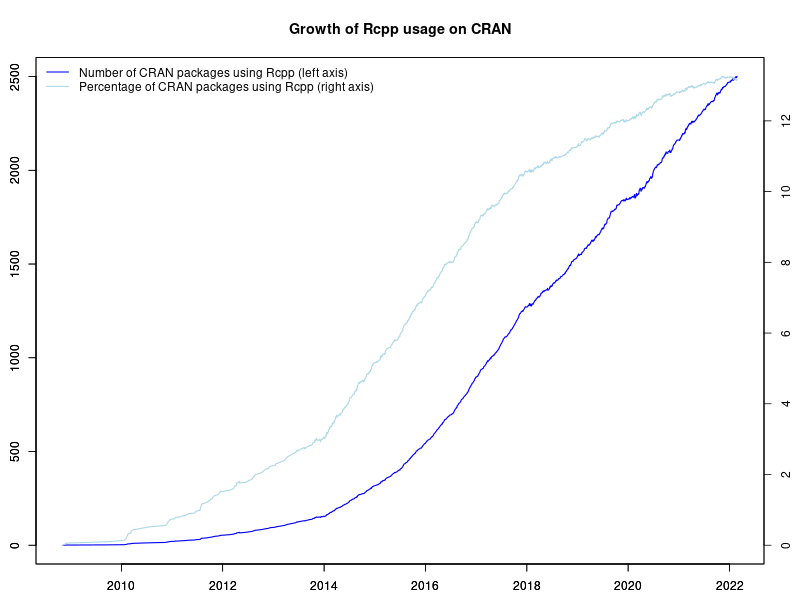
2500 Rcpp packages As of this morning, Rcpp stands at 2501 reverse-dependencies on CRAN. The graph on the left depicts the growth of Rcpp usage (as measured by Depends, Imports and LinkingTo, but excluding Suggests) over time. Rcpp was first released in November 2008. It probably cleared 50 packages around three years later in December 2011, 100 packages in January 2013, 200 packages in April 2014, and 300 packages in November 2014. It passed 400 packages in June 2015 (when I tweeted about it), 500 packages in late October 2015, 600 packages in March 2016, 700 packages in July 2016, 800 packages in October 2016, 900 packages early January 2017, 1000 packages in April 2017, 1250 packages in November 2017, 1500 packages in November 2018, 1750 packages in August 2019, 2000 packages in July 2020, and 2250 package in March of last year. The chart extends to the very beginning via manually compiled data from CRANberries and checked with crandb. The next part uses manually saved entries. The core (and by far largest) part of the data set was generated semi-automatically via a short script appending updates to a small file-based backend. A (manually curated) list of packages using Rcpp is available too. Also displayed in the graph is the relative proportion of CRAN packages using Rcpp. The four per-cent hurdle was cleared just before useR! 2014 where I showed a similar graph (as two distinct graphs) in my invited talk. We passed five percent in December of 2014, six percent July of 2015, seven percent just before Christmas 2015, eight percent in the summer of 2016, nine percent mid-December 2016, cracked ten percent in the summer of 2017, eleven percent in 2018 and passed 12.5 percent or one in every eight CRAN packages dependens on Rcpp along with the 2000 packages mark. Truly stunning. As before, there is more detail in the chart: how CRAN seems to be pushing back more and removing more aggressively (which my CRANberries tracks but not in as much detail as it could), how the growth of Rcpp seems to be slowing somewhat outright and even more so as a proportion of CRAN as one would expect a growth curve to. The Rcpp team continues to aim for keeping Rcpp as performant and reliable as it has been (and see e.g. here for some more details). A really big shoutout and Thank You! to all users and contributors of Rcpp for help, suggestions, bug reports, documentation or, of course, code. If you like this or other open-source work I do, you can now sponsor me at GitHub. For the first year, GitHub will match your contributions.

This post by Dirk Eddelbuettel originated on his Thinking inside the box blog. Please report excessive re-aggregation in third-party for-profit settings.

24 February 2022

Dirk Eddelbuettel: #36: pub/sub for live market monitoring with R and Redis

Welcome to the 36th post of the really randomly reverberating R, or R4 for short, write-ups. Today s post is about using Redis, and especially RcppRedis, for live or (near) real-time monitoring with R. market monitor There is an saying that you can take the boy out of the valley, but you cannot the valley out of the boy so for those of us who spent a decade or two in finance and on trading floors, having some market price information available becomes second nature. And/or sometimes it is just good fun to program this. A good while back Josh posted a gist on a simple-yet-robust while loop. It (very cleverly) uses his quantmod package to access the SP500 in real-time . (I use quotes here because at the end of retail broadband one is not at the same market action as someone co-located in a New Jersey data center. It is however not delayed: as an index, it is not immediately tradeable as a stock, etf, or derivative may be all of which are only disseminated as delayed price information, usually by ten minutes.) I quite enjoyed the gist and used it and started tinkering with it. For example, it collects data but only saves (i.e. persists ) it after market close. If for whatever reason one needs to restart recent history is gone. In any event, I used his code and generalized it a little and published this about a year ago as function intradayMarketMonitor() in my dang package. (See this blog post announcing it.) The chart of the left shows this in action, the chart is a snapshot from a couple of days ago when the vignettes (more on them below) were written. As lovely as intradayMarketMonitor() is, it also limits itself to market hours. And sometimes you want to see, say, how the market opens on Sunday (futures usually restart at 17h Chicago time), or how news dissipates during the night, or where markets are pre-open, or . So I both wanted to complement this with futures, and also cache it locally so that, say, one machine might collect data and one (or several others) can visualize. For such tasks, Redis is unparalleled. (Yet I also always felt Redis could do with another, simple, short and sweet introduction stressing the key features of i) being multi-lingual: write in one language, consume in another and ii) loose coupling: no linking as one talks to Redis via standard tcp/ip networking. So I wrote a new intro vignette that is now in RcppRedis. I hope this comes in handy. Comments welcome!) Our RcppRedis package had long been used for such tasks, and it was easy to set it up. Standard use is to loop, fetch some data, push it to Redis, sleep, and start over. Clients do the same: fetch most recent data, plot or report it, sleep, start over. That works, but it has a dual delay as the client sleeping may miss the data update! The standard answer to this is called publish/pubscribe, or pub/sub. Libraries such as 0mq or zeromq specialise in this. But it turns out Redis already has it. I had some initial difficulty adding it to RcppRedis so for a trial I tested the marvellous rredis package by Bryan and simply instantiated two Redis clients. Now the data getter simply publishes a new data point in a given channel, by convention named after the security it tracks. Clients register with the Redis server which does all the actual work of keeping track of who listens to what. The clients now simply listen (which is a blocking operation) and as soon as data comes in receive it. market monitor This is quite mesmerizing when you just run two command-line clients (in a byobu session, say). As sone as the data is written (as shown on console log) it is consumed. No measruable overhead. Just lovely. Bryan and I then talked a litte as he may or may not retire rredis. Having implemented the pub/sub logic for both sides once, he took a good hard look at RcppRedis and just like that added it there. With some really clever wrinkles for (optional) per-symbol callback as closure attached to the instance. Truly amazeballs And once we had it in there, generalizing from publishing or subscribing to just one symbol easily generalizes to having one listener collect and publish for multiple symbols, and having one or more clients subscribe and listen one, more or even all symbol. All with ease thanks tp Redis. The second chart, also from a few days ago, shows four symbols for four (front-contract) futures for Bitcoin, Crude Oil, SP500, and Gold. As all this can get a little technical, I wrote a second vignette for RcppRedis on just this: market monitoring. Give this a read, if interested, feedback on this one is most welcome too! But all the code you need is included in the package just run a local Redis instance. Before closing, one sour note. I uploaded all this in a new and much improved updated RcppRedis 0.2.0 to CRAN on March 13 ten days ago. Not only is it still not there , but CRAN in their most delightful way also refuses to answer any emails of mine. Just lovely. The package exhibited just one compiler warning: a C++ compiler objected to the (embedded) C library hiredis (included as a fallback) for using a C language construct. Yes. A C++ compiler complaining about C. It s a non-issue. Yet it s been ten days and we still have nothing. So irritating and demotivating. Anyway, you can get the package off its GitHub repo. If you like this or other open-source work I do, you can sponsor me at GitHub.

This post by Dirk Eddelbuettel originated on his Thinking inside the box blog. Please report excessive re-aggregation in third-party for-profit settings.

23 February 2022

Ian Jackson: Rooting an Eos Fairphone 4

Last week I received (finally) my Fairphone 4, supplied with a de-googled operating system, which I had ordered from the E Foundation s shop in December. (I m am very hard on hardware and my venerable Fairphone 2 is really on its last legs.) I expect to have full control over the software on any computing device I own which is as complicated, capable, and therefore, hazardous, as a mobile phone. Unfortunately the Eos image (they prefer to spell it /e/ os , srsly!) doesn t come with a way to get root without taking fairly serious measures including unlocking the bootloader. Unlocking the bootloader wouldn t be desirable for me but I can t live without root. So. I started with these helpful instructions: https://forum.xda-developers.com/t/fairphone-4-root.4376421/ I found the whole process a bit of a trial, and I thought I would write down what I did. But, it s not straightforward, at least for someone like me who only has a dim understanding of all this Android stuff. Unfortunately, due to the number of missteps and restarts, what I actually did is not really a sensible procedure. So here is a retcon of a process I think will work: Unlock the bootloader The E Foundation provide instructions for unlocking the bootloader on a stock FP4, here https://doc.e.foundation/devices/FP4/install and they seem applicable to the Murena phone supplied with Eos pre-installed, too. NB tht unlocking the bootloader wipes the phone. So we do it first. So:
  1. Power on the phone, with no SIM installed
  2. You get a welcome screen.
  3. Skip all things on startup including wifi
  4. Go to the very end of the settings, tap a gazillion times on the phone s version until you re a developer
  5. In the developer settings, allow usb debugging
  6. In the developer settings, allow oem bootloader unlocking
  7. Connect a computer via a USB cable, say yes on phone to USB debugging
  8. adb reboot bootloader
  9. The phone will reboot into a texty kind of screen, the bootloader
  10. fastboot flashing unlock
  11. The phone will reboot, back to the welcome screen
  12. Repeat steps 3-9 (maybe not all are necessary)
  13. fastboot flashing unlock_critical
  14. The phone will reboot, back to the welcome screen
Note that although you are running fastboot, you must run this command with the phone in bootloader mode, not fastboot (aka fastbootd ) mode. If you run fastboot flashing unlcok from fastboot you just get a don t know what you re talking about . I found conflicting instructions on what kind of Vulcan nerve pinches could be used to get into which boot modes, and had poor experiences with those. adb reboot bootloader always worked reliably for me. Some docs say to run fastboot oem unlock; I used flashing. Maybe this depends on the Android tools version. Initial privacy prep and OTA update We want to update the supplied phone OS. The build mine shipped with is too buggy to run Magisk, the application we are going to use to root the phone. (With the pre-installed phone OS, Magisk crashes at the patch boot image step.) But I didn t want to let the phone talk to Google, even for the push notifications registration.
  1. From the welcome screen, skip all things except location, date, time. Notably, do not set up wifi
  2. In settings, microg section
    1. turn off cloud messaging
    2. turn off google safetynet
    3. turn off google registration (NB you must do this after the other two, because their sliders become dysfunctional after you turn google registration off)
    4. turn off both location modules
  3. In settings, location section, turn off allowed location for browser and magic earth
  4. Now go into settings and enable wifi, giving it your wifi details
  5. Tell the phone to update its operating system. This is a big download.
Install Magisk, the root manager (As a starting point I used these instructions https://www.xda-developers.com/how-to-install-magisk/ and a lot of random forum posts.) You will need the official boot.img. Bizarrely there doesn t seem to be a way to obtain this from the phone. Instead, you must download it. You can find it by starting at https://doc.e.foundation/devices/FP4/install which links to https://images.ecloud.global/stable/FP4/. At the time of writing, the most recent version, whose version number seemed to correspond to the OS update I installed above, was IMG-e-0.21-r-20220123158735-stable-FP4.zip.
  1. Download the giant zipfile to your computer
  2. Unzip it to extract boot.img
  3. Copy the file to your phone s storage . Eg, via adb: with the phone booted into the main operating system, using USB debugging, adb push boot.img /storage/self/primary/Download.
  4. On the phone, open the browser, and enter https://f-droid.org. Click on the link to install f-droid. You will need to enable installing apps from the browser (follow the provided flow to the settings, change the setting, and then use Back, and you can do the install). If you wish, you can download the f-droid apk separately on a computer, and verify it with pgp.
  5. Using f-droid, install Magisk. You will need to enable installing apps from f-droid. (I installed Magisk from f-droid because 1. I was going to trust f-droid anyway 2. it has a shorter URL than Magisk s.)
  6. Open the Magisk app. Tell Magisk to install (Magisk, not the app). There will be only one option: patch boot file. Tell it to patch the boot.img file from before.
  7. Transfer the magisk_patched-THING.img back to your computer (eg via adb pull).
  8. adb reboot bootloader
  9. fastboot boot magisk_patched-THING.img (again, NB, from bootloader mode, not from fastboot mode)
  10. In Magisk you ll see it shows as installed. But it s not really; you ve just booted from an image with it. Ask to install Magisk with Direct install .
After you have done all this, I believe that each time you do an over-the-air OS update, you must, between installing the update and rebooting the phone, ask Magisk to Install to inactive slot (after OTA) . Presumably if you forget you must do the fastboot boot dance again. After all this, I was able to use tsu in Termux. There s a strange behaviour with the root prompt you get apropos Termux s request for root; I found that it definitely worked if Termux wasn t the foreground app You have to leave the bootloader unlocked. Howwever, as I understand it, the phone s encryption will still prevent an attacker from hoovering the data out of your phone. The bootloader lock is to prevent someone tricking you into entering the decryption passkey into a trojaned device. Other things to change There are probably other things to change. I have not yet transferred my Signal account from my old phone. It is possible that Signal will require me to re-enable the google push notifications, but I hope that having disabled them in microg it will be happy to use its own system, as it does on my old phone.

comment count unavailable comments

18 February 2022

Dirk Eddelbuettel: RcppSimdJson 0.1.7 on CRAN: Maintenance

The RcppSimdJson package was updated to release 0.1.7 today. CRAN had sent a note overnight that it triggered LENGTH_1 error (where boolean comparisons happen with longer vectors). That may be debatable in the two cases flagged if one looks at the commit but life being too short to debate this so we just fixed it. The email came in at 04:50h-ish when I was sound asleep, but four hours later the fixed version was on CRAN thanks to the automated processing: RcppSimdJson wraps the fantastic and genuinely impressive simdjson library by Daniel Lemire and collaborators. Via very clever algorithmic engineering to obtain largely branch-free code, coupled with modern C++ and newer compiler instructions, it results in parsing gigabytes of JSON parsed per second which is quite mindboggling. The best-case performance is faster than CPU speed as use of parallel SIMD instructions and careful branch avoidance can lead to less than one cpu cycle per byte parsed; see the video of the talk by Daniel Lemire at QCon (also voted best talk). The very short NEWS entry for this release follows.

Changes in version 0.1.7 (2022-02-18)
  • Two URLs were updated in 'README.md', and Travis artifacts and badges have been removed (Dirk).
  • One unit test file was updated to not trigger a 'LENGTH_1' warning (Dirk closing #76).

Courtesy of my CRANberries, there is also a diffstat report for this release. For questions, suggestions, or issues please use the issue tracker at the GitHub repo. If you like this or other open-source work I do, you can now sponsor me at GitHub.

This post by Dirk Eddelbuettel originated on his Thinking inside the box blog. Please report excessive re-aggregation in third-party for-profit settings.

10 February 2022

Russell Coker: Mouse and Teflon

I had a problem with my mouse. The slippery plastic bits on the bottom weren t glued on well and came off, which then gave more friction when moving on the desk. After asking advice on a mailing list the best suggestion was Teflon sticky tape. I bought a few meters of such tape (a lifetime supply for mouse repair) and used an 8cm strip on each side of the bottom of my mouse which made it slippery enough. Ebay seems like a good place to buy that, most of the offers are well below $20 for a reel of tape including postage. One thing to note is that they also sell non-adhesive teflon tape. I made the mistake of investigating the capabilities of teflon tape then buying the cheapest one on offer which turned out to be plumber s tape which doesn t have adhesive, fortunately it was well below $10. I now have a lifetime supply of plumber s tape if I can ever find a use for it.

7 February 2022

Dirk Eddelbuettel: x13binary 1.1.57-3 on CRAN: Packaging Updates

Release 1.1.57-3 of the x13binary package providing the X-13ARIMA-SEATS program by the US Census Bureau arrived late yesterday on CRAN. This release relaxes the download requirement on macOS and Linux: if a user supplies a path in an environment variable X13_PATH we check for a suitable binary there and omit the download. This helps with air-gapped installation (and alike). Courtesy of my CRANberries, there is also a diffstat report for this release showing changes to the previous release. If you like this or other open-source work I do, you can sponsor me at GitHub.

This post by Dirk Eddelbuettel originated on his Thinking inside the box blog. Please report excessive re-aggregation in third-party for-profit settings.

Russ Allbery: Review: Embers of War

Review: Embers of War, by Gareth L. Powell
Series: Embers of War #1
Publisher: Titan Books
Copyright: February 2018
ISBN: 1-78565-519-1
Format: Kindle
Pages: 312
The military leadership of the Outward faction of humanity was meeting on the forest world of Pelapatarn, creating an opportunity for the Conglomeration to win the war at a stroke. Resistance was supposed to be minimal, since the Outward had attempted to keep the conference secret rather than massing forces to protect it. But the Outward resistance was stronger than expected, and Captain Deal's forces would not be able to locate and assassinate the Outward leadership before they could escape. She therefore followed orders from above her and ordered the four incoming Carnivore heavy cruisers to jump past the space battle and bomb the planet. The entire planet. The Carnivores' nuclear and antimatter weaponry reduced the billion-year-old sentient jungle of Pelapatarn to ash. Three years later, Sal Konstanz is a ship captain for the House of Reclamation, a strictly neutral search and rescue force modeled after a long-vanished alien fleet that prioritizes preservation of life above all else. Anyone can join Reclamation, provided that they renounce their previous alliances and devote themselves to the Reclamation cause. Sal and her crew member Alva Clay were Outward. The ship medic was Conglomeration. So was the ship: the Trouble Dog, a sentient AI heavy cruiser built to carry an arsenal of weapons and three hundred crew, and now carrying three humans and a Druff mechanic. More precisely, the Trouble Dog was one of the four Carnivores that destroyed Pelapatarn. Meanwhile, Ona Sudak, a popular war poet, is a passenger on a luxury cruise on the liner Geest van Amsterdam, which is making an unscheduled stop in the star system known as the Gallery. The Gallery is the home of the Objects: seven planets that, ten thousand years earlier, were carved by unknown aliens into immense sculptures for unknown reasons. The Objects appear to be both harmless and mysterious, making them an irresistible tourist attraction for the liner passengers. The Gallery is in disputed space, but no one was expecting serious trouble. They certainly weren't expecting the Geest van Amsterdam to be attacked and brought down on the Object known as the Brain, killing nearly everyone aboard. The Trouble Dog is the closest rescue ship. This book was... fine. It's a perfectly serviceable science fiction novel that didn't stand out for me, which I think says more about the current excellent state of the science fiction field than about this book. When I was a teenager reading Asimov, Niven, and Heinlein, I would have devoured this. It compares favorably to minor Niven or Heinlein (The Integral Trees, for example, or Double Star), but the bar for excellent science fiction is just so much higher now. The best character in this book (and the reason why I read it) is the Trouble Dog. I love science fiction about intelligent space ships, and she did not disappoint. The AI ships in this book are partly made from human and dog neurons, so their viewpoint is mostly human but with some interesting minor variations. And the Trouble Dog would be a great character even if she weren't an intelligent ship: ethical, aggressive, daring, and introspective, with a nuanced relationship with her human crew. Unfortunately, Embers of War has four other viewpoint characters, and Powell chose to write them all in the first person. First person narration depends heavily on a memorable and interesting character because the reader is so thoroughly within their perspective. This works great for the Trouble Dog, and is fine for Nod, the Druff who serves as the ship mechanic. (Nod's perspective is intriguing, short, almost free-verse musings, rather than major story segments.) Sal, the ship captain, is a bit of a default character, but I didn't mind her much. Neither of the other two viewpoint characters are interesting enough to warrant the narrative attention. The Conglomerate agent Ashton Childe has such an uninteresting internal monologue that I would have liked the character better if he'd only been seen through other people's viewpoints, and although Powell needs some way to show Ona Sudak's view of events, I didn't think her thoughts added much to the story. The writing is adequate but a bit clunky: slightly flat descriptions, a bit too predictable at the sentence level, and rarely that memorable. There is a bit of fun world-building of the ancient artifact variety and a couple of decent set pieces (and one rather-too-obvious Matrix homage that I didn't think was as effective as the author did), but most of the story is focused on characters navigating their lives and processing trauma from the war. The story kept me turning the pages with interest, but I also doubt it will surprise anyone who has read much science fiction. I suspect a lot of it is setup for the following two books of the trilogy, and there are plenty of hooks for more stories in this universe. I really wanted a first-person story from the perspective of the Trouble Dog, possibly with some tight third-person interludes showing Ona Sudak's story. What I got instead was entertaining but not memorable enough to stand out in the current rich state of science fiction. I think I'm invested enough in this story to want to read the next book, though, so that's still a recommendation of sorts. Followed by Fleet of Knives. Rating: 6 out of 10

6 February 2022

Jonathan McDowell: Free Software Activities for 2021

About a month later than I probably should have posted it, here s a recap of my Free Software activities in 2021. For previous years see 2019 + 2020. Again, this year had fewer contributions than I d like thanks to continuing fatigue about the state of the world, and trying to work on separation between work and leisure while working from home. I ve made some effort to improve that balance but it s still a work in progress.

Conferences No surprise, I didn t attend any in-person conferences in 2021. I find virtual conferences don t do a lot for me (a combination of my not carving time out for them in the same way, because not being at the conference means other things will inevitably intrude, and the lack of the social side) but I did get to attend a few of the DebConf21 talks, which was nice. I m hoping to make it to DebConf22 this year in person.

Debian Most of my contributions to Free software continue to happen within Debian. As part of the Data Protection Team I responded to various inbound queries to that team. Some of this involved chasing up other project teams who had been slow to respond - folks, if you re running a service that stores personal data about people then you need to be responsive to requests about it. Some of this was dealing with what look like automated scraping tools which send no information about the person making the request, and in all the cases we ve seen so far there s been no indication of any data about that person on any systems we have access to. Further team time was wasted dealing with the Princeton-Radboud Study on Privacy Law Implementation (though Matthew did the majority of the work on this). The Debian Keyring was possibly my largest single point of contribution. We re in a roughly 3 month rotation of who handles the keyring updates, and I handled 2021.03.24, 2021.04.09, 2021.06.25, 2021.09.25 + 2021.12.24 For Debian New Members I m mostly inactive as an application manager - we generally seem to have enough available recently. If that changes I ll look at stepping in to help, but I don t see that happening. I continue to be involved in Front Desk, having various conversations throughout the year with the rest of the team, but there s no doubt Mattia and Pierre-Elliott are the real doers at present. I did take part in an NM Committee appeals process. In terms of package uploads I continued to work on gcc-xtensa-lx106, largely doing uploads to deal with updates to the GCC version or packaging (8 + 9). sigrok had a few minor updates, libsigkrok 0.5.2-3, pulseview 0.4.2-3 as well as a new upstream release of sigrok CLI 0.7.2-1. There was a last minute pre-release upload of libserialport 0.1.1-4 thanks to a kernel change in v5.10.37 which removed termiox support. Despite still not writing any VHDL these days I continue to keep an eye on ghdl, because I found it a useful tool in the past. Last year that was just a build fix for LLVM 11.1.0 - 1.0.0+dfsg+5. Andreas Bombe has largely taken over more proactive maintenance, which is nice to see. I uploaded OpenOCD 0.11.0~rc1-2, cleaning up some packaging / dependency issues. This was followed by 0.11.0~rc2-1 as a newer release candidate. Sadly 0.11.0 did not make it in time for bullseye, but rc2 was fairly close and I uploaded 0.11.0-1 once bullseye was released. Finally I did a drive-by upload for garmin-forerunner-tools 0.10repacked-12, cleaning up some packaging issues and uploading it to salsa. My Forerunner 305 has died (after 11 years of sterling service) and the Forerunner 45 I ve replaced it with uses a different set of tools, so I decided it didn t make sense to pick up longer term ownership of the package.

Linux My Linux contributions continued to revolve around pushing MikroTik RB3011 support upstream. There was a minor code change to Set FIFO sizes for ipq806x (which fixed up the allowed MTU for the internal switch + VLANs). The rest was DTS related - adding ADM DMA + NAND definitions now that the ADM driver was merged, adding tsens details, adding USB port info and adding the L2CC and RPM details for IPQ8064. Finally I was able to update the RB3011 DTS to enable NAND + USB. With all those in I m down to 4 local patches against a mainline kernel, all of which are hacks that aren t suitable for submission upstream. 2 are for patching in details of the root device and ethernet MAC addresses, one is dealing with the fact the IPQ8064 has some reserved memory that doesn t play well with AUTO_ZRELADDR (there keeps being efforts to add some support for this via devicetree, but unfortunately it gets shot down every time), and the final one is a hack to turn off the LCD backlight by treating it as an LED (actually supporting the LCD properly is on my TODO list).

Personal projects 2021 didn t see any releases of onak. It s not dead, just resting, but Sequoia PGP is probably where you should be looking for a modern OpenPGP implementation. I continued work on my Desk Viking project, which is an STM32F103 based debug tool inspired by the Bus Pirate. The main addtion was some CCLib support (forking it in the process to move to Python 3 and add some speed ups) to allow me to program my Zigbee dongles, but I also added some 1-Wire search logic and some support for Linux emulation mode with VCD output to allow for a faster development cycle. I really want to try and get OpenOCD JTAG mode supported at some point, and have vague plans for an STM32F4 based version that have suffered from a combination of a silicon shortage and a lack of time. That wraps up 2021. I d like to say I m hoping to make more Free Software contributions this year, but I don t have a concrete plan yet for how that might happen, so I ll have to wait and see.

Christian Kastner: New release of sbuild-qemu Utilities

I just released a new version of the sbuild-qemu utilities as part of sbuild. Notable changes are support for new architectures, and a new sbuild-qemu-boot utility to start a VM and interact with its console directly through the terminal. As a reminder, these utilities leverage functionality in vmdb2, autopkgtest, and sbuild to use QEMU VM images for building and testing packages in strongly isolated environments and/or on foreign architectures and/or that might break the system. For example, the following would create an image for sid on the ppc64el architecture, and then use that image to build a package:
# Creating an image still requires root, unfortunately
$ sudo sbuild-qemu-create --arch ppc64el -o simple.img unstable http://deb.debian.org/debian
$ sudo chown <user>:<group> simple.img

# Building a package doesn't
$ sbuild-qemu --arch ppc64el --image simple.img -d unstable [<other sbuild options>] FOO.dsc

# Neither does updating the image (runs apt-get update && dist-upgrade in the VM)
$ sbuild-qemu-update --arch ppc64el simple.img
Since the sbuild-qemu utilities build on top of the autopkgtest utilities, the created images can also be used for running autopkgtests:
$ autopkgtest <test params> -- qemu --dpkg-architecture ppc64el simple.img
sbuild-qemu-boot This new release now ships with sbuild-qemu-boot which boots a VM directly to a console, where it can be used as a porterbox, or to evaluate changes that might break the system, etc. By default, the VM is started in read-only mode, so changes are not saved when the VM is shut down. This can be changed with the --read-write option. With the --shared-dir option, a directory can be shared with the host. It will be mounted at /shared within the VM.
$ sbuild-qemu-boot --arch ppc64el --shared-dir /path/to/folder simple.img
Note that the console in the VM is 24x80 by default. This can be changed within the VM with stty to match your host, e.g.:
$ stty rows M cols N
I'm still pondering whether to automate this in sbuild-qemu-create.
New Architectures Thanks to updates to vmdb2 and autopkgtest, the sbuild-qemu utilities now also support new architectures. Currently, amd64, i386, arm64, armhf, and ppc64el are supported, so most of the official architectures. However, there's an autopkgtest issue (#10031002) with the host-guest communication bridge on armhf and on multi-core arm64 (single-core seems to work fine) that currently makes images unusable for sbuild and autopkgtest. I haven't yet figured out what the problem seems to be, but for the time being, the images can still be used with sbuild-qemu-boot.

Next.

Previous.