Search Results: "ads"

31 August 2024

Andrew Cater: Debian release weekend - Bullseye and Bookworm 20240831

A double length Debian release
means the Release Team don't get much peace
What with last minute breaks
And the time that it takes
Treat them with respect today, please

The media teams on the hook
As we follow our normal play book
With laptops all primed
The images are timed
Once we're told we'll start taking our look

This is the last time for 11
And for Bookworm, it's just 12.7
Give us time for each test
As we all do our best
With our ThinkPads - I see at least seven :)

Russ Allbery: Review: The Shepherd's Crown

Review: The Shepherd's Crown, by Terry Pratchett
Series: Discworld #41
Publisher: Harper
Copyright: 2015
Printing: 2016
ISBN: 0-06-242998-1
Format: Trade paperback
Pages: 276
The Shepherd's Crown is the 41st and final Discworld novel and the 5th and final Tiffany Aching novel. You should not start here. There is a pretty major character event in the second chapter of this book. I'm not going to say directly what it is, but you will likely be able to guess from the rest of the review. If you're particularly adverse to spoilers, you may want to skip reading this until you've read the book. Tiffany Aching is extremely busy. Witches are responsible for all the little tasks that fall between the cracks, and there are a lot of cracks. The better she gets at her job, the more of the job there seems to be.
"Well," said Tiffany, "there's too much to be done and not enough people to do it." The smile that the kelda gave her was a strange one. The little woman said, "Do ye let them try? Ye mustn't be afraid to ask for help. Pride is a good thing, my girl, but it will kill you in time."
And that's before an earth-shattering change in the world of witches, one that leaves Tiffany shuttling between Lancre and the Chalk trying to be too many things to too many people. Plus the kelda is worried some deeper trouble is brewing. And then Tiffany gets an exiled elven queen who has never understood the worth of other people dumped on her, and has to figure out what to do with her. The starting idea is great. I continue to be impressed with how well Pratchett handles Tiffany's coming-of-age story. Finding one's place in the world isn't one lesson or event; it's layers of them, with each new growth in responsibility uncovering new things to learn that are often quite different from the previous problems. Tiffany has worked through child problems, adolescent problems, and new adulthood problems. Now she's on a course towards burnout, which is exactly the kind of problem Tiffany would have given her personality. Even better, the writing at the start of The Shepherd's Crown is tight and controlled and sounds like Pratchett, which was a relief after the mess of Raising Steam. The contrast is so sharp that I found myself wondering if parts of this book had been written earlier, or if Pratchett found a new writing or editing method. The characters all sound like themselves, and although some of the turns of phrase are not quite as sharp as in earlier books, they're at least at the level of Snuff. Unfortunately, it doesn't last. There are some great moments and some good quotes, but the writing starts to slip at about the two-thirds point, the sentences began to meander, the characters start repeating the name of the person they're talking to, and the narration becomes increasingly strained. It felt like Pratchett knew the emotional tone he wanted to evoke but couldn't find a subtle way to express it, so the story and the characters start to bludgeon the reader with Grand Statements. It's never as bad as Raising Steam, but it doesn't slip smoothly off the page to rewrite your brain the way that Pratchett could at his best. What makes this worse is that the plot is not very interesting. I wanted to read a book about Tiffany understanding burnout, asking for help, and possibly also about mental load and how difficult delegation is. There is some movement in that direction: she takes on some apprentices, although we don't see as much of her interactions with them as I'd like, and there's an intriguing new male character who wants to be a witch. I wish Pratchett had been able to give Geoffrey his own book. He and his goat were the best part of the story, but it felt rushed and I think he would have had more impact if the reader got to see him develop his skills over time the way that we did with Tiffany. But, alas, all of that is side story to the main plot, which is about elves. As you may know from previous reviews, I do not get along with Pratchett's conception of elves. I find them boring and too obviously evil, and have since Lords and Ladies. Villains have never been one of Pratchett's strengths, and I think his elves are my least favorite. One of the goals of this book is to try to make them less one-note by having Tiffany try to teach one of them empathy, but I didn't find any of the queen's story arc convincing. If Pratchett had pulled those threads together with something more subtle, emotional, and subversive, I think it could have worked, but instead we got another battle royale, and Lords and Ladies did that better.
"Granny never said as she was better than others. She just got on with it and showed 'em and people worked it out for themselves."
And so we come to the end. I wish I could say that the quality held up through the whole series, and it nearly did, but alas it fell apart a bit at the end. Raising Steam I would skip entirely. The Shepherd's Crown is not that bad, but it's minor Pratchett that's worth reading mainly because it's the send-off (and there are a lot of reasons within the story to think Pratchett knew that when writing it). There are a few great lines, some catharsis, and a pretty solid ending for Tiffany, but it's probably not a book that I'll re-read. Content warning: major character death. Special thanks to Emmet Asher-Perrin, whose Tor.com/Reactor re-read of all of Discworld got me to pick the series up again and finally commit to reading all of it. I'm very glad I did. Rating: 6 out of 10

30 August 2024

Dirk Eddelbuettel: pkgKitten 0.2.4 on CRAN: Updates

kitten A shiny new release 0.2.4 of pkgKitten arrived on CRAN earlier, and has also been been uploaded to Debian. pkgKitten makes it simple to create new R packages via a simple function invocation. A wrapper kitten.r exists in the littler package to make it even easier. This release contains several improvements to the (optional) setup of the (wonderful) tinytest package, now supports the (now mandatory) Authors@R and polished a few aspect around the package repository and continuous integrations. The set of changes follows.

Changes in version 0.2.4 (2024-08-30)
  • The .Rbuildignore stanza now includes .github
  • The support of and usage illustrations of tinytest are much enhanced (Paul Hudor in #18 adressing #19 and #20)
  • The .gitignore file now includes C++ related files
  • Improvements and polish to badges and continuous integration
  • The DESCRIPTION file now contains an Authors@R entry

More details about the package are at the pkgKitten webpage, the pkgKitten docs site, and the pkgKitten GitHub repo. Courtesy of CRANberries, there is also a diffstat report for the most recent release. If you like this or other open-source work I do, you can sponsor me at GitHub.

This post by Dirk Eddelbuettel originated on his Thinking inside the box blog. Please report excessive re-aggregation in third-party for-profit settings.

Steve McIntyre: Party like it's 2024

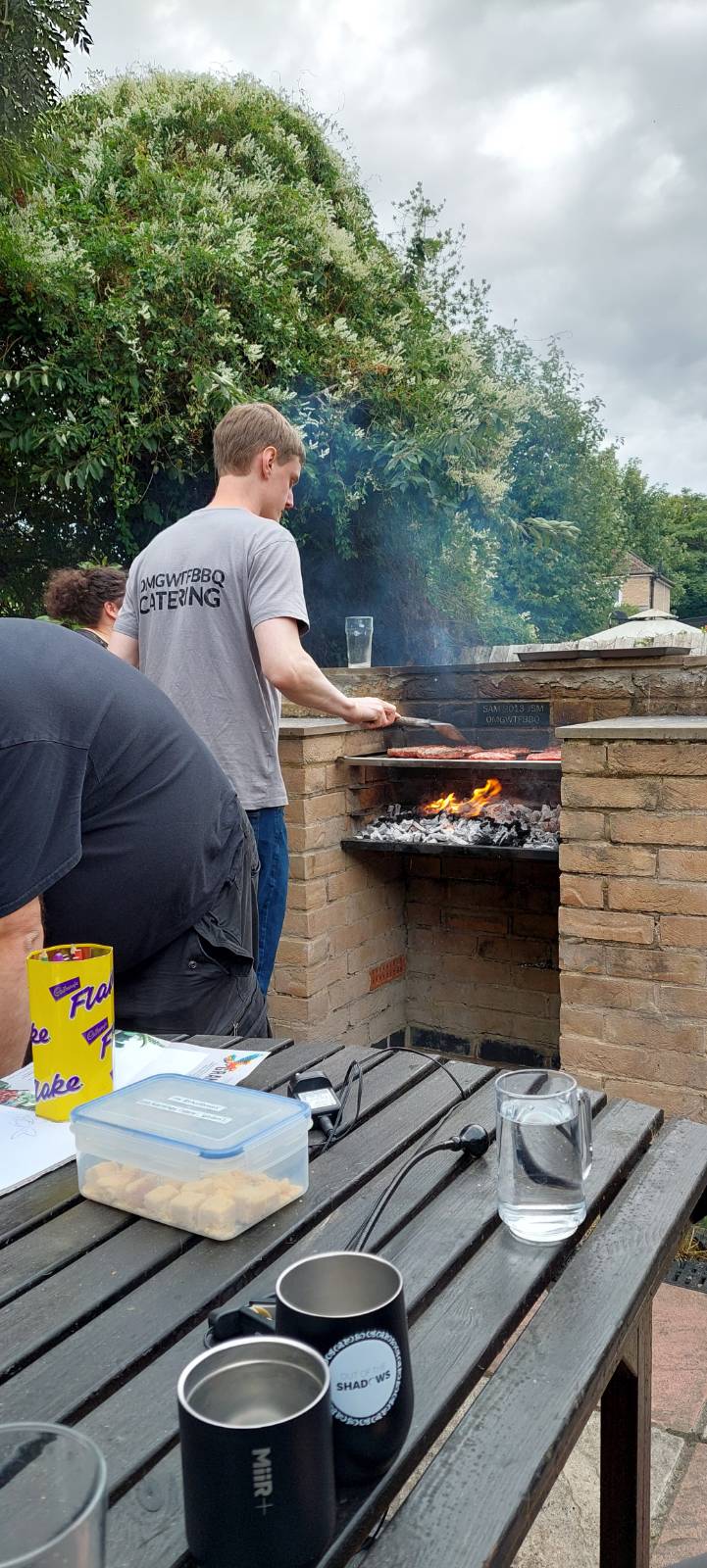
It (was) that time of year again - last weekend we hosted a bunch of nice people at our place in Cambridge for the annual Debian UK OMGWTFBBQ! can you BBQ gin?? Lots of friends, lots of good food and drink. Of course lots of geeky discussions about Debian, networking, random computer languages and... screws? And of course some card games to keep us laughing into each night! beer anyone? Many thanks to a number of awesome friendly people for again sponsoring the important refreshments for the weekend. It's hungry/thirsty work celebrating like this!

Steve McIntyre: A birthday gift to remember!

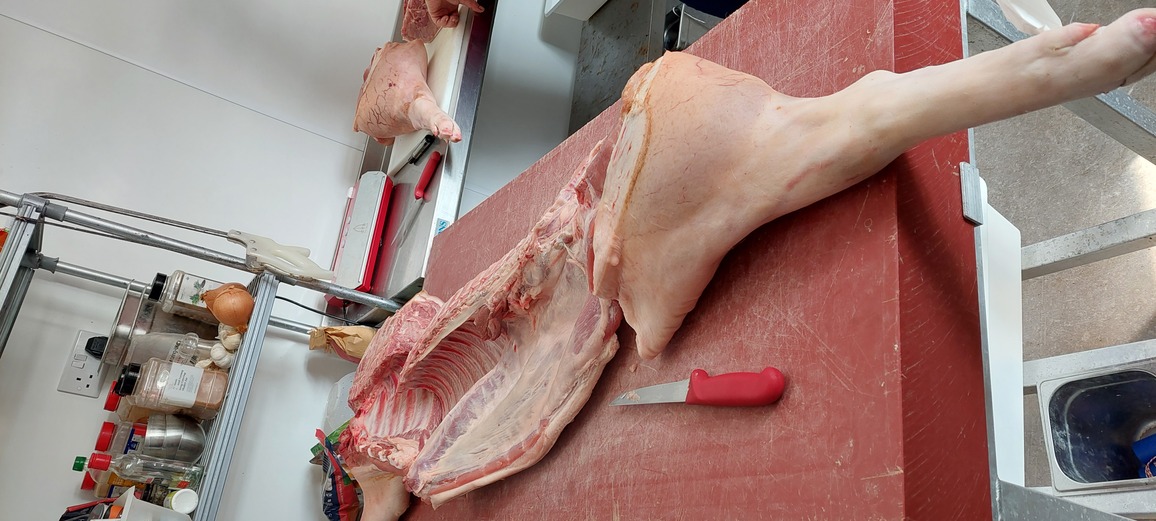
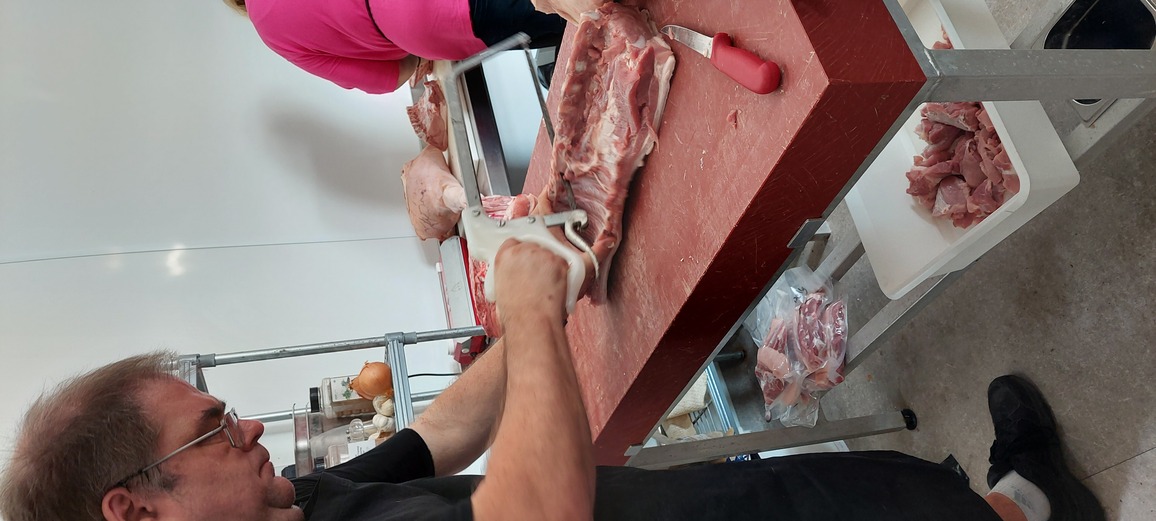
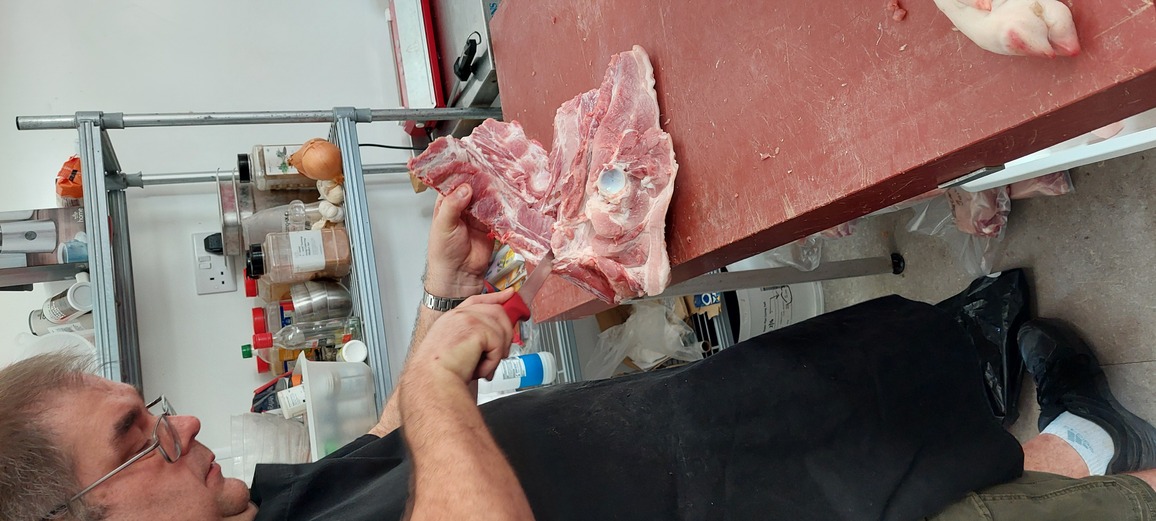
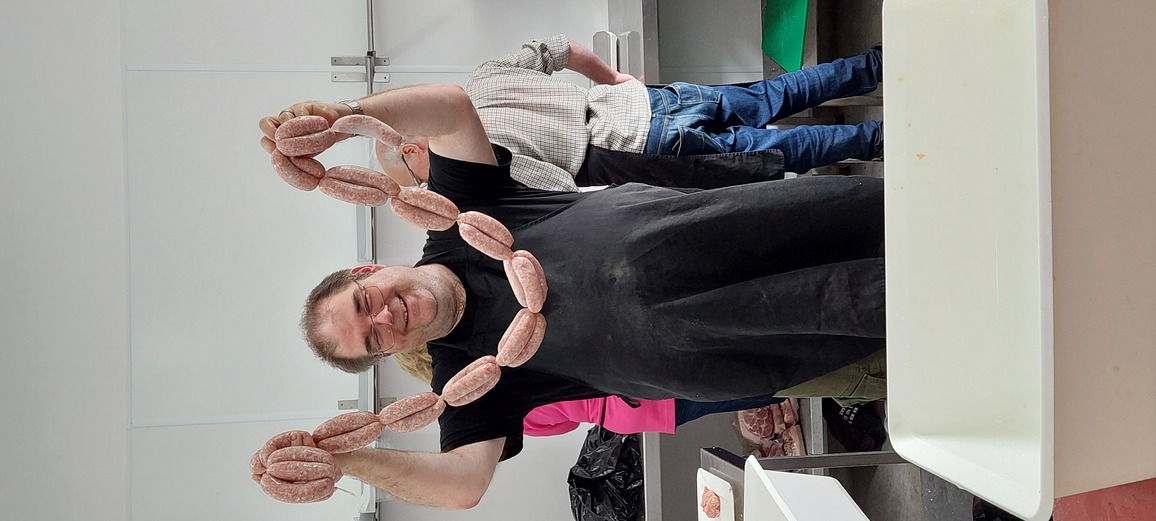
Warning: If you're not into meat, you might want to skip the rest of this... This year, I turned 50. Wow. Lots of friends and family turned up to help me celebrate, with a BBQ (of course!). I was very grateful for a lovely set of gifts from those awesome people, and I have a number of driving experiences to book in the next year or so. I'm going to have so much fun driving silly cars on and off road! However, the most surprising gift was something totally different - a full-day course of hands-on pork butchery. I was utterly bemused - I've never considered doing anything like this at all, and I'd certainly never talked to friends about anything like it either. I was shocked, but in a good way! So, two weekends back Jo and I went over to Empire Farm in Somerset. We stayed nearby so we could be ready on-site early on Sunday morning, and then we joined three other people doing the course. Jo was there to observe, i.e. to watch and take (lots of!) pictures. I can genuinely say that this was the most fun surprise gift I've ever received! David Coldman, the master butcher working with us, has been in the industry for many years. He was an excellent teacher, showing us everything we needed to know and being very patient with us when we needed it. It was great to hear his philosophy too - he only uses the very best locally-sourced meat and focuses on quality over quantity. He showed us all the different cuts of pork that a butcher will make, and we were encouraged to take everything home - no waste here! half a pig At the beginning of the day, we each started with half a pig. Over the next several hours, we steadily worked our way through a series of cuts with knife and saw, making the remaining pig smaller and smaller as we went. saw knife We finished the day with three sets of meat. First, a stack of vacuum-packed joints, chops and steaks ready for cooking and eating at home. Second: a box of off-cuts that we minced and made into sausages at the end of the day. Finally: a bag of skin and bones. Our friend's dog got some of the bones, and Jo turned a lot of the skin into crackling that we shared with friends at the OMGWTFBBQ the next weekend. sausages This was an amazing day. Massive thanks to my good friend Chris Walker for suggesting this gift. As I told David on the day: this was the most fun surprise gift I've ever received. Good hands-on teaching in a new craft is an incredible thing to experience, and I can't recommend this course highly enough.

29 August 2024

Jonathan Carter: Orphaning bcachefs-tools in Debian

Around a decade ago, I was happy to learn about bcache a Linux block cache system that implements tiered storage (like a pool of hard disks with SSDs for cache) on Linux. At that stage, ZFS on Linux was nowhere close to where it is today, so any progress on gaining more ZFS features in general Linux systems was very welcome. These days we care a bit less about tiered storage, since any cost benefit in using anything else than nvme tends to quickly evaporate compared to time you eventually lose on it. In 2015, it was announced that bcache would grow into its own filesystem. This was particularly exciting and it caused quite a buzz in the Linux community, because it brought along with it more features that compare with ZFS (and also btrfs), including built-in compression, built-in encryption, check-summing and RAID implementations. Unlike ZFS, it didn t have a dkms module, so if you wanted to test bcachefs back then, you d have to pull the entire upstream bcachefs kernel source tree and compile it. Not ideal, but for a promise of a new, shiny, full-featured filesystem, it was worth it. In 2019, it seemed that the time has come for bcachefs to be merged into Linux, so I thought that it s about time we have the userspace tools (bcachefs-tools) packaged in Debian. Even if the Debian kernel wouldn t have it yet by the time the bullseye (Debian 11) release happened, it might still have been useful for a future backported kernel or users who roll their own. By total coincidence, the first git snapshot that I got into Debian (version 0.1+git20190829.aa2a42b) was committed exactly 5 years ago today. It was quite easy to package it, since it was written in C and shipped with a makefile that just worked, and it made it past NEW into unstable in 19 January 2020, just as I was about to head off to FOSDEM as the pandemic started, but that s of course a whole other story. Fast-forwarding towards the end of 2023, version 1.2 shipped with some utilities written in Rust, this caused a little delay, since I wasn t at all familiar with Rust packaging yet, so I shipped an update that didn t yet include those utilities, and saw this as an opportunity to learn more about how the Rust eco-system worked and Rust in Debian. So, back in April the Rust dependencies for bcachefs-tools in Debian didn t at all match the build requirements. I got some help from the Rust team who says that the common practice is to relax the dependencies of Rust software so that it builds in Debian. So errno, which needed the exact version 0.2, was relaxed so that it could build with version 0.4 in Debian, udev 0.7 was relaxed for 0.8 in Debian, memoffset from 0.8.5 to 0.6.5, paste from 1.0.11 to 1.08 and bindgen from 0.69.9 to 0.66. I found this a bit disturbing, but it seems that some Rust people have lots of confidence that if something builds, it will run fine. And at least it did build, and the resulting binaries did work, although I m personally still not very comfortable or confident about this approach (perhaps that might change as I learn more about Rust). With that in mind, at this point you may wonder how any distribution could sanely package this. The problem is that they can t. Fedora and other distributions with stable releases take a similar approach to what we ve done in Debian, while distributions with much more relaxed policies (like Arch) include all the dependencies as they are vendored upstream. As it stands now, bcachefs-tools is impossible to maintain in Debian stable. While my primary concerns when packaging, are for Debian unstable and the next stable release, I also keep in mind people who have to support these packages long after I stopped caring about them (like Freexian who does LTS support for Debian or Canonical who has long-term Ubuntu support, and probably other organisations that I ve never even heard of yet). And of course, if bcachfs-tools don t have any usable stable releases, it doesn t have any LTS releases either, so anyone who needs to support bcachefs-tools long-term has to carry the support burden on their own, and if they bundle it s dependencies, then those as well. I ll admit that I don t have any solution for fixing this. I suppose if I were upstream I might look into the possibility of at least supporting a larger range of recent dependencies (usually easy enough if you don t hop onto the newest features right away) so that distributions with stable releases only need to concern themselves with providing some minimum recent versions, but even if that could work, the upstream author is 100% against any solution other than vendoring all its dependencies with the utility and insisting that it must only be built using these bundled dependencies. I ve made 6 uploads for this package so far this year, but still I constantly get complaints that it s out of date and that it s ancient. If a piece of software is considered so old that it s useless by the time it s been published for two or three months, then there s no way it can survive even a usual stable release cycle, nevermind any kind of long-term support. With this in mind (not even considering some hostile emails that I recently received from the upstream developer or his public rants on lkml and reddit), I decided to remove bcachefs-tools from Debian completely. Although after discussing this with another DD, I was convinced to orphan it instead, which I have now done. I made an upload to experimental so that it s still available if someone wants to work on it (without having to go through NEW again), it s been removed from unstable so that it doesn t migrate to testing, and the ancient (especially by bcachefs-tools standards) versions that are in stable and oldstable will be removed too, since they are very likely to cause damage with any recent kernel versions that support bcachefs. And so, my adventure with bcachefs-tools comes to an end. I d advise that if you consider using bcachefs for any kind of production use in the near future, you first consider how supportable it is long-term, and whether there s really anyone at all that is succeeding in providing stable support for it.

28 August 2024

Debian Brasil: Debian Day 2024 em Bel m e Po os de Caldas - Brasil

por Paulo Henrique de Lima Santana (phls) Listamos abaixo os links para os relatos e not cias do Debian Day 2024 realizado em Bel m e Po os de Caldas:

25 August 2024

Thomas Lange: Custom Live Media, also for Newer Hardware

At this years Debian conference in South Korea I've presented1 the new feature of the FAIme web service. You can now build your own Debian live media/ISO. The web interface provides various settings, for e.g. adding a user name and its password, selecting the Debian release (stable or testing), the desktop environment and the language. Additionally you can add your own list of packages, that will be installed into the live environment. It's possible to define a custom script that gets executed during the boot process. For remote access to the live system, you can easily sepcify a github, gitlab or salsa account, whose public ssh key will be used for passwordless root access. If your hardware needs special grub settings, you may also add those. I'm thinking about adding an autologin checkbox, so the live media could be used for a kiosk system. And finally newer hardware is supported with the help of the backports kernel for the Debian stable release (aka bookworm). This combination is not available from the official Debian live images or the netinst media because the later has some complicated dependencies which are not that easy to resolve2. At DebConf24 I've talked to Alper who has some ideas3 how to improve the Debian installer environment which then may support a backports kernel. The FAI web service for live ISO is available at https://fai-project.org/FAIme/live

24 August 2024

Jonathan Dowland: Fediverse and feeds

It's clear that Twitter has been circling the drain for years, but things have been especially bad in recent times. I haven't quit (I have some sympathy with the viewpoint don't cede territory to fascists) but I try to read it much less, and I certainly post much less. Especially at the moment, I really appreciate distractions. Last time I wrote about Mastodon (by which I meant the Fediverse1), I was looking for a new instance to try. I settled on Debian's social instance2. I'm now trying to put any energy I might spend engaging on Twitter, into engaging in the Fediverse instead. (You can follow me via the handle @jon@dow.land, I think, which should repoint to my actual handle, @jmtd@pleroma.debian.social.) There are other potential successors to Twitter: two big ones are Bluesky and Facebook-owned Threads. They are effectively cookie-cutter copies of the Twitter model, and so, we will repeat the same mistakes there. Sadly I see the majority of communities and sub-cultures I follow are migrating to one or the other of these. The Fediverse (or the Mastodon-ish bits of it) should avoid the fate of Twitter. JWZ puts it better and more succinctly than I can. The Fedi experience is, sadly, pretty clunky. So I want to try and write a bit from time to time with tips and tricks that might improve people's experiences. First up, something I discovered only today about Mastodon instances. As JWZ noted, If you are worried about picking the "right" Mastodon instance, don't. Just spin the wheel.. You can spend too much time trying to guess a good answer to this. Better to just get started. At the same time, individual instances are supposed to cater to specific niches. So it could be useful to sample the public posts from an entire instance. For example, to find people to follow, or decide to hop over to that instance yourself. You can't (I think) follow an entire instance from within yours, but, they usually have a public page which shows you the latest traffic. For example, the infosec-themed instance infosec.exchange has one here: https://infosec.exchange/public/local These pages don't provide RSS or Atom feeds3, sadly. I hope that's on the software's roadmap, and hasn't been spurned for ideological reasons. For now at least, OpenRSS provide RSS/Atom feeds for many Mastodon instances. For example, an RSS/Atom feed of the above: https://openrss.org/infosec.exchange/public/local One can add these feeds to your Feed reader and over time get a flavour for the kind of discourse that takes place on given instances. I think the OpenRSS have to manually add Mastodon instances to their service. I tried three instances and only one (infosec.exchange) worked. I'm not sure but I think trying an instance that doesn't work automatically puts it on OpenRSS's backlog.

  1. the Fediverse-versus-Mastodon nomenclature problem is just the the tip of the iceberg, in terms of adoption problems. Mastodon provides a twitter-like service that participates in the Fediverse. But it isn't correct to call the twitter-like service "Mastodon" because other softwares also participate in/provide that service. And it's not correct to call it "Fediverse" because that describes a bigger thing, with e.g. youtube clones also taking part. I'm not sure what the right term should be for "the twitter-like thing". Also, everything I wrote here is probably subtly wrong.
  2. Debian's instance actually runs Pleroma, an alternative to Mastodon. Why should it matter? I think it's healthy for there to be more than one implementation in an open ecosystem. However the experience can be janky, as the features don't perfectly align, some Mastodon features/APIs are not documented/standardised/etc.
  3. I have to remind myself that the concept of RSS/Atom feeds and Feedreaders might need explaining to a modern audience too. Perhaps in another blog post.

Dirk Eddelbuettel: RcppEigen 0.3.4.0.2 on CRAN: Micro Maintenance

A new maintenance release of RcppEigen is now on CRAN, and will go to Debian shortly as usual. Eigen is a C++ template library for linear algebra: matrices, vectors, numerical solvers, and related algorithms. RcppEigen is used by 460 other CRAN packages, and has been downloaded 31.9 million times just off the mirrors of CRAN keeping logs for counting. The recent change switing to Authors@R (now that CRAN mandates it) contained in dual typo in ORCID tags, this releases fixes it. The complete NEWS file entry follows.

Changes in RcppEigen version 0.3.4.0.2 (2024-08-23)
  • Correct two typos in the ORCID tag

Courtesy of CRANberries, there is also a diffstat report for the most recent release. If you like this or other open-source work I do, you can sponsor me at GitHub.

This post by Dirk Eddelbuettel originated on his Thinking inside the box blog. Please report excessive re-aggregation in third-party for-profit settings.

Russell Coker: Wifi 6E Mesh

I am looking into getting a Wifi mesh network. The aim is to use it for providing access to devices through my home especially for devices on the congested 2.4GHz frequency. Ideally I want 6GHz Wifi6E for the communication between mesh nodes as well as for talking to the few devices that are new enough to support it (I like buying cheap second hand devices). 2.5Gbit ethernet connections on all mesh nodes would be good too. Wifi 7 is semi-released, you can buy devices even though the specs aren t entirely finalised. I expect that next year when Wifi 7 devices are more common the second hand prices of Wifi 6E will drop. Currently Wifi 6E devices are somewhat expensive. One major problem at the moment is cloud configuration . Here is a 41 page forum thread of TP-Link customers asking in vain for non-cloud configuration [1]. The problems with cloud configuration are that it doesn t allow configuration without Internet access (so no fixing things when internet breaks and no use for a private network without Internet), it relies on a proprietary phone app (so a problem with your phone breaks everything), and it adds a dependency on an unpaid service that TP-Link might decide to turn off at some future time. The TP -Link Deco X55 AX3000 looks like a good set of devices, it currently costs $328 for a set of three Wifi 6 (not 6E) devices is a good deal, pity that the poor software options let it down. TP-Link also seems to be scanning web traffic and sending the analysis to an external site [2], it seems to be operating as malware. The TP-Link software seems to be most accurately described as malware. There is the OpenWrt project for open firmware on Wifi APs which is a great project [3] but it doesn t seem to support any Wifi 6 mesh systems yet. If most Wifi hardware requires malware for operation it seems that running a VPN over Wifi is the way to go. A hostile party being able to sniff your home network is much worse than a hostile party sniffing public Internet traffic. The Google Nest mesh devices have good specs and price, $359 for a three node Wifi 6E mesh that has 2.5Gbit ethernet. But they can only be configured with a Google app for Android or iOS and require a Gmail account. Giving Google the ability to shut down all my stuff by deleting my gmail account is not acceptable. Also Google is well known for cancelling services [4]. A mitigating factor is that there should be enough of those devices sold to make them a good target for an OpenWRT port. As an aside it looks like the TailScale mesh VPN system could be a solution to the security issues related to malware on Wifi APs problem [5]. There is also HeadScale which is the fully open source variant of that [6]. Even when the vendor isn t overtly hostile they can make mistakes so encryption is good. Kogan is selling an own-brand Wifi 6 mesh network package that comes with 1/2/3 devices for $70/$120/$140. It doesn t do Wifi 6E but supports the better encoding methods of Wifi 6 over Wifi 5 and will be good for bridging a LAN in one part of a house to a Wifi 2.4GHz or Ethernet connected device in another part. They also support up to 7 nodes so you could buy two of the 3 device packages and run one network with 2 and another with 4. The pricing is very competitive and they support web based administration! I ve just ordered the $140 Wifi 6 pack from Kogan. If it doesn t do what I want then I can find someone else who will be happy with whatever functionality it gives and $140 is an amount I can risk without concern. If it works well then I might upgrade to Wifi 6E or Wifi 7 next year and deploy the Wifi 6 one for a relative. It seems that for my needs a cheap and OK Wifi 6 device is better than an expensive Wifi 6E device.

22 August 2024

Thomas Goirand: Packaging Home Assistant

During Debconf, Edward Betts and myself started packaging Home Assistant for Debian. It consists of hundreds of Python packages. So far, we counted at least 675 packages. That s a lot, though most packages are just libraries to talk with some IoT devices and some APIs. It s fairly easy to create a new package: it takes me about 15 to 20 minutes, probably half that time to Edward. And it s a lot of fun. So far in one month of time, we managed to package about 1 third of the list (probably 200+ Python packages already). Once we ve done all the dependencies, we may start to have fun with the core of the application! At the current speed, hopefully we ll be done before the end of the year. Edward and myself have swear to make at least one package a day, which I ve been doing so far, and Edward did a way more We also received contributions from Silton0506, Tianyu, piotr, EiPi Fun, sourabhtk37, and Count-Dracula, as per the very bottom of the TODO list in the wiki (see link below). If you have a bit of free time, we d love to have more contributors. Here s were to get the needed information: We created a team in Salsa: https://salsa.debian.org/homeassistant-team/ Our TODO list: https://wiki.debian.org/Python/HomeAssistant Our DDPO Q/A page: https://qa.debian.org/developer.php?login=team%2Bhomeassistant%40tracker.debian.org Feel free to join us on IRC: #debian-homeassistant Discussing with a lot of people about it, I realized that A LOT of DDs are actually using Home Assistant. Wouldn t you like it better if it was just a apt install away ? Any DD can simply take a package in the wiki, open an ITP, upload it s debianized source on Salsa, and upload to the Debian archive. Most are very easy simple packages to make.

Jonathan McDowell: Thoughts on Advent of Code + Rust

Diego wrote about his dislike for Advent of Code and that reminded me I hadn t written up my experience from 2023. Mostly because, spoiler, I never actually completed it and always intended to do so and then write it up. I think it s time to accept I m not going to do that, and write down some thoughts before I forget all of them. These are somewhat vague, given the time that s elapsed, but I think still relevant. You might also find Roger s problem write up interesting. I ve tried AoC a couple of times before; I think I had a very brief attempt back in 2021, and I got 4 days in for 2022. For Advent of Code 2023 I tried much harder to actually complete the challenges, and got most of the way there. I didn t allow myself to move on to the next day until fully completing the previous day, and didn t end up doing the second half of December 24th, or any of December 25th.

Rust First I want to talk about Rust, which is the language I chose to use for the problems. I ve dabbled a little in it, but I d like more familiarity with the basic language, and some programming problems seemed like a good way to get that. It s a language I want to like; I ve spent a lot of my career writing C, do more in Go these days, and generally think Rust promises a low level, run-time light environment like C but with the rough edges taken off. I set myself the challenge of using just bare Rust; no external crates, no use of cargo. I was accused of playing on hard mode by doing this, but it really wasn t the intention - I figured that I should be able to do what I needed without recourse to anything outside the core language, and didn t want what seemed like the extra complexity of dealing with cargo. That caused problems, however. I m used to by-default generic error handling in Go through the error type, but Rust seems to have much more tightly typed errors. I was pointed at anyhow as the right way to do this in Rust. I still find this surprising; I ended up using unwrap() a lot when I think with more generic error handling I could have used ?. The other thing I discovered is that by default rustc is heavy on the debug output. I got significantly better results on some of the solutions with rustc -O -C target-cpu=native source.rs. I probably shouldn t be surprised by this, but worth noting. Rust, to me, has a syntax only a C++ programmer could love. I am not a C++ programmer. Coming from C I found Go to be a nice, simple syntax to learn. Rust has not been the same. There s a lot more punctuation, and it s not always clear to me what it s doing. This applies more when reading other people s code than when writing it myself, obviously, but I see a lot of Rust code that could give Perl a run for its money in terms of looking like line noise. The borrow checker didn t bug me too much, but did add overhead to my thinking. The Rust compiler is generally very good at outputting helpful error messages when the programmer is an idiot. I ended up having to use a RefCell for one solution, and using .iter() for loops rather than explicit iterators (why, why is this different?). I also kept forgetting to explicitly mark variables as mutable when declaring them. Things I liked? There s a rich set of first class data types. Look, I m a C programmer, I m easily pleased. You give me some sort of hash array and I ll be happy. Rust manages that, tuples, strings, all the standard bits any modern language can provide. The whole impl thing for adding methods to structures I like as a way of providing some abstraction, though I think Go has a nicer syntax for it. The compiler, as mentioned, is great at spitting out useful errors for the most part. Also although I wasn t using external crates for AoC I do appreciate there s a decent ecosystem there now (though that brings up another gripe: rust seems to still be a fairly fast moving target, to the extent I can no longer rely on the compiler in Debian stable to be able to compile random projects I find).

Advent of Code Let s talk about the advent of code bit now. Hopefully it s long enough since it came out that this won t be spoilers for anyone, but if you haven t attempted the 2023 AoC and might, you might want to stop reading here. First, a refresher on the format for those who might not be aware of it. Problems are posted daily from December 1st until the 25th. Each is in 2 parts; the second part is not viewable until you have provided the correct answer for the first part. There s a whole leaderboard thing going on, but the puzzle opens at midnight UTC-5 so generally by the time I wake up and have time to look the problem has been solved many times over; no chance of getting listed. Credit to AoC creator, Eric Wastl, for writing up the set of problems in an entertaining fashion. I quite enjoyed seeing how the puzzle would be phrased each day, and the whole thing obviously brings a lot of joy to folk I know. I always start AoC thinking it ll be a fun set of puzzles to solve. Then something happens and I miss a day or two, and all of a sudden I ve a bunch of catching up to do and it s all a bit more of a chore. I hit that at some points this time, but made a concerted effort to try and power through it. That perseverance was required up front, because I found the second part of Day 1 to be ill specified, and had to iterate a few times to actually calculate the desired solution (IIRC, issues about whether sevenone at the end of a line ended up as 7 or 1 really tripped me up). I don t recall any other problems that bit me as hard on the specification as this one, but it happening up front was unfortunate. The short example input doesn t always help with this either; either it s not enough to be able to extrapolate patterns, or it doesn t show all the variations you need to account for (that aren t fully specified in the text), or in a few cases it turned out I needed to understand the shape of the actual data to produce a solution that could actually complete in a reasonable time. Which brings me to another matter, sometimes brute force doesn t actually work. This is fine, but the second part of the day s problem can change the approach you d take. So sometimes I got lucky in the way I handled the first half, and doing the second half was a simple 5 minute tweak, and sometimes I had to entirely change the way I was storing data. You might claim that if I was a better programmer I d have always produced a first half solution that was amenable to extension for the second half. First, I dispute that; I think there are always situations where the problem domain can change in enough directions that you can t handle all of them without a lot of effort. Secondly, I didn t find AoC an environment that encouraged me to optimise for generic solutions. Maybe some of the puzzles in isolation would allow for that, but a month of daily problems to solve while still engaging in regular life meant I hacked things up, took short cuts based on the knowledge I had of the input data, etc, etc. Overall I can see the appeal, but the sheer quantity and the fact I write code as part of my day job just made it feel too much like a chore, rather than a fun mental exercise. I did wonder how they d look as a set of interview puzzles (obviously a subset, rather than all of them), but I m not sure how you d actually use them for that - I wouldn t want anyone to have to solve them in a live interview. So, in case it s not obvious, I m not planning to engage in AoC again this yet. But I m continuing to persevere with Rust (though most of my work stuff is thankfully still Go).

Debian Brasil: Debian Day 2024 em Natal/RN - Brasil

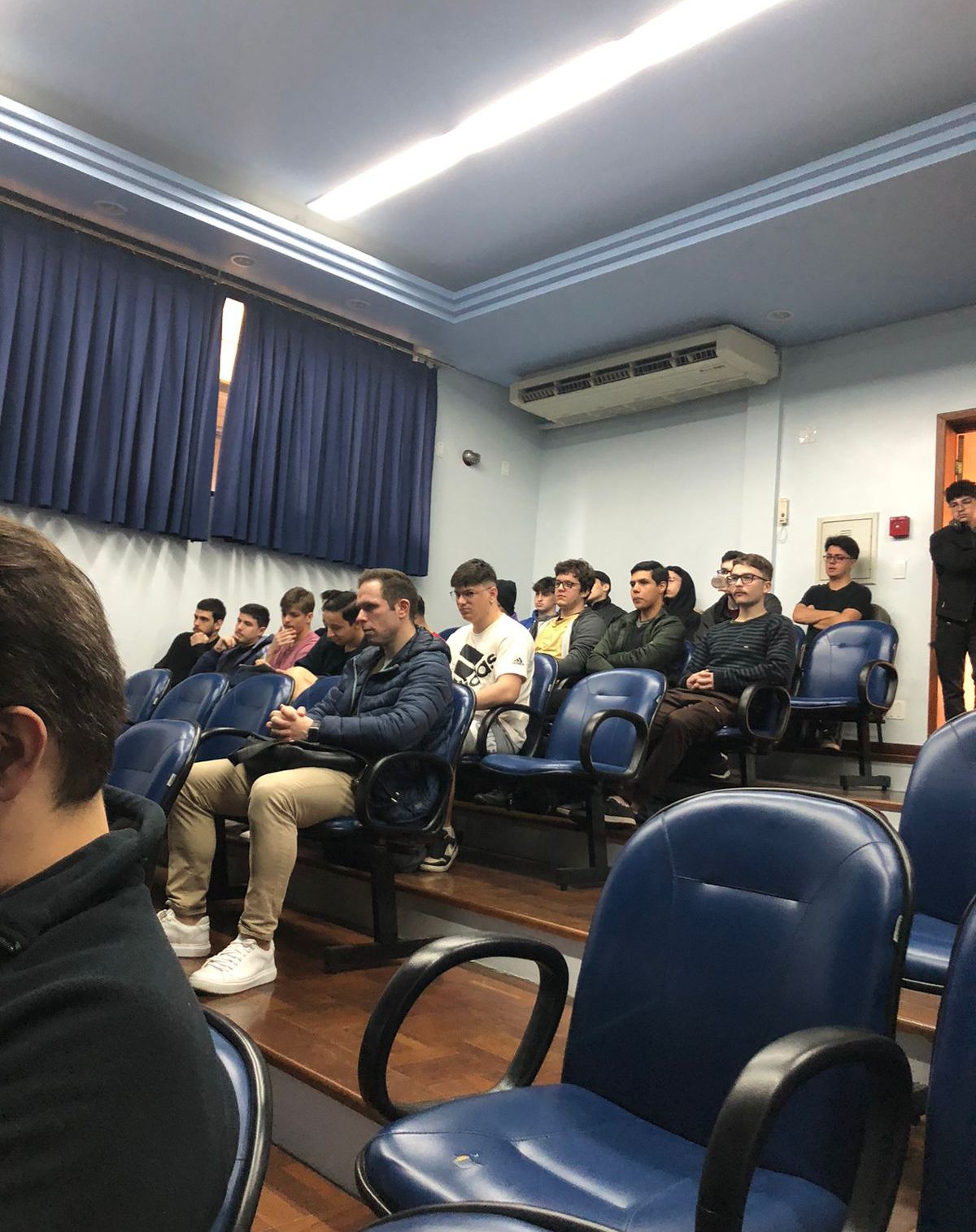
por Allythy O Debian Day um evento anual que celebra o anivers rio do Debian, uma das distribui es GNU/Linux mais importante do Software Livre, criada em 16 de Agosto de 1993, por Ian Murdock. No ltimo s bado (17/08/2024) no Sebrae-RN comemoramos os 31 anos Debian em Natal, no Rio Grande do Norte. A celebra o, foi organizada pela PotiLivre(Comunidade Potiguar de Software Livre), destacou os 31 anos de hist ria do Debian. O evento contou com algumas palestras e muitas discuss es sobre Software Livre. Tivemos 70 inscri es, 40 estiverem presentes. O Debian Day em Natal foi uma ocasi o para celebrar a trajet ria do Debian e refor ar a import ncia do Software Livre. Palestrantes Agradecemos imensamente a Isaque Barbosa Martins, Eduardo de Souza Paix o, Fernando Guisso,que palestraram nessa edi o! Obrigado por compartilhar tanto conhecimento com a comunidade. Esperamos ver voc s novamente em futuros encontros! foto da palestra conhecendo projeto Debian Link dos slides do Debian Day Participantes Um grande obrigado tamb m a todos os participantes, n s fazemos isso por voc s! Esperamos que tenham aprendido, se divertido e feito novas conex es entre a comunidade Participantes do Debian Day Natal-RN Essa edi o do Debina Day Natal foi organizada por: Allythy, Clara Nobre, Gabriel Damazio e Marcel Ribeiro.

Matthew Garrett: What the fuck is an SBAT and why does everyone suddenly care

Short version: Secure Boot Advanced Targeting and if that's enough for you you can skip the rest you're welcome.

Long version: When UEFI Secure Boot was specified, everyone involved was, well, a touch naive. The basic security model of Secure Boot is that all the code that ends up running in a kernel-level privileged environment should be validated before execution - the firmware verifies the bootloader, the bootloader verifies the kernel, the kernel verifies any additional runtime loaded kernel code, and now we have a trusted environment to impose any other security policy we want. Obviously people might screw up, but the spec included a way to revoke any signed components that turned out not to be trustworthy: simply add the hash of the untrustworthy code to a variable, and then refuse to load anything with that hash even if it's signed with a trusted key.

Unfortunately, as it turns out, scale. Every Linux distribution that works in the Secure Boot ecosystem generates their own bootloader binaries, and each of them has a different hash. If there's a vulnerability identified in the source code for said bootloader, there's a large number of different binaries that need to be revoked. And, well, the storage available to store the variable containing all these hashes is limited. There's simply not enough space to add a new set of hashes every time it turns out that grub (a bootloader initially written for a simpler time when there was no boot security and which has several separate image parsers and also a font parser and look you know where this is going) has another mechanism for a hostile actor to cause it to execute arbitrary code, so another solution was needed.

And that solution is SBAT. The general concept behind SBAT is pretty straightforward. Every important component in the boot chain declares a security generation that's incorporated into the signed binary. When a vulnerability is identified and fixed, that generation is incremented. An update can then be pushed that defines a minimum generation - boot components will look at the next item in the chain, compare its name and generation number to the ones stored in a firmware variable, and decide whether or not to execute it based on that. Instead of having to revoke a large number of individual hashes, it becomes possible to push one update that simply says "Any version of grub with a security generation below this number is considered untrustworthy".

So why is this suddenly relevant? SBAT was developed collaboratively between the Linux community and Microsoft, and Microsoft chose to push a Windows update that told systems not to trust versions of grub with a security generation below a certain level. This was because those versions of grub had genuine security vulnerabilities that would allow an attacker to compromise the Windows secure boot chain, and we've seen real world examples of malware wanting to do that (Black Lotus did so using a vulnerability in the Windows bootloader, but a vulnerability in grub would be just as viable for this). Viewed purely from a security perspective, this was a legitimate thing to want to do.

(An aside: the "Something has gone seriously wrong" message that's associated with people having a bad time as a result of this update? That's a message from shim, not any Microsoft code. Shim pays attention to SBAT updates in order to avoid violating the security assumptions made by other bootloaders on the system, so even though it was Microsoft that pushed the SBAT update, it's the Linux bootloader that refuses to run old versions of grub as a result. This is absolutely working as intended)

The problem we've ended up in is that several Linux distributions had not shipped versions of grub with a newer security generation, and so those versions of grub are assumed to be insecure (it's worth noting that grub is signed by individual distributions, not Microsoft, so there's no externally introduced lag here). Microsoft's stated intention was that Windows Update would only apply the SBAT update to systems that were Windows-only, and any dual-boot setups would instead be left vulnerable to attack until the installed distro updated its grub and shipped an SBAT update itself. Unfortunately, as is now obvious, that didn't work as intended and at least some dual-boot setups applied the update and that distribution's Shim refused to boot that distribution's grub.

What's the summary? Microsoft (understandably) didn't want it to be possible to attack Windows by using a vulnerable version of grub that could be tricked into executing arbitrary code and then introduce a bootkit into the Windows kernel during boot. Microsoft did this by pushing a Windows Update that updated the SBAT variable to indicate that known-vulnerable versions of grub shouldn't be allowed to boot on those systems. The distribution-provided Shim first-stage bootloader read this variable, read the SBAT section from the installed copy of grub, realised these conflicted, and refused to boot grub with the "Something has gone seriously wrong" message. This update was not supposed to apply to dual-boot systems, but did anyway. Basically:

1) Microsoft applied an update to systems where that update shouldn't have been applied
2) Some Linux distros failed to update their grub code and SBAT security generation when exploitable security vulnerabilities were identified in grub

The outcome is that some people can't boot their systems. I think there's plenty of blame here. Microsoft should have done more testing to ensure that dual-boot setups could be identified accurately. But also distributions shipping signed bootloaders should make sure that they're updating those and updating the security generation to match, because otherwise they're shipping a vector that can be used to attack other operating systems and that's kind of a violation of the social contract around all of this.

It's unfortunate that the victims here are largely end users faced with a system that suddenly refuses to boot the OS they want to boot. That should never happen. I don't think asking arbitrary end users whether they want secure boot updates is likely to result in good outcomes, and while I vaguely tend towards UEFI Secure Boot not being something that benefits most end users it's also a thing you really don't want to discover you want after the fact so I have sympathy for it being default on, so I do sympathise with Microsoft's choices here, other than the failed attempt to avoid the update on dual boot systems.

Anyway. I was extremely involved in the implementation of this for Linux back in 2012 and wrote the first prototype of Shim (which is now a massively better bootloader maintained by a wider set of people and that I haven't touched in years), so if you want to blame an individual please do feel free to blame me. This is something that shouldn't have happened, and unless you're either Microsoft or a Linux distribution it's not your fault. I'm sorry.

comment count unavailable comments

21 August 2024

Dirk Eddelbuettel: RcppMagicEnum 0.0.1 on CRAN: New Package!

Happy to announce a new package: RcppMagicEnum. It arrived on CRAN yesterday following the resumption of normal service following the CRAN summer break. RcppMagicEnum brings the magicenum library by Daniil Goncharov to R. Modern C++ is powerful, but still lacks reflection. This may change with C++26 but until then this library can help. A simple example, also shown on the README is as follows (and can be called from R via Rcpp::sourceCpp() if the RcppMagicEnum package is installed):
// [[Rcpp::depends(RcppMagicEnum)]]

#include <RcppMagicEnum>

// define a simple enum class, it uses optional typing as well as optional assigned values
enum class Color : int   RED = -10, BLUE = 0, GREEN = 10  ;

// [[Rcpp::export]]
void example()  
    // instantiate an enum value in variable 'val'
    auto val = Color::RED;

    // show the current value on stdout
    Rcpp::Rcout << "Name of enum: " << magic_enum::enum_name(val) << std::endl;
    Rcpp::Rcout << "Integer value of enum: " << magic_enum::enum_integer(val) << std::endl;
 

/*** R
example()
*/
It produces the following output (where the meta-comment at the end ensure the included and created-by-sourcing function example() is also called):
> Rcpp::sourceCpp("miniex.cpp")

> example()
Name of enum: RED
Integer value of enum: -10
>
The plan to experiment some more with this and then see if we could possible make factor variables map to such enums and vice versa. Help and discussion input is always welcome, and could be submitted either on the rcpp-devel list or as an issue at the repo. The short NEWS entry follows.

Changes in version 0.0.1 (2024-07-31)
  • Initial version and CRAN upload

If you like this or other open-source work I do, you can sponsor me at GitHub.

This post by Dirk Eddelbuettel originated on his Thinking inside the box blog. Please report excessive re-aggregation in third-party for-profit settings.

20 August 2024

Debian Brasil: Debian Day 2024 em Santa Maria/RS - Brasil

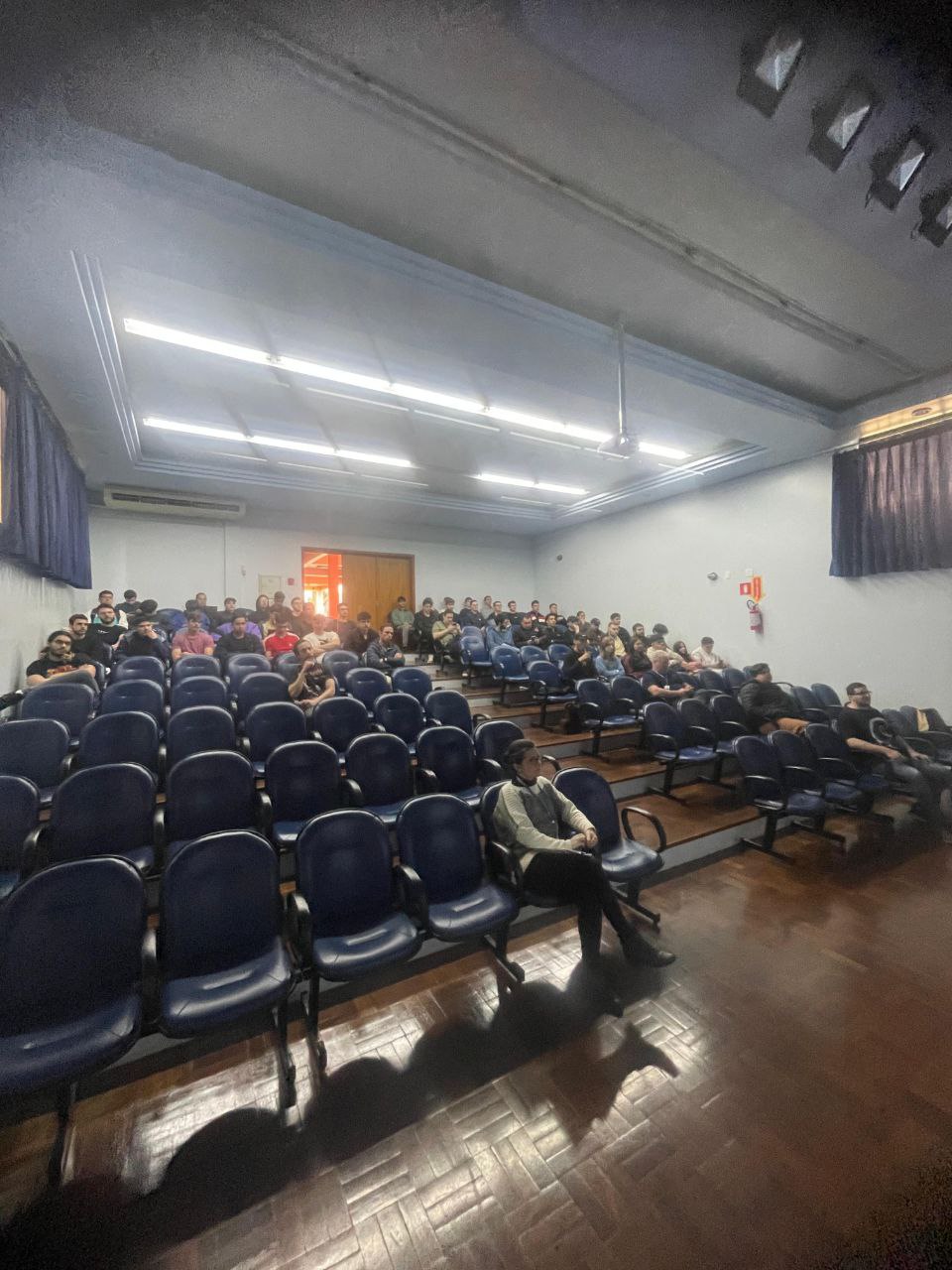
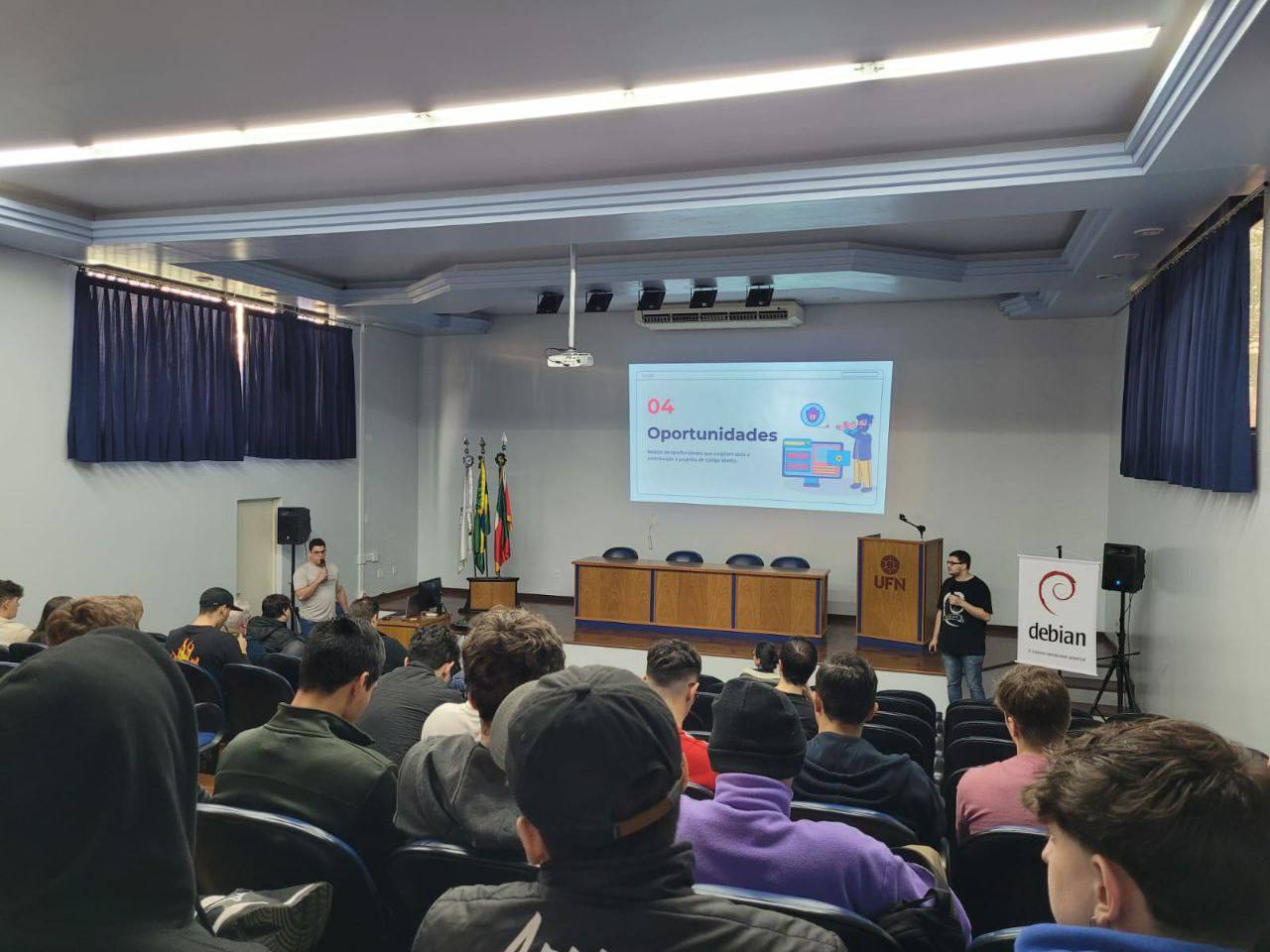
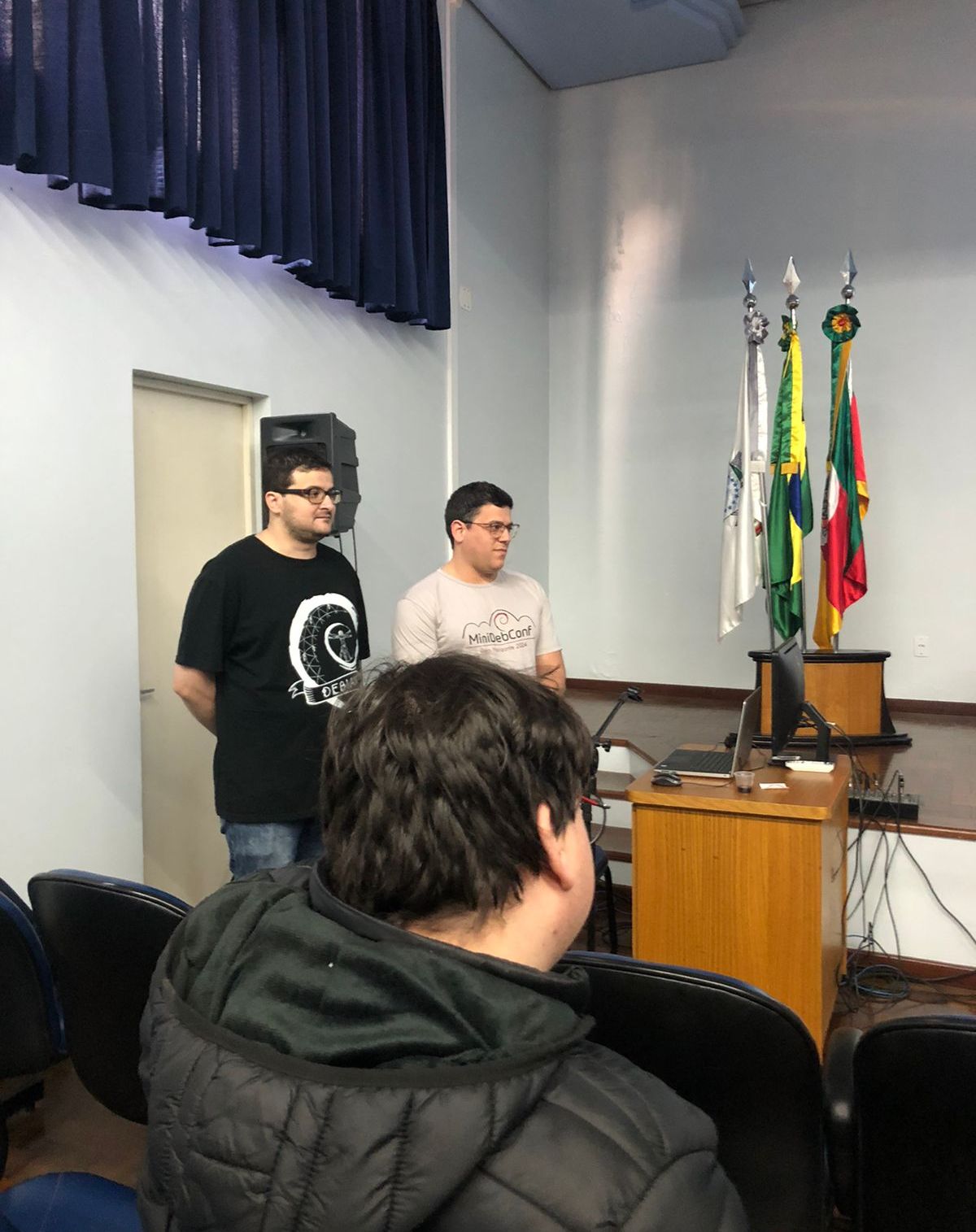
por Andrew Gon alves O Debian Day em Santa Maria - RS 2024 foi realizado ap s 5 anos de hiato, foi feito durante a manh do dia 16/08/2024 no Sal o Azul da Universidade Franciscana (UFN) com apoio da comunidade Debian e do Laborat rio de Pr ticas da Computa o da UFN. O evento contou com alunos de todos os semestres dos cursos de Ci ncia da Computa o, Jogos Digitais e Sistemas de Informa o, fizemos um coffee break onde tivemos a oportunidade de conversar com os participantes. Cerca de 60 alunos prestigiaram uma palestra de introdu o ao Software Livre e de C digo Aberto, Linux e foram introduzidos ao projeto Debian, tanto sobre a filosofia do projeto, at como ele acontece na pr tica e oportunidades que se abriram para participantes do projeto por fazerem parte do Debian. Ap s a palestra foi feita uma demonstra o de empacotamento pelo DD local Francisco Vilmar, que demonstrou na pr tica como funciona o empacotamento de software no Debian. Gostaria de agradecer a todas as pessoas que nos ajudaram: E um muito obrigado a todos os participantes que nos prestigiaram neste evento fazendo perguntas intrigantes e se interessando pelo mundo do Software Livre. Algumas fotos: DD em Santa Maria 1 DD em Santa Maria 2 DD em Santa Maria 3 DD em Santa Maria 4

Dirk Eddelbuettel: digest 0.6.37 on CRAN: Maintenance

Release 0.6.37 of the digest package arrived at CRAN today and has also been uploaded to Debian. digest creates hash digests of arbitrary R objects. It can use a number different hashing algorithms (md5, sha-1, sha-256, sha-512, crc32, xxhash32, xxhash64, murmur32, spookyhash, blake3,crc32c, xxh3_64 and xxh3_128), and enables easy comparison of (potentially large and nested) R language objects as it relies on the native serialization in R. It is a mature and widely-used package (with 70.8 million downloads just on the partial cloud mirrors of CRAN which keep logs) as many tasks may involve caching of objects for which it provides convenient general-purpose hash key generation to quickly identify the various objects. This release updates one of the different hashing source functions which, to remain close to their upstream, used Free() and Calloc() (uppercased to use the R allocator) but not the prefixed stricter versions R_Free() and R_Calloc(). R will switch to enforcing these in the next release next year. Kevin had noticed (while doing some other testing) that this now fails under R-devel (with a switch set), and prepares a very nice and clean PR to take care of it. As of today, CRAN is now sending please fix, or else notes so it was a good time to send this to CRAN. We also updated some remaining http URLs in the README.md to https, and switched to Author/Maintainer field to the now also mandatory Authors@R. My CRANberries provides a summary of changes to the previous version. For questions or comments use the issue tracker off the GitHub repo. For documentation (including the changelog) see the documentation site. If you like this or other open-source work I do, you can now sponsor me at GitHub.

This post by Dirk Eddelbuettel originated on his Thinking inside the box blog. Please report excessive re-aggregation in third-party for-profit settings.

19 August 2024

Matthew Garrett: Client-side filtering of private data is a bad idea

(The issues described in this post have been fixed, I have not exhaustively researched whether any other issues exist)

Feeld is a dating app aimed largely at alternative relationship communities (think "classier Fetlife" for the most part), so unsurprisingly it's fairly popular in San Francisco. Their website makes the claim:

Can people see what or who I'm looking for?
No. You're the only person who can see which genders or sexualities you're looking for. Your curiosity and privacy are always protected.


which is based on you being able to restrict searches to people of specific genders, sexualities, or relationship situations. This sort of claim is one of those things that just sits in the back of my head worrying me, so I checked it out.

First step was to grab a copy of the Android APK (there are multiple sites that scrape them from the Play Store) and run it through apk-mitm - Android apps by default don't trust any additional certificates in the device certificate store, and also frequently implement certificate pinning. apk-mitm pulls apart the apk, looks for known http libraries, disables pinning, and sets the appropriate manifest options for the app to trust additional certificates. Then I set up mitmproxy, installed the cert on a test phone, and installed the app. Now I was ready to start.

What became immediately clear was that the app was using graphql to query. What was a little more surprising is that it appears to have been implemented such that there's no server state - when browsing profiles, the client requests a batch of profiles along with a list of profiles that the client has already seen. This has the advantage that the server doesn't need to keep track of a session, but also means that queries just keep getting larger and larger the more you swipe. I'm not a web developer, I have absolutely no idea what the tradeoffs are here, so I point this out as a point of interest rather than anything else.

Anyway. For people unfamiliar with graphql, it's basically a way to query a database and define the set of fields you want returned. Let's take the example of requesting a user's profile. You'd provide the profile ID in question, and request their bio, age, rough distance, status, photos, and other bits of data that the client should show. So far so good. But what happens if we request other data?

graphql supports introspection to request a copy of the database schema, but this feature is optional and was disabled in this case. Could I find this data anywhere else? Pulling apart the apk revealed that it's a React Native app, so effectively a framework for allowing writing of native apps in Javascript. Sometimes you'll be lucky and find the actual Javascript source there, but these days it's more common to find Hermes blobs. Fortunately hermes-dec exists and does a decent job of recovering something that approximates the original input, and from this I was able to find various lists of database fields.

So, remember that original FAQ statement, that your desires would never be shown to anyone else? One of the fields mentioned in the app was "lookingFor", a field that wasn't present in the default profile query. What happens if we perform the incredibly complicated hack of exporting a profile query as a curl statement, add "lookingFor" into the set of requested fields, and run it?

Oops.

So, point 1 is that you can't simply protect data by having your client not ask for it - private data must never be released. But there was a whole separate class of issue that was an even more obvious issue.

Looking more closely at the profile data returned, I noticed that there were fields there that weren't being displayed in the UI. Those included things like "ageRange", the range of ages that the profile owner was interested in, and also whether the profile owner had already "liked" or "disliked" your profile (which means a bunch of the profiles you see may already have turned you down, but the app simply didn't show that). This isn't ideal, but what was more concerning was that profiles that were flagged as hidden were still being sent to the app and then just not displayed to the user. Another example of this is that the app supports associating your profile with profiles belonging to partners - if one of those profiles was then hidden, the app would stop showing the partnership, but was still providing the profile ID in the query response and querying that ID would still show the hidden profile contents.

Reporting this was inconvenient. There was no security contact listed on the website or in the app. I ended up finding Feeld's head of trust and safety on Linkedin, paying for a month of Linkedin Pro, and messaging them that way. I was then directed towards a HackerOne program with a link to terms and conditions that 404ed, and it took a while to convince them I was uninterested in signing up to a program without explicit terms and conditions. Finally I was just asked to email security@, and successfully got in touch. I heard nothing back, but after prompting was told that the issues were fixed - I then looked some more, found another example of the same sort of issue, and eventually that was fixed as well. I've now been informed that work has been done to ensure that this entire class of issue has been dealt with, but I haven't done any significant amount of work to ensure that that's the case.

You can't trust clients. You can't give them information and assume they'll never show it to anyone. You can't put private data in a database with no additional acls and just rely on nobody ever asking for it. You also can't find a single instance of this sort of issue and fix it without verifying that there aren't other examples of the same class. I'm glad that Feeld engaged with me earnestly and fixed these issues, and I really do hope that this has altered their development model such that it's not something that comes up again in future.

(Edit to add: as far as I can tell, pictures tagged as "private" which are only supposed to be visible if there's a match were appropriately protected, and while there is a "location" field that contains latitude and longitude this appears to only return 0 rather than leaking precise location. I also saw no evidence that email addresses, real names, or any billing data was leaked in any way)

comment count unavailable comments

18 August 2024

Gunnar Wolf: The social media my blog as well as some other sites I publish in is pushed to will soon stop receiving updates

For many years, I have been using the dlvr.it service to echo my online activity to where more people can follow it. Namely, I write in the following sources: Via dlvr.it s services, all those posts are echoed to Gwolfwolf in X (Twitter) and to the Gunnarwolfi page in Facebook. I use neither platform as a human (that is, I never log in there). Anyway, dlvr.it sent me a mail stating they would be soon (as in, the next few weeks) cutting their free tier. And, although I value their services and am thankfulfor their value so far, I am not going to pay for my personal stuff to be reposted to social media. So, this post s mission is twofold:
  1. If you follow me via any of those media, you will soon not be following me anymore
  2. If you know of any service that would fill the space left by dlvr.it, I will be very grateful. Extra gratefulness points if the option you suggest is able to post to accounts in less-propietary media (i.e. the Fediverse). Please tell me by mail (gwolf@gwolf.org).
Oh! Forgot to mention: Of course, my blog will continue to be appear in Planet Debian, Blograf a, and any decent aggregator that consumes my RSS.

Next.

Previous.