Search Results: "Dirk Eddelbuettel"

24 September 2010

Dirk Eddelbuettel: R / Finance 2011 Call for Papers

Brian announced it on r-help and r-sig-finance and I have since updated the R/Finance website and Call for Papers page. And as David Smith already outblogged me about it, without further ado our Call for Paper for next spring's R/Finance conference:
Call for Papers: R/Finance 2011: Applied Finance with R
April 29 and 30, 2011
Chicago, IL, USA
The third annual R/Finance conference for applied finance using R will be held this spring in Chicago, IL, USA on April 29 and 30, 2011. The two-day conference will cover topics including portfolio management, time series analysis, advanced risk tools, high-performance computing, market microstructure and econometrics. All will be discussed within the context of using R as a primary tool for financial risk management, portfolio construction, and trading. One-page abstracts or complete papers (in txt or pdf format) are invited to be submitted for consideration. Academic and practitioner proposals related to R are encouraged. We welcome submissions for full talks, abbreviated "lightning talks", and for a limited number of pre-conference (longer) seminar sessions. Presenters are strongly encouraged to provide working R code to accompany the presentation/paper. Data sets should also be made public for the purposes of reproducibility (though we realize this may be limited due to contracts with data vendors). Preference may be given to presenters who have released R packages. Please send submissions to: committee at RinFinance.com. The submission deadline is February 15th, 2011. Early submissions may receive early acceptance and scheduling. Submissions will be evaluated and submitters notified via email on a rolling basis. Determination of whether a presentation will be a long presentation or a lightning talk will be made once the full list of presenters is known. R/Finance 2009 and 2010 included attendees from around the world and featured keynote presentations from prominent academics and practitioners. 2009-2010 presenters names and presentations are online at the conference website. We anticipate another exciting line-up for 2011 including keynote presentations from John Bollinger, Mebane Faber, Stefano Iacus, and Louis Kates. Additional details will be announced via the conference website as they become available. For the program committee:
Gib Bassett, Peter Carl, Dirk Eddelbuettel, Brian Peterson,
Dale Rosenthal, Jeffrey Ryan, Joshua Ulrich
So see you in Chicago in April!

23 September 2010

Dirk Eddelbuettel: R Project and Google Summer of Code: Wrapping up

As this year's admin, I wrote up the following summary which has now been posted at the R site in the appropriate slot. My thanks to this year's students, fellow mentors and everybody else who helped to make it happen. GSoC 2010 logo

Projects 2010 As in 2008 and 2009, the R Project has again participated in the Google Summer of Code during 2010. Based on ideas collected and disussed on the R Wiki, the projects and students listed below (and sorted alphabetically by student) were selected for participation and have been sponsored by Google during the summer 2010. The finished projects are available via the R / GSoC 2010 repository at Google Code, and in several cases also via their individual repos (see below). Informal updates and final summaries on the work was also provided via the GSoC 2010 R group blog.

rdx - Automatic Differentiation in R Chidambaram Annamalai, mentored by John Nash. Proposal: radx is a package to compute derivatives (of any order) of native R code for multivariate functions with vector outputs, f:R^m -> R^n, through Automatic Differentiation (AD). Numerical evaluation of derivatives has widespread uses in many fields. rdx will implement two modes for the computation of derivatives, the Forward and Reverse modes of AD, combining which we can efficiently compute Jacobians and Hessians. Higher order derivatives will be evaluated through Univariate Taylor Propagation. Delivered: Two packages radx: forward automatic differentiation in R and tada: templated automatic differentiation in C++ were created; see this blog post for details.

A GUI for Graphics using ggplot and Deducer by Ian Fellows, mentored by Hadley Wickham. Proposal: R puts the latest statistical techniques at one's fingertips through thousands of add-on packages available on the CRAN download servers. The price for all of this power is complexity. Deducer is a cross-platform cross-console graphical user interface built on top of R designed to reduce this complexity. This project proposes to extend the scope of Deducer by creating an innovative yet intuitive system for generating statistical graphics based on the ggplot2 package. Delivered: All of the major features have been implemented, and are outlined in the video links in this blog post.

rgeos - an R wrapper for GEOS by Colin Rundel, mentored by Roger Bivand. Proposal: At present there does not exist a robust geometry engine available to R, the tools that are available tend to be limited in scope and do not easily integrate with existing spatial analysis tools. GEOS is a powerful open source geometry engine written in C++ that implements spatial functions and operators from the OpenGIS Simple Features for SQL specification. rgeos will make these tools available within R and will integrate with existing spatial data tools through the sp package. Delivered: The rgeos project on R-Forge; see the final update blog post.

Social Relations Analyses in R by Felix Schoenbrodt, mentored by Stefan Schmukle. Proposal: Social Relations Analyses (SRAs; Kenny, 1994) are a hot topic both in personality and in social psychology. While more and more research groups adopt the methodology, software solutions are lacking far behind - the main software for calculating SRAs are two DOS programs from 1995, which have a lot of restrictions. My GSOC project will extend the functionality of these existing programs and bring the power of SRAs into the R Environment for Statistical Computing as a state-of-the-art package. Delivered: The TripleR package is now on CRAN and hosted on RForge.Net; see this blog post for updates.

NoSQL Interface for R by Yasuhisa Yoshida, mentored by Dirk Eddelbuettel. Proposal: So-called NoSQL databases are becoming increasingly popular. They generally provide very efficient lookup of key/value pairs. I'll provide several implementation of NoSQL interface for R. Beyond a sample interface package, I'll try to support generic interface similar to what the DBI package does for SQL backends Status: An initial prototype is available via RTokyoCabinet on Github. No updates were made since June; no communication occurred with anybody related to the GSoC project since June and the project earned a fail.

Last modified: Wed Sep 22 19:39:43 CDT 2010

16 September 2010

Dirk Eddelbuettel: BLAS, BLASter, BLAStest: Some benchmark results, and a benchmarking framework

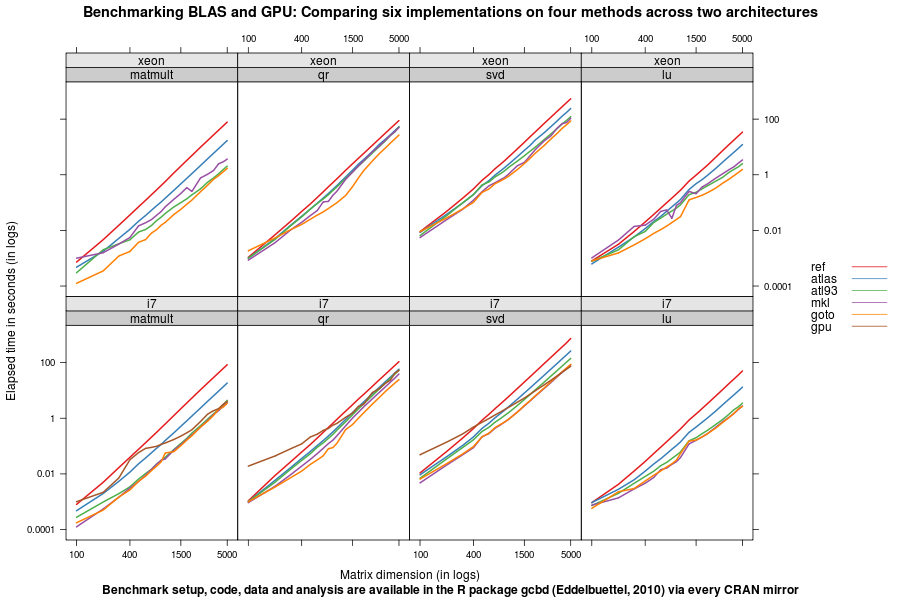
Usage of accelerated BLAS libraries seems to shrouded in some mystery, judging from somewhat regularly recurring requests for help on lists such as r-sig-hpc (gmane version), the R list dedicated to High-Performance Computing. Yet it doesn't have to be; installation can be really simple (on appropriate systems). Another issue that I felt needed addressing was a comparison between the different alternatives available, quite possibly including GPU computing. So a few weeks ago I sat down and wrote a small package to run, collect, analyse and visualize some benchmarks. That package, called gcbd (more about the name below) is now on CRAN as of this morning. The package both facilitates the data collection for the paper it also contains (in the vignette form common among R packages) and provides code to analyse the data---which is also included as a SQLite database. All this is done in the Debian and Ubuntu context by transparently installing and removing suitable packages providing BLAS implementations: that we can fully automate data collection over several competing implementations via a single script (which is also included). Contributions of benchmark results is encouraged---that is the idea of the package. The paper itself describes the background and technical details before presenting the results. The benchmark compares the basic reference BLAS, Atlas (both single- and multithreaded), Goto, Intel MKL and a GPU-based approach. This blog post is not the place to recap all results, so please do see the paper for more details. But one summary chart regrouping the main results fits well here: GPU/CPU Benchmark Results This chart, in a log/log form, shows how reference BLAS lags everything, how multithreaded newer Atlas improves over the standard Atlas package currently still the default in both distros, how the Intel MKL (available via Ubuntu) is fairly good but how Goto wins almost everything. GPU computing is compelling for really large sizes (at double precision) and too costly at small ones. It also illustrates variability and different computational cost across the methods tested: svd is more expensive than level-3 matrix multiplication, and the different implementations are less spread apart. More details are in the paper; code, data etc are in the package gcbd. The larger context is to do something like this benchmarking exercise, but across distributions, operating systems and possibly also GPU cards. Mark and I started to talk about this during and after R/Finance earlier this year and have some ideas. Time permitting, that work should be happening in the GPU/CPU Benchmarks (gdb) project, and that's why this got called gcbd as a simpler GPU/CPU Benchmarks on Debian Systems study.

13 September 2010

Dirk Eddelbuettel: RcppArmadillo 0.2.6

Now that Rcpp got updated to 0.8.6, we have an updated RcppArmadillo release containing mostly updates to Conrad's Armadillo version 0.9.70 as well as some more templated sugar magic. RcppArmadillo makes it easy to write highly efficient and highly readable C++ code for linear algebra (based on Armadillo) in R extensions (using Rcpp for the interface). The short NEWS file extract follows:
0.2.6   2010-09-12
    o   Upgraded to Armadillo 0.9.70 "Subtropical Winter Safari"
    
    o   arma::Mat, arma::Row and arma::Col get constructor that take vector
        or matrix sugar expressions. See the unit test "test.armadillo.sugar.ctor" 
        and "test.armadillo.sugar.matrix.ctor" for examples.
More information is on the RcppArmadillo page. Questions, comments etc should go to the rcpp-devel mailing list off the R-Forge page.

12 September 2010

Dirk Eddelbuettel: Chicago Half Marathon 2010

Second Sunday in September -- time for the annual Chicago Half Marathon now in its fourteenth edition (and I have been running it in 2003, 2004, 2005, 2006, 2007, 2008 and 2009 making this and the JPM Chase Corporate Challenge the races I've run most often). And the course was altered this year, alongside with an earlier start as the Bears have their season home opener today. So we started north towards 57th, then running down to 67th, turning east towards the lake at around three miles --- and having the remaining ten miles along the lakefront running up to 31st (the usual turn) and back down to 63rd. I like this course better; let's hope it sticks. Race conditions were fantastic. We had a rainy and gray day yesterday but today is pure bliss. Temperatures around 60 degrees at the 7:00am start, no wind, sunshine and not a cloud in the sky. The race itself went well. I had a pretty brutal running year suffering most of the time from some archilles tendon inflammation. It has gotten better in the last few weeks possibly thanks to some heel cups I now put in the shoes. But I had exactly one run longer than ten miles since the Boston Marathon. So I lost a lot of speed, as well as endurance and was a little nervous as to how I'd do. And considering all this, it went pretty well. I fininished in 1;41:50 or a 7:47 pace. While is easily the slowest half in a number of years, at least I got to run it evenly, pain free and with a negative split (== faster second half) and some gas left for a fast last half mile or so. So maybe I don't have to retire from running just yet. We'll see if I get some speed back in 2011.

Dirk Eddelbuettel: RProtoBuf 0.2,0

A brand new and shiny release of RProtoBuf, now at version 0.2.0, arrived on CRAN earlier today. RProtoBuf provides GNU R bindings for the Google Protobuf data encoding library used and release by Google and others. This is only the second release after 0.1-0 more than six months ago. Given that Rcpp is such a key ingedrient for RProtoBuf, and that Rcpp underwent so many exciting changes itself, Romain and I never got around to releasing new versions of RProtoBuf. This version is now much closer to the actual C++ API and fairly feature rich. We summarised a few of these new things in the presentation at useR! 2010. There is more information at the RProtoBuf page; there is a draft package vignette, a 'quick' overview vignette and a unit test summary vignette. Questions, comments etc should go to the rprotobuf mailing list off the RProtoBuf page at R-Forge.

11 September 2010

Dirk Eddelbuettel: Billy Bragg

In the spur of the moment, I cycled over to Dominican, one of the two small colleges in town, to see if I could snag a remaining ticket to see Billy Bragg perform. Turned out I could, and it became a nice evening out. Darren Hanlon started up the evening as the opener for a good half hour, and was quite decent; somewhat charming in a good natured way, not taking himself too too seriously. I'd gladlt see him again. After a longer-than-needed break Billy Bragg came on stage and played for two straight hours, alternating between an electric and acoustic guitar. And also alternating between some newer material and (especially towards the end and the encore) some old crowd-pleasure. I don't know his material all that well but have of course know of his career over these last 25 years and am quite glad I went to see him. Nice way to end the week.

10 September 2010

Dirk Eddelbuettel: Rcpp 0.8.6

After a somewhat longer than usual break, we now have a new release of Rcpp on CRAN and in Debian. This release adds quite few things. The main one may be the addition of density, distribution, quantile and random number functions for a rather large number of statistical distribution. Usage is pretty much as it would be in R, yet it is vectorised at the C++ level. A fair number of unit tests were added too, but some work is left to do there too.
Support for complex number was enhanced both in the expressive 'sugar' context and via a few binary operators that had been missing. We also started a new vignette to provide a 'quick reference'; unfortunately this is not quite complete yet. The NEWS entry follows below:
0.8.6   2010-09-09
    o	new macro RCPP_VERSION and Rcpp_Version to allow conditional compiling
        based on the version of Rcpp
    
           #if defined(RCPP_VERSION) && RCPP_VERSION >= Rcpp_Version(0,8,6)
           ...
           #endif
    o   new sugar functions for statistical distributions (d-p-q-r functions)
	with distributions : unif, norm, gamma, chisq, lnorm, weibull, logis,
	f, pois, binom, t, beta.
    o   new ctor for Vector taking size and function pointer so that for example
    	   NumericVector( 10, norm_rand )
	generates a N(0,1) vector of size 10
    o   added binary operators for complex numbers, as well as sugar support 
    o   more sugar math functions: sqrt, log, log10, exp, sin, cos, ...
    o	started new vignette Rcpp-quickref : quick reference guide of Rcpp API
        (still work in progress)
    o	various patches to comply with solaris/suncc stricter standards
    o	minor enhancements to ConvolutionBenchmark example
    o	simplified src/Makefile to no longer require GNU make; packages using
        Rcpp still do for the compile-time test of library locations
    
As always, even fuller details are in Rcpp Changelog page and the Rcpp page which also leads to the downloads, the browseable doxygen docs and zip files of doxygen output for the standard formats. A local directory has source and documentation too. Questions, comments etc should go to the rcpp-devel mailing list off the R-Forge page

Dirk Eddelbuettel: Rcpp 0.8.6

After a somewhat longer than usual break, we now have a new release of Rcpp on CRAN and in Debian. This release adds quite few things. The main one may be the addition of density, distribution, quantile and random number function for a rather large number of statistical distribution. Usage is pretty much as it would be in R, yet it is vectorised at the C++ level. A fair number of unit tests were added too, but some work is left to do there too.
Support for complex number was enhanced both in the expressive 'sugar' context and via a few binary operators that had been missing. We also started a new vignette to provide a 'quick reference'; unfortunately this is not quite complete yet. The NEWS entry follows below:
0.8.6   2010-09-09
    o	new macro RCPP_VERSION and Rcpp_Version to allow conditional compiling
        based on the version of Rcpp
    
           #if defined(RCPP_VERSION) && RCPP_VERSION >= Rcpp_Version(0,8,6)
           ...
           #endif
    o   new sugar functions for statistical distributions (d-p-q-r functions)
	with distributions : unif, norm, gamma, chisq, lnorm, weibull, logis,
	f, pois, binom, t, beta.
    o   new ctor for Vector taking size and function pointer so that for example
    	   NumericVector( 10, norm_rand )
	generates a N(0,1) vector of size 10
    o   added binary operators for complex numbers, as well as sugar support 
    o   more sugar math functions: sqrt, log, log10, exp, sin, cos, ...
    o	started new vignette Rcpp-quickref : quick reference guide of Rcpp API
        (still work in progress)
    o	various patches to comply with solaris/suncc stricter standards
    o	minor enhancements to ConvolutionBenchmark example
    o	simplified src/Makefile to no longer require GNU make; packages using
        Rcpp still do for the compile-time test of library locations
    
As always, even fuller details are in Rcpp Changelog page and the Rcpp page which also leads to the downloads, the browseable doxygen docs and zip files of doxygen output for the standard formats. A local directory has source and documentation too. Questions, comments etc should go to the rcpp-devel mailing list off the R-Forge page

8 September 2010

Dirk Eddelbuettel: Straight, curly, or compiled?

Christian Robert, whose blog I commented-on here once before, had followed up on a recent set of posts by Radford Neal which had appeared both on Radford's blog and on the r-devel mailing list. Now, let me prefix this by saying that I really enjoyed Radford's posts. He obviously put a lot of time into finding a number of (all somewhat small in isolation) inefficiencies in R which, when taken together, can make a difference in performance. I already spotted one commit by Duncan in the SVN logs for R so this is being looked at. Yet Christian, on the other hand, goes a little overboard in bemoaning performance differences somewhere between ten and fifteen percent -- the difference between curly and straight braces (as noticed in Radford's first post). Maybe he spent too much time waiting for his MCMC runs to finish to realize the obvious: compiled code is evidently much faster. And before everybody goes and moans and groans that that is hard, allow me to just interject and note that it is not. It really doesn't have to be. Here is a quick cleaned up version of Christian's example code, with proper assigment operators and a second variable x. We then get to the meat and potatoes and load our Rcpp package as well as inline to define the same little test function in C++. Throw in rbenchmark which I am becoming increasingly fond of for these little timing tests, et voila, we have ourselves a horserace:
# Xian's code, using <- for assignments and passing x down
f <- function(n, x=1) for (i in 1:n) x=1/(1+x)
g <- function(n, x=1) for (i in 1:n) x=(1/(1+x))
h <- function(n, x=1) for (i in 1:n) x=(1+x)^(-1)
j <- function(n, x=1) for (i in 1:n) x= 1/ 1+x 
k <- function(n, x=1) for (i in 1:n) x=1/ 1+x 
# now load some tools
library(Rcpp)
library(inline)
# and define our version in C++
l <- cxxfunction(signature(ns="integer", xs="numeric"),
                 'int n = as<int>(ns); double x=as<double>(xs);
                  for (int i=0; i<n; i++) x=1/(1+x);
                  return wrap(x); ',
                 plugin="Rcpp")
# more tools
library(rbenchmark)
# now run the benchmark
N <- 1e6
benchmark(f(N, 1), g(N, 1), h(N, 1), j(N, 1), k(N, 1), l(N, 1),
          columns=c("test", "replications", "elapsed", "relative"),
          order="relative", replications=10)
And how does it do? Well, glad you asked. On my i7, which the other three cores standing around and watching, we get an eighty-fold increase relative to the best interpreted version:
/tmp$ Rscript xian.R
Loading required package: methods
     test replications elapsed relative
6 l(N, 1)           10   0.122    1.000
5 k(N, 1)           10   9.880   80.984
1 f(N, 1)           10   9.978   81.787
4 j(N, 1)           10  11.293   92.566
2 g(N, 1)           10  12.027   98.582
3 h(N, 1)           10  15.372  126.000
/tmp$ 
So do we really want to spend time arguing about the ten and fifteen percent differences? Moore's law gets you those gains in a couple of weeks anyway. I'd much rather have a conversation about how we can get people speed increases that are orders of magnitude, not fractions. Rcpp is one such tool. Let's get more of them.

26 August 2010

Dirk Eddelbuettel: Louis: A Silent Film with Live Music

The Chicago Symphony hosted the world premiere of Louis last evening, and I had snatched the (literally) last available ticket. The film, which is written, directed and producted by Dan Pritzker, is based loosely on the early years of Louis Armstrong in New Orleans. The movie is shot beautifully by Vilmos Zsigmond in blend of colour and black-and-white which works very well for invoking the early days of film. A key part of the production is of course the score, and the live music with both a thirteen-piece orchestra featuring Wynton Marsalis as well as piano solo recitals by Cecile Licad with an emphasis on pieces by 19th-century composer Louis Moreau Gottschalk. The combination of a silent movie with a stong live band is something to behold -- if you can catch the movie and performance in a city nearby, go!

10 August 2010

Dirk Eddelbuettel: RQuantLib 0.3.4

A fresh release of RQuantLib is now on CRAN and in Debian. RQuantLib combines (some of) the quantitative analytics of QuantLib with the R statistical computing environment and language. This follows the 0.3.3 release from last week and has again a number of internal changes. All uses of objects from external namespaces are now explicit as I removed the remaining using namespace QuantLib;. This makes things a little more verbose, but should be much clearer to read, especially for those not yet up to speed on whether a given object comes from any one of the Boost, QuantLib or Rcpp namespaces. We also generalized an older three-dimensional plotting function used for option surfaces -- which had already been used in the demo() code -- and improved the code underlying this: arrays of option prices and analytics given two input vectors are now computed at the C++ level for a nice little gain in efficiency. This also illustrates the possible improvements from working with the new Rcpp API that is now used throughout the package, Full changelog details, examples and more details about this package are at my RQuantLib page.

7 August 2010

Dirk Eddelbuettel: RInside release 0.2.3

A new 0.2.3 release of RInside is now on CRAN. RInside is a set of convenience classes which facilitate embedding of R inside of C++ applications and programs. RInside works particularly well with Rcpp and now depends on it. This is the first release since March when we released 0.2.2. A few things got added to Rcpp in the meantime, and RInside is taking advantage of some of these as illustrated in several of the included examples. More details and the changelog are on the RInside page which also leads

5 August 2010

Dirk Eddelbuettel: RcppArmadillo 0.2.5

Hot on the heels of RcppArmadillo release 0.2.4 a few days ago comes a new release 0.2.5 which is now on CRAN. RcppArmadillo makes it easy to write highly efficient and highly readable C++ code for linear algebra (based on Armadillo) in R extensions (using Rcpp for the interface). This release upgrades the included Armadillo version to Conrad's just-released version 0.9.60. This overcomes some of minor issues we had with 'older' compilers such as g++ 4.2.x with x being 1 or 2. No other changes were made from our end. The short NEWS file extract follows:
0.2.5   2010-08-05
    o   Upgraded to Armadillo 0.9.60 "Killer Bush Turkey"
More information is on the RcppArmadillo page. Questions, comments etc should go to the rcpp-devel mailing list off the R-Forge page.

4 August 2010

Dirk Eddelbuettel: RQuantLib 0.3.3

A new release (now at version 0.3.3) of RQuantLib is now on CRAN and in Debian. RQuantLib combines (some of) the quantitative analytics of QuantLib with the R statistical computing environment and language. Many of the changes in this new version are internal. The code was re-written using the new Rcpp API throughout, and the build system was further simplified using the LinkingTo: mechanism. The arithmetic average-price asian option pricer was added. A few other code updates were made as well. Full changelog details, examples and more details about this package are at my RQuantLib page.

3 August 2010

Dirk Eddelbuettel: RcppExamples 0.1.1

On Friday, I quickly provided a new release of RcppExamples, our example package for using Rcpp, to CRAN. Very little content has been updated --- and a new TODO file even notes that we need to add more documentation for the new Rcpp API. And update existing documentation as lots has changed since the initial release in March. But at least this package now joins RcppArmadillo is using the highly-recommened LinkingTo: Rcpp directive in the DESCRIPTION file to let R find the Rcpp headers, making the build process a little more robust. A few more details on the page are on the RcppExamples page.

Dirk Eddelbuettel: inline 0.3.6

A couple of days ago, Romain released inline release 0.3.6 to CRAN. This is a maintenance release with no user-visible changes. However, as it captures compiler errors more directly, it should help us debug Rcpp on recalcitrant platforms such as Solaris with suncc where we have no shell access and no build robot (though that may be changing with the rumoured bin-builder). More details on the release at Romain's blog.

29 July 2010

Dirk Eddelbuettel: RcppArmadillo 0.2.4

A new release of RcppArmadillo is now on CRAN. RcppArmadillo makes it easy to write highly efficient and highly readable C++ code for linear algebra (based on Armadillo) in R extensions (using Rcpp for the interface). This release upgrades the included Armadillo version to 0.9.52 (see here for Conrad's high-level changes). We had to make two minor tweaks. In the fastLm() help page example we switched from inv() to pinv()</tt)> The short NEWS file extract follows:
0.2.4   2010-07-27
    o   Upgraded to Armadillo 0.9.52 'Monkey Wrench'
    o   src/fastLm.cpp: Switch from inv() to pinv() as inv() now tests for
        singular matrices and warns and returns an empty matrix which stops
        the example fastLm() implementation on the manual page -- and while
        this is generally reasonably it makes sense here to continue which
        the Moore-Penrose pseudo-inverse allows us to do this
More information is on the RcppArmadillo page. Questions, comments etc should go to the rcpp-devel mailing list off the R-Forge page.

27 July 2010

Dirk Eddelbuettel: Rcpp 0.8.5

A new release (now at version 0.8.5) of Rcpp is now on CRAN and in Debian. This release constitutes a quick follow-up to the last release 0.8.4 which we got out just before CRAN closed for summer vacations. Some fixes were made right after last release: two harmless warnings from the help file parser of the development version of R are now addressed, and we stopped using shell expansions in the Makefile snippets. We also added to some internal speedups we discovered while prepapring the talk about RProtoBuf for last week's useR! meeting. The NEWS entry follows below:
0.8.5   2010-07-25
    o   speed improvements. Vector::names, RObject::slot have been improved
        to take advantage of R API functions instead of callbacks to R
    o   Some small updates to the Rd-based documentation which now points to 
        content in the vignettes.  Also a small formatting change to suppress
        a warning from the development version of R.
    o   Minor changes to Date() code which may reenable SunStudio builds
As always, even fuller details are in Rcpp Changelog page and the Rcpp page which also leads to the downloads, the browseable doxygen docs and zip files of doxygen output for the standard formats. A local directory has source and documentation too. Questions, comments etc should go to the rcpp-devel mailing list off the R-Forge page

24 July 2010

Dirk Eddelbuettel: useR 2010 at NIST in Gaithersburg

This past week, the annual R user conference useR! 2010 took place at the National Institute of Standards and Technology (NIST) in Gaithersburg, MD (which is a tad northwest of Washington, DC). Kate Mullen and her team of local organizers did a truly tremendous job in putting together a very smooth conference attended by almost 500 people. It is always nice to meet so many other R contributors and users in person. And needless to say it's also just plain fun to hang out with these folks. As at the preceding useR! 2008 in Dortmund and useR! 2009 in Rennes, I presented a three-hour tutorial on high-performance computing with R. This covers scripting/automation, profiling, vectorisation, interfacing compiled code, parallel computing and large-memory approaches. The slides, as well as a condensed 2-up version, are now on my presentations page. On Wednesday, Romain and I had a chance to talk about recent work on Rcpp, our R and C++ integration. Thursday, we followed up with a presentation on RProtoBuf -- a project integrating Google's Protocol Buffers with R which much to our delight already seems to be in use at Google itself! It was quite fun to do these two talks jointly with Romain. But my other coauthor Khanh had to be at a conference related to his actual PhD work. So on Friday it was just me to give a presentation about RQuantLib which brings QuantLib to R. Slides from all these talks have now been added to my presentations page. I will also upload them via the conference form so that they can be part of the conference's collection of presentations which should be forthcoming.

Next.

Previous.