Search Results: "vela"

10 October 2013

Russ Allbery: Review: 2312

Review: 2312, by Kim Stanley Robinson
Publisher: Orbit
Copyright: 2012
ISBN: 0-316-19280-5
Format: Kindle
Pages: 563
Swan Er Hong is a native of Mercury, granddaughter of one of the most influential women in the solar system. Alex, known as the Lion of Mercury, has just died as the story opens, and Swan is mourning. But she's also discovering that something else has been going on, something that Alex had not confided in her. Something that involves an inspector from the asteroids, a scientist from Titan, and a message Alex left in the event of her death, asking Swan to convey something personally to another scientist on Io. And then Mercury is attacked and the situation becomes much more complicated. 2312 is, like most Robinson novels, built on top of monumental world-building. The date is given away by the title; the setting is a solar system full of terraforming, habitats, and explosive human colonization. There are human settlements on every world that could possibly sustain them, including a terraformed Mars and a vast in-progress terraforming project on Venus. Mercury, Song's home, supports the city known as Terminator, a shielded habitat that travels around the planet on rails, pushed forward by the thermal expansion of metal at sunrise. Humans have scattered across the solar system and changed everything they've touched, even the asteroids. Many of those have been repurposed as long-haul shuttles: self-contained habitats on carefully-designed routes on which people live for months or years until they get to their destinations. Parts of this book are gorgeous. One of Robinson's strengths is creating images of the vastness of space, science, and human endeavor that feel plausible and inspiring at the same time. The setting of 2312 frees him to go wild with mega construction projects, and he takes full advantage. Parts of the book inspire the same sense of awe as the Hoover Dam or the Great Wall of China, transplanted into space and backed with neat scientific ideas to ponder. (Even if the more skeptical will note certain human habitation hazards, such as prolonged weightlessness and radiation, are mostly hand-waved away.) Unusually for a Robinson novel, 2312 also features an interesting and vibrant protagonist. Usually I can barely remember Robinson's protagonists five minutes after I finish the book, but Swan is so impulsive, erratic, and emotionally intense that I doubt I'll forget her. Her past is stuffed with outrageous risks and intense creativity: having songbird neurons transplanted into her brain, ingesting extraterrestrial bacteria, designing habitats in the asteroid belt, and creating art on the plains of Mercury. As the story gets underway, she meets the oversized and mellow Wahram; at first, she finds him boring, but then they're thrown together by one of the best set pieces of the book, and both they and the reader discover they work well together. Wahram serves as a straight man and as a stand-in for the reader's opinion, showing Swan all the more clearly in contrast. All this sounds quite promising. Unfortunately, what makes 2312 an ambitious failure rather than an excellent story is the story part. Robinson has built an amazing world, but he doesn't seem to know what to do with it. His economy, at least outside of Earth (and more on that in a moment), is essentially post-scarcity. Few of the characters we meet seem to have any concept of fiscal or practical limitation. They head across the solar system on a moment's notice, take vacations in habitats, or head to favorite spots for the view. It felt like Robinson was trying to write a Culture story. Unlike Banks, however, he struggles with generating a plot. 2312 is, in structure, a murder mystery. The characters witness a crime, survive it, and then intend to investigate it, and the crime appears to grow and link to fault lines in their society. This could have worked, but it has two problems: their society is only barely coherent enough for the reader to perceive the potential fault lines, and Robinson seems to have no idea how to construct a mystery plot. There is no sense of coherence to Swan and Wahram's approach, no sense of a gathering of clues, and very little sense of drama. All of the plot revelations are either dropped in Swan's lap by another character at a convenient moment or generated by Swan refusing to take the plot of the book seriously. The characters do essentially no meaningful investigation on-camera and show almost no investment in the outcome of the plot. When the climax comes, it's all weirdly forgettable. There are also large sections of the book that appear to have nothing to do with the rest of the plot, and that's where the unfortunate interval on Earth comes in. Robinson takes advantage of the scenes on Earth to do a bit of alienation and shows how foreign and strange and stifling Earth feels to someone who grew up outside of its atmosphere. Parts of this work, but he puts the plot on hold to do it. And parts of it do not work at all. The most glaring example is Swan and Wahram's bizarre bit of attempted charity in Africa, which comes across as stunningly high-handed and arrogant. This could be in character, particularly for Swan (who is not long on empathy), but, if so, the book doesn't signal to the reader that it should be read that way. Instead, there are some side (or snide) comments that seem to indicate Robinson knows nothing about the economic arc of Africa from the past twenty years. And when their absurd, botched, condescending charity plan fails for all the obvious reasons, the characters, and apparently the novel, throw up their hands and write Earth off as a stagnant lost cause that can't accept the imposition of a good idea and go back to the plot, never apparently caring about Earth again. Almost as frustrating is the way that these interludes are tied back into the story, which is usually through Swan getting ridiculously lucky on her random encounter rolls. It felt like whenever Robinson needed to make progress in the plot, Swan would just accidentally run into exactly the right person or situation to bring up the next plot point or to have some investigation make sense. (Not that Swan usually figured this out. Normally, the inspector explains it to her.) The author's finger was planted so firmly on the scales that it destroyed my suspension of disbelief and made a mockery of the idea that the characters were actually investigating anything. 2312 is built around a skeleton of a plot, but the lack of engagement with it, the lack of tension and emotion, the way the next developments are generally narrated to the protagonists and the reader, and the repeated use of random encounters to steer it left me without much reason to care. Robinson tries a few twists, but since the story never felt committed to its plot anyway, those twists feel less like planned complications and more like another random veer in the road. It didn't help that the final outcome was more prosaic and forgettable than the book had been implying it would be. There is a lot to like here. I'm very pleased to see Robinson finally write a memorable protagonist, and he's very good at both world-building and set pieces. But it needed a plot, and it needed a more coherent and complete cultural backdrop for its characters. Without both, it fell back into the typical Robinson trap: gorgeous moments separated by a whole lot of boring, and an overall impression of a construction tour rather than a story. There are bits of it I loved and still remember, particularly Song and Wahram in the tunnels of Mercury (which is possibly the best extended characterization Robinson has ever written). But the book as a whole is a mess, and I can't recommend wading through it for the good parts. Rating: 5 out of 10

6 September 2013

Daniel Pocock: Latest NSA revelations no surprise, but...

The latest NSA revelations confirm the systematic manner in which the NSA exploits known and potentially unknown backdoors to work around cryptography. This is not surprising, I speculated briefly about the OpenBSD and Windows NSA key incidents when Snowden originally came into view. Even two days ago, a detailed piece in Wired Magazine predicted many of the things that are in today's headlines., although Schneier indicates in The Guardian he had seen some of the material before publication. What we really need to know If the NSA and CIA have had these capabilities, just how much did they really know before and during the financial crisis that kicked off in 2007? Could the crisis have been averted? It was already known that the Greek parliament was wired, was the NSA involved in similar shenanigans? This could well be part of the Snowden revelations that we are yet to see. In fact, it is this last issue that could be the most damaging for "US interests". If countries (or their citizens) receive such undeniable evidence of a CIA conspiracy exposed by Snowden in broad daylight and they refuse to pay debts then it could lead to major re-alignment of international politics, alliances and treaties. Syria would be just the tip of the iceberg.

6 August 2013

Daniel Pocock: DebConf next week, free real-time communications session

DebConf13 is just about to get under way. While last year's event involved an exciting visit to Nicaragua, this year it is right here in Switzerland making it very convenient for many of those in the very populous community of free software enthusiasts across western Europe.
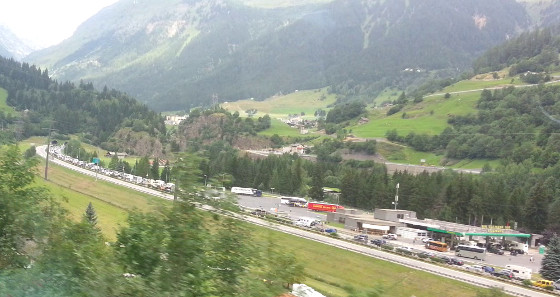
A long queue has already formed on the freeway going north from Italy into Switzerland's Gotthard Tunnel: did somebody put Debian's 20th birthday party on a social networking site? The big invitation On the final day of DebConf, Saturday 17 August, there is an afternoon track dedicated to the topic of free real-time communications. While DebConf is traditionally aimed at the Debian Developer community, real-time communications, by definition, requires cross-platform collaboration in order to succeed and it is a particularly hot topic thanks to recent revelations about communications privacy. Therefore, there is a wider invitation for visitors to attend this session, please just remember to register your details here, it is free (and private). To get a feel for the topic, please see the video of the Free, Open and Secure Communications panel from FOSDEM 2013 Seeing Switzerland
Who said Switzerland is expensive? Swiss Postbus is offering free wifi now Please see some of my previous blogs about Swiss travel for videos and pictures if you are looking for ideas for your time in .ch

24 June 2013

Daniel Pocock: Private WANs may be less secure than VPNs

The latest round of Snowden revelations concern a British GCHQ program dubbed "Mastering the Internet (MTI)". The program involves, among other things, tapping the world's under-sea fibre-optic cables and systematically monitoring all communications. One of the most significant facts that appears is the benefit of using IPsec and VPNs over the public Internet instead of trusting un-encrypted traffic to pass over private WAN connections. The definition of a private WAN connection is quite broad: many ISPs in the UK, for example, use the British Telecom OpenReach platform to tunnel DSL connections back to their data centers and offer virtual WANs to their business customers. Can any wifi be trusted? It should be assumed that all Wifi networks can be compromised at-will by a sophisticated attacker. This is another situation where VPNs may be part of the solution: even WPA2 secured wifi segments should be treated as untrusted public Internet networks and not bridged or routed onto any private subnets. Users with devices on a wifi network should be forced to use a VPN over wifi connection, even when the wifi is within the same building as the private network. Tor may be compromised by an attacker with this much data As I've mentioned in previous blogs with a focus on real-time communications there is no such thing as perfect privacy. Simply encrypting data with IPsec does not prevent the attacker knowing the volume of data transmitted or the time it was transmitted. Using a service like Tor for onion-routing provides some benefit. However, an attacker with sufficient infiltration of many points in the network may be able to deduce the real origins of a data transfer over Tor using some combination of packet sizes and timestamps. "Mastering the Internet (MTI)" may have sufficient coverage to achieve that. Tor could overcome this by putting dummy data into the network and adding fragmentation, but such schemes may add latency, reduce throughput and require significant effort to upgrade existing users. Gaining intelligence from encrypted data VoIP signals are typically compressed using some type of codec. These are dedicated, lossy compression schemes optimised for voice signals. Some codecs use a fixed compression ratio. Other codecs use a variable compression ratio (VBR): a simple example involves sending shorter packets to indicate a period of silence. Encrypting these packets prevents an attacker seeing what is inside them but the attacker can easily detect the lengths of the packets. Researchers have demonstrated that statistical techniques can be applied to VBR dataflows to identify syllables used in speech and then make a hypothesis about what has been said. (This would be an interesting hack to try and reproduce by collecting data with tcpdump and analysing it with R) Identifying phrases in encrypted VoIP using statistical analysis In many cases like those described, it is necessary to go beyond default encryption settings and put extra dummy data or frame padding into the data flow to gain a more fool-proof level of privacy. Simply connecting VoIP phones to an IPsec network doesn't automatically make them secure. The rise of the free-software VPN Even if the default configurations are not always universally resilient to every type of attack, many free software prodcuts provide an excellent building block for VPNs. Having the source code and specifications on hand, free software developers can then innovate to mix-and-match different technologies or add random data flows to mask the real activity on the network. In a recent hosting migration project, I successfully used the rather trivial VPN package tinc to bridge the ethernet segments between virtual machines in the old and new networks. This allowed virtual machines to be moved one-by-one over a period of a week. This is a remarkably simple solution that can protect the integrity of communications on a private subnet. A more comprehensive solution is strongSwan which provides support for industry-standard IPsec in various topologies. They now offer a full IPsec client for Android phones (hopefully it will be made available on f-droid: using a Google account to access Google Play may result in Google accidentally helping you "back up" your settings, including credentials, to their cloud, undermining the privacy of the system) An IPsec VPN can be deployed to all hosts on a network: then they can use opportunistic encryption for any type of communication without needing to worry about the underlying network. Furthermore, it is possible to add smart cards to further boost VPN security while using free software for the whole solution. For those interested in looking beyond Linux solutions, the *BSD range of operating systems, particularly OpenBSD provide a compelling alternative. This paper about OpenBSD's iked, which is also available on other platforms as OpenIKEd is very recent and provides a thorough overview of it's current status. One notable limitation is that their MOBIKE support is not yet complete. Many older VPNs likely to need an ugprade When I first started deploying Linux VPNs in the 90s the market was favourable for any type of Linux VPN. In extreme cases (which were surprisingly common at the time) companies accustomed to paying $20,000 per month for a leased line would happily pay a flat fee of $100,000 to purchase a VPN that was cobbled together using less than $10,000 of commodity hardware and some free software. Many of the first generation of these VPNs were built using RSA key lengths and algorithms no longer considered secure, such as DES. Some of these solutions (or products derived from them) may still remain in use today: managers may be slightly embarrassed to put aside their $100,000 VPN and replace it with a $50 router that is more secure. While that is the more extreme example, there are many intermediate solutions out there in the field. There are clear opportunities here to upgrade users to free software solutions.

18 June 2013

Daniel Pocock: RSA Key Sizes: 2048 or 4096 bits?

Many people are taking a fresh look at IT security strategies in the wake of the NSA revelations. One of the issues that comes up is the need for stronger encryption, using public key cryptography instead of just passwords. This is sometimes referred to as certificate authentication, but certificates are just one of many ways to use public key technology. One of the core decisions in this field is the key size. Most people have heard that 1024 bit RSA keys have been cracked and are not used any more for web sites or PGP. The next most fashionable number after 1024 appears to be 2048, but a lot of people have also been skipping that and moving to 4096 bit keys. This has lead to some confusion as people try to make decisions about which smartcards to use, which type of CA certificate to use, etc. The discussion here is exclusively about RSA key pairs, although the concepts are similar for other algorithms (although key lengths are not equivalent) The case for using 2048 bits instead of 4096 bits
  • Some hardware (many smart cards, some card readers, and some other devices such as Polycom phones) don't support anything bigger than 2048 bits.
  • Uses less CPU than a longer key during encryption and authentication
  • Using less CPU means using less battery power (important for mobile devices)
  • Uses less storage space: while not an issue on disk, this can be an issue in small devices like smart cards that measure their RAM in kilobytes rather than gigabytes
So there are some clear benefits of using 2048 bit keys and not just jumping on the 4096 bit key bandwagon The case for using 4096 bits
  • For some types of attack, security is not just double, it is exponential. 4096 is significantly more secure in this scenario. If an attack is found that allows a 2048 bit key to be hacked in 100 hours, that does not imply that a 4096 bit key can be hacked in 200 hours. The hack that breaks a 2048 bit key in 100 hours may still need many years to crack a single 4096 bit key
  • Some types of key (e.g. an OpenPGP primary key which is signed by many other people) are desirable to keep for an extended period of time, perhaps 10 years or more. In this context, the hassle of replacing all those signatures may be quite high and it is more desirable to have a long-term future-proof key length.
The myth of certificate expiration Many types of public key cryptography, such as X.509, offer an expiry feature. This is not just a scheme to force you to go back to the certificate authority and pay more money every 12 months. It provides a kind of weak safety net in the case where somebody is secretly using an unauthorised copy of the key or a certificate that the CA issued to an imposter. However, the expiry doesn't eliminate future algorithmic compromises. If, in the future, an attacker succeeds in finding a shortcut to break 2048 bit keys, then they would presumably crack the root certificate as easily as they crack the server certificates and then, using their shiny new root key, they would be in a position to issue new server certificates with extended expiry dates. Therefore, the expiry feature alone doesn't protect against abuse of the key in the distant future. It does provide some value though: forcing people to renew certificates periodically allows the industry to bring in new minimum key length standards from time to time. In practical terms, content signed with a 2048 bit key today will not be valid indefinitely. Imagine in the year 2040 you want to try out a copy of some code you released with a digital signature in 2013. In 2040, that signature may not be trustworthy: most software in that era would probably see the key and tell you there is no way you can trust it. The NIST speculates that 2048 bit keys will be valid up to about the year 2030, so that implies that any code you sign with a 2048 bit key today will have to be resigned with a longer key in the year 2029. You would do that re-signing in the 2048 bit twilight period while you still trust the old signature. Fortunately, there are likely to be few projects where such old code will be in demand. 4096 in practice One of the reasons I decided to write this blog is the fact that some organisations have made the 4096 bit keys very prominent (although nobody has made them mandatory as far as I am aware). Debian's guide to key creation currently recommends 4096 bit keys (although it doesn't explicitly mandate their use) Fedora's archive keys are all 4096 bit keys. The CACert.org project has developed a 4096 bit root These developments may leave people feeling a little bit naked if they have to use a shorter 2048 bit key for any of the reasons suggested above (e.g. for wider choice of smart cards and compatibility with readers). It has also resulted in some people spending time looking for 4096 bit smart cards and compatible readers when they may be better off just using 2048 bits and investing their time in other security improvements. In fact, the "risk" of using only 2048 rather than 4096 bits in the smartcard may well be far outweighed by the benefits of hardware security (especially if a smartcard reader with pin-pad is used) My own conclusion is that 2048 is not a dead duck and using this key length remains a valid decision and is very likely to remain so for the next 5 years at least. The US NIST makes a similar recommendation and suggests it will be safe until 2030, although it is the minimum key length they have recommended. My feeling is that the Debian preference for 4096 bit PGP keys is not based solely on security, rather, it is also influenced by the fact that Debian is a project run by volunteers. Given this background, there is a perception that if everybody migrates from 1024 to 2048, then there would be another big migration effort to move all users from 2048 to 4096 and that those two migrations could be combined into a single effort going directly from 1024 to 4096, reducing the future workload of the volunteers who maintain the keyrings. This is a completely rational decision for administrative reasons, but it is not a decision that questions the security of using 2048 bit keys today. Therefore, people should not see Debian's preference to use 4096 bit keys as a hint that 2048 bit keys are fundamentally flawed. Unlike the Debian keys (which are user keys), the CACert.org roots and Fedora archive signing keys are centrally managed keys with a long lifetime and none of the benefits of using 2048 bit keys is a compelling factor in those use cases. Practical issues to consider when choosing key-length Therefore, the choice of using 2048 or 4096 is not pre-determined, and it can be balanced with a range of other decisions:
  • Key lifetime: is it a long life key, such as an X.509 root for an in-house CA or an OpenPGP primary key? Or is it just for a HTTPS web server or some other TLS server that can be replaced every two years?
  • Is it for a dedicated application (e.g. a closed user group all using the same software supporting 4096 bit) or is it for a widespread user base where some users need to use 2048 bit due to old software/hardware?
  • Is it necessary to use the key(s) in a wide variety of smartcard readers?
  • Is it a mobile application (where battery must be conserved) or a server that is likely to experience heavy load?

13 June 2013

Daniel Pocock: Skype Scandal and the Jedi Council

Normally Skype isn't mentioned by name on this blog, but today I'm making an exception. When a new scandal broke out in the Australian Army today, one of the first questions asked was how does it compare to the Skype Scandal which had everybody talking (and blushing) in 2011. A concise military reply direct from the General: "I'd say it's worse than the Skype matter" (the original Skype Scandal cadets are going on trial in six weeks) Jedi Council brings cultural change in the Army: from Skype to email Since the original scandal, there have been plenty of PR-orchestrated headlines about cultural change in the Army. Sadly, it seems that several ranking officers believed that was a cue to simply start using email instead of live feeds Operating under the operational code name Jedi Council, they've apparently been swapping annotated images of female colleagues and members of the public service. A more detailed account summarises it: "They were calling themselves the Jedi Council but they were doing the exact opposite of what Jedis are supposed to do" While the Skype scandal involved cadets behaving much like college kids elsewhere, this latest scandal involves the officer corp, the most senior officer implicated is allegedly a Lieutenant Colonel. Senior ranking officers like this have given many years of dedicated service to the country. They are widely respected and the vast majority of officers in these positions are unlikely to ever be implicated in such a scandal. Officers are in leadership roles, it should be no surprise if they have top secret security clearances. After the revelation that Australia has a direct and high-volume data sharing arrangement with the US Government (and in turn Facebook, Google, etc), there are all kinds of questions about whether a couple of rogue officers have access to pursue their private Jedi Council project using tools like PRISM and Boundless Informant. It's already been confirmed that they were keeping their own Jedi database of their victim's names, phone numbers, home addresses and various clothing measurements and if they are already emailing these photos about on Defence computers, does it seem improbable that they would be using PRISM or other sources to cross-reference their data? Behavior described as systematic and predatory It can't be ruled out that some defence computer systems may have direct access to NSA copies of images from those invasive airport body scanners - like these pictures that were not supposed to exist. Just like the British undercover cops stealing the identities of dead children and fully engaging with impressionable young women from environment campaign groups, there are a long list of possible abuses when the security state is over-empowered. While this latest Army example involves private pursuits, it is not hard to imagine many other permutations: perhaps a couple of rogue Government employees making unauthorised use of PRISM data for a commercial objective and gaining the upper hand on private sector competitors who have no such data feed. 100% trust? In every organisation there will always be a few people bending the rules. It's human nature, if it wasn't that way, we'd all be robots (or drones). The Army and the Catholic Church tend to be hammered a lot more in the public eye when these transgressions are discovered although statistically their crime rates are no higher than average. The bottom line is that no organisation is perfect and people have to take some responisbility to object to the excessive growth of the security state and keep our data to ourselves as you just never know who you can trust.

12 June 2013

Daniel Pocock: When conspiracy theories come true

In a blog attempting to join the dots between Australia's intelligence services and the US PRISM program, I speculated that Australia has had extensive access to data harvested by PRISM. My hunch has just been exposed rather dramatically today: Top secret data center under construction to house all our secrets. "There has been no discussion of the project in Senate estimates committee hearings, and the public reports of Parliament's joint committee on intelligence and security make no reference to it." The news story also suggests that the relationship is bi-directional, with data harvested from Australian ISPs cross referenced against US databases from Facebook and Google. From a human rights perspective, the implications of this data sharing are much more dramatic than the NSA just snooping on US citizens within the US. While Australia often tries to portray the image that it is a safe and happy country, it has a dark side. Police are kept busy investigating politicians and Government officials: Prime Minister and her associates connected to a union slush fund, the central bank's banknote printing agency's chief executive and 8 colleagues on conspiracy charges and even a senator on good old fashioned shoplifting and assault charges Exporting PRISM data to a human rights backwater As an Australian, my own rights and those of my family are more heavily protected and respected living in Europe than if I lived in my country of birth. Australia does not have a bill of rights like the US (where PRISM data is harvested) or the European Convention of Human Rights. Once US data is exported to Australia, it can be used to support sinister programs like the indefinite detention of coloured people in sinister desert camps. Just this week, the Government left over 50 bodies of poor refugees for the sharks to eat. For someone with such a lack of a conscience, can you imagine them thinking twice about using PRISM data for unscrupulous purposes? Is US PRISM data at greater risk? Despite the stench of corruption and lip service to human rights, is there any hard evidence that PRISM data will be at greater risk if allowed into the hands of Australians? Death by SMS One former Australian official (having dual-citizenship with Sri Lanka) is accused of facilitating war crimes in the Sri Lankan civil war. At present he is Sri Lanka's ambassador at the UN, giving him the benefit of diplomatic immunity. When he was working for Australia, how much data did he have access to? Isn't it ludicrous that in the name of stopping terrorism, data may have been collected and handed to war criminals on a silver platter? Behind enemy lines Like James Bond in reverse, an Australian official was exposed unofficially engaging in a relationship with a Vietnamese spy colonel. In addition to the $20 million in bribery to win a bank note printing contract, is data being used as a tool to leverage trade negotiations, officially or otherwise? If an Australian official with top-secret clearance ends up under the control of a foreign agent, what is the risk that they would be exploited to obtain PRISM data? Defence minister resignation in Chinese spy scandal In 2009 Australia's defence minister was identified having close links to a Chinese-Australian business woman including all the usual little luxuries: first class flights, apartment rental and joint business deals with family members. He subsequently resigned. Little details were made public. How much PRISM data was directly available to political officials like the defence minister? Disappearing Prime Ministers The disappearance of a serving Prime Minister, Harold Holt, during the cold war remains an unsolved mystery to this day. People continue to ask was he swept out to sea or voluntarily whisked away in a Chinese or Soviet nuclear submarine. While Australia has traditionally had strong ties to Britain and the US, there have been exceptions to the rule. Fortunately this all happened before PRISM and Harold Holt red submarine rumours are no more well-founded than the UFO theories of his abduction. Where did all the data go? As the music industry has found out the hard way, digital data can be copied at will with the originator having no control. The revelations that Britain and Australia are in on the PRISM shenanigans only confirms that this data is seen as a new form of currency for exchange in geo-political posturing. While used weapons take decades to work their way down the chain, data can spread at the speed of light.

7 June 2013

Daniel Pocock: "Do as we say, not as we do"

When I was preparing my blog entry about the Gold Standard in Free communications, I had absolutely no idea that The Guardian (another Ganglia user) would be hot on my heels with dramatic revelations about US Government surveillance of dangerous terrorists and maybe sucking up a little bit of data about a few hundred million of their own citizens and another 90% of the world's population for good measure. Some people even thought I've been a bit paranoid with my concerns about excessive surveillance. However, it is just remarkable to see that in the same week that the trial of Bradley Manning is getting under way for inappropriate use of his employer's computer, the US has been exposed plotting cyber attacks and setting a very bad example for all those little script kiddies out there. Practical questions for every one of us Is it time to start blocking email to and from sites like gmail and hotmail? What about the reports that the US Government was engineering back doors in the OpenBSD operating system? Have any open source projects actually been comprised in this way? Will spammers and other criminals take this as a cue that there is nothing morally wrong with hacking? Have certificate authorities been infiltrated too? They may well be the elephant in the room - while everybody was joking about the NSA key hidden in the depths of Microsoft Windows, maybe one or more of the well known trusted root certificates, right under our noses, is also a back door? The danger is real Anybody wondering about the practical implications of all this data gathering doesn't have to look very far to find out what can go wrong. In the same week as all these things were exposed, there have been more dramatic revelations about law enforcement officers selling private data for their own commercial gain. While the vast majority of police are surely good citizens, every organisation has it's bad apples and as Bradley Manning demonstrated so well, it only takes one person to breach security and enormous volumes of data can end up escaping.

29 May 2013

Russ Allbery: Review: The Making of the Indebted Man

Review: The Making of the Indebted Man, by Maurizio Lazzarato
Translator: Joshua David Jordan
Publisher: Semiotext(e)
Copyright: 2011, 2012
Printing: 2012
ISBN: 1-58435-115-2
Format: Trade paperback
Pages: 199
This is a continuation of my effort to catch up on Marxist thought while pondering workplace governance, this time following the recommendations of a friend after a related conversation (about pension systems and basic income guarantee in a Usenet group Usenet isn't dead yet). As opposed to Democracy at Work, which is a popularization, The Making of the Indebted Man has more of the density of a scholarly text. The version I'm reading is also in translation, which I suspect makes it even harder going in places. The basic thesis, though, is clear: debt is far more central to the way that we construct not only economic systems but social systems and even internal models of our own nature than is often realized. We prefer to think of societies as structured around mutual exchange, but in practice they're more often constructed around concepts of debt and credit that have been fully internalized and used to construct a moral code for a responsible debtor. And this is not a neutral construction; rather, it is a key support mechanism of capitalism and of the financial and economic status quo, used (both intentionally and accidentally) to reduce uncertainty and to support exploitation and economic domination. This is one of those perspectives that didn't occur to me prior to reading this book but which is startlingly obvious in retrospect. Once Lazzarato starts pointing it out, the prevelance and universality of debt as a basic structure of social and economic life is striking. The creditor and debtor concept extends not just to obvious examples, such as consumer credit or mortgages, but also to education (via student loans), law enforcement ("pay one's debt to society"), employment (most employers, particularly during economic downturns, have successfully inverted the natural direction of the creditor relationship and have made employees feel in debt to the employer for having a job), and social services (unemployment and welfare benefits come with significant, if often unstated, debt-like requirements). Debt is also the great leveller. It now cuts across race, gender, and social class. Apart from a small handful of extremely rich individuals and corporations, Lazzarato claims, convincingly, that nearly everyone is enmeshed to some extent in a network of debt, or at least in in attitudes and moral pressures of a debtor. Nor is this a static situation. The role of debt in our social lives seems to be constantly increasing. The past fifteen years in particular have seen drastic increases in debt during a debt-funded economic boom combined with debt-funded asset bubbles. Even after the financial collapse, much of that growth of debt persists. Lazzarato, probably in part because he's Italian, focuses on national debt (more on that in a moment); as an American, I'd identify student loan debt as a more compelling example in the United States. Other countries probably have their own examples. For a system to be this widespread, it must serve some social purpose. Lazzarato sees it as an instrument of control. Debt has been very effectively built up as a moral obligation, and (unlike a society of mutual support) it's a very one-sided moral obligation that strongly favors existing power. The debtor is held to a tight moral standard of repayment of debts, and is morally condemned by all of society, including their peers, for a failure to repay. But there is little or no corresponding moral pressure on the creditor: perhaps a half-hearted dislike of high interest rates or occasional pressure to not change previously agreed terms, but nothing like the moral pressure applied to the debtor. To be a creditor is to have an agreed-upon, one-sided right to dictate to the debtor the terms on which they must conduct a portion of their life, and the larger the debt, the larger the portion. The debtor is expected to realign their life, at least in part, around paying off the debt, including choice of profession, decisions about when to quit a job, about how to prioritize personal spending, and so forth. This is all so automatic and so deeply ingrained that, even while writing this, I'm nodding along and thinking "well, of course." Lazzarato offers an opportunity to take a step back and think about the implications, particularly of the deeply one-sided web of obligations this creates. A Marxist analysis adds another level of consideration. One of the basic questions of Marxist thought is why workers put up with exploitation by capitalists. In a Marxist analysis, workers provide the productive output of society, which is then redirected and controlled by a relatively small capitalists. The workers massively outnumber the capitalists. Why would they be content for this situation to continue? Marx, of course, thought they wouldn't be, that the periodic crises of capitalism would eventually result in a socialist revolution by the workers. But by and large this hasn't happened. Why? Lazzarato offers debt as a partial explanation. The profits redirected by capitalists are returned to workers to some extent, but as debt rather than payment. This allows workers to participate to some extent in the growth of societal wealth from constantly increasing productivity, while simultaneously entangling workers in a system of moral control. Company stores, starvation wages, and other confiscatory practices are clear mechanisms of external control that provoke directed outrage. Debt is something that the debtor has nominally agreed to (however much the situation is manipulated to make that agreement almost inevitable), and to which attaches a deep tradition of moral responsibility. The worker has respected grounds on which to object to inequitable treatment; the debtor is wholly responsible for repayment, and is rarely considered to have grounds to complain about the debt. Most of the historical attempts to balance those scales, such as laws and religious rules against usury or the historical Jewish rule of Jubilee, have fallen by the wayside. This is a rather extended summary of what I got out of the book. I'm doing that in part because the book itself is somewhat heavy going. Lazzarato makes extensive use of specialized terms (often not defined) and fills the book with references to other works without much in the way of useful summary. It's the sort of book where, if you're not already well-versed in the field, you may need to just keep reading through some passages to find a point of reference that makes the argument retroactively make sense. I had a particular difficulty with "subjectivation," a term that Wikipedia tells me is from the writings of Michel Foucault (a major source for this book), which Lazzarato uses extensively but never adequately defines. Some external research indicates that this is a very difficult term to define, which explains why I was never quite comfortable with my understanding. I think Lazzarato is using it to get at the process of internalization of the morality of debt and the way that a debt society forces individuals into a mode of economic individualism in which many of their personal choices are bent towards making themselves better (more reliable, more trustworthy) debtors. But I'm not completely sure. There are also places in which I think Lazzarato takes his argument too far, although one of those, I think, reflects a difference in national economic status. He makes quite a lot of national debt in this book, placing it in the universal position of the overarching debt that turns every citizen into a debtor even if they've avoided other debts. This is possibly true in countries whose national debts are held in other currencies, or in countries like Italy that are part of the Euro (which, if one is not Germany or France, amounts to much the same thing). It's a dubious assertion for countries like the UK, Japan, or the United States, where the national debt is held in their own free-floating currency and is largely owed domestically, and partly plays into some frustratingly incorrect political rhetoric. One of the key dynamics of debt, namely the extreme power imbalance between debtor and creditor, is missing in countries with sovereign debt in their own currency, since those countries can always (if they're willing to pay the inflation price) simply print money to pay off national debt. Creditors know this, and therefore interest rates are much lower, the amount of leverage the creditor has is quite limited, and the sorts of debt crises seen in Italy and elsewhere in the Euro periphery are not seen. Lazzarato is understandably writing from the Italian perspective, but I think he weakens his argument by lumping national debt so completely into the same category as the other types of exploitative debt he discusses. The principle does feel universal to me, but the best examples of debt vary by country, so one has to be careful about generalizing specific examples. Another place where I simply disagree with his conclusions is around some of the more dramatic presentations of subjectivation. Lazzarato talks, at one point, about how debt reduces debtors to mechanical components, and uses as an example an ATM machine, which he portrays as uniquely dehumanizing through the mechanical process that someone has to follow to withdraw money. There may be some point here about the dehumanization of debt and its subsumption into the foundation of day-to-day social interaction, but he lost me entirely with the unwarranted technophobia of the specific example. The idea that machines and automation make us less human is an old argument that's orthogonal to the thrust of his argument. It reminded me of old contentions that human relationships made on-line aren't real, which is nonsense. Overall, this is a fascinating and insightful discussion hampered by a difficult and sometimes overly elliptical presentation, a bit too much drama and grand theorizing, and a few poor choices of examples. I found the basic idea extremely valuable, but the amount of work required to extract it occasionally irritating. (This could be partly due to the limits of translation, but I suspect most of the difficulty was present in the original.) I'm not sure that I would recommend the book, but I definitely recommend considering the underlying ideas. Debt now works alongside the employment relationship as a primary means of reinforcing economic and social control and hierarchy. This is likely via accidental development rather than any grand plan, but it's now being actively exploited by the creditors of society, large corporations most notably. Viewed in that light, the explosive growth of student loan debt in the United States is particularly frightening. After Lazzarato's extensive examination of the distortive effects of permanent debt, not just on economics and society but on our own conceptions of our selves and our duties and roles in life, the idea of trapping a generation in debt from the moment of their financial independence is deeply troubling, even nauseating. Rating: 6 out of 10

7 May 2013

Steve Kemp: So progress is going well on lumail

A massive marathon has resulted in my lumail mail client working well. Functionally the application looks little different to the previous C-client, but it is a lot cleaner, neater, and nicer internally. The configuration file luamail.lua gives a good flavour of the code, and the github repository has brief instructions. Initially I decied that the navigation/index stuff was easy and the rest of the program would be hard; dealing with GPG-signatures, MIME-parts, etc. But I'm stubborn enough to keep going. If I can get as far as reading messages, with MIME handled properly, and replying then I can switch to using it immediately which will spur further development. I'm really pleased with the keybinding code, and implementing the built-in REPL-like prompt was a real revelation. Worht it for that alone. The domain name lumail.org was available. So I figured why not?

1 May 2013

Russ Allbery: Review: Questions for a Soldier

Review: Questions for a Soldier, by John Scalzi
Publisher: Subterranean
Copyright: 2005
Printing: 2012
ISBN: 1-59606-468-4
Format: Kindle
Pages: 28
Yet another short story from the Subterranean Scalzi Super Bundle collection, which is padding out my numbers this year since I don't seem to be writing as many reviews. Unlike some of the others, this one is fairly hard to come by if you didn't buy the original chapbook or the issue of Subterranean Magazine that included it. But don't worry, you're not really missing anything. Questions for a Soldier is really a short story, and slight even for that. It's a pendant to Old Man's War, a close-up of one stop in a good will tour that John Perry, the protagonist of that novel, does during it. In universe, it's basically a propaganda piece for the Colonial Defense Force that fleshes out some more of the background, mainly from the CDF side, of Scalzi's future universe. What Scalzi is doing here is mildly interesting: he's trying to capture the style of this sort of public affairs, feel-good speaking engagement but balance that against his portrayal of Perry as an honest straight shooter. Perry does a lot of the careful presentation of both sides that one would expect from someone who knows he's standing up to represent one side of an issue but doesn't want to make the propaganda too obvious. As a portrayal of a political speech of the subgenre "trying not to act like a politician," I think Scalzi successfully captures the tone. That's probably also why I found it vaguely annoying, since I think such speeches are a classic form of manipulation. Take someone (who may even honestly be a person of good will), put them up in front of a crowd, don't tell them what they have to say but make sure they're representing something that they're at least somewhat proud of, and let social pressure and expectations take care of the rest. The person will come across as honest and open (since they consider themselves to be), they don't actually know anything damaging, and they'll want to present their side in a good light. Humans are wonderful at rationalizations. The audience comes away feeling like the people they may be politically opposed to are human, and good people, and they can't be doing anything that upsetting since that fellow was a nice, upstanding person who told some great war stories and was clearly putting themselves in danger to protect the rest of us. It blunts political outrage and anger, justified or not, with a bit of "we're all on the same side and we're all good people" emotional camaraderie without any danger of any real revelations, uncomfortable information, or dangerous theories being expressed. Scalzi does a good job holding up a mirror here, and he also gives Perry the opportunity to make the solid (if quite predictable and dangerously incomplete) case for a professional military (and a completely cliched case for world, or galactic, peace). It all sounds quite believable because Perry obviously believes it. (That does not mean that Scalzi believes it; he's writing a character in a time, place, and role when the character believed those things.) But, at the end, it's a bit of political fluff that isn't really a story (no plot) and adds little to the larger series in which it was embedded. The later novels in the Old Man's War series raise the questions asked here in a much more forceful and direct way, in ways that produce at least a few answers. The general style is the sort of speech that you could find almost anywhere in US politics. If you have the collection anyway, it's mildly interesting to take apart what Scalzi is portraying here and think about it a bit, but it's completely missable. Rating: 5 out of 10

1 April 2013

Russ Allbery: Review: Echo

Review: Echo, by Jack McDevitt
Series: Alex Benedict #5
Publisher: Ace
Copyright: November 2010
Printing: November 2011
ISBN: 1-937007-00-6
Format: Mass market
Pages: 367
This is the fifth book in the ongoing Alex Benedict series, but reading the previous volumes is generally optional. While there are references to earlier events (and indeed I resorted to Wikipedia at one point to refresh my memory of the plot of the the first book in the series), they aren't critical to the plot. They mostly are background for the reactions of other characters to Benedict and his firm. Echo opens with the now-familiar prologue, giving us a fleeting and limited glimpse into the mystery that Benedict and Chase Kolpath will be pursuing for the rest of the book. This time, it features the explorer Somerest Tuttle, who has spent most of his life looking for intelligent alien life. (In the far future setting of these books, humanity has spread through a large region of the galaxy but has only encountered one other alien race.) In the twilight of his career and life, a friend who works as a tour guide for astronomical tours comes to him with a story about something she saw. What, we don't know, and won't for most of the book. But, whatever it is, Tuttle never goes public with it, which is directly contrary to what everyone would expect him to do with any news about alien life. Benedict and Kolpath get involved some years later, after Tuttle's death, when a stone slab with unknown markings that was part of his estate shows up on the future equivalent of Craigslist, free to the first person who will haul it away. Benedict finds that interesting enough to go pick up, but then is really hooked when someone else goes to considerable lengths to try to make the slab disappear before anyone can get a good look at it. This, slowly, leads into poking around Tuttle's life and connections, the star tour industry, and the possible origins of the slab. If you've read any of the previous books in this series, Echo is more of the same, and I mean that in a good way. I think McDevitt is at his best when writing this sort of cross between scientific puzzle, mystery, and non-military adventure, full of people who care deeply about knowing and understanding things and don't like to be thwarted in their efforts. There is McDevitt's trademark halting and red-herring-ridden investigation that succeeds in being engrossing and compelling, plenty of opportunities to guess what's really going on (a bit easier this book than in some others), and a bit of action that I thought was better-handled than the somewhat strained action scenes of The Devil's Eye. The book moves right along, despite multiple reversals in the progress of the investigation, and the final revelation does indeed justify the strange behavior of the various people Benedict encounters. As with McDevitt in general and this series in particular, there is one caveat: the astronomical details are often interesting, but the world building in general is not terribly believable. Despite supposedly taking place millennia into the future, the society is a straight transplant (projection would imply more change than exists) of middle-class American culture, with bonus air cars, space ships, and slightly better computers. Similarly, alien ecologies suffer from severe Star Trek problems: all the planets feel like copies of Earth with a few minor tweaks. This just goes with the territory, and if you're up to the fifth book of the series, you've probably gotten used to it, but the unrealistic lack of divergence is actually used as a plot point here. That strained my suspension of disbelief a bit. That said, this sort of extremely familiar social context does give the books an oddly calm, comfortable feeling. It's tempting to describe McDevitt as cozy science fiction. There's a bit of danger, a bit of suspense, but one is fairly certain that everything will work out in the end and the reader will leave the book knowing the solutions to most of the mysteries raised without having to work very hard at understanding the society or the puzzle. If that's what you're in the mood for (and I was when I read Echo), McDevitt delivers reliably. If you like the Alex Benedict series in general, recommended, as this is an excellent example of the type. Rating: 8 out of 10

12 March 2013

Russ Allbery: Review: Commitment Hour

Review: Commitment Hour, by James Alan Gardner
Series: League of Peoples #2
Publisher: Eos
Copyright: April 1998
ISBN: 0-380-79827-1
Format: Mass market
Pages: 343
This is the second book in Gardner's League of Peoples universe, following Expendable, but it is largely unrelated to that novel apart from taking place in the same universe. Expendable follows the portion of humanity that has left Earth and embraced the universe and the advanced technology of the League. Committment Hour is set on Earth, in one of the remaining low-tech settlements that have become a backwater of humanity. Earth is governed by the Spark Lords, who appear to be a sort of scientific artistocracy empowered by the League of Peoples (Gardner gets into this more in later books in the series), but the community in this book is largely left alone. The protagonist of Committment Hour is Fullin, a resident of Tober Cove. The Tober Cove community has a very unusual interaction with gender. Every year, all inhabitants under the age of twenty (starting at the age of two) are taken away by what are viewed locally as gods. When they return, they have the opposite gender. They live their childhoods alternating gender every year, including a mandatory pregnancy (created on one of those trips by the gods) and childbirth. Then, at the age of twenty, rather than being gender-swapped like the other children, they choose the gender that they'll live with for the rest of their life. Fullin is (at least at the start of this book) currently male, but as the book opens on the eve of the day of his final gender committment, he's still undecided on what gender he'll choose. A review of this sort of book immediately requires a significant caveat: this story is all about social constructions of gender and about the implications of one specific transgender scenario. As a cisgender man who fits comfortably within society's normal gender construction, I'm not going to do the best job of judging how well it deals with those issues. It was on the long list for the Tiptree Award, which is a fairly good sign that it does okay, and a quick Internet search didn't uncover any significant dislike, but it's quite possible that I would miss places where it fell short. That said, I found Gardner's presentation of gender fascinating, in large part because Committment Hour is told from deeply inside Fullin's perspective and Gardner treats the Tober Cove gender swapping mostly as the unremarked normal. Fullin and the other inhabitants are quite aware that gender doesn't work for them the way that it does for everyone else, but they consider their gender process entirely sensible and can't imagine how weird life would be without the chance to experience both genders and to have carried a child. And Gardner has several aces up his sleeve that let him, by the end of the book, position Tobin Cove's experience as a very specific and local experience that would not necessarily generalize to gender in society at large, which I thought was an ingenious way to avoid overreaching and excessive generalization. This is not a gender utopia; Fullin's world is rather patriarchal and strongly gender essentialist. The village was, in the past, ruled by a sort of religious fantatic who laid down very firm rules about the roles of men and women, and the village largely stuck to them, but since anyone can choose which gender they want to become, the gender essentialism is also undermined in an interesting way. It becomes more akin to a choice of careers rather than an innate quality, albeit with only two choices and with a permanent decision at the age of 20. Gardner complicates the situation further by introducing a neuter gender (at least that's what the characters call it; by physical description, hermaphrodite would be a more accurate description). People actually have three choices on their twentieth birthday, and although the Patriarch who ruled Tober Cove outlawed and banished all "neuts," it's still a choice. Near the start of Committment Hour one of those who chose the "neut" gender returns to Tober Cove in the company of a Spark Lord (thus making "it" the pronoun used by the natives untouchable and somewhat immune to the normal local prejudice). Committment Hour follows Fullin and his close friend and possible future wife or husband through their last day before their committment hour, a day complicated by the incessant curiosity of the observing Spark Lord and his companion. Gardner has some rather neat world building and some revelations in store; this is the sort of book where, by the end, the curtain has been fully pulled back and the audience gets to peer into the machinery. But most of the book is about the social and societal structure of Tober Cove, about how it feels to swap back and forth between genders (and how specific that is to Tober Cove's unique situation), and how this complicates interpersonal interactions. It's an immersive sort of book that puts the reader in Fullin's head and shows his (and her) comfort with the Tober Cove culture and discomfort with the life choices that he faces as part of committment. As with everything by him I've read, Gardner's tone in writing is unique and can take a bit of getting used to. His stories tend to have a light, almost flippant attitude with frequent touches of absurdist humor, which can give the erroneous impression that he isn't taking his story seriously. But there is depth beneath that tone. Fullin may treat some questions flippantly, but he gives them serious thought and works through the consequences. And I was delighted by how Fullin completely scuttled the Spark Lord's arrogant assumption of superiority around his scientific understanding of things Fullin treats as mythological. Committment Hour is different fare than the typical SF novel, with a lot of focus on an unusual domesticity and small village politics. The technology and the world building are mostly saved for the climax, although are quite satisfying when they finally come. It's primarily a thought-provoking treatment of gender that avoids overreaching by grounding the story in a specific situation. I found it a bit slow in places, and occasionally wanted the characters to stop being stupid and stop dithering, but I ended up enjoying it rather more than I expected. Mildly recommended. Rating: 7 out of 10

22 January 2013

Russ Allbery: Review: Fantasy & Science Fiction, March/April 2011

Review: Fantasy & Science Fiction, March/April 2011
Editor: Gordon van Gelder
Issue: Volume 120, No. 3 & 4
ISSN: 1095-8258
Pages: 258
Charles de Lint's book review column sticks with the sorts of things he normally reviews: urban and contemporary fantasy and young adult. Predictably, I didn't find that much of interest. But I was happy to see that not all the reviews were positive, and he talked some about how a few books didn't work. I do prefer seeing a mix of positive and negative (or at least critical) reviews. James Sallis's review column focuses entirely on Henry Kuttner and C.L. Moore (by way of reviewing a collection). I'm always happy to see this sort of review. But between that and de Lint's normal subject matter, this issue of F&SF was left without any current science fiction reviews, which was disappointing. Lucius Shepard's movie review column features stunning amounts of whining, even by Shepard's standards. The topic du jour is how indie films aren't indie enough, mixed with large amounts of cane-shaking and decrying of all popular art. I find it entertaining that the F&SF film review column regularly contains exactly the sort of analysis that one expects from literary gatekeepers who are reviewing science fiction and fantasy. Perhaps David Langford should consider adding an "As We See Others" feature to Ansible cataloging the things genre fiction fans say about popular movies. "Scatter My Ashes" by Albert E. Cowdrey: The protagonist of this story is an itinerant author who has been contracted to write a family history (for $100K, which I suspect is a bit of tongue-in-cheek wish fulfillment) and has promptly tumbled into bed with his employer. But he is somewhat serious about the writing as well, and is poking around in family archives and asking relatives about past details. There is a murder (maybe) in the family history, not to mention some supernatural connections. Those familiar with Cowdrey's writing will recognize the mix of historical drama, investigation, and the supernatural. Puzzles are, of course, untangled, not without a bit of physical danger. Experienced fantasy readers will probably guess at some of the explanation long before the protagonist does. Like most Cowdrey, it's reliably entertaining, but I found it a bit thin. (6) "A Pocketful of Faces" by Paul Di Filippo: Here's a bit of science fiction, and another mystery, this time following the basic model of a police procedural. The police in this case are enforcing laws around acceptable use of "faces" in a future world where one can clone someone's appearance from their DNA and then mount it on a programmable android. As you might expect from that setup, the possibilities are lurid, occasionally disgusting, and inclined to give the police nightmares. After some scene-setting, the story kicks in with the discovery of the face of a dead woman who, at least on the surface, no one should have any motive to clone. There were a few elements of the story that were a bit too disgusting for me, but the basic mystery plot was satisfying. I thought the ending was a let-down, however. Di Filippo tries to complicate the story and, I thought, went just a little too far, leaving motives and intent more confusing than illuminating. (6) "The Paper Menagerie" by Ken Liu: Back to fantasy, this time using a small bit of magic to illustrate the emotional conflicts and difficulties of allegiance for second-generation immigrants. Jack is the son of an American farther and a Chinese mother who was a mail-order bride. He's young at the start of the story and struggling with the embarassment and humiliation that he feels at his mother's history and the difficulties he has blending in with other kids, leading to the sort of breathtaking cruelty that comes so easily from teenagers who are too self-focused and haven't yet developed adult empathy. I found this very hard to read. The magic is beautiful, personal, and very badly damaged by the cruelty in ways that can never really be fixed. It's a sharp reminder of the importance of being open-hearted, but it's also a devastating reminder that the lesson is normally learned too late. Not the story to read if you're prone to worrying about how you might have hurt other people. (6) "The Evening and the Morning" by Sheila Finch: This long novella is about a third of the issue and is, for once, straight science fiction, a somewhat rare beast in F&SF these days. It's set in the far future, among humans who are members of the Guild of Xenolinguists and among aliens called the Venatixi, and it's about an expedition back to the long-abandoned planet of Earth. I had a lot of suspension of disbelief problems with the setup here. While Earth has mostly dropped out of memory, there's a startling lack of curiosity about its current condition among the humans. Finch plays some with transportation systems and leaves humanity largely dependent on other races to explain the failure to return to Earth, but I never quite bought it. It was necessary to set up the plot, which is an exploration story with touches of first contact set on an Earth that's become alien to the characters, but it seemed remarkably artificial to me. But, putting that aside, I did get pulled into the story. Its emotional focus is one of decline and senescence, a growing sense of futility, that's halted by exploration, mystery, and analysis. The question of what's happened on Earth is inherently interesting and engaging, and the slow movement of the story provides opportunities to build up to some eerie moments. The problem, continuing a theme for this issue, is the ending. Some of the reader's questions are answered, but most of the answers are old, well-worn paths in science fiction. The emotional arc of the story is decidedly unsatisfying, at least to me. I think I see what Finch was trying to do: there's an attempted undermining of the normal conclusion of this sort of investigation to make a broader point about how to stay engaged in the world. But it lacked triumph and catharsis for me, partly because the revelations that we get are too pedestrian for the build-up they received. It's still an interesting story, but I don't think it entirely worked. (6) "Night Gauntlet" by Walter C. DeBill, Jr., et al.: The full list of authors for this story (Walter C. DeBill, Jr., Richard Gavin, Robert M. Price, W.H. Pugmire, Jeffrey Thomas, and Don Webb) provides one with the first clue that it's gone off the rails. Collaborative storytelling, where each author tries to riff off the work of the previous author while spinning the story in a different direction, is something that I think works much better orally, particularly if you can watch facial expressions while the authors try to stump each other. In written form, it's a recipe for a poorly-told story. That's indeed what we get here. The setup is typical Cthulhu mythos stuff: a strange scientist obsessed with conspiracy theories goes insane, leaving behind an office with a map of linkages between apparently unrelated places. The characters in the story also start going insane for similar reasons, leading up to a typical confrontation with things man was not meant to know, or at least pay attention to. If you like that sort of thing, you may like this story better than I did, but I thought it was shallow and predictable. (3) "Happy Ending 2.0" by James Patrick Kelly: More fantasy, this time of the time travel variety. (I call it fantasy since there's no scientific explanation for the time travel and it plays a pure fantasy role in the story.) That's about as much as I can say without giving away the plot entirely (it's rather short). I can see what Kelly was going for, and I think he was largely successful, but I'm not sure how to react to it. The story felt like it reinforced some rather uncomfortable stereotypes about romantic relationships, and the so-called happy ending struck me as the sort of situation that was going to turn very nasty and very uncomfortable about five or ten pages past where Kelly ended the story. (5) "The Second Kalandar's Tale" by Francis Marion Soty: The main question I have about this story is one that I can't answer without doing more research than I feel like doing right now: how much of this is original to Soty and how much if it is straight from Burton's translation of One Thousand and One Nights. Burton is credited for the story, so I suspect quite a lot of this is from the original. Whether one would be better off just reading the original, or if Soty's retelling adds anything substantial, are good questions that I don't have the background to answer. Taken as a stand-alone story, it's not a bad one. It's a twisting magical adventure involving a djinn, a captive woman, some rather predictable fighting over the woman, and then a subsequent adventure involving physical transformation and a magical battle reminiscent of T.H. White. (Although I have quite likely reversed the order of inspiration if as much of this is straight from Burton as I suspect.) Gender roles, however, are kind of appalling, despite the presence of a stunningly powerful princess, due to the amount of self-sacrifice expected from every woman in the story. Personally, I don't think any of the men in the story are worth anywhere near the amount of loyalty and bravery that the women show. Still, it was reasonably entertaining throughout, in exactly the way that I would expect a One Thousand and One Nights tale to be. Whether there's any point in reading it instead of the original is a question I'll leave to others. (7) "Bodyguard" by Karl Bunker: This is probably the best science fiction of the issue. The first person protagonist is an explorer living with an alien race, partly in order to flee the post-singularity world of uploaded minds and apparent stagnation that Earth has become. It's a personal story that uses his analysis of alien mindsets (and his interaction with his assigned alien bodyguard) to flesh out his own desires, emotional background, and reactions to the world. There are some neat linguistic bits here that I quite enjoyed, although I wish they'd been developed at even more length. (The alien language is more realistic than it might sound; there are some human languages that construct sentences in a vaguely similar way.) It's a sad, elegiac story, but it grew on me. (7) "Botanical Exercises for Curious Girls" by Kali Wallace: One has to count this story as science fiction as well, although for me it had a fantasy tone because the scientific world seems to play by fantasy rules from the perspective of the protagonist. Unpacking that perspective is part of the enjoyment of the story. At the start, she seems to be a disabled girl who is being cared for by a strange succession of nurses who vary by the time of day, but as the story progresses, it becomes clear that something much stranger is going on. There are moments that capture a sense of wonder, reinforced by the persistantly curious and happy narrative voice, but both are undercut by a pervasive sense of danger and dread. This is a light story written about rather dark actions. My biggest complaint with the story is that it doesn't so much end as wander off into the sunset. It set up conflict within a claustrophobic frame, so I can understand the thematic intent of breaking free of that frame, but in the process I felt like the story walked away from all of the questions and structure that it created and ended in a place that felt less alive with potential than formless and oddly pointless. I think I wanted it to stay involved and engaged with the environment it had created. (6) "Ping" by Dixon Wragg: I probably should just skip this, since despite the table of contents billing and the full title introduction, it's not a story. It's a two-line joke. But it's such a bad two-line joke that I had to complain about it. I have no idea why F&SF bothered to reprint it. (1) "The Ifs of Time" by James Stoddard: This certainly fits with the Arabian Nights story in this issue. The timekeeper of a vast and rambling castle (think Gormenghast taken to the extreme) wanders into a story-telling session in a distant part of the castle. The reader gets to listen to four (fairly good) short stories about time, knowledge, and memory, told in four very different genres. All of this does relate to why the timekeeper is there, and the frame story is resolved by the end, but the embedded stories are the best part; each of them is interesting in a different way, and none of them outlast their welcome. This was probably the strongest story of this issue. (7) Rating: 6 out of 10

15 January 2013

Russ Allbery: More on Aaron Swartz

I got some feedback that the analogy I used in my last post was a bit confusing, and indeed I blew the phrasing of the analogy (also now corrected). So let me try this again, since I think there's a subtlety here that may be missed. I should note for the record that my understanding of what Swartz did that started the process is apparently somewhat based on the description from the prosecution, so it may not be the complete or accurate facts. Since there will now be no trial, we may never find out what the defense was, and whether those facts would be challenged. So it may be best to think of this as a hypothetical. We never established, or will establish, in court exactly what happened. Swartz was, generally speaking, charged with two things that I consider quite distinct, at least from an ethical perspective. Most of the focus is on the copyright part: downloading JSTOR articles with an intent (never acted upon) to distribute them to the world. There are a bunch of reasons why this may or may not be justified, which are tied into the origin of those articles (many of them were publicly funded) and the legitimacy of copyright licensing agreements. I think there is significant room to hold a variety of opinions on this, although I don't believe that "crime worth 35 years in prison" is even remotely close to justifiable under any interpretation. However, there is a second part of what he was charged with, and that's primarily what I was commenting on, not the copyright part. He allegedly hooked up a laptop in an unlocked MIT wiring closet without permission and then used MIT's network and JSTOR license to download information. This is, to me, a subtlely but entirely distinct act from the question of whether taking JSTOR's data was ethically or legally wrong. Whether or not one believes that JSTOR's copyrights are not legitimate, it's still not okay to use someone else's network and license or to trespass in their wiring closets without permission. (I work in central IT for a university, so this strikes closer to home.) And this is where the analogy came in, which I flubbed. I had originally said that this was akin to "traipsing into someone's barn or backyard shed without their permission and taking some of their tools because you want to use them." The word "taking" was wrong; it falsely implies that you weren't going to return the tools. I had been thinking "taking and then returning" when I wrote that, and the important second part didn't make it into the post. So let's try this again: Swartz's actions at MIT, as I understand them (and many things could change this, such as a revelation that he had MIT's prior permission), are akin to going onto someone's property and into their barn without permission, borrowing their hedge trimmer for a while because you want to use it, and returning the hedge trimmer without any damage when you're done (and without them noticing it was gone). I'm quite fond of this analogy, since I think it clearly establishes two things:
  1. Most people are going to be unhappy about this happening and will intuitively feel like it should probably be illegal. Not everyone; there are folks who don't believe in personal property, or at least wouldn't extend it to tools in a barn. But most people will feel that someone should ask first before they come borrow your tools. Even if they don't damage them, even if they return them before you notice they're gone, you might have wanted to use the tool at the same time or they might have damaged them without intending to, and they should just ask first. It's common politeness, and depending on the circumstances, someone who doesn't ask and is covert about borrowing tools might be worth calling the police over.
  2. There is absolutely no way in any reasonable moral system that doing this should result in 35 years in prison. Or even 10, or even 1. Yes, most people would consider this a crime, but most people would consider it a minor crime. It's the sort of thing where you might have to impose some consequences just to make sure the message of "knock it off" is delivered firmly, but someone doing this is rude and inconsiderate, not evil.
The JSTOR copyright stuff is more complex to analyze and is more politically divisive, but for me the key points are (a) Swartz never released the data, and (b) JSTOR declined to press charges. To me, that means the deeper copyright questions, which are quite interesting, were never actually reached in this particular case. The crime that did apparently happen was the trespass at MIT, for which I think the above analogy is the right way to think about it. The point I do want people to take away from this is that one should not overlook the trespass at MIT even if one wants to celebrate the undermining of the copyright regime and doesn't believe JSTOR's data should be considered their private property. Social activism and political disobedience are important and often valuable things, but performing your social activism using other people's stuff is just rude. I think it can be a forgivable rudeness; people can get caught up in the moment and not realize what they're doing. But it's still rude, and it's still not the way to go about civil disobedience. For both ethical and tactical reasons, involving bystanders in your act of social activism without their consent is a bad approach. ETA: The problem, of course, with discussing all of this is that while it's relevant and possibly even somewhat important in the broader sense of how our community acts going forward, it also doesn't capture the fact that this was only one incident in a remarkable life. One of the worst problems with the abusive prosecution of Swartz is that it blew this incident completely out of proportion. A moment of arguable judgement should not dominate one's life or cast a shadow over all of one's other accomplishments; the prosecution tried to make it do just that. That's part of what I'm arguing, but ironically that partly feeds into the lack of proportionality in the discussion. I've gotten kind of far afield here, so let me go back and say explicitly: Swartz was a remarkable person who did much to admire and respect, and the world is a worse place without him.

29 December 2012

Russ Allbery: Review: Blackout

Review: Blackout, by Mira Grant
Series: Newsflesh #3
Publisher: Orbit
Copyright: 2012
ISBN: 0-316-20218-5
Format: Kindle
Pages: 631
Blackout is the third book in the Newsflesh series that started with Feed. As with the second book, Deadline, you do not want to read this book out of order. All the emotional heavy lifting is done in Feed, and the book won't mean as much without that. Also, as with Deadline, be very careful about any information you read bout the sequels if you've not yet read Feed, since it's very easy to spoil that book and most information about subsequent books will do so. I'm going to try to write this review without spoilers. That's going to be a bit tricky due to events in Feed, so bear with me if I'm less specific than normal. This is the grand finale of the series, and it is a firm conclusion. As you might expect, particularly from Deadline, that involves a lot more politics, a few more big revelations, some reunions, escalating scale, and a lot of fighting. Unfortunately, it also involves setup. A lot of setup. I didn't expect that, given that Deadline ended at a run, but it takes about half of Blackout and a whole lot of pages before we get to the events that logically follow from the end of Blackout. And those pages dragged for me. There are some great moments. The banter continues to be strong, there are some deeply affecting scenes with Shaun, and Maggie continues to be wonderful. Grant also introduces some new secondary characters (Monkey and the rest of his household) who are brilliant and feel like they could have come directly from Borderlands. All of Blackout has a bit more of that mad scientist feel, full of slightly deranged people who take the fight to the world in their own ways. But it still drags. One branch of the book has the protagonists going here, there, and everywhere in several roundabout attempts to advance the plot. The other branch is more psychologically tense, but it takes too long to get moving and therefore turns into a repetition of the same emotions and the same complaints. I wanted to get to the key events that happen about halfway through the book in about half as many pages as they took. Thankfully, things do pick up when the two strands of the book come together. Some of the emotional dynamics strengthen as well, which I'd been missing. Grant does a great job here tying the whole series together in a way that shows the differences between Feed and Deadline and digs into their nature a bit more. There is one big reveal that I found disappointing, both because it had been obvious since early in Deadline and yet was treated as a big reveal and because I think it put the book and series onto slightly more conventional territory in a place where it had previously been interestingly distinct. (I'm being vague because of spoilers.) But that didn't bother me too much, and the surrounding character dynamics I think made up for it. The final ending isn't exactly bad, but neither did it entirely work for me. The whole series seems a touch too naive. This worked in Feed (at least for me; some other reviewers disliked it) since the naivete felt like part of the dynamic of the story and the characters, and the stakes were mostly kept small enough that it was believable. The stakes are large enough here that I needed the world to be a touch more complicated and the villains less hissable. (If there's been one consistent flaw throughout this series, it's that Grant's villains are too purely evil.) And, in the end, I didn't quite buy the conflict at the heart of the story; after everything that had happened, I wanted something more complex and nuanced. I'm a bit unsatisfied, but, like Deadline, Blackout is still a good book. Neither of them live up to Feed, but they're both enjoyable, action-filled, and creative looks at a zombie apocalypse. I think Blackout is at its best when it's being Fallout or Borderlands and emphasizing the mad scientist angle of Grant's world, and I would have happily read several more chapters about Monkey. The mix of wacky risk-taking and serious political idealism doesn't quite gel, and the latter never worked for me in Blackout, but I still had a lot of fun with the core character interactions. If you read Deadline, you certainly want to read Blackout. If you stopped at Feed, Blackout is probably not a persuasive argument to continue. Rating: 7 out of 10

26 December 2012

Gunnar Wolf: Brazilian electronic booths hacked in a real election Surprised, anyone?

Doing my regular news scan, I stumbled across this: Hacker reveals in Rio how he rigged an election (in Portuguese; you can try the Google-translated version). Why am I reposting this? Because, even after the reported studies by Diego Aranha and the information disclosure exploited by Sergio Freitas, Brazil is still portrayed as the biggest example on how electronic voting can be 100% secure and tamper-proof. Well, in this case, Rangel (his full name ahs not yet been disclosed), a 19 year old hacker, not only demonstrated how elections could be rigged, but admitted on doing so together with a small group, and even pointed at who was benefitted from this. Rangel's attack was done during the transmission phase After ~50% of the electoral results had been sent over the Oi network. And yes, the provider will most likely close the hole that was pointed at, but this basically shows (again!) that no system can be 100% tamperproof, and that the more electronic devices are trusted for fundamental democratic processes, the more we as a society will be open to such attacks. The security-minded among us will not doubt even for a second that, as this attack was crafted, new attacks will continue to be developed. And while up to some years ago the attack surface was quite smaller (i.e. booths didn't have a communications phase, just stored the votes, and communication was done by personal means), earlier booths have been breached as well. And so will future booths be breached. So, the news of this attack are indeed very relevant for the field. The presentation I am quoting was held around two weeks ago And December will surely dillute attention from this topic. Anyway, I will look for further details on the mechanism that was used, as well as to the process that follows in the TSE (Supreme Electoral Tribunal). I hope we have news to talk about soon!

6 November 2012

Raphaël Hertzog: My Free Software Activities in October 2012

This is my monthly summary of my free software related activities. If you re among the people who made a donation to support my work (120.46 , thanks everybody!), then you can learn how I spent your money. Otherwise it s just an interesting status update on my various projects. Dpkg At the start of the month, I reconfigured dpkg s git repository to use KGB instead of the discontinued CIA to send out commit notices to IRC (on #debian-dpkg on OFTC, aka irc.debian.org). I didn t do anything else that affects dpkg and I must say that Guillem does not make it easy for others to get involved. He keeps all his work hidden in his private for 1.17.x branch and refuses to open an official jessie branch as can be seen from the lack of answer to this mail. On the bright side, he deals with almost all incoming bugs even before I have a chance to take care of them. But it s a pity that I can never review any of his fixes because they are usually pushed shortly before an upload. Misc packaging I helped to get #689336 fixed so that the initrd properly setups the keymap before asking for a passphrase for an encrypted partition. Related to this I filed #689722 so that cryptsetup gains a dependency ensuring that the required tools for keymap setup are available. I packaged a new upstream version of zim (0.57) and also a security update for python-django that affected both Squeeze and Wheezy. I uploaded an NMU of revelation (0.4.13-1.2) so that it doesn t get dropped from Wheezy (it was on the release team list of leaf packages that would be removed if unfixed) since my wife is using it to store her passwords. I sponsored a new upstream version of ledgersmb. Debian France We managed to elect new officers for Debian France. I m taking over the role of president, Sylveste Ledru is the new treasurer and Julien Danjou is the new secretary. Thank you very much to the former officers: Carl Chenet, Aur lien Jarno and Julien Cristau. We re in the process of managing this transition which will be completed during the next mini-Debconf in Paris so that we can exchange some papers and the like. In the first tasks that I have set myself, there s recruiting two new members for the boards of directors since we re only 7 and there are 9 seats. I made a call for volunteers and we have two volunteers. If you want to get involved and help Debian France, please candidate by answering that message as soon as possible. The Debian Handbook I merged the translations contributed on debian.weblate.org (which led me to file this wishlist bug on Weblate itself) and I fixed a number of small issues that had been reported. I made an upload to Debian to incorporate all those fixes But this is still the book covering Squeeze so I started to plan the work to update it for Wheezy and with Roland we have decided who is going to take care of updating each chapter. Librement Progress is annoyingly slow on this project. Handling money for others is highly regulated, at least in the EU apparently. I only wanted an escrow account to secure the money of users of the service but opening this account requires either to be certified as a payment institution by the Autorit de contr le prudentiel or to get an exemption from the same authority (covering only some special cases) or to sign a partnership with an established payment institution. Being certified is out of scope for now since it requires a minimum of 125000 EUR in capital (which I don t have). My bank can t sign the kind of partnership that I would need. So I have to investigate whether I can make it fit in the limited cases of exemption or I need to find another payment institution that is willing to work with me. Gittip uses Balanced a payment service specialized in market places but unfortunately it s US-only if you want to withdraw money from the system. I would love a similar service in Europe If I can t position Librement as a market place for the free software world (and save each contributor the hassle to open a merchant account), then I shall fallback to the solution where Librement only provides the infrastructure but no account, and developers who want to collect donations will have to use either Paypal or any other supported merchant account to collect funds. That s why my latest spec updates concerning the donation service and the payment service mentions Paypal and the possibility of choosing your payment service for your donation form. Thanks See you next month for a new summary of my activities.
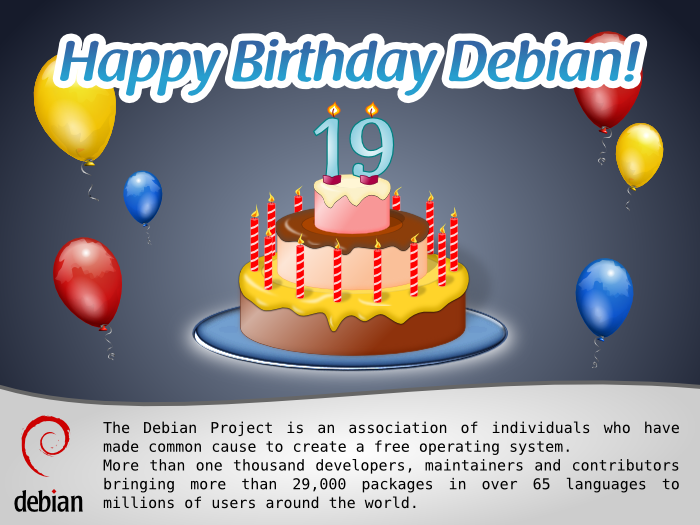
5 comments Liked this article? Click here. My blog is Flattr-enabled.

16 August 2012

Raphaël Hertzog: Happy Birthday Debian! And memories of an old-timer

For Debian s birthday, Francesca Ciceri of the Debian Publicity team suggested that developers blog about their first experiences with Debian . I found this a good idea so I m going to share my own early experience. It s quite different from what happens nowadays Before speaking of my early Debian experience, I have to set some context. In my youth, I have always been a Windows user and a fan of Bill Gates. That is until I got Internet at home at that point, I got involved in Usenet and made some friends there. One of those made me discover Perl and it has been somewhat of a revelation for me who had only been programming in Visual Basic, Delphi or ObjectPal. Later the same friend explained me that Perl was working much better on Linux and that Debian Linux installs it by default so I should try this one. I had no idea of what Linux was, but given how I loved Perl, I was eager to try his advice. So I got myself a Tri-Linux CD with Debian/RedHat/Slackware on it and started the installation process (which involved preparing boot floppies). But I did not manage to get the graphical interface working despite lots of fiddling with Xfree86 s configuration file. So I ended up installing RedHat and used it for a few months. But since many of the smart guys in my Usenet community were Debian users, I persisted and finally managed to get it to work! After a few months of usage, I was amazed at everything that was available for free and I wanted to give back. I filed my first bug report in July 1998, I created my first Debian packages in August 1998 and I got accepted as an official Debian developer in September 1998 (after a quick chat over the phone with Martin Schulze or James Troup I never understood the name of my interlocutor on the phone and I was so embarassed to have to use my rusty English over the phone that I never asked). That s right, it took me less than 3 months to become a Debian developer (I was 19 years old back then). I learned a lot during those months by reading and interacting with other Debian developers. Many of those went away from Debian in the mean time but some of them are still involved (Joey Hess, Manoj Srivastava, Ian Jackson, Martin Schulze, Steve McIntyre, Bdale Garbee, Adam Heath, John Goerzen, Marco D Itri, Phil Hands, Lars Wirzenius, Santiago Vila, Matthias Klose, Dan Jacobowitz, Michael Meskes, ). My initial Debian work was centered around Perl: I adopted dpkg-ftp (the FTP method for dselect) because it was written in Perl and had lots of outstanding bug reports. But I also got involved in more generic Quality Assurance work and tried to organize the nascent QA team. It was all really a lot of fun, I could take initiatives and it was clear to me that my work was appreciated. I don t know if you find this story interesting but I had some fun time digging through archives to find out the precise dates if you want to learn more about what I did over the following years, I maintain a webpage for this purpose.

One comment Liked this article? Click here. My blog is Flattr-enabled.

28 December 2011

Paul Tagliamonte: libolla (from the useless script department)

Hello, World! Today s hacks come remotely, on the first day of my long trek to Cleveland. As many debian readers know, debian URLs are usually transmitted over IRC or email with some snappy abbreviations. Usually, you ll see something like:
Feel free to check out information about frob at wiki.d.o/Frob
or something like:
I have uploaded package bar onto mentors.d.n for review
What bugs me most about this is that I have to expand URLs by hand. Which is lame. Enter libolla (a fitting name as well as a graceful nod to my alma mater John Carroll University s crest). When LD_PRELOAD d, it ll intercept and expand calls to getaddrinfo transparently. It seems to work fine on SSH, and chrome (but I can t test well, since I m not on a real line). This was all hacked up in a few hours I had to spare, and without any sort of internet love, so I m willing to bet there are some bits that can be cleaned up (after all, the name of the blog is Peace, Love and C++ , not Peace, Love and C - I don t clam to be a c expert ;) ) So, feel free to fork the project on github (or as I can now do - http://g.c/paultag/libolla) Now, I just need to find a way to globally pre-load this for apps that I start in my DE. Should be easy enough fiddling with some env-var files.

Next.

Previous.