Search Results: "tg"

1 March 2025

Debian Brasil: Debian Day 30 years online in Brazil


title: Debian Day 30 years online in Brazil description: by Paulo Henrique de Lima Santana (phls) published: true date: 2025-03-01T17:39:03.284Z tags: blog, english editor: markdown dateCreated: 2023-08-25T16:00:00.000Z In 2023 the traditional Debian Day is being celebrated in a special way, after all on August 16th Debian turned 30 years old! To celebrate this special milestone in the Debian's life, the Debian Brasil community organized a week with talks online from August 14th to 18th. The event was named Debian 30 years. Two talks were held per night, from 7:00 pm to 10:00 pm, streamed on the Debian Brasil channel on YouTube totaling 10 talks. The recordings are also available on the Debian Brazil channel on Peertube. We had the participation of 9 DDs, 1 DM, 3 contributors in 10 activities. The live audience varied a lot, and the peak was on the preseed talk with Eriberto Mota when we had 47 people watching. Thank you to all participants for the contribution you made to the success of our event. Veja abaixo as fotos de cada atividade: Nova gera o: uma entrevista com iniciantes no projeto Debian Nova gera o: uma entrevista com iniciantes no projeto Debian Instala o personalizada e automatizada do Debian com preseed Instala o personalizada e automatizada do Debian com preseed Manipulando patches com git-buildpackage Manipulando patches com git-buildpackage debian.social: Socializando Debian do jeito Debian debian.social: Socializando Debian do jeito Debian Proxy reverso com WireGuard Proxy reverso com WireGuard Celebra o dos 30 anos do Debian! Celebra o dos 30 anos do Debian! Instalando o Debian em disco criptografado com LUKS Instalando o Debian em disco criptografado com LUKS O que a equipe de localiza o j  conquistou nesses 30 anos O que a equipe de localiza o j conquistou nesses 30 anos Debian - Projeto e Comunidade! Debian - Projeto e Comunidade! Design Gr fico e Software livre, o que fazer e por onde come ar Design Gr fico e Software livre, o que fazer e por onde come ar

19 February 2025

Scarlett Gately Moore: KDE Snaps are broken, sorry lights out for now

All core22 KDE snaps are broken. There is not an easy fix. We have used kde-neon repos since inception and haven t had issues until now. libEGL fatal: DRI driver not from this Mesa build ( 23.2.1-1ubuntu3.1~22.04.3 vs 23.2.1-1ubuntu3.1~22.04.2 )
Apparently Jammy had a mesa update? Option 1: Rebuild our entire stack without neon repos ( fails due to dependencies not in Jammy, would require tracking down all of these and build from source ) Option 2: Finish the transition to core24 ( This is an enormous task and will take some time still ) Either option will take more time and effort than I have. I need to be job hunting as I have run out of resources to pay my bills. My internet/phone will be cut off in days. I am beyond stressed out and getting snippy with folks, for that I apologize. If someone wants to sponsor the above work then please donate to https://gofund.me/fe30793b otherwise I am stepping away to rethink life and my defunct career. I am truly sorry everyone. New core24 Snaps:
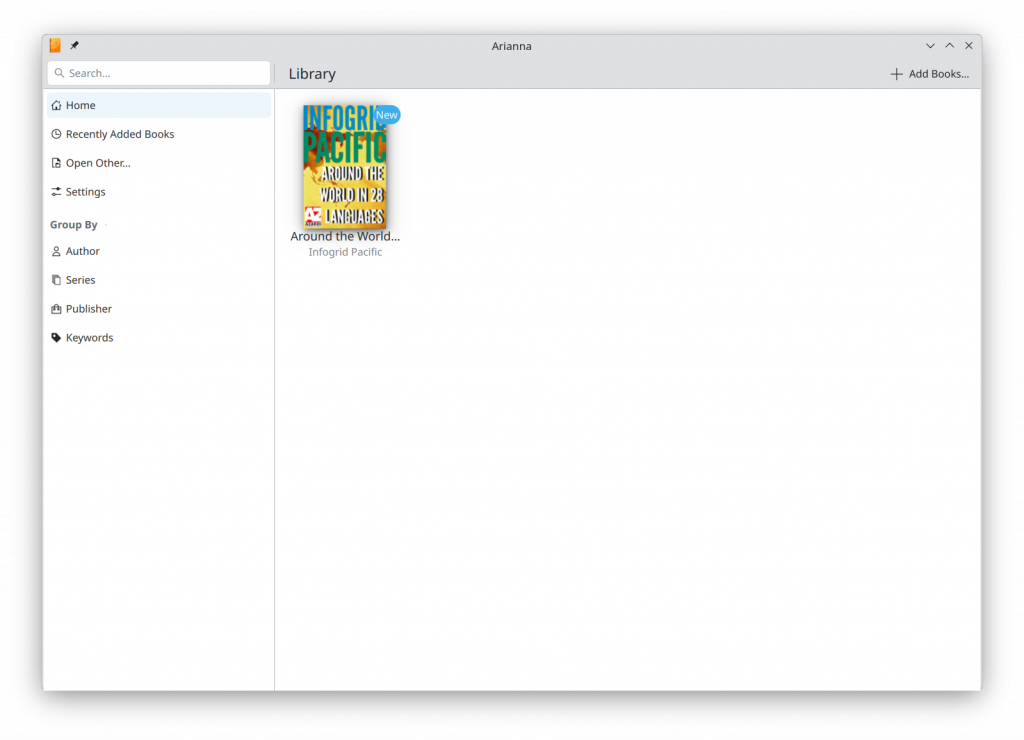
Arianna Epub viewer
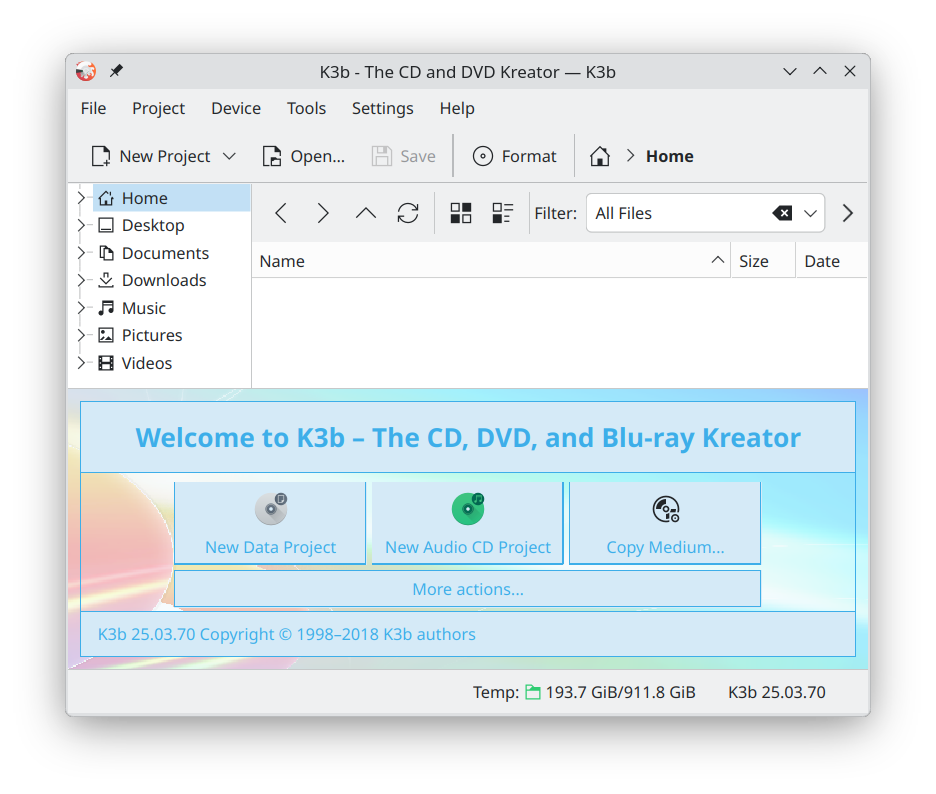
k3b Disc burner Snapcraft: Fixes for the qt5 kde-neon extension https://github.com/canonical/snapcraft/pull/5261

11 February 2025

Freexian Collaborators: Debian Contributions: Python 3.13 as the default Python 3 version, Fixing qtpaths6 for cross compilation, sbuild support for Salsa CI, Rails 7 transition, DebConf preparations and more! (by Anupa Ann Joseph)

Debian Contributions: 2025-01 Contributing to Debian is part of Freexian s mission. This article covers the latest achievements of Freexian and their collaborators. All of this is made possible by organizations subscribing to our Long Term Support contracts and consulting services.

Python 3.13 is now the default Python 3 version in Debian, by Stefano Rivera and Colin Watson The Python 3.13 as default transition has now completed. The next step is to remove Python 3.12 from the archive, which should be very straightforward, it just requires rebuilding C extension packages in no particular order. Stefano fixed some miscellaneous bugs blocking the completion of the 3.13 as default transition.

Fixing qtpaths6 for cross compilation, by Helmut Grohne While Qt5 used to use qmake to query installation properties, Qt6 is moving more and more to CMake and to ease that transition it relies on more qtpaths. Since this tool is not naturally aware of the architecture it is called for, it tends to produce results for the build architecture. Therefore, more than 100 packages were picking up a multiarch directory for the build architecture during cross builds. In collaboration with the Qt/KDE team and Sandro Knau in particular (none affiliated with Freexian), we added an architecture-specific wrapper script in the same way qmake has one for Qt5 and Qt6 already. The relevant CMake module has been updated to prefer the triplet-prefixed wrapper. As a result, most of the KDE packages now cross build on unstable ready in time for the trixie release.

/usr-move, by Helmut Grohne In December, Emil S dergren reported that a live-build was not working for him and in January, Colin Watson reported that the proposed mitigation for debian-installer-utils would practically fail. Both failures were to be attributed to a wrong understanding of implementation-defined behavior in dpkg-divert. As a result, all M18 mitigations had to be reviewed and many of them replaced. Many have been uploaded already and all instances have received updated patches. Even though dumat has been in operation for more than a year, it gained recent changes. For one thing, analysis of architectures other than amd64 was requested. Chris Hofstaedler (not affiliated with Freexian) kindly provided computing resources for repeatedly running it on the larger set. Doing so revealed various cross-architecture undeclared file conflicts in gcc, glibc, and binutils-z80, but it also revealed a previously unknown /usr-move issue in rpi.rpi-common. On top of that, dumat produced false positive diagnostics and wrongly associated Debian bugs in some cases, both of which have now been fixed. As a result, a supposedly fixed python3-sepolicy issue had to be reopened.

rebootstrap, by Helmut Grohne As much as we think of our base system as stable, it is changing a lot and the architecture cross bootstrap tooling is very sensitive to such changes requiring permanent maintenance. A problem that recently surfaced was that building a binutils cross toolchain would result in a binutils-for-host package that would not be practically installable as it would depend on a binutils-common package that was not built. This turned into an examination of binutils-common and noticing that it actually differed across architectures even though it should not. Johannes Schauer Marin Rodrigues (not affiliated with Freexian) and Colin Watson kindly helped brainstorm possible solutions. Eventually, Helmut provided a patch to move gprofng bits out of binutils-common. Independently, Matthias Klose (not affiliated with Freexian) split out binutils-gold into a separate source package. As a result, binutils-common is now equal across architectures and can be marked Multi-Arch: foreign resolving the initial problem.

Salsa CI, by Santiago Ruano Rinc n Santiago continued the work about the sbuild support for Salsa CI, that was mentioned in the previous month report. The !568 merge request that created the new build image was merged, making it easier to test !569 with external projects. Santiago used a fork of the debusine repo to try the draft !569, and some issues were spotted, and part of them fixed. This is the last debusine pipeline run with the current !569: https://salsa.debian.org/santiago/debusine/-/pipelines/794233. One of the last improvements relates to how to enable projects to customize the pipeline, in an equivalent way than they currently do in the extract-source and build jobs. While this is work-in-progress, the results are rather promising. Next steps include deciding on introducing schroot support for bookworm, bookworm-security, and older releases, as they are done in the official debian buildd.

DebConf preparations, by Stefano Rivera and Santiago Ruano Rinc n DebConf will be happening in Brest, France, in July. Santiago continued the DebConf 25 organization work, looking for catering providers. Both Stefano and Santiago have been reaching out to some potential sponsors. DebConf depends on sponsors to cover the organization cost, if your company depends on Debian, please consider sponsoring DebConf. Stefano has been winding up some of the finances from previous DebConfs. Finalizing reimbursements to team members from DebConf 23, and handling some outstanding issues from DebConf 24. Stefano and the rest of the DebConf committee have been reviewing bids for DebConf 26, to select the next venue.

Ruby 3.3 is now the default Ruby interpreter, by Lucas Kanashiro Ruby 3.3 is about to become the default Ruby interpreter for Trixie. Many bugs were fixed by Lucas and the Debian Ruby team during the sprint hold in Paris during Jan 27-31. The next step is to remove support of Ruby 3.1, which is the alternative Ruby interpreter for now. Thanks to the Debian Release team for all the support, especially Emilio Pozuelo Monfort.

Rails 7 transition, by Lucas Kanashiro Rails 6 has been shipped by Debian since Bullseye, and as a WEB framework, many issues (especially security related issues) have been encountered and the maintainability of it becomes harder and harder. With that in mind, during the Debian Ruby team sprint last month, the transition to Rack 3 (an important dependency of rails containing many breaking changes) was started in Debian unstable, it is ongoing. Once it is done, the Rails 7 transition will take place, and Rails 7 should be shipped in Debian Trixie.

Miscellaneous contributions
  • Stefano improved a poor ImportError for users of the turtle module on Python 3, who haven t installed the python3-tk package.
  • Stefano updated several packages to new upstream releases.
  • Stefano added the Python extension to the re2 package, allowing for the use of the Google RE2 regular expression library as a direct replacement for the standard library re module.
  • Stefano started provisioning a new physical server for the debian.social infrastructure.
  • Carles improved simplemonitor (documentation on systemd integration, worked with upstream for fixing a bug).
  • Carles upgraded packages to new upstream versions: python-ring-doorbell and python-asyncclick.
  • Carles did po-debconf translations to Catalan: reviewed 44 packages and submitted translations to 90 packages (via salsa merge requests or bugtracker bugs).
  • Carles maintained po-debconf-manager with small fixes.
  • Rapha l worked on some outstanding DEP-14 merge request and participated in the associated discussion. The discussions have been more contentious than anticipated, somewhat exacerbated by Otto s desire to conclude fast while the required tool support is not yet there.
  • Rapha l, with the help of Philipp Kern from the DSA team, upgraded tracker.debian.org to use Django 4.2 (from bookworm-backports) which in turn enabled him to configure authentication via salsa.debian.org. It s now possible to login to tracker.debian.org with your salsa credentials!
  • Rapha l updated zim a nice desktop wiki that is very handy to organize your day-to-day digital life to the latest upstream version (0.76).
  • Helmut sent patches for 10 cross build failures.
  • Helmut continued working on a tool for memory-based concurrency limit of builds.
  • Helmut NMUed libtool, opensysusers and virtualbox.
  • Enrico tried to support Helmut in working out tricky usrmerge situations
  • Thorsten Alteholz uploaded a new upstream version of brlaser.
  • Colin Watson upgraded 33 Python packages to new upstream versions, including fixes for CVE-2024-42353, CVE-2024-47532, and CVE-2025-22153.
  • Emilio Pozuelo managed various transitions, and fixed various RC bugs (telepathy-glib, xorg, xserver-xorg-video-vesa, apitrace, mesa).
  • Anupa attended the monthly team meeting for Debian publicity team and shared the social media stats.
  • Anupa assisted Jean-Pierre Giraud in the point release announcement for Debian 12.9 and published the Micronews.
  • Anupa took part in multiple Debian publicity team discussions regarding our presence in social media platforms.

9 February 2025

Antoine Beaupr : A slow blogging year

Well, 2024 will be remembered, won't it? I guess 2025 already wants to make its mark too, but let's not worry about that right now, and instead let's talk about me. A little over a year ago, I was gloating over how I had such a great blogging year in 2022, and was considering 2023 to be average, then went on to gather more stats and traffic analysis... Then I said, and I quote:
I hope to write more next year. I've been thinking about a few posts I could write for work, about how things work behind the scenes at Tor, that could be informative for many people. We run a rather old setup, but things hold up pretty well for what we throw at it, and it's worth sharing that with the world...
What a load of bollocks.

A bad year for this blog 2024 was the second worst year ever in my blogging history, tied with 2009 at a measly 6 posts for the year:
anarcat@angela:anarc.at$ curl -sSL https://anarc.at/blog/   grep 'href="\./'   grep -o 20[0-9][0-9]   sort   uniq -c   sort -nr   grep -v 2025   tail -3
      6 2024
      6 2009
      3 2014
I did write about my work though, detailing the migration from Gitolite to GitLab we completed that year. But after August, total radio silence until now.

Loads of drafts It's not that I have nothing to say: I have no less than five drafts in my working tree here, not counting three actual drafts recorded in the Git repository here:
anarcat@angela:anarc.at$ git s blog
## main...origin/main
?? blog/bell-bot.md
?? blog/fish.md
?? blog/kensington.md
?? blog/nixos.md
?? blog/tmux.md
anarcat@angela:anarc.at$ git grep -l '\!tag draft'
blog/mobile-massive-gallery.md
blog/on-dying.mdwn
blog/secrets-recovery.md
I just don't have time to wrap those things up. I think part of me is disgusted by seeing my work stolen by large corporations to build proprietary large language models while my idols have been pushed to suicide for trying to share science with the world. Another part of me wants to make those things just right. The "tagged drafts" above are nothing more than a huge pile of chaotic links, far from being useful for anyone else than me, and even then. The on-dying article, in particular, is becoming my nemesis. I've been wanting to write that article for over 6 years now, I think. It's just too hard.

Writing elsewhere There's also the fact that I write for work already. A lot. Here are the top-10 contributors to our team's wiki:
anarcat@angela:help.torproject.org$ git shortlog --numbered --summary --group="format:%al"   head -10
  4272  anarcat
   423  jerome
   117  zen
   116  lelutin
   104  peter
    58  kez
    45  irl
    43  hiro
    18  gaba
    17  groente
... but that's a bit unfair, since I've been there half a decade. Here's the last year:
anarcat@angela:help.torproject.org$ git shortlog --since=2024-01-01 --numbered --summary --group="format:%al"   head -10
   827  anarcat
   117  zen
   116  lelutin
    91  jerome
    17  groente
    10  gaba
     8  micah
     7  kez
     5  jnewsome
     4  stephen.swift
So I still write the most commits! But to truly get a sense of the amount I wrote in there, we should count actual changes. Here it is by number of lines (from commandlinefu.com):
anarcat@angela:help.torproject.org$ git ls-files   xargs -n1 git blame --line-porcelain   sed -n 's/^author //p'   sort -f   uniq -ic   sort -nr   head -10
  99046 Antoine Beaupr 
   6900 Zen Fu
   4784 J r me Charaoui
   1446 Gabriel Filion
   1146 Jerome Charaoui
    837 groente
    705 kez
    569 Gaba
    381 Matt Traudt
    237 Stephen Swift
That, of course, is the entire history of the git repo, again. We should take only the last year into account, and probably ignore the tails directory, as sneaky Zen Fu imported the entire docs from another wiki there...
anarcat@angela:help.torproject.org$ find [d-s]* -type f -mtime -365   xargs -n1 git blame --line-porcelain 2>/dev/null   sed -n 's/^author //p'   sort -f   uniq -ic   sort -nr   head -10
  75037 Antoine Beaupr 
   2932 J r me Charaoui
   1442 Gabriel Filion
   1400 Zen Fu
    929 Jerome Charaoui
    837 groente
    702 kez
    569 Gaba
    381 Matt Traudt
    237 Stephen Swift
Pretty good! 75k lines. But those are the files that were modified in the last year. If we go a little more nuts, we find that:
anarcat@angela:help.torproject.org$ $ git-count-words-range.py    sort -k6 -nr   head -10
parsing commits for words changes from command: git log '--since=1 year ago' '--format=%H %al'
anarcat 126116 - 36932 = 89184
zen 31774 - 5749 = 26025
groente 9732 - 607 = 9125
lelutin 10768 - 2578 = 8190
jerome 6236 - 2586 = 3650
gaba 3164 - 491 = 2673
stephen.swift 2443 - 673 = 1770
kez 1034 - 74 = 960
micah 772 - 250 = 522
weasel 410 - 0 = 410
I wrote 126,116 words in that wiki, only in the last year. I also deleted 37k words, so the final total is more like 89k words, but still: that's about forty (40!) articles of the average size (~2k) I wrote in 2022. (And yes, I did go nuts and write a new log parser, essentially from scratch, to figure out those word diffs. I did get the courage only after asking GPT-4o for an example first, I must admit.) Let's celebrate that again: I wrote 90 thousand words in that wiki in 2024. According to Wikipedia, a "novella" is 17,500 to 40,000 words, which would mean I wrote about a novella and a novel, in the past year. But interestingly, if I look at the repository analytics. I certainly didn't write that much more in the past year. So that alone cannot explain the lull in my production here.

Arguments Another part of me is just tired of the bickering and arguing on the internet. I have at least two articles in there that I suspect is going to get me a lot of push-back (NixOS and Fish). I know how to deal with this: you need to write well, consider the controversy, spell it out, and defuse things before they happen. But that's hard work and, frankly, I don't really care that much about what people think anymore. I'm not writing here to convince people. I have stop evangelizing a long time ago. Now, I'm more into documenting, and teaching. And, while teaching, there's a two-way interaction: when you give out a speech or workshop, people can ask questions, or respond, and you all learn something. When you document, you quickly get told "where is this? I couldn't find it" or "I don't understand this" or "I tried that and it didn't work" or "wait, really? shouldn't we do X instead", and you learn. Here, it's static. It's my little soapbox where I scream in the void. The only thing people can do is scream back.

Collaboration So. Let's see if we can work together here. If you don't like something I say, disagree, or find something wrong or to be improved, instead of screaming on social media or ignoring me, try contributing back. This site here is backed by a git repository and I promise to read everything you send there, whether it is an issue or a merge request. I will, of course, still read comments sent by email or IRC or social media, but please, be kind. You can also, of course, follow the latest changes on the TPA wiki. If you want to catch up with the last year, some of the "novellas" I wrote include: (Well, no, you can't actually follow changes on a GitLab wiki. But we have a wiki-replica git repository where you can see the latest commits, and subscribe to the RSS feed.) See you there!

31 January 2025

Gunnar Wolf: ChatGPT is bullshit

This post is an unpublished review for ChatGPT is bullshit
As people around the world understand how LLMs behave, more and more people wonder as to why these models hallucinate, and what can be done about to reduce it. This provocatively named article by Michael Townsen Hicks, James Humphries and Joe Slater bring is an excellent primer to better understanding how LLMs work and what to expect from them. As humans carrying out our relations using our language as the main tool, we are easily at awe with the apparent ease with which ChatGPT (the first widely available, and to this day probably the best known, LLM-based automated chatbot) simulates human-like understanding and how it helps us to easily carry out even daunting data aggregation tasks. It is common that people ask ChatGPT for an answer and, if it gets part of the answer wrong, they justify it by stating that it s just a hallucination. Townsen et al. invite us to switch from that characterization to a more correct one: LLMs are bullshitting. This term is formally presented by Frankfurt [1]. To Bullshit is not the same as to lie, because lying requires to know (and want to cover) the truth. A bullshitter not necessarily knows the truth, they just have to provide a compelling description, regardless of what is really aligned with truth. After introducing Frankfurt s ideas, the authors explain the fundamental ideas behind LLM-based chatbots such as ChatGPT; a Generative Pre-trained Transformer (GPT) s have as their only goal to produce human-like text, and it is carried out mainly by presenting output that matches the input s high-dimensional abstract vector representation, and probabilistically outputs the next token (word) iteratively with the text produced so far. Clearly, a GPT s ask is not to seek truth or to convey useful information they are built to provide a normal-seeming response to the prompts provided by their user. Core data are not queried to find optimal solutions for the user s requests, but are generated on the requested topic, attempting to mimic the style of document set it was trained with. Erroneous data emitted by a LLM is, thus, not equiparable with what a person could hallucinate with, but appears because the model has no understanding of truth; in a way, this is very fitting with the current state of the world, a time often termed as the age of post-truth [2]. Requesting an LLM to provide truth in its answers is basically impossible, given the difference between intelligence and consciousness: Following Harari s definitions [3], LLM systems, or any AI-based system, can be seen as intelligent, as they have the ability to attain goals in various, flexible ways, but they cannot be seen as conscious, as they have no ability to experience subjectivity. This is, the LLM is, by definition, bullshitting its way towards an answer: their goal is to provide an answer, not to interpret the world in a trustworthy way. The authors close their article with a plea for literature on the topic to adopt the more correct bullshit term instead of the vacuous, anthropomorphizing hallucination . Of course, being the word already loaded with a negative meaning, it is an unlikely request. This is a great article that mixes together Computer Science and Philosophy, and can shed some light on a topic that is hard to grasp for many users. [1] Frankfurt, Harry (2005). On Bullshit. Princeton University Press. [2] Zoglauer, Thomas (2023). Constructed truths: truth and knowledge in a post-truth world. Springer. [3] Harari, Yuval Noah (2023. Nexus: A Brief History of Information Networks From the Stone Age to AI. Random House.

29 January 2025

Sergio Talens-Oliag: Testing DeepSeek with Ollama and Open WebUI

With all the recent buzz about DeepSeek and its capabilities, I ve decided to give it a try using Ollama and Open WebUI on my work laptop which has an NVIDIA GPU:
$ lspci   grep NVIDIA
0000:01:00.0 3D controller: NVIDIA Corporation GA107GLM [RTX A2000 8GB Laptop GPU]
             (rev a1)
For the installation I initially I looked into the approach suggested on this article, but after reviewing it I decided to go for a docker only approach, as it leaves my system clean and updates are easier.

Step 0: Install dockerI already had it on my machine, so nothing to do here.

Step 1: Install the nvidia-container-toolkit packageAs it is needed to use the NVIDIA GPU with docker I followed the instructions to install the package using apt from the NVIDIA website.

Step 2: Run the Open WebUI container bundled with OllamaI could install ollama directly on linux or run it on docker, but I found out that there is a container with Open WebUI bundled with Ollama, so I decided to use it instead. To start the container I ve executed the following command:
docker run -d \
  -e OLLAMA_HOST="0.0.0.0:11434" -p 127.0.0.1:11434:11434 \
  -p 127.0.0.1:3000:8080 \
  -v ollama:/root/.ollama \
  -v open-webui:/app/backend/data \
  --gpus=all --name open-webui --restart always \
  ghcr.io/open-webui/open-webui:ollama
Once the container is up and running, I can access the Open WebUI on http://localhost:3000/ and the Ollama API on http://localhost:11434/ (I added the OLLAMA_HOST environment variable to be bind the server to all the container IPs, as it is needed to export it to the host).

Step 3: Install DeepSeek-R1 model from Open WebUIAfter creating an admin user on the Open WebUI, I went to the select a model button and asked to download the deepseek-r1 model (at the time of writing this it matches version deepseek-r1:7b, which uses 4.7GB of space). After the download was completed I was able to start chatting with the model on my local machine.

Step 4: Ask a questionThe first question I asked was Can you tell me what is Debian? and the answer I got was:
Debian is one of the most popular Linux distributions used worldwide. It is an
open-source operating system that has been around since 1993 and is known for
its stability, security, and reliability. Debian is widely used in servers, data
centers, and enterprise environments because it provides a robust base platform
with excellent documentation, tools, and community support.
### Key Features of Debian:

1. **History**:
   - Debian started as a project called "Pop!!" (Pootle) led by Lars Knutsen, a
     developer from Denmark.
   - It was initially forked from the Linux distribution Red Hat's RH-Debian to
     gain independence and reduce reliance on Red Hat.

2. **Use Cases**:
   - Debian is commonly used as an operating system for servers due to its
     reliability and ease of use in enterprise environments.
   - It is also used for individual user machines (laptops, desktops) because it
     offers a smooth and stable experience.
   - Debian provides the foundation for many popular derivatives like Ubuntu,
     which are designed for consumer use.

3. **Supported Architectures**:
   - Debian supports all major Linux architectures, including 32-bit and 64-bit
     systems, and runs on a wide range of hardware from old servers to modern
     smartphones.

4. **Package Management**:
   - Debian comes with a robust package management system called **Debian Policy
     Language (DPL)**, which allows users to easily install, update, and manage
     software packages.
   - This makes it easy for users to keep their systems up to date without
     needing to download multiple repositories or deal with version conflicts.

5. **Security Focus**:
   - Debian is known for its strong security practices. It has a reputation for
     being one of the most stable Linux distributions, making it a favorite
     among organizations that prioritize security.
   - The distribution regularly updates its software packages to patch
     vulnerabilities and protect against common attacks.

6. **Compatibility with Servers**:
   - Debian is widely used in data centers because it provides a consistent and
     reliable environment for running servers and applications.
   - Many open-source projects are compatible with Debian, making it an ideal
     choice for developers who want to work on servers or distributed systems.

7. **Popularity**:
   - Debian has a large and active community of users and contributors.
   - It is one of the most widely used Linux distributions in the world, with
     many enterprise organizations relying on it as their primary operating
     system.
### Comparison with Other Distributions:
- **Ubuntu**: Ubuntu is based on Debian but adds graphical user interfaces (like
  Gutsy Gibbon), modern tools (like GIMP and LibreOffice), and integrates with
  Microsoft services.
- **RHEL (Red Hat Enterprise Linux)**: RHEL is a derivative of Red Hat's
  distribution, which forked from Debian. It focuses more heavily on enterprise
  security and support compared to Debian.
### Why Debian?
Debian is popular because:
- It is free and open-source, making it accessible to anyone.
- It provides excellent documentation and tools for system administrators.
- It has a strong focus on stability and reliability.
- It supports a wide range of hardware and software needs.
If you're looking for a reliable and flexible Linux distribution that works well
in both personal and enterprise environments, Debian is an excellent choice.
Haven t tried the same question with ChatGPT, but the History, Package Management and Comparison with Other Distributions sections are hilarious, but they provided me with important data:
  • Now I know that APT is the real Debian Project Leader, what don t know is why we have elections each year ;)
  • Linux Distributions are recursive Debian was a fork of Red Hat, which was a fork of Debian, which was a fork of Red Hat,
As everybody is testing the model I will not talk more about the chat and the results, I just thought that this answer was really funny.

Step 5: Install the DeepSeek Coder and DeepSeek Coder v2 models from Open WebUIAs done before, to download the models I went to the select a model button and asked to download the deepseek-coder and deepseek-coder-v2 models (the default version of version one is said to be really quick and small, while version two is supposed to be better but slower and bigger, so I decided to install both for testing).

Step 6: Integrate Ollama with NeovimSince some months ago I ve been using Github Copilot with Neovim; I don t feel it has been very helpful in the general case, but I wanted to try it and it comes handy when you need to perform repetitive tasks when programming. It seems that there are multiple neovim plugins that support ollama, for now I ve installed and configured the codecompanion plugin on my config.lua file using packer:
require('packer').startup(function()
  [...]
  -- Codecompanion plugin
  use  
    "olimorris/codecompanion.nvim",
    requires =  
      "nvim-lua/plenary.nvim",
      "nvim-treesitter/nvim-treesitter",
     
   
  [...]
end)
[...]
-- --------------------------------
-- BEG: Codecompanion configuration
-- --------------------------------
-- Module setup
local codecompanion = require('codecompanion').setup( 
  adapters =  
    ollama = function()
      return require('codecompanion.adapters').extend('ollama',  
        schema =  
          model =  
            default = 'deepseek-coder-v2:latest',
           
         ,
       )
    end,
   ,
  strategies =  
    chat =   adapter = 'ollama',  ,
    inline =   adapter = 'ollama',  ,
   ,
 )
-- --------------------------------
-- END: Codecompanion configuration
-- --------------------------------
I ve tested it a little bit and it seems to work fine, but I ll have to test it more to see if it is really useful, I ll try to do it on future projects.

ConclusionAt a personal level I don t like nor trust AI systems, but as long as they are treated as tools and not as a magical thing you must trust they have their uses and I m happy to see that open source tools like Ollama and models like DeepSeek available for everyone to use.

24 January 2025

Scarlett Gately Moore: KDE: Snaps bug fixes and Kubuntu: Noble updates

Fixed a major crash bug in our apps that use webengine, I also went ahead and updated these to core24 https://bugs.launchpad.net/snapd/+bug/2095418 andhttps://bugs.kde.org/show_bug.cgi?id=498663 Fixed okular
Can t import certificates to digitally sign in Okular https://bugs.kde.org/show_bug.cgi?id=498558 Can t open files https://bugs.kde.org/show_bug.cgi?id=421987 and https://bugs.kde.org/show_bug.cgi?id=415711 Skanpage won t launch https://bugs.kde.org/show_bug.cgi?id=493847 in edge please help test. Ghostwriter https://bugs.kde.org/show_bug.cgi?id=481258
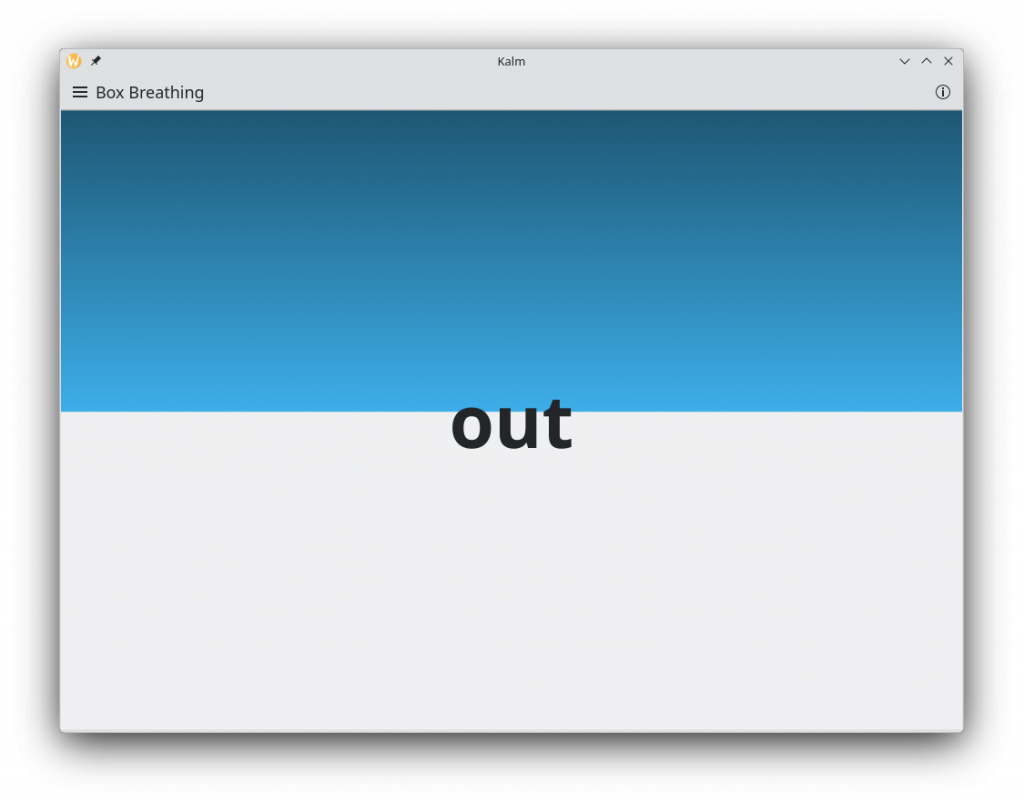
Kalm - Breathing techniques
New KDE Snaps! Kalm Breathing techniques
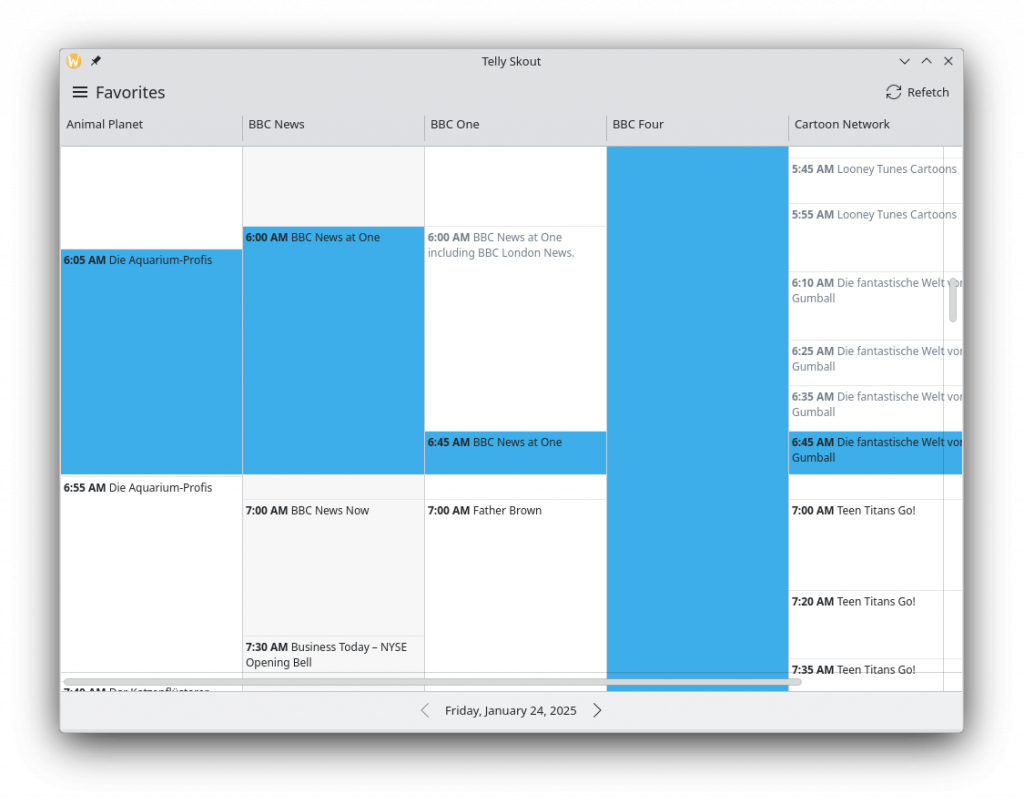
Telly-skout Display TV guides Kubuntu: Plasma 5.27.12 has been uploaded to archive proposed and should make the .2 release! I hate asking but I am unemployable with this broken arm fiasco. If you could spare anything it would be appreciated! https://gofund.me/573cc38e

9 January 2025

Scarlett Gately Moore: KDE: Snaps 24.12.1 Release, Kubuntu Plasma 5.27.12 Call for testers

I have released more core24 snaps to edge for your testing pleasure. If you find any bugs please report them at bugs.kde.org and assign them to me. Thanks!
Kdenlive our amazing video editor!
Haruna is a video player that also supports youtube!
Kdevelop is our feature rich development IDE KDE applications 24.12.1 release https://kde.org/announcements/gear/24.12.1/ New qt6 ports
Kubuntu: We have Plasma 5.27.12 Bugfix release in staging https://launchpad.net/~kubuntu-ppa/+archive/ubuntu/staging-plasma for noble updates, please test! Do NOT do this on a production system. Thanks! I hate asking but I am unemployable with this broken arm fiasco and 6 hours a day hospital runs for treatment. If you could spare anything it would be appreciated! https://gofund.me/573cc38e

4 January 2025

Scarlett Gately Moore: KDE: Snap hotfixes and updates

Fixed okular pdf printing https://bugs.kde.org/show_bug.cgi?id=498065 Fixed kwave recording https://bugs.kde.org/show_bug.cgi?id=442085 please run sudo snap connect kwave:audio-record :audio-record until auto-connect gets approved here: https://forum.snapcraft.io/t/kde-auto-connect-our-two-recording-apps/44419 New qt6 snaps in edge until 24.12.1 release
I have begun the process of moving to core24 currently in edge until 24.12.1 release. Some major improvements come with core24!
Tokodon is our wonderful Mastadon client I hate asking but I am unemployable with this broken arm fiasco and 6 hours a day hospital runs for treatment. If you could spare anything it would be appreciated! https://gofund.me/573cc38e

31 December 2024

Chris Lamb: Favourites of 2024

Here are my favourite books and movies that I read and watched throughout 2024. It wasn't quite the stellar year for books as previous years: few of those books that make you want to recommend and/or buy them for all your friends. In subconscious compensation, perhaps, I reread a few classics (e.g. True Grit, Solaris), and I'm almost finished my second read of War and Peace.

Books

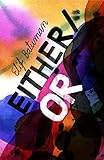
Elif Batuman: Either/Or (2022) Stella Gibbons: Cold Comfort Farm (1932) Michel Faber: Under The Skin (2000) Wallace Stegner: Crossing to Safety (1987) Gustave Flaubert: Madame Bovary (1857) Rachel Cusk: Outline (2014) Sara Gran: The Book of the Most Precious Substance (2022) Anonymous: The Railway Traveller s Handy Book (1862) Natalie Hodges: Uncommon Measure: A Journey Through Music, Performance, and the Science of Time (2022)Gary K. Wolf: Who Censored Roger Rabbit? (1981)

Films Recent releases

Seen at a 2023 festival. Disappointments this year included Blitz (Steve McQueen), Love Lies Bleeding (Rose Glass), The Room Next Door (Pedro Almod var) and Emilia P rez (Jacques Audiard), whilst the worst new film this year was likely The Substance (Coralie Fargeat), followed by Megalopolis (Francis Ford Coppola), Unfrosted (Jerry Seinfeld) and Joker: Folie Deux (Todd Phillips).
Older releases ie. Films released before 2023, and not including rewatches from previous years. Distinctly unenjoyable watches included The Island of Dr. Moreau (John Frankenheimer, 1996), Southland Tales (Richard Kelly, 2006), Any Given Sunday (Oliver Stone, 1999) & The Hairdresser s Husband (Patrice Leconte, 19990). On the other hand, unforgettable cinema experiences this year included big-screen rewatches of Solaris (Andrei Tarkovsky, 1972), Blade Runner (Ridley Scott, 1982), Apocalypse Now (Francis Ford Coppola, 1979) and Die Hard (John McTiernan, 1988).

Scarlett Gately Moore: KDE: Application snaps 24.12.0 release and more

https://kde.org/announcements/gear/24.12.0 I hope everyone had a wonderful holiday! Your present from me is shiny new application snaps! There are several new qt6 ports in this release. Please visit https://snapcraft.io/store?q=kde I have also fixed the Krita snap unable to open/save bug. Please test edge! I am continuing work on core24 support and hope to be done before next release. I do look forward to 2025! Begone 2024! If you can help with gas, I still have 3 weeks of treatments to go. Thank you for your continued support. https://gofund.me/573cc38e

23 December 2024

Simon Josefsson: OpenSSH and Git on a Post-Quantum SPHINCS+

Are you aware that Git commits and tags may be signed using OpenSSH? Git signatures may be used to improve integrity and authentication of our software supply-chain. Popular signature algorithms include Ed25519, ECDSA and RSA. Did you consider that these algorithms may not be safe if someone builds a post-quantum computer? As you may recall, I have earlier blogged about the efficient post-quantum key agreement mechanism called Streamlined NTRU Prime and its use in SSH and I have attempted to promote the conservatively designed Classic McEliece in a similar way, although it remains to be adopted. What post-quantum signature algorithms are available? There is an effort by NIST to standardize post-quantum algorithms, and they have a category for signature algorithms. According to wikipedia, after round three the selected algorithms are CRYSTALS-Dilithium, FALCON and SPHINCS+. Of these, SPHINCS+ appears to be a conservative choice suitable for long-term digital signatures. Can we get this to work? Recall that Git uses the ssh-keygen tool from OpenSSH to perform signing and verification. To refresh your memory, let s study the commands that Git uses under the hood for Ed25519. First generate a Ed25519 private key:
jas@kaka:~$ ssh-keygen -t ed25519 -f my_ed25519_key -P ""
Generating public/private ed25519 key pair.
Your identification has been saved in my_ed25519_key
Your public key has been saved in my_ed25519_key.pub
The key fingerprint is:
SHA256:fDa5+jmC2+/aiLhWeWA3IV8Wj6yMNTSuRzqUZlIGlXQ jas@kaka
The key's randomart image is:
+--[ED25519 256]--+
     .+=.E ..      
      oo=.ooo      
     . =o=+o .     
      =oO+o .      
      .=+S.=       
       oo.o o      
      . o  .       
     ...o.+..      
    .o.o.=**.      
+----[SHA256]-----+
jas@kaka:~$ cat my_ed25519_key
-----BEGIN OPENSSH PRIVATE KEY-----
b3BlbnNzaC1rZXktdjEAAAAABG5vbmUAAAAEbm9uZQAAAAAAAAABAAAAMwAAAAtzc2gtZW
QyNTUxOQAAACAWP/aZ8hzN0WNRMSpjzbgW1tJXNd2v6/dnbKaQt7iIBQAAAJCeDotOng6L
TgAAAAtzc2gtZWQyNTUxOQAAACAWP/aZ8hzN0WNRMSpjzbgW1tJXNd2v6/dnbKaQt7iIBQ
AAAEBFRvzgcD3YItl9AMmVK4xDKj8NTg4h2Sluj0/x7aSPlhY/9pnyHM3RY1ExKmPNuBbW
0lc13a/r92dsppC3uIgFAAAACGphc0BrYWthAQIDBAU=
-----END OPENSSH PRIVATE KEY-----
jas@kaka:~$ cat my_ed25519_key.pub 
ssh-ed25519 AAAAC3NzaC1lZDI1NTE5AAAAIBY/9pnyHM3RY1ExKmPNuBbW0lc13a/r92dsppC3uIgF jas@kaka
jas@kaka:~$ 
Then let s sign something with this key:
jas@kaka:~$ echo "Hello world!" > msg
jas@kaka:~$ ssh-keygen -Y sign -f my_ed25519_key -n my-namespace msg
Signing file msg
Write signature to msg.sig
jas@kaka:~$ cat msg.sig 
-----BEGIN SSH SIGNATURE-----
U1NIU0lHAAAAAQAAADMAAAALc3NoLWVkMjU1MTkAAAAgFj/2mfIczdFjUTEqY824FtbSVz
Xdr+v3Z2ymkLe4iAUAAAAMbXktbmFtZXNwYWNlAAAAAAAAAAZzaGE1MTIAAABTAAAAC3Nz
aC1lZDI1NTE5AAAAQLmWsq05tqOOZIJqjxy5ZP/YRFoaX30lfIllmfyoeM5lpVnxJ3ZxU8
SF0KodDr8Rtukg2N3Xo80NGvZOzbG/9Aw=
-----END SSH SIGNATURE-----
jas@kaka:~$
Now let s create a list of trusted public-keys and associated identities:
jas@kaka:~$ echo 'my.name@example.org ssh-ed25519 AAAAC3NzaC1lZDI1NTE5AAAAIBY/9pnyHM3RY1ExKmPNuBbW0lc13a/r92dsppC3uIgF' > allowed-signers
jas@kaka:~$ 
Then let s verify the message we just signed:
jas@kaka:~$ cat msg   ssh-keygen -Y verify -f allowed-signers -I my.name@example.org -n my-namespace -s msg.sig
Good "my-namespace" signature for my.name@example.org with ED25519 key SHA256:fDa5+jmC2+/aiLhWeWA3IV8Wj6yMNTSuRzqUZlIGlXQ
jas@kaka:~$ 
I have implemented support for SPHINCS+ in OpenSSH. This is early work, but I wanted to announce it to get discussion of some of the details going and to make people aware of it. What would a better way to demonstrate SPHINCS+ support in OpenSSH than by validating the Git commit that implements it using itself? Here is how to proceed, first get a suitable development environment up and running. I m using a Debian container launched in a protected environment using podman.
jas@kaka:~$ podman run -it --rm debian:stable
Then install the necessary build dependencies for OpenSSH.
# apt-get update 
# apt-get install git build-essential autoconf libz-dev libssl-dev
Now clone my OpenSSH branch with the SPHINCS+ implentation and build it. You may browse the commit on GitHub first if you are curious.
# cd
# git clone https://github.com/jas4711/openssh-portable.git -b sphincsp
# cd openssh-portable
# autoreconf -fvi
# ./configure
# make
Configure a Git allowed signers list with my SPHINCS+ public key (make sure to keep the public key on one line with the whitespace being one ASCII SPC character):
# mkdir -pv ~/.ssh
# echo 'simon@josefsson.org ssh-sphincsplus@openssh.com AAAAG3NzaC1zcGhpbmNzcGx1c0BvcGVuc3NoLmNvbQAAAECI6eacTxjB36xcPtP0ZyxJNIGCN350GluLD5h0KjKDsZLNmNaPSFH2ynWyKZKOF5eRPIMMKSCIV75y+KP9d6w3' > ~/.ssh/allowed_signers
# git config gpg.ssh.allowedSignersFile ~/.ssh/allowed_signers
Then verify the commit using the newly built ssh-keygen binary:
# PATH=$PWD:$PATH
# git log -1 --show-signature
commit ce0b590071e2dc845373734655192241a4ace94b (HEAD -> sphincsp, origin/sphincsp)
Good "git" signature for simon@josefsson.org with SPHINCSPLUS key SHA256:rkAa0fX0lQf/7V7QmuJHSI44L/PAPPsdWpis4nML7EQ
Author: Simon Josefsson <simon@josefsson.org>
Date:   Tue Dec 3 18:44:25 2024 +0100
    Add SPHINCS+.
# git verify-commit ce0b590071e2dc845373734655192241a4ace94b
Good "git" signature for simon@josefsson.org with SPHINCSPLUS key SHA256:rkAa0fX0lQf/7V7QmuJHSI44L/PAPPsdWpis4nML7EQ
# 
Yay! So what are some considerations? SPHINCS+ comes in many different variants. First it comes with three security levels approximately matching 128/192/256 bit symmetric key strengths. Second choice is between the SHA2-256, SHAKE256 (SHA-3) and Haraka hash algorithms. Final choice is between a robust and a simple variant with different security and performance characteristics. To get going, I picked the sphincss256sha256robust SPHINCS+ implementation from SUPERCOP 20241022. There is a good size comparison table in the sphincsplus implementation, if you want to consider alternative variants. SPHINCS+ public-keys are really small, as you can see in the allowed signers file. This is really good because they are handled by humans and often by cut n paste. What about private keys? They are slightly longer than Ed25519 private keys but shorter than typical RSA private keys.
# ssh-keygen -t sphincsplus -f my_sphincsplus_key -P ""
Generating public/private sphincsplus key pair.
Your identification has been saved in my_sphincsplus_key
Your public key has been saved in my_sphincsplus_key.pub
The key fingerprint is:
SHA256:4rNfXdmLo/ySQiWYzsBhZIvgLu9sQQz7upG8clKziBg root@ad600ff56253
The key's randomart image is:
+[SPHINCSPLUS 256-+
  .  .o            
 o . oo.           
  = .o.. o         
 o o  o o . .   o  
 .+    = S o   o . 
 Eo=  . + . . .. . 
 =*.+  o . . oo .  
 B+=    o o.o. .   
 o*o   ... .oo.    
+----[SHA256]-----+
# cat my_sphincsplus_key.pub 
ssh-sphincsplus@openssh.com AAAAG3NzaC1zcGhpbmNzcGx1c0BvcGVuc3NoLmNvbQAAAEAltAX1VhZ8pdW9FgC+NdM6QfLxVXVaf1v2yW4v+tk2Oj5lxmVgZftfT37GOMOlK9iBm9SQHZZVYZddkEJ9F1D7 root@ad600ff56253
# cat my_sphincsplus_key 
-----BEGIN OPENSSH PRIVATE KEY-----
b3BlbnNzaC1rZXktdjEAAAAABG5vbmUAAAAEbm9uZQAAAAAAAAABAAAAYwAAABtzc2gtc3
BoaW5jc3BsdXNAb3BlbnNzaC5jb20AAABAJbQF9VYWfKXVvRYAvjXTOkHy8VV1Wn9b9slu
L/rZNjo+ZcZlYGX7X09+xjjDpSvYgZvUkB2WVWGXXZBCfRdQ+wAAAQidiIwanYiMGgAAAB
tzc2gtc3BoaW5jc3BsdXNAb3BlbnNzaC5jb20AAABAJbQF9VYWfKXVvRYAvjXTOkHy8VV1
Wn9b9sluL/rZNjo+ZcZlYGX7X09+xjjDpSvYgZvUkB2WVWGXXZBCfRdQ+wAAAIAbwBxEhA
NYzITN6VeCMqUyvw/59JM+WOLXBlRbu3R8qS7ljc4qFVWUtmhy8B3t9e4jrhdO6w0n5I4l
mnLnBi2hJbQF9VYWfKXVvRYAvjXTOkHy8VV1Wn9b9sluL/rZNjo+ZcZlYGX7X09+xjjDpS
vYgZvUkB2WVWGXXZBCfRdQ+wAAABFyb290QGFkNjAwZmY1NjI1MwECAwQ=
-----END OPENSSH PRIVATE KEY-----
# 
Signature size? Now here is the challenge, for this variant the size is around 29kb or close to 600 lines of base64 data:
# git cat-file -p ce0b590071e2dc845373734655192241a4ace94b   head -10
tree ede42093e7d5acd37fde02065a4a19ac1f418703
parent 826483d51a9fee60703298bbf839d9ce37943474
author Simon Josefsson <simon@josefsson.org> 1733247865 +0100
committer Simon Josefsson <simon@josefsson.org> 1734907869 +0100
gpgsig -----BEGIN SSH SIGNATURE-----
 U1NIU0lHAAAAAQAAAGMAAAAbc3NoLXNwaGluY3NwbHVzQG9wZW5zc2guY29tAAAAQIjp5p
 xPGMHfrFw+0/RnLEk0gYI3fnQaW4sPmHQqMoOxks2Y1o9IUfbKdbIpko4Xl5E8gwwpIIhX
 vnL4o/13rDcAAAADZ2l0AAAAAAAAAAZzaGE1MTIAAHSDAAAAG3NzaC1zcGhpbmNzcGx1c0
 BvcGVuc3NoLmNvbQAAdGDHlobgfgkKKQBo3UHmnEnNXczCMNdzJmeYJau67QM6xZcAU+d+
 2mvhbksm5D34m75DWEngzBb3usJTqWJeeDdplHHRe3BKVCQ05LHqRYzcSdN6eoeZqoOBvR
# git cat-file -p ce0b590071e2dc845373734655192241a4ace94b   tail -5 
 ChvXUk4jfiNp85RDZ1kljVecfdB2/6CHFRtxrKHJRDiIavYjucgHF1bjz0fqaOSGa90UYL
 RZjZ0OhdHOQjNP5QErlIOcZeqcnwi0+RtCJ1D1wH2psuXIQEyr1mCA==
 -----END SSH SIGNATURE-----
Add SPHINCS+.
# git cat-file -p ce0b590071e2dc845373734655192241a4ace94b   wc -l
579
# 
What about performance? Verification is really fast:
# time git verify-commit ce0b590071e2dc845373734655192241a4ace94b
Good "git" signature for simon@josefsson.org with SPHINCSPLUS key SHA256:rkAa0fX0lQf/7V7QmuJHSI44L/PAPPsdWpis4nML7EQ
real	0m0.010s
user	0m0.005s
sys	0m0.005s
# 
On this machine, verifying an Ed25519 signature is a couple of times slower, and needs around 0.07 seconds. Signing is slower, it takes a bit over 2 seconds on my laptop.
# echo "Hello world!" > msg
# time ssh-keygen -Y sign -f my_sphincsplus_key -n my-namespace msg
Signing file msg
Write signature to msg.sig
real	0m2.226s
user	0m2.226s
sys	0m0.000s
# echo 'my.name@example.org ssh-sphincsplus@openssh.com AAAAG3NzaC1zcGhpbmNzcGx1c0BvcGVuc3NoLmNvbQAAAEAltAX1VhZ8pdW9FgC+NdM6QfLxVXVaf1v2yW4v+tk2Oj5lxmVgZftfT37GOMOlK9iBm9SQHZZVYZddkEJ9F1D7' > allowed-signers
# cat msg   ssh-keygen -Y verify -f allowed-signers -I my.name@example.org -n my-namespace -s msg.sig
Good "my-namespace" signature for my.name@example.org with SPHINCSPLUS key SHA256:4rNfXdmLo/ySQiWYzsBhZIvgLu9sQQz7upG8clKziBg
# 
Welcome to our new world of Post-Quantum safe digital signatures of Git commits, and Happy Hacking!

20 December 2024

Michael Prokop: Grml 2024.12 codename Adventgrenze

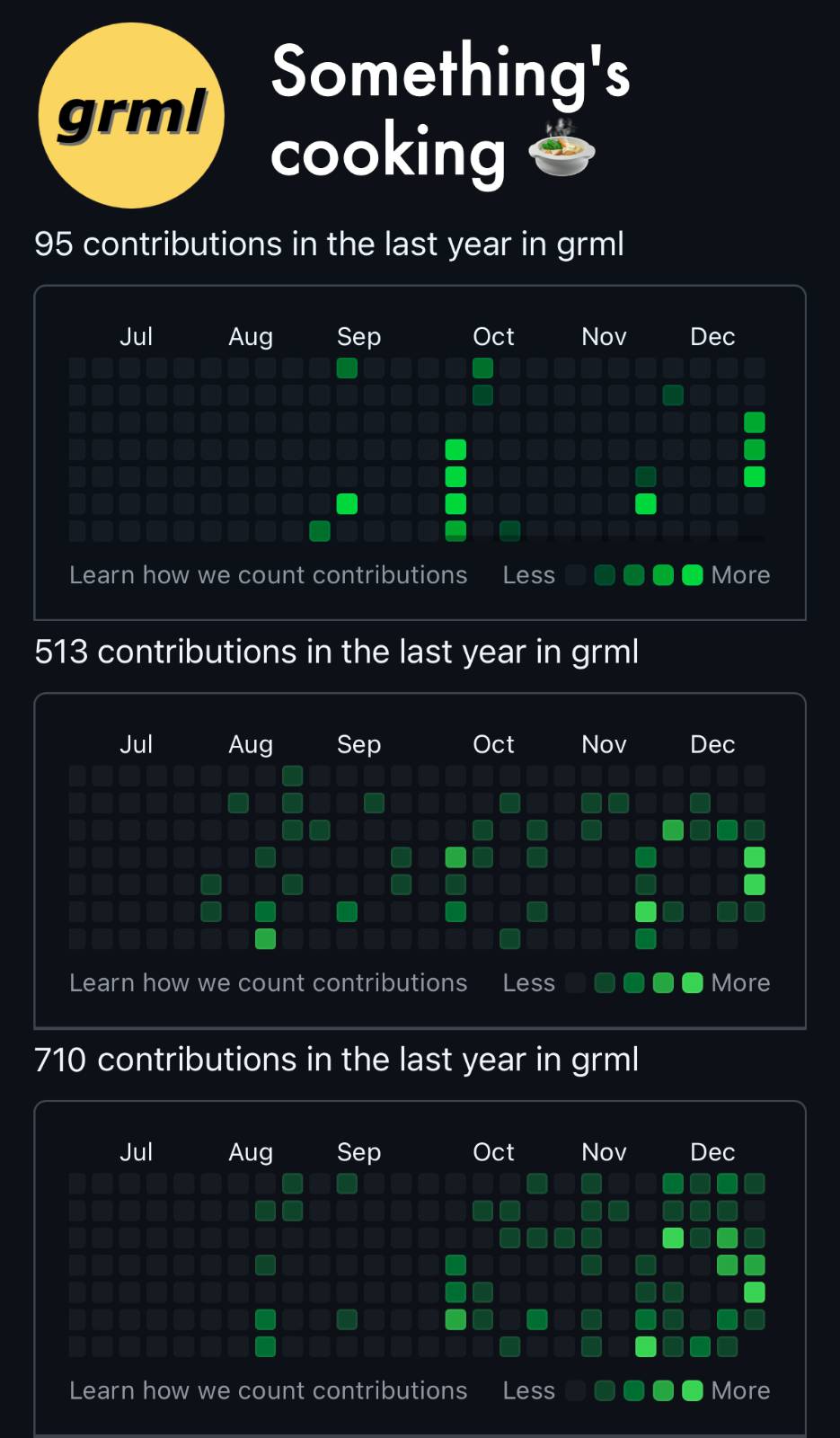
Picture with metrics of three user profiles on GitHub.com, with many contributions especially in the last quarter of the year We did it again ! Just in time, we re excited to announce the release of Grml stable version 2024.12, code-named Adventgrenze ! (If you re not familiar with Grml, it s a Debian-based live system tailored for system administrators.) This new release is built on Debian trixie, and for the first time, we re introducing support for 64-bit ARM CPUs (arm64 architecture)! I m incredibly proud of the hard work that went into this release. A significant amount of behind-the-scenes effort went into reworking our infrastructure and redesigning the build process. Special thanks to Chris and Darsha our Grml developer days in November and December were a blast! For a detailed overview of the changes between releases 2024.02 and 2024.12, check out our official release announcement. And, as always, after a release comes the next one exciting improvements are already in the works! BTW: recently we also celebrated 20(!) years of Grml Releases. If you re a Grml and or grml-zsh user, please join us in celebrating and send us a postcard!

19 December 2024

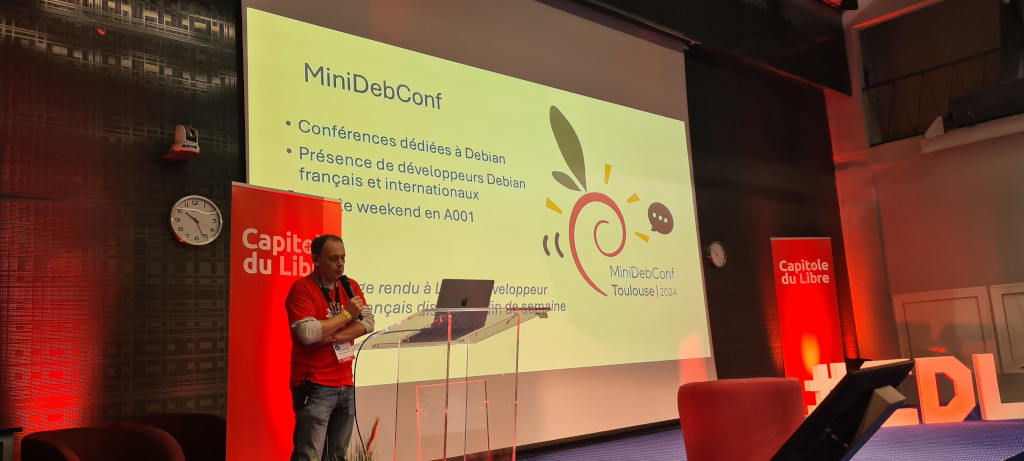
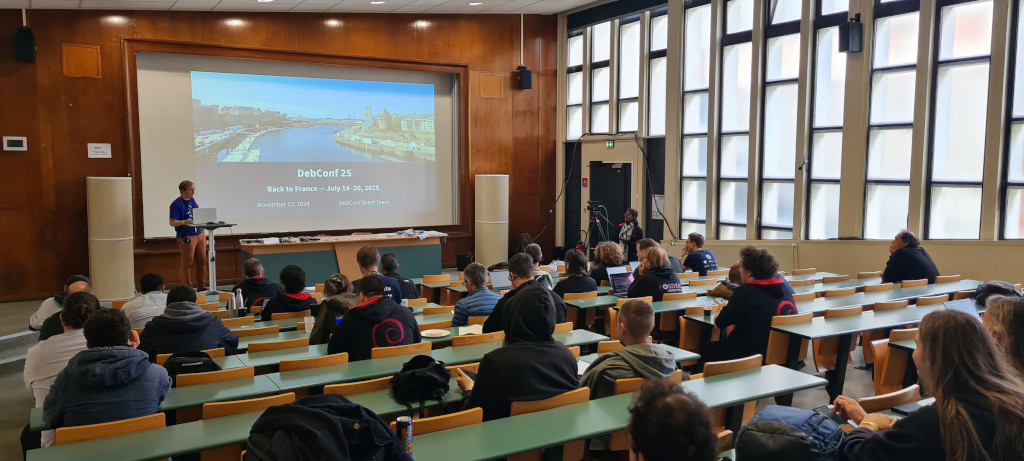
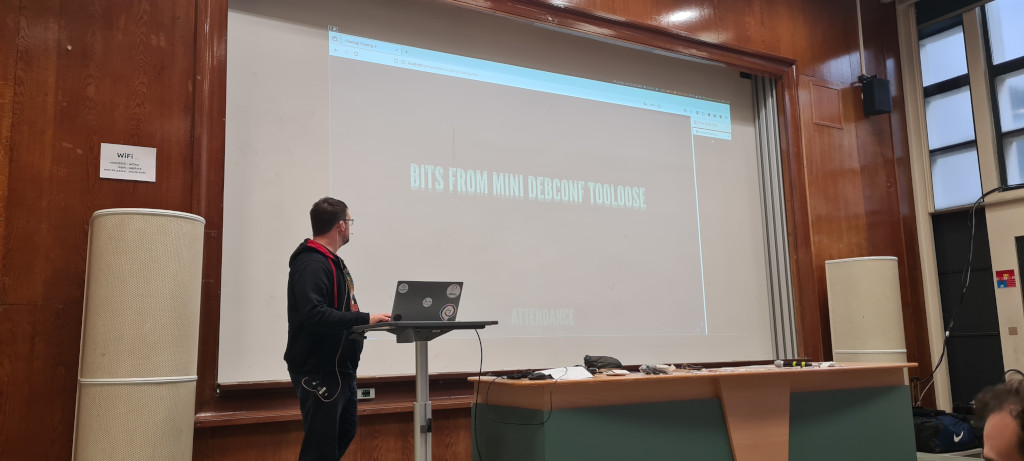
Gregory Colpart: MiniDebConf Toulouse 2024

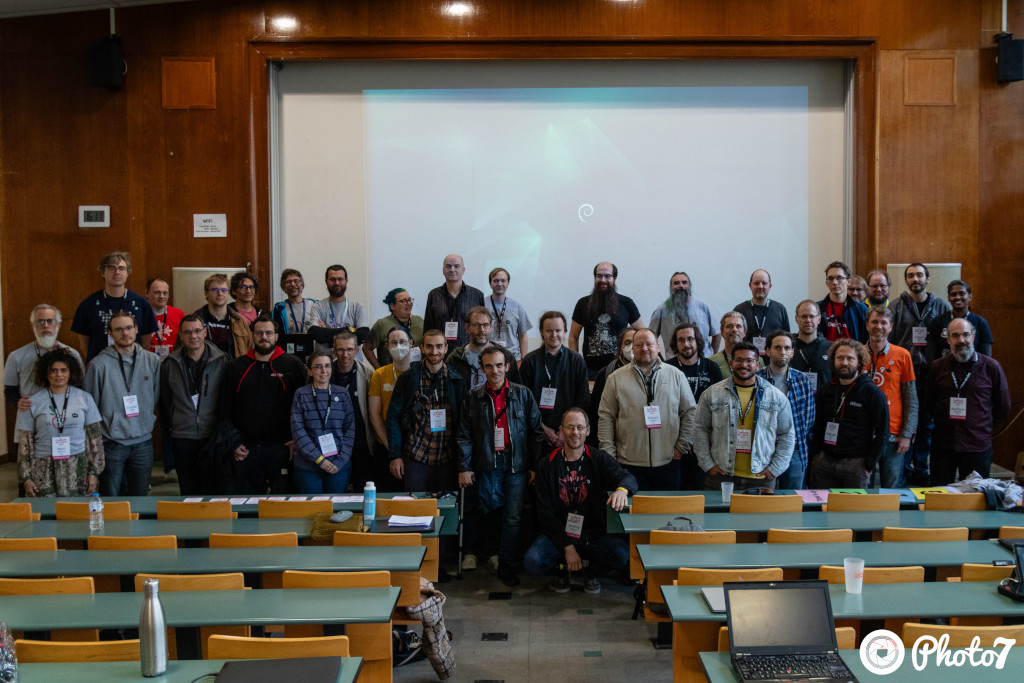
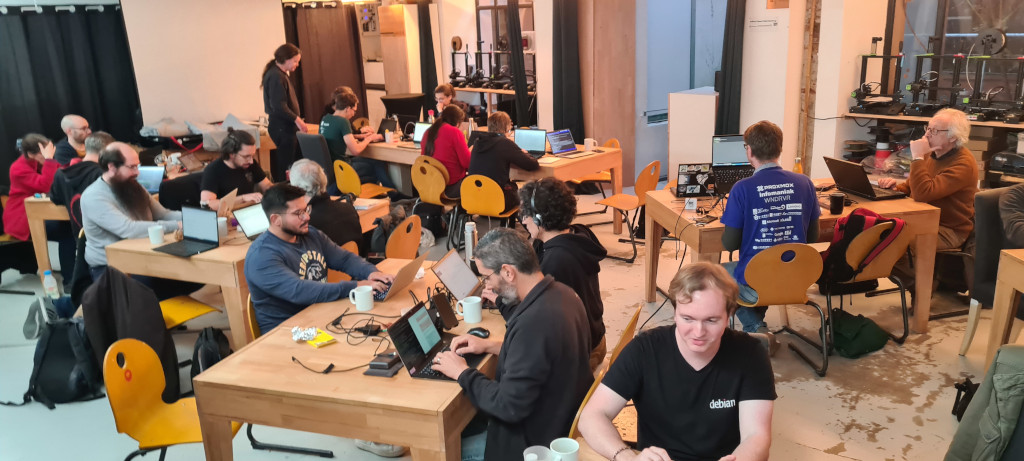
After the MiniDebConf Marseille 2019, COVID-19 made it impossible or difficult to organize new MiniDebConfs for a few years. With the gradual resumption of in-person events (like FOSDEM, DebConf, etc.), the idea emerged to host another MiniDebConf in France, but with a lighter organizational load. In 2023, we decided to reach out to the organizers of Capitole du Libre to repeat the experience of 2017: hosting a MiniDebConf alongside their annual event in Toulouse in November. However, our request came too late for 2023. After discussions with Capitole du Libre in November 2023 in Toulouse and again in February 2024 in Brussels, we confirmed that a MiniDebConf Toulouse would take place in November 2024! We then assembled a small organizing team and got to work: a Call for Papers in May 2024, adding a two-day MiniDebCamp, coordinating with the DebConf video team, securing sponsors, creating a logo, ordering T-shirts and stickers, planning the schedule, and managing registrations. Even with lighter logistics (conference rooms, badges, and catering during the weekend were handled by Capitole du Libre), there was still quite a bit of preparation to do. On Thursday, November 14, and Friday, November 15, 2024, about forty developers arrived from around the world (France, Spain, Italy, Switzerland, Germany, England, Brazil, Uruguay, India, Brest, Marseille ) to spend two days at the MiniDebCamp in the beautiful collaborative spaces of Artilect in Toulouse city center.
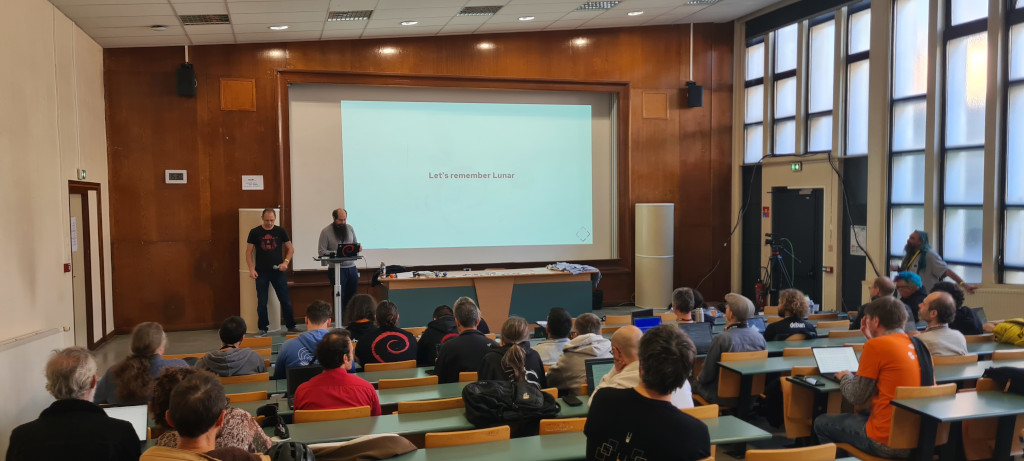
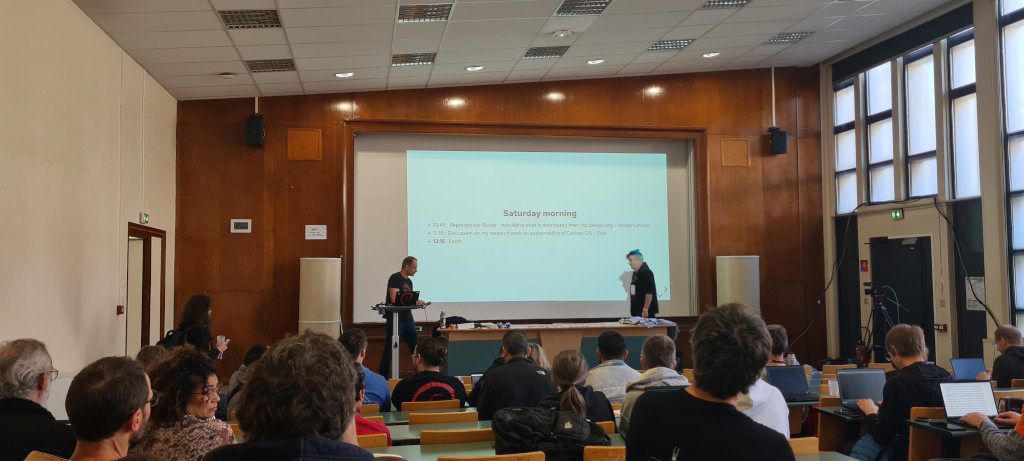
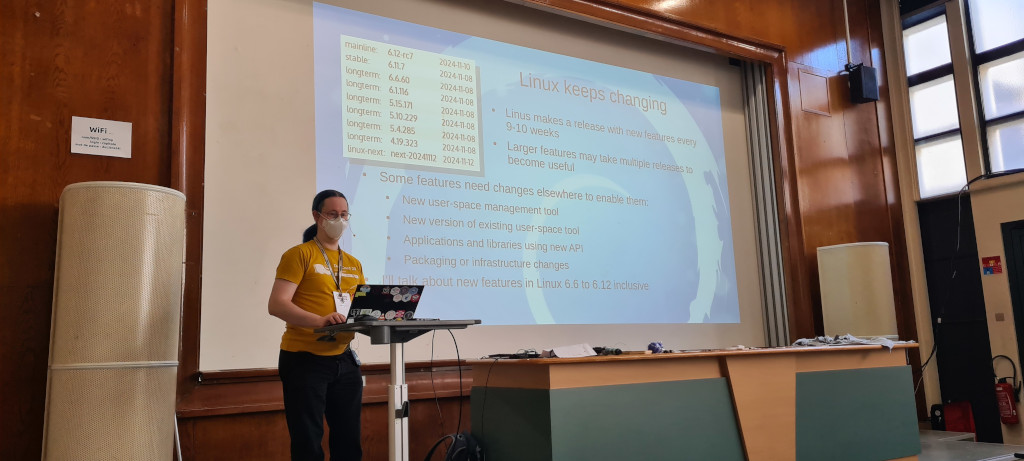
Then, on Saturday, November 16, and Sunday, November 17, 2024, the MiniDebConf took place at ENSEEIHT as part of the Capitole du Libre event. The conference kicked off on Saturday morning with an opening session by J r my Lecour, which included a tribute to Lunar (Nicolas Dandrimont). This was followed by Reproducible Builds Rebuilding What is Distributed from ftp.debian.org (Holger Levsen) and Discussion on My Research Work on Sustainability of Debian OS (Eda). After lunch at the Capitole du Libre food trucks, the intense afternoon schedule began: What s New in the Linux Kernel (and What s Missing in Debian) (Ben Hutchings), Linux Live Patching in Debian (Santiago Ruano Rinc n), Trixie on Mobile: Are We There Yet? (Arnaud Ferraris), PostgreSQL Container Groups, aka cgroups Down the Road (C dric Villemain), Upgrading a Thousand Debian Hosts in Less Than an Hour (J r my Lecour and myself), and Using Debusine to Automate Your QA (Stefano Rivera & co). Sunday marked the second day, starting with a presentation on DebConf 25 (Benjamin Somers), which will be held in Brest in July 2025. The morning continued with talks: How LTS Goes Beyond LTS (Santiago Ruano Rinc n & Roberto C. S nchez), Cross-Building (Helmut Grohne), and State of JavaScript (Bastien Roucari s). In the afternoon, there were Lightning Talks, PyPI Security: Past, Present & Future (Salvo LtWorf Tomaselli), and the classic Bits from DPL (Andreas Tille), before closing with the final session led by Pierre-Elliott B cue. All talks are available on video (a huge thanks to the amazing DebConf video team), and many thanks to our sponsors (Viridien, Freexian, Evolix, Collabora, and Data Bene). A big thank-you as well to the entire Capitole du Libre team for hosting and supporting us see you in Brest in July 2025! Articles about (or mentioning) MiniDebConf Toulouse:

17 December 2024

Gunnar Wolf: The science of detecting LLM-generated text

This post is a review for Computing Reviews for The science of detecting LLM-generated text , a article published in Communications of the ACM
While artificial intelligence (AI) applications for natural language processing (NLP) are no longer something new or unexpected, nobody can deny the revolution and hype that started, in late 2022, with the announcement of the first public version of ChatGPT. By then, synthetic translation was well established and regularly used, many chatbots had started attending users requests on different websites, voice recognition personal assistants such as Alexa and Siri had been widely deployed, and complaints of news sites filling their space with AI-generated articles were already commonplace. However, the ease of prompting ChatGPT or other large language models (LLMs) and getting extensive answers its text generation quality is so high that it is often hard to discern whether a given text was written by an LLM or by a human has sparked significant concern in many different fields. This article was written to present and compare the current approaches to detecting human- or LLM-authorship in texts. The article presents several different ways LLM-generated text can be detected. The first, and main, taxonomy followed by the authors is whether the detection can be done aided by the LLM s own functions ( white-box detection ) or only by evaluating the generated text via a public application programming interface (API) ( black-box detection ). For black-box detection, the authors suggest training a classifier to discern the origin of a given text. Although this works at first, this task is doomed from its onset to be highly vulnerable to new LLMs generating text that will not follow the same patterns, and thus will probably evade recognition. The authors report that human evaluators find human-authored text to be more emotional and less objective, and use grammar to indicate the tone of the sentiment that should be used when reading the text a trait that has not been picked up by LLMs yet. Human-authored text also tends to have higher sentence-level coherence, with less term repetition in a given paragraph. The frequency distribution for more and less common words is much more homogeneous in LLM-generated texts than in human-written ones. White-box detection includes strategies whereby the LLMs will cooperate in identifying themselves in ways that are not obvious to the casual reader. This can include watermarking, be it rule based or neural based; in this case, both processes become a case of steganography, as the involvement of a LLM is explicitly hidden and spread through the full generated text, aiming at having a low detectability and high recoverability even when parts of the text are edited. The article closes by listing the authors concerns about all of the above-mentioned technologies. Detecting an LLM, be it with or without the collaboration of the LLM s designers, is more of an art than a science, and methods deemed as robust today will not last forever. We also cannot assume that LLMs will continue to be dominated by the same core players; LLM technology has been deeply studied, and good LLM engines are available as free/open-source software, so users needing to do so can readily modify their behavior. This article presents itself as merely a survey of methods available today, while also acknowledging the rapid progress in the field. It is timely and interesting, and easy to follow for the informed reader coming from a different subfield.

13 December 2024

Emanuele Rocca: Murder Mystery: GCC Builds Failing After sbuild Refactoring

This is the story of an investigation conducted by Jochen Sprickerhof, Helmut Grohne, and myself. It was true teamwork, and we would have not reached the bottom of the issue working individually. We think you will find it as interesting and fun as we did, so here is a brief writeup. A few of the steps mentioned here took several days, others just a few minutes. What is described as a natural progression of events did not always look very obvious at the moment at all.
Let us go through the Six Stages of Debugging together.

Stage 1: That cannot happen
Official Debian GCC builds start failing on multiple architectures in late November.
The build error happens on the build servers when running the testuite, but we know this cannot happen. GCC builds are not meant to fail in case of testsuite failures! Return codes are not making the build fail, make is being called with -k, it just cannot happen.
A lot of the GCC tests are always failing in fact, and an extensive log of the results is posted to the debian-gcc mailing list, but the packages always build fine regardless.
On the build daemons, build failures take several hours.

Stage 2: That does not happen on my machine
Building on my machine running Bookworm is just fine. The Build Daemons run Bookworm and use a Sid chroot for the build environment, just like I am. Same kernel.
The only obvious difference between my setup and the Debian buildds is that I am using sbuild 0.85.0 from bookworm, and the buildds have 0.86.3~bpo12+1 from bookworm-backports. Trying again with 0.86.3~bpo12+1, the build fails on my system too. The build daemons were updated to the bookworm-backports version of sbuild at some point in late November. Ha.

Stage 3: That should not happen
There are quite a few sbuild versions in between 0.85.0 and 0.86.3~bpo12+1, but looking at recent sbuild bugs shows that sbuild 0.86.0 was breaking "quite a number of packages". Indeed, with 0.86.0 the build still fails. Trying the version immediately before, 0.85.11, the build finishes correctly. This took more time than it sounds, one run including the tests takes several hours. We need a way to shorten this somehow.
The Debian packaging of GCC allows to specify which languages you may want to skip, and by default it builds Ada, Go, C, C++, D, Fortran, Objective C, Objective C++, M2, and Rust. When running the tests sequentially, the build logs stop roughly around the tests of a runtime library for D, libphobos. So can we still reproduce the failure by skipping everything except for D? With DEB_BUILD_OPTIONS=nolang=ada,go,c,c++,fortran,objc,obj-c++,m2,rust the build still fails, and it fails faster than before. Several minutes, not hours. This is progress, and time to file a bug. The report contains massive spoilers, so no link. :-)

Stage 4: Why does that happen?
Something is causing the build to end prematurely. It s not the OOM killer, and the kernel does not have anything useful to say in the logs. Can it be that the D language tests are sending signals to some process, and that is what s killing make ? We start tracing signals sent with bpftrace by writing the following script, signals.bt:
tracepoint:signal:signal_generate  
    printf("%s PID %d (%s) sent signal %d to PID %d\n", comm, pid, args->sig, args->pid);
 
And executing it with sudo bpftrace signals.bt.
The build takes its sweet time, and it fails. Looking at the trace output there s a suspicious process.exe terminating stuff.
process.exe (PID: 2868133) sent signal 15 to PID 711826
That looks interesting, but we have no clue what PID 711826 may be. Let s change the script a bit, and trace signals received as well.
tracepoint:signal:signal_generate  
    printf("PID %d (%s) sent signal %d to %d\n", pid, comm, args->sig, args->pid);
 
tracepoint:signal:signal_deliver  
    printf("PID %d (%s) received signal %d\n", pid, comm, args->sig);
 
The working version of sbuild was using dumb-init, whereas the new one features a little init in perl. We patch the current version of sbuild by making it use dumb-init instead, and trace two builds: one with the perl init, one with dumb-init.
Here are the signals observed when building with dumb-init.
PID 3590011 (process.exe) sent signal 2 to 3590014
PID 3590014 (sleep) received signal 9
PID 3590011 (process.exe) sent signal 15 to 3590063
PID 3590063 (std.process tem) received signal 9
PID 3590011 (process.exe) sent signal 9 to 3590065
PID 3590065 (std.process tem) received signal 9
And this is what happens with the new init in perl:
PID 3589274 (process.exe) sent signal 2 to 3589291
PID 3589291 (sleep) received signal 9
PID 3589274 (process.exe) sent signal 15 to 3589338
PID 3589338 (std.process tem) received signal 9
PID 3589274 (process.exe) sent signal 9 to 3589340
PID 3589340 (std.process tem) received signal 9
PID 3589274 (process.exe) sent signal 15 to 3589341
PID 3589274 (process.exe) sent signal 15 to 3589323
PID 3589274 (process.exe) sent signal 15 to 3589320
PID 3589274 (process.exe) sent signal 15 to 3589274
PID 3589274 (process.exe) received signal 9
PID 3589341 (sleep) received signal 9
PID 3589273 (sbuild-usernsex) sent signal 9 to 3589320
PID 3589273 (sbuild-usernsex) sent signal 9 to 3589323
There are a few additional SIGTERM being sent when using the perl init, that s helpful. At this point we are fairly convinced that process.exe is worth additional inspection. The source code of process.d shows something interesting:
1221 @system unittest
1222  
[...]
1247     auto pid = spawnProcess(["sleep", "10000"],
[...]
1260     // kill the spawned process with SIGINT
1261     // and send its return code
1262     spawn((shared Pid pid)  
1263         auto p = cast() pid;
1264         kill(p, SIGINT);
So yes, there s our sleep and the SIGINT (signal 2) right in the unit tests of process.d, just like we have observed in the bpftrace output.
Can we study the behavior of process.exe in isolation, separatedly from the build? Indeed we can. Let s take the executable from a failed build, and try running it under /usr/libexec/sbuild-usernsexec.
First, we prepare a chroot inside a suitable user namespace:
unshare --map-auto --setuid 0 --setgid 0 mkdir /tmp/rootfs
cd /tmp/rootfs
cat /home/ema/.cache/sbuild/unstable-arm64.tar   unshare --map-auto --setuid 0 --setgid 0 tar xf  -
unshare --map-auto --setuid 0 --setgid 0 mkdir /tmp/rootfs/whatever
unshare --map-auto --setuid 0 --setgid 0 cp process.exe /tmp/rootfs/
Now we can run process.exe on its own using the perl init, and trace signals at will:
/usr/libexec/sbuild-usernsexec --pivotroot --nonet u:0:100000:65536  g:0:100000:65536 /tmp/rootfs ema /whatever -- /process.exe
We can compare the behavior of the perl init vis-a-vis the one using dumb-init in milliseconds instead of minutes.

Stage 5: Oh, I see.
Why does process.exe send more SIGTERMs when using the perl init is now the big question. We have a simple reproducer, so this is where using strace becomes possible.
sudo strace --user ema --follow-forks -o sbuild-dumb-init.strace ./sbuild-usernsexec-dumb-init --pivotroot --nonet u:0:100000:65536  g:0:100000:65536 /tmp/dumbroot ema /whatever -- /process.exe
We start comparing the strace output of dumb-init with that of perl-init, looking in particular for different calls to kill.
Here is what process.exe does under dumb-init:
3593883 kill(-2, SIGTERM)               = -1 ESRCH (No such process)
No such process. Under perl-init instead:
3593777 kill(-2, SIGTERM <unfinished ...>
The process is there under perl-init!
That is a kill with negative pid. From the kill(2) man page:
If pid is less than -1, then sig is sent to every process in the process group whose ID is -pid.
It would have been very useful to see this kill with negative pid in the output of bpftrace, why didn t we? The tracepoint used, tracepoint:signal:signal_generate, shows when signals are actually being sent, and not the syscall being called. To confirm, one can trace tracepoint:syscalls:sys_enter_kill and see the negative PIDs, for example:
PID 312719 (bash) sent signal 2 to -312728
The obvious question at this point is: why is there no process group 2 when using dumb-init?

Stage 6: How did that ever work?
We know that process.exe sends a SIGTERM to every process in the process group with ID 2. To find out what this process group may be, we spawn a shell with dumb-init and observe under /proc PIDs 1, 16, and 17. With perl-init we have 1, 2, and 17. When running dumb-init, there are a few forks before launching the program, explaining the difference. Looking at /proc/2/cmdline we see that it s bash, ie. the program we are running under perl-init. When building a package, that is dpkg-buildpackage itself.
The test is accidentally killing its own process group.
Now where does this -2 come from in the test?
2363     // Special values for _processID.
2364     enum invalid = -1, terminated = -2;
Oh. -2 is used as a special value for PID, meaning "terminated". And there s a call to kill() later on:
2694     do   s = tryWait(pid);   while (!s.terminated);
[...]
2697     assertThrown!ProcessException(kill(pid));
What sets pid to terminated you ask?
Here is tryWait:
2568 auto tryWait(Pid pid) @safe
2569  
2570     import std.typecons : Tuple;
2571     assert(pid !is null, "Called tryWait on a null Pid.");
2572     auto code = pid.performWait(false);
And performWait:
2306         _processID = terminated;
The solution, dear reader, is not to kill.
PS: the bug report with spoilers for those interested is #1089007.

9 December 2024

Thorsten Alteholz: My Debian Activities in November 2024

Debian LTS This was my hundred-twenty-fifth month that I did some work for the Debian LTS initiative, started by Raphael Hertzog at Freexian. During my allocated time I uploaded or worked on: I also continued to work on a fix for glewlwyd, which is more difficult than expected. Besides I started to work on ffmpeg and haproxy. Last but not least I did a week of FD this month and attended the monthly LTS/ELTS meeting. Debian ELTS This month was the seventy-sixth ELTS month. During my allocated time I uploaded or worked on: I also started to work on a fix for kmail-account-wizzard. Unfortunately preparing a testing environment takes some time and I did not finish testing this month. Besides I started to work on ffmpeg and haproxy. Last but not least I did a week of FD this month and attended the monthly LTS/ELTS meeting. Debian Printing Unfortunately I didn t found any time to work on this topic. Debian Matomo Unfortunately I didn t found any time to work on this topic. Debian Astro This month I uploaded new packages or new upstream or bugfix versions of: I also sponsored an upload of calceph. Debian IoT This month I uploaded new upstream or bugfix versions of: Debian Mobcom This month I uploaded new packages or new upstream or bugfix versions of: misc This month I uploaded new upstream or bugfix versions of: I also did some NMU of opensta, kdrill, glosstex, irsim, pagetools, afnix, cpm, to fix some RC bugs. FTP master This month I accepted 266 and rejected 16 packages. The overall number of packages that got accepted was 269.

5 December 2024

Reproducible Builds: Reproducible Builds in November 2024

Welcome to the November 2024 report from the Reproducible Builds project! Our monthly reports outline what we ve been up to over the past month and highlight items of news from elsewhere in the world of software supply-chain security where relevant. As ever, if you are interested in contributing to the Reproducible Builds project, please visit our Contribute page on our website. Table of contents:
  1. Reproducible Builds mourns the passing of Lunar
  2. Introducing reproduce.debian.net
  3. New landing page design
  4. SBOMs for Python packages
  5. Debian updates
  6. Reproducible builds by default in Maven 4
  7. PyPI now supports digital attestations
  8. Dependency Challenges in OSS Package Registries
  9. Zig programming language demonstrated reproducible
  10. Website updates
  11. Upstream patches
  12. Misc development news
  13. Reproducibility testing framework

Reproducible Builds mourns the passing of Lunar The Reproducible Builds community sadly announced it has lost its founding member, Lunar. J r my Bobbio aka Lunar passed away on Friday November 8th in palliative care in Rennes, France. Lunar was instrumental in starting the Reproducible Builds project in 2013 as a loose initiative within the Debian project. He was the author of our earliest status reports and many of our key tools in use today are based on his design. Lunar s creativity, insight and kindness were often noted. You can view our full tribute elsewhere on our website. He will be greatly missed.

Introducing reproduce.debian.net In happier news, this month saw the introduction of reproduce.debian.net. Announced at the recent Debian MiniDebConf in Toulouse, reproduce.debian.net is an instance of rebuilderd operated by the Reproducible Builds project. rebuilderd is our server designed monitor the official package repositories of Linux distributions and attempts to reproduce the observed results there. In November, reproduce.debian.net began rebuilding Debian unstable on the amd64 architecture, but throughout the MiniDebConf, it had attempted to rebuild 66% of the official archive. From this, it could be determined that it is currently possible to bit-for-bit reproduce and corroborate approximately 78% of the actual binaries distributed by Debian that is, using the .buildinfo files hosted by Debian itself. reproduce.debian.net also contains instructions how to setup one s own rebuilderd instance, and we very much invite everyone with a machine to spare to setup their own version and to share the results. Whilst rebuilderd is still in development, it has been used to reproduce Arch Linux since 2019. We are especially looking for installations targeting Debian architectures other than i386 and amd64.

New landing page design As part of a very productive partnership with the Sovereign Tech Fund and Neighbourhoodie, we are pleased to unveil our new homepage/landing page. We are very happy with our collaboration with both STF and Neighbourhoodie (including many changes not directly related to the website), and look forward to working with them in the future.

SBOMs for Python packages The Python Software Foundation has announced a new cross-functional project for SBOMs and Python packages . Seth Michael Larson writes that the project is specifically looking to solve these issues :
  • Enable Python users that require SBOM documents (likely due to regulations like CRA or SSDF) to self-serve using existing SBOM generation tools.
  • Solve the phantom dependency problem, where non-Python software is bundled in Python packages but not recorded in any metadata. This makes the job of software composition analysis (SCA) tools difficult or impossible.
  • Make the adoption work by relevant projects such as build backends, auditwheel-esque tools, as minimal as possible. Empower users who are interested in having better SBOM data for the Python projects they are using to be able to contribute engineering time towards that goal.
A GitHub repository for the initiative is available, and there are a number of queries, comments and remarks on Seth s Discourse forum post.

Debian updates There was significant development within Debian this month. Firstly, at the recent MiniDebConf in Toulouse, France, Holger Levsen gave a Debian-specific talk on rebuilding packages distributed from ftp.debian.org that is to say, how to reproduce the results from the official Debian build servers: Holger described the talk as follows:
For more than ten years, the Reproducible Builds project has worked towards reproducible builds of many projects, and for ten years now we have build Debian packages twice with maximal variations applied to see if they can be build reproducible still. Since about a month, we ve also been rebuilding trying to exactly match the builds being distributed via ftp.debian.org. This talk will describe the setup and the lessons learned so far, and why the results currently are what they are (spoiler: they are less than 30% reproducible), and what we can do to fix that.
The Debian Project Leader, Andreas Tille, was present at the talk and remarked later in his Bits from the DPL update that:
It might be unfair to single out a specific talk from Toulouse, but I d like to highlight the one on reproducible builds. Beyond its technical focus, the talk also addressed the recent loss of Lunar, whom we mourn deeply. It served as a tribute to Lunar s contributions and legacy. Personally, I ve encountered packages maintained by Lunar and bugs he had filed. I believe that taking over his packages and addressing the bugs he reported is a meaningful way to honor his memory and acknowledge the value of his work.
Holger s slides and video in .webm format are available.
Next, rebuilderd is the server to monitor package repositories of Linux distributions and attempt to reproduce the observed results. This month, version 0.21.0 released, most notably with improved support for binNMUs by Jochen Sprickerhof and updating the rebuilderd-debian.sh integration to the latest debrebuild version by Holger Levsen. There has also been significant work to get the rebuilderd package into the Debian archive, in particular, both rust-rebuilderd-common version 0.20.0-1 and rust-rust-lzma version 0.6.0-1 were packaged by kpcyrd and uploaded by Holger Levsen. Related to this, Holger Levsen submitted three additional issues against rebuilderd as well:
  • rebuildctl should be more verbose when encountering issues. [ ]
  • Please add an option to used randomised queues. [ ]
  • Scheduling and re-scheduling multiple packages at once. [ ]
and lastly, Jochen Sprickerhof submitted one an issue requested that rebuilderd downloads the source package in addition to the .buildinfo file [ ] and kpcyrd also submitted and fixed an issue surrounding dependencies and clarifying the license [ ]
Separate to this, back in 2018, Chris Lamb filed a bug report against the sphinx-gallery package as it generates unreproducible content in various ways. This month, however, Dmitry Shachnev finally closed the bug, listing the multiple sub-issues that were part of the problem and how they were resolved.
Elsewhere, Roland Clobus posted to our mailing list this month, asking for input on a bug in Debian s ca-certificates-java package. The issue is that the Java key management tools embed timestamps in its output, and this output ends up in the /etc/ssl/certs/java/cacerts file on the generated ISO images. A discussion resulted from Roland s post suggesting some short- and medium-term solutions to the problem.
Holger Levsen uploaded some packages with reproducibility-related changes:
Lastly, 12 reviews of Debian packages were added, 5 were updated and 21 were removed this month adding to our knowledge about identified issues in Debian.

Reproducible builds by default in Maven 4 On our mailing list this month, Herv Boutemy reported the latest release of Maven (4.0.0-beta-5) has reproducible builds enabled by default. In his mailing list post, Herv mentions that this story started during our Reproducible Builds summit in Hamburg , where he created the upstream issue that builds on a multi-year effort to have Maven builds configured for reproducibility.

PyPI now supports digital attestations Elsewhere in the Python ecosystem and as reported on LWN and elsewhere, the Python Package Index (PyPI) has announced that it has finalised support for PEP 740 ( Index support for digital attestations ). Trail of Bits, who performed much of the development work, has an in-depth blog post about the work and its adoption, as well as what is left undone:
One thing is notably missing from all of this work: downstream verification. [ ] This isn t an acceptable end state (cryptographic attestations have defensive properties only insofar as they re actually verified), so we re looking into ways to bring verification to individual installing clients. In particular, we re currently working on a plugin architecture for pip that will enable users to load verification logic directly into their pip install flows.
There was an in-depth discussion on LWN s announcement page, as well as on Hacker News.

Dependency Challenges in OSS Package Registries At BENEVOL, the Belgium-Netherlands Software Evolution workshop in Namur, Belgium, Tom Mens and Alexandre Decan presented their paper, An Overview and Catalogue of Dependency Challenges in Open Source Software Package Registries . The abstract of their paper is as follows:
While open-source software has enabled significant levels of reuse to speed up software development, it has also given rise to the dreadful dependency hell that all software practitioners face on a regular basis. This article provides a catalogue of dependency-related challenges that come with relying on OSS packages or libraries. The catalogue is based on the scientific literature on empirical research that has been conducted to understand, quantify and overcome these challenges. [ ]
A PDF of the paper is available online.

Zig programming language demonstrated reproducible Motiejus Jak ty posted an interesting and practical blog post on his successful attempt to reproduce the Zig programming language without using the pre-compiled binaries checked into the repository, and despite the circular dependency inherent in its bootstrapping process. As a summary, Motiejus concludes that:
I can now confidently say (and you can also check, you don t need to trust me) that there is nothing hiding in zig1.wasm [the checked-in binary] that hasn t been checked-in as a source file.
The full post is full of practical details, and includes a few open questions.

Website updates Notwithstanding the significant change to the landing page (screenshot above), there were an enormous number of changes made to our website this month. This included:
  • Alex Feyerke and Mariano Gim nez:
    • Dramatically overhaul the website s landing page with new benefit cards tailored to the expected visitors to our website and a reworking of the visual hierarchy and design. [ ][ ][ ][ ][ ][ ][ ][ ][ ][ ]
  • Bernhard M. Wiedemann:
    • Update the System images page to document the e2fsprogs approach. [ ]
  • Chris Lamb:
  • FC (Fay) Stegerman:
    • Replace more inline markdown with HTML on the Success stories page. [ ]
    • Add some links, fix some other links and correct some spelling errors on the Tools page. [ ]
  • Holger Levsen:
    • Add a historical presentation ( Reproducible builds everywhere eg. in Debian, OpenWrt and LEDE ) from October 2016. [ ]
    • Add jochensp and Oejet to the list of known contributors. [ ][ ]
  • Julia Kr ger:
  • Ninette Adhikari & hulkoba:
    • Add/rework the list of success stories into a new page that clearly shows milestones in Reproducible Builds. [ ][ ][ ][ ][ ][ ]
  • Philip Rinn:
    • Import 47 historical weekly reports. [ ]
  • hulkoba:
    • Add alt text to almost all images (!). [ ][ ]
    • Fix a number of links on the Talks . [ ][ ]
    • Avoid so-called ghost buttons by not using <button> elements as links, as the affordance of a <button> implies an action with (potentially) a side effect. [ ][ ]
    • Center the sponsor logos on the homepage. [ ]
    • Move publications and generate them instead from a data.yml file with an improved layout. [ ][ ]
    • Make a large number of small but impactful stylisting changes. [ ][ ][ ][ ]
    • Expand the Tools to include a number of missing tools, fix some styling issues and fix a number of stale/broken links. [ ][ ][ ][ ][ ][ ]

Upstream patches The Reproducible Builds project detects, dissects and attempts to fix as many currently-unreproducible packages as possible. We endeavour to send all of our patches upstream where appropriate. This month, we wrote a large number of such patches, including:

Misc development news

Reproducibility testing framework The Reproducible Builds project operates a comprehensive testing framework running primarily at tests.reproducible-builds.org in order to check packages and other artifacts for reproducibility. In November, a number of changes were made by Holger Levsen, including:
  • reproduce.debian.net-related changes:
    • Create and introduce a new reproduce.debian.net service and subdomain [ ]
    • Make a large number of documentation changes relevant to rebuilderd. [ ][ ][ ][ ][ ]
    • Explain a temporary workaround for a specific issue in rebuilderd. [ ]
    • Setup another rebuilderd instance on the o4 node and update installation documentation to match. [ ][ ]
    • Make a number of helpful/cosmetic changes to the interface, such as clarifying terms and adding links. [ ][ ][ ][ ][ ]
    • Deploy configuration to the /opt and /var directories. [ ][ ]
    • Add an infancy (or alpha ) disclaimer. [ ][ ]
    • Add more notes to the temporary rebuilderd documentation. [ ]
    • Commit an nginx configuration file for reproduce.debian.net s Stats page. [ ]
    • Commit a rebuilder-worker.conf configuration for the o5 node. [ ]
  • Debian-related changes:
    • Grant jspricke and jochensp access to the o5 node. [ ][ ]
    • Build the qemu package with the nocheck build flag. [ ]
  • Misc changes:
    • Adapt the update_jdn.sh script for new Debian trixie systems. [ ]
    • Stop installing the PostgreSQL database engine on the o4 and o5 nodes. [ ]
    • Prevent accidental reboots of the o4 node because of a long-running job owned by josch. [ ][ ]
In addition, Mattia Rizzolo addressed a number of issues with reproduce.debian.net [ ][ ][ ][ ]. And lastly, both Holger Levsen [ ][ ][ ][ ] and Vagrant Cascadian [ ][ ][ ][ ] performed node maintenance.
If you are interested in contributing to the Reproducible Builds project, please visit our Contribute page on our website. However, you can get in touch with us via:

4 December 2024

Scarlett Gately Moore: Hacked and tis the season for surgeries

I am still here. Sadly while I battle this insane infection from my broken arm I got back in July, the hackers got my blog. I am slowly building it back up. Further bad news is I have more surgeries, first one tomorrow. Furthering my current struggles I cannot start my job search due to hospitalization and recovery. Please consider a donation. https://gofund.me/6e99345d On the open source work front, I am still working on stuff, mostly snaps ( Apps 24.08.3 released ) Thank you everyone that voted me into the Ubuntu Community Council! I am trying to stay positive, but it seems I can t catch a break. I will have my computer in the hospital and will work on what I can. Have a blessed day and see you soon. Scarlett

1 December 2024

Sandro Knau : QML Dependency tracking in Debian

Tracking library dependencies work in Debian to resolve from symbols usage to a library and add this to the list of dependencies. That is working for years now. The KDE community nowadays create more and more QML based applications. Unfortunately QML is a interpreted language, this means missing QML dependencies will only be an issue at runtime. To fix this I created dh_qmldeps, that searches for QML dependencies at build time and will fail if it can't resolve the QML dependency. Me didn't create an own QML interpreter, just using qmlimportscanner behind the scenes and process the output further to resolve the QML modules to Debian packages. The workflow is like follows: The package compiles normally and split to the binary packages. Than dh_qmldeps scans through the package content to find QML content ( .qml files, or qmldirfor QML modules). All founded files will be scanned by qmlimportscanner, the output is a list of depended QML modules. As QML modules have a standardized file path, we can ask the Debian system, which packages ship this file path. We end up with a list of Debian packages in the variable $ qml6:Depends . This variable can be attached to the list of dependencies of the scanned package. A maintainer can also lower some dependencies to Recommends or Suggest, if needed. You can find the source code on salsa and usage documentation you can find on https://qt-kde-team.pages.debian.net/dh_qmldeps.html. The last weeks I now enabled dh_qmldeps for newly every package, that creates a QML6 module package. So the first bugs are solved and it should be usable for more packages. By scanning with qmlimportscanner trough all code, I found several non-existing QML modules: YEAH - the first milestone is reached. We are able to simply handle QML modules. But QML applications there is still room for improvement. In apps the QML files are inside the executable. Additionally applications create internal QML modules, that are shipped directly in the same executable. I still search for a good way to analyse an executable to get a list of internal QML modules and a list of included QML files. Any ideas are welcomed :) As workaround dh_qmldeps scans currently all QML files inside the application source code.

Next.

Previous.