Search Results: "seb"

21 June 2012

Russell Coker: New SE Linux Policy for Wheezy

I ve just uploaded a new SE Linux policy for Debian/Wheezy. It now works correctly with systemd and Chromium, two significant features that I wanted for Wheezy. Now it turns out that we have until the end of the month for Wheezy updates, so I may get another version of the policy uploaded before then. If so it will only be for relatively minor changes, I think that most SE Linux users would be reasonably happy with policy the way it is. Anything that doesn t work now can probably be solved by local configuration changes. execmem The current version of KDE in Debian is 4.8.4, it seems that large parts of the KDE environment depend on execmem access, this includes kwin and plasma-desktop. Basically there is no possibility of having a KDE desktop environment without those programs and therefore KDE depends on execmem access. Debugging this is difficult as the important programs SEGV when denied execmem access and the KDE crash handler really gets in the way of debugging it running /usr/bin/plasma-desktop results in the process forking a child and detaching from the gdb session. The most clear example of an execmem issue in KDE is from the program /usr/lib/kde4/libexec/kwin_opengl_test which gives the following error:
LLVM ERROR: Allocation failed when allocating new memory in the JIT
Can t allocate RWX Memory: Permission denied To make this work you run the command setsebool -P allow_execmem 1 which gives many domains the ability to create writable-executable memory regions. I raised this issue for discussion on the SE Linux mailing list and Hinnerk van Bruinehsen wrote an informative message in response summarising the situation [1]. It seems that it s possible to compile some of the programs in question to not use the JIT and therefore not require such access and there is a build option in Gentoo to allow it. But it s impractically difficult for me to fork KDE in Debian so the only option is to recommend that people enable the allow_execmem boolean for Debian desktop systems running SE Linux. Related posts:
  1. /run and SE Linux Policy Currently Debian/Unstable is going through a transition to using /run...
  2. An Update on DKIM Signing and SE Linux Policy In my previous post about DKIM [1] I forgot to...
  3. New SE Linux Policy for Squeeze I have just uploaded refpolicy version 0.2.20100524-1 to Unstable. This...

3 June 2012

Gregor Herrmann: RC bugs 2012/22

since most of the gcc 4.7 bugs are fixed by now, I looked again at the general RC bugs too this week. here's the usual short report:

Johannes Schauer: port bootstrap build-ordering tool report 1

A copy of this post is sent to soc-coordination@lists.alioth.debian.org as well as to debian-bootstrap@lists.mister-muffin.de. Diary May 21 May 22 May 23 May 24 May 25 May 29 May 30 May 31 June 1 June 2 Results I learned a good chunk of ocaml and how to use dose3 and libcudf. I created a gitorious project and a git repository for all the sourcecode.
git clone git://gitorious.org/debian-bootstrap/bootstrap.git
The git as of now contains 30 commits and 1197 lines of ocaml code. So far, 62 emails have been exchanged between me and Pietro and Wookey. I created a mailinglist for this project where all email exchange so far is publicly accessible in the archives. You can also download all of the email exchange in mbox format. Everybody is welcome to join and/or read the list. What seems to be finished: the program that finds the minimal amount of source packages that have to be cross compiled to end up with a minimal build system. What it does is:
  1. get all essential packages
  2. get their runtime dependencies
  3. get build-essential plus runtime dependencies
  4. get all source packages that are necessary to build 1.-3. those are the packages that have to be cross compiled
  5. get a list of all packages that are built by source packages from 4.
  6. add all packages from 1.,2.,3. and 5. plus all arch:all packages to a universe
  7. use Depsolver.trim on that universe to figure out which of those packages are actually installable
The result of 7. will then contain a list of packages that are available automatically on the foreign system due to cross compiled source packages and arch:all packages. For Debian Sid, the output of my program is:
# (1) number of packages with priority:required: 62
# (2) plus, number of dependencies of priority:required packages: 20
# (3) plus, build-essential and dependencies: 31
# number of source packages to build the above: 71
# number of additional packages built from the above source packages: 292
# (4) number of packages of those plus arch:all packages that are installable: 6421
# total number of installable packages (1)+(2)+(3)+(4): 6534
For Ubuntu Natty it is:
# (1) number of packages with priority:required: 96
# (2) plus, number of dependencies of priority:required packages: 7
# (3) plus, build-essential and dependencies: 31
# number of source packages to build the above: 87
# number of additional packages built from the above source packages: 217
# (4) number of packages of those plus arch:all packages that are installable: 2102
# total number of installable packages (1)+(2)+(3)+(4): 2236
So for Debian, 71 source packages definitely have to be made cross compilable while for Natty, the number is 87. The last two days I was toying around with these minimal systems to see how big the number of source packages is, that can be built on top of them without running into dependency cycles. After installing the binary packages that were built, I checked again until no new packages could be built. For Natty, I was only able to find 28 additional packages that can be built on top of the 2236 existing ones. This means that a number of dependency cycles prevent building anything else. In the coming two weeks I will focus on coming up with a tool that cleverly helps the user to identify packages that would be useful to have for building more packages (probably determined by how many packages depend on it - debhelper is an obvious candidate). The tool would then show why that crucial package is not available (in case of debhelper because some of its runtime dependencies are not available and require debhelper to be built) and how the situation can best be resolved. The possible methods to do so are to identify a package that is part of a cycle and either cross compile it or let it have staged build dependencies.

26 May 2012

Vincent Sanders: Each morning sees some task begun, each evening sees it close; Something attempted, something done, has earned a night's repose.

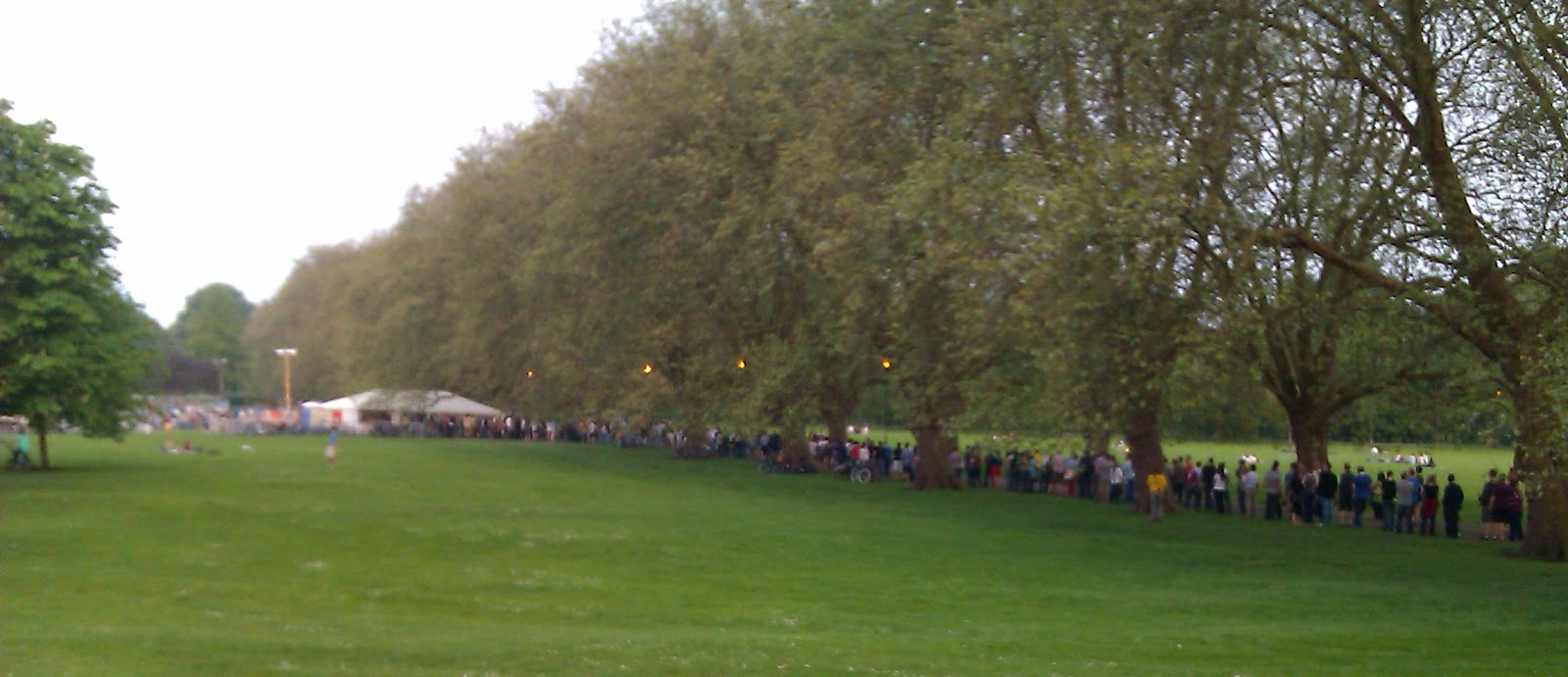
Thursday saw all the Collabora employees at Cambridge office go out and socialise at the beer festival. They seemed to have selected a wonderful day for it, the sun was shining and it was warm and blue sky day.

Alas, I had to attend some customer conference calls and work on some time sensitive research so I could not go to the ball as it were. At about eight my brain had run out of steam so I decided to call it a day and go and meetup with people at the festival for an hour or two.

The queue when I arrived dissuaded me from that notion. I asked one of the stewards and they indicated it would take at least an hour from where the queue finished.

So I decided to wend my way home along the bank of the Cam. I proceeded slowly along and to my utter surprise bumped into Ben Hutchings and his Solarflare work colleagues having their own soiree. I was immediately invited to sit and converse. Pretty quickly I was inveigled into accepting a glass of wine by John Aspden from his floating bar (AKA houseboat).

From here on my evening was a pleasant one of amusing new people, easy conversation and a definite pondering if the host would be discovering the delights of Cam swimming as he became progressively inebriated!

So although I missed the festival I did manage to have an enjoyable time. A big thanks to the solarflare guys and especially John who was the consummate host and provided me with far too much alcohol.

20 May 2012

Gregor Herrmann: RC bugs 2012/20

I was on vacations for a few days last week, therefor my list of RC bugs is a bit shorter this time. thanks again to everyone who sent patches to the BTS that I could just use.

19 May 2012

Richard Hartmann: Motherland's bosom

I read a translated poem about Russia being "the Motherland" and its vast bosom years ago. Having driven through a significant part of it, I can agree on the "vast" part... Also, as I am on a train and without access to the Internet, I will refrain from linking to a lot of pages; sorry. (Turns out I am posting this a week later, but I will still not link to stuff now; no time). Russia in general Moscow Sights Kreml Our remaining time in Moscow was spent with touring the usual suspects; the Kreml is a lot less impressive in real life, the Red Square is tiny when compared to the stories I heard about it and the Chapel ofi St. Basil is even more colorful and impressive in real life. Lenin's body was inaccessible because workers built seats for the May 9th parade to the left and the right of it and they apparently thought it would be a good idea to block access to one of the main tourist attractions while doing so. A river tour of Moscow was a nice cool-off and we got to see quite a few things. We managed to see the weekly military parade within the Kreml grounds, but it was mostly pomp and little substance. The National Treasure which you can access with an extra ticket within the Kreml grounds is nice, but less impressive than the tourist guides would make you believe. That being said... There's another museum within the museum and.... Whoah... Tourists pay extra, visitors go through the only non-security-theater check I encountered in Russia, guards are armed, people can only enter and leave in batches, and the stuff which is presented is mind-boggling. Disregarding the fist-to-calf-sized chunks of gold and platinum which are still in their original form directly from the mine, there is real, actual treasure galore. Little heaps of uncut and cut diamonds, an outline of Russia filled with cut diamonds and other random "we have this stuff" displays can be found as well. Then, you have various tiaras and other jewellery made from various gems. Not incorporating, but largely made of. All that pales in comparison to the crown, royal apple, scepter, etc. It's hard to put the amount of tiny multi-colored light points that shine at you into words. I was just standing there, swaying back and forth to catch the moving pattern of pinpoints. It's said that this collection is equalled only by the ones in the Tower of London and the one Shaw of Iran had and boy do I believe it. TV Tower Getting up there was funny. The old-style Soviet queuing system was used: "Security" for approaching the tower was multi-level, the guards see you approach along a long walkway way in advance and the main guard shed had several small cabins separated by thick glass. So good so menacing. But in a twist that would make Bizarro and Garry Larson proud, I was required, by means of metal detector gate, metal detector wand and even an x-ray machine to remove every shred of metal and other hard objects from myself and the camera bag and put them onto a table. Once I was without anything except my clothes and the bag was completely empty, I could pass. Everything I had had to remove was just laying there, not inspected in the least, for me to stuff back into pockets and bag and to take with me. This "everything" included a Spot Messenger 2 with lots of green and red blinky lights. The guard did not even glance and it. Security theater? Security theater. The view from 364 meters down on Moscow was nice, but there was a lot of Smog so I couldn't see very far. Jumping on the glass floor while looking down was a lot of fun, though. Subway to Thiefing I bet Christopher Nolan rode the subway in Moscow at least once. That unnerving sound you hear during several key scenes in "The Dark Knight"? Two thirds of all subways make the same sound while moving. Also, I had an encounter with a pickpocket down there; very classical, too. Guy approaches quickly, talks loudly and sounds as if it's really important (in Russian... duh... that's sure to keep me interested). His approach made me turn and protect my left leg pocket automatically, most likely marking the target for the tiny woman standing behind me. Now, I have to tell you something about my usual travel layout. As my normal pockets are very deep, it looks as if their content was in the leg pocket. Plus, there's an extra, hidden leg pocket where I keep the passports and train tickets. The outermost leg pocket is protected by a velcro flap, but it contains nothing of value; usually the appropriate phrasebook, local map, maybe a tissue or chewing gum. Due to this layering, the outermost pocket looks as if it's full to the brim with stuff. Also, I took pains to make it a habit to protect said leg pocket with my hand, nothing else. This looks as if that's the target, but what I am actually doing is protect my normal pocket with my forearm. The right side is different, but the most easily accessibly pocket always holds some small change. I pay from that stash but my actual wallet is well out of reach. Anyway, once the guy ran off, talking to several others, most likely marking all them for the actual pickpockets, I wanted to enter the subway. While the Russian-style queuing took place, I felt an unusual tug at the velcro flap. I looked down and saw a tiny woman to the left of me with a jacket held over her right side with the left arm; I look up to check no one is trying to steal from my permanently assigned female, feel another tug, look the woman into the eyes, look up again and around me, look down again and she is gone. All that took maybe three seconds and I had boarded the subway after an additional two. In hindsight, it makes sense to choose the time of entry for attack. It's crowded, you are being pushed around, and once you are in the subway, it will start moving more or less immediately while the thief remains in the station. In this case, she would only have gotten a grubby map of Moscow's subway and an English-Russian phrasebook, but she got nothing at all. Moscow-Novosibirsk Where to begin... If you think a few hours on a train are a long time, try over fifty hours. Things get so bad, you start getting land-sick while not in a moving train. You even start missing the familiar tunk-cachunk, tunk-cachunk, tunk-cachunk... of driving over rails with gaps in them when you are not moving. The defining element of the Trans-Siberian Railway are birch trees. And birch trees. And then more birch trees. You would not believe how many birch trees there are. This is made "worse" by the way the Russian Railway protects their rails. Left and right of the track, there's a cleared area of maybe ten to twenty meters, sometimes as little as three. Outside of that, they plant ten to twenty meters of birch trees, presumably to catch snow during winter. Beyond that protective perimeter, there's the normal landscape.As a result, on top of the near endless stretches of birch woods, you see most if not all scenery through a layer of birch trees. You get sick sick of birch trees after a few hours and you see them for days on end. Bullet points to save myself some typing and you some reading... Novosibirsk The non-existent hostel We arrived at ~0200 local and made our way to the hostel we had booked a room with. Walking to the correct address, we saw several signs but they all turned out to be for a police station and some other state agency. We walked back, forth, double-checked, triple-checked: no hostel. We then walked around the building through some not-quite-nice back alleys, but other than a few entries to private flats, there was nothing. Thankfully, the booking slip included a number which we called and after at least twenty rings (no kidding), when I had given up and wanted to hang up, it stopped ringing. Dead silence. After maybe ten seconds, someone started talking in Russian. I asked him if he spoke English and told him that we could not find the hostel. He mumbled something about being sorry and that we should wait, he would come down. Fast forward a minute or two and someone walked towards us. Again, he mumbled about being sorry, that the hostel "did not work" at the moment and that we would need to sleep in his private apartment. He ushered us into some back alley entrance, into his flat, and proceeded to remove the sheets from the couch on which he had slept; after putting on new sheets, we had our "hostel" bed, ready to sleep on. We briefly considered if he would murder us in our sleep, but him and me even got to talking a bit. Over cheese, sausage and rum (at 0300), he admitted that the hostel did not exist and he merely planned to turn his flat into a hostel for the summer while he and his family moved into their summer house (the Russian term of which escapes me, at the moment) in the countryside. He had accepted our reservation as he thought he would be finished by that time. He did not even get started, though. While he sent us an overbooking notice through booking.com two days before, we were on the train at that time, so... booking.com even called him to check what happenend to us as we did not book another place through them. Good customer service/protection, that. Next morning, he didn't even want to take our money (we paid anyway) and, as a means of compensation, drove us into the city in the morning and to a train museum well outside the city limits, one of the fabled scientist cities, and a large lake which everyone in Novosibirsk claims is an ocean, in the afternoon. Foreigners, foreigners! All in all, Novosibirsk was relatively uneventful, safe for one bizarre episode. We took our lunch in a local fast food joint (why do all the good stories happen there, and not at the various truly local places?) and threw the cashier our well-rehearsed "Niet Russkie; anglisky?" with phrasebook in hand and he actually understood a few words of English (beef, chicken, fries). We told him, in our worst Russian, that we are from Germany wished him a nice day and went to sit down. A few minutes later, a girl approached us, literally hopping from one foot to the other and wringing her hands. She told us that the cashier had told her that we spoke English and if it would be OK if she talked to us. We suspected some sort of elaborate ruse, but went with it. Turns out, she had English at school and really wanted someone to practice English on. Two young men passed our table and exchanged a few words with her, sitting down out of sight. When she told us that she had to leave now but if it would be OK if the two boys joined us we suspected a ruse yet again. But those two were law students, one with a minor in English and one with a minor in German; both of them also extremely nervous, asking us if we would talk to them. When they had to leave, they told us that the three of them worked at the burger joint and that their shift was just about to start when the news that foreigners were here spread amongst staff like wildfire. The girl stopped by several times in between cleaning tables, getting in a sentence or two before being cussed at by her supervisor. All in all, this took about twenty minutes and seeing three people so nervous and grateful to talk with us felt beyond absurd. On the other hand, not a single traveller we met even considered stopping in Novosibirsk during their transit so there really does seem to be a shortage of non-Russians there. Weird, and memorable. Novosibirsk-Irkutsk Irkutsk / Listvianka / Lake Baikal Listvianka Aah, lake Baikal... the oldest and deepest lake on Earth which holds a fifth of the global non-salt water reserves; a must-see in my book. Quad tours at break-neck speeds, dry-suit diving with Russian regulators, walking barefoot in between and across drift ice that made its way onto the shorei, and extended hiking around the lake's coast... All of which I could not do because I was ill and had to spend two solid days in bed. The draft from the open window in between Novosibirsk and Irkutsk was enough to give me a rather bad cold which peaked at Lake Baikal. Still, the area was lovely and we were glad to be out of a train and able to unpack our stuff without having to repack immediately for once. I am not sure where my current losing streak with regards to diving is coming from (Grimsey, diving north of the Arctic circle with birds that plummet into the water and hunt fish: Only guy who does this is on the Icelandic mainland that day; Svalbard, diving north of the Arctic circle in permanent darkness: The few people who do this privately did not reply while I was there; Baikal, oldest, deepest, largest lake on Earth: ill), but I will most likely return to Russia for a week of ice diving in Lake Baikal next winter or the one after that. As an aside, I saw several people walking to Lake Baikal with buckets to get their water. Other people got it from a well which was still half frozen. If you have running water consider yourself lucky... Irkutsk Nice city, largely uneventful. The farther east you get within Russia, the more normal women look. In Moscow, just as in Paris, they are way over-dressed and even service personnel will walk with high heels. Thankfully, I don't have to wear heels, but for the other males out there: Walking and standing in these things hurts and thus most if not all people who stand and walk for a living have flat shoes. We happened upon preparations for a military parade, complete with cordon, viewing podests, at least half a dozen TV cameras etc, but were not sure if it would start soon enough for us to catch our train.We asked someone who told us it would start at 2100 local, at 1945 local it seemed about to start, and sure enough at 1955 sharp, the whole thing went under way. About a dozen groups of 50-100 people each, all in their own, respective uniforms stood against one side of a cordoned-off street and several higher-ups on the other side. Two highest-ups shouted into microphones and the throng of people on the other side shouted back answers. Then, the two highest-ups stood in the back of a jeep each and drove past said throng, stopping in front of each group, shouting into microphones mounted in the back of the jeeps and the groups shouted back once again. After that, all groups marched around the make-shift plaza once, saluting the higher ups. Once they were done, and they took ages, two trucks drove by with soldiers jumping out of the moving trucks and moving into crouching positions. They ran around in a circle a few times and engaged in pretend hand-to-hand combat. I am sure they are skilled at whatever style they wanted to show, but they were overdoing things so badly, they were funny, not imposing. When they jumped over some barriers, the barriers fell to pieces and everyone scrambled to make it look as if that was part of the show. While carrying off the gear, it fell into further pieces which was even more funny. An armoured personnel carrier ended the show; several tougher looking guys jumped off of that one and their mock combat involved fully automatic fire (of blanks), several flashbangs, smoke grenades and, to top things off, the machine gun mounted on the APC moving down the opposing team with blanks. I never witnessed a "real" military parade in person but this one was somewhat disappointing. On the one hand, there was a distinct lack of ballistic missile carriers and tanks like you see in movies, documentaries and games, on the other hand, the whole thing had a make-do feeling to it. The cordoning police had designated spots to stand on, yet walked around. They were standing to attention, yet checking their cell phones. Several people in one uniformed group were wearing track suits and jeans. Another uniformed guy had a grocery bag with him; yet another one was carrying a huge water bottle. Bikers zig-zagged through the cordon and when the whole show was just about to wrap up the police finally started putting up barriers around the unmoving pedestrians, not blocking the bikers. One little girl was standing well within the cordoned area, watching with big eyes and after she did not react to the police talking to her, they just built the barriers in a curve around her. And to top it all off, some guy with a cane walked all through the parade with his personal camcorder, trying to direct the whole show while being ignored by everyone. Still, I am sure he managed to mess up some otherwise perfectly good TV scenes. Irkutsk-Russian border TL;DR 3000 kilometers of birch trees

6 May 2012

Gregor Herrmann: RC bugs 2012/17-18

as I was mostly offline last week, this is a report covering two weeks. as in the week before, it's mainly a mix of build-arch & gcc 4.7 bugs.

15 April 2012

Gregor Herrmann: RC bugs 2012/15

another weekend, another RCBW report:

Richard Hartmann: All aboard the Choo Choo train!

All aboard the Choo Choo train! As some of you know, we are planning our trip on the Trans-Siberian (well, Trans-Mongolian to be exact) railway, at the moment. Given the wall of text my post about Svalbard turned out to be, I am trying to split early and often. The plan Our three-week itinerary is pretty much fixed, by now: Visa issues Not wanting to just book any random package with any random travel agent, we are picking and mixing our own, as usual. Given visa requirements, language barriers and things that are plain weird, it's been an interesting ride before we even pack our bags a month or two from now. Being European, visas are something that do not concern us a lot, normally. I am starting to realize how incredibly lucky we are... barring India, we never needed to do much to be allowed to enter any foreign country. Not so on this trip... While Mongolia has rather lax, or let's just say reasonable, terms, China and Russia are different. To get a visa for Russia, you need: For China, you need to provide a night-to-night itinerary of hotel stays. This may be a remnant of Mao's philosophy of restricting free movement of the population within China, I don't know. On the plus side, they don't require an invitation, health insurance or means of industrial espionage. With processing times ranging from one to four weeks per visa, you will wait one to two months until your passports are back with you and properly visa'ed by everyone. Tickets, please Purchasing tickets in advance, but not through a travel agent, is turning out to be rather complicated. As you can not book train tickets with RZD, the Russian rail company, more than 45 days in advance, you end up with nice circular dependencies. We could pay a premium for faster processing of our visas and buy via travel agencies which sell train tickets from their special contingents, but that's kinda boring, innit? Also, rzd.ru offers Russian order forms, only. With the help of Google translate, ##russian on irc.freenode.net, and a lot of guess-work, we were able to hammer out the connections from Moscow to Novosibirsk and from there on to Irkutsk. Yet, it's quite a different experience not to not be able to fall back to English. No matter where we went in the past, English was the lingua franca, at least to some extent. That's not the case in any of our three intended destinations so those phrase books will get used a lot, I suspect... We are still not sure if the 4-people cabins in second class have a door, let alone one that can be locked, but we decided that this is not too much of an issue. Generally speaking, people are nice and there are train attendants so crime should not be an issue. And even if things do disappear, as long as we stay healthy and I still have one of my several copies of all photos I will take, I will be reasonably happy. As to getting from Irkutsk to Ulan Bator... even a Russian travel agent we contacted claimed you can only purchase tickets on site, not online. From Ulan Bator to Beijing, it's a different booking system. And from Beijing to Shanghai, it's yet another one. This is the most fragmented booking process we ever went through. Other than a few moments of stress and frustration, the hunting for information, cross-referencing and having the occasional eureka moment is tons of fun, though; no complaints here. When in Rome... According to Lonely Planet, the Trans-Siberian is more or less one large picnic where everyone shares whatever they have with them with everyone else. I poked a few Russians about what typically German food they like and they came up with Frankfurters, mustard, and beer. Guess that's what we will be stuffing our backpack with once everything else is packed. And snuff; apparently it's common courtesy to offer your snuff to other men you meet in Mongolia and then snuff from their bottle. When in Rome... German snuff tends to be mixed with menthol, I suspect that will raise some eyebrows ;) No idea if there is any non-obvious social grease to bring to China; still working on that. Initially, we wanted to tour Mongolia's main attractions, but we would either have to sit in a car for days on end or go by plane. Driving for days in between a solid week(!) spent on trains is not very appealing and neither is breaking our personal ground travel record by cheating flying. Thus, we decided to take the eco-tourism route: After a two-hour orientation course in Mongolian behaviour and manners, we will travel a few hundred kilometers by public bus, be picked up by a local, driven out into the outback and ride from ger to ger by camel and horse before returning to Ulan Bator by bus. The stays at the gers are immersive, if short; we will live with the families, help them do their daily chores, and visit local places of interest in between. Oddly enough, I am looking to forward to the bus ride even more than to the gers. At the gers, at least one person is able to speak basic English. Not so with the local bus. People on the various trains will be used to strangers, as are the families at the gers. People on the bus are, most likely, not. Communicating with hand, foot, phrasebook, and a smile will, hopefully, be a lasting experience. If time permits, we will try to visit kiva.org borrowers while in Ulan Bator; this is something we never had a chance to do before and it's been on the bucket list for some time, now. As an aside, the local agent in Mongolia asked us if our sleeping bags are rated down to -26 degrees Celsius. I do hope he was joking... On the privileges of living in a first-world country... Travelling by horse means travelling light. Not a problem for us as we pack light by default and still manage to bring everything from Swiss Tool to water bottles, zip ties, medkit, and everything in between. Still, there's one major thing I have been taking for granted all my life: electricity. Being without any source of power for four to five days is... challenging. Even more so as every single gadget I rely on uses a different type of battery. Flashlight: CR123A and AA; GPS: Ni-MH AA rechargeables and Lithium AAA primaries respectively; Laptop, cameras, cell phone, ebook reader, Nintendo DS and MP3 player: proprietary. I am starting to truly understand why NATO has a hard rule of allowing AA-powered devices, only; planning spares is a pain. Obviously, I am focusing on flashlights, GPS, and, above all, cameras. Battery grips with AA adapters to the rescue! Another even more unsettling realization came when I asked if it would be possible to have boodog (vegetarians/vegans: don't click). Mongolians do not usually prepare boodog in spring as the animals which survived the harsh winter need to fatten and breed before being killed for food. All my life, I have never even once considered the remote possibility of not being able to slaughter domesticated animals due to outside constraints. Mongolian nomads need their animals. This is not about wanting to do things one way or another; this is about survival. Quite fascinating, and humbling, to think about. I am incredibly privileged and, as you are reading this, so are you. An exercise for the reader If you have any information regarding: please let me know. As usual, but just a little bit more than usual, comments are appreciated.

19 March 2012

Jan Wagner: Chemnitzer Linuxtage 2012

As announced 3 weeks ago, the Debian project was present at Chemnitzer Linuxtage. Several talks and workshops where held by people related to the Debian project. At the booth we had talks and discussions with exhibitors and visitors, unfortunately I didn t had much time to visit more than small parts of two lectures. Unfortunately (for the visitors) we didn t had any merchandising on board, while we received several requests. On Sunday Axel surprised us with some leftovers from fosdem of debian.ch merch. At the booth we had a demo machine running Babelbox and xpenguins, which attracted visitors very well. Booth Babelbox We received also more than one Just thank you by satisfied users. :) Four different talks and one workshop were held by Debian people, but they were not specific to the Debian. The workshop was about OpenStreetMap, lectures was about commandline helpers, grep everything, quality analyzing and team management in opensource projects and Conkeror and other keyboard based webbrowsers. Many thanks to Jan Dittberner, Andreas Tille, Christian Hoffmann, Florian Baumann, Christoph Egger, Axel Beckert, Adam Schmalhofer, Markus Schnalke, Sebastian Harl and Patrick Matth i for running the booth, answering a wide range of questions or just chatting with visitors . A special thank to TMT GmbH & Co. KG for providing the complete equipment and sponsoring it s transportation. At the end we have to send a big thank to the organizing team of the Chemnitzer Linuxtage. It was fun and a pleasure to find new friends and meet old ones of the Free Software community. A small sidenote was anybody aware that OpenSuSE Package search is using screenshots.debian.net?

31 January 2012

Bartosz Feński: Back to Debian

Since all problems related to Zenbook (Asus UX31e) under Linux can be solved without using the bleeding edge kernel and rest of the stuff, I m going to end my short adventure with ArchLinux. Basically I have nothing against ArchLinux. Seems to be quite good choice for someone more experienced, but assuming I m able to use new laptop under Debian then learning new options of pacman or yaourt is useless for me. Even such short adventure with ArchLinux ended up with my own PKGBUILDs for this distro ;) Anyway. Goodbye Arch, welcome Debian unstable. Tomorrow I m going to reinstall to Debian. This time Windows 7 will be removed too.

22 December 2011

Gustavo Noronha Silva: AIClass and vacations

One of my side projects for these last months was to enroll on the online Introduction to AI class, with Peter Norvig and Sebastian Thrun, professors at Stanford. Through it I also learned about the Kahn Academy. I must say that getting to know these efforts made me feel similar to when I found Free Software: it s hard to believe that such great things exist! I learned some really cool stuff, and was also introduced to the amazing work of Sebastian Thrun with self-driving cars, it was an awesome experience! Last weekend I took the final exam, and today I got the certificate of accomplishment. It was delivered as a signed PDF which can be checked with a certificate they provided, pretty neat. I m very happy, and motivated to enroll on more such courses in the future =). Now it s time to cool down, though. My vacations start today, and on the weekend I ll travel to the sunny Fortaleza, in northeastern Brazil, to enjoy some nice beaches and get some tan. See you next year!
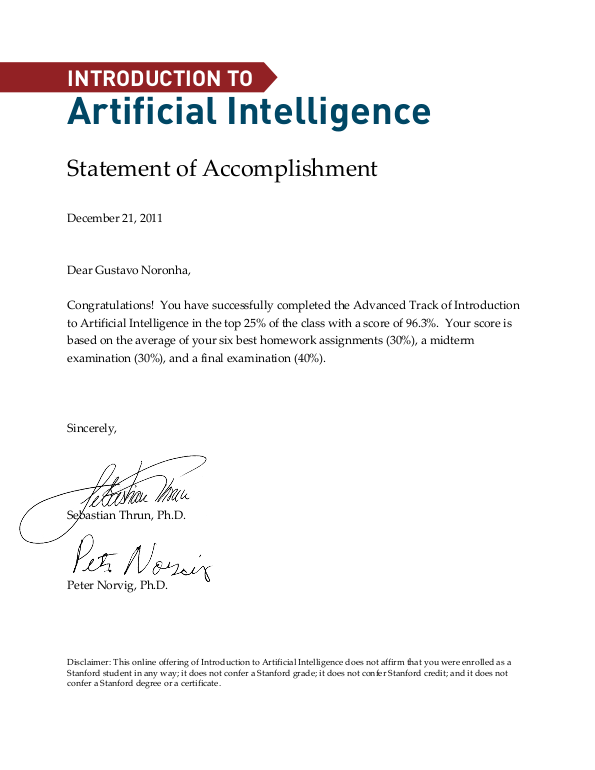
Statement of Accomplishment - AIClass 2011

Statement of Accomplishment - AIClass 2011

23 October 2011

Joey Hess: california postcard

Visiting California this week and having a great time. Experienced my first earthquake; visited the Noisebridge hackspace with Seth and Mako; and yesterday went up to Point Reyes and flew a kite from cliffs over Drake's Bay.

Up there even the cows have a view. Tomorrow, off to Google for the GitTogether.

16 September 2011

Raphaël Hertzog: How to triage bugs in the Debian bug tracking system

Triaging bugs is one of the easiest way to start contributing to Debian. I ll teach you the basics in this article. 1. Prerequisites All interactions with the Debian Bug Tracking System (BTS) happen through email so you need to have an email account with an address that you re willing to make public. All the mail that you send to the BTS will be archived and publicly available through its web-interface. This also means that you should have some spam filters in place because it will inevitably be harvested by spammers. :-( To ensure that this email address is consistently used by the various tools that we re going to use, it s a good idea to put this email address in the DEBEMAIL environment variable. You can also specify your full name in DEBFULLNAME (in case you don t want to use the name associated with your Unix account). You usually do this by modifying ~/.bashrc (if you use bash as login shell):

export DEBEMAIL="hertzog@debian.org"
export DEBFULLNAME="Rapha l Hertzog"
You should also install the devscripts package, it provides the bts command that we re going to use. 2. Find a package or a team with too many bugs You can literally pick any popular software that s in Debian, they almost always get more bug reports than the maintainers can handle. Instead of picking a package, you can also select a packaging team and concentrate your efforts on the set of packages managed by the team. In any case, it s important to receive the bug traffic for the packages that you re going to work on. If you went for a specific package, you should subscribe to the package via the Package Tracking System (there s a subscribe box on the bottom left corner once you selected the source package of interest). If you decided to help a team, there s usually a dedicated mailing list receiving all bug traffic. You can browse a list of packages with the most bugs if you have troubles finding a package to work on. A stack of bug reports to triage 3. Triage bugs! Bug triaging is all about making sure that bugs are correctly classified so that when a developer looks at the bug list, he can quickly find bugs with all the information required to be able to fix them! 3.1 Adding information to bug Adding supplementary information is easily done just by sending a mail to XXXX@bugs.debian.org (replace XXXX with the bug number). But often you want to reply to a message in the bug history, in that case bts --mbox show XXXX is for you. It will grab the corresponding mailbox and open a mailer (mutt by default) on it. Now you can directly reply in your favorite mailer. 3.2 Classifying bugs The Debian BTS uses tags (click the link and read the doc!) to classify bugs. bts tag XXXX + foo will add the foo tag (replace the + with a to remove a tag). If you want to explain why you re adding a tag, you should instead reply in the bug log as explained above, put control@bugs.debian.org in Bcc (Blind Carbon Copy) and start the body of your message with your tag command:

tag XXXX + foo
thanks
But what tag should you add? When a bug is submitted, you should try to reproduce the bug. If you can reproduce it, then tag the bug confirmed (example in #641710). If you can t, you should request more information (ex: a sample document triggering the bug, a configuration file, the output of some relevant command, etc.) until you can reproduce it or conclude that it was a user mistake. When you request supplementary information due to this, you should tag the bug unreproducible moreinfo (example in #526774). moreinfo should be later dropped when the requested information are provided, and unreproducible should be dropped if those information were enough to actually help reproduce the bug (example in #526774). During that initial evaluation, it s also worth differentiating packaging bugs (which are specific to Debian) from upstream bugs (which are relevant also for non-Debian users). The latter should be tagged upstream (and forwarded upstream if the bug is reproducible or contains enough information for the upstream developers, example in #635112). If you saw a (viable) patch in the bug log, the bug should be tagged patch . This is usually done by the patch submitter but sometimes it s forgotten (example in #632460). Take care though to not reinstate the patch tag if it was initially set but then dropped by the package maintainer after a review of the patch. If the title of the bug report is not descriptive enough, you can change it with a retitle XXXX new-title command (example in #170850). You can also change the severity of the bug report depending on the impact of the problem (with a command severity XXXX new-severity , what a surprise!). Request for new features are wishlist , most documentation problems are minor . On the other side of the scale, you can use important for bugs that are very annoying but that should not block a release. serious , grave and critical are used for release critical bugs, check the official definitions of the severities (examples in 502738 or #506498). 3.3 Closing non-bugs and bugs that are already fixed If your analysis of the bug report is that it s not really a bug but a user mistake, then you should close it by sending a mail to XXXX-done@bugs.debian.org with some explanations of the user s mistake so that he can get past his problem (example in #592853). If the problem was a real bug, but one that is apparently already fixed, you should try to quickly find the version that fixed the bug. If you can t find it in the changelog (there s a link to it in the PTS, or you can use /usr/share/doc/package/changelog.Debian.gz), you ll make the safe assumption that the upstream version you re currently using is the first one where this is fixed. Then you send a mail to XXXX-done@bugs.debian.org but you start your mail with Version: version-that-fixed-the-bug and continue with a small explanation of why you believe the bug to be fixed by this version (example in #122948). 3.4 Reassigning misfiled bug reports Bug reports are not always filed against the proper package. Users file bugs against applications where they experience the bugs, but the real bug might be in an underlying library or application. When that happens, you should use the reassign XXXX correct-package version command to get it filed against the correct package. The version parameter is optional but should be provided if possible, it should be the oldest version that we know to have the problem (example in #626232). 3.5 Forwarding bugs Forwarding bugs means opening bug reports in the upstream bug tracker for issues that have been reported in Debian but that applies to the upstream (unmodified) source code. Be sure to include all the relevant information and a link to the corresponding Debian bug. Depending on the upstream bug tracker, you might have to open an account to be able to file new bug reports. On the Debian side, you must record that a bug has been forwarded with bts forwarded XXXX upstream-bug-url . upstream-bug-url is the URL corresponding to the upstream bug report you created (ex: http://projects.ciarang.com/p/feed2omb/issues/21/ recorded in #609345 ). If the upstream authors fix the bug you reported, you can tag the Debian bug with fixed-upstream so that it s easier to find bugs to close when the next upstream release comes out (example in #637275). 3.6 Updating version information The Debian BTS uses version tracking to know which package versions are affected by a given bug. It s particularly important to have correct version information for release critical bugs since it might affect the migration of packages to testing. You can learn more on this topic here: http://wiki.debian.org/HowtoUseBTS. 4. More advice Colin Watson wrote a constructive rant explaining some mistakes that bug triagers are often doing. While it refers mainly to Ubuntu s launchpad, the advice apply equally as well to Debian. Check it out to become a better bug triager! Note that you can refer to this article with this shorter URL: http://raphaelhertzog.com/go/bugtriaging/

Do you want to read more tutorials like this one? Click here to subscribe to my free newsletter, you can opt to receive future articles by email.

One comment Liked this article? Click here. My blog is Flattr-enabled.

29 July 2011

Axel Beckert: Notes from the Emacs Skills Exchange Session at DebConf11

Thomas Koch asked at DebConf 11 for a Skills Exchange session about Emacs. As nobody stepped up for that session for quite some time, I did. But I knew just the answers to half of his questions by mind, so I left the remainder for someone else. Luckily Kan-Ru Chen and Sebastian Tennant stepped up for most of the remainder. We had a quite full meeting room and the notes that Kan-Ru and me prepared in Gobby (debian package) got collaboratively extended from being a braindump and guide what to talk about to a quite helpful, but compact and dense Emacs introduction. I ll probably use this as a base for an Emacs tutorial or workshop at some European FLOSS events, but I wouldn t be able to have such a good and comprehensive base for that without that Skills Exchange session. So thanks to all who contributed! Update, 02:31: There also seem to exist an Emacs Lisp implementation of the Obby protocol called Ebby, but it doesn t seem to support the 0.5 version of Gobby, only version 0.3.

18 July 2011

John Goerzen: Pooh, Books, and Dads

If I think back to fond memories of being with my dad during my childhood, there s one thing that always comes back first. It s those late summer evenings outside. Dad often had outdoor projects going on of some sort. I d go out there hanging around, maybe chatting, maybe playing with cats, or maybe doing something of my own. Dad often had an old AM radio sitting around and would be listening to a baseball game while working. As it got darker, lights would come on, and the bugs would start flying near them. Sometimes dad would be working just inside the barn, and the bugs would start flying in there, while some light poured out the big front door. There s something about that scratchy AM signal, the evening slowly getting darker, the slow pace of the baseball game, and just being around dad and a peripheral part of whatever he was doing that stirs a wonderfully fond recollection in me. I don t remember the specifics of any one of those times, nor do I really remember how often it happened, but it does stick with me. We ve had a routine in our house, starting early enough that neither of our boys know anything different, where right before bed, I read a book and sing a song to each of them individually. Last November, I was looking for some books to challenge Jacob a little more than what we had been reading. I found The Complete Winnie the Pooh used for $4 on Amazon. This contains the original A. A. Milne stories, not the Disney series. It had a few line drawings, but there were many pages without any. It s 352 pages and written in a rather dated form of British English. So for all these reasons, I wasn t sure if Jacob would like it. But it was $4 so I bought it. And Jacob was hooked. Each evening, we start bedtime with looking at the map of the 100-acre forest, just inside the cover. He gets to pick out 4 things for me to describe, and then we turn to our story. We usually read somewhere between 2 and 5 pages at bedtime, depending on how well he got ready without wasting time. And then we sing. A. A. Milne has his Pooh character make up songs throughout the book. They are printed with words only, no tune, so I make up a tune for them as we go. Jacob has taken to requesting these songs for his bedtime song as well. Jacob always gets to choose his bedtime story, and sometimes he chooses a different one but about 75% of the time, it s been Pooh. A few weeks ago, he started noticing that we were almost to the end. He got very concerned, asking what we d do next. I suggested a different book, which he didn t like. Then I pointed out that we could restart the Pooh stories from the beginning, which was exciting for him. Last night, we finished the book. The very last story was an interesting one, suggesting Christopher Robin growing up and no longer having imaginary adventures with the animals, but making Pooh promise to always be there for him. I don t think Jacob caught onto that meaning, though. When we finished it, we had this conversation: Jacob: Dad, is that the end? Me: Yes. Jacob, getting a big smile: Yay! So can we start back at the beginning tomorrow? Me: Sure! Jacob then gave a clap, shouted Yay! again, and was a very happy boy. Sometimes I wonder what our boys will remember in 25 years of their fun times with me. I don t know if Jacob will remember all the days reading about the animals in the 100-acre wood when he was 4, or maybe he ll remember watching train and combine videos, or playing radio hide-and-seek, or maybe something entirely different. But I have no doubt that I will remember sitting on the couch in his room, holding him on my lap, and reading a 350-page book to a loving 4-year-old. As Pooh aptly put it, Sometimes, the smallest things take up the most room in your heart.

4 June 2011

Jan Wagner: Monitoring related package updates

Some more about packaging nagios and icinga related packages can be found at our team site.

23 April 2011

Russell Coker: Links April 2011

Sebastian Thrun gave an interesting TED talk about the Google driverless car project and explains how his main aim is to avoid all the needless road deaths that are due to human error [1]. Finally a good use for the Google street-view type data! AnnMarie Thomas gave an interesting short TED talk about using play-dough to make circuits [2]. There are two recipies for play-dough, the one made with salt conducts well and the one made with sugar conducts poorly. That allows making wires with salty dough and insulators with the sugar dough. John Robb has published an interesting article about a Chinese fake revolutionary group that is triggering a backlash from Chinese security forces [3]. Even if this isn t accurate it seems like a good way to make people hate their local security forces and thus demand political change. Chris Rock made an interesting observation, we aren t making progress on racial issues, white people are getting less crazy [4]. Red Hill has an interesting article about 486 motherboards with fake cache chips that were sold in the 90 s [5]. One thing I disagree with is that they blame the customers for seeking low prices. When a white-box PC cost $2000 (which is $3000 in today s money) it made sense to try and get the cheapest option possible. Now that major department stores sell name-brand laptops for $400 it really makes sense to buy name-brand quality rather than white-box rubbish. IHollaBack.org is an interesting project to combat street harassment of women [6]. Psychology Today has an interesting article by Joe Navarro (former FBI counter-intelligence agent and author) about the serious implications of attempting to detect lies [7]. His main point is that most people over-estimate their ability to detect lies and because the legal system believes such claims from law enforcement officers many innocent people get found guilty and criminals get away free! Cory Doctorow wrote an informative article about the ways of persuading people to pay for content that can be obtained for free [8]. The main message seems to be that the big media companies are doing things the wrong way in everything that they do. The news satire site CBS Breaking News has an interesting about page explaining their mission [9]. They stopped their automated disaster generator after the Japanese Tsunami, while I can understand them wanting to keep some good taste and be sympathetic to the plight of the Japanese people it seems that they have forgotten that there is always a disaster somewhere. The typical bus plunge is just as bad as the Tsunami to the people on the bus and their relatives! Psychology Today has an interesting blog post by Satoshi Kanazawa explaining how criminals don t specialise, the psychological factors that make someone likely to commit one crime will make them likely to commit others, this makes it logical to collect DNA samples from all criminals [10]. Psychology Today has an interesting blog post by Dave Niose about a landmark US legal case in 1948 where Vashti McCollum had to escalate to the Supreme Court to allow her children to receive secular education [11]. We need something like this in Australia now as the religious extremists are going too far in indoctrinating children. Sam Richards gave a TED talk titled A Radical Experiment in Empathy which aims to teach Americans how to understand the way that people in the middle-east feel [12]. The comments suggest that his talk wasn t successful. Of course the fact that empathy doesn t have a clear definition in the English language doesn t help, and the fact that most people don t seem to interpret it in any way that corresponds to any dictionary and that most people seem unable to define what they mean by it makes things worse. At the moment I can t think of any examples of successfully teaching empathy to unwilling people. The people who want to learn will do so eventually, you can have some good success in helping them to learn faster. Kathryn Schulz gave an interesting TED talk about Being Wrong [13]. One interesting point that she makes concerns the way that people assume that people who disagree are ignorant, stupid, or evil instead of just having a different set of data or a different understanding of the same data. Of course it is possible for someone to be ignorant/stupid/evil AND have a different understanding. Marcin Jakubowski gave an inspiring TED talk about his project to develop free blueprints that allow anyone to create all machines needed to sustain civilisation with minimal cost [14]. His Open Source Ecology project has a blog and a wiki with blueprints and files for CAD/CAM [15]. Dave Meslin gave an insightful TED talk about apathy in the political process [16]. Among other things he compares council notices that supposedly request citizen input with adverts for running shoes which encourage people to buy them. One thing he didn t mention is the difference that technology can make, a short council advert with a QR code is probably a lot more useful than the current dense text-based adverts for today s audience.

26 February 2011

Vincent Fourmond: A praise for TikZ

I have been using xfig for ages to draw figures, and I appreciate it, especially combined with a small script I wrote based on an original idea by Seb Desreux at H&K, fig2ps, that allows painless integration of LaTeX code inside xfig figures. But recently, it seems that I've hit limitations in xfig. Mainly, if it is great when you want to produce sober figures, whenever you want to do something fancier, including shadings and the like, frustration comes in quickly (since it is purely impossible). I've spent a while looking for a decent alternative, until I had a look again at pgf, which since turned into TikZ. That was amazing. It integrates painlessly within LaTeX and is simply great to work with. Drawing complex diagrams with noes and complex relations between them is trivial. It handles moving the nodes very gracefully, and styling can be done in a CSS-like fashion (though it definitely isn't CSS), which means you can first concentrate on structure and then turn your graph into something nice, while for all the other programs I know, you have to handle both structural and stylistic aspects at the same time. Sure enough, you need to like the command-driven approach, as mice won't come in too useful here... As a side note, I wanted to express my admiration of Till Tantau's (TikZ's author) mastery of (La)TeX: TikZ can be seen as an interpreter of a simple graphical language written in pure TeX, which is, according to my humble experience with dirty trick in TeX, is simply amazing. Many thanks, Till !

16 February 2011

Russell Coker: Mplayer, Squeeze, and SE Linux on i386

I ve just updated my SE Linux repository for Squeeze to better support running mplayer on the i386 architecture, below is the APT sources.list line:deb http://www.coker.com.au squeeze selinuxThe first issue is a bug in the compilation of the SDL libraries which makes them request an executable stack (bug #613535). Recompiling the libraries on my system caused this bug to go away, so it must be some issue with the compilation process. I have previously summarised the execstack issue, but we haven t solved this yet [1].The next issue is the fact that the ffmpeg libraries require execmod access (see my previous post for the details of the execmod issue [2]. The execmod issue with ffmpeg is pretty much the same as it was when I first wrote about the issue in 2008 [3]Finally the allow_execmem boolean needs to be set on i386 with the command setsebool -P allow_execmem 1 to allow libGL the access it needs. This is an issue I haven t been able to solve, I don t know why libGL needs write and execute access to memory, I posted to the SE Linux list about this some time ago but didn t get any good answers [4]. Any suggestions would be appreciated.

Next.

Previous.