Search Results: "rul"

10 October 2025

Dirk Eddelbuettel: RcppArmadillo 15 CRAN Transition: Offering Office Hours

armadillo image Armadillo is a powerful and expressive C++ template library for linear algebra and scientific computing. It aims towards a good balance between speed and ease of use, has a syntax deliberately close to Matlab, and is useful for algorithm development directly in C++, or quick conversion of research code into production environments. RcppArmadillo integrates this library with the R environment and language and is widely used by (currently) 1273 other packages on CRAN, downloaded 41.8 million times (per the partial logs from the cloud mirrors of CRAN), and the CSDA paper (preprint / vignette) by Conrad and myself has been cited 651 times according to Google Scholar. Armadillo 15 brought changes. We mentioned these in the 15.0.2-1 and 15.0.2-1 release blog posts: (The second point is a consequence of the first. Prior to C++14, deprecation notes were issue via a macro, and the macro was set up by Conrad in the common way of allowing an override, which we took advantage of in RcppArmadillo effectively shielding downstream package. In C++14 this is now an attribute, and those cannot be suppressed.) We tested this then-upcoming change extensively: Thirteen reverse dependency runs expoloring different settings and leading to the current package setup where an automatic fallback to the last Armadillo 14 release offers fallback for hardwired C++11 use and Armadillo 15 others. Given the 1200+ reverse deoendencies, this took considerable time. All this was also quite extensively discussed with CRAN (especially Kurt Hornik) and documented / controlled via a series of issue tickets starting with overall issue #475 covering the subissues: The sixty pull requests (or emailed patches) followed a suggestion by CRAN to rank-order packages affected by their reverse dependencies sorted in descending package count. Now, while this change from Armadillo 14 to 15 was happening, CRAN also tightened the C++11 requirement for packages and imposed a deadline for changes. In discussion, CRAN also convinced me that a deadline for the deprecation warning, now unmasked, was viable (and is in fairness commensurate with similar, earlier changes triggered by changes in the behaviour of either gcc/g++ or clang/clang++). So we now have two larger deadline campaigns affecting the package (and as always there are some others). These deadlines are coming close: October 17 for the C++11 transition, and October 23 for the deprecation warning. Now, as became clear preparing the sixty pull requests and patches, these changes are often relatively straightforward. For the former, remove the C++11 enforcement and the package will likely build without changes. For the latter, make the often simple (e.g. swith from arma::is_finite to std::isfinite) change. I did not encounter anything much more complicated yet. The number of affected packages approximated by looking at all packages with a reverse dependency on RcppArmadillo and having a deadline can be computed as
suppressMessages(library(data.table))
D <- setDT(tools::CRAN_package_db())
P <- data.table(Package=tools::package_dependencies("RcppArmadillo", reverse=TRUE, db=D)[[1]])
W <- merge(P, D, all.x=TRUE)[is.na(Deadline)==FALSE,c(1:2,38,68)]
W

W[, nrevdep := length(tools::package_dependencies(Package, reverse=TRUE, recursive=TRUE, db=D)[[1]]), by=Package]
W[order(-nrevdep)]
and has been declining steadily from over 350 to now under 200. For that a big and heartfelt Thank You! to all the maintainers who already addressed their package and uploaded updated packages to CRAN. That rocks, and is truly appreciated. Yet the number is still large. And while issues #489 and #491 show a number of pending packages that have merged but not uploaded (yet?) there are also all the other packages I have not been able to look at in detail. While preparing sixty PRs / patches was viable over a period of a good week, I cannot create these for all packages. So with that said, here is a different suggestion for help: All of next week, I will be holding open door open source office hours online two times each day (11:00h to 13:00h Central, 16:00h to 18:00h Central) which can be booked via this booking link for Monday to Friday next week in either fifteen or thirty minutes slots you can book. This should offer Google Meet video conferencing (with jitsi as an alternate, you should be able to control that) which should allow for screen sharing. (I cannot hookup Zoom as my default account has organization settings with a different calendar integration.) If you are reading this and have a package that still needs helps, I hope to see you in the Open Source Office Hours to aid in the RcppArmadillo package updates for your package. Please book a slot!

This post by Dirk Eddelbuettel originated on his Thinking inside the box blog. If you like this or other open-source work I do, you can sponsor me at GitHub.

8 October 2025

Colin Watson: Free software activity in September 2025

About 90% of my Debian contributions this month were sponsored by Freexian. You can also support my work directly via Liberapay or GitHub Sponsors. Some months I feel like I m pedalling furiously just to keep everything in a roughly working state. This was one of those months. Python team I upgraded these packages to new upstream versions: I had to spend a fair bit of time this month chasing down build/test regressions in various packages due to some other upgrades, particularly to pydantic, python-pytest-asyncio, and rust-pyo3: After some upstream discussion I requested removal of pydantic-compat, since it was more trouble than it was worth to keep it working with the latest pydantic version. I filed dh-python: pybuild-plugin-pyproject doesn t know about headers and added it to Python/PybuildPluginPyproject, and converted some packages to pybuild-plugin-pyproject: I updated dh-python to suppress generated dependencies that would be satisfied by python3 >= 3.11. pkg_resources is deprecated. In most cases replacing it is a relatively simple matter of porting to importlib.resources, but packages that used its old namespace package support need more complicated work to port them to implicit namespace packages. We had quite a few bugs about this on zope.* packages, but fortunately upstream did the hard part of this recently. I went round and cleaned up most of the remaining loose ends, with some help from Alexandre Detiste. Some of these aren t completely done yet as they re awaiting new upstream releases: This work also caused a couple of build regressions, which I fixed: I fixed jupyter-client so that its autopkgtests would work in Debusine. I fixed waitress to build with the nocheck profile. I fixed several other build/test failures: I fixed some other bugs: Code reviews Other bits and pieces I fixed several CMake 4 build failures: I got CI for debbugs passing (!22, !23). I fixed a build failure with GCC 15 in trn4. I filed a release-notes bug about the tzdata reorganization in the trixie cycle. I filed and fixed a git-dpm regression with bash 5.3. I upgraded libfilter-perl to a new upstream version. I optimized some code in ubuntu-dev-tools that made O(1) HTTP requests when it could instead make O(n).

30 September 2025

Russ Allbery: Review: Deep Black

Review: Deep Black, by Miles Cameron
Series: Arcana Imperii #2
Publisher: Gollancz
Copyright: 2024
ISBN: 1-3996-1506-8
Format: Kindle
Pages: 509
Deep Black is a far-future science fiction novel and the direct sequel to Artifact Space. You do not want to start here. I regretted not reading the novels closer together and had to refresh my memory of what happened in the first book. The shorter fiction in Beyond the Fringe takes place between the two series novels and leads into some of the events in this book, although reading it is optional. Artifact Space left Marca Nbaro at the farthest point of the voyage of the Greatship Athens, an unexpected heroine and now well-integrated into the crew. On a merchant ship, however, there's always more work to be done after a heroic performance. Deep Black opens with that work: repairs from the events of the first book, the never-ending litany of tasks required to keep the ship running smoothly, and of course the trade with aliens that drew them so far out into the Deep Black. We knew early in the first book that this wouldn't be the simple, if long, trading voyage that most of the crew of the Athens was expecting, but now they have to worry about an unsettling second group of aliens on top of a potential major war between human factions. They don't yet have the cargo they came for, they have to reconstruct their trading post, and they're a very long way from home. Marca also knows, at this point in the story, that this voyage had additional goals from the start. She will slowly gain a more complete picture of those goals during this novel. Artifact Space was built around one of the most satisfying plots in military science fiction (at least to me): a protagonist who benefits immensely from the leveling effect and institutional inclusiveness of the military slowly discovering that, when working at its best, the military can be a true meritocracy. (The merchant marine of the Athens is not military, precisely, since it's modeled on the trading ships of Venice, but it's close enough for the purposes of this plot.) That's not a plot that lasts into a sequel, though, so Cameron had to find a new spine for the second half of the story. He chose first contact (of a sort) and space battle. The space battle parts are fine. I read a ton of children's World War II military fiction when I was a boy, and I always preferred the naval battles to the land battles. This part of Deep Black reminded me of those naval battles, particularly a book whose title escapes me about the Arctic convoys to the Soviet Union. I'm more interested in character than military adventure these days, but every once in a while I enjoy reading about a good space battle. This was not an exemplary specimen of the genre, but it delivered on all the required elements. The first contact part was more original, in part because Cameron chose an interesting medium ground between total incomprehensibility and universal translators. He stuck with the frustrations of communication for considerably longer than most SF authors are willing to write, and it worked for me. This is the first book I've read in a while where superficial alien fluency with the mere words of a human language masks continuing profound mutual incomprehension. The communication difficulties are neither malicious nor a setup for catastrophic misunderstanding, but an intrinsic part of learning about a truly alien species. I liked this, even though it makes for slower and more frustrating progress. It felt more believable than a lot of first contact, and it forced the characters to take risks and act on hunches and then live with the consequences. One of the other things that Cameron does well is maintain the steady rhythm of life on a working ship as a background anchor to the story. I've read a lot of science fiction that shows the day-to-day routine only until something more interesting and plot-focused starts happening and then seems to forget about it entirely. Not here. Marca goes through intense and adrenaline-filled moments requiring risk and fast reactions, and then has to handle promotion write-ups, routine watches, and studying for advancement. Cameron knows that real battles involve long periods of stressful waiting and incorporates them into the book without making them too boring, which requires a lot of writing skill. I prefer the emotional magic of finding a place where one belongs, so I was not as taken with Deep Black as I was with Artifact Space, but that's the inevitable result of plot progression and not really a problem with this book. Marca is absurdly central to the story in ways that have a whiff of "chosen one" dynamics, but if one can suspend one's disbelief about that, the rest of the book is solid. This is, fundamentally, a book about large space battles, so save it when you're in the mood for that sort of story, but it was a satisfying continuation of the series. I will definitely keep reading. Recommended if you enjoyed Artifact Space. If you didn't, Deep Black isn't going to change your mind. Followed by Whalesong, which is not yet released (and is currently in some sort of limbo for pre-orders in the US, which I hope will clear up). Rating: 7 out of 10

29 September 2025

Russ Allbery: Review: The Incandescent

Review: The Incandescent, by Emily Tesh
Publisher: Tor
Copyright: 2025
ISBN: 1-250-83502-X
Format: Kindle
Pages: 417
The Incandescent is a stand-alone magical boarding school fantasy.
Your students forgot you. It was natural for them to forget you. You were a brief cameo in their lives, a walk-on character from the prologue. For every sentimental my teacher changed my life story you heard, there were dozens of my teacher made me moderately bored a few times a week and then I got through the year and moved on with my life and never thought about them again. They forgot you. But you did not forget them.
Doctor Saffy Walden is Director of Magic at Chetwood, an elite boarding school for prospective British magicians. She has a collection of impressive degrees in academic magic, a specialization in demonic invocation, and a history of vague but lucrative government job offers that go with that specialty. She turned them down to be a teacher, and although she's now in a mostly administrative position, she's a good teacher, with the usual crop of promising, lazy, irritating, and nervous students. As the story opens, Walden's primary problem is Nikki Conway. Or, rather, Walden's primary problem is protecting Nikki Conway from the Marshals, and the infuriating Laura Kenning in particular. When Nikki was seven, she summoned a demon who killed her entire family and left her a ward of the school. To Laura Kenning, that makes her a risk who should ideally be kept far away from invocation. To Walden, that makes Nikki a prodigious natural talent who is developing into a brilliant student and who needs careful, professional training before she's tempted into trying to learn on her own. Most novels with this setup would become Nikki's story. This one does not. The Incandescent is Walden's story. There have been a lot of young-adult magical boarding school novels since Harry Potter became a mass phenomenon, but most of them focus on the students and the inevitable coming-of-age story. This is a story about the teachers: the paperwork, the faculty meetings, the funding challenges, the students who repeat in endless variations, and the frustrations and joys of attempting to grab the interest of a young mind. It's also about the temptation of higher-paying, higher-status, and less ethical work, which however firmly dismissed still nibbles around the edges. Even if you didn't know Emily Tesh is herself a teacher, you would guess that before you get far into this novel. There is a vividness and a depth of characterization that comes from being deeply immersed in the nuance and tedium of the life that your characters are living. Walden's exasperated fondness for her students was the emotional backbone of this book for me. She likes teenagers without idealizing the process of being a teenager, which I think is harder to pull off in a novel than it sounds.
It was hard to quantify the difference between a merely very intelligent student and a brilliant one. It didn't show up in a list of exam results. Sometimes, in fact, brilliance could be a disadvantage when all you needed to do was neatly jump the hoop of an examiner's grading rubric without ever asking why. It was the teachers who knew, the teachers who could feel the difference. A few times in your career, you would have the privilege of teaching someone truly remarkable; someone who was hard work to teach because they made you work harder, who asked you questions that had never occurred to you before, who stretched you to the very edge of your own abilities. If you were lucky as Walden, this time, had been lucky your remarkable student's chief interest was in your discipline: and then you could have the extraordinary, humbling experience of teaching a child whom you knew would one day totally surpass you.
I also loved the world-building, and I say this as someone who is generally not a fan of demons. The demons themselves are a bit of a disappointment and mostly hew to one of the stock demon conventions, but the rest of the magic system is deep enough to have practitioners who approach it from different angles and meaty enough to have some satisfying layered complexity. This is magic, not magical science, so don't expect a fully fleshed-out set of laws, but the magical system felt substantial and satisfying to me. Tesh's first novel, Some Desperate Glory, was by far my favorite science fiction novel of 2023. This is a much different book, which says good things about Tesh's range and the potential of her work yet to come: adult rather than YA, fantasy rather than science fiction, restrained and subtle in places where Some Desperate Glory was forceful and pointed. One thing the books do have in common, though, is some structure, particularly the false climax near the midpoint of the book. I like the feeling of uncertainty and possibility that gives both books, but in the case of The Incandescent, I was not quite in the mood for the second half of the story. My problem with this book is more of a reader preference than an objective critique: I was in the mood for a story about a confident, capable protagonist who was being underestimated, and Tesh was writing a novel with a more complicated and fraught emotional arc. (I'm being intentionally vague to avoid spoilers.) There's nothing wrong with the story that Tesh wanted to tell, and I admire the skill with which she did it, but I got a tight feeling in my stomach when I realized where she was going. There is a satisfying ending, and I'm still very happy I read this book, but be warned that this might not be the novel to read if you're in the mood for a purer competence porn experience. Recommended, and I am once again eagerly awaiting the next thing Emily Tesh writes (and reminding myself to go back and read her novellas). Content warnings: Grievous physical harm, mind control, and some body horror. Rating: 8 out of 10

23 September 2025

Ravi Dwivedi: Singapore Trip

In December 2024, I went on a trip through four countries - Singapore, Malaysia, Brunei, and Vietnam - with my friend Badri. This post covers our experiences in Singapore. I took an IndiGo flight from Delhi to Singapore, with a layover in Chennai. At the Chennai airport, I was joined by Badri. We had an early morning flight from Chennai that would land in Singapore in the afternoon. Within 48 hours of our scheduled arrival in Singapore, we submitted an arrival card online. At immigration, we simply needed to scan our passports at the gates, which opened automatically to let us through, and then give our address to an official nearby. The process was quick and smooth, but it unfortunately meant that we didn t get our passports stamped by Singapore. Before I left the airport, I wanted to visit the nature-themed park with a fountain I saw in pictures online. It is called Jewel Changi, and it took quite some walking to get there. After reaching the park, we saw a fountain that could be seen from all the levels. We roamed around for a couple of hours, then proceeded to the airport metro station to get to our hotel.
Jewel Changi A shot of Jewel Changi. Photo by Ravi Dwivedi. Released under the CC-BY-SA 4.0.
There were four ATMs on the way to the metro station, but none of them provided us with any cash. This was the first country (outside India, of course!) where my card didn t work at ATMs. To use the metro, one can tap the EZ-Link card or bank cards at the AFC gates to get in. You cannot buy tickets using cash. Before boarding the metro, I used my credit card to get Badri an EZ-Link card from a vending machine. It was 10 Singapore dollars ( 630) - 5 for the card, and 5 for the balance. I had planned to use my Visa credit card to pay for my own fare. I was relieved to see that my card worked, and I passed through the AFC gates. We had booked our stay at a hostel named Campbell s Inn, which was the cheapest we could find in Singapore. It was 1500 per night for dorm beds. The hostel was located in Little India. While Little India has an eponymous metro station, the one closest to our hostel was Rochor. On the way to the hostel, we found out that our booking had been canceled. We had booked from the Hostelworld website, opting to pay the deposit in advance and to pay the balance amount in person upon reaching. However, Hostelworld still tried to charge Badri s card again before our arrival. When the unauthorized charge failed, they sent an automatic message saying we tried to charge and to contact them soon to avoid cancellation, which we couldn t do as we were in the plane. Despite this, we went to the hostel to check the status of our booking. The trip from the airport to Rochor required a couple of transfers. It was 2 Singapore dollars (approx. 130) and took approximately an hour. Upon reaching the hostel, we were informed that our booking had indeed been canceled, and were not given any reason for the cancelation. Furthermore, no beds were available at the hostel for us to book on the spot. We decided to roam around and look for accommodation at other hostels in the area. Soon, we found a hostel by the name of Snooze Inn, which had two beds available. It was 36 Singapore dollars per person (around 2300) for a dormitory bed. Snooze Inn advertised supporting RuPay cards and UPI. Some other places in that area did the same. We paid using my card. We checked in and slept for a couple of hours after taking a shower. By the time we woke up, it was dark. We met Praveen s friend Sabeel to get my FLX1 phone. We also went to Mustafa Center nearby to exchange Indian rupees for Singapore dollars. Mustafa Center also had a shopping center with shops selling electronic items and souvenirs, among other things. When we were dropping off Sabeel at a bus stop, we discovered that the bus stops in Singapore had a digital board mentioning the bus routes for the stop and the number of minutes each bus was going to take. In addition to an organized bus system, Singapore had good pedestrian infrastructure. There were traffic lights and zebra crossings for pedestrians to cross the roads. Unlike in Indian cities, rules were being followed. Cars would stop for pedestrians at unmanaged zebra crossings; pedestrians would in turn wait for their crossing signal to turn green before attempting to walk across. Therefore, walking in Singapore was easy. Traffic rules were taken so seriously in Singapore I (as a pedestrian) was afraid of unintentionally breaking them, which could get me in trouble, as breaking rules is dealt with heavy fines in the country. For example, crossing roads without using a marked crossing (while being within 50 meters of it) - also known as jaywalking - is an offence in Singapore. Moreover, the streets were litter-free, and cleanliness seemed like an obsession. After exploring Mustafa Center, we went to a nearby 7-Eleven to top up Badri s EZ-Link card. He gave 20 Singapore dollars for the recharge, which credited the card by 19.40 Singapore dollars (0.6 dollars being the recharge fee). When I was planning this trip, I discovered that the World Chess Championship match was being held in Singapore. I seized the opportunity and bought a ticket in advance. The next day - the 5th of December - I went to watch the 9th game between Gukesh Dommaraju of India and Ding Liren of China. The venue was a hotel on Sentosa Island, and the ticket was 70 Singapore dollars, which was around 4000 at the time. We checked out from our hostel in the morning, as we were planning to stay with Badri s aunt that night. We had breakfast at a place in Little India. Then we took a couple of buses, followed by a walk to Sentosa Island. Paying the fare for the buses was similar to the metro - I tapped my credit card in the bus, while Badri tapped his EZ-Link card. We also had to tap it while getting off. If you are tapping your credit card to use public transport in Singapore, keep in mind that the total amount of all the trips taken on a day is deducted at the end. This makes it hard to determine the cost of individual trips. For example, I could take a bus and get off after tapping my card, but I would have no way to determine how much this journey cost. When you tap in, the maximum fare amount gets deducted. When you tap out, the balance amount gets refunded (if it s a shorter journey than the maximum fare one). So, there is incentive for passengers not to get off without tapping out. Going by your card statement, it looks like all that happens virtually, and only one statement comes in at the end. Maybe this combining only happens for international cards. We got off the bus a kilometer away from Sentosa Island and walked the rest of the way. We went on the Sentosa Boardwalk, which is itself a tourist attraction. I was using Organic Maps to navigate to the hotel Resorts World Sentosa, but Organic Maps route led us through an amusement park. I tried asking the locals (people working in shops) for directions, but it was a Chinese-speaking region, and they didn t understand English. Fortunately, we managed to find a local who helped us with the directions.
Sentosa Boardwalk A shot of Sentosa Boardwalk. Photo by Ravi Dwivedi. Released under the CC-BY-SA 4.0.
Following the directions, we somehow ended up having to walk on a road which did not have pedestrian paths. Singapore is a country with strict laws, so we did not want to walk on that road. Avoiding that road led us to the Michael Hotel. There was a person standing at the entrance, and I asked him for directions to Resorts World Sentosa. The person told me that the bus (which was standing at the entrance) would drop me there! The bus was a free service for getting to Resorts World Sentosa. Here I parted ways with Badri, who went to his aunt s place. I got to the Resorts Sentosa and showed my ticket to get in. There were two zones inside - the first was a room with a glass wall separating the audience and the players. This was the room to watch the game physically, and resembled a zoo or an aquarium. :) The room was also a silent room, which means talking or making noise was prohibited. Audiences were only allowed to have mobile phones for the first 30 minutes of the game - since I arrived late, I could not bring my phone inside that room. The other zone was outside this room. It had a big TV on which the game was being broadcast along with commentary by David Howell and Jovanka Houska - the official FIDE commentators for the event. If you don t already know, FIDE is the authoritative international chess body. I spent most of the time outside that silent room, giving me an opportunity to socialize. A lot of people were from Singapore. I saw there were many Indians there as well. Moreover, I had a good time with Vasudevan, a journalist from Tamil Nadu who was covering the match. He also asked questions to Gukesh during the post-match conference. His questions were in Tamil to lift Gukesh s spirits, as Gukesh is a Tamil speaker. Tea and coffee were free for the audience. I also bought a T-shirt from their stall as a souvenir. After the game, I took a shuttle bus from Resorts World Sentosa to a metro station, then travelled to Pasir Ris by metro, where Badri was staying with his aunt. I thought of getting something to eat, but could not find any caf s or restaurants while I was walking from the Pasir Ris metro station to my destination, and was positively starving when I got there. Badri s aunt s place was an apartment in a gated community. On the gate was a security guard who asked me the address of the apartment. Upon entering, there were many buildings. To enter the building, you need to dial the number of the apartment you want to go to and speak to them. I had seen that in the TV show Seinfeld, where Jerry s friends used to dial Jerry to get into his building. I was afraid they might not have anything to eat because I told them I was planning to get something on the way. This was fortunately not the case, and I was relieved to not have to sleep with an empty stomach. Badri s uncle gave us an idea of how safe Singapore is. He said that even if you forget your laptop in a public space, you can go back the next day to find it right there in the same spot. I also learned that owning cars was discouraged in Singapore - the government imposes a high registration fee on them, while also making public transport easy to use and affordable. I also found out that 7-Eleven was not that popular among residents in Singapore, unlike in Malaysia or Thailand. The next day was our third and final day in Singapore. We had a bus in the evening to Johor Bahru in Malaysia. We got up early, had breakfast, and checked out from Badri s aunt s home. A store by the name of Cat Socrates was our first stop for the day, as Badri wanted to buy some stationery. The plan was to take the metro, followed by the bus. So we got to Pasir Ris metro station. Next to the metro station was a mall. In the mall, Badri found an ATM where our cards worked, and we got some Singapore dollars. It was noon when we reached the stationery shop mentioned above. We had to walk a kilometer from the place where the bus dropped us. It was a hot, sunny day in Singapore, so walking was not comfortable. We had to go through residential areas in Singapore. We saw some non-touristy parts of Singapore. After we were done with the stationery shop, we went to a hawker center to get lunch. Hawker centers are unique to Singapore. They have a lot of shops that sell local food at cheap prices. It is similar to a food court. However, unlike the food courts in malls, hawker centers are open-air and can get quite hot.
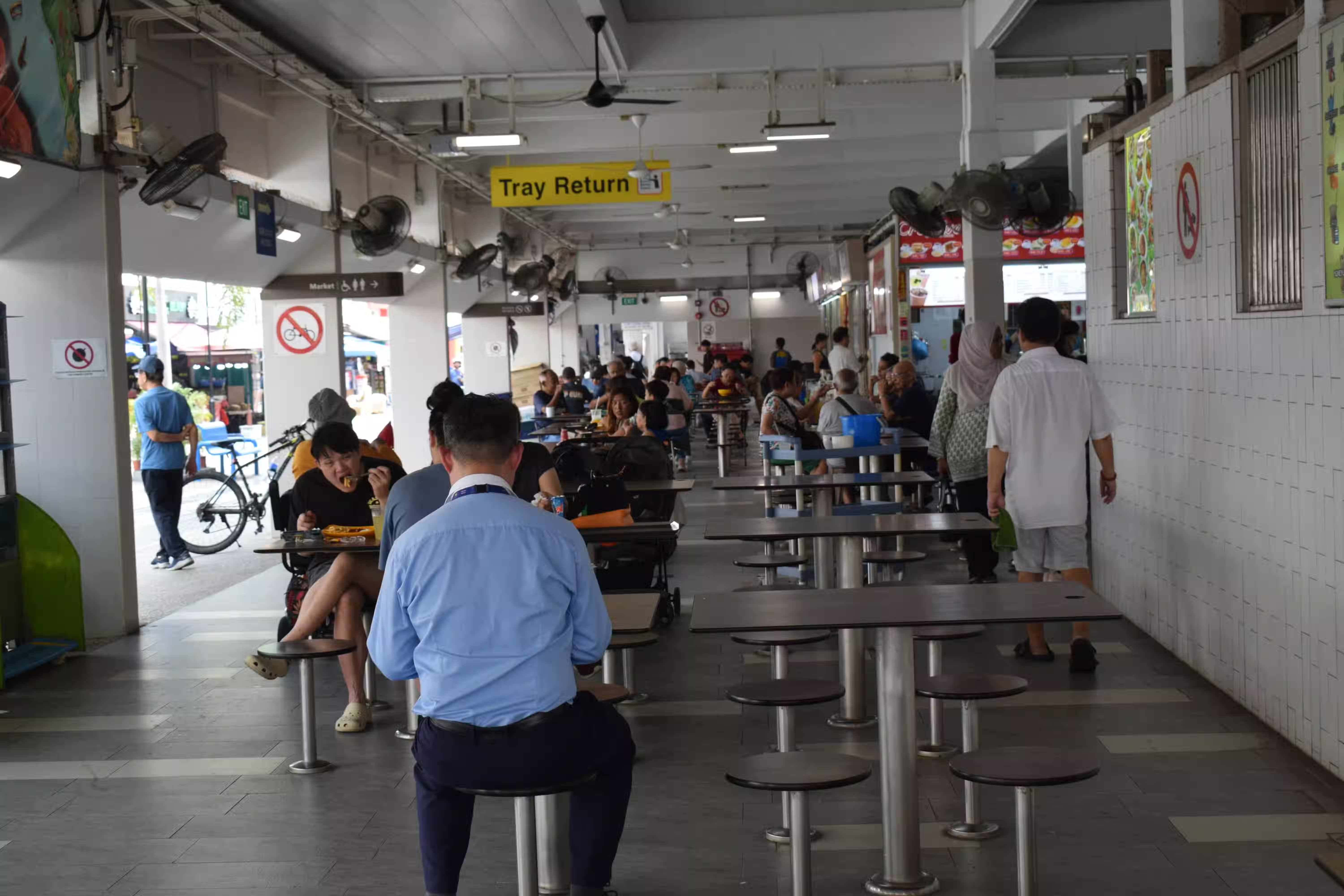
Jewel Changi This is the hawker center we went to. Photo by Ravi Dwivedi. Released under the CC-BY-SA 4.0.
To have something, you just need to buy it from one of the shops and find a table. After you are done, you need to put your tray in the tray-collecting spots. I had a kaya toast with chai, since there weren t many vegetarian options. I also bought a persimmon from a nearby fruit vendor. On the other hand, Badri sampled some local non-vegetarian dishes.
A sign saying, 'No table littering, by law.' Table littering at the hawker center was prohibited by law. Photo by Ravi Dwivedi. Released under the CC-BY-SA 4.0.
Next, we took a metro to Raffles Place, as we wanted to visit Merlion, the icon of Singapore. It is a statue having the head of a lion and the body of a fish. While getting through the AFC gates, my card was declined. Therefore, I had to buy an EZ-Link card, which I had been avoiding because the card itself costs 5 Singapore dollars. From the Raffles Place metro station, we walked to Merlion. The place also gave a nice view of Marina Bay Sands. It was filled with tourists clicking pictures, and we also did the same.
Merlion from behind Merlion from behind, giving a good view of Marina Bay Sands. Photo by Ravi Dwivedi. Released under the CC-BY-SA 4.0.
After this, we went to the bus stop to catch our bus to the border city of Johor Bahru, Malaysia. The bus was more than an hour late, and we worried that we had missed the bus. I asked an Indian woman at the stop who also planned to take the same bus, and she told us that the bus was late. Finally, our bus arrived, and we set off for Johor Bahru. Before I finish, let me give you an idea of my expenditure. Singapore is an expensive country, and I realized that expenses could go up pretty quickly. Overall, my stay in Singapore for 3 days and 2 nights was approx. 5500 rupees. That too, when we stayed one night at Badri s aunt s place (so we didn t have to pay for accomodation for one of the nights) and didn t have to pay for a couple of meals. This amount doesn t include the ticket for the chess game, but includes the costs of getting there. If you are in Singapore, it is likely you will pay a visit to Sentosa Island anyway. Stay tuned for our experiences in Malaysia! Credits: Thanks to Dione, Sahil, Badri and Contrapunctus for reviewing the draft. Thanks to Bhe for spotting a duplicate sentence.

9 September 2025

John Goerzen: btrfs on a Raspberry Pi

I m something of a filesystem geek, I guess. I first wrote about ZFS on Linux 14 years ago, and even before I used ZFS, I had used ext2/3/4, jfs, reiserfs, xfs, and no doubt some others. I ve also used btrfs. I last posted about it in 2014, when I noted it has some advantages over ZFS, but also some drawbacks, including a lot of kernel panics. Since that comparison, ZFS has gained trim support and btrfs has stabilized. The btrfs status page gives you an accurate idea of what is good to use on btrfs. Background: Moving towards ZFS and btrfs I have been trying to move everything away from ext4 and onto either ZFS or btrfs. There are generally several reasons for that:
  1. The checksums for every block help detect potential silent data corruption
  2. Instant snapshots make consistent backups of live systems a lot easier, and without the hassle and wasted space of LVM snapshots
  3. Transparent compression and dedup can save a lot of space in storage-constrained environments
For any machine with at least 32GB of RAM (plus my backup server, which has only 8GB), I run ZFS. While it lacks some of the flexibility of btrfs, it has polish. zfs list -o space shows a useful space accounting. zvols can be behind VMs. With my project simplesnap, I can easily send hourly backups with ZFS, and I choose to send them over NNCP in most cases. I have a few VMs in the cloud (running Debian, of course) that I use to host things like this blog, my website, my gopher site, the quux NNCP public relay, and various other things. In these environments, storage space can be expensive. For that matter, so can RAM. ZFS is RAM-hungry, so that rules out ZFS. I ve been running btrfs in those environments for a few years now, and it s worked out well. I do async dedup, lzo or zstd compression depending on the needs, and the occasional balance and defrag. Filesystems on the Raspberry Pi I run Debian trixie on all my Raspberry Pis; not Raspbian or Raspberry Pi OS for a number of reasons. My 8-yr-old uses a Raspberry Pi 400 as her primary computer and loves it! She doesn t do web browsing, but plays Tuxpaint, some old DOS games like Math Blaster via dosbox, and uses Thunderbird for a locked-down email account. But it was SLOW. Just really, glacially, slow, especially for Thunderbird. My first step to address that was to get a faster MicroSD card to hold the OS. That was a dramatic improvement. It s still slow, but a lot faster. Then, I thought, maybe I could use btrfs with LZO compression to reduce the amount of I/O and speed things up further? Analysis showed things were mostly slow due to I/O, not CPU, constraints. The conversion Rather than use the btrfs in-place conversion from ext4, I opted to dar it up (like tar), run mkfs.btrfs on the SD card, then unpack the archive back onto it. Easy enough, right? Well, not so fast. The MicroSD card is 128GB, and the entire filesystem is 6.2GB. But after unpacking 100MB onto it, I got an out of space error. btrfs has this notion of block groups. By default, each block group is dedicated to either data or metadata. btrfs fi df and btrfs fi usage will show you details about the block groups. btrfs allocates block groups greedily (the ssd_spread mount option I use may have exacerbated this). What happened was it allocated almost the entire drive to data block groups, trying to spread the data across it. It so happened that dar archived some larger files first (maybe /boot), so btrfs was allocating data and metadata blockgroups assuming few large files. But then it started unpacking one of the directories in /usr with lots of small files (maybe /usr/share/locale). It quickly filled up the metadata block group, and since the entire SD card had been allocated to different block groups, I got ENOSPC. Deleting a few files and running btrfs balance resolved it; now it allocated 1GB to metadata, which was plenty. I re-ran the dar extract and now everything was fine. See more details on btrfs balance and block groups. This was the only btrfs problem I encountered. Benchmarks I timed two things prior to switching to btrfs: how long it takes to boot (measured from the moment I turn on the power until the moment the XFCE login box is displayed), and how long it takes to start Thunderbird. After switching to btrfs with LZO compression, somewhat to my surprise, both measures were exactly the same! Why might this be? It turns out that SD cards are understood to be pathologically bad with random read performance. Boot and Thunderbird both are likely doing a lot of small random reads, not large streaming reads. Therefore, it may be that even though I have reduced the total I/O needed, the impact is unsubstantial because the real bottleneck is the seeks across the disk. Still, I gain the better backup support and silent data corruption prevention, so I kept btrfs. SSD mount options and MicroSD endurance btrfs has several mount options specifically relevant to SSDs. Aside from the obvious trim support, they are ssd and ssd_spread. The documentation on this is vague and my attempts to learn more about it found a lot of information that was outdated or unsubstantiated folklore. Some reports suggest that older SSDs will benefit from ssd_spread, but that it may have no effect or even a harmful effect on newer ones, and can at times cause fragmentation or write amplification. I could find nothing to back this up, though. And it seems particularly difficult to figure out what kind of wear leveling SSD firmware does. MicroSD firmware is likely to be on the less-advanced side, but still, I have no idea what it might do. In any case, with btrfs not updating blocks in-place, it should be better than ext4 in the most naive case (no wear leveling at all) but may have somewhat more write traffic for the pathological worst case (frequent updates of small portions of large files). One anecdotal report I read and can t find anymore, somehow was from a person that had set up a sort of torture test for SD cards, with reports that ext4 lasted a few weeks or months before the MicroSDs failed, while btrfs lasted years. If you are looking for a MicroSD card, by the way, The Great MicroSD Card Survey is a nice place to start. For longevity: I mount all my filesystems with noatime already, so I continue to recommend that. You can also consider limiting the log size in /etc/systemd/journald.conf, running daily fstrim (which may be more successful than live trims in all filesystems). Conclusion I ve been pretty pleased with btrfs. The concerns I have today relate to block groups and maintenance (periodic balance and maybe a periodic defrag). I m not sure I d be ready to say put btrfs on the computer you send to someone that isn t Linux-savvy because the chances of running into issues are higher than with ext4. Still, for people that have some tech savvy, btrfs can improve reliability and performance in other ways.

6 September 2025

Reproducible Builds: Reproducible Builds in August 2025

Welcome to the August 2025 report from the Reproducible Builds project! Welcome to the latest report from the Reproducible Builds project for August 2025. These monthly reports outline what we ve been up to over the past month, and highlight items of news from elsewhere in the increasingly-important area of software supply-chain security. If you are interested in contributing to the Reproducible Builds project, please see the Contribute page on our website. In this report:

  1. Reproducible Builds Summit 2025
  2. Reproducible Builds and live-bootstrap at WHY2025
  3. DALEQ Explainable Equivalence for Java Bytecode
  4. Reproducibility regression identifies issue with AppArmor security policies
  5. Rust toolchain fixes
  6. Distribution work
  7. diffoscope
  8. Website updates
  9. Reproducibility testing framework
  10. Upstream patches

Reproducible Builds Summit 2025 Please join us at the upcoming Reproducible Builds Summit, set to take place from October 28th 30th 2025 in Vienna, Austria!** We are thrilled to host the eighth edition of this exciting event, following the success of previous summits in various iconic locations around the world, including Venice, Marrakesh, Paris, Berlin, Hamburg and Athens. Our summits are a unique gathering that brings together attendees from diverse projects, united by a shared vision of advancing the Reproducible Builds effort. During this enriching event, participants will have the opportunity to engage in discussions, establish connections and exchange ideas to drive progress in this vital field. Our aim is to create an inclusive space that fosters collaboration, innovation and problem-solving. If you re interesting in joining us this year, please make sure to read the event page which has more details about the event and location. Registration is open until 20th September 2025, and we are very much looking forward to seeing many readers of these reports there!

Reproducible Builds and live-bootstrap at WHY2025 WHY2025 (What Hackers Yearn) is a nonprofit outdoors hacker camp that takes place in Geestmerambacht in the Netherlands (approximately 40km north of Amsterdam). The event is organised for and by volunteers from the worldwide hacker community, and knowledge sharing, technological advancement, experimentation, connecting with your hacker peers, forging friendships and hacking are at the core of this event . At this year s event, Frans Faase gave a talk on live-bootstrap, an attempt to provide a reproducible, automatic, complete end-to-end bootstrap from a minimal number of binary seeds to a supported fully functioning operating system . Frans talk is available to watch on video and his slides are available as well.

DALEQ Explainable Equivalence for Java Bytecode Jens Dietrich of the Victoria University of Wellington, New Zealand and Behnaz Hassanshahi of Oracle Labs, Australia published an article this month entitled DALEQ Explainable Equivalence for Java Bytecode which explores the options and difficulties when Java binaries are not identical despite being from the same sources, and what avenues are available for proving equivalence despite the lack of bitwise correlation:
[Java] binaries are often not bitwise identical; however, in most cases, the differences can be attributed to variations in the build environment, and the binaries can still be considered equivalent. Establishing such equivalence, however, is a labor-intensive and error-prone process.
Jens and Behnaz therefore propose a tool called DALEQ, which:
disassembles Java byte code into a relational database, and can normalise this database by applying Datalog rules. Those databases can then be used to infer equivalence between two classes. Notably, equivalence statements are accompanied with Datalog proofs recording the normalisation process. We demonstrate the impact of DALEQ in an industrial context through a large-scale evaluation involving 2,714 pairs of jars, comprising 265,690 class pairs. In this evaluation, DALEQ is compared to two existing bytecode transformation tools. Our findings reveal a significant reduction in the manual effort required to assess non-bitwise equivalent artifacts, which would otherwise demand intensive human inspection. Furthermore, the results show that DALEQ outperforms existing tools by identifying more artifacts rebuilt from the same code as equivalent, even when no behavioral differences are present.
Jens also posted this news to our mailing list.

Reproducibility regression identifies issue with AppArmor security policies Tails developer intrigeri has tracked and followed a reproducibility regression in the generation of AppArmor policy caches, and has identified an issue with the 4.1.0 version of AppArmor. Although initially tracked on the Tails issue tracker, intrigeri filed an issue on the upstream bug tracker. AppArmor developer John Johansen replied, confirming that they can reproduce the issue and went to work on a draft patch. Through this, John revealed that it was caused by an actual underlying security bug in AppArmor that is to say, it resulted in permissions not (always) matching what the policy intends and, crucially, not merely a cache reproducibility issue. Work on the fix is ongoing at time of writing.

Rust toolchain fixes Rust Clippy is a linting tool for the Rust programming language. It provides a collection of lints (rules) designed to identify common mistakes, stylistic issues, potential performance problems and unidiomatic code patterns in Rust projects. This month, however, Sosth ne Gu don filed a new issue in the GitHub requesting a new check that would lint against non deterministic operations in proc-macros, such as iterating over a HashMap .

Distribution work In Debian this month: Lastly, Bernhard M. Wiedemann posted another openSUSE monthly update for their work there.

diffoscope diffoscope is our in-depth and content-aware diff utility that can locate and diagnose reproducibility issues. This month, Chris Lamb made the following changes, including preparing and uploading versions, 303, 304 and 305 to Debian:
  • Improvements:
    • Use sed(1) backreferences when generating debian/tests/control to avoid duplicating ourselves. [ ]
    • Move from a mono-utils dependency to versioned mono-devel mono-utils dependency, taking care to maintain the [!riscv64] architecture restriction. [ ]
    • Use sed over awk to avoid mangling dependency lines containing = (equals) symbols such as version restrictions. [ ]
  • Bug fixes:
    • Fix a test after the upload of systemd-ukify version 258~rc3. [ ]
    • Ensure that Java class files are named .class on the filesystem before passing them to javap(1). [ ]
    • Do not run jsondiff on files over 100KiB as the algorithm runs in O(n^2) time. [ ]
    • Don t check for PyPDF version 3 specifically; check for >= 3. [ ]
  • Misc:
    • Update copyright years. [ ][ ]
In addition, Martin Joerg fixed an issue with the HTML presenter to avoid crash when page limit is None [ ] and Zbigniew J drzejewski-Szmek fixed compatibility with RPM 6 [ ]. Lastly, John Sirois fixed a missing requests dependency in the trydiffoscope tool. [ ]

Website updates Once again, there were a number of improvements made to our website this month including:

Reproducibility testing framework The Reproducible Builds project operates a comprehensive testing framework running primarily at tests.reproducible-builds.org in order to check packages and other artifacts for reproducibility. In August, however, a number of changes were made by Holger Levsen, including:
  • reproduce.debian.net-related:
    • Run 4 workers on the o4 node again in order to speed up testing. [ ][ ][ ][ ]
    • Also test trixie-proposed-updates and trixie-updates etc. [ ][ ]
    • Gather seperate statistics for each tested release. [ ]
    • Support sources from all Debian suites. [ ]
    • Run new code from the prototype database rework branch for the amd64-pull184 pseudo-architecture. [ ][ ]
    • Add a number of helpful links. [ ][ ][ ][ ][ ][ ][ ][ ][ ]
    • Temporarily call debrebuild without the --cache argument to experiment with a new version of devscripts. [ ][ ][ ]
    • Update public TODO. [ ]
  • Installation tests:
    • Add comments to explain structure. [ ]
    • Mark more old jobs as old or dead . [ ][ ][ ]
    • Turn the maintenance job into a no-op. [ ]
  • Jenkins node maintenance:
    • Increase penalties if the osuosl5 or ionos7 nodes are down. [ ]
    • Stop trying to fix network automatically. [ ]
    • Correctly mark ppc64el architecture nodes when down. [ ]
    • Upgrade the remaining arm64 nodes to Debian trixie in anticipation of the release. [ ][ ]
    • Allow higher SSD temperatures on the riscv64 architecture. [ ]
  • Debian-related:
    • Drop the armhf architecture; many thanks to Vagrant for physically hosting the nodes for ten years. [ ][ ]
    • Add Debian forky, and archive bullseye. [ ][ ][ ][ ][ ][ ][ ]
    • Document the filesystem space savings from dropping the armhf architecture. [ ]
    • Exclude i386 and armhfr from JSON results. [ ]
    • Update TODOs for when Debian trixie and forky have been released. [ ][ ]
  • tests.reproducible-builds.org-related:
  • Misc:
    • Detect errors with openQA erroring out. [ ]
    • Drop the long-disabled openwrt_rebuilder jobs. [ ]
    • Use qa-jenkins-dev@alioth-lists.debian.net as the contact for jenkins.debian.net. [ ]
    • Redirect reproducible-builds.org/vienna25 to reproducible-builds.org/vienna2025. [ ]
    • Disable all OpenWrt reproducible CI jobs, in coordination with the OpenWrt community. [ ][ ]
    • Make reproduce.debian.net accessable via IPv6. [ ]
    • Ignore that the megacli RAID controller requires packages from Debian bookworm. [ ]
In addition,
  • James Addison migrated away from deprecated toplevel deb822 Python module in favour of debian.deb822 in the bin/reproducible_scheduler.py script [ ] and removed a note on reproduce.debian.net note after the release of Debian trixie [ ].
  • Jochen Sprickerhof made a huge number of improvements to the reproduce.debian.net statistics calculation [ ][ ][ ][ ][ ][ ] as well as to the reproduce.debian.net service more generally [ ][ ][ ][ ][ ][ ][ ][ ].
  • Mattia Rizzolo performed a lot of work migrating scripts to SQLAlchemy version 2.0 [ ][ ][ ][ ][ ][ ] in addition to making some changes to the way openSUSE reproducibility tests are handled internally. [ ]
  • Lastly, Roland Clobus updated the Debian Live packages after the release of Debian trixie. [ ][ ]

Upstream patches The Reproducible Builds project detects, dissects and attempts to fix as many currently-unreproducible packages as possible. We endeavour to send all of our patches upstream where appropriate. This month, we wrote a large number of such patches, including:

Finally, if you are interested in contributing to the Reproducible Builds project, please visit our Contribute page on our website. However, you can get in touch with us via:

1 September 2025

Guido G nther: Free Software Activities August 2025

Another short status update of what happened on my side last month. Released Phosh 0.49.0 and added some more QoL improvements to Phosh Mobile stack (e.g. around Cell broadcasts). Also pulled my SHIFT6mq out of the drawer (where it was sitting in a drawwer far too long) and got it to show a picture after a small driver fix. Thanks to the work the sdm845-mainlining folks are doing that was all that was needed. If I can get touch to work better that would be another nice device for demoing Phosh. See below for details on the above and more: phosh phoc phosh-mobile-settings stevia (formerly phosh-osk-stub) xdg-desktop-portal-phosh pfs feedbackd feedbackd-device-themes libcmatrix Chatty Debian Cellbroadcastd ModemManager gnome-clocks git-buildpackage mobian-recipies Linux Reviews This is not code by me but reviews on other peoples code. The list is (as usual) slightly incomplete. Thanks for the contributions! Help Development If you want to support my work see donations. Comments? Join the Fediverse thread

Russ Allbery: Review: Regenesis

Review: Regenesis, by C.J. Cherryh
Series: Cyteen #2
Publisher: DAW
Copyright: January 2009
ISBN: 0-7564-0592-0
Format: Mass market
Pages: 682
The main text below is an edited version of my original review of Regensis written on 2012-12-21. Additional comments from my re-read are after the original review. Regenesis is a direct sequel to Cyteen, picking up very shortly after the end of that book and featuring all of the same characters. It would be absolutely pointless to read this book without first reading Cyteen; all of the emotional resonance and world-building that make Regensis work are done there, and you will almost certainly know whether you want to read it after reading the first book. Besides, Cyteen is one of the best SF novels ever written and not the novel to skip. Because this is such a direct sequel, it's impossible to provide a good description of Regenesis without spoiling at least characters and general plot developments from Cyteen. So stop reading here if you've not yet read the previous book. I've had this book for a while, and re-read Cyteen in anticipation of reading it, but I've been nervous about it. One of the best parts of Cyteen is that Cherryh didn't belabor the ending, and I wasn't sure what part of the plot could be reasonably extended. Making me more nervous was the back-cover text that framed the novel as an investigation of who actually killed the first Ari, a question that was fairly firmly in the past by the end of Cyteen and that neither I nor the characters had much interest in answering. Cyteen was also a magical blend of sympathetic characters, taut tension, complex plotting, and wonderful catharsis, the sort of lightning in a bottle that can rarely be caught twice. I need not have worried. If someone had told me that Regenesis was another 700 pages of my favorite section of Cyteen, I would have been dubious. But that's exactly what it is. And the characters only care about Ari's murderer because it comes up, fairly late in the novel, as a clue in another problem. Ari and Justin are back in the safe laboratory environment of Reseune, safe now that politics are not trying to kill or control them. Yanni has taken over administration. There is a general truce, and even some deeper agreement. Everyone can take a breath and relax, albeit with the presence of Justin's father Jordan as an ongoing irritant. But broader Union politics are not stable: there is an election in progress for the Defense councilor that may break the tenuous majority in favor of Reseune and the Science Directorate, and Yanni is working out a compromise to gain more support by turning a terraforming project loose on a remote world. As the election and the politics heat up, interpersonal relationships abruptly deteriorate, tensions with Jordan sharply worsen, and there may be moles in Reseune's iron-clad security. Navigating the crisis while keeping her chosen family safe will once again tax all of Ari's abilities. The third section of Cyteen, where Ari finally has the tools to take fate into her own hands and starts playing everyone off against each other, is one of my favorite sections of any book. If it was yours as well, Regenesis is another 700 pages of exactly that. As an extension and revisiting, it does lose a bit of immediacy and surprise from the original. Regenesis is also less concerned with the larger questions of azi society, the nature of thought and personality, loyalty and authority, and the best model for the development of human civilization. It's more of a political thriller. But it's a political thriller that recaptures much of the drama and tension of Cyteen and is full of exceptionally smart and paranoid people thinking through all angles of a problem, working fast on their feet, and successfully navigating tricky and treacherous political landscapes. And, like Cyteen but unlike others of Cherryh's novels I've read, it's a novel about empowerment, about seizing control of one's surroundings and effectively using all of the capability and leverage at one's fingertips. That gives it a catharsis that's almost as good as Cyteen. It's also, like its predecessor, a surprisingly authoritarian novel. I think it's in that, more than anything else in these books, that one sees the impact of the azi. Regenesis makes it clear that the story is set, not in a typical society, but inside a sort of corporation, with an essentially hierarchical governance structure. There are other SF novels set within corporations (Solitaire comes to mind), but normally they follow peons or at best mid-level personnel or field agents, or otherwise take the viewpoint of the employees or the exploited. When they follow the corporate leaders, the focus usually isn't down inside the organization, but out into the world, with the corporation as silent resources on which the protagonist can draw. Regenesis is instead about the leadership. It's about decisions about the future of humanity that characters feel they can make undemocratically (in part because they or their predecessors have effectively engineered the opinions of the democratic population), but it's also about how one manages and secures a top-down organization. Reseune is, as in the previous novel, a paranoid's suspicions come true; everyone is out to get everyone else, or at least might be, and the level of omnipresent security and threat forces a close parsing of alliances and motivations that elevates loyalty to the greatest virtue. In Cyteen, we had long enough with Ari to see the basic shape of her personality and her slight divergences from her predecessor, but her actions are mostly driven by necessity. Regenesis gives us more of a picture of what she's like when her actions aren't forced, and here I think Cherryh manages a masterpiece of subtle characterization. Ari has diverged substantially from her predecessor without always realizing, and those divergences are firmly grounded in the differences she found or created between her life and the first Ari's. She has friends, confidents, and a community, which combined with past trauma has made her fiercely, powerfully protective. It's that protective instinct that weaves the plot together. So many of the events of Cyteen and Regenesis are driven by people's varying reactions to trauma. If you, like me, loved the last third of Cyteen, read this, because Regenesis is more of exactly that. Cherryh finds new politics, new challenges, and a new and original plot within the same world and with the same characters, but it has the same feel of maneuvering, analysis, and decisive action. You will, as with Cyteen have to be comfortable with pages of internal monologue from people thinking through all sides of a problem. If you didn't like that in the previous book, avoid this one; if you loved it, here's the sequel you didn't know you were waiting for. Original rating: 9 out of 10

Some additional thoughts after re-reading Regenesis in 2025: Cyteen mostly held up to a re-reading and I had fond memories of Regenesis and hoped that it would as well. Unfortunately, it did not. I think I can see the shape of what I enjoyed the first time I read it, but I apparently was in precisely the right mood for this specific type of political power fantasy. I did at least say that you have to be comfortable with pages of internal monologue, but on re-reading, there was considerably more of that than I remembered and it was quite repetitive. Ari spends most of the book chasing her tail, going over and around and beside the same theories that she'd already considered and worrying over the nuances of every position. The last time around, I clearly enjoyed that; this time, I found it exhausting and not very well-written. The political maneuvering is not that deep; Ari just shows every minutia of her analysis. Regenesis also has more about the big questions of how to design a society and the role of the azi than I had remembered, but I'm not sure those discussions reach any satisfying conclusions. The book puts a great deal of effort into trying to convince the reader that Ari is capable of designing sociological structures that will shape Union society for generations to come through, mostly, manipulation of azi programming (deep sets is the term used in the book). I didn't find this entirely convincing the first time around, and I was even less convinced in this re-read. Human societies are a wicked problem, and I don't find Cherryh's computer projections any more convincing than Asimov's psychohistory. Related, I am surprised, in retrospect, that the authoritarian underpinnings of this book didn't bother me more on my first read. They were blatantly obvious on the second read. This felt like something Cherryh put into these books intentionally, and I think it's left intentionally ambiguous whether the reader is supposed to agree with Ari's goals and decisions, but I was much less in the mood on this re-read to read about Ari making blatantly authoritarian decisions about the future of society simply because she's smart and thinks she, unlike others, is acting ethically. I say this even though I like Ari and mostly enjoyed spending time in her head. But there is a deep fantasy of being able to reprogram society at play here that looks a lot nastier from the perspective of 2025 than apparently it did to me in 2012. Florian and Catlin are still my favorite characters in the series, though. I find it oddly satisfying to read about truly competent bodyguards, although like all of the azi they sit in an (I think intentionally) disturbing space of ambiguity between androids and human slaves. The somewhat too frank sexuality from Cyteen is still present in Regenesis, but I found it a bit less off-putting, mostly because everyone is older. The authoritarian bent is stronger, since Regenesis is the story of Ari consolidating power rather than the underdog power struggle of Cyteen, and I had less tolerance for it on this re-read. The main problem with this book on re-read was that I bogged down about halfway through and found excuses to do other things rather than finish it. On the first read, I was apparently in precisely the right mood to read about Ari building a fortified home for all of her friends; this time, it felt like endless logistics and musings on interior decorating that didn't advance the plot. Similarly, Justin and Grant's slow absorption into Ari's orbit felt like a satisfying slow burn friendship in my previous reading and this time felt touchy and repetitive. I was one of the few avid defenders of Regenesis the first time I read it, and sadly I've joined the general reaction on a re-read: This is not a very good book. It's too long, chases its own tail a bit too much, introduces a lot more authoritarianism and doesn't question it as directly as I wanted, and gets even deeper into Cherryh's invented pseudo-psychology than Cyteen. I have a high tolerance for the endless discussions of azi deep sets and human flux thinking, and even I got bored this time through. On re-read, this book was nowhere near as good as I thought it was originally, and I would only recommend it to people who loved Cyteen and who really wanted a continuation of Ari's story, even if it is flabby and not as well-written. I have normally been keeping the rating of my first read of books, but I went back and lowered this one by two points to ensure it didn't show as high on my list of recommendations.

Re-read rating: 6 out of 10

31 August 2025

Russell Coker: Links August 2025

Dimitri John Ledkov wrote an informative blog post about self encrypting disks and UEFI with Linux [1]. This Coffeezilla video highlights an interesting scam, run a broker for day traders and don t execute trades, just be the counterparty for every trade and rely on day traders losing [2]. First Sight is a Dust SciFi short film that s worthy of Black Mirror [3]. Apple published an interesting article about the operation of the Secure Enclave in iPhone, Mac, and all other significant Apple hardware [4]. Reese Waters made an amusing video about a conservative catfight that s going on, nice to see horrible people attacking each other [5]. Chengyuan Ma wrote an informative summary of the history of the Great Firewall of China [6]. The V2Ray proxy has a nice feature set! Interesting article about the JP Morgan Workplace Activity Data Utility (WADU) AI spyware system [7]. Corporate work is going to become even more horrible. Veritasium has a great video about the history of vulcanised rubber and the potential for significant problems if rubber leaf blight spreads to other countries [8]. Jalopnik has an interesting article about how Reagan killed the safest car ever built [9]. David Brin wrote an interesting article Tolkien Enemy of Progress about fiction that justifies autocratic rule [10].

Otto Kek l inen: Managing procrastination and distractions

Featured image of post Managing procrastination and distractionsI ve noticed that procrastination and inability to be consistently productive at work has become quite common in recent years. This is clearly visible in younger people who have grown up with an endless stream of entertainment literally at their fingertips, on their mobile phone. It is however a trap one can escape from with a little bit of help. Procrastination is natural they say humans are lazy by nature after all. Probably all of us have had moments when we choose to postpone a task we know we should be working on, and instead spent our time doing secondary tasks (valorisation). Classic example is cleaning your apartment when you should be preparing for an exam. Some may procrastinate by not doing any work at all, and just watching YouTube videos or the like. To some people, typically those who are in their 20s and early in their career, procrastination can be a big challenge and finding the discipline to stick to planned work may need intentional extra effort, and perhaps even external help. During my 20+ year career in software development I ve been blessed to work with engineers of various backgrounds and each with their unique set of strengths. I have also helped many grow in various areas and overcome challenges, such as lack of intrinsic motivation and managing procrastination, and some might be able to get it in check with some simple advice.

Distance yourself from the digital distractions The key to avoiding distractions and procrastination is to make it inconvenient enough that you rarely do it. If continuing to do work is easier than switching to procrastination, work is more likely to continue. Tips to minimize digital distractions, listed in order of importance:
  1. Put your phone away. Just like when you go to a movie and turn off your phone for two hours, you can put the phone away completely when starting to work. Put the phone in a different room to ensure there is enough physical distance between you and the distraction, so it is impossible for you to just take a quick peek .
  2. Turn off notifications from apps. Don t let the apps call you like sirens luring Odysseus. You don t need to have all the notifications. You will see what the apps have when you eventually open them at a time you choose to use them.
  3. Remove or disable social media apps, games and the like from your phone and your computer. You can install them back when you have vacation. You can probably live without them for some time. If you can t remove them, explore your phone s screen time restriction features to limit your own access to apps that most often waste your time. These features are sometimes listed in the phone settings under digital health .
  4. Have a separate work computer and work phone. Having dedicated ones just for work that are void of all unnecessary temptations helps keep distance from the devices that could derail your focus.
  5. Listen to music. If you feel your brain needs a dose of dopamine to get you going, listening to music helps satisfy your brain s cravings while still being able to simultaneously keep working.
Doing a full digital detox is probably not practical, or not sustainable for an extended time. One needs apps to stay in touch with friends and family, and staying current in software development probably requires spending some time reading news online and such. However the tips above can help contain the distractions and minimize the spontaneous attention the distractions get. Some of the distractions may ironically be from the work itself, for example Slack notifications or new email notifications. I recommend turning them off for a couple of hours every day to have some distraction free time. It should be enough to check work mail a couple times a day. Checking them every hour probably does not add much overall value for the company unless your work is in sales or support where the main task itself is responding to emails.

Distraction free work environment Following the same principle of distancing yourself from distractions, try to use a dedicated physical space for working. If you don t have a spare room to dedicate to work, use a neighborhood caf or sign up for a local co-working space or start commuting to the company office to find a space to be focused on work in.

Break down tasks into smaller steps Sometimes people postpone tasks because they feel intimidated by the size or complexity of a task. In particular in software engineering problems may be vague and appear large until one reaches the breakthrough that brings the vision of how to tackle it. Breaking down problems into smaller more manageable pieces has many advantages in software engineering. Not only can it help with task-avoidance, but it can also make the problem easier to analyze, suggest solutions and test them and build a solid foundation to expand upon to ultimately later reach a full solution on the entire larger problem. Working on big problems as a chain of smaller tasks may also offer more opportunities to celebrate success on completing each subtask and help getting in a suitable cadence of solving a single thing, taking a break and then tackling the next issue. Breaking down a task into concrete steps may also help with getting more realistic time estimations. Sometimes procrastination isn t real someone could just be overly ambitious and feel bad about themselves for not doing an unrealistic amount of work.

Intrinsic motivation Of course, you should follow your passion when possible. Strive to pick a career that you enjoy, and thus maximize the intrinsic motivation you experience. However, even a dream job is still a job. Nobody is ever paid to do whatever they want. Any work will include at least some tasks that feel like a chore or otherwise like something you would not do unless paid to. Some would say that the definition of work itself is having to do things one would otherwise not do. You can only fully do whatever you want while on vacation or when you choose to not have a job at all. But if you have a job, you simply need to find the intrinsic motivation to do it. Simply put, some tasks are just unpleasant or boring. Our natural inclination is to avoid them in favor of more enjoyable activities. For these situations we just have to find the discipline to force ourselves to do the tasks and figuratively speaking whip ourselves into being motivated to complete the tasks.

Extrinsic motivation As the name implies, this is something people external to you need to provide, such as your employer or manager. If you have challenges in managing yourself and delivering results on a regular basis, somebody else needs to set goals and deadlines and keep you accountable for them. At the end of the day this means that eventually you will stop receiving salary or other payments unless you did your job. Forcing people to do something isn t nice, but eventually it needs to be done. It would not be fair for an employer to pay those who did their work the same salary as those who procrastinated and fell short on their tasks. If you work solo, you can also simulate the extrinsic motivation by publicly announcing milestones and deadlines to build up pressure for yourself to meet them and avoid publicly humiliation. It is a well-studied and scientifically proven phenomenon that most university students procrastinate at the start of assignments, and truly start working on them only once the deadline is imminent.

External help for addictions If procrastination is mainly due to a single distraction that is always on your mind, it may be a sign of an addiction. For example, constantly thinking about a computer game or staying up late playing a computer game, to the extent that it seriously affects your ability to work, may be a symptom of an addiction, and getting out of it may be easier with external help.

Discipline and structure Most of the time procrastination is not due to an addiction, but simply due to lack of self-discipline and structure. The good thing is that those things can be learned. It is mostly a matter of getting into new habits, which most young software engineers pick up more or less automatically while working along the more senior ones. Hopefully these tips can help you stay on track and ensure you do everything you are expected to do with clear focus, and on time!

25 August 2025

Gunnar Wolf: The comedy of computation, or, how I learned to stop worrying and love obsolescence

This post is a review for Computing Reviews for The comedy of computation, or, how I learned to stop worrying and love obsolescence , a book published in Stanford University Press
The Comedy of Computation is not an easy book to review. It is a much enjoyable book that analyzes several examples of how being computational has been approached across literary genres in the last century how authors of stories, novels, theatrical plays and movies, focusing on comedic genres, have understood the role of the computer in defining human relations, reactions and even self-image. Mangrum structures his work in six thematic chapters, where he presents different angles on human society: How have racial stereotypes advanced in human imagination and perception about a future where we interact with mechanical or computational partners (from mechanical tools performing jobs that were identified with racial profiles to intelligent robots that threaten to control society); the genericity of computers and people can be seen as generic, interchangeable characters, often fueled by the tendency people exhibit to confer anthropomorphic qualities to inanimate objects; people s desire to be seen as truly authentic , regardless of what it ultimately means; romantic involvement and romance-led stories (with the computer seen as a facilitator for human-to-human romances, distractor away from them, or being itself a part of the couple); and the absurdity in antropomorphization, in comparing fundamentally different aspects such as intelligence and speed at solving mathematical operations, as well as the absurdity presented blatantly as such by several techno-utopian visions. But presenting this as a linear set of concepts that are presented does not do justice to the book. Throughout the sections of each chapter, a different work serves as the axis Novels and stories, Hollywood movies, Broadway plays, some covers for the Time magazine, a couple of presenting the would-be future, even a romantic comedy entirely written by bots . And for each of them, Benjamin Mangrum presents a very thorough analysis, drawing relations and comparing with contemporary works, but also with Shakespeare, classical Greek myths, and a very long etc tera. This book is hard to review because of the depth of work the author did: Reading it repeatedly made me look for other works, or at least longer references for them. Still, despite being a work with such erudition, Mangrum s text is easy and pleasant to read, without feeling heavy or written in an overly academic style. I very much enjoyed reading this book. It is certainly not a technical book about computers and society in any way; it is an exploration of human creativity and our understanding of the aspects the author has found as central to understanding the impact of computing on humankind. However, there is one point I must mention before closing: I believe the editorial decision to present the work as a running text, with all the material conceptualized as footnotes presented as a separate, over 50 page long final chapter, detracts from the final result. Personally, I enjoy reading the footnotes because they reveal the author s thought processes, even if they stray from the central line of thought. Even more, given my review copy was a PDF, I could not even keep said chapter open with one finger, bouncing back and forth. For all purposes, I missed out on the notes; now that I finished reading and stumbled upon that chapter, I know I missed an important part of the enjoyment.

22 August 2025

Daniel Lange: Polkitd (Policy Kit Daemon) in Trixie ... allowing remote users to suspend, reboot, power off the local system

As per the previous Polkit blog post the policykit framwork has lost the ability to understand its own .pkla files and policies need to be expressed in Javascript with .rules files now. To re-enable allowing remote users (think ssh) to reboot, hibernate, suspend or power off the local system, create a 10-shutdown-reboot.rules file in /etc/polkit-1/rules.d/:
polkit.addRule(function(action, subject)
if ((action.id == "org.freedesktop.login1.reboot-multiple-sessions"
action.id == "org.freedesktop.login1.reboot"
action.id == "org.freedesktop.login1.suspend-multiple-sessions"
action.id == "org.freedesktop.login1.suspend"
action.id == "org.freedesktop.login1.hibernate-multiple-sessions"
action.id == "org.freedesktop.login1.hibernate"
action.id == "org.freedesktop.login1.power-off-multiple-sessions"
action.id == "org.freedesktop.login1.power-off") &&
(subject.isInGroup("sudo") (subject.user == "root")))

return polkit.Result.YES;

);
and run systemctl restart polkit.

20 August 2025

Sven Hoexter: Istio: Connect via a VirtualService to External IP Addresses

Rant - I've a theory about istio: It feels like a software designed by people who hate the IT industry and wanted revenge. So they wrote a software with so many odd points of traffic interception (e.g. SNI based traffic re-routing) that's completely impossible to debug. If you roll that out into an average company you completely halt the IT operations for something like a year. On topic: I've two endpoints (IP addresses serving HTTPS on a none standard port) outside of kubernetes, and I need some rudimentary balancing of traffic. Since istio is already here one can levarage that, combining the resource kinds ServiceEntry, DestinationRule and VirtualService to publish a service name within the istio mesh. Since we do not have host names and DNS for those endpoint IP addresses we need to rely on istio itself to intercept the DNS traffic and deliver a virtual IP address to access the service. The sample given here leverages the exportTo configuration to make the service name only available in the same namespace. If you need broader access remove or adjust that. As usual in kubernetes you can resolve the name also as FQDN, e.g. acme-service.mynamespace.svc.cluster.local.
---
apiVersion: networking.istio.io/v1beta1
kind: ServiceEntry
metadata:
  name: acme-service
spec:
  hosts:
    - acme-service
  ports:
    - number: 12345
      name: acmeglue
      protocol: HTTPS
  resolution: STATIC
  location: MESH_EXTERNAL
  # limit the availability to the namespace this resource is applied to
  # if you need cross namespace access remove all the  exportTo s in here
  exportTo:
    - "."
  # use  endpoints:  in this setup,  addreses:  did not work
  endpoints:
    # region1
    - address: 192.168.0.1
      ports:
        acmeglue: 12345
    # region2
     - address: 10.60.48.50
       ports:
        acmeglue: 12345
---
apiVersion: networking.istio.io/v1beta1
kind: DestinationRule
metadata:
  name: acme-service
spec:
  host: acme-service
  # limit the availability to the namespace this resource is applied to
  exportTo:
    - "."
  trafficPolicy:
    loadBalancer:
      simple: LEAST_REQUEST
    connectionPool:
      tcp:
        tcpKeepalive:
          # We have GCP service attachments involved with a 20m idle timeout
          # https://cloud.google.com/vpc/docs/about-vpc-hosted-services#nat-subnets-other
          time: 600s
---
apiVersion: networking.istio.io/v1beta1
kind: VirtualService
metadata:
  name: acme-service
spec:
  hosts:
    - acme-service
  # limit the availability to the namespace this resource is applied to
  exportTo:
    - "."
  http:
  - route:
    - destination:
        host: acme-service
    retries:
      attempts: 2
      perTryTimeout: 2s
      retryOn: connect-failure,5xx
---
# Demo Deployment, istio configuration is the important part
apiVersion: apps/v1
kind: Deployment
metadata:
  name: foobar
  labels:
    app: foobar
spec:
  replicas: 1
  selector:
    matchLabels:
      app: foobar
  template:
    metadata:
      labels:
        app: foobar
        # enable istio sidecar
        sidecar.istio.io/inject: "true"
      annotations:
        # Enable DNS capture and interception, IP resolved will be in 240.240/16
        # If you use network policies you've to allow egress to this range.
        proxy.istio.io/config:  
          proxyMetadata:
            ISTIO_META_DNS_CAPTURE: "true"
    spec:
      containers:
      - name: nginx
        image: nginx:latest
        ports:
        - containerPort: 80
Now we can exec into the deployed pod, do something like curl -vk https://acme-service:12345, and it will talk to one of the endpoints defined in the ServiceEntry via an IP address out of the 240.240/16 Class E network. Documentation
https://istio.io/latest/docs/reference/config/networking/virtual-service/
https://istio.io/latest/docs/reference/config/networking/service-entry/#ServiceEntry-Resolution
https://istio.io/latest/docs/reference/config/networking/destination-rule/#LoadBalancerSettings-SimpleLB
https://istio.io/latest/docs/ops/configuration/traffic-management/dns-proxy/#sidecar-mode

18 August 2025

Jonathan Dowland: Amiga redux

Matthew blogged about his Amiga CDTV project, a truly unique Amiga hack which also manages to be a novel Doom project (no mean feat: it's a crowded space) This re-awakened my dormant wish to muck around with my childhood Amiga some more. When I last wrote about it (four years ago ) I'd upgraded the disk drive emulator with an OLED display and rotary encoder. I'd forgotten to mention I'd also sourced a modern trapdoor RAM expansion which adds 2MiB of RAM. The Amiga can only see 1.5MiB1 of it at the moment, I need perform a mainboard modification to access the final 512kiB2, which means some soldering.
[Amiga Test Kit](https://github.com/keirf/Amiga-Stuff) showing 2MiB RAM Amiga Test Kit showing 2MiB RAM
What I had planned to do back then: replace the switch in the left button of the original mouse, which was misbehaving; perform the aformentioned mainboard mod; upgrade the floppy emulator wiring to a ribbon cable with plug-and-socket, for easier removal; fit an RTC chip to the RAM expansion board to get clock support in the OS. However much of that might be might be moot, because of two other mods I am considering, PiStorm I've re-considered the PiStorm accelerator mentioned in Matt's blog. Four years ago, I'd passed over it, because it required you to run Linux on a Raspberry Pi, and then an m68k emulator as a user-space process under Linux. I didn't want to administer another Linux system, and I'm generally uncomfortable about using a regular Linux distribution on SD storage over the long term. However in the intervening years Emu68, a bare-metal m68k emulator has risen to prominence. You boot the Pi straight into Emu68 without Linux in the middle. For some reason that's a lot more compelling to me. The PiStorm enormously expands the RAM visible to the Amiga. There would be no point in doing the mainboard mod to add 512k (and I don't know how that would interact with the PiStorm). It also can provide virtual hard disk devices to the Amiga (backed by files on the SD card), meaning the floppy emulator would be superfluous. Denise Mainboard I've just learned about a truly incredible project: the Denise Mini-ITX Amiga mainboard. It fitss into a Mini-ITX case (I have a suitable one spare already). Some assembly required. You move the chips from the original Amiga over to the Denise mainboard. It's compatible with the PiStorm (or vice-versa). It supports PC-style PS/2 keyboards (I have a Model M in the loft, thanks again Simon) and has a bunch of other modern conveniences: onboard RTC; mini-ITX power (I'll need something like a picoPSU too) It wouldn't support my trapdoor RAM card but it takes a 72-pin DIMM which can supply 2MiB of Chip RAM, and the PiStorm can do the rest (they're compatible3). No stock at the moment but if I could get my hands on this, I could build something that could permanently live on my desk.

  1. the Boobip board's 1.5MiB is "chip" RAM: accessible to the other chips on the mainboard, with access mediated by the AGNUS chip.
  2. the final 512kiB is "Fast" RAM: only accessible to the CPU, not mediated via Agnus.
  3. confirmation

17 August 2025

C.J. Collier: The Very Model of a Patriot Online

It appears that the fragile masculinity tech evangelists have identified Debian as a community with boundaries which exclude them from abusing its members and they re so angry about it! In response to posts such as this, and inspired by Dr. Conway s piece, I ve composed a poem which, hopefully, correctly addresses the feelings of that crowd.
The Very Model of a Patriot Online
I am the very model of a modern patriot online,
My keyboard is my rifle and my noble cause is so divine.
I didn't learn my knowledge in a dusty college lecture hall,
But from the chans where bitter anonymity enthralls us all.
I spend a dozen hours every day upon my sacred quest,
To put the globo-homo narrative completely to the test.
My arguments are peer-reviewed by fellas in the comments section,
Which proves my every thesis is the model of complete perfection.
I m steeped in righteous anger that the libs call 'white fragility,'
For mocking their new pronouns and their lack of masculinity.
I m master of the epic troll, the comeback, and the searing snark,
A digital guerrilla who is fighting battles in the dark.
I know the secret symbols and the dog-whistles historical,
From Pepe the Frog to  Let s Go Brandon,  in order categorical;
In short, for fighting culture wars with rhetoric rhetorical,
I am the very model of a patriot polemical.
***
I stand for true expression, for the comics and the edgy clown,
Whose satire is too based for all the fragile folks in town.
They say my speech is 'violence' while my spirit they are trampling,
The way they try to silence me is really quite a startling sampling
Of 1984, which I've not read but thoroughly understand,
Is all about the tyranny that's gripping this once-blessed land.
My humor is a weapon, it s a razor-bladed, sharp critique,
(Though sensitive elites will call my masterpiece a form of  hate speech ).
They cannot comprehend my need for freedom from all consequence,
They call it 'hate,' I call it 'jokes,' they just don't have a lick of sense.
So when they call me  bigot  for the spicy memes I post pro bono,
I tell them their the ones who're cancelled, I'm the victim here, you know!
Then I can write a screed against the globalist cabal, you see,
And tell you every detail of their vile conspiracy.
In short, when I use logic that is flexible and personal,
I am the very model of a patriot controversial.
***
I'm very well acquainted with the scientific method, too,
It's watching lengthy YouTube vids until my face is turning blue.
I trust the heartfelt testimony of a tearful, blonde ex-nurse,
But what a paid fact-checker says has no effect and is perverse.
A PhD is proof that you've been brainwashed by the leftist mob,
While my own research on a meme is how I really do my job.
I know that masks will suffocate and vaccines are a devil's brew,
I learned it from a podcast host who used to sell brain-boosting goo.
He scorns the lamestream media, the CNNs and all the rest,
Whose biased reporting I've put fully to a rigorous test
By only reading headlines and confirming what I already knew,
Then posting my analysis for other patriots to view.
With every "study" that they cite from sources I can't stand to hear,
My own profound conclusions become ever more precisely clear.
In short, when I've debunked the experts with a confident "Says who?!",
I am the very model of a researcher who sees right through you.
***
But all these culture wars are just a sleight-of-hand, a clever feint,
To hide the stolen ballots and to cover up the moral taint
Of D.C. pizza parlors and of shipping crates from Wayfair, it s true,
It's all connected in a plot against the likes of me and you!
I've analyzed the satellite photography and watermarks,
I understand the secret drops, the cryptic Qs, the coded sparks.
The  habbening  is coming, friends, just give it two more weeks or three,
When all the traitors face the trials for their wicked treachery.
They say that nothing happened and the dates have all gone past, you see,
But that's just disinformation from the globalist enemy!
Their moving goalposts constantly, a tactic that is plain to see,
To wear us down and make us doubt the coming, final victory!
My mind can see the patterns that a simple sheep could never find,
The hidden puppet-masters who are poisoning our heart and mind.
In short, when I link drag queens to the price of gas and child-trafficking,
I am the very model of a patriot whose brain is quickening!
***
My pickup truck's a testament to everything that I hold dear,
With vinyl decals saying things the liberals all hate and fear.
The Gadsden flag is waving next to one that's blue and starkly thin,
To show my deep respect for law, except the feds who're steeped in sin.
There's Punisher and Molon Labe, so that everybody knows
I'm not someone to trifle with when push to final shoving goes.
I've got my tactical assault gear sitting ready in the den,
Awaiting for the signal to restore our land with my fellow men.
I practice clearing rooms at home when my mom goes out to the store,
A modern Minuteman who's ready for a civil war.
The neighbors give me funny looks, I see them whisper and take note,
They'll see what's what when I'm the one who's guarding checkpoints by their throat.
I am a peaceful man, of course, but I am also pre-prepared,
To neutralize the threats of which the average citizen's unscared.
In short, when my whole identity's a brand of tactical accessory,
You'll say a better warrior has never graced a Cabela's registry.
***
They say I have to tolerate a man who thinks he is a dame,
While feminists and immigrants are putting out my vital flame!
There taking all the jobs from us and giving them to folks who kneel,
And "woke HR" says my best jokes are things I'm not allowed to feel!
An Alpha Male is what I am, a lion, though I'm in this cubicle,
My life's frustrations can be traced to policies Talmudical.
They lecture me on privilege, I, who have to pay my bills and rent!
While they give handouts to the lazy, worthless, and incompetent!
My grandad fought the Nazis! Now I have to press a key for  one 
To get a call-rep I can't understand beneath the blazing sun
Of global, corporate tyranny that's crushing out the very soul
Of men like me, who've lost their rightful, natural, and just control!
So yes, I am resentful! And I'm angry! And I'm right to be!
They've stolen all my heritage and my masculinity!
In short, when my own failures are somebody else's evil plot,
I am the very model of the truest patriot we've got!
***
There putting chips inside of you! Their spraying things up in the sky!
They want to make you EAT THE BUGS and watch your very spirit die!
The towers for the 5G are a mind-control delivery tool!
To keep you docile while the children suffer in a grooming school!
The WEF, and Gates, and Soros have a plan they call the 'Great Reset,'
You'll own no property and you'll be happy, or you'll be in debt
To social credit overlords who'll track your every single deed!
There sterilizing you with plastics that they've hidden in the feed!
The world is flat! The moon is fake! The dinosaurs were just a lie!
And every major tragedy's a hoax with actors paid to cry!
I'M NOT INSANE! I SEE THE TRUTH! MY EYES ARE OPEN! CAN'T YOU SEE?!
YOU'RE ALL ASLEEP! YOU'RE COWARDS! YOU'RE AFRAID OF BEING TRULY FREE!
My heart is beating faster now, my breath is short, my vision's blurred,
From all the shocking truth that's in each single, solitary word!
I've sacrificed my life and friends to bring this message to the light, so...
You'd better listen to me now with all your concentrated might, ho!
***
For my heroic struggle, though it's cosmic and it's biblical,
Is waged inside the comments of a post that's algorithm-ical.
And still for all my knowledge that's both tactical and practical,
My mom just wants the rent I owe and says I'm being dramatical.

1 August 2025

Sergio Cipriano: How I deployed this Website

How I deployed this Website I will describe the step-by-step process I followed to make this static website accessible on the Internet.

DNS I bought this domain on NameCheap and am using their DNS for now, where I created these records:
Record Type Host Value
A sergiocipriano.com 201.54.0.17
CNAME www sergiocipriano.com

Virtual Machine I am using Magalu Cloud for hosting my VM, since employees have free credits. Besides creating a VM with a public IP, I only needed to set up a Security Group with the following rules:
Type Protocol Port Direction CIDR
IPv4 / IPv6 TCP 80 IN Any IP
IPv4 / IPv6 TCP 443 IN Any IP

Firewall The first thing I did in the VM was enabling ufw (Uncomplicated Firewall). Enabling ufw without pre-allowing SSH is a common pitfall and can lock you out of your VM. I did this once :) A safe way to enable ufw:
$ sudo ufw allow OpenSSH      # or: sudo ufw allow 22/tcp
$ sudo ufw allow 'Nginx Full' # or: sudo ufw allow 80,443/tcp
$ sudo ufw enable
To check if everything is ok, run:
$ sudo ufw status verbose
Status: active
Logging: on (low)
Default: deny (incoming), allow (outgoing), disabled (routed)
New profiles: skip
To                           Action      From
--                           ------      ----
22/tcp (OpenSSH)             ALLOW IN    Anywhere                  
80,443/tcp (Nginx Full)      ALLOW IN    Anywhere                  
22/tcp (OpenSSH (v6))        ALLOW IN    Anywhere (v6)             
80,443/tcp (Nginx Full (v6)) ALLOW IN    Anywhere (v6) 

Reverse Proxy I'm using Nginx as the reverse proxy. Since I use the Debian package, I just needed to add this file:
/etc/nginx/sites-enabled/sergiocipriano.com
with this content:
server  
    listen 443 ssl;      # IPv4
    listen [::]:443 ssl; # IPv6
    server_name sergiocipriano.com www.sergiocipriano.com;
    root /path/to/website/sergiocipriano.com;
    index index.html;
    location /  
        try_files $uri /index.html;
     
 
server  
    listen 80;
    listen [::]:80;
    server_name sergiocipriano.com www.sergiocipriano.com;
    # Redirect all HTTP traffic to HTTPS
    return 301 https://$host$request_uri;
 

TLS It's really easy to setup TLS thanks to Let's Encrypt:
$ sudo apt-get install certbot python3-certbot-nginx
$ sudo certbot install --cert-name sergiocipriano.com
Saving debug log to /var/log/letsencrypt/letsencrypt.log
Deploying certificate
Successfully deployed certificate for sergiocipriano.com to /etc/nginx/sites-enabled/sergiocipriano.com
Successfully deployed certificate for www.sergiocipriano.com to /etc/nginx/sites-enabled/sergiocipriano.com
Certbot will edit the nginx configuration with the path to the certificate.

HTTP Security Headers I decided to use wapiti, which is a web application vulnerability scanner, and the report found this problems:
  1. CSP is not set
  2. X-Frame-Options is not set
  3. X-XSS-Protection is not set
  4. X-Content-Type-Options is not set
  5. Strict-Transport-Security is not set
I'll explain one by one:
  1. The Content-Security-Policy header prevents XSS and data injection by restricting sources of scripts, images, styles, etc.
  2. The X-Frame-Options header prevents a website from being embedded in iframes (clickjacking).
  3. The X-XSS-Protection header is deprecated. It is recommended that CSP is used instead of XSS filtering.
  4. The X-Content-Type-Options header stops MIME-type sniffing to prevent certain attacks.
  5. The Strict-Transport-Security header informs browsers that the host should only be accessed using HTTPS, and that any future attempts to access it using HTTP should automatically be upgraded to HTTPS. Additionally, on future connections to the host, the browser will not allow the user to bypass secure connection errors, such as an invalid certificate. HSTS identifies a host by its domain name only.
I added this security headers inside the HTTPS and HTTP server block, outside the location block, so they apply globally to all responses. Here's how the Nginx config look like:
add_header Content-Security-Policy "default-src 'self'; style-src 'self';" always;
add_header X-Frame-Options "DENY" always;
add_header X-Content-Type-Options "nosniff" always;
add_header Strict-Transport-Security "max-age=31536000; includeSubDomains" always;
I added always to ensure that nginx sends the header regardless of the response code. To add Content-Security-Policy header I had to move the css to a separate file, because browsers block inline styles under strict CSP unless you allow them explicitly. They're considered unsafe inline unless you move to a separate file and link it like this:
<link rel="stylesheet" href="./resources/header.css">

31 July 2025

Michael Ablassmeier: libvirt - incremental backups for raw devices

Skimming through the latest libvirt releases, to my surprise, i found that latest versions (>= v10.10.0) have added support for the QCOW data-file setting. Usually the incremental backup feature using bitmaps was limited to qcow2 based images, as there was no way to store the bitmaps persistently within raw devices. This basically ruled out proper incremental backups for direct attached luns, etc. In the past, there were some discussions how to implement this, mostly by using a separate metadata qcow image, holding the bitmap information persistently. These approaches have been discussed again lately and required features were implemented In order to be able to use the feature, you need to configure the virtual machines and its disks in a special way: Lets assume you have a virtual machine that uses a raw device /tmp/datafile.raw 1) Create an qcow image (same size as the raw image):
 # point the data-file to a temporary file, as create will overwrite whatever it finds here
 qemu-img create -f qcow2 /tmp/metadata.qcow2 -o data_file=/tmp/TEMPFILE,data_file_raw=true ..
 rm -f /tmp/TEMPFILE
2) Now use the amend option to point the qcow image to the right raw device using the data-file option:
 qemu-img amend /tmp/metadata.qcow2 -o data_file=/tmp/datafile.raw,data_file_raw=true
3) Reconfigure the virtual machine configuration to look like this:
    <disk type='file' device='disk'>
      <driver name='qemu' type='qcow2' cache='none' io='native' discard='unmap'/>
      <source file='/tmp/metadata.qcow2'>
        <dataStore type='file'>
          <format type='raw'/>
          <source file='/tmp/datafile.raw'/>
        </dataStore>
      </source>
      <target dev='vda' bus='virtio'/>
    </disk>
Now its possible to create persistent checkpoints:
 virsh checkpoint-create-as vm6 --name test --diskspec vda,bitmap=test
 Domain checkpoint test created
and the persistent bitmap will be stored within the metadata image:
 qemu-img info  /tmp/tmp.16TRBzeeQn/vm6-sda.qcow2
 [..]
    bitmaps:
        [0]:
            flags:
                [0]: auto
            name: test
            granularity: 65536
Hoooray. Added support for this in virtnbdbackup v2.33

29 July 2025

Christoph Berg: The Debian Conference 2025 in Brest

It's Sunday and I'm now sitting in the train from Brest to Paris where I will be changing to Germany, on the way back from the annual Debian conference. A full week of presentations, discussions, talks and socializing is laying behind me and my head is still spinning from the intensity.
Pollito and the gang of DebConf mascots wearing their conference badgesPollito and the gang of DebConf mascots wearing their conference badges (photo: Christoph Berg)
Sunday, July 13th It started last Sunday with traveling to the conference. I got on the Eurostar in Duisburg and we left on time, but even before reaching Cologne, the train was already one hour delayed for external reasons, collecting yet another hour between Aachen and Liege for its own technical problems. "The train driver is working on trying to fix the problem." My original schedule had well over two hours for changing train stations in Paris, but being that late, I missed the connection to Brest in Montparnasse. At least in the end, the total delay was only one hour when finally arriving at the destination. Due to the French julliet quatorze fireworks approaching, buses in Brest were rerouted, but I managed to catch the right bus to the conference venue, already meeting a few Debian people on the way. The conference was hosted at the IMT Atlantique Brest campus, giving the event a nice university touch. I arrived shortly after 10 in the evening and after settling down a bit, got on one of the "magic" buses for transportation to the camping site where half of the attendees where stationed. I shared a mobile home with three other Debianites, where I got a small room for myself. Monday, July 14th Next morning, we took the bus back to the venue with a small breakfast and the opening session where Enrico Zini invited me to come to his and Nicolas Dandrimont's session about Debian community governance and curation, which I gladly did. Many ideas about conflict moderation and community steering were floated around. I hope some of that can be put into effect to make flamewars on the mailing lists less heated and more directed. After that, I attended Olly Betts' "Stemming with Snowball" session, which is the stemmer used also in PostgreSQL. Text search is one of the areas in PostgreSQL that I never really looked closely at, including the integration into the postgresql-common package, so it was nice to get more information about that. In preparation for the conference, a few of us Ham radio operators in Debian had decided to bring some radio gear to DebConf this year in order to perhaps spark more interest for our hobby among the fellow geeks. In the afternoon after the talks, I found a quieter spot just outside of the main hall and set up a shortwave antenna by attaching a 10m mast to one of the park benches there. The 40m band was still pretty much closed, but I could work a few stations from England, just across the channel from Bretagne, answering questions from interested passing-by Debian people between the contacts. Over time, the band opened and more European stations got into the log.
F/DF7CB in Brest (photo: Evangelos Ribeiro Tzaras)
Tuesday, July 15th Tuesday started with Helmut Grohne's session about "Reviving (un)schroot". The schroot program has been Debian's standard way of managing build chroots for a long time, but it is more and more being regarded as obsolete with all kinds of newer containerization and virtualization technologies taking over. Since many bits of Debian infrastructure depend on schroot, and its user interface is still very useful, Helmut reimplemented it using Linux namespaces and the "unshare" systemcall. I had already worked with him at the Hamburg Minidebconf to replace the apt.postgresql.org buildd machinery with the new system, but we were not quite there yet (network isolation is nice, but we still sometimes need proper networking), so it was nice to see the effort is still progressing and I will give his new scripts a try when I'm back home. Next, Stefano Rivera and Colin Watson presented Debusine, a new package repository and workflow management system. It looks very promising for anyone running their own repository, so perhaps yet another bit of apt.postgresql.org infrastructure to replace in the future. After that, I went to the Debian LTS BoF session by Santiago Ruano Rinc n and Bastien Roucari s - Debian releases plus LTS is what we are covering with apt.postgresql.org. Then there were bits from the DPL (Debian Project Leader), and a session moderated by Stefano Rivera interesting to me as a member of the Debian Technical Committee on the future structure of the packages required for cross-building in Debian, a topic which had been brought to TC a while ago. I am happy that we could resolve the issue without having to issue a formal TC ruling as the involved parties (kernel, glibc, gcc and the cross-build people) found a promising way forward themselves. DebConf is really a good way to get such issues unstuck. Ten years ago at the 2015 Heidelberg DebConf, Enrico had given a seminal "Semi-serious stand-up comedy" talk, drawing parallels between the Debian Open Source community and the BDSM community - "People doing things consensually together". (Back then, the talk was announced as "probably unsuitable for people of all ages".) With his unique presentation style and witty insights, the session made a lasting impression on everyone attending. Now, ten years later (and he and many in the audience being ten years older), he gave an updated version of it. We are now looking forward to the sequel in 2035. The evening closed with the famous DebConf tradition of the Cheese & Wine party in a old fort next to the coast, just below the conference venue. Even when he's a fellow Debian Developer, Ham and also TC member, I had never met Paul Tagliamonte in person before, but we spent most of the evening together geeking out on all things Debian and Ham radio.
The northern coast of Ushant (photo: Christoph Berg)
Wednesday, July 16th Wednesday already marked the end of the first half of the week, the day of the day trips. I had chosen to go to Ouessant island (Ushant in English) which marks the Western end of French mainland and hosts one of the lighthouses yielding the way into the English channel. The ferry trip included surprisingly big waves which left some participants seasick, but everyone recovered fast. After around one and a half hours we arrived, picked up the bicycles, and spent the rest of the day roaming the island. The weather forecast was originally very cloudy and 18 C, but over noon this turned into sunny and warm, so many got an unplanned sunburn. I enjoyed the trip very much - it made up for not having time visiting the city during the week. After returning, we spent the rest of the evening playing DebConf's standard game, Mao (spoiler alert: don't follow the link if you ever intend to play).
Having a nice day (photo: Christoph Berg)
Thursday, July 17th The next day started with the traditional "Meet the Technical Committee" session. This year, we trimmed the usual slide deck down to remove the boring boilerplate parts, so after a very short introduction to the work of the committee by our chairman Matthew Vernon, we opened up the discussion with the audience, with seven (out of 8) TC members on stage. I think the format worked very well, with good input from attendees. Next up was "Don't fear the TPM" by Jonathan McDowell. A common misconception in the Free Software community is that the TPM is evil DRM hardware working against the user, but while it could be used in theory that way, the necessary TPM attestations seem to impossible to attain in practice, so that wouldn't happen anyway. Instead, it is a crypto coprocessor present in almost all modern computers that can be used to hold keys, for example to be used for SSH. It will also be interesting to research if we can make use of it for holding the Transparent Data Encryption keys for CYBERTEC's PostgreSQL Enterprise Edition. Aigars Mahinovs then directed everyone in place for the DebConf group picture, and Lucas Nussbaum started a discussion about archive-wide QA tasks in Debian, an area where I did a lot of work in the past and that still interests me. Antonio Terceiro and Paul Gevers followed up with techniques to track archive-wide rebuilding and testing of packages and in turn filing a lot of bugs to track the problems. The evening ended with the conference dinner, again in the fort close by the coast. DebConf is good for meeting new people, and I incidentally ran into another Chris, who happened to be one of the original maintainers of pgaccess, the pre-predecessor of today's pgadmin. I admit still missing this PostgreSQL frontend for its simplicity and ability to easily edit table data, but it disappeared around 2004. Friday, July 18th On Friday, I participated in discussion sessions around contributors.debian.org (PostgreSQL is planning to set up something similar) and the New Member process which I had helped to run and reform a decade or two ago. Agathe Porte (also a Ham radio operator, like so many others at the conference I had no idea of) then shared her work on rust-rewriting the slower parts of Lintian, the Debian package linter. Craig Small talked about "Free as in Bytes", the evolution of the Linux procps free command. Over the time and many kernel versions, the summary numbers printed became better and better, but there will probably never be a version that suits all use cases alike. Later over dinner, Craig (who is also a TC member) and I shared our experiences with these numbers and customers (not) understanding them. He pointed out that for PostgreSQL and looking at used memory in the presence of large shared memory buffers, USS (unique set size) and PSS (proportional set size) should be more realistic numbers than the standard RSS (resident set size) that the top utility is showing by default. Antonio Terceiro and Paul Gevers again joined to lead a session, now on ci.debian.net and autopkgtest, the test driver used for running tests on packages after then have been installed on a system. The PostgreSQL packages are heavily using this to make sure no regressions creep in even after builds have successfully completed and test re-runs are rescheduled periodically. The day ended with Bdale Garbee's electronics team BoF and Paul Tagliamonte and me setting up the radio station in the courtyard, again answering countless questions about ionospheric conditions and operating practice. Saturday, July 19th Saturday was the last conference day. In the first session, Nikos Tsipinakis and Federico Vaga from CERN announced that the LHC will be moving to Debian for the accelerator's frontend computers in their next "long shutdown" maintenance period in the next year. CentOS broke compatibility too often, and Debian trixie together with the extended LTS support will cover the time until the next long shutdown window in 2035, until when the computers should have all been replaced with newer processors covering higher x86_64 baseline versions. The audience was very delighted to hear that Debian is now also being used in this prestige project. Ben Hutchings then presented new Linux kernel features. Particularly interesting for me was the support for atomic writes spanning more than one filesystem block. When configured correctly, this would mean PostgreSQL didn't have to record full-page images in the WAL anymore, increasing throughput and performance. After that, the Debian ftp team discussed ways to improve review of new packages in the archive, and which of their processes could be relaxed with new US laws around Open Source and cryptography algorithms export. Emmanuel Arias led a session on Salsa CI, Debian's Gitlab instance and standard CI pipeline. (I think it's too slow, but the runners are not under their control.) Julian Klode then presented new features in APT, Debian's package manager. I like the new display format (and a tiny bit of that is also from me sending in wishlist bugs). In the last round of sessions this week, I then led the Ham radio BoF with an introduction into the hobby and how Debian can be used. Bdale mentioned that the sBitx family of SDR radios is natively running Debian, so stock packages can be used from the radio's touch display. We also briefly discussed his involvement in ARDC and the possibility to get grants from them for Ham radio projects. Finally, DebConf wrapped up with everyone gathering in the main auditorium and cheering the organizers for making the conference possible and passing Pollito, the DebConf mascot, to the next organizer team.
Pollito on stage (photo: Christoph Berg)
Sunday, July 20th Zoom back to the train: I made it through the Paris metro and I'm now on the Eurostar back to Germany. It has been an intense week with all the conference sessions and meeting all the people I had not seen so long. There are a lot of new ideas to follow up on both for my Debian and PostgreSQL work. Next year's DebConf will take place in Santa Fe, Argentina. I haven't yet decided if I will be going, but I can recommend the experience to everyone! The post The Debian Conference 2025 in Brest appeared first on CYBERTEC PostgreSQL Services & Support.

28 July 2025

Russ Allbery: Review: Cyteen

Review: Cyteen, by C.J. Cherryh
Series: Cyteen #1
Publisher: Warner Aspect
Copyright: 1988
Printing: September 1995
ISBN: 0-446-67127-4
Format: Trade paperback
Pages: 680
The main text below is an edited version of my original review of Cyteen written on 2012-01-03. Additional comments from my re-read are after the original review. I've reviewed several other C.J. Cherryh books somewhat negatively, which might give the impression I'm not a fan. That is an artifact of when I started reviewing. I first discovered Cherryh with Cyteen some 20 years ago, and it remains one of my favorite SF novels of all time. After finishing my reading for 2011, I was casting about for what to start next, saw Cyteen on my parents' shelves, and decided it was past time for my third reading, particularly given the recent release of a sequel, Regenesis. Cyteen is set in Cherryh's Alliance-Union universe following the Company Wars. It references several other books in that universe, most notably Forty Thousand in Gehenna but also Downbelow Station and others. It also has mentions of the Compact Space series (The Pride of Chanur and sequels). More generally, almost all of Cherryh's writing is loosely tied together by an overarching future history. One does not need to read any of those other books before reading Cyteen; this book will fill you in on all of the politics and history you need to know. I read Cyteen first and have never felt the lack. Cyteen was at one time split into three books for publishing reasons: The Betrayal, The Rebirth, and The Vindication. This is an awful way to think of the book. There are no internal pauses or reasonable volume breaks; Cyteen is a single coherent novel, and Cherryh has requested that it never be broken up that way again. If you happen to find all three portions as your reading copy, they contain all the same words and are serviceable if you remember it's a single novel under three covers, but I recommend against reading the portions in isolation. Human colonization of the galaxy started with slower-than-light travel sponsored by the private Sol Corporation. The inhabitants of the far-flung stations and the crews of the merchant ships that supplied them have formed their own separate cultures, but initially remained attached to Earth. That changed with the discovery of FTL travel and a botched attempt by Earth to reassert its authority. At the time of Cyteen, there are three human powers: distant Earth (which plays little role in this book), the merchanter Alliance, and Union. The planet Cyteen is one of only a few Earth-like worlds discovered by human expansion, and is the seat of government and the most powerful force in Union. This is primarily because of Reseune: the Cyteen lab that produces the azi. If Cyteen is about any one thing, it's about azi: genetically engineered human clones who are programmed via intensive psychological conditioning starting before birth. The conditioning uses a combination of drugs to make them receptive and "tape," specific patterns of instruction and sensory stimulation. They are designed for specific jobs or roles, they're conditioned to be obedient to regular humans, and they're not citizens. They are, in short, slaves. In a lot of books, that's as deep as the analysis would go. Azi are slaves, and slavery is certainly bad, so there would probably be a plot around azi overthrowing their conditioning, or around the protagonists trying to free them from servitude. But Cyteen is not any SF novel, and azi are considerably more complex and difficult than that analysis. We learn over the course of the book that the immensely powerful head of Reseune Labs, Ariane Emory, has a specific broader purpose in mind for the azi. One of the reasons why Reseune fought for and gained the role of legal protector of all azi in Union, regardless of where they were birthed, is so that Reseune could act to break any permanent dependence on azi as labor. And yet, they are slaves; one of the protagonists of Cyteen is an experimental azi, which makes him the permanent property of Reseune and puts him in constant jeopardy of being used as a political prisoner and lever of manipulation against those who care about him. Cyteen is a book about manipulation, about programming people, about what it means to have power over someone else's thoughts, and what one can do with that power. But it's also a book about connection and identity, about what makes up a personality, about what constitutes identity and how people construct the moral codes and values that they hold at their core. It's also a book about certainty. Azi are absolutely certain, and are capable of absolute trust, because that's part of their conditioning. Naturally-raised humans are not. This means humans can do things that azi can't, but the reverse is also true. The azi are not mindless slaves, nor are they mindlessly programmed, and several of the characters, both human and azi, find a lot of appeal in the core of certainty and deep self-knowledge of their own psychological rules that azis can have. Cyteen is a book about emotions, and logic, and where they come from and how to balance them. About whether emotional pain and uncertainty is beneficial or damaging, and about how one's experiences make up and alter one's identity. This is also a book about politics, both institutional and personal. It opens with Ariane Emory, Councilor for Science for five decades and the head of the ruling Union Expansionist party. She's powerful, brilliant, dangerously good at reading people, and dangerously willing to manipulate and control people for her own ends. What she wants, at the start of the book, is to completely clone a Special (the legal status given to the most brilliant minds of Union). This was attempted before and failed, but Ariane believes it's now possible, with a combination of tape, genetic engineering, and environmental control, to reproduce the brilliance of the original mind. To give Union another lifespan of work by their most brilliant thinkers. Jordan Warrick, another scientist at Reseune, has had a long-standing professional and personal feud with Ariane Emory. As the book opens, he is fighting to be transferred out from under her to the new research station that would be part of the Special cloning project, and he wants to bring his son Justin and Justin's companion azi Grant with them. Justin is a PR, a parental replicate, meaning he shares Jordan's genetic makeup but was not an attempt to reproduce the conditions of Jordan's rearing. Grant was raised as his brother. And both have, for reasons that are initially unclear, attracted the attention of Ariane, who may be using them as pawns. This is just the initial setup, and along with this should come a warning: the first 150 pages set up a very complex and dangerous political situation and build the tension that will carry the rest of the book, and they do this by, largely, torturing Justin and Grant. The viewpoint jumps around, but Justin and Grant are the primary protagonists for this first section of the book. While one feels sympathy for both of them, I have never, in my multiple readings of the book, particularly liked them. They're hard to like, as opposed to pity, during this setup; they have very little agency, are in way over their heads, are constantly making mistakes, and are essentially having their lives destroyed. Don't let this turn you off on the rest of the book. Cyteen takes a dramatic shift about 150 pages in. A new set of protagonists are introduced who are some of the most interesting, complex, and delightful protagonists in any SF novel I have read, and who are very much worth waiting for. While Justin has his moments later on (his life is so hard that his courage can be profoundly moving), it's not necessary to like him to love this book. That's one of the reasons why I so strongly dislike breaking it into three sections; that first section, which is mostly Justin and Grant, is not representative of the book. I can't talk too much more about the plot without risking spoiling it, but it's a beautiful, taut, and complex story that is full of my favorite things in both settings and protagonists. Cyteen is a book about brilliant people who think on their feet. Cherryh succeeds at showing this through what they do, which is rarely done as well as it is here. It's a book about remembering one's friends and remembering one's enemies, and waiting for the most effective moment to act, but it also achieves some remarkable transformations. About 150 pages in, you are likely to loathe almost everyone in Reseune; by the end of the book, you find yourself liking, or at least understanding, nearly everyone. This is extremely hard, and Cherryh pulls it off in most cases without even giving the people she's redeeming their own viewpoint sections. Other than perhaps George R.R. Martin I've not seen another author do this as well. And, more than anything else, Cyteen is a book with the most wonderful feeling of catharsis. I think this is one of the reasons why I adore this book and have difficulties with some of Cherryh's other works. She's always good at ramping up the tension and putting her characters in awful, untenable positions. Less frequently does she provide the emotional payoff of turning the tables, where you get to watch a protagonist do everything you've been wanting them to do for hundreds of pages, except even better and more delightfully than you would have come up with. Cyteen is one of the most emotionally satisfying books I've ever read. I could go on and on; there is just so much here that I love. Deep questions of ethics and self-control, presented in a way that one can see the consequences of both bad decisions and good ones and contrast them. Some of the best political negotiations in fiction. A wonderful look at friendship and loyalty from several directions. Two of the best semi-human protagonists I've seen, who one can see simultaneously as both wonderful friends and utterly non-human and who put nearly all of the androids in fiction to shame by being something trickier and more complex. A wonderful unfolding sense of power. A computer that can somewhat anticipate problems and somewhat can't, and that encapsulates much of what I love about semi-intelligent bases in science fiction. Cyteen has that rarest of properties of SF novels: Both the characters and the technology meld in a wonderful combination where neither could exist without the other, where the character issues are illuminated by the technology and the technology supports the characters. I have, for this book, two warnings. The first, as previously mentioned, is that the first 150 pages of setup is necessary but painful to read, and I never fully warmed to Justin and Grant throughout. I would not be surprised to hear that someone started this book but gave up on it after 50 or 100 pages. I do think it's worth sticking out the rocky beginning, though. Justin and Grant continue to be a little annoying, but there's so much other good stuff going on that it doesn't matter. The other warning is that part of the setup of the story involves the rape of an underage character. This is mostly off-camera, but the emotional consequences are significant (as they should be) and are frequently discussed throughout the book. There is also rather frank discussion of adolescent sexuality later in the book. I think both of these are relevant to the story and handled in a way that isn't gratuitous, but they made me uncomfortable and I don't have any past history with those topics. Those warnings notwithstanding, this is simply one of the best SF novels ever written. It uses technology to pose deep questions about human emotions, identity, and interactions, and it uses complex and interesting characters to take a close look at the impact of technology on lives. And it does this with a wonderfully taut, complicated plot that sustains its tension through all 680 pages, and with characters whom I absolutely love. I have no doubt that I'll be reading it for a fourth and fifth time some years down the road. Followed by Regenesis, although Cyteen stands well entirely on its own and there's no pressing need to read the sequel. Rating: 10 out of 10

Some additional thoughts after re-reading Cyteen in 2025: I touched on this briefly in my original review, but I was really struck during this re-read how much the azi are a commentary on and a complication of the role of androids in earlier science fiction. Asimov's Three Laws of Robotics were an attempt to control the risks of robots, but can also be read as turning robots into slaves. Azis make the slavery more explicit and disturbing by running the programming on a human biological platform, but they're more explicitly programmed and artificial than a lot of science fiction androids. Artificial beings and their relationship to humans have been a recurring theme of SF since Frankenstein, but I can't remember a novel that makes the comparison to humans this ambiguous and conflicted. The azi not only like being azi, they can describe why they prefer it. It's clear that Union made azi for many of the same reasons that humans enslave other humans, and that Ariane Emory is using them as machinery in a larger (and highly ethically questionable) plan, but Cherryh gets deeper into the emergent social complications and societal impact than most SF novels manage. Azi are apparently closer to humans than the famous SF examples such as Commander Data, but the deep differences are both more subtle and more profound. I've seen some reviewers who are disturbed by the lack of a clear moral stance by the protagonists against the creation of azi. I'm not sure what to think about that. It's clear the characters mostly like the society they've created, and the groups attempting to "free" azi from their "captivity" are portrayed as idiots who have no understanding of azi psychology. Emory says she doesn't want azi to be a permanent aspect of society but clearly has no intention of ending production any time soon. The book does seem oddly unaware that the production of azi is unethical per se and, unlike androids, has an obvious exit ramp: Continue cloning gene lines as needed to maintain a sufficient population for a growing industrial civilization, but raise the children as children rather than using azi programming. If Cherryh included some reason why that was infeasible, I didn't see it, and I don't think the characters directly confronted it. I don't think societies in books need to be ethical, or that Cherryh intended to defend this one. There are a lot of nasty moral traps that civilizations can fall into that make for interesting stories. But the lack of acknowledgment of the problem within the novel did seem odd this time around. The other part of this novel that was harder to read past in this re-read is the sexual ethics. There's a lot of adolescent sexuality in this book, and even apart from the rape scene which was more on-the-page than I had remembered and which is quite (intentionally) disturbing there is a whole lot of somewhat dubious consent. Maybe I've gotten older or just more discriminating, but it felt weirdly voyeuristic to know this much about the sex lives of characters who are, at several critical points in the story, just a bunch of kids. All that being said, and with the repeated warning that the first 150 pages of this novel are just not very good, there is still something magic about the last two-thirds of this book. It has competence porn featuring a precociously brilliant teenager who I really like, it has one of the more interesting non-AI programmed computer systems that I've read in SF, it has satisfying politics that feel like modern politics (media strategy and relationships and negotiated alliances, rather than brute force and ideology), and it has a truly excellent feeling of catharsis. The plot resolution is a bit too abrupt and a bit insufficiently explained (there's more in Regenesis), but even though this was my fourth time through this book, the pacing grabbed me again and I could barely put down the last part of the story. Ethics aside (and I realize that's quite the way to start a sentence), I find the azi stuff fascinating. I know the psychology in this book is not real and is hopelessly simplified compared to real psychology, but there's something in the discussions of value sets and flux and self-knowledge that grabs my interest and makes me want to ponder. I think it's the illusion of simplicity and control, the what-if premise of thought where core motivations and moral rules could be knowable instead of endlessly fluid the way they are in us humans. Cherryh's azi are some of the most intriguing androids in science fiction to me precisely because they don't start with computers and add the humanity in, but instead start with humanity and overlay a computer-like certainty of purpose that's fully self-aware. The result is more subtle and interesting than anything Star Trek managed. I was not quite as enamored with this book this time around, but it's still excellent once the story gets properly started. I still would recommend it, but I might add more warnings about the disturbing parts.

Re-read rating: 9 out of 10

Next.

Previous.