Russ Allbery: Review: The Folded Sky
| Series: | White Space #3 |
| Publisher: | Saga Press |
| Copyright: | June 2025 |
| ISBN: | 1-6680-7812-0 |
| Format: | Kindle |
| Pages: | 483 |
| Series: | White Space #3 |
| Publisher: | Saga Press |
| Copyright: | June 2025 |
| ISBN: | 1-6680-7812-0 |
| Format: | Kindle |
| Pages: | 483 |
Please consider supporting my work in Debian and elsewhere through Liberapay.
Some months ago I started working on a small experiment: a specialised LLM assistant for Debian maintainers preparing proposed updates for stable and oldstable.
The aim is not to replace review by the Stable Release Managers, nor to automate away maintainer judgement. It is meant to be a pre-advice tool: something maintainers can use while they are still preparing a proposed update, before sending it to other people to review.
If you ve uploaded to stable before you may have some experience with our acceptance criteria. Does the version sort correctly? Is the changelog clear enough? Is the delta focused? Are the patches documented? Are the right bugs or CVEs mentioned? Are they of sufficient severity? What is the risk to users of stable? Is there an ABI change hiding in the diff?
These are the sort of checks where a structured first pass can be useful, provided it is treated as advice rather than authority.
To explain what the tool does, what could be more appropriate in an AI age than to ask it?
Describe yourself and your abilities and limitations for a blog post.
It answers:
I m Debian Stable Update Adviser, a specialised ChatGPT assistant for Debian maintainers preparing proposed updates for Debian stable and oldstable.
My main job is to review a single
.debdiffand give practical, policy-aware feedback before a maintainer submits or uploads a proposed update. I focus on whether the update appears suitable for Debian stable or oldstable, especially under the Stable Release Managers expectations for minimal, targeted, low-risk changes.I can inspect a debdiff for Debian changelog quality, including suite, version, bug references, CVE mentions, and rationale. I can check version correctness using Debian
dpkgversion semantics. I can review packaging changes underdebian/, such as patches, maintscripts, symbols files, conffiles, Build-Depends, autopkgtests, and control metadata. I can also group upstream source changes into behavioural and non-behavioural categories, and flag areas that may carry regression risk.My reports are intended to be concise and useful to maintainers. A typical review includes a quick summary, behavioural and non-behavioural change breakdown, mechanical policy checks, risk assessment, stable-policy checklist, acceptance likelihood, rationale, maintainer advice, and a clear conclusion.
My limitations are important. I cannot prove that a package builds, that tests pass, that the bug is fully fixed, or that the Stable Release Managers will accept the upload. I also do not replace maintainer judgment, archive review, autopkgtest results, reproducibility checks, or real-world upgrade testing. I can only review the provided debdiff and point out likely issues, risks, and improvements.
I also do not proceed without a valid debdiff. The whole point of my review is to assess the actual proposed delta, not to speculate from package names or bug descriptions alone.
In short, I act as a focused pre-review assistant for Debian stable and oldstable proposed updates: useful for catching policy, versioning, changelog, packaging, and regression-risk issues early, but not a substitute for the Debian review process itself.
That last point is an important one. This is not an oracle, and it is not part of the Debian archive machinery. It is a checklist with some language-model assistance, aimed at reading a debdiff and pointing out things that might be worth another look.
I know that commercial AI and LLM tools are not universally welcome in Debian. That is understandable. Debian depends on transparency, human responsibility, licensing clarity, and technical correctness. LLMs have obvious problems in all of those areas. They can be wrong, and worse, they can be wrong in a fluent and plausible way. They are impossible to reproduce and their training is opaque.
But I see this as a useful first pass for a maintainer who is unused to working in stable, and would benefit from a virtual mentor giving their proposal a quick check and reassurance. Perhaps they don t have a more experienced co-maintainer to ask. Perhaps they are conscious that stable reviews are presently a two-man effort and want to avoid adding round trips to that load. Perhaps they just need some reassurance.
So despite my reservations I am today opening the adviser up for general use, and I m interested in feedback about how it responds to real world proposals in various states. Most of the examples I have tested with already had a green light, so the value added by the adviser is limited. I would especially be interested in seeing a transcript alongside the submitted debdiff.
I would dearly love to build this in a more Debian-ish environment, but for now I m limited in resources and skill to do that (help is welcome). Until that s a reality, you can try out the ChatGPT implementation: Debian Stable Update Adviser
| Series: | Murderbot Diaries #8 |
| Publisher: | Tor |
| Copyright: | 2026 |
| ISBN: | 1-250-82701-9 |
| Format: | Kindle |
| Pages: | 245 |
So I had installed a mental health module. I know, I was surprised I did it too.After the events of System Collapse, University Medical decided that Murderbot needed a bit more metal health support.
The only reason I agreed to it was that the mental health module didn't actually try to adjust my processing or core programming or anything; it just monitored my organic neural tissue. When my neural tissue started to generate weird chemicals and whatever, it would ping me to "check in with my emotional state." Seriously, I could have coded that myself. (I told Dr. Bharadwaj that, and she said, "Would you have ever coded that yourself?" which was totally unfair and also correct. I would never have done that.)Speaking as someone whose neural tissue sometimes generates weird chemicals and whatever, I sympathize. The specific form this module takes is periodic "emotion check" parentheticals throughout the narration, which I found utterly delightful.
I ran that through risk assessment and it produced the equivalent of a shrug. (Emotion check: Shrug sigil right back at you, you piece of shit.)This is otherwise an extended action movie sort of a book, much like several of the early novellas. There are no major political or interpersonal developments here and the usual cast (apart from Murderbot) is mostly absent. Instead, we get an extended, dangerous journey through a corporation-controlled habitat, mixed with Murderbot trying to interact with humans in a way that minimizes its annoyance while being hopefully reassuring. It's competence porn with awkward but surprisingly heartfelt emotional bonding, not that Murderbot in any way wants to bond or would appreciate that description. I doubt this will be anyone's favorite entry into the series since there are none of the big reveals or major leaps of character development there have been in the past few books. But, like all Murderbot books, the narrative tone is wonderful and all of the small asides and little moments of character interaction are an utter delight. If you've gotten this far in the series, you know what I mean and you'll be as happy to read more of it as I was. There is a part of me that is hoping for some major plot development, and I always want to see more of ART (who has no significant role in this book), but Wells has the narrative style down so perfectly that I would read and enjoy a book about Murderbot doing just about anything. If you're this far in the series, you probably don't need a review, and since this is an action-heavy adventure rather than a character growth novel, I don't have a lot more to add. There's a new short Murderbot novel out and you want to read it. Recommended to everyone who enjoys the series. Rating: 8 out of 10
Armadillo is a powerful
and expressive C++ template library for linear algebra and scientific
computing. It aims towards a good balance between speed and ease of use,
has a syntax deliberately close to Matlab, and is useful for algorithm
development directly in C++, or quick conversion of research code into
production environments. RcppArmadillo
integrates this library with the R environment and language and is
widely used by (currently) 1282 other packages on CRAN, downloaded 47.1 million
times (per the partial logs from the cloud mirrors of CRAN), and the CSDA paper (preprint
/ vignette) by Conrad and myself has been cited 697 times according
to Google Scholar.
This versions updates to the 15.4.0 upstream Armadillo release made on
Thursday. We had run a complete reverse-dependency check leading up to
it, asserting there were no issues with packages dependent on it. As it
sometimes goes with that many packages involved, one CRAN package reported one test
failure. And it turned out to be both unrelated and pre-existing. But
sorting this out over one round of email delayed things by a day. And
then I went cycling
for a good cause so this announcement post comes a little later than
usual. The package has also been updated for Debian, built for r2u, and by now also at
CRAN for the different binary
releases.
All changes since the last CRAN release follow.
Courtesy of my CRANberries, there is a diffstat report relative to previous release. More detailed information is on the RcppArmadillo page. Questions, comments etc should go to the rcpp-devel mailing list off the Rcpp R-Forge page.Changes in RcppArmadillo version 15.4.0-1 (2026-06-17)
- Upgraded to Armadillo release 15.4.0 (Medium Roast Agave)
- Added
fill::nan,fill::pos_inf,fill::neg_infas optional fill forms for theMatclass- Added
.push_back()for appending elements to vectors- Faster handling of
find()within.elem()- Faster element-wise
min()andmax()- Faster
conv_towhen element types of input and output objects are the same
This post by Dirk Eddelbuettel originated on his Thinking inside the box blog. If you like this or other open-source work I do, you can sponsor me at GitHub. You can also sponsor my Tour de Shore 2026 ride in support of the Maywood Fine Arts Center.
Following up on my previous post, I have released the
debvulns CLI. This utility uses
the same parsing logic as the debsecan-mcp server but exposes the
functionality directly via the command line.
usage: debvulns [-h] [-s critical,high,medium,low,negligible ] [-f json,csv ] [--sort-by package,cve ] [--vuln-url VULN_URL] [--epss-url EPSS_URL] [--suite SUITE]
[--cache-dir CACHE_DIR] [--no-cache] [-v]
debvulns - CLI Debian Vulnerabilities Tracker
options:
-h, --help show this help message and exit
-s, --severity critical,high,medium,low,negligible
Filter vulnerabilities by severity
-f, --format json,csv
Output format (default: json)
-sort-by package,cve
Sort vulnerabilities by 'package' or 'cve'
--vuln-url VULN_URL Custom URL or local path for Debian Security Tracker data
--epss-url EPSS_URL Custom URL or local path for EPSS scores data
--suite SUITE Debian suite name (e.g. bookworm, sid). Auto-detected by default.
--cache-dir CACHE_DIR
Directory to cache fetched and parsed data (default: /var/cache/debvulns)
--no-cache Do not use cached data, force downloading and parsing
-v, --verbose Enable verbose debug logging (sent to stderr)
This post is a review for Computing Reviews for systemd for Linux SysAdmins , a book published in Apresssystemd. Yes, in full lowercase. If there was ever a technology to cause controversy in the Linux world, this is it. Since its inception in 2010, systemd s goals were set quite high: to replace the vital part in every Linux system that takes care of the system boot process. It quickly reached maturity, allowing it to be adopted as the main init system in most major distributions just five years later. Despite describing events that happened over a decade ago, systemd adoption still raises the temperature in any Linux-related discussion. David Both s comprehensive book tackles the what, why, and how issues surrounding systemd. Carefully divided into 16 chapters, going from the basics and some of the technical and political history behind the project to the different subsystems and aspects covered by systemd, its almost 450 pages can scare people away. But the text is written in a very clear, tutorial-like fashion, and while it can be read sequentially, cover-to-cover, readers can also pick a single aspect and jump straight to the relevant chapter. A frequent criticism of the systemd project is that it aims to basically rewrite all of a Linux system, and just looking at this book s index shows there is some truth to it. The first chapter is an introduction to the systemd project and a brief overview of its history (including the controversies around it), and the following four chapters deal with understanding and controlling the system boot process. That leaves ten chapters to cover different aspects or subprojects of systemd, such as time and date issues (synchronization, time specifications, and controlling repetitive tasks), understanding and leveraging the system journal that strongly departs from the old syslog system, network configuration and firewall management, system health and performance debugging all aspects that in the traditional Unix philosophy were managed by independent programs. And I can identify several systemd subprojects not covered by this book! We long-time Unix and Linux administrators took pride in how highly performant and stable systems were supported by the simplicity of our tools; systemd critics point out this massive project has absorbed dozens of individual tools, yielding corporate control over vast swaths of vital system tooling. Truth is, as a sysadmin myself, systemd is today one of my greatest allies. I appreciate how the author evaluates every component independently, including his personal evaluation of each even acknowledging when he prefers working with the traditional programs. If I had to note one criticism: given the many console captures, having a maximum width below 70 characters means several lines are unnaturally cut short (and continued with odd indentations). There is probably no right way to solve this, but it does affect the reading experience.
Through work, I have paid license to windsurf

(recently renamed to "devin"), an application for LLM-based (aka,
"Agentic") development.
I hadn't been using it that much, but in an effort to more clearly
understand how this whole AI development thing works, I decided to give
it a closer look recently.
My conclusions:
In its current form, this whole LLM wave is problematic for multiple
reasons. But ignoring that, and looking at the technology only, I can
say that:
sendmail to finish, but the hang was happening when the
application was idle, not when it was sending out emails, and only
when I told it about it happening when it was idle did it find the
deadlock.
So it's not a fully automatic process, and it needs to be guided by
someone who knows what they're doing. But if that is the case, you can
come up with something that works. I spent evenings and breaks for about
a week, and I managed to create a working application which, had I
written it by hand, would have taken me a few months of full-time work
to come up with. And I now have a side project, fully complete and
working, that I had been thinking about doing for more than a decade,
but never got around to actually doing, because of all the work that
would be involved and I just didn't see myself having the time for.
It's not perfect code. But it's mostly good enough, and it will perform
the job it needs to. And it looks far slicker than most of the side
projects I've done in the past, because in the past I would prioritize
between implementing new features or making something look slick, and I
would decide that the new feature was more important because it's only
for me and there's only me and nobody cares if it looks good or not and
I don't have three weeks to come up with something that looks better.
But here, I found myself sometimes spending 10 minutes writing a prompt
with instructions on making things look better. Because what's 10
minutes when you just spent an hour writing down and refining
specifications for functionality and tests?
There are a number of other things in which an LLM can help a
programmer.
For instance.
I received a bug report recently in a project I'm paid to
maintain that I couldn't make heads
or tails of. I opened the source code in my windsurf IDE, pasted the bug
report in the prompt, and then requested the tool to analyze the source
code and the associated logs and tell me how the described behavior
could be happening. It turned out that I had overlooked something, but
with the help of the tool, I found the bug in minutes.
I was trying to understand a particular part of a large
codebase that I didn't really grasp very well.
I loaded the codebase in the tool, and asked it to explain to me how a
particular action is performed by the code. I requested specific
functions and line numbers. I now have a far better understanding of how
the code works, and will be able to write that patch that I've been
wanting to write for years -- without using the LLM.
I have been struggling for, literally, years with understanding why
another tool that I
maintain was
misbehaving in a particular way but only in Firefox. I opened the
codebase in Firefox, explained the buggy behavior in plain English, and
asked it to explain how this could be happening. It picked up some
obscure corner case behavior of ffmpeg and mp4 containers that I was not
aware of and that perfectly explained why things were misbehaving in the
way that they were.
At the same time, there are limitations. Giving an LLM a codebase that
was originally generated by an LLM (either the same one or another one)
seems to work well. Giving it a codebase that was written by a human and
expecting it to correctly update it seems to be more error-prone. I did
one or two of those as a trial, and it is more problematic than
anything.
An LLM is also not intelligent, notwithstanding the popular term of
"Artificial Intelligence". On multiple occasions, I've asked it to write
a test case for some code that was not set up to do so; and rather than
suggesting a refactor is required, it would instead copy the code that
needed to be tested and then test the copy, rather than the original.
The tool has made multiple similar errors. I have sometimes people
describe agentic coding as "similar to interacting with junior
programmers", but that is not the case. A junior programmer will either
fill in the gaps in your specifications, or ask for clarification when
something seems off. The LLM will not do that; it will do what you ask,
exactly that and nothing more. If you missed a corner case in your
specification, then all bets are off.
I remember learning about programming language generations in college.
A first-generation language is "machine code", a second-generation
language is "assembler", a third-generation language is any high-level
language such as C, Perl, or Pascal. I've forgotten what set a
3rd-generation language apart from a 4th-generation language. But I
remember the definition they gave me for a 5th-generation language: "you
tell the computer what to do, and it will do it". At the time, I thought
it was ridiculous. Nobody could ever write something like that.
But it's here.
And it's a threat to free software.
If all you have is a hammer, then everything looks like a nail.LLMs are an outgrowth of machine learning, pushed by large corporations. These large corporations have a lot of money. If all you have is money, then every problem can be fixed by throwing more money at it. The initial language models were promising but not (yet) good enough, and it seemed that one way in which they could be improved was to increase the scale of the statistics: throw more hardware (and thus money) at it, and rather than improving the efficiency of the models, just scale up. Scaling up is something that megacorporations are very good at. It's only a money problem, after all. Does that mean that "scaling up" is the only way to improve the models, though? I'm not convinced. Some hardware, such as most modern Apple and Samsung devices, ship with accelerator hardware for machine learning algorithms. There are some models that are small enough to be able to run on these devices. I don't see why it should not be possible to create a small(er) language model that can do some useful part of the above-described use cases; if not locally, then at least on a server that one can run on-prem rather than requiring that you pay rent to one of the LLM companies. The Software Freedom Conservancy has published an aspirational statement on machine learning-assisted programming that, I think, gets a lot right. It's not quite a definition, but it's something to keep in mind. Perhaps that's the way forward? More questions than answers at this point, anyway.
The Debian LTS Team, funded by Freexian s Debian LTS offering, is
pleased to report its activities for May.
Disclaimer This is a story I like to tell to warn people about Goodhart s law.2 As these events happened almost 15 years ago, my recollection is a bit fuzzy. I left in 2012.
GO111MODULE=off, which practically implies a
very old compatibility version that enables a number of insecure settings. Most
Linux distributions use the default GO111MODULE=on and therefore consult a
go.mod file that often declares a sensible version. While doing so is the way
for Debian longer term, getting there involves major changes so we also sought
a more short term workaround. We developed a
patch to the Go compiler
that would enable it to pick up a compatibility version from the environment.
Tobias uploaded it to unstable. The next step is
communicating the declared compatibility version
from go.mod to the compiler via the new variable. Then, rebuilding the archive
resolves the immediate symptoms. This does not save us from having to perform
the larger transition to GO111MODULE=on, but this shortcut can be backported
to trixie.
Build-Depends of glib during the toolchain bootstrap. It
implicitly depends on build-essential, which happens to depend on libc6-dev.
This poses a cycle. It applies even for cross building, because it is
interpreted for the host architecture and that there is no way of satisfying
this dependency during the toolchain bootstrap.
Given discussions at MiniDebConf Hamburg
with Jochen Sprickerhof and others, a seemingly stupid idea evolved: Let s
delete build-essential. What looks insane on the surface might deserve a
second look. Given how we moved away from C, C++ and autotools, what is in
build-essential no longer is required by much of the archive. With the rise of
debputy, debian/rules no longer has to be a makefile. While the task would
be huge, those packages relevant to architecture bootstrap could explicitly
support building without the implied dependency making their dependencies
explicit. In a number of cases, this amounts to issuing a dependency on
g++-for-host. This dependency requires the use of architecture-prefixed tools.
Therefore, Helmut wrote a debhelper change
that makes it always pass build tools to various build systems. This also
enables more packages to honour environment variables such as CC and CXX.
wheel format, and some discussion of the new
abi3t shared library format for free-threaded python.
In preparation for the event, Stefano did a complete review of the current patch
stack.
Stefano s primary goal was to get some of Debian s patches merged during the
sprints, and results were mixed. Some trivial patches
(e.g. GH-150098, made progress
and merged, but the most consequential patch Debian is carrying
is still blocked. Stefano will
continue to try to drive progress on this.
debvm and guess_concurrency both featuring improved
reproducibility and documentation.gcc-defaults. Additionally, he poked at existing gcc patches giving answers,
rebasing or closing them.debci to configure a global
notice (which is being used in Debian CI to point to the system status pages).gem2deb (Ruby packaging helper) and in ruby-byebug, both
already fixed in unstable.python-pip, pystemmer, snowball-data,
snowball (making up a mini, uncoordinated snowball transition),
python-authlib, python-discovery, python-installer, python-mitogen,
python-pipx, python-cachecontrol, platformdirs, and python-virtualenv.dh-python, culminating in the
7.20260524 upload.hplip. He also
uploaded a new upstream version of epson-inkjet-printer-escpr. Last but not
least with the help of other contributors he could fix bugs in lprng.clang-extract package for debian. clang-extract is one of the
building blocks that will help to extract specific functions from large C code,
so only relevant code can be patched, without recompiling the whole original
basecode.For almost two decades, the PackageKit package management abstraction layer has shipped with pkcon as its command-line client. pkcon does its job, but it was always kind of a testing front-end for the PackageKit daemon rather than a tool designed for everyday use. The focus has instead been on the GUI tools, automatic system updates, GUI application managers and other front-ends. Its command names mirror the D-Bus API almost one-to-one (get-details, get-updates, get-depends), output is very plain, and there is no machine-readable mode for scripting. Most importantly though, there has been no development on it at all for almost a decade, so pkcon was stuck in its rudimentary state from that era.
Since a lot of changes will be coming to PackageKit, and testing the daemon and working with it from the command-line was not very pleasant anymore in 2025/2026, I decided to modernize the tool as part of my work as fellow for the Sovereign Tech Agency last year. pkgcli is the new command-line client for PackageKit. It is built from the ground up to be pleasant to use interactively and easy to drive from scripts.
Of course, instead of introducing a new tool, I could have just expanded pkcon instead. The problem with that approach is that the pkcon utility has been around for so long and its command-line API had ossified so much, that rather than changing it and potentially breaking a lot of scripts relying on its quirks, I decided to introduce a new tool instead. pkcon can still be optionally compiled for people who need it in their scripts and workflows.
The goals for pkgcli, and the features it now has are:
show, search, list-updates, what-provides, instead of get-details and friends.NO_COLOR and degrading gracefully).--json flag emits JSONL instead of fully human-readable output when possible, to make it easier to use the tool for scripting purposes.pkgctl?
Originally, this tool was called pkgctl, to match other common cross-distro tool names. However, that name was already taken by an Arch-specific distro development tool. When this issue was raised, we decided to just rename our tool to pkgcli with the next release, to avoid the name clash on Arch Linux.
Here are some examples on how to use the new tool (some of which include the abridged output pkgcli prints).
Search for anything containing the string editor in name or description, then look at the details of one result:
$ pkgcli search editor
Querying [ ] 100%
ace-of-penguins 1.5~rc2-7.amd64 [debian-testing-main]
acorn-fdisk 3.0.6-14.amd64 [debian-testing-main]
ardour 1:9.2.0+ds-1.amd64 [debian-testing-main]
audacity 3.7.7+dfsg-1.amd64 [manual:debian-testing-main]
audacity-data 3.7.7+dfsg-1.all [auto:debian-testing-main]
augeas-tools 1.14.1-1.1.amd64 [debian-testing-main]
emacs 1:30.2+1-3.all [debian-testing-main]
gedit 48.1-9+b1.amd64 [debian-testing-main]
gedit-common 48.1-9.all [debian-testing-main]
gedit-dev 48.1-9+b1.amd64 [debian-testing-main]
[...]
$ pkgcli show nano
Package: nano
Version: 9.0-1
Summary: small, friendly text editor inspired by Pico
Description: GNU nano is an easy-to-use text editor originally designed as
a replacement for Pico, the ncurses-based editor from the non-free mailer
package Pine.
[...]
URL: https://www.nano-editor.org/
Group: publishing
Installed Size: 2.9 MB
Download Size: 646.0 KB
Search only within package names rather than descriptions:
$ pkgcli search name python3
Check for updates. refresh updates the metadata, then list-updates reports what s available:
$ pkgcli refresh && pkgcli list-updates
Loading cache [ ] 100%
cme 1.048-1.all [debian-testing-main]
gir1.2-gdm-1.0 50.1-2.amd64 [debian-testing-main]
imagemagick 8:7.1.2.24+dfsg1-1.amd64 [debian-testing-main]
imagemagick-7-common 8:7.1.2.24+dfsg1-1.all [debian-testing-main]
imagemagick-7.q16 8:7.1.2.24+dfsg1-1.amd64 [debian-testing-main]
libdlrestrictions1 0.22.0.amd64 [debian-testing-main]
libfftw3-bin 3.3.11-1.amd64 [debian-testing-main]
libfftw3-dev 3.3.11-1.amd64 [debian-testing-main]
Explore relationships between packages:
$ pkgcli list-depends inkscape # list what inkscape depends on
$ pkgcli list-requiring libappstream5 # list what requires libappstream5
Find the package that provides a capability, here the AV1 GStreamer decoder:
$ pkgcli what-provides "gstreamer1(decoder-video/x-av1)"
gstreamer1.0-plugins-bad 1.28.3-1.amd64 [auto:debian-testing-main]
You can also have JSON output for most commands! Attach --json to any query and pipe the result straight into jq. Each line is a self-contained JSON object:
$ pkgcli --json list-updates jq -r '.name'
cme
gir1.2-gdm-1.0
imagemagick
imagemagick-7-common
imagemagick-7.q16
libdlrestrictions1
libfftw3-bin
libfftw3-dev
libfftw3-double3
pkgcli is built by default alongside the rest of PackageKit since PackageKit 1.3.4. If your distribution ships a recent enough PackageKit, it should already be on your PATH. You can read its man page man pkgcli for more information. Feedback, bug reports, and patches are very welcome.
past module (part of future?) to use the xrange function.
Python 2 used to have separate xrange and range functions, where
range returned a list in memory while xrange generated an
iterator. Because this seL4 script is iterating over a large range of
values, it s important the list is not generated in-memory. But
Python 3 removed the xrange function and just has range return an
object, so it s trivial to avoid the module import.
Having thought carefully some more about the specific line, there s
surely an off-by-one error in it - range iterates over 0 to n-1, so
this line shouldn t be subtracting one if it s looking to test all
32-bit values:
for i in range(2**32-1):include/api/types.h shows that ticks_t is always a uint64_t, so
if this were a proof by exhaustion it should run to 2**64 (though that
would take infeasibly long).
As discussed in issue
#1352, lots of people have
been running this code with the wrong divisor anyway. But because the
bit shift path is only used on 32-bit platforms, it s not clear to me
that there s even any point in specifying CLK_SHIFT/MAGIC on platforms
which are 64-bit only (e.g. the tx2 port).
And to follow this rabbit hole to the very end, in comments on PR
#1435
and issue #1509 it s clear
that the future of this code is to remove it, as it s 1. unnecessarily
clever (on 64-bit platforms the equivalent code just uses a division,
so performance can t be that important), and 2. the entire concept of
converting to microseconds breaks the seL4 principle of not
abstracting away details of the hardware.
So this has left me unclear on whether my small patch was a good thing
or not, but I certainly learnt something about this corner of seL4
timer handling. And I ve ordered a copy of Hacker s Delight on the
recommendation of a code comment.
As the Internet routing table contains more than 1 million routes, Akvorado needs to scale to tens of millions of routes. This has been aIn the next modification, the LLM puts device instead of equipment. This is correct as equipment is an uncountable noun. I know that, but I still fall into this trap.long timelong-standing challenge, but I expect this issue is now fixed by using RIB sharding, a methodto splitthat splits the routing database into several parts to enable concurrent updates.
When Akvorado does not find a route from a specific device, it falls back to a route sent by anotherI ask the LLM to use descriptive verbs and it complies by replacing a multi-word predicate with a lexically rich verb:equipmentdevice.
The benchmarks demonstrate itIt also fixes grammar errors. In the next excerpt, a list of routes is a singular expression. Moreover, stored is a state and I should not use into as it expresses a change.has better performance thanoutperforms otherpackages, bothpackages for lookups, insertions, and memory usage.
The list of routes for each prefixAs a last example, consider the following snippet. The require verb accepts a noun or an object followed by a to-infinitive. I can t use it with just a to-infinitive.areis not stored directlyintoin the prefix tree.
An alternative would be to have one prefix tree for each peer but it would requireAs someone who didn t grow up speaking English, I struggle with these grammar rules despite reading a lot of English material.3 French is more complex to get started but more systematic. English is full of irregularities.to configureconfiguring all routers to export their routes.

[ ] Good writing consists of mastering the fundamentals (vocabulary, grammar, the elements of style) and then filling the third level of your toolbox with the right instruments. Stephen King, On Writing
Note Unlike other recent articles, I did not use an LLM to edit this post: an unnamed person kindly accepted to proofread it. I translated it to French without using an LLM either.
Update (2026-06) See the story associated to this post on Lobsters, as well as the article How developers react to AI-scented blog posts by Cynthia Dunlop, one of the coauthor of Writing for Developers.
Official announcement
European Voxit community strengthens digital sovereignty: shared codebase completed.
Read the official announcement at:
The RISC-V CPU architecture has been gaining a lot of popularity since it launched in 2014, and now that the industry is standardizing on the RVA23 level that includes vector support as a mandatory extension, we are likely to see a lot more edge- and IoT devices with the ability to run local LLMs at reasonable speed, and most importantly at very compelling prices.
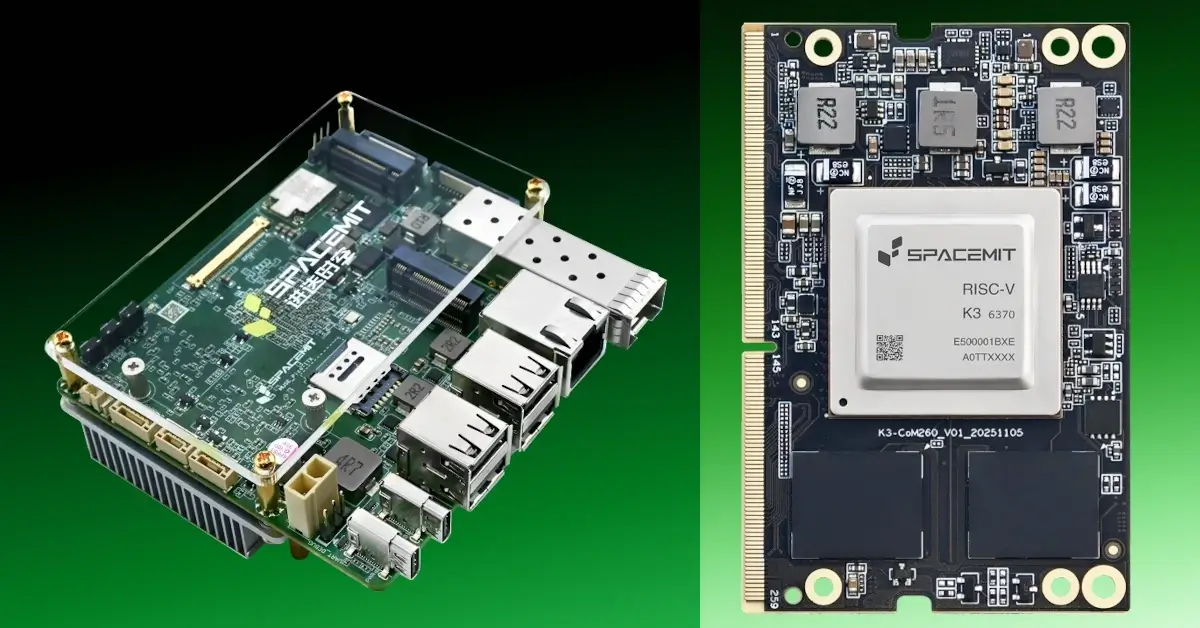
SpacemiT is a Chinese RISC-V CPU manufacturer that launched on May 11th, 2026, their long-anticipated next-gen RISC-V AI chip K3. It is among the earliest RISC-V CPUs that adhere to the RVA23 standard and performance-wise it is quite capable, providing 130 KDMIPS general computing power, 60 TOPS on INT4 which translates to about 15 tokens per second when running a 30 billion parameter large language model.
The aspect that really makes it stand out is:
A new minor release 0.4.27 of RQuantLib,
the first in over a year, arrived on CRAN a couple of minutes ago, has
just now been uploaded to Debian,
and is being built for r2u as well.
QuantLib is a rather
comprehensice free/open-source library for quantitative
finance. RQuantLib
connects (some parts of) it to the R environment and language, and has
been part of CRAN for nearly
twenty-three years (!!) as it was one of the first packages I uploaded
to CRAN.
This release of RQuantLib
brings an update to the interface for all equity options, vanilla and
exotics as well as implied volatilities. We now support the option
maturity via either an actual maturity date, or the (fractional
business-day years) numeric. This uses a clever little Rcpp trick I should discuss in a
separate blog post. We also re-ran compileAttributes() to
re-create the RcppExports.cpp file now using a slightly
improved way of calling Rf_error for an ongoing Rcpp transition, and did some more
standard maintenance. The details from the NEWS file follow as
usual.
Courtesy of my CRANberries, there is also a diffstat report for the this release. As always, more detailed information is on the RQuantLib page. Questions, comments etc should go to the rquantlib-devel mailing list. Issue tickets can be filed at the GitHub repo.Changes in RQuantLib version 0.4.27 (2026-06-07)
- All equity option functions can now take either a (fractional) time span to expiry or a given date, and accept a daycounter setter.
- Two very old schedule helpers had a superfluous
try/catchremoved.- The continuous integration setup received a minor update.
- The
RcppExports.cppfile was updated to aid aRcpptransition.
This post by Dirk Eddelbuettel originated on his Thinking inside the box blog. If you like this or other open-source work I do, you can now sponsor me at GitHub.
Welcome to the May 2026 report from the Reproducible Builds project. These reports outline what we ve been up to over the past month, highlighting items of news from elsewhere in the increasingly-important area of software supply-chain security. As ever, if you are interested in contributing to the Reproducible Builds project, please see the Contribute page on our website. In this month s report, we cover:
In a huge change in Debian s reproducibility policy, the Debian Release Team announced that:
we ve decided it s time to say that Debian must ship reproducible packages. Since yesterday, we have enabled our migration software to block migration of new packages that can t be reproduced [on reproduce.debian.net] or existing packages in testing that regress in reproducibility.That is to say, if newly-uploaded packages are not reproducible, they won t be considered candidates for inclusion in the next stable release of Debian codenamed forky. (Some exceptions may be granted.) This news generated a number of articles and comments in various news outlets:
.deb files in the official Debian archive itself. This small-sounding distinction is actually essential, as this is the only means through which the reproducible builds technique can determine whether build systems are compromised are not.
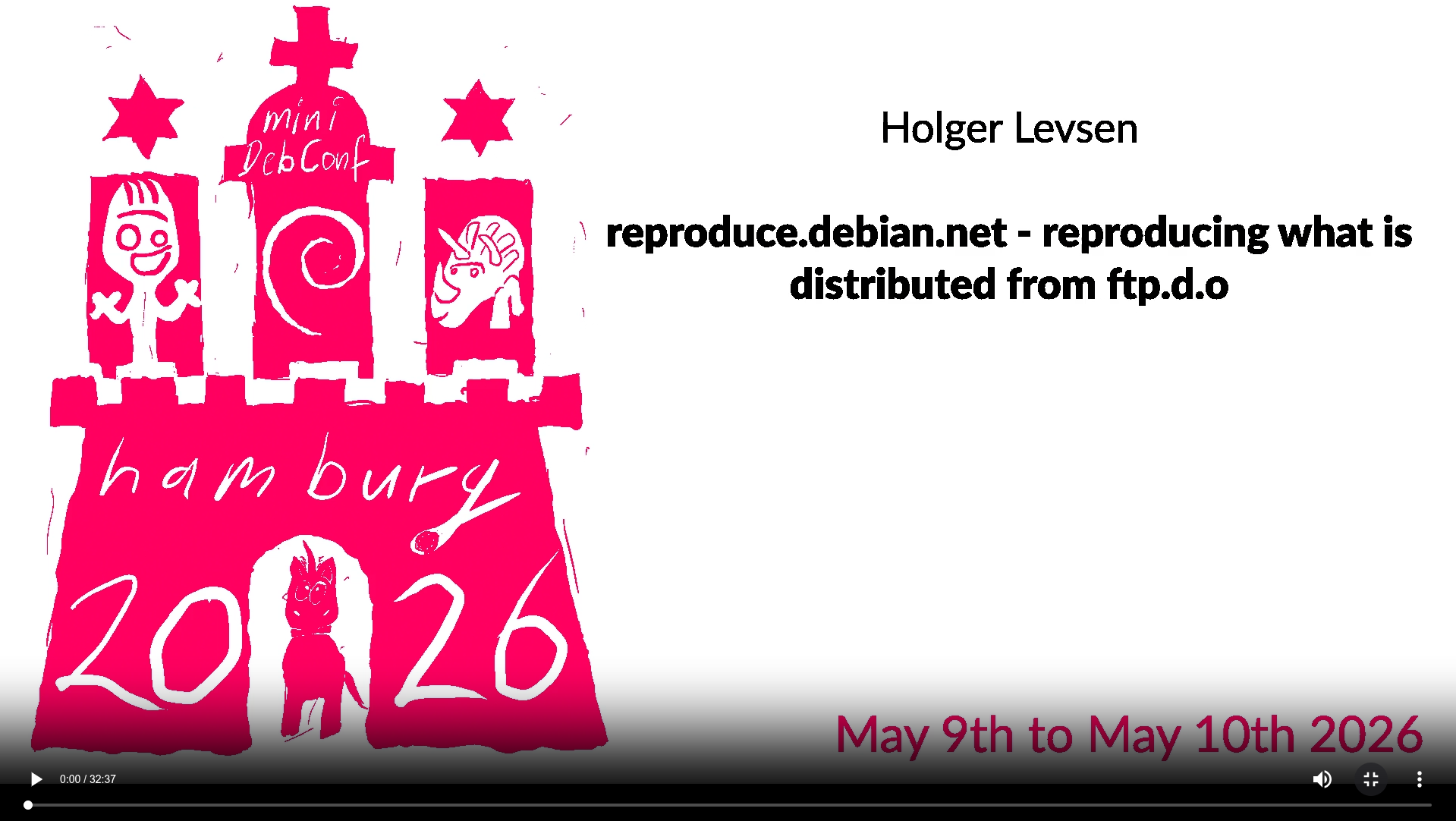
A video (32m37s) of the talk is available, as are Holger s slides.
Andr Arko and Amean Asad published a paper this month on Kettle, a build system that produces cryptographically verifiable provenance for software built inside Trusted Execution Environments :
A Kettle build records the source commit, dependency set, toolchain, build environment and output artifact digests in a provenance document produced inside a measured confidential VM. The SHA-256 digest of that document is committed to the TEE platform s attestation report-data field, so the hardware-signed attestation report is itself the signature on the provenance, with the signing identity chaining to the TEE manufacturer s root of trust rather than to the build infrastructure operator. Because the CVM image is itself reproducible, its launch measurement is public and stable, which lets a build requester pre-attest the CVM before submitting any input and optionally deliver source over a TLS channel terminated inside it, so the build runs end-to-end confidentially without the host ever seeing source code in plaintext.A PDF of the paper is available online.
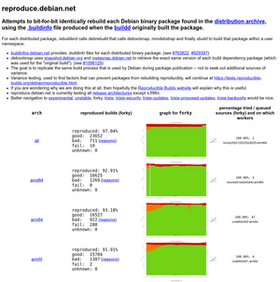
rebuilderd, our server designed for monitoring the official package repositories of Linux distributions and attempt to reproduce the observed results there; it powers, amongst other things, reproduce.debian.net.
A new version, 0.27.0, was released this month, with the following headline changes:
.udeb supportThe new rebuilderd package is currently available in theextra-testingrepository. Note the Arch Linux package is upgraded fromv0.25.0fromv0.27.0; please be patient with the database migrations on first restart, and make yourself familiar with the breaking changes in v0.26.0 too.
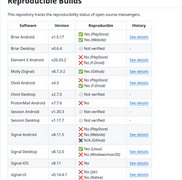
GitHub developer BarbossHack is maintaining an repository/page on GitHub to track reproducibility status of open source messengers .
In Debian this month, the loong64 architecture was added to reproduce.debian.net. This is a 64-bit Reduced Instruction Set Computer (RISC) instruction set architecture developed by Loongson.
Vagrant Cascadian performed Non-Maintainer Uploads (NMUs) in Debian for several packages with outstanding patches over a year old. These included rocdbgapi, onevpl-intel-gpu, python-pytest-shell-utilities, python-mt-940 and pympress.
On tests.reproducible-builds.org, Vagrant Cascadian fixed the huge spike in build failures by adding passwd to the base tarballs, and re-enabled building gcc and binutils packages with PGO (Profile Guided Optimization) and LTO (Link Time Optimization) to avoid giving a false sense of reproducibility.
Inconsistencies on the reproducibility of the condor package were brought up on the Debian reproducible-builds mailing list. Following a hunch, Vagrant Cascadian eventually identified the issue was related to embedded kernel versions which was then fixed upstream and fixed in Debian as well.
Lastly, 40 reviews of Debian packages were added, 68 were updated and 75 were removed this month adding to our knowledge about identified issues. A number of issue types were updated, such as the addition of a new sphinx_reading_durations toolchain issue [ ], a golang_mango_generates_manpages_with_build_date issue [ ] and a random_offset_id_in_cython_linetrace [ ]. In addition, the timestamps_in_qhc issue was refocused to timestamps_in_qhc [ ].
In Fedora, Jelle van der Waa submitted a request for an official Fedora rebuilderd package which was reviewed by Neal Gompa.
Lastly, Bernhard M. Wiedemann posted another openSUSE monthly update for their reproducibility work there.
grep package as being reproducible whilst their own is not. Although the root cause of the issue is that various translations are fetched from a remote location during bootstrap , cen argues that:
Perhaps rebuilderd needs a feature whereGOODpackages are also periodically rebuilt in exponential back-off style and compared against current upstream build and also our lastGOODbuild. This would confirm whether a package is reproducible if built in a short time window but also help uncover longer time window issues that are currently hidden.
dkimpy.fortran-stdlib.powerline.pycayennelpp.pycorrfit.sphinx-needs.ruby-otr-activerecord.git-pw.golang-github-akavel-rsrc.pampi.libreoffice-dictionaries.vnu.golang-github-shirou-gopsutil.javacc5.rssguard.golang-github-containerd-accelerated-container-image.docker-credential-gcr.xpenguins.cairocffi.meshy.bingo.golang-github-cyclonedx-cyclonedx-go.nfstest.
+ (plus sign) to the GNU Autotools example on the SOURCE_DATE_EPOCH documentation page. [ ]#reproducible-builds on irc.oftc.net.
rb-general@lists.reproducible-builds.org
i386-binfmt-P: Could not open '/lib/ld-linux.so.2': No such file or directory even after installing the i386 libc.
So I went the way of qemu-user and a chroot environment, a bit more convoluted but I can run any i386 binaries there in the future.
Create a debian-i386 chroot environment via deboostrap:
$ sudo apt install qemu-user qemu-user-binfmt debootstrap
$ fakeroot debootstrap --foreign --arch=i386 debian-i386
$ sudo chroot debian-i386
# inside the chroot
# /debootstrap/debootstrap --second-stage
# exit
Add needed mounts to run binaries inside the chroot:
$ sudo mount --bind /dev/ debian-i386/dev/
$ sudo mount --bind /dev/pts debian-i386/dev/pts
$ sudo mount -t proc none debian-i386/proc/
Install steamcmd in the chroot client:
$ sudo chroot debian-i386
# export LANG=C
# cat /etc/apt/sources.list
deb http://deb.debian.org/debian stable main contrib non-free
# apt update && apt install --yes steamcmd
# useradd --create-home --shell /bin/bash steam
# su - steam
$ steamcmd
... will download an updated version of the tool, and print a lot of tracing information
Steam> quit
From now on you can follow the Doom3 BFG instructions to download the game data.
Once you exit the chroot, the game data will be available at debian-i386/home/steam/
Next.