Raphaël Hertzog: People behind Debian: Martin Michlmayr, former Debian Project Leader

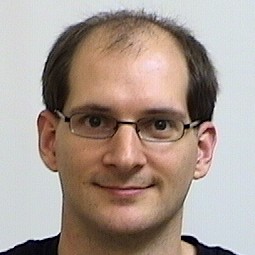 Martin Michlmayr is a Debian developer since 2000 and I share quite a few things with him, starting with his age and involvement in the quality assurance team. He managed to be elected Debian Project Leader in 2003 and 2004.
He s no longer as active as he used to be but his input is always very valuable and he continues to do very interesting things in particular concerning the support of NAS devices. Read on for the details.
Raphael: Who are you?
Martin: I m Martin Michlmayr. I m 32, originally from Austria, and currently living in the UK.
I ve contributed to various free software projects over the years but
Debian is without doubt the one I m most passionate about. I joined Debian
in 2000 when I was a student. I worked on Debian more or less full time
for a few years while I was pretending to study. Later I started a PhD to
do research about quality and management aspects of volunteer free software
projects. I investigated the release process in several free software
projects, in particular looking at time-based releases. After finishing my
PhD in 2007, I joined Hewlett-Packard. I m part of HP s Open Source
Program Office and work on various free software and open source
activities, both internally and within the community.
Raphael: How did you start contributing to Debian?
Martin: I first used Debian in the days of 0.93R6, some time around the end of
1995. The 0.93R6 release was still based on a.out but I needed an
ELF-based system for some application, so I moved to Slackware. I then
quickly moved to Red Hat Linux where I stayed for several years. I
rediscovered Debian in 2000 and quickly decided to join the project. I
cannot recall how I rediscovered Debian but when I did, it was clear to me
that Debian was the ideal project for me: I could identify with its
philosophy, I liked the volunteer nature of the project, and I found the
size and diversity of Debian interesting since a large project offers a lot
of different challenges and opportunities.
I remember how many new things there were to learn and back then the
documentation and other resources for new contributors were nowhere as good
as they are today. My application manager, Julian Gilbey, was a great
help he was incredibly friendly and passionate about Debian. I also
remember meeting up with Peter Palfrader (weasel) for key signing when we
were both in the New Maintainer queue. I was incredibly lucky with my New
Maintainer process and soon became an official Debian Developer. Because
there was a shortage of application managers, my first major contribution
in Debian was to become an application manager myself and help other people
join the project.
Debian is a large project with a long history and a rich culture, so new
contributors should expect that it will take some time to become familiar
with everything. Fortunately, there are many resources, such as
documentation and the debian-mentors list, for new contributors. Another
great way to become familiar with the way things are done in Debian is to
subscribe to various Debian mailing lists and ideally to read some mailing
list archives. It s also a great idea to attend the Debian Conference or
other conferences since meeting people in real life is a great way to
integrate. I remember attending Debian Conference 1 in Bordeaux where I
gave my first public talk.
Finally, new contributors should find an area where they can make a unique
contribution. Most people in Debian maintain packages but there are so
many other ways to contribute. For example, most of my contributions were
not technical but were about coordination and other organizational
activities.
Raphael: What s your biggest achievement within Debian?
Martin: I m particularly proud of a number of achievements:
- New Maintainer: I helped a lot of people join Debian. It s great to help someone join the project and then see how they contribute. Of course, some people join Debian and then quickly become inactive or retire you never know in advance how it will work out. But I had the pleasure to help some truly outstanding contributors to join Debian.
- Quality Assurance: I helped improve QA processes within Debian. In particular, I realized a few years ago that a lot of packages had maintainers who were inactive and that nobody did anything about it. I started to write to those maintainers to see what could be done. It s hard because you don t know the circumstance of someone they may be inactive because of an illness or for other good reasons so you have to be friendly, but yet persistent. Fortunately, most maintainers I contacted were truly inactive and so they couldn t complain when I took their packages away.
- DPL: I acted as the Debian Project Leader for two years. I m particularly proud of this because Debian is a great project and it was an honour to represent it. I performed important organizational and coordination tasks. I also traveled to a lot of conferences and had the pleasure to meet many Debian Developers as well as users of Debian. It s very motivating to meet users and to hear how they use Debian and how we can further improve it.
- Debian on NAS: Debian is without the doubt the Linux distro with the best support for NAS (Network Attached Storage) devices. I was always impressed by what the OpenWRT folks have done to support wireless routers and wanted to do something similar for Debian. Unfortunately, wireless routers just don t have enough storage for a full distro. But then NAS devices came along and they obviously have enough space since they are meant for storage.
Thank you to Martin for the time spent answering my questions. I hope you enjoyed reading his answers as I did. He raised some interesting questions. Subscribe to my newsletter to get my monthly summary of the Debian/Ubuntu news and to not miss further interviews. You can also follow along on Identi.ca, Twitter and Facebook.
No comment Liked this article? Click here. My blog is Flattr-enabled.
 See
 One nice (and even priceless) feature of Evolution is the vfolders, that allow me to manage the tons of emails in different contexts, wherever that may be located. AFAIK, Gnus doesn t offer any comparable feature. But it seems that the most interesting way to have it is to integrate Gnus with
 GNOME 3 packaging
Right after the GNOME 3 release, I was eager to try it out so I
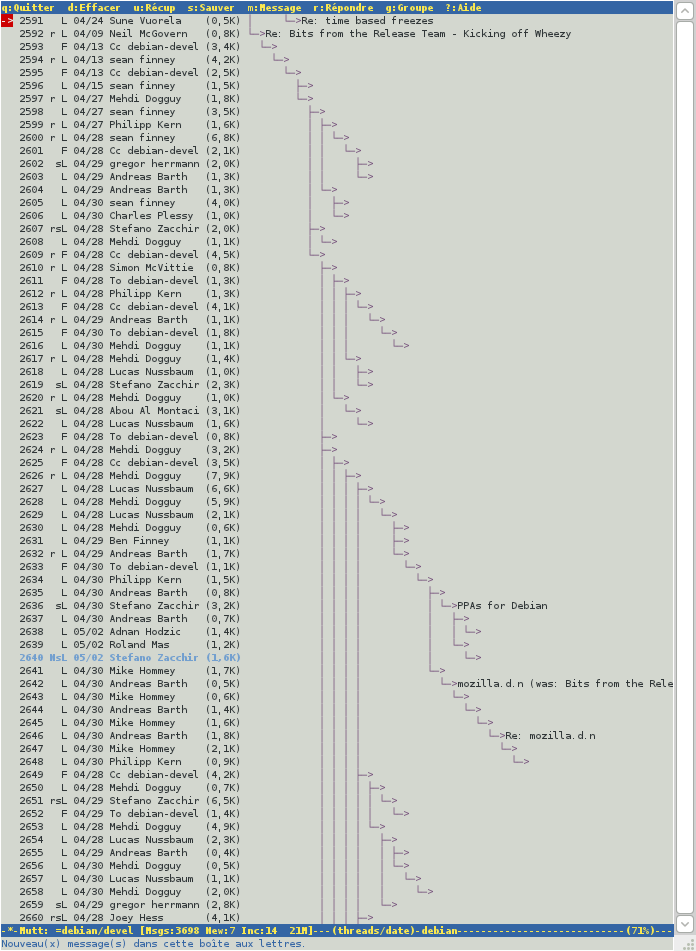
 I ve been running this code for more than 2 months and it works fine. I want to see it merged. I m ready to update my code should anything need to be changed to please Guillem. But without any feedback we re in a deadlock.
Misc dpkg work
While fixing a bug in update-alternatives (found in one of the valid reports on launchpad), I noticed that there was room for improvements in the error messages output by update-alternatives. I changed them to reuse the same strings that were already used in other parts of dpkg. The result is that there are a few strings less to translate (always a nice thing for the poor translators who have to deal with the thousands of strings that dpkg contains).
I also tried to fix some of the most cryptic error messages in dpkg (see
 I asked
 First steps as a GNOME packager
This is pretty common in free software and for once I followed the advice, I spent most of sunday helping out with GNOME 3 packaging. I have no prior experience with GNOME packaging but I m fairly proficient in Debian packaging in general so when I showed up on #debian-gnome (irc.debian.org) on sunday morning, Josselin quickly added me to the team on alioth.debian.org.
Still being a pkg-gnome rookie, I started by reading the documentation on
 Like
 Okay, so it's been five months since the last update. Sorry about
that. I guess I could force myself to more regular updates.
What have you missed? Only the branching of what will eventually
(soon?) become FusionForge 5.1. Quoting from the default home page,
and in no particular order:
 Roland Mas writes
 It s often said that KDE and GNOME are too bloated, too complex, too slow, or whatever. I won t deny that these critics are often justified, and some parts of the code are badly designed. But there can also be reasons behind this bloat: they are called features.
 When you want to mount an encrypted USB disk, you can write your own script and even
 Finally
 I was asked to write about what I do at
 This Monday, Debian celebrated its 17th birthday. Yay!
I was invited to
 While I have made good progress on many of my