Search Results: "rmh"

21 February 2017

Reproducible builds folks: Reproducible Builds: week 95 in Stretch cycle

Here's what happened in the Reproducible Builds effort between Sunday February 12 and Saturday February 18 2017: Upcoming Events The Reproducible Build Zoo will be presented by Vagrant Cascadian at the Embedded Linux Conference in Portland, Oregon, February 22nd. Introduction to Reproducible Builds will be presented by Vagrant Cascadian at Scale15x in Pasadena, California, March 5th. Toolchain development and fixes Ximin Luo posted a preliminary spec for BUILD_PATH_PREFIX_MAP, bringing together work and research from previous weeks. Ximin refactored and consolidated much of our existing documentation on both SOURCE_DATE_EPOCH and BUILD_PATH_PREFIX_MAP into one unified page, Standard Environment Variables, with extended discussion on related solutions and how these all fit into people's ideas of what reproducible builds should look like in the long term. The specific pages for each variable still remain, at Timestamps Proposal and Build Path Proposal, only without content that was previously duplicated on both pages. Ximin filed #855282 against devscripts for debsign(1) to support buildinfo files, and wrote an initial series of patches for it with some further additions from Guillem Jover. Packages reviewed and fixed, and bugs filed Chris Lamb: Reviews of unreproducible packages 35 package reviews have been added, 1 have been updated and 17 have been removed in this week, adding to our knowledge about identified issues. 1 issue type has been added: Weekly QA work During our reproducibility testing, the following FTBFS bugs have been detected and reported by: diffoscope development diffoscope 77 was uploaded to unstable by Mattia Rizzolo. It included contributions from: strip-nondeterminism development strip-nondeterminism 0.031-1 was uploaded to unstable by Chris Lamb. It included contributions from: strip-nondeterminism 0.031-1~bpo8+1 was uploaded to jessie-backports by Mattia. tests.reproducible-builds.org Misc. This week's edition was written by Ximin Luo & reviewed by a bunch of Reproducible Builds folks on IRC & the mailing lists.

11 February 2017

Reproducible builds folks: Reproducible Builds: week 93 in Stretch cycle

Here's what happened in the Reproducible Builds effort between Sunday January 29 and Saturday February 4 2017: Media coverage Dennis Gilmore and Holger Levsen presented "Reproducible Builds and Fedora" (Video, Slides) at Devconf.cz on February 27th 2017. On February 1st, stretch/armhf reached 90% reproducible packages in our test framework, so that now all four tested architectures are 90% reproducible in stretch. Yay! For armhf this means 22472 reproducible source packages (in main); for amd64, arm64 and i386 these figures are 23363, 23062 and 22607 respectively. Chris Lamb appeared on the Changelog podcast to talk about reproducible builds: Holger Levsen pitched Reproducible Builds and our need for a logo in the "Open Source Design" room at FOSDEM 2017 (Video, 09:36 - 12:00). Upcoming Events Reproducible work in other projects We learned that the "slightly more secure" Heads firmware (a Coreboot payload) is now reproducibly built regardless of host system or build directory. A picture says more than a thousand words: reproducible heads build on two machines Docker started preliminary work on making image builds reproducible. Toolchain development and fixes Ximin Luo continued to write code and test cases for the BUILD_PATH_PREFIX_MAP environment variable. He also did extensive research on cross-platform and cross-language issues with enviroment variables, filesystem paths, and character encodings, and started preparing a draft specification document to describe all of this. Chris Lamb asked CPython to implement an environment variable PYTHONREVERSEDICTKEYORDER to add an an option to reverse iteration order of items in a dict. However this was rejected because they are planning to formally fix this order in the next language version. Bernhard Wiedemann and Florian Festi added support for our SOURCE_DATE_EPOCH environment variable, to the RPM Package Manager. James McCoy uploaded devscripts 2.17.1 with a change from Guillem Jover for dscverify(1), adding support for .buildinfo files. (Closes: #852801) Piotr O arowski uploaded dh-python 2.20170125 with a change from Chris Lamb for a patch to fix #835805. Chris Lamb added documentation to diffoscope, strip-nondeterminism, disorderfs, reprotest and trydiffoscope about uploading signed tarballs when releasing. He also added a link to these on our website's tools page. Packages reviewed and bugs filed Bugs filed: Reviews of unreproducible packages 83 package reviews have been added, 86 have been updated and 276 have been removed in this week, adding to our knowledge about identified issues. 2 issue types have been updated: Weekly QA work During our reproducibility testing, the following FTBFS bugs have been detected and reported by: diffoscope development Work on the next version (71) continued in git this week: reproducible-website development Daniel Shahaf added more notes on our "How to chair a meeting" document. tests.reproducible-builds.org Holger unblacklisted pspp and tiledarray. If you think further packages should also be unblacklisted (possibly only on some architectures), please tell us. Misc. This week's edition was written by Ximin Luo, Holger Levsen and Chris Lamb & reviewed by a bunch of Reproducible Builds folks on IRC & the mailing lists.

1 February 2017

Wouter Verhelst: Resetting a Raspberry Pi to default using Ansible

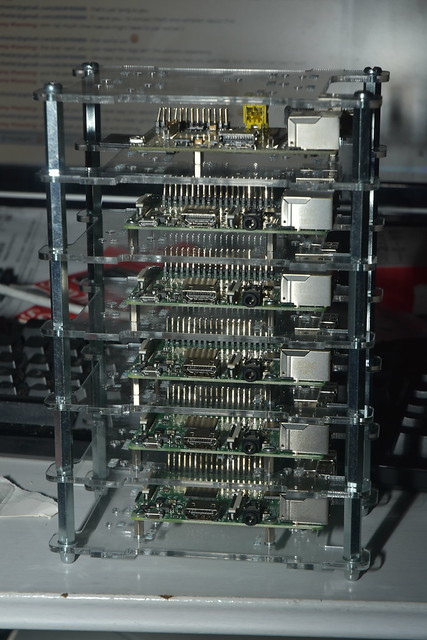
I got myself a bunch of Raspberry Pi 3s a short while ago: Stack of Raspberry Pis ...the idea being that I can use those to run a few experiments on. After the experiment, I would need to be able to somehow remove the stuff that I put on them again. The most obvious way to do that is to reimage them after every experiment; but the one downside of the multi-pi cases that I've put them in is that removing the micro-SD cards from the Pis without removing them from the case, while possible, is somewhat fiddly. That, plus the fact that I cared more about price than about speed when I got the micro-SD cards makes "image all the cards of these Raspberry Pis" something I don't want to do every day. So I needed a different way to reset them to a clean state, and I decided to use ansible to get it done. It required a bit of experimentation, but eventually I came up with this:
---
- name: install package-list fact
  hosts: all
  remote_user: root
  tasks:
  - name: install libjson-perl
    apt:
      pkg: libjson-perl
      state: latest
  - name: create ansible directory
    file:
      path: /etc/ansible
      state: directory
  - name: create facts directory
    file:
      path: /etc/ansible/facts.d
      state: directory
  - name: copy fact into ansible facts directory
    copy:
      dest: /etc/ansible/facts.d/allowclean.fact
      src: allowclean.fact
      mode: 0755
- name: remove extra stuff
  hosts: pis
  remote_user: root
  tasks:
  - apt: pkg=  item   state=absent purge=yes
    with_items: "  ansible_local.allowclean.cleanable_packages  "
- name: remove package facts
  hosts: pis
  remote_user: root
  tasks:
  - file:
      path: /etc/ansible/facts.d
      state: absent
  - apt:
      pkg: libjson-perl
      state: absent
      autoremove: yes
      purge: yes
This ansible playbook has three plays. The first play installs a custom ansible fact (written in perl) that emits a json file which defines cleanable_packages as a list of packages to remove. The second uses that fact to actually remove those packages; and the third removes the fact (and the libjson-perl library we used to produce the JSON). Which means, really, that all the hard work is done inside the allowclean.fact file. That looks like this:
#!/usr/bin/perl
use strict;
use warnings;
use JSON;
open PACKAGES, "dpkg -l ";
my @packages;
my %whitelist = (
    ...
);
while(<PACKAGES>)  
    next unless /^ii\s+(\S+)/;
    my $pack = $1;
    next if(exists($whitelist $pack ));
    if($pack =~ /(.*):armhf/)  
        $pack = $1;
     
    push @packages, $1;
 
my %hash;
$hash cleanable_packages  = \@packages;
print to_json(\%hash);
Basically, we create a whitelist, and compare the output of dpkg -l against that whitelist. If a certain package is in the whitelist, then we don't add it to our "packages" list; if it isn't, we do. The whitelist is just a list of package => 1 tuples. We just need the hash keys and don't care about the data, really; I could equally well have made it package => undef, I suppose, but whatever. Creating the whitelist is not that hard. I did it by setting up one raspberry pi to the minimum that I wanted, running
dpkg -l awk '/^ii/ print "\t\""$2"\" => 1," ' > packagelist
and then adding the contents of that packagelist file in place of the ... in the above perl script. Now whenever we apply the ansible playbook above, all packages (except for those in the whitelist) are removed from the system. Doing the same for things like users and files is left as an exercise to the reader. Side note: ... is a valid perl construct. You can write it, and the compiler won't complain. You can't run it, though.

11 January 2017

Reproducible builds folks: Reproducible Builds: week 89 in Stretch cycle

What happened in the Reproducible Builds effort between Sunday January 1 and Saturday January 7 2017: GSoC and Outreachy updates Toolchain development Packages reviewed and fixed, and bugs filed Chris Lamb: Dhole: Reviews of unreproducible packages 13 package reviews have been added, 4 have been updated and 6 have been removed in this week, adding to our knowledge about identified issues. 2 issue types have been added/updated: Upstreaming of reproducibility fixes Merged: Opened: Weekly QA work During our reproducibility testing, the following FTBFS bugs have been detected and reported by: diffoscope development diffoscope 67 was uploaded to unstable by Chris Lamb. It included contributions from :
[ Chris Lamb ]
* Optimisations:
  - Avoid multiple iterations over archive by unpacking once for an ~8X
    runtime optimisation.
  - Avoid unnecessary splitting and interpolating for a ~20X optimisation
    when writing --text output.
  - Avoid expensive diff regex parsing until we need it, speeding up diff
    parsing by 2X.
  - Alias expensive Config() in diff parsing lookup for a 10% optimisation.
* Progress bar:
  - Show filenames, ELF sections, etc. in progress bar.
  - Emit JSON on the the status file descriptor output instead of a custom
    format.
* Logging:
  - Use more-Pythonic logging functions and output based on __name__, etc.
  - Use Debian-style "I:", "D:" log level format modifier.
  - Only print milliseconds in output, not microseconds.
  - Print version in debug output so that saved debug outputs can standalone
    as bug reports.
* Profiling:
  - Also report the total number of method calls, not just the total time.
  - Report on the total wall clock taken to execute diffoscope, including
    cleanup.
* Tidying:
  - Rename "NonExisting" -> "Missing".
  - Entirely rework diffoscope.comparators module, splitting as many separate
    concerns into a different utility package, tidying imports, etc.
  - Split diffoscope.difference into diffoscope.diff, etc.
  - Update file references in debian/copyright post module reorganisation.
  - Many other cleanups, etc.
* Misc:
  - Clarify comment regarding why we call python3(1) directly. Thanks to J r my
    Bobbio <lunar@debian.org>.
  - Raise a clearer error if trying to use --html-dir on a file.
  - Fix --output-empty when files are identical and no outputs specified.
[ Reiner Herrmann ]
* Extend .apk recognition regex to also match zip archives (Closes: #849638)
[ Mattia Rizzolo ]
* Follow the rename of the Debian package "python-jsbeautifier" to
  "jsbeautifier".
[ siamezzze ]
* Fixed no newline being classified as order-like difference.
reprotest development reprotest 0.5 was uploaded to unstable by Chris Lamb. It included contributions from:
[ Ximin Luo ]
* Stop advertising variations that we're not actually varying.
  That is: domain_host, shell, user_group.
* Fix auto-presets in the case of a file in the current directory.
* Allow disabling build-path variations. (Closes: #833284)
* Add a faketime variation, with NO_FAKE_STAT=1 to avoid messing with
  various buildsystems. This is on by default; if it causes your builds
  to mess up please do file a bug report.
* Add a --store-dir option to save artifacts.
Other contributions (not yet uploaded): reproducible-builds.org website development tests.reproducible-builds.org Misc. This week's edition was written by Chris Lamb, Holger Levsen and Vagrant Cascadian, reviewed by a bunch of Reproducible Builds folks on IRC & the mailing lists.

3 January 2017

Reproducible builds folks: Reproducible Builds: week 88 in Stretch cycle

What happened in the Reproducible Builds effort between Sunday December 25 and Saturday December 31 2016: Media coverage Reproducible bugs filed Chris West: Chris Lamb: Rob Browning: Reviews of unreproducible packages 7 package reviews have been added, 12 have been updated and 14 have been removed in this week, adding to our knowledge about identified issues. 2 issue types have been updated: Weekly QA work During our reproducibility testing, the following FTBFS bugs have been detected and reported by: diffoscope development strip-nondeterminism development try.diffoscope.org development tests.reproducible-builds.org Misc. This week's edition was written by Chris Lamb, Holger Levsen and was reviewed by a bunch of Reproducible Builds folks on IRC & the mailing lists.

1 January 2017

Joey Hess: p2p dreams

In one of the good parts of the very mixed bag that is "Lo and Behold: Reveries of the Connected World", Werner Herzog asks his interviewees what the Internet might dream of, if it could dream. The best answer he gets is along the lines of: The Internet of before dreamed a dream of the World Wide Web. It dreamed some nodes were servers, and some were clients. And that dream became current reality, because that's the essence of the Internet. Three years ago, it seemed like perhaps another dream was developing post-Snowden, of dissolving the distinction between clients and servers, connecting peer-to-peer using addresses that are also cryptographic public keys, so authentication and encryption and authorization are built in. Telehash is one hopeful attempt at this, others include snow, cjdns, i2p, etc. So far, none of them seem to have developed into a widely used network, although any of them still might get there. There are a lot of technical challenges due to the current Internet dream/nightmare, where the peers on the edges have multiple barriers to connecting to other peers. But, one project has developed something similar to the new dream, almost as a side effect of its main goals: Tor's onion services. I'd wanted to use such a thing in git-annex, for peer-to-peer sharing and syncing of git-annex repositories. On November 13th, I started building it, using Tor, and I'm releasing it concurrently with this blog post.
git-annex's Tor support replaces its old hack of tunneling git protocol over XMPP. That hack was unreliable (it needed a TCP on top of XMPP layer) but worse, the XMPP server could see all the data being transferred. And, there are fewer large XMPP servers these days, so fewer users could use it at all. If you were using XMPP with git-annex, you'll need to switch to either Tor or a server accessed via ssh.
Now git-annex can serve a repository as a Tor onion service, and that can then be accessed as a git remote, using an url like tor-annex::tungqmfb62z3qirc.onion:42913. All the regular git, and git-annex commands, can be used with such a remote. Tor has a lot of goals for protecting anonymity and privacy. But the important things for this project are just that it has end-to-end encryption, with addresses that are public keys, and allows P2P connections. Building an anonymous file exchange on top of Tor is not my goal -- if you want that, you probably don't want to be exchanging git histories that record every edit to the file and expose your real name by default. Building this was not without its difficulties. Tor onion services were originally intended to run hidden websites, not to connect peers to peers, and this kind of shows.. Tor does not cater to end users setting up lots of Onion services. Either root has to edit the torrc file, or the Tor control port can be used to ask it to set one up. But, the control port is not enabled by default, so you still need to su to root to enable it. Also, it's difficult to find a place to put the hidden service's unix socket file that's writable by a non-root user. So I had to code around this, with a git annex enable-tor that su's to root and sets it all up for you.
One interesting detail about the implementation of the P2P protocol in git-annex is that it uses two Free monads to build up actions. There's a Net monad which can be used to send and receive protocol messages, and a Local monad which allows only the necessary modifications to files on disk. Interpreters for Free monad actions can chose exactly which actions to allow for security reasons. For example, before a peer has authenticated, the P2P protocol is being run by an interpreter that refuses to run any Local actions whatsoever. Other interpreters for the Net monad could be used to support other network transports than Tor.
When two peers are connected over Tor, one knows it's talking to the owner of a particular onion address, but the other peer knows nothing about who's talking to it, by design. This makes authentication harder than it would be in a P2P system with a design like Telehash. So git-annex does its own authentication on top of Tor. With authentication, users would need to exchange absurdly long addresses (over 150 characters) to connect their repositories. One very convenient thing about using XMPP was that a user would have connections to their friend's accounts, so it was easy to share with them. Exchanging long addresses is too hard. This is where Magic Wormhole saved the day. It's a very elegant way to get any two peers in touch with each other, and the users only have to exchange a short code phrase, like "2-mango-delight", which can only be used once. Magic Wormhole makes some security tradeoffs for this simplicity. It's got vulnerabilities to DOS attacks, and its MITM resistance could be improved. But I'm lucky it came along just in time. So, it takes only installing Tor and Magic Wormhole, running two git-annex commands, and exchanging short code phrases with a friend, perhaps over the phone or in an encrypted email, to get your git-annex repositories connected and syncing over Tor. See the documentation for details. Also, the git-annex webapp allows setting the same thing up point-and-click style. The Tor project blog has throughout December been featuring all kinds of projects that are using Tor. Consider this a late bonus addition to that. ;) I hope that Tor onion services will continue to develop to make them easier to use for peer-to-peer systems. We can still dream a better Internet.
This work was made possible by all my supporters on Patreon.

30 December 2016

Antoine Beaupr : My free software activities, November and December 2016

Debian Long Term Support (LTS) Those were 8th and 9th months working on Debian LTS started by Raphael Hertzog at Freexian. I had trouble resuming work in November as I had taken a long break during the month and started looking at issues only during the last week of November.

Imagemagick, again I have, again, spent a significant amount of time fighting the ImageMagick (IM) codebase. About 15 more vulnerabilities were found since the last upload, which resulted in DLA-756-1. In the advisory, I unfortunately forgot to mention CVE-2016-8677 and CVE-2016-9559, something that was noticed by my colleague Roberto after the upload... More details about the upload are available in the announcement. When you consider that I worked on IM back in october, which lead to an upload near the end of November covering around 80 more vulnerabilities, it doesn't look good for the project at all. Of the 15 vulnerabilities I worked on, only 6 had CVEs assigned and I had to request CVEs for the other 9 vulnerabilities plus 11 more that were still unassigned. This lead to the assignment of 25 distinct CVE identifiers as a lot of issues were found to be distinct enough to warrant their own CVEs. One could also question how many of those issues affect the fork, Graphicsmagick. A lot of the vulnerabilities were found through fuzzing searches that may not have been tested on Graphicsmagick. It seems clear to me that a public corpus of test data should be available to test regressions and cross-project vulnerabilities. It's already hard enough to track issues withing IM itself, I can't imagine what it would be for the fork to keep track of those issues, especially since upstream doesn't systematically request CVEs for issues that they find, a questionable practice considering the number of issues we all need to keep track of.

Nagios I have also worked on the Nagios package and produced DLA 751-1 which fixed two fairly major issues (CVE-2016-9565 and CVE-2016-9566) that could allow remote root access under certain conditions. Fortunately, the restricted permissions setup by default in the Debian package made both exploits limited to information disclosure and privilege escalation if the debug log is enabled. This says a lot about how proper Debian packaging can help in limiting the attack surface of certain vulnerabilities. It was also "interesting" to have to re-learn dpatch to add patches to the package: I regret not converting it to quilt, as the operation is simple and quilt is so much easier to use. People new to Debian packaging may be curious to learn about the staggering number of patching systems historically used in Debian. On that topic, I started a conversation about how much we want to reuse existing frameworks when we work on those odd packages, and the feedback was interesting. Basically, the answer is "it depends"...

NSS I had already worked on the package in November and continued the work in December. Most of the work was done by Raphael, which fixed a lot of issues with the test suite. I tried to wrap this up by fixing CVE-2016-9074, the build on armel and the test suite. Unfortunately, I had to stop again because I ran out of hours and the fips test suite was still failing, but fortunately Raphael was able to complete the work with DLA-759-1. As things stand now, the package is in better shape than in other suites as tests (Debian bug #806639) and autopkgtest (Debian bug #806207) are still not shipped in the sid or stable releases.

Other work For the second time, I forgot to formally assign myself a package before working on it, which meant that I wasted part of my hours working on the monit package. Those hours, of course, were not counted in my regular hours. I still spent some time reviewing mejo's patch to ensure it was done properly and it turned out we both made similar patches working independently, always a good sign. As I reported in my preliminary November report, I have also triaged issues in libxml2, ntp, openssl and tiff. Finally, I should mention my short review of the phpMyAdmin upload, among the many posts i sent to the LTS mailing list.

Other free software work One reason why I had so much trouble getting paid work done in November is that I was busy with unpaid work...

manpages.debian.org A major time hole for me was trying to tackle the manpages.debian.org service, which had been offline since August. After a thorough evaluation of the available codebases, I figured the problem space wasn't so hard and it was worth trying to do an implementation from scratch. The result is a tool called debmans. It took, obviously, way longer than I expected, as I experimented with Python libraries I had been keeping an eye on for a while. For the commanline interface, I used the click library, which is really a breeze to use, but a bit heavy for smaller scripts. For a web search service prototype, I looked at flask, which was also very interesting, as it is light and simple enough to use that I could get started quickly. It also, surprisingly, fares pretty well in the global TechEmpower benchmarking tests. Those interested in those tools may want to look at the source code, in particular the main command (using an interesting pattern itself, __main__.py) and the search prototype. Debmans is the first project for which I have tried the CII Best Practices Badge program, an interesting questionnaire to review best practices in software engineering. It is an excellent checklist I recommend every project manager and programmer to get familiar with. I still need to complete my work on Debmans: as I write this, I couldn't get access to the new server the DSA team setup for this purpose. It was a bit of a frustrating experience to wait for all the bits to get into place while I had a product ready to test. In the end, the existing manpages.d.o maintainer decided to deploy the existing codebase on the new server while the necessary dependencies are installed and accesses are granted. There's obviously still a bunch of work to be done for this to be running in production so I have postponed all this work to January. My hope is that this tool can be reused by other distributions, but after talking with Ubuntu folks, I am not holding my breath: it seems everyone has something that is "good enough" and that they don't want to break it...

Monkeysign I spent a good chunk of time giving a kick in the Monkeysign project, with the 2.2.2 release, which features contributions from two other developers, which may be a record for a single release. I am especially happy to have adopted a new code of conduct - it has been an interesting process to adapt the code of conduct for such a relatively small project. Monkeysign is becoming a bit of a template on how to do things properly for my Python projects: documentation on readthedocs.org including a code of conduct, support and contribution information, and so on. Even though the code now looks a bit old to me and I am embarrassed to read certain parts, I still think it is a solid project that is useful for a lot of people. I would love to have more time to spend on it.

LWN publishing As you may have noticed if you follow this blog, I have started publishing articles for the LWN magazine, filed here under the lwn tag. It is a way for me to actually get paid for some of my blogging work that used to be done for free. Reports like this one, for example, take up a significant amount of my time and are done without being paid. Converting parts of this work into paid work is part of my recent effort to reduce the amount of time I spend on the computer. An funny note: I always found the layout of the site to be a bit odd, until I looked at my articles posted there in a different web browser, which didn't have my normal ad blocker configuration. It turns out LWN uses ads, and Google ones too, which surprised me. I definitely didn't want to publish my work under banner ads, and will never do so on this blog. But it seems fair that, since I get paid for this work, there is some sort of revenue stream associated with it. If you prefer to see my work without ads, you can wait for it to be published here or become a subscriber which allows you to get rid of the ads on the site. My experience with LWN is great: they're great folks, and very supportive. It's my first experience with a real editor and it really pushed me in improving my writing to make better articles that I normally would here. Thanks to the LWN folks for their support! Expect more of those quality articles in 2017.

Debian packaging I have added a few packages to the Debian archive:
  • magic-wormhole: easy file-transfer tool, co-maintained with Jamie Rollins
  • slop: screenshot tool
  • xininfo: utility used by teiler
  • teiler (currently in NEW): GUI for screenshot and screencast tools
I have also updated sopel and atheme-services.

Other work Against my better judgment, I worked again on the borg project. This time I tried to improve the documentation, after a friend asked me for help on "how to make a quick backup". I realized I didn't have any good primer to send regular, non-sysadmin users to and figured that, instead of writing a new one, I could improve the upstream documentation instead. I generated a surprising 18 commits of documentation during that time, mainly to fix display issues and streamline the documentation. My final attempt at refactoring the docs eventually failed, unfortunately, again reminding me of the difficulty I have in collaborating on that project. I am not sure I succeeded in making the project more attractive to non-technical users, but maybe that's okay too: borg is a fairly advanced project and not currently aimed at such a public. This is yet another project I am thinking of creating: a metabackup program like backupninja that would implement the vision created by liw in his A vision for backups in Debian post, which was discarded by the Borg project. Github also tells me that I have opened 19 issues in 14 different repositories in November. I would like to particularly bring your attention to the linkchecker project which seems to be dead upstream and for which I am looking for collaborators in order to create a healthy fork. Finally, I started on reviving the stressant project and changing all my passwords, stay tuned for more!

21 November 2016

Reproducible builds folks: Reproducible Builds: week 82 in Stretch cycle

What happened in the Reproducible Builds effort between Sunday November 13 and Saturday November 19 2016: Media coverage Elsewhere in Debian Documentation update Packages reviewed and fixed, and bugs filed Reviews of unreproducible packages 43 package reviews have been added, 4 have been updated and 12 have been removed in this week, adding to our knowledge about identified issues. 2 issue types have been updated: 4 issue types have been added: Weekly QA work During our reproducibility testing, some FTBFS bugs have been detected and reported by: strip-nondeterminism development disorderfs development debrebuild development debrebuild is new tool proposed by HW42 and josch (see #774415: "From srebuild sbuild-wrapper to debrebuild"). debrepatch development debrepatch is a set of scripts that we're currently developing to make it easier to track unapplied patches. We have a lot of those and we're not always sure if they still work. The plan is to set up jobs to automatically apply old reproducibility patches to newer versions of packages and notify the right people if they don't apply and/or no longer make the package reproducible. debpatch is a component of debrepatch that applies debdiffs to Debian source packages. In other words, it is to debdiff(1) what patch(1) is to diff(1). It is a general tool that is not specific to Reproducible Builds. This week, Ximin Luo worked on making it more "production-ready" and will soon submit it for inclusion in devscripts. reprotest development Ximin Luo significantly improved reprotest, adding presets and auto-detection of which preset to use. One can now run e.g. reprotest auto . or reprotest auto $pkg_$ver.dsc instead of the long command lines that were needed before. He also made it easier to set up build dependencies inside the virtual server and made it possible to specify pre-build dependencies that reprotest itself needs to set up the variations. Previously one had to manually edit the virtual server to do that, which was not very usable to humans without an in-depth knowledge of the building process. These changes will be tested some more and then released in the near future as reprotest 0.4. tests.reproducible-builds.org Misc. This week's edition was written by Chris Lamb, Holger Levsen, Ximin Luo and reviewed by a bunch of Reproducible Builds folks on IRC.

17 November 2016

Uwe Kleine-K nig: Installing Debian Stretch on a Turris Omnia

Recently I got "my" Turris Omnia and it didn't take long to replace the original firmware with Debian. If you want to reproduce, here is what you have to do: Open the case of the Turris Omnia, connect the hacker pack (or an RS232-to-TTL adapter) to access the U-Boot prompt (see Turris Omnia: How to use the "Hacker pack"). Then download the installer and device tree:
# cd /srv/tftp
# wget https://d-i.debian.org/daily-images/armhf/daily/netboot/vmlinuz
# wget https://d-i.debian.org/daily-images/armhf/daily/netboot/initrd.gz
# wget https://www.kleine-koenig.org/tmp/armada-385-turris-omnia.dtb
(The latter is not included yet in Debian, but I'm working on that.) and after connecting the Turris Omnia's WAN to a dhcp managed network start it in U-Boot:
dhcp
setenv serverip 192.168.1.17
tftpboot 0x01000000 vmlinuz
tftpboot 0x02000000 armada-385-turris-omnia.dtb
tftpboot 0x03000000 initrd.gz
bootz 0x01000000 0x03000000:$filesize 0x02000000
With 192.168.1.17 being the IPv4 of the machine you have the tftp server running. I suggest to use btrfs as rootfs because that works well with U-Boot. Before finishing the installation put the dtb in the rootfs as /boot/dtb. To then boot into Debian do in U-Boot:
setenv mmcboot=btrload mmc 0 0x01000000 boot/vmlinuz\; btrload mmc 0 0x02000000 boot/dtb\; btrload mmc 0 0x03000000 boot/initrd.img\; bootz 0x01000000 0x03000000:$filesize 0x02000000
setenv bootargs console=ttyS0,115200 rootfstype=btrfs rootdelay=2 root=/dev/mmcblk0p1 rootflags=commit=5 rw
saveenv
boot
Known issues: If you have problems, don't hesitate to contact me. Also check the Debian Wiki for further details.

14 November 2016

Dimitri John Ledkov: /boot less LVM rootfs in Zesty


On Ubuntu many of the default boot loaders support booting kernels located on LVM volumes. This includes following platforms

  • i686, x86_64 bios grub2
  • arm64, armhf, i686, x86_64 UEFI grub2
  • PReP partitions on IBM PowerPC
  • zipl on IBM zSystems
For all of the above the d-i has been modified in Zesty to create LVM based installations without a dedicated /boot partition. We shall celebrate this achievement. Hopefully this means one doesn't need to remove kernels as much, or care about sizing /boot volume appropriately any more.

If there are more bootloaders in Ubuntu that support booting off LVM, please do get in touch with me. I'm interested if I can safely enable following platforms as well:
  • armhf with u-boot
  • arm64 with u-boot
  • ppc64el with PReP volume
ps. boots pic is from here

13 November 2016

Hideki Yamane: LTS for PowerPC?

Debian9 "Stretch" drops powerpc as release architecture, it means Debian based powerpc box would need more effort to maintain in the future.

If you use Debian for powerpc box in production environment, it maybe better to consider to join LTS funding and ask LTS team to add it to Jessie LTS architecture. I'm not sure they accept it or not, but if it's okay (as they did for armel and armhf), it may be worth to reduce your trouble.

8 November 2016

Uwe Kleine-K nig: Installing Debian Stretch on an Omnia Turris

Recently I got "my" Omnia Turris and it didn't take long to replace the original firmware with Debian. If you want to reproduce, here is what you have to do: Open the case of the Omnia Turris, connect the hacker pack (or an RS232-to-TTL adapter) to access the U-Boot prompt (see Turris Omnia: How to use the "Hacker pack"). Then download the installer and device tree:
# cd /srv/tftp
# wget https://d-i.debian.org/daily-images/armhf/daily/netboot/vmlinuz
# wget https://d-i.debian.org/daily-images/armhf/daily/netboot/initrd.gz
# wget https://www.kleine-koenig.org/tmp/armada-385-turris-omnia.dtb
(The latter is not included yet in Debian, but I'm working on that.) and after connecting the Omnia Turris's WAN to a dhcp managed network start it in U-Boot:
dhcp
setenv serverip 192.168.1.17
tftpboot 0x01000000 vmlinuz
tftpboot 0x02000000 armada-385-turris-omnia.dtb
tftpboot 0x03000000 initrd.gz
bootz 0x01000000 0x03000000:$filesize 0x02000000
With 192.168.1.17 being the IPv4 of the machine you have the tftp server running. I suggest to use btrfs as rootfs because that works well with U-Boot. Before finishing the installation put the dtb in the rootfs as /boot/dtb. To then boot into Debian do in U-Boot:
setenv mmcboot=btrload mmc 0 0x01000000 boot/vmlinuz\; btrload mmc 0 0x02000000 boot/dtb\; btrload mmc 0 0x03000000 boot/initrd.img\; bootz 0x01000000 0x03000000:$filesize 0x02000000
setenv bootargs console=ttyS0,115200 rootfstype=btrfs rootdelay=2 root=/dev/mmcblk0p1 rootflags=commit=5 rw
saveenv
boot
Known issues: If you have problems, don't hesitate to contact me.

22 October 2016

Christoph Egger: Running Debian on the ClearFog

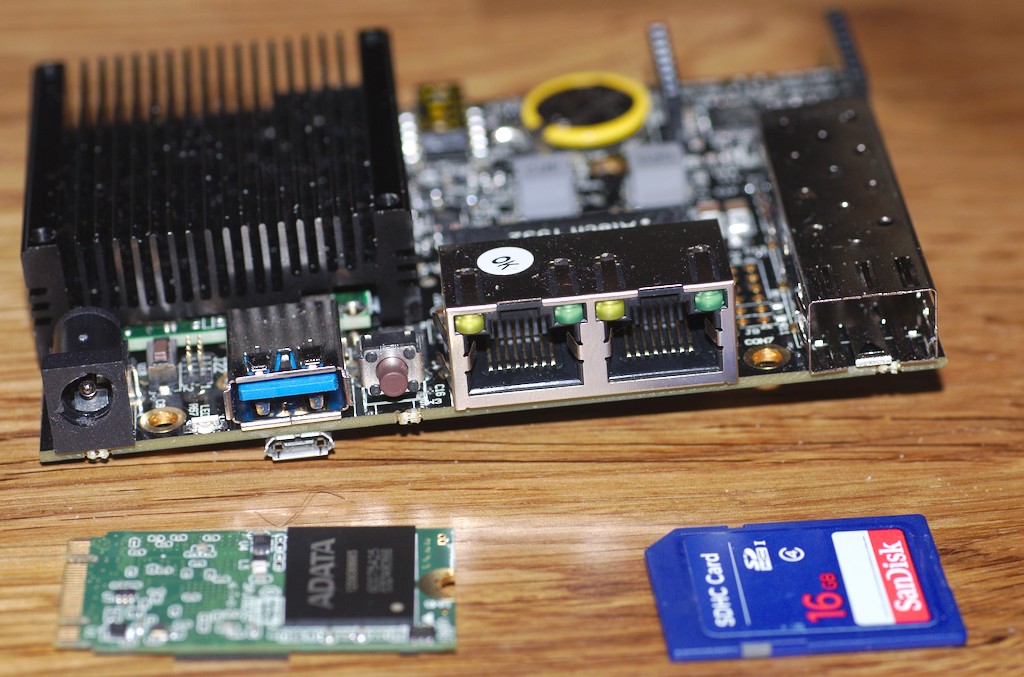
Back in August, I was looking for a Homeserver replacement. During FrOSCon I was then reminded of the Turris Omnia project by NIC.cz. The basic SoC (Marvel Armada 38x) seemed to be nice hand have decent mainline support (and, with the turris, users interested in keeping it working). Only I don't want any WIFI and I wasn't sure the standard case would be all that usefully. Fortunately, there's also a simple board available with the same SoC called ClearFog and so I got one of these (the Base version). With shipping and the SSD (the only 2242 M.2 SSD with 250 GiB I could find, a ADATA SP600) it slightly exceeds the budget but well. ClearFog with SSD When installing the machine, the obvious goal was to use mainline FOSS components only if possible. Fortunately there's mainline kernel support for the device as well as mainline U-Boot. First attempts to boot from a micro SD card did not work out at all, both with mainline U-Boot and the vendor version though. Turns out the eMMC version of the board does not support any micro SD cards at all, a fact that is documented but others failed to notice as well. U-Boot As the board does not come with any loader on eMMC and booting directly from M.2 requires removing some resistors from the board, the easiest way is using UART for booting. The vendor wiki has some shell script wrapping an included C fragment to feed U-Boot to the device but all that is really needed is U-Boot's kwboot utility. For some reason the SPL didn't properly detect UART booting on my device (wrong magic number) but patching the if (in arch-mvebu's spl.c) and always assume UART boot is an easy way around. The plan then was to boot a Debian armhf rootfs with a defconfig kernel from USB stick. and install U-Boot and the rootfs to eMMC from within that system. Unfortunately U-Boot seems to be unable to talk to the USB3 port so no kernel loading from there. One could probably make UART loading work but switching between screen for serial console and xmodem seemed somewhat fragile and I never got it working. However ethernet can be made to work, though you need to set eth1addr to eth3addr (or just the right one of these) in U-Boot, saveenv and reboot. After that TFTP works (but is somewhat slow). eMMC There's one last step required to allow U-Boot and Linux to access the eMMC. eMMC is wired to the same PINs as the SD card would be. However the SD card has an additional indicator pin showing whether a card is present. You might be lucky inserting a dummy card into the slot or go the clean route and remove the pin specification from the device tree.
--- a/arch/arm/dts/armada-388-clearfog.dts
+++ b/arch/arm/dts/armada-388-clearfog.dts
@@ -306,7 +307,6 @@
                        sdhci@d8000  
                                bus-width = <4>;
-                               cd-gpios = <&gpio0 20 GPIO_ACTIVE_LOW>;
                                no-1-8-v;
                                pinctrl-0 = <&clearfog_sdhci_pins
                                             &clearfog_sdhci_cd_pins>;
Next Up is flashing the U-Boot to eMMC. This seems to work with the vendor U-Boot but proves to be tricky with mainline. The fun part boils down to the fact that the boot firmware reads the first block from eMMC, but the second from SD card. If you write the mainline U-Boot, which was written and tested for SD card, to eMMC the SPL will try to load the main U-Boot starting from it's second sector from flash -- obviously resulting in garbage. This one took me several tries to figure out and made me read most of the SPL code for the device. The fix however is trivial (apart from the question on how to support all different variants from one codebase, which I'll leave to the U-Boot developers):
--- a/include/configs/clearfog.h
+++ b/include/configs/clearfog.h
@@ -143,8 +143,7 @@
 #define CONFIG_SPL_LIBDISK_SUPPORT
 #define CONFIG_SYS_MMC_U_BOOT_OFFS             (160 << 10)
 #define CONFIG_SYS_U_BOOT_OFFS                 CONFIG_SYS_MMC_U_BOOT_OFFS
-#define CONFIG_SYS_MMCSD_RAW_MODE_U_BOOT_SECTOR        ((CONFIG_SYS_U_BOOT_OFFS / 512)\
-                                                + 1)
+#define CONFIG_SYS_MMCSD_RAW_MODE_U_BOOT_SECTOR        (CONFIG_SYS_U_BOOT_OFFS / 512)
 #define CONFIG_SYS_U_BOOT_MAX_SIZE_SECTORS     ((512 << 10) / 512) /* 512KiB */
 #ifdef CONFIG_SPL_BUILD
 #define CONFIG_FIXED_SDHCI_ALIGNED_BUFFER      0x00180000      /* in SDRAM */
Linux Now we have a System booting from eMMC with mainline U-Boot (which is a most welcome speedup compared to the UART and TFTP combination from the beginning). Getting to fine-tune linux on the device -- we want to install the armmp Debian kernel and have it work. As all the drivers are build as modules for that kernel this also means initrd support. Funnily U-Boots bootz allows booting a plain vmlinux kernel but I couldn't get it to boot a plain initrd. Passing a uImage initrd and a normal kernel however works pretty well. Back when I first tried there were some modules missing and ethernet didn't work with the PHY driver built as a module. In the meantime the PHY problem was fixed in the Debian kernel and almost all modules already added. Ben then only added the USB3 module on my suggestion and as a result, unstable's armhf armmp kernel should work perfectly well on the device (you still need to patch the device tree similar to the patch above). Still missing is an updated flash-kernel to automatically generate the initrd uImage which is work in progress but got stalled until I fixed the U-Boot on eMMC problem and everything should be fine -- maybe get debian u-boot builds for that board. Pro versus Base The main difference so far between the Pro and the Base version of the ClearFog is the switch chip which is included on the Pro. The Base instead "just" has two gigabit ethernet ports and a SFP. Both, linux' and U-Boot's device tree are intended for the Pro version which makes on of the ethernet ports unusable (it tries to find the switch behind the ethernet port which isn't there). To get both ports working (or the one you settled on earlier) there's a second patch to the device tree (my version might be sub-optimal but works), U-Boot -- the linux-kernel version is a trivial adaption:
--- a/arch/arm/dts/armada-388-clearfog.dts
+++ b/arch/arm/dts/armada-388-clearfog.dts
@@ -89,13 +89,10 @@
                internal-regs  
                        ethernet@30000  
                                mac-address = [00 50 43 02 02 02];
+                               managed = "in-band-status";
+                               phy = <&phy1>;
                                phy-mode = "sgmii";
                                status = "okay";
-
-                               fixed-link  
-                                       speed = <1000>;
-                                       full-duplex;
-                                ;
                         ;
                        ethernet@34000  
@@ -227,6 +224,10 @@
                                pinctrl-0 = <&mdio_pins>;
                                pinctrl-names = "default";
+                               phy1: ethernet-phy@1   /* Marvell 88E1512 */
+                                    reg = <1>;
+                                ;
+
                                phy_dedicated: ethernet-phy@0  
                                        /*
                                         * Annoyingly, the marvell phy driver
@@ -386,62 +386,6 @@
                tx-fault-gpio = <&expander0 13 GPIO_ACTIVE_HIGH>;
         ;
-       dsa@0  
-               compatible = "marvell,dsa";
-               dsa,ethernet = <&eth1>;
-               dsa,mii-bus = <&mdio>;
-               pinctrl-0 = <&clearfog_dsa0_clk_pins &clearfog_dsa0_pins>;
-               pinctrl-names = "default";
-               #address-cells = <2>;
-               #size-cells = <0>;
-
-               switch@0  
-                       #address-cells = <1>;
-                       #size-cells = <0>;
-                       reg = <4 0>;
-
-                       port@0  
-                               reg = <0>;
-                               label = "lan1";
-                        ;
-
-                       port@1  
-                               reg = <1>;
-                               label = "lan2";
-                        ;
-
-                       port@2  
-                               reg = <2>;
-                               label = "lan3";
-                        ;
-
-                       port@3  
-                               reg = <3>;
-                               label = "lan4";
-                        ;
-
-                       port@4  
-                               reg = <4>;
-                               label = "lan5";
-                        ;
-
-                       port@5  
-                               reg = <5>;
-                               label = "cpu";
-                        ;
-
-                       port@6  
-                               /* 88E1512 external phy */
-                               reg = <6>;
-                               label = "lan6";
-                               fixed-link  
-                                       speed = <1000>;
-                                       full-duplex;
-                                ;
-                        ;
-                ;
-        ;
-
        gpio-keys  
                compatible = "gpio-keys";
                pinctrl-0 = <&rear_button_pins>;
Conclusion Apart from the mess with eMMC this seems to be a pretty nice device. It's now happily running with a M.2 SSD providing enough storage for now and still has a mSATA/mPCIe plug left for future journeys. It seems to be drawing around 5.5 Watts with SSD and one Ethernet connected while mostly idle and can feed around 500 Mb/s from disk over an encrypted ethernet connection which is, I guess, not too bad. My plans now include helping to finish flash-kernel support, creating a nice case and probably get it deployed. I might bring it to FOSDEM first though. Working on it was really quite some fun (apart from the frustrating parts finding the one-block-offset ..) and people were really helpful. Big thanks here to Debian's arm folks, Ben Hutchings the kernel maintainer and U-Boot upstream (especially Tom Rini and Stefan Roese)

19 October 2016

Reproducible builds folks: Reproducible Builds: week 77 in Stretch cycle

What happened in the Reproducible Builds effort between Sunday October 9 and Saturday October 15 2016: Media coverage Documentation update After discussions with HW42, Steven Chamberlain, Vagrant Cascadian, Daniel Shahaf, Christopher Berg, Daniel Kahn Gillmor and others, Ximin Luo has started writing up more concrete and detailed design plans for setting SOURCE_ROOT_DIR for reproducible debugging symbols, buildinfo security semantics and buildinfo security infrastructure. Toolchain development and fixes Dmitry Shachnev noted that our patch for #831779 has been temporarily rejected by docutils upstream; we are trying to persuade them again. Tony Mancill uploaded javatools/0.59 to unstable containing original patch by Chris Lamb. This fixed an issue where documentation Recommends: substvars would not be reproducible. Ximin Luo filed bug 77985 to GCC as a pre-requisite for future patches to make debugging symbols reproducible. Packages reviewed and fixed, and bugs filed The following updated packages have become reproducible - in our current test setup - after being fixed: The following updated packages appear to be reproducible now, for reasons we were not able to figure out. (Relevant changelogs did not mention reproducible builds.) Some uploads have addressed some reproducibility issues, but not all of them: Some uploads have addressed nearly all reproducibility issues, except for build path issues: Patches submitted that have not made their way to the archive yet: Reviews of unreproducible packages 101 package reviews have been added, 49 have been updated and 4 have been removed in this week, adding to our knowledge about identified issues. 3 issue types have been updated: Weekly QA work During of reproducibility testing, some FTBFS bugs have been detected and reported by: tests.reproducible-builds.org Debian: Openwrt/LEDE/NetBSD/coreboot/Fedora/archlinux: Misc. We are running a poll to find a good time for an IRC meeting. This week's edition was written by Ximin Luo, Holger Levsen & Chris Lamb and reviewed by a bunch of Reproducible Builds folks on IRC.

11 October 2016

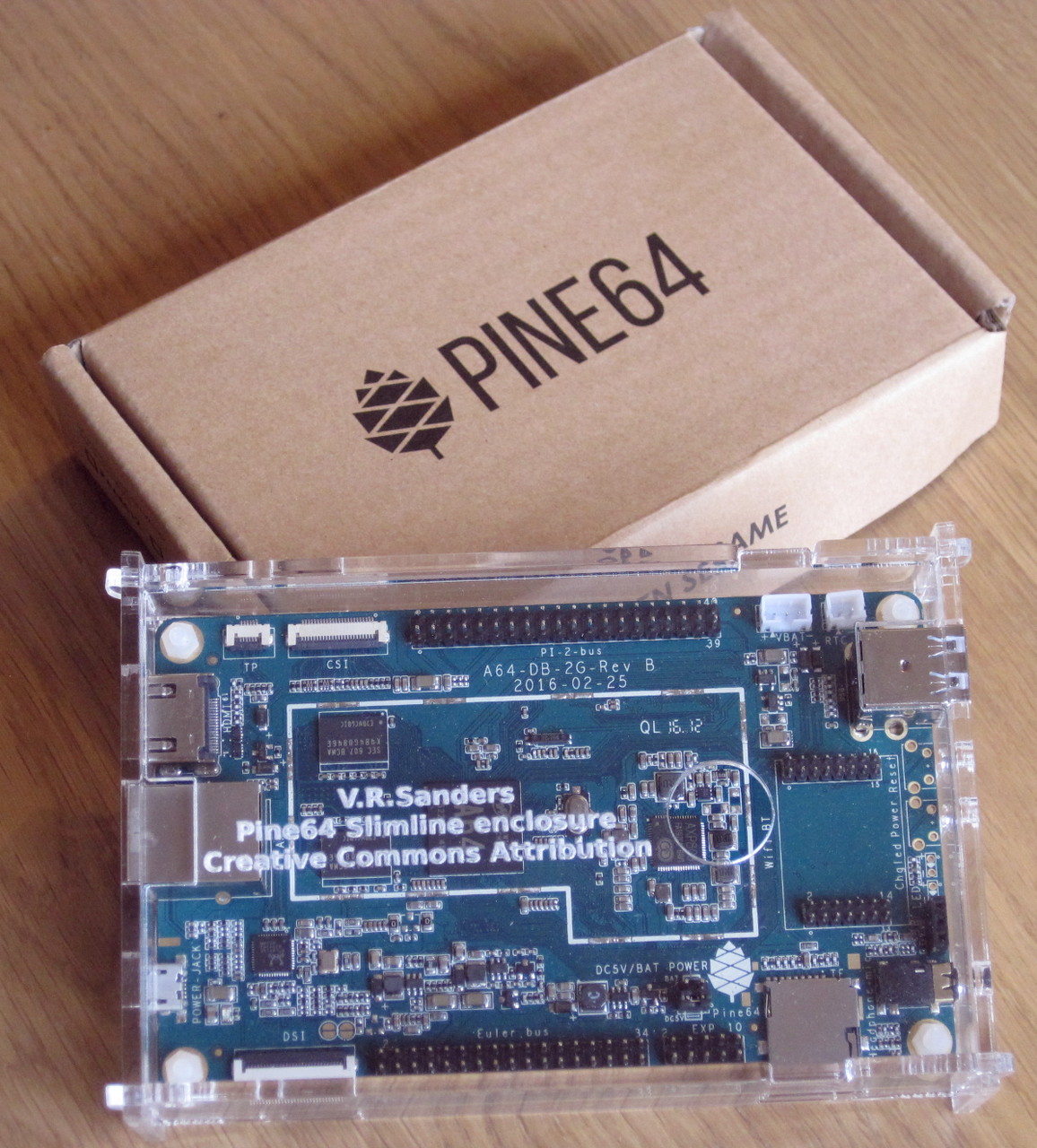
Vincent Sanders: The pine stays green in winter... wisdom in hardship.

In December 2015 I saw the kickstarter for the Pine64. The project seemed to have a viable hardware design and after my experience with the hikey I decided it could not be a great deal worse.

Pine64 board in my case design
The system I acquired comprises of:
Hardware based kickstarter projects are susceptible to several issues and the usual suspects occurred causing delays:
My personal view is that PINE 64 inc. handled it pretty well, much better than several other projects I have backed and as my Norman Douglas quotation suggests I think they have gained some wisdom from this.

I received my hardware at the beginning of April only a couple of months after their initial estimated shipping date which as these things go is not a huge delay. I understand some people who had slightly more complex orders were just receiving their orders in late June which is perhaps unfortunate but still well within kickstarter project norms.

As an aside: I fear that many people simply misunderstand the crowdfunding model for hardware projects and fail to understand that they are not buying a finished product, on the other side of the debate I think many projects need to learn expectation management much better than they do. Hyping the product to get interest is obviously the point of the crowdfunding platform, but over promising and under delivering always causes unhappy customers.

Pine64 board dimensions
Despite the delays in production and shipping the information available for the board was (and sadly remains) inadequate. As usual I wanted to case my board and there were no useful dimension drawings so I had to make my own from direct measurements together with a STL 3D model.

Also a mental sigh for "yet another poor form factor decision" so another special case size and design. After putting together a design and fabricating with the laser cutter I moved on to the software.

Once more this is where, once again, the story turns bleak. We find a very pretty website but no obvious link to the software (hint scroll to the bottom and find the "support" wiki link) once you find the wiki you will eventually discover that the provided software is either an Android 5.1.1 image (which failed to start on my board) or relies on some random guy from the forums who has put together his own OS images using a hacked up Allwinner Board Support Package (BSP) kernel.

Now please do not misunderstand me, I think the work by Simon Eisenmann (longsleep) to get a working kernel and Lenny Raposo to get viable OS images is outstanding and useful. I just feel that Allwinner and vendors like Pine64 Inc. should have provided something much, much better than they have. Even the efforts to get mainline support for this hardware are all completely volunteer community efforts and are are making slow progress as a result.

Assuming I wanted to run a useful OS on this hardware and not just use it as a modern work of art I installed a basic Debian arm64 using Lenny Raposo's pine64 pro site downloads. I was going to use the system for compiling and builds so used the "Debian Base" image to get a minimal setup. After generating unique ssh keys, renaming the default user and checking all the passwords and permissions I convinced myself the system was reasonably trustworthy.

The standard Debian Jessie OS runs as expected with few surprises. The main concern I have is that there are a number of unpackaged scripts installed (prefixed with pine64_) which perform several operations from reporting system health (using sysfs entries) to upgrading the kernel and bootloader.

While I understand these scripts have been provided for the novice users to reduce support burden, doing even more of the vendors job, I would much rather have had proper packages for these scripts, kernel and bootloader which apt could manage. This would have reduced image creation to a simple debootstrap giving much greater confidence in the images provenance.

The 3.10 based kernel is three years old at the time of writing and lacks a great number of features for the aarch64 ARM processors introduced since release. However I was pleasantly surprised at kvm apparently being available.

# dmesg grep -i kvm
[ 7.592896] kvm [1]: Using HYP init bounce page @b87c4000
[ 7.593361] kvm [1]: interrupt-controller@1c84000 IRQ25
[ 7.593778] kvm [1]: timer IRQ27
[ 7.593801] kvm [1]: Hyp mode initialized successfully

I installed the libvirt packages (and hence all their dependencies like qemu) and created a bridge ready for the virtual machines.

I needed access to storage for the host disc images and while I could have gone the route of using USB attached SATA as with the hikey I decided to try and use network attached storage instead. Initially I investigated iSCSI but it seems the Linux target (iSCSI uses initiator for client and target for server) support is either old, broken or unpackaged.

I turned to network block device (nbd) which is packaged and seems to have reasonable stability out of the box on modern distributions. This appeared to work well, indeed over the gigabit Ethernet interface I managed to get a sustained 40 megabytes a second read and write rate in basic testing. This is better performance than a USB 2.0 attached SSD on the hikey

I fired up the guest and perhaps I should have known better than to expect a 3.10 vendor kernel to cope. The immediate hard crashes despite tuning many variables convinced me that virtualisation was not viable with this kernel.

So abandoning that approach I attempted to run the CI workload directly on the system. To my dismay this also proved problematic. The processor has the bad habit of throttling due to thermal issues (despite a substantial heatsink) and because the storage is network attached throttling the CPU also massively impacts I/O.

The limitations meant that the workload caused the system to move between high performance and almost no progress on a roughly ten second cycle. This caused a simple NetSurf recompile CI job to take over fifteen minutes. For comparison the same task takes the armhf builder (CubieTruck) four minutes and a 64 bit x86 build which takes around a minute.

If the workload is tuned to a single core which does not trip thermal throttling the build took seven minutes. which is almost identical to the existing single core virtual machine instance running on the hikey.

In conclusion the Pine64 is an interesting bit of hardware with fatally flawed software offering. Without Simon and Lenny providing their builds to the community the device would be practically useless rather than just performing poorly. There appears to have been no progress whatsoever on the software offering from Pine64 in the six months since I received the device and no prospect of mainline Allwinner support for the SoC either.

Effectively I have spent around 50usd (40 for the board and 10 for the enclosure) on a failed experiment. Perhaps in the future the software will improve sufficiently for it to become useful but I do not hold out much hope that this will come from Pine64 themselves.

10 October 2016

Reproducible builds folks: Reproducible Builds: week 76 in Stretch cycle

What happened in the Reproducible Builds effort between Sunday October 2 and Saturday October 8 2016: Media coverage Events Packages reviewed and fixed, and bugs filed Reviews of unreproducible packages 31 package reviews have been added, 27 have been updated and over 20 have been removed in this week, adding to our knowledge about identified issues. 3 issue types have been addded: 1 issue type has been updated: Weekly QA work During of reproducibility testing, some FTBFS bugs have been detected and reported by: tests.reproducible-builds.org Debian: Misc. This week's edition was written by Chris Lamb, Holger Levsen & Vagrant Cascadian and reviewed by a bunch of Reproducible Builds folks on IRC.

26 September 2016

Reproducible builds folks: Reproducible Builds: week 74 in Stretch cycle

Here is what happened in the Reproducible Builds effort between Sunday September 18 and Saturday September 24 2016: Outreachy We intend to participate in Outreachy Round 13 and look forward for new enthusiastic applications to contribute to reproducible builds. We're offering four different areas to work on: Reproducible Builds World summit #2 We are planning e a similar event to our Athens 2015 summit and expect to reveal more information soon. If you haven't been contacted yet but would like to attend, please contact holger. Toolchain development and fixes Mattia uploaded dpkg/1.18.10.0~reproducible1 to our experimental repository. and covered the details for the upload in a mailing list post. The most important change is the incorporation of improvements made by Guillem Jover (dpkg maintainer) to the .buildinfo generator. This is also in the hope that it will speed up the merge in the upstream. One of the other relevant changes from before is that .buildinfo files generated from binary-only builds will no longer include the hash of the .dsc file in Checksums-Sha256 as documented in the specification. Even if it was considered important to include a checksum of the source package in .buildinfo, storing it that way breaks other assumptions (eg. that Checksums-Sha256 contains only files part of that are part of a single upload, wheras the .dsc might not be part of that upload), thus we look forward for another solution to store the source checksum in .buildinfo. Bugs filed Reviews of unreproducible packages 250 package reviews have been added, 4 have been updated and 4 have been removed in this week, adding to our knowledge about identified issues. 4 issue types have been added: 3 issue types have been updated: Weekly QA work FTBFS bugs have been reported by: Documentation updates h01ger created a new Jenkins job so that every commit pushed to the master branch for the website will update reproducible-builds.org. diffoscope development strip-nondeterminism development reprotest development tests.reproducible-builds.org Misc. This week's edition was written by Chris Lamb, Holger Levsen and Mattia Rizzolo and reviewed by a bunch of Reproducible Builds folks on IRC.

25 September 2016

Julian Andres Klode: Introducing TrieHash, a order-preserving minimal perfect hash function generator for C(++)

Abstract I introduce TrieHash an algorithm for constructing perfect hash functions from tries. The generated hash functions are pure C code, minimal, order-preserving and outperform existing alternatives. Together with the generated header files,they can also be used as a generic string to enumeration mapper (enums are created by the tool). Introduction APT (and dpkg) spend a lot of time in parsing various files, especially Packages files. APT currently uses a function called AlphaHash which hashes the last 8 bytes of a word in a case-insensitive manner to hash fields in those files (dpkg just compares strings in an array of structs). There is one obvious drawback to using a normal hash function: When we want to access the data in the hash table, we have to hash the key again, causing us to hash every accessed key at least twice. It turned out that this affects something like 5 to 10% of the cache generation performance. Enter perfect hash functions: A perfect hash function matches a set of words to constant values without collisions. You can thus just use the index to index into your hash table directly, and do not have to hash again (if you generate the function at compile time and store key constants) or handle collision resolution. As #debian-apt people know, I happened to play a bit around with tries this week before guillem suggested perfect hashing. Let me tell you one thing: My trie implementation was very naive, that did not really improve things a lot Enter TrieHash Now, how is this related to hashing? The answer is simple: I wrote a perfect hash function generator that is based on tries. You give it a list of words, it puts them in a trie, and generates C code out of it, using recursive switch statements (see code generation below). The function achieves competitive performance with other hash functions, it even usually outperforms them. Given a dictionary, it generates an enumeration (a C enum or C++ enum class) of all words in the dictionary, with the values corresponding to the order in the dictionary (the order-preserving property), and a function mapping strings to members of that enumeration. By default, the first word is considered to be 0 and each word increases a counter by one (that is, it generates a minimal hash function). You can tweak that however:
= 0
WordLabel ~ Word
OtherWord = 9
will return 0 for an unknown value, map Word to the enum member WordLabel and map OtherWord to 9. That is, the input list functions like the body of a C enumeration. If no label is specified for a word, it will be generated from the word. For more details see the documentation C code generation
switch(string[0]   32)  
case 't':
    switch(string[1]   32)  
    case 'a':
        switch(string[2]   32)  
        case 'g':
            return Tag;


return Unknown;
Yes, really recursive switches they directly represent the trie. Now, we did not really do a straightforward translation, there are some optimisations to make the whole thing faster and easier to look at: First of all, the 32 you see is used to make the check case insensitive in case all cases of the switch body are alphabetical characters. If there are non-alphabetical characters, it will generate two cases per character, one upper case and one lowercase (with one break in it). I did not know that lowercase and uppercase characters differed by only one bit before, thanks to the clang compiler for pointing that out in its generated assembler code! Secondly, we only insert breaks only between cases. Initially, each case ended with a return Unknown, but guillem (the dpkg developer) suggested it might be faster to let them fallthrough where possible. Turns out it was not faster on a good compiler, but it s still more readable anywhere. Finally, we build one trie per word length, and switch by the word length first. Like the 32 trick, his gives a huge improvement in performance. Digging into the assembler code The whole code translates to roughly 4 instructions per byte:
  1. A memory load,
  2. an or with 32
  3. a comparison, and
  4. a conditional jump.
(On x86, the case sensitive version actually only has a cmp-with-memory and a conditional jump). Due to https://gcc.gnu.org/bugzilla/show_bug.cgi?id=77729 this may be one instruction more: On some architectures an unneeded zero-extend-byte instruction is inserted this causes a 20% performance loss. Performance evaluation I run the hash against all 82 words understood by APT in Packages and Sources files, 1,000,000 times for each word, and summed up the average run-time:
host arch Trie TrieCase GPerfCase GPerf DJB
plummer ppc64el 540 601 1914 2000 1345
eller mipsel 4728 5255 12018 7837 4087
asachi arm64 1000 1603 4333 2401 1625
asachi armhf 1230 1350 5593 5002 1784
barriere amd64 689 950 3218 1982 1776
x230 amd64 465 504 1200 837 693
Suffice to say, GPerf does not really come close. All hosts except the x230 are Debian porterboxes. The x230 is my laptop with a a Core i5-3320M, barriere has an Opteron 23xx. I included the DJB hash function for another reference. Source code The generator is written in Perl, licensed under the MIT license and available from https://github.com/julian-klode/triehash I initially prototyped it in Python, but guillem complained that this would add new build dependencies to dpkg, so I rewrote it in Perl. Benchmark is available from https://github.com/julian-klode/hashbench Usage See the script for POD documentation.
Filed under: General

31 August 2016

Chris Lamb: Free software activities in August 2016

Here is my monthly update covering what I have been doing in the free software world (previously):

Reproducible builds

Whilst anyone can inspect the source code of free software for malicious flaws, most Linux distributions provide binary (or "compiled") packages to end users. The motivation behind the Reproducible Builds effort is to allow verification that no flaws have been introduced either maliciously and accidentally during this compilation process by promising identical binary packages are always generated from a given source.

Diffoscope diffoscope is our "diff on steroids" that will not only recursively unpack archives but will transform binary formats into human-readable forms in order to compare them:
  • Added a command-line interface to the try.diffoscope.org web service.
  • Added a JSON comparator.
  • In the HTML output, highlight lines when hovering to make it easier to visually track.
  • Ensure that we pass str types to our Difference class, otherwise we can't be sure we can render them later.
  • Testsuite improvements:
    • Generate test coverage reports.
    • Add tests for Haskell and GitIndex comparators.
    • Completely refactored all of the comparator tests, extracting out commonly-used routines.
    • Confirm rendering of text and HTML presenters when checking non-existing files.
    • Dropped a squashfs test as it was simply too unreliable and/or has too many requirements to satisfy.
  • A large number of miscellaneous cleanups, including:
    • Reworking the comparator setup/preference internals by dynamically importing classes via a single list.
    • Split exceptions out into dedicated diffoscope.exc module.
    • Tidying the PROVIDERS dict in diffoscope/__init__.py.
    • Use html.escape over xml.sax.saxutils.escape, cgi.escape, etc.
    • Removing hard-coding of manual page targets names in debian/rules.
    • Specify all string format arguments as logging function parameters, not using interpolation.
    • Tidying imports, correcting indentation levels and drop unnecessary whitespace.

disorderfs disorderfs is our FUSE filesystem that deliberately introduces nondeterminism in system calls such as readdir(3).
  • Added a testsuite to prevent regressions. (f124965)
  • Added a --sort-dirents=yes no option for forcing deterministic ordering. (2aae325)

Other
  • Improved strip-nondeterminism, our tool to remove specific nondeterministic information after a build:
    • Match more styles of Java .properties files.
    • Remove hyphen from "non-determinism" and "non-deterministic" throughout package for consistency.
  • Improvements to our testing infrastucture:
    • Improve the top-level navigation so that we can always get back to "home" of a package.
    • Give expandable elements cursor: pointer CSS styling to highlight they are clickable.
    • Drop various trailing underlined whitespaces after links.
    • Explicitly log that build was successful or not.
    • Various code-quality improvements, including prefering str.format over concatentation.
  • Miscellaneous updates to our filter-packages internal tool:
    • Add --random=N and --url options.
    • Add support for --show=comments.
    • Correct ordering so that --show-version runs after --filter-ftbfs.
    • Rename --show-ftbfs to --filter-ftbfs and --show-version to --show=version.
  • Created a proof-of-concept reproducible-utils package to contain commonly-used snippets aimed at developers wishing to make their packages reproducible.


I also submitted 92 patches to fix specific reproducibility issues in advi, amora-server, apt-cacher-ng, ara, argyll, audiotools, bam, bedtools, binutils-m68hc1x, botan1.10, broccoli, congress, cookiecutter, dacs, dapl, dateutils, ddd, dicom3tools, dispcalgui, dnssec-trigger, echoping, eekboek, emacspeak, eyed3, fdroidserver, flashrom, fntsample, forkstat, gkrellm, gkrellm, gnunet-gtk, handbrake, hardinfo, ircd-irc2, ircd-ircu, jack-audio-connection-kit, jpy, kxmlgui, libbson, libdc0, libdevel-cover-perl, libfm, libpam-ldap, libquvi, librep, lilyterm, mozvoikko, mp4h, mp4v2, myghty, n2n, nagios-nrpe, nikwi, nmh, nsnake, openhackware, pd-pdstring, phpab, phpdox, phpldapadmin, pixelmed-codec, pleiades, pybit, pygtksourceview, pyicu, python-attrs, python-gflags, quvi, radare2, rc, rest2web, roaraudio, rt-extension-customfieldsonupdate, ruby-compass, ruby-pg, sheepdog, tf5, ttf-tiresias, ttf-tiresias, tuxpaint, tuxpaint-config, twitter-bootstrap3, udpcast, uhub, valknut, varnish, vips, vit, wims, winswitch, wmweather+ & xshisen.

Debian GNU/Linux
Debian LTS

This month I have been paid to work 15 hours on Debian Long Term Support (LTS). In that time I did the following:
  • "Frontdesk" duties, triaging CVEs, etc.
  • Authored the patch & issued DLA 596-1 for extplorer, a web-based file manager, fixing an archive traversal exploit.
  • Issued DLA 598-1 for suckless-tools, fixing a segmentation fault in the slock screen locking tool.
  • Issued DLA 599-1 for cracklib2, a pro-active password checker library, fixing a stack-based buffer overflow when parsing large GECOS fields.
  • Improved the find-work internal tool adding optional colour highlighting and migrating it to Python 3.
  • Wrote an lts-missing-uploads tool to find mistakes where there was no correponding package in the archive after an announcement.
  • Added optional colour highlighting to the lts-cve-triage tool.

Uploads
  • redis 2:3.2.3-1 New upstream release, move to the DEP-5 debian/copyright format, ensure that we are running as root in LSB initscripts and add a README.Source regarding our local copies of redis.conf and sentinel.conf.
  • python-django:
    • 1:1.10-1 New upstream release.
    • 1:1.10-2 Fix test failures due to mishandled upstream translation updates.

  • gunicorn:
    • 19.6.0-2 Reload logrotate in the postrotate action to avoid processes writing to the old files and move to DEP-5 debian/copyright format.
    • 19.6.0-3 Drop our /usr/sbin/gunicorn ,3 -debian and related Debian-specific machinery to be more like upstream.
    • 19.6.0-4 Drop "template" systemd .service files and point towards examples and documentation instead.

  • adminer:
    • 4.2.5-1 Take over package maintenance, completely overhauling the packaging with a new upstream version, move to virtual-mysql-server to support MariaDB, updating package names of dependencies and fix the outdated Apache configuration.
    • 4.2.5-2 Correct the php5 package names.


FTP Team As a Debian FTP assistant I ACCEPTed 90 packages: android-platform-external-jsilver, android-platform-frameworks-data-binding, camlpdf, consolation, dfwinreg, diffoscope, django-restricted-resource, django-testproject, django-testscenarios, gitlab-ci-multi-runner, gnome-shell-extension-taskbar, golang-github-flynn-archive-go-shlex, golang-github-jamesclonk-vultr, golang-github-weppos-dnsimple-go, golang-golang-x-time, google-android-ndk-installer, haskell-expiring-cache-map, haskell-hclip, haskell-hdbc-session, haskell-microlens-ghc, haskell-names-th, haskell-persistable-record, haskell-should-not-typecheck, haskell-soap, haskell-soap-tls, haskell-th-reify-compat, haskell-with-location, haskell-wreq, kbtin, libclipboard-perl, libgtk3-simplelist-perl, libjs-jquery-selectize.js, liblemon, libplack-middleware-header-perl, libreoffice, libreswan, libtest-deep-json-perl, libtest-timer-perl, linux, linux-signed, live-tasks, llvm-toolchain-3.8, llvm-toolchain-snapshot, lua-luv, lua-torch-image, lua-torch-nn, magic-wormhole, mini-buildd, ncbi-vdb, node-ast-util, node-es6-module-transpiler, node-es6-promise, node-inline-source-map, node-number-is-nan, node-object-assign, nvidia-graphics-drivers, openhft-chronicle-bytes, openhft-chronicle-core, openhft-chronicle-network, openhft-chronicle-threads, openhft-chronicle-wire, pycodestyle, python-aptly, python-atomicwrites, python-click-log, python-django-casclient, python-git-os-job, python-hypothesis, python-nosehtmloutput, python-overpy, python-parsel, python-prov, python-py, python-schema, python-tackerclient, python-tornado, pyvo, r-cran-cairo, r-cran-mi, r-cran-rcppgsl, r-cran-sem, ruby-curses, ruby-fog-rackspace, ruby-mixlib-archive, ruby-tzinfo-data, salt-formula-swift, scapy3k, self-destructing-cookies, trollius-redis & websploit.

28 August 2016

Reproducible builds folks: Reproducible builds: week 70 in Stretch cycle

What happened in the Reproducible Builds effort between Sunday August 21 and Saturday August 27 2016: GSoC and Outreachy updates Packages reviewed and fixed, and bugs filed Reviews of unreproducible packages 10 package reviews have been added and 6 have been updated this week, adding to our knowledge about identified issues. A large number of issue types have been updated: Weekly QA work 29 FTBFS bugs have been reported by: diffoscope development Holger also created another test job for diffoscope on jenkins.debian.net, so that now also all commits to branches other than master are being tested. strip-nondeterminism development strip-nondeterminism 0.023-1 was uploaded by Chris Lamb:
 * Support Android .apk files with the JAR normalizer.
 * handlers/png.pm: Drop unused Archive::Zip import
 * Remove hyphen from non-determinism and non-deterministic.
 * javaproperties.pm: Match more styles of .properties and loosen filename matching.
 * Improve tests:
   - Make fixture runner generic to all normalizer types.
   - Replace (single) pearregistry test with a fixture.
   - Set a canonical time for fixture tests.
   - Add gzip testcase fixture.
   - Replace t/javadoc.t with fixture
   - Replace t/ar.t with a fixture.
   - t/javaproperties: move pom.properties and version.properties tests to fixtures
   - t/fixtures.t: move to using subtests
   - t/fixtures.t: Explicitly test that we can find a normalizer
   - t/fixtures.t: Don't run normalizer if we didn't find one.
strip-nondeterminism 0.023-2 uploaded by Mattia Rizzolo to allow stderr in autopkgtest. disorderfs development tests.reproducible-builds.org Debian: Somewhat related to reproducible builds there has been a first Debian jenkins team maintainance meeting on the #debian-qa IRC channel, to discuss current issues with the setup and to start the work of migrating jenkins.debian.net to jenkins.debian.org. The next meeting will take place on September 28th 2016 at 19 UTC. Misc. This week's edition was written by Chris Lamb and Holger Levsen and reviewed by a bunch of Reproducible Builds folks on IRC.

Next.

Previous.