Search Results: "radu"

26 April 2020

Enrico Zini: Some Italian women

Artemisia Gentileschi - Wikipedia
art history people archive.org
Artemisia Lomi or Artemisia Gentileschi (US: / d nt l ski, -ti -/, Italian: [arte mi zja d enti leski]; July 8, 1593 c. 1656) was an Italian Baroque painter, now considered one of the most accomplished seventeenth-century artists working in the dramatic style of Caravaggio. In an era when women had few opportunities to pursue artistic training or work as professional artists, Artemisia was the first woman to become a member of the Accademia di Arte del Disegno in Florence and had an international clientele.
Maria Pellegrina Amoretti (1756 1787), was an Italian lawyer. She is referred to as the first woman to graduate in law in Italy, and the third woman to earn a degree.
Laura Maria Caterina Bassi (October 1711 20 February 1778) was an Italian physicist and academic. She received a doctoral degree in Philosophy from the University of Bologna in May 1732. She was the first woman to earn a professorship in physics at a university. She is recognized as the first woman in the world to be appointed a university chair in a scientific field of studies. Bassi contributed immensely to the field of science while also helping to spread the study of Newtonian mechanics through Italy.
Maria Gaetana Agnesi (UK: / n je zi/ an-YAY-zee,[1] US: / n -/ ahn-,[2][3] Italian: [ma ri a ae ta na a zi, - e z-];[4] 16 May 1718 9 January 1799) was an Italian mathematician, philosopher, theologian, and humanitarian. She was the first woman to write a mathematics handbook and the first woman appointed as a mathematics professor at a university.[5]
Elena Lucrezia Cornaro Piscopia (US: /k r n ro p sko pi /,[4] Italian: [ lena lu kr ttsja kor na ro pi sk pja]) or Elena Lucrezia Corner (Italian: [kor n r]; 5 June 1646 26 July 1684), also known in English as Helen Cornaro, was a Venetian philosopher of noble descent who in 1678 became one of the first women to receive an academic degree from a university, and the first to receive a Doctor of Philosophy degree.
Maria Tecla Artemisia Montessori (/ m nt s ri/ MON-tiss-OR-ee, Italian: [ma ri a montes s ri]; August 31, 1870 May 6, 1952) was an Italian physician and educator best known for the philosophy of education that bears her name, and her writing on scientific pedagogy. At an early age, Montessori broke gender barriers and expectations when she enrolled in classes at an all-boys technical school, with hopes of becoming an engineer. She soon had a change of heart and began medical school at the Sapienza University of Rome, where she graduated with honors in 1896. Her educational method is still in use today in many public and private schools throughout the world.
Rita Levi-Montalcini OMRI OMCA (US: / le vi mo nt l t i ni, l v-, li vi m nt l -/, Italian: [ ri ta l vi montal t i ni]; 22 April 1909 30 December 2012) was an Italian Nobel laureate, honored for her work in neurobiology. She was awarded the 1986 Nobel Prize in Physiology or Medicine jointly with colleague Stanley Cohen for the discovery of nerve growth factor (NGF). From 2001 until her death, she also served in the Italian Senate as a Senator for Life. This honor was given due to her significant scientific contributions. On 22 April 2009, she became the first Nobel laureate ever to reach the age of 100, and the event was feted with a party at Rome's City Hall. At the time of her death, she was the oldest living Nobel laureate.
Margherita Hack Knight Grand Cross OMRI (Italian: [mar e ri ta (h)ak]; 12 June 1922 29 June 2013) was an Italian astrophysicist and scientific disseminator. The asteroid 8558 Hack, discovered in 1995, was named in her honour.
Samantha Cristoforetti (Italian pronunciation: [sa manta kristofo retti]; born 26 April 1977, in Milan) is an Italian European Space Agency astronaut, former Italian Air Force pilot and engineer. She holds the record for the longest uninterrupted spaceflight by a European astronaut (199 days, 16 hours), and until June 2017 held the record for the longest single space flight by a woman until this was broken by Peggy Whitson and later by Christina Koch. She is also the first Italian woman in space. Samantha Cristoforetti is also known as the first person who brewed an espresso in space.
17 November 2017

Renata Scheibler: Hello, world!

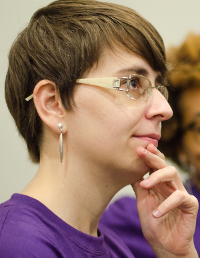
Renata's picture, a white woman profile. She touches her chin with her left hand fingertips About me Hello, world! For those who are meeting me for the first time, I am a 31 year old History teacher from Porto Alegre, Brazil. Some people might know me from the Python community, because I have been leading PyLadies Porto Alegre and helping organize Django Girls workshops in my state since 2016. If you don't, that's okay. Either way, it's nice to have you here. Ever since I learned about Rails Girls Summer of Code, during the International Free Software Forum - FISL 16, I have been wanting to get into a tech internship program. Google Summer of Code made into my radar as well, but I didn't really feel like I knew enough to try and get into those programs... until I found Outreachy. From their site:
Outreachy is an organization that provides three-month internships for people from groups traditionally underrepresented in tech. Interns work remotely with mentors from Free and Open Source Software (FOSS) communities on projects ranging from programming, user experience, documentation, illustration and graphical design, to data science.
There were many good projects to choose from on this round, a lot of them with few requirements - and most with requirements that I believed I could fullfill, such as some knowledge of HTML, CSS, Python or Django. I ought to say that I am not an expert in any of those. And, since you're reading this, I'm going to be completely honest. Coding is hard. Coding is hard to learn, it takes a lot of studying and a lot of practice. Even though I have been messing around computers pretty much since I was a kid, because I was a girl lucky enough to have a father who owned a computer store, I hadn't began learning how to program until mid-2015 - and I am still learning. I think I became such an autodidact because I had to (and, of course, because I was given the conditions to be, such as having spare time to study when I wasn't at school). I had to get any and all information from my surroundings and turn into knowledge that I could use to achieve my goals. In a time when I could only get new computer games through a CD-ROM and the computer I was allowed to use didn't have a CD-ROM drive, I had to try and learn how to open a computer cabinet and connect/disconnect hardware properly, so I could use my brother's CD-ROM drive on the computer I was allowed to and install the games without anyone noticing. When, back in 1998, I couldn't connect to the internet because the computer I was allowed to use didn't have a modem, I had to learn about networks to figure out how to do it from my brother's computer on the LAN (local network). I would go to the community public library and read books and any tech magazines I could get my hands into (libraries didn't usually have computers to be used by the public back then). It was about 2002 when I learned how to create HTML sites by studying at the source code from pages I had saved to read offline in one of the very, very few times I was allowed to access the internet and browse the web. Of course, the site I created back then never saw the light of the day, because I didn't have really have internet access at home. So, how come it is that only now, 14 years later, I am trying to get into tech? Because when I finished high school in 2003, I was still a minor and my family didn't allow me to go to Vocational School and take an IT course. (Never mind that my own oldest brother had graduated in IT and working with for almost a decade.) I ended up going to study... teacher training in History as an undergrad course. A lot has happened since then. I took the exam to become a public school teacher and more than two years had passed without being called to work. I spent 3 years in odd-jobs that paid barely enough to pay rent (and, sometimes, not even that). Since the IT is the new thing and all jobs are in IT, finally, finally it seemed okay for me to take that Vocational School training in a public school - and so I did. I gotta say, I thought that while I studied, I would be able to get some sort of job or internship to help with my learning. After all, I had seen it easily happening with people I met before getting into the course. And by "people", of course, I mean white men. For me, it took a whole year of searching, trying and interviewing for me to get an internship related to the field - tech support in a school computer lab, running GNU/Linux. And, in that very same week, I was hired as a public school teacher. There is a lot more... actually, there is so much more to this story, but I think I have told enough for now. Enough to know where I came from and who I am, as of now. I hope you stick around. I am bound to write here every two weeks, so I guess I will see you then! o/

9 October 2017

Gunnar Wolf: Achievement unlocked - Made with Creative Commons translated to Spanish! (Thanks, @xattack!)

I am very, very, very happy to report this And I cannot believe we have achieved this so fast: Back in June, I announced I'd start working on the translation of the Made with Creative Commons book into Spanish. Over the following few weeks, I worked out the most viable infrastructure, gathered input and commitments for help from a couple of friends, submitted my project for inclusion in the Hosted Weblate translations site (and got it approved!) Then, we quietly and slowly started working. Then, as it usually happens in late August, early September... The rush of the semester caught me in full, and I left this translation project for later For the next semester, perhaps... Today, I received a mail that surprised me. That stunned me. 99% of translated strings! Of course, it does not look as neat as "100%" would, but there are several strings not to be translated. So, yay for collaborative work! Oh, and FWIW Thanks to everybody who helped. And really, really, really, hats off to Luis Enrique Amaya, a friend whom I see way less than I should. A LIDSOL graduate, and a nice guy all around. Why to him specially? Well... This has several wrinkles to iron out, but, by number of translated lines: ...Need I say more? Luis, I hope you enjoyed reading the book :-] There is still a lot of work to do, and I'm asking the rest of the team some days so I can get my act together. From the mail I just sent, I need to:
  1. Review the Pandoc conversion process, to get the strings formatted again into a book; I had got this working somewhere in the process, but last I checked it broke. I expect this not to be too much of a hurdle, and it will help all other translations.
  2. Start the editorial process at my Institute. Once the book builds, I'll have to start again the stylistic correction process so the Institute agrees to print it out under its seal. This time, we have the hurdle that our correctors will probably hate us due to part of the work being done before we had actually agreed on some important Spanish language issues... which are different between Mexico, Argentina and Costa Rica (where translators are from). Anyway This sets the mood for a great start of the week. Yay!
AttachmentSize
Screenshot from 2017-10-08 20-55-30.png103.1 KB

17 August 2017

Sean Whitton: I went all the way to Montr al for DebConf17, and all I got was a new MUA

This year s group photo (by Aigars Mahinovs). I really like the tagline
On Sunday night I got back from Montr al, where I attended both DebCamp17 and DebConf17. It was a wonderful two weeks. All I really did was work on Debian for roughly eight hours per day, interspersed with getting to know both people I ve been working with since I first began contributing to Debian in late 2015, and people I didn t yet know. But this was all I really needed to be doing. There was no need to engage in distracting myself. I enjoyed the first week more. There were sufficiently few people present that you could know at least all of their faces, and interesting-sounding talks didn t interrupt making progress on one s own work or unblocking other people s work. In the second week it was great to meet people who were only present for the second week, but it felt more like regular Debian, in that I was often waiting on other people or they were waiting on me. While I spent one morning actually writing fresh code, and I did a fair amount of pure packaging work, the majority of my time was poured into (i) Debian Policy; (ii) discussions within the Emacs team; and (iii) discussions about dgit. This was as I expected. During DebConf, it s not that useful to seclude oneself and sufficiently reacquaint oneself with a codebase that one can start producing patches, because that can be done anywhere in the world, without everyone else around. It s far more useful to bring different people together to get projects unblocked. I did some of that for my own work, and also tried to help other people s, including those who weren t able to attend the conference. In my ordinary life, taking a step back from the methods by which I protect my PGP keys and other personal data, I can appear to myself as a paranoid extremist, or some kind of data hoarder. It was comforting to find at DebConf plenty of people who go way further than me: multiple user accounts on their laptop, with separate X servers, for tasks of different security levels; PGP keys on smartcards; refusal to sign my PGP key based on government-issued ID alone; use of Qubes OS. One thing that did surprise me was to find myself in a minority for using the GNOME desktop; I had previously assumed that most people deep in Debian development didn t bother with tiling window managers. Turns out they are enthusiastic to talk about the trade-offs between window managers while riding the subway train back to our accommodation at midnight who knew such people existed? I was pleased to find them. One evening, I received a tag-teamed live tutorial in using i3 s core keybindings, and the next morning GNOME seemed deeply inelegant. The insinuation began, but I was immediately embroiled in inner struggle over the fact that i3 is a very popular tiling window manager, so it wouldn t be very cool if I were to start using it. This difficulty was compounded when I learned that the Haskell team lead still uses xmonad. The struggle continues. I hope that I ve been influenced by the highly non-judgemental and tolerant attitudes of the attendees of the conference. While most people at the conference were pretty ordinary aside from wanting to talk about the details of Debian packaging and processes! there were several people who rather visibly rejected social norms about how to present themselves. Around these people there was nothing of the usual tension. Further, in contrast with my environment as a graduate student, everyone was extremely relaxed about how everyone was spending their time. People drinking beer in the evenings were sitting at tables where other people were continuing to silently work on Debian. It is nice to have my experience in Montr al as a reference to check my own judgemental tendencies. I came away with a lot more than a new MUA: a certainty that I want to try to get to next year s conference; friends; a real life community behind what was hitherto mostly a hobby; a long list of tasks and the belief that I can accomplish them; a list of PGP fingerprints to sign; a new perspective on the arguments that occur on Debian mailing lists; an awareness of the risk of unconsciously manipulating other community members into getting work done. With regard to the MUA, I should say that I did not waste a lot of DebConf time messing with its configuration. I had actually worked out a notmuch configuration some months ago, but couldn t use it because I couldn t figure out how to incorporate my old mail archives into its index. Fortunately notmuch s maintainer is also on the Emacs team he was able to confirm that the crazy solution I d come up with was not likely to break notmuch s operating assumptions, and so I was able to spend about half an hour copying and pasting the configuration and scripts I d previously developed into my homedir, and then start using notmuch for the remainder of the conference. The main reason for wanting to use notmuch was to handle Debian mailing list volume more effectively than I m able to with mutt, so I was very happy to have the opportunity to pester David with newbie questions. Many, many thanks to all the volunteers whose efforts made DebCamp17 and DebConf17 possible.

8 August 2017

Jonathan Dowland: libraries

Cover for The Rise Of The Meritocracy Cover for The Rise Of The Meritocracy
At some point during my Undergraduate years I lost the habit of using Libraries. On reflection this is probably Amazon's fault. In recent years I've tried to get back into the habit of using them. Using libraries is a great idea if you are trying to lead a more minimalist life. I am registered to use Libraries in two counties: North Tyneside, where I live, and Newcastle, where I work. The union of the two counties' catalogues is pretty extensive. Perhaps surprisingly I have found North Tyneside to offer both better customer service and a more interesting selection of books. Sometimes there are still things that are hard to get ahold of. After listening to BBC Radio 4's documentary The Rise and Fall of Meritocracy, presented by Toby Young, I became interested in reading The Rise of the Meritocracy: an alarmist, speculative essay that coined the term meritocracy, written by Toby's father, Michael Young. The book was not on either catalogue. It is out of print, with the price of second hand copies fluctuating but generally higher than I am prepared to pay. I finally managed to find a copy in Newcastle University's Library. As an associate of the School of Computing I have access to the Library services. It's an interesting read, and I think if it were framed more as a novel than as an essay it might be remembered in the same bracket as Brave New World or 1984.

15 May 2017

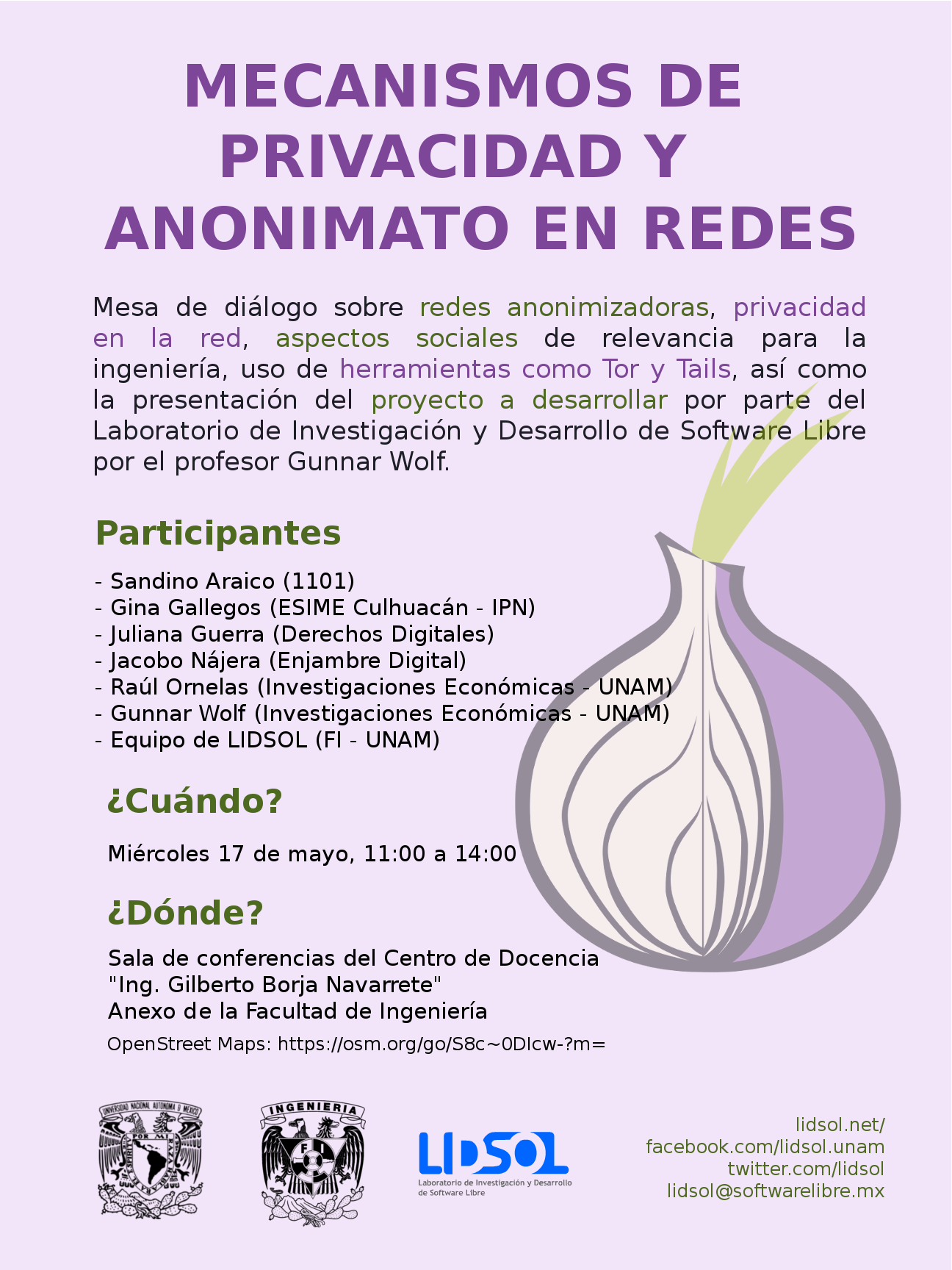
Gunnar Wolf: Starting a project on private and anonymous network usage

I am starting a work with the students of LIDSOL (Laboratorio de Investigaci n y Desarrollo de Software Libre, Free Software Research and Development Laboratory) of the Engineering Faculty of UNAM:

We want to dig into the technical and social implications of mechanisms that provide for anonymous, private usage of the network. We will have our first formal work session this Wednesday, for which we have invited several interesting people to join the discussion and help provide a path for our oncoming work. Our invited and confirmed guests are, in alphabetical order:

9 May 2017

Benjamin Mako Hill: Surviving an Eternal September: How an Online Community Managed a Surge of Newcomers

Attracting newcomers is among the most widely studied problems in online community research. However, with all the attention paid to challenge of getting new users, much less research has studied the flip side of that coin: large influxes of newcomers can pose major problems as well! The most widely known example of problems caused by an influx of newcomers into an online community occurred in Usenet. Every September, new university students connecting to the Internet for the first time would wreak havoc in the Usenet discussion forums. When AOL connected its users to the Usenet in 1994, it disrupted the community for so long that it became widely known as The September that never ended . Our study considered a similar influx in NoSleep an online community within Reddit where writers share original horror stories and readers comment and vote on them. With strict rules requiring that all members of the community suspend disbelief, NoSleep thrives off the fact that readers experience an immersive storytelling environment. Breaking the rules is as easy as questioning the truth of someone s story. Socializing newcomers represents a major challenge for NoSleep.
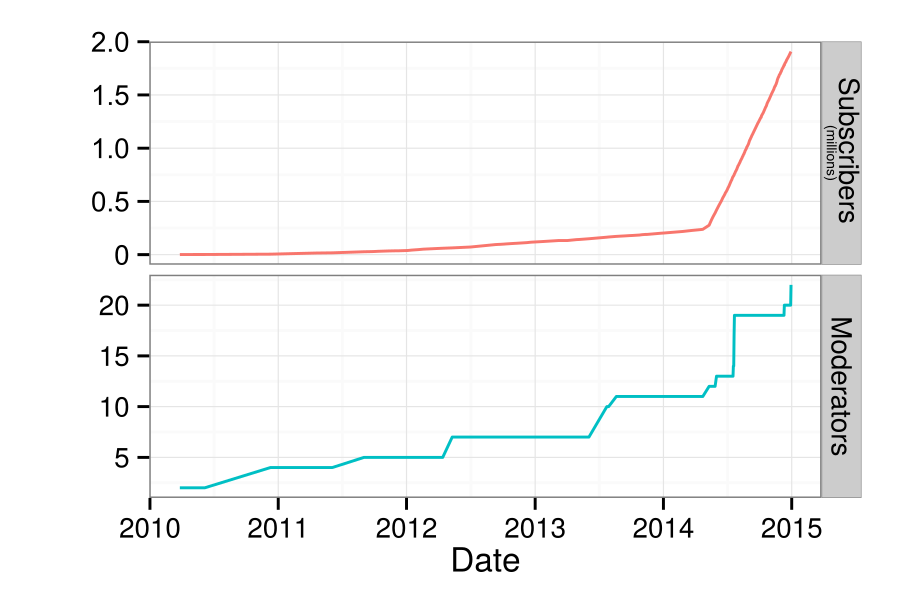
Number of subscribers and moderators on /r/NoSleep over time.
On May 7th, 2014, NoSleep became a default subreddit i.e., every new user to Reddit automatically joined NoSleep. After gradually accumulating roughly 240,000 members from 2010 to 2014, the NoSleep community grew to over 2 million subscribers in a year. That said, NoSleep appeared to largely hold things together. This reflects the major question that motivated our study: How did NoSleep withstand such a massive influx of newcomers without enduring their own Eternal September? To answer this question, we interviewed a number of NoSleep participants, writers, moderators, and admins. After transcribing, coding, and analyzing the results, we proposed that NoSleep survived because of three inter-connected systems that helped protect the community s norms and overall immersive environment. First, there was a strong and organized team of moderators who enforced the rules no matter what. They recruited new moderators knowing the community s population was going to surge. They utilized a private subreddit for NoSleep s staff. They were able to socialize and educate new moderators effectively. Although issuing sanctions against community members was often difficult, our interviewees explained that NoSleep s moderators were deeply committed and largely uncompromising. That commitment resonates within the second system that protected NoSleep: regulation by normal community members. From our interviews, we found that the participants felt a shared sense of community that motivated them both to socialize newcomers themselves as well as to report inappropriate comments and downvote people who violate the community s norms. Finally, we found that the technological systems protected the community as well. For instance, post-throttling was instituted to limit the frequency at which a writer could post their stories. Additionally, Reddit s Automoderator , a programmable AI bot, was used to issue sanctions against obvious norm violators while running in the background. Participants also pointed to the tools available to them the report feature and voting system in particular to explain how easy it was for them to report and regulate the community s disruptors.

This blog post was written with Charlie Kiene. The paper and work this post describes is collaborative work with Charlie Kiene and Andr s Monroy-Hern ndez. The paper was published in the Proceedings of CHI 2016 and is released as open access so anyone can read the entire paper here. A version of this post was published on the Community Data Science Collective blog.

19 April 2017

Steve Kemp: 3d-Printing is cool

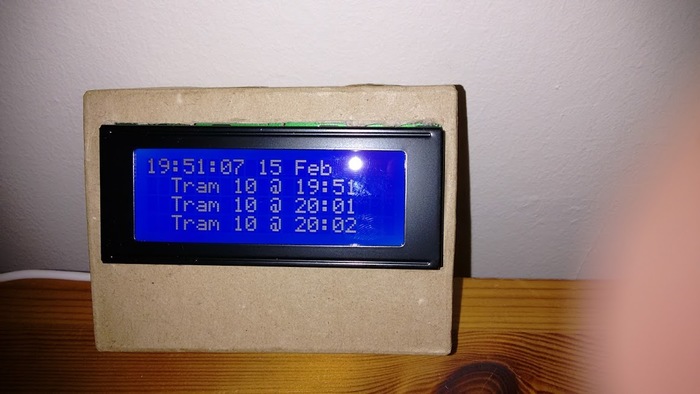
I've heard about 3d-printing a lot in the past, although the hype seems to have mostly died down. My view has always been "That seems cool", coupled with "Everybody says making the models is very hard", and "the process itself is fiddly & time-consuming". I've been sporadically working on a project for a few months now which displays tram-departure times, this is part of my drive to "hardware" things with Arduino/ESP8266 devices . Most visitors to our flat have commented on it, at least once, and over time it has become gradually more and more user-friendly. Initially it was just a toy-project for myself, so everything was hard-coded in the source but over time that changed - which I mentioned here, (specifically the Access-point setup): I've now wired up an input-button to the device too, experimenting with the different ways that a single button can carry out multiple actions: Anyway the software is neat, and I can't think of anything obvious to change. So lets move onto the real topic of this post: 3D Printing. I randomly remembered that I'd heard about an online site holding 3D-models, and on a whim I searched for "4x20 LCD". That lead me to this design, which is exactly what I was looking for. Just like open-source software we're now living in a world where you can get open-source hardware! How cool is that? I had to trust the dimensions of the model, and obviously I was going to mount my new button into the box, rather than the knob shown. But having a model was great. I could download it, for free, and I could view it online at viewstl.com. But with a model obtained the next step was getting it printed. I found a bunch of commercial companies, here in Europe, who would print a model, and ship it to me, but when I uploaded the model they priced it at 90+. Too much. I'd almost lost interest when I stumbled across a site which provides a gateway into a series of individual/companies who will print things for you, on-demand: 3dhubs. Once again I uploaded my model, and this time I was able to select a guy in the same city as me. He printed my model for 1/3-1/4 of the price of the companies I'd found, and sent me fun pictures of the object while it was in the process of being printed. To recap I started like this:
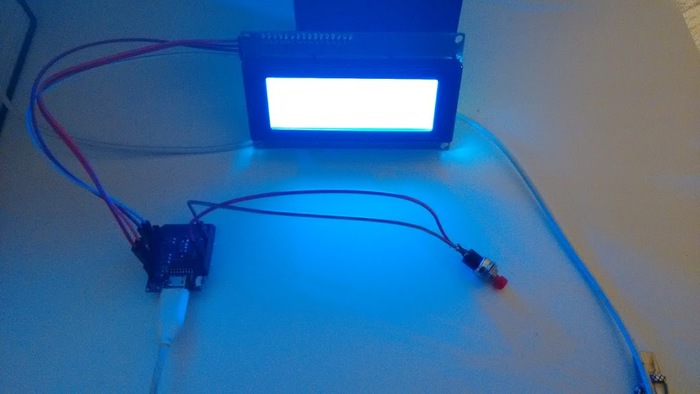
Then I boxed it in cardboard which looked better than nothing, but still not terribly great:
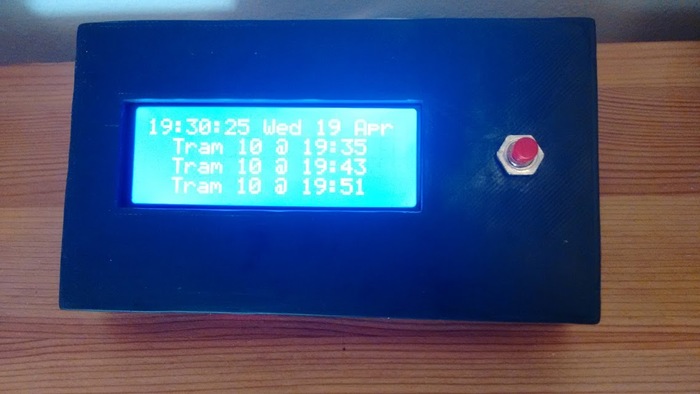
Now I've found an online case-design for free, got it printed cheaply by a volunteer (feels like the wrong word, after-all I did pay him), and I have something which look significantly more professional:
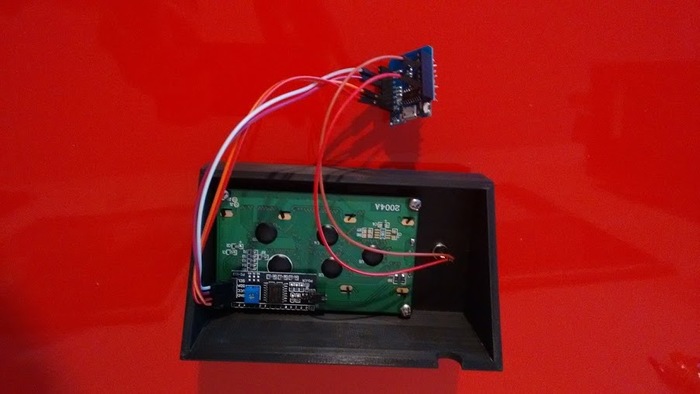
Inside it looks as neat as you would expect:
Of course the case still cost 5 times as much as the actual hardware involved (button: 0.05, processor-board 2.00 and LCD I2C display 3.00). But I've gone from being somebody who had zero experience with hardware-based projects 4 months ago, to somebody who has built a project which is functional and "pretty". The internet really is a glorious thing. Using it for learning, and coding is good, using it for building actual physical parts too? That's something I never could have predicted a few years ago and I can see myself doing it more in the future. Sure the case is a little rough around the edges, but I suspect it is now only a matter of time until I learn how to design my own models. An obvious extension is to add a status-LED above the switch, for example. How hard can it be to add a new hole to a model? (Hell I could just drill it!)

16 April 2017

Antoine Beaupr : Montreal Bug Squashing Party report

Un sommaire de cet article est galement traduit vers le fran ais, merci!
Last friday, a group of Debian users, developers and enthusiasts met at Koumbit.org offices for a bug squashing party. We were about a dozen people of various levels: developers, hackers and users. I gave a quick overview of Debian packaging using my quick development guide, which proved to be pretty useful. I made a deb.li link (https://deb.li/quickdev) for people to be able to easily find the guide on their computers. Then I started going through a list of different programs used to do Debian packaging, to try and see the level of the people attending: So mostly skilled Debian users (they know apt-get source) but not used to packaging (they don't know about dpkg-buildpackage). So I went through the list again and explained how they all fit together and could be used to work on Debian packages in the context of a Debian release bug squashing party. This was the fastest crash course in Debian packaging I have ever given (and probably the first too) - going through those tools in about 30 minutes. I was happy to have the guide that people could refer to later in the back. The first question after the presentation was "how do we find bugs"? which led me to add links to the UDD bugs page and release-critical bugs page. I also explained the key links on top of the UDD page to find specific sets of bugs, and explained the useful "patch" filter that allows to select bugs with our without patch. I guess that maybe half of the people were able to learn new, or improve their skills to make significant contributions or test actual patches. Other learned how to hunt and triage bugs in the BTS. Update: sorry for the wording: all contributions were really useful, thanks and apologies to bug hunters!! I myself learned how to use sbuild thanks to the excellent sbuild wiki page which I improved upon. A friend was able to pick up sbuild very quickly and use it to build a package for stretch, which I find encouraging: my first experience with pbuilder was definitely not as good. I have therefore starting the process of switching my build chroots to sbuild, which didn't go so well on Jessie because I use a backported kernel, and had to use the backported sbuild as well. That required a lot of poking around, so I ended up just using pbuilder for now, but I will definitely switch on my home machine, and I updated the sbuild wiki page to give out more explanations on how to setup pbuilder. We worked on a bunch of bugs, and learned how to tag them as part of the BSP, which was documented in the BSP wiki page. It seems we have worked on about 11 different bugs which is a better average than the last BSP that I organized, so I'm pretty happy with that. More importantly, we got Debian people together to meet and talk, over delicious pizza, thanks to a sponsorship granted by the DPL. Some people got involved in the next DebConf which is also great. On top of fixing bugs and getting people involved in Debian, my third goal was to have fun, and fun we certainly had. I didn't work on as many bugs as I expected myself, achieving only one upload in the end, but since I was answering so many questions left and right, I felt useful and that is certainly gratifying. Organization was simple enough: just get a place, send invites and get food, and the rest is just sharing knowledge and answering questions. Thanks everyone for coming, and let's do this again soon!

12 April 2017

Daniel Pocock: What is the risk of using proprietary software for people who prefer not to?

Jonas berg has recently blogged about Using Proprietary Software for Freedom. He argues that it can be acceptable to use proprietary software to further free and open source software ambitions if that is indeed the purpose. Jonas' blog suggests that each time proprietary software is used, the relative risk and reward should be considered and there may be situations where the reward is big enough and the risk low enough that proprietary software can be used. A question of leadership Many of the free software users and developers I've spoken to express frustration about how difficult it is to communicate to their family and friends about the risks of proprietary software. A typical example is explaining to family members why you would never install Skype. Imagine a doctor who gives a talk to school children about the dangers of smoking and is then spotted having a fag at the bus stop. After a month, if you ask the children what they remember about that doctor, is it more likely to be what he said or what he did? When contemplating Jonas' words, it is important to consider this leadership factor as a significant risk every time proprietary software or services are used. Getting busted with just one piece of proprietary software undermines your own credibility and posture now and well into the future. Research has shown that when communicating with people, what they see and how you communicate is ninety three percent of the impression you make. What you actually say to them is only seven percent. When giving a talk at a conference or a demo to a client, or communicating with family members in our everyday lives, using a proprietary application or a product or service that is obviously proprietary like an iPhone or Facebook will have far more impact than the words you say. It is not only a question of what you are seen doing in public: somebody who lives happily and comfortably without using proprietary software sounds a lot more credible than somebody who tries to explain freedom without living it. The many faces of proprietary software One of the first things to consider is that even for those developers who have a completely free operating system, there may well be some proprietary code lurking in their BIOS or other parts of their hardware. Their mobile phone, their car, their oven and even their alarm clock are all likely to contain some proprietary code too. The risks associated with these technologies may well be quite minimal, at least until that alarm clock becomes part of the Internet of Things and can be hacked by the bored teenager next door. Accessing most web sites these days inevitably involves some interaction with proprietary software, even if it is not running on your own computer. There is no need to give up Some people may consider this state of affairs and simply give up, using whatever appears to be the easiest solution for each problem at hand without thinking too much about whether it is proprietary or not. I don't think Jonas' blog intended to sanction this level of complacency. Every time you come across a piece of software, it is worth considering whether a free alternative exists and whether the software is really needed at all. An orderly migration to free software In our professional context, most software developers come across proprietary software every day in the networks operated by our employers and their clients. Sometimes we have the opportunity to influence the future of these systems. There are many cases where telling the client to go cold-turkey on their proprietary software would simply lead to the client choosing to get advice from somebody else. The free software engineer who looks at the situation strategically may find that it is possible to continue using the proprietary software as part of a staged migration, gradually helping the user to reduce their exposure over a period of months or even a few years. This may be one of the scenarios where Jonas is sanctioning the use of proprietary software. On a technical level, it may be possible to show the client that we are concerned about the dangers but that we also want to ensure the continuity of their business. We may propose a solution that involves sandboxing the proprietary software in a virtual machine or a DMZ to prevent it from compromising other systems or "calling home" to the vendor. As well as technical concerns about a sudden migration, promoters of free software frequently encounter political issues as well. For example, the IT manager in a company may be five years from retirement and is not concerned about his employer's long term ability to extricate itself from a web of Microsoft licenses after he or she has the freedom to go fishing every day. The free software professional may need to invest significant time winning the trust of senior management before he is able to work around a belligerant IT manager like this. No deal is better than a bad deal People in the UK have probably encountered the expression "No deal is better than a bad deal" many times already in the last few weeks. Please excuse me for borrowing it. If there is no free software alternative to a particular piece of proprietary software, maybe it is better to simply do without it. Facebook is a great example of this principle: life without social media is great and rather than trying to find or create a free alternative, why not just do something in the real world, like riding motorcycles, reading books or getting a cat or dog? Burning bridges behind you For those who are keen to be the visionaries and leaders in a world where free software is the dominant paradigm, would you really feel satisfied if you got there on the back of proprietary solutions? Or are you concerned that taking such shortcuts is only going to put that vision further out of reach? Each time you solve a problem with free software, whether it is small or large, in your personal life or in your business, the process you went through strengthens you to solve bigger problems the same way. Each time you solve a problem using a proprietary solution, not only do you miss out on that process of discovery but you also risk conditioning yourself to be dependent in future. For those who hope to build a successful startup company or be part of one, how would you feel if you reach your goal and then the rug is pulled out underneath you when a proprietary software vendor or cloud service you depend on changes the rules? Personally, in my own life, I prefer to avoid and weed out proprietary solutions wherever I can and force myself to either make free solutions work or do without them. Using proprietary software and services is living your life like a rat in a maze, where the oligarchs in Silicon Valley can move the walls around as they see fit.

3 April 2017

Sean Whitton: A different reason there are so few tenure-track jobs in philosophy

Recently I heard a different reason suggested as to why there are fewer and fewer tenure-track jobs in philosophy. University administrators are taking control of the tenure review process; previously departments made decisions and the administrators rubber-stamped them. The result of this is that it is easier to get tenure. This is because university administrators grant tenure based on quantitively-measurable achievements, rather than a qualitative assessment of the candidate qua philosopher. If a department thought that someone shouldn t get tenure, the administration might turn around and say that they are going to grant it because the candidate has fulfilled such-and-such requirements. Since it is easier to get tenure, hiring someone at the assistant professor level is much riskier for a philosophy department: they have to assume the candidate will get tenure. So the pre-tenure phase is no longer a probationary period. That is being pushed onto post-docs and graduate students. This results in the intellectual maturity of published work going down. There are various assumptions in the above that could be questioned, but what s interesting is that it takes a lot of the blame for the current situation off the shoulders of faculty members (there have been accusations that they are not doing enough). If tenure-track hires are a bigger risk for the quality of the academic philosophers who end up with permanent jobs, it is good that they are averse to that risk.

21 February 2017

Shirish Agarwal: The Indian elections hungama

a person showing s(he) showing s(he) Before I start, I would like to point out #855549 . This is a normal/wishlist bug I have filed against apt, the command-line package manager. I sincerely believe having a history command to know what packages were installed, which were upgraded, which were purged should be easily accessible, easily understood and if the output looks pretty, so much the better. Of particular interest to me is having a list of new packages I have installed in last couple of years after jessie became the stable release. It probably would make for some interesting reading. I dunno how much efforts would be to code something like that, but if it works, it would be the greatest. Apt would have finally arrived. Not that it s a bad tool, it s just that it would then make for a heck of a useful tool. Coming back to the topic on hand, Now for the last couple of weeks we don t have water or rather pressure of water. Water crisis has been hitting Pune every year since 2014 with no end in sight. This has been reported in newspapers addendum but it seems it has been felling on deaf ears. The end result of it is that I have to bring buckets of water from around 50 odd metres. It s not a big thing, it s not like some women in some villages in Rajasthan who have to walk in between 200 metres to 5 odd kilometres to get potable water or Darfur, Western Sudan where women are often kidnapped and sold as sexual slaves when they get to fetch water. The situation in Darfur has been shown quite vividly in Darfur is Dying . It is possible that I may have mentioned about Darfur before. While unfortunately the game is in flash as a web resource, the most disturbing part is that the game is extremely depressing, there is a no-win scenario. So knowing and seeing both those scenarios, I can t complain about 50 metres. BUT .but when you extrapolate the same data over some more or less 3.3-3.4 million citizens, 3.1 million during 2011 census with a conservative 2.3-2.4 percent population growth rate according to scroll.in. Fortunately or unfortunately, Pune Municipal Corporation elections were held today. Fortunately or unfortunately, this time all the political parties bought majorly unknown faces in these elections. For e.g. I belong to ward 14 which is spread over quite a bit of area and has around 10k of registered voters. Now the unfortunate part of having new faces in elections, you don t know anything about them. Apart from the affidavits filed, the only thing I come to know is whether there are criminal cases filed against them and what they have shown as their wealth. While I am and should be thankful to ADR which actually is the force behind having the collated data made public. There is a lot of untold story about political push-back by all the major national and regional political parties even when this bit of news were to be made public. It took major part of a decade for such information to come into public domain. But for my purpose of getting clean air and water supply 24 7 to each household seems a very distant dream. I tried to connect with the corporators about a week before the contest and almost all of the lower party functionaries hid behind their political parties manifestos stating they would do the best without any viable plan. For those not knowing, India has been blessed with 6 odd national parties and about 36 odd regional parties and every election some 20-25 new parties try their luck every time. The problem is we, the public, don t trust them or their manifestos. First of all the political parties themselves engage in mud-slinging as to who s copying whom with the manifesto.Even if a political party wins the elections, there is no *real* pressure for them to follow their own manifesto. This has been going for many a year. OF course, we the citizens are to also blame as most citizens for one reason or other chose to remain aloof of the process. I scanned/leafed through all the manifestos and all of them have the vague-wording we will make Pune tanker-free without any implementation details. While I was unable to meet the soon-to-be-Corporators, I did manage to meet a few of the assistants but all the meetings were entirely fruitless. Diagram of Rain Water Harvesting I asked why can t the city follow the Chennai model. Chennai, not so long ago was at the same place where Pune is, especially in relation to water. What happened next, in 2001 has been beautifully chronicled in Hindustan Times . What has not been shared in that story is that the idea was actually fielded by one of Chennai Mayor s assistants, an IAS Officer, I have forgotten her name, Thankfully, her advise/idea was taken to heart by the political establishment and they drove RWH. Saying why we can t do something similar in Pune, I heard all kinds of excuses. The worst and most used being Marathas can never unite which I think is pure bullshit. For people unfamiliar to the term, Marathas was a warrior clan in Shivaji s army. Shivaji, the king of Marathas were/are an expert tactician and master of guerilla warfare. It is due to the valor of Marathas, that we still have the Maratha Light Infantry a proud member of the Indian army. Why I said bullshit was the composition of people living in Maharashtra has changed over the decades. While at one time both the Brahmins and the Marathas had considerable political and population numbers, that has changed drastically. Maharashtra and more pointedly, Mumbai, Pune and Nagpur have become immigrant centres. Why just a decade back, Shiv Sena, an ultra right-wing political party used to play the Maratha card at each and every election and heckle people coming from Uttar Pradesh and Bihar, this has been documented as the 2008 immigrants attacks and 9 years later we see Shiv Sena trying to field its candidates in Uttar Pradesh. So, obviously they cannot use the same tactics which they could at one point of time. One more reason I call it bullshit, is it s a very lame excuse. When the Prime Minister of the country calls for demonetization which affects 1.25 billion people, people die, people stand in queues and is largely peaceful, I do not see people resisting if they bring a good scheme. I almost forgot, as an added sweetener, the Chennai municipality said that if you do RWH and show photos and certificates of the job, you won t have to pay as much property tax as otherwise you would, that also boosted people s participation. And that is not the only solution, one more solution has been outlined in Aaj Bhi Khade hain talaab written by just-deceased Gandhian environmental activist Anupam Mishra. His Book can be downloaded for free at India Water Portal . Unfortunately, the said book doesn t have a good English translation till date. Interestingly, all of his content is licensed under public domain (CC-0) so people can continue to enjoy and learn from his life-work. Another lesson or understanding could be taken from Israel, the father of the modern micro-drip irrigation for crops. One of the things on my bucket lists is to visit Israel and if possible learn how they went from a water-deficient country to a water-surplus one. India labor Which brings me to my second conundrum, most of the people believe that it s the Government s job to provide jobs to its people. India has been experiencing jobless growth for around a decade now, since the 2008 meltdown. While India was lucky to escape that, most of its trading partners weren t hence it slowed down International trade which slowed down creation of new enterprises etc. Laws such as the Bankruptcy law and the upcoming Goods and Services Tax . As everybody else, am a bit excited and a bit apprehensive about how the actual implementation will take place. null Even International businesses has been found wanting. The latest example has been Uber and Ola. There have been protests against the two cab/taxi aggregators operating in India. For the millions of jobless students coming out of schools and Universities, there aren t simply enough jobs for them, nor are most (okay 50%) of them qualified for the jobs, these 50 percent are also untrainable, so what to do ? In reality, this is what keeps me awake at night. India is sitting on this ticking bomb-shell. It is really, a miracle that the youths have not rebelled yet. While all the conditions, proposals and counter-proposals have been shared before, I wanted/needed to highlight it. While the issue seems to be local, I would assert that they are all glocal in nature. The questions we are facing, I m sure both developing and to some extent even developed countries have probably been affected by it. I look forward to know what I can learn from them. Update 23/02/17 I had wanted to share about Debian s Voting system a bit, but that got derailed. Hence in order not to do, I ll just point towards 2015 platforms where 3 people vied for DPL post. I *think* I shared about DPL voting process earlier but if not, would do in detail in some future blog post.
Filed under: Miscellenous Tagged: #Anupam Mishra, #Bankruptcy law, #Chennai model, #clean air, #clean water, #elections, #GST, #immigrant, #immigrants, #Maratha, #Maratha Light Infantry, #migration, #national parties, #Political party manifesto, #regional parties, #ride-sharing, #water availability, Rain Water Harvesting

7 January 2017

Simon Richter: Crossgrading Debian in 2017

So, once again I had a box that had been installed with the kind-of-wrong Debian architecture, in this case, powerpc (32 bit, bigendian), while I wanted ppc64 (64 bit, bigendian). So, crossgrade time. If you want to follow this, be aware that I use sysvinit. I doubt this can be done this way with systemd installed, because systemd has a lot more dependencies for PID 1, and there is also a dbus daemon involved that cannot be upgraded without a reboot. To make this a bit more complicated, ppc64 is an unofficial port, so it is even less synchronized across architectures than sid normally is (I would have used jessie, but there is no jessie for ppc64). Step 1: Be Prepared To work around the archive synchronisation issues, I installed pbuilder and created 32 and 64 bit base.tgz archives:

pbuilder --create --basetgz /var/cache/pbuilder/powerpc.tgz
pbuilder --create --basetgz /var/cache/pbuilder/ppc64.tgz \
    --architecture ppc64 \
    --mirror http://ftp.ports.debian.org/debian-ports \
    --debootstrapopts --keyring=/usr/share/keyrings/debian-ports-archive-keyring.gpg \
    --debootstrapopts --include=debian-ports-archive-keyring
Step 2: Gradually Heat the Water so the Frog Doesn't Notice Then, I added the sources to sources.list, and added the architecture to dpkg:
deb [arch=powerpc] http://ftp.debian.org/debian sid main
deb [arch=ppc64] http://ftp.ports.debian.org/debian-ports sid main
deb-src http://ftp.debian.org/debian sid main
dpkg --add-architecture ppc64
apt update
Step 3: Time to Go Wild
apt install dpkg:ppc64
Obviously, that didn't work, in my case because libattr1 and libacl1 weren't in sync, so there was no valid way to install powerpc and ppc64 versions in parallel, so I used pbuilder to compile the current version from sid for the architecture that wasn't up to date (IIRC, one for powerpc, and one for ppc64). Manually installed the libraries, then tried again:
apt install dpkg:ppc64
Woo, it actually wants to do that. Now, that only half works, because apt calls dpkg twice, once to remove the old version, and once to install the new one. Your options at this point are
apt-get download dpkg:ppc64
dpkg -i dpkg_*_ppc64.deb
or if you didn't think far enough ahead, cursing followed by
cd /tmp
ar x /var/cache/apt/archives/dpkg_*_ppc64.deb
cd /
tar -xJf /tmp/data.tar.xz
dpkg -i /var/cache/apt/archives/dpkg_*_ppc64.deb
Step 4: Automate That Now, I'd like to get this a bit more convenient, so I had to repeat the same dance with apt and aptitude and their dependencies. Thanks to pbuilder, this wasn't too bad. With the aptitude resolver, it was then simple to upgrade a test package
aptitude install coreutils:ppc64 coreutils:powerpc-
The resolver did its thing, and asked whether I really wanted to remove an Essential package. I did, and it replaced the package just fine. So I asked dpkg for a list of all powerpc packages installed (since it's a ppc64 dpkg, it will report powerpc as foreign), massage that into shape with grep and sed, and give the result to aptitude as a command line. Some time later, aptitude finished, and I had a shiny 64 bit system. Crossgrade through an ssh session that remained open all the time, and without a reboot. After closing the ssh session, the last 32 bit binary was deleted as it was no longer in use. There were a few minor hiccups during the process where dpkg refused to overwrite "shared" files with different versions, but these could be solved easily by manually installing the offending package with
dpkg --force-overwrite -i ...
and then resuming what aptitude was doing, using
aptitude install
So, in summary, this still works fairly well.

6 January 2017

Jonathan McDowell: 2016 in 50 Words

Idea via Roger. Roughly chronological order. Some things were obvious inclusions but it was interesting to go back and look at the year to get to the full 50 words. Speaking at BelFOSS. Earthlings birthday. ATtiny hacking. Speaking at ISCTSJ. Dublin Anomaly. Co-habiting. DebConf. Peak Lion. Laura s wedding. Christmas + picnic. Engagement. Car accident. Car write off. Tennent s Vital. Dissertation. OMGWTFBBQ. BSides. New job. Rachel s wedding. Digital Privacy talk. Graduation. All The Christmas Dinners. IMDB Top 250. Shay leaving drinks. (This also serves as a test to see if I ve correctly updated Planet Debian to use https and my new Hackergotchi that at least looks a bit more like I currently do.)

2 January 2017

Shirish Agarwal: India Tourism, E-Visa and Hong Kong

A Safe and Happy New Year to all. While Debconf India is still a pipe-dream as of now, did see that India has been gradually doing it easier for tourists and casual business visitors to come visit India. This I take as very positive development for India itself. The 1st condition is itself good for anybody visiting India
Eligibility International Travellers whose sole objective of visiting India is recreation , sight-seeing , casual visit to meet friends or relatives, short duration medical treatment or casual business visit.
https://indianvisaonline.gov.in/visa/tvoa.html That this facility is being given to 130 odd countries is better still
Albania, Andorra, Anguilla, Antigua & Barbuda, Argentina, Armenia, Aruba, Australia, Austria, Bahamas, Barbados, Belgium, Belize, Bolivia, Bosnia & Herzegovina, Botswana, Brazil, Brunei, Bulgaria, Cambodia, Canada, Cape Verde, Cayman Island, Chile, China, China- SAR Hong-Kong, China- SAR Macau, Colombia, Comoros, Cook Islands, Costa Rica, Cote d lvoire, Croatia, Cuba, Czech Republic, Denmark, Djibouti, Dominica, Dominican Republic, East Timor, Ecuador, El Salvador, Eritrea, Estonia, Fiji, Finland, France, Gabon, Gambia, Georgia, Germany, Ghana, Greece, Grenada, Guatemala, Guinea, Guyana, Haiti, Honduras, Hungary, Iceland, Indonesia, Ireland, Israel, Jamaica, Japan, Jordan, Kenya, Kiribati, Laos, Latvia, Lesotho, Liberia, Liechtenstein, Lithuania, Luxembourg, Madagascar, Malawi, Malaysia, Malta, Marshall Islands, Mauritius, Mexico, Micronesia, Moldova, Monaco, Mongolia, Montenegro, Montserrat, Mozambique, Myanmar, Namibia, Nauru, Netherlands, New Zealand, Nicaragua, Niue Island, Norway, Oman, Palau, Palestine, Panama, Papua New Guinea, Paraguay, Peru, Philippines, Poland, Portugal, Republic of Korea, Republic of Macedonia, Romania, Russia, Saint Christopher and Nevis, Saint Lucia, Saint Vincent & the Grenadines, Samoa, San Marino, Senegal, Serbia, Seychelles, Singapore, Slovakia, Slovenia, Solomon Islands, South Africa, Spain, Sri Lanka, Suriname, Swaziland, Sweden, Switzerland, Taiwan, Tajikistan, Tanzania, Thailand, Tonga, Trinidad & Tobago, Turks & Caicos Island, Tuvalu, UAE, Ukraine, United Kingdom, Uruguay, USA, Vanuatu, Vatican City-Holy See, Venezuela, Vietnam, Zambia and Zimbabwe.
This should make it somewhat easier for any Indian organizer as well as any participants from any of the member countries shared. There is possibility that this list would even get longer, provided we are able to scale our airports and all and any necessary infrastructure that would be needed for International Visitors to have a good experience. What has been particularly interesting is to know which ports of call are being used by International Visitors as well as overall growth rate
The Percentage share of Foreign Tourist Arrivals (FTAs) in India during November, 2016 among the top 15 source countries was highest from USA (15.53%) followed by UK (11.21%), Bangladesh (10.72%), Canada (4.66%), Russian Fed (4.53%), Australia (4.04%), Malaysia (3.65%), Germany (3.53%), China (3.14%), France (2.88%), Sri Lanka (2.49%), Japan (2.49%), Singapore (2.16%), Nepal (1.46%) and Thailand (1.37%).
And port of call
The Percentage share of Foreign Tourist Arrivals (FTAs) in India during November 2016 among the top 15 ports was highest at Delhi Airport (32.71%) followed by Mumbai Airport (18.51%), Chennai Airport (6.83%), Bengaluru Airport (5.89%), Haridaspur Land check post (5.87%), Goa Airport (5.63%), Kolkata Airport (3.90%), Cochin Airport (3.29%), Hyderabad Airport (3.14%), Ahmadabad Airport (2.76%), Trivandrum Airport (1.54%), Trichy Airport (1.53%), Gede Rail (1.16%), Amritsar Airport (1.15%), and Ghojadanga land check post (0.82%) .
The Ghojadanga land check post seems to be between West Bengal, India and Bangladesh. Gede Railway Station is also in West Bengal as well. So all and any overlanders could take any of those ways.Even Hardispur Land Check post comes in the Bengal-Bangladesh border only. In the airports, Delhi Airport seems to be attracting lot more business than the Mumbai Airport. Part of the reason I *think* is the direct link of Delhi Airport to NDLS via the Delhi Airport Express Line . The same when it will happen in Mumbai should be a game-changer for city too. Now if you are wondering why I have been suddenly talking about visas and airports in India, it came because Hong Kong is going to Withdraw Visa Free Entry Facility For Indians. Although, as rightly pointed out in the article doesn t make sense from economic POV and seems to be somewhat politically motivated. Not that I or anybody else can do anything about that. Seeing that, I thought it was a good opportunity to see how good/Bad our Government is and it seems to be on the right path. Although the hawks (Intelligence and Counter-Terrorist Agencies) will probably become a bit more paranoid , their work becomes tougher.
Filed under: Miscellenous Tagged: #Airport Metro Line 3, #CSIA, #Incredible India, #India, #International Tourism

31 December 2016

Sean Whitton: Burkeman on time management

Burkeman: Why time management is ruining our lives Over the past semester I ve been trying to convince one graduate student and one professor in my department to use Inbox Zero to get a better handle on their e-mail inboxes. The goal is not to be more productive. The two of them get far more academic work done than I do. However, both of them are far more stressed than I am. And in the case of the graduate student, I have to add items to my own to-do list to chase up e-mails that I ve sent him, which only spreads this stress and tension around. The graduate student sent me this essay by Oliver Burkeman about how these techniques can backfire, creating more stress, tension and anxiety. It seems to me that this happens when we think of these techniques as having anything to do with productivity. Often people will say use this technique and you ll be less stressed, more productive, and even more productive because you re less stressed. Why not just say use this technique and you ll be less anxious and stressed ? This is a refusal to treat lower anxiety as merely a means to some further end. People can autonomously set their own ends, and they ll probably do a better job of this when they re less anxious. Someone offering a technique to help with their sense of being overwhelmed need not tell them what to do with their new calm. It might be argued that this response to Burkeman fails to address the huge sense of obligation that an e-mail inbox can generate. Perhaps the only sane response to this infinite to-do list is to let it pile up. If we follow a technique like Inbox Zero, don t we invest our inbox with more importance than it has? Like a lot of areas of life, the issue is that the e-mails that will advance truly valuable projects and relationships, projects of both ourselves and of others, are mixed in with reams of stuff that doesn t matter. We face this situation whenever we go into a supermarket, or wonder what to do during an upcoming vacation. In all these situations, we have a responsibility to learn how to filter the important stuff out, just as we have a responsibility to avoid reading celebrity gossip columns when we are scanning through a newspaper. Inbox Zero is a technique to do that filtering in the case of e-mail. Just letting our inbox pile up is an abdication of responsibility, rather than an intelligent response to a piece of technology that most of the world abuses.

25 December 2016

Russ Allbery: Review: A Man Called Ove

Review: A Man Called Ove, by Fredrik Backman
Translator: Henning Koch
Publisher: Washington Square
Copyright: 2012, 2014
Printing: May 2015
ISBN: 1-4767-3802-5
Format: Trade paperback
Pages: 337
Ove is 59 years old and drives a Saab. He's grumpy, often taciturn, very particular in how things should be done, and extremely judgmental about how other people do them. He is the sort of person who regularly rants about how poorly things are done these days and how much better they used to be. Ove does not like change. A Man Called Ove opens with him terrorizing the employees of an Apple Store, trying to buy a computer, but this incident is actually foreshadowing, and will only make sense at the very end of the book. The story actually begins in the second chapter, with Ove making his morning rounds of the neighborhood in which he lives, discovering an out-of-place bicycle and a mangy cat, and then starting to put a hook in his ceiling. But just as he's getting started, he's interrupted by new neighbors, who are incapable of backing up a trailer properly without scraping it against his house. Not that motor vehicles are allowed in the area anyway. That inauspicious beginning changes Ove's life, mostly through the sheer persistence of other people's disasters. It's not obvious at first that it will, and at the start A Man Called Ove could be a funny collection of stories about a curmudgeon. But as Backman shows more of Ove's life and tells more of his background and situation, it becomes something so much more, something satisfying and heart-breaking and deeply human. I've been struggling to review this book because I find it hard to capture what makes it so wonderful. Making that even harder, several key plot elements are introduced gradually in the story in ways that add a lot to the rhythm of the plot, and I don't want to spoil them. I think the closest I can get in a spoiler-free review is that A Man Called Ove is about empathy. It's about human connection, even when people seem unlikable, unreachable, or angrily off-putting. And it's a book about seeing the best inside other people, and about finding ways to be persistently oneself while still changing enough to find new connections, and about recognizing those moments when someone is showing you their best without getting caught up on the surface presentation. The man Ove is the center of this story, the subject of tight third person perspective for nearly all of the book. He's 59 when the story opens, but by the end of the book, mostly through flashback chapters, the reader knows his childhood and early adulthood and much of the story of his marriage. At first, he seems to be an obnoxious, surly, angry curmudgeon, the sort of old man who yells at clouds. But the joy of this book is how the reader's perception changes, how one gains sympathy, and then respect, first for Ove's unshakable inner sense of morality that he got from his father and then for his rule-based approach to how the world should work. One never entirely agrees with him, but Backman demystifies and explains Ove's thought process and ties it into a different generation and a different way of interacting with work (although Ove was still uncommon even in his youth, just not as unique). As I write this review, news and opinion in the United States are very focused on the plight of the white working class and how that does or does not explain recent election results. Backman is Swedish (I read this book in translation), so it's not coming from US culture and the cultural fault lines are not quite the same. But I think this book says something deeply valuable and fascinating about the working-class culture of Ove's youth, something that's much less about specific politics and much more about how it feels to make things with one's hands, to build or rebuild one's own house, or to work for thirty years at the same job and not be interested in a promotion to management. Backman does a truly spectacular job conveying the sense of angry frustration at the changes in work and life, the difficulty communicating one's internal feelings meaningfully, and the quiet joy of finding those places in life where one can do things properly. Ove is, of course, not the only character in this book, and every character here is a delight in their own idiosyncratic ways. The main story arc involves the various people in his neighborhood, particularly his new next-door neighbors: a pregnant Iranian woman and her very laid-back husband who is incapable of doing things around the house but keeps trying. I think Parvaneh, the woman, is my favorite character of the story except for Ove, and it's fitting that she's the first to work out the broad outlines of what's happening in Ove's life and the tricky path to effectively helping him. In a way, she's Ove's opposite: fiery, mercurial, talkative, and meddling. But she sees things in Ove that no one else seems to notice. (And the scene between her and Ove when she's learning to drive is a thing of beauty.) This is a book that could have been extremely sad, and yet isn't. It's a book about somber, depressing topics that somehow manages to be delightfully funny. And it's about a curmudgeon who persistently fails to have any sort of stereotyped heart of gold, but is nonetheless one of the most satisfying, fascinating, ethical, and good-willed characters I've ever read about. It manages to treat a collection of very different characters with individualized deep empathy and appreciation, while never pushing them all into the same mold. And the ending is wonderful. I rarely read slice of life stories, but this one is worth making an exception for. It's one of the best books I've ever read. Highly, highly recommended. Rating: 10 out of 10

12 December 2016

Jonathan McDowell: No longer a student. Again.

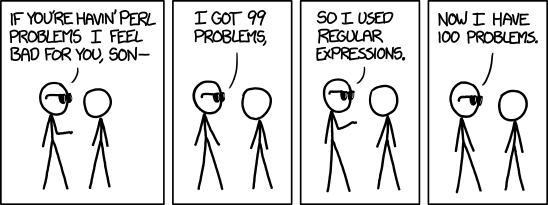
99 Problems (image courtesy of XKCD) Last week I graduated with a Masters in Legal Science (now taught as an MLaw) from Queen s University Belfast. I m pleased to have achieved a Distinction, as well an award for Outstanding Achievement in the Dissertation (which was on the infringement of privacy by private organisations due to state mandated surveillance and retention laws - pretty topical given the unfortunate introduction of the Investigatory Powers Act 2016). However, as previously stated, I had made the decision that I was happier building things, and wanted to return to the world of technology. I talked to a bunch of interesting options, got to various stages in the hiring process with each of them, and happily accepted a role with Titan IC Systems which started at the beginning of September. Titan have produced a hardware accelerated regular expression processor (hence the XKCD reference); the RXP in its FPGA variant (what I get to play with) can handle pattern matching against 40Gb/s of traffic. Which is kinda interesting, as it lends itself to a whole range of applications from network scanning to data mining to, well, anything where you want to sift through a large amount of data checking against a large number of rules. However it s brand new technology for me to get up to speed with (plus getting back into a regular working pattern rather than academentia), and the combination of that and spending most of the summer post DebConf wrapping up the dissertation has meant I haven t had as much time to devote other things as I d have liked. However I ve a few side projects at various stages of completion and will try to manage more regular updates.

4 December 2016

Ben Hutchings: Linux Kernel Summit 2016, part 2

I attended this year's Linux Kernel Summit in Santa Fe, NM, USA and made notes on some of the sessions that were relevant to Debian. LWN also reported many of the discussions. This is the second and last part of my notes; part 1 is here. Kernel Hardening Kees Cook presented the ongoing work on upstream kernel hardening, also known as the Kernel Self-Protection Project or KSPP. GCC plugins The kernel build system can now build and use GCC plugins to implement some protections. This requires gcc 4.5 and the plugin headers installed. It has been tested on x86, arm, and arm64. It is disabled by CONFIG_COMPILE_TEST because CI systems using allmodconfig/allyesconfig probably don't have those installed, but this ought to be changed at some point. There was a question as to how plugin headers should be installed for cross-compilers or custom compilers, but I didn't hear a clear answer to this. Kees has been prodding distribution gcc maintainers to package them. Mark Brown mentioned the Linaro toolchain being widely used; Kees has not talked to its maintainers yet. Probabilistic protections These protections are based on hidden state that an attacker will need to discover in order to make an effective attack; they reduce the probability of success but don't prevent it entirely. Kernel address space layout randomisation (KASLR) has now been implemented on x86, arm64, and mips for the kernel image. (Debian enables this.) However there are still lots of information leaks that defeat this. This could theoretically be improved by relocating different sections or smaller parts of the kernel independently, but this requires re-linking at boot. Aside from software information leaks, the branch target predictor on (common implementations of) x86 provides a side channel to find addresses of branches in the kernel. Page and heap allocation, etc., is still quite predictable. struct randomisation (RANDSTRUCT plugin from grsecurity) reorders members in (a) structures containing only function pointers (b) explicitly marked structures. This makes it very hard to attack custom kernels where the kernel image is not readable. But even for distribution kernels, it increases the maintenance burden for attackers. Deterministic protections These protections block a class of attacks completely. Read-only protection of kernel memory is either mandatory or enabled by default on x86, arm, and arm64. (Debian enables this.) Protections against execution of user memory in kernel mode are now implemented in hardware on x86 (SMEP, in Intel processors from Skylake onward) and on arm64 (PXN, from ARMv8.1). But Skylake is not available for servers and ARMv8.1 is not yet implemented at all! s390 always had this protection. It may be possible to 'emulate' this using other hardware protections. arm (v7) and arm64 now have this, but x86 doesn't. Linus doesn't like the overhead of previously proposed implementations for x86. It is possible to do this using PCID (in Intel processors from Sandy Bridge onward), which has already been done in PaX - and this should be fast enough. Virtually mapped stacks protect against stack overflow attacks. They were implemented as an option for x86 only in 4.9. (Debian enables this.) Copies to or from user memory sometimes use a user-controlled size that is not properly bounded. Hardened usercopy, implemented as an option in 4.8 for many architectures, protects against this. (Debian enables this.) Memory wiping (zero on free) protects against some information leaks and use-after-free bugs. It was already implemented as debug feature with non-zero poison value, but at some performance cost. Zeroing can be cheaper since it allows allocator to skip zeroing on reallocation. That was implemented as an option in 4.6. (Debian does not currently enable this but we might do if the performance cost is low enough.) Constification (with the CONSTIFY gcc plugin) reduces the amount of static data that can be written to. As with RANDSTRUCT, this is applied to function pointer tables and explicitly marked structures. Instances of some types need to be modified very occasionally. In PaX/Grsecurity this is done with pax_ open,close _kernel() which globally disable write protection temporarily. It would be preferable to override write protection in a more directed way, so that the permission to write doesn't leak into any other code that interrupts this process. The feature is not in mainline yet. Atomic wrap detction protects against reference-counting bugs which can result in a use-after-free. Overflow and underflow are trapped and result in an 'oops'. There is no measurable performance impact. It would be applied to all operations on the atomic_t type, but there needs to be an opt-out for atomics that are not ref-counters - probably by adding an atomic_wrap_t type for them. This has been implemented for x86, arm, and arm64 but is not in mainline yet. Kernel Freezer Hell For the second year running, Jiri Kosina raised the problem of 'freezing' kthreads (kernel-mode threads) in preparation for system suspend (suspend to RAM, or hibernation). What are the semantics? What invariants should be met when a kthread gets frozen? They are not defined anywhere. Most freezable threads don't actually need to be quiesced. Also many non-freezable threads are pointlessly calling try_to_freeze() (probably due to copying code without understanding it)). At a system level, what we actually need is I/O and filesystem consistency. This should be achieved by: The system suspend code should not need to directly freeze threads. Kernel Documentation Jon Corbet and Mauro Carvalho presented the recent work on kernel documentation. The kernel's documentation system was a house of cards involving DocBook and a lot of custom scripting. Both the DocBook templates and plain text files are gradually being converted to reStructuredText format, processed by Sphinx. However, manual page generation is currently 'broken' for documents processed by Sphinx. There are about 150 files at the top level of the documentation tree, that are being gradually moved into subdirectories. The most popular files, that are likely to be referenced in external documentation, have been replaced by placeholders. Sphinx is highly extensible and this has been used to integrate kernel-doc. It would be possible to add extensions that parse and include the MAINTAINERS file and Documentation/ABI/ files, which have their own formats, but the documentation maintainers would prefer not to add extensions that can't be pushed to Sphinx upstream. There is lots of obsolete documentation, and patches to remove those would be welcome. Linus objected to PDF files recently added under the Documentation/media directory - they are not the source format so should not be there! They should be generated from the corresponding SVG or image files at build time. Issues around Tracepoints Steve Rostedt and Shuah Khan led a discussion about tracepoints. Currently each maintainer decides which tracepoints to create. The cost of each added tracepoint is minimal, but the cost of very many tracepoints is more substantial. So there is such a thing as too many tracepoints, and we need a policy to decide when they are justified. They advised not to create tracepoints just in case, since kprobes can be used for tracing (almost) anywhere dynamically. There was some support for requiring documentation of each new tracepoint. That may dissuade introduction of obscure tracepoints, but also creates a higher expectation of stability. Tools such as bcc and IOVisor are now being created that depend on specific tracepoints or even function names (through kprobes). Should we care about breaking them? Linus said that we should strive to be polite to developers and users relying on tracepoints, but if it's too painful to maintain a tracepoint then we should go ahead and change it. Where the end users of the tool are themselves developers it's more reasonable to expect them to upgrade the tool and we should care less about changing it. In some cases tracepoints could provide dummy data for compatibility (as is done in some places in procfs).

Next.

Previous.