Search Results: "pm"

17 February 2026

Russell Coker: Links February 2026

Charles Stross has a good theory of why AI is being pushed on corporations, really we need to just replace CEOs with LLMs [1]. This disturbing and amusing article describes how an Open AI investor appears to be having psychological problems releated to SCP based text generated by ChatGPT [2]. Definitely going to be a recursive problem as people who believe in it invest in it. interesting analysis of dbus and design for a more secure replacement [3]. Scott Jenson gave an insightful lecture for Canonical about future potential developments in the desktop UX [4]. Ploum wrote an insightful article about the problems caused by the Github monopoly [5]. Radicale sounds interesting. Niki Tonsky write an interesting article about the UI problems with Tahoe (latest MacOS release) due to trying to make an icon for everything [6]. They have a really good writing style as well as being well researched. Fil-C is an interesting project to compile C/C++ programs in a memory safe way, some of which can be considered a software equivalent of CHERI [7]. Brian Krebs wrote a long list of the ways that Trump has enabled corruption and a variety of other crimes including child sex abuse in the last year [8]. This video about designing a C64 laptop is a masterclass in computer design [9]. Salon has an interesting article about the abortion thought experiment that conservatives can t handle [10]. Ron Garrett wrote an insightful blog post about abortion [11]. Bruce Schneier and Nathan E. Sanders wrote an insightful article about the potential of LLM systems for advertising and enshittification [12]. We need serious legislation about this ASAP!

Freexian Collaborators: Monthly report about Debian Long Term Support, January 2026 (by Santiago Ruano Rinc n)

The Debian LTS Team, funded by Freexian s Debian LTS offering, is pleased to report its activities for January.

Activity summary During the month of January, 20 contributors have been paid to work on Debian LTS (links to individual contributor reports are located below). The team released 33 DLAs fixing 216 CVEs. The team continued preparing security updates in its usual rhythm. Beyond the updates targeting Debian 11 ( bullseye ), which is the current release under LTS, the team also proposed updates for more recent releases (Debian 12 ( bookworm ) and Debian 13 ( trixie )), including Debian unstable. We highlight several notable security updates here below. Notable security updates:
  • python3.9, prepared by Andrej Shadura (DLA-4455-1), fixing multiple vulnerabilities in the Python interpreter.
  • php, prepared by Guilhem Moulin (DLA-4447-1), fixing two vulnerabilities that could yield to request forgery or denial of service.
  • apache2, prepared by Bastien Roucari s DLA-4452-1, fixing four CVEs.
  • linux-6.1, prepared by Ben Hutchings (DLA-4436-1), as a regular update of the linux 6.1 backport to Debian 11.
  • python-django, prepared by Chris Lamb (DLA-4458-1), resolving multiple vulnerabilities.
  • firefox-esr prepared by Emilio Pozuelo Monfort (DLA-4439-1)
  • gnupg2, prepared by Roberto S nchez (DLA-4437-1), fixing multiple issues, including CVE-2025-68973 that could potentially be exploited to execute arbitrary code.
  • apache-log4j2, prepared by Markus Koschany (DLA-4444-1)
  • ceph, prepared by Utkarsh Gupta (DLA-4460-1)
  • inetutils, prepared by Andreas Henriksson (DLA-4453-1), fixing an authentication bypass in telnetd.
Moreover, Sylvain Beucler studied the security support status of p7zip, a fork of 7zip that has become unmaintained upstream. To avoid letting the users continue using an unsupported package, Sylvain has investigated a path forward in collaboration with the security team and the 7zip maintainer, looking to replace p7zip with 7zip. It is to note however that 7zip developers don t reveal the information about the patches that fix CVEs, making it difficult to backport single patches to fix vulnerabilities in Debian released versions. Contributions from outside the LTS Team: Thunderbird, prepared by maintainer Christoph Goehre. The DLA (DLA-4442-1) was published by Emilio. The LTS Team has also contributed with updates to the latest Debian releases:
  • Bastien uploaded gpsd to unstable, and proposed updates for trixie #1126121 and bookworm #1126168 to fix two CVEs.
  • Bastien also prepared the imagemagick updates for trixie and bookworm, released as DSA-6111-1, along with the bullseye update DLA-4448-1.
  • Chris proposed a trixie point update for python-django (#112646), and the work for bookworm was completed in February (#1079454). The longstanding bookworm update required tracking down a regression in the django-storages packages.
  • Markus prepared tomcat10 updates for trixie and bookworm (DSA-6120-1), and tomcat11 for trixie (DSA-6121-1)
  • Thorsten Alteholz prepared bookworm point updates for zvbi (#1126167) to fix five CVEs; taglib (#1126273) to fix one CVE; and libuev (#1126370) to fix one CVE.
  • Utkarsh prepared an unstable update of node-lodash to fix one CVE.
Other than the work related to updates, Sylvain made several improvements to the documentation and tooling used by the team.

Individual Debian LTS contributor reports

Thanks to our sponsors Sponsors that joined recently are in bold.

16 February 2026

Antoine Beaupr : Kernel-only network configuration on Linux

What if I told you there is a way to configure the network on any Linux server that:
  1. works across all distributions
  2. doesn't require any software installed apart from the kernel and a boot loader (no systemd-networkd, ifupdown, NetworkManager, nothing)
  3. is backwards compatible all the way back to Linux 2.0, in 1996
It has literally 8 different caveats on top of that, but is still totally worth your time.

Known options in Debian People following Debian development might have noticed there are now four ways of configuring the network Debian system. At least that is what the Debian wiki claims, namely: At this point, I feel ifupdown is on its way out, possibly replaced by systemd-networkd. NetworkManager already manages most desktop configurations.

A "new" network configuration system The method is this:
  • ip= on the Linux kernel command line: for servers with a single IPv4 or IPv6 address, no software required other than the kernel and a boot loader (since 2002 or older)
So by "new" I mean "new to me". This option is really old. The nfsroot.txt where it is documented predates the git import of the Linux kernel: it's part of the 2005 git import of 2.6.12-rc2. That's already 20+ years old already. The oldest trace I found is in this 2002 commit, which imports the whole file at once, but the option might goes back as far as 1996-1997, if the copyright on the file is correct and the option was present back then.

What are you doing. The trick is to add an ip= parameter to the kernel's command-line. The syntax, as mentioned above, is in nfsroot.txt and looks like this:
ip=<client-ip>:<server-ip>:<gw-ip>:<netmask>:<hostname>:<device>:<autoconf>:<dns0-ip>:<dns1-ip>:<ntp0-ip>
Most settings are pretty self-explanatory, if you ignore the useless ones:
  • <client-ip>: IP address of the server
  • <gw-ip>: address of the gateway
  • <netmask>: netmask, in quad notation
  • <device>: interface name, if multiple available
  • <autoconf>: how to configure the interface, namely:
    • off or none: no autoconfiguration (static)
    • on or any: use any protocol (default)
    • dhcp, essentially like on for all intents and purposes
  • <dns0-ip>, <dns1-ip>: IP address of primary and secondary name servers, exported to /proc/net/pnp, can by symlinked to /etc/resolv.conf
We're ignoring the options:
  • <server-ip>: IP address of the NFS server, exported to /proc/net/pnp
  • <hostnname>: Name of the client, typically sent over the DHCP requests, which may lead to a DNS record to be created in some networks
  • <ntp0-ip>: exported to /proc/net/ipconfig/ntp_servers, unused by the kernel
Note that the Red Hat manual has a different opinion:
ip=[<server-id>]:<gateway-IP-number>:<netmask>:<client-hostname>:inteface:[dhcp dhcp6 auto6 on any none off]
It's essentially the same (although server-id is weird), and the autoconf variable has other settings, so that's a bit odd.

Examples For example, this command-line setting:
ip=192.0.2.42::192.0.2.1:255.255.255.0:::off
... will set the IP address to 192.0.2.42/24 and the gateway to 192.0.2.1. This will properly guess the network interface if there's a single one. A DHCP only configuration will look like this:
ip=::::::dhcp
Of course, you don't want to type this by hand every time you boot the machine. That wouldn't work. You need to configure the kernel commandline, and that depends on your boot loader.

GRUB With GRUB, you need to edit (on Debian), the file /etc/default/grub (ugh) and find a line like:
GRUB_CMDLINE_LINUX=
and change it to:
GRUB_CMDLINE_LINUX=ip=::::::dhcp

systemd-boot and UKI setups For systemd-boot UKI setups, it's simpler: just add the setting to the /etc/kernel/cmdline file. Don't forget to include anything that's non-default from /proc/cmdline. This assumes that is the Cmdline=@ setting in /etc/kernel/uki.conf. See 2025-08-20-luks-ukify-conversion for my minimal documentation on this.

Other systems This is perhaps where this is much less portable than it might first look, because of course each distribution has its own way of configuring those options. Here are some that I know of:
  • Arch (11 options, mostly /etc/default/grub, /boot/loader/entries/arch.conf for systemd-boot or /etc/kernel/cmdline for UKI)
  • Fedora (mostly /etc/default/grub, may be more RHEL mentions grubby, possibly some systemd-boot things here as well)
  • Gentoo (5 options, mostly /etc/default/grub, /efi/loader/entries/gentoo-sources-kernel.conf for systemd-boot, or /etc/kernel/install.d/95-uki-with-custom-opts.install)
It's interesting that /etc/default/grub is consistent across all distributions above, while the systemd-boot setups are all over the place (except for the UKI case), while I would have expected those be more standard than GRUB.

dropbear-initramfs If dropbear-initramfs is setup, it already requires you to have such a configuration, and it might not work out of the box. This is because, by default, it disables the interfaces configured in the kernel after completing its tasks (typically unlocking the encrypted disks). To fix this, you need to disable that "feature":
IFDOWN="none"
This will keep dropbear-initramfs from disabling the configured interface.

Why? Traditionally, I've always setup my servers with ifupdown on servers and NetworkManager on laptops, because that's essentially the default. But on some machines, I've started using systemd-networkd because ifupdown has ... issues, particularly with reloading network configurations. ifupdown is a old hack, feels like legacy, and is Debian-specific. Not excited about configuring another service, I figured I would try something else: just configure the network at boot, through the kernel command-line. I was already doing such configurations for dropbear-initramfs (see this documentation), which requires the network the be up for unlocking the full-disk encryption keys. So in a sense, this is a "Don't Repeat Yourself" solution.

Caveats Also known as: "wait, that works?" Yes, it does! That said...
  1. This is useful for servers where the network configuration will not change after boot. Of course, this won't work on laptops or any mobile device.
  2. This only works for configuring a single, simple, interface. You can't configure multiple interfaces, WiFi, bridges, VLAN, bonding, etc.
  3. It does support IPv6 and feels like the best way to configure IPv6 hosts: true zero configuration.
  4. It likely does not work with a dual-stack IPv4/IPv6 static configuration. It might work with a dynamic dual stack configuration, but I doubt it.
  5. I don't know what happens when a DHCP lease expires. No daemon seems to be running so I assume leases are not renewed, so this is more useful for static configurations, which includes server-side reserved fixed IP addresses. (A non-renewed lease risks getting reallocated to another machine, which would cause an addressing conflict.)
  6. It will not automatically reconfigure the interface on link changes, but ifupdown does not either.
  7. It will not write /etc/resolv.conf for you but the dns0-ip and dns1-ip do end up in /proc/net/pnp which has a compatible syntax, so a common configuration is:
    ln -s /proc/net/pnp /etc/resolv.conf
    
  8. I have not really tested this at scale: only a single, test server at home.
Yes, that's a lot of caveats, but it happens to cover a lot of machines for me, and it works surprisingly well. My main doubts are about long-term DHCP behaviour, but I don't see why that would be a problem with a statically defined lease.

Cleanup Once you have this configuration, you don't need any "user" level network system, so you can get rid of everything:
apt purge systemd-networkd ifupdown network-manager netplan.io
Note that ifupdown (and probably others) leave stray files in (e.g.) /etc/network which you might want to cleanup, or keep in case all this fails and I have put you in utter misery. Configuration files for other packages might also be left behind, I haven't tested this, no warranty.

Credits This whole idea came from the A/I folks (not to be confused with AI) who have been doing this forever, thanks!

10 February 2026

Freexian Collaborators: Writing a new worker task for Debusine (by Carles Pina i Estany)

Debusine is a tool designed for Debian developers and Operating System developers in general. You can try out Debusine on debusine.debian.net, and follow its development on salsa.debian.org. This post describes how to write a new worker task for Debusine. It can be used to add tasks to a self-hosted Debusine instance, or to submit to the Debusine project new tasks to add new capabilities to Debusine. Tasks are the lower-level pieces of Debusine workflows. Examples of tasks are Sbuild, Lintian, Debdiff (see the available tasks). This post will document the steps to write a new basic worker task. The example will add a worker task that runs reprotest and creates an artifact of the new type ReprotestArtifact with the reprotest log. Tasks are usually used by workflows. Workflows solve high-level goals by creating and orchestrating different tasks (e.g. a Sbuild workflow would create different Sbuild tasks, one for each architecture).

Overview of tasks A task usually does the following:
  • It receives structured data defining its input artifacts and configuration
  • Input artifacts are downloaded
  • A process is run by the worker (e.g. lintian, debdiff, etc.). In this blog post, it will run reprotest
  • The output (files, logs, exit code, etc.) is analyzed, artifacts and relations might be generated, and the work request is marked as completed, either with Success or Failure
If you want to follow the tutorial and add the Reprotest task, your Debusine development instance should have at least one worker, one user, a debusine client set up, and permissions for the client to create tasks. All of this can be setup following the steps in the Contribute section of the documentation. This blog post shows a functional Reprotest task. This task is not currently part of Debusine. The Reprotest task implementation is simplified (no error handling, unit tests, specific view, docs, some shortcuts in the environment preparation, etc.). At some point, in Debusine, we might add a debrebuild task which is based on buildinfo files and uses snapshot.debian.org to recreate the binary packages.

Defining the inputs of the task The input of the reprotest task will be a source artifact (a Debian source package). We model the input with pydantic in debusine/tasks/models.py:
class ReprotestData(BaseTaskDataWithExecutor):
   """Data for Reprotest task."""

   source_artifact: LookupSingle

class ReprotestDynamicData(BaseDynamicTaskDataWithExecutor):
   """Reprotest dynamic data."""

   source_artifact_id: int   None = None
The ReprotestData is what the user will input. A LookupSingle is a lookup that resolves to a single artifact. We would also have configuration for the desired variations to test, but we have left that out of this example for simplicity. Configuring variations is left as an exercise for the reader. Since ReprotestData is a subclass of BaseTaskDataWithExecutor it also contains environment where the user can specify in which environment the task will run. The environment is an artifact with a Debian image. The ReprotestDynamicData holds the resolution of all lookups. These can be seen in the Internals tab of the work request view.

Add the new Reprotest artifact data class In order for the reprotest task to create a new Artifact of the type DebianReprotest with the log and output metadata: add the new category to ArtifactCategory in debusine/artifacts/models.py:
    REPROTEST = "debian:reprotest"
In the same file add the DebianReprotest class:
class DebianReprotest(ArtifactData):
   """Data for debian:reprotest artifacts."""

   reproducible: bool   None = None

   def get_label(self) -> str:
       """Return a short human-readable label for the artifact."""
       return "reprotest analysis"
It could also include the package name or version. In order to have the category listed in the work request output artifacts table, edit the file debusine/db/models/artifacts.py: In ARTIFACT_CATEGORY_ICON_NAMES add ArtifactCategory.REPROTEST: "folder", and in ARTIFACT_CATEGORY_SHORT_NAMES add ArtifactCategory.REPROTEST: "reprotest",.

Create the new Task class In debusine/tasks/ create a new file reprotest.py.
reprotest.py
# Copyright   The Debusine Developers
# See the AUTHORS file at the top-level directory of this distribution
#
# This file is part of Debusine. It is subject to the license terms
# in the LICENSE file found in the top-level directory of this
# distribution. No part of Debusine, including this file, may be copied,
# modified, propagated, or distributed except according to the terms
# contained in the LICENSE file.

"""Task to use reprotest in debusine."""

from pathlib import Path
from typing import Any

from debusine import utils
from debusine.artifacts.local_artifact import ReprotestArtifact
from debusine.artifacts.models import (
    ArtifactCategory,
    CollectionCategory,
    DebianSourcePackage,
    DebianUpload,
    WorkRequestResults,
    get_source_package_name,
    get_source_package_version,
)
from debusine.client.models import RelationType
from debusine.tasks import BaseTaskWithExecutor, RunCommandTask
from debusine.tasks.models import ReprotestData, ReprotestDynamicData
from debusine.tasks.server import TaskDatabaseInterface


class Reprotest(
    RunCommandTask[ReprotestData, ReprotestDynamicData],
    BaseTaskWithExecutor[ReprotestData, ReprotestDynamicData],
):
    """Task to use reprotest in debusine."""

    TASK_VERSION = 1

    CAPTURE_OUTPUT_FILENAME = "reprotest.log"

    def __init__(
        self,
        task_data: dict[str, Any],
        dynamic_task_data: dict[str, Any]   None = None,
    ) -> None:
        """Initialize object."""
        super().__init__(task_data, dynamic_task_data)

        self._reprotest_target: Path   None = None

    def build_dynamic_data(
        self, task_database: TaskDatabaseInterface
    ) -> ReprotestDynamicData:
        """Compute and return ReprotestDynamicData."""
        input_source_artifact = task_database.lookup_single_artifact(
            self.data.source_artifact
        )

        assert input_source_artifact is not None
        self.ensure_artifact_categories(
            configuration_key="input.source_artifact",
            category=input_source_artifact.category,
            expected=(
                ArtifactCategory.SOURCE_PACKAGE,
                ArtifactCategory.UPLOAD,
            ),
        )
        assert isinstance(
            input_source_artifact.data, (DebianSourcePackage, DebianUpload)
        )
        subject = get_source_package_name(input_source_artifact.data)
        version = get_source_package_version(input_source_artifact.data)

        assert self.data.environment is not None

        environment = self.get_environment(
            task_database,
            self.data.environment,
            default_category=CollectionCategory.ENVIRONMENTS,
        )

        return ReprotestDynamicData(
            source_artifact_id=input_source_artifact.id,
            subject=subject,
            parameter_summary=f" subject _ version ",
            environment_id=environment.id,
        )

    def get_input_artifacts_ids(self) -> list[int]:
        """Return the list of input artifact IDs used by this task."""
        if not self.dynamic_data:
            return []

        return [
            self.dynamic_data.source_artifact_id,
            self.dynamic_data.environment_id,
        ]

    def fetch_input(self, destination: Path) -> bool:
        """Download the required artifacts."""
        assert self.dynamic_data

        artifact_id = self.dynamic_data.source_artifact_id
        assert artifact_id is not None
        self.fetch_artifact(artifact_id, destination)

        return True

    def configure_for_execution(self, download_directory: Path) -> bool:
        """
        Find a .dsc in download_directory.

        Install reprotest and other utilities used in _cmdline.
        Set self._reprotest_target to it.

        :param download_directory: where to search the files
        :return: True if valid files were found
        """
        self._prepare_executor_instance()

        if self.executor_instance is None:
            raise AssertionError("self.executor_instance cannot be None")

        self.run_executor_command(
            ["apt-get", "update"],
            log_filename="install.log",
            run_as_root=True,
            check=True,
        )
        self.run_executor_command(
            [
                "apt-get",
                "--yes",
                "--no-install-recommends",
                "install",
                "reprotest",
                "dpkg-dev",
                "devscripts",
                "equivs",
                "sudo",
            ],
            log_filename="install.log",
            run_as_root=True,
        )

        self._reprotest_target = utils.find_file_suffixes(
            download_directory, [".dsc"]
        )
        return True

    def _cmdline(self) -> list[str]:
        """
        Build the reprotest command line.

        Use configuration of self.data and self._reprotest_target.
        """
        target = self._reprotest_target
        assert target is not None

        cmd = [
            "bash",
            "-c",
            f"TMPDIR=/tmp ; cd /tmp ; dpkg-source -x  target  package/; "
            "cd package/ ; mk-build-deps ; apt-get install --yes ./*.deb ; "
            "rm *.deb ; "
            "reprotest --vary=-time,-user_group,-fileordering,-domain_host .",
        ]

        return cmd

    @staticmethod
    def _cmdline_as_root() -> bool:
        r"""apt-get install --yes ./\*.deb must be run as root."""
        return True

    def task_result(
        self,
        returncode: int   None,
        execute_directory: Path,  # noqa: U100
    ) -> WorkRequestResults:
        """
        Evaluate task output and return success.

        For a successful run of reprotest:
        -must have the output file
        -exit code is 0

        :return: WorkRequestResults.SUCCESS or WorkRequestResults.FAILURE.
        """
        reprotest_file = execute_directory / self.CAPTURE_OUTPUT_FILENAME

        if reprotest_file.exists() and returncode == 0:
            return WorkRequestResults.SUCCESS

        return WorkRequestResults.FAILURE

    def upload_artifacts(
        self, exec_directory: Path, *, execution_result: WorkRequestResults
    ) -> None:
        """Upload the ReprotestArtifact with the files and relationships."""
        if not self.debusine:
            raise AssertionError("self.debusine not set")

        assert self.dynamic_data is not None
        assert self.dynamic_data.parameter_summary is not None

        reprotest_artifact = ReprotestArtifact.create(
            reprotest_output=exec_directory / self.CAPTURE_OUTPUT_FILENAME,
            reproducible=execution_result == WorkRequestResults.SUCCESS,
            package=self.dynamic_data.parameter_summary,
        )

        uploaded = self.debusine.upload_artifact(
            reprotest_artifact,
            workspace=self.workspace_name,
            work_request=self.work_request_id,
        )

        assert self.dynamic_data is not None
        assert self.dynamic_data.source_artifact_id is not None
        self.debusine.relation_create(
            uploaded.id,
            self.dynamic_data.source_artifact_id,
            RelationType.RELATES_TO,
        )
Below are the main methods with some basic explanation. In order for Debusine to discover the task, add "Reprotest" in the file debusine/tasks/__init__.py in the __all__ list. Let s explain the different methods of the Reprotest class:

build_dynamic_data method The worker has no access to Debusine s database. Lookups are all resolved before the task gets dispatched to a worker, so all it has to do is download the specified input artifacts. build_dynamic_data method lookup the artifact, assert that is a valid category, extract the package name and version, and get the environment in which it will be executed. The environment is needed to run the task (reprotest will run in a container using unshare, incus ).
    def build_dynamic_data(
        self, task_database: TaskDatabaseInterface
    ) -> ReprotestDynamicData:
        """Compute and return ReprotestDynamicData."""
        input_source_artifact = task_database.lookup_single_artifact(
            self.data.source_artifact
        )

        assert input_source_artifact is not None
        self.ensure_artifact_categories(
            configuration_key="input.source_artifact",
            category=input_source_artifact.category,
            expected=(
                ArtifactCategory.SOURCE_PACKAGE,
                ArtifactCategory.UPLOAD,
            ),
        )
        assert isinstance(
            input_source_artifact.data, (DebianSourcePackage, DebianUpload)
        )
        subject = get_source_package_name(input_source_artifact.data)
        version = get_source_package_version(input_source_artifact.data)

        assert self.data.environment is not None

        environment = self.get_environment(
            task_database,
            self.data.environment,
            default_category=CollectionCategory.ENVIRONMENTS,
        )

        return ReprotestDynamicData(
            source_artifact_id=input_source_artifact.id,
            subject=subject,
            parameter_summary=f" subject _ version ",
            environment_id=environment.id,
        )

get_input_artifacts_ids method Used to list the task s input artifacts in the web UI.
   def get_input_artifacts_ids(self) -> list[int]:
       """Return the list of input artifact IDs used by this task."""
       if not self.dynamic_data:
           return []

       assert self.dynamic_data.source_artifact_id is not None
       return [self.dynamic_data.source_artifact_id]

fetch_input method Download the required artifacts on the worker.
    def fetch_input(self, destination: Path) -> bool:
        """Download the required artifacts."""
        assert self.dynamic_data

        artifact_id = self.dynamic_data.source_artifact_id
        assert artifact_id is not None
        self.fetch_artifact(artifact_id, destination)

        return True

configure_for_execution method Install the packages needed by the task and set _reprotest_target, which is used to build the task s command line.
   def configure_for_execution(self, download_directory: Path) -> bool:
       """
       Find a .dsc in download_directory.

       Install reprotest and other utilities used in _cmdline.
       Set self._reprotest_target to it.

       :param download_directory: where to search the files
       :return: True if valid files were found
       """
       self._prepare_executor_instance()

       if self.executor_instance is None:
           raise AssertionError("self.executor_instance cannot be None")

       self.run_executor_command(
           ["apt-get", "update"],
           log_filename="install.log",
           run_as_root=True,
           check=True,
       )
       self.run_executor_command(
           [
               "apt-get",
               "--yes",
               "--no-install-recommends",
               "install",
               "reprotest",
               "dpkg-dev",
               "devscripts",
               "equivs",
               "sudo",
           ],
           log_filename="install.log",
           run_as_root=True,
       )

       self._reprotest_target = utils.find_file_suffixes(
           download_directory, [".dsc"]
       )
       return True

_cmdline method Return the command line to run the task. In this case, and to keep the example simple, we will run reprotest directly in the worker s executor VM/container, without giving it an isolated virtual server. So, this command installs the build dependencies required by the package (so reprotest can build it) and runs reprotest itself.
   def _cmdline(self) -> list[str]:
       """
       Build the reprotest command line.

       Use configuration of self.data and self._reprotest_target.
       """
       target = self._reprotest_target
       assert target is not None

       cmd = [
           "bash",
           "-c",
           f"TMPDIR=/tmp ; cd /tmp ; dpkg-source -x  target  package/; "
           "cd package/ ; mk-build-deps ; apt-get install --yes ./*.deb ; "
           "rm *.deb ; "
           "reprotest --vary=-time,-user_group,-fileordering,-domain_host .",
       ]

       return cmd
Some reprotest variations are disabled. This is to keep the example simple with the set of packages to install and reprotest features.

_cmdline_as_root method Since during the execution it s needed to install packages, run it as root (in the container):
   @staticmethod
   def _cmdline_as_root() -> bool:
       r"""apt-get install --yes ./\*.deb must be run as root."""
       return True

task_result method Task succeeded if a log is generated and the return code is 0.
    def task_result(
        self,
        returncode: int   None,
        execute_directory: Path,  # noqa: U100
    ) -> WorkRequestResults:
        """
        Evaluate task output and return success.

        For a successful run of reprotest:
        -must have the output file
        -exit code is 0

        :return: WorkRequestResults.SUCCESS or WorkRequestResults.FAILURE.
        """
        reprotest_file = execute_directory / self.CAPTURE_OUTPUT_FILENAME

        if reprotest_file.exists() and returncode == 0:
            return WorkRequestResults.SUCCESS

        return WorkRequestResults.FAILURE

upload_artifacts method Create the ReprotestArtifact with the log and the reproducible boolean, upload it, and then add a relation between the ReprotestArtifact and the source package:
    def upload_artifacts(
        self, exec_directory: Path, *, execution_result: WorkRequestResults
    ) -> None:
        """Upload the ReprotestArtifact with the files and relationships."""
        if not self.debusine:
            raise AssertionError("self.debusine not set")

        assert self.dynamic_data is not None
        assert self.dynamic_data.parameter_summary is not None

        reprotest_artifact = ReprotestArtifact.create(
            reprotest_output=exec_directory / self.CAPTURE_OUTPUT_FILENAME,
            reproducible=execution_result == WorkRequestResults.SUCCESS,
            package=self.dynamic_data.parameter_summary,
        )

        uploaded = self.debusine.upload_artifact(
            reprotest_artifact,
            workspace=self.workspace_name,
            work_request=self.work_request_id,
        )

        assert self.dynamic_data is not None
        assert self.dynamic_data.source_artifact_id is not None
        self.debusine.relation_create(
            uploaded.id,
            self.dynamic_data.source_artifact_id,
            RelationType.RELATES_TO,
        )

Execution example To run this task in a local Debusine (see steps to have it ready with an environment, permissions and users created) you can do:
$ python3 -m debusine.client artifact import-debian -w System http://deb.debian.org/debian/pool/main/h/hello/hello_2.10-5.dsc
(get the artifact ID from the output of that command) The artifact can be seen in http://$DEBUSINE/debusine/System/artifact/$ARTIFACTID/. Then create a reprotest.yaml:
$ cat <<EOF > reprotest.yaml
source_artifact: $ARTIFACT_ID
environment: "debian/match:codename=bookworm"
EOF
Instead of debian/match:codename=bookworm it could use the artifact ID. Finally, create the work request to run the task:
$ python3 -m debusine.client create-work-request -w System reprotest --data reprotest.yaml
Using Debusine web you can see the work request, which should go to Running status, then Completed with Success or Failure (depending if reprotest could reproduce it or not). Clicking on the Output tab would have an artifact of type debian:reprotest with one file: the log. In the Metadata tab of the artifact it has Data: the package name and reproducible (true or false).

What is left to do? This was a simple example of creating a task. Other things that could be done:
  • unit tests
  • documentation
  • configurable variations
  • running reprotest directly on the worker host, using the executor environment as a reprotest virtual server
  • in this specific example, the command line might be doing too many things that could maybe be done by other parts of the task, such as prepare_environment.
  • integrate it in a workflow so it s easier to use (e.g. part of QaWorkflow)
  • extract more from the log than just pass/fail
  • display the output in a more useful way (implement an artifact specialized view)

8 February 2026

Colin Watson: Free software activity in January 2026

About 80% of my Debian contributions this month were sponsored by Freexian, as well as one direct donation via GitHub Sponsors (thanks!). If you appreciate this sort of work and are at a company that uses Debian, have a look to see whether you can pay for any of Freexian s services; as well as the direct benefits, that revenue stream helps to keep Debian development sustainable for me and several other lovely people. You can also support my work directly via Liberapay or GitHub Sponsors. Python packaging New upstream versions: Fixes for Python 3.14: Fixes for pytest 9: Porting away from the deprecated pkg_resources: Other build/test failures: I investigated several more build failures and suggested removing the packages in question: Other bugs: Other bits and pieces Alejandro Colomar reported that man(1) ignored the MANWIDTH environment variable in some circumstances. I investigated this and fixed it upstream. I contributed an ubuntu-dev-tools patch to stop recommending sudo. I added forky support to the images used in Salsa CI pipelines. I began working on getting a release candidate of groff 1.24.0 into experimental, though haven t finished that yet. I worked on some lower-priority security updates for OpenSSH. Code reviews

6 February 2026

Reproducible Builds: Reproducible Builds in January 2026

Welcome to the first monthly report in 2026 from the Reproducible Builds project! These reports outline what we ve been up to over the past month, highlighting items of news from elsewhere in the increasingly-important area of software supply-chain security. As ever, if you are interested in contributing to the Reproducible Builds project, please see the Contribute page on our website.

  1. Flathub now testing for reproducibility
  2. Reproducibility identifying projects that will fail to build in 2038
  3. Distribution work
  4. Tool development
  5. Two new academic papers
  6. Upstream patches

Flathub now testing for reproducibility Flathub, the primary repository/app store for Flatpak-based applications, has begun checking for build reproducibility. According to a recent blog post:
We have started testing binary reproducibility of x86_64 builds targeting the stable repository. This is possible thanks to flathub-repro-checker, a tool doing the necessary legwork to recreate the build environment and compare the result of the rebuild with what is published on Flathub. While these tests have been running for a while now, we have recently restarted them from scratch after enabling S3 storage for diffoscope artifacts.
The test results and status is available on their reproducible builds page.

Reproducibility identifying software projects that will fail to build in 2038 Longtime Reproducible Builds developer Bernhard M. Wiedemann posted on Reddit on Y2K38 commemoration day T-12 that is to say, twelve years to the day before the UNIX Epoch will no longer fit into a signed 32-bit integer variable on 19th January 2038. Bernhard s comment succinctly outlines the problem as well as notes some of the potential remedies, as well as links to a discussion with the GCC developers regarding adding warnings for int time_t conversions . At the time of publication, Bernhard s topic had generated 50 comments in response.

Distribution work Conda is language-agnostic package manager which was originally developed to help Python data scientists and is now a popular package manager for Python and R. conda-forge, a community-led infrastructure for Conda recently revamped their dashboards to rebuild packages straight to track reproducibility. There have been changes over the past two years to make the conda-forge build tooling fully reproducible by embedding the lockfile of the entire build environment inside the packages.
In Debian this month:
In NixOS this month, it was announced that the GNU Guix Full Source Bootstrap was ported to NixOS as part of Wire Jansen bachelor s thesis (PDF). At the time of publication, this change has landed in NiX stdev distribution.
Lastly, Bernhard M. Wiedemann posted another openSUSE monthly update for his work there.

Tool development diffoscope is our in-depth and content-aware diff utility that can locate and diagnose reproducibility issues. This month, Chris Lamb made the following changes, including preparing and uploading versions, 310 and 311 to Debian.
  • Fix test compatibility with u-boot-tools version 2026-01. [ ]
  • Drop the implied Rules-Requires-Root: no entry in debian/control. [ ]
  • Bump Standards-Version to 4.7.3. [ ]
  • Reference the Debian ocaml package instead of ocaml-nox. (#1125094)
  • Apply a patch by Jelle van der Waa to adjust a test fixture match new lines. [ ]
  • Also the drop implied Priority: optional from debian/control. [ ]

In addition, Holger Levsen uploaded two versions of disorderfs, first updating the package from FUSE 2 to FUSE 3 as described in last months report, as well as updating the packaging to the latest Debian standards. A second upload (0.6.2-1) was subsequently made, with Holger adding instructions on how to add the upstream release to our release archive and incorporating changes by Roland Clobus to set _FILE_OFFSET_BITS on 32-bit platforms, fixing a build failure on 32-bit systems. Vagrant Cascadian updated diffoscope in GNU Guix to version 311-2-ge4ec97f7 and disorderfs to 0.6.2.

Two new academic papers Julien Malka, Stefano Zacchiroli and Th o Zimmermann of T l com Paris in-house research laboratory, the Information Processing and Communications Laboratory (LTCI) published a paper this month titled Docker Does Not Guarantee Reproducibility:
[ ] While Docker is frequently cited in the literature as a tool that enables reproducibility in theory, the extent of its guarantees and limitations in practice remains under-explored. In this work, we address this gap through two complementary approaches. First, we conduct a systematic literature review to examine how Docker is framed in scientific discourse on reproducibility and to identify documented best practices for writing Dockerfiles enabling reproducible image building. Then, we perform a large-scale empirical study of 5,298 Docker builds collected from GitHub workflows. By rebuilding these images and comparing the results with their historical counterparts, we assess the real reproducibility of Docker images and evaluate the effectiveness of the best practices identified in the literature.
A PDF of their paper is available online.
Quentin Guilloteau, Antoine Waehren and Florina M. Ciorba of the University of Basel in Sweden also published a Docker-related paper, theirs called Longitudinal Study of the Software Environments Produced by Dockerfiles from Research Artifacts:
The reproducibility crisis has affected all scientific disciplines, including computer science (CS). To address this issue, the CS community has established artifact evaluation processes at conferences and in journals to evaluate the reproducibility of the results shared in publications. Authors are therefore required to share their artifacts with reviewers, including code, data, and the software environment necessary to reproduce the results. One method for sharing the software environment proposed by conferences and journals is to utilize container technologies such as Docker and Apptainer. However, these tools rely on non-reproducible tools, resulting in non-reproducible containers. In this paper, we present a tool and methodology to evaluate variations over time in software environments of container images derived from research artifacts. We also present initial results on a small set of Dockerfiles from the Euro-Par 2024 conference.
A PDF of their paper is available online.

Miscellaneous news On our mailing list this month: Lastly, kpcyrd added a Rust section to the Stable order for outputs page on our website. [ ]

Upstream patches The Reproducible Builds project detects, dissects and attempts to fix as many currently-unreproducible packages as possible. We endeavour to send all of our patches upstream where appropriate. This month, we wrote a large number of such patches, including:

Finally, if you are interested in contributing to the Reproducible Builds project, please visit our Contribute page on our website. However, you can get in touch with us via:

4 February 2026

Dirk Eddelbuettel: littler 0.3.23 on CRAN: More Features (and Fixes)

max-heap image The twentythird release of littler as a CRAN package landed on CRAN just now, following in the now twenty year history (!!) as a (initially non-CRAN) package started by Jeff in 2006, and joined by me a few weeks later. littler is the first command-line interface for R as it predates Rscript. It allows for piping as well for shebang scripting via #!, uses command-line arguments more consistently and still starts faster. It also always loaded the methods package which Rscript only began to do in later years. littler lives on Linux and Unix, has its difficulties on macOS due to some-braindeadedness there (who ever thought case-insensitive filesystems as a default were a good idea?) and simply does not exist on Windows (yet the build system could be extended see RInside for an existence proof, and volunteers are welcome!). See the FAQ vignette on how to add it to your PATH. A few examples are highlighted at the Github repo:, as well as in the examples vignette. This release, the first in about eleven months, once again brings two new helper scripts, and enhances six existing one. The release was triggered because it finally became clear why installGitHub.r ignored r2u when available: we forced the type argument to source (so thanks to I aki for spotting this). One change was once again contributed by Michael which is again greatly appreciated. The full change description follows.

Changes in littler version 0.3.22 (2026-02-03)
  • Changes in examples scripts
    • A new script busybees.r aggregates deadlined packages by maintainer
    • Several small updated have been made to the (mostly internal) 'r2u.r' script
    • The deadliners.r script has refined treatment for screen width
    • The install2.r script has new options --quiet and --verbose as proposed by Zivan Karaman
    • The rcc.r script passes build-args to 'rcmdcheck' to compact vignettes and save data
    • The installRub.r script now defaults to 'noble' and is more tolerant of inputs
    • The installRub.r script deals correctly with empty utils::osVersion thanks to Michael Chirico
    • New script checkPackageUrls.r inspired by how CRAN checks (with thanks to Kurt Hornik for the hint)
    • The installGithub.r script now adjusts to bspm and takes advantage of r2u binaries for its build dependencies
  • Changes in package
    • Environment variables (read at build time) can use double quotes
    • Continuous intgegration scripts received a minor update

My CRANberries service provides a comparison to the previous release. Full details for the littler release are provided as usual at the ChangeLog page, and also on the package docs website. The code is available via the GitHub repo, from tarballs and now of course also from its CRAN page and via install.packages("littler"). Binary packages are available directly in Debian as well as (in a day or two) Ubuntu binaries at CRAN thanks to the tireless Michael Rutter. Comments and suggestions are welcome at the GitHub repo.

This post by Dirk Eddelbuettel originated on his Thinking inside the box blog. If you like this or other open-source work I do, you can sponsor me at GitHub.

2 February 2026

Hellen Chemtai: Career Growth Through Open Source: A Personal Journey

Hello world  ! I am an intern at Outreachy working with the Debian OpenQA team on images testing. We get to know what career opportunities awaits us when we work on open source projects. In open source, we are constantly learning. The community has different sets of skills and a large network of people.

So, how did I start off in this internship

I entered the community with the these skills:

  • MERN (Mongo DB, Express JS , React JS and Node JS) for web development
  • Linux and Shell Scripting for some administrative purposes
  • Containerization using Google Cloud
  • Operating Systems
  • A learning passion for Open Source I contributed to some open source work in the past but it was in terms of documentation and bug hunting

I was a newbie at OpenQA but, I had a month to learn and contribute. Time is a critical resource but so is understanding what you are doing. I followed the installations instructions given but whenever I got errors, I had to research why I got the errors. I took time to understand errors I was solving then continued on with the tasks I wanted to do. I communicated my logic and understanding while working on the task and awaited reviews and feedback. Within a span of two months I had learned a lot by practicing and testing.

The skills I gained

As of today, I gained these technical skills from my work with Debian OpenQA team.

  • Perl the tests that we run are written in this language
  • Ansible configuration ansible configurations and settings for the machines the team runs
  • Git this is needed for code versioning and diving tasks into different branches
  • Linux shell scripting and working with the Debian Operating system
  • Virtual Machines and Operating Systems I constantly view how different operating systems are booted and run on virtual machines during testing
  • Testing I keep watch of needles and ensure the tests work as required
  • Debian I use a Debian system to run my Virtual Machines
  • OpenQA the tool that is used to automate testing of Images

With open source comes the need of constant communication. The community is diverse and the team is usually on different time zones. These are some of the soft / social skills I gained when working with the team

  • Communication this is essential especially in taking tasks with confidence, talking about issues encountered and stating the progress of the tasks
  • Interpersonal skills this is for general communication within the community
  • Flexibility we have to adapt to changes because we are a community of different people with different skills

With these skills and the willingness to learn , open source is a great area to focus on . Aside from your career you will extend your network. My interests are set on open source and Linux in general. Working with a wider network has really skilled me up and I will continue learning. Working with the Debian OpenQA team has been very great. The team is great at communication and I learn every day. The knowledge I gain from the team is helping me build a great career in open source.

1 February 2026

Russ Allbery: Review: Paladin's Faith

Review: Paladin's Faith, by T. Kingfisher
Series: The Saint of Steel #4
Publisher: Red Wombat Studio
Copyright: 2023
ISBN: 1-61450-614-0
Format: Kindle
Pages: 515
Paladin's Faith is the fourth book in T. Kingfisher's loosely connected series of fantasy novels about the berserker former paladins of the Saint of Steel. You could read this as a standalone, but there are numerous (spoilery) references to the previous books in the series. Marguerite, who was central to the plot of the first book in the series, Paladin's Grace, is a spy with a problem. An internal power struggle in the Red Sail, the organization that she's been working for, has left her a target. She has a plan for how to break their power sufficiently that they will hopefully leave her alone, but to pull it off she's going to need help. As the story opens, she is working to acquire that help in a very Marguerite sort of way: breaking into the office of Bishop Beartongue of the Temple of the White Rat. The Red Sail, the powerful merchant organization Marguerite worked for, makes their money in the salt trade. Marguerite has learned that someone invented a cheap and reproducible way to extract salt from sea water, thus making the salt trade irrelevant. The Red Sail wants to ensure that invention never sees the light of day, and has forced the artificer into hiding. Marguerite doesn't know where they are, but she knows where she can find out: the Court of Smoke, where the artificer has a patron.
Having grown up in Anuket City, Marguerite was familiar with many clockwork creations, not to mention all the ways that they could go horribly wrong. (Ninety-nine times out of a hundred, it was an explosion. The hundredth time, it ran amok and stabbed innocent bystanders, and the artificer would be left standing there saying, "But I had to put blades on it, or how would it rake the leaves?" while the gutters filled up with blood.)
All Marguerite needs to put her plan into motion is some bodyguards so that she's not constantly distracted and anxious about being assassinated. Readers of this series will be unsurprised to learn that the bodyguards she asks Beartongue for are paladins, including a large broody male one with serious self-esteem problems. This is, like the other books in this series, a slow-burn romance with infuriating communication problems and a male protagonist who would do well to seek out a sack of hammers as a mentor. However, it has two things going for it that most books in this series do not: a long and complex plot to which the romance takes a back seat, and Marguerite, who is not particularly interested in playing along with the expected romance developments. There are also two main paladins in this story, not just one, and the other is one of the two female paladins of the Saint of Steel and rather more entertaining than Shane. I generally like court intrigue stories, which is what fills most of this book. Marguerite is an experienced operative, so the reader gets some solid competence porn, and the paladins are fish out of water but are also unexpectedly dangerous, which adds both comedy and satisfying table-turning. I thoroughly enjoyed the maneuvering and the culture clashes. Marguerite is very good at what she does, knows it, and is entirely uninterested in other people's opinions about that, which short-circuits a lot of Shane's most annoying behavior and keeps the story from devolving into mopey angst like some of the books in this series have done. The end of this book takes the plot in a different direction that adds significantly to the world-building, but also has a (thankfully short) depths of despair segment that I endured rather than enjoyed. I am not really in the mood for bleak hopelessness in my fiction at the moment, even if the reader is fairly sure it will be temporary. But apart from that, I thoroughly enjoyed this book from beginning to end. When we finally meet the artificer, they are an absolute delight in that way that Kingfisher is so good at. The whole story is infused with the sense of determined and competent people refusing to stop trying to fix problems. As usual, the romance was not for me and I think the book would have been better without it, but it's less central to the plot and therefore annoyed me less than any of the books in this series so far. My one major complaint is the lack of gnoles, but we get some new and intriguing world-building to make up for it, along with a setup for a fifth book that I am now extremely curious about. By this point in the series, you probably know if you like the general formula. Compared to the previous book, Paladin's Hope, I thought Paladin's Faith was much stronger and more interesting, but it's clearly of the same type. If, like me, you like the plots but not the romance, the plot here is more substantial. You will have to decide if that makes up for a romance in the typical T. Kingfisher configuration. Personally, I enjoyed this quite a bit, except for the short bleak part, and I'm back to eagerly awaiting the next book in the series. Rating: 8 out of 10

29 January 2026

C.J. Collier: Part 3: Building the Keystone Dataproc Custom Images for Secure Boot & GPUs

Part
3: Building the Keystone Dataproc Custom Images for Secure Boot &
GPUs In Part 1, we established a secure, proxy-only network. In Part 2, we
explored the enhanced install_gpu_driver.sh initialization
action. Now, in Part 3, we ll focus on using the LLC-Technologies-Collier/custom-images
repository (branch proxy-exercise-2025-11) to build the
actual custom Dataproc images embedded with NVIDIA drivers signed for
Secure Boot, all within our proxied environment.

Why Custom Images? To run NVIDIA GPUs on Shielded VMs with Secure Boot enabled, the
NVIDIA kernel modules must be signed with a key trusted by the VM s EFI
firmware. Since standard Dataproc images don t include these
custom-signed modules, we need to build our own. This process also
allows us to pre-install a full stack of GPU-accelerated software.

The
custom-images Toolkit
(examples/secure-boot) The examples/secure-boot directory within the
custom-images repository contains the necessary scripts and
configurations, refined through significant development to handle proxy
and Secure Boot challenges. Key Components & Development Insights:
  • env.json: The central configuration
    file (as used in Part 1) for project, network, proxy, and bucket
    details. This became the single source of truth to avoid configuration
    drift.
  • create-key-pair.sh: Manages the Secure
    Boot signing keys (PK, KEK, DB) in Google Secret Manager, essential for
    the module signing.
  • build-and-run-podman.sh: Orchestrates
    the image build process in an isolated Podman container. This was
    introduced to standardize the build environment and encapsulate
    dependencies, simplifying what the user needs to install locally.
  • pre-init.sh: Sets up the build
    environment within the container and calls
    generate_custom_image.py. It crucially passes metadata
    derived from env.json (like proxy settings and Secure Boot
    key secret names) to the temporary build VM.
  • generate_custom_image.py: The core
    Python script that automates GCE VM creation, runs the customization
    script, and creates the final GCE image.
  • gce-proxy-setup.sh: This script from
    startup_script/ is vital. It s injected into the temporary
    build VM and runs first to configure the OS, package
    managers (apt, dnf), tools (curl, wget, GPG), Conda, and Java to use the
    proxy settings passed in the metadata. This ensures the entire build
    process is proxy-aware.
  • install_gpu_driver.sh: Used as the
    --customization-script within the build VM. As detailed in
    Part 2, this script handles the driver/CUDA/ML stack installation and
    signing, now able to function correctly due to the proxy setup by
    gce-proxy-setup.sh.
Layered Image Strategy: The pre-init.sh script employs a layered approach:
  1. secure-boot Image: Base image with
    Secure Boot certificates injected.
  2. tf Image: Based on
    secure-boot, this image runs the full
    install_gpu_driver.sh within the proxy-configured build VM
    to install NVIDIA drivers, CUDA, ML libraries (TensorFlow, PyTorch,
    RAPIDS), and sign the modules. This is the primary target image for our
    use case.
(Note: secure-proxy and proxy-tf layers
were experiments, but the -tf image combined with runtime
metadata emerged as the most effective solution for 2.2-debian12). Build Steps:
  1. Clone Repos & Configure
    env.json: Ensure you have the
    custom-images and cloud-dataproc repos and a
    complete env.json as described in Part 1.
  2. Run the Build:
    bash # Example: Build a 2.2-debian12 based image set # Run from the custom-images repository root bash examples/secure-boot/build-and-run-podman.sh 2.2-debian12
    This command will build the layered images, leveraging the proxy
    settings from env.json via the metadata injected into the
    build VM. Note the final image name produced (e.g.,
    dataproc-2-2-deb12-YYYYMMDD-HHMMSS-tf).

Conclusion of Part 3 Through an iterative process, we ve developed a robust workflow
within the custom-images repository to build Secure
Boot-compatible GPU images in a proxy-only environment. The key was
isolating the build in Podman, ensuring the build VM is fully
proxy-aware using gce-proxy-setup.sh, and leveraging the
enhanced install_gpu_driver.sh from Part 2. In Part 4, we ll bring it all together, deploying a Dataproc cluster
using this custom -tf image within the secure network, and
verifying the end-to-end functionality.

28 January 2026

C.J. Collier: Part 2: Taming the Beast Deep Dive into the Proxy-Aware GPU Initialization Action

Part
2: Taming the Beast Deep Dive into the Proxy-Aware GPU Initialization
Action In Part 1 of this series, we laid the network foundation for running
secure Dataproc clusters. Now, let s zoom in on the core component
responsible for installing and configuring NVIDIA GPU drivers and the
associated ML stack in this restricted environment: the
install_gpu_driver.sh script from the LLC-Technologies-Collier/initialization-actions
repository (branch gpu-202601). This isn t just any installation script; it has been significantly
enhanced to handle the nuances of Secure Boot and to operate seamlessly
behind an HTTP/S proxy.

The
Challenge: Installing GPU Drivers Without Direct Internet Our goal was to create a Dataproc custom image with NVIDIA GPU
drivers, sign the kernel modules for Secure Boot, and ensure the entire
process works seamlessly when the build VM and the eventual cluster
nodes have no direct internet access, relying solely on an HTTP/S proxy.
This involved:
  1. Proxy-Aware Build: Ensuring all build steps within
    the custom image creation process (package downloads, driver downloads,
    GPG keys, etc.) correctly use the customer s proxy.
  2. Secure Boot Signing: Integrating kernel module
    signing using keys managed in GCP Secret Manager, especially when
    drivers are built from source.
  3. Conda Environment: Reliably and speedily installing
    a complex Conda environment with PyTorch, TensorFlow, Rapids, and other
    GPU-accelerated libraries through the proxy.
  4. Dataproc Integration: Making sure the custom image
    works correctly with Dataproc s own startup, agent processes, and
    cluster-specific configurations like YARN.

The
Development Journey: Key Enhancements in
install_gpu_driver.sh To address these challenges, the script incorporates several key
features:
  • Robust Proxy Handling (set_proxy
    function):
    • Challenge: Initial script versions had spotty proxy
      support. Many tools like apt, curl,
      gpg, and even gsutil failed in proxy-only
      environments.
    • Enhancements: The set_proxy function
      (also used in gce-proxy-setup.sh) was completely overhauled
      to parse various proxy metadata (http-proxy,
      https-proxy, proxy-uri,
      no-proxy). Critically, environment variables
      (HTTP_PROXY, HTTPS_PROXY,
      NO_PROXY) are now set before any network
      operations. NO_PROXY is carefully set to include
      .google.com and .googleapis.com to allow
      direct access to Google APIs via Private Google Access. System-wide
      trust stores (OS, Java, Conda) are updated with the proxy s CA
      certificate if provided via http-proxy-pem-uri.
      gcloud, apt, dnf, and
      dirmngr are also configured to use the proxy.
  • Reliable GPG Key Fetching (import_gpg_keys
    function):
    • Challenge: Importing GPG keys for repositories
      often failed as keyservers use non-HTTP ports (e.g., 11371) blocked by
      firewalls, and gpg --recv-keys is not proxy-friendly.
    • Solution: A new import_gpg_keys
      function now fetches keys over HTTPS using curl, which
      respects the environment s proxy settings. This replaced all direct
      gpg --recv-keys calls.
  • GCS Caching is King:
    • Challenge: Repeatedly downloading large files
      (drivers, CUDA, source code) through a proxy is slow and
      inefficient.
    • Solution: Implemented extensive GCS caching for
      NVIDIA drivers, CUDA runfiles, NVIDIA Open Kernel Module source
      tarballs, compiled kernel modules, and even packed Conda environments.
      Scripts now check a GCS bucket (dataproc-temp-bucket)
      before hitting the internet.
    • Impact: Dramatically speeds up subsequent runs and
      init action execution times on cluster nodes after the cache is
      warmed.
  • Conda Environment Stability & Speed:
    • Challenge: Large Conda environments are prone to
      solver conflicts and slow installation times.
    • Solution: Integrated Mamba for faster package
      solving. Refined package lists for better compatibility. Added logic to
      force-clean and rebuild the Conda environment cache on GCS and locally
      if inconsistencies are detected (e.g., driver installed but Conda env
      not fully set up).
  • Secure Boot & Kernel Module Signing:
    • Challenge: Custom-compiled kernel modules must be
      signed to load when Secure Boot is enabled.
    • Solution: The script integrates with GCP Secret
      Manager to fetch signing keys. The build_driver_from_github
      function now includes robust steps to compile, sign (using
      sign-file), install, and verify the signed modules.
  • Custom Image Workflow & Deferred Configuration:
    • Challenge: Cluster-specific settings (like YARN GPU
      configuration) should not be baked into the image.
    • Solution: The install_gpu_driver.sh
      script detects when it s run during image creation
      (--metadata invocation-type=custom-images). In this mode,
      it defers cluster-specific setups to a systemd service
      (dataproc-gpu-config.service) that runs on the first boot
      of a cluster instance. This ensures that YARN and Spark configurations
      are applied in the context of the running cluster, not at image build
      time.

Conclusion of Part 2 The install_gpu_driver.sh initialization action is more
than just an installer; it s a carefully crafted tool designed to handle
the complexities of secure, proxied environments. Its robust proxy
support, comprehensive GCS caching, refined Conda management, Secure
Boot signing capabilities, and awareness of the custom image build
lifecycle make it a critical enabler. In Part 3, we ll explore how the LLC-Technologies-Collier/custom-images
repository (branch proxy-exercise-2025-11) uses this
initialization action to build the complete, ready-to-deploy Secure Boot
GPU custom images.

26 January 2026

Otto Kek l inen: Ubuntu Pro subscription - should you pay to use Linux?

Featured image of post Ubuntu Pro subscription - should you pay to use Linux?Ubuntu Pro is a subscription offering for Ubuntu users who want to pay for the assurance of getting quick and high-quality security updates for Ubuntu. I tested it out to see how it works in practice, and to evaluate how well it works as a commercial open source service model for Linux. Anyone running Ubuntu can subscribe to it at ubuntu.com/pro/subscribe by selecting the setup type Desktops for the price of $25 per year (+applicable taxes) for Enterprise users. There is also a free version for personal use. Once you have an account, you can find your activation token at ubuntu.com/pro/dashboard, and use it to activate Ubuntu Pro on your desktop or laptop Ubuntu machine by running sudo pro attach <token>:
$ sudo pro attach aabbcc112233aabbcc112233
Enabling default service esm-apps
Updating package lists
Ubuntu Pro: ESM Apps enabled
Enabling default service esm-infra
Updating package lists
Ubuntu Pro: ESM Infra enabled
Enabling default service livepatch
Installing canonical-livepatch snap
Canonical livepatch enabled.
Unable to determine current instance-id
This machine is now attached to 'Ubuntu Pro Desktop'
You can at any time confirm the Ubuntu Pro status by running:
$ sudo pro status --all
SERVICE ENTITLED STATUS DESCRIPTION
anbox-cloud yes disabled Scalable Android in the cloud
cc-eal yes n/a Common Criteria EAL2 Provisioning Packages
esm-apps yes enabled Expanded Security Maintenance for Applications
esm-infra yes enabled Expanded Security Maintenance for Infrastructure
fips yes n/a NIST-certified FIPS crypto packages
fips-preview yes n/a Preview of FIPS crypto packages undergoing certification with NIST
fips-updates yes disabled FIPS compliant crypto packages with stable security updates
landscape yes enabled Management and administration tool for Ubuntu
livepatch yes disabled Canonical Livepatch service
realtime-kernel yes disabled Ubuntu kernel with PREEMPT_RT patches integrated
  generic yes disabled Generic version of the RT kernel (default)
  intel-iotg yes n/a RT kernel optimized for Intel IOTG platform
  raspi yes n/a 24.04 Real-time kernel optimised for Raspberry Pi
ros yes n/a Security Updates for the Robot Operating System
ros-updates yes n/a All Updates for the Robot Operating System
usg yes disabled Security compliance and audit tools
Enable services with: pro enable <service>
Account: Otto Kekalainen
Subscription: Ubuntu Pro Desktop
Valid until: Thu Mar 3 08:08:38 2026 PDT
Technical support level: essential
For a regular desktop/laptop user the most relevant service is the esm-apps, which delivers extended security updates to many applications typically used on desktop systems. Another relevant command to confirm the current subscription status is:
$ sudo pro security-status
2828 packages installed:
2143 packages from Ubuntu Main/Restricted repository
660 packages from Ubuntu Universe/Multiverse repository
13 packages from third parties
12 packages no longer available for download
To get more information about the packages, run
pro security-status --help
for a list of available options.
This machine is receiving security patching for Ubuntu Main/Restricted
repository until 2029.
This machine is attached to an Ubuntu Pro subscription.
Ubuntu Pro with 'esm-infra' enabled provides security updates for
Main/Restricted packages until 2034.
Ubuntu Pro with 'esm-apps' enabled provides security updates for
Universe/Multiverse packages until 2034. You have received 26 security
updates.
This confirms the scope of the security support. You can even run sudo pro security-status --esm-apps to get a detailed breakdown of the installed software packages in scope for Expanded Security Maintenance (ESM).

Experiences from using Ubuntu Pro for over a year Personally I have been using it on two laptop systems for well over a year now and everything seems to have worked well. I see apt is downloading software updates from https://esm.ubuntu.com/apps/ubuntu, but other than that there aren t any notable signs of Ubuntu Pro being in use. That is a good thing after all one is paying for assurance that everything works with minimum disruptions, so the system that enables smooth sailing should stay in the background and not make too much noise of itself.

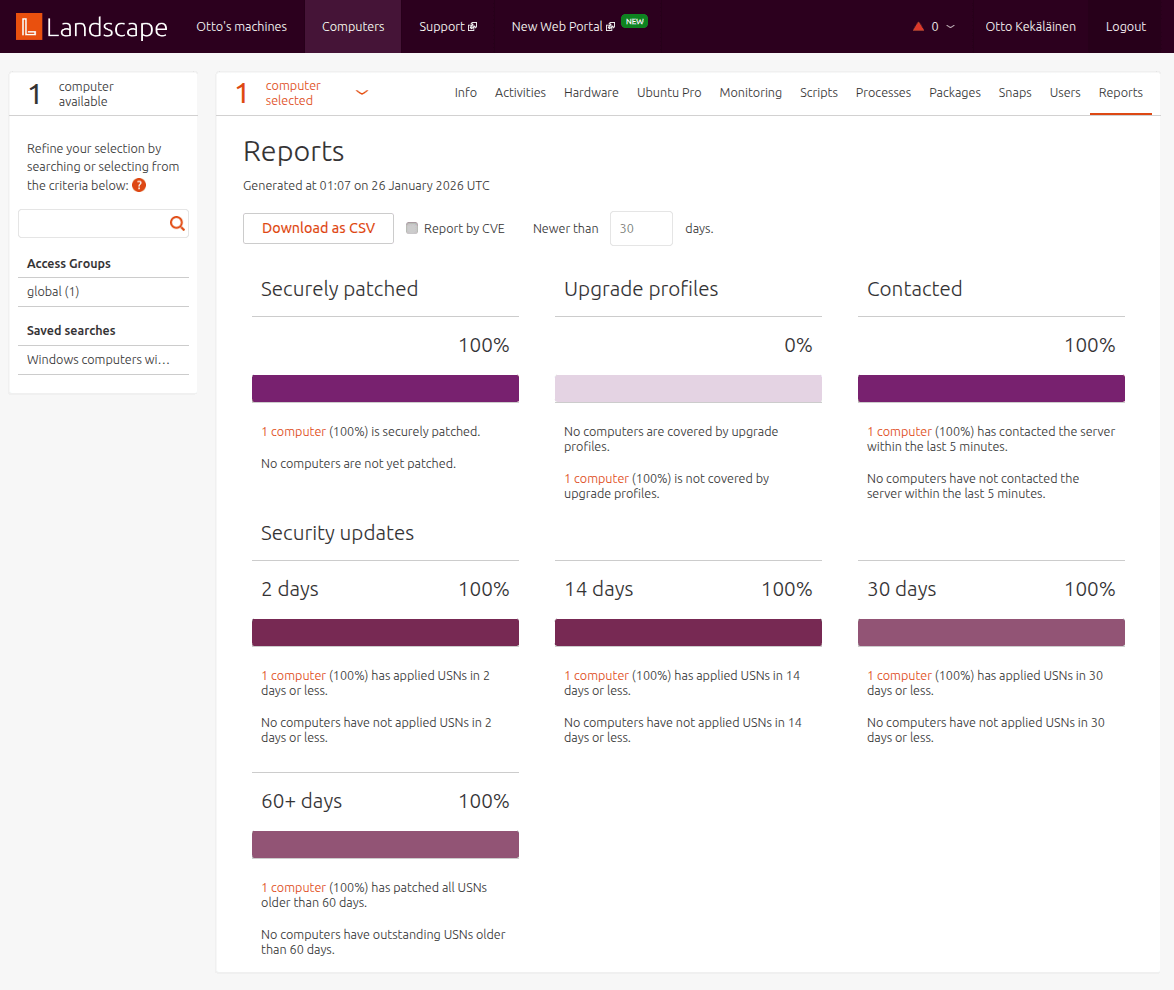
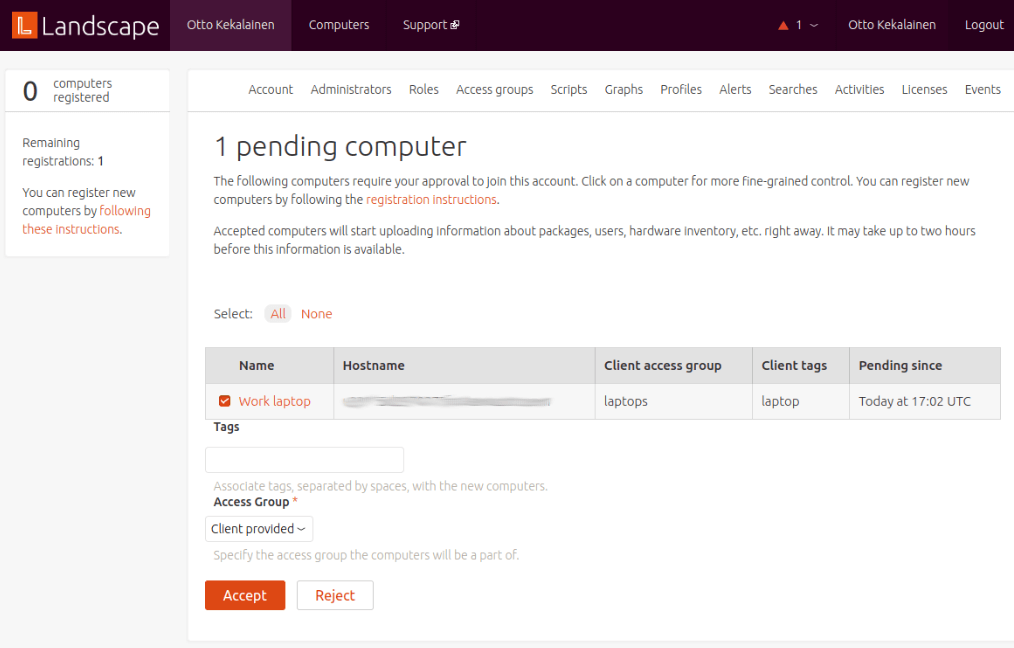
Using Landscape to manage multiple Ubuntu laptops Landscape portal reports showing security update status and resource utilization Landscape.canonical.com is a fleet management system that shows information like security update status and resource utilization for the computers you administer. Ubuntu Pro attached systems under one s account are not automatically visible in Landscape, but have to be enrolled in it. To enroll an Ubuntu Pro attached desktop/laptop to Landscape, first install the required package with sudo apt install landscape-client and then run sudo landscape-config --account-name <account name> to start the configuration wizard. You can find your account name in the Landscape portal. On the last wizard question Request a new registration for this computer now? [y/N] hit y to accept. If successful, the new computer will be visible on the Landscape portal page Pending computers , from where you can click to accept it. Landscape portal page showing pending computer registration If I had a large fleet of computers, Landscape might come in useful. Also it is obvious Landscape is intended primarily for managing server systems. For example, the default alarm trigger on systems being offline, which is common for laptops and desktop computers, is an alert-worthy thing only on server systems. It is good to know that Landscape exists, but on desktop systems I would probably skip it, and only stick to the security updates offered by Ubuntu Pro without using Landscape.

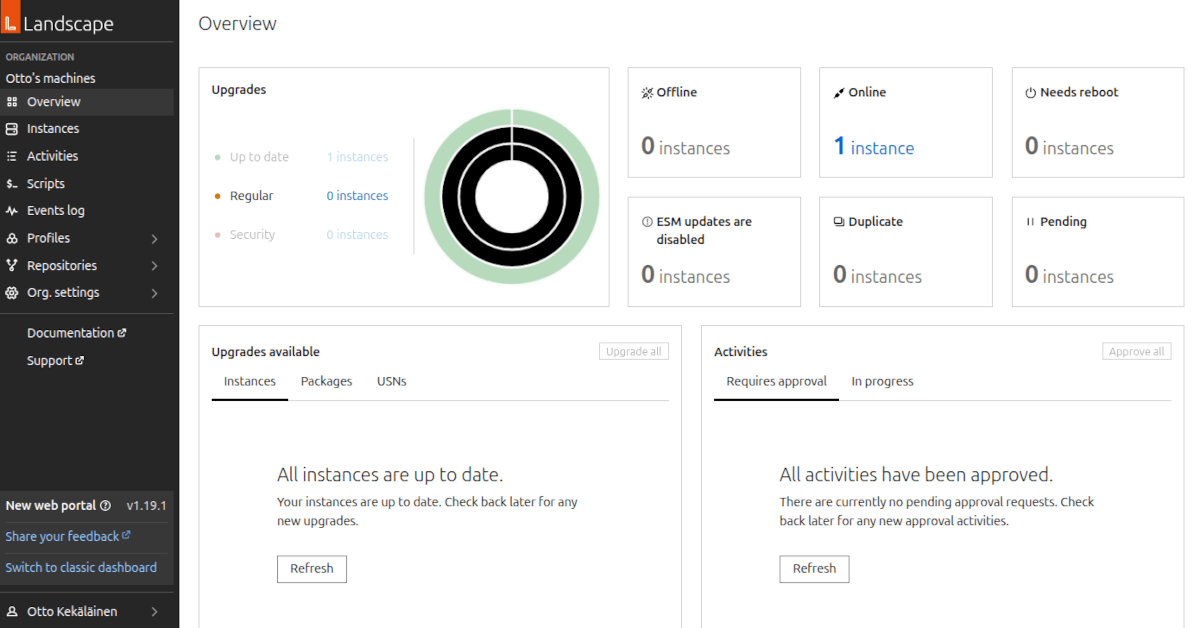
Landscape is evolving The screenshots above are from the current Landscape portal which I have been using so far. Recently Canonical has also launched a new web portal, with a fresh look: New Landscape dashboard with fresh look This shows Canonical is actively investing in the service and it is likely going to sit at the center of their business model for years to come.

Other offerings by Canonical for individual users Canonical, the company behind the world s most popular desktop Linux distribution Ubuntu, has been offering various commercial support services for corporate customers since the company launched back in 2005, but there haven t been any offerings available to individual users since Ubuntu One, with file syncing, a music store and more, was wound down back in 2014. Canonical and the other major Linux companies, Red Hat and SUSE, have always been very enterprise-oriented, presumably because achieving economies of scale is much easier when maintaining standardized corporate environments compared to dealing with a wide range of custom configurations that individual consumer customers might have. I remember some years ago Canonical offered desktop support under the Ubuntu Advantage product name, but the minimum subscription was for 5 desktop systems, which typically isn t an option for a regular home consumer. I am glad to see Ubuntu Pro is now available and I honestly hope people using Ubuntu will opt into it. The more customers it has, the more it incentivizes Canonical to develop and maintain features that are important for desktop and home users.

Pay for Linux because you can, not because you have to Open source is a great software development model for rapid innovation and adoption, but I don t think the business models in the space are yet quite mature. Users who get long-term value should participate more in funding open source maintenance work. While some donation platforms like GitHub Sponsors, OpenCollective and the like have gained popularity in recent years, none of them seem to generate recurring revenue comparable to the scale of how popular open source software is now in 2026. I welcome more paid schemes, such as Ubuntu Pro, as I believe it is beneficial for the whole ecosystem. I also expect more service providers to enter this space and experiment with different open source business models and various forms of decentralized funding. Linux and open source are primarily free as in speech, but as a side effect license fees are hard to enforce and many use Linux without paying for it. The more people, corporations and even countries rely on it to stay sovereign in the information society, the more users should think about how they want to use Linux and who they want to pay to maintain it and other critical parts of the open source ecosystem.

20 January 2026

Sahil Dhiman: Conferences, why?

Back in December, I was working to help organize multiple different conferences. One has already happened; the rest are still works in progress. That s when the thought struck me: why so many conferences, and why do I work for them? I have been fairly active in the scene since 2020. For most conferences, I usually arrive late in the city on the previous day and usually leave the city on conference close day. Conferences for me are the place to meet friends and new folks and hear about them, their work, new developments, and what s happening in their interest zones. I feel naturally happy talking to folks. In this case, people inspire me to work. Nothing can replace a passionate technical and social discussion, which stretches way into dinner parties and later. For most conference discussions now, I just show up without a set role (DebConf is probably an exception to it). It usually involves talking to folks, suggesting what needs to be done, doing a bit of it myself, and finishing some last-minute stuff during the actual thing. Having more of these conferences and helping make them happen naturally gives everyone more places to come together, meet, talk, and work on something. No doubt, one reason for all these conferences is evangelism for, let s say Free Software, OpenStreetMap, Debian etc. which is good and needed for the pipeline. But for me, the primary reason would always be meeting folks.

19 January 2026

Francesco Paolo Lovergine: A Terramaster NAS with Debian, take two.

After experimenting at home, the very first professional-grade NAS from Terramaster arrived at work, too, with 12 HDD bays and possibly a pair of M2s. NVME cards. In this case, I again installed a plain Debian distribution, but HDD monitoring required some configuration adjustments to run smartd properly.A decent approach to data safety is to run regularly scheduled short and long SMART tests on all disks to detect potential damage. Running such tests on all disks at once isn't ideal, so I set up a script to create a staggered configuration and test multiple groups of disks at different times. Note that it is mandatory to read the devices at each reboot because their names and order can change.Of course, the same principle (short/long test at regular intervals along the week) should be applied for a simpler configuration, as in the case of my home NAS with a pair of RAID1 devices.What follows is a simple script to create a staggered smartd.conf at boot time:
#!/bin/bash
#
# Save this as /usr/local/bin/create-smartd-conf.sh
#
# Dynamically generate smartd.conf with staggered SMART test scheduling
# at boot time based on discovered ATA devices
# HERE IS A LIST OF DIRECTIVES FOR THIS CONFIGURATION FILE.
# PLEASE SEE THE smartd.conf MAN PAGE FOR DETAILS
#
#   -d TYPE Set the device type: ata, scsi[+TYPE], nvme[,NSID],
#           sat[,auto][,N][+TYPE], usbcypress[,X], usbjmicron[,p][,x][,N],
#           usbprolific, usbsunplus, sntasmedia, sntjmicron[,NSID], sntrealtek,
#           ... (platform specific)
#   -T TYPE Set the tolerance to one of: normal, permissive
#   -o VAL  Enable/disable automatic offline tests (on/off)
#   -S VAL  Enable/disable attribute autosave (on/off)
#   -n MODE No check if: never, sleep[,N][,q], standby[,N][,q], idle[,N][,q]
#   -H      Monitor SMART Health Status, report if failed
#   -s REG  Do Self-Test at time(s) given by regular expression REG
#   -l TYPE Monitor SMART log or self-test status:
#           error, selftest, xerror, offlinests[,ns], selfteststs[,ns]
#   -l scterc,R,W  Set SCT Error Recovery Control
#   -e      Change device setting: aam,[N off], apm,[N off], dsn,[on off],
#           lookahead,[on off], security-freeze, standby,[N off], wcache,[on off]
#   -f      Monitor 'Usage' Attributes, report failures
#   -m ADD  Send email warning to address ADD
#   -M TYPE Modify email warning behavior (see man page)
#   -p      Report changes in 'Prefailure' Attributes
#   -u      Report changes in 'Usage' Attributes
#   -t      Equivalent to -p and -u Directives
#   -r ID   Also report Raw values of Attribute ID with -p, -u or -t
#   -R ID   Track changes in Attribute ID Raw value with -p, -u or -t
#   -i ID   Ignore Attribute ID for -f Directive
#   -I ID   Ignore Attribute ID for -p, -u or -t Directive
#   -C ID[+] Monitor [increases of] Current Pending Sectors in Attribute ID
#   -U ID[+] Monitor [increases of] Offline Uncorrectable Sectors in Attribute ID
#   -W D,I,C Monitor Temperature D)ifference, I)nformal limit, C)ritical limit
#   -v N,ST Modifies labeling of Attribute N (see man page)
#   -P TYPE Drive-specific presets: use, ignore, show, showall
#   -a      Default: -H -f -t -l error -l selftest -l selfteststs -C 197 -U 198
#   -F TYPE Use firmware bug workaround:
#           none, nologdir, samsung, samsung2, samsung3, xerrorlba
#   -c i=N  Set interval between disk checks to N seconds
#    #      Comment: text after a hash sign is ignored
#    \      Line continuation character
# Attribute ID is a decimal integer 1 <= ID <= 255
# except for -C and -U, where ID = 0 turns them off.
set -euo pipefail
# Test schedule configuration
BASE_SCHEDULE="L/../../6"  # Long test on Saturdays
TEST_HOURS=(01 03 05 07)   # 4 time slots: 1am, 3am, 5am, 7am
DEVICES_PER_GROUP=3
main()  
    # Get array of device names (e.g., sda, sdb, sdc)
    mapfile -t devices < <(ls -l /dev/disk/by-id/   grep ata   awk ' print $11 '   grep sd   cut -d/ -f3   sort -u)
    if [[ $ #devices[@]  -eq 0 ]]; then
        exit 1
    fi
    # Start building config file
    cat << EOF
# smartd.conf - Auto-generated at boot
# Generated: $(date '+%Y-%m-%d %H:%M:%S')
#
# Staggered SMART test scheduling to avoid concurrent disk load
# Long tests run on Saturdays at different times per group
#
EOF
    # Process devices into groups
    local group=0
    local count_in_group=0
    for i in "$ !devices[@] "; do
        local dev="$ devices[$i] "
        local hour="$ TEST_HOURS[$group] "
        # Add group header at start of each group
        if [[ $count_in_group -eq 0 ]]; then
            echo ""
            echo "# Group $((group + 1)) - Tests at $ hour :00 on Saturdays"
        fi
        # Add device entry
        #echo "/dev/$ dev  -a -o on -S on -s ($ BASE_SCHEDULE /$ hour ) -m root"
        echo "/dev/$ dev  -a -o on -S on -s (L/../../6/$ hour ) -s (S/../.././$(((hour + 12) % 24))) -m root"
        # Move to next group when current group is full
        count_in_group=$((count_in_group + 1))
        if [[ $count_in_group -ge $DEVICES_PER_GROUP ]]; then
            count_in_group=0
            group=$(((group + 1) % $ #TEST_HOURS[@] ))
        fi
    done
 
main "$@"
To run such a script at boot, add a unit file to the systemd configuration.
sudo systemctl  edit --full /etc/systemd/system/regenerate-smartd-conf.service
sudo systemctl enable regenerate-smartd-conf.service
Where the unit service is the following:
[Unit]
Description=Generate smartd.conf with staggered SMART test scheduling
# Wait for all local filesystems and udev device detection
After=local-fs.target systemd-udev-settle.service
Before=smartd.service
Wants=systemd-udev-settle.service
DefaultDependencies=no
[Service]
Type=oneshot
# Only generate the config file, don't touch smartd here
ExecStart=/bin/bash -c '/usr/local/bin/create-smartd-config.sh > /etc/smartd.conf'
StandardOutput=journal
StandardError=journal
RemainAfterExit=yes
[Install]
WantedBy=multi-user.target


Russell Coker: Furilabs FLX1s

The Aim I have just got a Furilabs FLX1s [1] which is a phone running a modified version of Debian. I want to have a phone that runs all apps that I control and can observe and debug. Android is very good for what it does and there are security focused forks of Android which have a lot of potential, but for my use a Debian phone is what I want. The FLX1s is not going to be my ideal phone, I am evaluating it for use as a daily-driver until a phone that meets my ideal criteria is built. In this post I aim to provide information to potential users about what it can do, how it does it, and how to get the basic functions working. I also evaluate how well it meets my usage criteria. I am not anywhere near an average user. I don t think an average user would ever even see one unless a more technical relative showed one to them. So while this phone could be used by an average user I am not evaluating it on that basis. But of course the features of the GUI that make a phone usable for an average user will allow a developer to rapidly get past the beginning stages and into more complex stuff. Features The Furilabs FLX1s [1] is a phone that is designed to run FuriOS which is a slightly modified version of Debian. The purpose of this is to run Debian instead of Android on a phone. It has switches to disable camera, phone communication, and microphone (similar to the Librem 5) but the one to disable phone communication doesn t turn off Wifi, the only other phone I know of with such switches is the Purism Librem 5. It has a 720*1600 display which is only slightly better than the 720*1440 display in the Librem 5 and PinePhone Pro. This doesn t compare well to the OnePlus 6 from early 2018 with 2280*1080 or the Note9 from late 2018 with 2960*1440 which are both phones that I ve run Debian on. The current price is $US499 which isn t that good when compared to the latest Google Pixel series, a Pixel 10 costs $US649 and has a 2424*1080 display and it also has 12G of RAM while the FLX1s only has 8G. Another annoying thing is how rounded the corners are, it seems that round corners that cut off the content are a standard practice nowadays, in my collection of phones the latest one I found with hard right angles on the display was a Huawei Mate 10 Pro which was released in 2017. The corners are rounder than the Note 9, this annoys me because the screen is not high resolution by today s standards so losing the corners matters. The default installation is Phosh (the GNOME shell for phones) and it is very well configured. Based on my experience with older phone users I think I could give a phone with this configuration to a relative in the 70+ age range who has minimal computer knowledge and they would be happy with it. Additionally I could set it up to allow ssh login and instead of going through the phone support thing of trying to describe every GUI setting to click on based on a web page describing menus for the version of Android they are running I could just ssh in and run diff on the .config directory to find out what they changed. Furilabs have done a very good job of setting up the default configuration, while Debian developers deserve a lot of credit for packaging the apps the Furilabs people have chosen a good set of default apps to install to get it going and appear to have made some noteworthy changes to some of them. Droidian The OS is based on Android drivers (using the same techniques as Droidian [2]) and the storage device has the huge number of partitions you expect from Android as well as a 110G Ext4 filesystem for the main OS. The first issue with the Droidian approach of using an Android kernel and containers for user space code to deal with drivers is that it doesn t work that well. There are 3 D state processes (uninterrupteable sleep which usually means a kernel bug if the process remains in that state) after booting and doing nothing special. My tests running Droidian on the Note 9 also had D state processes, in this case they are D state kernel threads (I can t remember if the Note 9 had regular processes or kernel threads stuck in D state). It is possible for a system to have full functionality in spite of some kernel threads in D state but generally it s a symptom of things not working as well as you would hope. The design of Droidian is inherently fragile. You use a kernel and user space code from Android and then use Debian for the rest. You can t do everything the Android way (with the full OS updates etc) and you also can t do everything the Debian way. The TOW Boot functionality in the PinePhone Pro is really handy for recovery [3], it allows the internal storage to be accessed as a USB mass storage device. The full Android setup with ADB has some OK options for recovery, but part Android and part Debian has less options. While it probably is technically possible to do the same things in regard to OS repair and reinstall the fact that it s different from most other devices means that fixes can t be done in the same way. Applications GUI The system uses Phosh and Phoc, the GNOME system for handheld devices. It s a very different UI from Android, I prefer Android but it is usable with Phosh. IM Chatty works well for Jabber (XMPP) in my tests. It supports Matrix which I didn t test because I don t desire the same program doing Matrix and Jabber and because Matrix is a heavy protocol which establishes new security keys for each login so I don t want to keep logging in on new applications. Chatty also does SMS but I couldn t test that without the SIM caddy. I use Nheko for Matrix which has worked very well for me on desktops and laptops running Debian. Email I am currently using Geary for email. It works reasonably well but is lacking proper management of folders, so I can t just subscribe to the important email on my phone so that bandwidth isn t wasted on less important email (there is a GNOME gitlab issue about this see the Debian Wiki page about Mobile apps [4]). Music Music playing isn t a noteworthy thing for a desktop or laptop, but a good music player is important for phone use. The Lollypop music player generally does everything you expect along with support for all the encoding formats including FLAC0 a major limitation of most Android music players seems to be lack of support for some of the common encoding formats. Lollypop has it s controls for pause/play and going forward and backward one track on the lock screen. Maps The installed map program is gnome-maps which works reasonably well. It gets directions via the Graphhopper API [5]. One thing we really need is a FOSS replacement for Graphhopper in GNOME Maps. Delivery and Unboxing I received my FLX1s on the 13th of Jan [1]. I had paid for it on the 16th of Oct but hadn t received the email with the confirmation link so the order had been put on hold. But after I contacted support about that on the 5th of Jan they rapidly got it to me which was good. They also gave me a free case and screen protector to apologise, I don t usually use screen protectors but in this case it might be useful as the edges of the case don t even extend 0.5mm above the screen. So if it falls face down the case won t help much. When I got it there was an open space at the bottom where the caddy for SIMs is supposed to be. So I couldn t immediately test VoLTE functionality. The contact form on their web site wasn t working when I tried to report that and the email for support was bouncing. Bluetooth As a test of Bluetooth I connected it to my Nissan LEAF which worked well for playing music and I connected it to several Bluetooth headphones. My Thinkpad running Debian/Trixie doesn t connect to the LEAF and to headphones which have worked on previous laptops running Debian and Ubuntu. A friend s laptop running Debian/Trixie also wouldn t connect to the LEAF so I suspect a bug in Trixie, I need to spend more time investigating this. Wifi Currently 5GHz wifi doesn t work, this is a software bug that the Furilabs people are working on. 2.4GHz wifi works fine. I haven t tested running a hotspot due to being unable to get 4G working as they haven t yet shipped me the SIM caddy. Docking This phone doesn t support DP Alt-mode or Thunderbolt docking so it can t drive an external monitor. This is disappointing, Samsung phones and tablets have supported such things since long before USB-C was invented. Samsung DeX is quite handy for Android devices and that type feature is much more useful on a device running Debian than on an Android device. Camera The camera works reasonably well on the FLX1s. Until recently for the Librem 5 the camera didn t work and the camera on my PinePhone Pro currently doesn t work. Here are samples of the regular camera and the selfie camera on the FLX1s and the Note 9. I think this shows that the camera is pretty decent. The selfie looks better and the front camera is worse for the relatively close photo of a laptop screen taking photos of computer screens is an important part of my work but I can probably work around that. I wasn t assessing this camera t find out if it s great, just to find out if I have the sorts of problems I had before and it just worked. The Samsung Galaxy Note series of phones has always had decent specs including good cameras. Even though the Note 9 is old comparing to it is a respectable performance. The lighting was poor for all photos. FLX1s
Note 9
Power Use In 93 minutes having the PinePhone Pro, Librem 5, and FLX1s online with open ssh sessions from my workstation the PinePhone Pro went from 100% battery to 26%, the Librem 5 went from 95% to 69%, and the FLX1s went from 100% to 99%. The battery discharge rate of them was reported as 3.0W, 2.6W, and 0.39W respectively. Based on having a 16.7Wh battery 93 minutes of use should have been close to 4% battery use, but in any case all measurements make it clear that the FLX1s will have a much longer battery life. Including the measurement of just putting my fingers on the phones and feeling the temperature (FLX1s felt cool and the others felt hot). The PinePhone Pro and the Librem 5 have an optional Caffeine mode which I enabled for this test, without that enabled the phone goes into a sleep state and disconnects from Wifi. So those phones would use much less power with caffeine mode enabled, but they also couldn t get fast response to notifications etc. I found the option to enable a Caffeine mode switch on the FLX1s but the power use was reported as being the same both with and without it. Charging One problem I found with my phone is that in every case it takes 22 seconds to negotiate power. Even when using straight USB charging (no BC or PD) it doesn t draw any current for 22 seconds. When I connect it it will stay at 5V and varying between 0W and 0.1W (current rounded off to zero) for 22 seconds or so and then start charging. After the 22 second display the phone will make the tick sound indicating that it s charging and the power meter will measure that it s drawing some current. I added the table from my previous post about phone charging speed [6] with an extra row for the FLX1s. For charging from my PC USB ports the results were the worst ever, the port that does BC did not work at all it was looping trying to negotiate after a 22 second negotiation delay the port would turn off. The non-BC port gave only 2.4W which matches the 2.5W given by the spec for a High-power device which is what that port is designed to give. In a discussion on the Purism forum about the Librem5 charging speed one of their engineers told me that the reason why their phone would draw 2A from that port was because the cable was identifying itself as a USB-C port not a High-power device port. But for some reason out of the 7 phones I tested the FLX1s and the One Plus 6 are the only ones to limit themselves to what the port is apparently supposed to do. Also the One Plus 6 charges slowly on every power supply so I don t know if it is obeying the spec or just sucking. On a cheap AliExpress charger the FLX1s gets 5.9V and on a USB battery it gets 5.8V. Out of all 42 combinations of device and charger I tested these were the only ones to involve more than 5.1V but less than 9V. I welcome comments suggesting an explanation. The case that I received has a hole for the USB-C connector that isn t wide enough for the plastic surrounds on most of my USB-C cables (including the Dell dock). Also to make a connection requires a fairly deep insertion (deeper than the One Plus 6 or the Note 9). So without adjustment I have to take the case off to charge it. It s no big deal to adjust the hole (I have done it with other cases) but it s an annoyance.
Phone Top z640 Bottom Z640 Monitor Ali Charger Dell Dock Battery Best Worst
FLX1s FAIL 5.0V 0.49A 2.4W 4.8V 1.9A 9.0W 5.9V 1.8A 11W 4.8V 2.1A 10W 5.8V 2.1A 12W 5.8V 2.1A 12W 5.0V 0.49A 2.4W
Note9 4.8V 1.0A 5.2W 4.8V 1.6A 7.5W 4.9V 2.0A 9.5W 5.1V 1.9A 9.7W 4.8V 2.1A 10W 5.1V 2.1A 10W 5.1V 2.1A 10W 4.8V 1.0A 5.2W
Pixel 7 pro 4.9V 0.80A 4.2W 4.8V 1.2A 5.9W 9.1V 1.3A 12W 9.1V 1.2A 11W 4.9V 1.8A 8.7W 9.0V 1.3A 12W 9.1V 1.3A 12W 4.9V 0.80A 4.2W
Pixel 8 4.7V 1.2A 5.4W 4.7V 1.5A 7.2W 8.9V 2.1A 19W 9.1V 2.7A 24W 4.8V 2.3A 11.0W 9.1V 2.6A 24W 9.1V 2.7A 24W 4.7V 1.2A 5.4W
PPP 4.7V 1.2A 6.0W 4.8V 1.3A 6.8W 4.9V 1.4A 6.6W 5.0V 1.2A 5.8W 4.9V 1.4A 5.9W 5.1V 1.2A 6.3W 4.8V 1.3A 6.8W 5.0V 1.2A 5.8W
Librem 5 4.4V 1.5A 6.7W 4.6V 2.0A 9.2W 4.8V 2.4A 11.2W 12V 0.48A 5.8W 5.0V 0.56A 2.7W 5.1V 2.0A 10W 4.8V 2.4A 11.2W 5.0V 0.56A 2.7W
OnePlus6 5.0V 0.51A 2.5W 5.0V 0.50A 2.5W 5.0V 0.81A 4.0W 5.0V 0.75A 3.7W 5.0V 0.77A 3.7W 5.0V 0.77A 3.9W 5.0V 0.81A 4.0W 5.0V 0.50A 2.5W
Best 4.4V 1.5A 6.7W 4.6V 2.0A 9.2W 8.9V 2.1A 19W 9.1V 2.7A 24W 4.8V 2.3A 11.0W 9.1V 2.6A 24W
Conclusion The Furilabs support people are friendly and enthusiastic but my customer experience wasn t ideal. It was good that they could quickly respond to my missing order status and the missing SIM caddy (which I still haven t received but believe is in the mail) but it would be better if such things just didn t happen. The phone is quite user friendly and could be used by a novice. I paid $US577 for the FLX1s which is $AU863 by today s exchange rates. For comparison I could get a refurbished Pixel 9 Pro Fold for $891 from Kogan (the major Australian mail-order company for technology) or a refurbished Pixel 9 Pro XL for $842. The Pixel 9 series has security support until 2031 which is probably longer than you can expect a phone to be used without being broken. So a phone with a much higher resolution screen that s only one generation behind the latest high end phones and is refurbished will cost less. For a brand new phone a Pixel 8 Pro which has security updates until 2030 costs $874 and a Pixel 9A which has security updates until 2032 costs $861. Doing what the Furilabs people have done is not a small project. It s a significant amount of work and the prices of their products need to cover that. I m not saying that the prices are bad, just that economies of scale and the large quantity of older stock makes the older Google products quite good value for money. The new Pixel phones of the latest models are unreasonably expensive. The Pixel 10 is selling new from Google for $AU1,149 which I consider a ridiculous price that I would not pay given the market for used phones etc. If I had a choice of $1,149 or a feature phone I d pay $1,149. But the FLX1s for $863 is a much better option for me. If all I had to choose from was a new Pixel 10 or a FLX1s for my parents I d get them the FLX1s. For a FOSS developer a FLX1s could be a mobile test and development system which could be lent to a relative when their main phone breaks and the replacement is on order. It seems to be fit for use as a commodity phone. Note that I give this review on the assumption that SMS and VoLTE will just work, I haven t tested them yet. The UI on the FLX1s is functional and easy enough for a new user while allowing an advanced user to do the things they desire. I prefer the Android style and the Plasma Mobile style is closer to Android than Phosh is, but changing it is something I can do later. Generally I think that the differences between UIs matter more when on a desktop environment that could be used for more complex tasks than on a phone which limits what can be done by the size of the screen. I am comparing the FLX1s to Android phones on the basis of what technology is available. But most people who would consider buying this phone will compare it to the PinePhone Pro and the Librem 5 as they have similar uses. The FLX1s beats both those phones handily in terms of battery life and of having everything just work. But it has the most non free software of the three and the people who want the $2000 Librem 5 that s entirely made in the US won t want the FLX1s. This isn t the destination for Debian based phones, but it s a good step on the way to it and I don t think I ll regret this purchase.

16 January 2026

Freexian Collaborators: Monthly report about Debian Long Term Support, December 2025 (by Santiago Ruano Rinc n)

The Debian LTS Team, funded by [Freexian s Debian LTS offering] (https://www.freexian.com/lts/debian/), is pleased to report its activities for December.

Activity summary During the month of December, 18 contributors have been paid to work on Debian LTS (links to individual contributor reports are located below). The team released 41 DLAs fixing 252 CVEs. The team currently focuses on preparing security updates for Debian 11 bullseye , but also looks for contributing with updates for Debian 12 bookworm , Debian 13 trixie and even Debian unstable. Notable security updates:
  • libsoup2.4 (DLA-4398-1), prepared by Andreas Henrikson, fixing several vulnerabilities.
  • glib2.0 (DLA-4412-1), published by Emilio Pozuelo Monfort, addressing multiple issues.
  • lasso (DLA-4397-1), prepared by Sylvain Beucler, addressing multiple issues, including a critical remote code execution (RCE) vulnerability (CVE-2025-47151)
  • roundcube (DLA 4415-1), prepared by Guilhem Moulin, fixing a cross-site-scripting (XSS) (CVE-2025-68461) and an information disclosure (CVE-2025-68460) vulnerabilities
  • mediawiki (DLA 4428-1), published by Guilhem, fixing multiple vulnerabilities could lead to information disclosure, denial of service or privilege escalation.
  • While the DLA has not been published yet, Charles Henrique Melara proposed upstream fixes for seven CVEs in ffmpeg: https://code.ffmpeg.org/FFmpeg/FFmpeg/pulls/21275.
  • python-apt (DLA 4408-1), prepared by Utkarsh Gupta, in coordination with the Debian Security Team and Julian Andres Klode, the apt s maintainer.
  • libpng1.6 (DLA-4396-1), published by Tobias Frost, completing the work started the previous month.
Notable non-security updates:
  • tzdata (DLA-4403-1), prepared by Emilio, including the latest changes to the leap second list and its expiry date, which was set for the end of December.
Contributions from outside the LTS Team:
  • Christoph Berg, co-maintainer of PostgreSQL in Debian, prepared a postgresql-13 update, released as DLA-4420-1
The LTS Team has also contributed with updates to the latest Debian releases:

Individual Debian LTS contributor reports

Thanks to our sponsors Sponsors that joined recently are in bold.

14 January 2026

Gunnar Wolf: The Innovation Engine Government-funded Academic Research

This post is an unpublished review for The Innovation Engine Government-funded Academic Research
David Patterson does not need an introduction. Being the brain behind many of the inventions that shaped the computing industry (repeatedly) over the past 40 years, when he put forward an opinion article in Communications of the ACM targeting the current day political waves in the USA, I could not avoid choosing it to write this review. Patterson worked for a a public university (University of California at Berkeley) between 1976 and 2016, and in this article he argues how government-funded academic research (GoFAR) allows for faster, more effective and freer development than private sector-funded research would, putting his own career milestones as an example of how public money that went to his research has easily been amplified by a factor of 10,000:1 for the country s economy, and 1,000:1 particularly for the government. Patterson illustrates this quoting five of the home-run research projects he started and pursued with government funding, eventually spinning them off as successful startups: Patterson identifies principles for the projects he has led, that are specially compatible with the ways research works at universitary systems: Multidisciplinary teams, demonstrative usable artifacts, seven- to ten-year impact horizons, five-year sunset clauses (to create urgency and to lower opportunity costs), physical proximity of collaborators, and leadership followed on team success rather than individual recognition. While it could be argued that it s easy to point at Patterson s work as a success example while he is by far not the average academic, the points he makes on how GoFAR research has been fundamental for the advance of science and technology, but also of biology, medicine, and several other fields are very clear.

13 January 2026

Freexian Collaborators: Debian Contributions: dh-python development, Python 3.14 and Ruby 3.4 transitions, Surviving scraper traffic in Debian CI and more! (by Anupa Ann Joseph)

Debian Contributions: 2025-12 Contributing to Debian is part of Freexian s mission. This article covers the latest achievements of Freexian and their collaborators. All of this is made possible by organizations subscribing to our Long Term Support contracts and consulting services.

dh-python development, by Stefano Rivera In Debian we build our Python packages with the help of a debhelper-compatible tool, dh-python. Before starting the 3.14 transition (that would rebuild many packages) we landed some updates to dh-python to fix bugs and add features. This started a month of attention on dh-python, iterating through several bug fixes, and a couple of unfortunate regressions. dh-python is used by almost all packages containing Python (over 5000). Most of these are very simple, but some are complex and use dh-python in unexpected ways. It s hard to avoid almost any change (including obvious bug fixes) from causing some unexpected knock-on behaviour. There is a fair amount of complexity in dh-python, and some rather clever code, which can make it tricky to work on. All of this means that good QA is important. Stefano spent some time adding type annotations and specialized types to make it easier to see what the code is doing and catch mistakes. This has already made work on dh-python easier. Now that Debusine has built-in repositories and debdiff support, Stefano could quickly test the effects of changes on many other packages. After each big change, he could upload dh-python to a repository, rebuild e.g. 50 Python packages with it, and see what differences appeared in the output. Reviewing the diffs is still a manual process, but can be improved. Stefano did a small test on what it would take to replace direct setuptools setup.py calls with PEP-517 (pyproject-style) builds. There is more work to do here.

Python 3.14 transition, by Stefano Rivera (et al.) In December the transition to add Python 3.14 as a supported version started in Debian unstable. To do this, we update the list of supported versions in python3-defaults, and then start rebuilding modules with C extensions from the leaves inwards. This had already been tested in a PPA and Ubuntu, so many of the biggest blocking compatibility issues with 3.14 had already been found and fixed. But there are always new issues to discover. Thanks to a number of people in the Debian Python team, we got through the first bit of the transition fairly quickly. There are still a number of open bugs that need attention and many failed tests blocking migration to testing. Python 3.14.1 released just after we started the transition, and very soon after, a follow-up 3.14.2 release came out to address a regression. We ran into another regression in Python 3.14.2.

Ruby 3.4 transition, by Lucas Kanashiro (et al.) The Debian Ruby team just started the preparation to move the default Ruby interpreter version to 3.4. At the moment, ruby3.4 source package is already available in experimental, also ruby-defaults added support to Ruby 3.4. Lucas rebuilt all reverse dependencies against this new version of the interpreter and published the results here. Lucas also reached out to some stakeholders to coordinate the work. Next steps are: 1) announcing the results to the whole team and asking for help to fix packages failing to build against the new interpreter; 2) file bugs against packages FTBFSing against Ruby 3.4 which are not fixed yet; 3) once we have a low number of build failures against Ruby 3.4, ask the Debian Release team to start the transition in unstable.

Surviving scraper traffic in Debian CI, by Antonio Terceiro Like most of the open web, Debian Continuous Integration has been struggling for a while to keep up with the insatiable hunger from data scrapers everywhere. Solving this involved a lot of trial and error; the final result seems to be stable, and consists of two parts. First, all Debian CI data pages, except the direct links to test log files (such as those provided by the Release Team s testing migration excuses), now require users to be authenticated before being accessed. This means that the Debian CI data is no longer publicly browseable, which is a bit sad. However, this is where we are now. Additionally, there is now a fail2ban powered firewall-level access limitation for clients that display an abusive access pattern. This went through several iterations, with some of them unfortunately blocking legitimate Debian contributors, but the current state seems to strike a good balance between blocking scrapers and not blocking real users. Please get in touch with the team on the #debci OFTC channel if you are affected by this.

A hybrid dependency solver for crossqa.debian.net, by Helmut Grohne crossqa.debian.net continuously cross builds packages from the Debian archive. Like Debian s native build infrastructure, it uses dose-builddebcheck to determine whether a package s dependencies can be satisfied before attempting a build. About one third of Debian s packages fail this check, so understanding the reasons is key to improving cross building. Unfortunately, dose-builddebcheck stops after reporting the first problem and does not display additional ones. To address this, a greedy solver implemented in Python now examines each build-dependency individually and can report multiple causes. dose-builddebcheck is still used as a fall-back when the greedy solver does not identify any problems. The report for bazel-bootstrap is a lengthy example.

rebootstrap, by Helmut Grohne Due to the changes suggested by Loongson earlier, rebootstrap now adds debhelper to its final installability test and builds a few more packages required for installing it. It also now uses a variant of build-essential that has been marked Multi-Arch: same (see foundational work from last year). This in turn made the use of a non-default GCC version more difficult and required more work to make it work for gcc-16 from experimental. Ongoing archive changes temporarily regressed building fribidi and dash. libselinux and groff have received patches for architecture specific changes and libverto has been NMUed to remove the glib2.0 dependency.

Miscellaneous contributions
  • Stefano did some administrative work on debian.social and debian.net instances and Debian reimbursements.
  • Stefano did routine updates of python-authlib, python-mitogen, xdot.
  • Stefano spent several hours discussing Debian s Python package layout with the PyPA upstream community. Debian has ended up with a very different on-disk installed Python layout than other distributions, and this continues to cause some frustration in many communities that have to have special workarounds to handle it. This ended up impacting cross builds as Helmut discovered.
  • Rapha l set up Debusine workflows for the various backports repositories on debusine.debian.net.
  • Zulip is not yet in Debian (RFP in #800052), but Rapha l helped on the French translation as he is experimenting with that discussion platform.
  • Antonio performed several routine Salsa maintenance tasks, including fixing salsa-nm-sync, the service that synchronizes project members data from LDAP to Salsa, which had been broken since salsa.debian.org was upgraded to trixie .
  • Antonio deployed a new amd64 worker host for Debian CI.
  • Antonio did several DebConf technical and administrative bits, including but adding support for custom check-in/check-out dates in the MiniDebConf registration module, publishing a call for bids for DebConf27.
  • Carles reviewed and submitted 14 Catalan translations using po-debconf-manager.
  • Carles improved po-debconf-manager: added delete-package command, show-information now uses properly formatted output (YAML), it now attaches the translation on the bug reports for which a merge request has been opened too long.
  • Carles investigated why some packages appeared in po-debconf-manager but not in the Debian l10n list. Turns out that some packages had debian/po/templates.pot (appearing in po-debconf-manager) but not the POTFILES.in file as expected. Created a script to find out which packages were in this or similar situation and reported bugs.
  • Carles tested and documented how to set up voices (mbrola and festival) if using Orca speech synthesizer. Commented a few issues and possible improvements in the debian-accessibility list.
  • Helmut sent patches for 48 cross build failures and initiated discussions on how to deal with two non-trivial matters. Besides Python mentioned above, CMake introduced a cmake_pkg_config builtin which is not aware of the host architecture. He also forwarded a Meson patch upstream.
  • Thorsten uploaded a new upstream version of cups to fix a nasty bug that was introduced by the latest security update.
  • Along with many other Python 3.14 fixes, Colin fixed a tricky segfault in python-confluent-kafka after a helpful debugging hint from upstream.
  • Colin upstreamed an improved version of an OpenSSH patch we ve been carrying since 2008 to fix misleading verbose output from scp.
  • Colin used Debusine to coordinate transitions for astroid and pygments, and wrote up the astroid case on his blog.
  • Emilio helped with various transitions, and provided a build fix for opencv for the ffmpeg 8 transition.
  • Emilio tested the GNOME updates for trixie proposed updates (gnome-shell, mutter, glib2.0).
  • Santiago helped to review the status of how to test different build profiles in parallel on the same pipeline, using the test-build-profiles job. This means, for example, to simultaneously test build profiles such as nocheck and nodoc for the same git tree. Finally, Santiago provided MR !685 to fix the documentation.
  • Anupa prepared a bits post for Outreachy interns announcement along with T ssia Cam es Ara jo and worked on publicity team tasks.

12 January 2026

Daniel Kahn Gillmor: AI as a Compression Problem

A recent article in The Atlantic makes the case that very large language models effectively contain much of the works they're trained on. This article is an attempt to popularize the insights in the recent academic paper Extracting books from production language models from Ahmed et al. The authors of the paper demonstrate convincingly that well-known copyrighted textual material can be extracted from the chatbot interfaces of popular commercial LLM services. The Atlantic article cites a podcast quote about the Stable Diffusion AI image-generator model, saying "We took 100,000 gigabytes of images and compressed it to a two-gigabyte file that can re-create any of those and iterations of those". By analogy, this suggests we might think of LLMs (which work on text, not the images handled by Stable Diffusion) as a form of lossy textual compression. The entire text of Moby Dick, the canonical Big American Novel is merely 1.2MiB uncompressed (and less than 0.4MiB losslessly compressed with bzip2 -9). It's not surprising to imagine that a model with hundreds of billions of parameters might contain copies of these works. Warning: The next paragraph contains fuzzy math with no real concrete engineering practice behind it! Consider a hypothetical model with 100 billion parameters, where each parameter is stored as a 16-bit floating point value. The model weights would take 200 GB of storage. If you were to fill the parameter space only with losslessly compressed copies of books like Moby Dick, you could still fit half a million books, more than anyone can read in a lifetime. And lossy compression is typically orders of magnitude less in size than lossless compression, so we're talking about millions of works effectively encoded, with the acceptance of some artifacts being injected in the output. I first encountered this "compression" view of AI nearly three years ago, in Ted Chiang's insightful ChatGPT is a Blurry JPEG of the Web. I was suprised that The Atlantic article didn't cite Chiang's piece. If you haven't read Ted Chiang, i strongly recommend his work, and this piece is a great place to start. Chiang aside, the more recent writing that focuses on the idea of compressed works being "contained" in the model weights seems to be used by people interested in wielding some sort of copyright claims against the AI companies that maintain or provide access to these models. There are many many problems with AI today, but attacking AI companies based on copyright concerns seems similar to going after Al Capone for tax evasion. We should be much more concerned with the effect these projects have on cultural homogeneity, mental health, labor rights, privacy, and social control than whether they're violating copyright in some specific instance.
11 January 2026

Otto Kek l inen: Stop using MySQL in 2026, it is not true open source

Featured image of post Stop using MySQL in 2026, it is not true open sourceIf you care about supporting open source software, and still use MySQL in 2026, you should switch to MariaDB like so many others have already done. The number of git commits on github.com/mysql/mysql-server has been significantly declining in 2025. The screenshot below shows the state of git commits as of writing this in January 2026, and the picture should be alarming to anyone who cares about software being open source. MySQL GitHub commit activity decreasing drastically
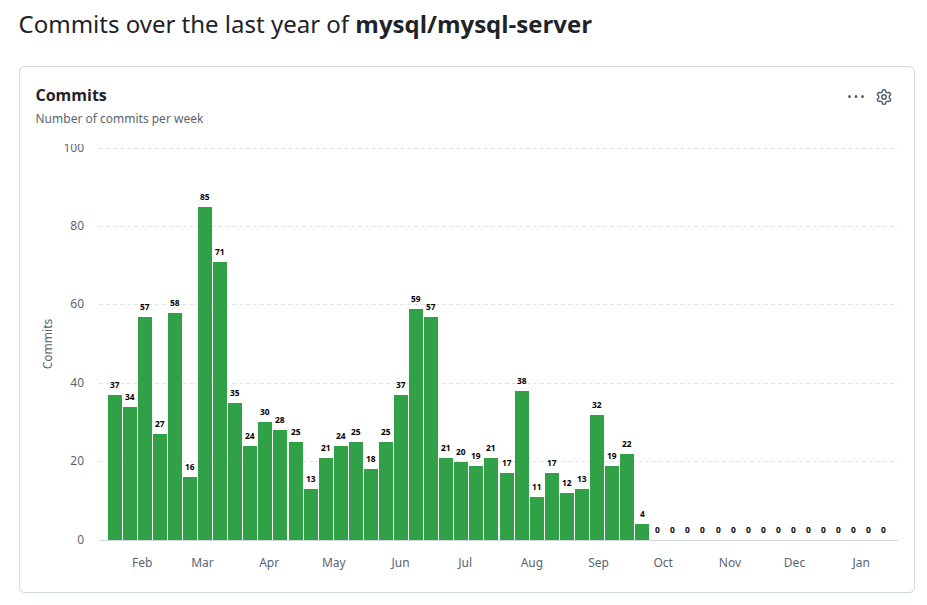
This is not surprising Oracle should not be trusted as the steward for open source projects When Oracle acquired Sun Microsystems and MySQL along with it back in 2009, the European Commission almost blocked the deal due to concerns that Oracle s goal was just to stifle competition. The deal went through as Oracle made a commitment to keep MySQL going and not kill it, but (to nobody s surprise) Oracle has not been a good steward of MySQL as an open source project and the community around it has been withering away for years now. All development is done behind closed doors. The publicly visible bug tracker is not the real one Oracle staff actually uses for MySQL development, and the few people who try to contribute to MySQL just see their Pull Requests and patch submissions marked as received with mostly no feedback and then those changes may or may not be in the next MySQL release, often rewritten, and with only Oracle staff in the git author/committer fields. The real author only gets a small mention in a blog post. When I was the engineering manager for the core team working on RDS MySQL and RDS MariaDB at Amazon Web Services, I oversaw my engineers contributions to both MySQL and MariaDB (the latter being a fork of MySQL by the original MySQL author, Michael Widenius). All the software developers in my org disliked submitting code to MySQL due to how bad the reception by Oracle was to their contributions. MariaDB is the stark opposite with all development taking place in real-time on github.com/mariadb/server, anyone being able to submit a Pull Request and get a review, all bugs being openly discussed at jira.mariadb.org and so forth, just like one would expect from a true open source project. MySQL is open source only by license (GPL v2), but not as a project.

MySQL s technical decline in recent years Despite not being a good open source steward, Oracle should be given credit that it did keep the MySQL organization alive and allowed it to exist fairly independently and continue developing and releasing new MySQL versions well over a decade after the acquisition. I have no insight into how many customers they had, but I assume the MySQL business was fairly profitable and financially useful to Oracle, at least as long as it didn t gain too many features to threaten Oracle s own main database business. I don t know why, perhaps because too many talented people had left the organization, but it seems that from a technical point of view MySQL clearly started to deteriorate from 2022 onward. When MySQL 8.0.29 was released with the default ALTER TABLE method switched to run in-place, it had a lot of corner cases that didn t work, causing the database to crash and data to corrupt for many users. The issue wasn t fully fixed until a year later in MySQL 8.0.32. To many users annoyance Oracle announced the 8.0 series as evergreen and introduced features and changes in the minor releases, instead of just doing bugfixes and security fixes like users historically had learnt to expect from these x.y.Z maintenance releases. There was no new major MySQL version for six years. After MySQL 8.0 in 2018 it wasn t until 2023 when MySQL 8.1 was released, and it was just a short-term preview release. The first actual new major release MySQL 8.4 LTS was released in 2024. Even though it was a new major release, many users got disappointed as it had barely any new features. Many also reported degraded performance with newer MySQL versions, for example the benchmark by famous MySQL performance expert Mark Callaghan below shows that on write-heavy workloads MySQL 9.5 throughput is typically 15% less than in 8.0. Benchmark showing new MySQL versions being slower than the old Due to newer MySQL versions deprecating many features, a lot of users also complained about significant struggles regarding both MySQL 5.7->8.0 and 8.0->8.4 upgrades. With few new features and heavy focus on code base cleanup and feature deprecation, it became obvious to many that Oracle had decided to just keep MySQL barely alive, and put all new relevant features (e.g. vector search) into Heatwave, Oracle s closed-source and cloud-only service for MySQL customers. As it was evident that Oracle isn t investing in MySQL, Percona s Peter Zaitsev wrote Is Oracle Finally Killing MySQL in June 2024. At this time MySQL s popularity as ranked by DB-Engines had also started to tank hard, a trend that likely accelerates in 2026. MySQL dropping significantly in DB-Engines ranking In September 2025 news reported that Oracle was reducing its workforce and that the MySQL staff was getting heavily reduced. Obviously this does not bode well for MySQL s future, and Peter Zaitsev posted already in November stats showing that the latest MySQL maintenance release contained fewer bug fixes than before.
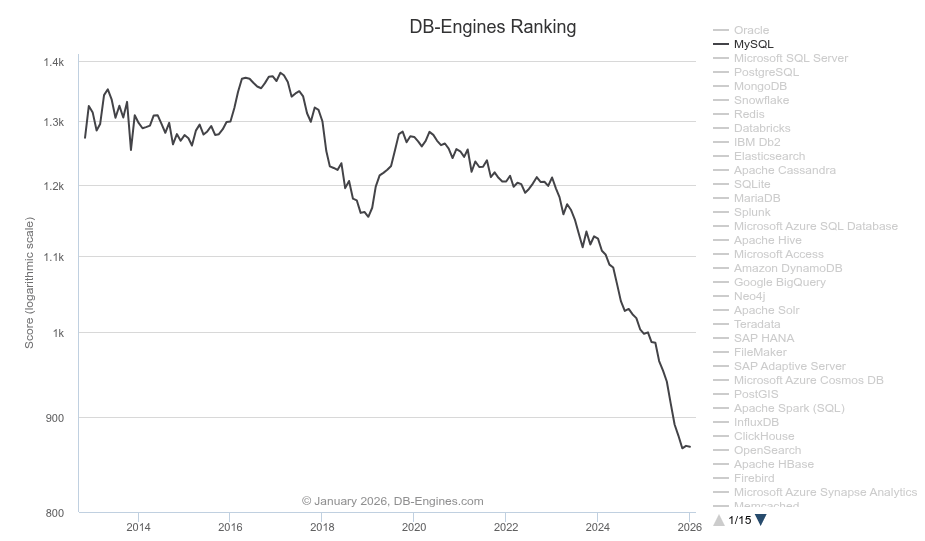
Open source is more than ideology: it has very real effects on software security and sovereignty Some say they don t care if MySQL is truly open source or not, or that they don t care if it has a future in coming years, as long as it still works now. I am afraid people thinking so are taking a huge risk. The database is often the most critical part of a software application stack, and any flaw or problem in operations, let alone a security issue, will have immediate consequences, and not caring will eventually get people fired or sued. In open source problems are discussed openly, and the bigger the problem, the more people and companies will contribute to fixing it. Open source as a development methodology is similar to the scientific method with free flow of ideas that are constantly contested and only the ones with the most compelling evidence win. Not being open means more obscurity, more risk and more just trust us bro attitude. This open vs. closed is very visible for example in how Oracle handles security issues. We can see that in 2025 alone MySQL published 123 CVEs about security issues, while MariaDB had 8. There were 117 CVEs that only affected MySQL and not MariaDB in 2025. I haven t read them all, but typically the CVEs hardly contain any real details. As an example, the most recent one CVE-2025-53067 states Easily exploitable vulnerability allows high privileged attacker with network access via multiple protocols to compromise MySQL Server. There is no information a security researcher or auditor could use to verify if any original issue actually existed, or if it was fixed, or if the fix was sufficient and fully mitigating the issue or not. MySQL users just have to take the word of Oracle that it is all good now. Handling security issues like this is in stark contrast to other open source projects, where all security issues and their code fixes are open for full scrutiny after the initial embargo is over and CVE made public. There is also various forms of enshittification going on one would not see in a true open source project, and everything about MySQL as a software, documentation and website is pushing users to stop using the open source version and move to the closed MySQL versions, and in particular to Heatwave, which is not only closed-source but also results in Oracle fully controlling customer s databases contents. Of course, some could say this is how Oracle makes money and is able to provide a better product. But stories on Reddit and elsewhere suggest that what is going on is more like Oracle milking hard the last remaining MySQL customers who are forced to pay more and more for getting less and less.

There are options and migrating is easy, just do it A large part of MySQL users switched to MariaDB already in the mid-2010s, in particular everyone who had cared deeply about their database software staying truly open source. That included large installations such as Wikipedia, and Linux distributions such as Fedora and Debian. Because it s open source and there is no centralized machine collecting statistics, nobody knows what the exact market shares look like. There are however some application specific stats, such as that 57% of WordPress sites around the world run MariaDB, while the share for MySQL is 42%. For anyone running a classic LAMP stack application such as WordPress, Drupal, Mediawiki, Nextcloud, or Magento, switching the old MySQL database to MariaDB is be straightforward. As MariaDB is a fork of MySQL and mostly backwards compatible with it, swapping out MySQL for MariaDB can be done without changing any of the existing connectors or database clients, as they will continue to work with MariaDB as if it was MySQL. For those running custom applications and who have the freedom to make changes to how and what database is used, there are tens of mature and well-functioning open source databases to choose from, with PostgreSQL being the most popular general database. If your application was built from the start for MySQL, switching to PostgreSQL may however require a lot of work, and the MySQL/MariaDB architecture and storage engine InnoDB may still offer an edge in e.g. online services where high performance, scalability and solid replication features are of highest priority. For a quick and easy migration MariaDB is probably the best option. Switching from MySQL to the Percona Server is also very easy, as it closely tracks all changes in MySQL and deviates from it only by a small number of improvements done by Percona. However, also precisely because of it being basically just a customized version of the MySQL Server, it s not a viable long-term solution for those trying to fully ditch the dependency on Oracle. There are also several open source databases that have no common ancestry with MySQL, but strive to be MySQL-compatible. Thus most apps built for MySQL can simply switch to using them without needing SQL statements to be rewritten. One such database is TiDB, which has been designed from scratch specifically for highly scalable and large systems, and is so good that even Amazon s latest database solution DSQL was built borrowing many ideas from TiDB. However, TiDB only really shines with larger distributed setups, so for the vast majority of regular small- and mid-scale applications currently using MySQL, the most practical solution is probably to just switch to MariaDB, which on most Linux distributions can simply be installed by running apt/dnf/brew install mariadb-server. Whatever you end up choosing, as long as it is not Oracle, you will be better off.

Next.

Previous.