Search Results: "phil"

19 October 2023

Russ Allbery: Review: The Cassini Division

Review: The Cassini Division, by Ken MacLeod
Series: Fall Revolution #3
Publisher: Tor
Copyright: 1998
Printing: August 2000
ISBN: 0-8125-6858-3
Format: Mass market
Pages: 305
The Cassini Division is the third book in the Fall Revolution series and a fairly direct sequel (albeit with different protagonists) to The Stone Canal. This is not a good place to start the series. It's impossible to talk about the plot of this book without discussing the future history of this series, which arguably includes some spoilers for The Star Fraction and The Stone Canal. I don't think the direction of history matters that much in enjoying the previous books, but read the first two books of the series before this review if you want to avoid all spoilers. When the Outwarders uploaded themselves and went fast, they did a lot of strange things: an interstellar probe contrary to all known laws of physics, the disassembly of Ganymede, and the Malley Mile, which plays a significant role in The Stone Canal. They also crashed the Earth. This was not entirely their fault. There were a lot of politics, religious fundamentalism, and plagues in play as well. But the storm of viruses broadcast from their transformed Jupiter shut down essentially all computing equipment on Earth, which set off much of the chaos. The results were catastrophic, and also politically transformative. Now, the Solar Union is a nearly unified anarchosocialist society, with only scattered enclaves of non-cooperators left outside that structure. Ellen May Ngewthu is a leader of the Cassini Division, the bulwark that stands between humans and the Outwarders. The Division ruthlessly destroys any remnant or probe that dares rise out of Jupiter's atmosphere, ensuring that the Outwarders, whatever they have become after untold generations of fast evolution, stay isolated to the one planet they have absorbed. The Division is very good at what they do. But there is a potential gap in that line of defense: there are fast folk in storage at the other end of the Malley Mile, on New Mars, and who knows what the deranged capitalists there will do or what forces they might unleash. The one person who knows a path through the Malley Mile isn't talking, so Ellen goes in search of the next best thing: the non-cooperator scientist Isambard Kingdom Malley. I am now thoroughly annoyed at how politics are handled in this series, and much less confused by the frequency with which MacLeod won Prometheus Awards from the Libertarian Futurist Society. Some of this is my own fault for having too high of hopes for political SF, but nothing in this series so far has convinced me that MacLeod is seriously engaging with political systems. Instead, the world-building to date makes the classic libertarian mistake of thinking societies will happily abandon stability and predictability in favor of their strange definition of freedom. The Solar Union is based on what Ellen calls the true knowledge, which is worth quoting in full so that you know what kind of politics we're talking about:
Life is a process of breaking down and using other matter, and if need be, other life. Therefore, life is aggression, and successful life is successful aggression. Life is the scum of matter, and people are the scum of life. There is nothing but matter, forces, space and time, which together make power. Nothing matters, except what matters to you. Might makes right, and power makes freedom. You are free to do whatever is in your power, and if you want to survive and thrive you had better do whatever is in your interests. If your interests conflict with those of others, let the others pit their power against yours, everyone for theirselves. If your interests coincide with those of others, let them work together with you, and against the rest. We are what we eat, and we eat everything. All that you really value, and the goodness and truth and beauty of life, have their roots in this apparently barren soil. This is the true knowledge. We had founded our idealism on the most nihilistic implications of science, our socialism on crass self-interest, our peace on our capacity for mutual destruction, and our liberty on determinism. We had replaced morality with convention, bravery with safety, frugality with plenty, philosophy with science, stoicism with anaesthetics and piety with immortality. The universal acid of the true knowledge had burned away a world of words, and exposed a universe of things. Things we could use.
This is certainly something that some people will believe, particularly cynical college students who love political theory, feeling smarter than other people, and calling their pet theories things like "the true knowledge." It is not even remotely believable as the governing philosophy of a solar confederation. The point of government for the average person in human society is to create and enforce predictable mutual rules that one can use as a basis for planning and habits, allowing you to not think about politics all the time. People who adore thinking about politics have great difficulty understanding how important it is to everyone else to have ignorable government. Constantly testing your power against other coalitions is a sport, not a governing philosophy. Given the implication that this testing is through violence or the threat of violence, it beggars belief that any large number of people would tolerate that type of instability for an extended period of time. Ellen is fully committed to the true knowledge. MacLeod likely is not; I don't think this represents the philosophy of the author. But the primary political conflict in this novel famous for being political science fiction is between the above variation of anarchy and an anarchocapitalist society, neither of which are believable as stable political systems for large numbers of people. This is a bit like seeking out a series because you were told it was about a great clash of European monarchies and discovering it was about a fight between Liberland and Sealand. It becomes hard to take the rest of the book seriously. I do realize that one point of political science fiction is to play with strange political ideas, similar to how science fiction plays with often-implausible science ideas. But those ideas need some contact with human nature. If you're going to tell me that the key to clawing society back from a world-wide catastrophic descent into chaos is to discard literally every social system used to create predictability and order, you had better be describing aliens, because that's not how humans work. The rest of the book is better. I am untangling a lot of backstory for the above synopsis, which in the book comes in dribs and drabs, but piecing that together is good fun. The plot is far more straightforward than the previous two books in the series: there is a clear enemy, a clear goal, and Ellen goes from point A to point B in a comprehensible way with enough twists to keep it interesting. The core moral conflict of the book is that Ellen is an anti-AI fanatic to the point that she considers anyone other than non-uploaded humans to be an existential threat. MacLeod gives the reader both reasons to believe Ellen is right and reasons to believe she's wrong, which maintains an interesting moral tension. One thing that MacLeod is very good at is what Bob Shaw called "wee thinky bits." I think my favorite in this book is the computer technology used by the Cassini Division, who have spent a century in close combat with inimical AI capable of infecting any digital computer system with tailored viruses. As a result, their computers are mechanical non-Von-Neumann machines, but mechanical with all the technology of a highly-advanced 24th century civilization with nanometer-scale manufacturing technology. It's a great mental image and a lot of fun to think about. This is the only science fiction novel that I can think of that has a hard-takeoff singularity that nonetheless is successfully resisted and fought to a stand-still by unmodified humanity. Most writers who were interested in the singularity idea treated it as either a near-total transformation leaving only remnants or as something that had to be stopped before it started. MacLeod realizes that there's no reason to believe a post-singularity form of life would be either uniform in intent or free from its own baffling sudden collapses and reversals, which can be exploited by humans. It makes for a much better story. The sociology of this book is difficult to swallow, but the characterization is significantly better than the previous books of the series and the plot is much tighter. I was too annoyed by the political science to fully enjoy it, but that may be partly the fault of my expectations coming in. If you like chewy, idea-filled science fiction with a lot of unexplained world-building that you have to puzzle out as you go, you may enjoy this, although unfortunately I think you need to read at least The Stone Canal first. The ending was a bit unsatisfying, but even that includes some neat science fiction ideas. Followed by The Sky Road, although I understand it is not a straightforward sequel. Rating: 6 out of 10

7 October 2023

Louis-Philippe V ronneau: Montreal's Debian & Stuff - "September" 2023

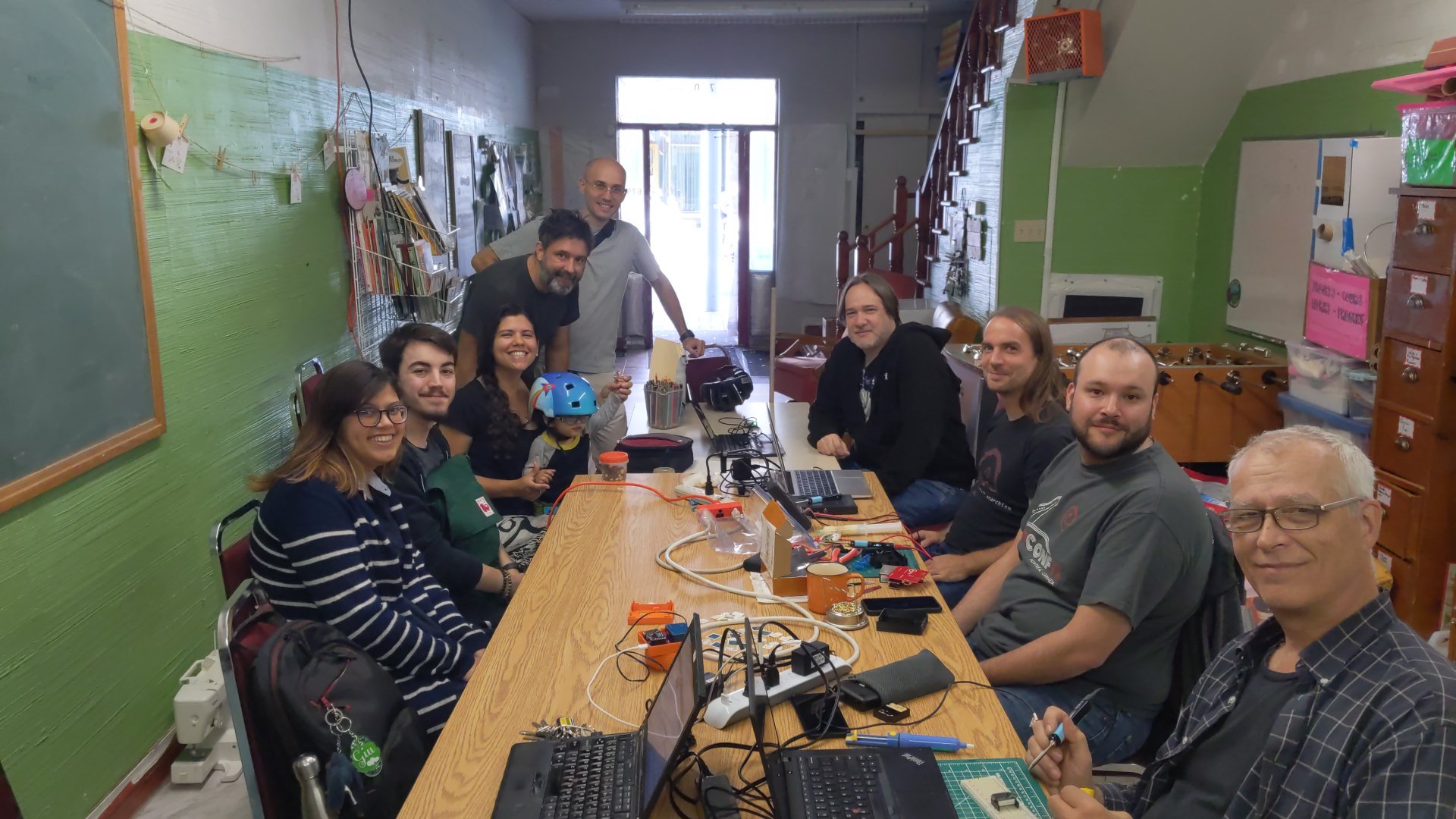
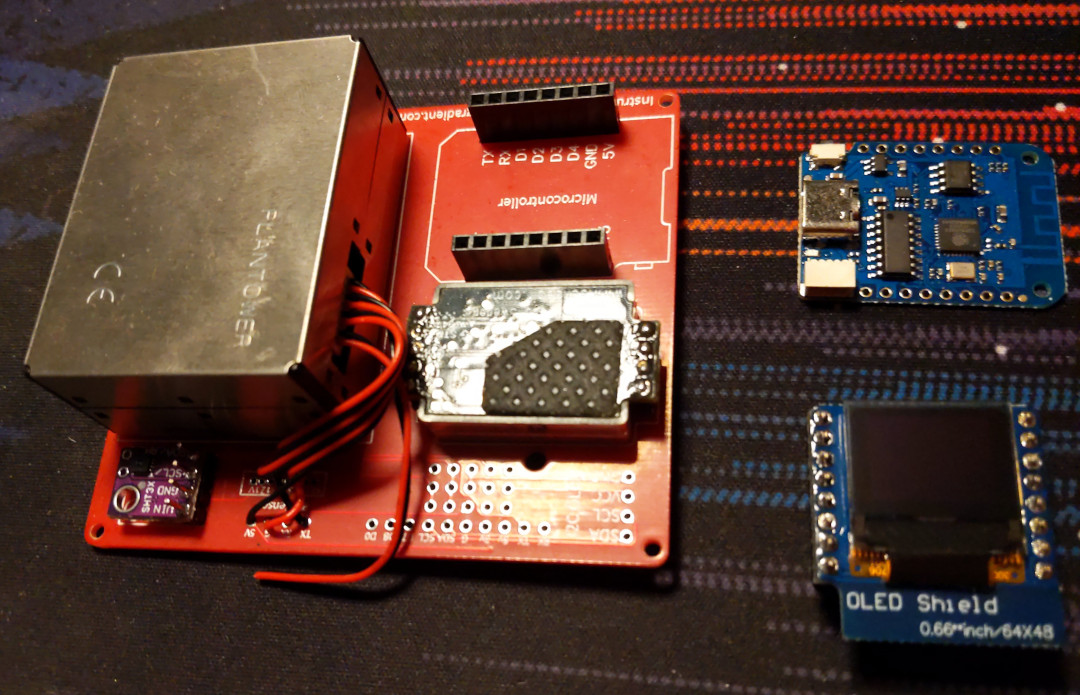
Last Sunday, our local Debian user group gathered to chat, to work on Debian and to do other, non-Debian related hacking. A "Debian & Stuff"! It had been a while since we held a proper meetup. Our last event was the Montreal BSP we organised back in March 2023... We somewhat missed the window for a June meetup and summer events never seem to gather a good crowd, so I didn't try to organise one. All this to say it was nice to see folks from the Montreal Debian community :) This event was also the first time we were hosted by L'Espace des possibles - Petite Patrie, a social venue that aims to provide a space for not-for-profit activities, like repair caf s, sowing classes, board game nights, etc. It was really nice and we will surely meet there again in the future. A group picture during the event Many people came to the event, including some new ones. Although people always tend to come and go during the day, a total of 12 people attended the event. As always, people worked on very different projects! One of the focus of this D&S was assembling AirGradient DIY basic kits. Our local community has been talking a lot about air quality metrics in the past few months1. Tiago thus decided to have a company print the PCBs for this kit and graciously gave away a few spares. Michael then took upon himself to order parts on AliExpress and a few of us ended up soldering the kits together while chatting. An AirGradient DIY basic kit, semi-assembled Otherwise, some Debian work was also done: The whole event was super fun, the tacos we had for lunch were delicious (and very authentic!), and we ended up at a local microbrewery to share a pint later in the evening. Looking forward to the next event!
  1. Mostly as a result of the large forest fires in Canada this summer. I myself blogged twice about air quality-related projects recently.

6 October 2023

Russ Allbery: Review: The Far Reaches

Review: The Far Reaches, edited by John Joseph Adams
Publisher: Amazon Original Stories
Copyright: June 2023
ISBN: 1-6625-1572-3
ISBN: 1-6625-1622-3
ISBN: 1-6625-1503-0
ISBN: 1-6625-1567-7
ISBN: 1-6625-1678-9
ISBN: 1-6625-1533-2
Format: Kindle
Pages: 219
Amazon has been releasing anthologies of original short SFF with various guest editors, free for Amazon Prime members. I previously tried Black Stars (edited by Nisi Shawl and Latoya Peterson) and Forward (edited by Blake Crouch). Neither were that good, but the second was much worse than the first. Amazon recently released a new collection, this time edited by long-standing SFF anthology editor John Joseph Adams and featuring a new story by Ann Leckie, which sounded promising enough to give them another chance. The definition of insanity is doing the same thing over and over again and expecting different results. As with the previous anthologies, each story is available separately for purchase or Amazon Prime "borrowing" with separate ISBNs. The sidebar cover is for the first in the sequence. Unlike the previous collections, which were longer novelettes or novellas, my guess is all of these are in the novelette range. (I did not do a word count.) If you're considering this anthology, read the Okorafor story ("Just Out of Jupiter's Reach"), consider "How It Unfolds" by James S.A. Corey, and avoid the rest. "How It Unfolds" by James S.A. Corey: Humans have invented a new form of physics called "slow light," which can duplicate any object that is scanned. The energy expense is extremely high, so the result is not a post-scarcity paradise. What the technology does offer, however, is a possible route to interstellar colonization: duplicate a team of volunteers and a ship full of bootstrapping equipment, and send copies to a bunch of promising-looking exoplanets. One of them might succeed. The premise is interesting. The twists Corey adds on top are even better. What can be duplicated once can be duplicated again, perhaps with more information. This is a lovely science fiction idea story that unfortunately bogs down because the authors couldn't think of anywhere better to go with it than relationship drama. I found the focus annoying, but the ideas are still very neat. (7) "Void" by Veronica Roth: A maintenance worker on a slower-than-light passenger ship making the run between Sol and Centauri unexpectedly is called to handle a dead body. A passenger has been murdered, two days outside the Sol system. Ace is in no way qualified to investigate the murder, nor is it her job, but she's watched a lot of crime dramas and she has met the victim before. The temptation to start poking around is impossible to resist. It's been a long time since I've read a story built around the differing experiences of time for people who stay on planets and people who spend most of their time traveling at relativistic speeds. It's a bit of a retro idea from an earlier era of science fiction, but it's still a good story hook for a murder mystery. None of the characters are that memorable and Roth never got me fully invested in the story, but this was still a pleasant way to pass the time. (6) "Falling Bodies" by Rebecca Roanhorse: Ira is the adopted son of a Genteel senator. He was a social experiment in civilizing the humans: rescue a human orphan and give him the best of Genteel society to see if he could behave himself appropriately. The answer was no, which is how Ira finds himself on Long Reach Station with a parole officer and a schooling opportunity, hopefully far enough from his previous mistakes for a second chance. Everyone else seems to like Rebecca Roanhorse's writing better than I do, and this is no exception. Beneath the veneer of a coming-of-age story with a twist of political intrigue, this is brutal, depressing, and awful, with an ending that needs a lot of content warnings. I'm sorry that I read it. (3) "The Long Game" by Ann Leckie: The Imperial Radch trilogy are some of my favorite science fiction novels of all time, but I am finding Leckie's other work a bit hit and miss. I have yet to read a novel of hers that I didn't like, but the short fiction I've read leans more heavily into exploring weird and alien perspectives, which is not my favorite part of her work. This story is firmly in that category: the first-person protagonist is a small tentacled alien creature, a bit like a swamp-dwelling octopus. I think I see what Leckie is doing here: balancing cynicism and optimism, exploring how lifespans influence thinking and planning, and making some subtle points about colonialism. But as a reading experience, I didn't enjoy it. I never liked any of the characters, and the conclusion of the story is the unsettling sort of main-character optimism that seems rather less optimistic to the reader. (4) "Just Out of Jupiter's Reach" by Nnedi Okorafor: K rm n scientists have found a way to grow living ships that can achieve a symbiosis with a human pilot, but the requirements for that symbiosis are very strict and hard to predict. The result was a planet-wide search using genetic testing to find the rare and possibly nonexistent matches. They found seven people. The deal was simple: spend ten years in space, alone, in her ship. No contact with any other human except at the midpoint, when the seven ships were allowed to meet up for a week. Two million euros a year, for as long as she followed the rules, and the opportunity to be part of a great experiment, providing data that will hopefully lead to humans becoming a spacefaring species. The core of this story is told during the seven days in the middle of the mission, and thus centers on people unfamiliar with human contact trying to navigate social relationships after five years in symbiotic ships that reshape themselves to their whims and personalities. The ships themselves link so that the others can tour, which offers both a good opportunity for interesting description and a concretized metaphor about meeting other people. I adore symbiotic spaceships, so this story had me at the premise. The surface plot is very psychological, and I didn't entirely click with it, but the sense of wonder vibes beneath that surface were wonderful. It also feels fresh and new: I've seen most of the ideas before, but not presented or written this way, or approached from quite this angle. Definitely the best story of the anthology. (8) "Slow Time Between the Stars" by John Scalzi: This, on the other hand, was a complete waste of time, redeemed only by being the shortest "story" in the collection. "Story" is generous, since there's only one character and a very dry, linear plot that exists only to make a philosophical point. "Speculative essay" may be closer. The protagonist is the artificial intelligence responsible for Earth's greatest interstellar probe. It is packed with a repository of all of human knowledge and the raw material to create life. Its mission is to find an exoplanet capable of sustaining that life, and then recreate it and support it. The plot, such as it is, follows the AI's decision to abandon that mission and cut off contact with Earth, for reasons that it eventually explains. Every possible beat of this story hit me wrong. The sense of wonder attaches to the most prosaic things and skips over the moments that could have provoked real wonder. The AI is both unbelievable and irritating, with all of the smug self-confidence of an Internet reply guy. The prose is overwrought in all the wrong places ("the finger of God, offering the spark to animate the dirt of another world" would totally be this AI's profile quote under their forum avatar). The only thing I liked about the story is the ethical point that it slowly meanders into, which I think I might agree with and at least find plausible. But it's delivered by the sort of character I would actively leave rooms to avoid, in a style that's about as engrossing as a tax form. Avoid. (2) Rating: 5 out of 10

27 September 2023

Bits from Debian: New Debian Developers and Maintainers (July and August 2023)

The following contributors got their Debian Developer accounts in the last two months: The following contributors were added as Debian Maintainers in the last two months: Congratulations!

10 September 2023

Freexian Collaborators: Debian Contributions: /usr-merge updates, Salsa CI progress, DebConf23 lead-up, and more! (by Utkarsh Gupta)

Contributing to Debian is part of Freexian s mission. This article covers the latest achievements of Freexian and their collaborators. All of this is made possible by organizations subscribing to our Long Term Support contracts and consulting services.

/usr-merge work, by Helmut Grohne, et al. Given that we now have consensus on moving forward by moving aliased files from / to /usr, we will also run into the problems that the file move moratorium was meant to prevent. The way forward is detecting them early and applying workarounds on a per-package basis. Said detection is now automated using the Debian Usr Merge Analysis Tool. As problems are reported to the bug tracking system, they are connected to the reports if properly usertagged. Bugs and patches for problem categories DEP17-P2 and DEP17-P6 have been filed. After consensus has been reached on the bootstrapping matters, debootstrap has been changed to swap the initial unpack and merging to avoid unpack errors due to pre-existing links. This is a precondition for having base-files install the aliasing symbolic links eventually. It was identified that the root filesystem used by the Debian installer is still unmerged and a change has been proposed. debhelper was changed to recognize systemd units installed to /usr. A discussion with the CTTE and release team on repealing the moratorium has been initiated.

Salsa CI work, by Santiago Ruano Rinc n August was a busy month in the Salsa CI world. Santiago reviewed and merged a bunch of MRs that have improved the project in different aspects: The aptly job got two MRs from Philip Hands. With the first one, the aptly now can export a couple of variables in a dotenv file, and with the second, it can include packages from multiple artifact directories. These MRs bring the base to improve how to test reverse dependencies with Salsa CI. Santiago is working on documenting this. As a result of the mass bug filing done in August, Salsa CI now includes a job to test how a package builds twice in a row. Thanks to the MRs of Sebastiaan Couwenberg and Johannes Schauer Marin Rodrigues. Last but not least, Santiago helped Johannes Schauer Marin Rodrigues to complete the support for arm64-only pipelines.

DebConf23 lead-up, by Stefano Rivera Stefano wears a few hats in the DebConf organization and in the lead up to the conference in mid-September, they ve all been quite busy. As one of the treasurers of DebConf 23, there has been a final budget update, and quite a few payments to coordinate from Debian s Trusted Organizations. We try to close the books from the previous conference at the next one, so a push was made to get DebConf 22 account statements out of TOs and record them in the conference ledger. As a website developer, we had a number of registration-related tasks, emailing attendees and trying to estimate numbers for food and accommodation. As a conference committee member, the job was mostly taking calls and helping the local team to make decisions on urgent issues. For example, getting conference visas issued to attendees required getting political approval from the Indian government. We only discovered the full process for this too late to clear some complex cases, so this required some hard calls on skipping some countries from the application list, allowing everyone else to get visas in time. Unfortunate, but necessary.

Miscellaneous contributions
  • Rapha l Hertzog updated gnome-shell-extension-hamster to a new upstream git snapshot that is compatible with GNOME Shell 44 that was recently uploaded to Debian unstable/testing. This extension makes it easy to start/stop tracking time with Hamster Time Tracker. Very handy for consultants like us who are billing their work per hour.
  • Rapha l also updated zim to the latest upstream release (0.74.2). This is a desktop wiki that can be very useful as a note-taking tool to build your own personal knowledge base or even to manage your personal todo lists.
  • Utkarsh reviewed and sponsored some uploads from mentors.debian.net.
  • Utkarsh helped the local team and the bursary team with some more DebConf activities and helped finalize the data.
  • Thorsten tried to update package hplip. Unfortunately upstream added some new compressed files that need to appear uncompressed in the package. Even though this sounded like an easy task, which seemed to be already implemented in the current debian/rules, the new type of files broke this implementation and made the package no longer buildable. The problem has been solved and the upload will happen soon.
  • Helmut sent 7 patches for cross build failures. Since dpkg-buildflags now defaults to issue arm64-specific compiler flags, more care is needed to distinguish between build architecture flags and host architecture flags than previously.
  • Stefano pushed the final bit of the tox 4 transition over the line in Debian, allowing dh-python and tox 4 to migrate to testing. We got caught up in a few unusual bugs in tox and the way we run it in Debian package building (which had to change with tox 4). This resulted in a couple of patches upstream.
  • Stefano visited Haifa, Israel, to see the proposed DebConf 24 venue and meet with the local team. While the venue isn t committed yet, we have high hopes for it.

4 August 2023

Louis-Philippe V ronneau: pymonitair: Air Quality Monitoring Display with MicroPython

I've never been a fan of IoT devices for obvious reasons: not only do they tend to be excellent at being expensive vendor locked-in machines, but far too often, they also end up turning into e-waste after a short amount of time. Manufacturers can go out of business or simply decide to shut down the cloud servers for older models, and then you're stuck with a brick. Well, this all changes today, as I've built my first IoT device and I love it. Introducing pymonitair. What pymonitair is a MicroPython project that aims to display weather data from a home weather station (like the ones sold by AirGradient) on a small display. The source code was written for the Raspberry Pi Pico W, the Waveshare Pico OLED 1.3 display and the RevolvAir Revo 1 weather station, but can be adapted to other displays and stations easily, as I tried to keep the code as modular as possible. The general MicroPython code itself isn't specific to the Raspberry Pi Pico and shouldn't need to be modified for other boards. pymonitair features: Here's a demo of me scrolling through the different pages and (somewhat failing) to turn the screen on and off: Why? If you follow my blog, you'll know that my last entry was about building a set of tools to collect and graph data from a weather station my neighbor set up. Why on Earth would I need a separate device to show this data, when the website I've built works perfectly fine and is accessible on any computer or smartphone? Mostly alerts. When the air quality here dropped following forest fires, I found out keeping track of if I had to close my windows and bunker down was quite a hassle. Air quality would degrade during the day and I would only notice it hours later. With the pymonitair, I'll have a little screen flashing angrily at me whenever this happens. A simpler solution would probably have been to forgo hardware altogether and code some icinga2 alert to ping me over Signal whenever the air quality got bad. Hacking on pymonitair was mostly a way to learn to use MicroPython and familiarize myself with this type of embedded hardware device. I'll surely blog about this later this year, but I plan to use a very similar stack to mod my apartment's HVAC unit to stop pulling air from outside when an air quality sensor detects cigarette smoke (or bad air quality in general). Things I've learnt This project was super fun and taught me many things:

  1. PM1, PM2.5, PM10, Temperature, Humidity and Pressure
  2. Part of the screen will flash repeatedly
  3. I did look for other solutions to transfer files to the board, but none of them were actually maintained. I nearly finished packaging ampy before realising it was officially unmaintained and its main alternative, rshell, has had its last release in December 2021. When I caught myself seriously considering writing a script to transfer files over the serial link, I gave up and decided thonny was not that bad after all.

1 August 2023

Louis-Philippe V ronneau: Weather Station Data Visualisations Using R and Python

A few weeks ago, my friend and neighbor J r me (aka lavamind) installed a weather station on his balcony and started collecting data from it. It has been quite useful to measure the degrading air quality during the recent forest fires plaguing northern Canada, but sadly, the hardware itself isn't great. Whereas some projects like airgradient offer open hardware devices running free software, the station we got is from RevolvAir, some kind of local air monitoring project that aims to be a one-stop solution for exterior air monitoring. Not only is their device pretty expensive1, but it also reboots frequently by itself. Even worse, their online data map requires an account to view the data and the interface is bad, unintuitive and only stores data up to a month. Having a good background in data visualisation and statistics thanks to my master's degree in economics, I decided I could do better. Two days later, I had built a series of tools to collect, analyse and graph the JSON time series data provided by the device. The result is a very simple website that works without any JavaScript, leveraging static graphs built using R. Modern web libraries and projects offer an incredible wealth of tools to graph and visualise data, but as for most of my web projects, I wanted something static and simple. The source code for the project can be found here, and although it is somewhat specific to the data structure provided by the RevolvAir device, it could easily be adapted to other devices, as they tend to have very similar JSON dumps.

  1. around 300 CAD, whereas a similar station from airgradient costs around 90 CAD. Thankfully, this station was a gift from a local group mobilising against an industrial project near our housing cooperative and we didn't have to pay for it ourselves.

27 July 2023

Louis-Philippe V ronneau: My new friend Ted

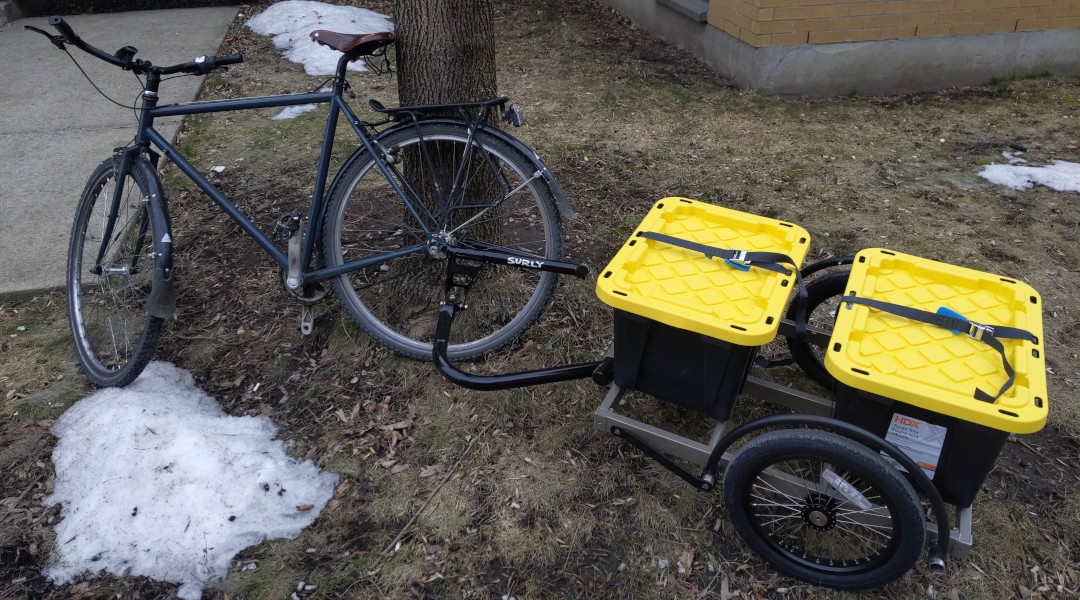
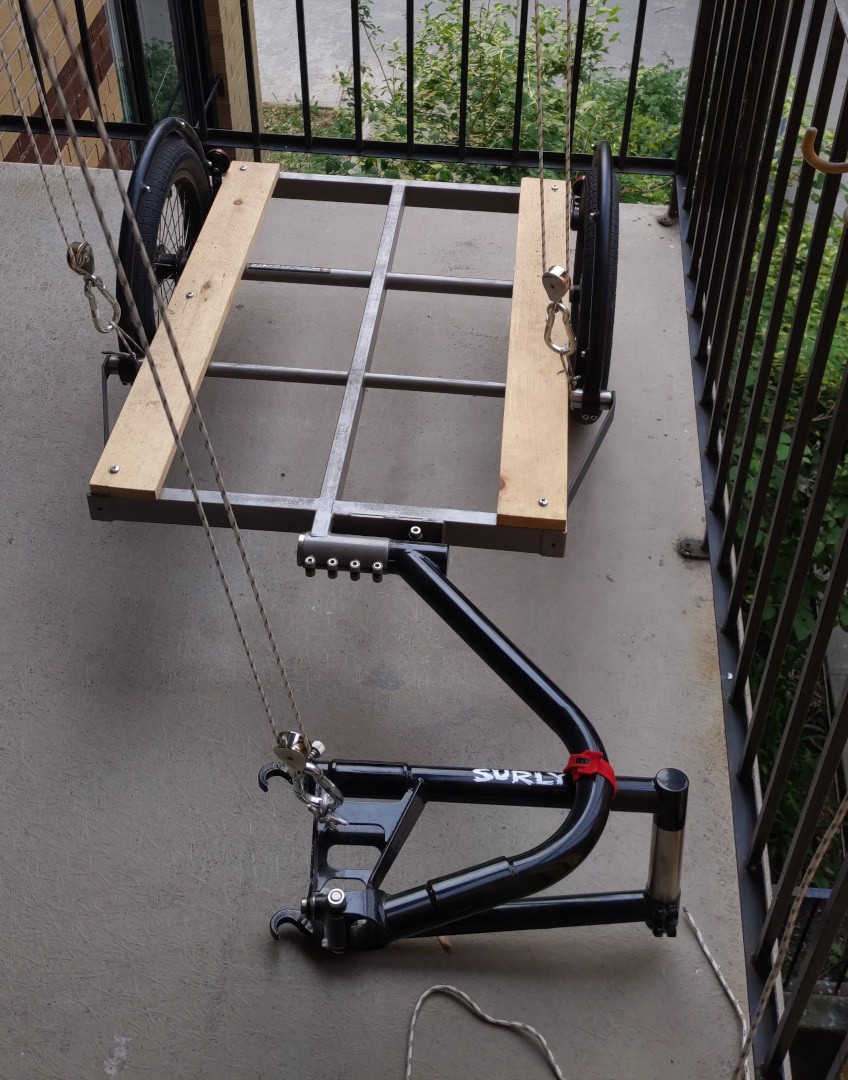
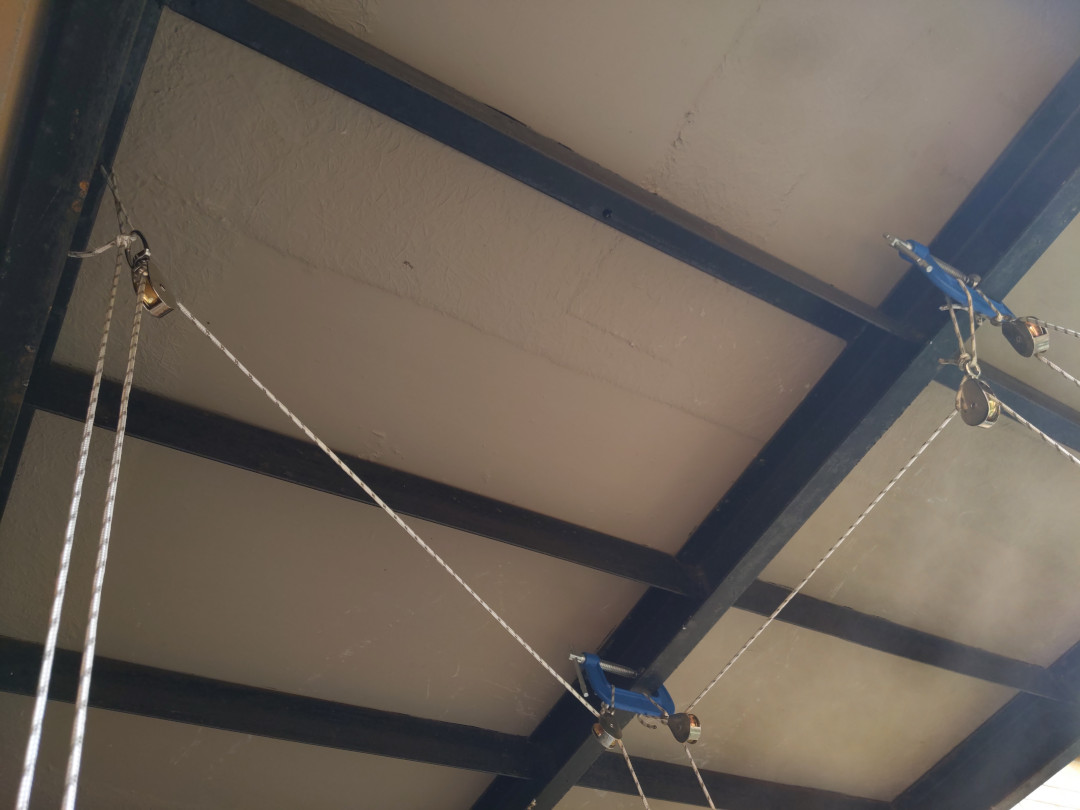
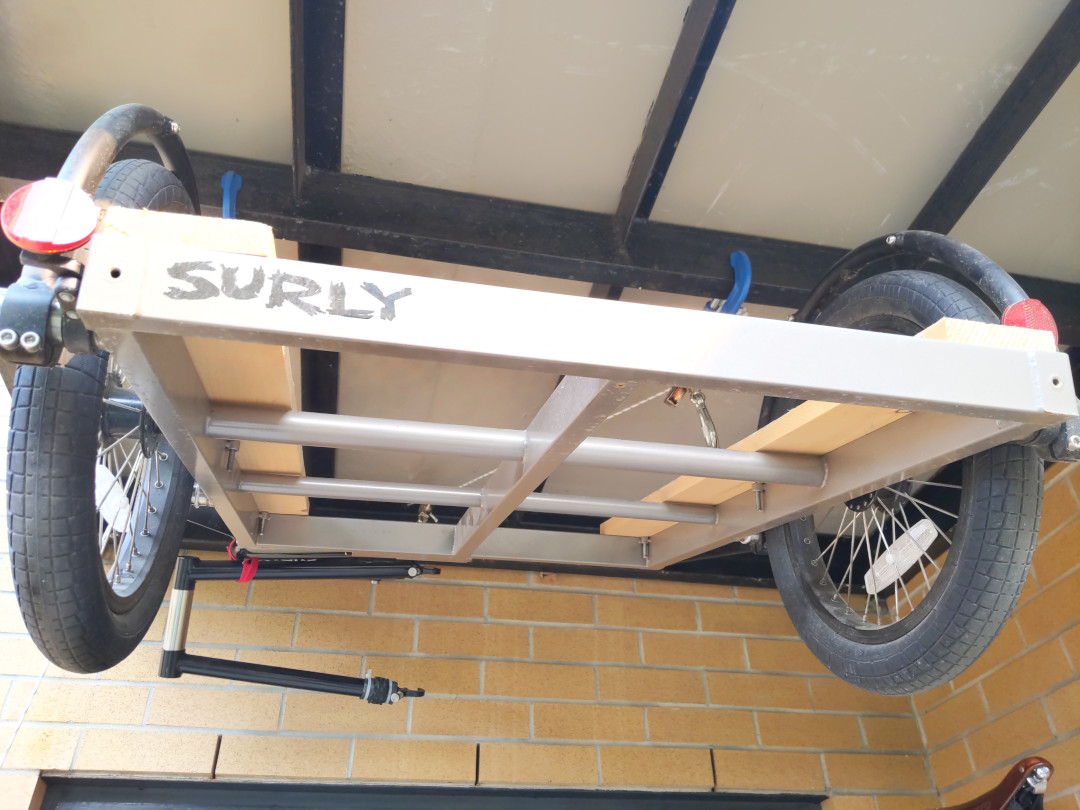
About 6 months ago, I decided to purchase a bike trailer. I don't drive and although I also have a shopping caddy, it often can't handle a week's groceries. The trailer, attached to my bike, hauling two storage crates Since the goal for the trailer was to haul encumbering and heavy loads, I decided to splurge and got a Surly Ted. The 32" x 24" flat bed is very versatile and the trailer is rated for up to 300 lbs (~135 kg). At around 30 lbs (~13.5 kg), the trailer itself is light enough for me to climb up the stairs to my apartment with it. Having seldom driven a bike trailer before, I was at first worried about its handling and if it would jerk me around (as some children's chariots tend to). I'm happy to report the two pronged hitch Surly designed works very well and lets you do 180 turns effortlessly. The trailer on my balcony, ready to be hoisted So far, I've used the trailer to go grocery shopping, buy bulk food and haul dirt and mulch. To make things easier, I've purchased two 45L storing crates from Home Depot and added two planks of wood on each side of the trailer to stabilise things when I strap the crates down to the bed. Since my partner and I are subscribed to an organic farmer's box during the summer and get baskets from Lufa during the winter, picking up our groceries at the pick-up point is as easy as dumping our order in the storing crates and strapping them back to the trailer. The pulleys on the roof of my balcony Although my housing cooperative has a (small) indoor bicycle parking space, my partner uses our spot during the summer, which means I have to store the trailer on my balcony. To make things more manageable and free up some space, I set up a system of pulleys to hoist the trailer up the air when it's not in use. I did go through a few iterations, but I'm pretty happy with the current 8 pulleys block and tackle mechanism I rigged. The trailer hoisted to the roof of the balcony All and all, this trailer wasn't cheap, but I regret nothing. Knowing Surley's reputation, it will last me many years and not having to drive a car to get around always ends up being the cheaper solution.
23 July 2023

Wouter Verhelst: Debconf Videoteam sprint in Paris, France, 2023-07-20 - 2023-07-23

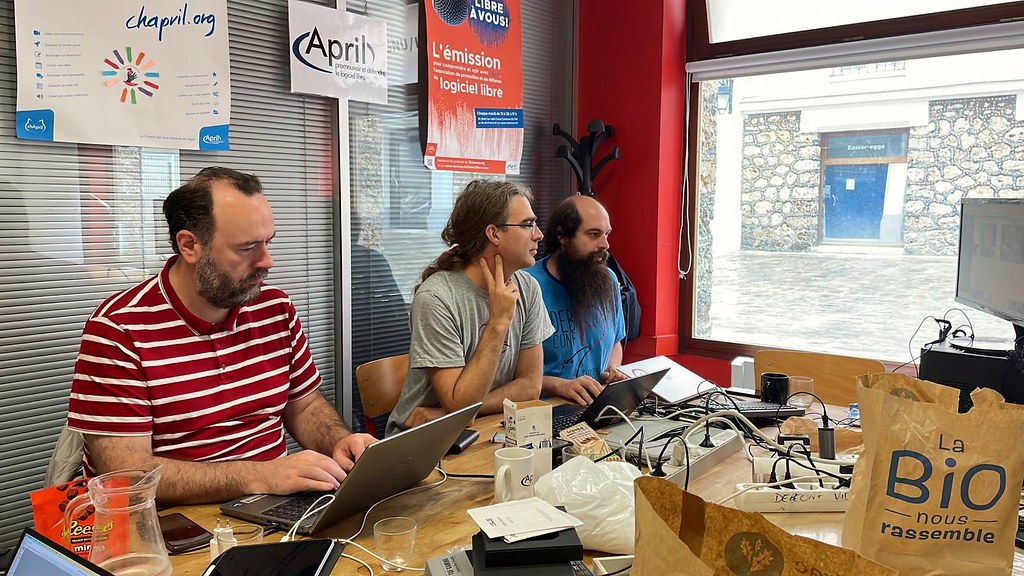
The DebConf video team has been sprinting in preparation for DebConf 23 which will happen in Kochi, India, in September of this year. Video team sprint Present were Nicolas "olasd" Dandrimont, Stefano "tumbleweed" Rivera, and yours truly. Additionally, Louis-Philippe "pollo" V ronneau and Carl "CarlFK" Karsten joined the sprint remotely from across the pond. Thank you to the DPL for agreeing to fund flights, food, and accomodation for the team members. We would also like to extend a special thanks to the Association April for hosting our sprint at their offices. We made a lot of progress: It is now Sunday the 23rd at 14:15, and while the sprint is coming to an end, we haven't quite finished yet, so some more progress can still be made. Let's see what happens by tonight. All in all, though, we believe that the progress we made will make the DebConf Videoteam's work a bit easier in some areas, and will make things work better in the future. See you in Kochi!

11 July 2023

Simon Josefsson: Coping with non-free software in Debian

A personal reflection on how I moved from my Debian home to find two new homes with Trisquel and Guix for my own ethical computing, and while doing so settled my dilemma about further Debian contributions. Debian s contributions to the free software community has been tremendous. Debian was one of the early distributions in the 1990 s that combined the GNU tools (compiler, linker, shell, editor, and a set of Unix tools) with the Linux kernel and published a free software operating system. Back then there were little guidance on how to publish free software binaries, let alone entire operating systems. There was a lack of established community processes and conflict resolution mechanisms, and lack of guiding principles to motivate the work. The community building efforts that came about in parallel with the technical work has resulted in a steady flow of releases over the years. From the work of Richard Stallman and the Free Software Foundation (FSF) during the 1980 s and early 1990 s, there was at the time already an established definition of free software. Inspired by free software definition, and a belief that a social contract helps to build a community and resolve conflicts, Debian s social contract (DSC) with the free software community was published in 1997. The DSC included the Debian Free Software Guidelines (DFSG), which directly led to the Open Source Definition.

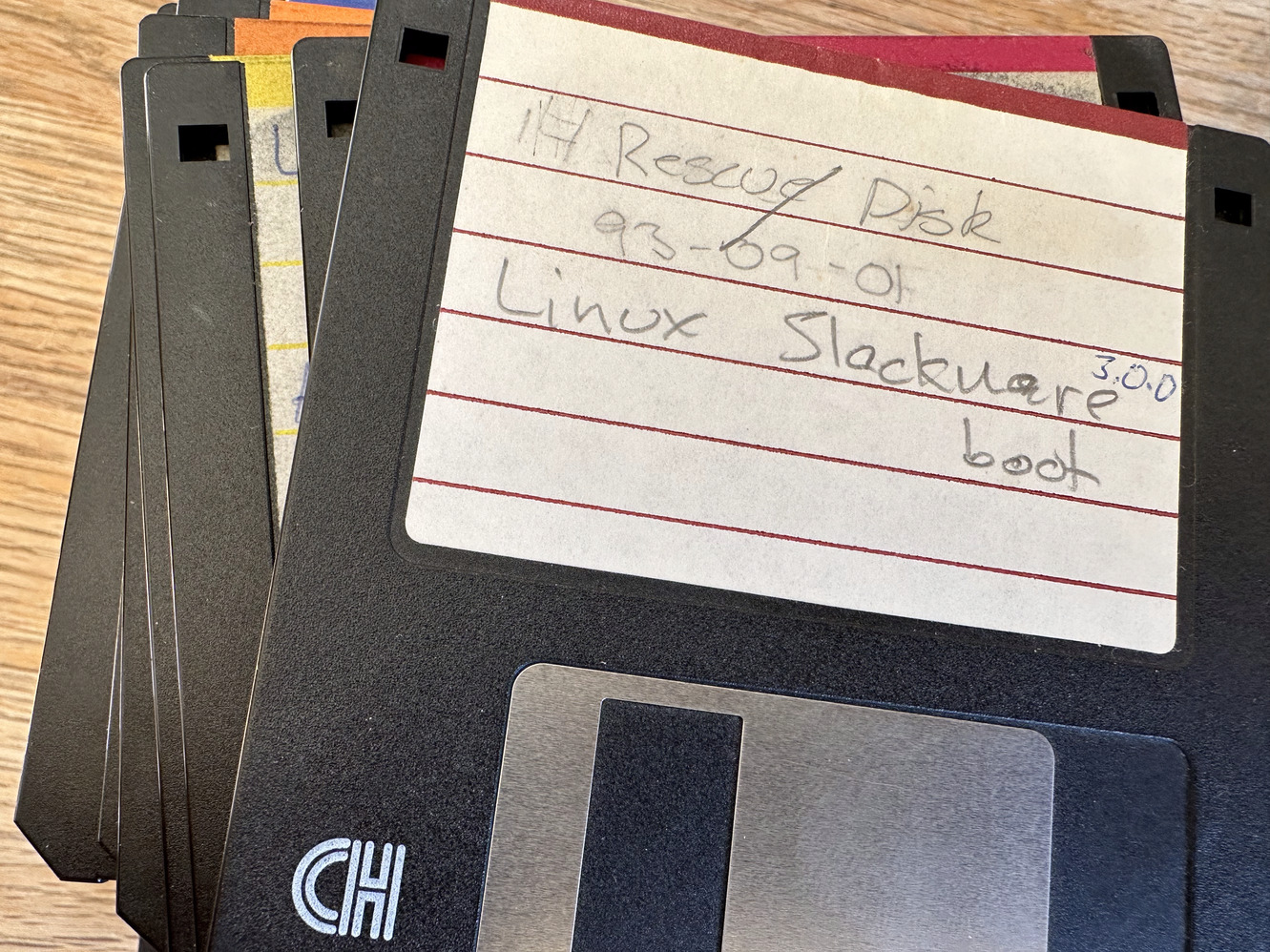
Slackware 3.5" disksOne of my earlier Slackware install disk sets, kept for nostalgic reasons.

I was introduced to GNU/Linux through Slackware in the early 1990 s (oh boy those nights calculating XFree86 modeline s and debugging sendmail.cf) and primarily used RedHat Linux during ca 1995-2003. I switched to Debian during the Woody release cycles, when the original RedHat Linux was abandoned and Fedora launched. It was Debian s explicit community processes and infrastructure that attracted me. The slow nature of community processes also kept me using RedHat for so long: centralized and dogmatic decision processes often produce quick and effective outcomes, and in my opinion RedHat Linux was technically better than Debian ca 1995-2003. However the RedHat model was not sustainable, and resulted in the RedHat vs Fedora split. Debian catched up, and reached technical stability once its community processes had been grounded. I started participating in the Debian community around late 2006. My interpretation of Debian s social contract is that Debian should be a distribution of works licensed 100% under a free license. The Debian community has always been inclusive towards non-free software, creating the contrib/non-free section and permitting use of the bug tracker to help resolve issues with non-free works. This is all explained in the social contract. There has always been a clear boundary between free and non-free work, and there has been a commitment that the Debian system itself would be 100% free. The concern that RedHat Linux was not 100% free software was not critical to me at the time: I primarily (and happily) ran GNU tools on Solaris, IRIX, AIX, OS/2, Windows etc. Running GNU tools on RedHat Linux was an improvement, and I hadn t realized it was possible to get rid of all non-free software on my own primary machine. Debian realized that goal for me. I ve been a believer in that model ever since. I can use Solaris, macOS, Android etc knowing that I have the option of using a 100% free Debian. While the inclusive approach towards non-free software invite and deserve criticism (some argue that being inclusive to non-inclusive behavior is a bad idea), I believe that Debian s approach was a successful survival technique: by being inclusive to and a compromise between free and non-free communities, Debian has been able to stay relevant and contribute to both environments. If Debian had not served and contributed to the free community, I believe free software people would have stopped contributing. If Debian had rejected non-free works completely, I don t think the successful Ubuntu distribution would have been based on Debian. I wrote the majority of the text above back in September 2022, intending to post it as a way to argue for my proposal to maintain the status quo within Debian. I didn t post it because I felt I was saying the obvious, and that the obvious do not need to be repeated, and the rest of the post was just me going down memory lane. The Debian project has been a sustainable producer of a 100% free OS up until Debian 11 bullseye. In the resolution on non-free firmware the community decided to leave the model that had resulted in a 100% free Debian for so long. The goal of Debian is no longer to publish a 100% free operating system, instead this was added: The Debian official media may include firmware . Indeed the Debian 12 bookworm release has confirmed that this would not only be an optional possibility. The Debian community could have published a 100% free Debian, in parallel with the non-free Debian, and still be consistent with their newly adopted policy, but chose not to. The result is that Debian s policies are not consistent with their actions. It doesn t make sense to claim that Debian is 100% free when the Debian installer contains non-free software. Actions speaks louder than words, so I m left reading the policies as well-intended prose that is no longer used for guidance, but for the peace of mind for people living in ivory towers. And to attract funding, I suppose. So how to deal with this, on a personal level? I did not have an answer to that back in October 2022 after the vote. It wasn t clear to me that I would ever want to contribute to Debian under the new social contract that promoted non-free software. I went on vacation from any Debian work. Meanwhile Debian 12 bookworm was released, confirming my fears. I kept coming back to this text, and my only take-away was that it would be unethical for me to use Debian on my machines. Letting actions speak for themselves, I switched to PureOS on my main laptop during October, barely noticing any difference since it is based on Debian 11 bullseye. Back in December, I bought a new laptop and tried Trisquel and Guix on it, as they promise a migration path towards ppc64el that PureOS do not. While I pondered how to approach my modest Debian contributions, I set out to learn Trisquel and gained trust in it. I migrated one Debian machine after another to Trisquel, and started to use Guix on others. Migration was easy because Trisquel is based on Ubuntu which is based on Debian. Using Guix has its challenges, but I enjoy its coherant documented environment. All of my essential self-hosted servers (VM hosts, DNS, e-mail, WWW, Nextcloud, CI/CD builders, backup etc) uses Trisquel or Guix now. I ve migrated many GitLab CI/CD rules to use Trisquel instead of Debian, to have a more ethical computing base for software development and deployment. I wish there were official Guix docker images around. Time has passed, and when I now think about any Debian contributions, I m a little less muddled by my disappointment of the exclusion of a 100% free Debian. I realize that today I can use Debian in the same way that I use macOS, Android, RHEL or Ubuntu. And what prevents me from contributing to free software on those platforms? So I will make the occasional Debian contribution again, knowing that it will also indirectly improve Trisquel. To avoid having to install Debian, I need a development environment in Trisquel that allows me to build Debian packages. I have found a recipe for doing this: # System commands:
sudo apt-get install debhelper git-buildpackage debian-archive-keyring
sudo wget -O /usr/share/debootstrap/scripts/debian-common https://sources.debian.org/data/main/d/debootstrap/1.0.128%2Bnmu2/scripts/debian-common
sudo wget -O /usr/share/debootstrap/scripts/sid https://sources.debian.org/data/main/d/debootstrap/1.0.128%2Bnmu2/scripts/sid
# Run once to create build image:
DIST=sid git-pbuilder create --mirror http://deb.debian.org/debian/ --debootstrapopts "--exclude=usr-is-merged" --basepath /var/cache/pbuilder/base-sid.cow
# Run in a directory with debian/ to build a package:
gbp buildpackage --git-pbuilder --git-dist=sid
How to sustainably deliver a 100% free software binary distributions seems like an open question, and the challenges are not all that different compared to the 1990 s or early 2000 s. I m hoping Debian will come back to provide a 100% free platform, but my fear is that Debian will compromise even further on the free software ideals rather than the opposite. With similar arguments that were used to add the non-free firmware, Debian could compromise the free software spirit of the Linux boot process (e.g., non-free boot images signed by Debian) and media handling (e.g., web browsers and DRM), as Debian have already done with appstore-like functionality for non-free software (Python pip). To learn about other freedom issues in Debian packaging, browsing Trisquel s helper scripts may enlight you. Debian s setback and the recent setback for RHEL-derived distributions are sad, and it will be a challenge for these communities to find internally consistent coherency going forward. I wish them the best of luck, as Debian and RHEL are important for the wider free software eco-system. Let s see how the community around Trisquel, Guix and the other FSDG-distributions evolve in the future. The situation for free software today appears better than it was years ago regardless of Debian and RHEL s setbacks though, which is important to remember! I don t recall being able install a 100% free OS on a modern laptop and modern server as easily as I am able to do today. Happy Hacking! Addendum 22 July 2023: The original title of this post was Coping with non-free Debian, and there was a thread about it that included feedback on the title. I do agree that my initial title was confrontational, and I ve changed it to the more specific Coping with non-free software in Debian. I do appreciate all the fine free software that goes into Debian, and hope that this will continue and improve, although I have doubts given the opinions expressed by the majority of developers. For the philosophically inclined, it is interesting to think about what it means to say that a compilation of software is freely licensed. At what point does a compilation of software deserve the labels free vs non-free? Windows probably contains some software that is published as free software, let s say Windows is 1% free. Apple authors a lot of free software (as a tangent, Apple probably produce more free software than what Debian as an organization produces), and let s say macOS contains 20% free software. Solaris (or some still maintained derivative like OpenIndiana) is mostly freely licensed these days, isn t it? Let s say it is 80% free. Ubuntu and RHEL pushes that closer to let s say 95% free software. Debian used to be 100% but is now slightly less at maybe 99%. Trisquel and Guix are at 100%. At what point is it reasonable to call a compilation free? Does Debian deserve to be called freely licensed? Does macOS? Is it even possible to use these labels for compilations in any meaningful way? All numbers just taken from thin air. It isn t even clear how this can be measured (binary bytes? lines of code? CPU cycles? etc). The caveat about license review mistakes applies. I ignore Debian s own claims that Debian is 100% free software, which I believe is inconsistent and no longer true under any reasonable objective analysis. It was not true before the firmware vote since Debian ships with non-free blobs in the Linux kernel for example.

29 June 2023

Russ Allbery: Review: Semiosis

Review: Semiosis, by Sue Burke
Series: Semiosis #1
Publisher: Tor
Copyright: February 2018
ISBN: 0-7653-9137-6
Format: Kindle
Pages: 333
Semiosis is a first-contact science fiction novel and the first half of a duology. It was Sue Burke's first novel. In the 2060s, with the Earth plagued by environmental issues, a group of utopians decided to found a colony on another planet. Their goal is to live in harmony with an unspoiled nature. They wrote a suitably high-minded founding document, the Constitution of the Commonwealth of Pax, and set out in cold sleep on an interstellar voyage. 158 years later, they awoke in orbit around a planet with a highly-developed ecology, which they named Pax. Two pods and several colonists were lost on landing, but the rest remained determined to follow through with their plan. Not that they had many alternatives. Pax does not have cities or technological mammalian life, just as they hoped. It does, however, have intelligent life. This novel struggled to win me over for reasons that aren't the fault of Burke's writing. The first is that it is divided into seven parts, each telling the story of a different generation. Intellectually, I like this technique for telling an anthropological story that follows a human society over time. But emotionally, I am a character reader first and foremost, and I struggle with books where I can't follow the same character throughout. It makes the novel feel more like a fix-up of short stories, and I'm not much of a short story reader. Second, this is one of those stories where a human colony loses access to its technology and falls back to a primitive lifestyle. This is a concept I find viscerally unpleasant and very difficult to read about. I don't mind reading stories that start at the lower technological level and rediscover lost technology, but the process of going backwards, losing knowledge, surrounded by breaking technology that can never be repaired, is disturbing at a level that throws me out of the story. It doesn't help that the original colonists chose to embrace that reversion. Some of this wasn't intentional some vital equipment was destroyed when they landed but a lot of it was the plan from the start. They are the type of fanatics who embrace a one-way trip and cannibalizing the equipment used to make it in order to show their devotion to the cause. I spent the first part of the book thinking the founding colonists were unbelievably foolish, but then they started enforcing an even more restrictive way of life on their children and that tipped me over into considering them immoral. This was the sort of political movement that purged all religion and political philosophy other than their one true way so that they could raise "uncorrupted" children. Burke does recognize how deeply abusive this is. The second part of the book, which focuses on the children of the initial colonists, was both my favorite section and had my favorite protagonist, precisely because someone put words to the criticisms that I'd been thinking since the start of the book. The book started off on a bad foot with me, but if it had kept up the momentum of political revolution and rethinking provided by the second part, it might have won me over. That leads to the third problem, though, which is the first contact part of the story. (If you've heard anything about this series, you probably know what the alien intelligence is, and even if not you can probably guess, but I'll avoid spoilers anyway.) This is another case where the idea is great, but I often don't get along with it as a reader. I'm a starships and AIs and space habitats sort of SF reader by preference and tend to struggle with biological SF, even though I think it's great more of it is being written. In this case, mind-altering chemicals enter the picture early in the story, and while this makes perfect sense given the world-building, this is another one of my visceral dislikes. A closely related problem is that the primary alien character is, by human standards, a narcissistic asshole. This is for very good story and world-building reasons. I bought the explanation that Burke offers, I like the way this shows how there's no reason to believe humans have a superior form of intelligence, and I think Burke's speculations on the nature of that alien intelligence are fascinating. There are a lot of good reasons to think that alien morality would be wildly different from human morality. But, well, I'm still a human reading this book and I detested the alien, which is kind of a problem given how significant of a character it is. That's a lot baggage for a story to overcome. It says something about how well-thought-out the world-building is that it kept my attention anyway. Burke uses the generational structure very effectively. Events, preferences, or even whims early in the novel turn into rituals or traditions. Early characters take on outsized roles in history. The humans stick with the rather absurd constitution of Pax, but do so in a way that feels true to how humans reinterpret and stretch and layer meaning on top of wholly inadequate documents written in complete ignorance of the challenges that later generations will encounter. I would have been happier without the misery and sickness and messy physicality of this abusive colonization project, but watching generations of humans patch together a mostly functioning society was intellectually satisfying. The alien interactions were also solid, with the caveat that it's probably impossible to avoid a lot of anthropomorphizing. If I were going to sum up the theme of the novel in a sentence, it's that even humans who think they want to live in harmony with nature are carrying more arrogance about what that harmony would look like than they realize. In most respects the human colonists stumbled across the best-case scenario for them on this world, and it was still harder than anything they had imagined. Unfortunately, I thought the tail end of the book had the weakest plot. It fell back on a story that could have happened in a lot of first-contact novels, rather than the highly original negotiation over ecological niches that happened in the first half of the book. Out of eight viewpoint characters in this book, I only liked one of them (Sylvia). Tatiana and Lucille were okay, and I might have warmed to them if they'd had more time in the spotlight, but I felt like they kept making bad decisions. That's the main reason why I can't really recommend it; I read for characters, I didn't really like the characters, and it's hard for a book to recover from that. It made the story feel chilly and distant, more of an intellectual exercise than the sort of engrossing emotional experience I prefer. But, that said, this is solid SF speculation. If your preferred balance of ideas and characters is tilted more towards ideas than mine, and particularly if you like interesting aliens and don't mind the loss of technology setting, this may well be to your liking. Even with all of my complaints, I'm curious enough about the world that I am tempted to read the sequel, since its plot appears to involve more of the kind of SF elements I like. Followed by Interference. Content warning: Rape, and a whole lot of illness and death. Rating: 6 out of 10

21 June 2023

Louis-Philippe V ronneau: New Keyboard, Who This?

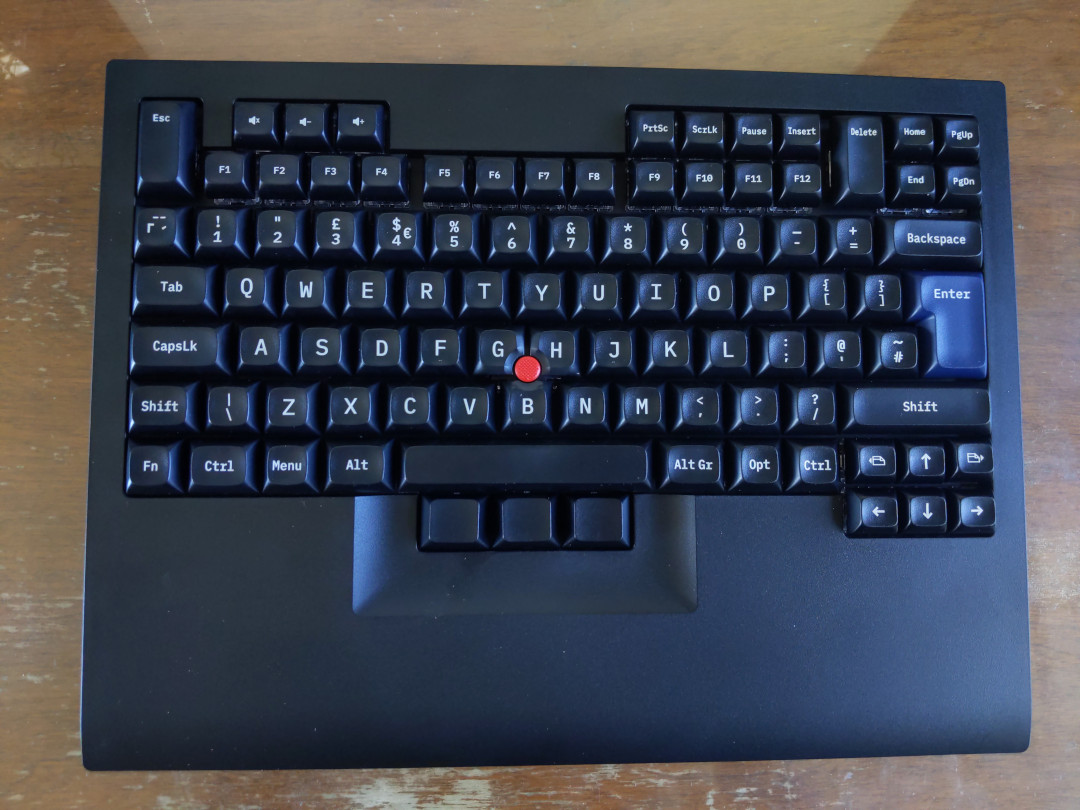
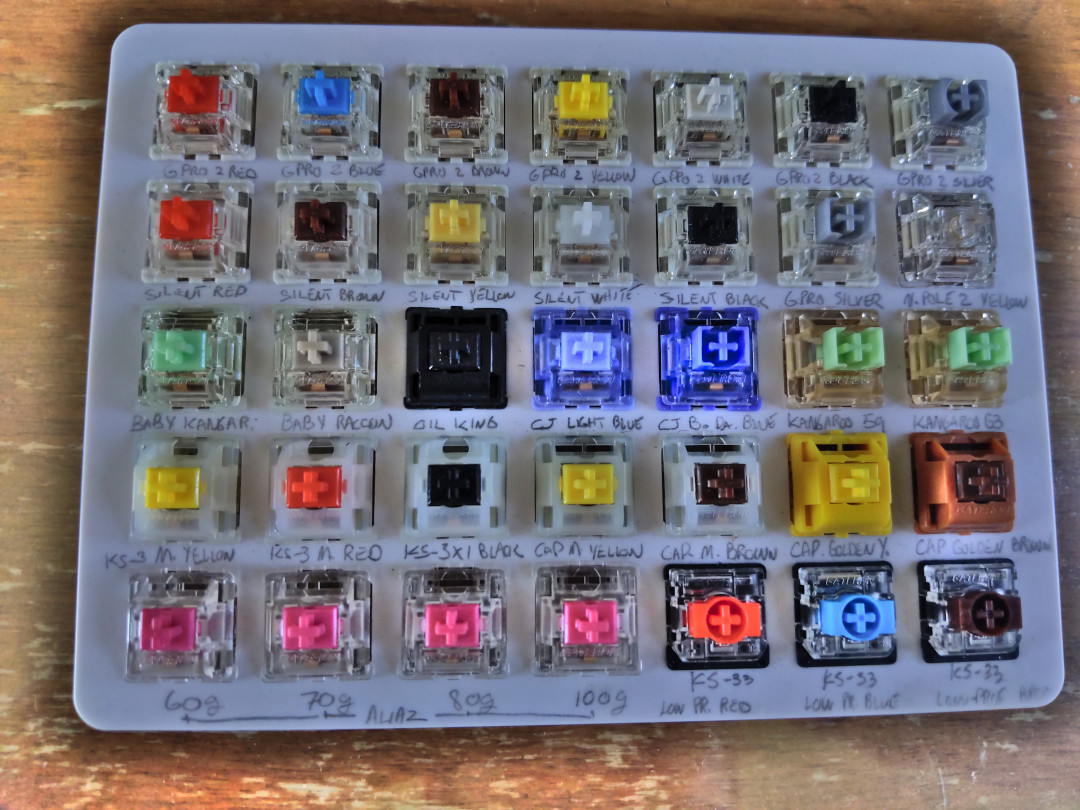
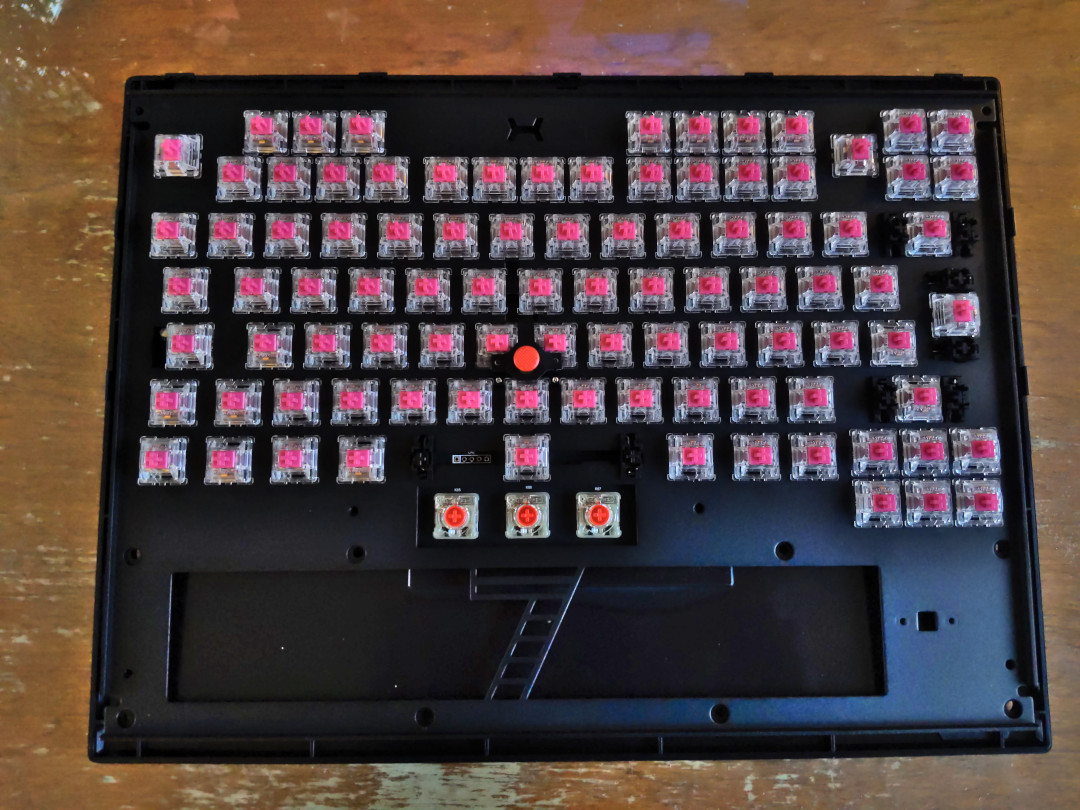
My old Thinkpad X220 has been slowly dying1 and as much as it makes me sad, it is also showing its age in terms of computational power. As such, I've pre-ordered a Framework 13 (the AMD version) and plan to retire my X220 when I get it. One thing I will miss from that laptop is the keyboard. At work, I dock it (on the amazing Thinkpad dock), which lets me use the keyboard while working on a larger monitor. I could probably replicate this setup with the Framework, but I'm not a fan of trackpads. So I built a keyboard. A nice one. One with a trackpoint. The bare board in its box If you follow Debian Planet, you may have seen the Tex Shinobi when Jonathan Dowland featured it on his blog back in January. It is a Tenkeyless board (saving me precious space at work) and is everything you would want from a old-school Thinkpad keyboard replacement. Since I had no previous experience with "Cherry MX"-style keyboard switches2, I decided to go full-bore and buy the "DIY" model that came unpopulated. A 35 switch tester board To know what model of switches I wanted, I bought a nice switch tester and played with it for a few days. After having thoroughly annoyed my SO (turns out 35 different switches on a little board is an incredible fidget toy), I decided to go with the Gateron Aliaz 70g. They are silent tactile switches, similar to the classic Cherry MX Browns, but with a much nicer sound profile and a much stronger actuation force (55g VS 70g). The end result is somewhat "stiff" keyboard that has a nice "THOCC", while still being relatively silent: perfect for a shared office. The keyboard with the switches, but no keycaps The only thing left to do on this keyboard is to replace the three soldered switches that came pre-installed for the mouse buttons. They are Cherry MX Red low-profile switches and are genuinely terrible3. I will be swapping them for Gateron KS-33 low-profile Blue switches when I get the ones I ordered online. My assembled Tex Shinobi Overall, I am very satisfied with this keyboard and I look forward using it daily when schools starts again in September.
  1. The power button sometimes does not work at all (for minutes?) and the laptop has been shutting down randomly (not a heat issue) more and more often...
  2. I am blessed with an IBM M keyboard at home and am in love with those clicky, very loud buckling springs.
  3. Not only are they linear switches (weird choice for mouse buttons), but they are very inconsistent. All three switches feel different and make different sounds.

18 June 2023

Louis-Philippe V ronneau: Solo V2: nice but flawed

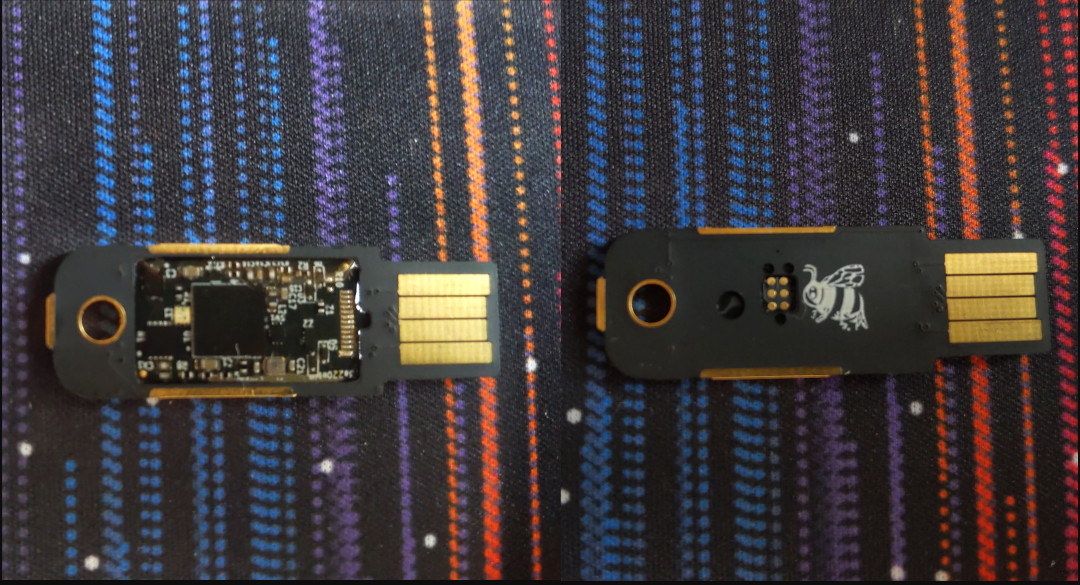
EDIT: One of my 2 keys has died. There are what seems like golden bubbles under the epoxy, over one of the chips and those were not there before. I've emailed SoloKeys and I'm waiting for a reply, but for now, I've stopped using the Solo V2 altogether :( I recently received the two Solo V2 hardware tokens I ordered as part of their crowdfunding campaign, back in March 2022. It did take them longer than advertised to ship me the tokens, but that's hardly unexpected from such small-scale, crowdfunded undertaking. I'm mostly happy about my purchase and I'm glad to get rid of the aging Tomu boards I was using as U2F tokens1. Still, beware: I am not sure it's a product I would recommend if what you want is simply something that works. If you do not care about open-source hardware, the Solo V2 is not for you. The Good A side-by-side view of the Solo V2's top and back sides I first want to mention I find the Solo V2 gorgeous. I really like the black and gold color scheme of the USB-A model (which is reversible!) and it seems like a well built and solid device. I'm not afraid to have it on my keyring and I fully expect it to last a long time. An animation of the build process, showing how the PCB is assembled and then slotted into the shell I'm also very impressed by the modular design: the PCB sits inside a shell, which decouples the logic from the USB interface and lets them manufacture a single board for both the USB-C and USB-A models. The clear epoxy layer on top of the PCB module also looks very nice in my opinion. A picture of the Solo V2 with its silicone case on my keyring, showing the 3 capacitive buttons I'm also very happy the Solo V2 has capacitive touch buttons instead of physical "clicky" buttons, as it means the device has no moving parts. The token has three buttons (the gold metal strips): one on each side of the device and a third one near the keyhole. As far as I've seen, the FIDO2 functions seem to work well via the USB interface and do not require any configuration on a Debian 12 machine. I've already migrated to the Solo V2 for web-based 2FA and I am in the process of migrating to an SSH ed25519-sk key. Here is a guide I recommend if you plan on setting those up with a Solo V2. The Bad and the Ugly Sadly, the Solo V2 is far from being a perfect project. First of all, since the crowdfunding campaign is still being fulfilled, it is not currently commercially available. Chances are you won't be able to buy one directly before at least Q4 2023. I've also hit what seems to be a pretty big firmware bug, or at least, one that affects my use case quite a bit. Invoking gpg crashes the Solo V2 completely if you also have scdaemon installed. Since scdaemon is necessary to use gpg with an OpenPGP smartcard, this means you cannot issue any gpg commands (like signing a git commit...) while the Solo V2 is plugged in. Any gpg commands that queries scdaemon, such as gpg --edit-card or gpg --sign foo.txt times out after about 20 seconds and leaves the token unresponsive to both touch and CLI commands. The way to "fix" this issue is to make sure scdaemon does not interact with the Solo V2 anymore, using the reader-port argument:
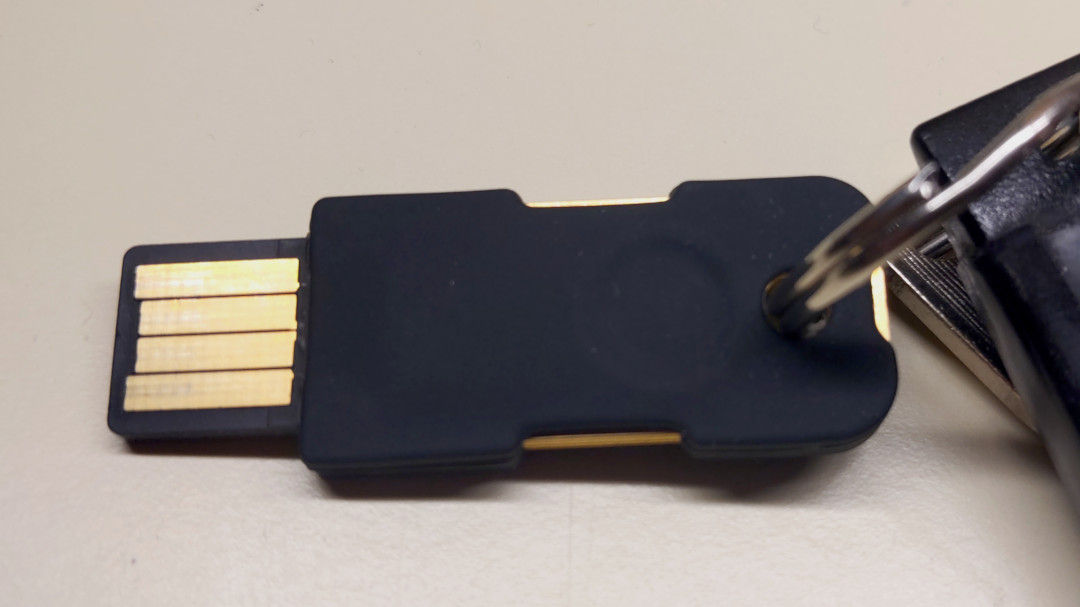
  1. Plug both your Solo V2 and your OpenPGP smartcard
  2. To get a list of the tokens scdaemon sees, run the following command: $ echo scd getinfo reader_list gpg-connect-agent --decode awk '/^D/ print $2 '
  3. Identify your OpenPGP smartcard. For example, my Nitrokey Start is listed as 20A0:4211:FSIJ-1.2.15-43211613:0
  4. Create a file in ~/.gnupg/scdaemon.conf with the following line reader-port $YOUR_TOKEN_ID. For example, in my case I have: reader-port 20A0:4211:FSIJ-1.2.15-43211613:0
  5. Reload scdaemon: $ gpgconf --reload scdaemon
Although this is clearly a firmware bug2, I do believe GnuPG is also partly to blame here. Let's just say I was not very surprised to have to battle scdaemon again, as I've had previous issues with it. Which leads me to my biggest gripe so far: it seems SoloKeys (the company) isn't really fixing firmware issues anymore and doesn't seems to care. The last firmware release is about a year old. Although people are experiencing serious bugs, there is no official way to report them, which leads to issues being seemingly ignored. For example, the NFC feature is apparently killing keys (!!!), but no one from the company seems to have acknowledged the issue. The same goes for my GnuPG bug, which was flagged in September 2022. For a project that mainly differentiates itself from its (superior) competition by being "Open", it's not a very good look... Although SoloKeys is still an unprofitable open source side business of its creators 3, this kind of attitude certainly doesn't help foster trust. Conclusion If you want to have a nice, durable FIDO2 token, I would suggest you get one of the many models Yubico offers. They are similarly priced, are readily commercially available, are part of a nice and maintained software ecosystem and have more features than the Solo V2 (OpenPGP support being the one I miss the most). Yubikeys are the practical option. What they are not is open-source hardware, whereas the Solo V2 is. As bunnie very well explained on his blog in 2019, it does not mean the later is inherently more trustable than the former, but it does make the Solo V2 the ideological option. Knowledge is power and it should be free. As such, tread carefully with SoloKeys, but don't dismiss them altogether: the Solo V2 is certainly functioning well enough for me.

  1. Although U2F is still part of the FIDO2 specification, the Tomus predate this standard and were thus not fully compliant with FIDO2. So long and thanks for all the fish little boards, you've served me well!
  2. It appears the Solo V2 shares its firmware with the Nitrokey 3, which had a similar issue a while back.
  3. This is a direct quote from one of the Solo V2 firmware maintainers.

6 June 2023

Russell Coker: Dell 32 4K Monitor and DisplayPort Switch

After determining that the Philips 43 monitor was too large for my taste as well as not having a clear enough display [1] I bought a Dell 32 4K monitor for $499 on the 1st of July 2022. That monitor has been working nicely for almost a year now, for DisplayPort it s operation is perfect and 32 seems like an ideal size for my use. There is one problem that both HDMI ports will sometimes turn off for about half a second, I ve tested on both ports and on multiple computers as well as a dock and it gives the same result so it s definitely the monitor. The problem for me is that the most casual inspection won t reveal the problem and the monitor is large and difficult to transport as I ve thrown out the box. If I had this sort of problem with a monitor at work I d add it to the list of things for Dell to fix next time they visit the office or use one of the many monitor boxes available to ship it back to them. But for home use it s more of a problem for me. The easiest solution is to avoid HDMI. A year ago I blogged about using DDC to switch monitor inputs [2], I had that running with a cheap USB switch since then to allow a workstation and a laptop to share the same monitor, keyboard, and mouse. Recently I got a USB-C dock that allows a USB-C laptop to talk to a display via DisplayPort as opposed to the HDMI connector that s built in. But my Dell monitor only has one DisplayPort input. So I have just bought a DisplayPort and USB KVM switch via eBay for $52, a reasonable price given that last year such things were well over $100. It has ports for 3 USB devices which is better than my previous setup of a USB switch with only a single port that I used with a 3 port hub for my keyboard and mouse. the DisplayPort switch is described as doing 4K at 60Hz, I don t know how it will perform with a 5K monitor, maybe it will work at 30Hz or 40Hz. But currently Dell 5K monitors are at $2,500 and 6K monitors are about $3,800 so I don t plan to get one of them any time soon.

29 May 2023

Louis-Philippe V ronneau: Python 3.11, pip and (breaking) system packages

As we get closer to Debian Bookworm's release, I thought I'd share one change in Python 3.11 that will surely affect many people. Python 3.11 implements the new PEP 668, Marking Python base environments as externally managed 1. If you use pip regularly on Debian, it's likely you'll eventually hit the externally-managed-environment error:
error: externally-managed-environment
  This environment is externally managed
 > To install Python packages system-wide, try apt install
    python3-xyz, where xyz is the package you are trying to
    install.
    If you wish to install a non-Debian-packaged Python package,
    create a virtual environment using python3 -m venv path/to/venv.
    Then use path/to/venv/bin/python and path/to/venv/bin/pip. Make
    sure you have python3-full installed.
    If you wish to install a non-Debian packaged Python application,
    it may be easiest to use pipx install xyz, which will manage a
    virtual environment for you. Make sure you have pipx installed.
    See /usr/share/doc/python3.11/README.venv for more information.
note: If you believe this is a mistake, please contact your Python installation or OS distribution provider. You can override this, at the risk of breaking your Python installation or OS, by passing --break-system-packages.
hint: See PEP 668 for the detailed specification.
With this PEP, Python tools can now distinguish between packages that have been installed by the user with a tool like pip and ones installed using a distribution's package manager, like apt. This is generally great news: it was previously too easy to break a system by mixing the two types of packages. This PEP will simplify our role as a distribution, as well as improve the overall Python user experience in Debian. Sadly, it's also likely this change will break some of your scripts, especially CI that (legitimately) install packages via pip alongside system packages. For example, I use the following gitlab-ci snippet to make sure my PRs don't break my build process2:
build:flit:
  stage: build
  script:
  - apt-get update && apt-get install -y flit python3-pip
  - FLIT_ROOT_INSTALL=1 flit install
  - metalfinder --help
With Python 3.11, this snippet will error out, as pip will refuse to install packages alongside the system's. The fix is to tell pip it's OK to "break" your system packages, either using the --break-system-packages parameter, or the PIP_BREAK_SYSTEM_PACKAGES=1 environment variable3. This, of course, is not something you should be using in production to restore the old behavior! The "proper" way to fix this issue, as the externally-managed-environment error message aptly (har har) informs you, is to use virtual environments. Happy hacking!

  1. Kudos to our own Matthias Klose, Stefano Rivera and Elana Hashman, who worked on designing and implementing this PEP!
  2. Which is something that bit me before... You push some changes to your git repository, everything seems fine and all the tests pass, so you merge it and make a new git tag. When the time comes to build and upload this tag to PyPi, you find out some minor thing broke your build system (which you weren't testing) and you have to scramble to make a point-release to fix the issue. Sad!
  3. Don't go searching for this environment variable in pip's code though, as you won't find it! All of pip's command line options can be passed as env vars using the PIP_<UPPER_LONG_NAME> format. Useful for tools that use pip indirectly, like flit.

21 May 2023

Russ Allbery: Review: The Stone Canal

Review: The Stone Canal, by Ken MacLeod
Series: Fall Revolution #2
Publisher: Tor
Copyright: 1996
Printing: January 2001
ISBN: 0-8125-6864-8
Format: Mass market
Pages: 339
The Stone Canal is a sort of halfway sequel to The Star Fraction. They both take place in the same universe, but the characters are almost entirely disjoint. Half of The Stone Canal happens (mostly) well before the previous book and the other half happens well after it. This book does contain spoilers for the ending of The Star Fraction if one connects the events of the two books correctly (which was a bit harder than I thought it should be), so I would not read them out of order. At the start of The Stone Canal, Jon Wilde wakes up on New Mars beside the titular canal, in the middle of nowhere, accompanied only by a robot that says it made him. Wilde remembers dying on Earth; this new life is apparently some type of resurrection. It's a long walk to Ship City, the center of civilization of a place the robot tells him is New Mars. In Ship City, an android named Dee Model has escaped from her owner and is hiding in a bar. There, she meets an AI abolitionist named Tamara, who helps her flee out the back and down the canal on a boat when Wilde walks into the bar and immediately recognizes her. The abolitionists provide her protection and legal assistance to argue her case for freedom from her owner, a man named Reid. The third thread of the story, and about half the book, is Jon Wilde's life on Earth, starting in 1975 and leading up to the chaotic wars, political fracturing, and revolutions that formed the background and plot of The Star Fraction. Eventually that story turns into a full-fledged science fiction setting, but not until the last 60 pages of the book. I successfully read two books in a Ken MacLeod series! Sadly, I'm not sure I enjoyed the experience. I commented in my review of The Star Fraction that the appeal for me in MacLeod's writing was his reputation as a writer of political science fiction. Unfortunately that's been a bust. The characters are certainly political, in the sense that they profess to have strong political viewpoints and are usually members of some radical (often Trotskyite) organization. There are libertarian anarchist societies and lots of political conflict. But there is almost no meaningful political discussion in any of these books so far. The politics are all tactical or background, and often seem to be created by authorial fiat. For example, New Mars is a sort of libertarian anarchy that somehow doesn't have corporations or a strongman ruler, even though the history (when we finally learn it) would have naturally given rise to one or the other (and has, in numerous other SF novels with similar plots). There's a half-assed explanation for this towards the end of the book that I didn't find remotely believable. Another part of the book describes the formation of the libertarian microstate in The Star Fraction, but never answers a "why" or "how" question I had in the previous book in a satisfying way. Somehow people stop caring about control or predictability or stability or traditional hierarchy without any significant difficulties except external threats, in situations of chaos and disorder where historically humans turn to anyone promising firm structure. It's common to joke about MacLeod winning multiple libertarian Prometheus Awards for his fiction despite being a Scottish communist. I'm finding that much less surprising now that I've read more of his books. Whether or not he believes in it himself, he's got the cynical libertarian smugness and hand-waving down pat. What his characters do care deeply about is smoking, drinking, and having casual sex. (There's more political fire here around opposition to anti-smoking laws than there is about any of the society-changing political structures that somehow fall into place.) I have no objections to any of those activities from a moral standpoint, but reading about other people doing them is a snoozefest. The flashback scenes sketch out enough imagined history to satisfy some curiosity from the previous book, but they're mostly about the world's least interesting love triangle, involving two completely unlikable men and lots of tedious jealousy and posturing. The characters in The Stone Canal are, in general, a problem. One of those unlikable men is Wilde, the protagonist for most of the book. Not only did I never warm to him, I never figured out what motivates him or what he cares about. He's a supposedly highly political person who seems to engage in politics with all the enthusiasm of someone filling out tax forms, and is entirely uninterested in explaining to the reader any sort of coherent philosophical approach. The most interesting characters in this book are the women (Annette, Dee Model, Tamara, and, very late in the book, Meg), but other than Dee Model they rarely get much focus from the story. By far the best part of this book is the last 60 pages, where MacLeod finally explains the critical bridge events between Wilde's political history on earth and the New Mars society. I thought this was engrossing, fast-moving, and full of interesting ideas (at least for a 1990s book; many of them feel a bit stale now, 25 years later). It was also frustrating, because this was the book I wanted to have been reading for the previous 270 pages, instead of MacLeod playing coy with his invented history or showing us interminable scenes about Wilde's insecure jealousy over his wife. It's also the sort of book where at one point characters (apparently uniformly male as far as one could tell from the text of the book) get assigned sex slaves, and while MacLeod clearly doesn't approve of this, the plot is reminiscent of a Heinlein novel: the protagonist's sex slave becomes a very loyal permanent female companion who seems to have the same upside for the male character in question. This was unfortunately not the book I was hoping for. I did enjoy the last hundred pages, and it's somewhat satisfying to have the history come together after puzzling over what happened for 200 pages. But I found the characters tedious and annoying and the politics weirdly devoid of anything like sociology, philosophy, or political science. There is the core of a decent 1990s AI and singularity novel here, but the technology is now rather dated and a lot of other people have tackled the same idea with fewer irritating ticks. Not recommended, although I'll probably continue to The Cassini Division because the ending was a pretty great hook for another book. Followed by The Cassini Division. Rating: 5 out of 10

1 May 2023

Russ Allbery: Review: The Amazing Maurice and His Educated Rodents

Review: The Amazing Maurice and His Educated Rodents, by Terry Pratchett
Series: Discworld #28
Publisher: HarperCollins
Copyright: 2001
Printing: 2008
ISBN: 0-06-001235-8
Format: Mass market
Pages: 351
The Amazing Maurice and His Educated Rodents is the 28th Discworld novel and the first marketed for younger readers. Although it has enough references to establish it as taking place on Discworld, it has no obvious connections with the other books and doesn't rely on any knowledge of the series so far. This would not be a bad place to start with Terry Pratchett and see if his writing style and sense of humor is for you. Despite being marketed as young adult, and despite Pratchett's comments in an afterward in the edition I own that writing YA novels is much harder, I didn't think this was that different than a typical Discworld novel. The two main human characters read as about twelve and there were some minor changes in tone, but I'm not sure I would have immediately labeled it as YA if I hadn't already known it was supposed to be. There are considerably fewer obvious pop culture references than average, though; if that's related, I think I'll prefer Pratchett's YA novels, since I think his writing is stronger when he's not playing reference bingo. Maurice (note to US readers: Maurice is pronounced "Morris" in the UK) is a talking cat and the mastermind of a wandering con job. He, a stupid-looking kid with a flute (Maurice's description), and a tribe of talking rats travel the small towns of Discworld. The rats go in first, making a show of breaking into the food, swimming in the cream, and widdling on things that humans don't want widdled on. Once the townspeople are convinced they have a plague of rats, the kid with the flute enters the town and offers to pipe the rats away for a very reasonable fee. He plays his flute, the rats swarm out of town, and they take their money and move on to the next town. It's a successful life that suits Maurice and his growing hoard of gold very well. If only the rats would stop asking pointed questions about the ethics of this scheme. The town of Bad Blintz is the next on their itinerary, and if the rats have their way, will be the last. Their hope is they've gathered enough money by now to find an island, away from humans, where they can live their own lives. But, as is always the case for one last job in fiction, there's something uncannily wrong about Bad Blintz. There are traps everywhere, more brutal and dangerous ones than they've found in any other town, and yet there is no sign of native, unintelligent rats. Meanwhile, Maurice and the boy find a town that looks wealthy but has food shortages, a bounty on rats that is absurdly high, and a pair of sinister-looking rat-catchers who are bringing in collections of rat tails that look suspiciously like bootlaces. The mayor's daughter discovers Maurice can talk and immediately decides she has to take them in hand. Malicia is very certain of her own opinions, not accustomed to taking no for an answer, and is certain that the world follows the logic of stories, even if she has to help it along. This is truly great stuff. I think this might be my favorite Discworld novel to date, although I do have some criticisms that I'll get to in a moment. The best part are the rats, and particularly the blind philosopher rat Dangerous Beans and his assistant Peaches. In the middle of daring infiltration of the trapped sewers in scenes reminiscent of Mission: Impossible, the rats are also having philosophical arguments. They've become something different than the unaltered rats that they call the keekees, but what those differences mean is harder to understand. The older rats are not happy about too many changes and think the rats should keep acting like rats. The younger ones are discovering that they're afraid of shadows because now they understand what the shadows hint at. Dangerous Beans is trying to work out a writing system so that they can keep important thoughts. One of their few guides is a children's book of talking animals, although they quickly discover that the portrayed clothing is annoyingly impractical. But as good as the rats are, Maurice is nearly as much fun in an entirely different way. He is unapologetically out for himself, streetwise and canny in a way that feels apt for a cat, gets bored and mentally wanders off in the middle of conversations, and pretends to agree with people when that's how he can get what he wants. But he also has a weird sense of loyalty and ethics that only shows up when something is truly important. It's a variation on the con man with a heart of gold, but it's a very well-done variation that weaves in a cat's impatience with and inattention to anything that doesn't directly concern them. I was laughing throughout the book. Malicia is an absolute delight, the sort of character who takes over scenes through sheer force of will, and the dumb-looking kid (whose name turns out to be Keith) is a perfect counterbalance: a laid-back, quiet boy who just wants to play his music and is almost entirely unflappable. It's such a great cast. The best part of the plot is the end. I won't spoil it, so I'll only say that Pratchett has the characters do the work on the aftermath that a lot of books skip over. He doesn't have any magical solutions for the world's problems, but he's so very good at restoring one's faith that maybe sometimes those solutions can be constructed. My one complaint with this book is that Pratchett introduces a second villain, and while there are good in-story justifications for it and it's entangled with the primary plot, he added elements of (mild) supernatural horror and evil that I thought were extraneous and unnecessary. He already had enough of a conflict set up without adding that additional element, and I think it undermined the moral complexity of the story. I would have much rather he kept the social dynamics of the town at the core of the story and used that to trigger the moments of sacrifice and philosophy that made the climax work. The Discworld books by this point have gotten very good, but each book seems to have one element like that where it felt like Pratchett took the easy way out of a plot corner or added some story element that didn't really work. I feel like the series is on the verge of having a truly great book that rises above the entire series to date, but never quite gets there. That caveat aside, I thoroughly enjoyed this and had trouble putting it down. Mrs. Frisby and the Rats of Nimh was one of my favorite books as a kid, and this reminded me of it in some good ways (enough so that I think some of the references were intentional). Great stuff. If you were to read only one Discworld book and didn't want to be confused by all the entangled plot threads and established characters, I would seriously consider making it this one. Recommended. Followed by Night Watch in publication order. There doesn't appear to be a direct plot sequel, more's the pity. Rating: 8 out of 10

29 April 2023

Simon Josefsson: How To Trust A Machine

Let s reflect on some of my recent work that started with understanding Trisquel GNU/Linux, improving transparency into apt-archives, working on reproducible builds of Trisquel, strengthening verification of apt-archives with Sigstore, and finally thinking about security device threat models. A theme in all this is improving methods to have trust in machines, or generally any external entity. While I believe that everything starts by trusting something, usually something familiar and well-known, we need to deal with misuse of that trust that leads to failure to deliver what is desired and expected from the trusted entity. How can an entity behave to invite trust? Let s argue for some properties that can be quantitatively measured, with a focus on computer software and hardware: Essentially, this boils down to: Trust, Verify and Hold Accountable. To put this dogma in perspective, it helps to understand that this approach may be harmful to human relationships (which could explain the social awkwardness of hackers), but it remains useful as a method to improve the design of computer systems, and a useful method to evaluate safety of computer systems. When a system fails some of the criteria above, we know we have more work to do to improve it. How far have we come on this journey? Through earlier efforts, we are in a fairly good situation. Richard Stallman through GNU/FSF made us aware of the importance of free software, the Reproducible/Bootstrappable build projects made us aware of the importance of verifiability, and Certificate Transparency highlighted the need for accountable signature logs leading to efforts like Sigstore for software. None of these efforts would have seen the light of day unless people wrote free software and packaged them into distributions that we can use, and built hardware that we can run it on. While there certainly exists more work to be done on the software side, with the recent amazing full-source build of Guix based on a 357-byte hand-written seed, I believe that we are closing that loop on the software engineering side. So what remains? Some inspiration for further work: Onwards and upwards, happy hacking! Update 2023-05-03: Added the Liberating property regarding free software, instead of having it be part of the Verifiability and Transparency .

27 April 2023

Simon Josefsson: A Security Device Threat Model: The Substitution Attack

I d like to describe and discuss a threat model for computational devices. This is generic but we will narrow it down to security-related devices. For example, portable hardware dongles used for OpenPGP/OpenSSH keys, FIDO/U2F, OATH HOTP/TOTP, PIV, payment cards, wallets etc and more permanently attached devices like a Hardware Security Module (HSM), a TPM-chip, or the hybrid variant of a mostly permanently-inserted but removable hardware security dongles. Our context is cryptographic hardware engineering, and the purpose of the threat model is to serve as as a thought experiment for how to build and design security devices that offer better protection. The threat model is related to the Evil maid attack. Our focus is to improve security for the end-user rather than the traditional focus to improve security for the organization that provides the token to the end-user, or to improve security for the site that the end-user is authenticating to. This is a critical but often under-appreciated distinction, and leads to surprising recommendations related to onboard key generation, randomness etc below.

The Substitution Attack
An attacker is able to substitute any component of the device (hardware or software) at any time for any period of time.
Your takeaway should be that devices should be designed to mitigate harmful consequences if any component of the device (hardware or software) is substituted for a malicious component for some period of time, at any time, during the lifespan of that component. Some designs protect better against this attack than other designs, and the threat model can be used to understand which designs are really bad, and which are less so.

Terminology The threat model involves at least one device that is well-behaving and one that is not, and we call these Good Device and Bad Device respectively. The bad device may be the same physical device as the good key, but with some minor software modification or a minor component replaced, but could also be a completely separate physical device. We don t care about that distinction, we just care if a particular device has a malicious component in it or not. I ll use terms like security device , device , hardware key , security co-processor etc interchangeably. From an engineering point of view, malicious here includes unintentional behavior such as software or hardware bugs. It is not possible to differentiate an intentionally malicious device from a well-designed device with a critical bug. Don t attribute to malice what can be adequately explained by stupidity, but don t na vely attribute to stupidity what may be deniable malicious.

What is some period of time ? Some period of time can be any length of time: seconds, minutes, days, weeks, etc. It may also occur at any time: During manufacturing, during transportation to the user, after first usage by the user, or after a couple of months usage by the user. Note that we intentionally consider time-of-manufacturing as a vulnerable phase. Even further, the substitution may occur multiple times. So the Good Key may be replaced with a Bad Key by the attacker for one day, then returned, and later this repeats a month later.

What is harmful consequences ? Since a security key has a fairly well-confined scope and purpose, we can get a fairly good exhaustive list of things that could go wrong. Harmful consequences include:
  • Attacker learns any secret keys stored on a Good Key.
  • Attacker causes user to trust a public generated by a Bad Key.
  • Attacker is able to sign something using a Good Key.
  • Attacker learns the PIN code used to unlock a Good Key.
  • Attacker learns data that is decrypted by a Good Key.

Thin vs Deep solutions One approach to mitigate many issues arising from device substitution is to have the host (or remote site) require that the device prove that it is the intended unique device before it continues to talk to it. This require an authentication/authorization protocol, which usually involves unique device identity and out-of-band trust anchors. Such trust anchors is often problematic, since a common use-case for security device is to connect it to a host that has never seen the device before. A weaker approach is to have the device prove that it merely belongs to a class of genuine devices from a trusted manufacturer, usually by providing a signature generated by a device-specific private key signed by the device manufacturer. This is weaker since then the user cannot differentiate two different good devices. In both cases, the host (or remote site) would stop talking to the device if it cannot prove that it is the intended key, or at least belongs to a class of known trusted genuine devices. Upon scrutiny, this solution is still vulnerable to a substitution attack, just earlier in the manufacturing chain: how can the process that injects the per-device or per-class identities/secrets know that it is putting them into a good key rather than a malicious device? Consider also the consequences if the cryptographic keys that guarantee that a device is genuine leaks. The model of the thin solution is similar to the old approach to network firewalls: have a filtering firewall that only lets through intended traffic, and then run completely insecure protocols internally such as telnet. The networking world has evolved, and now we have defense in depth: even within strongly firewall ed networks, it is prudent to run for example SSH with publickey-based user authentication even on locally physical trusted networks. This approach requires more thought and adds complexity, since each level has to provide some security checking. I m arguing we need similar defense-in-depth for security devices. Security key designs cannot simply dodge this problem by assuming it is working in a friendly environment where component substitution never occur.

Example: Device authentication using PIN codes To see how this threat model can be applied to reason about security key designs, let s consider a common design. Many security keys uses PIN codes to unlock private key operations, for example on OpenPGP cards that lacks built-in PIN-entry functionality. The software on the computer just sends a PIN code to the device, and the device allows private-key operations if the PIN code was correct. Let s apply the substitution threat model to this design: the attacker replaces the intended good key with a malicious device that saves a copy of the PIN code presented to it, and then gives out error messages. Once the user has entered the PIN code and gotten an error message, presumably temporarily giving up and doing other things, the attacker replaces the device back again. The attacker has learnt the PIN code, and can later use this to perform private-key operations on the good device. This means a good design involves not sending PIN codes in clear, but use a stronger authentication protocol that allows the card to know that the PIN was correct without learning the PIN. This is implemented optionally for many OpenPGP cards today as the key-derivation-function extension. That should be mandatory, and users should not use setups that sends device authentication in the clear, and ultimately security devices should not even include support for that. Compare how I build Gnuk on my PGP card with the kdf_do=required option.

Example: Onboard non-predictable key-generation Many devices offer both onboard key-generation, for example OpenPGP cards that generate a Ed25519 key internally on the devices, or externally where the device imports an externally generated cryptographic key. Let s apply the subsitution threat model to this design: the user wishes to generate a key and trust the public key that came out of that process. The attacker substitutes the device for a malicious device during key-generation, imports the private key into a good device and gives that back to the user. Most of the time except during key generation the user uses a good device but still the attacker succeeded in having the user trust a public key which the attacker knows the private key for. The substitution may be a software modification, and the method to leak the private key to the attacker may be out-of-band signalling. This means a good design never generates key on-board, but imports them from a user-controllable environment. That approach should be mandatory, and users should not use setups that generates private keys on-board, and ultimately security devices should not even include support for that.

Example: Non-predictable randomness-generation Many devices claims to generate random data, often with elaborate design documents explaining how good the randomness is. Let s apply the substitution threat model to this design: the attacker replaces the intended good key with a malicious design that generates (for the attacker) predictable randomness. The user will never be able to detect the difference since the random output is, well, random, and typically not distinguishable from weak randomness. The user cannot know if any cryptographic keys generated by a generator was faulty or not. This means a good design never generates non-predictable randomness on the device. That approach should be mandatory, and users should not use setups that generates non-predictable randomness on the device, and ideally devices should not have this functionality.

Case-Study: Tillitis I have warmed up a bit for this. Tillitis is a new security device with interesting properties, and core to its operation is the Compound Device Identifier (CDI), essentially your Ed25519 private key (used for SSH etc) is derived from the CDI that is computed like this:
cdi = blake2s(UDS, blake2s(device_app), USS)
Let s apply the substitution threat model to this design: Consider someone replacing the Tillitis key with a malicious key during postal delivery of the key to the user, and the replacement device is identical with the real Tillitis key but implements the following key derivation function:
cdi = weakprng(UDS , weakprng(device_app), USS)
Where weakprng is a compromised algorithm that is predictable for the attacker, but still appears random. Everything will work correctly, but the attacker will be able to learn the secrets used by the user, and the user will typically not be able to tell the difference since the CDI is secret and the Ed25519 public key is not self-verifiable.

Conclusion Remember that it is impossible to fully protect against this attack, that s why it is merely a thought experiment, intended to be used during design of these devices. Consider an attacker that never gives you access to a good key and as a user you only ever use a malicious device. There is no way to have good security in this situation. This is not hypothetical, many well-funded organizations do what they can to derive people from having access to trustworthy security devices. Philosophically it does not seem possible to tell if these organizations have succeeded 100% already and there are only bad security devices around where further resistance is futile, but to end on an optimistic note let s assume that there is a non-negligible chance that they haven t succeeded. In these situations, this threat model becomes useful to improve the situation by identifying less good designs, and that s why the design mantra of mitigate harmful consequences is crucial as a takeaway from this. Let s improve the design of security devices that further the security of its users!

18 April 2023

Shirish Agarwal: Philips LCD Monitor 22 , 1984, Reaper Man, The Firm.

PHILIPS PHL 221S8L Those who have been reading this blog for a long time would perhaps know that I had bought a Viewsonic 19 almost 12 years ago. The Monitor was functioning well till last week. I had thought to change it to a 24 monitor almost 3-4 years ago when 24 LCD Monitors were going for around 4k/- or thereabouts. But the monitor kept on functioning and I didn t have space (nor do) to have a dual-monitor setup. It just didn t make sense. Apart from higher electricity charges it would have also have made more demands on my old system which somehow is still functioning even after all those years. Then last week, it started to dim and after couple of days completely conked out. I had wanted to buy a new monitor in front of mum so she could watch movies or whatever but this was not to be. Sp I had to buy an LCD Monitor as Government raised taxes enormously after pandemic. Same/similar monitor that used to cost INR 4k/- today costed me almost INR 7k/- almost double the price. Hooking it to Debian I got the following

$ sudo hwinfo --monitor grep Model Model: "PHILIPS PHL 221S8L" FWIW hwinfo is the latest version

~$ sudo hwinfo --version21.82
I did see couple of movies before starting to write this blog post. Not an exceptional monitor but better than before. I had option from three brands, Dell (most expensive), Philips (middle) and & LG (lowest in prices). Interestingly, Viewsonic disappeared from the market about 5 years back and made a comeback just couple of years ago. Even Philips which had exited the PC Monitor almost a decade back re-entered the market. Apart from the branding, it doesn t make much of a difference as almost all the products including the above monitors are produced in China. I did remember her a lot while buying the monitor as I m sure she would have enjoyed it far more than me but that was not to be

1984 During last week when I didn t have the monitor I re-read 1984. To be completely honest, I had read the above book when I was in the 20 s and I had no context. The protagonist seemed like a whiner and for the life of me I couldn t understand why he didn t try to escape. Re-reading after almost 2 decades and a bit more I shat a number of times because now the context is pretty near and pretty real. I can see why the Republicans in the U.S. banned it. I also realized why the protagnist didn t attempt to run away because wherever he would run away it would be the same thing. It probably is one of the most depressing books I have ever read. To willfully accept what is false after all that torture. What was also interesting to me is to find that George Orwell was also a soldier just like Tolkien was. Both took part and wrote such different stories. While Mr. Tolkien writes and shares the pendulum between hope and despair, Mr. Orwell is decidedly dark. Not grey but dark. I am not sure if I would like to read Animal Farm anytime soon.

The Reaper Man Terry Pratchett It is by sheer coincidence or perhaps I needed something to fill me up when I got The Reaper Man from Terry Pratchett. It was practically like a breath of fresh air. And I love Mr. Pratchett for the inclusivity he brings in. We think about skin color, and what not and here Mr. Pratchett writes about an undead gentleman who s extremely polite as he was a wizard. I won t talk more as I don t really want to spoil the surprise but rest assured everybody is gonna love it. I also read Long Utopia but this is for those who believe and think of multiverses long before it became a buzzword that it is today.

The Firm John Grisham Now I don t know what I should write about this book as there aren t many John Grisham books where a rookie wins against more than one party opposite him. I wouldn t go much into depth but simply say it was worth a read. I am currently reading Gray Mountain. It very much shows how the coal Industry is corrupt and what all it does. It also brings to mind the amount of mining that is done in which Iron is the mostly sought after and done. Now if we are mining 94% Iron then wouldn t it make sense to ask to have a circular economy around Iron but we don t even hear a word about it. Even with all the imagined projections of lithium mining, it would hardly be 10% . I could go on but will finish for now, till later.

Next.

Previous.