I m finishing typing up this blog entry hours before my last 13 hour leg back home, after I spent 2 weeks in Busan, South Korea for DebCamp24 and DebCamp24. I had a rough year and decided to take it easy this DebConf. So this is the first DebConf in a long time where I didn t give any talks. I mostly caught up on a bit of packaging, worked on DebConf video stuff, attended a few BoFs and talked to people. Overall it was a very good DebConf, which also turned out to be more productive than I expeced it would.
In the welcome session on the first day of DebConf, Nicolas Dandrimont mentioned that a benefit of DebConf is that it provides a sort of caffeine for your Debian motivation. I could certainly feel that affect swell as the days went past, and it s nice to be excited about some ideas again that would otherwise be fading.
Recovering DPL
It s a bit of a gear shift being DPL for 4 years, and DebConf Committee for nearly 5 years before that, and then being at DebConf while some issue arise (as it always does during a conference). At first I jump into high alert mode, but then I have to remind myself it s not your problem anymore and let others deal with it.
It was nice spending a little in-person time with Andreas Tille, our new DPL, we did some more handover and discussed some current issues. I still have a few dozen emails in my DPL inbox that I need to collate and forward to Andreas, I hope to finish all that up by the end of August.
During the Bits from the DPL talk, the usual question came up whether Andreas will consider running for DPL again, to which he just responded in a slide Maybe . I think it s a good idea for a DPL to do at least two terms if it all works out for everyone, since it takes a while to get up to speed on everything.
Also, having been DPL for four years, I have a lot to say about it, and I think there s a lot we can fix in the role, or at least discuss it. If I had the bandwidth for it I would have scheduled a BoF for it, but I ll very likely do that for the next DebConf instead!
Video team
I set up the standby loop for the video streaming setup. We call it loopy, it s a bunch of OBS scenes that provide announcements, shows sponsors, the schedule and some social content. I wrote about it back in 2020, but it s evolved quite a bit since then, so I m probably due to write another blog post with a bunch of updates on it. I hope to organise a video team sprint in Cape Town in the first half of next year, so I ll summarize everything before then.
It would ve been great if we could have some displays in social areas that could show talks, the loop and other content, but we were just too pressed for time for that. This year s DebConf had a very compressed timeline, and there was just too much that had to be done and that had to be figured out on the last minute. This put quite a lot of strain on the organisers, but I was glad to see how, for the most part, most attendees were very sympathetic to some rough edges (but I digress ).
I added more of the OBS machine setup to the videoteam s ansible repository, so as of now it just needs an ansible setup and the OBS data and it s good to go. The loopy data is already in the videoteam git repository, so I could probably just add a git pull and create some symlinks in ansible and then that machine can be installed from 0% to 100% by just installing via debian-installer with our ansible hooks.
This DebConf I volunteered quite a bit for actual video roles during the conference, something I didn t have much time for in recent DebConfs, and it s been fun, especially in a session or two where nearly none of the other volunteers showed up. Sometimes chaos is just fun :-)
Baekyongee is the university mascot, who s visible throughout the university. So of course we included this four legged whale creature on the loop too!
Packaging
I was hoping to do more packaging during DebCamp, but at least it was a non-zero amount:
Uploaded gdisk 1.0.10-2 to unstable (previously tested effects of adding dh-sequence-movetousr) (Closes: #1073679).
Worked a bit on bcachefs-tools (updating git to 1.9.4), but has a build failure that I need to look into (we might need a newer bindgen) update: I m probably going to ROM this package soon, it doesn t seem suitable for packaging in Debian.
Calamares: Tested a fix for encrypted installs, and uploaded it.
Calamares: Uploaded (3.3.8-1) to backports (at the time of writing it s still in backports-NEW).
Pixelorama 1.0 I did some initial packaging for Pixelorama back when we did the MiniDebConf Gaming Edition, but it had a few stoppers back then. Version 1.0 seems to fix all of that, but it depends on Godot 4.2 and we re still on the 3 series in Debian, so I ll upload this once Godot 4.2 hits at least experimental. Godot software/games is otherwise quite easy to run, it s basically just source code / data that is installed and then run via godot-runner (godot3-runner package in Debian).
BoFs
Python Team BoF
Link to the etherpad / pad archive link and video can be found on the talk page: https://debconf24.debconf.org/talks/31-python-bof/
The session ended up being extended to a second part, since all the issues didn t fit into the first session.
I was distracted by too many thing during the Python 3.12 transition (to the point where I thought that 3.11 was still new in Debian), so it was very useful listening to the retrospective of that transition.
There was a discussion whether Python 3.13 could still make it to testing in time for freeze, and it seems that there is consensus that it can, although, likely with new experimental features like disabling the global interpreter lock and the just in time compiler disabled.
I learned for the first time about the dead batteries project, PEP-0594, which removes ancient modules that have mostly been superseded, from the Python standard library.
There was some talk about the process for changing team policy, and a policy discussion on whether we should require autopkgtests as a SHOULD or a MUST for migration to testing. As with many things, the devil is in the details and in my opinion you could go either way and achieve a similar result (the original MUST proposal allowed exceptions which imho made it the same as the SHOULD proposal).
There s an idea to do some ongoing remote sprints, like having co-ordinated days for bug squashing / working on stuff together. This is a nice idea and probably a good way to energise the team and also to gain some interest from potential newcomers.
Louis-Philipe V ronneau was added as a new team admin and there was some discussion on various Sphinx issues and which Lintian tags might be needed for Python 3.13. If you want to know more, you probably have to watch the videos / read the notes :)
Debian.net BoF
Link to the etherpad / pad archive link can be found on the talk page: https://debconf24.debconf.org/talks/37-debiannet-team-bof
Debian Developers can set up services on subdomains on debian.net, but a big problem we ve had before was that developers were on their own for hosting those services. This meant that they either hosted it on their DSL/fiber connection at home, paid for the hosting themselves, or hosted it at different services which became an accounting nightmare to claim back the used funds. So, a few of us started the debian.net hosting project (sometimes we just call it debian.net, this is probably a bit of a bug) so that Debian has accounts with cloud providers, and as admins we can create instances there that gets billed directly to Debian.
We had an initial rush of services, but requests have slowed down since (not really a bad thing, we don t want lots of spurious requests). Last year we did a census, to check which of the instances were still used, whether they received system updates and to ask whether they are performing backups. It went well and some issues were found along the way, so we ll be doing that again.
We also gained two potential volunteers to help run things, which is great.
Debian Social BoF
Link to the etherpad / pad archive link can be found on the talk page: https://debconf24.debconf.org/talks/34-debiansocial-bof
We discussed the services we run, you can view the current state of things at: https://wiki.debian.org/Teams/DebianSocial
Pleroma has shown some cracks over the last year or so, and there are some forks that seem promising. At the same time, it might be worth while considering Mastodon too. So we ll do some comparison of features and maintenance and find a way forward. At the time when Pleroma was installed, it was way ahead in terms of moderation features.
Pixelfed is doing well and chugging along nicely, we should probably promote it more.
Peertube is working well, although we learned that we still don t have all the recent DebConf videos on there. A bunch of other issues should be fixed once we move it to a new machine that we plan to set up.
We re removing writefreely and plume. Nice concepts, but it didn t get much traction yet, and no one who signed up for these actually used it, which is fine, some experimentation with services is good and sometimes they prove to be very popular and other times not.
The WordPress multisite instance has some mild use, otherwise haven t had any issues.
Matrix ended up to be much, much bigger than we thought, both in usage and in its requirements. It s very stateful and remembers discussions for as long as you let it, so it s Postgres database is continuously expanding, this will also be a lot easier to manage once we have this on the new host.
Jitsi is also quite popular, but it could probably be on jitsi.debian.net instead (we created this on debian.social during the initial height of COVID-19 where we didn t have the debian.net hosting yet), although in practice it doesn t really matter where it lives.
Most of our current challenges will be solved by moving everything to a new big machine that has a few public IPs available for some VMs, so we ll be doing that shortly.
Debian Foundation Discussion BoF
This was some brainstorming about the future structure of Debian, and what steps might be needed to get there. It s way too big a problem to take on in a BoF, but we made some progress in figuring out some smaller pieces of the larger puzzle. The DPL is going to get in touch with some legal advisors and our trusted organisations so that we can aim to formalise our relationships a bit more by the time it s DebConf again.
I also introduced my intention to join the Debian Partners delegation. When I was DPL, I enjoyed talking with external organisations who wanted to help Debian, but helping external organisations help Debian turned out to be too much additional load on the usual DPL roles, so I m pursuing this with the Debian Partners team, more on that some other time.
This session wasn t recorded, but if you feel like you missed something, don t worry, all intentions will be communicated and discussed with project members before anything moves forward. There was a strong agreement in the room though that we should push forward on this, and not reach another DebConf where we didn t make progress on formalising Debian s structure more.
Social
Conference Dinner
Conference Dinner Photo from Santiago
The conference dinner took place in the university gymnasium. I hope not many people do sports there in the summer, because it got HOT. There was also some interesting observations on the thermodynamics of the attempted cooling solutions, which was amusing. On the plus side, the food was great, the company was good, and the speeches were kept to a minimum, so it was a great conference dinner, even though it was probably cut a bit short due to the heat.
Cheese and Wine
Cheese and Wine happened on 1 August, which happens to be the date I became a DD at DebConf17 in Montr al seven years before, so this was a nice accidental celebration of my Debiversary :)
Since I m running out of time, I ll add some more photos to this post some time after publishing it :P
Group Photo
As per DebConf tradition, Aigars took the group photo. You can find the high resolution version on Debian s GitLab instance.
Debian annual conference Debconf 24, Busan, South Korea Photography: Aigars Mahinovs aigarius@debian.org License: CC-BYv3+ or GPLv2+
Talking
Ah yes, talking to people is a big part of DebConf, but I didn t keep track of it very well.
I mostly listened to Alper a bit about his ideas for his talk about debian installer.
I talked to Rhonda a bit about ActivityPub and MQTT and whether they could be useful for publicising Debian activity.
Listened to Gunnar and Julian have a discussion about GPG and APT which was interesting.
We had the usual continuous keysigning party. Besides it s intended function, this is always a good ice breaker and a way to for shy people to meet other shy people.
and many other fly-by discussions.
Stuff that didn t happen this DebConf
loo.py A simple Python script that could eventually replace the obs-advanced-scene-switcher sequencer in OBS. It would also be extremely useful if we d ever replace OBS for loopy. I was hoping to have some time to hack on this, and try to recreate the current loopy in loo.py, but didn t have the time.
toetally This year videoteam had to scramble to get a bunch of resistors to assemble some tally light. Even when assembled, they were a bit troublesome. It would ve been nice to hack on toetally and get something ready for testing, but it mostly relies on having something like a rasbperry pi zero with an attached screen in order to work on further. I ll try to have something ready for the next mini conf though.
extrepo on debian live I think we should have extrepo installed by default on desktop systems, I meant to start a discussion on this, but perhaps it s just time I go ahead and do it and announce it.
Live stream to peertube server It would ve been nice to live stream DebConf to PeerTube, but the dependency tree to get this going got a bit too huge. Following our plans discussed in the Debian Social BoF, we should have this safely ready before the next MiniDebConf and should be able to test it there.
Desktop Egg there was this idea to get a stand-in theme for Debian testing/unstable until the artwork for the next release is finalized (Debian bug: #1038660), I have an idea that I meant to implement months ago, but too many things got in the way. It s based on Juliette Taka s Homeworld theme, and basically transforms the homeworld into an egg. Get it? Something that hasn t hatched yet? I also only recently noticed that we never used the actualhomeworld graphics (featuring the world image) in the final bullseye release. lol.
So, another DebConf and another new plush animal. Last but not least, thanks to PKNU for being such a generous and fantastic host to us! See you again at DebConf25 in Brest, France next year!
Review: The Book That Wouldn't Burn, by Mark Lawrence
Series:
Library Trilogy #1
Publisher:
Ace
Copyright:
2023
ISBN:
0-593-43793-4
Format:
Kindle
Pages:
561
The Book That Wouldn't Burn is apparently high fantasy, but of the
crunchy sort that could easily instead be science fiction. It is the
first of a trilogy.
Livira is a young girl, named after a weed, who lives in a tiny settlement
in the Dust. She is the sort of endlessly curious and irrepressible girl
who can be more annoying than delightful to adults who are barely keeping
everyone alive. Her settlement is not the sort of place that's large
enough to have a name; only their well keeps them alive in the desert and
the ever-present dust. There is a city somewhere relatively near, which
Livira dreams of seeing, but people from the settlement don't go there.
When someone is spotted on the horizon approaching the settlement, it's
the first time Livira has ever seen a stranger. It's also not a good
sign. There's only one reason for someone to seek them out in the Dust:
to take. Livira and the other children are, in short order, prisoners of
the humanoid dog-like sabbers, being dragged off to an unknown fate.
Evar lives in the library and has for his entire life. Specifically, he
lives in a square room two miles to a side, with a ceiling so high that it
may as well be a stone sky. He lived there with his family before he was
lost in the Mechanism. Years later, the Mechanism spit him out alongside
four other similarly-lost kids, all from the same library in different
times. None of them had apparently aged, but everyone else was dead.
Now, years later, they live a strange and claustrophobic life with way too
much social contact between way too few people.
Evar's siblings, as he considers them, were each in the Mechanism with a
book. During their years in the Mechanism they absorbed that book until
it became their focus and to some extent their personality. His brothers
are an assassin, a psychologist, and a historian. His sister, the last to
enter the Mechanism and a refugee from the sabber attack that killed
everyone else, is a warrior. Evar... well, presumably he had a book,
since that's how the Mechanism works. But he can't remember anything
about it except the feeling that there was a woman.
Evar lives in a library in the sense that it's a room full of books, but
those books are not on shelves. They're stacked in piles and massive
columns, with no organizational system that any of them could discern.
There are four doors, all of which are closed and apparently impenetrable.
In front of one of them is a hundred yards of char and burned book
remnants, but that door is just as impenetrable as the others. There is a
pool in the center of the room, crops surrounding it, and two creatures
they call the Soldier and the Assistant. That is the entirety of Evar's
world.
As you might guess from the title, this book is about a library. Evar's
perspective of the library is quite odd and unexplained until well into
the book, and Livira's discovery of the library and subsequent
explorations are central to her story, so I'm going to avoid going into
too many details about its exact nature. What I will say is that I have
read a lot of fantasy novels that are based around a library, but I don't
think I've ever read one that was this satisfying.
I think the world of The Book That Wouldn't Burn is fantasy, in
that there are fundamental aspects of this world that don't seem amenable
to an explanation consistent with our laws of physics. It is, however,
the type of fantasy with discoverable rules. Even better, it's the type
of fantasy where discovering the rules is central to the story, for both
the characters and the readers, and the rules are worth the effort. This
is a world-building tour de force: one of the most engrossing and
deeply satisfying slow revelations that I have read in a long time. This
book is well over 500 pages, the plot never flags, new bits of
understanding were still slotting into place in the last chapter, and
there are lots of things I am desperately curious about that Lawrence left
for the rest of the series. If you like puzzling out the history and
rules of an invented world and you have anything close to my taste in
characters and setting, you are going to love this book.
(Also, there is at least one C.S. Lewis homage that I will not spoil but
that I thought was beautifully done and delightfully elaborated, and I am
fairly sure there is a conversation happening between this book and Philip
Pullman's His Dark Materials series that I didn't quite untangle
but that I am intrigued by.)
I do need to offer a disclaimer: Livira is precisely the type of character
I love reading about. She's stubborn, curious, courageous, persistent,
egalitarian, insatiable, and extremely sharp. I have a particular soft
spot for exactly this protagonist, so adjust the weight of my opinion
accordingly. But Lawrence also makes excellent use of her as a spotlight
to illuminate the world-building. More than anything else in the world,
Livira wants to understand, and there is so much here to
understand.
There is an explanation for nearly everything in this book, and those
explanations usually both make sense and prompt more questions. This is
such a tricky balance for the writer to pull off! A lot of world-building
of this sort fails either by having the explanations not live up to the
mysteries or by tying everything together so neatly that the stakes of the
world collapse into a puzzle box. Lawrence avoids both failures. This
world made sense to me but remained sufficiently messy to feel like humans
were living in it. I also thought the pacing and timing were impeccable:
I figured things out at roughly the same pace as the characters, and
several twists and turns caught me entirely by surprise.
I do have one minor complaint and one caveat. The minor complaint is that
I thought one critical aspect of the ending was a little bit too neat and
closed. It was the one time in the book where I thought Lawrence
simplified his plot structure rather than complicated it, and I didn't
like the effect it had on the character dynamics. There is, thankfully,
the promise of significant new complications in the next book.
The caveat is a bit harder to put my finger on, but a comparison to Alaya
Dawn Johnson's The Library of Broken
Worlds might help. That book was also about a library, featured a
protagonist thrown into the deep end of complex world-building, and put
discovery of the history and rules at the center of the story. I found
the rules structure of The Book That Wouldn't Burn more
satisfyingly complicated and layered, in a way that made puzzle pieces fit
together in my head in a thoroughly enjoyable way. But Johnson's book is
about very large questions of identity, history, sacrifice, and pain, and
it's full of murky ambiguity and emotions that are only approached via
metaphor and symbolism. Lawrence's book is far more accessible, but the
emotional themes are shallower and more straightforward. There is a
satisfying emotional through-line, and there are some larger issues at
stake, but it won't challenge your sense of morality and justice the way
that The Library of Broken Worlds might. I think which of those
books one finds better will depend on what mood you're in and what reading
experience you're looking for.
Personally, I was looking for a scrappy, indomitable character who would
channel her anger into overcoming every obstacle in the way of thoroughly
understanding her world, and that's exactly what I got. This was my most
enjoyable reading experience of the year to date and the best book I've
read since Some Desperate Glory.
Fantastic stuff, highly recommended.
Followed by The Book That Broke the World, and the ending is a bit
of a cliffhanger so you may want to have that on hand. Be warned that the
third book in the series won't be published until 2025.
Rating: 9 out of 10
My work on overhauling dhcpcd as the prime replacement for ISC's discontinued DHCP client is done. The package has achieved stability, both upstream and at Debian. The only remaining points are bug #1038882 to swap the Priorities of isc-dhcp-client and dhcpcd-base in the repository's override, and swaping ifupdown's search order to put dhcpcd first.
Meanwhile, ifupdown's de-facto maintainer prompted me to sollicit opinions on which of the 4 ifupdown implementations should ship with a minimal installation for Trixie. This, in turn, re-opened the debate of what should be Debian's default network configuation framework (see the thread starting with this post).
networkd
Given how most Debian ports (except for Hurd) ship with systemd, which includes a disabled networkd by standard, many people in the thread feel that this should become the default network configuration tool for minimal installations. As it happens, most of my hosts fit that scenario, so I figured that I would give another go at testing networkd on one host.
I used the following minimalistic /etc/systemd/network/dhcp.network:
[Match]
Name=en* wl*
[Network]
DHCP=yes
This correctly configured IPv4 via DHCP, with the small caveat that it doesn't update /etc/resolv.conf without installing resolvconf or systemd-resolved.
However, networkd's default IPv6 settings really are not suitable for public consumption. The key issues (see Bug #1076432):
Temporary addresses are not enabled by default. Worse, the setting is ignored if it was enabled by sysctl during bootup. This is a major privacy issue. Adding IPv6PrivacyExtensions=yes to the above exposed another issue: instead of using the fe80 address generated by the kernel, networkd adds a new one.
Networkd uses EUI64 addresses by default. This is another major privacy issue, since EUI64 addresses are forensically traceable to the interface's MAC address. Worse, the setting is ignored if stable-privacy was enabled by sysctl during bootup. To top it all, networkd does stable-privacy using systemd's time-proven brain-dead approach of reinventing the wheel: instead of merely setting the kernel's address generation mode to 3 and letting it configure the secret address, it expects the secret address to be spelled out in the systemd unit.
Conclusion: networkd works well enough for someone configuring an IPv4-only network from 20 years ago, but is utterly inadequate for IPv6 or dual-stack installations, doubly so on a software distribution that claims to care about privacy and network security.
Here comes the 3rd article of the 5-episode blog post series on Polis, written by Guido Berh rster, member of staff at my company Fre(i)e Software GmbH.Enjoy also this read on Guido's work on Polis,
Mike
Table of Contents of the Blog Post Series
Issues extending Polis and adjusting our goals (this article)
Creating (a) new frontend(s) for Polis
Current status and roadmap
Polis - Issues extending Polis and adjusting our Goals
After the initial implementation of limited branding support, user
feedback and the involvement of an UX designer lead to the conclusion that we
needed more far-reaching changes to the user interface in order to reduce
visual clutter, rearrange and improve UI elements, and provide better
integration with the websites in which conversations are embedded.
Challenges when visualizing Data in Polis
Polis visualizes groups using a spatial projection of users based on
similarities in voting behavior and places them in two to five groups
using a clustering algorithm.
During our testing and evaluation users were rarely able to interpret the
visualization and often intuitively made incorrect assumptions e.g. by
associating the filled area of a group with its significance or size. After
consultation with a member of the Multi-Agent Systems (MAS) Group at the
University of Groningen we chose to temporarily replace the visualization
offered by Polis with simple bar charts representing agreement or disagreement
with statements of a group or the majority. We intend to revisit this and
explore different forms of visualization at a later point in time.
The different factors playing into the weight attached to statements which
determine the pseuodo-random order in which they are presented for voting
( comment routing ) proved difficult to explain to stakeholders and users and
the admission of the ad-hoc and heuristic nature of the used algorithm1 by
Polis authors lead to the decision to temporarily remove this feature.
Instead, statements should be placed into three groups, namely
metadata questions,
seed statements,
and participant statements
Statements should then be sorted by group but in a fully randomized order
within the group so that metadata questions would be presented before seed
statements which would be presented before participant s statements. This
simpler method was deemed sufficient for the scale of our pilot projects,
however we intend to revisit this decision and explore different methods of
comment routing in cooperation with our scientific partners at a later point
in time.
An evaluation of the requirements for implementing mandatory authentication and
adding support for additional authentication methods to Polis showed that
significant changes to both the administration and participation frontend were
needed due to a lack of an abstraction layer or extension mechanism and the
current authentication providers being hardcoded in many parts of the code
base.
A New Frontend is born: Particiapp
Based on the implementation details of the participation frontend, the invasive
nature of the changes required, and the overhead of keeping up with active
upstream development it became clear that a different, more flexible approach
to development was needed. This ultimately lead to the creation of
Particiapp, a new Open Source project providing the building blocks and
necessary abstraction layers for rapid protoyping and experimentation with
different fontends which are compatible with but independent from Polis.
Small, Christopher T., Bjorkegren, Michael, Erkkil , Timo, Shaw, Lynette and Megill, Colin (2021). Polis: Scaling deliberation by mapping high dimensional opinion spaces. Recerca. Revista de Pensament i An lisi, 26(2), pp. 1-26.
Christian
David,
CC BY-SA 4.0, via Wikimedia CommonsThis post was originally published in the Wikimedia Tech blog, authored by Arturo Borrero Gonzalez.
Summary: this article shares the experience and learnings of migrating away from Kubernetes PodSecurityPolicy into
Kyverno in the Wikimedia Toolforge platform.
Wikimedia Toolforge is a Platform-as-a-Service, built with
Kubernetes, and maintained by the Wikimedia Cloud Services team (WMCS). It is completely free and open, and we welcome
anyone to use it to build and host tools (bots, webservices, scheduled jobs, etc) in support of Wikimedia projects.
We provide a set of platform-specific services, command line interfaces, and shortcuts to help in the task of setting up
webservices, jobs, and stuff like building container images, or using databases. Using these interfaces makes the
underlying Kubernetes system pretty much invisible to users. We also allow direct access to the Kubernetes API, and some
advanced users do directly interact with it.
Each account has a Kubernetes namespace where they can freely deploy their workloads. We have a number of controls in
place to ensure performance, stability, and fairness of the system, including quotas, RBAC permissions, and up until
recently PodSecurityPolicies (PSP). At the time of this writing, we had around 3.500 Toolforge tool accounts in the
system. We early adopted PSP in 2019 as a way to make sure Pods had the correct runtime configuration. We needed Pods to
stay within the safe boundaries of a set of pre-defined parameters. Back when we adopted PSP there was already the
option to use 3rd party agents, like OpenPolicyAgent Gatekeeper,
but we decided not to invest in them, and went with a native, built-in mechanism instead.
In 2021 it was announced
that the PSP mechanism would be deprecated, and removed in Kubernetes 1.25. Even though we had been warned years in
advance, we did not prioritize the migration of PSP until we were in Kubernetes 1.24, and blocked, unable to upgrade
forward without taking actions.
The WMCS team explored different alternatives for this migration, but eventually we decided to go with
Kyverno as a replacement for PSP. And so with that decision it began the
journey described in this blog post.
First, we needed a source code refactor for one of the key components of our Toolforge Kubernetes:
maintain-kubeusers. This custom piece of
software that we built in-house, contains the logic to fetch accounts from LDAP and do the necessary instrumentation on
Kubernetes to accommodate each one: create namespace, RBAC, quota, a kubeconfig file, etc. With the refactor, we
introduced a proper reconciliation loop, in a way that the software would have a notion of what needs to be done for
each account, what would be missing, what to delete, upgrade, and so on. This would allow us to easily deploy new
resources for each account, or iterate on their definitions.
The initial version of the refactor had a number of problems, though. For one, the new version of maintain-kubeusers was
doing more filesystem interaction than the previous version, resulting in a slow reconciliation loop over all the
accounts. We used NFS as the underlying storage system for Toolforge, and it could be very slow because of reasons
beyond this blog post. This was corrected in the next few days after the initial refactor rollout. A side note with an
implementation detail: we stored a configmap on each account namespace with the state of each resource. Storing more
state on this configmap was our solution to avoid additional NFS latency.
I initially estimated this refactor would take me a week to complete, but unfortunately it took me around three weeks
instead. Previous to the refactor, there were several manual steps and cleanups required to be done when updating the
definition of a resource. The process is now automated, more robust, performant, efficient and clean. So in my opinion
it was worth it, even if it took more time than expected.
Then, we worked on the Kyverno policies themselves. Because we had a very particular PSP setting, in order to ease the
transition, we tried to replicate their semantics on a 1:1 basis as much as possible. This involved things like
transparent mutation of Pod resources, then validation. Additionally, we had one different PSP definition for each
account, so we decided to create one different Kyverno namespaced policy resource for each account namespace remember,
we had 3.5k accounts.
We created a Kyverno policy
template
that we would then render and inject for each account.
For developing and testing all this, maintain-kubeusers and the Kyverno bits, we had a project called
lima-kilo, which was a local Kubernetes setup
replicating production Toolforge. This was used by each engineer in their laptop as a common development environment.
We had planned the migration from PSP to Kyverno policies in stages, like this:
update our internal template generators to make Pod security settings explicit
introduce Kyverno policies in Audit mode
see how the cluster would behave with them, and if we had any offending resources reported by the new policies, and
correct them
modify Kyverno policies and set them in Enforce mode
drop PSP
In stage 1, we updated things like the toolforge-jobs-framework and tools-webservice.
In stage 2, when we deployed the 3.5k Kyverno policy resources, our production cluster died almost immediately.
Surprise. All the monitoring went red, the Kubernetes apiserver became irresponsibe, and we were unable to perform any
administrative actions in the Kubernetes control plane, or even the underlying virtual machines. All Toolforge users
were impacted. This was a full scale
outage that required the
energy of the whole WMCS team to recover from. We temporarily disabled Kyverno until we could learn what had occurred.
This incident happened despite having tested before in lima-kilo and in another pre-production cluster we had, called
Toolsbeta. But we had not tested that many
policy resources. Clearly, this was something scale-related. After the incident, I went on and created 3.5k Kyverno
policy resources on lima-kilo, and indeed I was able to reproduce the outage. We took a number of measures, corrected a
few errors in our infrastructure, reached out to the Kyverno upstream
developers, asking for advice, and at the end we did the following to
accommodate the setup to our needs:
corrected the external HAproxy kubernetes apiserver health checks, from checking just for open TCP ports, to actually
checking the /healthz HTTP endpoint, which more accurately reflected the health of each k8s apiserver.
having a more realistic development environment. In lima-kilo, we created a couple of helper scripts to create/delete
4000 policy resources, each on a different namespace.
greatly over-provisioned memory in the Kubernetes control plane servers. This is, bigger memory in the base virtual
machine hosting the control plane. Scaling the memory headroom of the apiserver would prevent it from running out of
memory, and therefore crashing the whole system. We went from 8GB RAM per virtual machine to 32GB. In our cluster, a
single apiserver pod could eat 7GB of memory on a normal day, so having 8GB on the base virtual machine was clearly
not enough. I also sent a patch proposal to Kyverno upstream documentation suggesting they clarify the additional
memory pressure on the apiserver.
increased the number of replicas of the Kyverno admission controller to 7, so admission requests could be handled more
timely by Kyverno.
I have to admit, I was briefly tempted to drop Kyverno, and even stop pursuing using an external policy agent entirely,
and write our own custom admission controller out of concerns over performance of this architecture. However, after
applying all the measures listed above, the system became very stable, so we decided to move forward. The second attempt
at deploying it all went through just fine. No outage this time
When we were in stage 4 we detected another bug. We had been following the Kubernetes upstream documentation for setting
securityContext to the right values. In particular, we were enforcing the procMount to be set to the default value,
which per the docs it was
DefaultProcMount .
However, that string is the name of the internal variable in the source code, whereas the actual default value is the
string Default . This caused pods to be
rightfully rejected by Kyverno while we figured the problem. I sent a patch
upstream to fix this problem.
We finally had everything in place, reached stage 5, and we were able to disable PSP. We unloaded the PSP controller
from the kubernetes apiserver, and deleted every individual PSP definition. Everything was very smooth in this last step
of the migration.
This whole PSP project, including the maintain-kubeusers refactor, the outage, and all the different migration stages
took roughly three months to complete.
For me there are a number of valuable reasons to learn from this project. For one, the scale is something to consider,
and test, when evaluating a new architecture or software component. Not doing so can lead to service outages, or
unexpectedly poor performances. This is in the first chapter of the SRE handbook, but we got a reminder the hard way
This post was originally published in the Wikimedia Tech blog, authored by Arturo Borrero Gonzalez.
This is the first article of a 5-episode blog post series written by Guido Berh rster, member of staff at my company Fre(i)e Software GmbH. Thanks, Guido for being on the Polis project.Enjoy the read on the work Guido has been doing over the past months,
Mike
A team lead by Raoul Kramer/BetaBreak is currently adapting Polis for
evaluation and testing by several Dutch provincial governments and central
government ministries. Guido Berh rster (author of this article) who is an employee at Fre(i)e Software GmbH has been involved in this project as the main
software developer. This series of blog posts describes how and why Polis was
initially modified and adapted, what issues the team ran into and how this
ultimately lead them to start a new Open Source project called Particiapp
for accelerating the development of alternative Polis frontends compatible to
but independent from the upstream project.
Table of Contents of the Blog Post Series
Polis - The Introduction
What is Polis?
Polis is a platform for participation which helps to gather, analyze and
understand viewpoints of large groups of participants on complex issues. In
practical terms participants take part in conversations on a predefined topic
by voting on statements or submitting their own statements (referred to as
comments in Polis) for others to vote on1.
Through statistical analysis including machine learning participants are sorted
into groups based on similarities in voting behavior. In addition,
group-informed and overall consensus statements are identified and presented to
participants in real-time. This allows for participants to react to and refine
statements and either individually or through a predefined process to come to
an overall consensus.
Furthermore, the order in which statements are presented to participants is
influenced by a complex weighting system based on a number of factors such as
variance, recency, and frequency of skipping. This so called comment routing
is intended to facilitate a meaningful contribution of participants without
requiring them to vote on each of a potentially huge number of statements
2.
Polis open-ended nature sets it apart from online surveys using pre-defined
questions and allows its users to gather a more accurate picture of the public
opinion. In contrast to a discussion forum or comment section where
participants directly reply to each other, it discourages unproductive behavior
such as provocations or personal attacks by not presenting statements in
chronological order in combination with voting. Finally, its comment
routing is intended to provide scalability towards a large number of
participants which generate a potentially large number of statements.
The project was developed and is maintained by The Computational Democracy
Project, a USA-based non-profit organization which provides a hosted
version and offers related services. It is also released as Open Source
software under the AGPL 3.0 license.
Polis has been used in a variety of different contexts as part of broader
political processes facilitating broader political participation and
opinion-forming, and gathering feedback and creative input.
Use of Polis in Taiwan
One prominent use case of Polis is its adoption as part of the vTaiwan
participatory governance project. Established by the g0v civic tech community
in the wake of the 2014 mass protests by the Sunflower movement, the vTaiwan
project enables consultations on proposed legislation among a
broad range of stakeholders including government ministries, lawmakers,
experts, interest groups, civil society as well as the broader public.
Although the resulting recommendations are non-binding, they exert pressure on
the government to take action and recommendations have been adopted into
legislation.345
vTaiwan uses Polis for large-scale online deliberations as part of a structured
participation process. These deliberations take place after identifying and involving
stakeholders and experts and providing through information about the topic at
hand to the public. Citizens are then given the opportunity to vote on
statements or provide alternative proposals which allows for the refinement of
ideas and ideally leads to a consensus at the end. The results of these online
deliberations are then curated, discussed in publicly broadcast face-to-face
meetings which ultimately produce concrete policy recommendations. vTaiwan has
in numerous cases given impulses resulting in government action and provided
significant input e.g. on legislation regulating Uber or technological
experiments by Fintech startups.35
See also
When I started working on the language server for debputy,
one of several reasons was about automatic applying a formatting
style. Such that you would not have to remember to manually
reformat the file.
One of the problems with supporting automatic formatting is that
no one agrees on the "one true style". To make this concrete,
Johannes Schauer Marin Rodrigues did the numbers of which
wrap-and-sort option that are most common in
https://bugs.debian.org/895570#46. Unsurprising, we end up
with 14-15 different styles with various degrees of popularity.
To make matters worse, wrap-and-sort does not provide a way
to declare "this package uses options -sat".
So that begged the question, how would debputy know which
style it should use when it was going to reformat file. After
a couple of false-starts, Christian Hofstaedtler mentioned that we
could just have a field in debian/control for supporting
a "per-package" setting in responds to my concern about adding
a new "per-package" config file.
At first, I was not happy with it, because how would you specify
all of these options in a field (in a decent manner)? But
then I realized that one I do not want all these styles and that
I could start simpler. The Python code formatter black is
quite successful despite not having a lot of personalized
style options. In fact, black makes a statement out of
not allowing a lot of different styles.
Combing that, the result was X-Style: black (to be added
to the Source stanza of debian/control), which every
possible reference to the black tool for how styling
would work. Namely, you outsource the style management to
the tool (debputy) and then start using your focus on
something else than discussing styles.
As with black, this packaging formatting style is going
to be opinionated and it will evolve over time. At the starting
point, it is similar to wrap-and-sort-sat for the deb822
files (debputy does not reformat other files at the moment).
But as mentioned, it will likely evolve and possible diverge
from wrap-and-sort over time.
The choice of the starting point was based on the numbers posted
by Johannes #895570. It was not my personal favorite but it seemed
to have a majority and is also close to the one suggested by salsa
pipeline maintainers. The delta being -kb which I had
originally but removed in 0.1.34 at request of Otto Kek l inen
after reviewing the numbers from Johannes one more time.
To facilitate this new change, I uploaded debputy/0.1.30
(a while back) to Debian unstable with the following changes:
Support for the X-Style: black header.
When a style is defined, the debputy lsp server command
will now automatically reformat deb822 files on save (if
the editor supports it) or on explicit "reformat file" request
from the editor (usually indirectly from the user).
New subcommand debputy reformat command that will reformat
the files, when a style is defined.
A new pre-commit hook repo to run debputy lint and
debputy reformat. These hooks are available from
https://salsa.debian.org/debian/debputy-pre-commit-hooks
version v0.1 and can be used with the pre-commit
tool (from the package of same name).
The obvious omission is a salsa-pipeline feature for this. Otto
has put that on to his personal todo list and I am looking forward
to that.
Beyond black
Another thing I dislike about our existing style tooling is that if you
run wrap-and-sort without any arguments, you have a higher probability
of "trashing" the style of the current package than getting the desired
result. Part of this is because wrap-and-sort's defaults are out
of sync with the usage (which is basically what
https://bugs.debian.org/895570 is about).
But I see another problem. The wrap-and-sort tool explicitly defined
options to tweak the style but provided maintainers no way to record their
preference in any machine readable way. The net result is that we have
tons of diverging styles and that you (as a user of wrap-and-sort)
have to manually tell wrap-and-sort which style you want every time you
run the tool.
In my opinion that is not playing to the strengths of neither human nor
machine. Rather, it is playing to the weaknesses of the human if anything
at all.
But the salsa-CI pipeline people also ran into this issue and decided to
work around this deficiency. To use wrap-and-sort in the salsa-CI
pipeline, you have to set a variable to activate the job and another
variable with the actual options you want.
The salsa-CI pipeline is quite machine readable and wrap-and-sort
is widely used. I had debputy reformat also check for the salsa-CI
variables as a fallback. This fallback also works for the editor mode
(debputy lsp server), so you might not even have
to run debputy reformat. :)
This was a deliberate trade-off. While I do not want all us to have all
these options, I also want Debian packaging to be less painful and have
fewer paper cuts. Having debputy go extra lengths to meet
wrap-and-sort users where they are came out as the better solution
for me.
A nice side-effect of this trade-off is that debputy reformat now
a good tool for drive-by contributors. You can safely run
debputy reformat on any package and either it will apply the styling
or it will back out and inform you that no obvious style was detected.
In the latter case, you would have to fallback to manually deducing
the style and applying it.
Differences to wrap-and-sort
The debputy reformat has some limitations or known differences
to wrap-and-sort. Notably, debputy reformat (nor
debputy lsp server) will not invoke wrap-and-sort. Instead,
debputy has its own reformatting engine that provides similar
features.
One reason for not running wrap-and-sort is that I
want debputy reformat to match the style that
debputy lsp server will give you. That way, you get
consistent style across all debputy commands.
Another reason is that it is important to me that reformatting is
safe and does not change semantics. This leads to two regrettable
known differences to the wrap-and-sort behavior due to safety
in addition to one scope limitation in debputy:
debputy will ignore requests to sort the stanzas
when the "keep first" option is disabled (-b--no-keep-first).
This combination is unsafe reformatting. I feel it was a mistake for
wrap-and-sort to ever allow this but at least it is no longer
the default (-b is now -bk by default). This will be less
of a problem in debhelper-compat 15, since the concept of
"main package" will disappear and all multi-binary source packages
will be required to use debian/package.install rather than
debian/install.
debputy will not reorder the contents of debhelper
packaging files such as debian/install. This is also an
(theoretical) unsafe thing to do. While the average package
will not experience issues with this, there are rare corner
cases where the re-ordering can affect the end result. I
happen to know this, because I ran into issues when trying
to optimize dh_install in a way that assumed the order
did not matter. Stuff broke and there is now special-case
code in dh_install to back out of that optimization
when that happens.
debputy has a limited list of wrap-and-sort options
it understands. Some options may cause debputy to back
out and disable reformatting entirely with a remark that
it cannot apply that style. If you run into a case of this,
feel free to file a feature request to support it. I will
not promise to support everything, but if it is safe and
trivially doable with the engine already, then I probably
will.
As stated, where debputy cannot implement the
wrap-and-sort styles fully, then it will currently implement
a subset that is safe if that can be identified or back out
entirely of the formatting when it cannot. In all cases,
debputy will not break the formatting if it is correct.
It may just fail at correcting one aspect of the
wrap-and-sort style if you happen to get it wrong.
It is also important to remember that the prerequisite for
debputy applying any wrap-and-sort style is that
you have set the salsa-CI pipeline variables to trigger
wrap-and-sort with the salsa-CI pipeline. So there is
still a CI check before the merge that will run the
wrap-and-sort in its full glory that provides the final
safety net for you.
Just give me a style
In conclusion, if you, like me, are more interested in getting a consistent
style rather than discussing what that style should be, now you can get that
with X-Style: black. You can also have your custom wrap-and-sort
style be picked up automatically for drive-by contributors.
$ aptsatisfy'dh-debputy (>= 0.1.30), python3-lsprotocol'# AddX-Style:blacktodebian/controlfor"just give me a style"## OR,ifthereisaspecificwrap-and-sortstyleforyouthenset# SALSA_CI_DISABLE_WRAP_AND_SORT=noplussetrelevantoptionsin# SALSA_CI_WRAP_AND_SORT_ARGSindebian/salsa-ci.yml(or.gitlab-ci.yml)$ debputyreformat
It is sadly not yet in the salsa-ci pipeline. Otto is looking into that and
hopefully we will have it soon. :)
And if you find yourself often doing archive-wide contributions and is tired
of having to reverse engineer package formatting styles, consider using
debputy reformat or debputy lsp server. If you use debputy in
this way, please consider providing feedback on what would help you.
Snuff is the 39th Discworld novel and the 8th (and last) Watch
novel. This is not a good place to start reading.
Sam Vines has been talked, cajoled, and coerced into taking a vacation.
Since he is now the Duke of Ankh, he has a country estate that he's never
visited. Lady Sybil is insistent on remedying this, as is Vetinari. Both
of them may have ulterior motives. They may also be colluding.
It does not take long for Vimes to realize that something is amiss in the
countryside. It's not that the servants are uncomfortable with him
talking to them, the senior servants are annoyed that he talks to the
wrong servants, and the maids turn to face the wall at the sight of him.
Those are just the strange customs of the aristocracy, for which he has
little understanding and even less patience. There's something else going
on. The nobility is wary, the town blacksmith is angry about something
more than disliking the nobles, and the bartender doesn't want to get
involved. Vimes smells something suspicious.
When he's framed for a murder, the suspicions seem justified.
It takes some time before the reader learns what the local nobility are
squirming about, so I won't spoil it. What I will say is that
Snuff is Pratchett hammering away at one of his favorite targets:
prejudice, cruelty, and treating people like things. Vimes, with his
uncompromising morality, is one of the first to realize the depth of the
problem. It takes most of the rest longer to come around, even Sybil.
It's both painful, and painfully accurate, to contemplate how often
recognition of other people's worth only comes once they do something that
you recognize as valuable.
This is one of the better-plotted Discworld novels. Vimes starts out with
nothing but suspicions and stubbornness, and manages to turn Snuff
into a mystery novel through dogged persistence. The story is one
continuous plot arc with the normal Pratchett color (Young Sam's obsession
with types of poo, for example) but without extended digressions. It also
has considerably better villains than most Pratchett novels: layers of
foot soldiers and plotters, each of which have to be dealt with in a
suitable way. Even the concluding action sequences worked for me, which
is not always a given in Discworld.
The problem, unfortunately, is that the writing is getting a bit wobbly.
Pratchett died of early-onset Alzheimer's in 2015, four years after this
book was first published, and this is the first novel where I can see some
early effects. It mostly shows up in the dialogue: it's just a bit flabby
and a bit repetitive, and the characters, particularly towards the end of
the book, start repeating the name of the person they're talking to every
other line. Once I saw it, I couldn't unsee it, and it was annoying
enough to rob a bit of enjoyment from the end of the book.
That aside, though, this was a solid Discworld novel. Vimes testing his
moral certainty against the world and forcing it into a more ethical shape
is always rewarding, and here he takes more risks, with better
justification, than in most of the Watch novels. We also find out that
Vimes has a legacy from the events of Thud!, which has interesting implications that I wish Pratchett
had more time to explore.
I think the best part of this book is how it models the process of social
change through archetypes: the campaigner who knew the right choice early
on, the person who formed their opinion the first time they saw injustice,
the person who gets there through a more explicit moral code, the ones who
have to be pushed by someone who was a bit faster, the ones who have to be
convinced but then work to convince others, and of course the person who
is willing to take on the unfair and far-too-heavy burden of being
exceptional enough that they can be used as a tool to force other people
to acknowledge them as a person. And, since this is Discworld, Vetinari
is lurking in the scenery pulling strings, balancing threats, navigating
politics, and giving Vimes just enough leeway to try to change the world
without abusing his power. I love that the amount of leeway Vimes gets
depends on how egregious the offense is, and Vetinari calibrates this
quite carefully without ever saying so openly.
Recommended, and as much as I don't want to see this series end, this is
not a bad entry for the Watch novels to end on.
Followed in publication order by Raising Steam.
Rating: 8 out of 10
Bitter Angels is a stand-alone science fiction novel. It won the
Philip K. Dick award for best SF original paperback in 2010. C.L.
Anderson is a pen name for Sarah Zettel.
Terese was a Guardian, one of the agents of the Pax Solaris who find ways
to keep the peace in troubled systems and high-stress situations with the
help of an implanted Companion, an assistant AI. Forty years ago, on one
of those missions, she was captured and her Companion was forcibly
removed. She was rescued by her friend and mentor and retired afterwards,
starting a new life and a new family, trying to leave the memories behind.
Now, the woman who rescued her is dead. She was murdered on duty in the
Erasmus system, a corporate hellhole that appears to be on the verge of
exploding into a political hot spot. Bianca's last instructions asked for
Terese to replace her. Terese's family is furious at her for even
considering returning to the Guardians, but she can't say no. Duty, and
Bianca's dying request, call too strongly.
Amerand is Security on Dazzle, one of the Erasmus stations. He is one of
the refugees from Oblivion, the station that the First Bloods who rule the
system let die. He keeps his head above water and tries to protect his
father and find his mother without doing anything that the ever-present
Clerks might find concerning. Keeping an eye on newly-arriving Solaris
saints is a typical assignment, since the First Bloods don't trust the
meddling do-gooders. But something is not quite right, and a cryptic
warning from his Clerk makes him even more suspicious.
This is the second book by Sarah Zettel that
I've read, and both of them have been tense, claustrophobic thrillers set
in a world with harsh social inequality and little space for the
characters to maneuver. In this case, the structure of her future
universe reminded me a bit of Iain M. Banks's Culture, but with less
advanced technology and only humans. The Pax Solaris has eliminated war
within its borders and greatly extended lifespans. That peace is
maintained by Guardians, who play a role similar to Special Circumstances
but a bit more idealist and less lethal. They show up where there are
problems and meddle, manipulating and pushing to try to defuse the
problems before they reach the Pax Solaris.
Like a Culture novel, nearly all of the action takes place outside the Pax
Solaris in the Erasmus system. Erasmus is a corporate colony that has
turned into a cross between a hereditary dictatorship and the Corporate
Rim from Martha Wells's Murderbot series. Debt
slavery is ubiquitous, economic inequality is inconceivably vast, and the
Clerks are everywhere. Erasmus natives like Amerand have very little
leeway and even fewer options. Survival is a matter of not drawing the
attention of the wrong people. Terese and her fellow Guardians are
appalled, but also keenly aware that destabilizing the local politics may
make the situation even worse and get a lot of people killed.
Bitter Angels is structured like a mystery: who killed Bianca, and
what was her plan when she was killed? Unlike a lot of books of this
type, the villains are not idiots and their plan is both satisfyingly
complex and still depressingly relevant. I don't think I'm giving
anything away by saying that I have read recent news articles about people
with very similar plans, albeit involving less science-fiction technology.
Anderson starts with a tense situation and increases the pressure
relentlessly, leaving the heroes one step behind the villains for almost
the entire novel. It is not happy or optimistic reading at times, the
book is quite dark but it certainly was engrossing.
The one world-building quibble that I had is that the Erasmus system is
portrayed partly as a
hydraulic empire,
and while this is arguably feasible given that spaceship travel is
strictly controlled, it seemed like a weird choice given the prevalence of
water on the nearby moons. Water smuggling plays a significant role in
the plot, and I wasn't entirely convinced of the politics and logistics
behind it. If this sort of thing bugs you, there are some pieces that may
require suspension of disbelief.
Bitter Angels is the sort of tense thriller where catastrophe is
barely avoided and the cost of victory is too high, so you will want to be
in the mood for that before you dive in. But if that's what you're
looking for, I thought Anderson delivered a complex and satisfying story.
Content warning: major character suicide.
Rating: 7 out of 10
tl;dr: Your vote really counts!
Each vote in a UK General Election is worth maybe 100,000 - to you and all your fellow citizens taken together. If you really care about the welfare of everyone affected by actions of the UK government, then it s worth that to you too.
Introduction
It seems a common perception that one vote, in amongst all those millions, doesn t really matter. So maybe it s not worth voting. But, voting is (largely) what determines what the government does - and the government is big. It s as big as all the people.
If you are the kind of person who cares about what happens to everyone in your polity and indeed everyone its actions affect, then even your one vote is very important indeed.
A method for back of the envelope calculation
It would be nice to give a quantitative estimate. Many things in our society are measured in money, so let s try taking a stab at calculating the money value of your vote.
The argument I m going to make is this: the government (by which I include the legislature), which is selected by our votes, decides how to spend the national budget.
So, basically, I m going to divide the budget, by the electorate.
UK Parliament
UK Parliamentary elections decide not only the House of Commons, but, through that, the government. The upper house, the House of Lords, has very limited influence. So I think it s fair to regard the Parliamentary election as, simply, controlling that budget.
Being lazy, I m going to use Wikipedia data. We have the size of the electorate, for 2019, 47.6 million. But your influence isn t shared with the whole electorate, only with the other people who also vote. Turnout in 2019 was 67.3%. The 2019 budget isn t listed but I ll just average the 2018 and March 2020 figures 842bn and 873bn, so 857 billion. (Strictly speaking I should add up the budgets for the period of the Parliament, but that seems like a lot of effort.)
There s a discrepancy in the timescale we need to account for. Your vote influences the budgets for several years, depending how long it is until the next election. Taking Wikipedia s list of elections this century there ve been 7 in 24 years. So that s an average of about 3.4y.
So, multiplying it through, we have ( 857b * (24 / 7)) / (47.6M * 67.3%), giving a guess at the value of your UK General Election vote:
92,000.
European Parliament
2022 budget for the European Union (Wikipedia again) was 170.6 bn.
The last election, in 2019, had a turnout of 198,352,638. Each EU Parliament lasts 5 years.
The Parliament, however, shares responsibility for the budget with the European Council, which is controlled, ultimately, by national governments. We have to pick a numerical value for the Parliament s share of the influence. Over the past years the Parliament has gradually been more willing to exercise its powers in this area. I m going to arbitrarily call its share 50%.
The calculation, then, is 170.6 bn * 5 * 50% / 198M, giving a guess at the value of your EU Parliamentary Election vote:
2150.
This much smaller figure reflects simply that the EU doesn t spend very much money, for a polity of its size. (Those stories in the British press giving the impression that the EU is massively wasteful are, simply, lies.)
The interaction of this calculation with the Council s share of the influence, and with national budgets, is a bit of a question, but given the much smaller amounts involved, it doesn t seem worth thinking about that too hard.
Only if you care about other people as much as yourself!
All of this is only true for you if you value and want to help everyone in your society. That includes immigrants, women, unemployed people, disabled people, people who are much poorer or richer than you, etc.
If you think about it in purely personal terms, your vote is hardly worth anything - because while the effect of your vote, overall, is very large, that effect is shared by everyone in your polity. So if you only care about yourself, voting is a total waste of time. The more selfish and xenophobic and racist and so on you are - caring only about people like yourself - the less your vote is worth.
This is why voting is rightly seen as a civic duty. I just spent 30 to courier my EP vote to Den Haag. That only makes sense because I m very willing to spend that 30 to try to improve the spending of the 2000 or so that s my share of the EU budget.
This is a very rough analysis
These calculations neglect a lot of very important things: politics isn t just about the allocation of resources. It s also about values, and bad politics can seriously harm people.
Arguably many of those effects of your vote, are much more important than just how the budget is set and spent.
It would be interesting to see an attempt at a similar analysis but for taking into account life and death questions like hate crime, traffic violence, healthcare, refugees welfare, and so on. I m not sure how to approach that. Maybe some real social scientists have done so? References welcome.
Also, even on its own terms, this analysis is very rough and ready. We haven t modelled the ability of the government to change its tax rates; perhaps we should be multiplying GDP (or some other better measure) by 90% percentile total tax rate amongst countries like this one . The amount of influence that can be wielded by one vote is probably nonlinear in the size of the political faction, but IDK in which direction. In unfair voting systems like the UK s, some people s votes are worth much more than others. In a very marginal constituency, which is a target seat, your vote might be worth tens of millions. In a safe seat, it might only be worth a few thousand. And in practical terms you don t get to choose precisely the policies you want; you have to pick a party, which is sometimes very much a question of the lesser evil.
So, there is much I haven t modelled. But the key point stands:
Conclusion
Although your vote is diluted by everyone else s votes, together, we control the government, which affects us all. So if you care about the whole of society, the big numbers in the divisor, and the numerator, cancel out.
You can think of your vote as controlling one citizen s worth of government activity.
edited 2024-06-01 09:40 Z to fix a grammar botch
More people are searching for alternatives to Google.
Mainstream hard discs are incredibly big.
Mainstream internet connection is incredibly fast.
Google is bleeding talent.
Most of the building blocks are available as free software.
Success depends on your definition
My definition of success is:
A mildly technical computer user (able to install software) has access to a search engine that provides them with superior search results compared to Google for at least a few predefined areas of interest.
The exact algorithm used by Google Search to rank websites is a secret even to most Googlers. Still it is clear, that it relies heavily on big data: billions of queries, a comprehensive web index and user behaviour data. - All this is not available to us.
A distributed search engine however can instead rely on user input. Every admin of one node seeds the node ranking with their personal selection of trusted sites. They connect their node with nodes of people they trust. This results in a web of (transitive) trust much like pgp.
For comparison, imagine you are searching for something in a world without computers: You ask the people around you. They probably forward your question to their peers.
I already had a look at YaCy. It is active, somewhat usable and has a friendly maintainer. Unfortunately I consider the codebase to show its age. It takes a lot of time for a newcomer to find their way around and it contains a lot of cruft. Nevertheless, YaCy is a good example that a decentralized search software can be done even by a small team or just one person.
I myself started working on a software in Haskell and keep my notes here: Populus:DezInV. Since I m learning Haskell along the way, there is nothing there to see yet. Additionally I took a yak shaving break to learn nix.
By the way: DuckDuckGo is not the alternative. And while I would encourage you to also try Yandex for a second opinion, I don t consider this a solution.
I last reviewed email services in 2019. That review focused a lot of attention on privacy. At the time, I selected mailbox.org as my provider, and have been using them for these 5 years since. However, both their service and their support have gone significantly downhill since, so it is time for me to look at other options.
Here I am focusing strongly on email. Some of the providers mentioned here provide other services (IM, video calls, groupware, etc.), and to the extent they do, I am ignoring them.
What Matters in 2024
I want to start off by acknowledging that what you need in email probably depends on your circumstances and the country in which you live. For me, I begin by naming that the largest threat most of us face isn t from state actors but from criminals: hackers, ransomware gangs, etc. It is important to take as many steps as possible to secure one s account against that. Privacy and security are both part of the mix. I still value privacy but I am acknowledging, as Migadu does, that Email as we know it and encryption are incompatible. Although some of these services strongly protect parts of the conversation, the reality is that most people will be emailing people using plain old email services which don t. For stronger security, something like Signal would be needed. (I wrote about Signal in 2021 also.)
Interestingly, OpenPGP support seems to be something of a standard feature in the providers I reviewed by this point. All or almost all of them provide integration with browser-based encryption as well as server-side encryption if you prefer that.
Although mailbox.org can automatically PGP-encrypt every message that arrives in plaintext, for general use, this is unwieldy; there isn t good tooling for searching mailboxes where every message is encrypted, etc. So I never enabled that feature at Mailbox. I still value security and privacy, but a pragmatic approach addresses the most pressing threats first.
My criteria
The basic requirements for an email service include:
Ability to use my own domains
Strong privacy policy
Ability for me to use my own IMAP and SMTP clients on both desktop and mobile
It must be extremely reliable
It must not be free
It must have excellent support for those rare occasions when it is needed
Support for basic aliases
Why do I say it must not be free? Because if someone is providing a service with the quality I m talking about here, and not charging for it, it implies something is fishy: either they are unscrupulous, are financially unstable, or the product is something else like ads. I am not aware of any provider that matches the other criteria with a free account anyhow. These providers range from about $30 to $90 per year, so cheaper than a Netflix subscription.
Immediately, this rules out several options:
Proton doesn t let me use my own clients on mobile (their bridge is desktop-only)
Tuta also doesn t let me use my own clients
Posteo doesn t let me use my own domain
mxroute.com lacks a strong privacy policy, and its policy has numerous causes for concern (for instance, If you repeatedly send email to invalid/unroutable recipients, they may be published on our GitHub )
I will have a bit more to say about a couple of these providers below.
There are some additional criteria that are strongly desired but not absolutely required:
Ability to set individual access passwords for every device/app
Support for two-factor authentication (2FA/TFA/TOTP) for web-based access
Support for basics in filtering: ability to filter on envelope recipient (so if I get BCC d, I can still filter), and ability to execute more than one action on filter match (eg, deliver to two folders, or deliver to a folder and forward to someone else)
IMAP and SMTP don t really support 2FA, so by setting individual passwords for every device, you can at least limit the blast radius and cut off a specific device if something is (or might be) compromised.
The candidates
I considered these providers: Startmail, Mailfence, Runbox, Fastmail, Kolab, Mailbox.org, and Migadu. I ll review each, and highlight the pricing of the plan I would most likely use. Each provider offers multiple plans; some may be more expensive and some may be cheaper than the one I reviewed. I included a link to each provider s full pricing information so you can compare for your needs.
I set up trials with each of these (except Mailbox.org, with which I already had a paid account). It so happend that I had actual questions for support for each one, which gave me an opportunity to see how support responded. I did not fabricate questions, and would not have contacted support if I didn t have real ones. (This means that I asked different questions of each provider, because they were the REAL questions I had.) I ll jump to the spoiler right now: I eventually chose Migadu, with Fastmail and Mailfence as close seconds.
I looked for providers myself, and also solicited recommendations in a Mastodon thread.
Mailbox.org
I begin with Mailbox, as it was my top choice in 2019 and the incumbent.
Until this year, I had been quite happy with it. I had cause to reach their support less than once a year on average, and each time they replied the same day or next day. Now, however, they are failing on reliability and on support.
Their spam filter has become overly aggressive. It has blocked quite a bit of legitimate mail. When contacting their support about a prior issue earlier this year, they initially took 4 days to reply, and then 6 days to reply after that. Ouch. They had me disable some spam settings.
It didn t really help. I continue to lose mail. I don t know how much, because they block a lot of it before it even hits the spam folder. One of my friends texted to say mail was dropping. I raised a new ticket with mailbox, which took them 5 days to reply to. Their reply was unhelpful. As the Internet is not a static system, unforeseen events can always occur. Well yes, that s true, and I get it, false positives exist with email. But this was from an ISP s mail system with an address that had been established for years, and it was part of a larger pattern of rejecting quite a bit of legit mail. And every interaction with them recently hasn t resulted in them actually doing anything to resolve anything. It s just a paragraph or two of reply that does nothing and helps nothing.
When I complained that it took 5 days to reply, they said We have not been able to reply sooner as we are currently experiencing a high volume of customer enquiries. Even though their SLA for my account is a not-great 48 business hour turnaround, they still missed it and their reason is we re busy. I finally asked what RBL had caught the blocked email, since when I checked, the sender wasn t on any RBL. Mailbox s reply: they only keep their logs for 7 days, so next time I should contact them within 7 days. Which, of course, I DID; it was them that kept delaying. Ugh! It s like they ve become a cable company.
Even worse is how they have been blocking mail from GrapheneOS s discussion form. See their thread about it. In short, Graphene s mail server has a clean reputation and Mailbox has no problem with it. But because one of Graphene s IPv6 webservers has an IPv6 allocation of a size Mailbox doesn t like, they drop mail. It s ridiculous, and Mailbox was dismissive of this well-known and well-regarded Open Source project. So if the likes of GrapheneOS can t get good faith effort to deliver their mail, what chance does an individual like me have?
I m sorry, but I m literally paying you to deliver email for me and provide good support. If you can t do either of those, you don t get to push that problem down onto me. Hire appropriate staff.
On the technical side, they support aliases, my own clients, and have a reasonable privacy policy. Their 2FA support exists for the web interface (though weirdly not the support site), though it is somewhat weird. They do not support app passwords.
A somewhat unique feature is the @secure.mailbox.org domain. If you try to receive mail at that address, mailbox.org will block it unless it uses TLS. Same for sending. This isn t E2EE, but it does at least require things not be in plaintext for the last hop to Mailbox.
Verdict: not recommended due to poor reliability and support.
Mailbox.Org summary:
Reliability: iffy due to over-aggressive spam filtering
Support: Poor; takes 4-6 days for a reply and replies are unhelpful
Individual access passwords: No
2FA: Yes, but with a PIN instead of a password as the other factor
Filtering: Full SIEVE feature set and GUI editor
Spam settings: greylisting on/off, reject some/all spam, etc. But they re insufficient to address Mailbox s overzealousness, which support says I cannot workaround within the interface.
Aliases: 50 on your domain name, 25 on mailbox.org
Additional mailboxes: Available; each one at the same fee as the primary mailbox
Startmail
I really wanted to like Startmail. Its vault is an interesting idea and should contribute to the security and privacy of an account. They clearly care about privacy.
It falls down in filtering. They have no way to filter on envelope recipient (BCC or similar). Their support confirmed this to me and that s a showstopper.
Startmail support was also as slow as Mailbox, taking 5 days to respond to me.
Two showstoppers right there.
Verdict: Not recommended due to slow support responsiveness and weak filtering.
Startmail summary:
Support: Mediocre; Took 5 days for a reply, but the reply was helpful
Individual app access passwords: Yes
2FA: Yes
Filtering: Poor; cannot filter on envelope recipient, and can t build filters with multiple actions
Spam settings: None
Server storage location: The Netherlands
Plan as reviewed: Custom domain (trial was Personal), [pricing link]
Cost per year: $70
Mail storage included: 20GB
Limits on send/receive volume: none
Aliases: unlimited, with lots of features: can set expiration, etc.
Additional mailboxes: not available
Kolab
Kolab Now is mainly positioned as a full groupware service, but they do have a email-only option which I investigated. There isn t much documentation about it compared to other providers, and also not much in the way of settings. You can turn greylisting on or off. And . that s it.
It has a full suite of filtering options. They set an X-Envelope-To header which you can use with the arbitrary header match to do the right thing even for BCC situations. Filters can have multiple conditions and multiple actions. It is SIEVE-based and you can download your SIEVE definitions.
If you enable 2FA, you disable IMAP and SMTP; not great.
Verdict: Not an impressive enough email featureset to justify going with it.
Kolab Now summary:
Additional mailboxes: Yes if you set up a group account. Flexible pricing based on user count is not documented anywhere I could find.
Mailfence
Mailfence is another option, somewhat similar to Startmail but without the unique vault. I had some questions about filters, and support was quite responsive, responding in a couple of hours.
Some of their copy on their website is a bit misleading, but support clarified when I asked them. They do not offer encryption at rest (like most of the entries here).
Mailfence s filtering system is the kind I d like to see. It allows multiple conditions and multiple actions for each rule, and has some unique actions as well (notify by SMS or XMPP). Support says that Recipients matches envelope recipients. However, one ommission is that I can t match on arbitrary headers; only the canned list of headers they provide.
They have only two spam settings:
spam filter on/off
whitelist
Given some recent complaints about their spam filter being overly aggressive, I find this lack of control somewhat concerning. (However, I discount complaints about people begging for more features in free accounts; free won t provide the kind of service I m looking for with any provider.) There are generally just very few settings for email as well.
Verdict: Response and helpful support, filtering has the right structure but lacks arbitrary header match. Could be a good option.
Mailfence summary:
Support: Excellent responsiveness and helpful replies (after some initial confusion about my question of greylisting)
Individual app access passwords: No. You can set a per-service password (eg, an IMAP password), but those will be shared with all devices speaking that protocol.
2FA: Yes
Filtering: Good; only misses the ability to filter on arbitrary headers
Mail storage included: 10GB, with a maximum of 50,000 messages
Limits on send/receive volume: none
Aliases: 50. Aliases can t be deleted once created (there may be an exeption to this for aliases on your own domain rather than mailfence.com)
Additional mailboxes: Their page on this is a bit confusing, and the pricing page lacks the information promised. It looks like you can pay the same $42/year for additional mailboxes, with a limit of up to 2 additional paid mailboxes and 2 additional free mailboxes tied to the account.
Runbox
This one came recommended in a Mastodon thread. I had some questions about it, and support response was fantastic I heard from two people that were co-founders of the company! Even within hours, on a weekend. Incredible! This kind of response was only surpassed by Migadu.
I initially wrote to Runbox with questions about the incoming and outgoing message limits, which I hadn t seen elsewhere, as well as the bandwidth limit. They said the bandwidth limit is no longer enforced on paid accounts. The incoming and outgoing limits are enforced, and all email (even spam) counts towards the limit. Notably the outgoing limit is per recipient, so if you send 10 messages to your 50-recipient family group, that s the limit. However, they also indicated a willingness to reset the limit if something happens. Unfortunately, hitting the limit results in a hard bounce (SMTP 5xx) rather than a temporary failure (SMTP 4xx) so it can result in lost mail. This means I d be worried about some attack or other weirdness causing me to lose mail.
Their filter is a pain point. Here are the challenges:
You can t directly match on a BCC recipient. Support advised to use a headers match, which will search for something anywhere in the headers. This works and is probably good enough since this data is in the Received: headers, but it is a little more imprecise.
They only have a contains , not an equals operator. So, for instance, a pattern searching for test@example.com would also match newtest@example.com . Support advised to put the email address in angle brackets to avoid this. That will work mostly. Angle brackets aren t always required in headers.
There is no way to have multiple actions on the filter (there is just no way to file an incoming message into two folders). This was the ultimate showstopper for me.
Support advised they are planning to upgrade the filter system in the future, but these are the limitations today.
Verdict: A good option if you don t need much from the filtering system. Lots of privacy emphasis.
Runbox summary:
Limited on send/receive volume: Receive 5000 messages/day, Send 500 recipients/day
Aliases: 100 on runbox.com; unlimited on your own domain
Additional mailboxes: $15/yr each, also with 10GB non-shared storage per mailbox
Fastmail
Fastmail came recommended to me by a friend I ve known for decades.
Here s the thing about Fastmail, compared to all the services listed above: It all just works. Everything. Filtering, spam prevention, it is all there, all feature-complete, and all just does the right thing as you d hope. Their filtering system has a canned dropdown for To/Cc/Bcc , it supports multiple conditions and multiple actions, and just does the right thing. (Delivering to multiple folders is a little cumbersome but possible.) It has a particularly strong feature set around administering multiple accounts, including things like whether users can prevent admins from reading their mail.
The not-so-great part of the picture is around privacy. Fastmail is based in Australia, where the government has extensive power around spying on data, even to the point of forcing companies to add wiretap capabilities. Fastmail s privacy policy states user data may be held in Australia, USA, India, and Netherlands. By default, they share data with unidentified spam companies , though you can disable this in settings. On the other hand, they do make a good effort towards privacy.
I contacted support with some questions and got back a helpful response in three hours. However, one of the questions was about in which countries my particular data would be stored, and the support response said they would have to get back to me on that. It s been several days and no word back.
Verdict: A featureful option that just works , with a lot of features for managing family accounts and the like, but lacking in the privacy area.
Fastmail summary:
Support: Good response time on most questions; dropped the ball on one tha trequired research
Individual app access passwords: Yes
2FA: Yes
Filtering: Excellent
Spam settings: Can set filter aggressiveness, decide whether to share spam data with spam-fighting companies , configure how to handle backscatter spam, and evaluate the personal learning filter.
Server storage locations: Australia, USA, India, and The Netherlands. Legal jurisdiction is Australia.
Additional mailboxes: No; requires a different plan for that
Migadu
Migadu was a service I d never heard of, but came recommended to me on Mastodon.
I listed Migadu last because it is a class of its own compared to all the other options. Every other service is basically a webmail interface with a few extra settings tacked on.
Migadu has a full-featured email admin console in addition. By that I mean you can:
View usage graphs (incoming, outgoing, storage) over time
Manage DNS (if you want Migadu to run your nameservers)
Manage multiple domains, and cross-domain relationships with mailboxes
View a limited set of logs
Configure accounts, reset their passwords if needed/authorized, etc.
Configure email address rewrite rules with wildcards and so forth
Basically, if you were the sort of person that ran your own mail servers back in the day, here is Migadu giving you most of that functionality. Effectively you have a web interface to do all the useful stuff, and they handle the boring and annoying bits. This is a really attractive model.
Migadu support has been fantastic. They are quick to respond, and went above and beyond. I pointed out that their X-Envelope-To header, which is needed for filtering by BCC, wasn t being added on emails I sent myself. They replied 5 hours later indicating they had added the feature to add X-Envelope-To even for internal mails! Wow! I am impressed.
With Migadu, you buy a pool of resources: storage space and incoming/outgoing traffic. What you do within that pool is up to you. You can set up users ( mailboxes ), aliases, domains, whatever you like. It all just shares the pool. You can restrict users further so that an individual user has access to only a subset of the pool resources.
I was initially concerned about Migadu s daily send/receive message count limits, but in visiting with support and reading the documentation, what really comes out is that Migadu is a service with a personal touch. Hitting the incoming traffic limit will cause a SMTP temporary fail (4xx) response so you won t lose legit mail and support will work with you if it s a problem for legit uses. In other words, restrictions are soft and they are interpreted reasonably.
One interesting thing about Migadu is that they do not offer accounts under their domain. That is, you MUST bring your own domain. That s pretty easy and cheap, of course. It also puts you in a position of power, because it is easy to migrate email from one provider to another if you own the domain.
Filtering is done via SIEVE. There is a GUI editor which lets you accomplish most things, though it has an odd blind spot where you can t file a message into multiple folders. However, you can edit a SIEVE ruleset directly and you get the full SIEVE featureset, which is extensive (and does support filing a message into multiple folders). I note that the SIEVE :envelope match doesn t work, but Migadu adds an X-Envelope-To header which is just as good.
I particularly love a company that tells you all the reasons you might not want to use them. Migadu s pro/con list is an honest drawbacks list (of course, their homepage highlights all the features!).
Verdict: Fantastically powerful, excellent support, and good privacy. I chose this one.
Migadu summary:
Aliases: Unlimited on an unlimited number of domains
Additional mailboxes: Unlimited and free; uses pooled quotas, but individual quotas can be set
Others
Here are a few others that I didn t think worthy of getting a trial:
mxroute was recommended by several. Lots of concerning things in their policy, such as:
if you repeatedly send mail to unroutable recipients, they may publish the addresses on Github
they will terminate your account if they think you are rude or want to contest a charge
they reserve the right to cancel your service at any time for any (or no) reason.
Proton keeps coming up, and I will not consider it so long as I am locked into their client on mobile.
Skiff comes up sometimes, but they were acquired by Notion.
Disroot comes up; this discussion highlights a number of reasons why I avoid them. Their Terms of Service (ToS) is inconsistent with a general-purpose email account (I guess for targeting nonprofits and activists, that could make sense). Particularly laughable is that they claim to be friends of Open Source, but then would take down your account if you upload copyrighted material. News flash: in order for an Open Source license to be meaningful, the underlying work is copyrighted. It is perfectly legal to upload copyrighted material when you wrote it or have the license to do so!
Conclusions
There are a lot of good options for email hosting today, and in particular I appreciate the excellent personal support from companies like Migadu and Runbox. Support small businesses!
If you wander around a lot of open source repositories on the likes of GitHub, you ll invariably stumble over repos that have an issue (or more than one!) with a title like the above.
Sometimes sitting open and unloved, often with a comment or two from the maintainer and a bunch of I ll help out! followups that never seemed to pan out.
Very rarely, you ll find one that has been closed, with a happy ending.
These issues always fascinate me, because they say a lot about what it means to maintain an open source project, the nature of succession (particularly in a post-Jia Tan world), and the expectations of users and the impedence mismatch between maintainers, contributors, and users.
I ve also recently been thinking about pre-empting this sort of issue, and opening my own issue that answers the question before it s even asked.
Why These Issues Are Created
As both a producer and consumer of open source software, I completely understand the reasons someone might want to know whether a project is abandoned.
It s comforting to be able to believe that there s someone on the other end of the line , and that if you have a problem, you can ask for help with a non-zero chance of someone answering you.
There s also a better chance that, if the maintainer is still interested in the software, that compatibility issues and at least show-stopper bugs might get fixed for you.
But often there s more at play.
There is a delusion that maintained open source software comes with entitlements an expectation that your questions, bug reports, and feature requests will be attended to in some fashion.
This comes about, I think, in part because there are a lot of open source projects that are energetically supported, where generous volunteers do answer questions, fix reported bugs, and implement things that they don t personally need, but which random Internet strangers ask for.
If you ve had that kind of user experience, it s not surprising that you might start to expect it from all open source projects.
Of course, these wonders of cooperative collaboration are the exception, rather than the rule.
In many (most?) cases, there is little practical difference between most projects that are maintained and those that are formally declared unmaintained .
The contributors (or, most often, contributor singular) are unlikely to have the time or inclination to respond to your questions in a timely and effective manner.
If you find a problem with the software, you re going to be paddling your own canoe, even if the maintainer swears that they re still maintaining it.
A Thought Appears
With this in mind, I ve been considering how to get ahead of the problem and answer the question for the software projects I ve put out in the world.
Nothing I ve built has anything like what you d call a community ; most have never seen an external PR, or even an issue.
The last commit date on them might be years ago.
By most measures, almost all of my repos look unmaintained .
Yet, they don t feel unmaintained to me.
I m still using the code, sometimes as often as every day, and if something broke for me, I d fix it.
Anyone who needs the functionality I ve developed can use the code, and be pretty confident that it ll do what it says in the README.
I m considering creating an issue in all my repos, titled Is This Project Still Maintained? , pinning it to the issues list, and pasting in something I m starting to think of as The Open Source Maintainer s Manifesto .
It goes something like this:
Is This Project Still Maintained?
Yes. Maybe. Actually, perhaps no. Well, really, it depends on what you mean by maintained .
I wrote the software in this repo for my own benefit to solve the problems I had, when I had them.
While I could have kept the software to myself, I instead released it publicly, under the terms of an open licence, with the hope that it might be useful to others, but with no guarantees of any kind.
Thanks to the generosity of others, it costs me literally nothing for you to use, modify, and redistribute this project, so have at it!
OK, Whatever. What About Maintenance?
In one sense, this software is maintained , and always will be.
I fix the bugs that annoy me, I upgrade dependencies when not doing so causes me problems, and I add features that I need.
To the degree that any on-going development is happening, it s because I want that development to happen.
However, if maintained to you means responses to questions, bug fixes, upgrades, or new features, you may be somewhat disappointed.
That s not maintenance , that s support , and if you expect support, you ll probably want to have a support contract , where we come to an agreement where you pay me money, and I help you with the things you need help with.
That Doesn t Sound Fair!
If it makes you feel better, there are several things you are entitled to:
The ability to use, study, modify, and redistribute the contents of this repository, under the terms stated in the applicable licence(s).
That any interactions you may have with myself, other contributors, and anyone else in this project s spaces will be in line with the published Code of Conduct, and any transgressions of the Code of Conduct will be dealt with appropriately.
actually, that s it.
Things that you are not entitled to include an answer to your question, a fix for your bug, an implementation of your feature request, or a merge (or even review) of your pull request.
Sometimes I may respond, either immediately or at some time long afterwards.
You may luck out, and I ll think hmm, yeah, that s an interesting thing and I ll work on it, but if I do that in any particular instance, it does not create an entitlement that I will continue to do so, or that I will ever do so again in the future.
But I ve Found a Huge and Terrible Bug!
You have my full and complete sympathy.
It s reasonable to assume that I haven t come across the same bug, or at least that it doesn t bother me, otherwise I d have fixed it for myself.
Feel free to report it, if only to warn other people that there is a huge bug they might need to avoid (possibly by not using the software at all).
Well-written bug reports are great contributions, and I appreciate the effort you ve put in, but the work that you ve done on your bug report still doesn t create any entitlement on me to fix it.
If you really want that bug fixed, the source is available, and the licence gives you the right to modify it as you see fit.
I encourage you to dig in and fix the bug.
If you don t have the necessary skills to do so yourself, you can get someone else to fix it everyone has the same entitlements to use, study, modify, and redistribute as you do.
You may also decide to pay me for a support contract, and get the bug fixed that way.
That gets the bug fixed for everyone, and gives you the bonus warm fuzzies of contributing to the digital commons, which is always nice.
But My PR is a Gift!
If you take the time and effort to make a PR, you re doing good work and I commend you for it.
However, that doesn t mean I ll necessarily merge it into this repository, or even work with you to get it into a state suitable for merging.
A PR is what is often called a gift of work .
I ll have to make sure that, at the very least, it doesn t make anything actively worse.
That includes introducing bugs, or causing maintenance headaches in the future (which includes my getting irrationally angry at indenting, because I m like that).
Properly reviewing a PR takes me at least as much time as it would take me to write it from scratch, in almost all cases.
So, if your PR languishes, it might not be that it s bad, or that the project is (dum dum dummmm!) unmaintained , but just that I don t accept this particular gift of work at this particular time.
Don t forget that the terms of licence include permission to redistribute modified versions of the code I ve released.
If you think your PR is all that and a bag of potato chips, fork away!
I won t be offended if you decide to release a permanent fork of this software, as long as you comply with the terms of the licence(s) involved.
(Note that I do not undertake support contracts solely to review and merge PRs; that reeks a little too much of pay to play for my liking)
Gee, You Sound Like an Asshole
I prefer to think of myself as forthright and plain-speaking , but that brings to mind that third thing you re entitled to: your opinion.
I ve written this out because I feel like clarifying the reality we re living in, in the hope that it prevents misunderstandings.
If what I ve written makes you not want to use the software I ve written, that s fine you ve probably avoided future disappointment.
Opinions Sought
What do you think?
Too harsh?
Too wishy-washy?
Comment away!
This year's Wikimedia Hackathon was held in early May in Tallinn,
Estonia. Like last year, it was a great opportunity to both see
people I work with regularly, including people in my own team that I
had not seen in person before, and to work with and help people that I
have had very limited interactions with before.
I presented a session about Puppet (slides), the configuration
management tool used on Wikimedia infrastructure (and some other
projects I've been involved on) which I think went quite well. I
also organized (read: picked a spot for in the schedule) the
cuteness meetup.
In addition to the sessions, the main focus of the event was, of
course, hacking. As usual, I didn't make any major plans beforehand,
and instead ended up working on several smaller projects as they popped
up.
Here is a list of things I can remember working on:
I fixed several small issues in LibUp that makes it pass on more
MediaWiki repositories (including core.git). James and I also
migrated the LibUp configuration to GitLab.
I finished up an MR to grunt-banana-checker to add support for
automatically fixing some common issues that were causing LibUp
failures and to fix some minor bugs.
I worked with Piotr to get some of my patches to the OATHAuth and
WebAuthn MediaWiki extensions merged. This is a part of my project
to add support for more than one two-factor authentication device at
a time that I was also working on during the Wikimania 2023
hackathon. Next up on this project is writing some UI code.
I fixed Wikimedia Gerrit twice after it had some issues that needed
SRE intervention.
I sent a patch to Wikimedia's Phabricator/Phorge fork to add a new
fox token. This ended up being deployed on Sunday and I got to
showcase this during the hackathon showcase.
Reedy and I implemented support for foxes in WikiLove. I also wrote
a bot to spam foxes to Sammy's talk pages on the beta cluster.1
(This also involved a fun side quest to get a working thumbnail for
the fox image we used to show up on Beta since the thumbnailing there
is broken.)
I removed some deprecated code from core to earn the MediaWiki track
T-shirt. I also reviewed a bunch of patches by others trying to earn
that T-shirt.2
I found and reported somebugs relating to Parsoid read views on
Commons.
I processed some Toolforge account approval requests and
Cloud VPS project requests. I also helped some people debug some
Cloud VPS issues.
Got a 100% helpful, harmless, useful, etc. patch merged to something.
I will provide no more details on this one.
Finally, a conversation I had at the hackathon resulted in me
nominating Novem Linguae for mediawiki/* +2 access a few days after
the hackathon.
I had a great time, and the ferry trip to Tallinn was much nicer than
the very early flight I had last year. I can't wait to see you all
again :-)
Disclosure: I am currently a Wikimedia Foundation contractor, and the
Foundation did pay for my travel to Tallinn. This is my personal blog
and these are my own opinions.
Since backporting this change felt too risky to do on the weekend, and also I have a feeling I'd get in troble if I ran an unapproved bot that edited on random wikis on our production wiki farm.
Anyone who got 5 or more patches to core.git merged during the Hackathon got a cool MediaWiki T-shirt.
Contributing to Debian
is part of Freexian s mission. This article
covers the latest achievements of Freexian and their collaborators. All of this
is made possible by organizations subscribing to our
Long Term Support contracts and
consulting services.
P.S. We ve completed over a year of writing these blogs. If you have any
suggestions on how to make them better or what you d like us to cover, or any
other opinions/reviews you might have, et al, please let us know by dropping
an email to us. We d be
happy to hear your thoughts. :)
Salsa CI updates & GSoC candidacy, by Santiago Ruano Rincon
In the context of Google Summer of Code (GSoC), Santiago continued the
mentoring work, following the applications of three of the candidates. This
work started in March, but
Aquila Macedo,
Ahmed Siam and
Piyush Raj continued in April to propose and
review MRs. For example,
Update CI pipeline to utilize specific blhc image per release
and Remove references to buster-backports
by Aquila, or the reviews the candidates made to
Document the structure of the different components of the pipeline
(see below).
Unfortunately, the Salsa CI project didn t get any slot from the GSoC program
in the end.
Along with the Salsa CI related work, Santiago improved the documentation of
Salsa CI, to make it easier for newcomers (as the GSoC candidates) or people
willing to fork the project to understand its internals. Documentation is an
aspect where a lot of improvements can be made.
OpenSSH option review, by Colin Watson
In light of last month s xz-utils backdoor,
Colin did an extensive
review of some
of the choices in Debian s OpenSSH packaging. Some work on this has already
been done
(removing uses of libsystemd
and reducing tcp-wrappers linkage); the next
step is likely to be to start work on the plan to split out GSS-API key
exchange again.
Miscellaneous contributions
Utkarsh Gupta started to put together and kickstart the bursary team ahead of
DebConf 24, to be held in Busan, South Korea.
Utkarsh Gupta reviewed some MRs and docs for the bursary team for the DC24 website.
Helmut Grohne sent patches for 19 cross build failures and submitted a gcc
patch removing LIMITS_H_TESTupstream.
Helmut sent 8 bug reports with 3 patches related to the /usr-move.
Helmut diagnosed why /dev/stdout is
not accessible in sbuild --mode=unshare.
Thorsten Alteholz uploaded foo2zjs and fixed two bugs, one related to
/usr-merge. Likewise the upload of cups-filters (from the 1.x branch) fixed
three bugs. In order to fix an RC bug in cpdb-backends-cups, which was
updated to the 2.x branch, the new package libcupsfilters has been
introduced. Last but not least an upload of hplip fixed one RC bug and an
upload of gutenprint fixed two of them. All of these RC bugs were more or
less related to the time_t transition.
Santiago continued to work in the DebConf organization tasks, including some
for the DebConf 24 Content Team, and looking to build a local community for
DebConf 25.
Stefano Rivera made a couple of uploads of dh-python to Debian, and a few
other general package update uploads.
Stefano did some winding up of DebConf 23 finances, including closing bursary
claims and recording the amounts spent on travel bursaries.
Stefano opened DebConf 24 registration, which always requires some
last-minute work on the website.
Imagine you ve come across a trove of files documenting a serious deed and you feel the need to blow the whistle. Or maybe you are an investigative journalist and this whistleblower trusts you and wants to give you said data. Or maybe you are a technical person, trusted by said journalist to help them do things right not only to help them avoid being exposed while leaking the information, but also to assist them in analyzing the contents of the dataset. This book will be a great aid for all of the above tasks.
The author, Micah Lee, is both a journalist and a computer security engineer. The book is written entirely from his experience handling important datasets, and is organized in a very logical and sound way. Lee organized the 14 chapters in five parts. The first part the most vital to transmitting the book s message, in my opinion begins by talking about the care that must be taken when handling a sensitive dataset: how to store it, how to communicate it to others, sometimes even what to redact (exclude) so the information retains its strength but does not endanger others (or yourself). The first two chapters introduce several tools for encrypting information and keeping communication anonymous, not getting too deep into details and keeping it aimed at a mostly nontechnical audience.
Something that really sets this book apart from others like it is that Lee s aim is not only to tell stories about the hacks and leaks he has worked with, or to present the technical details on how he analyzed them, but to teach readers how to do the work. From Part 2 onward the book adopts a tutorial style, teaching the reader numerous tools for obtaining and digging information out of huge and very timely datasets. Lee guides the reader through various data breaches, all of them leaked within the last five years: BlueLeaks, Oath Keepers email dumps, Heritage Foundation, Parler, Epik, and Cadence Health. He guides us through a tutorial on using the command line (mostly targeted at Linux, but considering MacOS and Windows as well), running Docker containers, learning the basics of Python, parsing and filtering structured data, writing small web applications for getting at the right bits of data, and working with structured query language (SQL) databases.
The book does an excellent job of fulfilling its very ambitious aims, and this is even more impressive given the wide range of professional profiles it is written for; that being said, I do have a couple critiques. First, the book is ideologically loaded: the datasets all exhibit the alt-right movement that has gained strength in the last decade. Lee takes the reader through many instances of COVID deniers, rioters for Donald Trump during the January 2021 attempted coup, attacks against Black Lives Matter activists, and other extremism research; thus this book could alienate right-wing researchers, who might also be involved in handling important whistleblowing cases.
Second, given the breadth of the topic and my 30-plus years of programming experience, I was very interested in the first part of each chapter but less so in the tutorial part. I suppose a journalist reading through the same text might find the sections about the importance of data handling and source protection to be similarly introductory. This is unavoidable, of course, given the nature of this work. However, while Micah Lee is an excellent example of a journalist with the appropriate technical know-how to process the types of material he presents as examples, expecting any one person to become a professional in both fields is asking too much.
All in all, this book is excellent. The writing style is informal and easy to read, the examples are engaging, and the analysis is very good. It will certainly teach you something, no matter your background, and it might very well complement your professional skills.
The new-ish package RcppInt64
(announced last fall in this
post, with three small updates following) arrived on CRAN yesterday as relase 0.0.5. RcppInt64
collects some of the previous conversions between 64-bit integer values
in R and C++, and regroups them in a single package. It offers two
interfaces: both a more standard as<>() converter
from R values along with its companions wrap() to return to
R, as well as more dedicated functions from and to .
This release addresses an new nag from CRAN who no longer want us to use
the non-API header function SET_S4_OBJECT so a small
change was made.
The brief NEWS entry follows:
Changes in version 0.0.5
(2024-04-30)
Minor refactoring of internal code to not rely on
SET_S4_OBJECT.
To Each This World is a standalone science fiction novel.
Henry m'Yama t'Nowak is the Arbiter of New Earth. This is somewhat akin
to a president, but only in very specific ways. Henry's job is to deal
with the Kmet.
New Earth was settled by a slower-than-light colony ship from old Earth,
our Earth. It is, so far as they know, the last of humanity in the
universe. Origin Earth fell silent hundreds of years previous, before the
colonists even landed. New Earth is now a carefully and thoughtfully
managed world where humans survived, thrived, and at one point sent out
six slower-than-light colony ships of its own. All were feared lost after
a rushed launch due to a solar storm.
As this story opens, a probe from one of those ships arrives.
This is cause for rejoicing, but there are two small problems. The first
is that the culture of New Earth has changed drastically since the days
when they launched the Halcyon colony ships. New Earth is now part of the
Duality, a new alliance with aliens painstakingly negotiated after their
portal appeared in orbit. The Kmet were peaceful, eager to form an
alliance and offer new technology, although they struggled with concepts
such as individuality and insisted on interacting only with the Arbiter.
Their technological gifts and the apparent loss of the Halcyon colony
ships refocused New Earth on safety and caution. This unexpected message
is a somewhat tricky political problem, a reminder of the path not taken.
The other small problem is that the reaction of the Kmet to this message
is... dramatic.
This book has several problems, but the most serious is that it is simply
too long. If you have read any other Czerneda novels, you know that she
tends towards sprawling world-building, but usually there are enough
twists and turns in the plot to keep the story moving while the
protagonists slowly puzzle out the scientific mysteries. To Each
This World is not sufficiently twisty for 676 pages. I think you could
have cut half the novel without losing any major plot points.
The interesting parts of this book, to me, were figuring out what's going
on with the Kmet, some of the political tensions within the New Earth
government, and understanding what Henry and Pilot Killian's story had to
do with the apparently-unrelated but intriguing interludes following Beth
Seeker in a strange place called Doublet. All that stuff is in here, but
it's alongside a whole lot of Henry wrestling with lifeboat ethics in
situations where he thinks he needs to lie to and manipulate people for
their own good. We also get several extended tours of societies that,
while vaguely interesting in a science fiction world-building way, have
essentially nothing to do with the plot.
We also get a whole lot of Henry's eagerly helpful AI polymorph Flip. I
wanted to like this character, and I occasionally managed, but I felt like
there was a constant mismatch between, in hindsight, how Czerneda meant
for me to see Flip and what I thought she was signaling while I was
reading. I wanted Flip to either be a fascinatingly weird companion or to
be directly relevant to the plot, but instead there were hundreds of pages
of unnerving creepiness mixed with obsequiousness and emotional neediness,
all of which I think I read more into than Czerneda had intended. The
overall experience was more exhausting than fun.
The core of the plot is solid, and if you like SF novels built around
world-building and scientific mysteries, there's a lot here to enjoy. I
think Czerneda's Species Imperative series (starting with
Survival) is a better execution of some
of the same ideas, but I liked that series a lot and was willing to read
another take on it. Czerneda is one of the SF writers who takes biology
seriously and is willing to write very alien aliens, and that leads to a
few satisfying twists. Also, Beth Seeker is a great character (I wish
we'd seen more of her), and Killian, while a bit generic, is a serviceable
protagonist when Czerneda needs someone to go poke things with a stick.
Henry... I'm not sure what I think of Henry, and your enjoyment of this
book may depend on how much you click with him.
Henry is a diplomat and an extrovert. His greatest joy and talent is
talking to people, navigating political situations, and negotiating.
Science fiction is full of protagonists who should be this
character, but they rarely are this character, probably because a
lot of writers are introverts. I think Czerneda deserves real credit for
making her charismatic politician sufficiently accurate that his thought
processes occasionally felt alien. For me, Henry was easiest to
appreciate when Killian was the viewpoint protagonist and I could look at
him through someone else's eyes, but Henry's viewpoint mostly worked as
well. There's a lot of competence porn enjoyment in watching him do his
thing.
The problem for me is that I thought several of his actions were
unforgivably unethical, but no one in the book who matters seems to agree.
I can see why he reached those unethical decisions, but they were profound
violations of consent. He directly lies to people because he thinks
telling the truth would be too risky and not get them to do what he wants
them to do, and Czerneda sets up the story to imply that he might be
right.
This is not necessarily a bad choice in a novel, but the author has to do
some work to bring me along, and Czerneda didn't do enough of that work.
I kept wanting there to be some twist or sting or complication that forced
Henry to come to terms with what he was doing, but it never happens. He
has to pick between two moral principles that I consider rather finely
balanced, if not tilted in the opposite direction that he does, and he
treats one principle as inviolable and the other as mostly unimportant.
The plans he makes on that basis work fine, and those on the other side of
that decision are never heard from again. It left a bad taste in my
mouth, particularly given how much of the book is built around Henry
making tough, tricky decisions under pressure.
I don't know about this book. I have a lot of mixed feelings. Parts of
it I quite enjoyed. Parts of it I mostly enjoyed but wish were much less
dragged out. Parts of it frustrated or bored me. It's one of those books
where the more I thought about it after reading it, the more the parts I
disliked annoyed me.
If you like Czerneda's style of world-building and biology, and if you
have more tolerance for Henry's decisions than I did, you may well like
this, but read Species Imperative first. I should probably also warn that
there is a lot of magical technology in this book that blatantly violates
some core principles of physics. I have a high tolerance for that sort of
thing, but if you don't, you're going to be grumbling.
Rating: 6 out of 10
Nation is a stand-alone young adult fantasy novel. It was
published in the gap between Discworld novels Making Money and Unseen
Academicals.
Nation starts with a plague. The Russian influenza has ravaged
Britain, including the royal family. The next in line to the throne is
off on a remote island and must be retrieved and crowned as soon as
possible, or an obscure provision in Magna Carta will cause no end of
trouble. The Cutty Wren is sent on this mission, carrying the
Gentlemen of Last Resort.
Then comes the tsunami.
In the midst of fire raining from the sky and a wave like no one has ever
seen, Captain Roberts tied himself to the wheel of the Sweet Judy
and steered it as best he could, straight into an island. The sole
survivor of the shipwreck: one Ermintrude Fanshaw, daughter of the
governor of some British island possessions. Oh, and a parrot.
Mau was on the Boys' Island when the tsunami came, going through his rite
of passage into manhood. He was to return to the Nation the next morning
and receive his tattoos and his adult soul. He survived in a canoe. No
one else in the Nation did.
Terry Pratchett considered Nation to be his best book. It is not
his best book, at least in my opinion; it's firmly below the top tier of
Discworld novels, let alone Night Watch.
It is, however, an interesting and enjoyable book that tackles gods and
religion with a sledgehammer rather than a knife.
It's also very, very dark and utterly depressing at the start, despite a
few glimmers of Pratchett's humor. Mau is the main protagonist at first,
and the book opens with everyone he cares about dying. This is the place
where I thought Pratchett diverged the most from his Discworld style: in
Discworld, I think most of that would have been off-screen, but here we
follow Mau through the realization, the devastation, the disassociation,
the burials at sea, the thoughts of suicide, and the complete upheaval of
everything he thought he was or was about to become. I found the start of
this book difficult to get through. The immediate transition into
potentially tragic misunderstandings between Mau and Daphne (as Ermintrude
names herself once there is no one to tell her not to) didn't help.
As I got farther into the book, though, I warmed to it. The best parts
early on are Daphne's baffled but scientific attempts to understand Mau's
culture and her place in it. More survivors arrive, and they start to
assemble a community, anchored in large part by Mau's stubborn
determination to do what's right even though he's lost all of his
moorings. That community eventually re-establishes contact with the rest
of the world and the opening plot about the British monarchy, but not
before Daphne has been changed profoundly by being part of it.
I think Pratchett worked hard at keeping Mau's culture at the center of
the story. It's notable that the community that reforms over the course
of the book essentially follows the patterns of Mau's lost Nation and
incorporates Daphne into it, rather than (as is so often the case) the
other way around. The plot itself is fiercely anti-colonial in a way that
mostly worked. Still, though, it's a quasi-Pacific-island culture written
by a white British man, and I had some qualms.
Pratchett quite rightfully makes it clear in the afterward that this is an
alternate world and Mau's culture is not a real Pacific island culture.
However, that also means that its starkly gender-essentialist nature was a
free choice, rather than one based on some specific culture, and I found
that choice somewhat off-putting. The religious rituals are all gendered,
the dwelling places are gendered, and one's entire life course in Mau's
world seems based on binary classification as a man or a woman. Based on
Pratchett's other books, I assume this was more an unfortunate default
than a deliberate choice, but it's still a choice he could have avoided.
The end of this book wrestles directly with the relative worth of Mau's
culture versus that of the British. I liked most of this, but the twists
that Pratchett adds to avoid the colonialist results we saw in our world
stumble partly into the trap of making Mau's culture valuable by British
standards. (I'm being a bit vague here to avoid spoilers.) I think it is
very hard to base this book on a different set of priorities and still
bring the largely UK, US, and western European audience along, so I don't
blame Pratchett for failing to do it, but I'm a bit sad that the world
still revolved around a British axis.
This felt quite similar to Discworld to me in its overall sensibilities,
but with the roles of moral philosophy and humor reversed. Discworld
novels usually start with some larger-than-life characters and an absurd
plot, and then the moral philosophy sneaks up behind you when you're not
looking and hits you over the head. Nation starts with the moral
philosophy: Mau wrestles with his gods and the problem of evil in a way
that reminded me of Job, except with a far different pantheon and rather
less tolerance for divine excuses on the part of the protagonist. It's
the humor, instead, that sneaks up on you and makes you laugh when the
plot is a bit too much. But the mix arrives at much the same place: the
absurd hand-in-hand with the profound, and all seen from an angle that
makes it a bit easier to understand.
I'm not sure I would recommend Nation as a good place to start with
Pratchett. I felt like I benefited from having read a lot of Discworld
to build up my willingness to trust where Pratchett was going. But it has
the quality of writing of late Discworld without the (arguable) need to
read 25 books to understand all of the backstory. Regardless,
recommended, and you'll never hear Twinkle Twinkle Little Star in
quite the same way again.
Rating: 8 out of 10
 I m finishing typing up this blog entry hours before my last 13 hour leg back home, after I spent 2 weeks in Busan, South Korea for DebCamp24 and DebCamp24. I had a rough year and decided to take it easy this DebConf. So this is the first DebConf in a long time where I didn t give any talks. I mostly caught up on a bit of packaging, worked on DebConf video stuff, attended a few BoFs and talked to people. Overall it was a very good DebConf, which also turned out to be more productive than I expeced it would.
In the welcome session on the first day of DebConf, Nicolas Dandrimont mentioned that a benefit of DebConf is that it provides a sort of caffeine for your Debian motivation. I could certainly feel that affect swell as the days went past, and it s nice to be excited about some ideas again that would otherwise be fading.

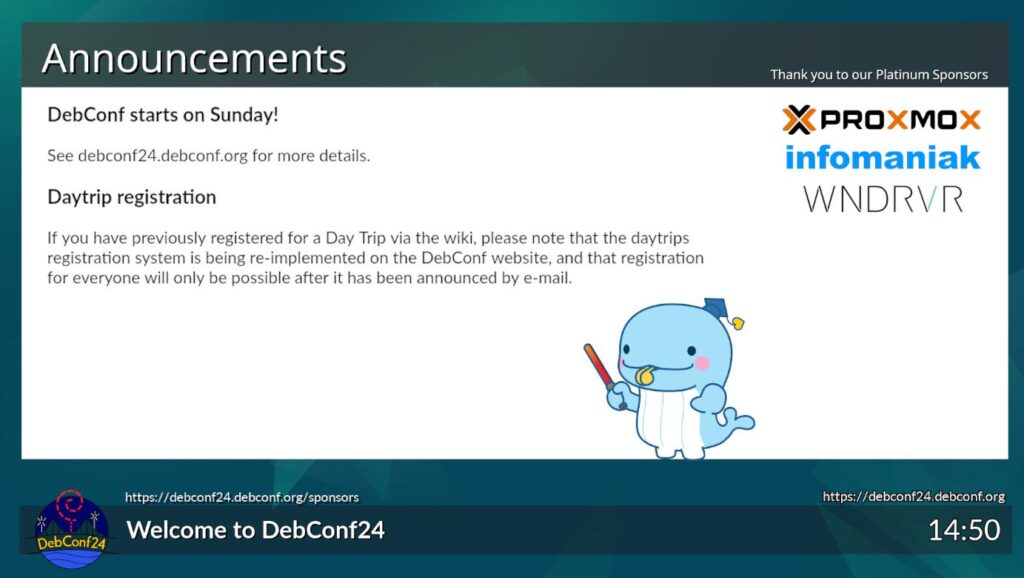
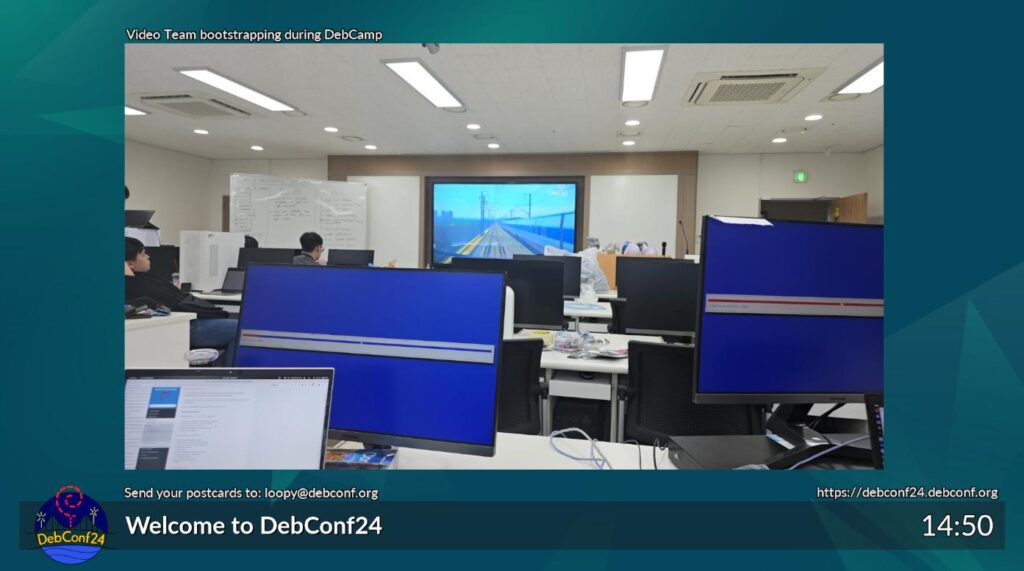

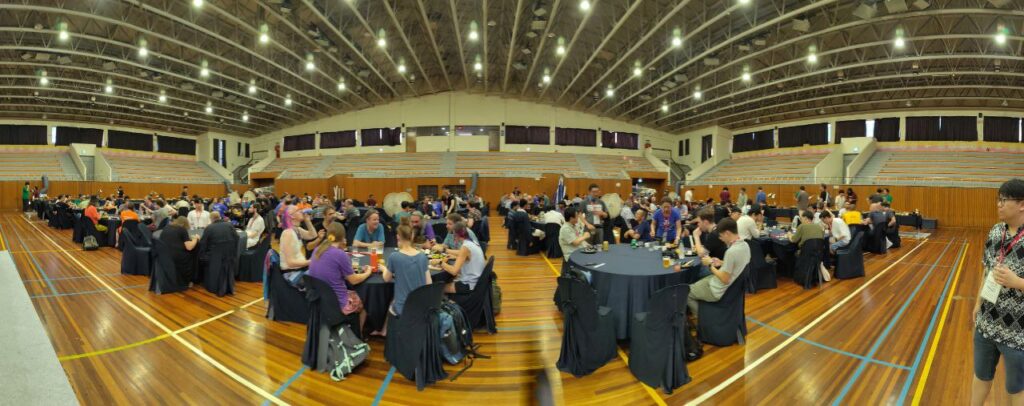 Conference Dinner Photo from Santiago
 Debian annual conference Debconf 24, Busan, South Korea


 Debian annual conference Debconf 24, Busan, South Korea
 My work on overhauling dhcpcd as the prime replacement for ISC's discontinued DHCP client is done. The package has achieved stability, both upstream and at Debian. The only remaining points are bug #1038882 to swap the Priorities of isc-dhcp-client and dhcpcd-base in the repository's override, and swaping ifupdown's search order to put dhcpcd first.
Meanwhile, ifupdown's de-facto maintainer prompted me to sollicit opinions on which of the 4 ifupdown implementations should ship with a minimal installation for Trixie. This, in turn, re-opened the debate of what should be Debian's default network configuation framework (see the thread starting with
 Here comes the 3rd article of the 5-episode blog post series on Polis, written by Guido Berh rster, member of staff at my company Fre(i)e Software GmbH.
Enjoy also this read on Guido's work on Polis,


 If you wander around a lot of open source repositories on the likes of GitHub, you ll invariably stumble over repos that have an issue (or more than one!) with a title like the above.
Sometimes sitting open and unloved, often with a comment or two from the maintainer and a bunch of I ll help out! followups that never seemed to pan out.
Very rarely, you ll find one that has been closed, with a happy ending.
These issues always fascinate me, because they say a lot about what it means to maintain an open source project, the nature of succession (particularly in a
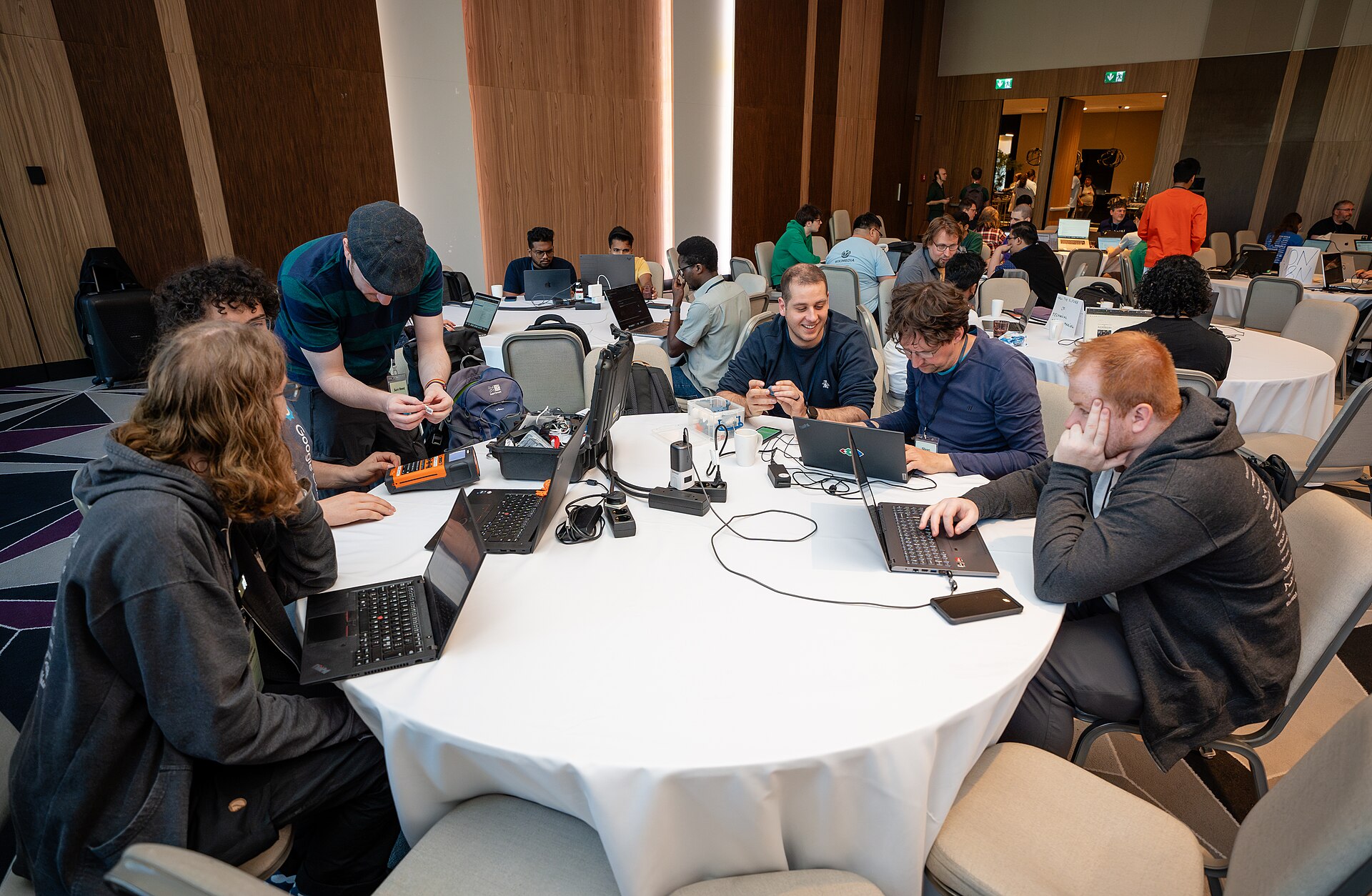


 The new-ish package

