There are times when an email based workflow gets really difficult. One of those times is when discussing projects related to spam and malware detection.
 noahm@debian.org
host stravinsky.debian.org [2001:41b8:202:deb::311:108]
SMTP error from remote mail server after end of data:
550-malware detected: Sanesecurity.Phishing.Fake.30934.1.UNOFFICIAL:
550 message rejected
submit@bugs.debian.org
host stravinsky.debian.org [2001:41b8:202:deb::311:108]
SMTP error from remote mail server after end of data:
550-malware detected: Sanesecurity.Phishing.Fake.30934.1.UNOFFICIAL:
550 message rejected
This was, in fact, a false positive. And now, because reportbug doesn t record outgoing messages locally, I need to retype the whole thing.
(NB. this is not a complaint about the policies deployed on the Debian mail servers; they d be negligent if they didn t implement such policies on today s internet.)
About 95% of my Debian contributions this month were
sponsored by Freexian.
You can also support my work directly via
Liberapay or GitHub
Sponsors.
Python team
forky is
open!
As a result I m starting to think about the upcoming Python
3.14. At some point we ll doubtless do
a full test rebuild, but in advance of that I concluded that one of the most
useful things I could do would be to work on our very long list of packages
with new upstream
versions.
Of course there s no real chance of this ever becoming empty since upstream
maintainers aren t going to stop work for that long, but there are a lot of
packages there where we re quite a long way out of date, and many of those
include fixes that we ll need for 3.14, either directly or by fixing
interactions with new versions of other packages that in turn will need to
be fixed. We can backport changes when we need to, but more often than not
the most efficient way to do things is just to keep up to date.
So, I upgraded these packages to new upstream versions (deep breath):
That s only about 10% of the backlog, but of course others are working on
this too. If we can keep this up for a while then it should help.
I packaged pytest-run-parallel,
pytest-unmagic (still in NEW), and
python-forbiddenfruit (still in NEW),
all needed as new dependencies of various other packages.
setuptools upstream will be removing the setup.py install
command on 31
October. While this may not trickle down immediately into Debian, it does
mean that in the near future nearly all Python packages will have to use
pybuild-plugin-pyproject (note that this does not mean that they
necessarily have to use pyproject.toml; this is just a question of how the
packaging runs the build system). We talked about this a bit at DebConf,
and I said that I d noticed a number of packages where this isn t
straightforward and promised to write up some notes. I wrote the
Python/PybuildPluginPyproject
wiki page for this; I expect to add more bits and pieces to it as I find them.
On that note, I converted several packages to pybuild-plugin-pyproject:
I reviewed Debian defaults: nftables as banaction and systemd as
backend,
but it looked as though nothing actually needed to be changed so we closed
this with no action.
Rust team
Upgrading Pydantic was complicated, and required a rust-pyo3 transition
(which Jelmer Vernoo started and Peter Michael Green has mostly been
driving, thankfully), packaging rust-malloc-size-of (including an upstream
portability fix), and
upgrading several packages to new upstream versions:
For my birthday I was gifted copies of Eno's last two albums, Luminal and
Lateral, both of which are collaborations with Beatie Wolfe.
Let's start with the art. I love this semi-minimalist, bold style, and how the
LP itself (in their coloured, bio-vinyl variants) feels like it's part of the
artwork. I like the way the artist credits mirror each other: Wolfe, Eno for
Luminal; Eno, Wolfe for Lateral.
My first "bio vinyl" LP was the Cure's last one, last year. Ahead of it arriving
I planned to blog about it, but when it came arrived it turned out I had nothing
interesting to say. In terms of how it feels, or sounds, it's basically the same
as the traditional vinyl formulation.
The attraction of bio-vinyl to well-known environmentalists like Eno (and I
guess, the Cure) is the reduced environmental impact due to changing out the
petroleum and other ingredients with recycled used cooking oil.
You can read more about bio-vinyl if you wish.
I try not to be too cynical about things like this; my immediate response is
to assume some kind of green-washing PR campaign (I'm
currently reading Consumed by Saabira
Chaudhuri, an excellent book that is not sadly only fuelling my cynicism) but
I know Eno in particular takes this stuff seriously and has likely done more
than a surface-level evaluation. So perhaps every little helps.
On to the music. The first few cuts I heard from the albums earlier in the year
didn't inspire me much. Possibly I heard something from Luminal, the vocal
album; and I'm generally more drawn to Eno's ambient work. (Lateral is
ambient instrumental). I was not otherwise familiar with Beatie Wolfe. On
returning to the albums months later, I found them more compelling. Luminal
reminds me a little of Apollo: Atmospheres and Soundtracks. Lateral worked
well as space music for phd-correction sessions.
The pair recently announced a third album, Liminal, to arrive in October, and
totally throw off the symmetry of the first two. Two of its tracks are available
to stream now in the usual places.
Matthew blogged about his Amiga CDTV
project, a truly
unique Amiga hack which also manages to be a
novel Doom project (no mean feat: it's a crowded space)
This re-awakened my dormant wish to muck around with my
childhood Amiga some more. When I last wrote about
it (four years ago ) I'd upgraded the disk drive emulator
with an OLED display and rotary encoder.
I'd forgotten to mention I'd also sourced a modern trapdoor RAM expansion which
adds 2MiB of RAM. The Amiga can only see 1.5MiB1 of it at the moment, I
need perform a mainboard modification to access the final 512kiB2, which
means some soldering.
What I had planned to do back then: replace the switch in the left button of the
original mouse, which was misbehaving; perform the aformentioned mainboard mod;
upgrade the floppy emulator wiring to a ribbon cable with plug-and-socket, for
easier removal;
fit an RTC chip to the RAM expansion board to get clock support in the OS.
However much of that might be might be moot, because of two
other mods I am considering,
PiStorm
I've re-considered the PiStorm accelerator mentioned in Matt's blog.
Four years ago, I'd passed over it, because it required you to run Linux on a
Raspberry Pi, and then an m68k emulator as a user-space process under Linux. I
didn't want to administer another Linux system, and I'm generally uncomfortable
about using a regular Linux distribution on SD storage over the long term.
However in the intervening years Emu68,
a bare-metal m68k emulator has risen to prominence. You boot the Pi straight
into Emu68 without Linux in the middle. For some reason that's a lot more
compelling to me.
The PiStorm enormously expands the RAM visible to the Amiga. There would be
no point in doing the mainboard mod to add 512k (and I don't know how that
would interact with the PiStorm). It also can provide virtual
hard disk devices to the Amiga (backed by files on the SD card), meaning the
floppy emulator would be superfluous.
Denise Mainboard
I've just learned about a truly incredible project: the Denise Mini-ITX Amiga
mainboard. It fitss into a Mini-ITX
case (I have a suitable one spare already). Some assembly required. You move
the chips from the original Amiga over to the Denise mainboard. It's compatible
with the PiStorm (or vice-versa). It supports PC-style PS/2 keyboards (I have a
Model M in the loft, thanks again Simon) and has
a bunch of other modern conveniences: onboard RTC; mini-ITX power (I'll need
something like a picoPSU too)
It wouldn't support my trapdoor RAM card but it takes a 72-pin DIMM which can
supply 2MiB of Chip RAM, and the PiStorm can do the rest (they're compatible3).
No stock at the moment but if I could get my hands on this, I could build
something that could permanently live on my desk.
the Boobip board's 1.5MiB is "chip" RAM: accessible to the other chips
on the mainboard, with access mediated by the AGNUS chip.
the final 512kiB is "Fast" RAM: only accessible to the CPU,
not mediated via Agnus.
The new Proxmox release advertises a new feature for easier snapshot handling of
virtual machines whose disks are stored on LVM volumes, I wondered.. whats the
deal..?
To be able to use the new feature, you need to enable a special flag for the
LVM volume group. This example shows the general workflow for a fresh setup.
1) Create the volume group with the snapshot-as-volume-chain feature turned on:
2) From this point on, you can create virtual machines right away, BUT those
virtual machines disks must use the QCOW image format for their disk
volumes. If you use the RAW format, you wont be able to create snapshots,
still.
So, why would it make sense to format the LVM volume as QCOW?
Snapshots on LVM thick provisioned devices are, as everybody knows, a very
I/O intensive task. Besides each snapshot, a special -cow Device is created
that tracks the changed block regions and the original block data for each
change to the active volume. This will waste quite some space within your
volume group for each snapshot.
Formatting the LVM volume as QCOW image, makes it possible to use the QCOW
backing-image option for these devices, this is the way PVE 9 handles these
kind of snapshots.
Creating a snapshot looks like this:
qm snapshot $VMIDid
snapshotting 'drive-scsi1'(lvmthick3:vm-401-disk-0.qcow2)
Renamed "vm-401-disk-0.qcow2" to "snap_vm-401-disk-0_id.qcow2"in volume group "lvm"
Rounding up size to full physical extent 1.00 GiB
Logical volume "vm-401-disk-0.qcow2" created.
Formatting '/dev/lvm/vm-401-disk-0.qcow2', fmt=qcow2 cluster_size=131072 extended_l2=on preallocation=metadata compression_type=zlib size=1073741824 backing_file=snap_vm-401-disk-0_id.qcow2 backing_fmt=qcow2 lazy_refcounts=off refcount_bits=16
So it will rename the current active disk and create another QCOW formatted LVM
volume, but pointing it to the snapshot image using the backing_file option.
Neat.
Debconf 25 photos
Debconf 25 came to the end in Brest, France this year a couple weeks ago.
This has been a very different and unusually interesting Debconf. For me it was for two, related reasons: for one the conference
was close enough in Western Europe that I could simply drive there with a car (which reminds me that I should make a blog post
about the BMW i5, before I am done with it at the end of this year) and for the other - the conference is close enough to Western
Europe that many other Debian developers could join this year who have not been seen at the event for many years. Being able to arrive early, decompress and spend extra time looking around the place made the event itself even more enjoyable than usual.
The French cuisine, especially in its Breton expression, has been a very welcome treat. Even if there were some rough patches
with the food selection, amount, or waiting, it was still a great experience.
I specifically want to say a big thank you to the
organisers for everything, but very explicitly for planning all the talk/BOF rooms in the same building and almost on the same
floor. It saved me a lot of footwork, but also for other participants the short walks between the talks made it possible to always
have a few minutes to talk to people or grab a croissant before running to the next talk.
IMHO we should come back to a tradition of organising Debconf in Europe every 2-3 years. This maximises one of the main goals of
Debconf - bringing as many Debian Developers as possible together in one physical location. This works best when the location is
actually close to large concentrations of existing developers. In other years, the other goal of Debconf can then take priority -
recruiting new developers in new locations. However, these goals could both be achieved at the same time - there are plenty of
locations in Europe and even in Western Europe that still have good potential for attracting new developers. Especially if we focus
on organising the event on the campuses of some larger technically-oriented universities.
This year was also very productive for me a lot of conversations with various people about all kinds of topics, especially technical packaging questions. It has been a long time since the very basic foundations of Debian packaging work have been so fundamentally refactored and modernized as in the past year. Tag2upload has become a catalyst for git-based packaging and for automated workflows via Salsa, and all of that feeds back into focusing on a few best-supported packaging workflows. There is still a bit of a documentation gap
of a new contributor getting to these modern packaging workflows from the point where the New Maintainers Guide stops.
In any case, next year Debconf will be happening in Santa Fe, Argentina. And the year after that it is all still open and in
a close competition
between Japan, Spain, Portugal, Brazil and .. El Salvador? Personally, I would love to travel to Japan (again), but Spain or
Portugal would also be great locations to meet more European developers again.
As for Santa Fe ... it is quite likely that I will not be able to make it there next year, for (planned) health reasons. I guess
I should also write a new blog post about what it means to be a Debconf Photographer, so that someone else could do this as well,
and also reduce the "bus factor" along the way.
But before that - here is the main group photo from this year:
You can also see it on:
Additionally, check out photos from other people on GIT LFS and consider adding your own photos there as well.
Other places I have updated with up-to-date information are these wiki pages:
In July I attended
DebCamp and DebConf in Brest,
France. I very much enjoyed the opportunity to reconnect with other
Debian contributors in person. I had a number of interesting and
fruitful conversations there, besides the formally organised BoFs and
talks.
I also gave my own talk on
What s new in the Linux kernel (and what s missing in Debian).
Here s the usual categorisation of activity:
(You wait ages for an archiving blog post and two come along at once!)
Between 1969-2019, the Newcastle University School of Computing published a
Technical Reports Series. Until 2017-ish, the full list of
individually-numbered reports was available on the School's website, as well as
full text PDFs for every report.
At some time around 2014 I was responsible for migrating the School's website
from self-managed to centrally-managed. The driver was to improve the website from
the perspective of student recruitment. The TR listings (as well as full
listings and texts for awarded PhD theses, MSc dissertations, Director's
reports and various others) survived the initial move. After I left (as staff)
in 2015, anything not specifically about student recruitment degraded and by
2017 the listings were gone.
I've been trying, on and off, to convince different parts of the University
to restore and take ownership of these lists ever since. For one reason or
another each avenue I've pursued has gone nowhere.
Recently the last remaining promising way forward failed, so I gave up and
did it myself. The list is now hosted by the Historic Computing Committee,
here:
https://nuhc.ncl.ac.uk/computing/techreports/
It's not complete (most of the missing entries are towards the end of the run),
but it's a start. The approach that finally yielded results was simply scraping
the Internet Archive Wayback Machine for various pages from back when the
material was represented on the School website, and then filling in the gaps
from some other sources.
What I envisage in the future: per-page reports with the relevant metadata
(including abstracts); authors de-duplicated and cross-referenced; PDFs OCRd;
providing access to the whole metadata DB (probably as as lump of JSON); a
mechanism for people to report errors; a platform for students to perform data
mining projects: perhaps some kind of classification/tagging by automated
content analysis; cross-referencing copies of papers in other venues (lots of
TRs are pre-prints).
I recently learned that, about 6 months ago, the Debian webteam
deleted all news articles from the main website older than 2022. There
have been several complaints from people in and outside of Debian,
notably
Joe Brockmeier of LWN,
and this really sad one from the nephew of a deceased developer,
wondering where the obituary had gone,
but the team have not been swayed and are not prepared to reinstate
the news.
It feels very important to me, too, that historic news, and their links, are
not broken. So, I hastily built a new Debian service, The Chronicles of
Debian, as as permanent home for historic web
content.
$ HEAD -S -H "Accept-Language: de" https://www.debian.org/News/1997/19971211
HEAD https://www.debian.org/News/1997/19971211
302 Found
HEAD https://chronicles.debian.org/www/News/1997/19971211
200 OK

Content-Language: de
Content-Location: 19971211.de.html
This was thrown up in a hurry to get something working as fast as
possible, and there is plenty of room for improvement. Get in touch
if there's an enhancement you would like or you would like to get involved!
I ve participated in this year s Google Summer of Code (GSoC)
program and have been working on the small (90h) autopkgtests for the rsync
package project at Debian.
Writing my proposal
Before you can start writing a proposal, you need to select an organization
you want to work with. Since many organizations participate in GSoC, I ve
used the following criteria to narrow things down for me:
Programming language familiarity: For me only Python (preferably) as well
as shell and Go projects would have made sense. While learning another
programming language is cool, I wouldn t be as effective and helpful to
the project as someone who is proficient in the language already.
Standing of the organization: Some of the organizations participating in
GSoC are well-known for the outstanding quality of the software they
produce. Debian is one of them, but so is e.g. the Django Foundation or
PostgreSQL. And my thinking was that the higher the quality of the
organization, the more there is to learn for me as a GSoC student.
Mentor interactions: Apart from the advantage you get from mentor
feedback when writing your proposal (more on that further below), it is
also helpful to gauge how responsive/helpful your potential mentor is
during the application phase. This is important since you will be working
together for a period of at least 2 months; if the mentor-student
communication doesn t work, the GSoC project is going to be difficult.
Free and Open-Source Software (FOSS) communication platforms: I
generally believe that FOSS projects should be built on FOSS
infrastructure. I personally won t run proprietary software
when I want to contribute to FOSS in my spare time.
Be a user of the project: As Eric S. Raymond has pointed out
in his seminal The Cathedral and the Bazaar 25 years ago
Every good work of software starts by scratching a developer s personal
itch.
Once I had some organizations in mind whose projects I d be interested in
working on, I started writing proposals for them. Turns out, I started
writing my proposals way too late: In the end I only managed to hand in a
single one which is risky. Competition for the GSoC projects is fierce
and the more quality (!) proposals you send out, the better your chances are
at getting one. However, don t write proposals for the sake of it: Reviewers
get way too many AI slop proposals already and you will not do yourself a
favor with a low-quality proposal. Take the time to read the
instructions/ideas/problem descriptions the project mentors have provided
and follow their guidelines. Don t hesitate to reach out to project mentors:
In my case, I ve asked Samuel Henrique a few clarification questions whereby
the following (email) discussion has helped me greatly in improving my
proposal. Once I ve finalized my proposal draft, I ve sent it to Samuel for
a review, which again led to some improvements to the final proposal
which I ve uploaded to the GSoC program webpage.
Community bonding period
Once you get the information that you ve been accepted into the GSoC program
(don t take it personally if you don t make it; this was my second attempt
after not making the cut in 2024), get in touch with your prospective mentor
ASAP. Agree upon a communication channel and some response times. Put
yourself in the loop for project news and discussions whatever that means in
the context of your organization: In Debian s case this boiled down to
subscribing to a bunch of mailing lists and IRC channels. Also make sure to
setup a functioning development environment if you haven t done so for
writing the proposal already.
Payoneer setup
The by far most annoying part of GSoC for me. But since you don t have a
choice if you want to get the stipend, you will need to signup for an
account at Payoneer.
In this iteration of GSoC all participants got a personalized link to open a
Payoneer account. When I tried to open an account by following this link, I
got an email after the registration and email verification that my
account is being blocked because Payoneer deems the email adress I gave a
temporary one. Well, the email in question is most certainly anything but
temporary, so I tried to get in touch with the Payoneer support - and ended
up in an LLM-infused kafkaesque support hell. Emails are answered by an LLM
which for me meant utterly off-topic replies and no help whatsoever. The
Payoneer website offers a real-time chat, but it is yet another instance of
a bullshit-spewing LLM bot. When I at last tried to call them (the
support lines are not listed on the Payoneer website but were provided by
the GSoC program), I kid you not, I was being told that their platform is
currently suffering from technical problems and was hung up on. Only thanks
to the swift and helpful support of the GSoC administrators (who get
priority support from Payoneer) I was able to setup a Payoneer account in
the end.
Apart from showing no respect to customers, Payoneer is also ripping them
off big time with fees (unless you get paid in USD). They charge you 2% for
currency conversions to EUR on top of the FX spread they take. What
worked for me to avoid all of those fees, was to open a USD account at Wise
and have Payoneer transfer my GSoC stipend in USD to that account. Then I
exchanged the USD to my local currency at Wise for significantly less than
Payoneer would have charged me. Also make sure to close your Payoneer
account after the end of GSoC to avoid their annual fee.
Project work
With all this prelude out of the way, I can finally get to the actual work
I ve been doing over the course of my GSoC project.
Background
The upstream rsync project generally sees little development. Nonetheless,
they released version 3.4.0 including some CVE fixes earlier
this year. Unfortunately, their changes broke the -H
flag. Now, Debian package maintainers need to apply those security fixes to
the package versions in the Debian repositories; and those are typically a
bit older. Which usually means that the patches cannot be applied as is but
will need some amendments by the Debian maintainers. For these cases it is
helpful to have autopkgtests defined, which check the package s
functionality in an automated way upon every build.
The question then is, why should the tests not be written upstream such that
regressions are caught in the development rather than the distribution
process? There s a lot to say on this question and it probably depends a lot
on the package at hand, but for rsync the main benefits are twofold:
The upstream project mocks the ssh connection over which rsync is most
typically used. Mocking is better than nothing but not the real thing. In
addition to being a more realisitic test scenario for the typical rsync
use case, involving an ssh server in the test would automatically extend
the overall resilience of Debian packages as now new versions of the
openssh-server package in Debian benefit from the test cases in the
rsync reverse dependency.
The upstream rsync test framework is somewhat idiosyncratic and
difficult to port to reimplementations of rsync. Given that the
original rsync upstream sees little development, an extensive test suit
further downstream can serve as a threshold for drop-in replacements for
rsync.
Goal(s)
At the start of the project, the Debian rsync package was just running (a
part of) the upstream tests as autopkgtests. The relevant snippet from the
build log for the rsync_3.4.1+ds1-3 package reads:
Samuel and I agreed that it would be a good first milestone to make the
skipped tests run. Afterwards, I should write some rsync test cases for
local calls, i.e. without an ssh connection, effectively using rsync as
a more powerful cp. And once that was done, I should extend the tests such
that they run over an active ssh connection.
With these milestones, I went to work.
Upstream tests
Running the seven skipped upstream tests turned out to be fairly
straightforward:
Two upstream tests concern access control lists and extended
filesystem attributes. For these tests to run they rely on
functionality provided by the acl and xattr Debian packages. Adding
those to the Build-Depends list in the debian/control file of the
rsync Debian package repo made them run.
Four upstream tests required root privileges to run. The autopkgtest
tool knows the needs-root restriction for that reason. However, Samuel
and I agreed that the tests should not exclusively run with root
privileges. So, instead of just adding the restiction to the existing
autopkgtest test, we created a new one which has the needs-root
restriction and runs the upstream-tests-as-root script - which is
nothing else than a symlink to the existing upstream-tests script.
The commits to implement these changes can be found in this merge
request.
The careful reader will have noticed that I only made 2 + 4 = 6 upstream
test cases run out of 7: The leftover upstream test is checking the
functionality of the --ctimes rsync option. In the context of Debian, the
problem is that the Linux kernel doesn t have a syscall to set the creation
time of a file. As long as that is the case, this test will always be
skipped for the Debian package.
Local tests
When it came to writing Debian specific test cases I started of a completely
clean slate. Which is a blessing and a curse at the same time: You have full
flexibility but also full responsibility.
There were a few things to consider at this point in time:
Which language to write the tests in?
The programming language I am most proficient in is Python. But testing a
CLI tool in Python would have been weird: it would have meant that I d
have to make repeated subprocess calls to run rsync and then read from
the filesystem to get the file statistics I want to check.
Samuel suggested I stick with shell scripts and make use of diffoscope -
one of the main tools used and maintained by the Reproducible Builds
project - to check whether the file contents and
file metadata are as expected after rsync calls. Since I did not have
good reasons to use bash, I ve decided to write the scripts to be POSIX
compliant.
How to avoid boilerplate? If one makes use of a testing framework, which
one?
Writing the tests would involve quite a bit of boilerplate, mostly related
to giving informative output on and during the test run, preparing the
file structure we want to run rsync on, and cleaning the files up after
the test has run. It would be very repetitive and in violation of DRY
to have the code for this appear in every test. Good testing frameworks
should provide convenience functions for these tasks. shunit2 comes with
those functions, is packaged for Debian, and given that it is already
being used in the curl project, I decided to go with it.
Do we use the same directory structure and files for every test or should
every test have an individual setup?
The tradeoff in this question being test isolation vs. idiosyncratic
code. If every test has its own setup, it takes a) more work to write the
test and b) more work to understand the differences between
tests. However, one can be sure that changes to the setup in one test will
have no side effects on other tests. In my opinion, this guarantee was
worth the additional effort in writing/reading the tests.
Having made these decisions, I simply started writing
tests and ran into issues very quickly.
rsync and subsecond mtime diffs
When testing the rsync --times option, I observed a weird phenomenon: If
the source and destination file have modification times which differ only in
the nanoseconds, an rsync --times call will not synchronize the
modification times. More details about this behavior and examples can be
found in the upstream issue I raised. In the Debian tests we
had to occasionally work around this by setting the timestamps explicitly
with touch -d.
diffoscope regression
In one test case, I was expecting a difference in the modification times but
diffoscope would not report a diff. After a good amount of time spent
on debugging the problem (my default, and usually correct, assumption is
that something about my code is seriously broken if I run into issues like
that), I was able to show that diffoscope only displayed this behavior in
the version in the unstable suite, not on Debian stable (which I am running
on my development machine).
Since everything pointed to a regression in the diffoscope project and
with diffoscope being written in Python, a language I am familiar with, I
wanted to spend some time investigating (and hopefully fixing) the problem.
Running git bisect on the diffoscope repo helped me in identifying the
commit which introduced the regression: The commit contained an optimization
via an early return for bit-by-bit identical files. Unfortunately, the early
return also caused an explicitly requested metadata comparison (which could
be different between the files) to be skipped.
With a nicely diagnosed issue like that, I was able to
go to a local hackerspace event, where people work on FOSS together for an
evening every month. In a group, we were able to first, write a test which
showcases the broken behavior in the latest diffoscope version, and
second, make a fix to the code such that the same test passes going
forward. All details can be found in this merge request.
shunit2 failures
At some point I had a few autopkgtests setup and passing, but adding a new
one would throw me totally inexplicable errors. After trying to isolate the
problem as much as possible, it turns out that shunit2 doesn t play well
together we the -e shell option. The project mentions this in the release
notes for the 2.1.8 version1, but in my opinion a
constraint this severe should be featured much more prominently, e.g. in the
README.
Tests over an ssh connection
The centrepiece of this project; everything else has in a way only been
preparation for this.
Obviously, the goal was to reuse the previously written local tests in some
way. Not only because lazy me would have less work to do this way, but also
because of a reduced long-term maintenance burden of one rather than two
test sets.
As it turns out, it is actually possible to accomplish that: The
remote-tests script doesn t do much apart from starting an ssh server on
localhost and running the local-tests script with the REMOTE environment
variable set.
The REMOTE environment variable changes the behavior of the local-tests
script in such a way that it prepends "$REMOTE": to the destination of the
rsync invocations. And given that we set REMOTE=rsync@localhost in the
remote-tests script, local-tests copies the files to the exact same
locations as before, just over ssh.
The implementational details for this can be found in this merge
request.
proposed-updates
Most of my development work on the Debian rsync package took place during
the Debian freeze as the release of Debian Trixie is just
around the corner. This means that uploading by Debian Developers (DD) and
Debian Maintainers (DM) to the unstable suite is discouraged as it makes
migrating the packages to testing more difficult for the Debian release
team. If DDs/DMs want to have the package version in unstable migrated to
testing during the freeze they have to file an unblock request.
Samuel has done this twice (1, 2) for my work for Trixie but has
asked me to file the proposed-updates request for current
stable (i.e. Debian Bookworm) myself after I ve backported my
tests to bookworm.
Unfinished business
To run the upstream tests which check access control list and extended file
system attributes functionality, I ve added the acl and xattr packages
to Build-Depends in debian/control. This, however, will only make the
packages available at build time: If Debian users install the rsync
package, the acl and xattr packages will not be installed alongside
it. For that, the dependencies would have to be added to Depends or
Suggests in debian/control. Depends is probably to strong of a relation
since rsync clearly works well in practice without, but adding them to
Suggests might be worthwhile. A decision on this would involve checking,
what happens if rsync is called with the relevant options on a host
machine which has those packages installed, but where the destination
machine lacks them.
Apart from the issue described above, the 15 tests I managed to write are
are a drop in the water in light of the infinitude of rsync
optionsand their combinations. Most glaringly, not all
options of the --archive option are covered separately (which would help
indicating what code path of rsync broke in a regression). To increase the
likelihood of catching regressions with the autopkgtests, the test
coverage should be extended in the future.
Conclusion
Generally, I am happy with my contributions to Debian over the course of my
small GSoC project: I ve created an extensible, easy to understand, and
working autopkgtest setup for the Debian rsync package. There are two
things which bother me, however:
In hindsight, I probably shouldn t have gone with shunit2 as a testing
framework. The fact that it behaves erratically with the -e flag is a
serious drawback for a shell testing framework: You really don t want a
shell command to fail silently and the test to continue running.
As alluded to in the previous section, I m not particularly proud of the
number of tests I managed to write.
On the other hand, finding and fixing the regression in diffoscope - while
derailing me from the GSoC project itself - might have a redeeming quality.
DebConf25
By sheer luck I happened to work on a GSoC project at Debian over a time
period during which the annual Debian conference would take place
close enough to my place of residence. Samuel pointed the
opportunity to attend DebConf out to me during the community bonding period
and since I could make time for the event in my schedule, I signed up.
DebConf was a great experience which - aside from gaining more knowledge
about Debian development - allowed me to meet the actual people usually
hidden behind email adresses and IRC nicks. I can wholeheartedly recommend
attending a DebConf to every interested Debian user!
For those who have missed this year s iteration of the conference, I can
recommend the following recorded talks:
While not featuring as a keynote speaker (understandably so as the newcomer
to Debian community that I am), I could still contribute a bit to the
conference program.
Debian install workshop
Additionally, with so many Debian experts gathering in one place while KDE s
End of 10 campaign is ongoing, I felt it natural to
organize a Debian install workhop. In hindsight I can say
that I underestimated how much work it would be, especially for me who does
not speak a word of French. But although the turnout of people who wanted us
to install Linux on their machines was disappointingly low, it was still
worth it: Not only because the material in the repo can be
helpful to others planning install workshops but also because it was nice to
meet a) the person behind the Debian installer images and b) the
local Brest/Finist re Linux user group as well as the motivated and helpful
people at Infini.
Credits
I want to thank the Open Source team at Google for organizing GSoC: The
highly structured program with a one-to-one mentorship is a great avenue to
start contributing to well established and at times intimidating FOSS
projects. And as much as I disagree with Google s surveillance
capitalist business model, I have to give it to them that the company at
least takes its responsibility for FOSS (somewhat) seriously - unlike many
other businesses which rely on FOSS and choose to freeride of it.
Big thanks to the Debian community! I ve experienced nothing but
friendliness in my interactions with the community.
And lastly, the biggest thanks to my GSoC mentor Samuel Henrique. He has
dealt patiently and competently with all my stupid newbie questions. His
support enabled me to make - albeit small - contributions to Debian. It has
been a pleasure to work with him during GSoC and I m looking forward to
working together with him in the future.
Obviously, I ve only read them after experiencing the problem.
It's Sunday and I'm now sitting in the train from Brest to Paris where I will be changing to Germany, on the way back from the annual Debian conference. A full week of presentations, discussions, talks and socializing is laying behind me and my head is still spinning from the intensity.
Pollito and the gang of DebConf mascots wearing their conference badges (photo: Christoph Berg)
Table of Contents
Sunday, July 13th
It started last Sunday with traveling to the conference. I got on the Eurostar in Duisburg and we left on time, but even before reaching Cologne, the train was already one hour delayed for external reasons, collecting yet another hour between Aachen and Liege for its own technical problems. "The train driver is working on trying to fix the problem." My original schedule had well over two hours for changing train stations in Paris, but being that late, I missed the connection to Brest in Montparnasse. At least in the end, the total delay was only one hour when finally arriving at the destination. Due to the French julliet quatorze fireworks approaching, buses in Brest were rerouted, but I managed to catch the right bus to the conference venue, already meeting a few Debian people on the way.
The conference was hosted at the IMT Atlantique Brest campus, giving the event a nice university touch. I arrived shortly after 10 in the evening and after settling down a bit, got on one of the "magic" buses for transportation to the camping site where half of the attendees where stationed. I shared a mobile home with three other Debianites, where I got a small room for myself.
Monday, July 14th
Next morning, we took the bus back to the venue with a small breakfast and the opening session where Enrico Zini invited me to come to his and Nicolas Dandrimont's session about Debian community governance and curation, which I gladly did. Many ideas about conflict moderation and community steering were floated around. I hope some of that can be put into effect to make flamewars on the mailing lists less heated and more directed. After that, I attended Olly Betts' "Stemming with Snowball" session, which is the stemmer used also in PostgreSQL. Text search is one of the areas in PostgreSQL that I never really looked closely at, including the integration into the postgresql-common package, so it was nice to get more information about that.
In preparation for the conference, a few of us Ham radio operators in Debian had decided to bring some radio gear to DebConf this year in order to perhaps spark more interest for our hobby among the fellow geeks. In the afternoon after the talks, I found a quieter spot just outside of the main hall and set up a shortwave antenna by attaching a 10m mast to one of the park benches there. The 40m band was still pretty much closed, but I could work a few stations from England, just across the channel from Bretagne, answering questions from interested passing-by Debian people between the contacts. Over time, the band opened and more European stations got into the log.
F/DF7CB in Brest (photo: Evangelos Ribeiro Tzaras)
Tuesday, July 15th
Tuesday started with Helmut Grohne's session about "Reviving (un)schroot". The schroot program has been Debian's standard way of managing build chroots for a long time, but it is more and more being regarded as obsolete with all kinds of newer containerization and virtualization technologies taking over. Since many bits of Debian infrastructure depend on schroot, and its user interface is still very useful, Helmut reimplemented it using Linux namespaces and the "unshare" systemcall. I had already worked with him at the Hamburg Minidebconf to replace the apt.postgresql.org buildd machinery with the new system, but we were not quite there yet (network isolation is nice, but we still sometimes need proper networking), so it was nice to see the effort is still progressing and I will give his new scripts a try when I'm back home.
Next, Stefano Rivera and Colin Watson presented Debusine, a new package repository and workflow management system. It looks very promising for anyone running their own repository, so perhaps yet another bit of apt.postgresql.org infrastructure to replace in the future. After that, I went to the Debian LTS BoF session by Santiago Ruano Rinc n and Bastien Roucari s - Debian releases plus LTS is what we are covering with apt.postgresql.org. Then there were bits from the DPL (Debian Project Leader), and a session moderated by Stefano Rivera interesting to me as a member of the Debian Technical Committee on the future structure of the packages required for cross-building in Debian, a topic which had been brought to TC a while ago. I am happy that we could resolve the issue without having to issue a formal TC ruling as the involved parties (kernel, glibc, gcc and the cross-build people) found a promising way forward themselves. DebConf is really a good way to get such issues unstuck.
Ten years ago at the 2015 Heidelberg DebConf, Enrico had given a seminal "Semi-serious stand-up comedy" talk, drawing parallels between the Debian Open Source community and the BDSM community - "People doing things consensually together". (Back then, the talk was announced as "probably unsuitable for people of all ages".) With his unique presentation style and witty insights, the session made a lasting impression on everyone attending. Now, ten years later (and he and many in the audience being ten years older), he gave an updated version of it. We are now looking forward to the sequel in 2035. The evening closed with the famous DebConf tradition of the Cheese & Wine party in a old fort next to the coast, just below the conference venue. Even when he's a fellow Debian Developer, Ham and also TC member, I had never met Paul Tagliamonte in person before, but we spent most of the evening together geeking out on all things Debian and Ham radio.
The northern coast of Ushant (photo: Christoph Berg)
Wednesday, July 16th
Wednesday already marked the end of the first half of the week, the day of the day trips. I had chosen to go to Ouessant island (Ushant in English) which marks the Western end of French mainland and hosts one of the lighthouses yielding the way into the English channel. The ferry trip included surprisingly big waves which left some participants seasick, but everyone recovered fast. After around one and a half hours we arrived, picked up the bicycles, and spent the rest of the day roaming the island. The weather forecast was originally very cloudy and 18 C, but over noon this turned into sunny and warm, so many got an unplanned sunburn. I enjoyed the trip very much - it made up for not having time visiting the city during the week. After returning, we spent the rest of the evening playing DebConf's standard game, Mao (spoiler alert: don't follow the link if you ever intend to play).
Having a nice day (photo: Christoph Berg)
Thursday, July 17th
The next day started with the traditional "Meet the Technical Committee" session. This year, we trimmed the usual slide deck down to remove the boring boilerplate parts, so after a very short introduction to the work of the committee by our chairman Matthew Vernon, we opened up the discussion with the audience, with seven (out of 8) TC members on stage. I think the format worked very well, with good input from attendees. Next up was "Don't fear the TPM" by Jonathan McDowell. A common misconception in the Free Software community is that the TPM is evil DRM hardware working against the user, but while it could be used in theory that way, the necessary TPM attestations seem to impossible to attain in practice, so that wouldn't happen anyway. Instead, it is a crypto coprocessor present in almost all modern computers that can be used to hold keys, for example to be used for SSH. It will also be interesting to research if we can make use of it for holding the Transparent Data Encryption keys for CYBERTEC's PostgreSQL Enterprise Edition.
Aigars Mahinovs then directed everyone in place for the DebConf group picture, and Lucas Nussbaum started a discussion about archive-wide QA tasks in Debian, an area where I did a lot of work in the past and that still interests me. Antonio Terceiro and Paul Gevers followed up with techniques to track archive-wide rebuilding and testing of packages and in turn filing a lot of bugs to track the problems. The evening ended with the conference dinner, again in the fort close by the coast. DebConf is good for meeting new people, and I incidentally ran into another Chris, who happened to be one of the original maintainers of pgaccess, the pre-predecessor of today's pgadmin. I admit still missing this PostgreSQL frontend for its simplicity and ability to easily edit table data, but it disappeared around 2004.
Friday, July 18th
On Friday, I participated in discussion sessions around contributors.debian.org (PostgreSQL is planning to set up something similar) and the New Member process which I had helped to run and reform a decade or two ago. Agathe Porte (also a Ham radio operator, like so many others at the conference I had no idea of) then shared her work on rust-rewriting the slower parts of Lintian, the Debian package linter. Craig Small talked about "Free as in Bytes", the evolution of the Linux procps free command. Over the time and many kernel versions, the summary numbers printed became better and better, but there will probably never be a version that suits all use cases alike. Later over dinner, Craig (who is also a TC member) and I shared our experiences with these numbers and customers (not) understanding them. He pointed out that for PostgreSQL and looking at used memory in the presence of large shared memory buffers, USS (unique set size) and PSS (proportional set size) should be more realistic numbers than the standard RSS (resident set size) that the top utility is showing by default.
Antonio Terceiro and Paul Gevers again joined to lead a session, now on ci.debian.net and autopkgtest, the test driver used for running tests on packages after then have been installed on a system. The PostgreSQL packages are heavily using this to make sure no regressions creep in even after builds have successfully completed and test re-runs are rescheduled periodically. The day ended with Bdale Garbee's electronics team BoF and Paul Tagliamonte and me setting up the radio station in the courtyard, again answering countless questions about ionospheric conditions and operating practice.
Saturday, July 19th
Saturday was the last conference day. In the first session, Nikos Tsipinakis and Federico Vaga from CERN announced that the LHC will be moving to Debian for the accelerator's frontend computers in their next "long shutdown" maintenance period in the next year. CentOS broke compatibility too often, and Debian trixie together with the extended LTS support will cover the time until the next long shutdown window in 2035, until when the computers should have all been replaced with newer processors covering higher x86_64 baseline versions. The audience was very delighted to hear that Debian is now also being used in this prestige project.
Ben Hutchings then presented new Linux kernel features. Particularly interesting for me was the support for atomic writes spanning more than one filesystem block. When configured correctly, this would mean PostgreSQL didn't have to record full-page images in the WAL anymore, increasing throughput and performance. After that, the Debian ftp team discussed ways to improve review of new packages in the archive, and which of their processes could be relaxed with new US laws around Open Source and cryptography algorithms export. Emmanuel Arias led a session on Salsa CI, Debian's Gitlab instance and standard CI pipeline. (I think it's too slow, but the runners are not under their control.) Julian Klode then presented new features in APT, Debian's package manager. I like the new display format (and a tiny bit of that is also from me sending in wishlist bugs).
In the last round of sessions this week, I then led the Ham radio BoF with an introduction into the hobby and how Debian can be used. Bdale mentioned that the sBitx family of SDR radios is natively running Debian, so stock packages can be used from the radio's touch display. We also briefly discussed his involvement in ARDC and the possibility to get grants from them for Ham radio projects. Finally, DebConf wrapped up with everyone gathering in the main auditorium and cheering the organizers for making the conference possible and passing Pollito, the DebConf mascot, to the next organizer team.
Pollito on stage (photo: Christoph Berg)
Sunday, July 20th
Zoom back to the train: I made it through the Paris metro and I'm now on the Eurostar back to Germany. It has been an intense week with all the conference sessions and meeting all the people I had not seen so long. There are a lot of new ideas to follow up on both for my Debian and PostgreSQL work. Next year's DebConf will take place in Santa Fe, Argentina. I haven't yet decided if I will be going, but I can recommend the experience to everyone!
The post The Debian Conference 2025 in Brest appeared first on CYBERTEC PostgreSQL Services & Support.
$ b4 am 20250715-pci-port-reset-v6-0-6f9cce94e7bb@oss.qualcomm.com
$ git am -3 v6_20250715_manivannan_sadhasivam_pci_add_support_for_resetting_the_root_ports_in_a_platform_specifi.mbx
There is quite a scary looking conflict between the last patch in the
series and
https://lore.kernel.org/r/1744940759-23823-1-git-send-email-shawn.lin@rock-chips.com
which is now upstream (collabora) in rockchip-devel. I resolved
the second basically by taking both, as it seemed like two independent sets of
additions to the same parts of the file. The first it looks like Shawn's commit referenced above should prevail.
If anyone is curious about the (possibly incorrectly) rebased
patches, they are at
https://salsa.debian.org/bremner/collabora-rockchip-3588
(reform-patches is the default, and relevant branch).
testing
The new (6.16~rc7+) kernel boots
It successfully reboots
devices test passes, although the UBSAN warning / error is still there
Unsurprisingly, if I try an actual resume (instead of a "platform"
test), I get the same messages about "Phy link never came up" and
the system needs a hard reboot after trying to resume.
Barring inspiration, my next move will be to report my lack of
success to the appropriate kernel mailing list(s).
On July 7th I did a quick one-day trip to Paris to watch Nine Inch Nails, who
were performing one of their last shows for the European leg of the tour. I'd missed all
the UK dates, which were announced after I was committed to a family holiday.
The setup for these shows differs a lot from the norm. First, the support act was
German-Iraqi techno DJ Boys Noize, who TR&AR had collaborated with on their soundtrack
for the recent movie Challengers. BN did a 75-minute opening set:
Stripped down Set 1
The main gig was divided into four acts. Act 1 took place on a square "B Stage", situated
in the middle of the main floor. Trent and 2-3 band members performed three stripped-down
songs, with interpolations to other songs, alternative lyrics, and the like. I enjoyed this section more than I expected to.
Main stage lighting
They then transition to the main stage for a six-song full-band set. The main
stage was draped in layers of transparent curtains. One of the team was on-stage, walking
around with a video camera, and the live camera footage was processed and projected onto
the curtains in realtime. The visuals were truly fantastic.
For the third act, Trent and Atticus returned to the B stage, to be joined by Boys Noize,
who then performed four songs in a reworked, remixed, electronic dance format. This ended
up being the highlight of the gig for me. I felt the reworkings breathed new life into some
old songs.
remix Set 3
Finally, back to the main stage to close out with a final seven songs. The
traditional triad of closers was adjusted, substituting "The Hand That Feeds"
for "The Perfect Drug"; a song that wasn't played at all from 1997 to 2018, and has now
become a regular fixture.
Several tapers recorded the show, and their recordings are up at nin.live.
Overall it was great fun: I ended up flying via London and the airport time was a bit of
a pain, but I did get a good start on my corrections. I was home the next
afternoon. I'm trying not to think of the cost.
Update on 2025-07-28: added note about Debian 13/trixie support for OpenVox (thanks, Ben Ford!)
Debian v13 with codename trixie is scheduled to be published as new stable release on 9th of August 2025.
I was the driving force at several of my customers to be well prepared for the upcoming stable release (my efforts for trixie started in August 2024). On the one hand, to make sure packages we care about are available and actually make it into the release. On the other hand, to ensure there are no severe issues that make it into the release and to get proper and working upgrades. So far everything is looking pretty well and working fine, the efforts seemed to have payed off. :)
As usual with major upgrades, there are some things to be aware of, and hereby I m starting my public notes on trixie that might be worth for other folks. My focus is primarily on server systems and looking at things from a sysadmin perspective.
Further readings
As usual start at the official Debian release notes, make sure to especially go through What s new in Debian 13 + issues to be aware of for trixie (strongly recommended read!).
Package versions
As a starting point, let s look at some selected packages and their versions in bookworm vs. trixie as of 2025-07-20 (mainly having amd64 in mind):
Package
bookworm/v12
trixie/v13
ansible
2.14.3
2.19.0
apache
2.4.62
2.4.64
apt
2.6.1
3.0.3
bash
5.2.15
5.2.37
ceph
16.2.11
18.2.7
docker
20.10.24
26.1.5
dovecot
2.3.19
2.4.1
dpkg
1.21.22
1.22.21
emacs
28.2
30.1
gcc
12.2.0
14.2.0
git
2.39.5
2.47.2
golang
1.19
1.24
libc
2.36
2.41
linux kernel
6.1
6.12
llvm
14.0
19.0
lxc
5.0.2
6.0.4
mariadb
10.11
11.8
nginx
1.22.1
1.26.3
nodejs
18.13
20.19
openjdk
17.0
21.0
openssh
9.2p1
10.0p1
openssl
3.0
3.5
perl
5.36.0
5.40.1
php
8.2+93
8.4+96
podman
4.3.1
5.4.2
postfix
3.7.11
3.10.3
postgres
15
17
puppet
7.23.0
8.10.0
python3
3.11.2
3.13.5
qemu/kvm
7.2
10.0
rsync
3.2.7
3.4.1
ruby
3.1
3.3
rust
1.63.0
1.85.0
samba
4.17.12
4.22.3
systemd
252.36
257.7-1
unattended-upgrades
2.9.1
2.12
util-linux
2.38.1
2.41
vagrant
2.3.4
2.3.7
vim
9.0.1378
9.1.1230
zsh
5.9
5.9
Misc unsorted
The asterisk package once again didn t make it into trixie (see #1031046)
The new debian-repro-status package provides the identically named command-line tool debian-repro-status to query the reproducibility status of your installed Debian packages
The Grml live system project provided further of their packages into Debian. Available as of trixie are now also grml-keyring (OpenPGP certificates used for signing the Grml repositories), grml-hwinfo (a tool which collects information of the hardware ) + grml-paste (command line interface for paste.debian.net)
If you use pacemaker, be aware that its fence-agents package is now a transitional package. All the fence-agents got split into separate packages (fence-agents-$whatever). If you want to have all the fence-agents available, make sure to install the fence-agents-all package. If you have Recommends disabled, you definitely should be aware of this.
support for colors (f.e. green for installs/upgrades, yellow for downgrades, red for removals, can be disabled via &dash&dashno-color, APT_NO_COLOR=1 or NO_COLOR=1 and customized via e.g. APT::Color::Action::Install cyan )
organizes output in more readable sections and shows removals more prominently
the new apt modernize-sources command converts /etc/apt/sources.list.d/*.list files into the new .sources format (AKA DEB822)
the new apt distclean command removes all files under $statedir/lists except Release, Release.gpg, and InRelease (it can be used for example, when finalizing images distributed to users)
new configuration option APT::NeverAutoRemove::KernelCount for keeping a configurable amount of kernels, f.e. setting APT::NeverAutoRemove::KernelCount 3 will keep 3 kernels (including the running, and most recent)
new command line option &dash&dashsnapshot, and configuration option APT::Snapshot, controlling the snapshot chosen for archives with Snapshot: enable
new command line option &dash&dashupdate to run the update command before the specified command, like apt &dash&dashupdate install zsh, apt &dash&dashupdate remove foobar or apt &dash&dashupdate safe-upgrade
apt-key is gone, and there s no replacement for it available (if you need an interface for listing present keys)
systemd
systemd got upgraded from v252.36-1~deb12u1 to 257.7-1 and there are lots of changes.
Be aware that systemd v257 has a new net.naming_scheme, v257 being PCI slot number is now read from firmware_node/sun sysfs file. The naming scheme based on devicetree aliases was extended to support aliases for individual interfaces of controllers with multiple ports. This might affect you, see e.g. #1092176 and #1107187, the Debian Wiki provides further useful information.
There are new systemd tools available:
run0: temporarily and interactively acquire elevated or different privileges (serves a similar purpose as sudo)
systemd-ac-power: Report whether we are connected to an external power source
systemd-vpick: Resolve paths to .v/ versioned directories
varlinkctl: Introspect with and invoke Varlink services
The tools provided by systemd gained several new options:
busctl: new option &dash&dashlimit&dashmessages=NUMBER (Stop monitoring after receiving the specified number of message)
hostnamectl: new option &dashj (same as &dash&dashjson=pretty on tty, &dash&dashjson=short otherwise)
journalctl: new options &dash&dashimage&dashpolicy=POLICY (Specify disk image dissection policy), &dash&dashinvocation=ID (Show logs from the matching invocation ID), &dashI (Show logs from the latest invocation of unit), &dash&dashexclude-identifier=STRING (Hide entries with the specified syslog identifier),&dash&dashtruncate-newline (Truncate entries by first newline character), &dash&dashlist-invocations (Show invocation IDs of specified unit), &dash&dashlist-namespaces (Show list of journal namespaces)
localectl: new option &dash&dashfull (Do not ellipsize output)
loginctl: new options &dash&dashjson=MODE (Generate JSON output for list-sessions/users/seats) + &dashj (Same as &dash&dashjson=pretty on tty, &dash&dashjson=short otherwise)
networkctl: new commands edit FILES DEVICES (Edit network configuration files), cat [FILES DEVICES ] (Show network configuration files), mask FILES (Mask network configuration files) + unmask FILES (Unmask network configuration files) + persistent-storage BOOL (Notify systemd-networkd if persistent storage is ready), and new options &dash&dashno-ask-password (Do not prompt for password), &dash&dashno-reload (Do not reload systemd-networkd or systemd-udevd after editing network config), &dash&dashdrop-in=NAME (Edit specified drop-in instead of main config file), &dash&dashruntime (Edit runtime config files) + &dash&dashstdin (Read new contents of edited file from stdin)
systemctl new commands list-paths [PATTERN] (List path units currently in memory, ordered by path), whoami [PID ] (Return unit caller or specified PIDs are part of), soft-reboot (Shut down and reboot userspace) + sleep (Put the system to sleep), and new options &dash&dashcapsule=NAME (Connect to service manager of specified capsule), &dash&dashbefore (Show units ordered before with list-dependencies ), &dash&dashafter (Show units ordered after with list-dependencies ), &dash&dashkill-value=INT (Signal value to enqueue), &dash&dashno-warn (Suppress several warnings shown by default), &dash&dashmessage=MESSAGE (Specify human readable reason for system shutdown), &dash&dashimage&dashpolicy=POLICY (Specify disk image dissection policy), &dash&dashreboot&dashargument=ARG (Specify argument string to pass to reboot()), &dash&dashdrop-in=NAME (Edit unit files using the specified drop-in file name), &dash&dashwhen=TIME (Schedule halt/power-off/reboot/kexec action after a certain timestamp) + &dash&dashstdin (Read
new contents of edited file from stdin)
systemd-analyze new commands architectures [NAME ] (List known architectures), smbios11 (List strings passed via SMBIOS Type #11), image-policy POLICY (Analyze image policy string), fdstore SERVICE (Show file descriptor store contents of service), malloc [D-BUS SERVICE ] (Dump malloc stats of a D-Bus service), has-tpm2 (Report whether TPM2 support is available), pcrs [PCR ] (Show TPM2 PCRs and their names) + srk [>FILE] (Write TPM2 SRK (to FILE)) and new options &dash&dashno-legend (Disable column headers and hints in plot with either &dash&dashtable or &dash&dashjson=), &dash&dashinstance=NAME (Specify fallback instance name for template units), &dash&dashunit=UNIT (Evaluate conditions and asserts of unit), &dash&dashtable (Output plot s raw time data as a table), &dash&dashscale-svg=FACTOR (Stretch x-axis of plot by FACTOR (default: 1.0)), &dash&dashdetailed (Add more details to SVG plot), &dash&dashtldr (Skip comments and empty lines), &dash&dashimage
-policy=POLICY (Specify disk image dissection policy) + &dash&dashmask (Parse parameter as numeric capability mask)
systemd-ask-password: new options &dash&dashuser (Ask only our own user s agents) + &dash&dashsystem (Ask agents of the system and of all users)
systemd-cat: new option &dash&dashnamespace=NAMESPACE (Connect to specified journal namespace)
systemd-creds: new options &dash&dashuser (Select user-scoped credential encryption), &dash&dashuid=UID (Select user for scoped credentials) + &dash&dashallow-null (Allow decrypting credentials with empty key)
systemd-detect-virt: new options &dash&dashcvm (Only detect whether we are run in a confidential VM) + &dash&dashlist-cvm (List all known and detectable types of confidential virtualization)
systemd-firstboot: new options &dash&dashimage-policy=POLICY (Specify disk image dissection policy), &dash&dashkernel-command-line=CMDLINE (Set kernel command line) + &dash&dashreset (Remove existing files)
systemd-id128: new commands var-partition-uuid (Print the UUID for the /var/ partition) + show [NAME UUID] (Print one or more UUIDs), and new options &dash&dashno-pager (Do not pipe output into a pager), &dash&dashno-legend (Do not show the headers and footers), &dash&dashjson=FORMAT (Output inspection data in JSON), &dashj (Equivalent to &dash&dashjson=pretty (on TTY) or &dash&dashjson=short (otherwise)) + &dashP &dash&dashvalue (Only print the value)
systemd-inhibit: new option &dash&dashno-ask-password (Do not attempt interactive authorization)
systemd-machine-id-setup: new option &dash&dashimage-policy=POLICY (Specify disk image dissection policy)
systemd-mount: new options &dash&dashjson=pretty short off (Generate JSON output) + &dash&dashtmpfs (Create a new tmpfs on the mount point)
systemd-notify: new options &dash&dashreloading (Inform the service manager about configuration reloading), &dash&dashstopping (Inform the service manager about service shutdown), &dash&dashexec (Execute command line separated by ; once done), &dash&dashfd=FD (Pass specified file descriptor with along with message) + &dash&dashfdname=NAME (Name to assign to passed file descriptor(s))
systemd-path: new option &dash&dashno-pager (Do not pipe output into a pager)
systemd-run: new options &dash&dashexpand-environment=BOOL (Control expansion of environment variables), &dash&dashjson=pretty short off (Print unit name and invocation id as JSON), &dash&dashignore-failure (Ignore the exit status of the invoked process) + &dash&dashbackground=COLOR (Set ANSI color for background)
systemd-sysext: new options &dash&dashmutable=yes no auto import ephemeral ephemeral-import (Specify a mutability mode of the merged hierarchy), &dash&dashno-reload (Do not reload the service manager), &dash&dashimage-policy=POLICY (Specify disk image dissection policy) + &dash&dashnoexec=BOOL (Whether to mount extension overlay with noexec)
systemd-sysusers: new options &dash&dashtldr (Show non-comment parts of configuration) + &dash&dashimage-policy=POLICY (Specify disk image dissection policy)
systemd-tmpfiles: new command &dash&dashpurge(Delete files and directories marked for creation in specified configuration files (careful!)), and new options &dash&dashuser (Execute user configuration), &dash&dashtldr (Show non-comment parts of configuration files), &dash&dashgraceful (Quietly ignore unknown users or groups), &dash&dashimage-policy=POLICY (Specify disk image dissection policy) + &dash&dashdry-run (Just print what would be done)
systemd-umount: new options &dash&dashjson=pretty short off (Generate JSON output) + &dash&dashtmpfs (Create a new tmpfs on the mount point)
timedatectl: new commands ntp-servers INTERFACE SERVER (Set the interface specific NTP servers) + revert INTERFACE (Revert the interface specific NTP servers) and new option &dashP NAME (Equivalent to &dash&dashvalue &dash&dashproperty=NAME)
Debian s systemd ships new binary packages:
systemd-boot-efi-amd64-signed (Tools to manage UEFI firmware updates (signed))
systemd-cryptsetup (Provides cryptsetup, integritysetup and veritysetup utilities)
systemd-netlogd (journal message forwarder)
systemd-repart (Provides the systemd-repart and systemd-sbsign utilities)
systemd-standalone-shutdown (standalone shutdown binary for use in exitrds)
systemd-ukify (tool to build Unified Kernel Images)
Linux Kernel
The trixie release ships a Linux kernel based on latest longterm version 6.12. As usual there are lots of changes in the kernel area, including better hardware support, and this might warrant a separate blog entry. To highlight some changes with Debian trixie:
New Debian package linux-bpf-dev, providing the header file for BPF CO-RE builds
New Debian package intel-sdsi, Intel On Demand (SDSi) provisioning tool
New Debian package virtme-ng, providing helper scripts to easily test a Linux kernel on a QEMU VM
See Kernelnewbies.org for further changes between kernel versions.
Configuration management
For puppet users, Debian provides the puppet-agent (v8.10.0), puppetserver (v8.7.0) and puppetdb (v8.4.1) packages. Puppet s upstream does not provide packages for trixie, yet. Given how long it took them for Debian bookworm, and with their recent Plans for Open Source Puppet in 2025, it s unclear when (and whether at all) we might get something. As a result of upstream behavior, also the OpenVox project evolved, and they already provide Debian 13/trixie support (https://apt.voxpupuli.org/openvox8-release-debian13.deb). FYI: the AIO puppet-agent package for bookworm (v7.34.0-1bookworm) so far works fine for me on Debian/trixie. Be aware that due to the apt-key removal you need a recent version of the puppetlabs-apt for usage with trixie. The puppetlabs-ntp module isn t yet ready for trixie (regarding ntp/ntpsec), if you should depend on that.
ansible is available and made it with version 2.19 into trixie.
Prometheus stack
Prometheus server was updated from v2.42.0 to v2.53, and all the exporters that got shipped with bookworm are still around (in more recent versions of course). Trixie gained some new exporters:
Virtualization
docker (v26.1.5), ganeti (v3.1.0), libvirt (v11.3.0, be aware of significant changes to libvirt packaging), lxc (v6.0.4), podman (v5.4.2), openstack (see openstack-team on Salsa), qemu/kvm (v10.0.2), xen (v4.20.0) are all still around.
Proxmox already announced their PVE 9.0 BETA, being based on trixie and providing 6.14.8-1 kernel, QEMU 10.0.2, LXC 6.0.4, OpenZFS 2.3.3.
Vagrant is available in version 2.3.7, but Vagrant upstream does not provide packages for trixie yet. Given that HashiCorp adopted the BSL, the future of vagrant in Debian is unclear.
If you re relying on VirtualBox, be aware that upstream doesn t provide packages for trixie, yet. VirtualBox is available from Debian/unstable (version 7.1.12-dfsg-1 as of 2025-07-20), but not shipped with stable release since quite some time (due to lack of cooperation from upstream on security support for older releases, see #794466). Be aware that starting with Linux kernel 6.12, KVM initializes virtualization on module loading by default. This prevents VirtualBox VMs from starting. In order to avoid this, either add kvm.enable_virt_at_load=0 parameter into kernel command line or unload the corresponding kvm_intel / kvm_amd module.
If you want to use Vagrant with VirtualBox on trixie, be aware that Debian s vagrant package as present in trixie doesn t support the VirtualBox package version 7.1 as present in Debian/unstable (manually patching vagrant s meta.rb and rebuilding the package without Breaks: virtualbox (>= 7.1) is known to be working).
util-linux
The are plenty of new options available in the tools provided by util-linux:
blkdiscard: new option &dash&dashquiet (suppress warning messages)
blockdev: new options &dash&dashgetdiskseq (get disk sequence number) + &dash&dashgetzonesz (get zone size)
dmesg: new option &dash&dashkmsg-file (use the file in kmsg format), new &dash&dashtime-format argument raw
findmnt: new options &dash&dashlist-columns (list the available columns), &dash&dashdfi (imitate the output of df(1) with -i option), &dash&dashid (filter by mount node ID), &dash&dashfilter (apply display filter) + &dash&dashuniq-id (filter by
mount node 64-bit ID)
fstrim: new option -types . (limit the set of filesystem types)
hardlink: new options &dash&dashrespect-dir (directory names have to be identical), &dash&dashexclude-subtree (regular expression to exclude directories), &dash&dashprioritize-trees (files found in the earliest specified top-level directory have higher priority), &dash&dashlist-duplicates (print every group of duplicate files), &dash&dashmount (stay within the same filesystem) + &dash&dashzero (delimit output with NULs instead of newlines)
ipcmk: new options &dash&dashposix-shmem (create POSIX shared memory segment of size), &dash&dashposix-semaphore (create POSIX semaphore), &dash&dashposix-mqueue (create POSIX message queue) + &dash&dashname (name of the POSIX resource)
ipcrm: new options &dash&dashposix-shmem (remove POSIX shared memory segment by name), &dash&dashposix-mqueue (remove POSIX message queue by name), &dash&dashposix-semaphore (remove POSIX semaphore by name) + &dash&dashall= (remove all in specified category)
lsblk: new options &dash&dashct-filter (restrict the next counter), &dash&dashct (define a custom counter), &dash&dashhighlight (colorize lines matching the expression), &dash&dashlist-columns (list the available columns), &dash&dashnvme (output info about NVMe devices), &dash&dashproperties-by (methods used to gather data), &dash&dashfilter (print only lines matching the expression), &dash&dashvirtio (output info about virtio devices)
lscpu: new options &dash&dashraw (use raw output format (for -e, -p and -C)) + &dash&dashhierarchic= (use subsections in summary (auto, never, always))
lslocks: new option &dash&dashlist-columns (list the available columns)
lslogins: new option &dash&dashlastlog2 (set an alternate path for lastlog2)
lsns: new options &dash&dashpersistent (namespaces without processes), &dash&dashfilter (apply display filter) + &dash&dashlist-columns (list the available columns)
mkswap: new options &dash&dashendianness= (specify the endianness to use (native, little or big)), &dash&dashoffset (specify the offset in the device), &dash&dashsize (specify the size of a swap file in bytes) + &dash&dashfile (create a swap file)
namei: &dash&dashcontext (print any security context of each file)
nsenter: new options &dash&dashnet-socket (enter socket s network namespace), &dash&dashuser-parent (enter parent user namespace), &dash&dashkeep-caps (retain capabilities granted in user namespaces), &dash&dashenv (inherit environment variables from tar get process) + &dash&dashjoin-cgroup (join the cgroup of the target process)
runuser: new option &dash&dashno-pty (do not create a new pseudo-terminal)
setarch: new option &dash&dashshow= (show current or specific personality and exit)
setpriv: new options &dash&dashptracer (allow ptracing from the given process), &dash&dashlandlock-access (add Landlock access), &dash&dashlandlock-rule (add Landlock rule) + &dash&dashseccomp-filter (load seccomp filter from file)
su: new option &dash&dashno-pty (do not create a new pseudo-terminal)
unshare: new option &dash&dashload-interp ( load binfmt definition in the namespace)
whereis: new option -g (interpret name as glob (pathnames pattern))
wipefs: new argument option feature for &dash&dashbackup= option to specify directory (instead of default $HOME)
zramctl: new option &dash&dashalgorithm-params (algorithm parameters to use)
Now no longer present in util-linux as of trixie:
addpart (tell the kernel about the existence of a specified partition): use partx instead
delpart (tell the kernel to forget about a specified partition): use partx instead
last (show a listing of last logged in users, binary got moved to wtmpdb), lastb (show a listing of last logged in users), mesg (control write access of other users to your terminal), utmpdump (dump UTMP and WTMP files in raw format): see Debian release notes for details
coresched: manage core scheduling cookies for tasks
enosys: utility to make syscalls fail with ENOSYS
exch: atomically exchanges paths between two files
fadvise: utility to use the posix_fadvise system call
pipesz: set or examine pipe buffer sizes and optionally execute command.
waitpid: utility to wait for arbitrary processes
OpenSSH
OpenSSH was updated from v9.2p1 to 10.0p1-5, so if you re interested in all the changes, check out the release notes between those versions (9.3, 9.4, 9.5, 9.6, 9.7, 9.8, 9.9 + 10.0).
Let s highlight some notable behavior changes in Debian:
add support for reading ED25519 private keys in PEM PKCS8 format. Previously only the OpenSSH private key format was supported.
the new hybrid post-quantum algorithm mlkem768x25519-sha256 (based on the FIPS 203 Module-Lattice Key Encapsulation mechanism (ML-KEM) combined with X25519 ECDH) is now used by default for key agreement. This algorithm is considered to be safe against attack by quantum computers, is guaranteed to be no less strong than the popular curve25519-sha256 algorithm, has been standardised by NIST and is considerably faster than the previous default.
the ssh-agent will now delete all loaded keys when signaled with SIGUSR1. This allows deletion of keys without having access to $SSH_AUTH_SOCK.
support systemd-style socket activation in ssh-agent using the LISTEN_PID/LISTEN_FDS mechanism. Activated when these environment variables are set, the agent is started with the -d or -D option and no socket path is set.
add a sshd -G option that parses and prints the effective configuration without attempting to load private keys and perform other checks. (This allows usage of the option before keys have been generated and for configuration evaluation and verification by unprivileged users.)
add support for configuration tags to ssh(1). This adds a ssh_config(5) Tag directive and corresponding Match tag predicate that may be used to select blocks of configuration.
add a match localnetwork predicate. This allows matching on the addresses of available network interfaces and may be used to vary the effective client configuration based on network location.
add a %j token that expands to the configured ProxyJump hostname
add support for Match sessiontype to ssh_config. Allows matching on the type of session initially requested, either shell for interactive sessions, exec for command execution sessions, subsystem for subsystem requests, such as sftp, or none for transport/forwarding-only sessions.
allow glob(3) patterns to be used in sshd_config AuthorizedKeysFile and AuthorizedPrincipalsFile directives.
Thanks to everyone involved in the release, looking forward to trixie + and happy upgrading!
Let s continue with working towards Debian/forky. :)
DebConf25, the 25th annual
Debian Developer Conference, is taking place in
Brest, France from 14 to 19 July 2025.
Debian contributors from all over the world have come together at the Campus of
IMT Atlantique Bretagne-Pays de la Loire, Brest, to participate and work in a
conference exclusively ran by volunteers.
As the conference begins on July 14, the French National Day, Debian can make
France's motto its own: "Libert , galit , fraternit ", Freedom for Free
and Open Source Software, Equity for the equal right (and duties) of everyone
to use, modify and share Free Software, Fraternity which perfectly covers what
our code of conduct defines.
Today the main conference starts with around 500 expected attendants and over
140 scheduled activities, including 45-minute and 20-minute talks, Bird of a
Feather ("BoF") team meetings, workshops, a job fair, as well as
a variety of other events.
The full schedule is updated each
day, including activities planned ad-hoc by attendees over the course of the
conference.
If you would like to engage remotely, you can follow the video streams
available from the DebConf25 website for the
events happening in the three talk rooms: M ridienne, Grand amphi and
Petit amphi accessible from the DebConf25 homepage.
Or you can join the conversations happening inside the talk rooms via the
OFTC IRC network in the
#debconf-meridienne,
#debconf-grandamphi,
#debconf-petitamphi, and
#debconf-bof channels.
Please also join us in the #debconf channel for
common discussions related to DebConf.
You can also follow the live coverage of news about DebConf25 provided by our
micronews service or the @debian profile on
your favorite social network.
DebConf is committed to a safe and welcoming environment for all participants.
Please see our Code of Conduct page
for more information on this.
Debian thanks the commitment of numerous sponsors to support DebConf25,
particularly our Platinum Sponsors: Infomaniak, Proxmox, Viridien,
EDF, and AMD.
DebConf25, the 26th edition of the Debian
conference is taking place in Brest Campus of
IMT Atlantique Bretagne-Pays de la Loire,
France. We appreciate the organizers for their hard work, and hope this event
will be highly beneficial for those who attend in person as well as online.
This event would not be possible without the help from our generous sponsors.
We would like to warmly welcome the sponsors of DebConf 25, and introduce them to
you.
We have five Platinum sponsors.
Our first Platinum sponsor is Infomaniak.
Infomaniak is Switzerland s leading developer of Web technologies. With
operations all over Europe and based exclusively in Switzerland, the company
designs and manages its own data centers powered by 100% renewable energy,
and develops all its solutions locally, without outsourcing. With millions of
users and the trust of public and private organizations across Europe - such
as RTBF, the United Nations, central banks, over 3,000 radio and TV stations,
as well as numerous cities and security bodies - Infomaniak stands for
sovereign, sustainable and independent digital technology. The company offers
a complete suite of collaborative tools, cloud hosting, streaming, marketing
and events solutions, while being owned by its employees and self-financed
exclusively by its customers.
Proxmox is the second Platinum sponsor.
Proxmox develops powerful, yet easy-to-use Open Source server software. The
product portfolio from Proxmox, including server virtualization, backup,
and email security, helps companies of any size, sector, or industry to
simplify their IT infrastructures. The Proxmox solutions are built on Debian,
we are happy that they give back to the community by sponsoring DebConf25.
Viridien is our third Platinum sponsor.
Viridien is an advanced technology, digital and Earth data company that
pushes the boundaries of science for a more prosperous and sustainable future.
Viridien has been using Debian-based systems to power most of its HPC
infrastructure and its cloud platform since 2009 and currently employs two
active Debian Project Members.
EDF is our fourth Platinum sponsor.
EDF is a leading global utility company focused on low-carbon power
generation. The group uses advanced engineering and scientific computing
tools to drive innovation and efficiency in its operations, especially in
nuclear power plant design and safety assessment.
Since 2003, the EDF Group has been using Debian as its main scientific
computing environment. Debian's focus on stability and reproducibility
ensures that EDF's calculations and simulations produce consistent and
accurate results.
AMD is our fifth Platinum sponsor.
The AMD ROCm platform includes programming models, tools, compilers,
libraries, and runtimes for AI and HPC solution development on AMD GPUs.
Debian is an officially supported platform for AMD ROCm and a growing
number of components are now included directly in the Debian distribution.
For more than 55 years AMD has driven innovation in high-performance
computing, graphics and visualization technologies.
AMD is deeply committed to supporting and contributing to open-source
projects, foundations, and open-standards organizations, taking pride in
fostering innovation and collaboration within the open-source community.
Our Gold sponsors are:
Ubuntu,
the Operating System delivered by Canonical.
Freexian,
a services company specialized in Free Software and in particular Debian
GNU/Linux, covering consulting, custom developments, support and training.
Lenovo,
a global technology leader manufacturing a wide portfolio of connected
products including smartphones, tablets, PCs and workstations as well as
AR/VR devices, smart home/office and data center solutions.
Collabora, a global consultancy delivering
Open Source software solutions to the commercial world.
Vyos Networks provides a free routing platform that
competes directly with other commercially available solutions and VyOS is an
open source network operating system based on Debian.
Our Silver sponsors are:
Google, one of the largest technology companies in
the world, providing a wide range of Internet-related services and products
such as online advertising technologies, search, cloud computing, software,
and hardware.
Arm: leading technology provider of processor
IP, Arm powered solutions have been supporting innovation for
more than 30 years and are deployed in over 280 billion chips to date.
Siemens is a technology company
focused on industry, infrastructure and transport.
Linagora develops ethical Free and Open Source
Software, supports Open Source products that helps humans and boosts digital
progress. They promote Free Software in France.
Pexip brings the ease of commercial video
platforms to secure and sovereign environments without compromising control
or performance.
Sipgate offers cloud telephony that automates
routine tasks, recognizes customer needs, and enables deep CRM
integrations.
evolix is a french company specialized in Hosting
and Managed Services Provider (MSP) working only with Open Source softwares.
Civil Infrastructure Platform,
a collaborative project hosted by the Linux Foundation, establishing an open
source base layer of industrial grade software.
credativ: a consulting and services company
offering comprehensive services and technical support for the implementation
and operation of Open Source Software in business applications.
Wind River is a leader in delivering the
highest levels of secure, safe, and reliable solutions for mission-critical
intelligent systems.
NovaCustom is a company that lets you
configure your own laptop with various hardware and software options,
focusing on privacy and security.
Microsoft who enables
digital transformation for the era of an intelligent cloud and an intelligent
edge. Its mission is to empower every person and every organization on the
planet to achieve more.
McKay Brothers is the acknowledged
leader in providing extreme low latency microwave private bandwidth for firms
trading in financial markets.
Matanel Foundation, whose first concern is to
preserve the cohesion of a society and a nation plagued by divisions.
Qualcomm Technologies
one of the world's leading companies in field of mobile technology, sponsors
and contributes to Open Source developer communities that drive collaboration.
A special thanks to the
IMT Atlantique Bretagne-Pays de la Loire,
our Venue Partner and our Network Partner ResEl!
Thanks to all our sponsors for their support!
Their contributions enable a diverse global community of Debian developers and
maintainers to collaborate, support one another, and share knowledge at
DebConf25.
unschroot, by Helmut Grohne
Quite a while back, the sbuild maintainers added the unshare backend to
enable better isolation of builds, but in doing so sbuild now effectively
bundles a container runtime. unschroot is an attempt to separate containment
from sbuild by implementing the same features and more in a schroot-compatible
way. Last year, vague feature parity
was achieved, but going beyond required changing the model from keeping state in
the filesystem to keeping Linux namespaces as session state. A proof of concept
is now available. While it still has sharp corners, it enables building packages
on a squashfs with an overlayfs or id-mapped bind mounting of your ccache
neither of which is possible with sbuild s unshare backend. There shall be a
DebConf25 presentation
about this work.
DebConf 25, by Stefano Rivera, Santiago Ruano Rinc n and Lucas Kanashiro
DebConf 25 is now under way in Brest,
France. Santiago is part of the local team running the event, and Stefano Rivera
is part of the DebConf committee, supporting the event, as well as the video
team. Both have spent considerable time in the last month, getting things ready
for DebConf. Lucas Kanashiro built the schedule for DebConf 25. Also followed-up
on multiple requests from speakers and stakeholders.
Miscellaneous contributions
Carles did general maintenance on simplemonitor, qnetload and qdacco packages;
provided simplemonitor upstream feedback on new feature.
Carles s updates about po-debconf-manager: prepared for DebCamp/DebConf, used
it for reviewing and merging different packages. Also fixed multispeech
po-debconf templates.
Colin Watson found a crash in pterm (PuTTY s terminal emulator) when running
in a Wayland session, and backported the resulting upstream fix
to trixie.
Colin responded to an upstream groff bug report
about URLs being dropped from PDF output in some cases on Debian, and backported
the fix to trixie.
Helmut debugged rebootstrap failures and worked around build failures
related to gcc-15 when they had patches and sent ones otherwise.
Thorsten Alteholz uploaded cups to fix a FTBFS-bug. This bug was introduced by
a change in systemd, which bumped the maximum number of open files. This
resulted in a longer test duration that triggered a timeout so that the build
failed. Thorsten also uploaded mtink and lprng, which got new translation files.
Lucas Kanashiro followed-up on multiple unblock requests for ruby packages due
to reproducible builds fixes. All of them were accepted into trixie.
Lucas Kanashiro discussed license issues with upstream involving Redis 8 new
license and the possibility of backporting patches to old versions with a
different license. Outcome is that upstream is adding a new paragraph to their
license to allow the backport for security fixes.
Lucas Kanashiro fixed multiple CVEs reported against valkey in unstable and
trixie.
Lucas Kanashiro gave a Debian packaging course of 8 hours for students at a
free software development course at the University of Sao Paulo.
Lucas Kanashiro fixed a couple of cross building issues in the ruby ecosystem
with Helmut s help.
Lucas Kanashiro is working on a debci fix for
#1107645 (ongoing).
Stefano Rivera updated python-mitogen to the latest beta releases with
upstream support for Ansible 12.
Stefano Rivera spent some time winding up DebConf 24 books.
Stefano Rivera fixed packages that were blocking cPython 3.13.5 from migrating
to trixie, and filed an unblock request.
Stefano Rivera investigated a regression in cPython 3.13 that was breaking
OpenStack Nova. There is a patch in progress for cPython, but it is not ready
for use, yet.
Santiago reviewed different MRs in Salsa CI. For example, the
MR !605
proposed by Aquila that aims to introduce a new debdiff job, as well as the
autopkgtest MR !33
to extend the support to architectures other than amd64. Also reviewed
MR !611
by Aayush Raj that fixes the autopkgtest images cleanup. And the
MR !614,
prepared by Charles, to change the suffix name used to bump the version used in
the pipeline.
Anupa procured supplies needed for the DebConf ID tag for the DebConf
registration team and co-ordinated its transport to the venue.
Anupa joined Nattie to complete the registration team tasks.
Log from (failed) platform test
After some fun I got the serial console working and re-ran
the platform test.
After a bit of reading the serial console, I realized that rmmod dwc3 was causing
more problems than it solved, in particularly reliable hard lockup on one of the CPUs.
My revised test script is
set -xecho platform > /sys/power/pm_test
echo reboot > /sys/power/disk
sleep2
rmmod mt76x2u
sleep2echo disk > /sys/power/state
sleep2
modprobe mt76x2u
The current problem seems to be pcie not resuming properly.
[   65.306842] usbcore: deregistering interface driver mt76x2u
[   65.343606] wlx000a5205eb2d: deauthenticating from 20:05:b7:00:2d:89 by local choice (Reason: 3=DEAUTH_LEAVING)
[   67.995239] PM: hibernation: hibernation entry
[   68.048103] Filesystems sync: 0.022 seconds
[   68.049005] Freezing user space processes
[   68.051075] Freezing user space processes completed (elapsed 0.001 seconds)
[   68.051760] OOM killer disabled.
[   68.052597] PM: hibernation: Basic memory bitmaps created
[   68.053108] PM: hibernation: Preallocating image memory
[   69.719040] PM: hibernation: Allocated 366708 pages for snapshot
[   69.719650] PM: hibernation: Allocated 1466832 kbytes in 1.66 seconds (883.63 MB/s)
[   69.720370] Freezing remaining freezable tasks
[   69.723558] Freezing remaining freezable tasks completed (elapsed 0.002 seconds)
[   69.728002] rk_gmac-dwmac fe1b0000.ethernet end0: Link is Down
[   69.992324] rockchip-dw-pcie a40c00000.pcie: Failed to receive PME_TO_Ack
[   69.993405] PM: hibernation: debug: Waiting for 5 seconds.
[   76.059484] rockchip-dw-pcie a40c00000.pcie: Phy link never came up
[   76.060043] rockchip-dw-pcie a40c00000.pcie: fail to resume
[   76.060546] rockchip-dw-pcie a40c00000.pcie: PM: dpm_run_callback(): genpd_restore_noirq returns -110
[   76.061363] rockchip-dw-pcie a40c00000.pcie: PM: failed to restore noirq: error -110
Debian LTS
This was my hundred-thirty-second month that I did some work for the Debian LTS initiative, started by Raphael Hertzog at Freexian. During my allocated time I uploaded or worked on:
[DLA 4221-1] libblockdev security update of one embargoed CVE related to obtaining full root privileges.
[hardening udisks2] uploaded new version of udisks2 with a hardening patch related to DLA 4221-1
[DLA 4235-1] sudo security update to fix one embargoed CVE related to prevent a local privilege escalation.
[#1106867] got permission to upload kmail-account-wizard; the package was marked as accepted in July.
This month I also did a week of FD duties and attended the monthly LTS/ELTS meeting.
Debian ELTS
This month was the eighty-third ELTS month. During my allocated time I uploaded or worked on:
[ELA-1465-1] libblockdev security update to fix one embargoed CVE in Buster, related to obtaining full root privileges.
[ELA-1475-1] gst-plugins-good1.0 security update to fix 16 CVEs in Stretch. This also includes cherry picking other commits to make this fixes possible.
[ELA-1476-1] sudo security update to fix one embargoed CVE in Buster, Stretch and Jessie. The fix is related to prevent a local privilege escalation.
This month I also did a week of FD duties and attended the monthly LTS/ELTS meeting.
Debian Printing
This month I uploaded bugfix versions of:
cups to fix a FTBFS introduced by changes to systemd
Thanks a lot again to the Release Team who quickly handled all my unblock bugs!
This work is generously funded by Freexian!
Debian Astro
This month I uploaded bugfix versions of:
ta-lib to close at least one RFP by uploading a real package
Unfortunately I stumbled over a discussion about RFPs. One part of those involved wanted to automatically close older RFPs, the other part just wanted to keep them. But nobody suggested to really take care of those RFPs. Why is it easier to spend time on talking about something instead of solving the real problem? Anyway, I had a look at those open RFPs. Some of them can be just closed because they haven t been closed when uploading the corresponding package. For some others the corresponding software has not seen any upstream activity for several years and depends on older software no longer in Debian (like Python 2). Such bugs can be just closed. Some requested software only works together with long gone technology (for example the open Twitter API). Such bugs can be just closed. Last but not least, even the old RFPs contain nice software, that is still maintained upstream and useful. One example is ta-lib that I uploaded in June. So, please, let s put our money where out mouths are. My diary of closed RFP bugs is on people.d.o. If only ten people follow suit, all bugs can be closed within a year.
FTP master
It is still this time of the year when just a few packages arrive in NEW: it is Hard Freeze. So please don t hold it against me that I enjoy the sun more than processing packages in NEW. This month I accepted 104 and rejected 13 packages. The overall number of packages that got accepted was 105.
 About 95% of my Debian contributions this month were

 For my birthday I was gifted copies of Eno's last two albums, Luminal and
Lateral, both of which are collaborations with Beatie Wolfe.

 showing 2MiB RAM](https://jmtd.net/amiga/2mb.jpg)
 Debconf 25 photos

 It's Sunday and I'm now sitting in the train from Brest to Paris where I will be changing to Germany, on the way back from the
 Pollito and the gang of DebConf mascots wearing their conference badges (photo: Christoph Berg)
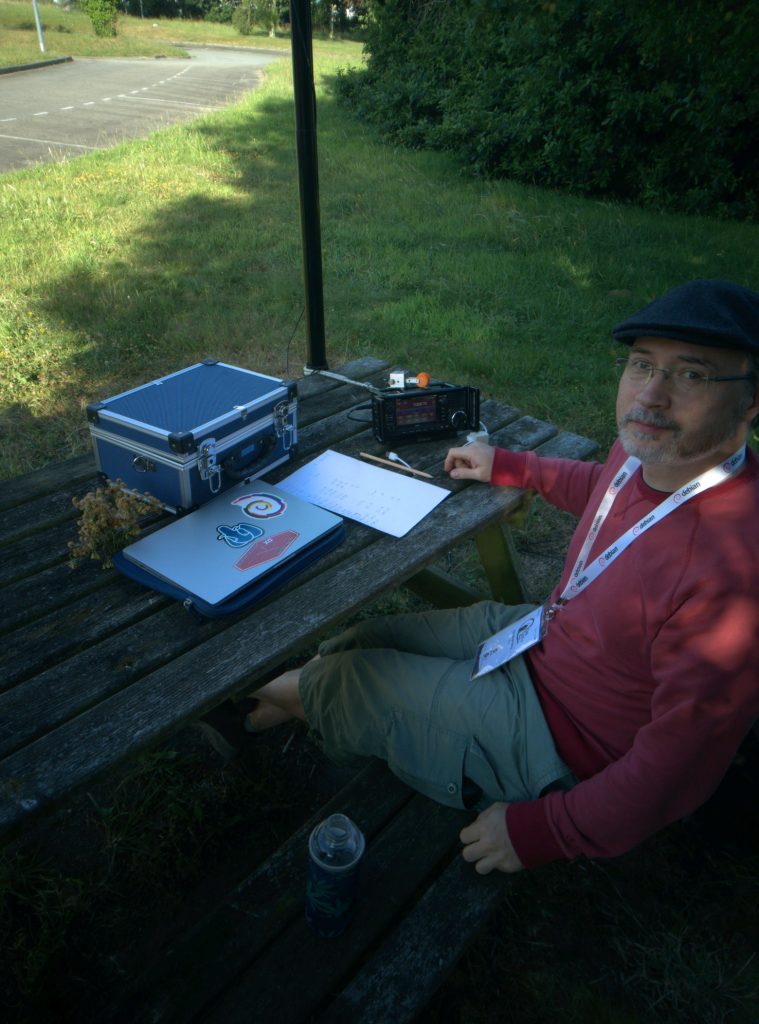 F/DF7CB in Brest (photo: Evangelos Ribeiro Tzaras)
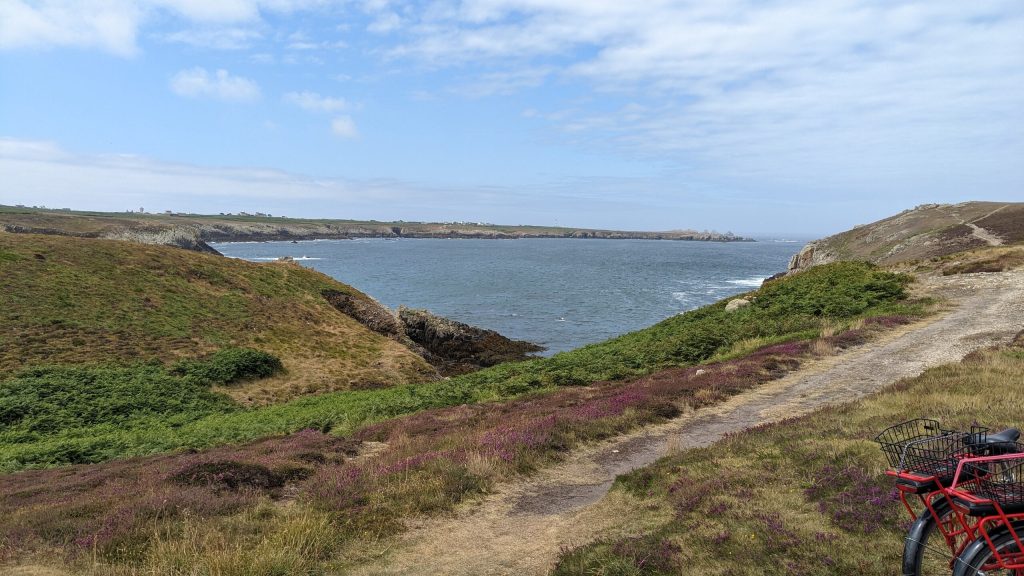 The northern coast of Ushant (photo: Christoph Berg)
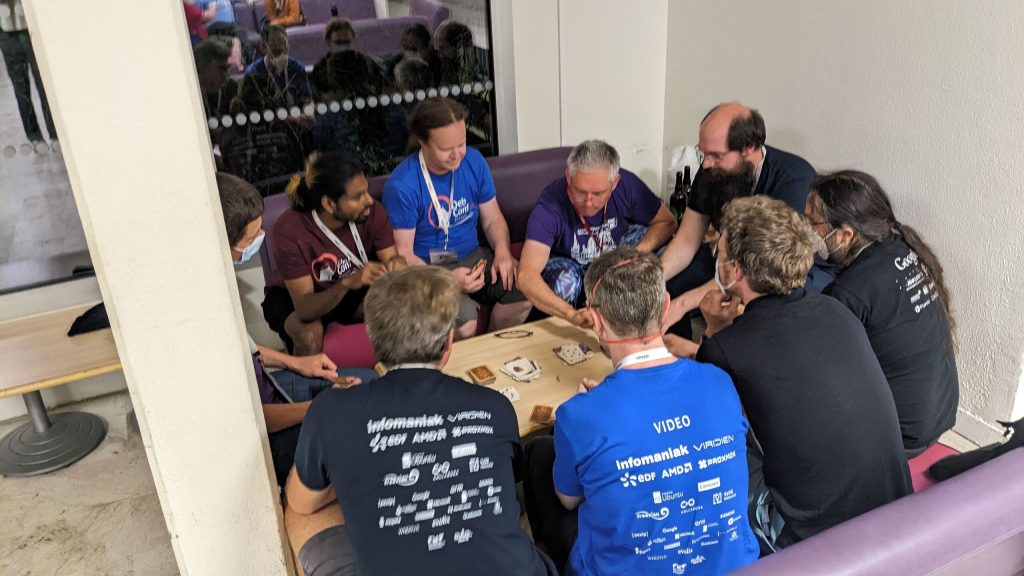 Having a nice day (photo: Christoph Berg)
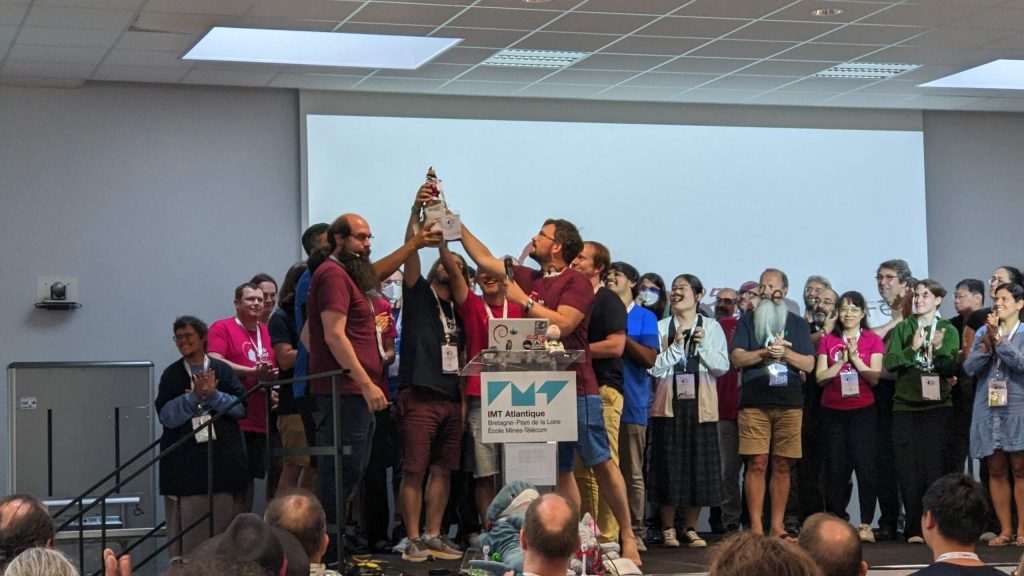 Pollito on stage (photo: Christoph Berg)