Search Results: "marv"

15 March 2009

Martin Michlmayr: SheevaPlug: the NSLU2 killer

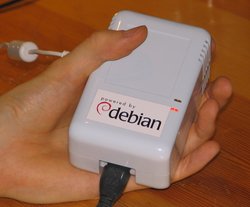
SheevaPlug in my hand I received a SheevaPlug this week, an intriguing device that packs incredible power and functionality into a tiny package. As many of you know, I've been doing a lot of work on Debian for the Linksys NSLU2 in the last few years. The NSLU2 is a key reason why ARM has become the third most popular architecture in Debian (after 32 and 64 bit x86), and I believe a main reason is that the NSLU2 is so incredibly cheap. At a price under $100, most people don't think too long and simply buy a device and do something cool with it. The SheevaPlug is being offered at the same price range but offers considerably more. Riku Voipio asked the right question: "What would you do with something approximately 10x more powerful with same prize/size range?" I believe the SheevaPlug is a killer replacement for the NSLU2 and here's why: I'm incredibly excited about the SheevaPlug and the first thing I did was to take the device apart and look at the inside. The results can be found in the SheevaPlug image gallery. My next project will be slightly more productive: porting Debian. As I see it, we should support the following three installation variants for the SheevaPlug: The first two should be relatively straight forward, but of course installing to the internal flash memory is particularly interesting given that 512 MB (plus compression) is enough for a basic installation of Debian. Unfortunately, installations to MTD flash are currently not supported in the Debian installer but I hope we can find a volunteer who wants to implement this functionality. My next steps are to put a kernel for the SheevaPlug into the archive and to get a basic installation going. From there we can look at more sophisticated installation options and other functionality.
12 March 2009

Martin Michlmayr: Debian support for QNAP TS-119 and TS-219 Turbo NAS coming

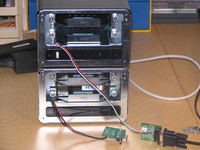
TS-219 on top of TS-209 I received a sample of QNAP's new TS-219 Turbo NAS today. The TS-119 and TS-219 devices are an upgrade to QNAP's TS-109 and TS-209 devices and were announced earlier this month at CeBIT. The new TS-219 uses the same robust case as the TS-209 but offers much more performance: The numbers I've seen about the Kirkwood CPU suggest that the TS-219 will indeed give a very significant performance boost. So far, the TS-219 looks very nice. My only complaint is that QNAP didn't export the second Ethernet port the Kirkwood chip offers, but I suspect this is because they wanted to stay as close to the original design of the TS-209 as possible. In any case, the TS-219 is a nice machine and I look forward to porting Debian to it. As a first step, this means getting the mainline kernel to run on the device and adding a kernel for Kirkwood to the archive (the latter is needed for a number of other devices based on Kirkwood anyway). Hopefully, the remaining porting work and integration into the Debian installer should be fairly straightforward given that the TS-209 is already supported in Debian. I'm sure I'll find out as I dig into the details... I'll give periodic updates of my progress. In the meantime, I've created an image gallery of the TS-219.

26 February 2009

Riku Voipio: The not-slug: SheevaPlug

popcon lists approximately 1000 arm/armel Debian installations. There is also listed 864 installations of nslu2-utils, letting us estimate that approximately 85% of debian/arm(el) installations are Linksys nslu2's. It is nicked sympathetically as "The Slug", which pretty accurately describes the performance of nslu2. Still, people have found absolutely amazing amount of ways to use their slugs. What would you do with something approximately 10x more powerful with same prize/size range?

Enter the Marvell SheevaPlug


What Slug SheevaPlug
CPU 266Mhz 1.2Ghz
Cache 32KB 32+256KB
Flash 8MB 512MB
MEM 32MB 512MB
Net 100Mb 1Gb


And that's not everything - SheevaPlug comes with SDIO slot and miniusb to be used as a serial console (and JTAG). No soldering needed for hacking.

Some more details on the LinuxDevices article.

For those of you who think that has one port too few of something, or don't like the wall-wart design, Other devices based on kirkwood SoC (which SheevaPlug is based on) are on the way from various ODM/OEM houses.

28 January 2009

Obey Arthur Liu: Debian Summer of Code 08 : Where are they now (part 2/3)

Here s for the second installment of my review of this past year s Summer of Code at Debian. See the previous part here: Debian Summer of Code 08 : Where are they now (part 1/3). I apologize for being so late at getting this second part out but I have been very busy. Still, I ll get the last part out before FOSDEM. Those of you who ever had to write a Java compiler (ok, Java subset, but the OOP part was here ) in brainfucking Ada will understand what I went through working on two of my most loathed languages. Debian NAS, improve support of Debian on NAS devices Presentation There is a large range of inexpensive Network storage devices available on the market. For some of them, such as Linksys NSLU-2 and Thecus N2100, we have added support, but there is many many more devices we could support. For this summer we look forward at supporting multiple Marvell Orion based devices (as outlined in Martin Michlmayr s talk Running Debian on Inexpensive Network Storage Devices), such as Revogear Kuro Box Pro, Buffalo Linkstation, QNAP TS-109+, If you don t have old computers lying around to turn into NAS servers, you need to sleep at night without the soothing sound of computer fans or if you actually pay your own electricity bill, you might want to have a look at standalone NAS devices. They re cheap and can be made vastly more capable by slapping a Debian on it. If you ever heard of DD-WRT, you know the spirit. The project was mentored by Riku Voipio, with help from Martin Michlmayr. The project proposal (sorry, Google cache) was introduced by Martin, who did a presentation about it the previous year at FOSDEM. Student Per Andersson was a 24 year old student working towards a MSc in computer science at Chalmers University of Technology in Sweden. He had been looking for ways to join Debian but with school still being priority one, he didn t find time to dive in. Result This project was successful. The Kurobox Pro is now supported and several useful tools were packaged to make life easier with these NAS devices. Martin Michlmayer is still working on Debian NAS related stuff. Per was happy to be invited to the Emdebian work session in Extremadura and has been active within debian, maintaining the packages he created during the Summer of Code. Cran2deb, generate Debian packages from R packages Presentation GNU R has become the preeminent platform for computing with data . The CRAN archives contain over 1300 source packages of very high-quality, and BioConductor has again almost as many focuses on bioinformatics. We want more of these in Debian, and going beyond the 50+ packages we currently have suggests more scripting and automation. R is a pretty big among statisticians and all of them they wasted no time writing their own package to work on particular research subject. It s a lot like Perl with CPAN or LaTeX with CTAN. It s always a pain to discovery that a particular R package is not wihtin Debian and having to resort to unmanaged installation of said packages. The project was mentored by Dirk Eddelbuetel. The project proposal (which is nowhere to be found but seemed to be good) was introduced by Dirk, along with another proposal he did for R. Student Charles Blundell is a research student at.. hum.. didn t do my homework about that. Anyway, you can find him around R related projects. Result This project was successful. Cran2deb is happilly turning more than 1400 of the ~1500 CRAN R packages, all with correct dependencies. The work has since been moved to R-Forge. It s working, we re almost there. We just need it to be polished and we ll get a whole bunch of new packages into Debian. Charles pinged me about the status of Cran2Deb after the previous post. He admits that he hasn t done much about cran2deb recently because of his new position as a research student but hopes to commit again to it soon. I do encourage him to get these R packages into Debian. I had to manually install some packages myself when I had to use R for school because they weren t into Debian and it s not pretty. Mergemaster, interactively merge changes in configuration files Presentation FreeBSD has a shellscript called mergemaster which is used to interactively merge changes in configuration files, based on 3-way diffs. Debian s approach to configuration file differences is much more primitive: either keep the original file, or blow it away (including all local changes) and use the Debian-provided file. It would be nice to get a system such as mergemaster into Debian. Important is to remember that Debian contains two often-used configuration file management systems: ucf, and conffiles; porting mergemaster in such a way that it will be used in both cases would be great. The handling of configuration files during upgrades has always been a little.. brutal, with the user being asked at gunpoint to make a good decision, lest the upgrade won t continue or configuration files get borked (ever tried automerging nagios configuration files?). Having a less stressful upgrade experience is a good thing since the point of Debian is to make package management a stressless thing. The project was mentored by, hum, Manoj Srivastava. I have no idea who came up at first with the proposal. UPDATE: Wouter Verhelst mailed to say that he made the original proposal. Student Max Wiehle was a physics student at the University of Heidelberg. He did a Summer of Code stint (Archive.org copy..) as a student for Beagle Project in 2006 which, I suppose, was successful. He s been active in the past with Gnome and desktop related projects. Result This project was somewhat successful. He posted an update one month into the program with repositories with code to test. Last commit to the mergecf branch of project was September 19th but it was never merged in. According to Steve McIntyre, it s dead, Jim. I couldn t find any further public involvement of Max within Debian. PAS NSS Debian Installer, improve support of PAM and NSS at install-time Presentation It would be very important for the Debian allowing the user to configure additional PAM and NSS modules (eg. LDAP, NIS) during the installation process inside the Debian Installer. To do this, we have to provide tools and helpers to modify /etc/nsswitch.conf and /etc/pam.d/common-*, as well as changing the maintainer scripts for the packages libpam-* and libnss-* to apply the required changes at install time using debconf and these helpers. To be honest, I will probably never use this. I don t do that many coordinated installs in the same place to warrant doing funny authentication with PAM and NSS, and if I did, I would probably use a more elaborate tool to personalize the install, like FAI. On the other hand, I can see the appeal of being done with authentication mechanisms before the first boot. The project was mentored by Fabio Tranchitella. The proposal came from the student. Student Juan Luis Belmonte was a computer science student. He worked in a couple of companies in the area of Sarragossa. He is now founding debug_mode=ON. Result This was quite a disappointement after seemingly good work. Although Juan was satisfied with the project, the PAM package maintainer (Steve Vorlon Langasek) was not. He was never asked about this project (but didn t intervene timely either when the accepted projects were announced though). In his words, it was the wrong solution to the problem . You can find his lenghty rationale on the wontfix bug report that resulted from the project. It really was a problem of communication with the Debian developpers since Juan could certainly have done the right work if pointed to it. Juan didn t ask thoroughly for existing work and Steve didn t publicize his (enough). That s all for now. The information is quite fragmented I admit. Most of it was pulled from Google, mailing lists, commit logs, blogs, whatever. If some projects are lacking in information here, it s because I couldn t find it readily (which is an issue in itself!). In my next post, I ll try to give a student point of view of the Summer of Code in general, and more specifically, at Debian. It will be post 2.5/3 since it s getting a little longer than I planned. Release early, release often, as the say.
If you re a student or a mentor mentioned above, feel free to fill any of the blanks in my report. It s much appreciated. You re not a student or mentor mentioned above and have an opinion on how to improve the next Debian Summer of Code ? Feel free to comment.

9 January 2009

James Morrison: Grand Canyon for new years

Sarah came up a great idea for us to do over the long, long weekend after New Years. She wanted to go to the Grand Canyon, and hike in it. I, also enjoying hiking trips, went along.

We organized the trip rather late, I think on the 27th of Dec from my parents house (I think my mom enjoys being around for trip planning since it reminds her of the trips she should plan). Given our late planning we could only get a reservation at Phantom Ranch for the night of the 1st. So the trip plan was get back to SF on 30 Dec 2008. Take bart from the airport, sleep/pack (in either order), then drive to Williams, AZ on the 31st. Take a bus the to Grand Canyon on the 1st, hike down to Phantom Ranch, sleep, hike back up to the top, see the Grand Canyon from the top. Take a bus back to Williams and drive somewhere near the Hoover Dam. Sleep. Drive, see the Hoover Dam, get to Las Vegas, and see the Cirque du Soleil show Ka. Sleep. Drive home.

So that was the plan, now for the execution. We got back to SF on time and picked up our bags from the baggage claim without any issue. The next morning we got up and moving. The optimistic hope was that we would be on the road by 8am to Williams, then stop in Fresno for gear and food. It turns out we weren't ready to go until 10, so we got hiking poles and fake crampons at the REI in SF. We also did our grocery shopping in SF. We were on the road to Williams by noon. We shared the driving Sarah took the parts with traffic, I took the 4 and two lane highways. The fortunate part about this is that I drove through the San Joaquin. One the way there, it was basically IFR conditions (I had no instruments), so I was driving through a cloud (some call it fog) and I couldn't see anything that wasn't on the road. It was really pretty but not the best for a road with lots of ups, downs and turns. I felt like a race car driver. The other interesting part (at least while I was driving) was going through the Mojave desert at sundown. I don't think Sarah has any pictures, but it was very pretty.

Finally we arrived in Williams, AZ and got to the Grand Canyon Railway Hotel, at 2345hrs, (for those counting that means we were on the road for 10h 45m). We checked in by 2358hrs on 31 Dec 2008. So we stood by the fire for two minutes, counted down, and kissed for New Years.

In the morning, things went as expected, we backed our bags to hike 10 miles, and put the rest of the stuff in the car. We got in a van that took us to the Grand Canyon. Our driver up to the Grand Canyon was very nice and showed us the sites along the way. We also met two Japanese exchange students on their way to see the Grand Canyon.

On the way was slow since we took a lot of pictures (Sarah has them all since I lots my 1GB SD card before it made its way into my camera). Unfortunatly, Sarah got tired on the way down, and also hurt her ankle. So we stumbled our way to Phantom Ranch around 1600. From the time we got to the ranch until supper at 1830, we laid back and relaxed, we needed it, our feed were sore and Sarah iced her ankle. The food at Phantom Ranch was good, not great, and there was enough of it after being on our feet all day. At end end of the day, we slept, as planned. In the morning we got up for the early breakfast. Again, it was decently, but not great, but there was enough food. Unfortunatly, Sarah was sick (She'd figured out how to deal with her ankle though) (Oh, and she isn't pregnant). So we harrassed the rangers, got some imodium, and started on our way back up the Bright Angel Trail, we took the Bright Angel Trail down and were planning on the South Kaibab trail up but the Bright Angel Trail has places to stop the South kaibab trail doesn't. Again were were planning on an early 630hrs start, but started a little later at 745hrs. We used our poles with gusto on the way back up and made it up by 1345, 6hrs on the way back up, the same time it took us to get down. The rest of the daylight hours was spent taking the village bus around the Grand Canyon village and seeing the sights from the top.

After the Grand Canyon, we drove to Kingman, stayed there, then continued on, saw the Hoover Dam, it is like Itaipu, but less political and taller, then went on to vegas. In Vegas we saw the inside of a couple hotels, I spent $1 on a slot machine, then we say Ka. Ka is an amazing show, I don't think it really suck in until after the show was over all the things the performers pulled off. That said, the stage itself was an engineering marvel that I watched almost as much as the performers.

After Vegas, the drive back was mostly uneventful, the fog in San Joaquin was a little lighter, but still heavy, Mojave is prettier at sunset and it is still good to sleep in my own bed.

26 December 2008

Chris Lamb: Unfortunately, we get parallel octaves at the end

A reel from Glenn Gould's 1955 recording of the Goldberg Variations contains the following dialogue between the 22-year-old pianist and the recording engineer after a take of the 30th variation, a quodlibet:
By the way, I have a quodlibet of my own which came to me in the bathtub the other night. One of these days I will be asked to perform on the fourth of July, I'm sure, and when I do I figured out that by leaving out the repeats in the Star Spangled Banner and starting your entry on the thirteenth bar of God Save The King and then playing God Save the King over again and altering the harmony in the second half of The King to modulate to the supertonic region, it has the most marvelous effect. Listen to this.. (202KiB Ogg Vorbis).

14 December 2008

Cyril Brulebois: First times

First time So far, so good. But after having voted in reply to a possible abuse of position, now we have a vote with another abuse of position, as pointed several times on debian-vote@. Too bad we haven t seen any reply from the DPL. Yet? In the meantime, I was pointed (thanks!) to a marvellous secretary sucking page, best viewed with a CSS3-enabled browser. Screenshot from midori follows (note that it could be even worse with konqi from experimental, at least so am I told): Secretary (page!) sucks Oh, and another first time but not Debian-related:

13 November 2008

Martin Michlmayr: Debian installer improvements for NAS devices in lenny RC1

There have been a number of improvements to the Debian installer on Network Attached Storage (NAS) devices in the last few months and they are available to users now that RC1 has been released. We have added support for Marvell's Orion platform. Orion is a system on a chip (SoC) that integrates an ARM CPU, Ethernet, SATA, USB, and other functionality in one chip. The majority of NAS devices that have come out within the last two years are based on Orion chips, so it's exciting to have support for this significant platform in Debian. Specifically, we support the following devices based on Orion: QNAP Turbo Station (TS-109, TS-209, TS-409), HP Media Vault mv2120, and Buffalo Kurobox Pro (with more to come later). Here are some other newsworthy improvements and changes: Finally, the armel port is recommended for new installations now. Debian lenny has two different and incompatible ARM ports: the old ABI port (arm) and the new EABI port (armel). Debian lenny is the last release with support for the arm port and future releases will only support the armel port. It's therefore recommended to use armel for new installations of lenny.

23 October 2008

Matthew Palmer: Porting debian-installer to the DNS-323

I've just started a new job, so I decided to take a few days holiday in between and work on something that's been on my todo list for way too long now -- making the debian-installer work on the D-Link DNS-323. After a couple of days of work, I've just finished off the install of Debian on my DNS-323, which I initiated by loading a firmware image into the web interface of the stock firmware, and then SSHing into the machine at the appropriate moment. What this means is that anyone with a DNS-323 can install Debian on it. I think that's worthy of a small, quiet "woo hoo!"... Looking back now, it seems to have been a fairly simple and straightforward operation, but I can remember that it didn't look so simple when I started a week ago. So, in the interests of perhaps short-cutting someone else's adventure into the world of d-i hacking, I'm writing everything up while it's fresh in my mind (the benefits of being on holidays -- plenty of time to write long blog posts). Alternately, if anyone has a random device they'd like to see d-i on but doesn't have the inclination to do it themselves, feel free to send me one and I'll do it for you. Before I begin, I've got a few "shout outs" (I think that's what the cool kids are calling it these days) to people who've helped me along the way. First off, Martin Michlmayr has answered innumerable dumb questions from me, and I think wrote most of the parts of d-i that I've extended -- it's fair to say that I'd have had no hope of doing this without him. Thanks also to the people in #debian-boot and #debian-arm for answering questions and putting up with my frequent bouts of self-congratulation whenever I passed the most miniscule milestone. Finally, everyone who has put work into d-i has my thanks, too -- it's not perfect, but it's a damn sight better (both to use and also to hack on) than any other installer I've ever met. So, without further ado, off we go... Work out how to get a console Unless you are a guru of unbelievable skill, you will undoubtedly not do everything quite perfectly the first time, and you'll want to see the kernel/init boot messages, and maybe in some cases try some investigation and diagnostic work. For that, you're going to have to have some sort of console access. If the device doesn't have a full screen/keyboard thing going on, the chances are you'll almost certainly end up with a serial console. A few devices have a network management thingo that will give you a console, usually over VNC or some sort of horrid Java applet, but I've only ever encountered that in rackmount servers, which have a keyboard/video interface anyway... In theory, I suppose, the kernel could provide a network console, but I've never heard of such a thing being attempted, and Google is not helping me out. I might add that to the todo list as a future hacking project... On the DNS-323, it was a serial console that was needed. Like a lot of the embedded devices I've seen, it didn't quite talk RS-232, so I needed an adapter (I got a TTL-232R-3V3 USB-to-3.3v-serial adapter from a local electronics supply place, which worked perfectly with Linux as soon as I plugged it in). I needed to solder a few wires to a connecter inside, and connect that up to the USB doohickey, but it all came good in the end. The chances are someone's done a similar job for your device of choice, so a search for things like "devicename serial console" will almost certainly pay off. Work out how to load and boot a kernel/initrd Your development work will involve booting weird kernels and initial ramdisks to make everything work; you need some way of stuffing those into the device and booting from them. Everything has a boot loader of one sort or another; working out what you've got and how to make it sing and dance is the ultimate quest here. How this is done will vary greatly from device to device; the WRT-54GL, for example, waits for a tftp connection for a couple of seconds on startup, which you can use to send a new firmware; many other devices have a boot loader that you have to explicitly control (via the console), but it will make a tftp connection out to another machine if you ask it to. Some devices you just need to load the data in via serial cable (at 115200bps it's bearable; at the 9600bps I've heard some devices work at, it would be tres painful). The DNS-323 runs uBoot as the boot loader, which will do a tftp request by default. However, D-link, or Marvell, or someone in the decision-making chain for this thing decided to knobble it and removed most of the useful commands, so sending the thing via serial port is the only option. Since writing to flash takes a pile of extra time, I found (eventually) that you can just load the data into RAM somewhere and boot from there, without needing to write it to flash (also handy to avoid wasting precious write cycles), since you can tell uBoot to boot a kernel located anywhere in the address space. Obviously you need to reload the kernel/initrd on every boot if you don't write it to flash, so if you've got a "stable" kernel or initrd that you think you'll be using for a while (when you're testing the other item) you should flash it then. One note on uBoot, that took me far too long to work out -- you can't just stuff a kernel fresh off the Makefile in and assume it'll work -- uBoot needs a special header prepended that tells it all about what you're loading (architecture, file type, compression method, etc). You "wrap" a file in this uBoot header with the "mkimage" command (in the uboot-mkimage package in Debian). Incidentally, if you need to remove the uBoot bits from a file, just strip the first 64 bytes off -- that's all the uBoot header is, so something like this will do nicely:
 dd if=file.uboot of=file bs=64 skip=1
A final uBoot warning: it's fairly important to specify a "load address" for the files; if you get them wrong, your kernel and initrd may or may not boot (I never quite got the hang of why some wrong values worked and some didn't). If your device uses uBoot, and you have the ability to extract the uBoot-enabled kernel and initrd from a vendor-provided firmware image, you can use mkimage -l to inspect what all the values need to be for your own kernels and initrds. Just stick with them. Does Debian support your hardware? Obviously, if you want to run Debian on something, Debian has to support that hardware. The easiest way to test this out is to try an install. For this, you'll need to retrieve an appropriate kernel and initrd pair for the installer. Some arches, like i386 and amd64, only have one kernel and initrd for the installer, so you just have to choose if you're going to netboot, or do a full CD install, or whatever. Other arches, though, like arm, have subtly different images for different machines. There are two reasons they vary: firstly, they often need to split into subarches, where they all share a general CPU architecture but there are enough differences in the hardware that they're not all supportable by the same kernel. At a more fine-grained level some different machines of the same sub-architecture need differently formatted firmware images to boot. On ARM, in particular, it's pretty common to need to prepend a "device ID" to the kernel image so that the kernel knows what sort of machine it's booting on, which means that every machine typically needs it's own kernel image, regardless of any other issues with firmware formats. Choosing the sub-architecture should be relatively straightforward, if you know much about the machine you're targetting. Picking a machine type can be a bit harder, but again, if you know what your boot loader needs, it shouldn't be too hard to find a kernel/initrd from the existing machines in your subarch that you can mangle to fit. Load up your kernel/initrd into the device, boot it, and see how far it gets. You might get lucky, and the kernel inits, your hard drives are detected, your NIC is initialised, and you're off and running without further ado. Or you might not be so lucky. The worst case is that the kernel doesn't even get as far as loading the initrd -- it might not print anything at all, or the kernel might hang part way through the boot. This is likely to require a fair amount of debugging fun, as initial boot failures get a bit tricky. A better situation is where the kernel boots OK, and d-i starts, but something in the install process falls over. This can either be a kernel/driver problem, or a d-i problem. Either way, since d-i has started, you're likely to be able to get a shell and do some debugging. In order to make d-i work, you need to have somewhere to install to (disks, usually) and a source of packages to install from (CD/DVD if you're on a suitably large device, or the network otherwise). These are the two key ingredients you need; most everything else is stuff that ranges between "nice to have" and "critical" for operational purposes, but which has absolutely zero impact on your ability to do the install, so we'll ignore it for now. For the DNS-323, I had a few kernel problems (which I'd been warned about by Martin before I started) -- the NIC wasn't initialised with it's MAC address, which meant it was running around my Ethernet screaming "I am 00:00:00:00:00:00! Ph33r m3!", and the SATA controller just didn't seem to exist at all. These were kinda critical to doing an install, so it was time to get hacking to make those work. There were also a couple of parts of d-i that needed tweaking -- the preseeding code didn't support the device, and I needed to package a tool to build a "complete" uploadable firmware image and teach d-i how to use it. Apart from that, though, things were looking pretty good. Make the Debian kernel support your hardware Once you've worked out what hardware you need to make work, you need to dig into the kernel and fix it. Sometimes, if you're really lucky, a kernel version newer than the one currently in Debian has better support for something, and you can backport the fix / feature improvement. Other times, there's something similar already in the kernel for a different device and you can crib off that (I did this extensively for my little fixes). Then there's the "ask an expert" school, where you find someone who knows what they're on about and pick their brain (I did a bit of that, too). Finally, there's plain old "research and development", for which there are piles of documentation already out there. My changes for the DNS-323 came to 121 added lines and 16 deleted lines, most of which was cribbed-and-tweaked from other parts of the kernel. I might have written 10-20 lines of code "from scratch". It's not always scary-hard. Cross-compiling your own kernel One thing that I think needs mentioning in the kernel hacking department is cross-compiling a modified kernel for testing purposes. Chances are your main workstation has a lot more grunt (and build tools) than whatever you're trying to get Debian onto, so cross-compilation is the way to go. You need to first grab a copy of the source you want to build (from apt-get source linux-image-blahdiblah, or a release tarball, or Linus' git repo, it doesn't really matter) and a cross-compilation toolchain. For my cross-compilation toolchain, I just added this to my sources.list:
 deb http://www.emdebian.org/debian/ unstable main
then I ran apt-get update, and installed these packages:
	binutils-arm-linux-gnueabi gcc-4.1-arm-linux-gnueabi
	gcc-4.3-arm-linux-gnueabi-base libc6-dev-armel-cross
Kudos to the emdebian team for making that such an utterly painless exercise, by the way -- the days of needing to faff round with gcc sources to get a cross-compilation toolchain are apparently over. Once you've got a source tree and a cross-compiler available, you can run any of the usual kernel make commands (like make zImage or make oldconfig), as long as you've got a couple of make variables defined. In my case, I used:
 ARCH=arm CROSS_COMPILE=arm-linux-gnueabi-
ARCH tells the kernel what architecture to build for (useful in all make commands because not all arches have the same config options in make menuconfig, for example) and CROSS_COMPILE tells the build system what to prefix the calls to gcc, ld and such with (if you installed the same cross-compiler packages as I did, you'll find it installs files like /usr/bin/arm-linux-gnueabi-gcc, so you can ls /usr/bin/*gcc to find out what you'll need for the CROSS_COMPILE setting). Hack d-i to make things work In addition to tweaking the kernel, it's quite possible that the internals of d-i might need some tuning. It's possible that d-i might need to be "taught" to recognise the hardware in your device, or you'll need to extend some aspect of the installation process to complete the installation. In order to hack d-i, you need to know a bit about how it works and how it is structured, so let's run through that first. The entireity of d-i is based around udebs, which are packages of the same format as "real" debs, but which have been built differently (against a small libc, for instance) and have had everything that isn't absolutely necessary (docs, non-essential scripts, extra functionality, etc) stripped out of them to create the smallest possible packages. There are a variety of different udebs -- most are derived from otherwise normal, law-abiding citizens of the archive, like busybox (basic unix utilities like cp and ls), the shell that's used in the installer, parted, various libraries, and so on. Others are "special", and have no big brother in the archive. These are mostly "task" udebs, that define what actually happens in the installer. When they're "installed", they have special fields in the package metadata that define where in the install sequence they go, and they end up on the menu you see if your installation goes a bit pear-shaped. The tricky thing about udebs is that, as small as they are, there's too many of them to be able to have them all available when the system first boots, so even the "setup" of the installation gets done in several stages. First, the kernel and initrd boot. The initrd contains just enough stuff to get access to the rest of the udebs, and nothing else. Even this early stage is built from udebs -- there's lists of what goes into the initrd for various architectures and flavours of installer under installer/build/pkg-list in the d-i SVN. If you need an extra udeb in your initrd, that's the place to specify it. Once the initrd has gotten access to a source of packages (off a CD, over the network, telepathy, whatever) it can drag the rest of the packages it needs from there. Space is still an issue at this point, though -- there's no diskspace yet to put anything onto, so everything needs to fit into a ramdisk. Don't go loading anything you don't need. The packages loaded at this stage are what defines most of the steps that will be done for the rest of the install, so once all those extra udebs are loaded, the remainder of the install kicks off and does it's thing. Different architectures and install methods have different requirements, too, which complicates matters. For example, when you're installing on a regular PC with screen/keyboard, you can guide the install using that. However, if you've got no screen, how can you control the install? There's serial consoles, but requiring everyone to void the warranty (more) on their little embedded doodad by installing a serial console cable to install Debian isn't so hot. So, lacking a terminal, how do you control the install? Well, on install flavours for devices that might be in this situation, you can SSH into the installer and complete it that way. That feature is, like everything else, provided in a udeb -- called network-console, as it happens. But what IP address do you connect to, and what network settings does the device use? Again, without a console you can't configure your network, and not everyone has a DHCP server (and even fewer people have a DHCP server that will hand out an address that they'll know in advance, or be able to find out). So, there's a udeb (called oldsys-preseed) that does it's best to configure your network based on the settings already in the nvram for your device. In short, there's a lot of tricky, well-thought-out shit going on inside d-i, and you might have to deal with a little bit of it. The nice thing is that by now I expect most of the really hard problems have been solved, so with a bit of luck you'll only ever have to do minor tweaking. In general, all of the packages that are "d-i specific" live in packages in the d-i SVN. If you need to modify a udeb, you need to rebuild it and put it in installer/build/localudebs/ (creating it first if need be) and every time you change it, you need to delete installer/build/apt.udeb/cache/. To give a concrete example (from the ever-present DNS-323), I had to modify oldsys-preseed so that it would get the details from the nvram that the stock firmware uses to configure itself. This, in turn, required that the minix-modules udeb be included in the initrd, because the DNS-323's nvram is actually a small minix partition stored in flash. Painfully, this required some more hacking, because the armel d-i kernel wasn't configured to generate minix-modules. That might need some explanation... Since building the kernel is a fairly massive undertaking, CPU-wise, instead of building all the udebs from scratch there's a package called kernel-wedge to split a real linux-image package into lots of little udebs. There's a separate source package for each architecture, linux-kernel-di-$ARCH-2.6, that contains the configuration data for kernel-wedge to specify what udebs need to be built, and what goes into each of them. A small tweak to the armel package and voila! I had a minix-modules udeb to include in the initrd. With the config stuff I'd done in the d-i build itself and my changes to oldsys-preseed, we were done with d-i. Tell d-i how to build your bootable artifacts If your device needs a "different" install image from other similar devices, you need to write some makefile rules to build those files. Look under the installer/build/config/$ARCH/ directory to see the various rules files available. I had to package a new tool to create uploadable firmware images for the DNS-323, along with adding a rule to use that tool to build images. None of it was particularly difficult. Polish the diamond Getting d-i working is only part of the battle; it's quite likely that there will be other hardware in the machine that needs to be supported. This could involve kernel-level stuff to interface to the hardware, or userland tools to manage the hardware. There's several bits in the DNS-323 that still need work; I can't control the LEDs on the front panel, nor the fan, and I can't use the on-board temperature sensors yet. But, I do have Debian running on the thing, which is what I was shooting for. Examples If you're interested in exactly what I did, there are a number of bugs in the BTS that contain the patches I made:

20 October 2008

Decklin Foster: And yet I swear this oath

There was a lot of political talk last week in the US about this guy "Joe the Plumber". I'm really quite mystified by the (lack of) Democratic response to this one; it seems like a perfect opportunity for the Dems to explain what their ideals actually mean, after years of complete inarticulacy. The Republican party, and conservatives in general, have somehow successfully sold their platform of, as Robert Reich brilliantly put it on the Daily Show last week, "socialism for the rich and capitalism for everyone else", to poor but socially-conservative citizens for quite some time. They've convinced people to vote against their economic self-interest, and cut taxes on the rich instead of themselves. Is voting for policies that directly benefit you less necessarily bad? I don't think so. In many cases, selflessness and altruism are better in the long run. Conservative economic policies speak to a sense of right and wrong that give people a feeling of purpose, and so an incentive to create: this is mine, I made it, you can't take it away. In a theoretical sense, leaving more wealth in the hands of the rich should "trickle down" to society in general, by providing more capital, and thus creating jobs, etc. However, I do not believe that this is why Americans, specifically, tend to support conservative economic policy. The USA has this idea of the "American Dream", pulling yourself up by your bootstraps, if you will, and striking it rich through hard work and character. It's advantageous for conservatives to sell this idea because it makes people think "tax the rich? What if I get rich?", which is a sort of enlightened self-interest, arguably. And it gets poor people to vote for them. What makes this "plumber" thing interesting to me is that is should demonstrate where this approach ought to fall down, logically and emotionally. But it does not. Here is the problem. A working stiff who earns "five figures", such as myself, generally makes that money by going to an employer every day, performing some services for them, and then drawing a paycheck. Where this money comes from is abstracted away (this is the marvelous thing we call "business"). Let's say you want to sell the "American Dream" to this person. They get their paycheck every week, and there's a chunk taken out of it by Uncle Sam. Maybe they're saving up to start a business, or go to college, etc. They sure could do it faster if taxes weren't so high. So you remind them this: when you do strike it rich (since this is America, where anyone can strike it rich), do you want those taxes to be even greater? This story contains a lie of omission, probably the greatest lie ever told in US politics, and one that has almost universally succeeded as far back as I can remember. And that is: when you do make that jump to where our hypothetical Joe is, making just over a quarter-million dollars, that it's not going to look any different. You'll get your paycheck from some abstracted source, just like before, but more will be taken out unless we stop raising taxes on those higher income brackets. There will be some node higher up in the tree for that wealth to "trickle down" from; you could say it's implied, even, that wealth is created at the root and destroyed at the leaves. What's wrong here? Simple: a self-employed plumber does not have a paycheck, except maybe to him/herself for accounting purposes. They collect their income in the form of payments from customers. They don't have an abstraction: they hire more labor and become the abstraction. If their customers have no money, the abstraction leaks, their employees have to be laid off (and then can no longer afford plumbing services themselves). The success of the plumber depends as much on how many people are able to pay them as it does on his costs (such as taxes). We want to make sure those customers can still pay. This is, in theory terms, the idea of demand-side or Keynesian economics. (Not really exactly. I took about two econ courses. But bear with me for a moment.) Now, you can argue demand-side vs. what we would call supply-side economics, which is the idea that no, first you have to stop taxing Joe so he can hire people so they have money to go buy things, for ages. People have made whole careers out of it. I am not here to do that. What I am here to wonder out loud is: why is this argument not happening, now, in our public sphere? Even if only as a small plot point in one Presidential campaign? There are very good arguments for both sides (I agree with the Keynesians, myself), and they should be what this debate is about, not digging up dirt on some guy whose real name, horrors, might not be "Joe" or protests about all those you-know-what poor people getting "government giveaways" that are disturbingly close to racism in my opinion. When I turn on talk radio I hear zombies, unable to string together any thought more complicated than "Democrat == higher taxes on everyone" (which would be depressing even if the claim were true). It begins to get unsettling when you understand your opponent's argument, and yet watch them completely unable to articulate it. When they deal with this by appealing to fear and thought-killing sound bites, it gets alarming. Obama has backpedaled whenever the whole issue has come up. In the last debate, he was saved by merely shutting up and letting out enough rope for McCain to hang himself. Not very inspiring. As a result I hear repetitions of Obama's phrase "spread the wealth around" constantly met on the airwaves with... silence. He won't touch it, and honestly, I can't blame him for not wanting to fan the flames of class warfare with only two more weeks left to stick it out. But I don't understand why, and why a single person on the left hasn't had the faith that this idea can be discussed in our society. I think that, whichever side you are rooting for (and yeah, I am for the Democrats), the Democrats should have won this point readily. Not to belabor the point, but it really amazes me that they have not. It wouldn't have taken much. Here's what you do: go to Wherever, OH with your crack PR team and find several of "Joe the Plumber"s customers. Interview them all. A few of them are, in this economy, going to be really hurting. If you're lucky: Remember that Joe owes taxes to the IRS. Very possibly, someone owes Joe money! That would be a coup. You just put them in front of the media and the whole thing sells itself. Mary needs to make these repairs... if only her tax credit were larger... etc. This would not settle the argument, by any means, especially not for political junkies. But it would begin it. We could talk about policy, whether one way of "spreading" things will result in more wealth to spread than another, instead of red-baiting. I feel a bit ripped off that we haven't even gotten that much. The theory part is pretty much irrelevant to most people; that's fine. But they deserve context. I can only assume that my ("my") party is still either terrified or stupid. I hope winning the Presidency changes that somewhat. That whole right and wrong, purpose, "noble cause" thing, right? Right, guys?

12 September 2008

Nicolas Valc rcel: It s name is (meme)

Following with the meme on Planet Ubuntu and started somehow in Planet Debian here it comes my machine names:
Current ones:
Laptop: Buster
Netbook: GogoDodo
Old Machines
Old Laptop: Marvin
Desktop: LePew
Work: LaFume
Palm: Tweety Did you already guessed what’s the patron? If not, i always take those names from here. Thank you Wikipedia for having the complete list of the Looney Tunes Characters.

Riku Voipio: Marvell 78x00 board


What we are having here is a quite non-typical ARM based motherboard. It features a pre-production version of Marvell 78x00 series ARM SoC, clocked at 1GHz. It features multiple on-board sata and gigE connectors, as well as pci-e slots and DDR2 ram slots. Fairly "meh" in x86 world, but on the ARM world most systems are designed mainly for low power consumption, tiny size and low cost. Which, while creating allows creating many exciting devices, makes finding meaty buildd's tricky. When we intruduced armel port, the security people rose the concern that arm buildd's are too slow. Especially from the security Point of view, where getting security fixes out fast is important - every second of waiting for security builds to finish someone could be exploited!

Luckily, some people from Marvell had heard about our need and arranged to donate a developer board for us!

So far, the build speed improvement, compared to our current (Thecus N2100) buildd's is very promising. When looking at build times of some slow-building packages which likely will see security uploads:


Package Thecus MV78100 HPPA MIPS
linux-2.6 39h 11h 6h 17h
webkit 17h 5h 3h 4h
qt4-x11 59h 17h 7h 13h
xulrunner 14h 4h 1.5h 3h


We see that with a Marvell board we are more in the line with other architectures. And the production hardware is going to be even faster! There is a dual-core version as well, but it's not SMP. Both cores are independent, and would basically both run their own Linux image. If manage to find a easy way to implement and manage that, we could run two theoretically run two independent buildd instances on the same board.

See the Linux Devices article for more details about the MV78x00 in general.

8 September 2008

Martin Michlmayr: Visiting Marvell in Yoqne'am

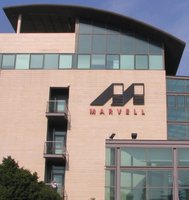
Marvell in Yoqne'am Since I'm spending the summer in Israel, I used the opportunity yesterday to visit the Marvell site in Yoqne'am where the majority of the NAS software engineering team is located. They first gave me a tour through the hardware labs which I found incredibly interesting. It's amazing what equipment those folks use to perform QA tests of new chips, how they can reverse engineer chips and even make some modifications to test their theories about hardware bugs. I found it really amazing and at the same time felt glad that changing things in software is so easy. Later they showed me the software lab where they had an exhibition of various devices based on the Orion chip, including NAS devices, but also printers, wifi APs and game machines. They also told me some details of their product roadmap but unfortunately I cannot share that information. The only thing I can say is that we'll see a lot of new devices to which it would be cool to port Debian.

12 August 2008

Joerg Jaspert: DebConf8 - And time after it

Third day of DebConf8 now - and it has been a pretty nice time since I arrived. The local orga team is doing a marvelous job, making this whole conference a really nice experience for about every attendee. Thanks to that we had a lot of time doing actual Debian work, which meant that we got a nice number of changes in dak either done or planned for the future, including a redesign of our database schema. Which is urgently needed if we want to follow some of the points we discussed. Like throwing away apt-ftparchive and generating the Packages files ourselve. Or various other enhancements. So for dak, the changes are summarised into: But we did not only do work on dak, we also did some work for the conference. In the days down here we (re)wrote the Pentabarf entrance controller, enabling our frontdesk to check people in, keeping track of various details they need to know about them. We wrote entirely new controllers for Pentabarf, one of it being the part that manages this years Assassins game. Other orga team members (hello triple des :) ) wrote a video and a volunteer controller. I guess after DebConf we will have some fun time to merge our changes back to upstream.
Travel in .ar Oh well, as some people know, I stay in Argentina for about 10 days more after DebConf is over (my flight back goes on 27. August, in the evening). Up to now I haven’t decided - or even started planning - what I do here. I should probably look at that soon. Hrm. Anyone out there doing something similar the next days? :) Comments: 0

10 August 2008

Martin Michlmayr: 2.6.26 ARM and MIPS udebs on the way...

Otavio has updated kernel-wedge in SVN to 2.6.26, so I updated ARM and MIPS today. The udebs built after minor modifications and I can also build installer images after having fixed some bugs in the build process. I tested a 2.6.26 based image on the QNAP TS-409 (armel) as well as in QEMU (mipsel). 2.6.26 will bring major improvements on ARM. Orion support is much better and our 2.6.26 has a number of patches from Marvell that help with performance on Orion. Our 2.6.26 also has Riku Voipio's LED driver for Thecus N2100 which has been accepted for the 2.6.27 mainline kernel. I haven't actually uploaded the udebs yet because I'm waiting for the go-ahead as well as for the new version of the 2.6.26 kernel package to build. But at least we're getting closer to having 2.6.26 as the kernel for lenny.

30 July 2008

Martin Michlmayr: Debian on HP mv2120 web site

I've created a web site with information for running Debian on the HP mv2120. The HP mv2120 is a NAS device based on Marvell's Orion platform and has a 500 MHz ARM CPU, 128 MB RAM and two SATA slots. All components needed to support Debian on the HP mv2120 have been integrated into Debian and Debian installer. However, a new release of the Debian installer is required so installations of Debian testing are actually possible.

28 June 2008

Martin Michlmayr: Debian support for HP mv2120: putting everything together

I managed to get my hands on a HP Media Vault mv2120, a nice ARM based NAS device, a few months ago with the intentions of porting Debian to it. Unfortunately, I have been really busy lately and most of my time was spent on adding support for the QNAP TS-109/TS-209 and TS-409 (which required a lot of generic work to get Marvell Orion support into Debian, a new SoC used in many NAS devices, including the QNAP TS-x09 and HP mv2120). There were a number of things that had to be worked out before Debian would run on the mv2120. The good news is that Marc Singer and Eugene San have done all of the heavy lifting in the last few weeks in figuring out how the mv2120 works and that now it's just a matter of putting everything together for Debian to work. Here are the issues that had to be worked out: Now that these two issues are resolved, I simply need to put everything together and add support for the mv2120 to a number of debian-installer components. We already have Orion kernel images in unstable that support the HP mv2120 (along with a number of other Orion based NAS devices) and the rest shouldn't take too long.

5 June 2008

Christian Perrier: [life] Barcelona rocks

(update with right spellings for Catalan names, thanks Guillem) So, we (Elizabeth and /me) spent four days in May-end in Barcelona...without my laptop. That was already 2 weeks ago but it took me time to cook this blog entry..:-) Indeed, we enjoyed that a lot. That city is deeply appealing and friendly, and welcoming, and etc. Elizabeth found a good, though expensive, hotel in the city center, close to La Rambla (career Junta de Comer for those who care)....but far enough from La Rambla's noise..:-) The city is of course full of tourists...just like us...but, in some way, it absorbs the "load" very well and it doesn't look like the Touristorama that Paris turns into from May to September, for instance. It probably comes from the city having several interesting places to go without hard "hot spots" where all international buses of hurried folks run around like a sheep cattle...:-) Of course, we went to the "famous" places and, well, we enjoyed them a lot. For instance, the city hot spot, namely La Sagrada Familia... I wouldn't really have guessed that I would enjoy it that much. I was expecting something crazy and full of religious crap, just like Paris' "Sacre Coeur". I actually found a marvel of modern architecture. The portal of Passion is....astonishing and its modern sculpture framework is full of emotion. The inside, though still under huge work left me thrilled. That forest of pilars, the size of the ceiling and the elegance of all this is....wonderful. Really, I hope I'll live enough to see the end of this. We spent more than 4 hours there... La Rambla is as well somethign one has to enjoy. Of course full of crappy tourist-oriented stuff....but also a really living place and a place where one just want to "ramble on". We visited Park G ell on Friday with the best weather we had. Just sitting there on the terrace and enjoy the sun and some music by a quite good trumpetist was a great first introduction to the week-end. We wandered a long time around Montjuich hill, enjoying the view on the city. Definitely a place I would love running in if I was a Catalan. We also wandered through Gr cia which was a separate village in the past, though close to city's center. Nice walk in small places. Go there on evenings. The Musuem of the City's history is also a place to go. Great visit of remainings of the Roman and post-Roman city, under places just near to the cathedral. We were also lucky to see the Corpus Christi procession with Giants and related things (interrupted by rain, unfortunately) as well as attend a local "sardane" contest on a small place close to the cathedral on Saturday. Just friendly and nice being sitting there. We also went on some event I have no idea about, which featured some kinds of "fratenities" of people in a procession, with many giant flags (I mean *really giant*: about 5-8 meters high and held by one single person). We followed them for 1-2 kms in the avenues around the University after seeing them from the bus...:-) Barcelona's transport system is great. We had the great idea to buy "Barcelona cards" which just give you free access to bus, trains, metro, tram and several reduced fees to museums and such other places. This way, we could go around the city without walking too much and be too tired... If you do so some day, just use busses. They go everywhere, are very fast and they come often, even on Sundays. The metro is faster but you don't see the city. My favourite bus line is 24. Another option is the bicycle rental system. It seems fairly easy to use and, just like Paris V'lib, you find bicycles everywhere. Just remember that you'll ride in Spain (the same stands for Paris...) so buy eyes for all around your head. I still have so many things to say about Barcelona, but I want to complete that blog entry. In short, go there and enjoy. It deserves it. Ah, and if you live in Barcelona (and are not veg'), just try the "Biblioteca" restaurant in Junta de Comer o (I hope I remember the name well...anyway there are not that many restaurants in that street). We went there two nights in a row just because we wanted to try more stuff from their great menu..:-).

6 March 2008

Ondřej Čertík: Sage Days 8

Between February 29 and March 4, 2008 I attended the Sage Days 8, hosted at the Enthought headquarters in Austin, Texas. This was my 5th time in the USA and it was a marvelous experience, as with all my visits in the states.

As usual, I had some adventures in Atlanta, that interested readers can find at the end of this post. Anyway, on the Austin's airport I met Peter and his wife Crystal, Fernando, Benjamin, Jarrod, Eric and Clement. We went to have a dinner and then me and Clement were staying at Peter's house:


You can see the neighbor's cat and Peter's dog Trinity behind the window. The next day we went to Enthought, that was providing us with a breakfast and a lunch each day - and it was delicious. After the breakfast, we gathered in the room and introduced ourselves. Enthought rents 3/4 of the 21th floor in the Bank of America building, so when I looked left I saw:


When I looked behind I saw:


and in front of me, I saw all the participants (I took photos of all participants together with names). As you can see, there were really good people in there, like Travis (creator of NumPy), William (main author of Sage), Eric (CEO of Enthought), Fernando (author of IPython), Jarrod (the release manager of SciPy), Michael (the release manager of Sage) etc. See also the Fernando's welcome speech and the video of each of us introducting himself.

The views from the windows are terrific. I enjoyed working on each of the 4 sides of the skyscraper with completely different scenery, or when the sun is going down, that's also very cool.

We spent the whole Friday doing presentations, some of which you can find here. Then we went to Eric's house to have a big dinner together.

On Saturday, Sunday and Monday we were all hacking on many different things. I joined Fernando, Benjamin, Brian and Stefan on ipython1, Travis was implementing a new type (gmp integer) in NumPy, William wrote a manipulate command in Sage, Eric did the same in Traits, Gary and Michael implemented parallel testing of Sage, ...

On Tuesday we had final status reports and people left in the afternoon. In the evening we went with Clement to have a dinner and then we visited some bars on the 6th street, having a beer in each.

On Wednesday I visited John and Roy from the Computational Fluid Dynamics Lab at the University of Texas, Austin, who wrote the libMesh library, that I extensively used and also created a Debian package of. It was very influential to see the libMesh "from behind", also John and Roy are cool people (not mentioning the Debian tradition of having good relations with upstream:). Then I visited some professors at the same campus, after which I went into the Capitol and then I took the bus to the Barton Creek Square Mall to buy some ipods and jeans, so that I can say I have jeans from Texas. BTW, the ipod works excellent in Debian - I plugged it in and it just shows on my Gnome desktop. It's true that naively dragging mp3 files on it didn't make it play, but these instructions made it work.

On Thursday I fixed the remaining release blockers in SymPy and made a new release. In the evening, I am going to meet Aswin, he also uses SciPy and also is a friend of Kumar, who is now maintaining python-numpy and python-scipy Debian packages with me (Kumar also knows Prabhu, the author of Mayavi2 hosted at Enthought, so it's all connected).

Anyway, the whole workshop was an excellent experience for me. I learned a lot of new things and being able to speak with people who wrote tools that I use almost everyday is important. We also extensively discussed the future of all the projects (Sage, SciPy, NumPy, IPython, Cython, SymPy). See my summarizing email to the SymPy mailinglist.

Another thing, that I find very interesting is that Microsoft is financing the windows port of Sage, that will make basically anything that uses Python/Cython/C/Fortran very easy to install on windows (just a spkg package in sage). I find it really cool that MS is not only supporting but even financing a truly opensource project.

Finally the promised adventure in Atlanta: we took off the Prague airport on February 28th with a 2 hours delay (due to some paperwork as we were told by the captain). As I had 3 hours in Atlanta for the connection to Austin and I had to go through immigration, it was clear that I'll miss it. But I was not surprised, last time I was flying through Atlanta, they canceled my flight to LA completely. We arrived in Atlanta an hour and a half before my departure, then I was waiting for about an hour at immigration, it was incredibly slow. When I had around 20 min to departure, I had to ask people standing in front of me if they let me in, they were very nice and did. I was leaving immigration 10 min to my departure, then I was running to get my luggage and myself through customs and screening, it was 5 min to my departure when I ran down to the display with departure times. Then I was sprinting like hell to the terminal D to only see the clerk doing some final paperwork with all the people already boarded and the jetway door shut. After a little persuading he let me in too, fortunately there was still one seat left, so I made it. You can imagine my pleasant surprise in Austin when I discovered, that my luggage made it too, considering that I handed it to the Atlanta's airport personnel exactly 10 min prior the departure.

17 February 2008

Matthew Garrett: Boston

Back in the US, crashing with [info]kernelslacker and marvelling at the fact that Snoop Dogg has a reality TV show on bringing up kids. It also seems that the cosmetics industry has solved the cancer problem, based on the number of adverts that show magic moisturiser molecules appearing to repair DNA.

Leaving on Tuesday, some potential for booze on Monday. I'll be at FOSDEM from Friday, and ought to be at Bossa next month. April sees LRL US and power management or laptops or some sort of hangover-inspired song and dance interpretation of the driver model.

(Edited: cancer problem, not cancer industry. Sometimes I wonder about myself)

Next.

Previous.