Search Results: "mako"

16 November 2012

Paul Tagliamonte: pathfinding debian's social connections

As a followup to my toy over at debtree, I ve taken some suggestions from my buddy Arno and found some time in the hotel during a visit for work up to Canada with the Open North folks hacking on open13. The hack is called debfriends (I need to purge personal details from the source tree before I can push it to VCS, since it uses the nm.d.o dump. Sorry, I should have been better about that.) I ve posted a cute front-end on my staging machine to play with over at graph.lucifer.pault.ag There s also an API, but it has all the data in the NM dump exposed. If you re a DD who will treat this data right, I can add a key (it s not secure, like, at all). I m going to publish the source ASAP so that others can stand up an instance if they d like. It s a cute toy, though! In the tradition of using nhandler for my examples, here s an example path from pabs to Nathan: pabs > nhandler Also, we re a shockingly well connected bunch. Well done :) Feel free to play with it!

31 October 2012

Benjamin Mako Hill: Time to Boot

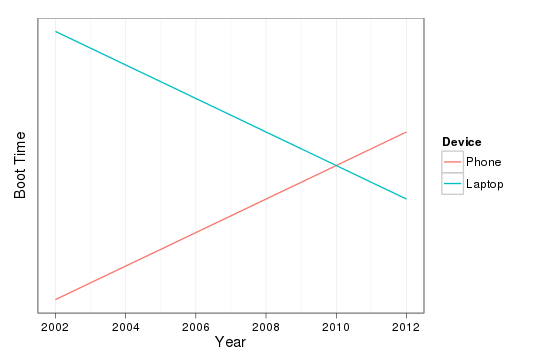
Last weekend, my friend Andr s Monroy-Hern ndez pointed out something that I've been noticing as well. Although the last decade has seen a huge decrease in the time of it takes to boot, the same can not be said for the increasing powerful computer in my pocket that is my phone. Graph showing increasing boot-times for phones and decreasing boot-times for laptops. As the graph indicates, I think my cross-over was around 2010 when I acquired an SSD for my laptop.

22 October 2012

Benjamin Mako Hill: Lookalikes

The seal of the National Intellectual Property Rights Coordination Center declares "Protection is Our Trademark." But, is the same seal violating Nintendo's trademark for the Pok mon Zapdos? I'll let you decide. /copyrighteous/images/niprc_zapdos_lookalike.png Thanks to Tomas Reimers for catching this one. Previous lookalikes here and here.

27 September 2012

Benjamin Mako Hill: Pregnant with Suspense

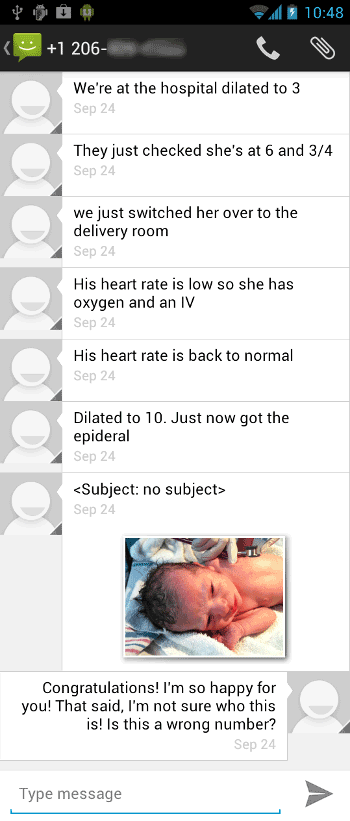
A couple days ago, I woke up to this exciting series of text messages from a unfamiliar phone number. Text messages describing the birth of a child, a picture of a newborn, and a response at the end asking who it is and if it was a wrong number. Because I've not received a reply in the last couple days, because it was a Seattle phone number but I haven't lived in Seattle for years, and because I don't know of anyone in Seattle who was about to give birth, I'm pretty confident that this was indeed a case of misdirected text messages! But whoever you are: Congratulations! I know it was a mistake, but that really made my day!

2 September 2012

Benjamin Mako Hill: Open Brands

In late July, the Awesome Foundations invited me to participate in an interesting conversation about open brands at their conference. Awesome is a young collection of organizations struggling with the idea of if, and how, they want to try to control who gets call themselves Awesome. I was asked to talk about how the free software community approaches the issue. Guidance from free software is surprisingly unclear. I have watched and participated in struggles over issues of branding in every successful free software project I've worked in. Many years ago, Greg Pomerantz and I wrote a draft trademark policy for the Debian distribution over a couple beers. Over the last year, I've been working with Debian Project Leader Stefano Zacchiroli and lawyers at the Software Freedom Law Center to help draft a trademark policy for the Debian project. Through that process, I've come up with three principles which I think lead to more clear discussion about whether a free culture or free software should register a trademark and, if they do, how they should think about licensing it. I've listed those principles below in order of importance. 1. We want people to use our brands. Conversation about trademarks seem to turn into an exercise in imagining all the horrible ways in which a brand might be misused. This is silly and wrong. It is worth being extremely clear on this point: Our problem is not that people will misuse our brands. Our problem is that not enough people will use them at all. The most important goal of a trademark policy should be to make legitimate use possible and easy. We want people to make t-shirts with our logos. We want people to write books about our products. We want people to create user groups and hold conferences. We want people to use, talk about, and promote our projects both commercially and non-commercially. Trademarks will limit the diffusion of our brand and, in that way, will hurt our projects. Sometimes, after carefully considering these drawbacks, we think the trade-off is worth making. And sometimes it is. However, projects are generally overly risk averse and, as a result, almost always err on the side of too much control. I am confident that free software and free culture projects' desire to control their brands has done more damage than all brand misuse put together. 2. We want our projects to be able to evolve. The creation of a trademark puts legal power to control a brand in the hands of an individual, firm, or a non-profit. Although it might not seem like such a big deal, this power is, fundamentally, the ability to determine what a project is and is not. By doing this, it creates a single point of failure and a new position of authority and, in that process, limits projects' ability to shift and grow organically over time. I've heard that in US politics, there is no trademark for the terms Republican or Democrat and that you do not need permission to create an organization that claims to be part of either party. And that does not mean that everybody is confused. Through social and organizational structures, it is clear who is in, who is out, and who is on the fringes. More importantly, this structure allows for new branches and groups outside of the orthodoxy to grow and develop on the margins. Both parties have been around since the nineteenth century, have swapped places on the political spectrum on a large number of issues, and have played host to major internal ideological disagreements. Almost any organization should aspire to such longevity, internal debate, and flexibility. 3. We should not confuse our communities. Although they are often abused, trademarks are fundamentally pro-consumer. The point of legally protected brands is to help consumers from being confused as the source of a product or service. Users might love software from the Debian project, or might hate it, but it's nice for them to be able to know that they're getting "Debian Quality" when they download a distribution. Of course, legally protected trademarks aren't the only way to ensure this. Domains names, internal policies, and laws against fraud and misrepresentation all serve this purpose as well. The Open Source Initiative applied for a trademark on the term open source and had their application rejected. The lack of a registered trademark has not kept folks from policing use of the term. Folks try to call their stuff "open source" when it is not and are kept in line by a community of folks who know better. And since lawyers are rarely involved, it is hardly clear that a registered trademark would help in the vast majority of these these situations. It is also the case that most free software/culture organizations lack the money, lawyers, or time, to enforce trademarks in any case. Keeping your communities of users and developers clear on what is, and what isn't, your product and your project is deeply important. But how we choose to do this is something we should never take for granted.

25 August 2012

Benjamin Mako Hill: Visions of the Future

This vision of the future at Sam's No. 3 in Denver suggests that we will have ample blackboards after the apocalypse. Dell monitor re-purposed as a blackboard. And that the contrast will be greatly improved in direct sunlight.

10 August 2012

Benjamin Mako Hill: A Model of Free Software Success

Last week I helped organize the Open and User Innovation Conference at Harvard Business School. One of many interesting papers presented there was an essay on Institutional Change and Information Production by Fabio Landini from the University of Siena. At the core of the paper is an economic model of the relationship between rights protection and technologies that affects the way that cognitive labor can be divided and aggregated. Although that may sound very abstract (and it is in the paper), it is basically a theory that tries to explain the growth of free software. The old story about free software and free culture (at least among economists and many other academics) is that the movements surged to prominence over the last decade because improvements in communication technology made new forms of mass-collaboration -- like GNU/Linux and Wikipedia -- possible. "Possible", for these types of models, usually means profit-maximizing for rational, profit-seeking, actors like capitalist firms. You can basically think of these attempts as trying to explain why open source claims that free licensing leads to "better quality, higher reliability, more flexibility, lower cost" are correct: new technology makes possible an open development process which leads to collaboration which leads to higher quality work which leads to profit. Landini suggests there are problems with this story. One problem is that it treats technology as being taken for granted and technological changes as effectively being dropped in from outside (i.e., exogenous). Landini points out that software businesses build an enormous amount of technology to help organize their work and to help themselves succeed in what they see as their ideal property rights regime. The key feature of Landini's alternate model is that it considers this possibility. What comes out the other end of the model is a prediction for a multiple equilibrium system -- a situation where there are several strategies that can be stable and profitable. This can help explain why, although free software has succeeded in some areas, its success has hardly been total and usually has not led to change within existing proprietary software firms. After all, there are still plenty of companies selling proprietary software. In Landini's model, free is just one of several winning options. But Landini's model raises what might be an even bigger question. If free software can be as efficient as proprietary software, how would anybody ever find out? If all the successful software companies out there are doing proprietary software, which greedy capitalist is going to take the risk of seeing if they could also be successful by throwing exclusive rights out the window? In the early days, new paths are always unclear, unsure, and unproven. Landini suggests that ethically motivated free software hackers provide what he calls a "cultural subsidy." Essentially, a few hackers are motivated enough by the ethical principles behind free software that they are willing to contribute to it even when it isn't clearly better than proprietary alternatives. And in fact, historically speaking, many free software hackers were willing to contribute to free software even when they thought it was likely less profitable than the proprietary alternative models. As Landini suggests, this group was able to build technological platforms and find new social and business arrangements where the free model actually is competitive. I think that the idea of an "cultural subsidy" is a nice way to think about the important role that ethical arguments play in movements like free software and free culture. "Open source" style efficiency arguments persuade a lot of people. Especially when they are true. But those arguments are only ever true because a group of ethically motivated people fought to find a way to make them true. Free software didn't start out as competitive with proprietary software. It became so only because a bunch of ethically motivated hackers were willing to "subsidize" the movement with their with their failed, and successful, attempts at free software and free culture projects and businesses. Of course, the folks attracted by "open source" style superiority arguments can find the ethical motivated folks shrill, off-putting, and annoying. The ethically motivated folks often think the "efficiency" group is shortsighted and mercenary. But as awkward as this marriage might be, it has some huge upsides. In Landini's model, the ethical folks can build their better world without convincing everyone else that they are right and by relying, at least in part, on the self-interest of others who don't share their principles. Just as the free software movement has done. I think that Landini's paper is a good description of the critically important role that the free software movement, and the FSF in particular, can play. The influence and importance of individuals motivated by principles can go far beyond the groups of people who take an ethical stand. They can make involvement possible for large groups of people who do not think that taking a stand on a particular ethical issue is even a good idea.

26 July 2012

Benjamin Mako Hill: User Innovation on NPR Radio

I was invited onto NPR in Boston this week for a segment on user innovation alongside Eric von Hippel (my advisor at MIT) and Carliss Baldwin from Harvard Business School. I talked about innovation that has happened on the CHDK platform -- a cool firmware hack for Canon cameras example I use in some of my teaching -- plus a little bit about free software, the democratization of development and design tools, and a little bit about user communities that LEGO has cultivated. I would have liked the conversation and terminology to do more to emphasize user freedom and free software, but I'm otherwise pretty happy with the result. The segment will be aired again on NPR in Boston this weekend and is available on the WGBH website.

9 July 2012

Benjamin Mako Hill: Wiki Conferencing

I am in Berlin for the Wikipedia Academy, a very cool hybrid free culture community plus refereed academic conference organized, in part, by Wikimedia Deutschland. On Friday, I was very excited to have been invited to give the conference's opening keynote based on my own hybrid take on learning from failures in peer production and incorporating a bunch of my own research. Today, I was on a panel at the conference about free culture and sharing practices. I'll post talks materials and videos when the conference puts them online. I will be in Berlin for the next week or so before I head to directly to Washington, DC for Wikimania between the 11th and 15th. I'll be giving three talks there: Between then and now, I'm taking the next week in Berlin to catch up on work, and with friends. If you're in either place and want to meet up, please get in touch and lets try to arrange something.

Benjamin Mako Hill: The Global Iron Blogger Network

Since last November, I've been participating in and coordinating Iron Blogger: a drinking club where you pay $5 to a "beer" pool if you fail to blog weekly. The revival of Iron Blogger in Boston has been a big success. Even more exciting, however, is that Iron Blogger concept has spread. There are now two other Iron Blogger instances: in San Francisco coordinated by Parker Higgens, and in Berlin run by Nicole Ebber and Michelle Thorne. Yesterday, we convened a virtual meeting of the Global Iron Blogger Council (i.e., an email thread) and we all agreed a new on iron blogger rule that might sweeten the deal for jet-setting prospective Iron Bloggers: any paid-up member of any Iron Blogger club can attend meet-ups in any other Iron Blogger cities if they happen to be in town for one. Because We Are One. If you want to join us in Boston, we have some room through attrition. Rust bloggers, perhaps? If you'd like to join, you should contact me. And if you'd like to set up your own in a different city, the code is in git. One warning, however. As those of us that have set it up have figured out, the documentation for the software to run Iron Blogger is between poor and non-existent. If you do want to set up your own instance, please get in touch. I'm happy to give you some pointers that you'll probably need but, more importantly, I'd like to work with the next brave soul to put together documentation of the setup process along the way.

2 July 2012

Benjamin Mako Hill: Wiki Conferencing

I am in Berlin for the Wikipedia Academy, a very cool hybrid free culture community plus refereed academic conference organized, in part, by Wikimedia Deutschland. On Friday, I was very excited to have been invited to give the conference's opening keynote based on my own hybrid take on learning from failures in peer production and incorporating a bunch of my own research. Today, I was on a panel at the conference about free culture and sharing practices. I'll post talks materials and videos when the conference puts them online. I will be in Berlin for the next week or so before I head to directly to Washington, DC for Wikimania between the 11th and 15th. I'll be giving three talks there: Between then and now, I'm taking the next week in Berlin to catch up on work, and with friends. If you're in either place and want to meet up, please get in touch and lets try to arrange something.

4 June 2012

Benjamin Mako Hill: Why Facebook's Network Effects are Overrated

A lot of people interested in free software, and user autonomy and network services are very worried about Facebook. Folks are worried for the same reason that so many investors are interested: the networks effects brought by hundreds of millions of folks signed up to use the service. Network effects -- the concept that a good or service increases in value as more people use it -- are not a new problem for free software. Software developers target Microsoft Windows because that is where the large majority of users are. Users with no love for Microsoft and who are otherwise sympathetic to free software use Windows because programs they need will only run there. Folks worried about Facebook are afraid for similar reasons. Sure, you can close down your Facebook account and move to Diaspora. But who will you talk to there? You can already hear people complaining about Facebook the same way they've been complaining about Windows or Office for years. People feel that their hands are tied and that their software, and their social network, will be determined by what everybody is doing. I'm worried about Facebook. But I'm not too intimidated by Facebook's network effects for two reasons. First, using Facebook doesn't preclude using anything else. Twitter has enormous overlapping functionality with Facebook. Sure, people use the systems very differently. But they both ask you to create lists of friends and followers and are designed around sending and receiving short status messages. Millions of people do both and both systems are thriving. For the millions of people who use both Facebook and Twitter, the two services have had to negotiate their marginal utility in a world they share with the other one. People decide that Twitter is for certain types of short messages and Facebook is for others. But these arrangements shift over time. And the relationships between services aren't always peaceful coexistence. Remember Friendster? Remember Orkut? Remember Tribe? Remember MySpace? MySpace, and all the others, are great examples of how social networks die. They very slowly fade away. MySpace users signed up for Facebook accounts and used both. They almost never just switched. Over time, as one platform became more attractive than the other, for many complicated reasons, attention and activity shifted. People logged in on MySpace less and Facebook more and, eventually, realized they were effectively no longer MySpace users. Anyone that has been on the Internet long enough to watch a few of these shifts from one platform to another knows that they're not abrupt -- even if they can be set in motion by a particular event or action. Users of social networking sites simply don't have to choose in the way that a person choosing to boot Windows and GNU/Linux does. I'm sure the vast majority of people with Diaspora accounts use Facebook actively. This is not a problem for Diaspora. It is how Diaspora -- or whatever else eventually achieves what many of us hoped Diaspora would -- could win. Second, Facebook is for the ephemeral. Facebook is primarily used for information that was produced very recently. This week if not today. If not this hour. Facebook has an enormous amount of data that users have fed it that may be hard to get out and move somewhere else. But most people don't care very much about having any regular access to the large majority of this information. What people care deeply about is having access to the data that they and their friends created today. And that data can just as easily be created somewhere else tomorrow. Or, with the right tools, created just as easily in both places. Compare this to something like Windows where moving away would require learning, converting, and perhaps even writing, new software. Perhaps even in new programming languages that most developers don't know yet. Compared to Windows, a migration away from Facebook will be easy. Facebook's photo galleries are an example of an important place where this holds less well. Social network information -- i.e., the list of who is friends with who -- is another example of something that is persistently valuable. That said, people really enjoy the act of finding and friending. Indeed, this process was part of the initial draw of Facebook and other social networks. None of this means that Facebook is over. It doesn't even mean that its ascendancy will be slowed. What it does mean is that Facebook is vulnerable to the next thing more than many technology firms that have benefited from network effects in the past. If users are given compelling reasons to switch to something else, they can with less trouble and they will. That compelling reason might be a new social network with better features or an awesome distributed architecture that allows freedom for users and the ability of those users to benefit from new and fantastic things that Facebook's overseers would never let them have and without the things Facebook's users suffer through today. Or it might be a sexier proprietary box to store users' private information. It doesn't mean that I'm not worried about Facebook. I remain deeply worried. It's just not very hard for me to imagine the end.

14 May 2012

Benjamin Mako Hill: Date Arithmetic

When I set an alarm, my clock, now running on the computer in my pocket, is smart enough to tell me how much time will pass until the alarm is scheduled to sound. This has eliminated the old problem of sleeping past meetings before being surprised by an alarm precisely half a day after I had originally planned to wake. The price has been having to know exactly how little I will sleep: a usually depressing fact that had previously been obscured by my difficulty doing time arithmetic in my most somnolent moments.

Benjamin Mako Hill: Diamond Clarity

I3 I2 I1 SI2 SI1 VS2 VS1 VVS2 VVS1 IF FL
The GIA diamond clarity scale, shown above, is rather opaque.

12 April 2012

Benjamin Mako Hill: My Setup

The Setup is an awesome blog that posts of interviews with nerdy people that ask the same four questions:
  1. Who are you, and what do you do?
  2. What hardware are you using?
  3. And what software?
  4. What would be your dream setup?
I really care about my setup so I am excited, and honored, that they just posted an interview with me! I answer questions about my setup often so I tried to be comprehensive with the hope that I will be able to point people to it in the future.

5 April 2012

Benjamin Mako Hill: OH Man!

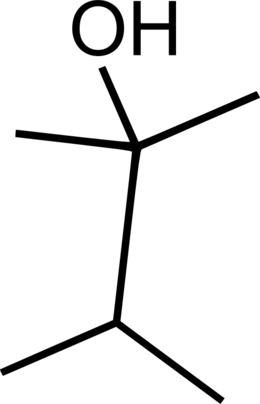
Since installing a whiteboard in our kitchen, conversations at the Acetarium have been moving in new and interesting directions. For example, Mika and I recently noticed that, when rotated correctly, the skeletal formula for 2,3-dimethyl-2-butanol looks pretty friendly! /copyrighteous/images/2,3-dimethyl-2-butanol-clean.png

19 March 2012

Benjamin Mako Hill: A Manhattan Project for Clich Collection

This weekend, I launched an extremely ambitious effort to collect evidence of extremely ambitious efforts. The result was a short program that searched the web and revealed the: [Previously in this series: frailty, the invisible hand, science as dance.]

6 March 2012

Benjamin Mako Hill: Half the Battle Against DRM

As the free software and free culture movements have sat quietly by, DRM is now well on its way to becoming the norm in the electronic book publishing industry. The free culture movement has failed to communicate the reality of DRM and, as a result, millions of people are buying books that they won't be able to read when they switch to a different model of ebook reader in the future. They are buying books that will become inaccessible when the DRM system that supports them is shut down -- as we've already seen with music from companies including Wal*Mart, Yahoo, and Microsoft. They are buying books that require that readers use proprietary tools that lock them out from doing basic things that have always been the right of a book owner. Some anti-DRM advocates are, indirectly, part of this problem as they buy these books and turn to shady methods of stripping the DRM. Buying DRMed books is voting with your wallet for a system that criminalizes those that insist on living in freedom and will screw us all in the long run when DRM is the only choice we are offered and removing the DRM is difficult, unsafe, and illegal. Buying non-DRMed e-books is a more freedom-friendly alternative for those that, like me, are excited about not lugging kilograms of paper around our cities and the world. We can do this at "non-mainstream" publishers like Smashwords who explicitly reject DRM. Of course, the big ebook sellers like Amazon, and Barnes and Nobel, and Google all offer non-DRMed books. But none of the major ebook retailers explicitly reveal the DRM status of locked down books before purchase. On Amazon, there are some cryptic signs and signals that, if you understand them, suggest the absence of DRM. Google and Barnes and Nobel currently offer no way to know if a book is DRMed without buying it first and questions in their support forums go unanswered. It's hard to support non-DRM alternatives when we can't recognize them. It's hard to tell people to not buy DRM ebooks if we can't even tell them apart. Getting this message through to book buyers -- and perhaps even to ebook retailers -- seems like a critical first step.

5 March 2012

Benjamin Mako Hill: Unhappy Birthday Hall of Shame

/copyrighteous/images/no_happy_bday.png I roll my eyes a little when I think that Unhappy Birthday is the document I have written that has been read by the most people. The page -- basically a website encouraging people to rat on their friends for copyright violation for singing Happy Birthday in public -- has received millions of page views and has generated tons of its own media (including a rather memorable interview of CBC's WireTap). At the bottom of the page I am listed, by name and email, as the "copyrighteous spokesman" for the initiative. And since the page has been online, I have received hate mail about it. Constantly. Since the email only goes to me, I thought it might be fun to share some of these publicly. All these messages are quoted verbatim but I have not included the senders' names. Be warned: the language is often salty. This email is years old now but it is probably still my favorite:
Atrocity and strife run rampant in this world. Babies are abandoned in dumpsters. Teachers molest students. Impoverished Indonesians make sneakers for pennies while the spoiled jackhole in the 30-second commercial makes millions for sinking a three-pointer and smirking at the camera. Forms of religion are interpreted as to compel people to strap explosives to their chest and board buses full of innocents. Boss Tweeds embezzle and get severance pay while John Q. Workingman gets put out on the street when the corporation goes belly up. Out of all these indignities and countless others I haven't the time to mention, why do you make it your personal crusade to assist in the flagrant persecution of family restaurants for partaking in the time-honored tradition of singing "Happy Birthday"? God forbid these foul brigands bend copyright law in order to bring a smile to somebody's face. Food for thought...without the accompanying song.
Many others strike a defiant, if less poetic, tone:
Good luck! There are millions of us who refuse to accept the ridiculous "copyright" on Happy Birthday. If Time Warner were an ethical company rather than a greedy megacorp they would do something truly special and release it into the public domain. There are some things in this world more important than money.
Quite a few people notice that my last name is Hill and suspect that I must be related to the Hill sisters who originally penned the song. I'm not, to my knowledge, although since Time Warner bought the rights, it's not clear it would matter:
I am writing to just let you know how disappointed I am that a large corporation and others (like the HILL family) are making $2 million plus for a song that was created over 100 years ago with noone knowing who created the lyrics! None of us at our place of employment could believe this and we certainly won't encourage people to send money to ASCAP. It is a shame that ASCAP license fees aren't used to pay more to up-and-coming artists who I'm sure need this money alot more than Time Warner. We all plan to sing Happy Birthday MORE now in public places and if anyone asks if it is copyrighted we will say "of course not". Maybe this way the song will not die out completely as more and more other "birthday" songs are being sung. It would also be nice if your website cited whose opinion is writing the piece and your obvious conflict of interest.
Or another:
Is it a coincidence that your last name is the same as the last name of the authors of the song "Happy Birthday?" You seem to have a personal monetary motive for your work with the "grassroots project" you call Unhappy Birthday, and if you do not, your concern is misplaced all the same. Whom do you imagine your campaign serves? And do you realize whom it harms? I do not question the illegality of performing the copyrighted song publicly. And you are correct that most of the public is not even aware that the song is under copyright. I think the harm done to Time Warner and its associates by such public performances is far outweighed by the joy created when the much-loved happy tune is shared. I urge you to ask yourself why you think the immortal Hill sisters wrote the song in the first place. It was not to put more money Time Warner's pocket. It was, I would argue, for the sake of the song itself and the happiness it brings when performed (publicly or otherwise). Please consider siding with the children and the artists; let the lawsuits alone.
Some people suspect the site may be satire, but include insults and and attacks just in case it isn't:
I'm trying to figure out if your Unhappy Birthday site is meant to be in jest. If so Rofl, and congrats on a hilarious site. If you're actually serious, then fuck you Nazi cunts and your corporate butt buddies. Thank you for your time.
Or these two alternatives (each were separate emails):
If this is a joke then it's rather funny. However if this website is serious then you're a fucking idiot. Get a life!!!! if it is a form of protest, then THANK YOU! if it is not, then screw you all!
One memorable piece of mail was from someone who knew of me from my activities in the free software and free culture communities and had a hard time reconciling my work there with the high protectionist website:
I was quiet surprised to see your name and email address at the bottom of the home page of the site Unhappy Birthday. The site claims that you are their spokesman. Is this correct? I do not understand... You have all this Open Source/ Free Software background and then this site that defends one of the most controversial copyright issues??? Do you really mean this? Do you want to help Time Warner?
I've also received probably half a dozen mails that offer some sort of support! For example, this person liked the website -- and even wanted to buy one of our t-shirts -- but objected to our logo:
I was going to buy one of your products from your Unhappy Birthday Shop at CafePress but there's a problem. I hate emblems that uses human skulls in them. Being a member of ASCAP I really do support your cause but I can't buy a product that I would never wear.
And many people are simply confused asking something like this one:
So I saw the unhappy birthday site and I'm just a little confused. Is this a joke or a serious thing?
I usually reply and explain that I have tried to ensure that the site describes the legal situation around Happy Birthday honestly and correctly. That said, the vast majority of messages I receive are unequivocal. Like this email that I received last week addressed to "you anti-free speech fascists":
         __
        /  \


 __  __      __
/  \/  \    /  \
                \
                  
                 /
                 \
                  /
\                /
                 
                 
Half an hour later, the author followed up with a English version of the same message, set to the tune of happy birthday. You might think that getting insulted and flipped off by confused people on the Internet might get me down. It doesn't! I made Unhappy Birthday because I thought that the fact that something as important to our culture as Happy Birthday could be owned was outrageous. Every piece of hate mail means that somebody else -- almost always somebody who isn't a "copyfighter" or a free culture geek -- is now upset about the current state of copyright too. Sure, Unhappy Birthday makes me a tiny bit sad about people's ability to recognize satire. But it makes me really happy about people's ability to get very annoyed at what they think is the outrageous control of our culture through copyright. When more people are as mad as the the people I've quoted above, we will be able to change copyright into something less outrageous to all of us.

18 February 2012

Benjamin Mako Hill: Advice for Prospective Doctoral Students

There is tons of advice on the Internet (e.g., on the academic blogs I read) for prospective doctoral students. I am very happy with my own graduate school choices but I feel that I basically got lucky. Few people are saying the two things I really wish someone had told me before I made the decision to get a PhD: Most People Getting Doctorates Probably Shouldn't In most fields, the only thing you need a PhD for is to become a professor -- and even this requirement can be flexible. You can have almost any job in any company or non-profit without a PhD. You can teach without a PhD. You can write books without a PhD. You can do research and work in thinktanks without a PhD. You don't even always need a PhD to grant PhDs to other people: two of my advisors at the Media Lab supervised PhD work but did not have doctorates themselves! Becoming a tenured professor is more difficult without a doctorate, but it is not impossible. There are grants and jobs outside of universities that require doctorates, but not nearly as many as most people applying for PhDs programs think. Getting a doctorate can even hurt: If you want to work in a company or non-profit, you are usually better off with 4-6 years of experience doing the kind of work you want to do than with the doctorate and the less relevant experience of getting one. Starting salaries for people with doctorates are often higher than for people with masters degrees. But salaries for people with masters degrees and 5 years of experience are even higher -- and that's before you take into account the opportunity costs of working for relatively low graduate student wages for half a decade. PhD take an enormous amount of time and, in most programs, you spend a huge amount of this time doing academic busy work, teaching, applying for grants or fellowships, and writing academic papers that very few people read. These are skills you'll need to be a successful professor. They are useful skills for other jobs too, but not as useful as the experience of actually doing those other jobs for the time it takes to get the degree. Evaluating Graduate Programs If you are still convinced you need a doctorate, or any graduate degree for that matter, you will need to pick a program. Plenty of people will offer advice on how to pick the right program and trying to balance all the complicated and contradictory advice can be difficult. Although I love my program and advisors, I've known many less happy students. Toward that end, there are two pieces of meta-advice that I wish everybody was told before they applied:
  1. Find recent graduates of the program you are considering, and the faculty advisor(s) you are planning on working with, and look at where they are now. Are these ex-students doing the kind of work that you want to do? Are they at great programs at great universities? Chances are good that a PhD program and its faculty will prepare future students to be like, and do work like, the students they have trained in the past. Programs that consistently make good placements are preparing their students well, supporting them, making sure they have the resources necessary to do good work, and helping their students when they are on the job market. A program whose students do poorly, or just end doing work that isn't like the kind you want to do, will probably fail you too.

  2. If recent graduates seem to be generally successful and doing the kind of work you want to do, find one who looks most like the kind of academic you want to become and talk to them about their experience. Chances are, your faculty advisors will overlap with theirs and your experience will be similar. Ex-students can tell you the strengths of weaknesses of the program you are considering and what to watch out for. If they had a horrible experience, there's a decent chance you will too, and they will tell you so.

Doing these two things means you don't have to worry about trying to think of all the axes on which you want to evaluate a program or pour through admissions material which is only tangentially connected to the reality you'll live for a long time. What matters most is the outcomes, of course, because you're be living the rest of your life for a lot longer than you'll be in the PhD program.

Next.

Previous.