Search Results: "lamby"

25 January 2015

Chris Lamb: Recent Redis hacking

I've done a bunch of hacking on the Redis key/value database server recently:
I also made the following changes to the Debian packaging:

23 January 2015

Chris Lamb: Slack integration for Django

I recently started using the Slack group chat tool in a few teams. Wishing to add some vanity notifications such as sales and user growth milestones from some Django-based projects, I put together an easy-to-use integration between the two called django-slack. Whilst you can use any generic Python-based method of sending messages to Slack, using a Django-specific integration has some advantages:
Here is an example of how to send a message from a Django view:
from django_slack import slack_message
@login_required
def view(request, item_id):
    item = get_object_or_404(Item, pk=item_id)
    slack_message('items/viewed.slack',  
        'item': item,
        'user': request.user,
     )
    return render(request, 'items/view.html',  
        'item': item,
     )
Where items/viewed.slack (in your templates directory) might contain:
 % extends django_slack % 
 % block text % 
  user.get_full_name   just viewed   item.title   (  item.content urlize  ).
 % endblock % 
.slack files are regular Django templates text is automatically escaped as appropriate and that you can use the regular template filters and tags such as urlize, loops, etc. By default, django-slack posts to the #general channel, but it can be overridden on a per-message basis by specifying a channel block:
 % block channel % 
#mychannel
 % endblock % 
You can also set the icon, URL and emoji in a similar fashion. You can set global defaults for all of these attributes to avoid DRY violations within .slack templates as well. For more information please see the project homepage or read the documentation. Patches and other contributions are welcome via the django-slack GitHub project.

21 January 2015

Chris Lamb: Sprezzatura

Wolf Hall on Twitter et al:
He says, "Majesty, we were talking of Castiglione's book. You have found time to read it?" "Indeed. He extrolls sprezzatura. The art of doing everything gracefully and well, without the appearance of effort. A quality princes should cultivate." "Yes. But besides sprezzatura one must exhibit at all times a dignified public restraint..."

18 January 2015

Chris Lamb: Adjusting a backing track with SoX

Earlier today I came across some classical sheet music that included a "playalong" CD, just like a regular recording except it omits the solo cello part. After a quick listen it became clear there were two problems: SoX, the "Swiss Army knife of sound processing programs", can easily adjust the latter, but to remedy the former it must be provided with a dimensionless "cent" unit ie. 1/100th of a semitone rather than the 442Hz and 440Hz reference frequencies. First, we calculate the cent difference with: https://d1icoid1cnixnp.cloudfront.net/yadt/blog.Image/image/original/24.jpeg Next, we rip the material from the CD:
$ sudo apt-get install ripit flac
[..]
$ ripit --coder 2 --eject --nointeraction
[..]
And finally we adjust the tempo and pitch:
$ apt-get install sox libsox-fmt-mp3
[..]
$ sox 01.flac 01.mp3 pitch -7.85 tempo 1.00 # (Tuning notes)
$ sox 02.flac 02.mp3 pitch -7.85 tempo 0.95 # Too fast!
$ sox 03.flac 03.mp3 pitch -7.85 tempo 1.01 # Close..
$ sox 04.flac 04.mp3 pitch -7.85 tempo 1.03 # Too slow!
(I'm converting to MP3 at the same time it'll be more convenient on my phone.)

12 January 2015

Chris Lamb: Giant's Causeway puzzle

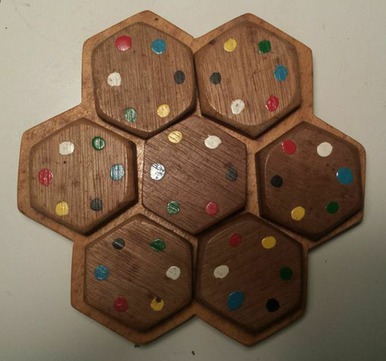
https://d1icoid1cnixnp.cloudfront.net/yadt/blog.Image/image/original/23.jpeg Over Christmas I found the above puzzle at my parent's house. I don't know if it has a name but it seemed apt to name it after The Giant's Causeway. The idea is that you swap and/or rotate the outer tiles until the colours at the edges match. The center tile is fixed, or at least I assume it is as the wooden edges are deliberately less rounded. Of course, solving it manually would be boring so here's a dumb brute force solution. I actually admire how inefficient and stupid it is...
import itertools
class Tile(list):
    def __getitem__(self, x):
        return super(Tile, self).__getitem__(x % len(self))
    def rotate(self, x):
        return Tile(self[x:] + self[:x])
COLOURS = ('YELLOW', 'WHITE', 'BLACK', 'RED', 'GREEN', 'BLUE')
YELLOW, WHITE, BLACK, RED, GREEN, BLUE = range(len(COLOURS))
TILES = (
    Tile((WHITE, YELLOW, RED, BLUE, BLACK, GREEN)),
    Tile((RED, BLUE, BLACK, YELLOW, GREEN, WHITE)),
    Tile((WHITE, BLACK, YELLOW, GREEN, BLUE, RED)),
    Tile((WHITE, BLUE, GREEN, YELLOW, BLACK, RED)),
    Tile((GREEN, BLUE, BLACK, YELLOW, RED, WHITE)),
    Tile((RED, YELLOW, GREEN, BLACK, BLUE, WHITE)),
)
CENTER = Tile((WHITE, BLACK, RED, GREEN, BLUE, YELLOW))
def pairwise(it):
    a, b = itertools.tee(it)
    next(b, None)
    return itertools.izip(a, b)
def validate(xs):
    for idx, x in enumerate(xs):
        if x[idx + 3] != CENTER[idx]:
            raise ValueError("Tile does not match center")
    for idx, (a, b) in enumerate(pairwise(xs)):
        if a[idx + 2] != b[idx + 5]:
            raise ValueError("Tile does not match previous anticlockwise tile")
    return xs
def find_solution():
    # For all possible tile permutations..
    for xs in itertools.permutations(TILES):
        # ... try all possible rotations
        for ys in itertools.product(range(len(COLOURS)), repeat=len(COLOURS)):
            try:
                return validate([x.rotate(y) for x, y in zip(xs, ys)])
            except ValueError:
                pass
    raise ValueError("Could not find a solution.")
for x in find_solution():
    print ', '.join(COLOURS[y] for y in x)
This prints (after 5 minutes!):
$ python giants.py
GREEN, BLUE, RED, WHITE, BLACK, YELLOW
WHITE, BLUE, GREEN, YELLOW, BLACK, RED
YELLOW, GREEN, BLACK, BLUE, WHITE, RED
GREEN, WHITE, YELLOW, RED, BLUE, BLACK
RED, BLUE, BLACK, YELLOW, GREEN, WHITE
BLUE, BLACK, YELLOW, RED, WHITE, GREEN
python giants.py  269.08s user 0.02s system 99% cpu 4:29.36 total
UPDATE: Seems like this puzzle is called "Circus Seven". Now to dust off my Prolog...

9 January 2015

Chris Lamb: Uploading a large number of files to Amazon S3

I recently had to upload a large number (~1 million) of files to Amazon S3. My first attempts revolved around s3cmd (and subsequently s4cmd) but both projects seem to based around analysing all the files first rather than blindly uploading them. This not only requires a large amount of memory, non-trivial experimentation, fiddling and patching is also needed to avoid unnecessary stat(2) calls. I even tried a simple find xargs -P 5 s3cmd put [..] but I just didn't trust the error handling correctly. I finally alighted on s3-parallel-put, which worked out well. Here's a brief rundown on how to use it:
  1. First, change to your source directory. This is to ensure that the filenames created in your S3 bucket are not prefixed with the directory structure of your local filesystem whilst s3-parallel-put has a --prefix option, it is ignored if you pass a fully-qualified source, ie. one starting with a /.
  2. Run with --dry-run --limit=1 and check that the resulting filenames will be correct after all:
$ export AWS_ACCESS_KEY_ID=FIXME
$ export AWS_SECRET_ACCESS_KEY=FIXME
$ /path/to/bin/s3-parallel-put \
    --bucket=my-bucket \
    --host=s3.amazonaws.com \
    --put=stupid \
    --insecure \
    --dry-run --limit=1 \
    .
[..]
INFO:s3-parallel-put[putter-21714]:./yadt/profile.Profile/image/circle/807.jpeg -> yadt/profile.Profile/image/circle/807.jpeg
[..]
  1. Remove --dry-run --limit=1, and let it roll.

7 January 2015

Chris Lamb: Web scraping: Let's move on

Every few days, someone publishes a new guide, tutorial, library or framework about web scraping, the practice of extracting information from websites where an API is either not provided or is otherwise incomplete. However, I find these resources fundamentally deceptive the arduous parts of "real world" scraping simply aren't in the parsing and extraction of data from the target page, the typical focus of these articles. The difficulties are invariably in "post-processing"; working around incomplete data on the page, handling errors gracefully and retrying in some (but not all) situations, keeping on top of layout/URL/data changes to the target site, not hitting your target site too often, logging into the target site if necessary and rotating credentials and IP addresses, respecting robots.txt, target site being utterly braindead, keeping users meaningfully informed of scraping progress if they are waiting of it, target site adding and removing data resulting in a null-leaning database schema, sane parallelisation in the presence of prioritisation of important requests, difficulties in monitoring a scraping system due to its implicitly non-deterministic nature, and general problems associated with long-running background processes in web stacks. Et cetera. In other words, extracting the right text on the page is the easiest and trivial part by far, with little practical difference between an admittedly cute jQuery-esque parsing library or even just using a blunt regular expression. It would be quixotic to simply retort that sites should provide "proper" APIs but I would love to see more attempts at solutions that go beyond the superficial.

1 January 2015

Chris Lamb: Goals

Dr. Guy Winch:
We used to think that happiness is based on succeeding at our goals, but it turns out not so much. Most marathon runners, for example not professionals but the amateur runners their high for completing the marathon usually disappears even before their nipples stop bleeding. My point is that the high lasts for a very short amount of time. If you track where people's happiness and satisfaction is, it is in "getting" or in making progress towards our goals. It's a more satisfying, life-affirming, motivating and happy thing than actually reaching them. So it's a great thing to keep in mind... Health, for example. When you define health as something you want to do, living your life and looking back on the week and saying "That was a healthy week for me: I worked out this number of times, I did this amount of push-ups, I ate reasonably most of the time..." that's very satisfying and that's where you'll feel happy about yourself. And if you're too focused on a scale for some reason, then that's an external thing that you'll hit... and then what? So it is about creating goals that are longer lasting and really focusing on the journey because that's really where we get our happiness and our satisfaction. Once it's achieved... now what?

31 December 2014

Chris Lamb: 2014: Selected highlights

Previously: 2012 & 2013.


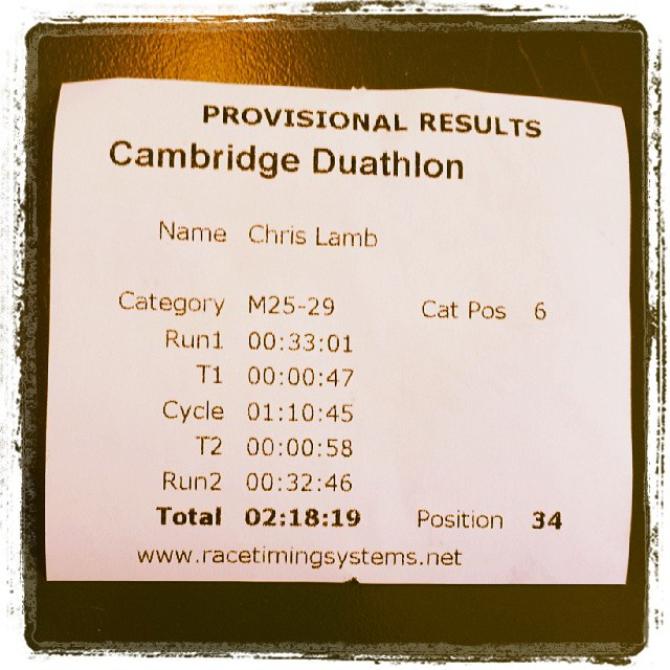
January https://d1icoid1cnixnp.cloudfront.net/yadt/blog.Image/image/cropped/15.jpeg Was lent a 15-course baroque lute. February https://d1icoid1cnixnp.cloudfront.net/yadt/blog.Image/image/cropped/19.jpeg Grandpa's funeral. In December he was posthumously awarded the Ushakov Medal (pictured) for his service in the Royal Navy's Arctic Convoys during the Second World War. March https://d1icoid1cnixnp.cloudfront.net/yadt/blog.Image/image/cropped/14.jpeg A lot of triathlon training but also got back into cooking. April https://d1icoid1cnixnp.cloudfront.net/yadt/blog.Image/image/cropped/2.jpeg Returned to the Cambridge Duathlon. May https://d1icoid1cnixnp.cloudfront.net/yadt/blog.Image/image/cropped/13.jpeg Raced 50 and 100 mile cycling time trials & visited the Stratford Olympic pool (pictured). June https://d1icoid1cnixnp.cloudfront.net/yadt/blog.Image/image/cropped/1.jpeg Ironman Austria. July https://d1icoid1cnixnp.cloudfront.net/yadt/blog.Image/image/cropped/9.jpeg Paced my sister at the Downtow-Upflow Half-marathon. Also released the first version of the Strava Enhancement Suite. August https://d1icoid1cnixnp.cloudfront.net/yadt/blog.Image/image/cropped/3.jpeg Visited Cornwall for my cousin's wedding (pictured). Another month for sport including my first ultramarathon and my first sub-20 minute 5k. September https://d1icoid1cnixnp.cloudfront.net/yadt/blog.Image/image/cropped/11.jpeg Entered a London Oxford London cycling brevet, my longest single-ride to date (269 km). Also visited the Tour of Britain and the Sri Chomnoy 24-hour endurance race. October https://d1icoid1cnixnp.cloudfront.net/yadt/blog.Image/image/cropped/10.jpeg London Paris London cycling tour (588 km). November https://d1icoid1cnixnp.cloudfront.net/yadt/blog.Image/image/cropped/5.jpeg Performed Handel's Messiah in Kettering. December https://d1icoid1cnixnp.cloudfront.net/yadt/blog.Image/image/cropped/18.jpeg Left Thread.com.

24 December 2014

Chris Lamb: find(1), trailing slashes and symbolic links to directories

Here's a nice little "gotcha" in find(1). First, let's create a directory and a symlink to that directory. We'll add an empty file just underneath to illustrate what is going on:
$ mkdir a
$ ln -s a b
$ touch a/file
If we invoke find with a trailing slash, everything works as expected:
$ find a/
a/
a/file
$ find b/
b/
b/file
... but if we omit the trailing slash, find does not traverse the symlink:
$ find a
a
a/file
$ find b
b
This implies that any normal-looking invokation of find such as:
find /path/to/dir -name 'somefile.ext' ...
... is subtly buggy as it won't accomodate the sysadmin replacing that path with a symlink.
This is, of course, well-covered in the find(1) manpage (spoiler: the safest option is to specify -H, or simply to append the trailing slash), but I would still class this as a "gotcha" because of the subtle difference between the trailing and non-trailing slash variants. Putting it another way, it's completely reasonable that find doesn't follow symlinks, but when this behaviour based on the presence of the trailing slash a usually meaningless syntactic distinction it crosses the rubicon to being counter-intutive.

Chris Lamb: 8:20AM. Sunday, 22 December 2013

Running east into the sun, he hadn't seen another human for over half an hour. He navigates Westferry Circus and heads south, cutting from the road through to the riverside pathway. He keeps is breathing steady - no reason to hurry. The wind catches him from Westminster. It smells slightly salty but it's an ersatz attempt, nowhere near bracing enough to be a real sea breeze. Pressing on, the vacant citadel of Canary Wharf disappears behind him. But as the peninsula curves around, a man appears in the distance. Even half a mile away he looks out of place, or rather given the hour time. He's walking purposefully, but it doesn't feel the kind of route someone would be taking to work. He's not wearing quite enough clothes for the weather either, and homeless people are rarely made to feel welcome in the Docklands. His supermarket denim visibly flaps in the breeze. "Relaxed fit", they call it. When he gets within earshot the man cocks his head, not expecting to hear the regular cadence of approaching footsteps. He turns slightly to reveal he's cradling a large bottle of Coca-Cola, meekly wrapped in the swathing bands of two anonymously blue corner-shop plastic bags. The runner eyes the Coke greedily but can quickly see that it has already been opened, tainted. Although only a mouthful or so has gone, a brown froth sloshes against the top of the container. Amateur, he thinks. He'll regret that later. He looks back up to the man, who is now smiling at him. His left hand bccomes visible as he strides: a four-pack of Carling. The man laughs. "Oh, you and me mate are worlds apart!" the man shouts. It's immediately friendly. He starts to raise his Carling as but thinks better of it. It's momentarily awkward. "Worlds apart mate", the man continues. "Have a good one!" The runner smiles back. Only in time, the runner thinks. They both can't stop.

10 December 2014

Chris Lamb: Starting IPython automatically from zsh

Instead of a calculator, I tend to use IPython for those quotidian bits of "mental" arithmetic:
In  [1]: 17 * 22.2
Out [1]: 377.4
However, I often forget to actually start IPython, resulting in me running the following in my shell:
$ 17 * 22.2
zsh: command not found: 17
Whilst I could learn do this maths within Zsh itself, I would prefer to dump myself into IPython instead being able to use "_" and Python modules generally is just too useful. After following this pattern too many times, I put together the following snippet that will detect whether I have prematurely attempted a calculation inside zsh and pretend that I ran it in IPython all along:
zmodload zsh/pcre
math_regex='^[\d\-][\d\.\s\+\*\/\-]*$'
function math_precmd()  
    if [ "$ ? " = 0 ]
    then
        return
    fi
    if [ -z "$ math_command " ]
    then
        return
    fi
    if whence -- "$math_command" 2>&1 >/dev/null
    then
        return
    fi
    if [ "$ math_command " -pcre-match "$ math_regex " ]
    then
        echo
        ipython -i -c "_=$ math_command ; print _"
    fi
 
function math_preexec()  
    typeset -g math_command="$ 1 "
 
typeset -ga precmd_functions
typeset -ga preexec_functions
precmd_functions+=math_precmd
preexec_functions+=math_preexec
For example:
lamby@seriouscat:~% 17 * 22.2
zsh: command not found: 17
377.4
In  [1]: _ + 1
Out [1]: 378.4
(Canonical version from my zshrc.d)

4 December 2014

Chris Lamb: Don't ask your questions in private

(If I've linked you to this page, it is my feeble attempt to provide a more convincing justification.)


I often receive instant messages or emails requesting help or guidance at work or on one of my various programming projects. When asked why they asked privately, the responses vary; mostly along the lines of it simply being an accident, not knowing where else to ask, as well as not wishing to "disturb" others with their bespoke question. Some will be more candid and simply admit that they were afraid of looking unknowledgable in front of others. It is always tempting to simply reply with the answer, especially as helping another human is inherently rewarding unless one is a psychopath. However, one can actually do more good overall by insisting the the question is re-asked in a more public forum.
This is for many reasons. Most obviously, public questions are simply far more efficient as soon as more than one person asks that question the response can be found in a search engine or linked to in the future. These time savings soon add up, meaning that simply more stuff can be done in any given day. After all, most questions are not as unique as people think. Secondly, a private communication cannot be corrected or elaborated on if someone else notices it is incorrect or incomplete. Even this rather banal point is more subtle that it first appears the lack of possible corrections deprives both the person asking and the person responding of the true and correct answer. Lastly, conversations that happen in private are depriving others of the answer as well. Perhaps someone was curious but hadn't got around to asking? Maybe the answer or even the question! contains a clue to solving some other issue. None of this can happen if this is occurs behind closed doors. (There are lots of subtler reasons too in a large organisation or team, simply knowing what other people are curious about can be curiously valuable information.)
Note that this is not as you might immediately suspect simply a way of ensuring that one gets the public recognition or "kudos" from being seen helping others. I wouldn't deny that technical communities work on a gift economy basis to some degree, but to attribute all acts of assistance as "selfish" and value-extracting would be to take the argument too far in the other direction. Saying that, the lure and appeal of public recognition should not be understated and can certainly provide an incentive to elaborate and provide a generally superior response.

More philosophically, there's also something fundamentally "honest" about airing issues in an appropriately public and transparent manner. I feel it promotes a culture of egoless conversations, of being able to admit one's mistakes and ultimately a healthy personal mindset. So please, take care not only in the way you phrase and frame your question, but also consider wider context in which you are asking it. And don't take it too personally if I ask you to re-ask elsewhere...

25 November 2014

Chris Lamb: Validating Django model attribute assignment

Ever done the following?
>>> user = User.objects.get(pk=102)
>>> user.superuser = True
>>> user.save()
# Argh, why is this user now not a superuser...
Here's a dirty hack to validate these:
import sys
from django.db import models
from django.conf import settings
FIELDS =  
EXCEPTIONS =  
    'auth.User': ('backend',),
 
def setattr_validate(self, name, value):
    super(models.Model, self).__setattr__(name, value)
    # Real field names cannot start with underscores
    if name.startswith('_'):
        return
    # Magic
    if name == 'pk':
        return
    k = '%s.%s' % (self._meta.app_label, self._meta.object_name)
    try:
        fields = FIELDS[k]
    except KeyError:
        fields = FIELDS[k] = set(
            getattr(x, y) for x in self._meta.fields
            for y in ('attname', 'name')
        )
    # Field is in allowed list
    if name in fields:
        return
    # Field is in known exceptions
    if  name in EXCEPTIONS.get(k, ()):
        return
    # Always allow Django internals to set values (eg. aggregates)
    if 'django/db/models' in sys._getframe().f_back.f_code.co_filename:
        return
    raise ValueError(
        "Refusing to set unknown attribute '%s' on %s instance. "
        "(Did you misspell %s?)" % (name, k, ', '.join(fields))
    )
# Let's assume we have good test coverage
if settings.DEBUG:
    models.Model.__setattr__ = setattr_validate
Now:
>>> user = User.objects.get(pk=102)
>>> user.superuser = True
...
ValueError: Refusing to set unknown attribute 'superuser' on auth.User instance. (Did you misspell 'username', 'first_name', 'last_name', 'is_active', 'email', 'is_superuser', 'is_staff', 'last_login', 'password', 'id', 'date_joined')
(Django can be a little schizophrenic on this Model.save()'s update_fields keyword argument validates its fields, as does prefetch_related, but it's taking select_related a little while to land.)

17 November 2014

Chris Lamb: Calculating the number of pedal turns on a bike ride

If you have a cadence sensor on your bike such as the Garmin GSC-10, you can approximate the number of pedal turns you made on the bike ride using the following script (requires GPSBabel):
#!/bin/sh
STYLE="$(mktemp)"
cat >$ STYLE  <<EOF
FIELD_DELIMITER COMMA
RECORD_DELIMITER NEWLINE
OFIELD CADENCE,"","%d"
EOF
exec gpsbabel -i garmin_fit -f "$ 1 " -o xcsv,style=$ STYLE  -F-  
    awk ' x += $1  END  print int(x / 60) '
... then call with:
$ sh cadence.sh ~/path/to/2014-11-16-14-46-05.fit
24344
Unfortunately the Garmin .fit format doesn't store the actual number of pedal turns, only the average for each particular second. However, it should be reasonably accurate given that one keeps a reasonably steady cadence. As a bonus, using a small amount of shell plumbing you can then sum an entire year's worth of riding like so:
$ for X in ~/path/to/2014-*.fit; do sh cadence.sh $ X ; done   awk ' x += $1  END   print x  '
749943

3 November 2014

Chris Lamb: Generating gradiented fade images using ImageMagick

Whilst gradienting images is certainly possible with CSS, current browser support means that it can still make sense to do it yourself, especially if front-end performance is a concern. However, to avoid manual work in Gimp or Photoshop, you can use ImageMagick to generate them for you:
$ wget --quiet -Obackground.jpg http://i.imgur.com/WCjlJ.jpg
$ convert background.jpg \
      -alpha set -channel A \
      -sparse-color Barycentric '%w,%[fx:h-300] opaque %w,%h transparent' \
      -background '#ffcc32' -flatten \
      background-gradiented.jpg
300 here refers to the height or "speed" of the gradient and the target colour is specified by with -background. Before: https://chris-lamb.co.uk/wp-content/2014/gradient_before.png After: https://chris-lamb.co.uk/wp-content/2014/gradient_after.png
30 October 2014

Chris Lamb: Are you building an internet fridge?

Mikkel Rasmussen:
If you look at the idea of "The Kitchen of Tomorrow" as IKEA thought about it is the core idea is that cooking is slavery. It's the idea that technology can free us from making food. It can do it for us. It can recognise who we are, we don't have to be tied to the kitchen all day, we don't have to think about it. Now if you're an anthropologist, they would tell you that cooking is perhaps one of the most complicated things you can think about when it comes to the human condition. If you think about your own cooking habits they probably come from your childhood, the nation you're from, the region you're from. It takes a lot of skill to cook. It's not so easy. And actually, it's quite fun to cook. there's also a lot of improvisation. I don't know if you ever tried to come home to a fridge and you just look into the fridge: oh, there's a carrot and some milk and some white wine and you figure it out. That's what cooking is like it's a very human thing to do.
https://chris-lamb.co.uk/wp-content/2014/fridge.jpg

The physical version of your smart recipe site?


Therefore, if you think about it, having anything that automates this for you or decides for you or improvises for you is actually not doing anything to help you with what you want to do, which is that it's nice to cook. More generally, if you make technology for example that has at its core the idea that cooking is slavery and that idea is wrong, then your technology will fail. Not because of the technology, but because it simply gets people wrong. This happens all the time. You cannot swing a cat these days without hitting one of those refrigerator companies that make smart fridges. I don't know you've ever seen them, like a "intelligent fridge". There's so many of them that there is actually a website called "Fuck your internet fridge" by a guy who tracks failed prototypes on intelligent fridges. Why? Because the idea is wrong. Not the technology, but the idea about who we are - that we do not want the kitchen to be automated for us. We want to cook. We want Japanese knives. We want complicated cooking. And so what we are saying here is not that technology is wrong as such. It's just you need to base it especially when you are innovating really big ideas on something that's a true human insight. And cooking as slavery is not a true human insight and therefore the prototypes will fail.
(I hereby nominate "internet fridge" as the term to describe products or ideas that whilst technologically sound is based on fundamentally flawed anthropology.) Hearing "I hate X" and thinking that simply removing X will provide real value to your users is short-sighted, especially when you don't really understand why humans are doing X in the first place.

9 October 2014

Chris Lamb: London Paris London 2014

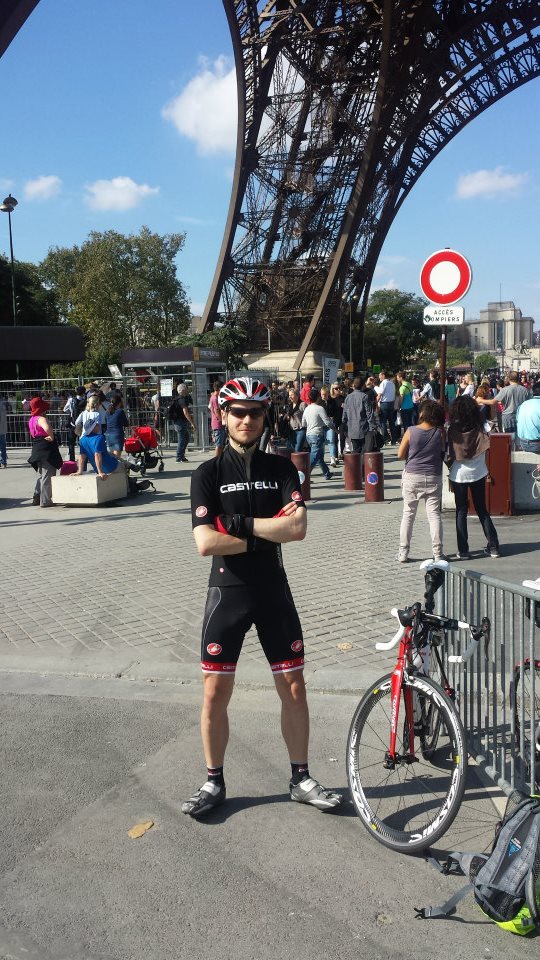
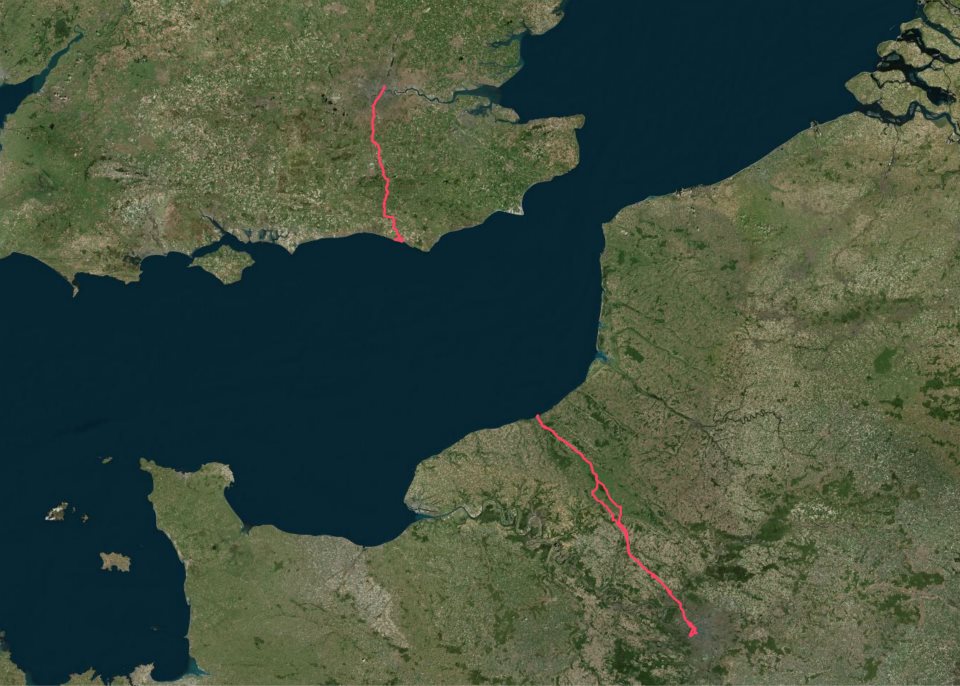
I've wanted to ride to Paris for a few months now but was put off by the hassle of taking a bicycle on the Eurostar, as well having a somewhat philosophical and aesthetic objection to taking a bike on a train in the first place. After all, if one already is possession of a mode of transport... My itinerary was straightforward:
Friday 12h00
London Newhaven
Friday 23h00
Newhaven Dieppe (ferry)
Saturday 04h00
Dieppe Paris
Saturday 23h00
(Sleep)
Sunday 07h00
Paris Dieppe
Sunday 18h00
Dieppe Newhaven (ferry)
Sunday 21h00
Newhaven Peacehaven
Sunday 23h00
(Sleep)
Monday 07h00
Peacehaven London
Packing list https://chris-lamb.co.uk/wp-content/2014/london-paris-london/01.jpg
  • Ferry ticket (unnecessary in the end)
  • Passport
  • Credit card
  • USB A male mini A male (charges phone, battery pack & front light)
  • USB A male mini B male (for charging or connecting to Edge 800)
  • USB mini A male OTG A female (for Edge 800 uploads via phone)
  • Waterproof pocket
  • Sleeping mask for ferry (probably unnecessary)
  • Battery pack

Not pictured:
  • Castelli Gabba Windstopper short-sleeve jersey
  • Castelli Velocissimo bib shorts
  • Castelli Nanoflex arm warmers
  • Castelli Squadra rain jacket
  • Garmin Edge 800
  • Phone
  • Front light: Lezyne Macro Drive
  • Rear lights: Knog Gekko (on bike), Knog Frog (on helmet)
  • Inner tubes (X2), Lezyne multitool, tire levers, hand pump

Day 1: London Newhaven
https://chris-lamb.co.uk/wp-content/2014/london-paris-london/02.jpg

Tower Bridge.

Many attempt to go from Tower Bridge Eiffel Tower (or Marble Arch Arc de Triomphe) in less than 24 hours. This would have been quite easy if I had left a couple of hours later.
https://chris-lamb.co.uk/wp-content/2014/london-paris-london/03.jpg

Fanny's Farm Shop, Merstham, Surrey.

https://chris-lamb.co.uk/wp-content/2014/london-paris-london/04.jpg

Plumpton, East Sussex.

https://chris-lamb.co.uk/wp-content/2014/london-paris-london/05.jpg

West Pier, Newhaven.

https://chris-lamb.co.uk/wp-content/2014/london-paris-london/07.jpg

Leaving Newhaven on the 23h00 ferry.


Day 2: Dieppe Paris
https://chris-lamb.co.uk/wp-content/2014/london-paris-london/09.jpg

Beauvoir-en-Lyons, Haute-Normandie.

https://chris-lamb.co.uk/wp-content/2014/london-paris-london/10.jpg

S rifontaine, Picardie.

https://chris-lamb.co.uk/wp-content/2014/london-paris-london/12.jpg

La tour Eiffel, Paris.

https://chris-lamb.co.uk/wp-content/2014/london-paris-london/13.jpg

Champ de Mars, Paris.

https://chris-lamb.co.uk/wp-content/2014/london-paris-london/15.jpg

Pont de Grenelle, Paris.


Day 3: Paris Dieppe
https://chris-lamb.co.uk/wp-content/2014/london-paris-london/18.jpg

Cormeilles-en-Vexin, le-de-France.

https://chris-lamb.co.uk/wp-content/2014/london-paris-london/20.jpg

Gisors, Haute-Normandie.

https://chris-lamb.co.uk/wp-content/2014/london-paris-london/21.jpg

Paris-Brest, Gisors, Haute-Normandie.

Wikipedia: This pastry was created in 1910 to commemorate the Paris Brest bicycle race begun in 1891. Its circular shape is representative of a wheel. It became popular with riders on the Paris Brest cycle race, partly because of its energizing high caloric value, and is now found in p tisseries all over France.
https://chris-lamb.co.uk/wp-content/2014/london-paris-london/22.jpg

Gournay-en-Bray, Haute-Normandie.

https://chris-lamb.co.uk/wp-content/2014/london-paris-london/23.jpg

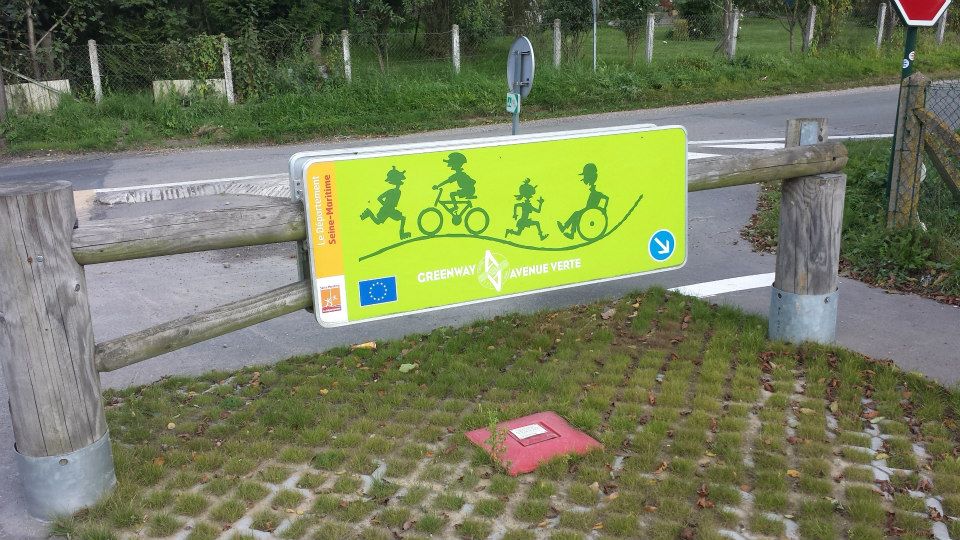
D but de l'Avenue Verte, Forges-les-Eaux, Haute-Normandie.

https://chris-lamb.co.uk/wp-content/2014/london-paris-london/24.jpg

Mesni res-en-Bray, Haute-Normandie.

https://chris-lamb.co.uk/wp-content/2014/london-paris-london/26.jpg

Dieppe, Haute-Normandie.

https://chris-lamb.co.uk/wp-content/2014/london-paris-london/28.jpg

La Mancha .


Day 4: Peacehaven London
https://chris-lamb.co.uk/wp-content/2014/london-paris-london/29.jpg

Peacehaven, East Sussex.

https://chris-lamb.co.uk/wp-content/2014/london-paris-london/31.jpg

Highbrook, West Sussex.

https://chris-lamb.co.uk/wp-content/2014/london-paris-london/33.jpg

London weather.


Summary https://chris-lamb.co.uk/wp-content/2014/london-paris-london/34.jpg
Distance
588.17 km
Pedal turns
~105,795
My only non-obvious tips would be to buy a disposable blanket in the Newhaven Co-Op to help you sleep on the ferry. In addition, as the food on the ferry is good enough you only need to get to the terminal one hour before departure, avoiding time on your feet in unpicturesque Newhaven. In terms of equipment, I would bring another light for the 4AM start on L'Avenue Verte if only as a backup and I would have checked I could arrive at my Parisian Airbnb earlier in the day - I had to hang around for five hours in the heat before I could have a shower, properly relax, etc. I had been warned not to rely on being able to obtain enough water en route on Sunday but whilst most shops were indeed shut I saw a bustling tabac or boulangerie at least once every 20km so one would never be truly stuck. Route-wise, the surburbs of London and Paris are both equally dismal and unmotivating and there is about 50km of rather uninspiring and exposed riding on the D915. However, L'Avenue Verte is fantastic even in the pitch-black and the entire trip was worth it simply for the silent and beautiful Normandy sunrise. I will be back.

6 August 2014

Chris Lamb: Strava Enhancement Suite update

https://chris-lamb.co.uk/wp-content/2014/strava/chrome_web_store.png I've been told I don't blog about my projects often enough, so here's a feature update on my Chrome Extension that adds various improvements to the Strava.com fitness tracker. All the features are optional and can be individually enabled in the options panel.

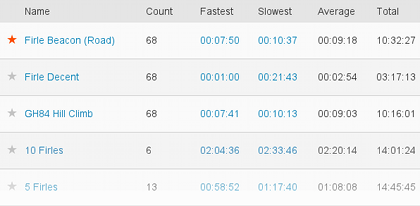
Repeated segments This adds aggregate data (fastest, slowest, average, etc.) when segments are repeated within an activity. It's particularly useful for laps or like this Everesting attempt hill repeats: https://chris-lamb.co.uk/wp-content/2014/strava/repeated_segments3.png

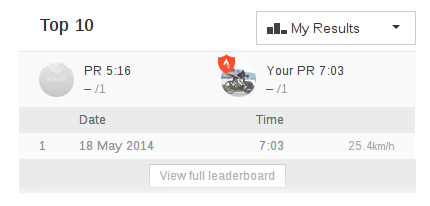
Leaderboard default Changes the default leaderboard away from "Overall" when viewing a segment effort. The most rewarding training often comes from comparing your own past performances rather than those of others, so viewing your own results by default can make more sense. You can select any of Men, Women, I'm Following or My Results: https://chris-lamb.co.uk/wp-content/2014/strava/leaderboard_default.png

Hide feed entries Hides various entry types in the activity feed that can get annoying. You currently have the option of hiding challenges, route creations, goals created or club memberships: https://chris-lamb.co.uk/wp-content/2014/strava/hide_challenge_feed_entries.png

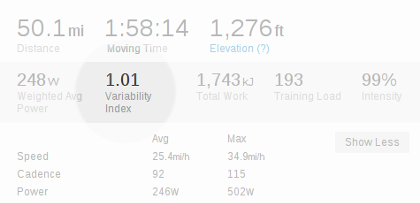
Variability Index Calculates a Variability Index (VI) from the weighted average power and the average power, an indication of how "smooth" a ride was. Required a power meter. A VI of 1.0 would mean a ride was paced "perfectly", with very few surges of effort: https://chris-lamb.co.uk/wp-content/2014/strava/variability_index.png

Infinite scroll Automatically loads more dashboard entries when reaching the bottom, saving a tedious click on the "More" button: https://chris-lamb.co.uk/wp-content/2014/strava/infinite_scroll.png

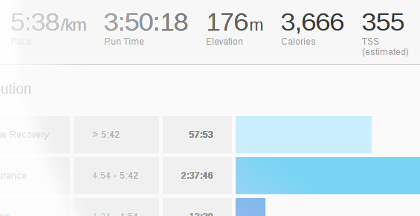
Running TSS Estimates a run's Training Stress Score (TSS) from its Grade Adjusted Pace distribution, a measure of that workout's duration and intensity relative to the athletes's capability, providing an insight into correct recovery time and overall training load over time: https://chris-lamb.co.uk/wp-content/2014/strava/running_tss.png

Hide "find friends" Hides social networking buttons, including invitations to invite or find further friends: https://chris-lamb.co.uk/wp-content/2014/strava/hide_invite_friends.png

"Enter" posts comment Immediately posts comment when pressing Enter/Return key in the edit box rather than adding a newline: https://chris-lamb.co.uk/wp-content/2014/strava/comment_post_on_enter.png

Compare running Changes the default sport for the "Side by Side comparison" module to running when viewing athlete profiles: https://chris-lamb.co.uk/wp-content/2014/strava/side_by_side_running.png

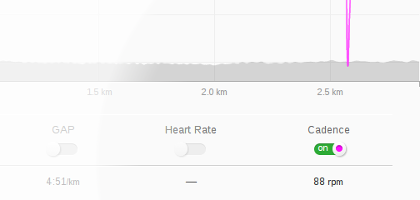
Running cadence Shows running cadence by default in the elevation profile: https://chris-lamb.co.uk/wp-content/2014/strava/running_cadence.png

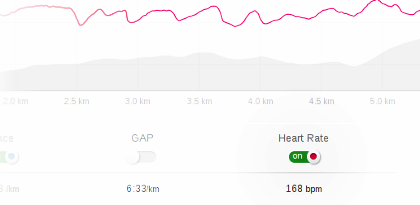
Running heart rate Shows running heart rate by default in elevation profile: https://chris-lamb.co.uk/wp-content/2014/strava/running_heart_rate.png

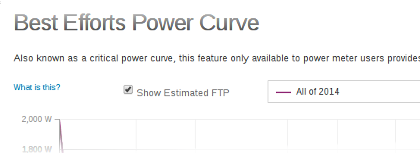
Estimated FTP Selects "Show Estimated FTP" by default on the Power Curve page: https://chris-lamb.co.uk/wp-content/2014/strava/estimated_ftp.png

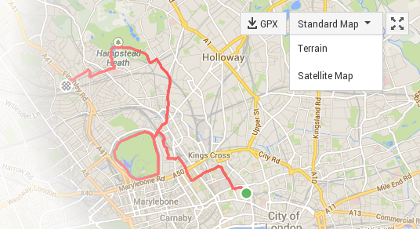
Standard Google map Prefer the "Standard" Google map over the "Terrain" view: https://chris-lamb.co.uk/wp-content/2014/strava/standard_google_map.png

Let me know if you have any comments, suggestions or if you have any other feedback. If you find this software useful, please consider donating via Paypal to support further development. You can also view the source and contribute directly on GitHub. https://chris-lamb.co.uk/wp-content/2014/strava/chrome_web_store.png

28 July 2014

Chris Lamb: start-stop-daemon: --exec vs --startas

start-stop-daemon is the classic tool on Debian and derived distributions to manage system background processes. A typical invokation from an initscript is as follows:
start-stop-daemon \
    --quiet \
    --oknodo \
    --start \
    --pidfile /var/run/daemon.pid \
    --exec /usr/sbin/daemon \
    -- -c /etc/daemon.cfg -p /var/run/daemon.pid
The basic operation is that it will first check whether /usr/sbin/daemon is not running and, if not, execute /usr/sbin/daemon -c /etc/daemon.cfg -p /var/run/daemon.pid. This process then has the responsibility to daemonise itself and write the resulting process ID to /var/run/daemon.pid. start-stop-daemon then waits until /var/run/daemon.pid has been created as the test of whether the service has actually started, raising an error if that doesn't happen. (In practice, the locations of all these files are parameterised to prevent DRY violations.)
Idempotency By idempotence we are mostly concerned with repeated calls to /etc/init.d/daemon start not starting multiple versions of our daemon. This might not seem to be particularly big issue at first but the increased adoption of stateless configuration management tools such as Ansible (which should be completely free to call start to ensure a started state) mean that one should be particularly careful of this apparent corner case. In its usual operation, start-stop-daemon ensures only one instance of the daemon is running with the --exec parameter: if the specified pidfile exists and the PID it refers to is an "instance" of that executable, then it is assumed that the daemon is already running and another copy is not started. This is handled in the pid_is_exec method (source) - the /proc/$PID/exe symlink is resolved and checked against the value of --exec.
Interpreted scripts However, one case where this doesn't work is interpreted scripts. Lets look at what happens if /usr/sbin/daemon is such a script, eg. a file that starts:
#!/usr/bin/env python
# [..]
The problem this introduces is that /proc/$PID/exe now points to the interpreter instead, often with an essentially non-deterministic version suffix:
$ ls -l /proc/14494/exe
lrwxrwxrwx 1 www-data www-data 0 Jul 25 15:18
                              /proc/14494/exe -> /usr/bin/python2.7
When this process is examined using the --exec mechanism outlined above it will be rejected as an instance of /usr/sbin/daemon and therefore another instance of that daemon will be incorrectly started.
--startas The solution is to use the --startas parameter instead. This omits the /proc/$PID/exe check and merely tests whether a PID with that number is running:
start-stop-daemon \
    --quiet \
    --oknodo \
    --start \
    --pidfile /var/run/daemon.pid \
    --startas /usr/sbin/daemon \
    -- -c /etc/daemon.cfg -p /var/run/daemon.pid
Whilst it is therefore less reliable (in that the PID found in the pidfile could actually be an entirely different process altogether) it's probably an acceptable trade-off against the case of running multiple instances of that daemon. This danger can be ameliorated by using some of start-stop-daemon's other matching tests, such as --user or even --name.

Next.

Previous.