Search Results: "jak"

28 October 2012

Gregor Herrmann: RC bugs 2012/43

here's the short overview about my activities around release-critical bugs for the last week:

13 October 2012

Vasudev Kamath: Weekly Log - 06/13-102012

Update for 06/10/2012 Well I had not written the weekly work log for the last week that is because the week was short (oh yeah thanks to all these bandhs our week got fluctuated and to be frank the week was only 4 days long) and second was my lazyness. Here goes the update * After a long discussion with Aravinda on "why productivity is reducing these days." We concluded the social network is eating up most of time. So decision was made and I closed all pinned tabs for Twitter Gmail Identi.ca and Friendica on my browser * After the above resolution I finished almost 4 chapters of Moder Perl within 2 hours!. Indeed Social networks kill the productivity. Update for 13/10/2012 I've really fallen in love with computerised bots, thanks to the wonderful KGB bot :-). So majority of my work on this week is on bots. Jabber Dictionary Redesign After thinking for a while I decided to re-write the dictionary bot which when release got an overwhelming response as see in the comments of above link. Few reason for re-write
  1. Generalise the bot framework so single bot can handle multiple languages
  2. Improve the data collection on bot side
  3. Current code base was not very well organised and trying to add more feature it had become messy.
  4. Provide XEP support to help in data collections
Few changes which are already implemented include
  1. New code is now using pyxmpp2 library instead of GPLed xmppy used by current code.
  2. Implemented XEP-0071 extension to properly format the meaning display by the bot
  3. Current implementation was displaying all words in one set without distinguishing between adjectives,verbs proverbs etc. even though wiktionary displays meaning based on this. New implementation gives out meaning in same format as it is displayed on wiktionary.
Things remaining todo
  1. Separating wiktionary parsing logic from bot code by providing some sort of intermediate interface between bot and wiktionary parsers.
  2. Adding more language wiktionary parsers and teaching the bot to become multilingual :-)
  3. Integrating XEP-0004 (Data Forms) for taking the meaning input from user. Current code requires user to enter data in particular format
suckless-tools fix for Wheezy Jakub Wilk suggested me to prepare a minimal version of suckless-tools for Wheezy which includes a patch to the bug #685611. And few minor changes which involve taking over the package and fixes in copyright file other than above mentioned bug. Hopefully release-team will be okay with these changes. I'm waiting for the upload to file an unblock-request. I did face a problem I was halfway through wit suckless-tools_39-1 when Jakub asked me about this change and current repository was fresh one prepared for 39-1 and didn't have history for 38 version. First I thought of preparing separate repository for 38 version which was not an correct option, but I even couldn't play with current repository. So finally I renamed current version of repository to suckless-tools-39.git on collab-maint and prepared fresh repository suckless-tools.git basing it on 38-1 version. From 39 version suckless-tools will be following 3.0 (quilt) source format and will not be working with git-buildpackage as the tool can't handle multi-tarball packages. Yes every tool involved in the package will have separate tarball from 39. More work on Bots Well today I again worked on Jabber bot, but not the dictionary bot. This time its an SMS Gateway bot for Jonas Smedegard and the coding was done in Perl. Thanks to jonas I finally could apply what I learnt in Perl. Code may not be very elegant but it works :-). And after hacking one full day in Perl now I'm not feeling very much interested to go back and hack on my own Python based dictionary bot :-). But I will anyway. Misc So that's it folks. Quite longish post hope you are not bored reading it :-). Well time for movie C'ya all with next weeks log.

26 August 2012

Gregor Herrmann: RC bugs 2012/34

good news: I'm seeing more & more people contributing to RC bugs in the BTS. here are my own contributions for the past week:

19 August 2012

Gregor Herrmann: RC bugs 2012/33

it's sunday evening again, & again, here comes my report about activities around RC bugs:

16 August 2012

Julian Andres Klode: Cleaning up the system with pseudo-boolean optimization

You can use a PBO solver to clean up your system from unneeded automatically installed packages. First of all, you convert the system state to PB, and add an optimization function telling it to remove as many automatically installed packages as possible. Then you run this thing through a solver (such as clasp, which seems the fastest solver for PBO instances in the Debian archive) and convert its output to human-readable package names. Code is provided at http://anonscm.debian.org/gitweb/?p=users/jak/cleanup.git, under the MPL 2.0. You need to have python-apt and clasp installed to use it. There is potential minisat+ support, but it s currently a bit broken. To use, run python program_builder.py, and it will tell you which packages are no longer needed on your system. It ignores Suggests, if you want those in, you have to hack the code and replace Recommends by Recommends , Suggests . You can also turn of such dependencies by setting Program.hard_softdeps to False.
Filed under: APT2, Debian, Python

15 August 2012

Jakub Wilk: Spell-checker for irssi

I tried many spell-checkers for irssi, and they all sucked (and some of them were also completely insane). So I took the one that seemed least crazy and forked it.

11 August 2012

Jakub Wilk: Adequate quality

I present you adequate, a tool that checks for some common bugs in packages you have installed on your system. The Debian package comes with APT hooks, so that you'll be notified (via debconf) every time you install an adequately-buggy package. If you don't like broken symlinks, disappearing /usr/share/doc/*/ directories, obsolete conffiles, or *.py files without corresponding *.pyc, adequate is for you.

12 July 2012

Craig Small: debhelper versions Guilty!

After reading Jakub s pet peeve about debhelper build-dependencies I decided to check my own and sponsored packages to see how they fare.
find debian/ -type f -name control   xargs grep -h -o 'debhelper (>= 9[^)]*)'   sort   uniq -c
      2 debhelper (>= 9)
      2 debhelper (>= 9.0)
      3 debhelper (>= 9.0.0)
      1 debhelper (>= 9.20120115)
Oops! Something to fix in all subsequent releases.

10 July 2012

Jakub Wilk: Pet peeves: debhelper build-dependencies

$ zcat Sources.gz   grep -o 'debhelper (>= 9.0[^)]*)'   sort   uniq -c   sort -rn
     47 debhelper (>= 9.0.0)
     13 debhelper (>= 9.0)
      4 debhelper (>= 9.0.0~)
      3 debhelper (>= 9.0~)
Hey, wake up! debhelper is no longer using such versioning scheme. Simple (>= 9) would be both shorter and less silly.

3 July 2012

Jakub Wilk: Why you shouldn't use Ohloh

Here's why.

21 May 2012

Johannes Schauer: sisyphus wins ICRA 2012 VMAC

Sisyphus is a piece of software that I wrote as a member of a team from Jacobs University led by Prof. Dr. Andreas N chter. It managed to place our team first in this year's IEEE ICRA 2012 Virtual Manufacturing Automation Competition in all three rounds. The goal was, to stack a given set of boxes of different length, height and width on a pallet in a way that achieved optimal volume utilization, center of mass and interlock of the boxes. Besides the cartesian placement of a box on the pallet, the only other degree of freedom was a 90 rotation of the box around a vertical axis. Since the arrangement of boxes into a three dimensional container is NP hard (three dimensional orthogonal knapsack), I decided for a heuristic for an approximate solution. The premise is, that there are many boxes of equal height which was the case in the test cases that were available from the 2011 VMAC. Given this premise, my heuristic was, to arrange the boxes into layers of equal height and then stack these layers on top of each other. A set of boxes that would be left over or too little from the start to form its own full layer, would then be stacked on the top of the completed layers. There is a video of how this looked like. My code is now online on github and it even documented for everybody who is not me (or a potential future me of course). This blog post is about the "interesting" parts of sisyphus. You can read about the overall workings of it in the project's README. Python dict to XML and XML to Python dict The evaluation program for the challenge is reading XML files and the pallet size and the list of articles with their sizes are also given in XML format. So I had to have a way to easily read article information from XML and to easily dump my data into XML format. Luckily, all the XML involved was not making use of XML attributes at all, so the only children a node had, where other nodes. Thus, the whole XML file could be represented as an XML dictionary with keys being tagnames and the values being other dictionaries or lists or strings or integers. The code doing that uses xml.etree.ElementTree and turns out to be very simple:
from xml.etree import ElementTree

def xmltodict(element):
def xmltodict_handler(parent_element):
result = dict()
for element in parent_element:
if len(element):
obj = xmltodict_handler(element)
else:
obj = element.text
if result.get(element.tag):
if hasattr(result[element.tag], "append"):
result[element.tag].append(obj)
else:
result[element.tag] = [result[element.tag], obj]
else:
result[element.tag] = obj
return result
return element.tag: xmltodict_handler(element)

def dicttoxml(element):
def dicttoxml_handler(result, key, value):
if isinstance(value, list):
for e in value:
dicttoxml_handler(result, key, e)
elif isinstance(value, basestring):
elem = ElementTree.Element(key)
elem.text = value
result.append(elem)
elif isinstance(value, int) or isinstance(value, float):
elem = ElementTree.Element(key)
elem.text = str(value)
result.append(elem)
elif value is None:
result.append(ElementTree.Element(key))
else:
res = ElementTree.Element(key)
for k, v in value.items():
dicttoxml_handler(res, k, v)
result.append(res)
result = ElementTree.Element(element.keys()[0])
for key, value in element[element.keys()[0]].items():
dicttoxml_handler(result, key, value)
return result

def xmlfiletodict(filename):
return xmltodict(ElementTree.parse(filename).getroot())

def dicttoxmlfile(element, filename):
ElementTree.ElementTree(dicttoxml(element)).write(filename)

def xmlstringtodict(xmlstring):
return xmltodict(ElementTree.fromstring(xmlstring))

def dicttoxmlstring(element):
return ElementTree.tostring(dicttoxml(element))
Lets try this out:
>>> from util import xmlstringtodict, dicttoxmlstring
>>> xmlstring = "<foo><bar>foobar</bar><baz><a>1</a><a>2</a></baz></foo>"
>>> xmldict = xmlstringtodict(xmlstring)
>>> print xmldict
 'foo':  'baz':  'a': ['1', '2'] , 'bar': 'foobar' 
>>> dicttoxmlstring(xmldict)
'<foo><baz><a>1</a><a>2</a></baz><bar>foobar</bar></foo>'
The dict container doesnt preserve order, but as XML doesnt require that, this is also not an issue. Arranging items in layers When it was decided, that I wanted to take the layered approach, it boiled down the 3D knapsack problem to a 2D knapsack problem. The problem statement now was: how to best fit small rectangles into a big rectangle? I decided for a simple and fast approach as it is explained in Jake Gordon's blog article. There is a demo of his code and should the site vanish from the net, the code is on github. This solution seemed to generate results that were "good enough" while simple to implement and fast to execute. If you look very hard, you can still see some design similarities between my arrange_spread.py and his packer.js code. Jake Gordon got his idea from Jim Scott who wrote an article of arranging randomly sized lightmaps into a bigger texture. There is also an ActiveState Code recipe from 2005 which looks very similar to the code by Jake Gordon. The posts of Jake Gordon and Jim Scott explain the solution well, so that I dont have to repeat it. Should the above resources go offline, I made backups of them here and here. There is also a backup of the ActiveState piece here. Spreading items out The algorithm above would cram all rectangles into a top-left position. As a result, there would mostly be space at the bottom and left edge of the available pallet surface. This is bad for two reasons:
  1. the mass is distributed unequally
  2. articles on the layer above at the bottom or left edge, are prone to overhang too much so that they tumble down
Instead all articles should be spread over the available pallet area, creating small gaps between them instead big spaces at the pallet borders. Since articles were of different size, it was not clear to me from the start what "equal distribution" would even mean because it was obvious that it was not as simple as making the space between all rectangles equal. The spacing had to be different between them to accommodate for differently sized boxes. The solution I came up with, made use of the tree structure, that was built by the algorithm that arranged the rectangles in the first place. The idea is, to spread articles vertically first, recursively starting with the deepest nodes and spreading them out in their parent rectangle. And then spreading them horizontally, spreading the upper nodes first, recursively resizing and spreading child nodes. The whole recursion idea created problems of its own. One of the nicest recursive beauty is the following function:
def get_max_horiz_nodes(node):
if node is None or not node['article']:
return [], []
elif node['down'] and node['down']['article']:
rightbranch, sr = get_max_horiz_nodes(node['right'])
rightbranch = [node] + rightbranch
downbranch, sd = get_max_horiz_nodes(node['down'])
ar = rightbranch[len(rightbranch)-1]['article']
ad = downbranch[len(downbranch)-1]['article']
if ar['x']+ar['width'] > ad['x']+ad['width']:
return rightbranch, sr+[downbranch[0]]
else:
return downbranch, sd+[rightbranch[0]]
else:
rightbranch, short = get_max_horiz_nodes(node['right'])
return [node] + rightbranch, short
get_max_horiz_nodes() traverses all branches of the tree that node has below itself and returns a tuple containing the list of nodes that form the branch that stretches out widest plus the list of nodes that are in the other branches (which are shorter than the widest). Another interesting problem was, how to decide on the gap between articles. This was interesting because the number resulting of the subtraction of the available length (or width) and the sum of the articles lengths (or widths), was mostly not divisible by the amount of gaps without leaving a rest. So there had to be an algorithm that gives me a list of integers, neither of them differing by more than one to any other, that when summed up, would give me the total amount of empty space. Or in other words: how to divide a number m into n integer pieces such that each of those integers doesnt differ more than 1 from any other. Surprisingly, generating this list doesnt contain any complex loop constructs:
>>> m = 108 # total amount
>>> n = 7 # number of pieces
>>> d,e = divmod(m, n)
>>> pieces = (e)*[(d+1)]+(n-e)*[d]
>>> print pieces
[16, 16, 16, 15, 15, 15, 15]
>>> sum(pieces) == m
True
>>> len(pieces) == n
True
You can test out the algorithms that arrange rectangles and spread them out by cloning the git and then running:
PYTHONPATH=. python legacy/arrange_spread.py
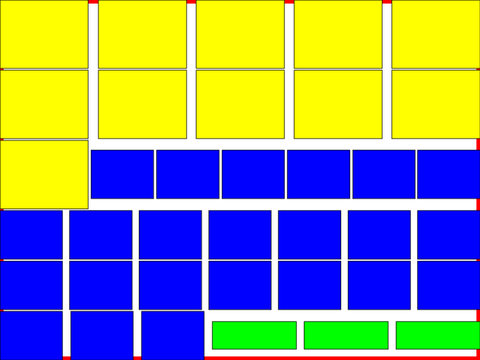
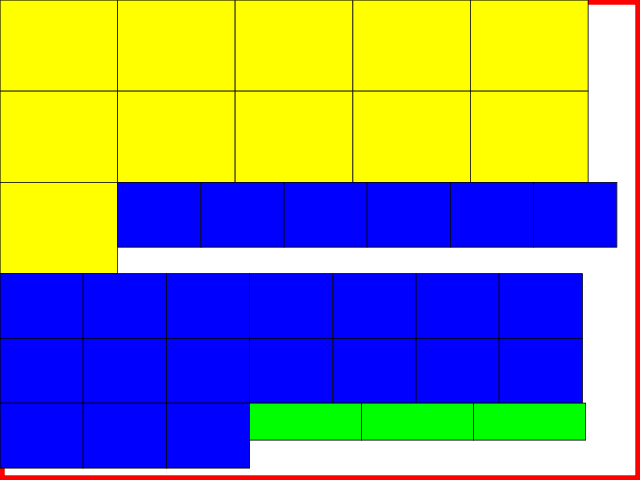
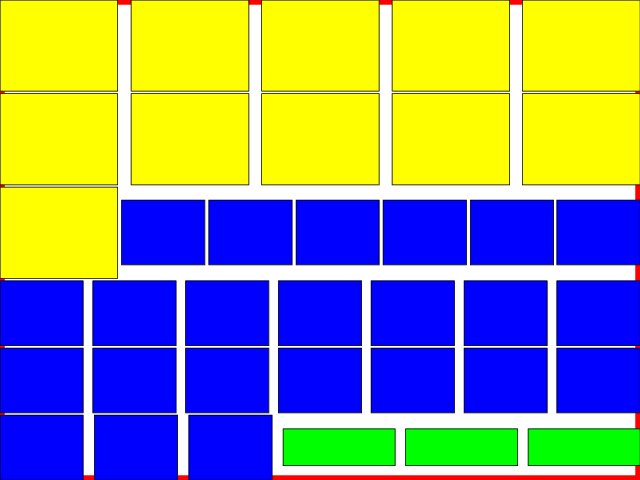
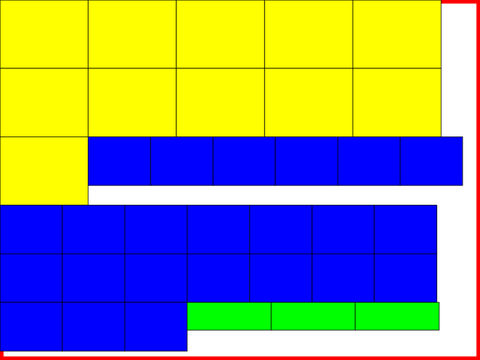
The results will be svg files test1.svg and test2.svg, the latter showing the spread-out result. Here is an example how the output looks like (without the red border which is drawn to mark the pallet border): arrange_spread2.py contains an adaption of arrange_spread.py for the actual problem. Permutations without known length When creating a layer out of articles of same height, then there are four strategies that I can choose from. It is four because there are two methods that I can either use or not. I can rotate the article by 90 per default or not and I can rotate the pallet or not. So every time that I build a new layer, there are those four options. Depending on which strategy I choose, there is a different amount of possible leftover articles that did not fit into any layer. The amount is different because each strategy is more or less efficient. To try out all combinations of possible layer arrangements, I have to walk through a tree where at each node I branch four times for each individual strategy. Individual neighboring nodes might be the same but this outcome is unlikely due to the path leading to those neighboring nodes being different. To simplify, lets name the four possible strategies for each layers 0, 1, 2 and 3. I now want an algorithm that enumerates through all possible permutations of those four numbers for "some" length. This is similar to counting. And the itertools module comes with the product() method that nearly does what I want. For example, should I know that my tree does not become deeper than 8 (read: no more than eight layers will be built), then I can just run:
>>> for i in itertools.product([0,1,2,3], repeat=8):
...     print i
...
(0,0,0,0,0,0,0,0)
(0,0,0,0,0,0,0,1)
(0,0,0,0,0,0,0,2)
(0,0,0,0,0,0,0,3)
(0,0,0,0,0,0,1,0)
(0,0,0,0,0,0,1,1)
(0,0,0,0,0,0,1,2)
(0,0,0,0,0,0,1,3)
This would work if the number of layers created with each strategy was the same. But as each strategy behaves differently depending on the input, it cannot be known before actually trying out a sequence of strategies, how many layers it will yield. The strategy (0,0,0,0,0,0,0,0) might create 7 layers, resulting in (0,0,0,0,0,0,0,1), (0,0,0,0,0,0,0,2) and (0,0,0,0,0,0,0,3) yielding the same output as only the first 7 strategies count. This would create duplicates which I should not waste cpu cycles on later. It might also be that (0,0,0,0,0,0,1,0) turns out to be a combination of strategies that creates more than 8 layers in which case the whole thing fails. So what I need is a generator, that gives me a new strategy depending on how often it is asked for one. It should dynamically extend the tree of possible permutations to accommodate for any size. Since the tree will become humongous (4^11 = 4194304), already traversed nodes should automatically be cleaned so that only the nodes that make the current list of strategies stays in memory at any point in time. This sounded all complicated which made me even more surprised by how simple the solution was in the end. Here a version of the algorithm that could easily be ported to C:
class Tree:
def __init__(self, branch_factor):
self.branch_factor = branch_factor
self.root = "value": None, "parent": None, "children": []
self.current = self.root

def next(self):
if not self.current["children"]:
self.current["children"] = [ "value":val, "parent":self.current, "children":[] for val in range(self.branch_factor)]
self.current = self.current["children"][0]
return self.current["value"]

def reset(self):
if self.current["parent"]:
self.current["parent"]["children"].pop(0)
else:
return False
if self.current["parent"]["children"]:
self.current = self.root
return True
else:
self.current = self.current["parent"]
return self.reset()

def __str__(self):
return str(self.root)
It would be used like this:
>>> tree = Tree(4)
>>> print tree.next(), tree.next(), tree.next()
>>> while tree.reset():
...     print tree.next(), tree.next(), tree.next()
Which would be equivalent to calling itertools.product([1,2,3,4], 3). The special part is, that in each iteration of the loop I can call tree.next() an arbitrary amount of times, just how much it is needed. Whenever I cannot generate an additional layer anymore, I can call tree.reset() to start a new permutation. For my code I used a python specific version which is a generator:
def product_varlength(branch_factor):
root = "value": None, "parent": None, "children": []
current = root
while True:
if not current["children"]:
current["children"] = [ "value":val, "parent":current, "children":[] for val in range(branch_factor)]
current = current["children"][0]
if (yield current["value"]):
while True:
if current["parent"]:
current["parent"]["children"].pop(0)
else:
return
if current["parent"]["children"]:
current = root
break
else:
current = current["parent"]
It is used like this:
it = product_varlength(4)
print it.next(), it.send(False), it.send(False)
while True:
    print it.send(True), it.send(False), it.send(False)
Again, the expression in the loop can have any number of it.send(False). The first it.send(True) tells the generator to do a reset.

10 April 2012

Anand Kumria: The state of Django money.

Updated (2012-04-11): Now contains the final and correct pip install command. TL;DR: pip install django-money will give you a working set of Django fields that handle Money and Currency. Read below for how that happened. I began this Easter weekend trying to finish up one of my pet-projects and get it ready to publish. The goal of the website is to compare providers, of the same thing, from around the world. Representing prices is simple. A float will do if you are in a hurry. Except. When you need to perform calculations and you run into rounding errors. At that point you will likely discover the Decimal module. Which also works perfectly fine. And if you only ever deal in a single market that is fine. But across markets? That requires Money. Money is normally defined as a value and currency. Once you have both of those, you can then do cross-market comparison and upgrade you program to handle multi-currency easily. I hoped that I was not the only person who had realised this, so I started to look around. And I struck gold! I found Python Money. It even included appropriate Django fields as well. Unfortunately it had had no updates since 2008. . Worse it didn't work so well. I continued my search. I kept on looking and found Django Money. Even better. This separated out the Django support and the Python support. It turned out Jakewin's py-moneyed was actually a fork of Limist's py-moneyed. So I set about retrieving every fork and comparing them. <aside>Aside: There should be a git hubclone command which will add every fork of a project as an upstream so you can easily compare what has occurred and what has happened amongst them.</aside> It turns out that Jakewin's version was good, just out-of-date. It mentioned waiting until a pull request has been merged in to limist's version. Which had been done a while ago. And Jakewin's Django-money (djmoney) was nicely done too, unittests and all. It had just bitrotted compared to newer versions of Django (and South). I discovered there were a set of forks of django-money at github too. I analysed them all, and basically only jakewins's and reinbach's mattered. I created fixes for jakewins and reinbach's version. I also opened up on an issue asking limist's to tag and upload a new version of py-moneyed. I also got a response from limist and now you can do pip install py-moneyed and get a useful, working, version. And reinbach also responded and now you can do pip install django-money and get a working, usable, representation of Money within Django. It turned out to be a productive, if yak-shaving, weekend after all.

2 April 2012

Niels Thykier: Kudos to Jakub Adam, Miguel Landaeta and James Page

Credit where it is due and I believe it is due for Jakub Adam for packaging eclipse packages. If you use any of the eclipse packages provided the apt repositories for Wheezy or sid, it is very likely you have Jakub Adam to thank for it. I also believe that Miguel Landaeta and James Page deserve praise for their work. Miguel is to thank for the removal of libservlet2.4-java and updating its reverse dependencies not in that order ;-) . James Page, on the other hand, has been introducing and updating a lot of packages, noticeably the jenkins packages. Thank you and keep up the good work.

1 April 2012

Julian Andres Klode: [updated] Functional programming language for C programmers and friends

Just for you:
module main  
    import std (range);
    import std.io (printf, IO);
    /* print the Fahrenheit-Celcius table
        for fahr = 0, 20, ..., 300 */
    function main(mutable IO io)  
        Int lower = 0;   // lower bound
        Int upper = 300; // upper bound
        Int step = 20;   // step
        for (Int fahr in range(lower, upper, step))  
            Double celcius = 5 * (fahr - 32) / 9;
            std.io.printf(io, "%3d\t%6.1f\n", fahr, celcius);


It does not really look like it, but this language is purely functional. It represents side effects using unique types. If you declare a mutable parameter, you basically declare a unique input parameter and a unique output parameter. I m also giving you a list implementation
module std.container.list  
    /** The standard singly-linked list type */
    type List[E]  
        Nil;                    /** empty list */
        Node  
            E value;            /** current value */
            List[E] next;       /** remaining list */


Thus are only excerpts from a document with tens of pages and the reference implementation of the standard library. The incomplete working draft for the language is attached: JAK Programming Language Early Working Draft (28 pages). Update: Fixed the link.
Filed under: General

3 March 2012

Julian Andres Klode: hardlink 0.2 RC1 released

I have just released version 0.2 RC1 of my hardlink program. Compared to the 0.1.X series, the program has been rewritten in C, as Python was to memory-hungry for people with millions of files. The new program uses almost the same algorithm and has almost completely the same bugs as the old version. The code should be portable to all UNIX-like platforms supporting nftw(). I have tested the code on Debian, FreeBSD 9, and Minix 3.2. For storing path names, it uses a flexible array member on C99 compilers, a zero-length-array on GNU compilers, and a array of length 1 on all other compilers (which should work everywhere as far as I heard). The new version may have slightly different behaviour compared to 0.1.2 when regular expressions are specified on the command-line, as a result of the switch from Python s regular expression engine to PCRE (if compiled with PCRE support, you can also use POSIX extended regular expressions if you like). The code is significantly faster than the old code (in situations where it s not I/O bound), and uses much less memory than the old one. Per file, we now store a <tt>struct stat</tt>, a pointer, an int, a char, and the filename; as well as three pointers for a binary search tree (which uses tsearch()). It should also be compatible to Red Hat s original hardlink tool now command-line-wise, there is at least a -c option now. The history and the name conflict are interesting, but probably nothing for this post. We re even less resistant against changing trees than Fedora s tool (and derived) currently, but should otherwise be better (and far more complicated and feature-packed). And we don t require mmap(), but use fread() instead. There was no real performance difference in testing. And we are not GPL-licensed, but use the MIT/Expat license. The package is currently entering Debian experimental for testing purposes. If you have used hardlink previously, or are just curious, give it try. And the makefile is now compatible with the various BSD makes out there, if that s interesting for you. Link to website: http://jak-linux.org/projects/hardlink/
Filed under: General

22 February 2012

Cyril Brulebois: Wrench days

Fixing hardware Thanks to the nice Debian Swiss Knives initiative! Fixing software Besides trying to maintain the whole X stack as usual, and preparing the funky wayland, mesa, and weston trio for experimental, I got myself into other areas. Debugging gzip Jakup Wilk noticed a while ago that some multiarchified packages couldn t be co-installed due to gzipped files being different between architectures. That was reported as #647522 against the gzip package. While some developers consider the lack of determinism (as in: it s not in the gzip specification, and the current implementation generates different packages anyway!) as a dead-end for the multiarch experiment, it didn t look like undebuggable or unfixable. And indeed, as confirmed by a quick analysis: a lack of clean-up when several files are processed at once can lead to different results, depending on the order in which files are specified on the command line; the patch for that is trivial, and was later made smaller and the need for it was explained. Working in the Release Team I reviewed/approved a few packages for squeeze, but also took care of handling or finishing a few transitions (as seen in my hints file), among which the funny iceweasel9/libmozjs ones; release tools are nice, but one gets to learn lots of stuff at once (which isn t a negative aspect). I hacked a tiny collision detector so that packages involved in several transitions can be easily spotted. Given the huge number of ongoing transitions we had lately, that didn t look overkill. Squashing bugs It had been a very long time since my last working on totally random RC bugs. The Bug Squashing Party organized at IRILL was a very nice opportunity to get back to totally crazy bugs in unknown packages, but also to meet with other Debian contributors; sponsoring maintainers with good patches on their first try was nice, but walking other contributors through their first patches sent to the BTS or through their first NMUs was nice too. Waving good bye to yada Back in the M rida QA meeting I attended in 2007, there were already jokes about how bad yada was, and how it should die in a fire etc. When I started looking at the RC bug list, I quickly switched to scrolling it backwards, and I wondered how much work was left. The details can be seen in #660548, and the result is: yada is gone! sanity++; packages.debian.org Both long descriptions and translations for packages in some suites disappeared after the switch to Description-md5. Thanks to a quick and reduced packages.debian.org setup (mostly: en+de for squeeze+sid+experimental), I managed to find my way through Perl and DB files to propose patches for #657557. I m still waiting for a confirmation, but in case it works fine, we could even get a fix for DDTP/DDTSS.

12 February 2012

Gregor Herrmann: RC bugs 2012/05-06

I was at FOSDEM over the last weekend, so here's my report for two weeks now:

4 February 2012

Stefano Zacchiroli: bits from the DPL for January 2012

Fresh from the oven, monthly report of what I've been working on as DPL during January 2012.
Dear Developers,
here is another monthly report of what happened in DPL-land, this time for January 2012. There's quite a bit to report about --- including an insane amount of legal-ish stuff --- so please bear with me. Or not. Legal stuff Most of the above wouldn't have been possible without the precious help of folks at SFLC working for SPI and Debian. Be sure to thank SFLC for what they're doing for us and many other Free Software projects. Coordination Nobody stepped up to coordinate the artwork collection for Wheezy I've mentioned last month, so I've tried to do a little bit of that myself. The -publicity team is now preparing the call for artwork and hopefully we'll send it out RSN. In case you want to help, there is still a lot of room for that; just show up on the debian-desktop mailing list. Sprints A Debian Med sprint has happened in January, and Andreas Tille has provided a nice and detailed report about it. Some more sprints are forthcoming this spring, how about yours? Money Important stuff going on Other important stuff has been going on in various area of the project in January. I'd like to point your attention to a couple of things: Miscellanea In the unlikely case you've read thus far, thanks for your attention! Happy Debian hacking.
PS as usual, the boring day-to-day activity log is available at master:/srv/leader/news/bits-from-the-DPL.*

24 January 2012

Julian Andres Klode: Managing system package selections using custom meta packages

Over the last years, I have developed a variety of metapackages for managing the package selections of the systems I administrate. The meta packages are organized like this:
jak-standard
Standard packages for all systems
jak-desktop
Standard packages for all desktop systems (GNOME 3 if possible, otherwise GNOME 2)
jak-printing
Print support
jak-devel
Development packages
jak-machine-<X>
The meta package defining the computer X
Each computer has a jak-machine-X package installed. This package is marked as manually installed, all other packages are marked as automatically installed. The machine packages have the attribute XB-Important: yes set in debian/control. This creates an Important: yes field. This field is not official, but APT recognizes it and does not remove those packages (the same field is set for the APT package by APT when building the cache, as APT should not be removed either by APT). It seems to work a bit like Essential, with the exception that non-installed packages are not installed automatically on dist-upgrade. The meta packages are created using seed files similar to Ubuntu. In contrast to Ubuntu, I m not using germinate to create the packages from the seeds, but a custom dh_germinate_lite that simply takes a seed file and creates the correct substvars. It s faster than germinate and really simplistic. It also does not handle Recommends currently. The whole result can be seen on http://anonscm.debian.org/gitweb/?p=users/jak/jak-meta.git. Maybe that s useful for some people. And if you happen to find some packages in the seeds that are deprecated, please let me know. Oh, and yes, some packages (such as the letterman one) are internal software not publically available yet [letterman is a simple GUI for creating letters using LaTeX]. While I m at it, I also built Ubuntu s version of wine1.2 for i386 squeeze. It can be found in
deb http://people.debian.org/~jak/debian/ squeeze main (it still needs a few changes to be correct though, I ll upload a jak2 build soon). I also built updated sun-java6 packages for my parents (mostly needed due to the plugin, some websites do not work with the IcedTea one), but can t share the binaries due to licensing requirements. I may push out a source repository, though, so others can build those packages themselves. I ll let you know once that s done.
Filed under: Debian, General

22 January 2012

Gregor Herrmann: RC bugs 2012/03

here's the list of RC bugs I've worked on during the last week:

Next.

Previous.