Search Results: "jab"

27 January 2014

Daniel Pocock: A quick look at ENUM mapping telephone numbers to DNS

With my talk about Lumicall at FOSDEM coming this Sunday, I'm going to have a quick look at some of the technologies used in Lumicall over this week. The first is ENUM Introduction to ENUM ENUM, as defined by the IETF, is a convenient and powerful way to map telephone numbers to the latest communications technologies such as SIP, XMPP (Jabber) and web sites. ENUM resolution operates much like reverse DNS lookup:
  • Take the number you want to call and normalize it into E.164 format - in other words, by removing any leading zero and punctuation and adding the country code. For example, for a British number "020 7123 4567", the country code is 44 and so the normalized form of the number is +442071234567
  • Remove the leading plus symbol, reverse the digits and insert a dot between each digit. For our sample number +442071234567, it becomes 7.6.5.4.3.2.1.7.0.2.4.4
  • Choose the ENUM suffix. The official ENUM tree defined by the IETF uses the e164.arpa ENUM suffix. There are several third-party suffixes as well, such as e164.org and for the sip5060.net service, use the suffix e164-addr.sip5060.net. For our example, the full string, with suffix, is 7.6.5.4.3.2.1.7.0.2.4.4.e164.arpa
  • Perform a DNS lookup, typically looking for NAPTR records
Here is an example using dig. The subject number we are looking up is 01865 332244 from the Nominet contact page:
$ dig -t naptr 4.4.2.2.3.3.5.6.8.1.4.4.e164.arpa ; > DiG 9.8.4-rpz2+rl005.12-P1 > -t naptr 4.4.2.2.3.3.5.6.8.1.4.4.e164.arpa
;; global options: +cmd
;; Got answer:
;; ->>HEADER ;; flags: qr rd ra; QUERY: 1, ANSWER: 2, AUTHORITY: 3, ADDITIONAL: 4 ;; QUESTION SECTION:
;4.4.2.2.3.3.5.6.8.1.4.4.e164.arpa. IN NAPTR ;; ANSWER SECTION:
4.4.2.2.3.3.5.6.8.1.4.4.e164.arpa. 86400 IN NAPTR 100 20 "u" "E2U+pstn:tel" "!^(.*)$!tel:\\1!" .
4.4.2.2.3.3.5.6.8.1.4.4.e164.arpa. 86400 IN NAPTR 100 10 "u" "E2U+sip" "!^\\+441865332(.*)$!sip:\\1@nominet.org.uk!" . Ready to use today dlz-ldap-enum is a plugin for bind9 nameservers that can read telephone numbers from LDAP and make them available in real time for DNS lookup Most SIP proxies and related products like Asterisk also support ENUM lookups during the process of routing a call. ENUM dialing from Lumicall When dialing any number from your address book on Android, Lumicall can perform an ENUM lookup against the public ENUM tree and any private ENUM trees you configure. This blog is based on a page I published at sip5060.net

18 January 2014

Daniel Pocock: Debian.org enabled for SIP federation, who will be next?

The Debian community has announced the availability of SIP for all of approximately 1,000 Debian Developers who comprise the membership of the organisation. Benefits for the wider free software community This means packages providing SIP (and soon XMPP/Jabber) will hopefully be under much more scrutiny from developers in the lead up to the next major Debian release, codename jessie, expected early 2015. Although the user guide provides setup details for several packages and softphones, including Jitsi and Lumicall, the developers of the core SIP server have not indicated that any specific package should be preferred and it is up to each user to choose the client that best suits their needs. Who will be next? Discussion has already started about replicating this technology for the Fedora community. Users of the Lumicall softphone on Android are already able to make federated SIP calls, so just dialing username@debian.org from Lumicall is sufficient to make a call to a Debian Developer and see federated SIP working. People who want to try SIP federation for their workplace or any other organisation are encouraged to see the Real-time Communications (RTC) Quick start guide

16 January 2014

Daniel Pocock: Get ready to try Debian SIP

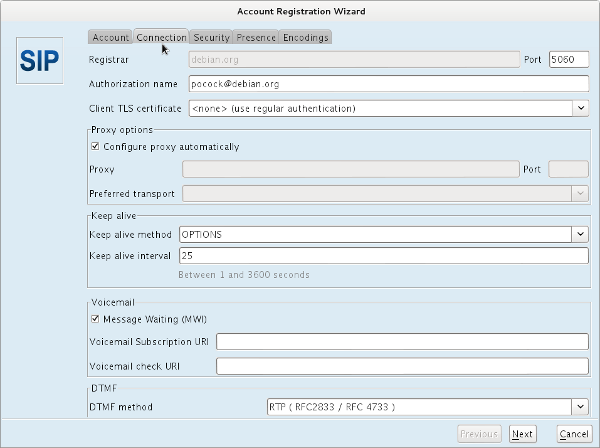
Before going on to talk about SIP, there is one really important thing that must be emphasized: XMPP/Jabber is also in the roadmap. Some of the infrastructure that has already been deployed (the new RTC passwords in ud-ldap, the TURN server and the RADIUS server) is good for both SIP and XMPP use cases. All to be revealed on Sunday As mentioned in my recent blog about the Debian.org NAPTR record, more details will be coming in my talk at mini-DebConf Paris this weekend. Today I'm just going to describe some things to install for those who want a head start. Jitsi Jitsi has been around for many years (originally as SIP Communicator) and it is probably the most advanced desktop softphone in the free software world. Jitsi packages are in jessie and sid - why not install them now. If you don't want to pull in dependencies from jessie on your wheezy system, you can also download from upstream and run it standalone. WebRTC browsers I've prepared a JSCommunicator implementation based on the jscommunicator-web-phone package. To use it, you need the latest version of Iceweasel/Firefox or Chromium. As HTML5 WebRTC / RTCPeerConnection is an evolving standard, using a recent browser is essential. Jitsi configuration for sip:debian.org It is not open for users just yet, but this is how you will configure it when it is available. More details to come...
AttachmentSize
step-4-setup-connection-scaled.png59.66 KB

2 January 2014

Francois Marier: Running your own XMPP server on Debian or Ubuntu

In order to get closer to my goal of reducing my dependence on centralized services, I decided to setup my own XMPP / Jabber server on a Linode VPS running Debian wheezy. I chose ejabberd since it was recommended by the RTC Quick Start website and here's how I put everything together.

DNS and SSL My personal domain is fmarier.org and so I created the following DNS records:
jabber-gw            CNAME    fmarier.org.
_xmpp-client._tcp    SRV      5 0 5222 jabber-gw.fmarier.org.
_xmpp-server._tcp    SRV      5 0 5269 jabber-gw.fmarier.org.
Then I went to get a free XMPP SSL certificate for jabber-gw.fmarier.org from StartSSL. This is how I generated the CSR (Certificate Signing Request) on a high-entropy machine:
openssl req -new -newkey rsa:2048 -nodes -out ssl.csr -keyout ssl.key -subj "/C=NZ/CN=jabber-gw.fmarier.org"
I downloaded the signed certificate as well as the StartSSL intermediate certificate and combined them this way:
cat ssl.crt ssl.key sub.class1.server.ca.pem > ejabberd.pem

ejabberd installation Installing ejabberd on Debian is pretty simple and I mostly followed the steps on the Ubuntu wiki with an additional customization to solve the Pidgin "Not authorized" connection problems.
  1. Install the package, using "admin" as the username for the administrative user:
    apt-get install ejabberd
    
  2. Set the following in /etc/ejabberd/ejabberd.cfg (don't forget the trailing dots!):
     acl, admin,  user, "admin", "fmarier.org" .
     hosts, ["fmarier.org"] .
     fqdn, "jabber-gw.fmarier.org" .
    
  3. Copy the SSL certificate into the /etc/ejabberd/ directory and set the permissions correctly:
    chown root:ejabberd /etc/ejabberd/ejabberd.pem
    chmod 640 /etc/ejabberd/ejabberd.pem
    
  4. Restart the ejabberd daemon:
    /etc/init.d/ejabberd restart
    
  5. Create a new user account for yourself:
    ejabberdctl register me fmarier.org P@ssw0rd1!
    
  6. Open up the following ports on the server's firewall:
    iptables -A INPUT -p tcp --dport 5222 -j ACCEPT
    iptables -A INPUT -p tcp --dport 5269 -j ACCEPT
    

Client setup On the client side, if you use Pidgin, create a new account with the following settings in the "Basic" tab:
  • Protocol: XMPP
  • Username: me
  • Domain: fmarier.org
  • Password: P@ssw0rd1!
and the following setting in the "Advanced" tab:
  • Connection security: Require encryption
From this, I was able to connect to the server without clicking through any certificate warnings. If you want to make sure that XMPP federation works, add your GMail address as a buddy to the account and send yourself a test message. In this example, the XMPP address I give to my friends is me@fmarier.org.

25 December 2013

Petter Reinholdtsen: Debian Edu interview: Dominik George

The Debian Edu / Skolelinux project consist of both newcomers and old timers, and this time I was able to get an interview with a newcomer in the project who showed up on the IRC channel a few weeks ago to let us know about his successful installation of Debian Edu Wheezy in his School. Say hello to Dominik George. Who are you, and how do you spend your days? I am a 23 year-old student from Germany who has spent half of his life with open source. In "real life", I am, as already mentioned, a student in the fields of Computer Science, Electrical Engineering, Information Technologies and Anglistics. Due to my (only partially voluntary) huge engagement in the open source world, these things are a bit vacant right now however. I also have been working as a project teacher at a Gymasnium (public school) for various years now. I took up that work some time around 2005 when still attending that school myself and have continued it until today. I also had been running the (kind of very advanced) network of that school together with a team of very interested and talented students in the age of 11 to 15 years, who took the chance to learn a lot about open source and networking before I left the school to help building another school's informational education concept from scratch. That said, one might see me as a kind of "glue" between school kids and the elderly of teachers as well as between the open source ecosystem and the (even more complex) educational ecosystem. When I am not busy with open source or education, I like Geocaching and cycling. How did you get in contact with the Skolelinux / Debian Edu project? I think that happened some time around 2009 when I first attended FrOSCon and visited the project booth. I think I wasn't too interested back then because I used to have an attitude of disliking software that does too much stuff on its own. Maybe I was too inexperienced to realise the upsides of an "out-of-the-box" solution ;). The first time I actively talked to Skolelinux people was at OpenRheinRuhr 2011 when the BiscuIT project, a home-grewn software used by my school for various really cool things from timetables and class contact lists to lunch ordering, student ID card printing and project elections first got to a stage where it could have been published. I asked the Skolelinux guys running the booth if the project were interested in it and gave a small demonstration, but there wasn't any real feedback and the guys seemed rather uninterested. After I left the school where I developed the software, it got mostly lost, but I am now reimplementing it for my new school. I have reusability and compatibility in mind, and I hop there will be a new basis for contributing it to the Skolelinux project ;)! What do you see as the advantages of Skolelinux / Debian Edu? The most important advantage seems to be that it "just works". After overcoming some minor (but still very annoying) glitches in the installer, I got a fully functional, working school network, without the month-long hassle I experienced when setting all that up from scratch in earlier years. And above that, it rocked - I didn't have any real hardware at hand, because the school was just founded and has no money whatsoever, so I installed a combined server (main server, terminal services and workstation) in a VM on my personal notebook, bridging the LTSP network interface to the ethernet port, and then PXE-booted the Windows notebooks that were lying around from it. I could use 8 clients without any performance issues, by using a tiny little VM on a tiny little notebook. I think that's enough to say that it rocks! Secondly, there are marketing reasons. Life's bad, and so no politician will ever permit a setup described as "Debian, an universal operating system, with some really cool educational tools" while they will be jsut fine with "Skolelinux, a single-purpose solution for your school network", even if both turn out to be the very same thing (yes, this is unfair towards the Skolelinux project, and must not be taken too seriously - you get the idea, anyway). What do you see as the disadvantages of Skolelinux / Debian Edu? I have not been involved with Skolelinux long enough to really answer this question in a fair way. Thus, please allow me to put it in other words: "What do you expect from Skolelinux to keep liking it?" I can list a few points about that: I'm really sorry I cannot say much more about that :(! Which free software do you use daily? First of all, all software I use is free and open. I have abandoned all non-free software (except for firmware on my darned phone) this year. I run Debian GNU/Linux on all PC systems I use. On that, I mostly run text tools. I use mksh as shell, jupp as very advanced text editor (I even got the developer to help me write a script/macro based full-featured student management software with the two), mcabber for XMPP and irssi for IRC. For that overly coloured world called the WWW, I use Iceweasel (Firefox). Oh, and mutt for e-mail. However, while I am personally aware of the fact that text tools are more efficient and powerful than anything else, I also use (or at least operate) some tools that are suitable to bring open source to kids. One of these things is Jappix, which I already introduced to some kids even before they got aware of Facebook, making them see for themselves that they do not need Facebook now ;). Which strategy do you believe is the right one to use to get schools to use free software? Well, that's a two-sided thing. One side is what I believe, and one side is what I have experienced. I believe that the right strategy is showing them the benefits. But that won't work out as long as the acceptance of free alternatives grows globally. What I mean is that if all the kids are almost forced to use Windows, Facebook, Skype, you name it at home, they will not see why they would want to use alternatives at school. I have seen students take seat in front of a fully-functional, modern Debian desktop that could do anything their Windows at home could do, and they jsut refused to use it because "Linux sucks". It is something that makes the council of our city spend around 600000 to buy software - not including hardware, mind you - for operating school networks, and for installing a system that, as has been proved, does not work. For those of you readers who are good at maths, have you already found out how many lives could have been saved with that money if we had instead used it to bring education to parts of the world that need it? I have, and found it to be nothing less dramatic than plain criminal. That said, the only feasible way appears to be the bottom up method. We have to bring free software to kids and parents. I have founded an association named Teckids here in Germany that does just that. We organise several events for kids and adolescents in the area of free and open source software, for example the FrogLabs, which share staff with Teckids and are the youth programme of the Free and Open Source Software Conference (FrOSCon). We do a lot more than most other conferences - this year, we first offered the FrogLabs as a holiday camp for kids aged 10 to 16. It was a huge success, with approx. 30 kids taking part and learning with and about free software through a whole weekend. All of us had a lot of fun, and the results were really exciting. Apart from that, we are preparing a campaign that is supposed to bring the message of free alternatives to stuff kids use every day to them and their parents, e.g. the use of Jabber / Jappix instead of Facebook and Skype. To make that possible, we are planning to get together a team of clever kids who understand very well what their peers need and can bring it across to them. So we will have a peer-driven network of adolescents who teach each other and collect feedback from the community of minors. We then take that feedback and our own experience to work closely with open source projects, such as Skolelinux or Jappix, at improving their software in a way that makes it more and more attractive for the target group. At least I hope that we will have good cooperation with Skolelinux in the future ;)! So in conclusion, what I believe is that, if it weren't for the world being so bad, it should be very clear to the political decision makers that the only way to go nowadays is free software for various reasons, but I have learnt that the only way that seems to work is bottom up.

5 December 2013

Daniel Kahn Gillmor: The legal utility of deniability in secure chat

This Monday, I attended a workshop on Multi-party Off the Record Messaging and Deniability hosted by the Calyx Institute. The discussion was a combination of legal and technical people, looking at how the characteristics of this particular technology affect (or do not affect) the law. This is a report-back, since I know other people wanted to attend. I'm not a lawyer, but I develop software to improve communications security, I care about these questions, and I want other people to be aware of the discussion. I hope I did not misrepresent anything below. I'd be happy if anyone wants to offer corrections. BackgroundOff the Record Messaging (OTR) is a way to secure instant messaging (e.g. jabber/XMPP, gChat, AIM). The two most common characteristics people want from a secure instant messaging program are:
Authentication
Each participant should be able to know specifically who the other parties are on the chat.
Confidentiality
The content of the messages should only be intelligible to the parties involved with the chat; it should appear opaque or encrypted to anyone else listening in. Note that confidentiality effectively depends on authentication -- if you don't know who you're talking to, you can't make sensible assertions about confidentiality.
As with many other modern networked encryption schemes, OTR relies on each user maintaining a long-lived "secret key", and publishing a corresponding "public key" for their peers to examine. These keys are critical for providing authentication (and by extension, for confidentiality). But OTR offers several interesting characteristics beyond the common two. Its most commonly cited characteristics are "forward secrecy" and "deniability".
Forward secrecy
Assuming the parties communicating are operating in good faith, forward secrecy offers protection against a special kind of adversary: one who logs the encrypted chat, and subsequently steals either party's long-term secret key. Without forward secrecy, such an adversary would be able to discover the content of the messages, violating the confidentiality characteristic. With forward secrecy, this adversary is be stymied and the messages remain confidential.
Deniability
Deniability only comes into play when one of the parties is no longer operating in good faith (e.g. their computer is compromised, or they are collaborating with an adversary). In this context, if Alice is chatting with Bob, she does not want Bob to be able to cryptographically prove to anyone else that she made any of the specific statements in the conversation. This is the focus of Monday's discussion. To be clear, this kind of deniability means Alice can correctly say "you have no cryptographic proof I said X", but it does not let her assert "here is cryptographic proof that I did not say X" (I can't think of any protocol that offers the latter assertion). The opposite of deniability is a cryptographic proof of origin, which usually runs something like "only someone with access to Alice's secret key could have said X."
The traditional two-party OTR protocol has offered both forward secrecy and deniability for years. But deniability in particular is a challenging characteristic to provide for group chat which is the domain of Multi-Party OTR (mpOTR). You can read some past discussion about the challenges of deniability in mpOTR (and why it's harder when there are more than two people chatting) from the otr-users mailing list. If you're not doing anything wrong... The discussion was well-anchored by a comment from another participant who cheekily asked "If you're not doing anything wrong, why do you need to hide your chat at all, let alone be able to deny it?" The general sense of the room was that we'd all heard this question many times, from many people. There are lots of problems with the ideas behind the question from many perspectives. But just from a legal perspective, there are at least two problems with the way this question is posed: In these situations, people confront real risk from the law. If we care about these people, we need to figure out if we can build systems to help them reduce that legal risk (of course we also need to fix broken laws, and the legal environment in general, but those approaches were out of scope for this discussion). The Legal Utility of Deniability Monday's meeting was called specifically because it wasn't clear how much real-world usefulness there is in the "deniability" characteristic, and whether this feature is worth the development effort and implementation tradeoffs required. In particular, the group was interested in deniability's utility in legal contexts; many (most?) people in the room were lawyers, and it's also not clear that deniability has much utility outside of a formal legal setting. If your adversary isn't constrained by some rule of law, they probably won't care at all whether there is a cryptographic proof or not that you wrote a particular message (In retrospect, one possible exception is exposure in the media, but we did not discuss that scenario). Places of possible usefulness So where might deniability come in handy during civil litigation or a criminal trial? Presumably the circumstance is that a piece of a chat log is offered as incriminating evidence, and the defendant is trying to deny something that they appear to have said in the log. This denial could take place in two rather different contexts: during rules over admissibility of evidence, or (once admitted) in front of a jury. In legal wrangling over admissibility, apparently a lot of horse-trading can go on -- each side concedes some things in exchange for the other side conceding other things. It appears that cryptographic proof of origin (that is, a lack of deniability) on the chat logs themselves might reduce the amount of leverage a defense lawyer can get from conceding or arguing strongly over that piece of evidence. For example, if the chain of custody of a chat transcript is fuzzy (i.e. the transcript could have been mishandled or modified somehow before reaching trial), then a cryptographic proof of origin would make it much harder for the defense to contest the chat transcript on the grounds of tampering. Deniability would give the defense more bargaining power. In arguing about already-admitted evidence before a jury, deniability in this sense seems like a job for expert witnesses, who would need to convince the jury of their interpretation of the data. There was a lot of skepticism in the room over this, both around the possibility of most jurors really understanding what OTR's claim of deniability actually means, and on jurors' ability to distinguish this argument from a bogus argument presented by an opposing expert witness who is willing to lie about the nature of the protocol (or who misunderstands it and passes on their misunderstanding to the jury). The complexity of the tech systems involved in a data-heavy prosecution or civil litigation are themselves opportunities for lawyers to argue (and experts to weigh in) on the general reliability of these systems. Sifting through the quantities of data available and ensuring that the appropriate evidence is actually findable, relevant, and suitably preserved for the jury's inspection is a hard and complicated job, with room for error. OTR's deniability might be one more element in a multi-pronged attack on these data systems. These are the most compelling arguments for the legal utility of deniability that I took away from the discussion. I confess that they don't seem particularly strong to me, though some level of "avoiding a weaker position when horse-trading" resonates with me. What about the arguments against its utility? Limitations The most basic argument against OTR's deniability is that courts don't care about cryptographic proof for digital evidence. People are convicted or lose civil cases based on unsigned electronic communications (e.g. normal e-mail, plain chat logs) all the time. OTR's deniability doesn't provide any legal cover stronger than trying to claim you didn't write a given e-mail that appears to have originated from your account. As someone who understands the forgeability of e-mail, i find this overall situation troubling, but it seems to be where we are. Worse, OTR's deniability doesn't cover whether you had a conversation, just what you said in that conversation. That is, Bob can still cryptographically prove to an adversary (or before a judge or jury) that he had a communication with someone controlling Alice's secret key (which is probably Alice); he just can't prove that Alice herself said any particular part of the conversation he produces. Additionally, there are runtime tradeoffs depending on how the protocol manages to achieve these features. For example, forward secrecy itself requires an additional round trip or two when compared to authenticated, encrypted communications without forward secrecy (a "round trip" is a message from Alice to Bob followed by a message back from Bob to Alice). Getting proper deniability into the mpOTR spec might incur extra latency (imagine having to wait 60 seconds after everyone joins before starting a group chat, or a pause in the chat of 15 seconds when a new member joins) or extra computational power (meaning that they might not work well on slower/older devices) or an order of magnitude more bandwidth (meaning that chat might not work at all on a weak connection). There could also simply be complexity that makes it harder to correctly implement a protocol with deniability than an alternate protocol without deniability. Incorrectly-implemented software can put its users at risk. I don't know enough about the current state of mpOTR to know what the specific tradeoffs are for the deniability feature, but it's clear there will be some. Who decides whether the tradeoffs are worth the feature? Other kinds of deniability Further weakening the case for the legal utility of OTR's deniability, there seem to be other ways to get deniability in a legal context over a chat transcript. There are deniability arguments that can be made from outside the protocol. For example, you can always claim someone else took control of your computer while you were asleep or using the bathroom or eating dinner, or you can claim that your computer had a virus that exported your secret key and it must have been used by someone else. If you're desperate enough to sacrifice your digital identity, you could arrange to have your secret key published, at which point anyone can make signed statements with it. Having forward secrecy makes it possible to expose your secret key without exposing the content of your past communications to any listener who happened to log them. Conclusion My takeaway from the discussion is that the legal utility of OTR's deniability is non-zero, but quite low; and that development energy focused on deniability is probably only justified if there are very few costs associated with it. Several folks pointed out that most communications-security tools are too complicated or inconvenient to use for normal people. If we have limited development energy to spend on securing instant messaging, usability and ubiquity would be a better focus than this form of deniability. Secure chat systems that take too long to make, that are too complex, or that are too cumbersome are not going to be adopted. But this doesn't mean people won't chat at all -- they'll just use cleartext chat, or maybe they'll use supposedly "secure" protocols with even worse properties: for example, without proper end-to-end authentication (permitting spoofing or impersonation by the server operator or potentially by anyone else); with encryption that is reversible by the chatroom operator or flawed enough to be reversed by any listener with a powerful computer; without forward secrecy; or so on. As a demonstration of this, we heard some lawyers in the room admit to using Skype to talk with their clients even though they know it's not a safe communications channel because their clients' adversaries might have access to the skype messaging system itself. My conclusion from the meeting is that there are a few particular situations where deniability could be useful legally, but that overall, it is not where we as a community should be spending our development energy. Perhaps in some future world where all communications are already authenticated, encrypted, and forward-secret by default, we can look into improving our protocols to provide this characteristic, but for now, we really need to work on usability, popularization, and wide deployment. Thanks Many thanks to Nick Merrill for organizing the discussion, to Shayana Kadidal and Stanley Cohen for providing a wealth of legal insight and legal experience, to Tom Ritter for an excellent presentation of the technical details, and to everyone in the group who participated in the interesting and lively discussion. Tags: chat, deniability, otr, security

28 November 2013

Debian Med: Bits from Debian Med team (by Andreas Tille)

Some of these bits are a bit outdated but there is no point in hiding this information just because it is old. FOSDEM talkAndreas Tille had a talk at FOSDEM which is also Video recorded. A quite similar but updated talk was held at DebConf 13 (see below). Jabber interview by reporter from IndiaThere was an interesting interview between Rajeev Nair and Andreas Tille at So, 17.02.2013 Rajeev Nair is Business head of an health care journal in India held via jabber. Since this might serve as some nice FAQ about Debian Med here is a complete log of this interview (permission to publish it was granted). Article about Debian MedAs a consequence of the interview above the Debian Med team has assembled an article which was originally intended to be published in the Health Cafe journal but somehow this never happened. So we ended up with a nice article targeting at interested readers about Free Software in medicine with not necessarily informatics background. Since the article is considered to be of good quality and has consumed some time of several team members we are seeking for ideas for relevant places where to publish it. It is available as PDFas well as in SVN. Yearly sprint of Debian Med teamThis year we had our third sprint of the Debian Med team and all participants consider it a great success again. The sprint was in end of February and the individual reports are linked from the according wiki page. Since Andreas Tille was able to prove the nice effect of having face to face meetings in Debian teams in the team metrics graphs presented in his talks at DebConf (see below) we will keep on with this good tradition. The next sprint is scheduled for Friday 31st January until Sunday 2nd February in Stonehaven near Aberdeen. If you are interested to meet the people behind Debian Med and want to join us in developing packages which are helpful in health care and bioinformatics you are invited to join us. DebConf 13 in VaumarcusAndreas Tille had two talks with specific influence to Debian Med development(Debian Med as a success story for other Blends, How to attract new developers for your team (MoM, SoB). For those who want to read a full (and lengthy) report about DebConf 13 by Andreas Tille this is online in this blog article. Codefest of the Open Bioinformatics FoundationIvo Maintz and Steffen M ller organised the Codefest of the Open Bioinformatics Foundation in Berlin. About 40 contributors from all over the world attended, connecting the Debian community strongly with upstream. The event triggered a joint paper of participants to Sprints, Codefests and Hackathons alike, presented at the Nettab conference on Semantic, Social, and Mobile Applications for Bioinformatics and Biomedical Laboratories in Venice. Reupload unattended packagesAndreas Tille has mentored the GSoC student Emmanouil Kiagias and as a byproduct some Blends metadata were now kept in UDD. This has inspired some new tools and one of this was an UDD query to return all packages in the interest of the Blend ordered by date when they were uploaded. It has shown that there were packages hanging around in the package pool since five years. So some effort was done to check those packages which were not necessarily "buggy" according to BTS entries and so we were able to fix the following issues in about 20-30 packages: Since it was impressive how many things that deserve fixing are hidden in such long unattended packages it is recommended also to other teams to spend some time into these. The UDD query can be easily tweaked for a team maintainer address. Debian Med Bug Squashing Advent Calendar 2013The Debian Med team will again do the Bug Squashing Advent Calendar. Feel free to join us in our bug squashing effort where we close bugs while other people are opening doors. :-) Kind regards and see you at Debian Med sprint
Andreas.

13 November 2013

Julien Danjou: OpenStack Design Summit Icehouse, from a Ceilometer point of view

Last week was the OpenStack Design Summit Icehouse in Hong-Kong where we, OpenStack developers, discussed and designed the new OpenStack release (Icehouse) that is coming up. The week has been wonderful. It was my second OpenStack design summit, and I loved it. Bumping into various people I've never met so far and worked with online was a real pleasure. As it was to meet again with fellow OpenStack developers! The event organisation was great, as were the parties. :-) On the last day, I had the chance to present a talk with Eoghan Glynn and Nick Barcet how we built the auto-scaling feature in Heat, implementing the "alarming" feature needed in Ceilometer.
The slides and video of the talk is online on my talks page. Design sessions This time, Ceilometer design sessions were spread on 3 days. Everything we talked about has its Etherpad instance. The discussions were interesting, and the amount of feedback gathered is big and is going to be very useful. There's a lot of people and companies using Ceilometer now, and the project is getting more and more traction in general. There's a lot of different way to use it and to bend it to one's needs. Considering the amount of features and options that is provided, building functionality with a genericized approach it making Ceilometer useful for a lot of different and interesting use-cases. Icehouse roadmap The list of blueprints targeting Icehouse is available, but not yet complete. I expect people to start filling this list in the next days.If you want to propose blueprints, you're free to do so and inform us about it so we can validate it. The same applies if you wish to implement one of them! Thereafter, I try to guess what the roadmap will look like in the upcoming weeks for Ceilometer based on the discussion we had last week during the summit. Events management A lot of work is going to be put into event management. Ceilometer plans to store notifications sent using oslo.messaging by OpenStack projects. Some work already got merge for Havana, but the API part and future improvements and ideas will continue to flow into the Icehouse release. Agents and group management A lot has been discussed around the polling agents and around the alarm evaluator agent. The current state of the ceilometer-central-agent disallows any kind of high-availability and load-balancing, as the polling task are kept and scheduled on only one node. The high-availability part is already covered by a custom mechanism built into ceilometer-alarm-evaluator, but it came clear to us that a more generic approach is needed. A lot of other projects needs this kind of functionality, and a pattern have been pointed out. A blueprint about group membership has been discussed in an Oslo session, and will end into a new Python library written to solve this in Ceilometer and in other projects. TaskFlow will also probably be leveraged to solve the task distribution issue. Documentation Since a few weeks, Ceilometer auto-generates its API reference documentation using sphinxcontrib-docbookrestapi that parses our API code that uses WSME. We also want to start writing a user guide, and we'll do that inside our own repository. That way, I hope that we will be the first project in OpenStack to require documentation to be incorporated into every patch that's being sent to Ceilometer. This is the best way to assure that nothing can be changed nor added without being accompanied with a documentation update. Tempest testing Testing of Ceilometer already has been a subject during the previous design summit about testing. We already put a large effort on Tempest testing in this last cycle, but we encountered a lot of small issues that we had to tackle to achieve something. Some Ceilometer basic tests are already on their way into Tempest, so this is something that is going to be achieved very soon. Ultimately, I would also want Ceilometer moving towards providing its own set of Tempest tests as part of the code base. That way, it'd be as easy for core reviewers to refuse a patch if it doesn't provide functional tests as it is to refuse it if it doesn't provide unit tests. As we'll do for the documentation. API improvements Once again, a few API improvements will probably be implemented, like aggregation or the ability to specify multiple queries with OR and AND operators. Roll-up, archiving of data There seems to be interest in archiving and rolling-up the data stored by Ceilometer, so work in this area is to be expected. Supporting multiple data storage driver in parallel seems to be something that needs to be done for this and other aspects of Ceilometer feature set. Alarming The alarming feature set is already big, and the work that has been accomplished pretty amazing. A few improvements will be made, as retrieving better metrics and building better statistics (exclusion of low quality data points).

30 October 2013

Daniel Kahn Gillmor: getting to TLS (STARTTLS HOWTO)

Many protocols today allow you to upgrade to TLS from within a cleartext version of the protocol. This often falls under the rubric of "STARTTLS", though different protocols have different ways of doing it. I often forget the exact steps, and when i'm debugging a TLS connection (e.g. with tools like gnutls-cli) i need to poke a remote peer into being ready for a TLS handshake. So i'm noting the different mechanisms here. lines starting with C: are from the client, lines starting with S: are from the server. many of these are (roughly) built into openssl s_client, using the -starttls option. Sometimes this doesn't work because the handshake needs tuning for a given server; other times you want to do this with a different TLS library. To use the techniques below with gnutls-cli from the gnutls-bin package, just provide the --starttls argument (and the appropriate --port XXX argument), and then hit Ctrl+D when you think it's ok to start the TLS negotiation. SMTP The polite SMTP handshake (on port 25 or port 587) that negotiates a TLS upgrade looks like:
C: EHLO myhostname.example
S: [...]
S: 250-STARTTLS
S: [...]
S: 250 [somefeature]
C: STARTTLS
S: 220 2.0.0 Ready to start TLS
<Client can begin TLS handshake>
IMAP The polite IMAP handshake (on port 143) that negotiates a TLS upgrade looks like:
S: OK [CAPABILITY IMAP4rev1 [...] STARTTLS [...]] [...]
C: A STARTTLS
S: A OK Begin TLS negotiation now
<Client can begin TLS handshake>
POP The polite POP handshake (on port 110) that negotiates a TLS upgrade looks like:
S: +OK POP3 ready
C: STLS
S: +OK Begin TLS 
<Client can begin TLS handshake>
XMPP The polite XMPP handshake (on port 5222 for client-to-server, or port 5269 for server-to-server) that negiotiates a TLS upgrade looks something like (note that the domain requested needs to be the right one):
C: <?xml version="1.0"?><stream:stream to="example.net"
C:  xmlns="jabber:client" xmlns:stream="http://etherx.jabber.org/streams" version="1.0">
S: <?xml version='1.0'?>
S: <stream:stream
S:  xmlns:db='jabber:server:dialback'
S:  xmlns:stream='http://etherx.jabber.org/streams'
S:  version='1.0'
S:  from='example.net'
S:  id='d34edc7c-22bd-44b3-9dba-8162da5b5e72'
S:  xml:lang='en'
S:  xmlns='jabber:server'>
S: <stream:features>
S: <dialback xmlns='urn:xmpp:features:dialback'/>
S: <starttls xmlns='urn:ietf:params:xml:ns:xmpp-tls'/>
S: </stream:features>
C: <starttls xmlns="urn:ietf:params:xml:ns:xmpp-tls" id="1"/>
S: <proceed xmlns='urn:ietf:params:xml:ns:xmpp-tls'/>
<Client can begin TLS handshake>
NNTP RogerBW (in the comments below) points out that NNTP has TLS support:
C: CAPABILITIES
S: [...]
S: STARTTLS
S: [...]
S: .
C: STARTTLS
S: 382 Continue with TLS negotiation
PostgreSQL I got mail from James Cloos suggesting how to negotiate an upgrade to TLS over the PostgreSQL RDBMS. He points to the protocol docs, and in particular, to multiple protocol flow documents, and SSLRequest and StartupMessage chunks of the protocol spec (and clarification that data is sent in network byte order). It won't work in a text-mode communication, but it's worth noting here anyway: The client starts by sending these eight octets:
0x00 0x00 0x00 0x08 0x04 0xD2 0x16 0x2F
and the server replies with 'S' for secure or 'N' for not. If the reply is S, TLS negotiation follows. The message represents int32(8) specifying that there are 8 octets and int16(1234),int16(5678). All sent in network order. (The non-TLS case starts with a similar message with int16(3),int16(0) for protocol version 3.0. Starttls is essentially pg protocol version 1234.5678.) what else? I don't know (but would like to) how to do: If you know other mechanisms, or see bugs with the simple handshakes i've posted above, please let me know either by e-mail or on the comments here. Other interesting notes: RFC 2817, a not-widely-supported mechanism for upgrading to TLS in the middle of a normal HTTP session.Tags: gnutls, imap, pop, postgresql, smtp, starttls, tls, xmpp

22 October 2013

Francesca Ciceri: Improving collaboration skills

[...] this is a great example of overcoming something that we call "problem A, problem B" paradox.
So you've got a group of people coming together, and they're all trying to solve the same problem (problem A) and they're really passionate about it. And then, you've got this problem B thing, which is that you got a bunch of people with different views.
And they may seem to be conflicting, and it seems like a paradox: the same differences that we need to solve the problem are getting in our way. But if you think about it as a paradox, you can get through it.
You think: OK, we've got all these differences. You have to identify the differences that actually are going to move us forward and those that are getting in our way.
And the differences that are getting in your way, set them aside. Push them off to the side and focus on the ones that are helping you move forward.
Kathryn Jablokow Well, I noticed that at first everybody was saying "Yes, but this is my idea".
And as we got closer and closer together, it became "Yes, and".
Jack Matson
(Quotes from a lecture about "Collaboration skills", part of the Creativity, Innovation and Change course on Coursera) IMO this is an important lesson to learn if you want to work effectively in a community project like Debian.
We talk much about diversity, and the added value of diversity in our project.
But diversity also means that to converge towards consensus is difficult and requires a specific set of best practices. A little thing like saying "Yes and" instead of "Yes but" could be of help. Words definitely matter.

10 September 2013

Petter Reinholdtsen: Recipe to test the Freedombox project on amd64 or Raspberry Pi

I was introduced to the Freedombox project in 2010, when Eben Moglen presented his vision about serving the need of non-technical people to keep their personal information private and within the legal protection of their own homes. The idea is to give people back the power over their network and machines, and return Internet back to its intended peer-to-peer architecture. Instead of depending on a central service, the Freedombox will give everyone control over their own basic infrastructure. I've intended to join the effort since then, but other tasks have taken priority. But this summers nasty news about the misuse of trust and privilege exercised by the "western" intelligence gathering communities increased my eagerness to contribute to a point where I actually started working on the project a while back. The initial Debian initiative based on the vision from Eben Moglen, is to create a simple and cheap Debian based appliance that anyone can hook up in their home and get access to secure and private services and communication. The initial deployment platform have been the Dreamplug, which is a piece of hardware I do not own. So to be able to test what the current Freedombox setup look like, I had to come up with a way to install it on some hardware I do have access to. I have rewritten the freedom-maker image build framework to use .deb packages instead of only copying setup into the boot images, and thanks to this rewrite I am able to set up any machine supported by Debian Wheezy as a Freedombox, using the previously mentioned deb (and a few support debs for packages missing in Debian). The current Freedombox setup consist of a set of bootstrapping scripts (freedombox-setup), and a administrative web interface (plinth + exmachina + withsqlite), as well as a privacy enhancing proxy based on privoxy (freedombox-privoxy). There is also a web/javascript based XMPP client (jwchat) trying (unsuccessfully so far) to talk to the XMPP server (ejabberd). The web interface is pluggable, and the goal is to use it to enable OpenID services, mesh network connectivity, use of TOR, etc, etc. Not much of this is really working yet, see the project TODO for links to GIT repositories. Most of the code is on github at the moment. The HTTP proxy is operational out of the box, and the admin web interface can be used to add/remove plinth users. I've not been able to do anything else with it so far, but know there are several branches spread around github and other places with lots of half baked features. Anyway, if you want to have a look at the current state, the following recipes should work to give you a test machine to poke at. Debian Wheezy amd64
  1. Fetch normal Debian Wheezy installation ISO.
  2. Boot from it, either as CD or USB stick.
  3. Press [tab] on the boot prompt and add this as a boot argument to the Debian installer:
    url=http://www.reinholdtsen.name/freedombox/preseed-wheezy.dat
  4. Answer the few language/region/password questions and pick disk to install on.
  5. When the installation is finished and the machine have rebooted a few times, your Freedombox is ready for testing.
Raspberry Pi Raspbian
  1. Fetch a Raspbian SD card image, create SD card.
  2. Boot from SD card, extend file system to fill the card completely.
  3. Log in and add this to /etc/sources.list:
    deb http://www.reinholdtsen.name/freedombox wheezy main
    
  4. Run this as root:
    wget -O - http://www.reinholdtsen.name/freedombox/BE1A583D.asc   \
       apt-key add -
    apt-get update
    apt-get install freedombox-setup
    /usr/lib/freedombox/setup
    
  5. Reboot into your freshly created Freedombox.
You can test it on other architectures too, but because the freedombox-privoxy package is binary, it will only work as intended on the architectures where I have had time to build the binary and put it in my APT repository. But do not let this stop you. It is only a short "apt-get source -b freedombox-privoxy" away. :) Note that by default Freedombox is a DHCP server on the 192.168.1.0/24 subnet, so if this is your subnet be careful and turn off the DHCP server by running "update-rc.d isc-dhcp-server disable" as root. Please let me know if this works for you, or if you have any problems. We gather on the IRC channel #freedombox on irc.debian.org and the project mailing list. Once you get your freedombox operational, you can visit http://your-host-name:8001/ to see the state of the plint welcome screen (dead end - do not be surprised if you are unable to get past it), and next visit http://your-host-name:8001/help/ to look at the rest of plinth. The default user is 'admin' and the default password is 'secret'.

1 August 2013

Matthew Garrett: Don't ship 32-bit UEFI firmware on x86

Shipping a UEFI-bootable Linux distribution is a touch awkward[1], with the main sticking point being the necessity to produce boot media with multiple El-Torito images. An El-Torito image is either an image of a floppy disk or a small hard drive, embedded into the ISO. This allows BIOS systems to look for an El Torito image, hook some interrupts and then boot without the BIOS having to care about the fact that the image is embedded in an ISO-9660 filesystem. UEFI systems will look for an El-Torito image with a special tag - if they find it they'll mount it as a FAT filesystem and look for a bootloader, and if not they'll fall back to BIOS compatibility.

So, if you want a CD that'll boot on both BIOS and UEFI systems, you need two El-Torito images - one for BIOS, one for UEFI. Unfortunately, various BIOSes deal exceptionally badly with CD images that contain more than one El-Torito image. The most common failure case is to print a menu asking you to choose an option without labelling the options, but some will just fail outright. Thankfully, this is pretty much exclusively limited to 32-bit systems.

Things get irritatingly more complicated due to a quirk of UEFI. UEFI is based on executing code in native mode. That means that 32-bit UEFI systems can't execute 64-bit code in firmware, even if the CPU is capable of it. A 64-bit OS can only boot on 32-bit UEFI if it has very ugly compatibility hacks, including having to rewrite structures and register state every time it makes a UEFI call. The only OS I'm aware of that implements this is MacOS X. Having looked into what it'd take to implement it in Linux, I decided that hammering rusty nails through my feet would be a preferable use of time. Thankfully, I went drinking instead.

So distributions have a choice. They can either produce UEFI-bootable CD images for 32-bit x86 and risk failures on actual 32-bit systems, or they can ignore UEFI entirely on 32-bit and succeed in booting on all the hardware that people actually own[2]. Unsurprisingly, they tend to choose the second option.

So, if you're building an x86 hardware platform, don't ship with 32-bit UEFI. If you're stuck with a 32-bit CPU then just ship BIOS. If you have a 64-bit CPU then ship a 64-bit UEFI. If you ship with 32-bit UEFI, no significant existing Linux distribution will support you, and you'll face an uphill battle to convince them to do so.

32-bit UEFI. Just say what on earth were you thinking, please, no, can't you find a solution that doesn't involve me getting tetanus jabs.

(If you're worried about the extra memory consumption of 64-bit OSes, just encourage 32-bit userspace on a 64-bit kernel. Or just boot via BIOS)

[1] See the number that still don't manage it despite having had several years to adapt
[2] Until recently, the only vendor to ship 32-bit UEFI firmware on volume hardware was Apple. This was fine on their 32-bit systems, but on their 64-bit systems with 32-bit UEFI booting a 64-bit version of Windows would result in boot failure. Apple rectified this by stating that 64-bit Windows wasn't supported on platforms with 32-bit UEFI, which is a neat trick if you can manage it. 32-bit Windows (and Linux) was fine because it didn't include a UEFI boot image and so didn't trigger the bug.

comment count unavailable comments

28 May 2013

Daniel Pocock: Google's XMPP users left high and dry

A few weeks ago, I was alarmed to discover Empathy's dependency on the Google version of XMPP, particularly for NAT traversal It was surprising to see those fears confirmed so quickly with Google moving away from open XMPP connectivity, particularly for multimedia protocols such as voice and video, leaving open source clients like Empathy who put their trust in Google high-and-dry. With Empathy being the default chat client on the Gnome desktop of Debian and Fedora, this is quite a serious situation. Fortunately, the latest versions of Debian 7 (wheezy) and Fedora 19 (Schrodinger's Cat (beta)) contain their best ever support for VoIP and RTC federation on the server side. Still under construction, the RTCquickStart.org guide tries to make it easier than ever to put the necessary packages to use - anybody who already runs their own mail, DNS or web server can become their own VoIP/SIP/XMPP provider in less than an hour. One particular point to note is that TURN servers work equally well for both SIP and XMPP users. Getting close to 100% support for VoIP users behind NAT requires a TURN server. It is possible to mix and match the reSIProcate TURN server, reTurn with any popular SIP and Jabber servers on Debian, Ubuntu or Fedora. Also look at the Turnserver.org project and RFC 5766 TURN server project I'd strongly encourage those who are concerned about this latest development to come and join the discussion in the Free RTC mailing list sponsored by the Free Software Foundation Europe

21 May 2013

Erich Schubert: Google Hangouts drops XMPP support

Update: today I've been receiving XMPP messages in the Google+ variant of Hangouts. Looks as if it currently is back (at least while you are logged in via XMPP - havn't tried without pidgin at the same time yet). Let's just hope that XMPP federation will continue to be supported on the long run.
It's been all over the internet, so you probably heard it already: Google Hangouts no longer receives messages from XMPP users. Before, you could easily chat with "federated" users from other Jabber servers.
While of course the various open-source people are not amused -- for me, most of my contacts disappeared, so I then uninstalled Hangouts to get back Google Talk (apparently this works if Talk was preinstalled in your phones firmware) -- this bears some larger risks for Google:
  • Reputation: Google used to have the reputation of being open. XMPP support was open, the current "Hangups" protocol is not. This continuing trend of abandoning open standards and moving to "walled garden" solutions will likely harm the companies reputation in the open source community
  • Legal risk of an antitrust action: Before, other competitors could interface with Google using an indepentend and widely accepted standard. An example is United Internet in Germany, which operates for example the Web.de and GMX platforms, mail.com, the 1&1 internet provider. By effectively locking out its competitors - without an obvious technical reason, as XMPP was working fine just before, and apparently continues to be used at Google for example in AppEngine - bears a high risk of running into an antitrust action in Europe. If I were 1&1, I would try to get my lawyers started... or if I were Microsoft, who apparently just wanted to add XMPP messaging to Hotmail?
  • Users: Google+ is not that big yet. Especially in Germany. Since 90% of my contacts were XMPP contacts, where am I likely going to move to: Hangouts or another XMPP server? Or back to Skype? I still use Skype for more Voice calls than Google (which I used like twice), because there are some people that prefer Skype. One of these calls probably was not using the Google plugin, but an open source phone. Because with XMPP and Jingle, my regular chat client would interoperate. An in fact, the reason I started using Google Talk the first place was because it would interoperate with other networks, too, and I assumed they would be good at operating a Jabber server.
In my opinion, Google needs to quickly restore a functioning XMPP bridge. It is okay if they offer add-on functionality only for Hangout users (XMPP was always designed to allow for add-on functionality); it is also okay if they propose an entirely new open protocol to migrate to on the long run, if they can show good reasons such as scalability issues. But the way they approached the Hangup rollout looks like a big #fail to me.
Oh, and there are other issues, too. For example Linus Torvalds complains about the fonts being screwed up (not hinted properly) in the new Google+, others complain about broken presence indicators (but then you might as well just send an email, if you can't tell whether the recepient will be able to receive and answer right away), but using Hangouts will apparently also (for now -- rumor has it that Voice will also be replaced by Hangups entirely) lose you Google Voice support. The only thing that seems to give positive press are the easter eggs...
All in all, I'm not surprised to see over 20% of users giving the lowest rating in the Google Play Store, and less than 45% giving the highest rating - for a Google product, this must be really low.

15 May 2013

Benjamin Mako Hill: Sounds Like a Map

Colored visualization of the puzzle. I love maps something that became clear to me when I was looking at the tag cloud of my bookmarks a few years back. One of my favorite blogs (now a book) is Frank Jabobs Strange Maps. So it s no coincidence that a number of my favorite MIT Mystery Hunt puzzles are map based. Trying to connect the two worlds, I sent Jacobs a write-up of the hunt and of a particularly strange sound-based map puzzle called White Noise that I worked with Don Armstrong to solve in the 2006 hunt. While I wasn t paying attention, Jacobs did a very nice writeup of my writeup of the puzzle for Strange Maps!

7 May 2013

Evgeni Golov: Wheezy, ejabberd, Pidgin and SRV records

TL;DR: fqdn, "jabber.die-welt.net" . So, how many servers do you have, that are still running Squeeze? I count one, mostly because I did not figure out a proper upgrade path from OpenVZ to something else yet, but this is a different story. This post is about the upgrade of my communication machine, dengon.die-welt.net. It runs my private XMPP and IRC servers. I upgraded it to Wheezy, checked that my irssi and my BitlBee still could connect and left for work. There I noticed, that Pidgin could only connect to one of the two XMPP accounts I have on that server. sargentd@jabber.die-welt.net worked just fine, while evgeni@golov.de failed to connect. ejabberd was logging a failed authentication:
I(<0.1604.0>:ejabberd_c2s:802) : ( socket_state,tls, tlssock,#Port<0.5130>,#Port<0.5132> ,<0.1603.0> ) Failed authentication for evgeni@golov.de

While Pidgin was just throwing Not authorized errors. I checked the password in Pidgin (even if it did not change). I tried different (new) accounts: anything@jabber.die-welt.net worked, nothing@golov.de did not and somethingdifferent@jabber.<censored>.de worked too. So where was the difference between the three vhosts? jabber.die-welt.net and jabber.<censored>.de point directly (A/CNAME) to dengon.die-welt.net. golov.de has SRV records for XMPP pointing to jabber.die-welt.net. Let s ask Google about ejabberd pidgin srv . There are some bugs. But they are marked as fixed in Wheezy. Mhh Let s read again Okay, I have to set fqdn, "<my_srv_record_name>" . when this does not match my hostname. Edit /etc/ejabberd/ejabberd.cfg, add fqdn, "jabber.die-welt.net" . (do not forget the dot at the end) and restart the ejabberd. Pidgin can connect again. Yeah.

1 May 2013

Daniel Pocock: British Telecom attacks free software with patent demands

The Register is reporting that British Telecom is now attacking the VoIP industry by claiming that it has patents over the IETF standardised Session Initition Protocol (SIP RFC 3261) SIP is widely implemented in free software, in standalone products such as Lumicall and in Linux distributions such as Debian that carry a wide variety of SIP servers, SIP proxies and SIP clients, including the default chat client Empathy It remains to be seen whether they will engage in a similar attack on related protocols like XMPP / Jabber Many of the VoIP companies under attack are heavy users of free software

Daniel Pocock: British Telecom attacks free software with patent demands

The Register is reporting that British Telecom is now attacking the VoIP industry by claiming that it has patents over the IETF standardised Session Initition Protocol (SIP RFC 3261) SIP is widely implemented in free software, in standalone products such as Lumicall and in Linux distributions such as Debian that carry a wide variety of SIP servers, SIP proxies and SIP clients, including the default chat client Empathy It remains to be seen whether they will engage in a similar attack on related protocols like XMPP / Jabber Many of the VoIP companies under attack are heavy users of free software

25 April 2013

Julien Danjou: OpenStack Design Summit Havana, from a Ceilometer point of view

Last week was the OpenStack Design Summit in Portland, OR where we, developers, discussed and designed the new OpenStack release (Havana) coming up. The summit has been wonderful. It was my first OpenStack design summit -- even more as a PTL -- and bumping into various people I've never met so far and worked with online only was a real pleasure! <figure> <figcaption>Me and Nick ready to talk about Ceilometer new features.</figcaption> </figure> Nick Barcet from eNovance, our dear previous Ceilometer PTL, and myself, talked about Ceilometer and presented the work that bas been done for Grizzly, with some previews of what we'll like to see done for its Havana release. You can take a look at the slides if you're curious. Design sessions Ceilometer had his design sessions during the last days of the summit. We noted a lot of things and commented during the sessions in our Etherpads instances. The first session was a description of Ceilometer core architecture for interested people, and was a wonderful success considering that the room was packed. Our Doug Hellmann did a wonderful job introducing people to Ceilometer and answering question. <figure> <figcaption>Doug explaining Ceilometer architecture.</figcaption> </figure> The next session was about getting feedbacks from our users. We had a lot of surprise to discover wonderful real use-cases and deployments, like the CERN using Ceilometer and generating 2 GB of data per day! The following sessions ran on Thursday and were much more about new features discussion. A lot ot already existing blueprints were discussed and quickly validated during the first morning session. Then, Sandy Walsh introduced the architecture they use inside StackTach, so we can start thinking about getting things from it into Ceilometer. API improvements were discussed without surprises and with a good consensus on what needs to be done. The four following sessions that occupied a lot of the days were related to alarming. All were lead by Eoghan Glynn, from RedHat, who did an amazing job presenting the possible architectures with theirs pros and cons. Actually, all we had to do was to nod to his designs and acknowledge the plan on how to build this. That last two sessions were about discussing advanced models for billing where we got some interesting feedback from Daniel Dyer from HP, and then were a quick follow-up of the StackTach presentation from the morning session. Havana roadmap The list of blueprints targetting Havana is available and should be finished by next week. If you want to propose blueprints, you're free to do so and inform us about it so we can validate it. The same applies if you wish to implement one of them! API extension I do think the API version 2 is going to be heavily extended during this release cycle. We need more feature, like the group-by functionnality. Healthnmon In parallel of the design sessions, discussions took place in the unconference room with the Healthnmon developers to figure out a plan in order to merge some of their efforts into Ceilometer. They should provide a component to help Ceilometer supports more hypervisors than it currently does. Alarming Alarming is definitely going to be the next big project for Ceilometer. Today, Eoghan and I started building blueprints on alarming, centralized in a general blueprint. We know this is going to happen for real and very soon, thanks to the engagements of eNovance and RedHat who are commiting resources to this amazing project!

11 April 2013

Daniel Pocock: reSIProcate and reTURN come to Fedora

This week, I've released the first official reSIProcate packages for Fedora. EPEL packages for RHEL5 and RHEL6 are on the way too. This is exceptionally good news for Debian, Ubuntu, OpenWRT routers and every other platform that is already carrying these packages. reSIProcate is not just SIP: it also contains the powerful STUN/TURN server, reTurn Server. The TURN protocol is the IETF standard that solves many of the difficulties faced using VoIP/RTC from behind NAT. It is equally useful for SIP or XMPP (Jabber) and is supported in various ways by Empathy, Jitsi and Lumicall and it is a mandatory element of WebRTC which is expected to rapidly rise in prominence during 2013. Metcalfe's law tells us that the success of a communications platform grows quadratically in proportion to the number of users. In simple terms, doubling the number of potential SIP users gives four times the benefit to existing users. The tide lifts all ships equally The significance of these developments should not be underestimated. The success of Free software and open standards is intricately linked with the success of Free and open communications technology. In the world of RTC, projects don't exist in an ideological bubble, they have to be implemented in the real world and connected together for personal use, small business and large enterprise. People committed to free and open technology need to win all those domains. Conversely, the peer pressure of proprietary softphone technology is one of the strongest barriers faced in the deployment of all forms of Free software on the desktop. Offering an alternative is a high priority campaign of the FSF

Next.

Previous.