Search Results: "iari"

20 November 2010

Jon Dowland: scm

Can anyone recommend some videos to me which explain the ins-and-outs of the chef and puppet configuration management tools? I have some familiarity with configuration management, having worked on cfengine (version 2) for a few years. However I haven't managed to evaluate the newer tools effectively. The barrier to entry (setting up at least a master and a slave VM...) has been too high (or I haven't given it enough time!) If there are any good screencasts/videos that cover not just how they work but their individual advantages, that would be excellent: I have some upcoming time in which I can absorb material like that (but not the kind of time in which I could get hands-on).

25 August 2010

Iustin Pop: My first NMU

Late last night my first NMU (not counting patches sent to BTS, but only actual NMUs done) entered the archive (after the appropriate DELAYED/xx wait). It even fixes one RC bug If you wonder why is my first NMU, and why it took me so long the answer is that finding RC bugs that I can actually fix is not trivial. Yep, I know about http://bts.turmzimmer.net/details.php and about rc-alert, but: So my usual attempt at trying to fix RC bugs is to spend 30 minutes scanning the RC bug list, trying to find some bugs I can tackle, then give up in despair. Assuming I can dedicate only a few hours per week towards fixing RC bugs, how should I proceed? Is it possible with such a small time budget? Comments welcome, even if telling me I'm just lazy and should try harder :)

18 August 2010

Gunnar Wolf: Planet Plagiarism

Online translators are not hot news anymore. Not by a long, long shot. Still, today I wanted to get a couple of words in Latin. And was amazed that Google's translation service does not (yet?) offer Latin as an option, so I turned to Translation Guide's free online translators. And, as it always happens, I thought, hmmm... and what about the random ramblings on my site? So on I went to Gunnar Lupus alio domus. Of course, several funny things popped up, many of which I don't think are proper Latin, but still, among lotsa' nonsense, I found that Planet Debian gets translated to Plagiarius Debian Which possibly explains why many people have complained about other unauthorized planetoids plagarizing their posts!

13 June 2010

Gunnar Wolf: World Naked Bike Ride 2010 Mexico

For the second time (First time was in 2008; I didn't join in 2009 as I travelled to Nicaragua on that date), I took part of the World Naked Bike Ride. The WNBR is a global effort, where people in ~150 cities all over the world go cycling nude on the streets of our towns, with varied demands, including: I love my bike! One of the things I most like about WNBR is its diversity. Not everybody goes for the same reasons. As people who read me often will know, I took part because I believe (and act accordingly!) that the bicycle is the best, most efficient vehicle in by far most of the situations we face day to day, but we need to raise awareness in everybody that the bicycle is just one more vehicle: On one side, we have the right to safely ride on the streets, like any other vehicle. On the other side, we must be responsible, safe drivers, just as we want car drivers to be. Ok, and I will recognize it before anybody complains that I sound too idealistic: I took part of the WNBR because it is _tons_ of fun. This year, we were between 300 and 500 people (depending on whom you ask). Compared to 2008, I felt less tension, more integration, more respect within the group. Of course, it is only natural in the society I live in that most of the participants were men, but the proportion of women really tends to even out. Also, many more people joined fully or partially in the nude (as nudity is not required, it is just an invitation). There was a great display of creativity, people painted with all kinds of interesting phrases and designs, some really beautiful. Oh, one more point, important to me: This is one of the best ways to show that we bikers are not athletes or anything like that. We were people ranging from very thin to quite fat, from very young to quite old. And that is even more striking when we show our whole equipment. If we can all bike around... So can you! Some links, with obvious nudity warnings in case you are offended by looking at innocent butts and similar stuff: As for the sad, stupid note: 19 cyclists were placed under arrest in Morelia, Michoac n because of faltas a la moral (trasgressions against morality), an ill-defined and often abused concept. Also, by far, most of the comments I have read from people on the media, as well a most questions we had by reporters before or after the ride were either why are you going nude (because that's the only way I'll get your attention!) or But many people were not nude! (nudity is not a requirement but only an option.

13 April 2010

Gunnar Wolf: Regarding the fatal cycling accident in Ciudad Universitaria

My blog is written in English, even though I sometimes post content relevant locally. Anyway, I want this to be as widely known as possible. We are about to launch a website/community for my University's cyclists, BiciUNAMonos. Please note the site I'm linking is still very preliminary in several ways. But that's the least relevant for now. I am translating here a message written by fellow cyclist (and researcher in the Institute of Astronomy of my University) Sergio Mendoza.
Regarding the fatal cycling accident in Ciudad Universitaria Yesterday night I got home, and was quite surprised to open my mailbox and find a considerable amount of messages under the subject Urgent: Fallen cyclist! I immediately noticed something was very wrong, and was surprised they were contacting me. When I decided to read the first such message, I realized what happened: Dr. Jorge Villanueva was run over by the Puma [internal University service] bus number 14, route 2, which was being driven over the speed limit. This happened last Sunday, April 11. On Sundays, all of Ciudad Universitaria becomes a cycling and running circuit. I was immediately brought back to the moment that, when I was leaving my office in the Astronomy Institute and heading towards Cerro del Agua avenue, a lady driving over the speed limit on the circuit that comes from Metro Universidad threw her car at me. I saw her at a few centimeters distance from her windshield... To the day I don't know how I pulled my bike away, as I was going to hit the windshield with my shoulder. Everything happened in slow motion, I just heard several cars honking at this imprudent lady. I didn't have a scratch, but got excessively close to getting a strong hit, and with the adrenaline raging I gave a kind caress with my closed fist to her brand new car. I had to free my adrenaline somehow... My legs were trembling when I tried to pedal. I told her, lady, I am excessively visible in my bike, why did you do this? , she didn't answer, she just looked despectively at me. This kind of accidents happen every day in the University and its main entries. Precisely today, a University professor threw his car at me entering the University via Cerro del Agua. When I reached him and confronted him, he told me completely sure of his words that I was invading the lane with my bike, and that it was my fault. Anybody would have thought a car-driving university professor is capable of reading the Metropolitant Transit Regulations that clearly states on its 1st article: The priority for using the public space, for the different transport modes will be according to the following priorization: I. Pedestrians; II. Cyclists; III. Users and providers of massive, collective or individual public transport service; IV. users of particular automotor transport; and V. users and providers of freight transport. We are now organizing to put up the first ghost bike in Ciudad Universitaria. This happens few days before the formal inauguration of BiciUNAMonos, the universitary association of urban cyclists; we will do this remembering our university mate. I see every day more people in the University hitting their bike pedals to get to their faculties, centers and research institutes, but what is striking is the lack of University infrastructure. The few cycleways we have are built to use a bycicle system that is open only until 16:00. It is good, but it is in no way useful for those of us who use the bike every day and at every hour, no matter the weather. The main problem lies at the communication points, when cyclists arrive from outside Ciudad Universitaria and have to take the regular circuits to reach the cycleways. The Transit Regulation, in the 1st article I quoted above, defines in an excellent way the priorities that must exist to allow human movility. In this regard we have to mention that:
  1. The pedestrians must be enormously protected with walkways and semaphores to allow them to safely walk. In Ciudad Unviersitaria there are many places that don't even have a walkway or semaphores, and drivers do not respect the pedestrian's preference. Also, now in the central area of Ciudad Universitaria we have the Pumabus system on a confined lane, providing an excellent service to the pedestrians to move within the campus.
  2. The cyclist comes next in this priorization, but there is nothing obvious for him. There are a couple of cyclist ways, usually invaded by pedestrians, and explicitly made to use the Bicipuma system. Cyclists need their own lane for circulation in the Universitary circuit; pedestrians have walkways, Pumab s has its confined lanes, but the cyclists still lack it. The third lane that remains is precisely for the IV and V entries in the Metropolitan Transport Regulations. They can perfectly share the remaining lane in the campus.
The last thing I wanted was to formally announce BiciUNAMonos reminding a fallen cyclist and dedicating a ghost bycicle to his memory in Ciudad Universtiaria, but we don't have a choice. We have to make it very clear to the University community that the bicycle is the best transport system, and that the drivers' imprudence inside Ciudad Universitaria must be strongly punished. Sergio Mendoza
President
http://www.biciunamonos.org
Coincidentally, today I also had a freightening experience. Taking one of my usual routes to work, going up from the sporting area in the Western half of the campus (just before where the map lists the highest point in my ride), just by Investigaciones Biom dicas, I heard a car hitting the breaks behind me and passing me (on my right side) quite narrowly. I was, as always, driving towards the center of the lane, to be able to respond to unforseen events (as this one, precisely). The Universitary authorities had the great(?) idea of placing round, small bumps before the Pumabus stations to avoid drivers parking in front of them. I have seen a strong accident caused by them, and was close to suffering one myself some months ago. I know that just after Biom dicas there are some such bumps, so I never ride too much to the right I don't know what was on this driver's head. Ciudad Universitaria has a 40 Km/h speed limit. Yes, it might seem too low - Circuits are wide and well planned. But there is a lot of cyclist and pedestrian transit, at all times, and I must recognize such a limit is well in place. I often take a longer route to my Institute, bordering the University along Av. Delf n Madrigal. People tell me I'm crazy, as this is an avenue that's often taken at high speed - Usually, cars pass me by between 60 and 80 Km/h. However, I even feel safer going that way than going inside the University. Contrary to the popular belief, Universitary people do not have better driving habits than the bulk of the population. And it's often much easier to drive along a way where the traffic even if it goes at three times my speed runs only in one direction, unlike the swarming of people going in every possible direction inside the main campus. Anyway, last Sunday we lost a University professor, we lost a cyclist. Some people lost a friend, a family member. We have to make this case well known, we have to speak with the authorities so they see the Bicipuma system is good, but not enough. Cycling is the only way to go for a city as complex as ours. A much needed first step is to allow proper vial connections linking the University and the many avenues that surround it. Another one is to make a campaign so the cyclists are not seen as Sergio regards as intruders in the streets The street belongs to us all. Cyclists should never drive on walkways or among pedestrians. Drivers need to learn to share the streets with us.

7 March 2010

Gunnar Wolf: Authoral rights in the editorial world seminar

I must confess I don't remember who I got this invitation from. Anyway, if you are in the right geographic area, you might be interested. I will try to participate: This is a year-long seminar that will be held the second Thursday every month at Fonoteca Nacional (a place I have wanted to visit for a long time!), in Barrio de Santa Catarina, Coyoac n. Among the organizers they have Creative Commons Mexico. Free entrance (but limited space - so they ask interested people to confirm their presence by mail to bvallarta@conaculta.gob.mx). [update] I went with Pooka to the first session. We arrived almost 1hr late (due to me mistaking the schedule :-/ ) but it was interesting. Of course, quite biased towards the Google viewpoints, but interesting. We got the program for the next sessions So, mostly for myself to keep handy, here it goes:
Date Title Speakers
2010-03-11 Google and copyright Manuel Tamez, Hugo Contreras, Mar a Fernanda Mendoza
2010-04-08 Generalities about rights on intelectual property Jes s Parets, Guillermo Sol rzano, Jorge Mier y Concha
2010-05-13 Copyright's nature and competent authorites Carmen Arteaga, Luis Schmidt, C sar Callejas
2010-06-10 Moral and patrimonial rights Guillermo Pous, Eduardo de la Parra, Ram n Ob n
2010-07-08 Reproduction rights for audible material lvaro Hegewisch, scar Javier Solorio, Marco Antonio Morales, Jos Ram n C rdeno
2010-08-12 Licenses and patrimonial right transmission. Works for hire, works done under laboral relationship, or carried out in official service Dolores Franco, Jes s Mej a, Ra l Pastor
2010-09-09 Limits to explotation rights and literary plagiarism Carmen Arteaga, Juan Ram n Ob n, Jorge Mier y Concha, C sar Callejas
2010-10-14 Copyright in a digital setting Jes s Parets, Gast n Esquivel
2010-11-11 Law-regulated intelectual property rights Rosalba Elizalde, Salvador Ortega, Gast n Esquivel, Manrique Moheno
2010-12-09 International protection and collective gestive societies Horacio Rangel, Luis Schmidt, Jes s Mej a

30 November 2009

Andrew Pollock: [tech] Review: iGala digital picture frame

Now that I'm not letting the cat out of the bag (I bought these as gifts) I can write a review. The use case was pretty simple: I thought it'd be a cool Christmas present for our parents to give them something Internet-enabled that would give them regular updates on their grandchild (when he/she arrives). I was thinking a picture a day type of thing. So I hunted around for a WiFi-enabled digital picture frame, and found the iGala being sold pretty much exclusively by ThinkGeek. The reviews seemed pretty good. I know WiFi-capable frames have been around for a few years, but they always seemed to be pretty lacking in terms of WiFi functionality. Like they wouldn't do any security, or they'd only do WEP. This particular product claimed to do the whole gamut, including WPA2. The fact that it was a touch screen and ran Linux also made it appealing. So I ordered a couple of them for a few weeks before we headed to Australia, with the intention of making sure that they'd work. Here's the highlights. WPA2 didn't work (nor did WPA) Despite the software on the frames claiming to be able to talk WPA2, the frame would not associate with my Linksys WRTU54G-TM. I had to drop it all the way back to WEP to get it to connect. For me, this was the most disappointing failure. I bought the product specifically on the strength of its claim that it supported WPA2, and it just didn't work. It was also pretty impossible to debug the failure. I downloaded the latest firmware update, and that added additional settings for TKIP or AES when selecting WPA2, but neither option helped. The automatic updates are brain-dead Speaking of downloading firmware updates, the latest firmware that I downloaded and installed on the frames added automatic over-the-air firmware updates. Nice enough feature, except for the implementation. The frame tried to make an HTTP GET request for a non-existent file, every 6 seconds. So the frequency of checking alone is totally ridiculous, but couple with this the fact that it's making a GET request (this is what $DEITY invented the HEAD request for, people!) and the website has a "friendly" 404 Not Found page that weighs in at a little over 10 Kb. By my calculations, that's nearly 150 Mb of failed update checking traffic a day. Taking these frames to a backward country like Australia, where ISP users still have monthly quotas, gives the frame a pretty horrendous running cost in terms of traffic. Not to mention the outbound bandwidth requirements for the server hosting the updates. Crikey, the mind boggles. I'd have thought checking once a day and on power on would be perfectly sufficient. Transitions are unavoidable It may be just me, but I hate cheezy transitions. Digital picture frames tend to come with a myriad of them, but they all look cheap. It's impossible to tell the frame to just change the picture, it has to use at least one transition effect all the time. It defaults to randomly choosing from all the available ones. At least you can tone it down to just one. Automatic on/off time I liked that it was possible to configure operating times. No need to have the thing chewing power 24x7. It just seems to turn off the backlight outside of the programmed operating hours, so it's still doing the lame uber-frequent and bandwidth-intensive checking for updates even when it's "off". Photo check frequency is configurable Another nice feature was the ability to check for new photos at varying intervals. What I wanted for my parents was to just update once a day, so they'd get a new photo every day (assuming we put a new one in the Picasa web album that it's checking). This was very doable, and coupled with the automatic on/off time, means they should wake up to a new photo every day (that we change it). Built in photos are a bit too sticky There's 3 or 4 in-built photos as part of the firmware. If there's nothing accessible or available online, it'll cycle through these. Somewhat annoyingly, you need to have at least two photos in your online source for it to stop wanting to incorporate the stock photos in the mix. The workaround is to put the same photo in the online album twice, so you don't realise it's switching between two images. Lame, but it works... Touch screen UI was adequate Given the alternative user interface for digital picture frames is a little IR remote control and some dinky menus, the iGala was nice to configure. A full on-screen QWERTY keyboard pops up for entering WEP/WPA/WPA2 keys and configuring the Picasa/Flickr connections. Fairly responsive support The main near-showstopper for me was the lack of advertised WPA2 support. I emailed the Aequitech support folks quite a bit during my "evaluation" period. They got back to me fairly quickly most of the time and wanted to know exact details of my setup so they could reproduce it in the lab. They'd be well served having an actual ticketing system, instead of hiding behind an email address, as it made it hard to keep track of the multiple issues I was raising with them. It's written in Lua?! I have no familiarity with Lua, other than I know of its existence as a programming language. I'm curious as to what their motivation was for this language choice. All of the Lua code shipped in the complete firmware refresh ZIP files is bytecode. I have no idea if it's possible to decompile it. The CPU architecture would appear to be a Blackfin based on the few compiled binaries included in the full firmware. Easy to update Prior to the new update "functionality" I've already railed against, it was pretty easy to update. Download a ZIP file and a shell script, put them in the root directory of a USB key, and plug it into the frame and stand back. The updates don't seem to cryptographically verified (even the over-the-air ones), so I wonder if it's possible to break into the frame by way of a cleverly crafted "update". I have no idea what breaking into the frame would buy you. I don't know what sort of computing power they have. Conclusion I still think the iGala is a reasonable, if somewhat immature product. If the software is going to be actively worked on, and the support people continue to be responsive, then I think it's got good potential. For the price, I expected a more polished product, though. I received an email from their support people shortly after returning from Australia saying that they'd fixed the WPA2 problem. Unfortunately I had no intention of trying to remotely talk my parents through how to reconfigure their access point or the frame (interestingly WPA2 didn't work with their Linksys WAG54G2 either, so I'd love to know what WPA2 devices it was tested with), so it's 128-bit WEP until I next go to Australia.

24 November 2009

Jaldhar Vyas: The Mind of Mnencia

I am pleased to announce that Marco Nenciarini has joined the Dovecot maintainer team. One of his first contributions was converting the package to the 3.0 (quilt) source format which all the cool kids are doing these days. One ongoing problem we have is that Dovecot does not (yet) have a stable ABI for plugins. This affects dovecot-antispam as described in bug #544588 The short term solution is binNMUs but obviously a better long term solution is needed. One idea I've had is to include dovecot-antispam as an additional tarball within the dovecot source package now that 3.0 (quilt) gives us that capability. This way, dovecot-antispam will be rebuilt (with the right dependencies) whenever dovecot is. I have previously experimented with multiple tarballs and it works although at the moment all the debian build tools (devscripts, *-buildpackage etc.) don't fully support it. I expect that will be rectified soon enough but there is a philosophical issue as well. dovecot and dovecot-antispam though related, are two seperate upstream projects with seperate versioning, maintainers etc. Does it make sense to lump them together? I say yes; conceptually they belong together. (dovecot-antispam is useless except as a dovecot plugin.) In fact we have many source packages like this, that only exist as workarounds for a flaw the lack of source dependencies in the packaging system. However when I brought this up on IRC, there was some disagreement. So I put it to this august assembly, should source packages combine related but distinct upstream sources or not?

13 November 2009

MJ Ray: Congratulations Peter Marks, UK Business Leader of the Year

As well as being a member of TTLLP, I m a member of the Co-operative Group, which (amongst other things) runs the co-operative shops in areas where there is no regional cooperative society, including Weston-super-Mare and Worle. Congratulations to our Chief Executive Peter Marks for being named Business Leader of the Year this week. Co-operatives employ 10% more people in the world than all the multinationals and their subsidiaries put together (according to according to Peter Couchman). It s nice to see our business success being recognised in popular awards.

15 October 2009

Gustavo Noronha Silva: Moving back to Belo!

So, next Saturday Luciana and I are moving back from Rio de Janeiro to Belo Horizonte after about 6 months here. It was an interesting ride. We didn t really have a good time finding a good place to live at - Rio is very expensive and it looks like demand is so high anywhere close to Luciana s work place that the only reasonable solution was to live very far away, and even there we didn t really have much success, although for other reasons I may talk about later. Belo is how the foreign people who live there usually refer to Belo Horizonte. I think that is probably because it s a bit too hard for them to say Horizonte =D (if it helps you, you could use the Mineirish Belzonte ). I have borrowed this svg file kindly licensed in the FDL by Raphael Lorenzeto de Abreu, and generated a simple png image that you can see in this post with Belo Horizonte, and some other cities we often talk about at Collabora =): A straight line between Recife and Belo Horizonte has about 1640km. There are 340km between BH and Rio, and 973km between BH and Florian polis. A bit about Belo Horizonte, for those friends of mine to whom I always have a hard time explaining where it s located, and what kind of city it is: Belo Hozizonte is a nice, beautiful city, with a quite big metropolitan area. About 6 million people live in greater Belo Horizonte. It is considered one of the three most influential cities in Brazil, along with S o Paulo and Rio de Janeiro. It s surrounded by mountains, which are considered one of the defining geographical features of the Minas Gerais state, of which it is the capital. Here s a picture that is available under the public domain in Wikipedia: Speaking of Minas Gerais, it is, according to Wikipedia, the fourth in size among the 26 States of Brazil, being just a bit bigger than mainland-France. Minas Gerais is one of the main earth transports hubs of the country (having the largest number of federal roads), and is famous for its tasty food, the beauty of its people, its cheeses, the calm, introspective nature of its people, its interesting way of speaking portuguese, and its alcoholic beverages. Now, going away from Rio to Belo Horizonte has a single big disadvantage associated with it: we don t get to have the Sea a few minutes away, anymore. Our solution to that is, of course, going to one of the numerous bars (the legend goes around that BH has the largest absolute number of bars of all cities in the world), and drinking instead of swimming! Quem n o tem mar, vai pro bar!

2 October 2009

Gustavo Noronha Silva: You know what, this clutter thing is cool

One of my awesome colleagues from Collabora, Danielle Madeley, has done various improvements to the clutter-gtk project started by the also awesome Alexander Larsson. Reading her blog I was so impressed with this post, that I decided to spend some free time to try out some crazy, experimental stuff using that. What I did was create a very simple GTK+ widget that derives from GtkClutterEmbed, and works as a somewhat replacement for GtkNotebook, called, proving how bad I am at naming things, GkOverview. Like I said, it s not really stable or well-done, it doesn t even free its resources (in fact, it doesn t even have implementations for finalize and dispose!), it s really just an experiment. What GkOverview does is provide a simple API for you to append widgets into it, and it is able to show you one of those widgets, or an overview of all of them. This is quite simple, and yet very powerful. With the help of my significant other, I have got a layout of the widgets in the overview that I really like. Of course I used WebKitGTK+ to try it out, what else? And since I had effectivelly, at least in my head, created a fairly convincible replacement for GtkNotebook functionality, I decided a second challenge I could take on myself was to make my preferred browser, Epiphany, use that instead of its EphyNotebook widget. Epiphany being quite well-designed, replacing EphyNotebook was quite a breeze, and here s the result! Before I go on, let me repeat it: this is all crappy, experimental, curiosity-induced work. It may be that in the future we can use stuff like this to make, say, improving the back/forward mechanism, history navigation, as other browsers do, replacing tabs with a better UI mechanism, and whatnot. A couple videos, for your pleasure (I was finally able to create a nice video, using Byzanz =)): GkOverview show off

4 April 2009

John Goerzen: Review: Why Religion Matters by Huston Smith

Most of the book deals with things we already know yet never learn. Huston Smith
This is perhaps one of the most enlightening books I ve ever read, and yet I feel like I ve only grasped a small bit of its meaning. It is with that warning that I attempt this review. I should add at the outset that this is one of those books where no matter what you expect it to be, after reading it, you will find that it wasn t what you expected. I heartily recommend it to everyone, from the devoutly religious to the devoutly atheistic. Science and Scientism Smith begins with a discussion of science and scientism. He is a forceful defender of science and of the work of scientists in general. But he is careful to separate science from scientism. Paraphrased, he defines scientism as the belief that science is the only (or the best) route to truth about everything. He points out that, through no explicit fault of scientists, scientism has become so ingrained in our modern psyche that even theologians have started thinking in terms of it. Yet there are some pretty glaring flaws in scientism, particularly where it comes to matters of philosophy, conscience, meaning, and religion. Smith argues that the foundation of science is the controlled experiment and logical inferences derived from it. He then proceeds to make strong case that it is not possible for humans to set up a controlled experiment to either prove or disprove the existence of something more than our material world a transcendence, a metaphysical reality, a spirit, a God. We, with our existence trapped in this finite world, cannot possibly hope to capture and control something so much more than us in every way: intelligence, versatility, and finiteness . Thus science can t even address the question. That hasn t stopped people from claiming that religion is just a helpful delusion, for instance, despite not being able to prove whether it is in fact a delusion or reality. Worldviews Smith then asks us to indulge a moment in considering two different worldviews: one the science-only worldview so common these days, and the other a more traditional religious worldview with a rightful place for science. He defers supporting evidence for each for later chapters. The science-only worldview is pretty familiar to many, and I have even heard parts of it articulated in comments left on this blog. It goes roughly like this: The universe is x billions of years old. It is, so far as we presently know, a vast expanse with mostly dead matter. Earth is the only exception, which contains some living organisms and even sentient beings, though these make up a small fraction of even the earth. This life arrived by accident through physical and biological processes, some of which are well-understood and some aren t. In the end, the universe will again become entirely dead, as our planet will be incinerated when our sun goes nova. Or, in any case, the entire universe will eventually expire in one of various ways. This worldview suggests that it is an accident that we are here and that we have consciousness, and that our actions have no ultimate meaning because the earth will eventually be incinerated anyhow. The traditional worldview holds the opposite: that instead of having our origins in the tiniest and simplest of building blocks, and eventually improving over time, we should more properly think of ourselves as being derived from something greater than ourselves. That greater something is part of our world, but something much bigger than it too. It does not rule out science, but neither is it something that science can ever explain. It suggests that our lives have a purpose, that our work has meaning, and that there are ultimate ends to seek. Smith is a scholar of world religions, and draws on his considerable experience to point out that virtually all world religions, before the Enlightenment, drew essentially the same picture of our world and the more . He reminds us though perhaps less effectively than Marcus Borg that there are other ways of knowing truth besides science, and suggests that we pay attention to what the vast majority of humanity had to say about the nature of existence before a human invention started to squelch the story. The Stories The book is filled with personal stories (Smith spent at least a decade each researching and practicing at least four different religions), quotes, and insights. I consider it the most enlightening book on religion I have yet read. Smith has more than a passing familiarity with physics, and the physicists in the crowd will probably be delighted at his discussions of quantum mechanics and the claim that nonlocality provides us with the first level platform since modern science arose on which scientists and theologians can continue their discussions. One passage reads like this:
Again I will let Henry Stapp say it: Everything we [now] know about Nature is in accord with the idea that the fundamental process of Nature lies outside space-time, but generates events that can be located in space-time. Stapp does not mention matter, but his phrase space-time implies it, for physics locks the three together.
He says that quantum theory of course can t prove that there is a God, but that recent research seems to disprove the old notion that, given enough time, all questions will be answerable by science. Even if you disagree with every one of Smith s conclusions, you ll be along for a fascinating ride through physics, biology, philosophy, and innumerable religions. One of my favorite anecdotes concerns noted physicist David Bohm (who studied under Oppenheimer and worked with Einstein, among others). He gave a lecture at one point, apparently touching on his hidden variable theories to a great extent. At its conclusion, a senior physics professor asked derivisely, What does all this philosophy have to do with physics? Bohm replied, I do not make that distinction. How s that for something to ponder? The Writing The book is fun to read, and the stories make it all the moreso. However, it is not a light read. Houston Smith wrote this near the beginning, without any hint of irony:
The first of these differences is that Gass s is an aristocratic book, written for the literary elite, whereas mine is as plebeian as I can render its not always simple arguments.
I can think of a few simpler ways to express that thought. In any case, it isn t light reading, but it is accessible even if you, like me, have little formal training in philosophy, theology, or quantum physics. Conclusion I would do such a poor job trying to paraphrase Smith s main points that I haven t even really attempted to do so here. Get the book you ll be in for a treat. Incidentally, I had been thinking of buying the book for awhile. What finally made me do so was an NPR story about how he helped preserve the sound of the Gyuto Monks Tantric Choir back in 1964, when he (of course) was sleeping in a monastery in the Himalayas and awoke to investigate something transcendent the holiest sound I have ever heard. I pressed the Buy button for the Kindle edition a few minutes later.

28 March 2009

David Welton: Software Economics - Public Goods

To look at the economics of open source software, you have to start with the economics of software as a category, both proprietary and open source. Note: it should be perfectly obvious to everyone that open source software works, and works quite well for some things. This article is more about understanding the how and they why. Just to avoid any confusion... If you look at software as a product, it has a couple of defining characteristics:
  • It's difficult to keep people from sharing it. Not impossible, but not easy, either. It was already doable in the days of floppy disks, but with the rise of the internet, it has become nearly effortless. This means, in terms of economics, that it's "non excludable" - it's difficult to keep everyone from enjoying it once you've created it and started to distribute it.
  • If you give a copy of a program to a friend, it in no way detracts from your own use of the program. Quite the contrary, it may even make your use of it better, if, say, your friend discovers how to use a cool feature, or writes a handy extension. This is different from traditional goods like bicycles. If you loan me your bicycle, you can't use it to get around. In economics, things like software (or radio or over the air TV) are called 'non rivalrous' goods - many people can take advantage of them without ruining them.
What do you get when you combine something that's "non excludable" and "non rivalrous"? In economics, these are known as "public goods": http://en.wikipedia.org/wiki/Public_good - read the whole thing if you have a few minutes, it's what I'll be talking about. As per the article, "The Problem" as it were, is the free rider problem. Let's stop and look at a contrived example: Bob is an ex-dentist and really knows what it would take to write a great program for managing a dentist's office (or pick your own example... it's contrived, don't quibble about the details). He's also a good programmer, with the skills necessary to implement the program. He talks to a few of his dentist friends, and they're enthusiastic about the whole thing. Let's look at a few scenarios of how things might play out: Bob values his time at 10 dollars an hour, and it will take him 100 hours to complete the project, meaning the whole project would cost about 1000 dollars. One way things could work is that he could find a dentist friend who needs this program, and bill him 1000$ for his time and services, bang out the code, and release it as open source software. Bob gets his money, the dentist gets his code... and all the other dentists in town get it for free, which is bound to make the dentist who shelled out the money a bit irritated, given that he's a human, not a homo-economus, and doesn't like paying and see others get the same thing for free. Let's introduce another variable: the software is only really worth 200$ to the dentist - any more than that and yeah, it's helpful, but not worth that much money (And please stay with me, I know it's contrived, but keep in mind that the situation *is* possible, even if the numbers might be different). That means that if Bob wants 1000$ for his time, but the dentist will only pay 200$, then no transaction will occur! The software won't get written, Bob won't get any money, and the dentist will be worse off because he won't have the nice program, and neither will his dentist colleagues. One way things might still work is if the dentist rounds up some friends and they all contribute a bit, however, that's kind of a pain in the neck for everyone concerned - the dentist doesn't want to get into the software business and spend a bunch of time trying to chase his friends for money, and even if 10 dentists contribute, the ideal position to be in his the 11th guy, who pays nothing, and still gets the software for free. So it's in everyone's interests to not return the dentist's calls in the hope of being the 11th guy. Also, none of them gets the software until they're all on board. So, how to resolve this problem? The wikipedia page talks about introducing an exclusion mechanism, which in this case would be a copyright system so that Bob can sell a copy of his software for 100$ and be sure that it won't be open to everyone to use. This way, the dentists get the software for 100$ less than they value it at (200$), and as soon as Bob signs up an 11th dentist, he's making more than his time/materials costs, and is therefore coming out ahead! The dentists all know that they're paying the same price, so have no reason to grumble about free riders. In short, everyone is pretty happy. Of course, in the real world, things don't play out like that all the time. There are problems with the simplified example above, some of which are very evident: the cost of enforcing copyright laws, in an age when copying is extremely easy, is very high and potentially very intrusive. However, "intellectual property" is, by and large, a compromise solution that has had positive aspects, especially when you ignore the outliers like Microsoft, and look at all kinds of niche software vendors, who make a nice living, create good products, and have happy, satisfied customers. If you look at the other solutions to the free rider problem listed on the wikipedia page, we can see how they might be applied to the world of software.
  • Dominant assurance contracts
    Assurance contracts are contracts in which participants make a binding pledge to contribute to a contract for building a public good, contingent on a quorum of a predetermined size being reached. Otherwise their money is refunded. A dominant assurance contract is a variation in which an entrepreneur creates the contract and refunds the initial pledge plus an additional sum of money if the quorum is not reached. In game theory terms this makes pledging to build the public good a dominant strategy: the best move is to pledge to the contract regardless of the actions of others.
    This means that Bob goes out and gets a number of dentists to pledge 100$ to his dentist program, and if he doesn't raise at least 1000$, he'll give them each back 110$. So it's a clever solution that works out for everyone, but is still a lot fiddlier than the copyright system - Bob has to go sell the contracts and explain how things work to a bunch of people before he can get started. This might be doable with 10 dentists, but for a more mass-market sort of program, it would not be feasible.
  • Coasian solution
    a mechanism by which potential beneficiaries of a public good band together and pool their resources based on their willingness to pay to create the public good. Coase (1960) argued that if the transaction costs between potential beneficiaries of a public good are sufficiently low, and it is therefore easy for beneficiaries to find each other and pool their money based on the public good's value to them, then an adequate level of public goods production can occur even under competitive free market conditions.
    That sounds an awful lot like open source software, especially the kind espoused by groups like the Apache Software Foundation, where making free software is not a moral imperative, but a good way of producing something that is not necessarily a key business component. This has proven to work very well for infrastructure type code, as well as lots of developer tools. It is less proven as a way to develop end-user software - in the example above, it's not like Bob needs help to develop his system, or that the dentists really want to contribute - they just want a working program and don't want to get involved in its production.
  • Government provision This would mean that the government would be responsible for funding the production of open source software. I'm no free-market zealot, but I think the idea of the government being responsible for software products is not one I am entirely comfortable with. Of course, I do think the government has a role with places like universities, where people can do "research" in the sense of hacking on cool systems just to see what can be done, without necessarily having to be thinking of how to make a profit in the short to medium term. Software like BSD, Tcl, and plenty of other great stuff has come out of universities, meaning that in part it is ultimately funded by the government and taxes. The problem, though, is the process of refining those things down into something people are willing to buy. Would Bob go to a local government official to get a grant to produce his software? Why should Bob get the contract and not some other guy? Does the government official know enough about code or dentists to determine who should write the program?
  • Subsidies Subsidies might work to encourage software production, but would probably simply be abused. It's probably not as relevant as other potential solutions. What form would it take? 1$ off your taxes per line of code written? It would be difficult to place a value on anything, and might be quite difficult to implement.
  • Privileged group This, as the wikipedia page says, is an incomplete solution, and is less generally applicable. In terms of Bob, it might mean that instead of valuing his code at 200$, his wealthy dentist friend with a large practice really needs the code - it's worth 2000$ to him, and can pay Bob the full 1000$ to develop it out of pocket and still come out ahead, and he doesn't really care that much about the free riders because he's getting what he needs and the rest doesn't matter too much.
  • Social norms If Bob and the dentists live in a small town, and are all good friends, perhaps Bob could still release the software, and even though the other dentists could copy and use it for free, they don't, because they feel an obligation to Bob to help him out for the work he's done. Even though they could take advantage of it for free, they would feel bad about doing so, and so each chip in 100$, which after enough people contribute, is enough to cover Bob's costs. It's likely that anything distributed on a larger scale, however, will see more free-riding, and "please pay!" might not work out. And it's probably fairly distressful for a developer to make that jump, knowing he's at the mercy of other people's good will.
None of these solutions is perfect, and all, including exclusion in the form of intellectual property laws, or simply doing nothing at all, have problems of their own. Due to the very nature of software, this is somewhat inevitable, and the best we can do is come up with good compromises, and continue to reevaluate them as technology and society change (this is something that needs to happen with IP laws, for instance).

27 March 2009

David Welton: Software Economics - Public Goods

To look at the economics of open source software, you have to start with the economics of software as a category, both proprietary and open source. Note: it should be perfectly obvious to everyone that open source software works, and works quite well for some things. This article is more about understanding the how and they why. Just to avoid any confusion... If you look at software as a product, it has a couple of defining characteristics: What do you get when you combine something that's "non excludable" and "non rivalrous"? In economics, these are known as "public goods": http://en.wikipedia.org/wiki/Public_good - read the whole thing if you have a few minutes, it's what I'll be talking about. As per the article, "The Problem" as it were, is the free rider problem. Let's stop and look at a contrived example: Bob is an ex-dentist and really knows what it would take to write a great program for managing a dentist's office (or pick your own example... it's contrived, don't quibble about the details). He's also a good programmer, with the skills necessary to implement the program. He talks to a few of his dentist friends, and they're enthusiastic about the whole thing. Let's look at a few scenarios of how things might play out: Bob values his time at 10 dollars an hour, and it will take him 100 hours to complete the project, meaning the whole project would cost about 1000 dollars. One way things could work is that he could find a dentist friend who needs this program, and bill him 1000$ for his time and services, bang out the code, and release it as open source software. Bob gets his money, the dentist gets his code... and all the other dentists in town get it for free, which is bound to make the dentist who shelled out the money a bit irritated, given that he's a human, not a homo-economus, and doesn't like paying and see others get the same thing for free. Let's introduce another variable: the software is only really worth 200$ to the dentist - any more than that and yeah, it's helpful, but not worth that much money (And please stay with me, I know it's contrived, but keep in mind that the situation *is* possible, even if the numbers might be different). That means that if Bob wants 1000$ for his time, but the dentist will only pay 200$, then no transaction will occur! The software won't get written, Bob won't get any money, and the dentist will be worse off because he won't have the nice program, and neither will his dentist colleagues. One way things might still work is if the dentist rounds up some friends and they all contribute a bit, however, that's kind of a pain in the neck for everyone concerned - the dentist doesn't want to get into the software business and spend a bunch of time trying to chase his friends for money, and even if 10 dentists contribute, the ideal position to be in his the 11th guy, who pays nothing, and still gets the software for free. So it's in everyone's interests to not return the dentist's calls in the hope of being the 11th guy. Also, none of them gets the software until they're all on board. So, how to resolve this problem? The wikipedia page talks about introducing an exclusion mechanism, which in this case would be a copyright system so that Bob can sell a copy of his software for 100$ and be sure that it won't be open to everyone to use. This way, the dentists get the software for 100$ less than they value it at (200$), and as soon as Bob signs up an 11th dentist, he's making more than his time/materials costs, and is therefore coming out ahead! The dentists all know that they're paying the same price, so have no reason to grumble about free riders. In short, everyone is pretty happy. Of course, in the real world, things don't play out like that all the time. There are problems with the simplified example above, some of which are very evident: the cost of enforcing copyright laws, in an age when copying is extremely easy, is very high and potentially very intrusive. However, "intellectual property" is, by and large, a compromise solution that has had positive aspects, especially when you ignore the outliers like Microsoft, and look at all kinds of niche software vendors, who make a nice living, create good products, and have happy, satisfied customers. If you look at the other solutions to the free rider problem listed on the wikipedia page, we can see how they might be applied to the world of software. None of these solutions is perfect, and all, including exclusion in the form of intellectual property laws, or simply doing nothing at all, have problems of their own. Due to the very nature of software, this is somewhat inevitable, and the best we can do is come up with good compromises, and continue to reevaluate them as technology and society change (this is something that needs to happen with IP laws, for instance).

8 February 2009

MJ Ray: The Phone Co-op AGM 2009

Yesterday I phoned into The Phone Co-op AGM 2009 and heard the reports, most of which you can read in the PDF annual report from the AGM website. There were also various questions from members, which I scribbled down as follows:-
What does ADSL mean?
Asymmetric Digital Subscriber Line. Essentially, what we sell as broadband.
How many day-equivalents of training did part-time employees get on average? (I think this was the question, but I got a bit lost.)
Information not immediately available. ThePhoneCoop will research and reply later. The number of part-time employees is an asterisk footnote in the non-financial performance indicators.
Where are the Phone Co-op s investments?
Most of the share capital is for investment in TPC, but surpluses arise for various reasons and are invested outside. Current locations include 40k in long-term investments, including 10k in the Co-operative Group, 20k in Westmill wind farm, 5k in a hydro power project; 60k is in the ICOF share account, 1.4m in the Co-operative Group, [...I missed some. I was struggling to keep up. Some of this may be wrong anyway...] 486k in Midcounties Cooperative share account, 20k in Chelmsford Star; total of about 2.9m.
Is ICOF deciding recipients of the sustainability fund or The Phone Co-op?
The arrangement with ICOF is now ending for various reasons and now TPC will partner with Black Country Reinvestment Society. Don t want to manage the fund directly because it s not a core task for a phone company.
The increase in turnover is described as mainly to existing customers. Has there been an increase in the number of customers?
The Phone Co-op is recruiting 150-200pcm residential and 30 business customers, but losing a similar number. Have recruited new staff to try to improve this.
Is share account interest being cut in line with banking interest?
Just cut to 3%, but there has been a net inflow of investment. Current interest receipts from TPC cover it due to long-term investments, but they will mature, so the interest rate will be cut gradually to keep it sustainable.
Purchase from other cooperatives is 11% and falling. What is being done to increase it?
[I missed the answer to this.]
What is happening about getting a new office?
The Phone Co-op still has an option on a site in Chipping Norton, but no planning permission. An alternative commercial building which was being discussed with its owner was lost to housing (planning permission granted there!). There is a general lack of suitable sites available and things are happening cautiously in the current climate.
If we re trying to save paper, why did members receive two envelopes in the post for this AGM?
The report was sent from Calverts directly, to save time, postage, staff and report miles
Is the description of non-white in the performance indicators a problem for mixed white+non-white people?
Will look into this.
How many affinity schemes are there?
There are currently 300 and they are being reviewed for the best way to work better with them.
Are acquisitions likely?
Expect the credit crisis to being opportunities. There are benefits from more traffic and so on. TPC has been contacting potential suppliers and intermediaries asking after other providers in difficulties.
What is the deferred income shown in the financial statements?
Pre-billed broadband and similar products.
Is the investment in the Co-operative Group risky?
TCG holds around 4bn in assets under and is one of the longest continuously-traded companies in the UK.
Are ThePhoneCo-op s 0845 numbers advantageous to TPC or the caller?
Still yes for TPC, paying 1p/min at peak; probably not advantageous to caller these days.
There are 15% sales to cooperatives shown. What s the largest cooperative and what % of that is it?
Shown in the annual report. [The numbers in report work out to about 15% of all sales I think. So, nearly all sales to cooperatives are sales to Midcounties?]
All errors and omissions in the above are mine. I heard the allocation approved, then I had to leave before the special meeting and the presentations. If anyone has links to them or coverage, please leave me a comment. Other comments welcome, too.

30 January 2009

Jon Dowland: state of fear

I've recently read Michael Crichton's controversial "State of Fear": A book where radical environmentalists stage terror attacks to promote the idea of catastrophic climate change. I read this book as a counterbalance to a few other things I have consumed recently: Kim Stanley Robinson's excellent ecological series "40 Signs of Rain", "50 Degrees Below" and "60 Days and Counting"; as well as Al Gore's "An Inconvenient Truth". I can also kid myself that I don't exclusively read Science Fiction (It's filed under "literature!" honest!) Given these points, I was not expecting to enjoy this book. It's been a while since I last read a Crichton, so it might just be lack of familiarity with his style, but I found the beginning of the book to be a bit frustrating: he doesn't spend much time detailing the world and situations that his characters find themselves in. Some of the early characters are typical Star Trek-style red shirts who exist soley to be killed off. Eventually I either meshed gears with it pacing-wise or the main characters stopped being cardboard because I started to enjoy it. Sometimes it gets a bit preachy and I can see why climate scientists and global warming activists got so wound up about it, although I think some of the reactions are very knee-jerk. At the end of the book, Crichton has a short essay about his feelings regarding climate change, followed by some references. The message I took away from the book was not "global warming is all a farce" as many of the reviews and descriptions suggested to me, but rather, evidence-based science is crucial and don't take things for granted: including either stance on climate change, two points I strongly agree with. There are some other points he raises which I think are really good ideas and hope to write more about soon.

10 January 2009

David Welton: Developer > Project, or Project > Developer(s)?

I've been fooling around with "git" lately - it's useful for local projects where I don't want to have to set up a remote server, and it also seems to be "the way the wind is blowing" - lots of open source projects are starting to use it, so I might as well familiarize myself with how it works. The github service seems to be very popular at the moment, and it's not hard to see why. They've created a very useful service, and give it away completely free for open source use. That's a pretty good deal! It's also an easy to use site that's well integrated with git, so you can see lots of stuff graphically instead of fooling around with command line tools. However, I have a nagging doubt. Github apparently bases everything around the developer. In other words, projects hosted there are mostly attached to a developer who 'owns' the project, rather than existing on their own. There are a few exceptions - there seems to be a 'rails' role account to manage Rails, rather than having it belong to, say, DHH, so it's not impossible to do something in a project-centric fashion, but it doesn't seem to be very common either. What I'm wondering is what sort of effects this might have in the long term. Github, and git itself, make it very easy to 'fork' projects. Could, or will this lead to a situation where people don't try so hard to get their code in the 'official' branch? What happens when someone loses interest in their project? Sure, someone else can fork their repository, but if all the links were pointing to the first guy, because he was the main hacker on a project for X years, they're not going to switch overnight even if guy B takes over maintanance. And in the meantime, casual searchers might turn up the 'dead' branch, or simply be confused as to who's doing what. This could make things confusing for someone who just wants to check out some code and start using it.... trying to sort out various revisions and ancestry of a project could be quite discouraging. At the Apache Software Foundation, on the other hand, people are obviously very important, but projects are the organizational unit that people get involved with, and a lot of emphasis is placed on not having one big benevolent dictator, but on having a group of people who make decisions and act as arbiters of what goes into the project. People can come and go as they please, but the project, and, importantly, the links to it, remain the same over time (barring any big, unforeseen blowups). As far as I can tell, this is not a git problem, but something related to how github organizes their site. And, of course, it's possible that I have simply missed something due to my lack of knowledge of git, and not being more than superficially familiar with github. Even if I'm right, it shouldn't take that much effort for github to create a system where it's possible for multiple people to 'own' a project.

9 October 2008

Dirk Eddelbuettel: More running data visualization

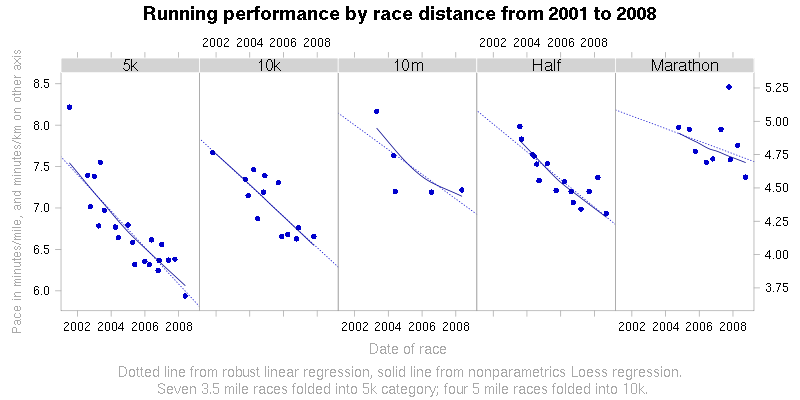
A few years into this running hobby, I realized that my times were getting better. But I had no feel for by how much, or whether that was a constant rate of improvement etc pp. Long story short, I started to plot some of the data. What seemed natural was to record the date, the distance in miles as well as in a qualitative variable, and finally the average pace. Additionally, I played with groupings into just three categories 'short', 'mid' and 'long'. This leads to a natural 'one-factor' model of pace as a function of race date grouped by race distance. And given how easy it is to do conditional plots in R, I quickly arrived at something that already resembled the following chart: (pace by date given group lattice chart) At first, some of the groups had too few data points to actually reliably construct regression lines, let alone non-parametric smoothers. But over time more and more data points were added as I kept running races. Including for example the somewhat disappointing result from last year's Chicago marathon in record heat that resulted in the outlier in the last panel. It actually made the smooth fit turn upwards! Luckily, the subsequent times in New York last fall, London in April, and of course in Berlin last month helped to dampen the effect of the one outlier, resulting in a more normal straight line for marathon performance that is comparable to the other four race lengths. All in all I am now quite happy with the chart. The combination of the non-parametric loess smoother and the robust linear regression (using lrm from the MASS package for R) shows that most groups exhibit very little non-linearity as both regression curves are very close to each other. The curvature in the '10m' group is probably mostly a small-sample effect. And I am obviously happy with the fact that three of the five panels show their respective last race as a PR :) The R script containing the data and code is available here but requires some familiarity with the lattice package for R (as the lattice book would provide).
19 September 2008

Francois Marier: Choosing the right license for your new Free Software/Open Source project

Writing the software is only one component of a successful Free Software project. If you want to build a community around your pet project, there are a number of important things you need to do but which typically fall outside of the "coding" job. One of these tasks is choosing a license.

A license choice is very personal since it involves putting in writing the permissions and protections that you want to give with respect to your code. However, your choice of license will have a number of implications.
"A license can ruin a perfectly good piece of software"
- Jon Stevens
Whenever possible, try to avoid:
  1. writing your own license
  2. choosing a license which is incompatible with the GPL
To make sure that your project can be included in a Free Software distribution like Debian and to make your code most useful to other people, it is highly recommended that you choose a standard license. Common ones include the GPL, LGPL, the Modified BSD license and the Apache license. You can find a more exhaustive list on the Free Software Foundation website.

Common licenses are well understood by the community and have stood the test of time. Their compatibility with other licenses are also much clearer. This is important if you'd like your code to be reused inside other projects, but also if you want to include code from other sources inside yours.

The standard licenses are also more likely to make sense in different countries. The latest version of the GPL, for example, was reviewed by lawyers from all over the World. Whatever you come up with is unlikely to have this level of scrutiny. If you think that the existing licenses don't fit your needs, please write to licensing@fsf.org to discuss your specific situation and avoid practical problems.

So take the time to familiarize yourself with common licenses and then decide for yourself what protections you want to give to your code. Then, add the following to your tarball before you publish your source code online:
  1. a copy of the license
  2. a clear copyright statement in a file like README
Here's an sample copyright statement for a piece of software under the latest version of the GNU General Public License:
Email-Reminder - Receive emails for events like birthdays and anniversaries
Copyright (C) 2004-2008 by Francois Marier (fmarier@gmail.com)

This program is free software: you can redistribute it and/or modify
it under the terms of the GNU General Public License as published by
the Free Software Foundation, either version 3 of the License, or
(at your option) any later version.

This program is distributed in the hope that it will be useful,
but WITHOUT ANY WARRANTY; without even the implied warranty of
MERCHANTABILITY or FITNESS FOR A PARTICULAR PURPOSE. See the
GNU General Public License for more details.

You should have received a copy of the GNU General Public License
along with this program. If not, see http://www.gnu.org/licenses/.
This helps distributors and contributors by explicitly stating the license version as well as the name and contact details of the copyright holder.

Next up: some tips and ideas about what to provide along with your source code

Next.

Previous.