Search Results: "gq"

14 April 2014

Daniel Kahn Gillmor: OTR key replacement (heartbleed)

I'm replacing my OTR key for XMPP because of heartbleed (see below). If the plain ASCII text below is mangled beyond verification, you can retrieve a copy of it from my web site that should be able to be verified.
-----BEGIN PGP SIGNED MESSAGE-----
Hash: SHA512
OTR Key Replacement for XMPP dkg@jabber.org
===========================================
Date: 2014-04-14
My main XMPP account is dkg@jabber.org.
I prefer OTR [0] conversations when using XMPP for private
discussions.
I was using irssi to connect to XMPP servers, and irssi relies on
OpenSSL for the TLS connections.  I was using it with versions of
OpenSSL that were vulnerable to the "Heartbleed" attack [1].  It's
possible that my OTR long-term secret key was leaked via this attack.
As a result, I'm changing my OTR key for this account.
The new, correct OTR fingerprint for the XMPP account at dkg@jabber.org is:
  F8953C5D 48ABABA2 F48EE99C D6550A78 A91EF63D
Thanks for taking the time to verify your peers' fingerprints.  Secure
communication is important not only to protect yourself, but also to
protect your friends, their friends and so on.
Happy Hacking,
  --dkg  (Daniel Kahn Gillmor)
Notes:
[0] OTR: https://otr.cypherpunks.ca/
[1] Heartbleed: http://heartbleed.com/
-----BEGIN PGP SIGNATURE-----
Version: GnuPG v1
iQJ8BAEBCgBmBQJTTBF+XxSAAAAAAC4AKGlzc3Vlci1mcHJAbm90YXRpb25zLm9w
ZW5wZ3AuZmlmdGhob3JzZW1hbi5uZXRFQjk2OTEyODdBN0FEREUzNzU3RDkxMUVB
NTI0MDFCMTFCRkRGQTVDAAoJEKUkAbEb/fpcYwkQAKLzEnTV1lrK6YrhdvRnuYnh
Bh9Ad2ZY44RQmN+STMEnCJ4OWbn5qx/NrziNVUZN6JddrEvYUOxME6K0mGHdY2KR
yjLYudsBuSMZQ+5crZkE8rjBL8vDj8Dbn3mHyT8bAbB9cmASESeQMu96vni15ePd
2sB7iBofee9YAoiewI+xRvjo2aRX8nbFSykoIusgnYG2qwo2qPaBVOjmoBPB5YRI
PkN0/hAh11Ky0qQ/GUROytp/BMJXZx2rea2xHs0mplZLqJrX400u1Bawllgz3gfV
qQKKNc3st6iHf3F6p6Z0db9NRq+AJ24fTJNcQ+t07vMZHCWM+hTelofvDyBhqG/r
l8e4gdSh/zWTR/7TR3ZYLCiZzU0uYNd0rE3CcxDbnGTUS1ZxooykWBNIPJMl1DUE
zzcrQleLS5tna1b9la3rJWtFIATyO4dvUXXa9wU3c3+Wr60cSXbsK5OCct2KmiWY
fJme0bpM5m1j7B8QwLzKqy/+YgOOJ05QDVbBZwJn1B7rvUYmb968yLQUqO5Q87L4
GvPB1yY+2bLLF2oFMJJzFmhKuAflslRXyKcAhTmtKZY+hUpxoWuVa1qLU3bQCUSE
MlC4Hv6vaq14BEYLeopoSb7THsIcUdRjho+WEKPkryj6aVZM5WnIGIS/4QtYvWpk
3UsXFdVZGfE9rfCOLf0F
=BGa1
-----END PGP SIGNATURE-----

31 March 2014

John Goerzen: Springtime in the Mountains

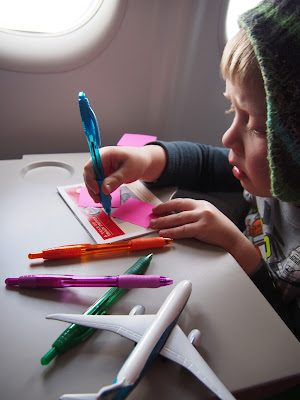
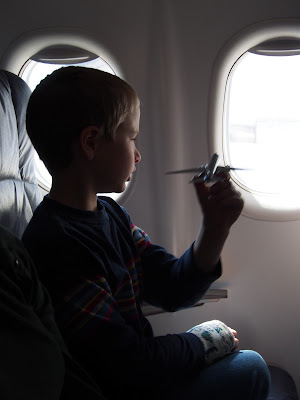
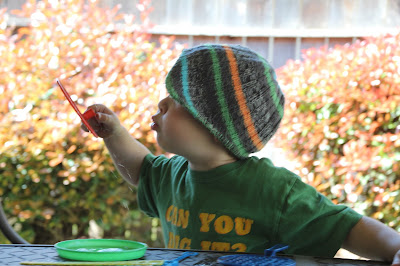
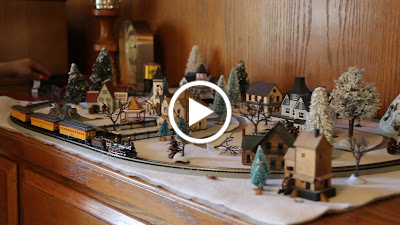
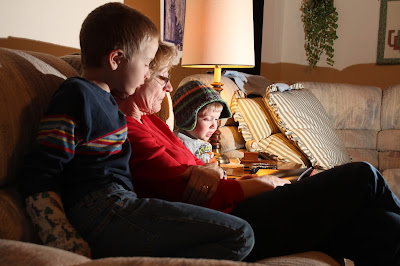
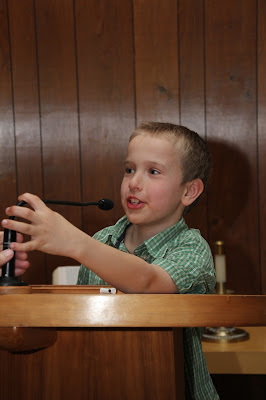
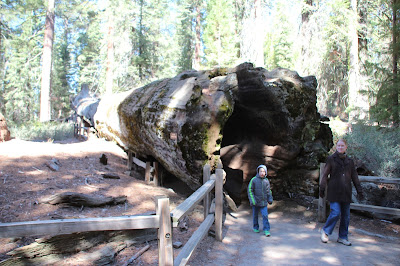
The scene: early one morning as the sun has just started to rise. Jacob and Oliver, ages 7 and 4, are the first people to wake up in the house their grandparents in California, where the four of us are visiting for the first time as a family. They have a conversation and decide that would be a good to go find a mystery. They decide to take their flashlights pink and blue, matching each boy s favorite color and slowly, but not very quietly, open their bedroom door and creep out. Brother, you forgot your flashlight! says Oliver. Oh, thanks brother! I ll get it! says Jacob. Meanwhile, Laura s mom wakes up, and notices two boys with flashlights creeping through the living room. Pretty soon they reach the kitchen, open the dishwasher, spy a suspicious-looking bowl, and decide that they have found the mystery a clean bowl! Or, at least that s the story that I pieced together based on what a 4-year-old and the grandma he awakened told me. We were on our first family trip to the Fresno, California area, to visit Laura s parents Jacob and Oliver s new grandparents. They ve played together before, but as this was our first visit to their place, there was quite the excitement. The boys had flown before, but it was several years ago and neither of them remember it well, so they were excited about that, too. The night before, Jacob woke up to tell me Dad, I am too excited to sleep. I think I will go downstairs and watch some TV. He didn t get too far with that plan. But he was excited. We went through security at the laid-back Wichita airport (where the TSA agents smile and there are often no security lines at all). We found our gate with enough time to grab lunch, which we did. The boys and I then did what we often do to kill time: explore. We explored the terminal, watching carpet-layers cut out carpet for the jetway, watching the construction of the new Terminal 3 out the window. And, of course, watching airplanes take off and land from the terminal s large windows. Finally it was our turn to board, and we all got on the plane: Jacob and Oliver with their backpacks of on-board activites, Laura and me with the rest of our carryon luggage, for the short trip to Denver. Jacob and Oliver s noses were pressed against the windows. Or, well, Jacob s was. Oliver s window was a little too high for him, but he was thrilled anyhow. They delighted in the airplane snacks, and the fact that they were allowed to drink pop on the plane. We packed books and some new art supplies for them (colored post-its, pages from a train-themed page-a-day calendar, a notebook, and a set of colored pens really seemed to do the trick.) We had a choice of 35 minutes or 4 hours between flights in Denver, and I had chosen 4 hours, thinking that would be a lot less stressful with boys. And it was. We found a nice corner of the mezzanine to sit for awhile they did art projects and played a game with Laura. Then I took them exploring Denver. We rode the moving sidewalks up and down the terminal, took a train ride to another terminal and back, ate supper all together, and flew to Fresno. We had stopped in the Wichita airport to buy them each a souvenir airplane, and these came out often during the rest of the trip. They enjoyed the mockups of the sequoias in Fresno Yosemite International Airport, enjoyed their beds and their room at the house, and did actually manage to fall asleep eventually. We had a few days there, where they played in a park, with bubbles on the patio, or croquet in the yard (I even discovered Jacob happily using the cast his broken arm is in as a hammer to pound the hoops into the ground!) There are a lot of miniatures in the house, and the boys enjoyed exploring the dollhouses and especially the N-gauge model train. Jacob enjoyed it so much he asked me to record a video of him playing with the trains. Evenings often brought book-reading, from the many children s books in the house. At home, Laura and I and both boys often scrunch onto an oversized chair and read a book and sing a song (one I make up on whatever topic they choose). Over there, we often had Laura, Jacob, Oliver, Laura s mom, and me scrunched up somewhere while the boys heard a story read to them by their grandma. That happened plenty of times other than bedtime, too. (Or Jacob would take his favorite books and read them to himself.) Laura s parents organized a reception Sunday for us, for the people from that area that couldn t make it to our wedding. Jacob and Oliver, predictably, had fun playing and even talked to some of the adults. The adults that didn t ask Jacob about his cast, anyhow (he dislikes talking about it). The boys discovered a live mic at the church where the reception was, and do I detect two future pastors in our midst? We had a great time at Laura s uncle and aunt s place. The boys were happy to discover an orange tree in their backyard, a tetherball post not far away, and an uncle ready to give them a demonstration of a swimming pool vacuum cleaner or sit at the piano with them. Jacob s favorite part, though, was when the hamburger buns his great uncle were toasting were left on the grill during the prayer before the meal, got a bit scorched, and the uncle remarked with a chuckle that I guess the Lord was tired of listening to me drone on! Jacob loved his meal, and cackled at the thought of a prayer causing buns to get scorched. But their highlight was the visit to the sequoias at Kings Canyon National Park the next day. The excitement had been building for that day all weekend. On the way out, we stopped at a fruit stand and bought some delicious strawberries the fresh, juicy, sweet and tasty kind that are red all the way through. We continued up through the foothills, stopping periodically to get out and stretch, look at the sights, take some photos, or borrow grandpa s binoculars. I knew we d be traveling in two cars, so I had the thought to pack some 2-way radios before we left. I gave one to the boys and one to the grandparents. All weekend long, whenever the six of us went somewhere, the boys (and especially Jacob) would give directions to the car that was following. Turn right! The light is green! Catch up, you re going too slow! So all the way into the mountains, Jacob would send back instructions on what to do. We saw Grant Grove, home to the worlds third-largest tree (267ft/81m tall and 3000 years old). It s quite the impressive tree the trunk s diameter near the ground is 29ft or almost 9m. As we walked the trails, their speed kept increasing as they were hunting for the tree tunnel I had told them about a tree that fell centuries ago and had been hollowed out to make a home. That trunk was easily 8ft or more in diameter, and I could stand up completely in places. We found it, to much delight from the boys So this is what it s like to be inside a tree! Our trip home brought a delay in Denver and a missed flight, which excited the boys when I told them now we get to eat supper in the airport! I wonder how long that tactic will work But Jacob was also excited because the plane we were put on in the end was bigger than the one we were scheduled on, so that was another piece of excitement. We got home, and I carried two sleeping boys in from the car, upstairs, tucked them in, pulled off their shoes, and put their favorite stuffed animals in their arms. They were happy to be home, and with memories to treasure for a long time.

21 February 2014

Jakub Wilk: For those who care about snowclones

Instances of the for those who care about X snowclone on Debian mailing lists:

26 January 2014

Neil Williams: Home server rack

The uses of this particular rack I ll cover in future entries this is about how I made the rack itself, with help from friends (Steve McIntyre & Andy Simpkins). A common theme is making allowances for using dev kit boards ready-to-rack ARM servers are not here yet. My aim was to have 4, possibly 6 ARM dev kit boards running services from home, so there was no need for a standard 42U rack, a 9U rack is enough. Hence:
Wall Mounted 9U 450mm deep 19 inch rack enclosure glass door To run various other services around the house (firewall, file server etc.), a microserver was also necessary:
HP 704941-421 ProLiant Micro Server (AMD Turion II Neo N54L 2.2GHz, 2GB RAM, 250GB HDD, 2 Core, 7th Generation) I chose to mount that on a bookcase beneath the wall mounted rack as it kept all the cables at the bottom of the rack itself. The microserver needed a second gigabit network card fitted to cope with being a firewall as well, if you do the same, ensure you find a suitable card with a low profile bracket. Some are described as being low profile but do not package the low profile bracket, only a low profile card and a full height bracket.
Intel EXPI9301CTBLK PRO1000 Network Card note the low profile bracket in the pack. The first of the dev kit requirements is the lack of boards which can be racked, so shelves are going to be needed, leading on to something to stop the boards wandering across the shelf when the cables are adjusted velcro pads in my case. Second requirement is that dev kit boards are notorious for not rebooting cleanly. Nothing to do with the image being run, the board just doesn t cut power or doesn t come back after cutting power. Sometimes this is down to early revisions of the board, sometimes the board pulls enough power through the USB serial converter to remain alive, whatever the cause, it won t reboot without user involvement. So a PDU becomes necessary remotely controllable. New units tend to be expensive and/or only suitable for larger racks, I managed to find an older 8 port APC unit, something like: (Don t be surprised if that becomes a dead link search for APC Smart Slot Master Switch Power Distribution Unit). Talking of power, I m looking to use SATA drives with these boards and the boards themselves come with a variety of wall wart plugs or USB cables, so a number of IEC sockets are needed not the usual plugs:
Power cable IEC C14 plug 13A socket 25 cm or, for devices which genuinely need 2A to boot (use the 1A for attached SATA or leave empty):

Black Universal 3.1A 15W 5V Dual USB Rapid Mains Charger Plug Check the power output rating of the USB plugs used to connect to the mains as well many are 1A or less. Keep the right plug for the right board.
Power is going to also be a problem if, like me, you want to run SATA drives off boards which support SATA. The lack of a standard case means that ATX power is awkward, so check out some cheap SATA enclosures to get a SATA connector with USB power. I am using these enclosures (prices seem to have risen since I obtained them):

Startech 2.5 inch eSATA USB External Hard Drive Enclosure for SATA HDD Along with these:
eSATA to SATA Serial External Shielded Cable 1m because the iMx53 boards have SATA connectors but the enclosure exports eSATA. Whilst this might seem awkward, the merit of having both eSATA and simple USB power on one enclosure is not to be under-estimated. (Avoid the stiffer black cables space will get tight inside the rack.) Naturally, a 2.5 inch SATA drive is going to be needed for each enclosure, I m using HDD but SSD is also an option. Also, consider simple 2 or 3 way fused adaptors so that the board and the SATA drive can be powered from a single PDU port, this makes rebooting much simpler if the board needs a power supply with integrated plug instead of over USB. Now to the networking (2 x 8 port was cheaper than 1 x 16):
Netgear GS108 8-port Gigabit Ethernet Unmanaged Switch Don t forget the cat5 cables too you ll want lots of short cables, 1m or shorter inside the rack and a few longer ones going to the microserver and wall socket. I used 8x1m. Naturally, on the floor below your rack you are going to put a UPS, so the PDU power then needs to be converted to draw from the UPS via IEC plugs instead of standard mains. I decided to use a 6 gang extension 1m cable with an IEC plug it was the only bit of wiring I had to do and even those are available ready-made if you want to do it that way. Depending on the board, you may need your own serial to USB converters, you ll certainly need some powered USB hubs. I m using a wall mounted 9U rack, so I also needed a masonry drill and 4 heavy duty masonry M8 bolts. The rack comes with a mounting plate which needs to be bolted to the wall but nothing else is included. This step is much easier with someone else to take the weight of the rack as it is guided into the brackets on the mounting plate the bracket may need a little persuasion to allow for the bolt heads to not get in the way during mounting. Once mounted, the holes in the back of the rack allow for plenty of room, it s just getting to that point. The rack has side panels which latch out easily, providing easy maintenance. The glass door can be easily reversed to open from the opposite side. However, the key in the glass door is largely useless. The expectation is that the units in the rack are attached at the front but the dev boards on shelves are not going to be protected by a key in the front door. The key therefore ends up being little more than a handle for the glass door. OK. If you ve got this far, it s a case of putting things together:
Economy Cage Nut Tool 19 inch racking for cagenut extraction Yes, you really do want one. Fine, do without the premium one, but the economy one will save you a lot of (physical) pain. At this stage, it becomes clear that the normal 19 inch server rack shelves don t leave a lot of room at the back of the rack for the cables and there are a lot of cables. Each board has power, USB serial connection and network. The SATA has power too. The PDU has a power lead and you ll need network switches too. The network switches need power and an uplink cable. I positioned the supports in the rack as far forward as possible and attached the shelves to give enough room for the PDU on the base of the rack, the network switches resting on top and the extension bar (with the heavier, stiffer cables) at the back. (I need to bring my shelves another 1 or 2 positions further forward as there is barely enough room for one cable between the shelf and the back of the rack and that makes moving boards around harder than it needs to be.) The PDU defaults to enabling all ports at startup, so connect to it over telnet and turn off the ports before connecting things and sorting out the network interface to what the rest of the lab needs. (I m using a 10. range and the PDU was originally set to use 192.168.1.) That s about it as far as the hardware setup is concerned. Just time to label up each board, note down which PDU port does which device, which serial to USB converter is on which device on the microserver and check the power my initial problem with one board was traced to the inability of the board to power SATA off the on-board USB port even when using the provided 2A power supply. That meant adding a standard mains adaptor to feed both the SATA power and the board power off the one PDU port there is little point powering off the board but not the SATA, or vice versa. I haven t totalled up the expenditure but the biggest expenses were the microserver and the wall mounted rack but don t underestimate how much it will cost to buy 6 IEC plugs, various USB serial converters and how much you may spend on peripheral items. There is quite a lot of room on the 2 shelves for more boards, what will limit the deployment in this rack is space for the cables, especially power. The shorter the power cables, the easier it will be to maintain the devices in the rack. It might be worth looking at a 12U rack, if only to give plenty of space for cables. Once I ve got the software working, I ll describe what this rack will be doing it s got something to do with Debian, ARM, Linux and tests but you ve probably already guessed that much

21 January 2014

John Goerzen: Married!

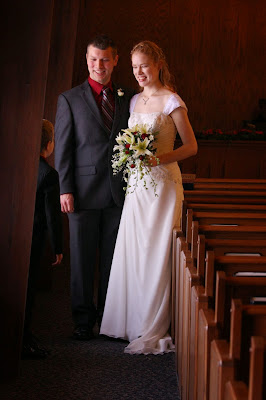
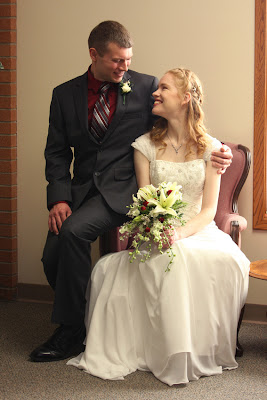
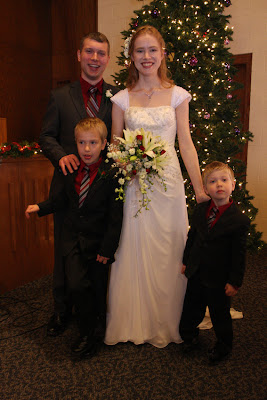
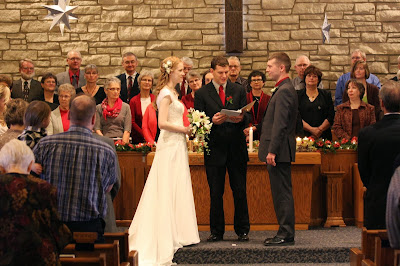
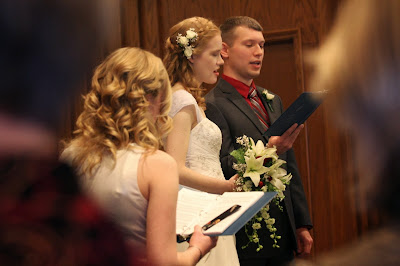
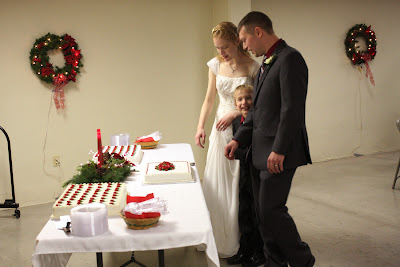
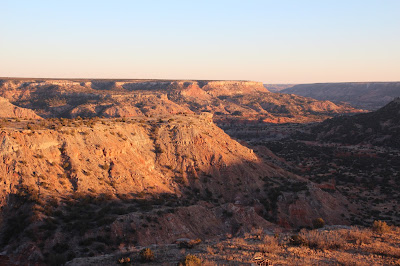
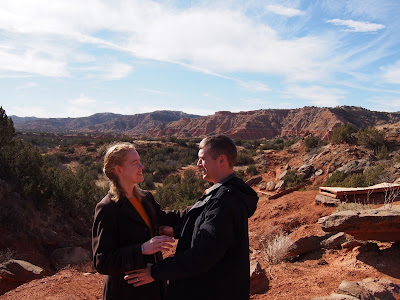
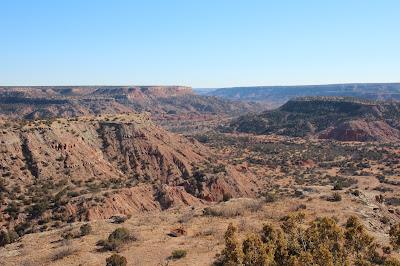
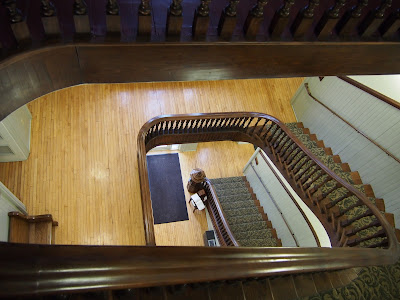
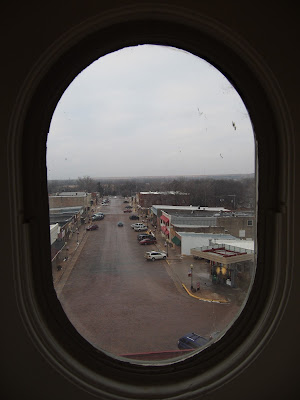
One week before the wedding, to Laura: Mono won t just clear up right away. One week before the wedding, to me: That s going to need stitches. Yes, not long before the wedding, Laura had come down with mononucleosis and I had cut into my finger with a very sharp knife while cutting bread requiring a trip to the emergency room to get stitches. Two days before we got married, instead of moving furniture, I was getting stitches out of my finger. It wasn t the kind of week we had planned. But it was the happiest, most amazing occasion I could have ever imagined. As I wrote last month, I am richly blessed indeed. Our wedding was three days after Christmas. The church was still decorated for Christmas, with the tree in on corner, glittering stars suspended in mid-air on cables from the walls, wreaths and candles in the windows, and it was a joy-filled day. Before the ceremony, we took pictures the only part of the day Jacob and Oliver weren t thrilled with. Nevertheless, we got some fun ones. Laura and I seem to know quite a few pastors between us and not just because Laura is a pastor. My brother officiated with the wedding vows, his wife with scripture and a prayer of blessing, and the church s pastor gave the message. Laura and I wrote in our wedding program, Music has long been a thread running through both our lives. We have enjoyed singing together, playing piano and pennywhistle duets, attending concerts, and even exploring old hymnals. Music is also one of the best ways to have a conversation even a conversation with God. We wrote a page in the program about each of the hymns that were a part of the wedding, and why we picked them. The combined church choirs of my home church and Laura s church sang John Rutter s beautiful arrangement of For the Beauty of the Earth (click here to listen to a different choir). Hearing For the beauty of each hour , For the joy of human love , and Lord of all, to thee we raise this our joyful hymn of praise was perfect for the day. It was with such great happiness that we walked out of the sanctuary, a married couple, to the sound of the congregation singing Joy to the World! Jacob and Oliver were so very excited on our wedding day. They happily explored the church while waiting for things to happen. We had them help us light our unity candle, and they were pleased with that. Jacob loved his suit, which made him look just like me. And they were, of course, delighted with the cake and in the middle of it all. For our honeymoon, we managed to get two weeks of vacation, and spent about half of it at home. We had looked at various options for retreats in the country, but eventually concluded that our house is a retreat in the country, so might as well enjoy it at home. We also went to the Palo Duro Canyon area near Amarillo in the Texas panhandle, staying in a small B&B in Canyon, TX. Palo Duro is the second-largest canyon in North America, and quite colorful year-round. What a beautiful place to go for our honeymoon! By the time we got there, Laura was getting past mono, and we went for hikes in the canyon on two different days hiking a total of 10 miles, including a hike up the side of the canyon. After we got back home, on the last weekday of our honeymoon, we went back to the Flint Hills of Kansas, to some of the same places we had spent our third date. We climbed the windy staircase at the Chase County Courthouse, the oldest courthouse still in use in Kansas. And peered out its famous oval window. We found the last remnant of the old ghost town of Elk, ate at the same restaurant we had that day. It brought back wonderful memories, and it was a good day in itself. Because even though it was a gold, drizzly, overcast day in January, this time, we were married. And this year, Thanksgiving is all year.

8 January 2014

Pau Garcia i Quiles: FOSDEM Desktops DevRoom 2014: looking for volunteers for video recordings

Qt and KDE will be present at FOSDEM, the largest open-source event in Europe. One more year, we will be sharing the Desktops DevRoom with Gnome, Unity, Enlightenment, LXQt and Hawaii (a Qt Quick desktop environment). We recently published the schedule for the devroom, which will be also available in the printed booklet available at the front desk. fosdem-logo For the 2014 edition, the FOSDEM organization wants to achieve 100% recording of presentations. That means every presentation, in every room (devroom, lightning talk, main conference, etc) must be recorded. That s hundreds of talks. While the FOSDEM and devrooms organization teams comprise a lot of people, we are far too busy already with the organizative stuff and cannot spend time doing the actual recordings. Good thing is, you can help! Do you want to join the FOSDEM Video Team and receive the t-shirt? We are now looking for volunteer cameramen (and camerawomen, of course :-) ). FOSDEM will provide you with equipment and training, you only need to start recording, focus, make sure nobody gets between the camera and the speaker/stage, etc. You do NOT need to record the whole track, even one talk recording would help. More details on what will be required from you are available in this e-mail from Wouter. Please contact me (pgquiles at elpauer dot org) if you are interested in recording one or more presentations from the Desktops DevRoom.


5 January 2014

Lisandro Damián Nicanor Pérez Meyer: Qt 5.2.0 in Debian experimental, now available for more archs

Qt 5.2.0 is already available in experimental until we get a transition slot, but don't be afraid to test it. With this release we had major improvements. With 5.1.1 currently in sid we have the following buildd chart:

Qt 5.1.1 in Debian Sid
Now with 5.2.0 in Debian experimental we have:

Qt 5.2.0 in Debian experimental

As you can see Qt has compiled in more archs, thanks to the effort of the Debian's porters and from the Qt/KDE team.

Note that Qt JS Backend has dissapeared: it's functionality (the javascript engine) is now in Qt Declarative itself. It has been ported away from Google's v8 to a Qt-based engine, allowing it to build in more archs among other features.

You can also note that we still have quite some FTBFS, mostly coming from Qt Webkit. Feel free to send patches ;-)

9 December 2013

Pau Garcia i Quiles: Going to FOSDEM 2014

Once more, I m going to FOSDEM 2014, the largest Free/Libre/Open Source Software event in Europe (5,000 attendants every year). fosdem-logo As usual, I will be in charge of the Desktops DevRoom, together with our friends from Gnome (Christophe Fergeau), Unity (Didier Roche), Enlightenment (Philippe Caseiro) and others. See you in Brussels 1-2 February 2014! BTW, have you already submitted your talk proposal for the Desktops DevRoom? The deadline (15th December) is very close! Do not wait any more!!! See the details here: FOSDEM 2014 Desktops DevRoom Call for Talks

28 November 2013

Pau Garcia i Quiles: Reminder: FOSDEM 2014, Desktops DevRoom Call for Talks

Just a friendly reminder we are inviting people to submit proposals for talks at the Desktops DevRoom at FOSDEM 2014, which will take place in Brussels 1-2 February 2014. Here is the full text for the Call for Talks: http://www.elpauer.org/2013/10/fosdem-desktops-devroom-2014-call-for-talks/ Deadline is approaching! Submit your proposal ASAP!

30 October 2013

Thomas Goirand: OpenRC running on Debian / kFreeBSD

I have always pretended that OpenRC would be very easy to port to Debian GNU/kFreeBSD. Well, now I stop pretending: http://youtu.be/zoNoi8BgQjs This was done within a few hours working with upstream. Now, next-up: Debian GNU/Hurd. Hoping that porters will volunteer to do the work.

29 October 2013

Pau Garcia i Quiles: FOSDEM 2014 Desktops DevRoom Call for Talks

FOSDEM is one of the largest gatherings of Free Software contributors in the world and happens each February in Brussels (Belgium). One of the tracks will be the Desktops DevRoom (formerly known as CrossDesktop DevRoom ), which will host Desktop-related talks. We are now inviting proposals for talks about Free/Libre/Open-source Software on the topics of Desktop development, Desktop applications and interoperability amongst Desktop Environments. This is a unique opportunity to show novel ideas and developments to a wide technical audience. Topics accepted include, but are not limited to: Enlightenment, Gnome, KDE, Unity, XFCE/Razor, Windows, Mac OS X, general desktop matters, applications that enhance desktops and web (when related to desktop). Talks can be very specific, such as developing mobile applications with Qt Quick; or as general as predictions for the fusion of Desktop and web in 5 years time. Topics that are of interest to the users and developers of all desktop environments are especially welcome. The FOSDEM 2013 schedule might give you some inspiration. Please include the following information when submitting a proposal: The deadline for submissions is December 14th 2013. FOSDEM will be held on the weekend of 1-2 February 2014. Please use the following website to submit your proposals: https://penta.fosdem.org/submission/FOSDEM14 You can also join the devroom s mailing list, which is the official communication channel for the DevRoom: desktops-devroom@lists.fosdem.org (subscription page for the mailing list) The Desktops DevRoom 2014 Organization Team

8 October 2013

Thomas Goirand: My old 1024 bits key is dead, please use 0xAC6B43FE

-----BEGIN PGP SIGNED MESSAGE-----
Hash: SHA256
Hi,
I am not using my old GPG key, 0x98EF9A49 anymore. My new key, using
4096 SHA2 256,
with fingerprint:
A0B1 A9F3 5089 5613 0E7A  425C D416 AD15 AC6B 43FE
has replaced the old one in the Debian keyring. Please don't encrypt
message to me using the old key anymore.
Since the idea is that we shouldn't trust 1024 bits keys anymore, I'm
not signing this message with the old key, but only with the new one,
which has gathered enough signatures from Debian Developers (more than a
dozen).
Thomas Goirand (zigo)
-----BEGIN PGP SIGNATURE-----
Version: GnuPG v1.4.12 (GNU/Linux)
iQIcBAEBCAAGBQJSVC02AAoJENQWrRWsa0P+3wAP/i2ORGgXMoQVtjoUNX+x/Ovz
yoNSLztmih4pOLw9+qHJfM+OkBKUPwrkyjgBWkwD2IxoM2WRgNZaY5q/jBEaMVgq
psegqAm99zkX0XJTIYfqwOZFA1JLWMi1uLJQO71j0tkJWPzBSa6Jhai81X89HKgq
PqQXver+WbORHkYGIWwBvwj+VbPZ+ssY7sjbdWTaiMcaYjzLQR4s994FOFfTWH8G
5zLdwj+lD/+tBH90qcB9ETlbSE1WG4zBwz5f4++FcPYVUfBPosE/hcyhIp6p3SPK
8F6B51pUvqwRe52unZcoA30gEtlz+VNHGQ3yF3T1/HPlfkyysAypnZOw0md6CFv8
oIgsT+JBXVavfxxAJtemogyAQ/DPBEGuYmr72SSav+05BluBcK8Oevt3tIKnf7Q5
lPTs7lxGBKI0kSxKttm+JcDNkm70+Olh6bwh2KUPBSyVw0Sf6fmQdJt97tC4q7ky
945l42IGTOSY0rqdmOgCRu8Q5W1Ela9EDZN2jPmPu4P6nzqIRHUw3gS+YBeF1i+H
/2jw4yXSXSYQ+fVWJqNb5R2raR37ytNWcZvZvt4gDxBWRqnaK+UTN6tdF323HKmr
V/67+ewIhFtH6a9W9mPakyfiHqoK6QOyOhdjQIzL+g26QMrjJdOEWkqzvuIboGsw
OnyYVaKsZSFoKBs0kOFw
=qjaO
-----END PGP SIGNATURE-----

15 August 2013

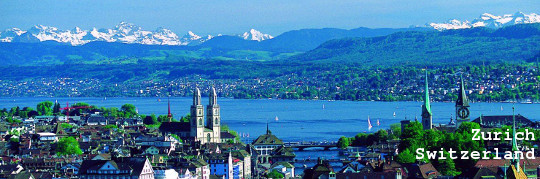
Daniel Pocock: Free software for free markets

Co-inciding with the first DebConf in Switzerland, one of the world's leading financial centers, the first official packaging of open messaging and market data distribution framework OpenMAMA for a Linux distribution has just been uploaded. The packages, along with the Avis low-latency event-router middleware/transport were uploaded to the Debian unstable catalog this week and will soon be available conveniently to install with apt-get. OpenMAMA was developed by NYSE Technologies and includes code originally developed under their previous brand Wombat Financial Software. The project was recently placed under the strategic umbrella of the Linux Foundation. Packages for Fedora and EPEL The initial packaging effort has identified a number of build system bugs, patches have been contributed upstream. The resolution of these issues and the experience gained with the Debian package will make it relatively easy to package for RPM-based platforms in the near future. Not just for finance While it is clear that OpenMAMA's designers had financial services in mind (and the low-latency, high throughput transport of market price data in particular), the solution is generalised and likely to be useful in other domains where asynchronous messaging and inter-process communication is required. In fact, this distinction is made particularly clear by the division of OpenMAMA into two subprojects:
  • OpenMAMA itself is a general-purpose programming API for asynchronous messaging. It hides the details of various low-level transports, including the open source Avis event router and popular proprietary solutions like Tibco Rendezvous. Java programmers have had such a generalised API for many years (JMS), whereas OpenMAMA brings a similar paradigm to the C/C++ developer.
  • OpenMAMDA is a further layer on top of OpenMAMA designed to encapsulate market data. It competes directly with proprietary solutions such as those from Reuters and Bloomberg. OpenMAMDA comes with specific APIs for news, order books and options and could be extended for other markets.
Commercial background Reuters and Bloomberg are well known as two of the main vendors in the market data industry. Both of them (and other competitors) provide a range of data services and related software. Buying a data feed doesn't automatically give access to the software from the same franchise: the software and APIs are promoted as a valuable product in their own right. It is actually quite possible (and not unheard of) for an institution to run a Reuters Market Data System (RMDS) software stack fed by a data feed from Bloomberg or vice-versa. When an IT department or third-party vendor of trading systems wants to transport data between applications (or between multiple users of a single application) they will not typically do it themselves and one of these APIs is usually chosen. OpenMAMA appears to be a strong contender for such use cases. Bloomberg has recently made their API public, although OpenMAMA goes much further by making their source code public too. Development samples with the OpenMAMA API Programming the OpenMAMA API appears to be relatively consistent with the event-loop model that many developers are already comfortable with. For a very fast start, two compelling examples are the basic publisher and basic subscriber. Here is a sample of the code from the basic subscriber, demonstrating how to start the event loop and receive event notifications in a callback class:

static void createSubscriber (void)
 
    try
     
        gSubscription = new MamaBasicSubscription;
        gSubscription->createBasic (gTransport,
                                    gDefaultQueue,
                                    new SubscriptionCallback (),
                                    gTopic);
        gSubscription->setDebugLevel (gSubscLogLevel);
     
    catch (MamaStatus &status)
     
        cerr << "Error creating subscription: " 
             << status.toString () << endl;
        exit (1);
     
 
and here is some basic code that processes messages asynchronously:
class SubscriptionCallback : public MamaBasicSubscriptionCallback
 
public:
    virtual ~SubscriptionCallback ()  
    virtual void onCreate (MamaBasicSubscription*  subscription)
     
        if (gQuietLevel < 2)
         
            printf ("Created inbound subscription.\n");
         
     
    virtual void onError (MamaBasicSubscription*  subscription,
                          const MamaStatus&       status,
                          const char*             subject) 
     
        printf ("Error creating subscription: %s\n", 
                status.toString ());
        exit (1);
     
    virtual void onMsg (MamaBasicSubscription* subscription, 
                        MamaMsg&               msg)
     
        if (gQuietLevel < 2)
         
            printf ("Recieved msg.\n");
         
        DisplayIterator it;
        msg.iterateFields (it, NULL, NULL);
     
    //JG: need to add in onDestroy as this is abstract and must be implemented
    virtual void onDestroy (MamaBasicSubscription*  subscription, void * closure)
     
        if (gQuietLevel < 2)
         
            printf ("Destroyed subscription.\n");
         
     
 ;
Practical uses outside financial services Some people may feel that having a low-latency market-data system is overkill for anybody not running a trading desk. Not so. OpenMAMA may well prove useful and convenient as a one-stop-shop API for multi-currency accounting software (Postbooks, GnuCash, etc), for multi-currency web sites (e.g. UberCart) and many other applications.

31 July 2013

Richard Hartmann: richih@debian.org

MIME-Version: 1.0
Received: by 10.194.17.9 with HTTP; Wed, 31 Jul 2013 09:21:17 -0700 (PDT)
Date: Wed, 31 Jul 2013 18:21:17 +0200
Delivered-To: richih.mailinglist@gmail.com
Message-ID: <CAD77+gQboyX1nDcJAYr-5B9Yrnmb7Uus9Yb9TzAc=C9Dnoxhcg@mail.gmail.com>
Subject: Test
From: Richard Hartmann <richih.mailinglist@gmail.com>
To: richih@debian.org
Content-Type: text/plain; charset=UTF-8
-- 
Richard

5 July 2013

John Sullivan: I think this says something about my taste in music

johnsu01@myles:~$ mpc playlist grep -i outro wc -l
14

20 March 2013

Masayuki Hatta: Recipe for Debian Haskell packaging

The following is what I usually do when I want to debianize a Haskell stuff from Hackage. This is a personal recipe, by no means official procedure or such. I may be wrong, badly at that.
  1. Check pkg-haskell repository whether your intended package already exists or not. Somebody might work on it already.
  2. Find the webpage of your intended package at HackageDB, then download Cabal source package . Untar it. The tarball filename should be changed to fit the Debian source package convention. For example, if the original name is something like foobar-1.0.tar.gz, then it should be haskell-foobar_1.0.orig.tar.gz.
  3. File ITP. reportbug is your friend.
  4. Run cabal-debian in untared dir:
     $ cabal-debian --debianize --quilt
    
    We do have the upstream tarball, so use quilt. See http://wiki.debian.org/UsingQuilt. It might give you warnings about changelog. debian/changelog doesn t exist yet, so ignore it.
  5. Now read http://wiki.debian.org/Haskell/CollabMaint/Processes and http://wiki.debian.org/Haskell/CollabMaint/PackageTemplate carefully. Then do things as they say. These two are short, but well-written instructions. Edit the generated debian/control appropriately. Do not forget to make your debian/copyright machine-friendly. See http://www.debian.org/doc/packaging-manuals/copyright-format/1.0/.
  6. Test whether your package is flawless and really buildable. Do lintian. Use pbuilder.
     $ lintian haskell-foobar_1.0-1_amd64.changes
     # pbuilder --build haskell-foobar_1.0-1.dsc
    
  7. Read http://wiki.debian.org/Haskell/CollabMaint/DarcsBasic. Darcs is quite easy to use, and you don t have to be the master of Darcs to merely debianize things anyway. Basically, what I usually do is
     $ darcs record -a; darcs push --repo=debian
    
    Darcs is well-suited to Haskell-related development, but seems you can use Git, too.
  8. Change debian/changelog. UNRELEASED in the first line should be unstable or experimental . Do not forget to close ITP.
  9. Finally, do
     $ debuild -tc; debcommit -r; debrelease; darcs push --repo=debian
    
    That s all folks!

15 March 2013

John Goerzen: It s Warm Enough For Mud

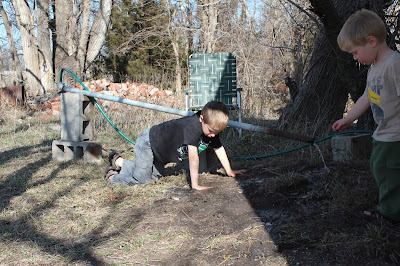
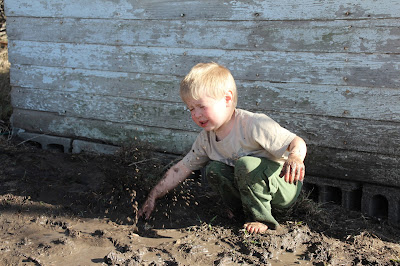
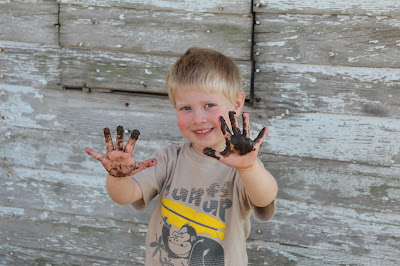
Today the outdoor temperatures got to nearly 75F/24C. The boys had this idea to go play with their streams . Here s one of the cleaner moments: I had set up an old pipe and a hose, with the water coming slowly out of the pipe onto a little mound of dirt. They can then use their fingers to make channels in the dirt for the water to flow through. They ve found that sticks can become bridges, making a hole in the earth makes a pond, and, oh yes, it s quite muddy and a lot of fun. Oliver at one point realized that he could splash the mud all around quite nicely. And he wanted to make sure I took photos of his hands. They could have played out there for hours, I m sure. When it was time to clean up, they enjoyed seeing the mud come off their sandals, arms, hands, and feet. It was a perfect use for the first really warm day of spring.

7 March 2013

Pau Garcia i Quiles: Mark s divisive leadership

Mark Shuttleworth recently critized Jonathan Riddell for proposing Xubuntu and others join the Kubuntu community. I thought I could make a few amendments to Mark s writing:

Jonathan Mark says that Canonical Kubuntu is not taking care of the Ubuntu community.

Consider for a minute, Jonathan Mark, the difference between our actions.

Canonical Kubuntu, as one stakeholder in the Ubuntu community, is spending a large amount of energy to evaluate how its actions might impact on all the other stakeholders, and offering to do chunks of work in support of those other stakeholder needs.

You, as one stakeholder in the Ubuntu community, are inviting people to contribute less to the broader project [all the X and Wayland -based desktops], and more to one stakeholder [Unity and Mir].

Hmm. Just because you may not get what you want is no basis for divisive leadership.

Yes, you should figure out what s important to Kubuntu Ubuntu Unity and Mir, and yes, you should motivate folks to help you achieve those goals. But it s simply wrong to suggest that Canonical Kubuntu isn t hugely accommodating to the needs of others, or that it s not possible to contribute or participate in the parts of Ubuntu which Canonical Kubuntu has a particularly strong interest in. Witness the fantastic work being done on both the system and the apps to bring Ubuntu Plasma to the phone and tablet. That may not be your cup of tea, but it s tremendously motivating and exciting and energetic. See Mark? I only needed to do a little search and replace on your words and suddenly, meaning is completely reversed! Canonical started looking only after its own a couple of years ago and totally dumped the community. Many people have noticed this and written about this in the past two years. How dare you say Jonathan or anyone from Kubuntu is proposing contributing less to the broader community? The broader community uses X and/or Wayland. Canonical recently came with Mir, a replacement for X and Wayland, out of thin air. Incompatible with X and Wayland. No mention of it at all to anyone from X or Wayland. No mention of it at FOSDEM one month ago, even though I, as the organizer of the Cross Desktop DevRoom, had been stalking your guy for months because we wanted diversity (and we got it: Gnome, KDE, Razor, XFCE, Enlightenment, etc, we even invided OpenBox, FVWM, CDE and others!). I even wrote a mail to you personally warning you Unity was going to lose its opportunity to be on the stand at FOSDEM. You never answered, of course. Don t you think Mir, a whole new replacement for X and Wayland, which has been in development for 8 months, deserved a mention at the largest open source event in Europe? Come on, man. It is perfectly fine to say yes, Canonical is not so interested in the community. It s our way or the highway . But do not pretend it s anything else or someone else is a bad guy. In fact, is there any bad guy in this story at all!? I think there is not, it s just people with different visions and chosen paths to achieve them. Maybe Mir and Unity are great ideas, much better than X and Wayland. But that s not what we are talking about. We are talking about community, and Canonical has been steadily destroying it for a long time already. If you cannot or do not want to see that, you ve got a huge problem going on.

13 February 2013

Jan Wagner: Searching painting: Strawberry and Man on Pumps with Sparkling wine

We are searching a motive for a painting or a painting itself for a quite while now. This should find it's place in our living room. Unfortunately we didn't found one, which matched our both prospect and/or wasn't compatible with the rest of our living room. Yesterday we stumbled upon a motive which was quite nice, but was too small and it was neighter possible to get it in a bigger size nor to find out who was the origin painter of the picture. Now we are searching for the name of the picture and/or the painter. Any hints appreciated at 'blog - at - waja - dot - info'. A photo with higher resolution can be found here Update: Okay ... an unknown people (many thanks) hinted me, that google image search is the tool that could be very usefull. Google revealed that the painter is Inna Panasenko. P.S. Is it noticeable that I'm in vacation mode? ;)

13 January 2013

Bernhard R. Link: some signature basics

While almost everyone has already worked with cryptographic signatures, they are usually only used as black boxes, without taking a closer look. This article intends to shed some lights behind the scenes. Let's take a look at some signature. In ascii-armoured form or behind a clearsigned message one often does only see something like this:
-----BEGIN PGP SIGNATURE-----
Version: GnuPG v1.4.12 (GNU/Linux)
iQIcBAABAgAGBQJQ8qxQAAoJEH8RcgMj+wLc1QwP+gLQFEvNSwVonSwSCq/Dn2Zy
fHofviINC1z2d/voYea3YFENNqFE+Vw/KMEBw+l4kIdJ7rii1DqRegsWQ2ftpno4
BFhXo74vzkFkTVjo1s05Hmj+kGy+v9aofnX7CA9D/x4RRImzkYzqWKQPLrAEUxpa
xWIije/XlD/INuhmx71xdj954MHjDSCI+9yqfl64xK00+8NFUqEh5oYmOC24NjO1
qqyMXvUO1Thkt6pLKYUtDrnA2GurttK2maodWpNBUHfx9MIMGwOa66U7CbMHReY8
nkLa/1SMp0fHCjpzjvOs95LJv2nlS3xhgw+40LtxJBW6xI3JvMbrNYlVrMhC/p6U
AL+ZcJprcUlVi/LCVWuSYLvUdNQOhv/Z+ZYLDGNROmuciKnvqHb7n/Jai9D89HM7
NUXu4CLdpEEwpzclMG1qwHuywLpDLAgfAGp6+0OJS5hUYCAZiE0Gst0sEvg2OyL5
dq/ggUS6GDxI0qUJisBpR2Wct64r7fyvEoT2Asb8zQ+0gQvOvikBxPej2WhwWxqC
FBYLuz+ToVxdVBgCvIfMi/2JEE3x8MaGzqnBicxNPycTZqIXjiPAGkODkiQ6lMbK
bXnR+mPGInAAbelQKmfsNQQN5DZ5fLu+kQRd1HJ7zNyUmzutpjqJ7nynHr7OAeqa
ybdIb5QeGDP+CTyNbsPa
=kHtn
-----END PGP SIGNATURE-----
This is actually only a form of base64 encoded data stream. It can be translated to the actual byte stream using gpg's --enarmor and --dearmour commands (Can be quite useful if some tool only expects one BEGIN SIGNATURE/END SIGNATURE block but you want to include multiple signatures but cannot generate them with a single gpg invocation because the keys are stored too securely in different places). Reading byte streams manually is not much fun, so I wrote gpg2txt some years ago, which can give you some more information. Above signature looks like the following:
89 02 1C -- packet type 2 (signature) length 540
        04 00 -- version 4 sigclass 0
        01 -- pubkey 1 (RSA)
        02 -- digest 2 (SHA1)
        00 06 -- hashed data of 6 bytes
                05 02 -- subpacket type 2 (signature creation time) length 4
                        50 F2 AC 50 -- created 1358081104 (2013-01-13 12:45:04)
        00 0A -- unhashed data of 10 bytes
                09 10 -- subpacket type 16 (issuer key ID) length 8
                        7F 11 72 03 23 FB 02 DC -- issuer 7F11720323FB02DC
        D5 0C -- digeststart 213,12
        0F FA -- integer with 4090 bits
                02 D0 [....]
Now, what does this mean. First all gpg data (signatures, keyrings, ...) is stored as a series of blocks (which makes it trivial to concatenate public keys, keyrings or signatures). Each block has a type and a length. A single signature is a single block. If you create multiple signatures at once (by giving multiple -u to gpg) there are simple multiple blocks one after the other. Then there is a version and a signature class. Version 4 is the current format, some really old stuff (or things wanting to be compatible with very old stuff) sometimes still have version 3. The signature class means what kind of signature it is. There are roughly two signature classes: A verbatim signature (like this one), or a signature of a clearsigned signature. With a clearsigned signature not the file itself is hashed, but instead a normalized form that is supposed to be invariant under usual modifications by mailers. (This is done so people can still read the text of a mail but the recipient can still verify it even if there were some slight distortions on the way.) Then the type of the key used and the digest algorithm used for creating this signature. The digest algorithm (together with the signclass, see above) describes which hashing algorithm is used. (You never sign a message, you only sign a hashsum. (Otherwise your signature would be as big as your message and it would take ages to create a signature, as asymetric keys are necessarily very slow)). This example uses SHA1, which is no longer recommended: As SHA1 has shown some weaknesses, it may get broken in the not too distant future. And then it might be possible to take this signature and claim it is the signature of something else. (If your signatures are still using SHA1, you might want to edit your key preferences and/or set a digest algorithm to use in your ~/.gnupg/gpg.conf. Then there are some more information about this signature: the time it was generated on and the key it was generated with. Then, after the first 2 bytes of the message digest (I suppose it was added in cleartext to allow checking if the message is OK before starting with expensive cryptograhic stuff, but it might not checked anywhere at all), there is the actual signature. Format-wise the signature itself is the most boring stuff. It's simply one big number for RSA or two smaller numbers for DSA. Some little detail is still missing: What is this "hashed data" and "unhashed data" about? If the signed digest would only be a digest of the message text, then having a timestamp in the signature would not make much sense, as anyone could edit it without making the signature invalid. That's why the digest is not only signed message, but also parts of the information about the signature (those are the hashed parts) but not everything (not the unhashed parts).

Next.

Previous.