Search Results: "gio"

29 September 2024

Reproducible Builds: Supporter spotlight: Kees Cook on Linux kernel security

The Reproducible Builds project relies on several projects, supporters and sponsors for financial support, but they are also valued as ambassadors who spread the word about our project and the work that we do. This is the eighth installment in a series featuring the projects, companies and individuals who support the Reproducible Builds project. We started this series by featuring the Civil Infrastructure Platform project, and followed this up with a post about the Ford Foundation as well as recent ones about ARDC, the Google Open Source Security Team (GOSST), Bootstrappable Builds, the F-Droid project, David A. Wheeler and Simon Butler. Today, however, we will be talking with Kees Cook, founder of the Kernel Self-Protection Project.

Vagrant Cascadian: Could you tell me a bit about yourself? What sort of things do you work on? Kees Cook: I m a Free Software junkie living in Portland, Oregon, USA. I have been focusing on the upstream Linux kernel s protection of itself. There is a lot of support that the kernel provides userspace to defend itself, but when I first started focusing on this there was not as much attention given to the kernel protecting itself. As userspace got more hardened the kernel itself became a bigger target. Almost 9 years ago I formally announced the Kernel Self-Protection Project because the work necessary was way more than my time and expertise could do alone. So I just try to get people to help as much as possible; people who understand the ARM architecture, people who understand the memory management subsystem to help, people who understand how to make the kernel less buggy.
Vagrant: Could you describe the path that lead you to working on this sort of thing? Kees: I have always been interested in security through the aspect of exploitable flaws. I always thought it was like a magic trick to make a computer do something that it was very much not designed to do and seeing how easy it is to subvert bugs. I wanted to improve that fragility. In 2006, I started working at Canonical on Ubuntu and was mainly focusing on bringing Debian and Ubuntu up to what was the state of the art for Fedora and Gentoo s security hardening efforts. Both had really pioneered a lot of userspace hardening with compiler flags and ELF stuff and many other things for hardened binaries. On the whole, Debian had not really paid attention to it. Debian s packaging building process at the time was sort of a chaotic free-for-all as there wasn t centralized build methodology for defining things. Luckily that did slowly change over the years. In Ubuntu we had the opportunity to apply top down build rules for hardening all the packages. In 2011 Chrome OS was following along and took advantage of a bunch of the security hardening work as they were based on ebuild out of Gentoo and when they looked for someone to help out they reached out to me. We recognized the Linux kernel was pretty much the weakest link in the Chrome OS security posture and I joined them to help solve that. Their userspace was pretty well handled but the kernel had a lot of weaknesses, so focusing on hardening was the next place to go. When I compared notes with other users of the Linux kernel within Google there were a number of common concerns and desires. Chrome OS already had an upstream first requirement, so I tried to consolidate the concerns and solve them upstream. It was challenging to land anything in other kernel team repos at Google, as they (correctly) wanted to minimize their delta from upstream, so I needed to work on any major improvements entirely in upstream and had a lot of support from Google to do that. As such, my focus shifted further from working directly on Chrome OS into being entirely upstream and being more of a consultant to internal teams, helping with integration or sometimes backporting. Since the volume of needed work was so gigantic I needed to find ways to inspire other developers (both inside and outside of Google) to help. Once I had a budget I tried to get folks paid (or hired) to work on these areas when it wasn t already their job.
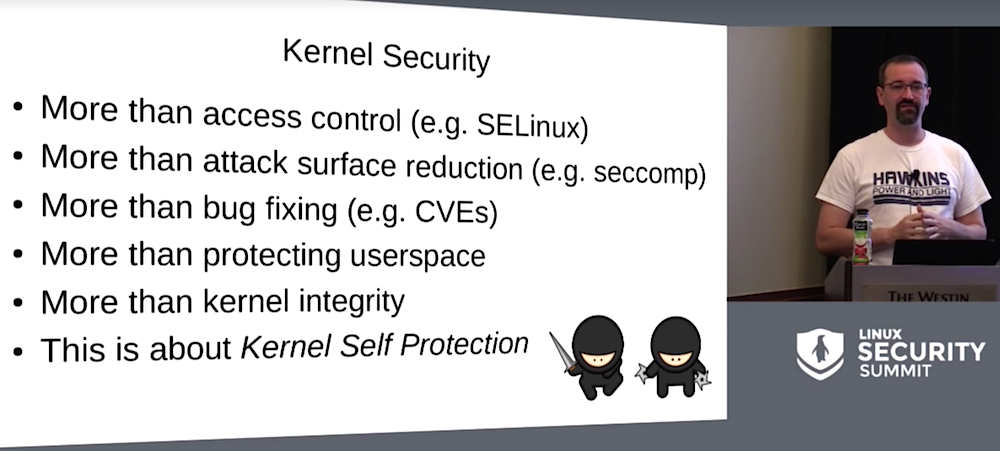
Vagrant: So my understanding of some of your recent work is basically defining undefined behavior in the language or compiler? Kees: I ve found the term undefined behavior to have a really strict meaning within the compiler community, so I have tried to redefine my goal as eliminating unexpected behavior or ambiguous language constructs . At the end of the day ambiguity leads to bugs, and bugs lead to exploitable security flaws. I ve been taking a four-pronged approach: supporting the work people are doing to get rid of ambiguity, identify new areas where ambiguity needs to be removed, actually removing that ambiguity from the C language, and then dealing with any needed refactoring in the Linux kernel source to adapt to the new constraints. None of this is particularly novel; people have recognized how dangerous some of these language constructs are for decades and decades but I think it is a combination of hard problems and a lot of refactoring that nobody has the interest/resources to do. So, we have been incrementally going after the lowest hanging fruit. One clear example in recent years was the elimination of C s implicit fall-through in switch statements. The language would just fall through between adjacent cases if a break (or other code flow directive) wasn t present. But this is ambiguous: is the code meant to fall-through, or did the author just forget a break statement? By defining the [[fallthrough]] statement, and requiring its use in Linux, all switch statements now have explicit code flow, and the entire class of bugs disappeared. During our refactoring we actually found that 1 in 10 added [[fallthrough]] statements were actually missing break statements. This was an extraordinarily common bug! So getting rid of that ambiguity is where we have been. Another area I ve been spending a bit of time on lately is looking at how defensive security work has challenges associated with metrics. How do you measure your defensive security impact? You can t say because we installed locks on the doors, 20% fewer break-ins have happened. Much of our signal is always secondary or retrospective, which is frustrating: This class of flaw was used X much over the last decade so, and if we have eliminated that class of flaw and will never see it again, what is the impact? Is the impact infinity? Attackers will just move to the next easiest thing. But it means that exploitation gets incrementally more difficult. As attack surfaces are reduced, the expense of exploitation goes up.
Vagrant: So it is hard to identify how effective this is how bad would it be if people just gave up? Kees: I think it would be pretty bad, because as we have seen, using secondary factors, the work we have done in the industry at large, not just the Linux kernel, has had an impact. What we, Microsoft, Apple, and everyone else is doing for their respective software ecosystems, has shown that the price of functional exploits in the black market has gone up. Especially for really egregious stuff like a zero-click remote code execution. If those were cheap then obviously we are not doing something right, and it becomes clear that it s trivial for anyone to attack the infrastructure that our lives depend on. But thankfully we have seen over the last two decades that prices for exploits keep going up and up into millions of dollars. I think it is important to keep working on that because, as a central piece of modern computer infrastructure, the Linux kernel has a giant target painted on it. If we give up, we have to accept that our computers are not doing what they were designed to do, which I can t accept. The safety of my grandparents shouldn t be any different from the safety of journalists, and political activists, and anyone else who might be the target of attacks. We need to be able to trust our devices otherwise why use them at all?
Vagrant: What has been your biggest success in recent years? Kees: I think with all these things I am not the only actor. Almost everything that we have been successful at has been because of a lot of people s work, and one of the big ones that has been coordinated across the ecosystem and across compilers was initializing stack variables to 0 by default. This feature was added in Clang, GCC, and MSVC across the board even though there were a lot of fears about forking the C language. The worry was that developers would come to depend on zero-initialized stack variables, but this hasn t been the case because we still warn about uninitialized variables when the compiler can figure that out. So you still still get the warnings at compile time but now you can count on the contents of your stack at run-time and we drop an entire class of uninitialized variable flaws. While the exploitation of this class has mostly been around memory content exposure, it has also been used for control flow attacks. So that was politically and technically a large challenge: convincing people it was necessary, showing its utility, and implementing it in a way that everyone would be happy with, resulting in the elimination of a large and persistent class of flaws in C.
Vagrant: In a world where things are generally Reproducible do you see ways in which that might affect your work? Kees: One of the questions I frequently get is, What version of the Linux kernel has feature $foo? If I know how things are built, I can answer with just a version number. In a Reproducible Builds scenario I can count on the compiler version, compiler flags, kernel configuration, etc. all those things are known, so I can actually answer definitively that a certain feature exists. So that is an area where Reproducible Builds affects me most directly. Indirectly, it is just being able to trust the binaries you are running are going to behave the same for the same build environment is critical for sane testing.
Vagrant: Have you used diffoscope? Kees: I have! One subset of tree-wide refactoring that we do when getting rid of ambiguous language usage in the kernel is when we have to make source level changes to satisfy some new compiler requirement but where the binary output is not expected to change at all. It is mostly about getting the compiler to understand what is happening, what is intended in the cases where the old ambiguity does actually match the new unambiguous description of what is intended. The binary shouldn t change. We have used diffoscope to compare the before and after binaries to confirm that yep, there is no change in binary .
Vagrant: You cannot just use checksums for that? Kees: For the most part, we need to only compare the text segments. We try to hold as much stable as we can, following the Reproducible Builds documentation for the kernel, but there are macros in the kernel that are sensitive to source line numbers and as a result those will change the layout of the data segment (and sometimes the text segment too). With diffoscope there s flexibility where I can exclude or include different comparisons. Sometimes I just go look at what diffoscope is doing and do that manually, because I can tweak that a little harder, but diffoscope is definitely the default. Diffoscope is awesome!
Vagrant: Where has reproducible builds affected you? Kees: One of the notable wins of reproducible builds lately was dealing with the fallout of the XZ backdoor and just being able to ask the question is my build environment running the expected code? and to be able to compare the output generated from one install that never had a vulnerable XZ and one that did have a vulnerable XZ and compare the results of what you get. That was important for kernel builds because the XZ threat actor was working to expand their influence and capabilities to include Linux kernel builds, but they didn t finish their work before they were noticed. I think what happened with Debian proving the build infrastructure was not affected is an important example of how people would have needed to verify the kernel builds too.
Vagrant: What do you want to see for the near or distant future in security work? Kees: For reproducible builds in the kernel, in the work that has been going on in the ClangBuiltLinux project, one of the driving forces of code and usability quality has been the continuous integration work. As soon as something breaks, on the kernel side, the Clang side, or something in between the two, we get a fast signal and can chase it and fix the bugs quickly. I would like to see someone with funding to maintain a reproducible kernel build CI. There have been places where there are certain architecture configurations or certain build configuration where we lose reproducibility and right now we have sort of a standard open source development feedback loop where those things get fixed but the time in between introduction and fix can be large. Getting a CI for reproducible kernels would give us the opportunity to shorten that time.
Vagrant: Well, thanks for that! Any last closing thoughts? Kees: I am a big fan of reproducible builds, thank you for all your work. The world is a safer place because of it.
Vagrant: Likewise for your work!


For more information about the Reproducible Builds project, please see our website at reproducible-builds.org. If you are interested in ensuring the ongoing security of the software that underpins our civilisation and wish to sponsor the Reproducible Builds project, please reach out to the project by emailing contact@reproducible-builds.org.

16 September 2024

Russ Allbery: Review: The Wings Upon Her Back

Review: The Wings Upon Her Back, by Samantha Mills
Publisher: Tachyon
Copyright: 2024
ISBN: 1-61696-415-4
Format: Kindle
Pages: 394
The Wings Upon Her Back is a political steampunk science fantasy novel. If the author's name sounds familiar, it may be because Samantha Mills's short story "Rabbit Test" won Nebula, Locus, Hugo, and Sturgeon awards. This is her first novel. Winged Zemolai is a soldier of the mecha god and the protege of Mecha Vodaya, the Voice. She has served the city-state of Radezhda by defending it against all enemies, foreign and domestic, for twenty-six years. Despite that, it takes only a moment of errant mercy for her entire life to come crashing down. On a whim, she spares a kitchen worker who was concealing a statue of the scholar god, meaning that he was only pretending to worship the worker god like all workers should. Vodaya is unforgiving and uncompromising, as is the sleeping mecha god. Zemolai's wings are ripped from her back and crushed in the hand of the god, and she's left on the ground to die of mechalin withdrawal. The Wings Upon Her Back is told in two alternating timelines. The main one follows Zemolai after her exile as she is rescued by a young group of revolutionaries who think she may be useful in their plans. The other thread starts with Zemolai's childhood and shows the reader how she became Winged Zemolai: her scholar family, her obsession with flying, her true devotion to the mecha god, and the critical early years when she became Vodaya's protege. Mills maintains the separate timelines through the book and wraps them up in a rather neat piece of symbolic parallelism in the epilogue. I picked up this book on a recommendation from C.L. Clark, and yes, indeed, I can see why she liked this book. It's a story about a political awakening, in which Zemolai slowly realizes that she has been manipulated and lied to and that she may, in fact, be one of the baddies. The Wings Upon Her Back is more personal than some other books with that theme, since Zemolai was specifically (and abusively) groomed for her role by Vodaya. Much of the book is Zemolai trying to pull out the hooks that Vodaya put in her or, in the flashback timeline, the reader watching Vodaya install those hooks. The flashback timeline is difficult reading. I don't think Mills could have left it out, but she says in the afterword that it was the hardest part of the book to write and it was also the hardest part of the book to read. It fills in some interesting bits of world-building and backstory, and Mills does a great job pacing the story revelations so that both threads contribute equally, but mostly it's a story of manipulative abuse. We know from the main storyline that Vodaya's tactics work, which gives those scenes the feel of a slow-motion train wreck. You know what's going to happen, you know it will be bad, and yet you can't look away. It occurred to me while reading this that Emily Tesh's Some Desperate Glory told a similar type of story without the flashback structure, which eliminates the stifling feeling of inevitability. I don't think that would not have worked for this story. If you simply rearranged the chapters of The Wings Upon Her Back into a linear narrative, I would have bailed on the book. Watching Zemolai being manipulated would have been too depressing and awful for me to make it to the payoff without the forward-looking hope of the main timeline. It gave me new appreciation for the difficulty of what Tesh pulled off. Mills uses this interwoven structure well, though. At about 90% through this book I had no idea how it could end in the space remaining, but it reaches a surprising and satisfying conclusion. Mills uses a type of ending that normally bothers me, but she does it by handling the psychological impact so well that I couldn't help but admire it. I'm avoiding specifics because I think it worked better when I wasn't expecting it, but it ties beautifully into the thematic point of the book. I do have one structural objection, though. It's one of those problems I didn't notice while reading, but that started bothering me when I thought back through the story from a political lens. The Wings Upon Her Back is Zemolai's story, her redemption arc, and that means she drives the plot. The band of revolutionaries are great characters (particularly Galiana), but they're supporting characters. Zemolai is older, more experienced, and knows critical information they don't have, and she uses it to effectively take over. As setup for her character arc, I see why Mills did this. As political praxis, I have issues. There is a tendency in politics to believe that political skill is portable and repurposable. Converting opposing operatives to the cause is welcomed not only because they indicate added support, but also because they can use their political skill to help you win instead. To an extent this is not wrong, and is probably the most true of combat skills (which Zemolai has in abundance). But there's an underlying assumption that politics is symmetric, and a critical reason why I hold many of the political positions that I do hold is that I don't think politics is symmetric. If someone has been successfully stoking resentment and xenophobia in support of authoritarians, converts to an anti-authoritarian cause, and then produces propaganda stoking resentment and xenophobia against authoritarians, this is in some sense an improvement. But if one believes that resentment and xenophobia are inherently wrong, if one's politics are aimed at reducing the resentment and xenophobia in the world, then in a way this person has not truly converted. Worse, because this is an effective manipulation tactic, there is a strong tendency to put this type of political convert into a leadership position, where they will, intentionally or not, start turning the anti-authoritarian movement into a copy of the authoritarian movement they left. They haven't actually changed their politics because they haven't understood (or simply don't believe in) the fundamental asymmetry in the positions. It's the same criticism that I have of realpolitik: the ends do not justify the means because the means corrupt the ends. Nothing that happens in this book is as egregious as my example, but the more I thought about the plot structure, the more it bothered me that Zemolai never listens to the revolutionaries she joins long enough to wrestle with why she became an agent of an authoritarian state and they didn't. They got something fundamentally right that she got wrong, and perhaps that should have been reflected in who got to make future decisions. Zemolai made very poor choices and yet continues to be the sole main character of the story, the one whose decisions and actions truly matter. Maybe being wrong about everything should be disqualifying for being the main character, at least for a while, even if you think you've understood why you were wrong. That problem aside, I enjoyed this. Both timelines were compelling and quite difficult to put down, even when they got rather dark. I could have done with less body horror and a few fewer fight scenes, but I'm glad I read it. Science fiction readers should be warned that the world-building, despite having an intricate and fascinating surface, is mostly vibes. I started the book wondering how people with giant metal wings on their back can literally fly, and thought the mentions of neural ports, high-tech materials, and immune-suppressing drugs might mean that we'd get some sort of explanation. We do not: heavier-than-air flight works because it looks really cool and serves some thematic purposes. There are enough hints of technology indistinguishable from magic that you could make up your own explanations if you wanted to, but that's not something this book is interested in. There's not a thing wrong with that, but don't get caught by surprise if you were in the mood for a neat scientific explanation of apparent magic. Recommended if you like somewhat-harrowing character development with a heavy political lens and steampunk vibes, although it's not the sort of book that I'd press into the hands of everyone I know. The Wings Upon Her Back is a complete story in a single novel. Content warning: the main character is a victim of physical and emotional abuse, so some of that is a lot. Also surgical gore, some torture, and genocide. Rating: 7 out of 10

7 September 2024

Sergio Durigan Junior: Chatting in the 21st century

Several people have been asking me to explain and/or write about my solution for chatting nowadays. I realize that the current scenario is much more complex than, say, 10 or 20 years ago. Back then, this post would probably be more about the IRC client I used than about different chatting technologies. I have also spent a non trivial amount of time setting things up the way I want, so I understand that it s about time to write about my setup not only because I think it can be helpful to others, but also because I would like to document things for myself.

The backbone: Matrix I chose to use Matrix as the place where I integrate everything. Despite there being some heavy (and justified) criticism on the protocol itself, it serves me well for what I need right now. Obviously, I don t like the fact that I have to provide Matrix and all of its accompanying bridges a VPS with 4GB of RAM and 3 vCPUs, but I think that that ship has sailed, unfortunately. In an ideal world, I would be using XMPP and dedicating only a fraction of the resources I m using today to have a full chat system. And since I have been running my personal XMPP server for more than a decade now, I did try to find a solution that would allow me to keep using it, but unfortunately the protocol became almost a hobbyist thing, so there s that.

A few disclaimers I self-host everything, including my Matrix server. Much of what I did won t work if you don t self-host Matrix, so keep that in mind. This won t be a post teaching you how to deploy the services. My intention is to describe what I use and for what purpose. Also, as much as I try to use Debian packages for everything I do, I opted to deploy all services using a community-maintained Ansible playbook which is very well written and organized: matrix-docker-ansible-deploy. Last but not least, as I said above, you will likely need a machine with a good amount of RAM, CPU and storage, especially if you deploy Synapse as your Matrix homeserver (which is what I recommend if you plan to use the bridges I ll mention). My current VPS has 4GB of RAM, 3 vCPUs and 80GB of storage (of which I m currently using approximately 55GB).

Problem #1: my Matrix client(s) There are a lot of clients that can talk the Matrix protocol, but most of them are either web clients or GUI programs. I live on the terminal, more specifically inside Emacs, so I settled for the amazing ement.el Emacs mode. It works surprisingly well, but unfortunately doesn t support end-to-end encryption out of the box; for that, you have to hook it up with pantalaimon. Unfortunately, the project seems abandoned and therefore I don t recommend you to use it. I don t use it myself. When I have to reply some E2E encrypted message from another user, I go to my web browser and use my self-hosted Element client. It s a nuisance, but one that I m willing to accept because of security concerns. If you re into web clients and don t want to use Element (because it is heavy), you can try Cinny. It s lightweight and supports a decent set of features. If you re a terminal lover but don t use Emacs, you may want to try gomuks or iamb.

Problem #2: IRC bridging There are basically two types of IRC bridges for Matrix:
  • The regular and most used matrix-appservice-irc. This bridge takes Matrix to IRC (think of IRC users with the [m] suffix appended to their nicknames), and is what the matrix.org and other big homeservers (including matrix.debian.social) use. It s a complex service which allows thousands of Matrix users to connect to IRC networks, but that unfortunately has complex problems and is only worth using if you intend to host a community server.
  • A bouncer-like bridge called Heisenbridge. This is what I use personally. It takes IRC to Matrix, which means that people on IRC will not know that you re using Matrix. This bridge is much simpler, and because it acts like a bouncer it s pretty much impossible for it to cause problems with the IRC network.
Due to the fact that I sometimes like to use other IRC clients, I still run a regular ZNC bouncer, and I use Heisenbridge to connect to my ZNC. This means that I can use, e.g., ERC inside Emacs and my Matrix bridge at the same time. But you don t necessarily need to run another bouncer; you can simply use Heisenbridge and connect directly to the IRC network(s) you want. A word of caution, though: unlike ZNC, Heisenbridge doesn t support per-user configuration when you use it in bouncer mode. This is the reason why you need to self-host it, and why it s not possible to offer the service to other users (they would have access to your IRC network configuration otherwise). It s also worth talking about logs. I find that keeping logs of everything that goes on IRC has saved me a bunch of times, and so I find it really important to continue doing that. Unfortunately, neither ement.el nor Element support logging things out of the box (at least not that I know). This is also one of the reasons why I still keep my ZNC around: I configure it to log everything.

Problem #3: Telegram I don t use Telegram myself, but unfortunately several people from the Debian community do, especially in Brazil. There is a whole Debian community on Telegram, and I wanted to be able to bridge our Debian Matrix channels to their Telegram counterparts. I am currently using mautrix-telegram for that, and it s working great. You need someone with a Telegram account to configure their credentials so that the bridge can connect to it, but afterwards it s really easy to bridge channels together.

Problem #4: GitLab webhooks Something else I wanted to be able to do was to receive notifications regarding new issues, merge requests and other activities from Salsa. For this, I m using maubot, which is awesome and has a huge list of plugins. I m using the gitlab one.

Final thoughts Overall, I m satisfied with the setup I have now. It has certainly taken some time and effort to find the right tool for each problem I needed to solve, and I still feel like there are some rough edges to soften (like the fact that my Emacs client doesn t support E2E encryption out of the box, or the whole logging situation), but otherwise things are working fine and I haven t had any big problems with the deployment. You do have to be much more careful about stuff (for example, when I installed an unrelated service that hijacked my Apache configuration and made Matrix s federation silently stop working), though. If you have more specific questions about any part of my setup, shoot me an email and I ll do my best to help. Happy chatting!

4 September 2024

Samuel Henrique: DebConf24 was fun!: Security, curl, wcurl, Debian's quality

A picture of a badger2040w with Samuel's badge and the curl manpage PCB on the side

tl;dr DebConf24 was fun! A playlist of all of my talks, with subtitles (en, pt-br) and chapters is available on YouTube.

Overview DebConf24 was held in Busan, South Korea, between Sunday July 28th to Sunday August 4th 2024. As usual for DebConfs, I had a great time meeting my friends, but also met new people and got to learn a bit about the interesting things they're working on. I ended up getting too excited during the talk submission stage of the conference and as a result I presented 5 different activities (3 talks, 1 BoF and 1 lightning talk). Since I was too busy with the presentations, I did not have a lot of time to actually hang out with folks, or even to go out in the city, I guess I've learned my lesson for next time. The main purpose of this post is to write about all of the things I presented at the conference. I did want to list some of the interesting talks I've watched, but that I would not be able to be fair as I'm sure I would miss some. You can get the schedule and the recordings of any talks from the conference's website: https://debconf24.debconf.org/schedule/

wcurl Lightning Talk The most fun of my presentations, during the second-to-last day of the conference, I've asked for help from Sergio Durigan Junior <sergiodj> to setup an URL containing a whitespace and redirecting that to wcurl's manpage. I then did a little demo to showcase why me (and a lot others) struggle with downloading things with curl, and how wcurl solves that. https://www.youtube.com/watch?v=eM8M5qa4pPM

Fixing CVEs on Debian: Everything you probably know already I've always felt like DebConf was missing security-related talks, so I decided to do something about it and presented a few of the things I've learned when fixing CVEs for Debian. This is an area where we don't get a lot of new contributors, I'm trying to change that, and this talk can be used to introduce newcomers to it. https://www.youtube.com/watch?v=XzNVVILVyUM

The secret sauce of Debian Debian is not very vocal about all of the nice things it has regarding quality-assurance, testing, or CI, even though it's at the state-of-the-art for a lot of things. This talk is an initial step towards making people aware of the cool things happening behind the scenes. Ideally we should have it well-documented somewhere. https://www.youtube.com/watch?v=x_X2IBnpjic

"I use Debian BTW": fzf, tmux, zoxide and friends One of my earliest good memories of Debian was when it started coming with a colored PS1 by default, I still remember the feeling of relief whenever I jumped into a Debian server and didn't have to deal with a black and white PS1. There's still a lot of room for Debian to ship better defaults, and I think some of them can actually happen. This talk is a bit of a silly one where I'm just making people aware of the existence of a few Golang/Rust CLI tools, and also some dotfiles configurations that should probably be the default. https://www.youtube.com/watch?v=tfto3Seokn4

curl The curl project does such a great job with their security advisories that it will likely never receive the amount of praise it deserves, but I did my best at mentioning it throughout my CVEs talk. Maybe I will write more extensively about this someday, but in case I don't:
There's no other project which always consistently mentions the exact range of commits that are affected by a given CVE. Forget about whether the versions are EOL, curl doesn't have LTS releases, yet they do such a great job at clearly documenting their CVEs that I would take that over having LTS releases anytime (that's for curl at least, I acknowledge some types of projects have a different need for LTS releases). Not only that, but they are also always careful about explaining alternative mitigations such as configuration changes, build flags that defuse the exploitation, or parameters that you should not use.
Just like we tend to do every time we meet, me and the other Debian curl maintainers spent the first 2 or 3 days of the conference talking about how we wanted to eventually meet up to discuss the package. It was going to be informal, maybe during the Cheese and Wine party, but then I've realized we should make it part of the official schedule, which would also give us the recordings for later. And so the "curl maintainers BoF" happened, where we spoke about HTTP3, GnutTLS, wcurl and other things. https://www.youtube.com/watch?v=fL7hSypUTdM

wcurl Right after that BoF, Daniel Stenberg asked if we were interested in having wcurl adopted into curl, which we definitely were, so wcurl is now part of the curl project. Daniel was also kind enough to design a logo for the project, which makes me especially happy because I can stop with my own approach at a logo (which I had to redo every few days): A laptop with a curl and a GoHorse sticker, there's a 'w' handwritten with a marker on the right side of the curl sticker, making it 'wcurl' And here is the new logo: 'wcurl' written with the same font and colors as the curl logo, with the 'w' being green instead of blue, and a download icon at the end Much better, I would say :)

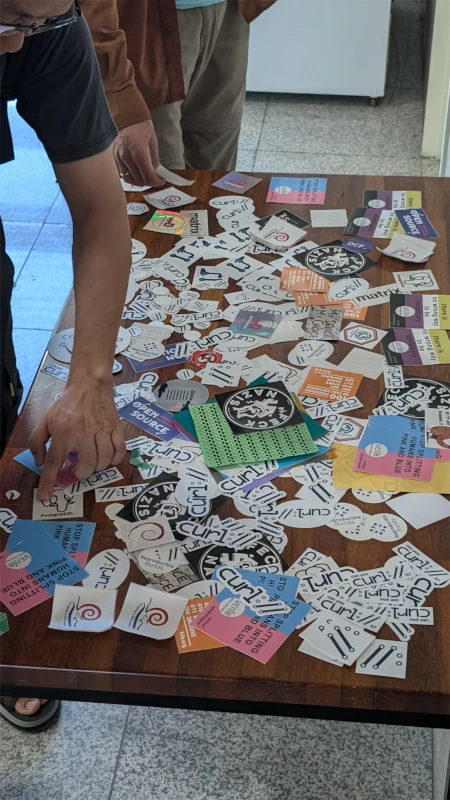
curl Swag DebConf24 was my chance at forwarding some curl swag items to the other curl maintainers, so both Sergio Durigan Junior <sergiodj> and Carlos Henrique Lima Melara <charles> got the curl-up t-shirt and the very cool curl PCB coaster, both gifted by Daniel Stenberg. Unfortunately I didn't have any of that for DebConf attendees, but I did drop loads of curl stickers at the stickers table, they were gone very quickly. A table full of different stickers, curl stickers can be seen over the whole table

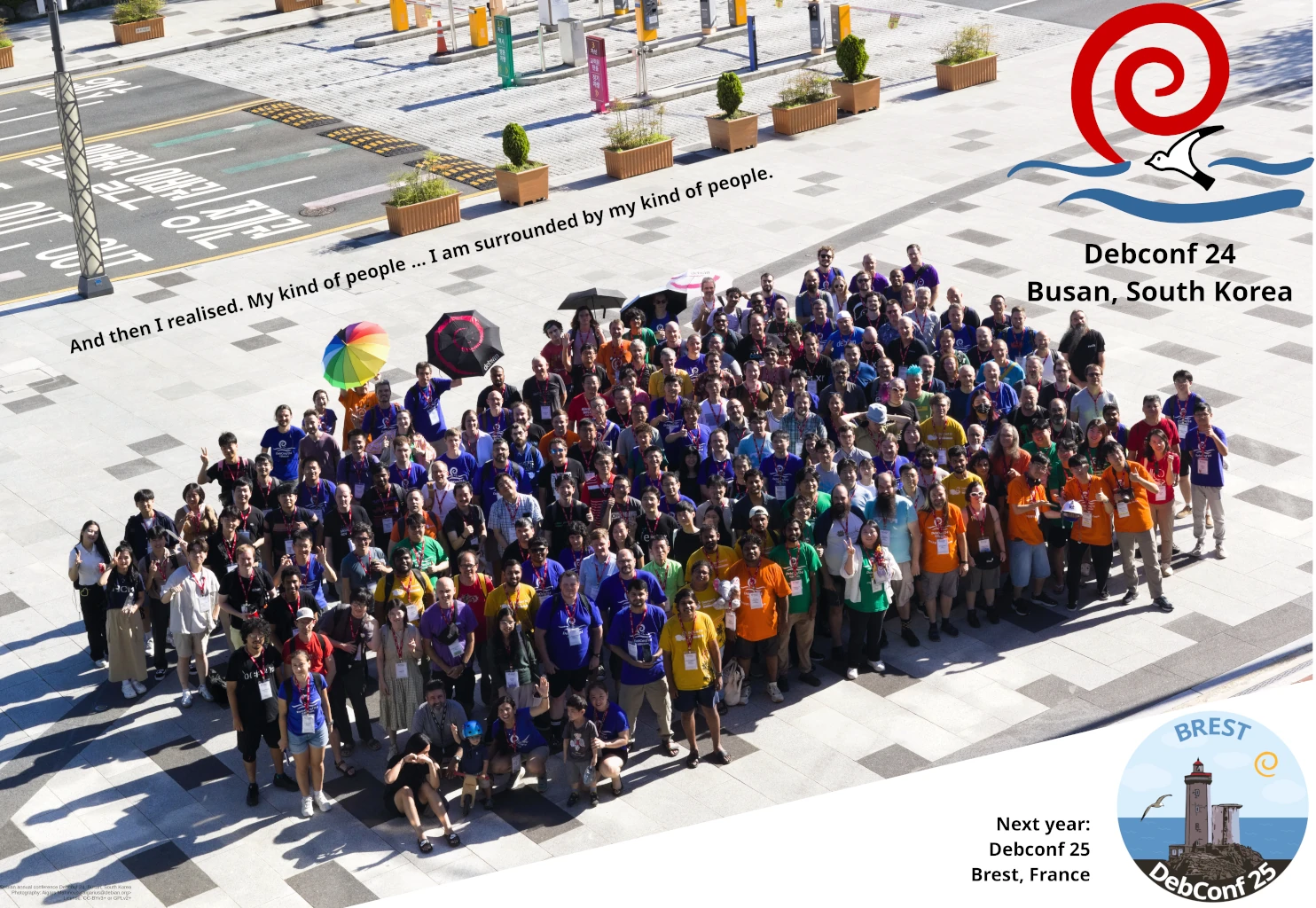
For the future I used to think the most humbling experience you could have as someone who presented a talk was to have to watch it yourself, you notice a lot of mistakes and you instantly think about things that should be done differently. It turns out the most humbling thing to do is actually to write subtitles for your talks, I noticed every single mistake, often multiple times. So after spending more than 30 hours writing the subtitles for both English and Brazilian Portuguese for my talks, I feel like it's going to be much easier to avoid committing the same mistakes again. After some time you stop feeling shame about those mistakes and you're just left with feelings of annoyance, and at that point it becomes easier to consciously avoid them. I am collecting a list of things I wish I had done differently on all of those talks, so if I end up presenting any one of them again, it will be an improved version. A picture from the top of a group of conference attendees, there's about 150 people in the picture

1 September 2024

Russ Allbery: Review: Reasons Not to Worry

Review: Reasons Not to Worry, by Brigid Delaney
Publisher: Harper
Copyright: 2022
Printing: October 2023
ISBN: 0-06-331484-3
Format: Kindle
Pages: 295
Reasons Not to Worry is a self-help non-fiction book about stoicism, focusing specifically on quotes from Seneca, Epictetus, and Marcus Aurelius. Brigid Delaney is a long-time Guardian columnist who has written on a huge variety of topics, including (somewhat relevantly to this book) her personal experiences trying weird fads. Stoicism is having a moment among the sort of men who give people life advice in podcast form. Ryan Holiday, a former marketing executive, has made a career out of being the face of stoicism in everyone's podcast feed (and, of course, hosting his own). He is far from alone. If you pay attention to anyone in the male self-help space right now (Cal Newport, in my case), you have probably heard something vague about the "wisdom of the stoics." Given that the core of stoicism is easily interpreted as a strategy for overcoming your emotions with logic, this isn't surprising. Philosophies that lean heavily on college dorm room logic, discount emotion, and argue that society is full of obvious flaws that can be analyzed and debunked by one dude with some blog software and a free afternoon have been very popular in tech circles for the past ten to fifteen years, and have spread to some extent into popular culture. Intriguingly, though, stoicism is a system of virtue ethics, which means it is historically in opposition to consequentialist philosophies like utilitarianism, the ethical philosophy behind effective altruism and other related Silicon Valley fads. I am pretty exhausted with the whole genre of men talking to each other about how to live a better life Cal Newport by himself more than satisfies the amount of that I want to absorb but I was still mildly curious about stoicism. My education didn't provide me with a satisfying grounding in major historical philosophical movements, so I occasionally look around for good introductions. Stoicism also has some reputation as an anxiety-reduction technique, and I could use more of those. When I saw a Discord recommendation for Reasons Not to Worry that specifically mentioned its lack of bro perspective, I figured I'd give it a shot. Reasons Not to Worry is indeed not a bro book, although I would have preferred fewer appearances of the author's friend Andrew, whose opinions on stoicism I could not possibly care less about. What it is, though, is a shallow and credulous book that falls squarely in the middle of the lightweight self-help genre. Delaney is here to explain why stoicism is awesome and to convince you that a school of Greek and Roman philosophers knew exactly how you should think about your life today. If this sounds quasi-religious, well, I'll get to that. Delaney does provide a solid introduction to stoicism that I think is a bit more approachable than reading the relevant Wikipedia article. In her presentation, the core of stoicism is the practice of four virtues: wisdom, courage, moderation, and justice. The modern definition of "stoic" as someone who is impassive in the presence of pleasure or pain is somewhat misleading, but Delaney does emphasize a goal of ataraxia, or tranquility of mind. By making that the goal rather than joy or pleasure, stoicism tries to avoid the trap of the hedonic treadmill in favor of a more achievable persistent contentment. As an aside, some quick Internet research makes me doubt Delaney's summary here. Other material about stoicism I found focuses on apatheia and associates ataraxia with Epicureanism instead. But I won't start quibbling with Delaney's definitions; I'm not qualified and this review is already too long. The key to ataraxia, in Delaney's summary of stoicism, is to focus only on those parts of life we can control. She summarizes those as our character, how we treat others, and our actions and reactions. Everything else wealth, the esteem of our colleagues, good health, good fortune is at least partly outside of our control, and therefore we should enjoy it when we have it but try to be indifferent to whether it will last. Attempting to control things that are outside of our control is doomed to failure and will disturb our tranquility. Essentially all of this book is elaborations and variations on this theme, specialized to some specific area of life like social media, anxiety, or grief and written in the style of a breezy memoir. If you're familiar with modern psychological treatment frameworks like cognitive behavioral therapy or acceptance and commitment therapy, this summary of stoicism may sound familiar. (Apparently this is not an accident; the predecessor to CBT used stoicism as a philosophical basis.) Stoicism, like those treatment approaches, tries to refocus your attention on the things that you can improve and de-emphasizes the things outside of your control. This is a lot of the appeal, at least to me (and I think to Delaney as well). Hearing that definition, you may have some questions. Why those virtues specifically? They sound good, but all virtues sound good almost by definition. Is there any measure of your success in following those virtues outside your subjective feeling of ataraxia? Does the focus on only things you can control lead to ignoring problems only mostly outside of your control, where your actions would matter but only to a small degree? Doesn't this whole philosophy sound a little self-centered? What do non-stoic virtue ethics look like, and why do they differ from stoicism? What is the consequentialist critique of stoicism? This is where the shortcomings of this book become clear: Delaney is not very interested in questions like this. There are sections on some of those topics, particularly the relationship between stoicism and social justice, but her treatment is highly unsatisfying. She raises the question, talks about her doubts about stoicism's applicability, and then says that, after further thought, she decided stoicism is entirely consistent with social justice and the stoics were right after all. There is a little bit more explanation than that, but not much. Stoicism can apparently never be wrong; it can only be incompletely understood. Self-help books often fall short here, and I suspect this may be what the audience wants. Part of the appeal of the self-help genre is artificial certainty. Becoming a better manager, starting a business, becoming more productive, or working out an entire life philosophy are not problems amenable to a highly approachable and undemanding book. We all know that at some level, but the seductive allure of the self-help genre is the promise of simplifying complex problems down to a few approachable bullet points. Here is a life philosophy in a neatly packaged form, and if you just think deeply about its core principles, you will find they can be applied to any situation and any doubts you were harboring will turn out to be incorrect. I am all too familiar with this pattern because it's also how fundamentalist Christianity works. The second time Delaney talked about her doubts about the applicability of stoicism and then claimed a few pages later that those doubts disappeared with additional thought and discussion, my radar went off. This book was sounding less like a thoughtful examination of one specific philosophy out of many and more like the soothing adoption of religious certainty by a convert. I was therefore entirely unsurprised when Delaney all but says outright in the epilogue that she's adopted stoicism as her religion and approaches it with the same dedicated practice that she used to bring to Catholicism. I think this is where a lot of self-help books end up, although most of them don't admit it. There's nothing wrong with this, to be clear. It sounds like she was looking for a non-theistic religion, found one that she liked, and is excited to tell other people about it. But it's a profound mismatch with what I was looking for in an introduction to stoicism. I wanted context, history, and a frank discussion of the problems with adopting philosophy to everyday issues. I also wanted some acknowledgment that it is highly unlikely that a few men who lived 2000 years ago in a wildly different social context, and with drastically limited information about cultures other than their own, figured out a foolproof recipe for how to approach life. The subsequent two millennia of philosophical debates prove that stoicism didn't end the argument, and that a lot of other philosophers thought that stoicism got a few things wrong. You would never know that from this book. What I wanted is outside the scope of this sort of undemanding self-help book, though, and this is the problem that I keep having with philosophy. The books I happen across are either nigh-incomprehensibly dense and academic, or they're simplified into catechism. This was the latter. That's probably more the fault of my reading selection than it is the fault of the book, but it was still annoying. What I will say for this book, and what I suspect may be the most useful property of self-help books in general, is that it prompts you to think about basic stoic principles without getting in the way of your thoughts. It's like background music for the brain: nothing Delaney wrote was very thorny or engaging, but she kept quietly and persistently repeating the basic stoic formula and turning my thoughts back to it. Some of those thoughts may have been useful? As a source of prompts for me to ponder, Reasons Not to Worry was therefore somewhat successful. The concept of not trying to control things outside of my control is simple but valid, and it probably didn't hurt me to spend a week thinking about it. "It kind of works as an undemanding meditation aid" is not a good enough reason for me to recommend this book, but maybe that's what someone else is looking for. Rating: 5 out of 10

22 August 2024

Debian Brasil: Debian Day 2024 em Natal/RN - Brasil

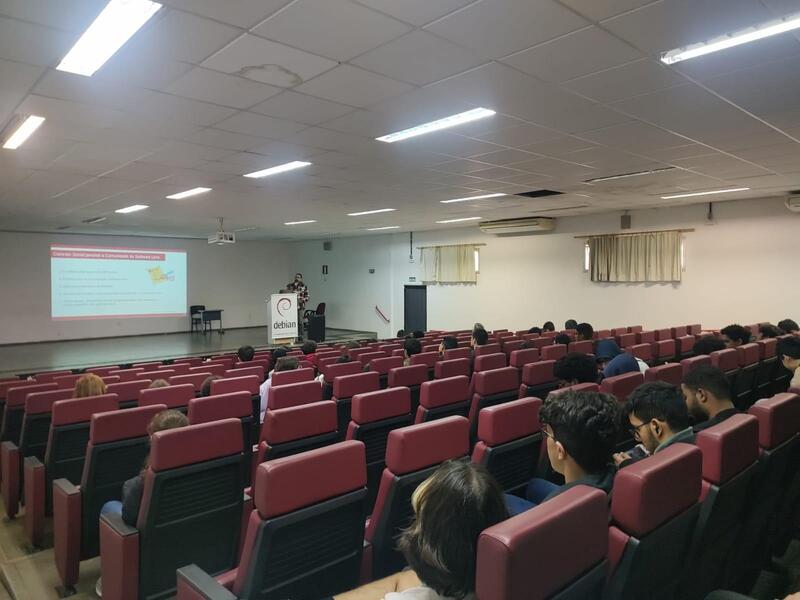
por Allythy O Debian Day um evento anual que celebra o anivers rio do Debian, uma das distribui es GNU/Linux mais importante do Software Livre, criada em 16 de Agosto de 1993, por Ian Murdock. No ltimo s bado (17/08/2024) no Sebrae-RN comemoramos os 31 anos Debian em Natal, no Rio Grande do Norte. A celebra o, foi organizada pela PotiLivre(Comunidade Potiguar de Software Livre), destacou os 31 anos de hist ria do Debian. O evento contou com algumas palestras e muitas discuss es sobre Software Livre. Tivemos 70 inscri es, 40 estiverem presentes. O Debian Day em Natal foi uma ocasi o para celebrar a trajet ria do Debian e refor ar a import ncia do Software Livre. Palestrantes Agradecemos imensamente a Isaque Barbosa Martins, Eduardo de Souza Paix o, Fernando Guisso,que palestraram nessa edi o! Obrigado por compartilhar tanto conhecimento com a comunidade. Esperamos ver voc s novamente em futuros encontros! foto da palestra conhecendo projeto Debian Link dos slides do Debian Day Participantes Um grande obrigado tamb m a todos os participantes, n s fazemos isso por voc s! Esperamos que tenham aprendido, se divertido e feito novas conex es entre a comunidade Participantes do Debian Day Natal-RN Essa edi o do Debina Day Natal foi organizada por: Allythy, Clara Nobre, Gabriel Damazio e Marcel Ribeiro.
21 August 2024

Russ Allbery: Review: These Burning Stars

Review: These Burning Stars, by Bethany Jacobs
Series: Kindom Trilogy #1
Publisher: Orbit
Copyright: October 2023
ISBN: 0-316-46342-6
Format: Kindle
Pages: 430
These Burning Stars is a science fiction thriller with cyberpunk vibes. It is Bethany Jacobs's first novel and the first of an expected trilogy, and won the 2024 Philip K. Dick Award for the best SF paperback original published in the US. Generation starships brought humanity to the three star systems of the Treble, where they've built a new and thriving culture of billions. The Treble is ruled by the Kindom, a tripartite government structure built around the worship of six gods and the aristocratic power of the First Families. The Clerisy handle religion, the Secretaries run the bureaucracy, and the Cloaksaan enforce the decisions of the other branches. The Nightfoots are one of the First Families. They control sevite, the propellant required to move between the systems of the Treble now that the moon Jeve and the sole source of natural jevite has been destroyed. Esek Nightfoot is a cleric, theoretically following the rules of the Clerisy, but she has made a career of training cloaksaan. She is is mercurial, powerful, ruthless, ambitious, politically well-connected, and greatly feared. She is also obsessed with a person named Six: an orphan she first encountered at a training school who was too young to have a gender or a name but who was already one of the best fighters in the school. In the sort of manipulative challenge typical of Esek, she dangled the offer of a place as a student and challenged the child to learn enough to do something impressive. The subsequent twenty years of elusive taunts and mysterious gifts from the impossible-to-locate Six have driven Esek wild. Cleric Chono was beside Esek for much of that time. One of Six's classmates and another of Esek's rescues, Chono is the rare student who became a cleric rather than a cloaksaan. She is pious, cautious, and careful, the opposite of Esek's mercurial rage, but it's impossible to spend that much time around the woman and not be affected and manipulated by her. As this story opens, Chono is summoned by the First Cleric to join Esek on an assignment: recover a data coin that was stolen from a pirate raid on the Nightfoot compound. He refuses to tell them what data is on it, only saying that he believes it could be used to undermine public trust in the Nightfoot family. Jun is a hacker with considerably fewer connections to power or government and no desire to meet any of these people. She and her partner Liis make a dubiously legal living from smaller, quieter jobs. Buying a collection of stolen data coins for an archivist consortium is riskier than she prefers, but she's been tracking down rumors of this coin for months. The deal is worth a lot of money, enough to make a huge difference for her family. This is the second book I've read recently with strong cyberpunk vibes, although These Burning Stars mixes them with political thriller. This is a messy world with complicated political and religious systems, a lot of contentious history, and vast inequality. The story is told in two interleaved time sequences: the present-day fight over the data coin and the information that it contains, and a sequence of flashbacks telling the history of Esek's relationship with Six and Chono. Jun's story is the most cyberpunk and the one I found the most enjoyable to read, but Chono is a good viewpoint character for Esek's vicious energy and abusive charisma. Six is not a viewpoint character. For most of the book, they're present mostly in shadows, glimpses, and consequences, but they're the strongest character of the book. Both Esek and Six are larger than life, creatures of legend stuffed into mundane politics but too full of strong emotions, both good and bad, to play by any of the rules. Esek has the power base and access to the levers of government, but Six's quiet competence and mercilessly targeted morality may make them the more dangerous of the pair. I found the twisty political thriller part of this book engrossing and very difficult to put down, but it was also a bit too much drama for me in places. Jacobs has some surprises in store, one of which I did not expect at all, and they're set up beautifully and well-done within the story, but Esek and Six become an emotional star that the other characters orbit around and are in danger of getting pulled into. Chono is an accomplished and powerful character in her own right, but she's also an abuse victim, and while those parts are realistic, I didn't entirely enjoy reading them. There is quiet competence here alongside the drama, but I think I wanted the balance of emotion to tip a bit more towards the competence. There is one thing that Jacobs does with the end of the book that greatly impressed me. Unfortunately I can't even hint at it for fear of spoilers, but the ending is unsettling in a way that I found surprising and thought-provoking. I think what I can say is that this book respects the intelligence and skill of secondary characters in a way that I think is rare in a story with such overwhelming protagonists. I'm still thinking about that, and it's going to pull me right into the sequel. This is not going to be to everyone's taste. Esek is a viewpoint character and she can be very nasty. There's a lot of violence and abuse, including one rather graphic fight scene that I thought dragged on much longer than it needed to. But it's a satisfying, complex story with a true variety of characters and some real surprises. I'm glad I read it. Followed by On Vicious Worlds, not yet published as I write this. Content warnings: emotional and physical abuse, graphic violence, off-screen rape and sexual abuse of minors. Rating: 7 out of 10

18 August 2024

Debian Brasil: Debian Day 2024 em Pouso Alegre/MG - Brasil

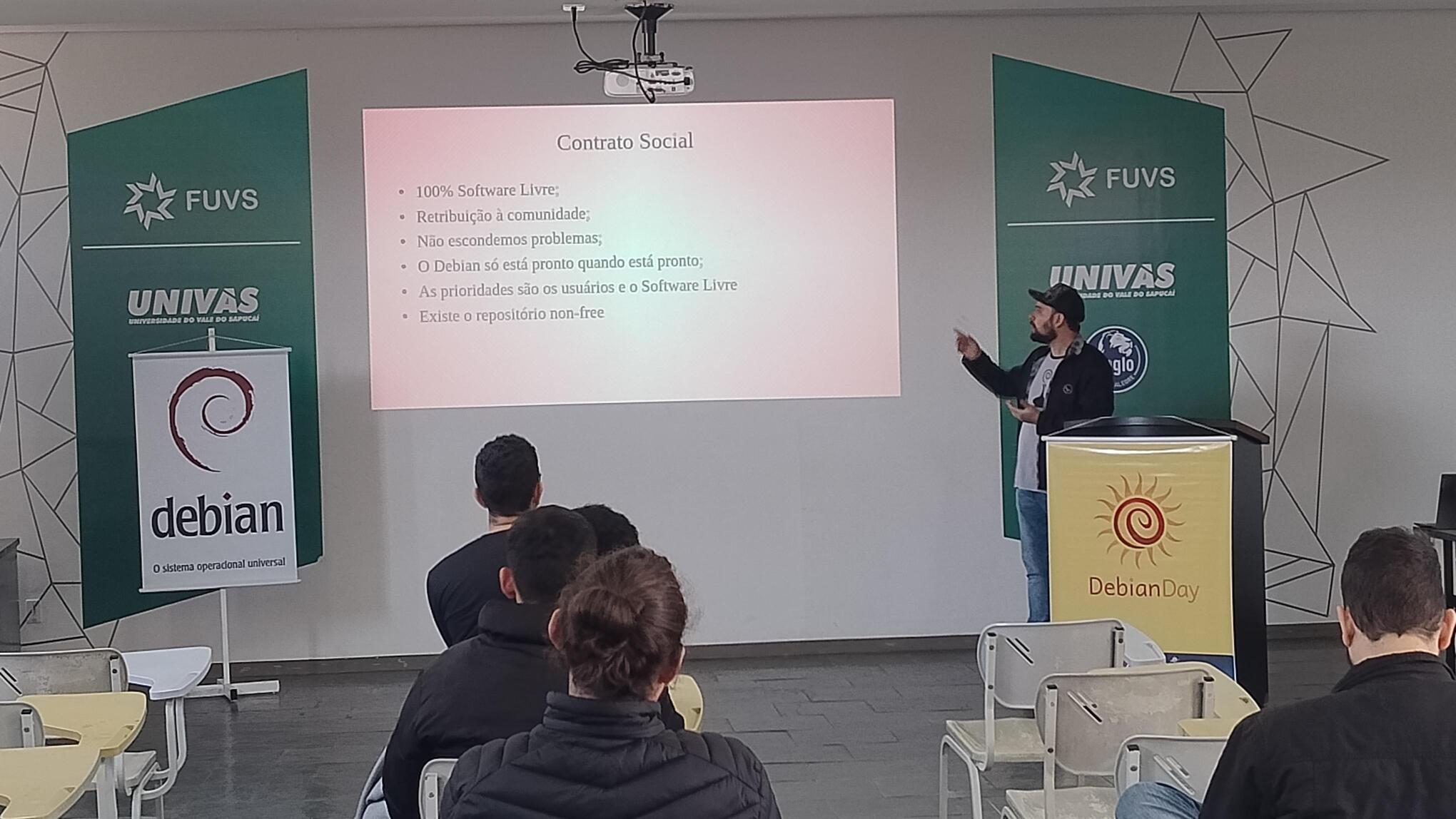
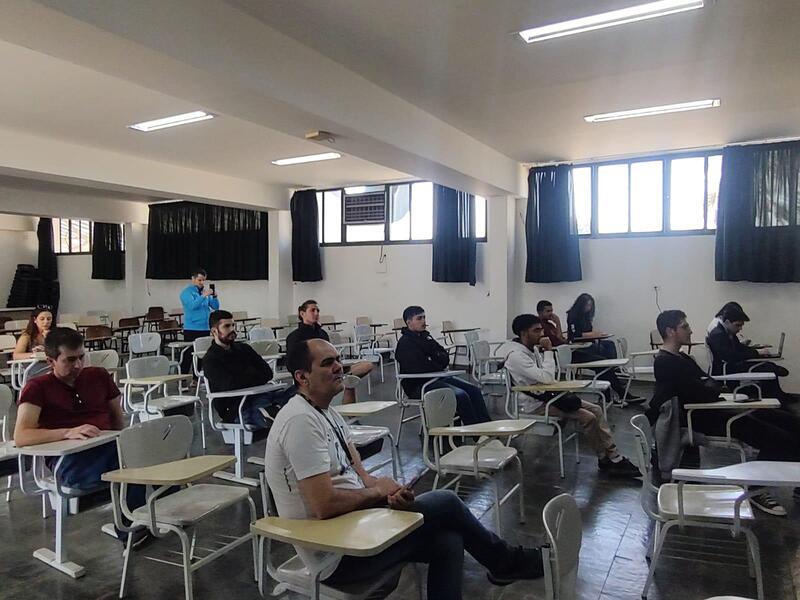
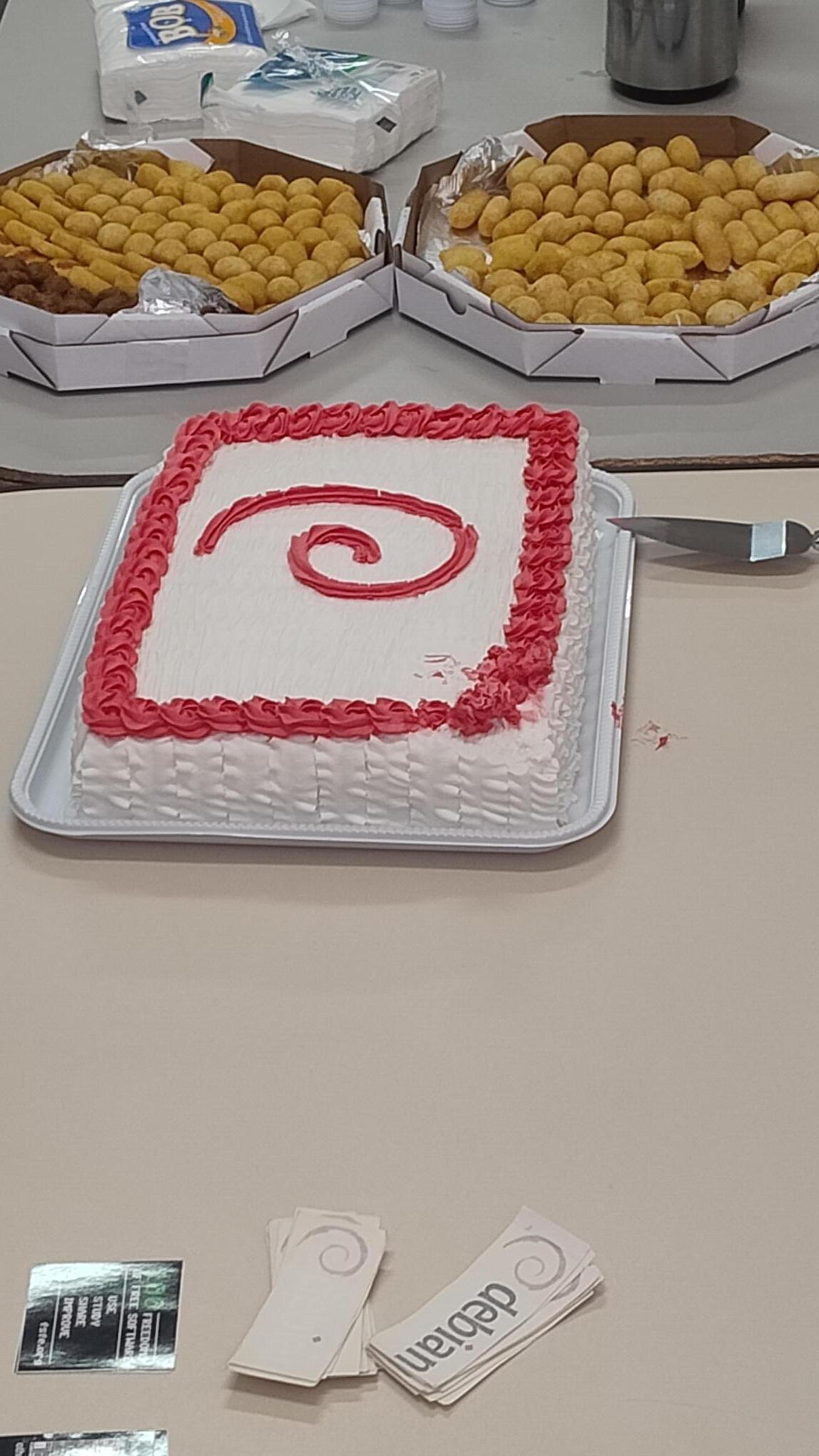
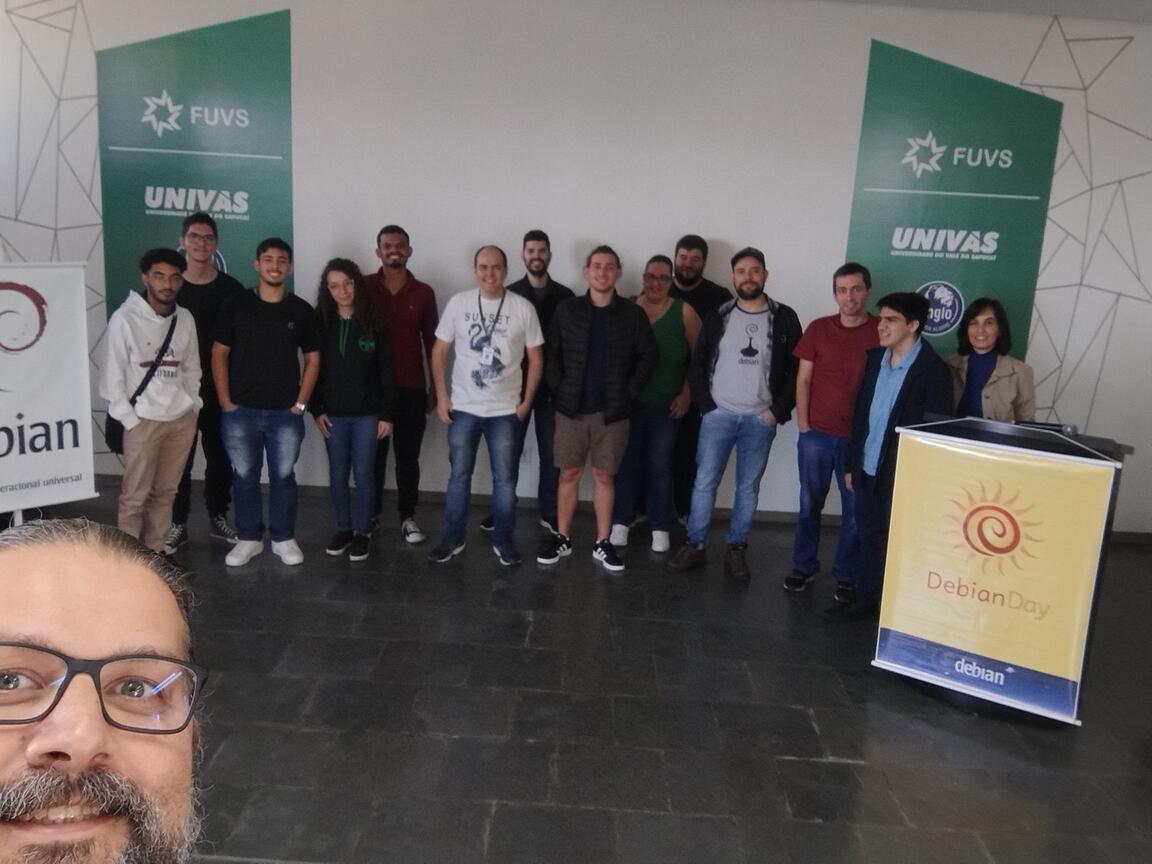
por Thiago Pezzo e Giovani Ferreira As celebra es locais do Dia do Debian 2024 tamb m aconteceram em Pouso Alegre, MG, Brasil. Neste ano conseguimos organizar dois dias de palestras! No dia 14 de agosto de 2024, quarta-feira pela manh , estivemos no campus Pouso Alegre do Instituto Federal de Educa o, Ci ncia e Tecnologia do Sul de Minas Gerais (IFSULDEMINAS). Fizemos a apresenta o introdut ria do Projeto Debian, sistema operacional e comunidade, para os tr s anos do Curso T cnico de Ensino M dio em Inform tica. O evento foi fechado para o IFSULDEMINAS e estiveram presentes por volta de 60 estudantes. J no dia 17 de agosto de 2024, um s bado pela manh , realizamos o evento aberto comunidade na Universidade do Vale do Sapuca (Univ s), com apoio institucional do Curso de Sistemas de Informa o. Falamos sobre o Projeto Debian com Giovani Ferreira (Debian Developer); sobre a equipe de tradu o Debian pt_BR com Thiago Pezzo; sobre experi ncias no dia a dia com uso de softwares livres com Virg nia Cardoso; e sobre como configurar um ambiente de desenvolvimento pronto para produ o usando Debian e Docker com Marcos Ant nio dos Santos. Encerradas as palestras, foram servidos salgadinhos, caf e bolo, enquanto os/as participantes conversavam, tiravam d vidas e partilhavam experi ncias. Gostar amos de agradecer a todas as pessoas que nos ajudaram: Algumas fotos: Apresenta o no campus Pouso Alegre do IFSULDEMINAS 1 Apresenta o no campus Pouso Alegre do IFSULDEMINAS 2 Apresenta o no campus F tica da UNIV S 1 Apresenta o no campus F tica da UNIV S 2 Apresenta o no campus F tica da UNIV S 3 Apresenta o no campus F tica da UNIV S 4

17 July 2024

Gunnar Wolf: Scholarly spam Wulfenia

I just got one of those utterly funny spam messages And yes, I recognize everybody likes building a name for themselves. But some spammers are downright silly. I just got the following mail:

From: Hermine Wolf <hwolf850@gmail.com>
To: me, obviously  
Date: Mon, 15 Jul 2024 22:18:58 -0700
Subject: Make sure that your manuscript gets indexed and showcased in the prestigious Scopus database soon.
Message-ID: <CAEZZb3XCXSc_YOeR7KtnoSK4i3OhD=FH7u+A5xSMsYvhQZojQA@mail.gmail.com>
This message has visual elements included. If they don't display, please   
update your email preferences.
*Dear Esteemed Author,*
Upon careful examination of your recent research articles available online,
we are excited to invite you to submit your latest work to our esteemed    
journal, '*WULFENIA*'. Renowned for upholding high standards of excellence 
in peer-reviewed academic research spanning various fields, our journal is 
committed to promoting innovative ideas and driving advancements in        
theoretical and applied sciences, engineering, natural sciences, and social
sciences. 'WULFENIA' takes pride in its impressive 5-year impact factor of 
*1.000* and is highly respected in prestigious databases including the     
Science Citation Index Expanded (ISI Thomson Reuters), Index Copernicus,   
Elsevier BIOBASE, and BIOSIS Previews.                                     
                                                                           
*Wulfenia submission page:*                                                
[image: research--check.png][image: scrutiny-table-chat.png][image:        
exchange-check.png][image: interaction.png]                                
.                                                                          
Please don't reply to this email                                           
                                                                           
We sincerely value your consideration of 'WULFENIA' as a platform to       
present your scholarly work. We eagerly anticipate receiving your valuable 
contributions.                                                             
*Best regards,*                                                            
Professor Dr. Vienna S. Franz                                              
Scholarly spam Who cares what Wulfenia is about? It s about you, my stupid Wolf cousin!

8 July 2024

Russ Allbery: Review: Beyond Control

Review: Beyond Control, by Kit Rocha
Series: Beyond #2
Publisher: Kit Rocha
Copyright: December 2013
ASIN: B00GIA4GN8
Format: Kindle
Pages: 364
Beyond Control is science fiction erotica (dystopian erotic romance, per the marketing) and a direct sequel to Beyond Shame. These books shift protagonists with each volume and enough of the world background is explained that you could start here, but there are significant spoilers for the previous book. I read this book as part of the Beyond Series Bundle (Books 1-3), which is what the sidebar information is for. This is one of those reviews that I write because I'm stubborn about reviewing all the books I read, not because it's likely to be useful to anyone. There are also considerably more spoilers for the shape of the story than I normally include, so be warned. The Beyond series is erotica. Specifically, so far, consensual BDSM erotica with bisexuality but otherwise typical gender stereotypes. The authors (Kit Rocha is a pen name for Donna Herren and Bree Bridges) are women, so it's more female gaze than male gaze, but by erotica I don't mean romance with an above-average number of steamy scenes. I mean it felt like half the book by page count was descriptions of sex. This review is rather pointless because, one, I'm not going to review the sex that's the main point of the book, and two, I skimmed all the sex and read it for the story because I'm weird. Beyond Shame got me interested in these absurdly horny people and their post-apocalyptic survival struggles in the outskirts of a city run by a religious surveillance state, and I wanted to find out what happened next. Besides, this book promised to focus on my favorite character from the first novel, Lex, and I wanted to read more about her. Beyond Control uses a series pattern that I understand is common in romance but which is not often seen in SFF (my usual genre): each book focuses on a new couple adjacent to the previous couple, while the happily ever after of the previous couple plays out in the background. In this case, it also teases the protagonists of the next book. I can see why romance uses this structure: it's an excuse to provide satisfying interludes for the reader. In between Lex and Dallas's current relationship problems, one gets to enjoy how well everything worked out for Noelle and how much she's grown. In Beyond Shame, Lex was the sort-of partner of Dallas O'Kane, the leader of the street gang that is running Sector Four. (Picture a circle surrounding the rich-people-only city of Eden. That circle is divided into eight wedge-shaped sectors, which provide heavy industries, black-market pleasures, and slums for agricultural workers.) Dallas is an intensely possessive, personally charismatic semi-dictator who cultivates the image of a dangerous barbarian to everyone outside and most of the people inside Sector Four. Since he's supposed to be one of the good guys, this is more image than reality, but it's not entirely disconnected from reality. This book is about Lex and Dallas forming an actual relationship, instead of the fraught and complicated thing they had in the first book. I was hoping that this would involve Dallas becoming less of an asshole. It unfortunately does not, although some of what I attributed to malice may be adequately explained by stupidity. I'm not sure that's an improvement. Lex is great, just like she was in the first book. It's obvious by this point in the series that she does most of the emotional labor of keeping the gang running, and her support is central to Dallas's success. Like most of the people in this story, she has a nasty and abusive background that she's still dealing with in various ways. Dallas's possessiveness is intensely appealing to her, but she wants that possessiveness on different terms than Dallas may be willing to offer, or is even aware of. Lex was, I thought, exceptionally clear about what she wanted out of this relationship. Dallas thinks this is entirely about sex, and is, in general, dumber than a sack of hammers. That means fights. Also orgies, but, well, hopefully you knew what you were getting into if you picked up this book. I know, I know, it's erotica, that's the whole point, but these people have a truly absurd amount of sex. Eden puts birth control in the water supply, which is a neat way to simplify some of the in-story consequences of erotica. They must be putting aphrodisiacs in the water supply as well. There was a lot of sector politics in this book that I found way more interesting than it had any right to be. I really like most of these people, even Dallas when he manages to get his three brain cells connected for more than a few minutes. The events of the first book have a lot of significant fallout, Lex continues being a badass, the social dynamics between the women are very well-done (and pass the Bechdel test yet again even though this is mostly traditional-gender-role erotica), and if Dallas had managed to understand what he did wrong at a deeper-than-emotional level, I would have rather enjoyed the non-erotica story parts. Alas. I therefore wouldn't recommend this book even if I were willing to offer any recommendations about erotica (which I'm not). I was hoping it was going somewhere more rewarding than it did. But I still kind of want to read another one? I am weirdly fascinated with the lives of these people. The next book is about Six, who has the potential to turn into the sort of snarky, cynical character I love reading about. And it's not that hard to skim over the orgies. Maybe Dallas will get one additional brain cell per book? Followed by Beyond Pain. Rating: 5 out of 10

4 July 2024

Samuel Henrique: Debian's curl now supports HTTP3

tl;dr Starting with curl 8.0.0-2, you can now use HTTP3.
curl --http3-only https://example.com
Or, if you would like to try it out in a container:
podman run debian:unstable apt install --update -y curl && curl --http3-only https://example.com
(in case you haven't noticed, apt now has the --update option for the upgrade and install commands, although not available on stable yet)

Availability
  • Debian unstable - Since 2024-07-02
  • Debian testing - Since 2024-07-18
  • Debian 12/bookworm backports - Expected by the end of August 2024.
  • Debian 12/bookworm - Due to the mechanisms we have in place to make sure Debian stable is in fact stable, we will never be able to ship this in the regular repository. Users can make use of the backports repositories instead.
  • Debian derivatives - Rolling releases will get it by the time it's on Debian testing (e.g.: Kali Linux). Stable derivatives only in their next major release.

The challenge HTTP3 is fresh new, well... not really, but at least fresh enough that I'm not aware of any other Linux distribution supporting it on curl, the reason is likely two-fold:
  1. OpenSSL is not there yet OpenSSL still doesn't have proper HTTP3 support, and given that OpenSSL is so widely used, almost every curl distributor/packager will build curl with it and thus changing the TLS backend to something else is risky. Unfortunately, proper support for the OpenSSL libcurl is unlikely to come anytime before the end of this year, the OpenSSL performance is not good enough yet as of version 3.3. Daniel Stenberg has written about the state of this multiple times, most recently at HTTP/3 in curl mid 2024, if you're interested, I suggest reading through his other posts as well. Some might have noticed that nginx does support HTTP3 through OpenSSL, although when you look closely, it's not exactly perfect:
    An SSL library that provides QUIC support is recommended to build nginx, such as BoringSSL, LibreSSL, or QuicTLS. Otherwise, the OpenSSL compatibility layer will be used that does not support early data.
    As you can see, they don't recommend using OpenSSL, and when doing so, you don't get complete support.

  2. HTTP3 support for GnuTLS/nghttp3/ngtcp2 is recent The non-experimental support arrived back in October 2023, and so that's when I started seriously planning for this. curl has been working on HTTP3 support for years, and so it did support other TLS backends before that, but out of them, the one most feasible for a distribution to ship would be GnuTLS, which gets HTTP3 support through ngctp2 and nghttp3.

How it was done The Debian curl package has historically shipped at least two variants of libcurl, an OpenSSL and a GnuTLS one. The OpenSSL libcurl can't support HTTP3 for the reasons explained above, but the GnuTLS libcurl can (with ngtcp2 and nghtp3). Debian packages can choose which version of libcurl to link against (without having to modify any upstream source code). Debian's "git" package being a famous example of a package that links against the GnuTLS libcurl. Enabling HTTP3 on curl was done in three steps:
  1. Make sure all required dependencies fulfill the minimum requirements.
  2. Enable HTTP3 for GnuTLS libcurl.
  3. Change the libcurl used by the curl CLI, from OpenSSL to GnuTLS.
curl's HTTP3 support requires a somewhat recent version of nghttp3 and updating that required a transition (due to the SONAME bump), while we've also had months of freeze for transitions due to the time_t transition. After the dependencies were in place, enabling HTTP3 for the GnuTLS libcurl was straightforward. Then, for the last part, we had to switch the TLS backend used by the curl CLI. Doing the swap is also quite easy on the packaging level, but we have to consider the chances of this change breaking our users' environments.

Ensuring there are no breakages The first thing to consider regarding breakages is that this change is not going to be pushed directly to the current Debian stable releases, it will be present in the next stable release (13/trixie) but the current one will stick to the version that's already shipped. Secondly, we have to consider the risk of losing the ability to use certain parameters from the curl CLI which could be limited to the OpenSSL backend. During curl-up 2024, the curl developers pointed out the existence of a page that lists the TLS related options and the backends they work with. Analysing that page, ignoring all of the options that are suffixed with "BLOB" (only pertinent to the library, not the CLI), the only one left which is attention worthy is CURLOPT_ECH.
This experimental feature requires a special build of OpenSSL, as ECH is not yet supported in OpenSSL releases. In contrast ECH is supported by the latest BoringSSL and wolfSSL releases.
As it turns out, Encrypted Client Hello is experimental and it's not supported by the vanilla OpenSSL. This was enough of an investigation for me to go ahead with the change. Noting that even in the worst case scenario (we find a horrible regression), we can rollback without having affected a single stable release. Now that the package is on Debian unstable, the CI tests (autopkgtest) of every package that depends on curl is currently running, the results are compared against the migration-reference (in this case, the curl CLI with OpenSSL, before the change). If everything goes right, curl with HTTP3 support will migrate to Debian testing in around 5 days. If we spot any issues, we'll have to solve them first and it's going to be hard to predict how long it takes, although it's fair to expect less than a month.

Feedback Feel free to join the Matrix room for the Debian curl maintainers:
https://matrix.to/#/#debian-curl-maintainers:matrix.org

Acknowledgements It took us a bit longer than expected to be able to enable HTTP3, nonetheless it's still early enough to be excited about. A lot of people were crucial to make this happen. I should recognize in the first place, obviously, the curl developers and the developers of the supporting libraries: GnuTLS, nghttp3, ngtcp2. Participating in the curl-up 2024 conference helped me get motivated to push this through, besides becoming aware of the right documentation to research for impact. On the Debian side, Sakirnth Nagarasa <sakirnth> was responsible for updating and taking care of the transition for nghttp3 and ngtcp2. Also on the Debian side, I've got loads of help and support from the co-maintainers of the curl package: Sergio Durigan Junior <sergiodj> and Carlos Henrique Lima Melara <charles>.

Changes since publication

2024-07-18
  • Update date of availability for Debian testing and expected date for bookworm backports.
  • We have historically spoken Portuguese in the room but we'll switch to English in case anyone joins.

3 July 2024

Samuel Henrique: Announcing wcurl: a curl wrapper to download files

tl;dr Whenever you need to download files through the terminal and don't feel like using wget:
wcurl example.com/filename.txt
Manpage:
https://manpages.debian.org/unstable/curl/wcurl.1.en.html

Availability (comes installed with the curl package):
  • Debian unstable - Since 2024-07-02
  • Debian testing - Since 2024-07-18
  • Debian 12/bookworm backports - Expected by the end of August 2024.
  • Debian 12/bookworm - Depends on whether Debian's release team will approve it, it could be available in the next point release.
  • Debian derivatives - Rolling releases will get it by the time it's on Debian testing (e.g.: Kali Linux). Stable derivatives only in their next major release.
If you don't want to wait for the package update to arrive, you can always copy the script and place it in your /usr/bin, the code is here:
https://github.com/Debian/wcurl/blob/main/wcurl
https://salsa.debian.org/debian/wcurl/-/blob/main/wcurl?ref_type=heads

Smoother CLI experience Starting with curl version 8.8.0-2, the Debian's curl package now ships a wcurl executable. wcurl is the solution for those who just need to download files without having to remember curl's parameters for things like automatically naming the files. Some people, myself included, would fall back to using wget whenever there was a need to download a file. Sometimes even installing wget just for that usecase. After all, it's easier to remember "apt install wget" rather than "curl -L -O -C - ...". wcurl consists of a simple shell script that provides sane defaults for the curl invocation, for when the use case is to just download files. By default, wcurl will:
  • Encode whitespaces in URLs;
  • Download multiple URLs in parallel if the installed curl's version is >= 7.66.0;
  • Follow redirects;
  • Automatically choose a filename as output;
  • Avoid overwriting files if the installed curl's version is >= 7.83.0 (--no-clobber);
  • Perform retries;
  • Set the downloaded file timestamp to the value provided by the server, if available;
  • Default to the protocol used as https if the URL doesn't contain any;
  • Disable curl's URL globbing parser so and [] characters in URLs are not treated specially.
Example to download a single file:
wcurl example.com/filename.txt
If you ever need to set a custom flag, you can make use of the --curl-options wcurl option, anything set there will be passed to the curl invocation. Just beware that if you need to set any custom flags, it's likely you will be better served by calling curl directly. The --curl-options option is there to allow for some flexibility in unforeseen circumstances.

The need for wcurl I've always felt a bit ashamed of not remembering curl's parameters for downloading a file and automatically naming it, having resorted to wget most of the times this was needed (even installing wget when it wasn't there, just for this). I've spoken to a few other experienced people I know and confirmed what could be obvious to others: a lot of people struggle with this. Recently, the curl project released the results of 2024's curl survey, which also showed this is as a much needed feature, just look at some of the answers:

Q: Which curl command line option do you think needs improvement and how?
-O, I really want wget like functionality where I don't have to specify the name
Downloading a file (like wget) could be improved - with automatic naming of the file
downloading files - wget is much cleaner
I wish the default behaviour when GETting a binary was to drop it on disk. That's the only reason 'wget foo.tgz" is still ingrained in my muscle memory .
Maybe have a way to download without specifying something in -o (the only reason i used wget still)
--remote-time should be default
--remote-name-all could really use a short flag

Q: If you miss support for something, tell us what!
"Write the data to the file named in the URL (or in redirects if I'm feeling daring), and timestamp the file to the last-modified-date". This is the main reason I'm still using wget.
I can finally feel less bad about falling back to wget due to not remembering the parameters I want.

Idealization vs. reality I don't believe curl will ever change its default behavior in such a way that would accommodate this need, as that would have a side-effect of breaking things which expect the current behavior (the blast radius is literally the solar system). This means a new executable needs to be shipped side-by-side with curl, an opportunity to start fresh and work with a more focused use case (to download files). Ideally, this new executable would be maintained by the curl project, make use of libcurl under-the-hood, and be available everywhere. Nobody wants to worry if their systems have the tool or not, it should always be there. Given I'm just a Debian Developer, with not as much free time as I wish, I've decided to write a simple shell script wrapper calling the curl CLI under-the-hood. wcurl will come installed with the curl package from now on, and I will check with the release team about shipping it on the current Debian stable as well. Shipping wcurl in other distros will be up to them (Debian-derivatives should pick it up automatically, though). We've tried to make it easy for anyone to ship this by using the curl license, keeping the script POSIX-compliant, and shipping a manpage. Maybe if there's enough interest across distributions, someone might sign up for implementing this in upstream curl and increase its reach. I would be happy with the curl project reusing the wcurl name when that happens. It's unlikely that wcurl would be shipped by curl upstream as it is, assuming they would prefer a solution that uses libcurl direclty (more similar to curl the CLI, to maintain). In the worst case, wcurl becomes a Debian-specific tool that only a few people are aware of, in the best case, it becomes the new go-to CLI tool for simply downloading files. I would be happy if at least someone other than me finds it useful.

Naming is hard When I started working on it, I was calling the new executable "curld" (stands for "curl download"), but then when discussing this in one of our weekly calls in the Debian Bras lia community, it was mentioned that this could be confused for a daemon. We then settled for the name "wcurl", suggested by Carlos Henrique Lima Melara <charles>. It doesn't really stand for anything, but it's very easy to remember. You know... "it's that wget alternative for when you want to use curl instead" :)

Feedback I'm hosting the code on Github and Debian's GitLab instance, feel free to open an issue to provide feedback.
https://salsa.debian.org/debian/wcurl
https://github.com/Debian/wcurl We also have a Matrix room for the Debian curl maintainers:
https://matrix.to/#/#debian-curl-maintainers:matrix.org

Acknowledgments The idea for wcurl came a few days before the curl-up conference 2024. I've been thinking a lot about developer productivity in the terminal lately, different tools and better defaults. Before curl-up, I was also thinking about packaging improvements for the curl package. I don't remember what exactly happened, but I likely had to download something and felt a bit ashamed of maintaining curl and not remembering the parameters to download files the way I wanted. I first discussed this idea in the conference, where I asked the participants about it and there were no concerns raised, and some people said I should give it a go. Participating in curl-up was a really great experience and I'm thankful for the interactions I've had there. On the Debian side, I've got reviews of the code and manpage by Sergio Durigan Junior <sergiodj>, Guilherme Puida Moreira <puida> and Carlos Henrique Lima Melara <charles>. Sergio ended up rewriting the tool to be POSIX-compliant (my version was written in bash), so he takes all the credit for the portability.

Changes since publication

2024-07-18
  • Update date of availability for Debian testing and expected date for bookworm backports.
  • Mention charles as the person who suggested "wcurl" as a name.
  • Update wcurl's -o/--opts options, it's now just --curl-options.
  • Remove mention of language spoken in the Matrix room, we are using English now.
  • Update list of features of wcurl.

1 July 2024

Guido G nther: Free Software Activities June 2024

A short status update of what happened on my side last month. Was able to test our Cellbroadcast bits, feedbackd became more flexible regarding LEDs, Phosh 0.40 is out, and some more. Phosh Phoc gmobile phosh-mobile-settings phosh-wallpapers emacs Debian ModemManager Feedbackd Livi Calls Chatty meta-phosh Libhandy If you want to support my work see donations.

Russ Allbery: Review: Snuff

Review: Snuff, by Terry Pratchett
Series: Discworld #39
Publisher: Harper
Copyright: October 2011
Printing: January 2013
ISBN: 0-06-221886-7
Format: Mass market
Pages: 470
Snuff is the 39th Discworld novel and the 8th (and last) Watch novel. This is not a good place to start reading. Sam Vines has been talked, cajoled, and coerced into taking a vacation. Since he is now the Duke of Ankh, he has a country estate that he's never visited. Lady Sybil is insistent on remedying this, as is Vetinari. Both of them may have ulterior motives. They may also be colluding. It does not take long for Vimes to realize that something is amiss in the countryside. It's not that the servants are uncomfortable with him talking to them, the senior servants are annoyed that he talks to the wrong servants, and the maids turn to face the wall at the sight of him. Those are just the strange customs of the aristocracy, for which he has little understanding and even less patience. There's something else going on. The nobility is wary, the town blacksmith is angry about something more than disliking the nobles, and the bartender doesn't want to get involved. Vimes smells something suspicious. When he's framed for a murder, the suspicions seem justified. It takes some time before the reader learns what the local nobility are squirming about, so I won't spoil it. What I will say is that Snuff is Pratchett hammering away at one of his favorite targets: prejudice, cruelty, and treating people like things. Vimes, with his uncompromising morality, is one of the first to realize the depth of the problem. It takes most of the rest longer to come around, even Sybil. It's both painful, and painfully accurate, to contemplate how often recognition of other people's worth only comes once they do something that you recognize as valuable. This is one of the better-plotted Discworld novels. Vimes starts out with nothing but suspicions and stubbornness, and manages to turn Snuff into a mystery novel through dogged persistence. The story is one continuous plot arc with the normal Pratchett color (Young Sam's obsession with types of poo, for example) but without extended digressions. It also has considerably better villains than most Pratchett novels: layers of foot soldiers and plotters, each of which have to be dealt with in a suitable way. Even the concluding action sequences worked for me, which is not always a given in Discworld. The problem, unfortunately, is that the writing is getting a bit wobbly. Pratchett died of early-onset Alzheimer's in 2015, four years after this book was first published, and this is the first novel where I can see some early effects. It mostly shows up in the dialogue: it's just a bit flabby and a bit repetitive, and the characters, particularly towards the end of the book, start repeating the name of the person they're talking to every other line. Once I saw it, I couldn't unsee it, and it was annoying enough to rob a bit of enjoyment from the end of the book. That aside, though, this was a solid Discworld novel. Vimes testing his moral certainty against the world and forcing it into a more ethical shape is always rewarding, and here he takes more risks, with better justification, than in most of the Watch novels. We also find out that Vimes has a legacy from the events of Thud!, which has interesting implications that I wish Pratchett had more time to explore. I think the best part of this book is how it models the process of social change through archetypes: the campaigner who knew the right choice early on, the person who formed their opinion the first time they saw injustice, the person who gets there through a more explicit moral code, the ones who have to be pushed by someone who was a bit faster, the ones who have to be convinced but then work to convince others, and of course the person who is willing to take on the unfair and far-too-heavy burden of being exceptional enough that they can be used as a tool to force other people to acknowledge them as a person. And, since this is Discworld, Vetinari is lurking in the scenery pulling strings, balancing threats, navigating politics, and giving Vimes just enough leeway to try to change the world without abusing his power. I love that the amount of leeway Vimes gets depends on how egregious the offense is, and Vetinari calibrates this quite carefully without ever saying so openly. Recommended, and as much as I don't want to see this series end, this is not a bad entry for the Watch novels to end on. Followed in publication order by Raising Steam. Rating: 8 out of 10

13 June 2024

Sergio Durigan Junior: The Pagure Debian package is now orphan

As promised in the last post, I have now orphaned the Pagure Debian package. Here s the full text I posted on the BTS:
After several years, I finally decided to orphan pagure :-(. I haven t been using it as my personal forge anymore, and unfortunately upstream development slowed down quite a bit after the main author and maintainer stopped contributing regularly to the project. But that is not to say that upstream is dead; they are still working towards preparing the next release. Pagure is a big package with several components and an extensive list of build dependencies (and an even bigger testsuite which I never managed to make fully work on Debian). It is not for the faint of heart, and most of the time is usually spent fixing its (build) dependencies so that it doesn t get removed from testing. If I may, I would like to leave some suggestions for a future maintainer.
  • I never had the time to write dep8 tests, mainly because setting up the software is not trivial. It would be great if the package had more Debian-centric testing.
  • Speaking of the hurdles to setting up Pagure, I believe the package installation could be made a bit more automated using debconf. I don t see a way to fully automate it (look at d/README.Debian), but there is certainly room for improvement.
I also left a brief TODO list inside d/README.source; feel free to tackle any item there! I wish the next maintainer can have as much fun with the package as I did when I first made it for Debian! Thank you,
That s it. It was good while it lasted, but I needed to feel myself unburdened so that I don t have that constant feeling of I should be properly maintaining this package . If you feel like you d like to give it a try at maintaining Pagure, now is the time!

27 May 2024

Sahil Dhiman: A Late, Late Debconf23 Post

After much procrastination, I have gotten around to complete my DebConf23 (DC23), Kochi blog post. I lost the original etherpad which was started before DebConf23, for jotting down things. Now, I have started afresh with whatever I can remember, months after the actual conference ended. So things might be as accurate as my memory. DebConf23, the 24th annual Debian Conference, happened in Infopark, Kochi, India from 10th September to 17th September 2023. It was preceded by DebCamp from 3rd September to 9th September 2023. First formal bid to host DebConf in India was made during DebConf18 in Hsinchu, Taiwan by Raju Dev, which didn t came our way. In next DebConf, DebConf19 in Curitiba, Brazil, another bid was made by him with help and support from Sruthi, Utkarsh and the whole team.This time, India got the opportunity to host DebConf22, which eventually became DebConf23 for the reasons you all know. I initially met the local team on the sidelines of DebConf20, which was also my first DebConf. Having recently switched to Debian, DC20 introduced me to how things work in Debian. Video team s call for volunteers email pulled me in. Things stuck, and I kept hanging out and helping the local Indian DC team with various stuff. We did manage to organize multiple events leading to DebConf23 including MiniDebConf India 2021 Online, MiniDebConf Palakkad 2022, MiniDebConf Tamil Nadu 2023 and DebUtsav Kochi 2023, which gave us quite a bit of experience and workout. Many local organizers from these conferences later joined various DebConf teams during the conference to help out. For DebConf23, originally I was part of publicity team because that was my usual thing. After a team redistribution exercise, Sruthi and Praveen moved me to sponsorship team, as anyhow we didn t had to do much publicity and sponsorship was one of those things I could get involved remotely. Sponsorship team had to take care of raising funds by reaching out to sponsors, managing invoices and fulfillment. Praveen joined as well in sponsorship team. We also had international sponsorship team, Anisa, Daniel and various Debian Trusted Organizations (TO)s which took care of reaching out to international organizations, and we took care of reaching out to Indian organizations for sponsorship. It was really proud moment when my present employer, Unmukti (makers of hopbox) came aboard as Bronze sponsor. Though fundraising seem to be hit hard from tech industry slowdown and layoffs. Many of our yesteryear sponsors couldn t sponsor. We had biweekly local team meetings, which were turned to weekly as we neared the event. This was done in addition to biweekly global team meeting. Pathu
Pathu, DebConf23 mascot
To describe the conference venue, it happened in InfoPark, Kochi with the main conference hall being Athulya Hall and food, accommodation and two smaller halls in Four Point Hotel, right outside Infopark. We got Athulya Hall as part of venue sponsorship from Infopark. The distance between both of them was around 300 meters. Halls were named Anamudi, Kuthiran and Ponmudi based on hills and mountain areas in host state of Kerala. Other than Annamudi hall which was the main hall, I couldn t remember the names of the hall, I still can t. Four Points was big and expensive, and we had, as expected, cost overruns. Due to how DebConf function, an Indian university wasn t suitable to host a conference of this scale. Infinity Pool at Night
Four Point's Infinity Pool at Night
I landed in Kochi on the first day of DebCamp on 3rd September. As usual, met Abraham first, and the better part of the next hour was spent on meet and greet. It was my first IRL DebConf so met many old friends and new folks. I got a room to myself. Abraham lived nearby and hadn t taken the accommodation, so I asked him to join. He finally joined from second day onwards. All through the conference, room 928 became in-famous for various reasons, and I had various roommates for company. In DebCamp days, we would get up to have breakfast and go back to sleep and get active only past lunch for hacking and helping in the hack lab for the day, followed by fun late night discussions and parties. Nilesh, Chirag and Apple at DC23
Nilesh, Chirag and Apple at DC23
The team even managed to get a press conference arranged as well, and we got an opportunity to go to Press Club, Ernakulam. Sruthi and Jonathan gave the speech and answered questions from journalists. The event was covered by media as well due to this. Ernakulam Press Club
Ernakulam Press Club
During the conference, every night the team use to have 9 PM meetings for retrospection and planning for next day, which was always dotted with new problems. Every day, we used to hijack Silent Hacklab for the meeting and gently ask the only people there at the time to give us space. DebConf, it itself is a well oiled machine. Network was brought up from scratch. Video team built the recording, audio mixing, live-streaming, editing and transcoding infrastructure on site. A gaming rig served as router and gateway. We got internet uplinks, a 1 Gbps sponsored leased line from Kerala Vision and a paid backup 100 Mbps connection from a different provider. IPv6 was added through HE s Tunnelbroker. Overall the network worked fine as additionally we had hotel Wi-Fi, so the conference network wasn t stretched much. I must highlight, DebConf is my only conference where almost everything and every piece of software in developed in-house, for the conference and modified according to need on the fly. Even event recording cameras, audio check, direction, recording and editing is all done on in-house software by volunteer-attendees (in some cases remote ones as well), all trained on the sideline of the conference. The core recording and mixing equipment is owned by Debian and travels to each venue. The rest is sourced locally. Gaming Rig which served as DC23 gateway router
Gaming Rig which served as DC23 gateway router
It was fun seeing how almost all the things were coordinated over text on Internet Relay Chat (IRC). If a talk/event was missing a talkmeister or a director or a camera person, a quick text on #debconf channel would be enough for someone to volunteer. Video team had a dedicated support channel for each conference venue for any issues and were quick to respond and fix stuff. Network information. Screengrab from closing ceremony
Network information. Screengrab from closing ceremony
It rained for the initial days, which gave us a cool weather. Swag team had decided to hand out umbrellas in swag kit which turned out to be quite useful. The swag kit was praised for quality and selection - many thanks to Anupa, Sruthi and others. It was fun wearing different color T-shirts, all designed by Abraham. Red for volunteers, light green for Video team, green for core-team i.e. staff and yellow for conference attendees. With highvoltage
With highvoltage
We were already acclimatized by the time DebConf really started as we had been talking, hacking and hanging out since last 7 days. Rush really started with the start of DebConf. More people joined on the first and second day of the conference. As has been the tradition, an opening talk was prepared by the Sruthi and local team (which I highly recommend watching to get more insights of the process). DebConf day 1 also saw job fair, where Canonical and FOSSEE, IIT Bombay had stalls for community interactions, which judging by the crowd itself turned out to be quite a hit. For me, association with DebConf (and Debian) started due to volunteering with video team, so anyhow I was going to continue doing that this conference as well. I usually volunteer for talks/events which anyhow I m interested in. Handling the camera, talkmeister-ing and direction are fun activities, though I didn t do sound this time around. Sound seemed difficult, and I didn t want to spoil someone s stream and recording. Talk attendance varied a lot, like in Bits from DPL talk, the hall was full but for some there were barely enough people to handle the volunteering tasks, but that s what usually happens. DebConf is more of a place to come together and collaborate, so talk attendance is an afterthought sometimes. Audience in highvoltage's Bits from DPL talk
Audience in highvoltage's Bits from DPL talk
I didn t submit any talk proposals this time around, as just being in the orga team was too much work already, and I knew, the talk preparation would get delayed to the last moment and I would have to rush through it. Enrico's talk
Enrico's talk
From Day 2 onward, more sponsor stalls were introduced in the hallway area. Hopbox by Unmukti , MostlyHarmless and Deeproot (joint stall) and FOSEE. MostlyHarmless stall had nice mechanical keyboards and other fun gadgets. Whenever I got the time, I would go and start typing racing to enjoy the nice, clicky keyboards. As the DebConf tradition dictates, we had a Cheese and Wine party. Everyone brought in cheese and other delicacies from their region. Then there was yummy Sadya. Sadya is a traditional vegetarian Malayalis lunch served over banana leaves. There were loads of different dishes served, the names of most I couldn t pronounce or recollect properly, but everything was super delicious. Day 4 was day trip and I chose to go to Athirappilly Waterfalls and Jungle safari. Pictures would describe the beauty better than words. The journey was bit long though. Athirappilly Falls
Athirappilly Falls

Pathu Pathu Tea Gardens
Tea Gardens
Late that day, we heard the news of Abraham gone missing. We lost Abraham. He had worked really hard all through the years for Debian and making this conference possible. Talks were cancelled for the next day and Jonathan addressed everyone. We went to Abraham s home the next day to meet his family. Team had arranged buses to Abraham s place. It was an unfortunate moment that I only got an opportunity to visit his place after he was gone. Days went by slowly after that. The last day was marked by a small conference dinner. Some of the people had already left. All through the day and next, we kept saying goodbye to friends, with whom we spent almost a fortnight together. Athirappilly Falls
Group photo with all DebConf T-shirts chronologically
This was 2nd trip to Kochi. Vistara Airway s UK886 has become the default flight now. I have almost learned how to travel in and around Kochi by Metro, Water Metro, Airport Shuttle and auto. Things are quite accessible in Kochi but metro is a bit expensive compared to Delhi. I left Kochi on 19th. My flight was due to leave around 8 PM, so I had the whole day to myself. A direct option would have taken less than 1 hour, but as I had time and chose to take the long way to the airport. First took an auto rickshaw to Kakkanad Water Metro station. Then sailed in the water metro to Vyttila Water Metro station. Vyttila serves as intermobility hub which connects water metro, metro, bus at once place. I switched to Metro here at Vyttila Metro station till Aluva Metro station. Here, I had lunch and then boarded the Airport feeder bus to reach Kochi Airport. All in all, I did auto rickshaw > water metro > metro > feeder bus to reach Airport. I was fun and scenic. I must say, public transport and intermodal integration is quite good and once can transition seamlessly from one mode to next. Kochi Water Metro
Kochi Water Metro

Scenes from Kochi Water Metro Scenes from Kochi Water Metro
Scenes from Kochi Water Metro
DebConf23 served its purpose of getting existing Debian people together, as well as getting new people interested and contributing to Debian. People who came are still contributing to Debian, and that s amazing. Streaming video stats
Streaming video stats. Screengrab from closing ceremony
The conference wasn t without its fair share of troubles. There were multiple money transfer woes, and being in India didn t help. Many thanks to multiple organizations who were proactive in helping out. On top of this, there was conference visa uncertainty and other issues which troubled visa team a lot. Kudos to everyone who made this possible. Surely, I m going to miss the name, so thank you for it, you know how much you have done to make this event possible. Now, DebConf24 is scheduled for Busan, South Korea, and work is already in full swing. As usual, I m helping with the fundraising part and plan to attend too. Let s see if I can make it or not. DebConf23 Group Photo
DebConf23 Group Photo. Click to enlarge.
Credits - Aigars Mahinovs
In the end, we kept on saying, no DebConf at this scale would come back to India for the next 10 or 20 years. It s too much trouble to be frank. It was probably the peak that we might not reach again. I would be happy to be proven wrong though :)

21 May 2024

Michael Ablassmeier: lvm thin send/recv

A few days ago i found this mail on the LKML that introduces support for userspace access to LVM thin provisioned metadata snapshots. I didn t know this is possible. Using the thin provisioning tools you can then export the metadata information for your LVM snapshots to track changed regions between them. The workflow is pretty straight forward, yet not really documented:
# lvcreate -ay -Ky --snapshot -n full_backup thingroup/vol1
  # dmsetup message /dev/mapper/thingroup-thinpool-tpool 0 reserve_metadata_snap
  # lvcreate -ay -Ky --snapshot -n inc_backup thingroup/vol1
  # thin_delta  -m --snap1 $(lvs --noheadings -o thin_id thingroup/full_backup) --snap2 $(lvs --noheadings -o thin_id thingroup/inc_backup) > delta_dump
  # dmsetup message /dev/mapper/thingroup-thinpool-tpool 0 release_metadata_snap
This all has already been implemented by a nice utility called thin-send-recv, which based on this functionality allows to (incrementally) send LVM snapshots to remote systems just like zfs send or zfs recv.

20 May 2024

Debian Brasil: MiniDebConf Belo Horizonte 2024 - um breve relato

De 27 a 30 de abril de 2024 foi realizada a MiniDebConf Belo Horizonte 2024 no Campus Pampulha da UFMG - Universidade Federal de Minas Gerais, em Belo Horizonte - MG. MiniDebConf BH 2024 banners Esta foi a quinta vez que uma MiniDebConf (como um evento presencial exclusivo sobre Debian) aconteceu no Brasil. As edi es anteriores foram em Curitiba (2016, 2017, e 2018), e em Bras lia 2023. Tivemos outras edi es de MiniDebConfs realizadas dentro de eventos de Software Livre como o FISL e a Latinoware, e outros eventos online. Veja o nosso hist rico de eventos. Paralelamente MiniDebConf, no dia 27 (s bado) aconteceu o FLISOL - Festival Latino-americano de Instala o de Software Livre, maior evento da Am rica Latina de divulga o de Software Livre realizado desde o ano de 2005 simultaneamente em v rias cidades. A MiniDebConf Belo Horizonte 2024 foi um sucesso (assim como as edi es anteriores) gra as participa o de todos(as), independentemente do n vel de conhecimento sobre o Debian. Valorizamos a presen a tanto dos(as) usu rios(as) iniciantes que est o se familiarizando com o sistema quanto dos(as) desenvolvedores(as) oficiais do projeto. O esp rito de acolhimento e colabora o esteve presente em todos os momentos. MiniDebConf BH 2024 flisol N meros da edi o 2024 Durante os quatro dias de evento aconteceram diversas atividades para todos os n veis de usu rios(as) e colaboradores(as) do projeto Debian. A programa o oficial foi composta de: MiniDebConf BH 2024 palestra Os n meros finais da MiniDebConf Belo Horizonte 2024 mostram que tivemos um recorde de participantes. Dos 224 participantes, 15 eram contribuidores(as) oficiais brasileiros sendo 10 DDs (Debian Developers) e 05 (Debian Maintainers), al m de diversos(as) contribuidores(as) n o oficiais. A organiza o foi realizada por 14 pessoas que come aram a trabalhar ainda no final de 2023, entre elas o Prof. Lo c Cerf do Departamento de Computa o que viabilizou o evento na UFMG, e 37 volunt rios(as) que ajudaram durante o evento. Como a MiniDebConf foi realizado nas instala es da UFMG, tivemos a ajuda de mais de 10 funcion rios da Universidade. Veja a lista com os nomes das pessoas que ajudaram de alguma forma na realiza o da MiniDebConf Belo Horizonte 2024. A diferen a entre o n mero de pessoas inscritas e o n mero de pessoas presentes provavelmente se explica pelo fato de n o haver cobran a de inscri o, ent o se a pessoa desistir de ir ao evento ela n o ter preju zo financeiro. A edi o 2024 da MiniDebconf Belo Horizonte foi realmente grandiosa e mostra o resultado dos constantes esfor os realizados ao longo dos ltimos anos para atrair mais colaboradores(as) para a comunidade Debian no Brasil. A cada edi o os n meros s aumentam, com mais participantes, mais atividades, mais salas, e mais patrocinadores/apoiadores. MiniDebConf BH 2024 grupo
MiniDebConf BH 2024 grupo Atividades A programa o da MiniDebConf foi intensa e diversificada. Nos dias 27, 29 e 30 (s bado, segunda e ter a-feira) tivemos palestras, debates, oficinas e muitas atividades pr ticas. MiniDebConf BH 2024 palestra J no dia 28 (domingo), ocorreu o Day Trip, um dia dedicado a passeios pela cidade. Pela manh sa mos do hotel e fomos, em um nibus fretado, para o Mercado Central de Belo Horizonte. O pessoal aproveitou para comprar v rias coisas como queijos, doces, cacha as e lembrancinhas, al m de experimentar algumas comidas locais. MiniDebConf BH 2024 mercado Depois de 2 horas de passeio pelo Mercado, voltamos para o nibus e pegamos a estrada para almo armos em um restaurante de comida t pica mineira. MiniDebConf BH 2024 palestra Com todos bem alimentados, voltamos para Belo Horizonte para visitarmos o principal ponto tur stico da cidade: a Lagoa da Pampulha e a Capela S o Francisco de Assis, mais conhecida como Igrejinha da Pampulha. MiniDebConf BH 2024 palestra Voltamos para o hotel e o dia terminou no hacker space que montamos na sala de eventos para o pessoal conversar, empacotar, e comer umas pizzas. MiniDebConf BH 2024 palestra Financiamento coletivo Pela terceira vez fizemos uma campanha de financiamento coletivo e foi incr vel como as pessoas contribu ram! A meta inicial era arrecadar o valor equivalente a uma cota ouro de R$ 3.000,00. Ao atingirmos essa meta, definimos uma nova, equivalente a uma cota ouro + uma cota prata (R$ 5.000,00). E novamente atingimos essa meta. Ent o propusermos como meta final o valor de uma cota ouro + prata + bronze, que seria equivalente a R$ 6.000,00. O resultado foi que arrecadamos R$ 7.239,65 com a ajuda de mais de 100 pessoas! Muito obrigado as pessoas que contribu ram com qualquer valor. Como forma de agradecimento, listamos os nomes das pessoas que doaram. MiniDebConf BH 2024 doadores Bolsas de alimenta o, hospedagem e/ou passagens para participantes Cada edi o da MiniDebConf trouxe alguma inova o, ou algum benef cio diferente para os(a) participantes. Na edi o deste ano em Belo Horizonte, assim como acontece nas DebConfs, oferecemos bolsas de alimenta o, hospedagem e/ou passagens para ajudar aquelas pessoas que gostariam de vir para o evento mas que precisariam de algum tipo de ajuda. No formul rio de inscri o, colocamos a op o para a pessoa solicitar bolsa de alimenta o, hospedagem e/ou passagens, mas para isso, ela deveria se identificar como contribuidor(a) (oficial ou n o oficial) do Debian e escrever uma justificativa para o pedido. N mero de pessoas beneficiadas: A bolsa de alimenta o forneceu almo o e jantar todos os dias. Os almo os inclu ram pessoas que moram em Belo Horizonte e regi o. J o jantares foram pagos para os(as) participantes que tamb m receberam a bolsa de hospedagem e/ou passagens. A hospedagem foi realizada no Hotel BH Jaragu . E as passagens inclu ram de avi o ou de nibus, ou combust vel (para quem veio de carro ou moto). Boa parte do dinheiro para custear as bolsas vieram do Projeto Debian, principalmente para as passagens. Enviamos um or amento o ent o l der do Debian Jonathan Carter, e ele prontamente aprovou o nosso pedido. Al m deste or amento do evento, o l der tamb m aprovou os pedidos individuais enviados por alguns DDs que preferiram solicitar diretamente para ele. A experi ncia de oferecer as bolsas foi realmente muito boa porque permitiu a vinda de v rias pessoas de outras cidades. MiniDebConf BH 2024 grupo Fotos e v deos Voc pode assistir as grava es das palestras nos links abaixo: E ver as fotos feitas por v rios(as) colaboradores(as) nos links abaixo: Agradecimentos Gostar amos de agradecer a todos(as) os(as) participantes, organizadores(as), volunt rios(as), patrocinadores(as) e apoiadores(as) que contribu ram para o sucesso da MiniDebConf Belo Horizonte 2024. MiniDebConf BH 2024 grupo Patrocinadores Ouro: Prata: Bronze: Apoiadores Organiza o
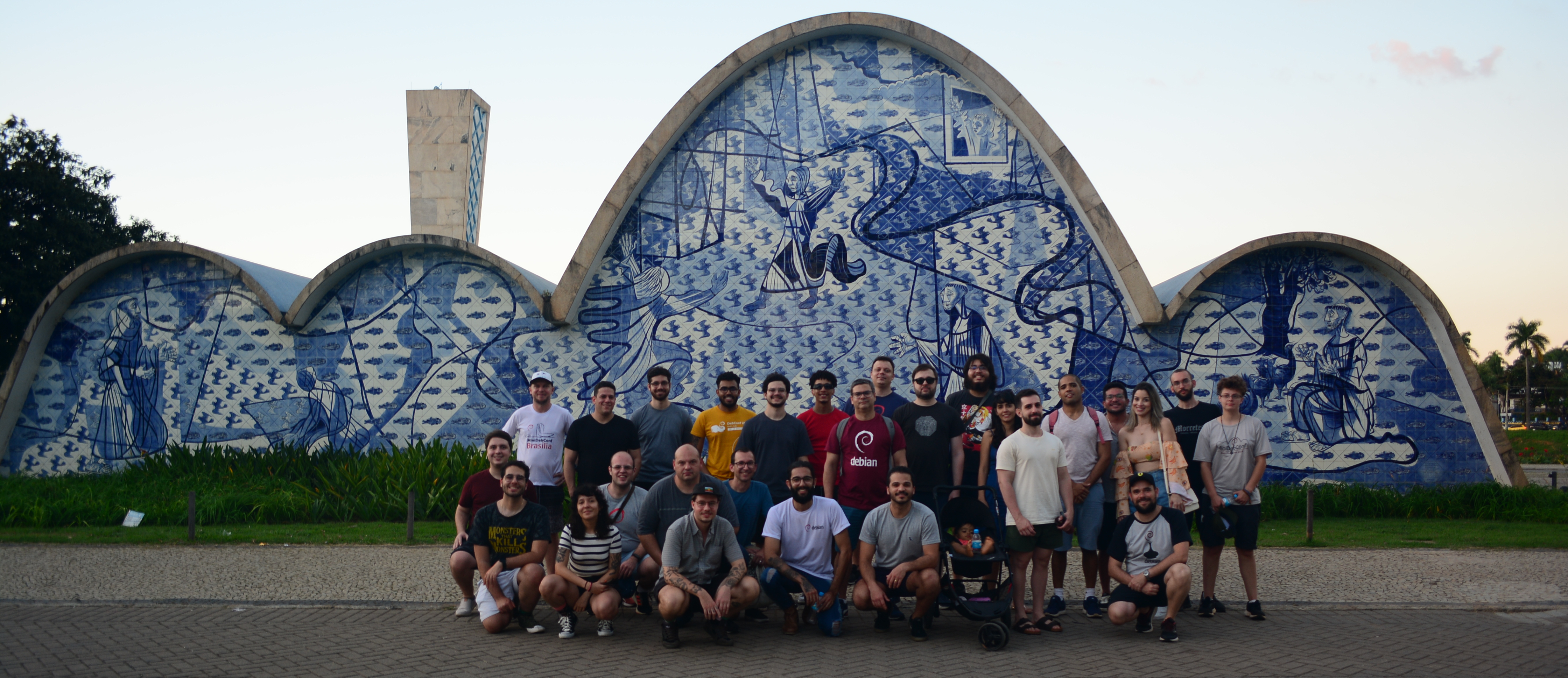
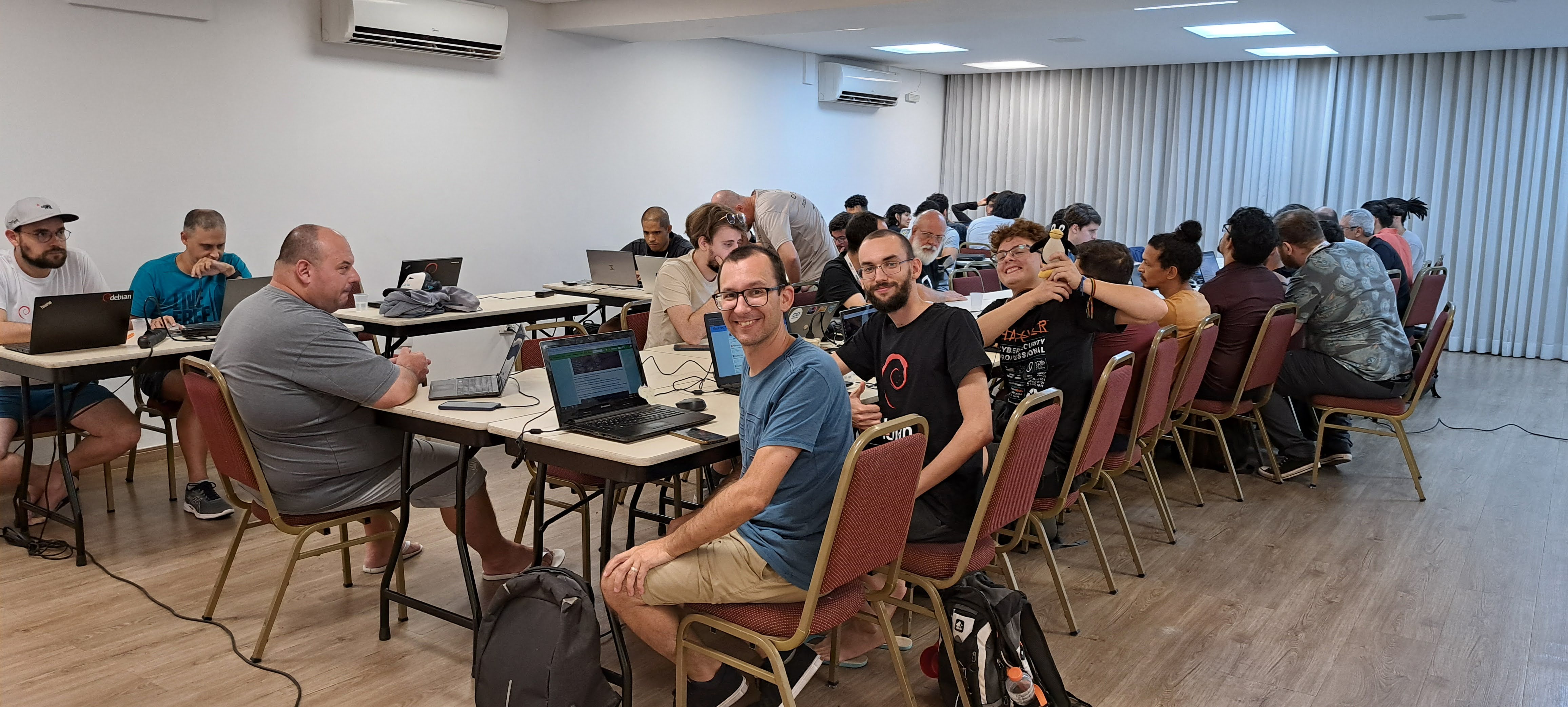
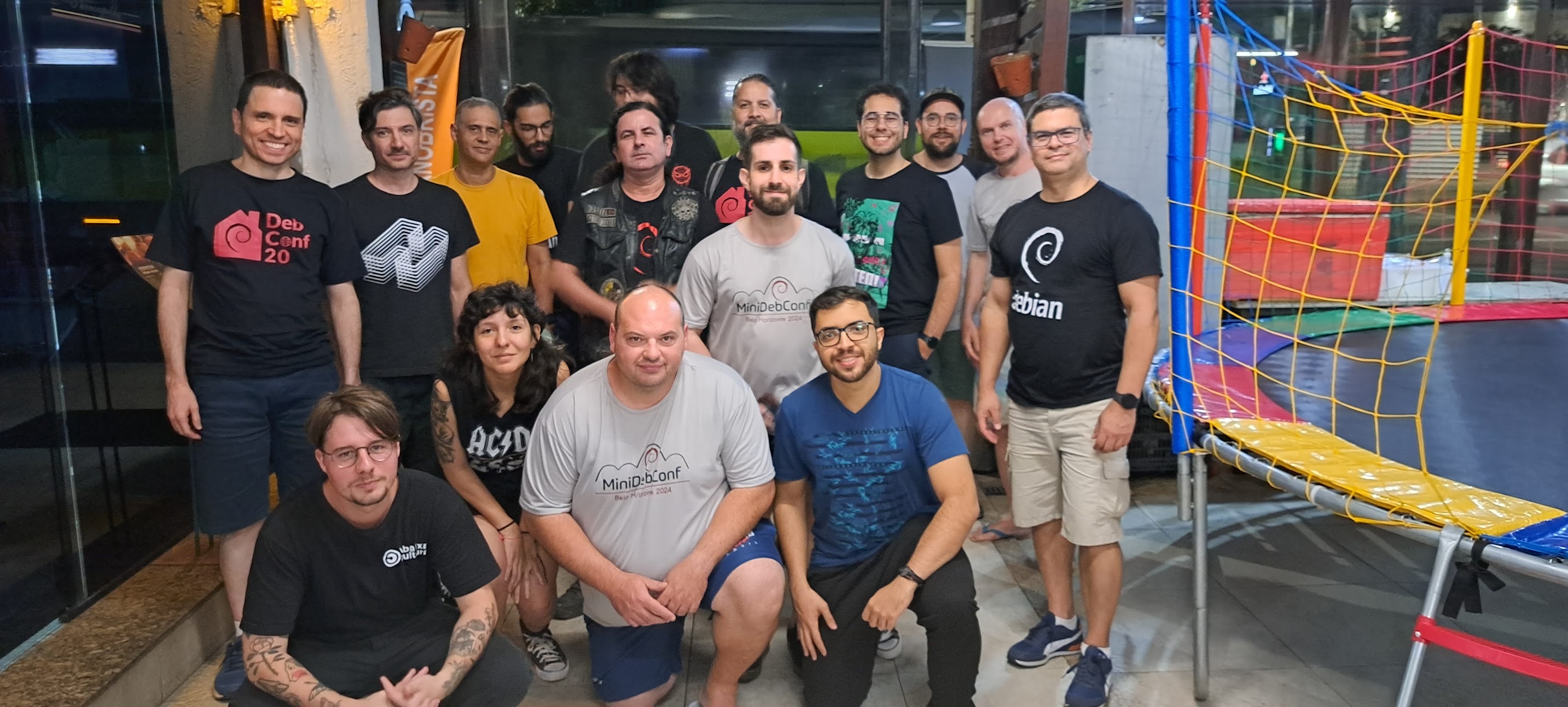
8 May 2024

Debian Brasil: MiniDebConf BH 2024 - v deos e fotos

Os v deos das palestras MiniDebConf BH 2024 est o dispon veis nos links abaixo: As fotos do evento est o nos links abaixo: E os arquivos usados nas apresenta es est o aqui: Em breve divulgaremos um relato sobre o evento, aguardem :-)

26 April 2024

Robert McQueen: Update from the GNOME board

It s been around 6 months since the GNOME Foundation was joined by our new Executive Director, Holly Million, and the board and I wanted to update members on the Foundation s current status and some exciting upcoming changes.

Finances As you may be aware, the GNOME Foundation has operated at a deficit (nonprofit speak for a loss ie spending more than we ve been raising each year) for over three years, essentially running the Foundation on reserves from some substantial donations received 4-5 years ago. The Foundation has a reserves policy which specifies a minimum amount of money we have to keep in our accounts. This is so that if there is a significant interruption to our usual income, we can preserve our core operations while we work on new funding sources. We ve now hit the buffers of this reserves policy, meaning the Board can t approve any more deficit budgets to keep spending at the same level we must increase our income. One of the board s top priorities in hiring Holly was therefore her experience in communications and fundraising, and building broader and more diverse support for our mission and work. Her goals since joining as well as building her familiarity with the community and project have been to set up better financial controls and reporting, develop a strategic plan, and start fundraising. You may have noticed the Foundation being more cautious with spending this year, because Holly prepared a break-even budget for the Board to approve in October, so that we can steady the ship while we prepare and launch our new fundraising initiatives.

Strategy & Fundraising The biggest prerequisite for fundraising is a clear strategy we need to explain what we re doing and why it s important, and use that to convince people to support our plans. I m very pleased to report that Holly has been working hard on this and meeting with many stakeholders across the community, and has prepared a detailed and insightful five year strategic plan. The plan defines the areas where the Foundation will prioritise, develop and fund initiatives to support and grow the GNOME project and community. The board has approved a draft version of this plan, and over the coming weeks Holly and the Foundation team will be sharing this plan and running a consultation process to gather feedback input from GNOME foundation and community members. In parallel, Holly has been working on a fundraising plan to stabilise the Foundation, growing our revenue and ability to deliver on these plans. We will be launching a variety of fundraising activities over the coming months, including a development fund for people to directly support GNOME development, working with professional grant writers and managers to apply for government and private foundation funding opportunities, and building better communications to explain the importance of our work to corporate and individual donors.

Board Development Another observation that Holly had since joining was that we had, by general nonprofit standards, a very small board of just 7 directors. While we do have some committees which have (very much appreciated!) volunteers from outside the board, our officers are usually appointed from within the board, and many board members end up serving on multiple committees and wearing several hats. It also means the number of perspectives on the board is limited and less representative of the diverse contributors and users that make up the GNOME community. Holly has been working with the board and the governance committee to reduce how much we ask from individual board members, and improve representation from the community within the Foundation s governance. Firstly, the board has decided to increase its size from 7 to 9 members, effective from the upcoming elections this May & June, allowing more voices to be heard within the board discussions. After that, we re going to be working on opening up the board to more participants, creating non-voting officer seats to represent certain regions or interests from across the community, and take part in committees and board meetings. These new non-voting roles are likely to be appointed with some kind of application process, and we ll share details about these roles and how to be considered for them as we refine our plans over the coming year.

Elections We re really excited to develop and share these plans and increase the ways that people can get involved in shaping the Foundation s strategy and how we raise and spend money to support and grow the GNOME community. This brings me to my final point, which is that we re in the run up to the annual board elections which take place in the run up to GUADEC. Because of the expansion of the board, and four directors coming to the end of their terms, we ll be electing 6 seats this election. It s really important to Holly and the board that we use this opportunity to bring some new voices to the table, leading by example in growing and better representing our community. Allan wrote in the past about what the board does and what s expected from directors. As you can see we re working hard on reducing what we ask from each individual board member by increasing the number of directors, and bringing additional members in to committees and non-voting roles. If you re interested in seeing more diverse backgrounds and perspectives represented on the board, I would strongly encourage you consider standing for election and reach out to a board member to discuss their experience. Thanks for reading! Until next time. Best Wishes,
Rob
President, GNOME Foundation Update 2024-04-27: It was suggested in the Discourse thread that I clarify the interaction between the break-even budget and the 1M EUR committed by the STF project. This money is received in the form of a contract for services rather than a grant to the Foundation, and must be spent on the development areas agreed during the planning and application process. It s included within this year s budget (October 23 September 24) and is all expected to be spent during this fiscal year, so it doesn t have an impact on the Foundation s reserves position. The Foundation retains a small % fee to support its costs in connection with the project, including the new requirement to have our accounts externally audited at the end of the financial year. We are putting this money towards recruitment of an administrative assistant to improve financial and other operational support for the Foundation and community, including the STF project and future development initiatives. (also posted to GNOME Discourse, please head there if you have any questions or comments)

Next.

Previous.