Search Results: "edd"

6 February 2026

Reproducible Builds: Reproducible Builds in January 2026

Welcome to the first monthly report in 2026 from the Reproducible Builds project! These reports outline what we ve been up to over the past month, highlighting items of news from elsewhere in the increasingly-important area of software supply-chain security. As ever, if you are interested in contributing to the Reproducible Builds project, please see the Contribute page on our website.

  1. Flathub now testing for reproducibility

  2. Reproducibility identifying projects that will fail to build in 2038
  3. Distribution work
  4. Tool development
  5. Two new academic papers
  6. Upstream patches

Flathub now testing for reproducibility Flathub, the primary repository/app store for Flatpak-based applications, has begun checking for build reproducibility. According to a recent blog post:
We have started testing binary reproducibility of x86_64 builds targeting the stable repository. This is possible thanks to flathub-repro-checker, a tool doing the necessary legwork to recreate the build environment and compare the result of the rebuild with what is published on Flathub. While these tests have been running for a while now, we have recently restarted them from scratch after enabling S3 storage for diffoscope artifacts.
The test results and status is available on their reproducible builds page.

Reproducibility identifying software projects that will fail to build in 2038 Longtime Reproducible Builds developer Bernhard M. Wiedemann posted on Reddit on Y2K38 commemoration day T-12 that is to say, twelve years to the day before the UNIX Epoch will no longer fit into a signed 32-bit integer variable on 19th January 2038. Bernhard s comment succinctly outlines the problem as well as notes some of the potential remedies, as well as links to a discussion with the GCC developers regarding adding warnings for int time_t conversions . At the time of publication, Bernhard s topic had generated 50 comments in response.

Distribution work Conda is language-agnostic package manager which was originally developed to help Python data scientists and is now a popular package manager for Python and R. conda-forge, a community-led infrastructure for Conda recently revamped their dashboards to rebuild packages straight to track reproducibility. There have been changes over the past two years to make the conda-forge build tooling fully reproducible by embedding the lockfile of the entire build environment inside the packages.

In Debian this month:
In NixOS this month, it was announced that the GNU Guix Full Source Bootstrap was ported to NixOS as part of Wire Jansen bachelor s thesis (PDF). At the time of publication, this change has landed in NiX stdev distribution.
Lastly, Bernhard M. Wiedemann posted another openSUSE monthly update for his work there.

Tool development diffoscope is our in-depth and content-aware diff utility that can locate and diagnose reproducibility issues. This month, Chris Lamb made the following changes, including preparing and uploading versions, 310 and 311 to Debian.
  • Fix test compatibility with u-boot-tools version 2026-01. [ ]
  • Drop the implied Rules-Requires-Root: no entry in debian/control. [ ]
  • Bump Standards-Version to 4.7.3. [ ]
  • Reference the Debian ocaml package instead of ocaml-nox. (#1125094)
  • Apply a patch by Jelle van der Waa to adjust a test fixture match new lines. [ ]
  • Also the drop implied Priority: optional from debian/control. [ ]

In addition, Holger Levsen uploaded two versions of disorderfs, first updating the package from FUSE 2 to FUSE 3 as described in last months report, as well as updating the packaging to the latest Debian standards. A second upload (0.6.2-1) was subsequently made, with Holger adding instructions on how to add the upstream release to our release archive and incorporating changes by Roland Clobus to set _FILE_OFFSET_BITS on 32-bit platforms, fixing a build failure on 32-bit systems. Vagrant Cascadian updated diffoscope in GNU Guix to version 311-2-ge4ec97f7 and disorderfs to 0.6.2.

Two new academic papers Julien Malka, Stefano Zacchiroli and Th o Zimmermann of T l com Paris in-house research laboratory, the Information Processing and Communications Laboratory (LTCI) published a paper this month titled Docker Does Not Guarantee Reproducibility:
[ ] While Docker is frequently cited in the literature as a tool that enables reproducibility in theory, the extent of its guarantees and limitations in practice remains under-explored. In this work, we address this gap through two complementary approaches. First, we conduct a systematic literature review to examine how Docker is framed in scientific discourse on reproducibility and to identify documented best practices for writing Dockerfiles enabling reproducible image building. Then, we perform a large-scale empirical study of 5,298 Docker builds collected from GitHub workflows. By rebuilding these images and comparing the results with their historical counterparts, we assess the real reproducibility of Docker images and evaluate the effectiveness of the best practices identified in the literature.
A PDF of their paper is available online.
Quentin Guilloteau, Antoine Waehren and Florina M. Ciorba of the University of Basel in Sweden also published a Docker-related paper, theirs called Longitudinal Study of the Software Environments Produced by Dockerfiles from Research Artifacts:
The reproducibility crisis has affected all scientific disciplines, including computer science (CS). To address this issue, the CS community has established artifact evaluation processes at conferences and in journals to evaluate the reproducibility of the results shared in publications. Authors are therefore required to share their artifacts with reviewers, including code, data, and the software environment necessary to reproduce the results. One method for sharing the software environment proposed by conferences and journals is to utilize container technologies such as Docker and Apptainer. However, these tools rely on non-reproducible tools, resulting in non-reproducible containers. In this paper, we present a tool and methodology to evaluate variations over time in software environments of container images derived from research artifacts. We also present initial results on a small set of Dockerfiles from the Euro-Par 2024 conference.
A PDF of their paper is available online.

Miscellaneous news On our mailing list this month: Lastly, kpcyrd added a Rust section to the Stable order for outputs page on our website. [ ]

Upstream patches The Reproducible Builds project detects, dissects and attempts to fix as many currently-unreproducible packages as possible. We endeavour to send all of our patches upstream where appropriate. This month, we wrote a large number of such patches, including:

Finally, if you are interested in contributing to the Reproducible Builds project, please visit our Contribute page on our website. However, you can get in touch with us via:

5 February 2026

Dirk Eddelbuettel: rfoaas 2.3.3: Limited Rebirth

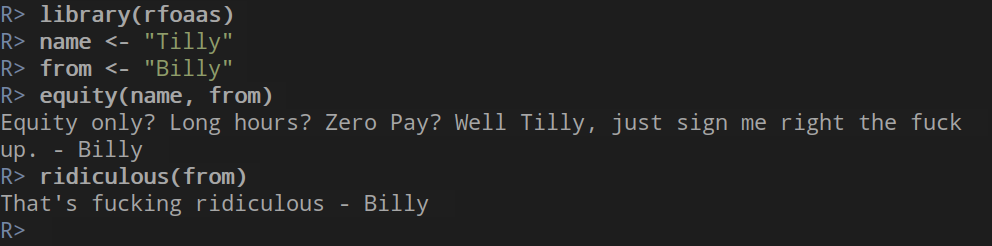
rfoaas greed example The original FOAAS site provided a rather wide variety of REST access points, but it sadky is no more (while the old repo is still there). A newer replacement site FOASS is up and running, but with a somewhat reduced offering. (For example, the two accessors shown in the screenshot are no more. C est la vie.) Recognising that perfect may once again be the enemy of (somewhat) good (enough), we have rejigged the rfoaas package in a new release 2.3.3. (The precding version number 2.3.2 corresponded to the upstream version, indicating which API release we matched. Now we just went + 0.0.1 but there is no longer a correspondence to the service version at FOASS.) Accessor functions for each of the now available access points are provided, ans the random sampling accessor getRandomFO() now picks from that set. My CRANberries service provides a comparison to the previous release. Questions, comments etc should go to the GitHub issue tracker. More background information is on the project page as well as on the github repo

This post by Dirk Eddelbuettel originated on his Thinking inside the box blog. If you like this or other open-source work I do, you can sponsor me at GitHub.

4 February 2026

Dirk Eddelbuettel: littler 0.3.23 on CRAN: More Features (and Fixes)

max-heap image The twentythird release of littler as a CRAN package landed on CRAN just now, following in the now twenty year history (!!) as a (initially non-CRAN) package started by Jeff in 2006, and joined by me a few weeks later. littler is the first command-line interface for R as it predates Rscript. It allows for piping as well for shebang scripting via #!, uses command-line arguments more consistently and still starts faster. It also always loaded the methods package which Rscript only began to do in later years. littler lives on Linux and Unix, has its difficulties on macOS due to some-braindeadedness there (who ever thought case-insensitive filesystems as a default were a good idea?) and simply does not exist on Windows (yet the build system could be extended see RInside for an existence proof, and volunteers are welcome!). See the FAQ vignette on how to add it to your PATH. A few examples are highlighted at the Github repo:, as well as in the examples vignette. This release, the first in about eleven months, once again brings two new helper scripts, and enhances six existing one. The release was triggered because it finally became clear why installGitHub.r ignored r2u when available: we forced the type argument to source (so thanks to I aki for spotting this). One change was once again contributed by Michael which is again greatly appreciated. The full change description follows.

Changes in littler version 0.3.22 (2026-02-03)
  • Changes in examples scripts
    • A new script busybees.r aggregates deadlined packages by maintainer
    • Several small updated have been made to the (mostly internal) 'r2u.r' script
    • The deadliners.r script has refined treatment for screen width
    • The install2.r script has new options --quiet and --verbose as proposed by Zivan Karaman
    • The rcc.r script passes build-args to 'rcmdcheck' to compact vignettes and save data
    • The installRub.r script now defaults to 'noble' and is more tolerant of inputs
    • The installRub.r script deals correctly with empty utils::osVersion thanks to Michael Chirico
    • New script checkPackageUrls.r inspired by how CRAN checks (with thanks to Kurt Hornik for the hint)
    • The installGithub.r script now adjusts to bspm and takes advantage of r2u binaries for its build dependencies
  • Changes in package
    • Environment variables (read at build time) can use double quotes
    • Continuous intgegration scripts received a minor update

My CRANberries service provides a comparison to the previous release. Full details for the littler release are provided as usual at the ChangeLog page, and also on the package docs website. The code is available via the GitHub repo, from tarballs and now of course also from its CRAN page and via install.packages("littler"). Binary packages are available directly in Debian as well as (in a day or two) Ubuntu binaries at CRAN thanks to the tireless Michael Rutter. Comments and suggestions are welcome at the GitHub repo.

This post by Dirk Eddelbuettel originated on his Thinking inside the box blog. If you like this or other open-source work I do, you can sponsor me at GitHub.

31 January 2026

Michael Prokop: apt, SHA-1 keys + 2026-02-01

You might have seen Policy will reject signature within a year warnings in apt(-get) update runs like this:
root@424812bd4556:/# apt update
Get:1 http://foo.example.org/debian demo InRelease [4229 B]
Hit:2 http://deb.debian.org/debian trixie InRelease
Hit:3 http://deb.debian.org/debian trixie-updates InRelease
Hit:4 http://deb.debian.org/debian-security trixie-security InRelease
Get:5 http://foo.example.org/debian demo/main amd64 Packages [1097 B]
Fetched 5326 B in 0s (43.2 kB/s)
All packages are up to date.
Warning: http://foo.example.org/debian/dists/demo/InRelease: Policy will reject signature within a year, see --audit for details
root@424812bd4556:/# apt --audit update
Hit:1 http://foo.example.org/debian demo InRelease
Hit:2 http://deb.debian.org/debian trixie InRelease
Hit:3 http://deb.debian.org/debian trixie-updates InRelease
Hit:4 http://deb.debian.org/debian-security trixie-security InRelease
All packages are up to date.    
Warning:  http://foo.example.org/debian/dists/demo/InRelease: Policy will reject signature within a year, see --audit for details
Audit:  http://foo.example.org/debian/dists/demo/InRelease: Sub-process /usr/bin/sqv returned an error code (1), error message is:
   Signing key on 54321ABCD6789ABCD0123ABCD124567ABCD89123 is not bound:
              No binding signature at time 2024-06-19T10:33:47Z
     because: Policy rejected non-revocation signature (PositiveCertification) requiring second pre-image resistance
     because: SHA1 is not considered secure since 2026-02-01T00:00:00Z
Audit: The sources.list(5) entry for 'http://foo.example.org/debian' should be upgraded to deb822 .sources
Audit: Missing Signed-By in the sources.list(5) entry for 'http://foo.example.org/debian'
Audit: Consider migrating all sources.list(5) entries to the deb822 .sources format
Audit: The deb822 .sources format supports both embedded as well as external OpenPGP keys
Audit: See apt-secure(8) for best practices in configuring repository signing.
Audit: Some sources can be modernized. Run 'apt modernize-sources' to do so.
If you ignored this for the last year, I would like to tell you that 2026-02-01 is not that far away (hello from the past if you re reading this because you re already affected). Let s simulate the future:
root@424812bd4556:/# apt --update -y install faketime
[...]
root@424812bd4556:/# export LD_PRELOAD=/usr/lib/x86_64-linux-gnu/faketime/libfaketime.so.1 FAKETIME="2026-08-29 23:42:11" 
root@424812bd4556:/# date
Sat Aug 29 23:42:11 UTC 2026
root@424812bd4556:/# apt update
Get:1 http://foo.example.org/debian demo InRelease [4229 B]
Hit:2 http://deb.debian.org/debian trixie InRelease                                 
Err:1 http://foo.example.org/debian demo InRelease
  Sub-process /usr/bin/sqv returned an error code (1), error message is: Signing key on 54321ABCD6789ABCD0123ABCD124567ABCD89123 is not bound:            No binding signature at time 2024-06-19T10:33:47Z   because: Policy rejected non-revocation signature (PositiveCertification) requiring second pre-image resistance   because: SHA1 is not considered secure since 2026-02-01T00:00:00Z
[...]
Warning: An error occurred during the signature verification. The repository is not updated and the previous index files will be used. OpenPGP signature verification failed: http://foo.example.org/debian demo InRelease: Sub-process /usr/bin/sqv returned an error code (1), error message is: Signing key on 54321ABCD6789ABCD0123ABCD124567ABCD89123 is not bound:            No binding signature at time 2024-06-19T10:33:47Z   because: Policy rejected non-revocation signature (PositiveCertification) requiring second pre-image resistance   because: SHA1 is not considered secure since 2026-02-01T00:00:00Z
[...]
root@424812bd4556:/# echo $?
100
Now, the proper solution would have been to fix the signing key underneath (via e.g. sq cert lint &dash&dashfix &dash&dashcert-file $PRIVAT_KEY_FILE > $PRIVAT_KEY_FILE-fixed). If you don t have access to the according private key (e.g. when using an upstream repository that has been ignoring this issue), you re out of luck for a proper fix. But there s a workaround for the apt situation (related see apt commit 0989275c2f7afb7a5f7698a096664a1035118ebf):
root@424812bd4556:/# cat /usr/share/apt/default-sequoia.config
# Default APT Sequoia configuration. To overwrite, consider copying this
# to /etc/crypto-policies/back-ends/apt-sequoia.config and modify the
# desired values.
[asymmetric_algorithms]
dsa2048 = 2024-02-01
dsa3072 = 2024-02-01
dsa4096 = 2024-02-01
brainpoolp256 = 2028-02-01
brainpoolp384 = 2028-02-01
brainpoolp512 = 2028-02-01
rsa2048  = 2030-02-01
[hash_algorithms]
sha1.second_preimage_resistance = 2026-02-01    # Extend the expiry for legacy repositories
sha224 = 2026-02-01
[packets]
signature.v3 = 2026-02-01   # Extend the expiry
Adjust this according to your needs:
root@424812bd4556:/# mkdir -p /etc/crypto-policies/back-ends/
root@424812bd4556:/# cp /usr/share/apt/default-sequoia.config /etc/crypto-policies/back-ends/apt-sequoia.config
root@424812bd4556:/# $EDITOR /etc/crypto-policies/back-ends/apt-sequoia.config
root@424812bd4556:/# cat /etc/crypto-policies/back-ends/apt-sequoia.config
# APT Sequoia override configuration
[asymmetric_algorithms]
dsa2048 = 2024-02-01
dsa3072 = 2024-02-01
dsa4096 = 2024-02-01
brainpoolp256 = 2028-02-01
brainpoolp384 = 2028-02-01
brainpoolp512 = 2028-02-01
rsa2048  = 2030-02-01
[hash_algorithms]
sha1.second_preimage_resistance = 2026-09-01    # Extend the expiry for legacy repositories
sha224 = 2026-09-01
[packets]
signature.v3 = 2026-02-01   # Extend the expiry
Then we re back into the original situation, being a warning instead of an error:
root@424812bd4556:/# apt update
Hit:1 http://deb.debian.org/debian trixie InRelease
Get:2 http://foo.example.org/debian demo InRelease [4229 B]
Hit:3 http://deb.debian.org/debian trixie-updates InRelease
Hit:4 http://deb.debian.org/debian-security trixie-security InRelease
Warning: http://foo.example.org/debian/dists/demo/InRelease: Policy will reject signature within a year, see --audit for details
[..]
Please note that this is a workaround, and not a proper solution.

29 January 2026

C.J. Collier: Part 3: Building the Keystone Dataproc Custom Images for Secure Boot & GPUs

Part
3: Building the Keystone Dataproc Custom Images for Secure Boot &
GPUs In Part 1, we established a secure, proxy-only network. In Part 2, we
explored the enhanced install_gpu_driver.sh initialization
action. Now, in Part 3, we ll focus on using the LLC-Technologies-Collier/custom-images
repository (branch proxy-exercise-2025-11) to build the
actual custom Dataproc images embedded with NVIDIA drivers signed for
Secure Boot, all within our proxied environment.

Why Custom Images? To run NVIDIA GPUs on Shielded VMs with Secure Boot enabled, the
NVIDIA kernel modules must be signed with a key trusted by the VM s EFI
firmware. Since standard Dataproc images don t include these
custom-signed modules, we need to build our own. This process also
allows us to pre-install a full stack of GPU-accelerated software.

The
custom-images Toolkit
(examples/secure-boot) The examples/secure-boot directory within the
custom-images repository contains the necessary scripts and
configurations, refined through significant development to handle proxy
and Secure Boot challenges. Key Components & Development Insights:
  • env.json: The central configuration
    file (as used in Part 1) for project, network, proxy, and bucket
    details. This became the single source of truth to avoid configuration
    drift.
  • create-key-pair.sh: Manages the Secure
    Boot signing keys (PK, KEK, DB) in Google Secret Manager, essential for
    the module signing.
  • build-and-run-podman.sh: Orchestrates
    the image build process in an isolated Podman container. This was
    introduced to standardize the build environment and encapsulate
    dependencies, simplifying what the user needs to install locally.
  • pre-init.sh: Sets up the build
    environment within the container and calls
    generate_custom_image.py. It crucially passes metadata
    derived from env.json (like proxy settings and Secure Boot
    key secret names) to the temporary build VM.
  • generate_custom_image.py: The core
    Python script that automates GCE VM creation, runs the customization
    script, and creates the final GCE image.
  • gce-proxy-setup.sh: This script from
    startup_script/ is vital. It s injected into the temporary
    build VM and runs first to configure the OS, package
    managers (apt, dnf), tools (curl, wget, GPG), Conda, and Java to use the
    proxy settings passed in the metadata. This ensures the entire build
    process is proxy-aware.
  • install_gpu_driver.sh: Used as the
    --customization-script within the build VM. As detailed in
    Part 2, this script handles the driver/CUDA/ML stack installation and
    signing, now able to function correctly due to the proxy setup by
    gce-proxy-setup.sh.
Layered Image Strategy: The pre-init.sh script employs a layered approach:
  1. secure-boot Image: Base image with
    Secure Boot certificates injected.
  2. tf Image: Based on
    secure-boot, this image runs the full
    install_gpu_driver.sh within the proxy-configured build VM
    to install NVIDIA drivers, CUDA, ML libraries (TensorFlow, PyTorch,
    RAPIDS), and sign the modules. This is the primary target image for our
    use case.
(Note: secure-proxy and proxy-tf layers
were experiments, but the -tf image combined with runtime
metadata emerged as the most effective solution for 2.2-debian12). Build Steps:
  1. Clone Repos & Configure
    env.json: Ensure you have the
    custom-images and cloud-dataproc repos and a
    complete env.json as described in Part 1.
  2. Run the Build:
    bash # Example: Build a 2.2-debian12 based image set # Run from the custom-images repository root bash examples/secure-boot/build-and-run-podman.sh 2.2-debian12
    This command will build the layered images, leveraging the proxy
    settings from env.json via the metadata injected into the
    build VM. Note the final image name produced (e.g.,
    dataproc-2-2-deb12-YYYYMMDD-HHMMSS-tf).

Conclusion of Part 3 Through an iterative process, we ve developed a robust workflow
within the custom-images repository to build Secure
Boot-compatible GPU images in a proxy-only environment. The key was
isolating the build in Podman, ensuring the build VM is fully
proxy-aware using gce-proxy-setup.sh, and leveraging the
enhanced install_gpu_driver.sh from Part 2. In Part 4, we ll bring it all together, deploying a Dataproc cluster
using this custom -tf image within the secure network, and
verifying the end-to-end functionality.

19 January 2026

Dirk Eddelbuettel: RApiDatetime 0.0.11 on CRAN: Micro-Maintenance

A new (micro) maintenance release of our RApiDatetime package is now on CRAN, coming only a good week after the 0.0.10 release which itself had a two year gap to its predecessor release. RApiDatetime provides a number of entry points for C-level functions of the R API for Date and Datetime calculations. The functions asPOSIXlt and asPOSIXct convert between long and compact datetime representation, formatPOSIXlt and Rstrptime convert to and from character strings, and POSIXlt2D and D2POSIXlt convert between Date and POSIXlt datetime. Lastly, asDatePOSIXct converts to a date type. All these functions are rather useful, but were not previously exported by R for C-level use by other packages. Which this package aims to change. This release adds a single (and ) around one variable as the rchk container and service by Tomas now flagged this. Which is somewhat peculiar, as this is old code also borrowed from R itself but no point arguing so I just added this. Details of the release follow based on the NEWS file.

Changes in RApiDatetime version 0.0.11 (2026-01-19)
  • Add PROTECT (and UNPROTECT) to appease rchk

Courtesy of my CRANberries, there is also a diffstat report for this release.

This post by Dirk Eddelbuettel originated on his Thinking inside the box blog. If you like this or other open-source work I do, you can sponsor me at GitHub.

16 January 2026

Dirk Eddelbuettel: RcppSpdlog 0.0.26 on CRAN: Another Microfix

Version 0.0.26 of RcppSpdlog arrived on CRAN moments ago, and will be uploaded to Debian and built for r2u shortly. The (nice) documentation site has been refreshed too. RcppSpdlog bundles spdlog, a wonderful header-only C++ logging library with all the bells and whistles you would want that was written by Gabi Melman, and also includes fmt by Victor Zverovich. You can learn more at the nice package documention site. Brian Ripley noticed an infelicity when building under C++20 which he is testing hard and fast. Sadly, this came a day late for yesterday s upload of release 0.0.25 with another trivial fix so another incremental release was called for. We already accommodated C++20 and its use of std::format (in lieu of the included fmt::format) but had not turned it on unconditionally. We do so now, but offer an opt-out for those who prefer the previous build type. The NEWS entry for this release follows.

Changes in RcppSpdlog version 0.0.26 (2026-01-16)
  • Under C++20 or later, switch to using std::format to avoid a compiler nag that CRAN now complains about

Courtesy of my CRANberries, there is also a diffstat report detailing changes. More detailed information is on the RcppSpdlog page, or the package documention site.

This post by Dirk Eddelbuettel originated on his Thinking inside the box blog. If you like this or other open-source work I do, you can sponsor me at GitHub.

15 January 2026

Dirk Eddelbuettel: RcppSpdlog 0.0.25 on CRAN: Microfix

Version 0.0.25 of RcppSpdlog arrived on CRAN right now, and will be uploaded to Debian and built for r2u shortly along with a minimal refresh of the documentation site. RcppSpdlog bundles spdlog, a wonderful header-only C++ logging library with all the bells and whistles you would want that was written by Gabi Melman, and also includes fmt by Victor Zverovich. You can learn more at the nice package documention site. This release fixes a minuscule cosmetic issue from the previous release a week ago. We rely on two #defines that R sets to signal to spdlog that we are building in the R context (which matters for the R-specific logging sink, and picks up something Gabi added upon my suggestion at the very start of this package). But I use the same #defines to now check in Rcpp that we are building with R and, in this case, wrongly conclude R headers have already been installed so Rcpp (incorrectly) nags about that. The solution is to add two #undefine and proceed as normal (with Rcpp controlling and taking care of R header includion too) and that is what we do here. All good now, no nags from a false positive. The NEWS entry for this release follows.

Changes in RcppSpdlog version 0.0.25 (2026-01-15)
  • Ensure #define signaling R build (needed with spdlog) is unset before including R headers to not falsely triggering message from Rcpp

Courtesy of my CRANberries, there is also a diffstat report detailing changes. More detailed information is on the RcppSpdlog page, or the package documention site.

This post by Dirk Eddelbuettel originated on his Thinking inside the box blog. If you like this or other open-source work I do, you can sponsor me at GitHub.

14 January 2026

Dirk Eddelbuettel: RcppSimdJson 0.1.15 on CRAN: New Upstream, Some Maintenance

A brand new release 0.1.15 of the RcppSimdJson package is now on CRAN. RcppSimdJson wraps the fantastic and genuinely impressive simdjson library by Daniel Lemire and collaborators. Via very clever algorithmic engineering to obtain largely branch-free code, coupled with modern C++ and newer compiler instructions, it results in parsing gigabytes of JSON parsed per second which is quite mindboggling. The best-case performance is faster than CPU speed as use of parallel SIMD instructions and careful branch avoidance can lead to less than one cpu cycle per byte parsed; see the video of the talk by Daniel Lemire at QCon. This version updates to the current 4.2.4 upstream release. It also updates the RcppExports.cpp file with glue between C++ and R. We want move away from using Rf_error() (as Rcpp::stop() is generally preferable). Packages (such as this one) that are declaring an interface have an actual Rf_error() call generated in RcppExports.cpp which can protect which is what current Rcpp code generation does. Long story short, a minor internal reason. The short NEWS entry for this release follows.

Changes in version 0.1.15 (2026-01-14)
  • simdjson was upgraded to version 4.2.4 (Dirk in #97
  • RcppExports.cpp was regenerated to aid a Rcpp transition
  • Standard maintenance updates for continuous integration and URLs

Courtesy of my CRANberries, there is also a diffstat report for this release. For questions, suggestions, or issues please use the issue tracker at the GitHub repo.

This post by Dirk Eddelbuettel originated on his Thinking inside the box blog. If you like this or other open-source work I do, you can now sponsor me at GitHub.

Dirk Eddelbuettel: gunsales 0.1.3 on CRAN: Maintenance

An update to the gunsales package is now on CRAN. As in the last update nine years ago (!!), changes are mostly internal. An upcoming dplyr change requires a switch from the old and soon to-be-removed underscored verb form; that was kindly addressed in an incoming pull request. We also updated the CI scripts a few times during this period as needed, and switched to using Authors@R, and refreshed and updated a number of URL references. Courtesy of my CRANberries, there is also a diffstat report for this release.

This post by Dirk Eddelbuettel originated on his Thinking inside the box blog. If you like this or other open-source work I do, you can sponsor me at GitHub.

12 January 2026

Dirk Eddelbuettel: RcppAnnoy 0.0.23 on CRAN: Several Updates

annoy image A new release, now at version 0.0.22, of RcppAnnoy has arrived on CRAN, just a little short of two years since the previous release. RcppAnnoy is the Rcpp-based R integration of the nifty Annoy library by Erik Bernhardsson. Annoy is a small and lightweight C++ template header library for very fast approximate nearest neighbours originally developed to drive the Spotify music discovery algorithm. It had all the buzzwords already a decade ago: it is one of the algorithms behind (drum roll ) vector search as it finds approximate matches very quickly and also allows to persist the data. This release contains three contributed pull requests covering a new metric, a new demo and quieter compilation, some changes to documentation and last but not least general polish including letting the vignette now use the Rcpp::asis builder. Details of the release follow based on the NEWS file.

Changes in version 0.0.23 (2026-01-12)
  • Add dot product distance metrics (Benjamin James in #78)
  • Apply small polish to the documentation (Dirk closing #79)
  • A new demo() has been added (Samuel Granjeaud in #79)
  • Switch to Authors@R in DESCRIPTION
  • Several updates to continuous integration and README.md
  • Small enhancements to package help files
  • Updates to vignettes and references
  • Vignette now uses Rcpp::asis builder (Dirk in #80)
  • Switch one macro to a function to avoid a compiler nag (Amos Elberg in #81)

Courtesy of my CRANberries, there is also a diffstat report for this release.

This post by Dirk Eddelbuettel originated on his Thinking inside the box blog. If you like this or other open-source work I do, you can sponsor me at GitHub.

11 January 2026

Dirk Eddelbuettel: RApiDatetime 0.0.10 on CRAN: Maintenance

A new maintenance release of our RApiDatetime package is now on CRAN, coming just about two years after the previous maintenance release. RApiDatetime provides a number of entry points for C-level functions of the R API for Date and Datetime calculations. The functions asPOSIXlt and asPOSIXct convert between long and compact datetime representation, formatPOSIXlt and Rstrptime convert to and from character strings, and POSIXlt2D and D2POSIXlt convert between Date and POSIXlt datetime. Lastly, asDatePOSIXct converts to a date type. All these functions are rather useful, but were not previously exported by R for C-level use by other packages. Which this package aims to change. This release avoids use of and which are now outlawed under R-devel, and makes a number of other smaller maintenance updates. Just like the previous release, we are at OS_type: unix meaning there will not be any Windows builds at CRAN. If you would like that to change, and ideally can work in the Windows portion, do not hesitate to get in touch. Details of the release follow based on the NEWS file.

Changes in RApiDatetime version 0.0.10 (2026-01-11)
  • Minor maintenance for continuous integration files, README.md
  • Switch to Authors@R in DESCRIPTION
  • Use Rf_setAttrib with R 4.5.0 or later

Courtesy of my CRANberries, there is also a diffstat report for this release.

This post by Dirk Eddelbuettel originated on his Thinking inside the box blog. If you like this or other open-source work I do, you can sponsor me at GitHub.

Dirk Eddelbuettel: RProtoBuf 0.4.25 on CRAN: Mostly Maintenance

A new maintenance release 0.4.25 of RProtoBuf arrived on CRAN today. RProtoBuf provides R with bindings for the Google Protocol Buffers ( ProtoBuf ) data encoding and serialization library used and released by Google, and deployed very widely in numerous projects as a language and operating-system agnostic protocol. This release brings an update to a header use force by R-devel, the usual set of continunous integration updates, and a large overhaul of URLs as CRAN is now running more powerful checks. As a benefit the three vignettes have all been refreshed. they are now also delivered via the new Rcpp::asis() vignette builder that permits pre-made pdf files to be used easily. The following section from the NEWS.Rd file has full details.

Changes in RProtoBuf version 0.4.25 (2026-01-11)
  • Several routine updates to continuous integration script
  • Include ObjectTable.h instead of Callback.h to accommodate R 4.6.0
  • Switch vignettes to Rcpp::asis driver, update references

Thanks to my CRANberries, there is a diff to the previous release. The RProtoBuf page has copies of the (older) package vignette, the quick overview vignette, and the pre-print of our JSS paper. Questions, comments etc should go to the GitHub issue tracker off the GitHub repo.

This post by Dirk Eddelbuettel originated on his Thinking inside the box blog. If you like this or other open-source work I do, you can sponsor me at GitHub.

Otto Kek l inen: Stop using MySQL in 2026, it is not true open source

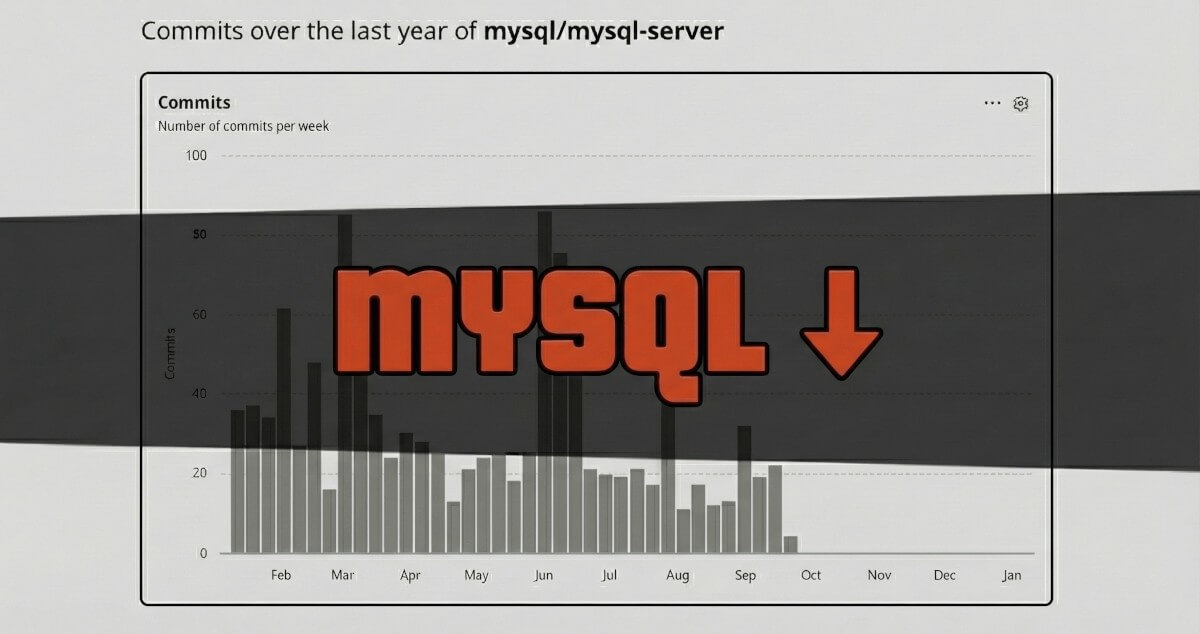
Featured image of post Stop using MySQL in 2026, it is not true open sourceIf you care about supporting open source software, and still use MySQL in 2026, you should switch to MariaDB like so many others have already done. The number of git commits on github.com/mysql/mysql-server has been significantly declining in 2025. The screenshot below shows the state of git commits as of writing this in January 2026, and the picture should be alarming to anyone who cares about software being open source. MySQL GitHub commit activity decreasing drastically
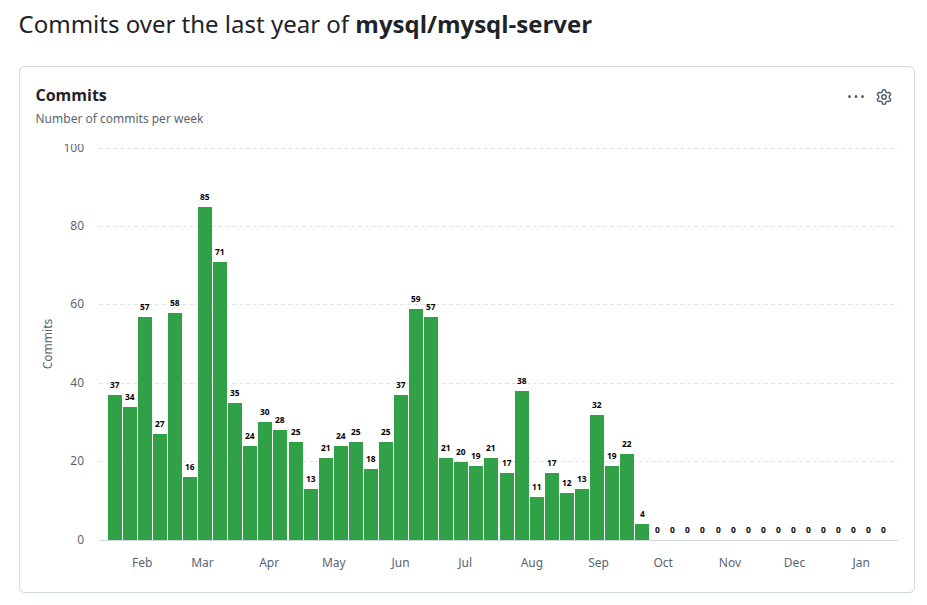
This is not surprising Oracle should not be trusted as the steward for open source projects When Oracle acquired Sun Microsystems and MySQL along with it back in 2009, the European Commission almost blocked the deal due to concerns that Oracle s goal was just to stifle competition. The deal went through as Oracle made a commitment to keep MySQL going and not kill it, but (to nobody s surprise) Oracle has not been a good steward of MySQL as an open source project and the community around it has been withering away for years now. All development is done behind closed doors. The publicly visible bug tracker is not the real one Oracle staff actually uses for MySQL development, and the few people who try to contribute to MySQL just see their Pull Requests and patch submissions marked as received with mostly no feedback and then those changes may or may not be in the next MySQL release, often rewritten, and with only Oracle staff in the git author/committer fields. The real author only gets a small mention in a blog post. When I was the engineering manager for the core team working on RDS MySQL and RDS MariaDB at Amazon Web Services, I oversaw my engineers contributions to both MySQL and MariaDB (the latter being a fork of MySQL by the original MySQL author, Michael Widenius). All the software developers in my org disliked submitting code to MySQL due to how bad the reception by Oracle was to their contributions. MariaDB is the stark opposite with all development taking place in real-time on github.com/mariadb/server, anyone being able to submit a Pull Request and get a review, all bugs being openly discussed at jira.mariadb.org and so forth, just like one would expect from a true open source project. MySQL is open source only by license (GPL v2), but not as a project.

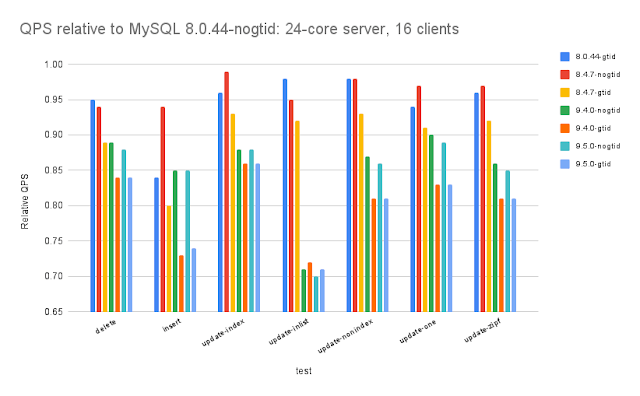
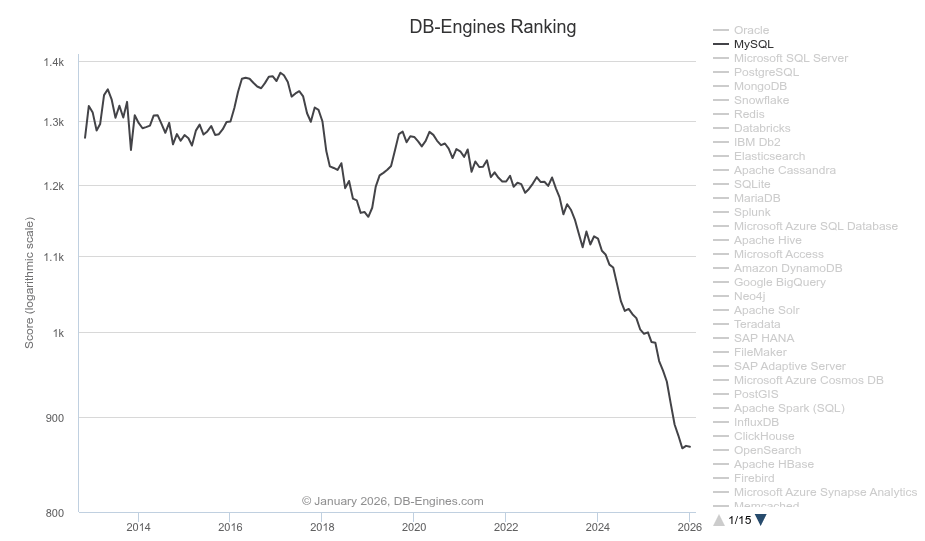
MySQL s technical decline in recent years Despite not being a good open source steward, Oracle should be given credit that it did keep the MySQL organization alive and allowed it to exist fairly independently and continue developing and releasing new MySQL versions well over a decade after the acquisition. I have no insight into how many customers they had, but I assume the MySQL business was fairly profitable and financially useful to Oracle, at least as long as it didn t gain too many features to threaten Oracle s own main database business. I don t know why, perhaps because too many talented people had left the organization, but it seems that from a technical point of view MySQL clearly started to deteriorate from 2022 onward. When MySQL 8.0.29 was released with the default ALTER TABLE method switched to run in-place, it had a lot of corner cases that didn t work, causing the database to crash and data to corrupt for many users. The issue wasn t fully fixed until a year later in MySQL 8.0.32. To many users annoyance Oracle announced the 8.0 series as evergreen and introduced features and changes in the minor releases, instead of just doing bugfixes and security fixes like users historically had learnt to expect from these x.y.Z maintenance releases. There was no new major MySQL version for six years. After MySQL 8.0 in 2018 it wasn t until 2023 when MySQL 8.1 was released, and it was just a short-term preview release. The first actual new major release MySQL 8.4 LTS was released in 2024. Even though it was a new major release, many users got disappointed as it had barely any new features. Many also reported degraded performance with newer MySQL versions, for example the benchmark by famous MySQL performance expert Mark Callaghan below shows that on write-heavy workloads MySQL 9.5 throughput is typically 15% less than in 8.0. Benchmark showing new MySQL versions being slower than the old Due to newer MySQL versions deprecating many features, a lot of users also complained about significant struggles regarding both MySQL 5.7->8.0 and 8.0->8.4 upgrades. With few new features and heavy focus on code base cleanup and feature deprecation, it became obvious to many that Oracle had decided to just keep MySQL barely alive, and put all new relevant features (e.g. vector search) into Heatwave, Oracle s closed-source and cloud-only service for MySQL customers. As it was evident that Oracle isn t investing in MySQL, Percona s Peter Zaitsev wrote Is Oracle Finally Killing MySQL in June 2024. At this time MySQL s popularity as ranked by DB-Engines had also started to tank hard, a trend that likely accelerates in 2026. MySQL dropping significantly in DB-Engines ranking In September 2025 news reported that Oracle was reducing its workforce and that the MySQL staff was getting heavily reduced. Obviously this does not bode well for MySQL s future, and Peter Zaitsev posted already in November stats showing that the latest MySQL maintenance release contained fewer bug fixes than before.
Open source is more than ideology: it has very real effects on software security and sovereignty Some say they don t care if MySQL is truly open source or not, or that they don t care if it has a future in coming years, as long as it still works now. I am afraid people thinking so are taking a huge risk. The database is often the most critical part of a software application stack, and any flaw or problem in operations, let alone a security issue, will have immediate consequences, and not caring will eventually get people fired or sued. In open source problems are discussed openly, and the bigger the problem, the more people and companies will contribute to fixing it. Open source as a development methodology is similar to the scientific method with free flow of ideas that are constantly contested and only the ones with the most compelling evidence win. Not being open means more obscurity, more risk and more just trust us bro attitude. This open vs. closed is very visible for example in how Oracle handles security issues. We can see that in 2025 alone MySQL published 123 CVEs about security issues, while MariaDB had 8. There were 117 CVEs that only affected MySQL and not MariaDB in 2025. I haven t read them all, but typically the CVEs hardly contain any real details. As an example, the most recent one CVE-2025-53067 states Easily exploitable vulnerability allows high privileged attacker with network access via multiple protocols to compromise MySQL Server. There is no information a security researcher or auditor could use to verify if any original issue actually existed, or if it was fixed, or if the fix was sufficient and fully mitigating the issue or not. MySQL users just have to take the word of Oracle that it is all good now. Handling security issues like this is in stark contrast to other open source projects, where all security issues and their code fixes are open for full scrutiny after the initial embargo is over and CVE made public. There is also various forms of enshittification going on one would not see in a true open source project, and everything about MySQL as a software, documentation and website is pushing users to stop using the open source version and move to the closed MySQL versions, and in particular to Heatwave, which is not only closed-source but also results in Oracle fully controlling customer s databases contents. Of course, some could say this is how Oracle makes money and is able to provide a better product. But stories on Reddit and elsewhere suggest that what is going on is more like Oracle milking hard the last remaining MySQL customers who are forced to pay more and more for getting less and less.

There are options and migrating is easy, just do it A large part of MySQL users switched to MariaDB already in the mid-2010s, in particular everyone who had cared deeply about their database software staying truly open source. That included large installations such as Wikipedia, and Linux distributions such as Fedora and Debian. Because it s open source and there is no centralized machine collecting statistics, nobody knows what the exact market shares look like. There are however some application specific stats, such as that 57% of WordPress sites around the world run MariaDB, while the share for MySQL is 42%. For anyone running a classic LAMP stack application such as WordPress, Drupal, Mediawiki, Nextcloud, or Magento, switching the old MySQL database to MariaDB is be straightforward. As MariaDB is a fork of MySQL and mostly backwards compatible with it, swapping out MySQL for MariaDB can be done without changing any of the existing connectors or database clients, as they will continue to work with MariaDB as if it was MySQL. For those running custom applications and who have the freedom to make changes to how and what database is used, there are tens of mature and well-functioning open source databases to choose from, with PostgreSQL being the most popular general database. If your application was built from the start for MySQL, switching to PostgreSQL may however require a lot of work, and the MySQL/MariaDB architecture and storage engine InnoDB may still offer an edge in e.g. online services where high performance, scalability and solid replication features are of highest priority. For a quick and easy migration MariaDB is probably the best option. Switching from MySQL to the Percona Server is also very easy, as it closely tracks all changes in MySQL and deviates from it only by a small number of improvements done by Percona. However, also precisely because of it being basically just a customized version of the MySQL Server, it s not a viable long-term solution for those trying to fully ditch the dependency on Oracle. There are also several open source databases that have no common ancestry with MySQL, but strive to be MySQL-compatible. Thus most apps built for MySQL can simply switch to using them without needing SQL statements to be rewritten. One such database is TiDB, which has been designed from scratch specifically for highly scalable and large systems, and is so good that even Amazon s latest database solution DSQL was built borrowing many ideas from TiDB. However, TiDB only really shines with larger distributed setups, so for the vast majority of regular small- and mid-scale applications currently using MySQL, the most practical solution is probably to just switch to MariaDB, which on most Linux distributions can simply be installed by running apt/dnf/brew install mariadb-server. Whatever you end up choosing, as long as it is not Oracle, you will be better off.

10 January 2026

Dirk Eddelbuettel: Rcpp 1.1.1 on CRAN: Many Improvements in Semi-Annual Update

rcpp logo Team Rcpp is thrilled to share that an exciting new version 1.1.1 of Rcpp is now on CRAN (and also uploaded to Debian and already built for r2u). Having switchted to C++11 as the minimum standard in the previous 1.1.0 release, this version takes full advantage of it and removes a lot of conditional code catering to older standards that no longer need to be supported. Consequently, the source tarball shrinks by 39% from 3.11 mb to 1.88 mb. That is a big deal. (Size peaked with Rcpp 1.0.12 two years ago at 3.43 mb; relative to its size we are down 45% !!) Removing unused code also makes maintenance easier, and quickens both compilation and installation in general. This release continues as usual with the six-months January-July cycle started with release 1.0.5 in July 2020. Interim snapshots are always available via the r-universe page and repo. We continue to strongly encourage the use of these development released and their testing we tend to run our systems with them too. Rcpp has long established itself as the most popular way of enhancing R with C or C++ code. Right now, 3020 packages on CRAN depend on Rcpp for making analytical code go faster and further. On CRAN, 13.1% of all packages depend (directly) on Rcpp, and 60.9% of all compiled packages do. From the cloud mirror of CRAN (which is but a subset of all CRAN downloads), Rcpp has been downloaded 109.8 million times. The two published papers (also included in the package as preprint vignettes) have, respectively, 2151 (JSS, 2011) and 405 (TAS, 2018) citations, while the the book (Springer useR!, 2013) has another 715. This time, I am not attempting to summarize the different changes. The full list follows below and details all these changes, their respective PRs and, if applicable, issue tickets. Big thanks from all of us to all contributors!

Changes in Rcpp release version 1.1.1 (2026-01-08)
  • Changes in Rcpp API:
    • An unused old R function for a compiler version check has been removed after checking no known package uses it (Dirk in #1395)
    • A narrowing warning is avoided via a cast (Dirk in #1398)
    • Demangling checks have been simplified (I aki in #1401 addressing #1400)
    • The treatment of signed zeros is now improved in the Sugar code (I aki in #1404)
    • Preparations for phasing out use of Rf_error have been made (I aki in #1407)
    • The long-deprecated function loadRcppModules() has been removed (Dirk in #1416 closing #1415)
    • Some non-API includes from R were refactored to accommodate R-devel changes (I aki in #1418 addressing #1417)
    • An accessor to Rf_rnbeta has been removed (Dirk in #1419 also addressing #1420)
    • Code accessing non-API Rf_findVarInFrame now uses R_getVarEx (Dirk in #1423 fixing #1421)
    • Code conditional on the R version now expects at least R 3.5.0; older code has been removed (Dirk in #1426 fixing #1425)
    • The non-API ATTRIB entry point to the R API is no longer used (Dirk in #1430 addressing #1429)
    • The unwind-protect mechanism is now used unconditionally (Dirk in #1437 closing #1436)
  • Changes in Rcpp Attributes:
    • The OpenMP plugin has been generalized for different macOS compiler installations (Kevin in #1414)
  • Changes in Rcpp Documentation:
    • Vignettes are now processed via a new "asis" processor adopted from R.rsp (Dirk in #1394 fixing #1393)
    • R is now cited via its DOI (Dirk)
    • A (very) stale help page has been removed (Dirk in #1428 fixing #1427)
    • The main README.md was updated emphasizing r-universe in favor of the local drat repos (Dirk in #1431)
  • Changes in Rcpp Deployment:
    • A temporary change in R-devel concerning NA part in complex variables was accommodated, and then reverted (Dirk in #1399 fixing #1397)
    • The macOS CI runners now use macos-14 (Dirk in #1405)
    • A message is shown if R.h is included before Rcpp headers as this can lead to errors (Dirk in #1411 closing #1410)
    • Old helper functions use message() to signal they are not used, deprecation and removal to follow (Dirk in #1413 closing #1412)
    • Three tests were being silenced following #1413 (Dirk in #1422)
    • The heuristic whether to run all available tests was refined (Dirk in #1434 addressing #1433)
    • Coverage has been tweaked via additional #nocov tags (Dirk in #1435)
  • Non-release Changes:
    • Two interim non-releases 1.1.0.8.1 and .2 were made in order to unblock CRAN due to changes in R-devel rather than Rcpp

Thanks to my CRANberries, you can also look at a diff to the previous interim release along with pre-releaseds 1.1.0.8, 1.1.0.8.1 and 1.1.0.8.2 that were needed because R-devel all of a sudden decided to move fast and break things. Not our doing. Questions, comments etc should go to the GitHub discussion section list]rcppdevellist off the R-Forge page. Bugs reports are welcome at the GitHub issue tracker as well. Both sections can be searched as well.

This post by Dirk Eddelbuettel originated on his Thinking inside the box blog. If you like this or other open-source work I do, you can sponsor me at GitHub.

8 January 2026

Reproducible Builds: Reproducible Builds in December 2025

Welcome to the December 2025 from the Reproducible Builds project! Our monthly reports outline what we ve been up to over the past month, highlighting items of news from elsewhere in the increasingly-important area of software supply-chain security. As ever, if you are interested in contributing to the Reproducible Builds project, please see the Contribute page on our website.

  1. New orig-check service to validate Debian upstream tarballs
  2. Distribution work
  3. disorderfs updated to FUSE 3
  4. Mailing list updates
  5. Three new academic papers published
  6. Website updates
  7. Upstream patches

New orig-check service to validate Debian upstream tarballs This month, Debian Developer Lucas Nussbaum announced the orig-check service, which attempts to automatically reproduce the generation upstream tarballs (ie. the original source component of a Debian source package), comparing that to the upstream tarball actually shipped with Debian. As of the time of writing, it is possible for a Debian developer to upload a source archive that does not actually correspond to upstream s version. Whilst this is not inherently malicious (it typically indicates some tooling/process issue), the very possibility that a maintainer s version may differ potentially permits a maintainer to make (malicious) changes that would be misattributed to upstream. This service therefore nicely complements the whatsrc.org service, which was reported in our reports for both April and August. The orig-check is dedicated to Lunar, who sadly passed away a year ago.

Distribution work In Arch Linux this month, Robin Candau and Mark Hegreberg worked at making the Arch Linux WSL image bit-for-bit reproducible. Robin also shared some implementation details and future related work on our mailing list. Continuing a series reported in these reports for March, April and July 2025 (etc.), Simon Josefsson has published another interesting article this month, itself a followup to a post Simon published in December 2024 regarding GNU Guix Container Images that are hosted on GitLab. In Debian this month, Micha Lenk posted to the debian-backports-announce mailing list with the news that the Backports archive will now discard binaries generated and uploaded by maintainers: The benefit is that all binary packages [will] get built by the Debian buildds before we distribute them within the archive. Felix Moessbauer of Siemens then filed a bug in the Debian bug tracker to signal their intention to package debsbom, a software bill of materials (SBOM) generator for distributions based on Debian. This generated a discussion on the bug inquiring about the output format as well as a question about how these SBOMs might be distributed. Holger Levsen merged a number of significant changes written by Alper Nebi Yasak to the Debian Installer in order to improve its reproducibility. As noted in Alper s merge request, These are the reproducibility fixes I looked into before bookworm release, but was a bit afraid to send as it s just before the release, because the things like the xorriso conversion changes the content of the files to try to make them reproducible. In addition, 76 reviews of Debian packages were added, 8 were updated and 27 were removed this month adding to our knowledge about identified issues. A new different_package_content_when_built_with_nocheck issue type was added by Holger Levsen. [ ] Arnout Engelen posted to our mailing list reporting that they successfully reproduced the NixOS minimal installation ISO for the 25.11 release without relying on a pre-compiled package archive, with more details on their blog. Lastly, Bernhard M. Wiedemann posted another openSUSE monthly update for his work there.

disorderfs updated to FUSE 3 disorderfs is our FUSE-based filesystem that deliberately introduces non-determinism into system calls to reliably flush out reproducibility issues. This month, however, Roland Clobus upgraded disorderfs* from FUSE 2 to FUSE 3 after its package automatically got removed from Debian testing. Some tests in Debian currently require disorderfs to make the Debian live images reproducible, although disorderfs is not a Debian-specific tool.

Mailing list updates On our mailing list this month:
  • Luca Di Maio announced stampdalf, a filesystem timestamp preservation tool that wraps arbitrary commands and ensures filesystem timestamp reproducibility :
    stampdalf allows you to run any command that modifies files in a directory tree, then automatically resets all timestamps back to their original values. Any new files created during command execution are set to [the UNIX epoch] or a custom timestamp via SOURCE_DATE_EPOCH.
    The project s GitHub page helpfully reveals that the project is pronounced: stamp-dalf (stamp like time-stamp, dalf like Gandalf the wizard) as it s a wizard of time and stamps .)
  • Lastly, Reproducible Builds developer cen1 posted to our list announcing that early/experimental/alpha support for FreeBSD was added to rebuilderd. In their post, cen1 reports that the initial builds are in progress and look quite decent . cen1 also interestingly notes that since the upstream is currently not technically reproducible I had to relax the bit-for-bit identical requirement of rebuilderd [ ] I consider the pkg to be reproducible if the tar is content-identical (via diffoscope), ignoring timestamps and some of the manifest files. .

Three new academic papers published Yogya Gamage and Benoit Baudry of Universit de Montr al, Canada together with Deepika Tiwari and Martin Monperrus of KTH Royal Institute of Technology, Sweden published a paper on The Design Space of Lockfiles Across Package Managers:
Most package managers also generate a lockfile, which records the exact set of resolved dependency versions. Lockfiles are used to reduce build times; to verify the integrity of resolved packages; and to support build reproducibility across environments and time. Despite these beneficial features, developers often struggle with their maintenance, usage, and interpretation. In this study, we unveil the major challenges related to lockfiles, such that future researchers and engineers can address them. [ ]
A PDF of their paper is available online. Benoit Baudry also posted an announcement to our mailing list, which generated a number of replies.
Betul Gokkaya, Leonardo Aniello and Basel Halak of the University of Southampton then published a paper on the A taxonomy of attacks, mitigations and risk assessment strategies within the software supply chain:
While existing studies primarily focus on software supply chain attacks prevention and detection methods, there is a need for a broad overview of attacks and comprehensive risk assessment for software supply chain security. This study conducts a systematic literature review to fill this gap. By analyzing 96 papers published between 2015-2023, we identified 19 distinct SSC attacks, including 6 novel attacks highlighted in recent studies. Additionally, we developed 25 specific security controls and established a precisely mapped taxonomy that transparently links each control to one or more specific attacks. [ ]
A PDF of the paper is available online via the article s canonical page.
Aman Sharma and Martin Monperrus of the KTH Royal Institute of Technology, Sweden along with Benoit Baudry of Universit de Montr al, Canada published a paper this month on Causes and Canonicalization of Unreproducible Builds in Java. The abstract of the paper is as follows:
[Achieving] reproducibility at scale remains difficult, especially in Java, due to a range of non-deterministic factors and caveats in the build process. In this work, we focus on reproducibility in Java-based software, archetypal of enterprise applications. We introduce a conceptual framework for reproducible builds, we analyze a large dataset from Reproducible Central, and we develop a novel taxonomy of six root causes of unreproducibility. [ ]
A PDF of the paper is available online.

Website updates Once again, there were a number of improvements made to our website this month including:

Upstream patches The Reproducible Builds project detects, dissects and attempts to fix as many currently-unreproducible packages as possible. We endeavour to send all of our patches upstream where appropriate. This month, we wrote a large number of such patches, including:

Finally, if you are interested in contributing to the Reproducible Builds project, please visit our Contribute page on our website. However, you can get in touch with us via:

Dirk Eddelbuettel: RcppCCTZ 0.2.14 on CRAN: New Upstream, Small Edits

A new release 0.2.14 of RcppCCTZ is now on CRAN, in Debian and built for r2u. RcppCCTZ uses Rcpp to bring CCTZ to R. CCTZ is a C++ library for translating between absolute and civil times using the rules of a time zone. In fact, it is two libraries. One for dealing with civil time: human-readable dates and times, and one for converting between between absolute and civil times via time zones. And while CCTZ is made by Google(rs), it is not an official Google product. The RcppCCTZ page has a few usage examples and details. This package was the first CRAN package to use CCTZ; by now several others packages (four the last time we counted) include its sources too. Not ideal, but beyond our control. This version updates to a new upstream release, and brings some small local edits. CRAN and R-devel were stumbled over us still mentioning C++11 in SystemRequirements (yes, this package is old enough for that to have mattered once). As that is a false positive the package compiles well under any recent standard we removed the mention. The key changes since the last CRAN release are summarised below.

Changes in version 0.2.14 (2026-01-08)
  • Synchronized with upstream CCTZ (Dirk in #46).
  • Explicitly enumerate files to be compiled in src/Makevars* (Dirk in #47)

Courtesy of my CRANberries, there is a diffstat report relative to to the previous version. More details are at the RcppCCTZ page; code, issue tickets etc at the GitHub repository.

This post by Dirk Eddelbuettel originated on his Thinking inside the box blog. If you like this or other open-source work I do, you can sponsor me at GitHub.

Dirk Eddelbuettel: RcppSpdlog 0.0.24 on CRAN: New Upstream

Version 0.0.24 of RcppSpdlog arrived on CRAN today, has been been uploaded to Debian, and also been built for r2u. This follows an upstream release on Sunday which we incorporated immediately, but CRAN was still closed for the winter break until yesterday. RcppSpdlog bundles spdlog, a wonderful header-only C++ logging library with all the bells and whistles you would want that was written by Gabi Melman, and also includes fmt by Victor Zverovich. You can learn more at the nice package documention site. This release updates the code to the version 1.17.0 of spdlog which was released yesterday morning, and includes version 12.1.0 of fmt. No other changes besides tweaks to the documentation site (that was updated to using altdoc last release) have been made. The NEWS entry for this release follows.

Changes in RcppSpdlog version 0.0.24 (2026-01-07)
  • Upgraded to upstream release spdlog 1.17.0 (including fmt 12.1.0)

Courtesy of my CRANberries, there is also a diffstat report detailing changes. More detailed information is on the RcppSpdlog page, or the package documention site.

This post by Dirk Eddelbuettel originated on his Thinking inside the box blog. If you like this or other open-source work I do, you can sponsor me at GitHub.

5 January 2026

Vincent Bernat: Using eBPF to load-balance traffic across UDP sockets with Go

Akvorado collects sFlow and IPFIX flows over UDP. Because UDP does not retransmit lost packets, it needs to process them quickly. Akvorado runs several workers listening to the same port. The kernel should load-balance received packets fairly between these workers. However, this does not work as expected. A couple of workers exhibit high packet loss:
$ curl -s 127.0.0.1:8080/api/v0/inlet/metrics \
>   sed -n s/akvorado_inlet_flow_input_udp_in_dropped//p
packets_total listener="0.0.0.0:2055",worker="0"  0
packets_total listener="0.0.0.0:2055",worker="1"  0
packets_total listener="0.0.0.0:2055",worker="2"  0
packets_total listener="0.0.0.0:2055",worker="3"  1.614933572278264e+15
packets_total listener="0.0.0.0:2055",worker="4"  0
packets_total listener="0.0.0.0:2055",worker="5"  0
packets_total listener="0.0.0.0:2055",worker="6"  9.59964121598348e+14
packets_total listener="0.0.0.0:2055",worker="7"  0
eBPF can help by implementing an alternate balancing algorithm.

Options for load-balancing There are three methods to load-balance UDP packets across workers:
  1. One worker receives the packets and dispatches them to the other workers.
  2. All workers share the same socket.
  3. Each worker has its own socket, listening to the same port, with the SO_REUSEPORT socket option.

SO_REUSEPORT option Tom Hebert added the SO_REUSEPORT socket option in Linux 3.9. The cover letter for his patch series explains why this new option is better than the two existing ones from a performance point of view:
SO_REUSEPORT allows multiple listener sockets to be bound to the same port. [ ] Received packets are distributed to multiple sockets bound to the same port using a 4-tuple hash. The motivating case for SO_RESUSEPORT in TCP would be something like a web server binding to port 80 running with multiple threads, where each thread might have it s own listener socket. This could be done as an alternative to other models:
  1. have one listener thread which dispatches completed connections to workers, or
  2. accept on a single listener socket from multiple threads.
In case #1, the listener thread can easily become the bottleneck with high connection turn-over rate. In case #2, the proportion of connections accepted per thread tends to be uneven under high connection load. [ ] We have seen the disproportion to be as high as 3:1 ratio between thread accepting most connections and the one accepting the fewest. With SO_REUSEPORT the distribution is uniform. The motivating case for SO_REUSEPORT in UDP would be something like a DNS server. An alternative would be to receive on the same socket from multiple threads. As in the case of TCP, the load across these threads tends to be disproportionate and we also see a lot of contection on the socket lock.
Akvorado uses the SO_REUSEPORT option to dispatch the packets across the workers. However, because the distribution uses a 4-tuple hash, a single socket handles all the flows from one exporter.

SO_ATTACH_REUSEPORT_EBPF option In Linux 4.5, Craig Gallek added the SO_ATTACH_REUSEPORT_EBPF option to attach an eBPF program to select the target UDP socket. In Linux 4.6, he extended it to support TCP. The socket(7) manual page documents this mechanism:1
The BPF program must return an index between 0 and N-1 representing the socket which should receive the packet (where N is the number of sockets in the group). If the BPF program returns an invalid index, socket selection will fall back to the plain SO_REUSEPORT mechanism.
In Linux 4.19, Martin KaFai Lau added the BPF_PROG_TYPE_SK_REUSEPORT program type. Such an eBPF program selects the socket from a BPF_MAP_TYPE_REUSEPORT_ARRAY map instead. This new approach is more reliable when switching target sockets from one instance to another for example, when upgrading, a new instance can add its sockets and remove the old ones.

Load-balancing with eBPF and Go Altering the load-balancing algorithm for a group of sockets requires two steps:
  1. write and compile an eBPF program in C,2 and
  2. load it and attach it in Go.

eBPF program in C A simple load-balancing algorithm is to randomly choose the destination socket. The kernel provides the bpf_get_prandom_u32() helper function to get a pseudo-random number.
volatile const __u32 num_sockets; //  
struct  
    __uint(type, BPF_MAP_TYPE_REUSEPORT_SOCKARRAY);
    __type(key, __u32);
    __type(value, __u64);
    __uint(max_entries, 256);
  socket_map SEC(".maps"); //  
SEC("sk_reuseport")
int reuseport_balance_prog(struct sk_reuseport_md *reuse_md)
 
    __u32 index = bpf_get_prandom_u32() % num_sockets; //  
    bpf_sk_select_reuseport(reuse_md, &socket_map, &index, 0); //  
    return SK_PASS; //  
 
char _license[] SEC("license") = "GPL";
In , we declare a volatile constant for the number of sockets in the group. We will initialize this constant before loading the eBPF program into the kernel. In , we define the socket map. We will populate it with the socket file descriptors. In , we randomly select the index of the target socket.3 In , we invoke the bpf_sk_select_reuseport() helper to record our decision. Finally, in , we accept the packet.

Header files If you compile the C source with clang, you get errors due to missing headers. The recommended way to solve this is to generate a vmlinux.h file with bpftool:
$ bpftool btf dump file /sys/kernel/btf/vmlinux format c > vmlinux.h
Then, include the following headers:4
#include "vmlinux.h"
#include <bpf/bpf_helpers.h>
For my 6.17 kernel, the generated vmlinux.h is quite big: 2.7 MiB. Moreover, bpf/bpf_helpers.h is shipped with libbpf. This adds another dependency for users. As the eBPF program is quite small, I prefer to put the strict minimum in vmlinux.h by cherry-picking the definitions I need.

Compilation The eBPF Library for Go ships bpf2go, a tool to compile eBPF programs and to generate some scaffolding code. We create a gen.go file with the following content:
package main
//go:generate go tool bpf2go -tags linux reuseport reuseport_kern.c
After running go generate ./..., we can inspect the resulting objects with readelf and llvm-objdump:
$ readelf -S reuseport_bpfeb.o
There are 14 section headers, starting at offset 0x840:
  [Nr] Name              Type             Address           Offset
[ ]
  [ 3] sk_reuseport      PROGBITS         0000000000000000  00000040
  [ 6] .maps             PROGBITS         0000000000000000  000000c8
  [ 7] license           PROGBITS         0000000000000000  000000e8
[ ]
$ llvm-objdump -S reuseport_bpfeb.o
reuseport_bpfeb.o:  file format elf64-bpf
Disassembly of section sk_reuseport:
0000000000000000 <reuseport_balance_prog>:
;  
       0:   bf 61 00 00 00 00 00 00     r6 = r1
;     __u32 index = bpf_get_prandom_u32() % num_sockets;
       1:   85 00 00 00 00 00 00 07     call 0x7
[ ]

Usage from Go Let s set up 10 workers listening to the same port.5 Each socket enables the SO_REUSEPORT option before binding:6
var (
    err error
    fds []uintptr
    conns []*net.UDPConn
)
workers := 10
listenAddr := "127.0.0.1:0"
listenConfig := net.ListenConfig 
    Control: func(_, _ string, c syscall.RawConn) error  
        c.Control(func(fd uintptr)  
            err = unix.SetsockoptInt(int(fd), unix.SOL_SOCKET, unix.SO_REUSEPORT, 1)
            fds = append(fds, fd)
         )
        return err
     ,
 
for range workers  
    pconn, err := listenConfig.ListenPacket(t.Context(), "udp", listenAddr)
    if err != nil  
        t.Fatalf("ListenPacket() error:\n%+v", err)
     
    udpConn := pconn.(*net.UDPConn)
    listenAddr = udpConn.LocalAddr().String()
    conns = append(conns, udpConn)
 
The second step is to load the eBPF program, initialize the num_sockets variable, populate the socket map, and attach the program to the first socket.7
// Load the eBPF collection.
spec, err := loadReuseport()
if err != nil  
    t.Fatalf("loadVariables() error:\n%+v", err)
 
// Set "num_sockets" global variable to the number of file descriptors we will register
if err := spec.Variables["num_sockets"].Set(uint32(len(fds))); err != nil  
    t.Fatalf("NumSockets.Set() error:\n%+v", err)
 
// Load the map and the program into the kernel.
var objs reuseportObjects
if err := spec.LoadAndAssign(&objs, nil); err != nil  
    t.Fatalf("loadReuseportObjects() error:\n%+v", err)
 
t.Cleanup(func()   objs.Close()  )
// Assign the file descriptors to the socket map.
for worker, fd := range fds  
    if err := objs.reuseportMaps.SocketMap.Put(uint32(worker), uint64(fd)); err != nil  
        t.Fatalf("SocketMap.Put() error:\n%+v", err)
     
 
// Attach the eBPF program to the first socket.
socketFD := int(fds[0])
progFD := objs.reuseportPrograms.ReuseportBalanceProg.FD()
if err := unix.SetsockoptInt(socketFD, unix.SOL_SOCKET, unix.SO_ATTACH_REUSEPORT_EBPF, progFD); err != nil  
    t.Fatalf("SetsockoptInt() error:\n%+v", err)
 
We are now ready to process incoming packets. Each worker is a Go routine incrementing a counter for each received packet:8
var wg sync.WaitGroup
receivedPackets := make([]int, workers)
for worker := range workers  
    conn := conns[worker]
    packets := &receivedPackets[worker]
    wg.Go(func()  
        payload := make([]byte, 9000)
        for  
            if _, err := conn.Read(payload); err != nil  
                if errors.Is(err, net.ErrClosed)  
                    return
                 
                t.Logf("Read() error:\n%+v", err)
             
            *packets++
         
     )
 
Let s send 1000 packets:
sentPackets := 1000
conn, err := net.Dial("udp", conns[0].LocalAddr().String())
if err != nil  
    t.Fatalf("Dial() error:\n%+v", err)
 
defer conn.Close()
for range sentPackets  
    if _, err := conn.Write([]byte("hello world!")); err != nil  
        t.Fatalf("Write() error:\n%+v", err)
     
 
If we print the content of the receivedPackets array, we can check the balancing works as expected, with each worker getting about 100 packets:
=== RUN   TestUDPWorkerBalancing
    balancing_test.go:84: receivedPackets[0] = 107
    balancing_test.go:84: receivedPackets[1] = 92
    balancing_test.go:84: receivedPackets[2] = 99
    balancing_test.go:84: receivedPackets[3] = 105
    balancing_test.go:84: receivedPackets[4] = 107
    balancing_test.go:84: receivedPackets[5] = 96
    balancing_test.go:84: receivedPackets[6] = 102
    balancing_test.go:84: receivedPackets[7] = 105
    balancing_test.go:84: receivedPackets[8] = 99
    balancing_test.go:84: receivedPackets[9] = 88
    balancing_test.go:91: receivedPackets = 1000
    balancing_test.go:92: sentPackets     = 1000

Graceful restart You can also use SO_ATTACH_REUSEPORT_EBPF to gracefully restart an application. A new instance of the application binds to the same address and prepare its own version of the socket map. Once it attaches the eBPF program to the first socket, the kernel steers incoming packets to this new instance. The old instance needs to drain the already received packets before shutting down. To check we are not losing any packet, we spawn a Go routine to send as many packets as possible:
sentPackets := 0
notSentPackets := 0
done := make(chan bool)
conn, err := net.Dial("udp", conns1[0].LocalAddr().String())
if err != nil  
    t.Fatalf("Dial() error:\n%+v", err)
 
defer conn.Close()
go func()  
    for  
        if _, err := conn.Write([]byte("hello world!")); err != nil  
            notSentPackets++
          else  
            sentPackets++
         
        select  
        case <-done:
            return
        default:
         
     
 ()
Then, while the Go routine runs, we start the second set of workers. Once they are running, they start receiving packets. If we gracefully stop the initial set of workers, not a single packet is lost!9
=== RUN   TestGracefulRestart
    graceful_test.go:135: receivedPackets1[0] = 165
    graceful_test.go:135: receivedPackets1[1] = 195
    graceful_test.go:135: receivedPackets1[2] = 194
    graceful_test.go:135: receivedPackets1[3] = 190
    graceful_test.go:135: receivedPackets1[4] = 213
    graceful_test.go:135: receivedPackets1[5] = 187
    graceful_test.go:135: receivedPackets1[6] = 170
    graceful_test.go:135: receivedPackets1[7] = 190
    graceful_test.go:135: receivedPackets1[8] = 194
    graceful_test.go:135: receivedPackets1[9] = 155
    graceful_test.go:139: receivedPackets2[0] = 1631
    graceful_test.go:139: receivedPackets2[1] = 1582
    graceful_test.go:139: receivedPackets2[2] = 1594
    graceful_test.go:139: receivedPackets2[3] = 1611
    graceful_test.go:139: receivedPackets2[4] = 1571
    graceful_test.go:139: receivedPackets2[5] = 1660
    graceful_test.go:139: receivedPackets2[6] = 1587
    graceful_test.go:139: receivedPackets2[7] = 1605
    graceful_test.go:139: receivedPackets2[8] = 1631
    graceful_test.go:139: receivedPackets2[9] = 1689
    graceful_test.go:147: receivedPackets = 18014
    graceful_test.go:148: sentPackets     = 18014
Unfortunately, gracefully shutting down a UDP socket is not trivial in Go.10 Previously, we were terminating workers by closing their sockets. However, if we close them too soon, the application loses packets that were assigned to them but not yet processed. Before stopping, a worker needs to call conn.Read() until there are no more packets. A solution is to set a deadline for conn.Read() and check if we should stop the Go routine when the deadline is exceeded:
payload := make([]byte, 9000)
for  
    conn.SetReadDeadline(time.Now().Add(50 * time.Millisecond))
    if _, err := conn.Read(payload); err != nil  
        if errors.Is(err, os.ErrDeadlineExceeded)  
            select  
            case <-done:
                return
            default:
                continue
             
         
        t.Logf("Read() error:\n%+v", err)
     
    *packets++
 
With TCP, this aspect is simpler: after enabling the net.ipv4.tcp_migrate_req sysctl, the kernel automatically migrates waiting connections to a random socket in the same group. Alternatively, eBPF can also control this migration. Both features are available since Linux 5.14.

Addendum After implementing this strategy in Akvorado, all workers now drop packets!
$ curl -s 127.0.0.1:8080/api/v0/inlet/metrics \
>   sed -n s/akvorado_inlet_flow_input_udp_in_dropped//p
packets_total listener="0.0.0.0:2055",worker="0"  838673
packets_total listener="0.0.0.0:2055",worker="1"  843675
packets_total listener="0.0.0.0:2055",worker="2"  837922
packets_total listener="0.0.0.0:2055",worker="3"  841443
packets_total listener="0.0.0.0:2055",worker="4"  840668
packets_total listener="0.0.0.0:2055",worker="5"  850274
packets_total listener="0.0.0.0:2055",worker="6"  835488
packets_total listener="0.0.0.0:2055",worker="7"  834479
The root cause is the default limit of 32 records for Kafka batch sizes. This limit is too low because the brokers have a large overhead when handling each batch: they need to ensure they persist correctly before acknowledging them. Increasing the limit to 4096 records fixes this issue. While load-balancing incoming flows with eBPF remains useful, it did not solve the main issue. At least the even distribution of dropped packets helped identify the real bottleneck.

  1. The current version of the manual page is incomplete and does not cover the evolution introduced in Linux 4.19. There is a pending patch about this.
  2. Rust is another option. However, the program we use is so trivial that it does not make sense to use Rust.
  3. As bpf_get_prandom_u32() returns a pseudo-random 32-bit unsigned value, this method exhibits a very slight bias towards the first indexes. This is unlikely to be worth fixing.
  4. Some examples include <linux/bpf.h> instead of "vmlinux.h". This makes your eBPF program dependent on the installed kernel headers.
  5. listenAddr is initially set to 127.0.0.1:0 to allocate a random port. After the first iteration, it is updated with the allocated port.
  6. This is the setupSockets() function in fixtures_test.go.
  7. This is the setupEBPF() function in fixtures_test.go.
  8. The complete code is in balancing_test.go
  9. The complete code is in graceful_test.go
  10. In C, we would poll() both the socket and a pipe used to signal for shutdown. When the second condition is triggered, we drain the socket by executing a series of non-blocking read() until we get EWOULDBLOCK.

Jonathan McDowell: Free Software Activities for 2025

Given we ve entered a new year it s time for my annual recap of my Free Software activities for the previous calendar year. For previous years see 2019, 2020, 2021, 2022, 2023 + 2024.

Conferences My first conference of the year was FOSDEM. I d submitted a talk proposal about system attestation in production environments for the attestation devroom, but they had a lot of good submissions and mine was a bit more this is how we do it rather than here s some neat Free Software that does it . I m still trying to work out how to make some of the bits we do more open, but the problem is a lot of the neat stuff is about taking internal knowledge about what should be running and making sure that s the case, and what you end up with if you abstract that is a toolkit that still needs a lot of work to get something useful. I d more luck at DebConf25 where I gave a talk (Don t fear the TPM) trying to explain how TPMs could be useful in a Debian context. Naturally the comments section descended into a discussion about UEFI Secure Boot, which is a separate, if related, thing. DebConf also featured the usual catch up with fellow team members, hanging out with folk I hadn t seen in ages, and generally feeling a bit more invigorated about Debian. Other conferences I considered, but couldn t justify, were All Systems Go! and the Linux Plumbers Conference. I ve no doubt both would have had a bunch of interesting and relevant talks + discussions, but not enough this year. I m going to have to miss FOSDEM this year, due to travel later in the month, and I m uncertain if I m going to make DebConf (for a variety of reasons). That means I don t have a Free Software conference planned for 2026. Ironically FOSSY moving away from Portland makes it a less appealing option (I have Portland friends it would be good to visit). Other than potential Debian MiniConfs, anything else European I should consider?

Debian I continue to try and keep RetroArch in shape, with 1.22.2+dfsg-1 (and, shortly after, 1.22.2+dfsg-2 - git-buildpackage in trixie seems more strict about Build-Depends existing in the outside environment, and I keep forgetting I need Build-Depends-Arch and Build-Depends-Indep to be pretty much the same with a minimal Build-Depends that just has enough for the clean target) getting uploaded in December, and 1.20.0+dfsg-1, 1.20+dfsg-2 + 1.20+dfsg-3 all being uploaded earlier in the year. retroarch-assets had 1.20.0+dfsg-1 uploaded back in April. I need to find some time to get 1.22.0 packaged. libretro-snes9x got updated to 1.63+dfsg-1. sdcc saw 4.5.0+dfsg-1, 4.5.0+dfsg-2, 4.5.0+dfsg-3 (I love major GCC upgrades) and 4.5.0-dfsg-4 uploads. There s an outstanding bug around a LaTeX error building the manual, but this turns out to be a bug in the 2.5 RC for LyX. Huge credit to Tobias Quathamer for engaging with this, and Pavel Sanda + J rgen Spitzm ller from the LyX upstream for figuring out the issue + a fix. Pulseview saw 0.4.2-4 uploaded to fix issues with the GCC 15 + CMake upgrades. I should probably chase the sigrok upstream about new releases; I think there are a bunch of devices that have gained support in git without seeing a tagged release yet. I did an Electronics Team upload for gputils 1.5.2-2 to fix compilation with GCC 15. While I don t do a lot with storage devices these days if I can help it I still pay a little bit of attention to sg3-utils. That resulted in 1.48-2 and 1.48-3 uploads in 2025. libcli got a 1.10.7-3 upload to deal with the libcrypt-dev split out. Finally I got more up-to-date versions of libtorrent (0.15.7-1) and rtorrent (also 0.15.7-1) uploaded to experimental. There s a ppc64el build failure in libtorrent, but having asked on debian-powerpc this looks like a flaky test/code and I should probably go ahead and upload to unstable. I sponsored some uploads for Michel Lind - the initial uploads of plymouth-theme-hot-dog, and the separated out pykdumpfile package. Recognising the fact I wasn t contributing in a useful fashion to the Data Protection Team I set about trying to resign in an orderly fashion - see Andreas call for volunteers that went out in the last week. Shout out to Enrico for pointing out in the past that we should gracefully step down from things we re not actually managing to do, to avoid the perception it s all fine and no one else needs to step up. Took me too long to act on it. The Debian keyring team continues to operate smoothly, maintaining our monthly release cadence with a 3 month rotation ensuring all team members stay familiar with the process, and ensure their setups are still operational (especially important after Debian releases). I handled the 2025.03.23, 2025.06.24, 2025.06.27, 2025.09.18, 2025.12.08 + 2025.12.26 pushes.

Linux TPM related fixes were the theme of my kernel contributions in 2025, all within a work context. Some were just cleanups, but several fixed real issues that were causing us issues. I ve also tried to be more proactive about reviewing diffs in the TPM subsystem; it feels like a useful way to contribute, as well as making me more actively pay attention to what s going on there.

Personal projects I did some work on onak, my OpenPGP keyserver. That resulted in a 0.6.4 release, mainly driven by fixes for building with more recent CMake + GCC versions in Debian. I ve got a set of changes that should add RFC9580 (v6) support, but there s not a lot of test keys out there at present for making sure I m handling things properly. Equally there s a plan to remove Berkeley DB from Debian, which I m completely down with, but that means I need a new primary backend. I ve got a draft of LMDB support to replace that, but I need to go back and confirm I ve got all the important bits implemented before publishing it and committing to a DB layout. I d also like to add sqlite support as an option, but that needs some thought about trying to take proper advantage of its features, rather than just treating it as a key-value store. (I know everyone likes to hate on OpenPGP these days, but I continue to be interested by the whole web-of-trust piece of it, which nothing else I m aware of offers.) That about wraps up 2025. Nothing particularly earth shaking in there, more a case of continuing to tread water on the various things I m involved. I highly doubt 2026 will be much different, but I think that s ok. I scratch my own itches, and if that helps out other folk too then that s lovely, but not the primary goal.

Next.

Previous.