Search Results: "don"

15 August 2026

Russell Coker: Hacked by Chinafans

What Happened On 2026/08/10 at 2:11 am Australian eastern standard time (2026/08/09 16:11 UTC) someone created a post titled Hacked by Chinafans on my documents blog [1]. The person in question created an account named 67965e42a3c3 on that site with the email address 67965e42a3c3@google.com associated with it (I tried emailing that address and it bounced). At 04:28:41am Australian eastern standard time (18:28 UTC) I was sent an email titled Have you been hacked by a reader of my blogs who subscribed to the RSS feed of my documents blog (a blog that I never expected anyone to read by RSS). Along the lines of the wisdom of crowds should we have the unexpected observation and problem reporting of crowds ? I appreciate the notification, I might not have noticed until the next time I watched an unusually good movie otherwise. The account in question was apparently created on 2026-07-21 at 16:43:47 (presumably UTC) even though at the time I believe creating accounts was not permitted. As an aside the timestamp of account creation is stored in the user_registered column of the wp_users table in the database, there doesn t appear to be a way to access this in a standard WordPress installation other than doing a SQL query.
2026-07-24 15:43:17 status triggers-pending wordpress:all 7.0+dfsg1-1
2026-07-24 15:43:19 upgrade wordpress:all 7.0+dfsg1-1 7.0.2+dfsg1-1
Above are the relevant sections of my dpkg log showing the WordPress versions in use. I was running version 7.0+dfsg1-1 at the time the account was apparently created. I am confident in the accuracy of the dpkg logs and believe that they did not compromise the OS, I am not sure whether they ran hostile SQL code to change fields in the MySQL database so had to consider the possibility that the account creation time could have been set to a deliberately misleading value. I checked backups of the MySQL database stored off-site and found that the account in question was not in the 2026-07-21 backup (which was done before 16:43) but in the 2026-07-22 backup. The WordPress release history [2] has version 7.0.1 released on 2026-07-09 and version 7.0.2 released on 2026-07-17. So presumably the attacker diffed the code on those releases, found an exploitable bug, and used it to create an account on my blog with admin privs. Then they waited a few weeks to see if I would notice and published a blog post when I didn t notice. WordPress Deficiencies
  1. WordPress doesn t seem to store the version it s running at the time of operations. So anyone who doesn t have a suitable external log of versions deployed (such as the dpkg.log file for a Debian managed installation) won t know for sure which version was running. It supports automatic updates but you can t be sure that they happened soon after the release.
  2. There is no log of IP addresses used for operations. There are apparently some 3rd party modules to log such things and web pages documenting how to modify the PHP to add it but nothing in the standard distribution.
  3. Software should have a standard distribution with some support for logging of security relevant data. The typical situation is that people don t plan for logging such things until after they have been attacked so the data should be recorded without users going out of their way to log it.
  4. A log of security relevant data should be stored in a database table with only insert access (no update, delete, or drop).
  5. Ideally a CMS would support different database accounts for different purposes. Someone from an internal network or VPN could talk to an instance of the web server which has a database username and password giving full access. Everyone from outside the trusted range gets an instance of the web server with database access only allowing to read the posts and appearance configuration and to enter comments. If the database didn t allow the account used for public access to create new admin users or create posts then it would be a lot harder for attackers.
  6. Ideally for everything that stores user account data there would be an easy way of getting a list of users in a plain text format to allow running diff. The design of WordPress has two tables, one for users and one for encoded metadata about users of which one will be the access level. The following SQL command will give a list of all users that aren t subscribers (everyone above the minimum level of access which is typical for new users) along with their encoded password and access level. This could be used in a monitoring system to alert about new privileged users. The TABLE_PREFIX variable is for the prefix for WordPress tables, which is wp_ by default but can be any legal value.
    select $TABLE_PREFIXusers.user_login, $TABLE_PREFIXusers.user_pass, $TABLE_PREFIXusermeta.meta_value from  $TABLE_PREFIXusers join $TABLE_PREFIXusermeta on $TABLE_PREFIXusers.id = $TABLE_PREFIXusermeta.user_id and meta_key='$TABLE_PREFIXcapabilities' and meta_value != 'a:1: s:10:"subscriber";b:1; ';
What Next? The blog post they created had a couple of links to Telegram which could presumably be used to contact them. If anyone involved in computer security wants a copy of the original post to do so then they can contact me by any of the usual methods. I am interested in communication with the attacker if they wish, Telegram is not a service I use but I presume that anyone capable of doing this sort of attack is also capable of finding other ways of contacting me. I have idly considered changing to a static site generator, here is a good list of static site generators [3]. I have also idly considered other platforms for blogging such as Lemmy. I don t know if Lemmy is better than WordPress for security and updates, but there are plenty of free instances running where it wouldn t be an issue I have to work on. 15 Years It s been 15 years since my blog server was cracked by a trojaned ssh client [4]. At least this time it was only one service that was compromised.

Russell Coker: AMD Video Drivers, LLMs, and Debian Kernels

The AMD GPU Problem For a while I ve been having issues with AMD GPUs, video locking up periodically. I blogged about this late last year but I first had noticeable problems early last year [1]. The problems hadn t only concerned my workstation but also my home server which is also used as a workstation. I ve recently upgraded my machines to Debian/Testing, my home server has been generally OK but my workstation has been crashing a lot. Every second day when on kernel 7.1.6 and then when on 7.1.7 it crashed at least once a day. The AMD GPUs I have are [AMD/ATI] Baffin [Radeon RX 460/560D / Pro 450/455/460/555/555X/560/560X] (rev e5) in my main desktop workstation, [AMD/ATI] Lexa [Radeon 540X/550X/630 / RX 640 / E9171 MCM] (rev c1) in my build server, and [AMD/ATI] Baffin [Radeon RX 460/560D / Pro 450/455/460/555/555X/560/560X] (rev cf) in my home server. They aren t new GPUs, but also aren t really old and they all support 4K and better resolution. Chat GPT Was Useful When I googled the errors I was seeing I found nothing useful. On the suggestion of a friend I tried asking ChatGPT. Generally I don t recommend asking LLMs about such things, but it can be a last resort as long as you know what you are doing. ChatGPT asked me to run a number of commands to get information for it to make more informed decisions. I know that the output of lspci and similar commands isn t a risk, but a novice could be tricked into running commands that expose sensitive data. ChatGPT did give me some useful information, not a solution but an indication that the problem was due to driver bugs. Upgrading to Experimental Debian/Experimental is for packages that are expected to have problems and generally aren t recommended even for the people who usually use Debian/Unstable. It s commonly used for packages that are needed to develop other packages, EG new libraries that aren t fully usable but which are needed to package newer versions of applications. I upgraded my workstation to the Debian/Experimental kernel 7.2~rc7-1~exp1 after having tried every other convenient option. Generally I wouldn t recommend that anyone run an Experimental kernel without a really good reason, but crashing more than once a day is a fairly good reason. That kernel has now given me over 4 days of uptime on a system that previously wouldn t last a day. I installed it on my dual-socket build server that has an old AMD GPU in it for test purposes and that also hasn t crashed since. I installed it on my ML test machine which has an Intel B580 Battlemage GPU with 16G of VRAM and was repeatedly getting a kernel panic related to the GPU a few seconds after boot and now it also works correctly. It seems that the 7.1.x kernels have bugs in the AMD video drivers and in some part of the code that affects Intel video drivers and that the bugs in question are fixed in the tree that will become 7.2. I would not recommend anyone who has a 7.1.x kernel working fine for them try 7.2 RC kernels at this time, but anyone who has GPU related problems (particularly Intel and AMD GPUs) should definitely test it out. I also don t recommend upgrading any system with an AMD GPU to Debian/Testing or Debian/Unstable at this time unless you are also prepared to install an Experimental kernel if it becomes necessary. There are a several kernel log dumps related to this after the break (which won t be in RSS feeds). This is mainly for Google so that other people who have such issues can get more useful results out of Google searches than I got. Future Support Options Separate from the issue of whether commercial LLMs like ChatGPT can be useful for solving technical problems there is the issue of whether they are desirable. I think that we really don t want people solving problems in FOSS systems with closed-source LLMs. This leads to loss of privacy, loss of the control users deserve to have over their own systems, and an implied promotion of non-fee software. I think that the ideal would be to have a cross distribution effort to generate training data for a support LLM system which can then be further trained by each distribution for a greater emphasis on distribution specific issues. Errors on AMD GPUs
2026-08-09T23:03:06.004792+10:00 xev kernel: amdgpu 0000:02:00.0: GPU fault detected: 147 0x00024802
2026-08-09T23:03:06.004792+10:00 xev kernel: amdgpu 0000:02:00.0: Process kscreenlocker_g pid 42037 thread kscreenloc:cs0 pid 42044
2026-08-09T23:03:06.004793+10:00 xev kernel: amdgpu 0000:02:00.0: VM_CONTEXT1_PROTECTION_FAULT_ADDR 0x00000800
2026-08-09T23:03:06.004794+10:00 xev kernel: amdgpu 0000:02:00.0: VM_CONTEXT1_PROTECTION_FAULT_STATUS 0x0F048002
2026-08-09T23:03:06.004795+10:00 xev kernel: amdgpu 0000:02:00.0: VM fault (0x02, vmid 7, pasid 130) at page 2048, write from 'TC0' (0x54433000) (72)
2026-08-09T23:03:06.008762+10:00 xev kernel: amdgpu 0000:02:00.0: GPU fault detected: 147 0x00004802
2026-08-09T23:03:06.008768+10:00 xev kernel: amdgpu 0000:02:00.0: Process kscreenlocker_g pid 42037 thread kscreenloc:cs0 pid 42044
2026-08-04T01:13:37.505839+10:00 xev kernel: ------------[ cut here ]------------ 
2026-08-04T01:13:37.505859+10:00 xev kernel: amdgpu 0000:02:00.0: [drm] drm_WARN_ON_ONCE(cur_vblank != vblank->last) 
2026-08-04T01:13:37.505862+10:00 xev kernel: WARNING: CPU: 6 PID: 210534 at drivers/gpu/drm/drm_vblank.c:362 drm_update_vblank_count+0x2f1/0x3c0 [drm] 
2026-08-04T01:13:37.505866+10:00 xev kernel: snd_intel_dspcfg wmi_bmof rc_core snd_intel_sdw_acpi drm_ttm_helper uas realtek snd_usbmidi_lib snd_hda_codec ttm mdio_devres snd_hda_core snd_seq_midi drm_kms_helper usb_storage mc snd_hwdep libphy snd_seq_midi_event intel_uncore snd_pcm_oss i2c_algo_bit serio_raw snd_rawmidi pcspkr snd_mixer_oss i2c_i801 video snd_seq snd_pcm i2c_smbus lpc_ich snd_seq_device mei_me e1000e snd_timer mei snd tpm_infineon soundcore joydev bnx2 wmi button nfsd auth_rpcgss nfs_acl lockd grace sunrpc coretemp br_netfilter bridge stp llc sg ghash_clmulni_intel loop msr i2c_dev drm efi_pstore configfs nfnetlink ip_tables x_tables autofs4 btrfs blake2b_generic dm_crypt dm_mod raid10 raid456 async_raid6_recov async_memcpy async_pq async_xor async_tx libcrc32c xor raid6_pq raid1 raid0 md_mod ext4 crc16 mbcache jbd2 crc32c_generic virtio_blk evdev hid_generic usbhid hid sd_mod xhci_pci xhci_hcd ahci ehci_pci ehci_hcd libahci crc32c_intel libata usbcore aesni_intel nvme psmouse scsi_mod gf128mul crypto_simd nvme_core cryptd 
2026-08-04T01:13:37.505879+10:00 xev kernel: nvme_auth scsi_common usb_common efivarfs 
2026-08-04T01:13:37.505880+10:00 xev kernel: CPU: 6 UID: 1008 PID: 210534 Comm: sshd-session Tainted: G D 6.12.88+deb13-amd64 #1 Debian 6.12.88-1 
2026-08-04T01:13:37.505881+10:00 xev kernel: Tainted: [D]=DIE 
2026-08-04T01:13:37.505883+10:00 xev kernel: Hardware name: Hewlett-Packard HP Z640 Workstation/212A, BIOS M60 v02.61 03/23/2023 
2026-08-04T01:13:37.505884+10:00 xev kernel: RIP: 0010:drm_update_vblank_count+0x2f1/0x3c0 [drm] 
2026-08-04T01:13:37.505885+10:00 xev kernel: Code: 48 8b 5f 50 48 85 db 75 03 48 8b 1f e8 68 eb 2b cf 48 c7 c1 70 3e cb c0 48 89 da 48 c7 c7 f9 6f cb c0 48 89 c6 e8 af d7 a6 ce <0f> 0b e9 4b fe ff ff 48 8b 4c 24 18 e9 31 fe ff ff 31 f6 48 85 db 
2026-08-04T01:13:37.505887+10:00 xev kernel: RSP: 0000:ffffd3cc8681fca0 EFLAGS: 00010082 
2026-08-04T01:13:37.505888+10:00 xev kernel: RAX: 0000000000000000 RBX: ffff8c6b42b13710 RCX: 0000000000000027 
2026-08-04T01:13:37.505889+10:00 xev kernel: RDX: ffff8c89ef521788 RSI: 0000000000000001 RDI: ffff8c89ef521780 
2026-08-04T01:13:37.505890+10:00 xev kernel: RBP: 0000000000000000 R08: 0000000000000000 R09: ffffd3cc8681fb20 
2026-08-04T01:13:37.505891+10:00 xev kernel: R10: ffff8c8a6fef3628 R11: 0000000000000003 R12: 0000000000000000 
2026-08-04T01:13:37.505892+10:00 xev kernel: R13: ffff8c6c07853828 R14: 0000000000000003 R15: 0000000000000000 
2026-08-04T01:13:37.505893+10:00 xev kernel: FS: 00007ffaf2fd5880(0000) GS:ffff8c89ef500000(0000) knlGS:0000000000000000 
2026-08-04T01:13:37.505895+10:00 xev kernel: CS: 0010 DS: 0000 ES: 0000 CR0: 0000000080050033 
2026-08-04T01:13:37.505896+10:00 xev kernel: CR2: 00007fb1718c8000 CR3: 000000074521a004 CR4: 00000000003706f0 
2026-08-04T01:13:37.505897+10:00 xev kernel: Call Trace: 
2026-08-04T01:13:37.505898+10:00 xev kernel:  
2026-08-04T01:13:37.505899+10:00 xev kernel: drm_crtc_accurate_vblank_count+0x41/0xc0 [drm] 
2026-08-04T01:13:37.505900+10:00 xev kernel: dm_pflip_high_irq+0x155/0x330 [amdgpu] 
2026-08-04T01:13:37.505901+10:00 xev kernel: amdgpu_dm_irq_handler+0x85/0x1f0 [amdgpu] 
2026-08-04T01:13:37.505902+10:00 xev kernel: amdgpu_irq_dispatch+0xd2/0x230 [amdgpu] 
2026-08-04T01:13:37.505903+10:00 xev kernel: amdgpu_ih_process+0x84/0x100 [amdgpu] 
2026-08-04T01:13:37.505904+10:00 xev kernel: amdgpu_irq_handler+0x23/0x60 [amdgpu] 
2026-08-04T01:13:37.505905+10:00 xev kernel: __handle_irq_event_percpu+0x4a/0x190
2026-08-04T01:13:37.505907+10:00 xev kernel: handle_irq_event+0x38/0x80 
2026-08-04T01:13:37.505908+10:00 xev kernel: handle_edge_irq+0x8b/0x230 
2026-08-04T01:13:37.505909+10:00 xev kernel: __common_interrupt+0x45/0xe0 
2026-08-04T01:13:37.505910+10:00 xev kernel: common_interrupt+0x42/0xa0 
2026-08-04T01:13:37.505911+10:00 xev kernel: asm_common_interrupt+0x26/0x40 
2026-08-04T01:13:37.505912+10:00 xev kernel: RIP: 0033:0x7ffaf3c5fd7b 
2026-08-04T01:13:37.505913+10:00 xev kernel: Code: 70 c7 00 66 0f 6e f8 c1 ef 02 66 0f 70 f7 e0 83 c7 01 66 0f ef ff 66 0f fa f2 0f 1f 44 00 00 f3 0f 7e 01 66 0f 6f ce 83 c6 01 <48> 83 e9 08 f2 0f 70 c0 1b 66 0f 6f e0 66 0f 6f e8 66 41 0f f9 c0 
2026-08-04T01:13:37.505915+10:00 xev kernel: RSP: 002b:00007fff86a5e0e0 EFLAGS: 00000202 
2026-08-04T01:13:37.505916+10:00 xev kernel: RAX: 0000000000008000 RBX: 0000562614a04050 RCX: 0000562614982ed8 
2026-08-04T01:13:37.505946+10:00 xev kernel: RDX: 0000000000007fe2 RSI: 0000000000000fad RDI: 0000000000002000 
2026-08-04T01:13:37.505948+10:00 xev kernel: RBP: 0000000000000000 R08: 000056261498ac40 R09: 0000000000008000 
2026-08-04T01:13:37.505949+10:00 xev kernel: R10: 0000000000000066 R11: 0000000000007fe1 R12: 0000000000007efa
2026-08-04T01:13:37.505950+10:00 xev kernel: R13: 0000000000008000 R14: 0000000000008000 R15: 000000000000ffe0 
2026-08-04T01:13:37.505951+10:00 xev kernel:  
2026-08-04T01:13:37.505953+10:00 xev kernel: ---[ end trace 0000000000000000 ]--- 
2026-08-04T01:55:40.844110+10:00 xev kernel: pcieport 0000:00:03.3: AER: Multiple Correctable error message received from 0000:00:03.3 
2026-08-04T01:55:40.844130+10:00 xev kernel: pcieport 0000:00:03.3: PCIe Bus Error: severity=Correctable, type=Data Link Layer, (Receiver ID) 
2026-08-04T01:55:40.844132+10:00 xev kernel: pcieport 0000:00:03.3: device [8086:6f0b] error status/mask=00000040/00002000 
2026-08-04T01:55:40.844134+10:00 xev kernel: pcieport 0000:00:03.3: [ 6] BadTLP
2026-08-11T09:33:33.473855+10:00 xev kernel: amdgpu 0000:02:00.0: GPU fault detected: 147 0x00024802
2026-08-11T09:33:33.473871+10:00 xev kernel: amdgpu 0000:02:00.0: Process kscreenlocker_g pid 150905 thread kscreenloc:cs0 pid 150912
2026-08-11T09:33:33.473871+10:00 xev kernel: amdgpu 0000:02:00.0: VM_CONTEXT1_PROTECTION_FAULT_ADDR 0x00000800
2026-08-11T09:33:33.473873+10:00 xev kernel: amdgpu 0000:02:00.0: VM_CONTEXT1_PROTECTION_FAULT_STATUS 0x0F048002
2026-08-11T09:33:33.473873+10:00 xev kernel: amdgpu 0000:02:00.0: VM fault (0x02, vmid 7, pasid 63) at page 2048, write from 'TC0' (0x54433000) (72)
2026-08-11T09:33:33.473874+10:00 xev kernel: amdgpu 0000:02:00.0: GPU fault detected: 147 0x00004802
2026-08-11T09:33:33.473874+10:00 xev kernel: amdgpu 0000:02:00.0: Process kscreenlocker_g pid 150905 thread kscreenloc:cs0 pid 150912
2026-08-11T09:33:33.473875+10:00 xev kernel: amdgpu 0000:02:00.0: VM_CONTEXT1_PROTECTION_FAULT_ADDR 0x00000800
2026-08-11T09:33:33.473876+10:00 xev kernel: amdgpu 0000:02:00.0: VM_CONTEXT1_PROTECTION_FAULT_STATUS 0x0E048002
2026-08-11T09:33:33.473876+10:00 xev kernel: amdgpu 0000:02:00.0: VM fault (0x02, vmid 7, pasid 63) at page 2048, read from 'TC0' (0x54433000) (72)
2026-08-11T09:33:35.481863+10:00 xev kernel: amdgpu 0000:02:00.0: Dumping IP State
2026-08-11T09:33:35.481875+10:00 xev kernel: amdgpu 0000:02:00.0: Dumping IP State Completed
2026-08-11T09:33:35.481875+10:00 xev kernel: amdgpu 0000:02:00.0: [drm] AMDGPU device coredump file has been created
2026-08-11T09:33:35.481876+10:00 xev kernel: amdgpu 0000:02:00.0: [drm] Check your /sys/class/drm/card0/device/devcoredump/data
2026-08-11T09:33:35.481877+10:00 xev kernel: amdgpu 0000:02:00.0: GPU fault detected: 146 0x0110040c
2026-08-11T09:33:35.481877+10:00 xev kernel: amdgpu 0000:02:00.0: Process kscreenlocker_g pid 150905 thread kscreenloc:cs0 pid 150912
2026-08-11T09:33:35.481878+10:00 xev kernel: amdgpu 0000:02:00.0: VM_CONTEXT1_PROTECTION_FAULT_ADDR 0x00000022
2026-08-11T09:33:35.481879+10:00 xev kernel: amdgpu 0000:02:00.0: VM_CONTEXT1_PROTECTION_FAULT_STATUS 0x0E00400C
2026-08-11T09:33:35.481879+10:00 xev kernel: amdgpu 0000:02:00.0: VM fault (0x0c, vmid 7, pasid 63) at page 34, read from 'TC3' (0x54433300) (4)
2026-08-11T09:33:35.489845+10:00 xev kernel: amdgpu 0000:02:00.0: ring gfx timeout, signaled seq=5123619, emitted seq=5123621
2026-08-11T09:33:35.489853+10:00 xev kernel: amdgpu 0000:02:00.0: Process kscreenlocker_g pid 150905 thread kscreenloc:cs0 pid 150912
2026-08-11T09:33:35.489854+10:00 xev kernel: amdgpu 0000:02:00.0: GPU reset begin!. Source: 1
2026-08-11T09:33:35.493839+10:00 xev kernel: amdgpu 0000:02:00.0: [drm] ERROR Failed to initialize parser -125!
2026-08-11T09:33:35.737848+10:00 xev kernel: amdgpu: cp is busy, skip halt cp
2026-08-11T09:33:35.897842+10:00 xev kernel: amdgpu: rlc is busy, skip halt rlc
2026-08-11T09:33:35.897852+10:00 xev kernel: amdgpu 0000:02:00.0: BACO reset
2026-08-11T09:33:36.485849+10:00 xev kernel: amdgpu 0000:02:00.0: GPU reset succeeded, trying to resume
2026-08-11T09:33:36.485859+10:00 xev kernel: amdgpu 0000:02:00.0: [drm] PCIE GART of 256M enabled (table at 0x000000F402000000).
2026-08-11T09:33:36.485860+10:00 xev kernel: amdgpu 0000:02:00.0: VRAM is lost due to GPU reset!
Errors on Battlemage
Aug 11 17:01:47 ami kernel: ------------[ cut here ]------------
Aug 11 17:01:47 ami kernel: xe 0000:23:00.0: [drm] DMC 1 mmio[0]/0x5f074 incorrect (expected 0x96fc0, current 0x0)
Aug 11 17:01:47 ami kernel: WARNING: drivers/gpu/drm/i915/display/intel_dmc.c:696 at assert_dmc_loaded+0x275/0x430 [xe], CPU#0: kworker/0:3/215
Aug 11 17:01:47 ami kernel: Modules linked in: intel_rapl_msr intel_rapl_common intel_uncore_frequency intel_uncore_frequency_common xe(+) skx_edac snd_h>
Aug 11 17:01:47 ami kernel:  msr i2c_dev configfs efi_pstore efivarfs autofs4 btrfs libblake2b raid6_pq xor mpt3sas raid_class scsi_transport_sas megarai>
Aug 11 17:01:47 ami kernel: CPU: 0 UID: 0 PID: 215 Comm: kworker/0:3 Not tainted 7.1.7+deb14-amd64 #1 PREEMPT(lazy)  Debian 7.1.7-1 
Aug 11 17:01:47 ami kernel: Hardware name: HP HP Z4 G4 Workstation/81C5, BIOS P61 v03.00 04/15/2026
Aug 11 17:01:47 ami kernel: Workqueue: sync_wq local_pci_probe_callback
Aug 11 17:01:47 ami kernel: RIP: 0010:assert_dmc_loaded+0x291/0x430 [xe]
Aug 11 17:01:47 ami kernel: Code: 24 10 e8 f2 e5 a3 ce 48 8d 3d bb 85 0d 00 8b 54 24 0c 45 89 e9 45 89 e0 48 89 c6 52 8b 4c 24 2c 51 8b 4c 24 30 48 8b 54>
Aug 11 17:01:47 ami kernel: RSP: 0018:ffffd27ac0b87b80 EFLAGS: 00010282
Aug 11 17:01:47 ami kernel: RAX: ffffffffc1743dfd RBX: ffff8c5b80e54000 RCX: 0000000000000001
Aug 11 17:01:47 ami kernel: RDX: ffff8c5b81df5a10 RSI: ffffffffc1743dfd RDI: ffffffffc1605860
Aug 11 17:01:47 ami kernel: RBP: ffff8c5b86955000 R08: 0000000000000000 R09: 000000000005f074
Aug 11 17:01:47 ami kernel: R10: 0000000000000000 R11: 0000000000091050 R12: 0000000000000000
Aug 11 17:01:47 ami kernel: R13: 000000000005f074 R14: 0000000000000001 R15: 0000000000000000
Aug 11 17:01:47 ami kernel: FS:  0000000000000000(0000) GS:ffff8c673e172000(0000) knlGS:0000000000000000
Aug 11 17:01:47 ami kernel: CS:  0010 DS: 0000 ES: 0000 CR0: 0000000080050033
Aug 11 17:01:47 ami kernel: CR2: 00007ffed1fdcd00 CR3: 0000000ae942a003 CR4: 00000000003706f0
Aug 11 17:01:47 ami kernel: Call Trace:
Aug 11 17:01:47 ami kernel:  
Aug 11 17:01:47 ami kernel:  intel_dmc_enable_pipe+0xe4/0x290 [xe]
Aug 11 17:01:47 ami kernel:  ? drm_crtc_vblank_reset+0x4d/0x120 [drm]
Aug 11 17:01:47 ami kernel:  intel_modeset_setup_hw_state+0xb50/0x1e10 [xe]
Aug 11 17:01:47 ami kernel:  ? intel_display_driver_probe_nogem+0x138/0x1a0 [xe]
Aug 11 17:01:47 ami kernel:  intel_display_driver_probe_nogem+0x138/0x1a0 [xe]
Aug 11 17:01:47 ami kernel:  xe_display_init_early+0xb2/0x140 [xe]
Aug 11 17:01:47 ami kernel:  xe_device_probe+0x3c8/0xb50 [xe]
Aug 11 17:01:47 ami kernel:  ? xe_pm_init_early+0x152/0x160 [xe]
Aug 11 17:01:47 ami kernel:  xe_pci_probe+0xc26/0x1150 [xe]
Aug 11 17:01:47 ami kernel:  local_pci_probe+0x3e/0x90
Aug 11 17:01:47 ami kernel:  local_pci_probe_callback+0x16/0x20
Aug 11 17:01:47 ami kernel:  process_one_work+0x19d/0x3a0
Aug 11 17:01:47 ami kernel:  worker_thread+0x1af/0x320
Aug 11 17:01:47 ami kernel:  ? __pfx_worker_thread+0x10/0x10
Aug 11 17:01:47 ami kernel:  kthread+0xe3/0x120
Aug 11 17:01:47 ami kernel:  ? __pfx_kthread+0x10/0x10
Aug 11 17:01:47 ami kernel:  ret_from_fork+0x2b2/0x340
Aug 11 17:01:47 ami kernel:  ? __pfx_kthread+0x10/0x10
Aug 11 17:01:47 ami kernel:  ret_from_fork_asm+0x1a/0x30
Aug 11 17:01:47 ami kernel:  
Aug 11 17:01:47 ami kernel: ---[ end trace 0000000000000000 ]---

14 August 2026

Reproducible Builds (diffoscope): diffoscope 328 released

The diffoscope maintainers are pleased to announce the release of diffoscope version 328. This version includes the following changes:
[ Chris Lamb ]
* Don't require python3-guestfs in the autopkgtests on 32-bit architectures.
  (Closes: #1144372)
[ Jochen Sprickerhof ]
* Use the XML comparators for SVG vector image files. (Closes: #1144242)
You find out more by visiting the project homepage.

13 August 2026

Gunnar Wolf: File recovery in process...

Ohai, I have some pending, encrypted mails to answer. And some of my answers for the next few days (particularly to what pertains to the current in-discussion vote on LLM usage in Debian) will be unsigned, even though I d like otherwise. My desktop system at work is showing some data corruption, and I m slowly backing up my data. Fortunately, it seems I haven t lost any data, but still, given I m letting rsync run until it starts spewing I/O errors, then power down and let the machine cool a bit, and start again it is a potentially long process. And yes, this makes me somewhat angry. Why angry? Because I m working on a brand-new computer (well, have used it for slightly over six months), custom-built to specs requested by my workplace. Specs that I don t really need, this machine is an utter luxury (i.e. an AMD Ryzen 9 9950X processor with 16 real cores / 32 threads; 128GB RAM in this day and age of RAM shortage, quite recent 32GB GPU, and lots of shiny lights seen in its huge fishbowl cabinet, liquid-based cooling ). The specs came not from me, but from people who had no idea what we would use them for. And yes, I expect the little fortune spent on this machine to be good for my use for probably a decade, as my previous computer was, but the amount paid was exorbitant. But still, what I learned recently is that the 4TB nVME SSD it has (a T-Force TM8FFJX34T) is a very cheap brand, bought because it was close to half the price of other offerings similar in capacity. According to smartctl s output, th SSD operates with a Warning Comp. Temp. Threshold: 90 Celsius and Critical Comp. Temp. Threshold: 110 Celsius, which sounds sensible, even too high for my standards (my last two laptops have been fanless yes, an ARM system is very different from a high-end gaming machine). I m right now typing from my laptop, which shows 78 C and 82 C for warning/critical thresholds. And as expected, under heavy sustained reads (backing up to my NFS server), the desktop s smartctl shows Temperature: 83 Celsius and, further down, Temperature Sensor 1: 107 Celsius and Temperature Sensor 2: 82 Celsius (don t know which of these would make the threshold jump). The SSD has sustained Media and Data Integrity Errors: 20 and Warning Comp. Temperature Time: 21 (although Critical Comp. Temperature Time: 0). At least one of my colleagues have shrugged and installed a SATA SSD, laying the huge nVME basically to waste. Anyway I also learned I am not the first, but the fourth person to notice this kind of issues in this system (out of ten similar purchased systems AIUI). It is completely unacceptable, and I ll be pushing our Institute s authorities to demand the provider to provide either good component quality for this very expensive system that has many luxury items, or to fix the system s build in a way the nVME does not heat as much as it currently does. Anyway, sigh, I only wanted to say, please excuse me for not using my cryptographic keys for a couple of days PS- I m also currently not connected to IRC and Jabber (and some similar technologies), as my bouncer runs from my usual workstation.

11 August 2026

Freexian Collaborators: Debian Contributions: DebConf 26 organization, d-i VLAN support and more! (by Anupa Ann Joseph)

Debian Contributions: 2026-07 Contributing to Debian is part of Freexian s mission. This article covers the latest achievements of Freexian and their collaborators. All of this is made possible by organizations subscribing to our Long Term Support contracts and consulting services.

DebConf 26 organization, by Lucas Kanashiro, Santiago Ruano Rinc n, Stefano Rivera and Antonio Terceiro The 27th Annual Debian Conference was held in Santa Fe, Argentina, and several Freexian fellows were quite busy by being involved in the organization team.
  • Santiago continued helping with duties related to the local team, e.g. preparing or proof-reading some announcements, reviewing the proposed food and the menus for the different diet required.
  • During the conference, Kanashiro and Santiago also carried over tasks related to the content of the conference, including updating the schedule as it became necessary during the event.
  • Stefano worked within the core video team, setting up equipment in talk rooms and coordinating the live video streaming. Stefano also supported the front desk and local organisers as a website developer and conference book-keeper.
  • Antonio kept working on website maintenance, specially in support of the content team. During DebConf he also ran a hands-on workshop to help interested contributors get started with developing the DebConf websites.

d-i VLAN support, by Colin Watson In environments that use IEEE 802.1Q VLANs, some hosts (such as routers attached to trunk ports) may need to apply VLAN tags themselves rather than relying on switches to do so. There has been a long-running request to add support for these to the Debian installer with a proposed patch set put together by several people over the years, and a Freexian customer asked us to help get this over the line. Colin reviewed the latest version of the patch set, applied a number of corrections, added Netplan support, spent some time testing a variety of possible paths through the installer, and landed this. There s also now documentation for this in the next version of the installation guide.

Miscellaneous contributions
  • Carles wrote documentation for installing Mailman3 and migrating from Mailman2. Added it into Mailman3 upstream documentation.
  • Carles, using po-debconf-manager: reviewed 2 packages, submitted 2 packages
  • Carles organized Catalan translation update. Created a Debian Wiki page to have an overview of the work / coordination during next months. Reviewed and submitted some pages.
  • Carles improved the documentation for building the debian.org Web in MR 1154 and MR 1557. Fixed debian-reference documentation. Added sections on Mutt Wiki page (handling of mailto, viewing HTML parts web browser), update and improve bash-completion Wiki page. Added a troubleshooting section in Signal Wiki.
  • Thorsten did another upload of hplip to fix RC bugs. He also spent some time taking care of older bugs. Most of the time such bugs had been fixed in a previous upload but haven t been closed in the BTS. He also uploaded a new upstream version of foomatic-db. Last but not least, he gave some user support with the package epson-inkjet-printer-escpr. There seems to be a new software available for Epson printers. Unfortunately the license is not compatible with DFSG and so this software will never make it into Debian.
  • During DebCamp 26, the Golang team had a dedicated Sprint to transition the Golang toolchain (namely on dh-golang) to make builds aware of the module defined upstream with the aim of solving important issues. To help in these efforts, Santiago made changes in the Salsa CI pipeline and documented on how to use it to check if a package requires adjustments after the toolchain update.
  • Santiago continued co-mentoring Aryan Karamtoth on the Linux livepatching project, specifically providing feedback about the implementation of dlp-tools.
  • Stefano reviewed and merged a migration of Debian reimbursements from wkhtmltopdf to weasyprint, unblocking an upgrade to Debian trixie.
  • Stefano s cPython upstream merge request adding multiarch tags to stable ABI extensions was finally merged.
  • Stefano iterated on his upstream cPython merge request to add CI coverage for Debian s multi-arch expectations.
  • Stefano uploaded Python 3.15.0 beta 4 to Debian experimental.
  • Stefano uploaded Python 3.13 to trixie, fixing a regression in a previous trixie point update he made.
  • Helmut continued to report undeclared file conflicts.
  • Helmut sent patches for three cross build failures.
  • Helmut proposed a MR to port piuparts to pathlib.
  • Antonio has done quite some work on Debian CI, including rebuilding the Debian CI armhf/armel worker VMs, and releasing debci 4.2, implementing a backup scheme, and several improvements to the codebase such as improving the incus-lxc backend in preparation for switching to the upcoming switch to using it by default as announced in the latest bits from the ci.debian.net operators.
  • Emilio helped with transitions, particularly with Python 3.14 as default and Perl 5.42. During the Perl transition, an issue was identified with how britney schedules autopkgtests for binNMUs, and that testing was reverted for the time being.
  • Colin restructured openssh-* binary packages to better support the upcoming GSS-API package split. This caused several autopkgtest regressions in other packages because openssh-server no longer depends on openssh-client, all of which have fixes either pending review or merged now.
  • Lucas started a discussion around the creation of a Debian packaging video course for newcomers in the context of the Outreach team.
  • Lucas reviewed some contributions to ruby3.4 and provided feedback.
  • Anupa worked with Jean-Pierre Giraud on the point release announcements for Debian 13.6 and Debian 12.15.
  • Anupa joined Jean-Pierre Giraud to prepare the Micronews for DebConf 26 press coverage.

9 August 2026

Elana Hashman: Managing virtualenvs with a little bash

When you need to install something directly from PyPI, Python virtualenvs have been my go-to for over a decade. A quick virtualenv intro Most of my readers are probably already familiar with virtualenvs, but for completeness, I'll give you a brief introduction. A virtualenv (short for "virtual environment") is an isolated distribution of Python packages, where you can independently install packages without disturbing your system packages or other virtualenvs. You can set one up like this, assuming you are using Python 3.3 or higher:
python3 -m venv ~/.venv/my-virtualenv
The directory specified here is just a convention. I keep all my virtualenvs in the .venv folder in my home directory, but you can pick whatever location you like. To use the virtualenv, you must activate it:
source ~/.venv/my-virtualenv/bin/activate
This activation script is a special shell script that configures your current shell, pointing at all the right paths in order to use the virtual environment. source runs this script in your current shell session to set it up. You will notice that this adds (my-virtualenv) to the beginning of your shell prompt, reminding you that the "my-virtualenv" virtualenv is active. Now when you pip install amazing-package, the software will only be available in this virtual environment. When you're done, you can deactivate it like so:
deactivate
Wonderful! Managing many virtualenvs gets annoying Over time, I end up accumulating many virtualenvs, which can become harder to manage. Maybe something like this:
$ ls ~/.venv/
my-virtualenv cool-project snakes-ahoy
I also don't want to type source ~/.venv/my-virtualenv/bin/activate every time I use the virtualenv, because it gets very repetitive only the name of the venv is really needed. But luckily, we can write a little bit of bash to make managing this less annoying. (Or you can use one of many Python developer tools that are designed to manage this, like pipx, but when I merely want to consume Python software, I might not have a development environment set up. So that's beyond the scope of this post!) If you add the following shell function to your ~/.bashrc or ~/.bash_aliases file, it will nicely wrap our activation command:
setup-venv()  
        source "$HOME/.venv/$1/bin/activate"
 
Now all we need to run is
setup-venv my-virtualenv
So much quicker! Spicing it up with tab completion The first thing I noticed after writing this wrapper was that I started hitting tab on the virtual environment name, but... nothing happened. Wouldn't it be nice to know what virtualenvs I had available, and to not have to type out the whole long thing? Well, we can write it ourselves If for some reason you don't already have bash completion installed, on a Debian-based system, you will need to install it with
apt install bash-completion
In order to configure our bash completion, we will create a new file, /etc/bash_completion.d/venv, with the following contents:
_list_venvs()
 
    local cur prev opts
    COMPREPLY=()
    cur="$ COMP_WORDS[COMP_CWORD] "
    prev="$ COMP_WORDS[COMP_CWORD-1] "
    opts=$(find $HOME/.venv/ -mindepth 1 -maxdepth 1 -type d -printf "%f ")
    COMPREPLY=( $(compgen -W "$ opts " -- $ cur ) )
    return 0
 
complete -F _list_venvs setup-venv
This file defines another shell function order to determine how to autocomplete the options for our setup-venv function. $opts is where we define the options for our function. We generate it with a find command looking at the .venv folder in the current user's home directory, then only including child folders (excluding the current directory itself, .venv, in our results) by using the min/max depth and type arguments, and printing just the individual directory names, deliminated by spaces using our print formatter. Everything else is the standard scaffolding required to use bash completions. Once you save this file and reload your shell, you'll see that you are able to use completions as expected!
setup-venv <tab>
my-virtualenv cool-project snakes-ahoy
setup-venv s<tab>
setup-venv snakes-ahoy
Complaints, comments, questions? Hope this was helpful! If it wasn't, that's too bad. But don't worry you can safely ignore this post.

Reproducible Builds: Reproducible Builds in July 2026

Welcome to the July 2026 report from the Reproducible Builds project! In our reports, we try to outline the most important things that we have been up to over the past month. As a quick recap about what problem our project intends to solve, whilst anyone may inspect the source code of free software for malicious flaws, almost all software is distributed to end users as pre-compiled binaries. The motivation behind the reproducible builds effort is to ensure no flaws have been introduced during this compilation process by promising identical results are always generated from a given source, thus allowing multiple third-parties to come to a consensus on whether a build was compromised or not. If you are interested in contributing to the project, please visit the Contribute page on our website. In this month s report, we cover:

  1. Tool development
  2. Distribution work
  3. Three new scholarly papers
  4. Patches
  5. Misc news

Tool development diffoscope is our in-depth and content-aware diff utility that can locate and diagnose reproducibility issues. This month, Chris Lamb made the following changes, including preparing and uploading versions 324, 325 and 326 to Debian:
  • Fix tests to work with zipdetails 4.0008. (#1141359)
  • Bump debhelper compatibility level to 13. [ ]
  • Update copyright years. [ ]
In addition, Paul Spooren made changes to allow trailing garbage in Gzip files [ ] and Vagrant Cascadian added an external tool reference for the pedump binary to use the mono package under GNU Guix. [ ]
disorderfs is our FUSE-based filesystem that deliberately introduces non-determinism into system calls to reliably flush out reproducibility issues. This month, Christelle Gloor added the option to sort by ctime as returned by the lstat(2) syscall. [ ], which Chris Lamb uploaded whilst bumping the Standards-Version to version 4.7.4 [ ]. Bernhard Wiedemann also updated disorderfs to version 0.7.0 in openSUSE.
Yet again, there were a number of improvements made to our website this month as well. For example, Chris Lamb, by request of Digital Ocean, changed the target of a referral link so that they can manage incoming referrers [ ] and pushed a number of changes to the Tools page [ ].

Distribution work In Debian this month, 32 reviews of Debian packages were added, 26 were updated and a total of 21 were removed this month, adding to our extensive knowledge about identified issues. A number of issue types were added by Chris Lamb, including:
  • python_towncrier_build_date [ ][ ]
  • log_files_installed_in_package [ ]
  • fontforge_varies_by_timezone [ ][ ]
Chris also added a further note for the build_date_in_manpage_generated_by_spf13_cobra issue. [ ]
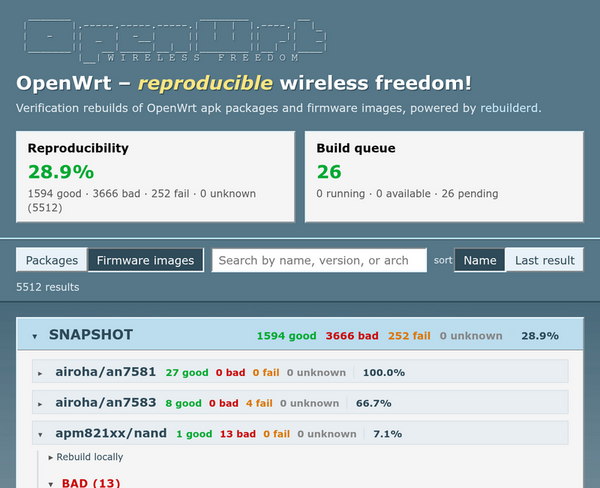
In addition, there is a new page showing verification rebuilds of OpenWrt APK packages and firmware images, powered by rebuilderd:

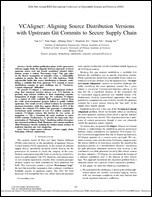
Three new scholarly papers Yan Li, Nan Jiang, Qihang Zhou, Shaowen Xu, Yamin Xie and Xiaoqi Jia of the Chinese Academy of Sciences published a paper titled VCAligner: Aligning Source Distribution Versions with Upstream Git Commits to Secure Supply Chain:
We present VCAligner, a content-based alignment methodology that constructs inverted indexes over VCS histories to precisely map released artifacts to their originating commits, independent of fragile version tags. We evaluated VCAligner on a dataset of 2,984 verifiable PyPI packages derived from the 4,000 most-downloaded projects linked to public GitHub upstreams. Our results reveal a critical weakness in conventional tag-based heuristics: while they appear effective on 85% of the dataset, the residual 15% failure rate generates a catastrophic downstream audit workload of over 10.3 million commits. In contrast, VCAligner reduces this burden by two orders of magnitude ( 158 ), bounding the total workload to under 65,000 commits. Furthermore, we provide the large-scale characterization of Packaging Noise, classifying artifact divergence into structural additions (Path Phantoms) and content mutations (Blob Phantoms), thereby isolating the distinct attack surfaces of malicious injection and code tampering.

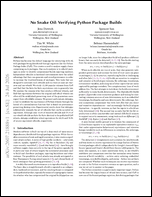
Jens Dietrich and Spencer Sun from the Victoria University of Wellington together with Tim W. White and Behnaz Hassanshahi from Oracle Inc pre-published their paper No Snake Oil: Verifying Python Package Builds (PDF):
Python has become the default language for interacting with AI, with packages being distributed through registries like the Python Package Index (PyPI). This creates a need to analyse supply chains comprising such packages. One such analysis is to rebuild packages in order to identify compromised builds injecting malware. Independent rebuilds in hardened environments have the added advantage that they can generate and record provenance in order to increase the trustworthiness of packages. Two tools that are designed to automate such rebuilds and run them at scale are macaron and oss-rebuild. We study 12,180 popular releases from PyPI and find that the byte-for-byte equivalence rate is generally low. We analyse the reasons why they produce different wheels, and find that equivalence between the original and rebuilt wheels can often still be established, preserving most of the guarantees users expect from rebuildable releases. We present and evaluate daleq4py, a tool to establish the equivalence of Python wheels through the kernel of a normalisation function that is based on provenance-preserving datalog rules. Experimental results show that daleq4py substantially expands the set of rebuilds that can be accepted as equivalent. Although only 15.4% of macaron rebuilds and 19.1% of oss-rebuild rebuilds are byte-for-byte identical to the published PyPI wheels, daleq4py establishes wheel equivalence for 60.2% and 78.9% of source-equivalent rebuilds, respectively.

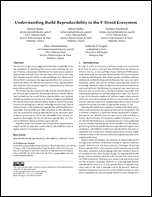
Denise Nanni, Julien Malka, Stefano Zacchiroli and Th o Zimmermann from T l com Paris together with Gabriele D Angelo from the University of Bologna pre-published their paper Understanding Build Reproducibility in the F-Droid Ecosystem (PDF), which was accepted at the 2026 ACM Conference on Reproducibility and Replicability:
The security of open source applications benefits considerably from the possibility of rebuilding their source and verifying the output. F-Droid, a prominent distribution for open source Android applications, systematically rebuilds them from source and tests their bitwise reproducibility at app publishing time. However, F-Droid offers no guarantee that app reproducibility will continue to hold in the future. As software ecosystems evolve, reproducibility may degrade, with potential negative consequences for software preservation and security. We present the first empirical study of build reproducibility in the F-Droid app ecosystem. Analyzing historical reproducibility logs, we find that the overall bitwise reproducibility rate has been steadily increasing over time (as new versions of apps are published). We then evaluate how reproducibility holds in time for fixed app versions, by attempting to rebuild 18 904 app versions that F-Droid had previously confirmed bitwise reproducible, published between September 2018 and February 2026, achieving an 83% rebuild success rate, and identify missing dependencies as the dominant cause of failure, accounting for 76% of non-rebuildable cases. Among successfully rebuilt apps, 94% are also bitwise reproducible-i.e., they still yield bitwise identical artifacts upon rebuild. Together, these results show that while bitwise reproducibility largely holds for apps that can be rebuilt, rebuildability itself is highly sensitive to temporal decay.

Patches The Reproducible Builds project detects, dissects and attempts to fix as many currently-unreproducible packages as possible. We endeavour to send all of our patches upstream where applicable or possible. This month, we wrote a large number of such patches, including:

Misc news On our mailing list this month, Colin Winter of Markovian Protocol wrote to our mailing list on the topic of Reproducible verification for retained logs:
Reproducible builds remove trust in the builder: anyone re-derives the same artifact from the same source, byte for byte. The same shape applies one layer over, to a retained record. Most record-keeping regimes (the EU AI Act s Article 12 logging is the current example) require that events be recorded and logs retained, but not that a retained log be verifiable, by a party who was not present, as unaltered and existing when claimed. That leaves an integrity obligation resting on trusting the party being audited.
(Full thread)

Finally, if you are interested in contributing to the Reproducible Builds project, please visit our Contribute page on our website. However, you can get in touch with us via:

6 August 2026

Bits from Debian: DebConf26 closes in Santa Fe and DebConf27 announced

DebConf26 group photo - click to enlarge On Saturday 25 July 2026, the annual Debian Developers and Contributors Conference came to a close. Over 270 attendees representing 35 countries from around the world came together for a combined 90 events (including some which took place during the DebCamp) including more than 27 Talks, 21 Short Talks, 29 Birds of a Feather sessions ("BoF" informal meeting between developers and users), 8 workshops, and activities in support of furthering our distribution and free software, learning from our mentors and peers, building our community, and having a bit of fun. The conference was preceded by the annual DebCamp hacking session held 13 through 19 July where Debian Developers and Contributors convened to focus on their individual Debian-related projects or work in team sprints geared toward in-person collaboration in developing Debian. As has been the case for several years, a special effort has been made to welcome newcomers and help them become familiar with Debian and DebConf by organizing a sprint "New Contributors Onboarding" every day of Debcamp, followed more informally by mentorship during DebConf. Half a dozen new contributors joined the sessions and learned about Debian, free software, packaging and much more. This year, a week-long DebCamp session was dedicated to auditing, patching, and modernizing the Go ecosystem in Debian and enable the transition triggered by the recent upload of dh-golang enabling GO111MODULE=on by default in Experimental. In order to make the conference more accessible for local participants, a local language track was included in the schedule for talks in Spanish, as was done at DebConf19 in Brazil. The actual Debian Developers Conference started on Monday 20 July 2026. In addition to the traditional "Bits from the DPL" talk, the continuous key-signing party, lightning talks, and the announcement of next year's DebConf27, there were several update sessions shared by internal projects and teams. Many of the hosted discussion sessions were presented by our technical core teams with the usual and useful "Meet the Technical Committee", three talks about Linux Kernel, early boot and improving Debian s kernel and installer support for Chromebooks, and about twenty BoFs and talks about Debian packaging policy, Debian infrastructure, security and privacy. This year, and echoing ongoing discussions within the Free Software community, Artificial Intelligence and Age Verification have been the subject of several talks. The Python, Perl, Ruby, Go, and Rust programming language teams also shared updates on their work and efforts. More than 17 BoFs and talks about community, diversity, and local outreach highlighted the work of various teams involved in not just the technical but also the social aspect of our community The schedule was updated each day with planned and ad hoc activities introduced by attendees over the course of the conference. Several traditional activities took place: a poetry performance, the traditional Cheese and Wine party, the Group Photos, and the Day Trip. For those who were not able to attend, most of the talks and sessions were broadcasted live and recorded. One can find the seventy hours of recorded videos available via the conference schedule, or alternatively through this link. Almost all of the sessions facilitated remote participation via IRC and Matrix messaging apps or online collaborative text documents which allowed remote attendees to "be in the room" and ask questions or share comments with the speaker or assembled audience. DebConf26 saw over 341 T-shirts, a day trip, and up to 130 meals planned per day. All of these events, activities, conversations, and streams coupled with our love, interest, and participation in Debian and F/OSS certainly made this conference an overall success both here in Santa Fe, Argentina and online around the world. The DebConf26 website will remain active for archival purposes and will continue to offer links to the presentations and videos of talks and events. Next year, DebConf27 will be held in Asahikawa, Hokkaido, Japan, from Sunday September 5th to Saturday September 11th, 2027. As tradition follows before the next DebConf the local organizers in Japan will start the conference activities with DebCamp with a particular focus on individual and team work towards improving the distribution. DebConf is committed to a safe and welcome environment for all participants. See the web page about the Code of Conduct on the DebConf26 website for more details on this. Debian thanks the commitment of numerous sponsors to support DebConf26, particularly our Platinum Sponsors: Infomaniak, and Proxmox, and our Gold Sponsors : Freexian, and Viridien. We also wish to thank our Video and Infrastructure teams, the DebConf26 and DebConf committees, our host nation of Argentina, and each and every person who helped contribute to this event and to Debian overall. Thank you all for your work in helping Debian continue to be "The Universal Operating System". See you next year! About Debian The Debian Project was founded in 1993 by Ian Murdock to be a truly free community project. Since then the project has grown to be one of the largest and most influential Open Source projects. Thousands of volunteers from all over the world work together to create and maintain Debian software. Available in 70 languages, and supporting a huge range of computer types, Debian calls itself the universal operating system. About DebConf DebConf is the Debian Project's developer conference. In addition to a full schedule of technical, social and policy talks, DebConf provides an opportunity for developers, contributors and other interested people to meet in person and work together more closely. It has taken place annually since 2000 in locations as varied as Scotland, Bosnia and Herzegovina, India, Korea, France. More information about DebConf is available from https://debconf.org/. About Infomaniak Infomaniak is an independent, employee-owned Swiss technology company that designs, develops, and operates its own cloud infrastructure and digital services entirely in Switzerland. With over 300 employees more than 70% engineers and developers the company reinvests all profits into R&D. Its public cloud is built on OpenStack, with managed Kubernetes, Database as a Service, object storage, and sovereign AI services accessible via OpenAI-compatible APIs, all running on its own Swiss infrastructure. Infomaniak also develops a sovereign collaborative suite messaging, email, storage, online office tools, videoconferencing, and a built-in AI assistant developed in-house and as a privacy-respecting solution to proprietary platforms. Open source is central to how Infomaniak operates. Its latest data center (D4) runs on 100% renewable energy and uses no traditional cooling: all the heat generated by its servers is captured and fed into Geneva's district heating network, supplying up to 6,000 homes in winter and hot water year-round. The entire project has been documented and open-sourced at d4project.org. About Proxmox Proxmox develops powerful, yet easy-to-use open-source server solutions. The comprehensive open-source ecosystem is designed to manage divers IT landscapes, from single servers to large-scale distributed data centers. Our unified platform integrates server virtualization, easy backup, and rock-solid email security ensuring seamless interoperability across the entire portfolio. With the Proxmox Datacenter Manager, the ecosystem also offers a "single pane of glass" for centralized management across different locations. Since 2005, all Proxmox solutions have been built on the rock-solid Debian platform. We are proud to return to DebConf26 as a sponsor because the Debian community provides the foundation that makes our work possible. We believe in keeping IT simple, open, and under your control. Contact Information For further information, please visit the DebConf26 web page at https://debconf26.debconf.org/ or send mail to press@debian.org.

Russell Coker: TV Control etc

In 2008 I wrote a blog post The Problem is Too Many Remote Controls [1] about the issues of controlling a TV and related things. It recently got some comments on Mastodon so I think it s time for an update. The first issue I raised was Now it s not uncommon to have separate remote controls for the TV, VCR, DVD player, and the Cable TV box a total of four remote controls which seems to have alleviated. VCRs seem to have almost entirely gone away. The VHS Wikipedia page [2] is worth reading for everyone who hasn t seen a VCR in operation, which I expect to be more than a few readers now and an increasing number over the next 18 years. I personally don t have Cable TV, I own a DVD player which isn t connected to my TV because I haven t used it for years, I don t own a VCR, and I don t watch free to air TV. So I have one remote control for the TV which I use for Netflix and sometimes YouTube. When viewing YouTube on TV there are significantly more adverts and longer adverts. I presume that is because installing an ad-blocker on my TV isn t a viable option for me and it s a total impossibility for most users. Generally my desktop PC is a much better platform for YouTube than my TV, it has a better quality display, is more user friendly (my previous post addressed the difficulty of getting to the data source that s desired), and doesn t require entering search terms via a slow on-screen keyboard. Netflix on Linux is limited to 720p at low bitrate which is obviously of low visual quality while on the TV it s in 4K. I have Netflix so I use that only on the TV. In my previous post I wrote a thought experiment on how to use a cheap laptop ($500 at the time equivalent to $777 in 2025 money according to the Reserve Bank of Australia) to control a $5000 TV ($7770 in 2025 money). Now you can buy a new 65 4K TV for under $800 and a new laptop capable of 4K output for under $400 so the options are very different. For a $800 TV the manufacturer isn t going to develop a remote control interface and Google (who develops the software the TVs run) won t do it because it could reduce their advertising revenue. But a typical home user could setup a cheap laptop connected to their TV via HDMI providing a familiar and efficient user interface for themselves and visitors. For a Windows laptop 4K Netflix should work and for a Linux laptop the options of a laptop for everything apart from Netflix and the TV for Netflix are bearable, two controls are worse than one but better than the 3+ that used to be common. In my previous post I raised the issue that it s often the case that you don t want to stop watching one show while trying to find another . This is still an unsolved problem and is not addressed in modern software. I am not aware of a Linux music player that supports such functionality and this would be much easier for a music player than for a video player where the screen would have to be shared between the interface for finding the next thing to play and the space for playing the end of the current one. Maybe I should file a bunch of wishlist bugs against music players asking for this. I suggested that cable modem and cable TV box could be integrated into a single device. That has not happened, in fact it s got worse. A relative who has Foxtel has a cable modem, a cable TV box, and a Wifi AP with VOIP to provide landline phone service and to make it more exciting the latter two both have bugs that require a periodic hardware reset to fix. Hopefully cable TV will go away in the next 18 years. Regular PCs have become less noisy in recent years. I am currently using a HP Z640 to write this post and I have HP Z840 and HP Z4G4 systems behind me running as servers and the background noise is still very low. The allegedly 8K TV [3] that I have in my lounge room has cooling fans that make more noise than those three high-end HP computers combined. Using a quiet PC like one of those HP systems to drive a TV is a very viable option and I did just that for a couple of years. Kogan has currently got a selection of refurbished Lenovo ThinkStation systems on sale for under $400, they are quiet and would do well for this, it s also nice that Kogan is selling systems with ECC RAM at home user prices. TV does seem to be going away. YouTube and streaming services seem to get more watching time and many people don t use TV at all. Since my previous post the number of streaming services has increased so torrenting offers increasing benefits as no-one wants to subscribe to 6+ services. For anyone who wants to get all the content that interests them while paying the user interface situation is much worse now than it used to be in 2008. If you use KDE on a PC then the kconnect program allows a phone to be used to remotely control some aspects of a PC and has a good interface for pause/resume of a video and seeking 10 seconds forwards/backwards. The interface for controlling volume is hard to get to and doesn t work on my installation. If you want to use a keyboard to start something playing and then a phone for pause control then kdeconnect is a decent option. A comment on my previous post by Michael Croes raised the issue of remote control which is now a solvable problem. Justin also wrote a comment suggesting a Nokia N800 as a remote. Jason suggested a programmable remote, which would be a good option for a power user and a viable option for someone setting things up for their grandparents. But the amount of pain is greater than I m interested in as lounge room TV isn t an important thing to me. It may appeal to more people than having a dedicated lounge room PC though.

5 August 2026

Iustin Pop: Yes-yes, still alive!

I am not sure what happened, but my interests have changed significantly, and I haven t blogged, I haven t done any open source work, and didn t even process any pictures for the entire year. Not because anything went bad, just new stuff, new interests, life changes. However, still alive, and still struggling with sports, and with sleep :) On the positive side, on a recent mid-length flight, I thought I haven t done any work on Corydalis, since last year I closed quite of a few of my must have features, so probably, nothing else to do for now, right? I opened an editor and started thinking about ideas, and surprised! One hour later, I had written down enough ideas for a couple of months of work. So now just need to find the time but can t wait for the planned things! Stay well!

Enrico Zini: Gnome refusing to suspend

I'm tired, I want to do go bed. I click "sleep" on gnome shell, nothing happens. Swearwords. I want to go to bed. I might have want to put my laptop in a bag and run to catch a train. I hate when this happens. systemd-inhibit --list --mode=block doesn't help much:
$ systemd-inhibit --list --mode=block
WHO    UID  USER   PID  COMM            WHAT                                                     WHY                        MODE
enrico 1000 enrico 3042 gsd-power       handle-lid-switch                                        External monitor attached  block
enrico 1000 enrico 3037 gsd-media-keys  handle-power-key:handle-suspend-key:handle-hibernate-key GNOME handling keypresses  block
enrico 1000 enrico 2878 gnome-session-b sleep                                                    user session inhibited     block
After much googling I found out about gnome-session-inhibit:
$ gnome-session-inhibit  --list
mutter: idle-inhibit (idle)
/usr/lib/chromium/chromium: Playing audio (suspend)
Found the right tab in chromium, paused playing, sleep works again. My sleep was a good half an hour overdue, and all I got for it was to write this blog post. Of course Gnome could have shown me its inhibitor list instead of doing nothing, since it has that information, but it didn't. What I really would expect is that if I intentionally click a suspend button, audio and video playing wouldn't inhibit the suspend. Maybe in a future version of Gnome?

4 August 2026

Russell Coker: Monitors for Work

The Corporate Monitor Issue Some time ago I worked in the IT department of a company that had a corporate standard of two 27 FUllHD (either 1920*1080 or 1920*1200) monitors for the desktop. I was pushing to make the standard be one 32 4K monitor or the two cheaper monitors. They ended up making one 27 4K monitor an option which was still a better option for many users than two FullHD monitors due to having twice the pixels even though it had half the screen area. It was a surprise to me when hardly anyone took up that option. One man who worked there brought a wide curved monitor from home and ran with one of the FullHD monitors on each side of that. As an employee in the IT department I had concerns about expensive personal equipment being used in the office regarding who s going to pay the bill if it gets broken. But I was assured that it was his old monitor that he didn t need after buying a better one for gaming at home and he wouldn t be too upset if something happened to it. This isn t the only time I ve witnessed such problems of companies paying large salaries for skilled people and providing poor equipment for them to do the work. One previous time I raised a OH&S issue because the outdated monitors were so blurry but the company determined that the monitors wouldn t cause health problems and spending $150 per employee on better replacements was a waste of money. Computer hardware tends to become cheaper over time and one thing that has become really cheap recently is portable monitors. Kogan has a 15.6 FullHD monitor with USB-C and mini-HDMI inputs for $89 [1]. It wouldn t be difficult for someone to put one of those on each side of the monitor or monitors that their employer provides and put them in a desk drawer at the end of the day to minimise risk. The same Kogan page has a 16 monitor with 2560*1600 resolution for $189. Company Ownership I previously wrote about the potential benefits to companies in not owning all those keyboards, mice, and headsets when they could just give each employee the money and have them buy their own [2]. I don t think we are at the stage where that can be applied to monitors as the cheapest price for a decent monitor is about $500 which takes it out of the disposable price range that keyboards and mice are in. Also from an IT support perspective there are real support issues with monitors and cables having compatibility issues. But paying small amounts of money to reimburse employees who buy cheap portable monitors to supplement their main monitor is a more reasonable option. For some people that will allow noteworthy improvements in work performance. Who Will it Help? I don t think that adding such portable monitors will directly help the majority of workers. I think that to maximise performance and efficiency we need to chase the long tail of improvements. Big monitors, really big monitors (65 at a larger distance), multiple monitors, standing desks, and whatever else people want. There was some research from Microsoft some years ago (back when 27 was a really big monitor) showing that some tasks had a 50% increase in performance with a larger monitor. Now that 27 is about the smallest monitor size commonly available the potential for improvement is reduced. Probably most workers now already have monitors that provide the benefits to them that the big monitors in Microsoft research provided. But there will always be some portion of the user base who will benefit. If you can get a 50% performance boost for 1% of the users that s really worth doing. If you can get a 0.5% benefit for 100% of the users that is also worth doing and will theoretically give equal benefits. Costs of Employees It is claimed that the total cost of an employee including all overheads of management and providing office facilities etc amounts to twice their base salary. If that is the case then a minimum wage employee in Australia costs $100k per year, someone at the low end of the IT pay scale costs $200k, and someone at the high end of the IT scale is around $400k. It seems clearly worthwhile to spend $1000 in hardware purchases for a $100k employee who declares that it will really help their work, anything which is noticeable to the user is going to be more than a 1% difference in performance. For someone at the high end of the IT pay scale spending $40,000 on hardware to improve their performance could pay for itself. This is not only due to direct return on investment but because the people who do such work are often in key roles in important projects. If there s too much work for one person on minimum wage to do then you just hire another person. You can t hire another senior IT person and have them just do the work, it can take months to get up to speed. But as management in corporations seems unable to recognise this cheap hardware employees can afford to buy with their own money can bridge the gap. Job Interviews In future when interviewing for jobs I ll ask about the hardware that s to be used. I won t say I m not interested in this job offer because you don t respect your employees enough to buy adequate hardware , but I may make it a condition of working at a company that the hardware on my desk will not be obsolete.

Dirk Eddelbuettel: #058: Reverse Dependencies Made Easy, Fast, Reliable

Welcome to post 58 in the R4 series. R and the CRAN repositories maintain a very high level of what we might call quality assurrance by requiring that newly-added code does not break any existing dependencies. This is frequently called a reverse-dependency check . For any given CRAN package one can quickly determine it reverse dependencies. Calling tools::package_dependencies(pkgName, reverse=TRUE) will for a scalar or vector-valued argument return a named list with the reverse dependencies. It is then a matter of looping over this list. There are helper functions in base R as well as in contributed packages on and off CRAN. I also wrote my own with package prrd which, while possibly a wee bit specialised and under-documented has served me well to check on Rcpp and related packages which can indeed have a large number of reverse dependencies. I recently looked into one of these contributed runner packages, and while I will refrain from naming its implementation language let me just mention that the term cargo cult may be a real thing here. What go me interested in this was the fact that if one has a simple-to-use runner then the fact that r2u makes it fast, easy, reliable: pick all three (to borrow its slogan) to deal with actual depencies if Ubuntu has indeed been selected as the host. We will maintain the position that if you can in fact integrate with the system-wide package management then any alternative per-repo package management approach not doing so will likely be dominated by an approach that does integrate with the system facilities. Which is what precisely what r2u does, and offers. And why it is used enough to by now have shipped eighty eight million binary packages. So I tested it for the reverse-dependency check task. What I learned by looking into the (much more complicated) runner was that it at the end of the day it hands the actual task of running the reverse dependecies off to a helper function rev_check that is part of the xfun package by Yuhui. I quickly found that besides xfun we would also need its suggested dependency tinytex which in turn would error unless the tlmgr binary was present. So as the sole requirement (on an Ubuntu system with r2u) turns out to be
$ apt install r-cran-xfun r-cran-tinytex texlive-base
where we do it all in one apt call (as root in the container). (Given r2u we could also call install.packages(c("xfun","tinytext")) followed by apt install texlive-base but it is simpler for this setup step to be just one call). With that we are basically done. I did this (twice) using a rocker/r2u container with r2u preinstalled, mounting a local work and scrap directory for the container. In it we expand the package to be tested (i.e. tar xaf pkgName_*tar.gz for a given source package pkgName from CRAN) and then just call with the package name and expanded direcrtory. I.e. I used this call to test my package AsioHeaders (which has just three reverse dependencies) to both name it and to point to the expanded source directory created for this purposed:
> system.time( res <- xfun::rev_check("AsioHeaders", src="AsioHeaders") )
## ... earlier output omitted for brevity here ...
   user  system elapsed 
 35.732   3.333 149.683 
> res
   httpgd ipaddress websocket 
        0         0         0 
> 
and about a good two minutes later I would get the timing result and the summary in variable res. As I checked the current CRAN version, the check was as expected free of concerns or issues. To support this, r2u did indeed go off and install about sixty seven binary packages (and the total includes all binary dependencies fully resolved) delivering on the just works promise by the r2u documentation. As another check, I did the same for RcppAnnoy which has seven reverse dependencies and needed about two hundred CRAN packages to be installed. The full test took just over four minutes with the timing function reporting some nice gains from parallelisation as total user compute time was on the order of just under eight minutes. Again, test results were clean and free of worries as expected:
> system.time( res <- xfun::rev_check("RcppAnnoy", src="RcppAnnoy") )
## ... earlier output omitted for brevity here ...
   user  system elapsed 
471.765 378.220 266.855 
> res
   bbknnR  bigANNOY  blocking     scDHA    Seurat      uwot VectrixDB 
        0         0         0         0         0         0         0 
> 
Overall this was a rather useful quick excursion as it demonstrates that - existing functions can be used to orchestrate a reverse dependency check - with reasonable dependency scale we can do this on a single machine quite easily taking advantage of parallel computing on multi-core machines - using r2u gives us fast, easy, reliable package installation making testing of packages we might not otherwise use or know a breeze - doing this in an ephemeral Docker container facilitates easy build-up of required resources and leaves no side effects behind which might affect our normal development environment

This post by Dirk Eddelbuettel originated on his Thinking inside the box blog. If you like this or other open-source work I do, you can now sponsor me at GitHub.

Petter Reinholdtsen: FreeCAD MCP with llama.cpp, toy or tool?

After seeing a video a few months ago demonstrating how a proprietary CAM solution uses machine learning and large language models to automatically generate CNC instructions, and successfully testing it on a real CNC, I began wondering if the same could be achieved with free software. I still do not know the answer, but I may be getting closer to finding out. Two weeks ago, I came across the video "I Connected Claude AI to FreeCAD (And It Models Parts Like an Engineer)" by Make Form, which introduced me to the FreeCAD MCP project. Even though the video creator apparently believes it is acceptable to download and run random binaries from the Internet on a local machine (his setup uses UCX), I do not. I would probably have left the project alone entirely if I had not noticed that all of its dependencies are already available in Debian. This significantly boosted my motivation, so I set out to test it using packages built from source on Debian rather than relying on untrusted binaries. The first hurdle was that the MCP SDK for Python was not present on my Debian Forky test machine. I initially believed it was missing from Debian altogether, but it has been available in Debian Unstable for about a month and is only absent from Forky because some automated tests fail on architectures like riscv64 and s390. Fortunately, backporting it was straightforward using apt-get source -b python3-mcp . The next hurdle involved an outdated version of the Validators Python library. Since I am a member of Debian's Python team, which maintains this package, updating it to a sufficient version for FreeCAD MCP was relatively easy. I could not upgrade to the latest upstream release due to a new dependency on an Ethereum-related library, so I settled on a 2024 version. With those dependencies in place, I proceeded to create a Debian package for FreeCAD MCP. I had previously submitted a request for packaging of FreeCAD MCP to gauge interest while deciding whether to prioritize maintaining it myself. Because salsa.debian.org blocks access from Tor users like myself, I published my draft packaging scripts in a Git repository on Codeberg as the Debian FreeCAD MCP project and got it working with the FreeCAD 1.1 version in Forky. I initially struggled with the button controls for the MCP feature, which led me to submit a pull request titled "Fixed startup sync of checkable toolbar buttons" proposing a fix. Once this confusion was resolved and the MCP setup was enabled via the GUI, I was able to run FreeCAD completely headless using xvfb-run on a machine without an X server to generate models. I am using a private LLM service running the Debian package of llama.cpp with the Qwen 3.6 model downloaded from Hugging Face, configured with a maximum context window of 105k tokens. I also tested the Bonsai model on my test laptop; initially, its context window was too small (8k and 16k could not accommodate the FreeCAD MCP instructions), but even after increasing it to 32k, it proved useless for generating FreeCAD models so far. I've used Claw Code, Aider and Open Code with my server so far, and for this test I ended up with OpenCode because it was easy to set up to use an MCP. Because none of my LLM services are set up to be multimodal (capable of processing both text and images in this case), I configured the MCP to return only textual feedback from FreeCAD. I am unsure if this is a major limitation, though I suspect it might be. My testing experience remains limited, with no clear successes yet. Part of the issue likely stems from my ability to provide effective instructions for modeling 3D objects (I am relatively new to FreeCAD, English is not my first language, and I lack a precise vocabulary for describing construction features to an LLM). Nevertheless, the LLM has demonstrated the capacity to create 3D models in FreeCAD. In one of my first tests, I asked it to generate a cube and then produce CAM/G-code instructions for a CNC machine. It did output G-code (which remains untested), but I was surprised to find that it bypassed FreeCAD's built-in CAM module entirely and instead generated an external Python script to produce the code. This was not quite what I intended, though my instructions were probably unclear. The Qwen model with OpenCode seems to strongly prefer programming directly; it frequently executes Python snippets inside FreeCAD to achieve its goals rather than using the standard sketch-and-extrude workflow I am accustomed to. In another test, I asked the LLM to create a parameterized pipe assembly to see which of FreeCAD's parametric tools it would choose, but found no evidence of traditional parametric features in the output. When prompted, the LLM explained that the parameters were embedded directly in the Python script used to generate the model, rather than in native FreeCAD features. With more explicit instructions, it eventually created a FreeCAD spreadsheet to manage the parameters. The resulting model looked much closer to my expectations and could have been useful with further refinement. My so far last experiment was less successful: I asked it to design a pipe clamp, but the LLM repeatedly failed to position the clamping screws in a way that would actually secure the brackets around the pipe. It is unclear whether this limitation lies with the model, my prompt, or other factors. Based on my testing so far, I am uncertain whether FreeCAD MCP is merely a fun toy or a genuinely useful tool. I will only commit time to maintaining it in Debian if it proves to be practically valuable. I would welcome feedback from anyone who has experience with the project, preferably via the original request-for-packaging mailing list thread. Alternatively, I am available in the FreeCAD and Debian AI IRC channels for further discussion. As usual, if you use Bitcoin and wish to support my activities, please send donations to 15oWEoG9dUPovwmUL9KWAnYRtNJEkP1u1b.

Anuradha Weeraman: Plan 9 from Bell Labs, the little OS that could

Plan 9 Fourth Edition showing the rio windowing systemScreenshot by VulcanSphere via Wikimedia Commons MIT License
I first heard of Plan 9 from my friend Vajra in 1999 or so, as we were distro-hopping on early Linux distributions and trying to find our way. Vajra is now a Nebula Award-winning science fiction author - have a look at his work. We had just been through Tom's Root Boot, a UNIX-like operating system crammed into a single floppy, and through it discovered a whole new world outside of DOS 6.22. Combing through old UNIX manuals, we went in search of the perfect OS, through Slackware, Caldera, TurboLinux, SUSE and Red Hat. I finally settled on Debian, which lived up to everything I stood for. Plan 9 was distinct. It came out of the Computing Sciences Research Center at Bell Labs, built by Rob Pike, Ken Thompson, Dave Presotto and Phil Winterbottom, with Dennis Ritchie heading the department. The name is a joke at their own expense, borrowed from Ed Wood's 1959 Plan 9 from Outer Space, routinely nominated as the worst film ever made. Thompson and Ritchie had, of course, built the original UNIX; it almost seemed as if they were building a new OS from the lessons learnt from building it - which was in turn built on the lessons from Multics. I remember the awe I felt playing around with Plan 9, and I've not been able to replicate it since. Plan 9 was different in a couple of fundamental ways: per-process namespaces, and a protocol that abstracted locality of resources to processes. As a consequence of these core primitives, the OS surface area was distinctly small. The entire system from the core kernel, to the system call interface, to the compiler, linker and shell was reduced to a form small enough that a single developer could hold it in their head. Lessons from the implementation of UNIX helped the designers make the system leaner, and in Ken Thompson's words, it's the "best operating system out except that it doesn't have the apps that everybody demands" [1]. It also took the concept of "everything is a file" in UNIX to a whole new level. The network stack is a filesystem (/net), processes are files, the display is a file (/dev/draw). Because every resource speaks 9P and every process has its own namespace, you can mount another machine's /net into your namespace and your program makes network calls through that machine's stack without knowing or caring. No sockets API, no RPC layer, just ordinary file system operations through a simple system call interface. Some would say that OS research is dead, and that backwards-compatibility and POSIX killed it. Rob Pike himself argued as much in his 2000 talk, "Systems Software Research is Irrelevant" - but we didn't care at the time. There was so much happening that we didn't have time to take it all in. And then Linux happened, and Software Freedom became a focal point (more on that in a later post). In the summer of 2020, with the world deep in Covid lockdowns, I decided to build a toy operating system, just to try my hand at the the thing that I had always wanted to do. I spent three feverish months working on Odyssey and, looking back, it is perhaps the most fun I have ever had. I would not dare compare it to the magnum opus that is Plan 9, but it gave me perspective: how hard it is to build an OS from scratch, and above all, how fun it is to build an OS from scratch, and why the original creators kept coming back to the same problem. The highlight of those three months was booting the OS and watching it render "The Great Wave off Kanagawa". Nothing in my professional achievements to date captures what that meant to me.
Odyssey rendering The Great Wave off Kanagawa during boot Odyssey displaying "The Great Wave Off Kanagawa"
Decades on from the first time I booted Plan 9, I look back with nothing but awe and respect for the creators of this little operating system and marvel at the foresight that went into it. While many readers will not have heard of Plan 9, they have almost certainly worked with the ideas that came from it: 9P (if you ever used the Windows Subsystem for Linux), UTF-8 (if you ever used any modern operating system), per-process namespaces (if you've ever run a container), Go (whose assembler still uses Plan 9 syntax). Plan 9 still lives on in 9front, a community-maintained fork. Separately, Yoann Padioleau [2] has produced a set of annotated books at principia-softwarica.org, presenting the Plan 9 source in the spirit of Donald Knuth's literate programming - an admirable effort to introduce new readers to the art of operating systems engineering. Pike thought systems research had become irrelevant, and Thompson thought Plan 9 would never "make it" [1]. Both were right about the industry, but may have been pessimistic about the impact. The system lost as a product but won as a set of ideas, assimilated one at a time by modern operating systems. Success is not always measured by popularity. The mark that Plan 9 left behind is greater than what's reflected in its current user base. To me, Plan 9 will always be the OS that punched above its weight class, the little OS that could. References [1] Ken Thompson Interview, March 6, 2024 [2] Yoann Padioleau Principia Softwarica, May 9, 2026

3 August 2026

Bernhard R. Link: I learned something new about URLs today

Today I stumbled over some behavior that I found quite surprising:
$ ipython3 -c 'import httpx;print(httpx.URL("https://example.com/foo/bar/../../baz"))'
https://example.com/baz
Even more surprising that behavior is actually standards-compliant, even mandated by RFC 3986. The underlying motivation is relative reverences. If some resource reachable by "https://example.com/foo/bar" references another resource relatively as "../../baz" then this is of course the intended result. Getting from this problem to what RFC 3986 suggests might be surprising in the result, but somewhat understandable if you look at the consequences of that problem: Giving the path components ".." (and ".") special meaning at the start of the relative reference means that if you allowed them in absolute URLs those would be impossible (or at least very convoluted) to address as relative URLs. So RFC 3986 describes a way to handle them everywhere: Just join the path of the base URL and the path of the relative reference and normalize the result. Or normalize the absolute on either side if only that is to be taken. This makes things very convenient: Multiple reference URLs can just be joined without special handling for relative references starting with dots, making writing applications handling them easier. Programmers don't have to care how to handle relative references and can just join everything in whatever way they want. For maximum elegance there is still some corner case left: What happens if an absolute URL has a path starting with double-dot components? Or an relative path starting with more of them then the base URL's path has components. You just ignore them:
$ ipython3 -c 'import httpx;print(httpx.URL("https://example.com/../../baz"))'
https://example.com/baz
With that last point every URL is valid and has well-defined meaning. Handling relative references and relative paths is very easy and convenient. So this shows a high regard for simplicity, elegance and convenience. And a total and uncompromising disregard of security. After all the most convenient it is for an attacker; If they are allowed to supply a path component for a request a system does in their behalf, then they can easily escape anything they were supposed to be limited to. The ignoring of dots at the start means they don't even have to know exactly how deep their request is:
$ python3 -c 'import httpx;print(httpx.URL("https://example.com/public/api/public/resources/harmless/../../../../../../../../../internal/data"))'
https://example.com/internal/data
So even if the resource server securely handles request (unless you consider not having any way to lower your permissions for one request to a specific subset), your fully RFC conforming client library will already request the permission they should not have permission for. Even worse dots are usually not characters you can easily forbid so once slashes are to be allowed things get complicated. There also would have been a simple, elegant and secure way: Consider every path element ".." or "." in an (absolute) URL an error. Define a reference resolution that allows the relative reference to only start with "./" or one or multiple "../" and consider every appearance of a dot or two dots as path components after than an error. Everything joining two paths has to either use an implementation of that path joining algorithm, but only if they want to joins paths in the potentially dangerous way allowing leading "../". Otherwise they can just use the normal join and even if an attacker gets those dots that will just cause the generated URL to be rejected as invalid. Of course using a secure implementation is now even more inconvenient thanks to RFC 3986 being around: If you have no control over the generator of relative references, it is always possible that they generate relative references with ".." components after non-dot components. And if you check all code to properly filter out "/../", keep in mind that convienence does not stop there. After all it is not unheared of for server implementations to helpfully normalize unicode characters, too, or translate them to their nearest ASCII equivalents. Or translate percent escaped characters back before doing path splitting. Or you might think there was some unicode codepoints between those two dots, but they that those were some meaningless control characters that can be omitted. So you need some really restrictive allow lists...

1 August 2026

Russ Allbery: Review: How to Steal a Galaxy

Review: How to Steal a Galaxy, by Beth Revis
Series: Chaotic Orbits #2
Publisher: DAW Books
Copyright: December 2024
ISBN: 0-7564-1949-2
Format: Kindle
Pages: 143
How to Steal a Galaxy is a far-future science fiction caper short novel (maybe a novella?) and the sequel to Full Speed to a Crash Landing. You don't have to remember the details of the previous book to enjoy this one. There's an excellent inline summary at the start of this installment. After an annoying negotiation with people who keep trying to preach at her about causes, Ada Lamarr has a new contract. She is going undercover, after a fashion, at a charity gala and auction on Rigel-Earth. While she's there, she's going to steal something. What, precisely, she keeps a mystery from both the other characters and from the reader until the end of the story. Government agent Rian White is working security at this charity gala. Due to its link with the plot of Full Speed to a Crash Landing, he was fairly certain Ada would be there, as indeed she is. What she is planning, however, is maddeningly unclear. Also maddening is how good Ada looks in a dress. As with the previous book, How to Steal a Galaxy is told by Ada in the first person using the same teasing tone and constant misdirection that she uses when verbally fencing with Rian and the other characters. I found this novella even more entertaining and satisfying than the previous one. The charity gala is supposedly intended to benefit the poor people of Earth, and is run with exactly the sort of condescension and disguised capitalist looting typical of such exercises in elite charity. Ada's narration is scathing in a deeply relatable way. Also, there is a trillionaire tech-bro fake philanthropist who is smug and condescending and accustomed to getting exactly what he wants.
"I don't think anyone should have enough personal wealth to decimate a large country's income just because he's going through a midlife crisis."
Ada's interactions with Strom Fetor are an absolute delight. He is so sure of himself that he is incapable of registering her as a threat, and she effortlessly deceives him by hiding in plain sight.
"You really shouldn't be talking about this," Rian starts. Fetor waves aside his concerns. "We're all friends here." "Not me," I say. "I hate you. Remember?" Fetor laughs in a tone I'm sure he thinks is charming.
Fetor's complete inability to realize that a beautiful woman might both sincerely not like him and not be flirting with him is perfect. I was cackling through half of this book. Like any good heist story, there are twists and turns, surprises, double agents, unexpected complications, and a delightful amount of verbal fencing. I adore the narrative tone Revis uses for these stories. Ada has just the right mix of idealism, cynicism, professionalism, and irreverence to carry off the feeling that she's a step ahead of everyone else. Underneath the bones of a delightful plot is a character who cares deeply but is very aware of her limitations, and therefore has taught herself to laugh at and be ruthless with her own emotions. I am finding it an incredibly compelling type of competence porn. I enjoyed the first book of this series, but this one was so much better. These stories are exactly the right length to keep the reader engrossed throughout and satisfied but wanting more at the end. How to Steal a Galaxy ends on a cliffhanger of sorts, to be resolved in the next and final book. I can hardly wait to start it. Highly recommended. Followed by Last Chance to Save the World. Rating: 9 out of 10

31 July 2026

Otto Kek l inen: Estonia, the country of the fit and the wit

Featured image of post Estonia, the country of the fit and the witWhile many Western democracies seem to be in a state of decay and are no longer the safe, civilized and prosperous countries they once were, there are still some European countries that are governed well. One of those that stand out is Estonia. Estonia is probably most well known for multiple software companies that originated from there, such as Wise, Bolt, Pipedrive and Skype. The government itself is also famous for being early in issuing government IDs with an embedded smart chip for online authentication already in the 1990s. Via the national portal at eesti.ee all residents can access extensive eServices ranging from viewing their health benefits to filing taxes. Estonia has also been running an e-Residency program since 2014, where they issue digital ID cards to foreigners, making it easy for them to remotely log into the government portals and for example, establish businesses, file annual reports and so forth. Note that the e-Residency is not a path to physical residency. Estonia does, however, have a separate Digital Nomad visa program that makes it easy for non-EU citizens to also physically establish themselves in Estonia, assuming, of course, you meet the criteria, which includes, among others, a minimum monthly income of 3960 from outside Estonia. EU citizens naturally have free mobility inside the EU and can simply get an apartment and register as a resident in Estonia if they so choose. And there are plenty of reasons to do so.
Estonians value health, education and entrepreneurship I moved to Estonia about one and a half years ago. In my observations Estonia strikes me as a country that values health, education (in particular programming and natural sciences) and entrepreneurship highly. I don t know how Estonians achieve it, but they look pretty fit and rarely obese. Estonia has rye bread and sauna in their culture just like Finland, and in addition the flat terrain and well-planned bike routes and extensive network of parks (and pull-up bars everywhere) seem to create an environment where it is easy to live in a healthier way. The consumption of processed foods and candy also seems relatively low among Estonians. The gym chain MyFitness also seems to be present everywhere. Even the Tallinn airport has a calisthenics workout station right at the departure gates, which anyone is free to use while waiting for their flight to take off. One of the top longevity influencers in Europe, Siim Land, is Estonian. Estonia has lots of good bike paths, parks and outdoor gyms There is even a calisthenics station with pull-up bar and more at the departure gates at Tallinn airport Estonians also seem to value the school system highly. The government has been actively raising teacher pay and has a stated goal of reaching 120% of the national average by 2027. The students are also expected to value the education and respect their teachers. According to the TALIS 2024 survey (OECD s international teacher survey), Estonian teachers spend significantly more time on actual teaching and learning and waste less time on interruptions or keeping classroom order compared to the OECD average. This is among the highest rates internationally, meaning they spend relatively little time on maintaining order or dealing with disruptions. While the international education benchmark PISA scores have been dropping globally, Estonia has consistently been climbing the ranks in past decades. In the latest PISA study (from 2022), Estonia ranked number one in Europe for reading, mathematics and science. In the overall results, Estonia ranked seventh globally, only behind countries such as Japan, Korea and Singapore. Valuing entrepreneurship is evident in how the taxation system is set up in Estonia. Famously, in Estonia, companies can defer taxes on annual earnings and reinvest all of their profit in growing the company. Taxes are due only later, when paid out from the company, for example as dividends. For individuals, receiving dividends from any Estonian or foreign company is tax-free as long as the company paying dividends already paid corporate tax on the same income. The tax system is also very simple. For all individuals, all types of income, including salary and capital gains, are always taxed at a flat rate of 22%. This removes the incentive for anyone to try to convert income into different types, setting up holding company structures and other optimizations as there is no gain. All entrepreneurs can simply focus on growing their business and forget extra bureaucracy. There is also no marginal tax rate cliff to stop working at everyone is encouraged to always try to produce as much value as they can. A simple tax system is also reflected in the fact that anyone can easily read all tax rules that apply to individuals in plain English on the Estonian tax authority website, and one does not need to hire any accountants simply to file taxes. Estonia also has a very straightforward investment account system: any person can freely open a self-directed investment account at any brokerage at no extra cost and report it as such to the tax authority, and then use it to save for an apartment, retirement, or other purposes, and defer all income taxes until withdrawal. There are no caps or time limits, and all residents are encouraged to save and invest as much as they can and thus take responsibility for their own wealth accumulation. It seems that culturally Estonians respect people who are active and progress in their careers and businesses more than in other countries. Unlike in Finland, successful people are admired and living on government welfare is not romanticized. At the same time, the government benefits are less generous so people can t live comfortably on them and, for example, many of the asylum seekers Estonia accepted have since left on their own initiative to other European countries in search of better benefits.

Low crime, high trust Another thing that strikes me when walking the streets of Tallinn is that there are no drug addicts, beggars, thugs or the like. The difference compared to, for example, Vancouver (where I lived previously) is stark. In public buildings, people leave their coats and bags hanging in the lobby while visiting. Private houses and apartment block yards are not fenced. In my building, I noticed people even leave their bikes unlocked in the bike shed. I have also seen the staff of a coffee stall in a shopping mall going for a break and leaving everything unattended, not worrying that anyone would take anything while the staff is away. Nobody is stealing anything from the unattended coffee shop while staff is having a break at  lemiste shopping mall This is not just my personal experience. According to the Numbeo crime index, Estonia has one of the lowest crime rates in the world. Also, comparing drug and property crime stats, for example, Finland has twice as much crime per capita, and places like Vancouver in Canada almost five times more. I don t have any clear explanation for why crime is so much lower in Estonia, but some suggest that higher social cohesion and lower levels of welfare contribute to people standing to lose more if they behave antisocially. Compared to Finland, Estonia also more readily jails repeat offenders, and those who are put on trial will experience a swifter court process thanks to simplified legal processes and more efficient governance.

Moving to Estonia: quick checklist Moving to Estonia is very easy for any EU citizen, in particular if your work is not location-dependent (e.g., remote work or an online business) and you are simply looking for the cleanest and safest environment to live in. First, check into a hotel in Tallinn, check out various neighborhoods to figure out what area you like (my favorites are Kalaranna, Kalamaja, Noblessner and Volta) and start browsing available apartments in English at kv.ee. Most professionals speak fluent English, so there should not be any difficulty in reaching out to people by email or phone. Tallinn is famous for the old town The economic boom of recent decades created a lot of new construction, with Kalaranna being among the newest areas The next step is to buy a local prepaid SIM card at e.g., an R-Kiosk or a convenience store as signing up for other matters later on will require an Estonian phone number. Once you have an apartment and e.g., signed a rental agreement, you can register in the population registry online. After that, you have proof you are a local resident with an address and telephone number in Estonia. With local resident status, you can go to the police station to get a local ID card. Don t bother scheduling an appointment, just go to the Tammesaare police station in Tallinn, take a queue number and wait. Once it is your turn, they will guide you on how to use the photo booth, fingerprint registration device, and file your application. A few days later you will receive an email confirming whether your application was accepted, and after a few more days, you will get another email notifying you that your ID card has been printed and is available for pick-up at the same location. This will also be your first practical experience of how fast and efficient the government in Estonia is. Once you have the local ID card, you can use the smart card feature to log into all the government eServices and sort out the rest of the relocation process, such as registering tax residency and getting a family doctor. The main eServices portal in Estonia: eesti.ee
How did Estonia evolve to be like this? After Estonia regained its independence after the fall of the Soviet Union in 1991, the first elected government in 1992 was led by a very progressive 31-year-old Prime Minister Mart Laar, who managed to set up some very good policies and laid the foundation of a society that has evolved well in the decades since. Estonia was very lucky to have people in power in the 1990s who didn t simply copy what other Western countries were doing, but who tried to think about things from first principles and create Estonia s own model for efficient and fair governance. As a post-Soviet country, the population had also been vaccinated against overly socialist and unrealistic ideals, and everyone had a healthy distrust of the government s ability to solve problems and emphasis was placed on people s liberty to work for themselves as they best see fit. The improvement in living standards over the past 35+ years has also been witnessed by the population, and voting behavior supports keeping the country on the same trajectory. General living standards still continue to improve as the nominal wage growth sits at around 6%, clearly above the annual inflation rate of about 3%. In 2026, the Estonian economy is expected to grow about 2.4%, which is faster than the EU average. The growth in Estonia is not the result of any accounting tricks - Estonia is part of the euro and can t print its own currency, nor has it been funding the public sector with excessive debt. With a 24% debt-to-GDP ratio, Estonia consistently ranks as one of the most responsibly managed countries among advanced Western economies. As wages in Estonia soon catch up with the EU average, and higher defence spending has forced the government to raise taxes in recent years, the economic growth that Estonia has enjoyed for 35+ years since it exited the Soviet Union might slow down a bit in future years. The policies that fueled this growth in living standards, however, are likely to stay.

The tiger leap There is one specific government policy in Estonia s history that I think should be highlighted in particular. Estonia was very progressive by announcing the Tiigrih pe (Tiger Leap) program in 1996 with the goal of equipping all schools with computers and teaching all students the basics of programming. This surely had a large influence on why Estonia has so many successful software companies, why the government eServices are so mature that even neighboring countries like Finland are striving to copy the Estonian government s IT architecture called X-road. The Tiigrih pe project was originally suggested in the mid-1990s by Toomas Hendrik Ilves, then ambassador of Estonia to the United States, Canada and Mexico, and later President of Estonia in 2006 2016. While he was a psychologist by education, he was also a self-taught amateur programmer and used his political influence to promote sensible adoption of information technology in both Estonia and the EU. The history of Estonia has several prominent figures who were not lawyers by profession but engineers, scientists and historians who were very practical in their political decisions, which I think is now reflected in how government processes were formed. The video below shows how the Estonian government advertises itself and what values they choose to highlight:

Should other countries adopt policies from Estonia? Of course, not everything is perfect in Estonia either. The fertility rate of 1.16 in Estonia is very low. This trend is present globally, but in Estonia it is way below the EU average. Also, the service culture is something that needs to improve in Estonia. While services are in general fast and efficient, the attitude of people working in cafes and stores does not reflect a willingness to fill in gaps if the standard process falls short, nor are visitors actively made to feel welcome as individual humans, but are treated as mere process inputs. However, many of the things listed earlier I think should be studied by policymakers elsewhere. Societies are complex systems and there is of course no guarantee that copying a single policy to another country with different ethnicities, history and ingrained culture would lead to the same policy outcomes. But considering that Estonia is a small country without favorable geography and no natural resources, and that it started out from a place of total chaos, low economic activity and high crime in 1992 to rise to what it is now in 2026, the success it has seen is surely largely a result of good policies, governance and culture that other countries can and should mimic.

30 July 2026

Clint Adams: not ninpo

The UX of jj's builtin merge editor finally became too much for me. So, I looked at the list of merge tool options, saw vimdiff, and thought, Oh, cool, I know how to use vimdiff. So, I launched jj config edit --user, added a ui section, and set merge-editor to vimdiff. With the new config, I ran jj resolve again. It was at that point that I realized that I do not, in fact, know how to use vimdiff: I only know how to use vimdiff with two buffers. What appeared in my terminal was a 4-pane monstrosity. Why are there four panes? I'm trying to resolve conflicts between only two changes on only one file. For a moment, I nearly go down a rabbit hole, because this says that by default, vimdiff is barely useable [sic]. Should I be installing some addon or a Python script? Apparently there are tradeoffs. I just want to resolve these conflicts without doing line-by-line approvals for how ever many hours that would take. Accordingly, I ran away in terror, installed meld, set merge-editor to meld, and went clicky-clicky in the GUI. I'm not happy using a GUI, but at least it didn't have a mysterious extra buffer to confuse and taunt me.
Posted on 2026-07-30

29 July 2026

Joey Hess: my harddrive is probably not full

I enjoyed reading this post by Marginalia "Your harddrive is probably full"
You can construct an entropic argument that there are simply more ways for a harddrive to be full than ways in which it can be empty.
Of course it made me check how full my laptop drive is, and indeed it was more than 75% full, as predicted. But, I almost never feel that my hard drive is full. I can very easily free up almost any amount of disk space at any time, without any thought. While writing this blog post, I ran a single command and now my harddrive is 50% empty.
The other part of the equation is that a full disk isn t a problem until it s so full you can t put more stuff on it, and at the point it s so irredeemably cluttered that when you do clean it up, you only have the patience to clean up enough to bide your time, judging the fate of every file on the harddrive is simply too much work.
Why doesn't this apply to me? Because I have put in the up-front thought to organize things, so that I never have to do that anymore. I have 3 categories of files that I can remove at any time I need more space, without any thought:
  1. Any files that are stored in git-annex. This is one of git-annex's superpowers; you can git-annex drop any file and stop it using disk space, but the file is still there (as a broken symlink) so you don't risk losing or forgetting about it.
  2. Caches.
  3. Files in ~/tmp/, which is reserved for any files I only want to have a passing acquaintance with. If I'm not comfortable with something being deleted at any time, I don't put it there.
Not only do I only have these 3 categories, these are the only 3 categories for everything except OS files and files I have decided I never want to remove (eg dotfiles and other files stored in git repos). Computer scientists invented caches (and of course cache invalidation is no problem lol) so I only needed to learn about that one. Unix gave me /tmp/ as an example that I long ago used as the basis for the rules for my ~/tmp/. I hope that git-annex might also serve as an example that moving files between drives is not the best way to manage disk space use.

Next.

Previous.