Search Results: "dave"

13 December 2008

David Welton: Startups and Work: Europe vs the US

Michael Arrington of Techcrunch comments on the US vs Europe in terms of startups: Joie De Vivre: The Europeans Are Out To Lunch It's a pretty rough and coarse-grained view of things, but there's a grain of truth there. I've written about this a little bit before. It's something that I feel qualified to talk about, having lived and worked in both the US and Europe (Italy and Austria to be precise), and in that time, generally gravitated towards startups. Here's my quick take on a list of what's good and bad about each. Please note that these are of course not true for everyone, that things are changing, but are still things I think are generally true, even when I could think of several counterexamples for some of them myself. Also, it's very important to keep in mind how diverse "Europe" is, so most of what I write is really about Italy, and to a much smaller degree, Austria. I'd be very curious to hear your own experiences in the comments. Europe Bad
  • Less of a startup culture and mentality. It's more typical to get a "job for life" and hang on to it for all you're worth. Many Italians are tremendously creative, industrious, inventive people, but are going to find it more difficult to express that in some form of business.
  • The side effects of this mean that there are fewer people to talk with, and network with, fewer potential employees willing to risk a startup, and so on. For instance, people are at times more suspicious of a new company - both clients and suppliers.
  • As I mentioned in my other article, it takes a lot more money to get started in many European countries - something like 10,000 Euro in Italy. Other places like the UK are cheaper, and apparently Germany is introducing some legislation to ease the burden on new companies. I really hope this changes in Europe because it's such an easy change to make: don't extract money from companies until they're making it.
  • More bureaucracy. I think that higher taxes, once you are profitable, might be worth paying for the social system you get in Europe, but the cost of sorting out paperwork falls inordinately on smaller, newer companies. Big, established firms can hire people to deal with all the rules and regulations, and probably have contacts in the government that can help them out in some cases. Smaller firms are the ones whose time is really going to be wasted running around to different offices trying to figure out what they have to do.
  • Smaller, fragmented markets. Localization is not a lot of fun in some ways, and trying to translate everything into all the languages of the European Union is a huge undertaking. In the US, you get a huge market with just English and the US Dollar. Even beyond language issues, the culture changes less in the US from place to place, meaning that you have a more homogeneous target.
  • Lack of acceptance of failure, both culturally and institutionally. If you go bankrupt in Italy, it's a very serious problem. Apparently (although this is second hand, I'm not 100% sure of it - maybe someone can confirm whether it's actually true?), you can even lose the right to vote. Plenty of people in the US try several times before they get it right.
Good
  • Even if your undertaking fails, you still have health care. Likewise, there are other bits and pieces of social support (that change from country to country) that mean you're probably not going to land quite so hard on your rear if things go wrong.
  • Lots of smart, educated people. I never lacked for plenty of smart people to talk shop with in Padova, and didn't miss the California bay area at all from that point of view. Open source is really big in Europe - perhaps, in part, because for many people it's a better avenue for their talents than creating a business, when doing so is difficult and less common.
  • Work/life balance. Sorry Mike, but the amount of people who are truly going to strike it rich is pretty small. If they want to work hard, great, but it's nice to have some other options, in terms of good, lasting friendships (rather than everything revolving around work), knowing plenty of people from outside your field, people living in and belonging to a community (how many people spend their whole lives in the bay area?). When I moved from San Francisco to Padova in 2000, I went from a world gone mad with money and the dot com craze to one where there were rich and poor, families, young people, old people, and many people who were not working for some dot com. That's not to say that people don't work quite hard in Italy - two hour lunches are a thing of the past for most anyone I know.
  • Smaller fragmented markets can be an advantage, too. By the time some valley-based startup finally gets around to noticing that languages other than English exist, it's possible to capture a smaller market. Ok, so you won't be the next Google that way, but there's good money to be had in doing so.
  • In some ways, the staid, established, don't rock the boat way of doing things in some industries may present big opportunities for outsiders to come in and pull the carpet out from under everyone. This is especially true of internet/web companies that can get started quickly and cheaply.
US Bad
  • If you're not careful, you can get completely sucked in to work - your life revolves around it, your friends are mostly work friends, and if something happens to your job, a lot of that goes poof. This is especially true in places like the bay area, where so many people are 'transients' - just there for a few years, without any real roots in the area. This is ok if you'll potentially make a big pile of money, but long term it's unhealthy.
  • Less of a sense of building for the long term. Personally, I don't want a "job for life", but I think there is some value in loyalty (the genuine sort, not the sort created by legally not being able to lose a job) between employer and employee that has been lost in the US. Being able to count on someone growing with your company, and as an employee, knowing that your company will do what it can to help you out even in tough times are things that capture some value. The US seems to be heading towards a "Coasian" world where everyone is a freelancer, and while that efficiency is hard to deny, I wonder what is lost in the process.
  • The competition is tough. Sure, it is in Europe too, but in Europe everyone may compete quite hard during the year, but still all take that one month vacation (although that is becoming a bit less common, especially amongst people my age), whereas in the US almost no one gets that kind of benefit - even if you wanted to take unpaid time off, people would look askance at that kind of behavior. That said, if you need to stay open in, say, August, in Italy, to compete, you are in big trouble, because for many businesses it's simply impossible because it's a chain reaction: all your suppliers and clients shut down, so you really have no choice.
Good
  • There are certainly bureaucratic obstacles in the US, but are much more maneageable, and don't hit smaller/newer companies quite so badly.
  • It's cheap to get started. As per my other article, the actual state filing fee in Oregon for an LLC is $55, and that's all you really need.
  • The culture is definitely there, especially in the right places like the Bay Area, but even in plenty of others.
  • You aren't bound to employees for life, and it's easy to find freelancers. I know I'm contradicting myself, but I think it's actually a complex issue, and there are definite advantages to not having people who expect or at least want to find that job for life.
  • A large target market. Go online in one state, and you can, for the most part, deal with customers all over the US, in one language.
  • Things turn around faster. I have more of a sense that when there are problems, they get fixed. Companies (the debacle of the automakers notwithstanding) are more often allowed to fail, or at least put in Chapter 11. Sometimes this means that when things are bad, they get really bad, but also turn around and get better sooner.
Conclusions An interesting example of all this from my own experience was Linuxcare. The company was, culturally, a Bay Area startup, with the headquarters in San Francisco, founded by very startup oriented guys (one of whom, Dave Sifry, went on to do technorati, and is currently working on yet another venture). However, most of the actual open source talent was in our satellite offices, in Australia, Italy and Canada, places where, perhaps, people were not so distracted by the prospect of "make money fast!!! hurry!!!" that they had time to work, learn, and create some really great open source code. To be honest, I find myself torn. Business-wise, I prefer the US. However, outside of that, there's a lot to be said for Europe. I also think that some of what's good about business in the US is coming to Europe, albeit slowly in some cases, in Europe. People my age here can see what's going on elsewhere, and try and copy what they like. A lot of what's good about Europe, though, might be more difficult to import into the US, especially the livability of the cities. In any case, I can conclude that it's a complex, difficult topic best discussed over a glass of wine.

David Welton: Startups and Work: Europe vs the US

Michael Arrington of Techcrunch comments on the US vs Europe in terms of startups: Joie De Vivre: The Europeans Are Out To Lunch It's a pretty rough and coarse-grained view of things, but there's a grain of truth there. I've written about this a little bit before. It's something that I feel qualified to talk about, having lived and worked in both the US and Europe (Italy and Austria to be precise), and in that time, generally gravitated towards startups. Here's my quick take on a list of what's good and bad about each. Please note that these are of course not true for everyone, that things are changing, but are still things I think are generally true, even when I could think of several counterexamples for some of them myself. Also, it's very important to keep in mind how diverse "Europe" is, so most of what I write is really about Italy, and to a much smaller degree, Austria. I'd be very curious to hear your own experiences in the comments. Europe Bad Good US Bad Good Conclusions An interesting example of all this from my own experience was Linuxcare. The company was, culturally, a Bay Area startup, with the headquarters in San Francisco, founded by very startup oriented guys (one of whom, Dave Sifry, went on to do technorati, and is currently working on yet another venture). However, most of the actual open source talent was in our satellite offices, in Australia, Italy and Canada, places where, perhaps, people were not so distracted by the prospect of "make money fast!!! hurry!!!" that they had time to work, learn, and create some really great open source code. To be honest, I find myself torn. Business-wise, I prefer the US. However, outside of that, there's a lot to be said for Europe. I also think that some of what's good about business in the US is coming to Europe, albeit slowly in some cases, in Europe. People my age here can see what's going on elsewhere, and try and copy what they like. A lot of what's good about Europe, though, might be more difficult to import into the US, especially the livability of the cities. In any case, I can conclude that it's a complex, difficult topic best discussed over a glass of wine.

10 December 2008

Russell Coker: New version of Bonnie++ and Violin Memory

I have just released version 1.03e of my Bonnie++ benchmark [1]. The only change is support for direct IO in Bonnie++ (via the -D command-line parameter). The patch for this was written by Dave Murch of Violin Memory [2]. Violin specialise in 2RU storage servers based on DRAM and/or Flash storage. One of their products is designed to handle a sustained load of 100,000 write IOPS (in 4K blocks) and 200,000 read IOPS per second for it’s 10 year life (but it’s not clear whether you could do 100,000 writes AND 200,000 reads in a second). The only pricing information that they have online is a claim that flash costs less than $50 per gig, while that would be quite affordable for dozens of gigs and not really expensive for hundreds of gigs, as they are discussing a device with 4TB capacity it sounds rather expensive - but of course it would be a lot cheaper than using hard disks if you need that combination of capacity and performance. I wonder how much benefit you would get from using a Violin device to manage the journals for 100 servers in a data center. It seems that 1000 writes per second is near the upper end of the capacity of a 2RU server for many common work-loads, this is of course just a rough estimation based on observations of some servers that I run. If the main storage was on a SAN then using data journaling and putting the journals on a Violin device seems likely to improve latency (data is committed faster and the application can report success to the client sooner) while also reducing the load on the SAN disks (which are really expensive). Now given that their price point is less than $50 per gig, it seems that a virtual hosting provider could provide really fast storage to their customers for a quite affordable price. $5 per month per gig for flash storage in a virtual hosting environment would be an attractive option for many people. Currently if you have a small service that you want hosted a virtual server is the best way to do it, and as most providers offer little information on the disk IO capacity of their services it seems quite unlikely that anyone has taken any serious steps to prevent high load from one customer from degrading the performance of the rest. With flash storage you not only get a much higher number of writes per second, but one customer writing data won’t seriously impact read speed for other customers (with hard drive one process that does a lot of writes can cripple the performance of processes that do reads). The experimental versions of Bonnie++ have better support for testing some of these usage scenarios. One new feature is measuring the worst-case latency of all operations in each section of the test run. I will soon release Bonnie++ version 1.99 which includes direct IO support, it should show some significant benefits for all usage cases involving Violin devices, ZFS (when configured with multiple types of storage hardware), NetApp Filers, and other advanced storage options. For a while I have been dithering about the exact feature list of Bonnie++ 2.x. After some pressure from a contributor to the OpenSolaris project I have decided to freeze the feature list at the current 1.94 level plus direct IO support. This doesn’t mean that I will stop adding new features in the 2.0x branch, but I will avoid doing anything that can change the results. So in future benchmark results made from Bonnie++ version 1.94 can be directly compared to results that will be made from version 2.0 and above. There is one minor issue, new versions of GCC have in the past made differences to some of the benchmark results (the per-character IO test was the main one) - but that’s not my problem. As far as I am concerned Bonnie++ benchmarks everything from the compiler to the mass storage device in terms of disk IO performance. If you compare two systems with different kernels, different versions of GCC, or other differences then it’s up to you to make appropriate notes of what was changed. This means that the OpenSolaris people can now cease using the 1.0x branch of Bonnie++, and other distributions can do the same if they wish. I have just uploaded version 1.03e to Debian and will request that it goes in Lenny - I believe that it is way too late to put 1.9x in Lenny. But once Lenny is released I will upload version 2.00 to Debian/Unstable and that will be the only version supported in Debian after that time.

1 November 2008

Asheesh Laroia: Mouse cursors

John Goerzen was surprised by a mouse pointer change. His mouse changed from X.org's class black mouse pointer to the new GNOME translucent set. Upset, he wrote:
I noticed that my beloved standard X11 cursors had been replaced by some ugly antialiased white cursor theme. I felt as if XP had inched closer to taking over my machine.
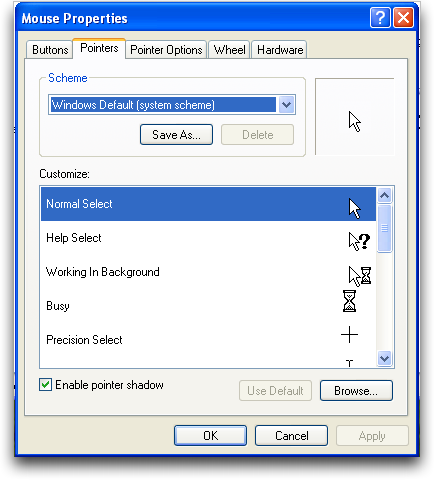
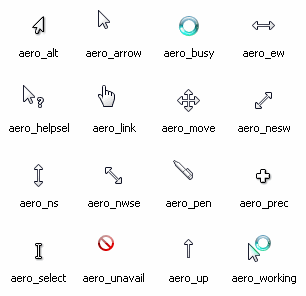
Windows users seem to place similar importance on that clicky thing. A recent PC Magazine article writes, "Few things are more important in Windows than the mouse pointers." Dave Taylor discussed mouse pointers once, showing this picture of Windows XP's mouse pointers: Windows XP's mouse pointer, then, doesn't look like the one John Goerzen got. They look like a bent version of the normal X11 pointers with inverted colors. Windows Vista's mouse cursors do look like GNOME's (via a BlogIsEverything post): For this reason, Windows Vista feels like a cheap knock-off of GNOME to me whenever I use it.
14 October 2008

MJ Ray: Three Internet (GPRS) with Sony Ericsson k608i and GNU/Linux

One massive annoyance with last week’s trip to the L2SE conference was the terrible state of WiFi access in London. I’d actually paid a little extra for first class on the home trip because it gives access to Paddington’s Victorian Lounge which says “It also has workstations with access to the Internet”. What it doesn’t say is that the workstations are desks not computers, there’s no wired ethernet and the wifi is Extortionate ISP The Cloud at the cost of 4.50 an hour. Alternatively, you can pay through Orange at 6/hour or more reasonably through O2 at 7.50/month. I was carrying two mobile phones, but not an O2. Why is Paddington so backwards? Bristol Temple Meads has U2com free wifi access through Dashi sushi bar (note it’s not National Rail or First Great Western) and fon which was about 3/day last time I used it. 4.50/hour seems a really terrible deal to me - I’ve used cheaper internet cafes than that and they have to maintain actual hardware. If that fee really reflects their costs, The Cloud must be a pretty wasteful operator. So I finally got GPRS working on my phone. Essentially, it was the same as described on Dave Stevens site and davesource, with the exception that the k608i already knows the connection settings, so the AT+CGDCONT line can be removed completely, as mentioned on Of Linux, GPRS Phones, Serial Cable, Irda, Bluetooth and USB, by Mikko Rapeli - otherwise the phone replies ERROR and the connection fails. It also needs the guest * guest line in the pap-secrets file and a matching user guest in the gprs options file. Another TTLLP member tells me that later phones offer NAP service and that pand is much simpler than pppd/gprs. I’ll find that out when I get a newer phone, I guess. Someone else suggested ip-over-dns to punish The Cloud for their silly fees, but is that legal?

13 October 2008

Decklin Foster: What's sup?

After some weeks of final testing, I've just uploaded packages for sup-mail to NEW. I'm pretty excited about this. Sup is a console-based MUA, like mutt (which I have used for many years). A few things distinguish it from most mail readers targeted at geeks like us:
  • Sup has no folders, a la Gmail. After watching many friends and even fellow hackers switch to Gmail, I have to admit: this literal hierarchical organization thing doesn't scale. I was planning to totally redo my mail folder system Any Day Now for about six months prior to starting on this. It was never going to happen.
  • Sup uses a Ferret full-text index to make this approach plausible. Search is super fast and beats (for me) both any kind of "organization" I could have disciplined myself into and the fine-grained control of something like mutt's search. It's sort of like git: until you do it, you don't realize how much more productive you can be when previously-expensive operations become instantaneous.
  • Sup works with threads, not messages; this is another thing Gmail got right. I used to waste brain cells thinking about which messages in a thread were worthwhile enough to save or not. Given the absurdly cheap price of disk relative to what we can type out in plain text since, like, a decade ago, this is crazy. In the index, I only have to look at whether a thread has new chatter or not, not its size, shape, or where the new messages are relative to it. All that's in the thread-view buffer where I actually read content.
  • Sup is written in Ruby. Back in the dawn of time, I used Gnus, and while I wasn't very good at elisp, the hackability afforded by being written in a high-level language was very nice compared to programs mostly implemented in C (even if they had a tacked-on scripting language). Plus, I love Ruby right now.
Despite all of those wins, sup currently has many drawbacks, and I don't recommend it for everyone. (And I mean everyone who thinks that the above are good ideas and are interested in using it; plenty of people, I'm sure, already think everything about this is idiotic, not new, or inferior to their preferred MUA. That's fine! You can ignore it all.) Here's what's still problematic:
  • At version 0.6, sup is very much not-yet-1.0. While it handles insanely large amounts of email without breaking a sweat, I still keep an additional backup of everything. (If Ferret crashes, the original copies of mail will be untouched, but it never hurts to be paranoid.)
  • The flow of data from your physical mail store to the sup index is currently one-way only. Actually removing deleted/spam messages is a big hack (if it works at all), and labels/flags/etc live entirely in Ferret-land. If you want to manipulate an actual mailbox, mutt is still the tool for the job (and then, you need to re-sync sup). This is probably the deal-breaker for most of us. I jumped in anyway because I feel like it can be solved (or more likely, made irrelevant) later.
  • William (upstream) is currently re-designing the whole thing from scratch, replacing the index library with Sphinx, and decoupling the index from the console frontend. As a result, the previous item is pretty much a non-priority (and bugs in general are not going to get the same amount of love as usual). I am hoping that we end up dumping mail into the index directly, then writing more frontends to write to Maildir backup, serve as webmail/whatever, but this is a long way off. On the plus side, thanks to Thrift, they will not be limited to Ruby.
  • Ruby's ncurses library still doesn't handle Unicode correctly. It can be patched (still doesn't work totally right), but I'm trying to find a more permanent solution for Debian.
So, if you're interested enough that you want to deal with these warts for now, apt-get install sup-mail (as soon as it hits the archive) and join us! Hopefully being in Debian will increase the userbase and get things fixed faster. If you're unsure, stay tuned for the next-generation version later. (There are screenshots and a few introductory docs over at Rubyforge that illustrate and explain all this in more depth, which I recommend checking out if you're still saying, "...huh." Me, I'm a sucker for any piece of software with a manifesto.)

21 August 2008

David Welton: Introductions

I'm doing some contracting work at a local firm, and one of the little details that I have been pleased with is the fact that they seem to do introductions for people. On my first day, I was taken around and introduced to everyone, despite the fact that I probably won't be there long term (depending on where we go and when). Today, they were showing around a guy who will be doing a sort of student internship there, and once again, they stopped by my office. I appreciate that a lot, and think that it's a good thing for a group of people to at least have a bit of an idea who newcomers are. One of the things that I have always loathed, and vowed to do differently should DedaSys ever be more than myself, is feeling like an animal in a zoo when The Boss brought someone into the office to take them on a tour, pointing at us developers and talking about what we do, with no reciprocity. "This is Dave, one of our open source guys, who is really into Linux. He once roamed the temperate forests of Oregon and his mating season is from early January to late December." We get pointed at and talked about, and the other person remains a Mysterious Stranger. Granted, it's not always possible to disclose everything, but I think that you can still do a lot to make people feel respected without spilling the beans on a big potential customer or investment.

1 August 2008

Matthew Garrett

Coincidentally, I had the opportunity to poke at a machine that actually does deliberately treat Linux differently in its ACPI tables today. Jeremy was poking at an Acer Aspire One before installing Fedora on it, and Dave noticed that it printing a bootup message indicating that the firmware was testing for _OSI("Linux"). A bit of poking later, and we have the following:
            If (_OSI ("Linux"))
             
                Store (0x03E8, OSYS)
                Store (0x0A, \_SB.PCI0.LPC.S4TM)
                Store (0x43, \_SB.PCI0.EXP2.PXS2.LSMP)
                Store (One, \_SB.PCI0.EXP2.LL0S)
                Store (One, \_SB.PCI0.EXP2.LLL1)
             
            Else
             
                If (_OSI ("Windows 2006"))
                 
                    Store (0x07D6, OSYS)
                    Store (0x06, \_SB.PCI0.LPC.S4TM)
                    Store (Zero, \_SB.PCI0.EXP2.PXS2.LSMP)
                    Store (Zero, \_SB.PCI0.EXP2.LL0S)
                    Store (Zero, \_SB.PCI0.EXP2.LLL1)
                 
Other OSes get the same values as Linux, other than the OSYS field. Now, what do these writes do? They're all to PCI config space, so since the machine in question is a 945/ICH7 machine we have publically available docs. A bit of digging later and it shows that the firmware is disabling PCIE active state link control and programming more conservative timings for entry into the C4 processor idle power saving state. In other words, certain bits of power management functionality are compromised if it detects that it's running anything other than Vista. Weirdly, it also flags the HPET as present but invisible on Linux, but I suspect that's an oversight rather than anything deliberate.

Why would they do this? I've no idea. I suspect it's something to do with the degree of platform validation performed rather than a subtle attempt to degrade Linux's battery life on the hardware (frankly, we do a good enough job of that ourselves right now), but this is exactly the kind of reason we removed _OSI("Linux") support from the kernel. Vendors will do stupid things with it.

27 July 2008

Russell Coker: New Net Connections

On Thursday my new InterNode ADSL2+ service was connected [1]. I needed to get a connection with a larger download cap and a better upload speed because one of my clients wants me to transfer some significant amounts of data as well as hosting some Xen DomU’s for him. Strangely InterNode couldn’t offer a regular ADSL service but could offer Naked DSL (which means DSL without a phone service on the same pair of wires). So I now have Naked ADSL 2+[2] although unfortunately the line speed is reported as being 8263/814 Kbps - ADSL2 speed. For the moment this will do, but I’ll investigate the possibility of improving this eventually. Another strange thing about this is that Optus is the carrier for the ADSL line, Telstra is the monopoly telco with the vast majority of local-loop copper pairs so it’s surprising that I end up with Optus owning my copper - the wires in question were used by the previous owner of my house for a Telstra connection! On Friday I converted my network to using the new ADSL link and on Saturday I got my SE Linux Play Machine online again [3]. I could have managed the transition without ~20 hours of down-time for the Play Machine, but as I only get a few logins per day it didn’t seem to be worth the effort of rushing it. Also on Friday I got a new 3G modem from Three [4]. They advertise that the USB or PC-Card modem will cost $5 per month on a 24 month plan, but when I ordered it I discovered that as I have an existing mobile phone plan with them the $5 per month is waived. So all that I have to pay is $15 per month for a 1GB data allowance (which is about the best deal available). A client is paying for this so that I can provide remote support for his network. I had previously written about my search for an ideal mobile SSH client [5], I ended up getting an EeePC 701 which cost $300, an 8G SD card and 8G USB stick (for expanding the internal storage and for moving files around respectively) which cost $83, and now $15 per month over 24 months for net access. That gives a total of $743 for two years of mobile net access. This compares well to the $960 that an iPhone would cost over two years and provides a lot more utility (while admittedly not fitting into a pocket). Dave Hall [6] gave me a lot of great advice about selecting and using 3G modems. He recommended that I get the E220 modem as it’s easy to configure (mine was easy on Debian/Lenny but didn’t work with a Debian/Etch kernel as the necessary driver was not available). Three also sells another model the E169G which is apparently tricky to set up. There was one mistake made in the design of the E220, the cable is installed in such a way that the LED which indicates connection status is going to be face-down when connected to almost any laptop which has horizontally mounted USB ports (which includes all the thinner ones). Here is the PPP chatscript for use with an E220 modem (suggested file name /etc/chatscripts/three):

ABORT 'BUSY'
ABORT 'NO CARRIER'
ABORT 'ERROR'
'' AT
OK ATQ0V1E1S0=0&C1&D2+FCLASS=0
OK 'AT+COPS=0,0,"3TELSTRA",2'
OK AT+CGATT=1
OK AT+CGDCONT=1,"IP","3netaccess"
OK ATDT*99**3# Here is the ppp configuration file which references the above chatscript:
/dev/ttyUSB0
230400
noauth
defaultroute
usepeerdns connect "/usr/sbin/chat -v -f /etc/chatscripts/three"

23 July 2008

MJ Ray: LugRadio Live Event Review, Part Web2.0


LUGRadioLive 2008 by sheilaellen (cc-by-2.0) One aspect I didn’t mention in the LugRadio Live Event Review was how old-fashioned it seemed in some ways. I guess I’ve got used to seeing conferences experimenting with various web2.0 toys like live-blogging, feedback walls and so on, or the excellent live video streaming of DebConfs, but it was a bit of a surprise to find myself the only person in the audience who connected to the IRC channel from the event. One possible reason for that was that the wireless network was a bit difficult, or at least that was what I was told. I felt quite smug with my 3G smartphone IRC client (which I’ll blog about later) until Rufus Pollock mentioned the 800+ patents involved in 3G. Damn - I guess I hate freedom. In one way, I guess it’s appropriate if the network wasn’t up to the task. Broken networks were a regular feature of early ALUG meetings, as the end of this email hints. Web2.0 was there a little bit. There was a facebook page (which I accidentally spammed while travelling to the event), flickr:lugradiolive and a twitter link of #lugradiolive - but how does that work? There’s no user called lugradiolive and you can’t have usernames containing # Update: twitter:#lugradiolive (thanks to Dave Briggs for the explanation in a comment). Anyway, seeing as there will be another LUG Radio Live, maybe we can arrange something more interactive but free-software-friendly for 2009? More reviews I’ve read: davee: Lugradio-in makes me feel good , Peter Cannon: The party’s over for LugRadio Live and No’: Lugradio Undead - but why aren’t more people writing about this event? There seemed to be enough there. Or are they out there but I’m just not seeing them?

19 July 2008

MJ Ray: Lug! Radio! Live! 2008!

All being well, as this post appears, I’m on my bike on the first leg of my journey to LugRadiO Live UK 2008 in Wolverhampton, blasting my way past WordCampUK who daftly picked the same day. However, I plan to post a report from LRL, while Dave Briggs will post from WordCUK. Now, shall I heckle Open Knowledge, Community-Community-Community or Beard?

3 June 2008

MJ Ray: BBC website, TV and Technology

[Dish]
(How I get TV) The British Broadcasting Corporation, the largest UK public service broadcaster, is seen as a slow lumbering beast and a bit clueless about technology, as you can see from the comment when I wrote about Click: Free=beer and facebook-flaming recently. I think that's a pretty typical view. For example, the BBC has recently helped to launch Freesat which is good in some ways (free-to-air and maybe more standards-based than Sky) but still publishes half-truths like

"Installing a satellite dish is a job for professionals"
(On balance, it's no harder than installing most TV aerials, in my opinion, but remember you get no warranty on DIY.) It's pretty much the same situation online, which is why stories like The BBC and innovation [DavePress] and Good news for websites - BBC told to link out more! continue to be news, nearly 12 years after the BBC's website launched. (Source) One of the few areas where BBC triumphs is probably news-gathering, picking up stories that are unpopular with both business and government, like BBC NEWS: Towns triumph in broadband tests which follows the Experts Say Ofcom Wrong About Rural Broadband storm online. I recently helped The Doon of May team look into internet connectivity and I was surprised how bad it was in their location: a bit of attention from BBC News is most welcome. If you'd like to try receiving the BBC - or some other national broadcasters in Europe - by satellite, I'm currently taking Questions About Cycling on Satellite over on my Cycling Fans blog.

23 May 2008

John Goerzen: Bicycling to Work

We hear a lot these days about the price of gas, energy efficiency, and the like. But, in the United States, outside of a few progressive cities, there aren't a lot of people that are using the ultimate zero-emissions transportation technology: bicycles.

That's really too bad, because bicycles are a lot cheaper to operate than cars even before you consider gas prices. They also are great exercise and are probably faster, safer, and more convenient than you think.

I live about 10 miles (16 km) from work, which includes several miles on sand roads. I haven't bicycled in about 6 years. Last week, I got my bicycle out, touched it up a bit, and started riding. Sunday I rode in to work and back as a test. As soon as I get a bit of gear (hopefully by the middle of next week), I plan to start riding bike to work at least 3 days a week.

I've picked up some tips along the way. Let's talk about a few of them.

Safety

Many people think bicycling is dangerous. In fact, bicycling is about as safe as driving an SUV. Not only that, but only 10% of bicycling accidents occur when you are hit from behind (and 90% of those produce only minor injuries). It turns out that the vast majority of bicycling accidents occur because people are not riding on the road with traffic, or are acting unpredictably. Following some basic safety advice can make you safer in a bicycle than an SUV. Oh, and don't drink and ride; 24% of fatal bicycle accidents involve an intoxicated rider.

Distance

Think it's too far? Think again. It's fairly easy for an untrained, unfit person to ride a bicycle up to 10 miles without working hard at it. That can probably be done in about an hour. As you get more fit and used to the bike, you may be able to go that distance in half that time. Also, get pannier bags for your bicycle. They attach in back and let you carry work clothes, laptops, etc. without having to use a backpack.

Smell

Many people with office jobs are concerned about this. Not everywhere has a convenient shower. Check out these tips from the Tips and Tricks for Biking to Work manual.

I'm excited about it, and will be sure to post more here on how it goes.

16 May 2008

MJ Ray: No Battles - Just Stand Firm On Best Practice

"Here are three examples of rules that I think it's time to abandon. These particular examples are all about email. 1/ Top Posting [...] 2/ HTML Email [...] 3/ Reply-To On Mailing Lists [...] So, yes, the barbarians are at the gate. The lunatics have taken over the asylum. Good ideas have been crushed by the number of people who don't understand them. But there's no point in complaining about it. You just have to accept it and move on."
-- Pointless Battles For Geeks, By Dave Cross Unsurprisingly, given the above links to my site, I disagree with Dave Cross's conclusion, but I do agree with two aspects: battling is generally pointless and using hard rules about these things is unnecessary. I have those pages on my website so that I can point to them when their broken emails aren't handled as expected. I use some aspects of them as scoring inputs in my mail filters. I don't use them as rules and I try not to complain about them too often. Nevertheless, I still believe sending properly-trimmed plain text emails from a list-friendly email client is clearly best practice, to be recommended when someone asks why their email bad habits are causing them problems.

24 April 2008

Wouter Verhelst: Breakfast

I should have breakfast with Dave Jones some day. Giggle.

18 April 2008

MJ Ray: Explaining web site improvements: what's important to you?

[Photo of Some Traffic]
Is this traffic or congestion? This is one of those Friday Afternoon Projects - it's been put off all through a busy week because it's unpaid, I'm not completely sure how to approach it and now my arms hurt like hell from travel jabs which are making it hard to concentrate! So I'm going to float it on here... I've been asked to brief a meeting next week about that group's current web site and its problems. I'm not linking it yet to avoid insulting/embarrassing them. The site looks OK, but doesn't rank well on search engines and doesn't allow much member participation. I need to explain why that's a bad thing and how the site's technical choices have led to that. I'm not directly pitching for TTLLP to get any work (because I'm a member of that group, it might be a conflict of interest and we're pretty busy anyway - even our own site needs work on some of the points I'm going to mention), but I don't want to be unhappy if we're asked to implement my recommendations. I've got a usual outline that I follow, but my presentation's time is limited, so I'd like to ask you: what about this is important and what isn't? If you give me useful feedback, I'll put you in the Acknowledgements with a backlink and I hope the briefing will be shared pretty widely over the next few months. The current plan is to start with a basic explanation of how search engines rank pages, as far as we can tell, referring to PageRank Explained Correctly with Examples, by Ian Rogers as well as the shorter official summaries from the dominant search sites at Yahoo, Microsoft and Google. Then I go through a quick evaluation of the site against the basics of validation, accessibility and robot-friendliness, followed by a couple of SEO-style checks of its current rankings and inbound links. Next is a bit different because I have access to some of their web access stats: I summarise what we know and suggest some other stats they've probably not considered and why they're useful, along the lines of Dave Briggs's measures of blog success. Finally, I suggest ways to improve the site. The top tip will be to take control of the site hosting and stop using the cheap and cheerful donated server that makes all links except the front page point to another domain. I'll probably suggest a mix of free and open source software tools to power it. If they don't want to move it all yet, I'll suggest running a second site for member participation, using tools like Wordpress, NoseRub and so on. What do you think? Plan for success, am I missing some tricks, or am I setting myself up for a lynching? Let me know with a comment or email, please.

15 March 2008

Dirk Eddelbuettel: SFJAZZ Collective at CSO

Went to the CSO yesterday as a nice way to end a frantic workweek: first a beer or two after work, and then off for some Jazz. Yesterday's program was the SFJAZZ Collective: eight individuals, all noted in their own right, coming together for a few weeks each year to play as an ensemble. The program generally consists of two halfes: one with material by a modern composer -- Wayne Shorter is this year's pick -- and new original compositions by the band members. This was a special treat as Wayne Shorter's compositions from the 1960s, both from the bands he lead and as a member of the legendary Miles Davis Quintet, have always been some of my most favourite modern pieces. At the same time, it gave me a chance to finally see Joe Lovano on ts and Stefon Harris on vb. Other band members were equally impressive: Dave Douglas tp, Miguel Zenon as, Robin Eubanks tb, Renee Rosnes p, Matt Penman b, Eric Harland dr. Favourite new composition of the night: 'Angel's Shares' by Penman. All in all a nice evening out to cap off a busy week.

4 March 2008

Andrew Pollock: [life/americania] Viva la fortnight!

I'm slowly converting the team I work with to use the term fortnight. It's so much less ambiguous than "bi-weekly". (Provoked by Dave Jones' post)

Kai Hendry: Gear the Web on mobiles

android on dwm Update (3/3/2008): We’re also working to bring Google Gears for mobile to Android and other mobile platforms with capable web browsers. Here is my writeup of yesterdays Android Code Day in London. Eclipse 3.3 is needed to get the plugin working. Only eclipse 3.2 is in Debian unstable. Download the Europa release and re-setting up the plugin will do it. I’m no Eclipse fan boy, though the integrated debugger works. The iteration cycles are really short for trying stuff out. Very good. Developers, mainly from a Symbian background grilled Jason Chen over security and wanting C API access. Lot of people didn’t seem to like the idea that users were controlling security. I like Google’s “empowering the users” stance, though I think representatives from operators don’t. I heard that poor argument about users asking their operators for android support. Jason argued well that it’s up to user education to contact the right people. When a computer crashes in the UK, who do people call? VirginMedia? Please! :) How about Breakpad crash reporting on Android?. Jason used the OHA to defend Google from looking like they have all the political power… Hmmmm. :) I can understand the tight rope that Google are walking. They are trying not to fragment their platform before it’s properly released. OEMs, operators will feck it up if they have the chance to play with the source code before a Google co-ordinated release. Once they release Google claim they will release everything under the Apache 2 license. So I asked could we see Android on desktops? Jason said there is nothing stopping you. I hope not. Their opened fonts and multimedia codecs on desktop PCs could really make a big difference for Linux take up, especially in Asian (growth) markets. I have studied and implemented Asian fonts and Android’s font rendering even on that nightmare Website sina looked good to me. Despite the “Symbian developers” giving Jason hell in the beginning I had impression they actually liked Android. It fealt almost staged. Scary. Symbian C++ programmers learning Java and jumping ship! Same old problems with images. People are concerned about how bitmap images will scale on different target screens. There is four ‘skins’ already supported in the emulator (QVGA-L+P, HVGA-L+P). We need scalable images too on the Web. ;) Though there are some workarounds demonstrated which seemed OK to me. During the hackathon, I wanted to write a backup/sync tool. Since only Jason Chen seemed to know Android and there was a filled audience, I didn’t get to ask him how really to go about coding it. Though with the help of Dave from Zyb, we eventually found out about content providers. Took some debugging to find that out, but we got there. Having a working debugger is really really nice. We discovered we needed “android.permission.READ_CONTACTS” in the manifest to make our little application that read out the contact on stdout. Cool, though I’d rather use Javascript and the Web stack. Anyway, Android seemed like a good platform, but I have concerns. My biggest concern is basically where is Google Gears on Android? Jason could neither confirm or deny this, so perhaps they have it. Though gears is an opensource project and you can see code reviews… no Android mentioned. What happens if the Android platform is wildly successful? Then we are going to see two major platforms. The Android platform on mobiles and the Web platform on everything else. I worryingly saw no support for Web application device APIs on Android. Encouraging people to write for their Android/java-esque platform undermines their main Web platform! It’s like Microsoft’s mistake of undermining their own platform all over again. From Android you can use Webkit and the Web stack. But from the Web API stack you can’t seemingly access their Dalvik VM APIs. I disclose I am an employee of Aplix (opinions etc. are my own), also a OHA member. I am actively working on a plugin technology that exposes APIs as familiar JS APIs to Web developers. I have already done a proof of concept implementation of Google Gear’s Location API on mobile devices with Aplix technologies. Google you should really do the same and make Web applications equal citizens on your mobile platform by implementing Gears on Android (if you haven’t already).

29 February 2008

Dave Noble: More Linux Audio Conference Talks

A quick update on the situation of the video streams from Linux Audio Conf; yesterday we had over 200 viewers watching the live streams, today even more. If there was a talk on yesterday that you wanted to see, the videos are available online here.

As usual, the live streams are available here.

Next.

Previous.