Search Results: "cklin"

28 October 2008

Ondřej Čertík: Google Mentor Summit III

On Sunday I checked out from the hotel and enjoyed the breakfast, basically the same as the first picture here. Which is cool, the best way to start a day is with a good breakfast in the morning.


At Google I finally met with Bart Massey, who works at the Portland State University where I was an intern (in 2005) and also he was sponsoring one SymPy GSoC student in 2007.


Then we started to port SymPy to Jython with Philip Jenvey. I first installed openjdk-6, which is in Debian main, then checked out Jython svn, typed "ant" and it just worked. This is so awesome, that we finally have a truly opensource and fully working java implementation in Debian. Philip fixed some bugs already, so SymPy imports just fine. Most of the tests run, but also quite a lot still fail.

We managed to isolate two bugs: issue 1158 and 1159. Then there was an annoying recursion bug, that took us several hours to dig into and I then had to leave at 6pm without a clue. But Philip kept saying, I just need to look more at the java stacktraces that Jython was generating and I'll figure it out. And he did! The next morning he filed an issue 412 in the PyPy tracker, because they seem to have the same problem. There are subtle differences in how to handle __mul__ and __rmul__ methods that are not well documented, so it works in CPython but fails in Jython/PyPy. I think we can fix that in SymPy too in the meantime, so I am very excited, because it seems SymPy will work on top of Jython soon.

There was also a git vs hg session with both hg and git developers. Since I recently switched from hg to git for all stuff where I can choose the vcs, it was very interesting for me. And I must say I am glad I switched. Mercurial works fine enough and with the recent rebase feature I think it is usable, but git just has a bigger momentum at the moment and it just doesn't get in my way.

During the day Steve sent an email to the GSoC list that Dirk forgot his jacket in the hotel room, so I said to myself, haha, that's a pity. And then I realized, oh shit, I left my jacket there as well. They didn't have it in the evening when I stopped there, but fortunately they sent me an email yesterday that they found it, so I'll stop there on my way back.

We also took couple of group pictures, here is just my lame attempt (I am sure people will soon post better ones):


On Monday morning I met with Fernando Perez, the author of ipython, he know works with Jarrod. Then I rented a car and came to visit Brian Granger and his family in San Luis Obispo.

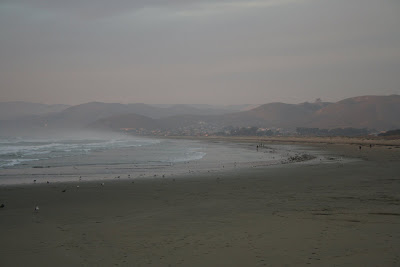
We went to the beach in the evening:


And had a dinner together. Brian showed me his options pricing example he did with SymPy, so I made him create an issue 1175 with the code.
Then we played with the parallel stuff that Brian contributed to ipython and we tried sympy with it and to our disappointment, we found pickling bugs in sympy, it works with protocol 0, but not protocol 2, see the issue 1176 and 1177. This almost smells like a bug in Python itself, but I need to investigate that later more deeply.

Today is Tuesday and we'll work on doing atomic physics calculations with sympy. See also Brian's email to the sympy list about it.

27 October 2008

Decklin Foster: We could customer care less

(And now, a cathartic "I hate this company and I am never patronizing them again, please don't either" post. I should have done ones for at least Speakeasy/Covad and IBM's server division last year. Ah well.) I went to go register a new domain yesterday (announcement soon! Probably this weekend). I've been using Joker for a while, IIRC on the principle that the cooks were using it so it must be decent enough. While registering, I had a bunch of problems with the horrid, useless "Verified by Visa" popup [1] that you see everywhere these days, and eventually this must have looked like suspicious activity to the bank so my card was declined. I only actually found this out when I got mail saying my order was canceled. Okay, sure. I wrote back and explained what I thought was going on and that I'd like to resolve it. Another half hour later, I got this response:
Hello,
please use
   https://joker.com/goto/support/
for all support inquiries.
Regards, your Joker.com team
This is complete and utter bullshit [2]. If a company is going to mail me, I expect to be able to mail them. I have a mail client; it manages communication the way I want it to, and runs my preferred editor to compose messages (which is, in fact, how I am writing this very blog post). I am sick of dicking around on JavaScript-requiring web forms that all work differently and typing in postage-stamp-sized little textareas. Anything I do type in them is lost, because unlike my email client, web forms don't save sent messages unless the authors feel like letting you have a Cc:. When a company forces me to do this, I take it as a sign of disrespect. I tolerate a web browser [3] for reading pages; "applications" are universally painful [4]. One of the things I used to like about Joker was the PGP mail interface. AFAIK, they have not killed it (I didn't bother to check), but with automatic "we don't want to listen to you unless you inconvenience yourself" bounces like this, what's the point? I surmise that there is, or was, some smart person there who understood how (and more to the point, why) to hook a pseudo-mailbox up to a software system, and that they have been overridden by someone in management who realized it's much easier to have dime-a-dozen webmonkeys hook a form up to the same system since 90% of users just don't care (and even people who do notice and dislike this, but are not as inflamed as I, have come to expect it because everyone else refuses mail, so, y'know, pick yr battles son, etc.). Not the sort of culture I put faith my in. The irony of it all was that I was registering this domain to run a service I had decided to create specifically because of another site refusing mail and directing me to an even lamer web form. That would take incoming mail and, you know... process it with software. Suffice it to say, I am no longer going to be their customer. In deciding who to use instead, I figured I'd do a survey of where the domains in that "Subscription" column [5] on Planet Debian were registered, but... WHOIS is basically useless. Every server just returns free text, formatted differently by (apparently) every implementation under the sun. Cheaply parsing something out from .com/.org/.net is possible, but InterNIC kindly blacklists your IP after making more than a few requests in a few minutes. I guess I'm just gonna go with Gandi (but other suggestions would be welcome). In somewhat unrelated developments, I went to nic.at to update my nameservers for Where the Bus At? last week. There was no authentication or anything on the request form, so I just filled it in and sent it off. I got some automatic mail saying I need to print out a PDF, sign it, and fax it internationally. Annoying, and hardly as secure as mailing them with PGP, but whatever. But then, also yesterday, I got another mail saying the update was complete (lo and behold, it was). I am now somewhat concerned about the security of my domain: it seems like anyone can come by and put something in the form and if I'm not around to notice the courtesy mail and ask that they stop the request, it'll eventually go through, no questions asked. I have not yet written them to figure out what the deal is, though. Kinda burned out. I guess I didn't really have high hopes for dealing directly with a ccTLD registrar (this was the first time I've done it... I can't believe I blew 60 on a cutesy domain name) rather than a reseller who competes in a market, but then, I go and google "domain registrar" and look at all the AdWords dollars spent trying to compete with GoDaddy [6] and just kind of want to put my head in my hands. On DJB's DNS pages there's this bit about setting up a domain. It doesn't say "How to (buy register whatever) a domain name". It says, "How to receive a delegation from .com". Which is of course, how it works. And what I want to buy. I don't want "parking" or even gratis nameservers. Just a delegation from .com. Please. No AdWords came up when I googled for that phrase to copy the link. Sometimes I guess markets just sink to the bottom. Anyway. I feel like there's a free-software angle here. My continuing irrational hatred of using other people's forms, web-based mailing-list substitutes, nameservers, etc. stems not so much from their suckage but from the fact that there is no longer any software there, in front of me, for the four freedoms to possibly apply to. Being able to run your mail reader for any purpose doesn't win you much if no one uses mail. I don't really know what to do about this.
[1]It was only twelve dollars! If I go to hipster market or some other place with brand-new POS systems they don't even make me sign a paper slip for less than $20 or so. But this is the sort of thing dreamed up by people who think good security is setting a cookie to denote that I've answered "what was your first dog's name" or whatever. IF YOU WANT TO BREAK INTO MY BANK ACCOUNTS: I've set the answer to every single one of these questions to "security theater". Easy to remember.
[2]Not to mention a glaringly RESTless URI.
[3]Also, as a rule I normally try not to have anything up on my desktop that I can't close and re-open at any time, thanks to screen, MPD, emacsclient, actually using my browser's bookmark function and resisting the lure of tab-bar.js, etc. Web browsers are supposed to suck at preserving state; HTTP is stateless. See also here (and for further reading on that in the Haskell world, check out Yi. I'm hoping to switch to it someday).
[4]Debbugs, for example, may not have the slickest interface, but if I want to do flags, labels, archiving, threading, or whatever, I can; I'm not at the mercy of some front-end web developer. But we've all heard this litany before.
[5]Thanks, Hpricot!
[6]Even if GoDaddy's customer service were completely hacker-friendly, I would not use them, because their president Hates America.

20 October 2008

Decklin Foster: And yet I swear this oath

There was a lot of political talk last week in the US about this guy "Joe the Plumber". I'm really quite mystified by the (lack of) Democratic response to this one; it seems like a perfect opportunity for the Dems to explain what their ideals actually mean, after years of complete inarticulacy. The Republican party, and conservatives in general, have somehow successfully sold their platform of, as Robert Reich brilliantly put it on the Daily Show last week, "socialism for the rich and capitalism for everyone else", to poor but socially-conservative citizens for quite some time. They've convinced people to vote against their economic self-interest, and cut taxes on the rich instead of themselves. Is voting for policies that directly benefit you less necessarily bad? I don't think so. In many cases, selflessness and altruism are better in the long run. Conservative economic policies speak to a sense of right and wrong that give people a feeling of purpose, and so an incentive to create: this is mine, I made it, you can't take it away. In a theoretical sense, leaving more wealth in the hands of the rich should "trickle down" to society in general, by providing more capital, and thus creating jobs, etc. However, I do not believe that this is why Americans, specifically, tend to support conservative economic policy. The USA has this idea of the "American Dream", pulling yourself up by your bootstraps, if you will, and striking it rich through hard work and character. It's advantageous for conservatives to sell this idea because it makes people think "tax the rich? What if I get rich?", which is a sort of enlightened self-interest, arguably. And it gets poor people to vote for them. What makes this "plumber" thing interesting to me is that is should demonstrate where this approach ought to fall down, logically and emotionally. But it does not. Here is the problem. A working stiff who earns "five figures", such as myself, generally makes that money by going to an employer every day, performing some services for them, and then drawing a paycheck. Where this money comes from is abstracted away (this is the marvelous thing we call "business"). Let's say you want to sell the "American Dream" to this person. They get their paycheck every week, and there's a chunk taken out of it by Uncle Sam. Maybe they're saving up to start a business, or go to college, etc. They sure could do it faster if taxes weren't so high. So you remind them this: when you do strike it rich (since this is America, where anyone can strike it rich), do you want those taxes to be even greater? This story contains a lie of omission, probably the greatest lie ever told in US politics, and one that has almost universally succeeded as far back as I can remember. And that is: when you do make that jump to where our hypothetical Joe is, making just over a quarter-million dollars, that it's not going to look any different. You'll get your paycheck from some abstracted source, just like before, but more will be taken out unless we stop raising taxes on those higher income brackets. There will be some node higher up in the tree for that wealth to "trickle down" from; you could say it's implied, even, that wealth is created at the root and destroyed at the leaves. What's wrong here? Simple: a self-employed plumber does not have a paycheck, except maybe to him/herself for accounting purposes. They collect their income in the form of payments from customers. They don't have an abstraction: they hire more labor and become the abstraction. If their customers have no money, the abstraction leaks, their employees have to be laid off (and then can no longer afford plumbing services themselves). The success of the plumber depends as much on how many people are able to pay them as it does on his costs (such as taxes). We want to make sure those customers can still pay. This is, in theory terms, the idea of demand-side or Keynesian economics. (Not really exactly. I took about two econ courses. But bear with me for a moment.) Now, you can argue demand-side vs. what we would call supply-side economics, which is the idea that no, first you have to stop taxing Joe so he can hire people so they have money to go buy things, for ages. People have made whole careers out of it. I am not here to do that. What I am here to wonder out loud is: why is this argument not happening, now, in our public sphere? Even if only as a small plot point in one Presidential campaign? There are very good arguments for both sides (I agree with the Keynesians, myself), and they should be what this debate is about, not digging up dirt on some guy whose real name, horrors, might not be "Joe" or protests about all those you-know-what poor people getting "government giveaways" that are disturbingly close to racism in my opinion. When I turn on talk radio I hear zombies, unable to string together any thought more complicated than "Democrat == higher taxes on everyone" (which would be depressing even if the claim were true). It begins to get unsettling when you understand your opponent's argument, and yet watch them completely unable to articulate it. When they deal with this by appealing to fear and thought-killing sound bites, it gets alarming. Obama has backpedaled whenever the whole issue has come up. In the last debate, he was saved by merely shutting up and letting out enough rope for McCain to hang himself. Not very inspiring. As a result I hear repetitions of Obama's phrase "spread the wealth around" constantly met on the airwaves with... silence. He won't touch it, and honestly, I can't blame him for not wanting to fan the flames of class warfare with only two more weeks left to stick it out. But I don't understand why, and why a single person on the left hasn't had the faith that this idea can be discussed in our society. I think that, whichever side you are rooting for (and yeah, I am for the Democrats), the Democrats should have won this point readily. Not to belabor the point, but it really amazes me that they have not. It wouldn't have taken much. Here's what you do: go to Wherever, OH with your crack PR team and find several of "Joe the Plumber"s customers. Interview them all. A few of them are, in this economy, going to be really hurting. If you're lucky: Remember that Joe owes taxes to the IRS. Very possibly, someone owes Joe money! That would be a coup. You just put them in front of the media and the whole thing sells itself. Mary needs to make these repairs... if only her tax credit were larger... etc. This would not settle the argument, by any means, especially not for political junkies. But it would begin it. We could talk about policy, whether one way of "spreading" things will result in more wealth to spread than another, instead of red-baiting. I feel a bit ripped off that we haven't even gotten that much. The theory part is pretty much irrelevant to most people; that's fine. But they deserve context. I can only assume that my ("my") party is still either terrified or stupid. I hope winning the Presidency changes that somewhat. That whole right and wrong, purpose, "noble cause" thing, right? Right, guys?

19 October 2008

Decklin Foster: Njiiri 0.2.0

Seems like it's been ages since I've been able to do this (probably because it has!): I've released a brand-new piece of software. Njiiri is a client for MPD, using GTK+, written in Ruby. I don't see a lot of desktop apps out there using Ruby, so this was a new and fun experience for me. I've tried to make it as "boring" as possible, in the sense of looking vaguely like a proper, HIG-compliant GNOME app, with (appropriately) no pointless configuration knobs. The browser, in particular, is a mostly pixel-for-pixel clone of the standard file-open dialog. And it's accessed by a big toolbar button with a stock "Open" icon. Basically, if desktop software makes me think ("oh, I'm in iTunes, all the controls work differently, let's adjust our approach"), it's failed. For me, anyway. So, I'm pretty happy with the direction I'm going (even though I'm very much not there yet. I haven't hooked up search, for example). One of the things I like about MPD is that it gives me the freedom to remove things if I want to. And I like removing things; small is beautiful. For example, I originally had no place to stick a crossfading control in, so I was going to just dump it. If you need it, "mpc crossfade" is a terminal away. (It turned out that it did eventually fit nicely into my layout. I'm a bit obsessive about aesthetics.) In a similar way, I've avoided duplicating anything I do with homegrown scripts or mpdtoys; there's just no need. What I want out of a GUI frontend is a sort-of tangible way to manipulate things when I feel like looking at them visually for a bit. Then I close it and move on. MPD certainly isn't the most wonderful implementation of a system which allows that, but the client ecosystem is quite diverse and I'd say it deserves a look if any of this sounds interesting to you.

14 October 2008

Decklin Foster: The cradle rocks above an abyss

In related news: with sup out of the way, I have returned to packaging Mnemosyne, the program that powers this blog. It is also in NEW, so expect to see it soon. (Like sup, which is packaged as sup-mail since sup is the Software Update Protocol, it is mnemosyne-blog since mnemosyne is the program formerly known as PyQt MemAid.) If you're just joining us, Mnemosyne compiles a Maildir into a static site. You can use it for a blog or just about anything else where a traditional CMS would be overkill. It's all XML and Python-extensible. The documentation kind of sucks, though, so I'm also hoping I get some more users from this to tell me what to fix. It hasn't otherwise seen much action since the beginning of 2006. Drop me a line if you have any feedback! (If it's not obvious, I think blog "comments" in general are pretty worthless. But with some craftiness, they could certainly be implemented within Mnemosyne as it stands. As could a general mailing list archive, etc...)

13 October 2008

Decklin Foster: What's sup?

After some weeks of final testing, I've just uploaded packages for sup-mail to NEW. I'm pretty excited about this. Sup is a console-based MUA, like mutt (which I have used for many years). A few things distinguish it from most mail readers targeted at geeks like us:
  • Sup has no folders, a la Gmail. After watching many friends and even fellow hackers switch to Gmail, I have to admit: this literal hierarchical organization thing doesn't scale. I was planning to totally redo my mail folder system Any Day Now for about six months prior to starting on this. It was never going to happen.
  • Sup uses a Ferret full-text index to make this approach plausible. Search is super fast and beats (for me) both any kind of "organization" I could have disciplined myself into and the fine-grained control of something like mutt's search. It's sort of like git: until you do it, you don't realize how much more productive you can be when previously-expensive operations become instantaneous.
  • Sup works with threads, not messages; this is another thing Gmail got right. I used to waste brain cells thinking about which messages in a thread were worthwhile enough to save or not. Given the absurdly cheap price of disk relative to what we can type out in plain text since, like, a decade ago, this is crazy. In the index, I only have to look at whether a thread has new chatter or not, not its size, shape, or where the new messages are relative to it. All that's in the thread-view buffer where I actually read content.
  • Sup is written in Ruby. Back in the dawn of time, I used Gnus, and while I wasn't very good at elisp, the hackability afforded by being written in a high-level language was very nice compared to programs mostly implemented in C (even if they had a tacked-on scripting language). Plus, I love Ruby right now.
Despite all of those wins, sup currently has many drawbacks, and I don't recommend it for everyone. (And I mean everyone who thinks that the above are good ideas and are interested in using it; plenty of people, I'm sure, already think everything about this is idiotic, not new, or inferior to their preferred MUA. That's fine! You can ignore it all.) Here's what's still problematic:
  • At version 0.6, sup is very much not-yet-1.0. While it handles insanely large amounts of email without breaking a sweat, I still keep an additional backup of everything. (If Ferret crashes, the original copies of mail will be untouched, but it never hurts to be paranoid.)
  • The flow of data from your physical mail store to the sup index is currently one-way only. Actually removing deleted/spam messages is a big hack (if it works at all), and labels/flags/etc live entirely in Ferret-land. If you want to manipulate an actual mailbox, mutt is still the tool for the job (and then, you need to re-sync sup). This is probably the deal-breaker for most of us. I jumped in anyway because I feel like it can be solved (or more likely, made irrelevant) later.
  • William (upstream) is currently re-designing the whole thing from scratch, replacing the index library with Sphinx, and decoupling the index from the console frontend. As a result, the previous item is pretty much a non-priority (and bugs in general are not going to get the same amount of love as usual). I am hoping that we end up dumping mail into the index directly, then writing more frontends to write to Maildir backup, serve as webmail/whatever, but this is a long way off. On the plus side, thanks to Thrift, they will not be limited to Ruby.
  • Ruby's ncurses library still doesn't handle Unicode correctly. It can be patched (still doesn't work totally right), but I'm trying to find a more permanent solution for Debian.
So, if you're interested enough that you want to deal with these warts for now, apt-get install sup-mail (as soon as it hits the archive) and join us! Hopefully being in Debian will increase the userbase and get things fixed faster. If you're unsure, stay tuned for the next-generation version later. (There are screenshots and a few introductory docs over at Rubyforge that illustrate and explain all this in more depth, which I recommend checking out if you're still saying, "...huh." Me, I'm a sucker for any piece of software with a manifesto.)

8 October 2008

Decklin Foster: Mass cynicism

"Obama had the additional skill of criticizing George W. Bush."
Basically: yes. And that's what passes for politics over here, folks. Sorry about your economies and all that.

1 October 2008

Decklin Foster: Your internet access is going to get suspended

So today I recieved another batch of backscatter spam (it comes in waves; my email address will forever be on these lists). Normally there are several rejections from mailing lists where only subscribers can post, etc. But this time:
The following lines in your email message did not appear to be
Lyris ListManager commands and were skipped:
> unsubscribe confirm
>  -> You did not specify a valid mailing list name to unsubscribe from.
Disturbing. Now they're trying to take me off legit mailing lists! Perhaps they think I won't notice and it'll reduce the amount of ham I have for my Bayesian filter. Little do they know I'm still subscribed to -devel :-)

MJ Ray: How not to be a Popular Politician

So, while everyone was watching the Bush Bank Bail-out plan get rejected by Congress, they also found time to approve more bad copyright law, an RIAA-backed initiative to attack cooperative download tools like BitTorrent. Thankfully, the attempt to empower the Department of Justice to prosecute on behalf of Big Music was lost (DoJ didn’t want the task anyway) and the Bush administration is minded to veto it. But that’s been the least of my politician annoyances in September. Earlier this year, we were encouraged by Cooperatives-UK to get involved with our Local Strategic Partnership. I went to North Somerset Partnership’s event but I was less than impressed by it. There’s no obvious way that NSP is capable of promoting cooperation. Publishing a thick glossy book about sustainability makes me wonder if it’s capable of doing anything sensible - most people I’ve shown it to have either laughed at it, or got angry about the wasted resources. They’re not the only LSP we have here. Last week, I went to the West of England Partnership’s Transport Forum which

“horrendously perverted the idea of a “forum” - the event would have been better titled “Joint Transport Lectures” because nearly all our time was spent watching council officers and consultants tell us how wonderful transport is here (they’re meeting 18 out of 21 targets, you know!) and what roads and bus roads they will build next. … The whole event seems like a colossal waste of resources for all involved.”
So, I seem to be having a bad time with politicians recently. If the above wasn’t enough, we got a reply to our petition requesting ODF at the National Archives which amazingly doesn’t mention Open Document Format at all. I’ve written to our MP (John Penrose) asking about that. And finally, I asked Climate Change Minister Joan Ruddock MP
“If there’s no windfall tax to fund it, how will the government remove the climate-harming services from the market and encourage new suppliers (particularly Third Sector ones who should show concern for their communities and sustainable energy) into the market?”
and got the non-answer of
“The Government is tackling a very wide range of issues that impact on Climate Change through a variety of mechanisms. The energy efficiency programme recently announced is directed at those most in need and where a small expenditure can produce a significant and lasting saving in energy use. Thus saving households money and reducing CO2 emissions.”
What the heck has that to do with removing harmful services and encouraging new suppliers? If any politicians want to be held in better esteem, try giving some straight answers instead of imitating the above, please. “Yes, Minister” was meant to be a satire!

29 September 2008

Ian Wienand: Kernel Development Course

Here are some slides and examples I used for a kernel course I developed (some time ago now). The course was aimed at C developers who wanted an introduction to both general UNIX-style user-space and Linux kernel development with a focus on embedded systems issues. The course is aimed at two 8-hour days, and is pretty packed in even then. The first day is user-space development and kernel building, focusing on things like make, autotools, advanced gcc, getting cross-compilers working, configuring the kernel and building. The second day we get into kernel internals; building up a kernel module to produce some simple proc nodes, take data, crash and debug, etc, look at internals like concurrency and the driver model, and focus on USB quite a bit. Here is a tarball of the entire thing, including the examples. Hopefully these can help out anyone tackling the design of such a course.

26 September 2008

Kapil Paranjape: Why people write Free Software

Some people troll free software lists with remarks like:
Linux will never be able to displace MacOS/Windows since the latter are much more pretty/user-friendly. You will lose.
Such people assume that hackers write free software because they "hate Microsoft" or "hate capitalism" or have some other pet hates. However, it should be obvious that such a large creative effort cannot be sustained if it is based on such negative emotions.1 There are a number of positive reasons why one works on free software. The software that I like to work on is software2 that I use or want to use. This has some consequences which are worth underlining: Giving others the "four freedoms" results in wider critical examination of these aspects. Bugs must be acknowledged and fixed --- or elevated to features! Moreover, there are parts of the task that are "obvious" to me but I would have to ask others for advice on other parts. So I gain a lot by being part of a larger community. There are other reasons to write free software. For example, someone may pay you to do it. However, this is just deferring the same question to your employer. In most cases, your employer already has a use in mind for the software. The employer has the same concerns as I outlined above except that the job of writing the code is being out-sourced. The usability, portability and long-term maintainability are probably even bigger concerns for your employer. "Last but not the least" (as we always wrote in our school-day essays) free software is fun! You share ideas with people from across the globe and to show them your own clever little tricks. Good code and good themes resonate with people who may not even speak the same language as you do. What could be nicer than that!

  1. One should not ignore the strength of negative emotions. Enormous war machines are built on negative emotions.
  2. I use the term "software" here for computer programs. Most of what is written applies equally well to books, articles and documentation --- which are "software for the brain".

19 September 2008

Kapil Paranjape: Fedora Core DomU on Debian Etch

The IMSc recently installed a desktop machine for me that is powerful enough to run Xen virtualised domU's. (My previous desktop machine was removed at my request; explanations at a later date!) One task was to get Fedora Core running under this Debian Etch machine. Since the information required for this task was rather difficult to find (rant later!), here is a quick 2-paise tip (to borrow a phrase from the linux gazette) on how to get Fedora Core running under a Debian Xen machine. The helpful packages under Debian are xen-tools and rinse.1 Since the latter is only available with "lenny", this requires an schroot installation about which I have written elsewhere. So let me assume that we have a lenny chroot inside the dom0 in which xen-tools and rinse have been installed. One can either bind mount /etc/xen from the dom0 into the lenny chroot or one can just create this directory to hold the configuration file for the domU to be created. Creating the domU is as simple as:

xen-create-image --ip=192.168.17.71 --hostname=fedora \
  	--arch=amd64 --lvm vg0 --install-method rinse \
  	--dist fedora-core-8

   
with ip address, hostname, lvm volume group and arch chosen appropriately. (Be careful and choose a hostname that does not match a hostname that you have already used in the same Xen system). This will create the logical volumes /dev/vg0/fedora-disk and /dev/vg0/fedora-swap containing the appropriate images for use with the Fedora domU. Before you can boot into this domU there are some minor issues you need to fix; see #499476. The fixes are to create /etc/shadow and /etc/gshadow and set a usable password as follows. Mount /dev/vg0/fedora-disk somewhere and chroot to it. Then run the following commands:

  pwconv
  grpconv
  passwd root

   
Then exit the chroot and unmount /dev/vg0/fedora-disk and then exit the lenny chroot. If necessary, copy the file etc/xen/fedora.cfg from within the lenny chroot to /etc/xen/ in the dom0. You should now be ready to boot your Fedora Core 8 domU with

  xm create fedora.cfg

   
It would be nice if one could install Fedora Core 9 the same way; see #499477.

  1. Thanks go out to Steve Kemp and the maintainers of the Debian packages for their excellent work. ↩

17 September 2008

Decklin Foster: When mayonnaise goes bad

This is is a wonderful metaphor: "looking in the fridge every few minutes and hoping that something tasty will appear". I may be thick, but Planet does not appear to store any information about how often a feed ought to be polled (my blog seems to be hit every 20 minutes even when I'm AWOL). I use rawdog, which does. When adding a feed, I make a vague guess at how often I want to poll it, and then periodically adjust the time based on how often updates actually happened. This is done with a terrible, awful, ugly hack that reads the database[1] and spits out the config file with new-and-improved times. Pretty dumb, but good enough "for now" (apparently I haven't touched it in over a year). rawdog will also automatically update feed locations if given a 301. Since it already rewrites the config for that, I might try to merge time updating into the core someday, but no one has demanded such a feature AFAIK.
[1]And by "database", I mean "pickle", since Adam doesn't want any fancy dependencies. Despite how slow this ought to be, the combination of optimized (such as it is) feed-polling and ever-faster CPUs in my web servers have made it fast enough for me not to care.

Decklin Foster: Catch 22

$ hg ci
abort: cannot commit over an applied mq patch
$ hg qpop
abort: local changes found, refresh first
Obviously, I just need to RTFM, but I still find this amusing in an existential sort of way. (If I write a replacement for mq, please shoot me. I have too many things to do already.)

4 September 2008

Kapil Paranjape: Happy Birthday to GNU

The FSF is celebrating the birth of the idea that is GNU. There is a video which I have mirrored here for local users. So I plan to sing "Happy Birthday to GNU" on 27th September 2008 as well. It seems like some people are not quite so happy. One correspondent wrote that it was not the 25th birthday of the "GNU Operating System" since that would mean the GNU+HURD which he feels is still not ready. In my opinion the term "GNU Operating System" represents in loose terms "a free alternative to Unix" (free as in mukta). And that idea was born 25 years ago.2 I think that the HURD was just the "concept of a notion of an idea" 25 years ago. (The first article about the HURD was on the net about 1990 or so). Moreover, in comparison with Unix of 25 years ago, the GNU+HURD combination could be considered "ready". Thus, there is indeed much to celebrate. For example,
  1. There is not one --- there are many free alternatives to Unix. In fact, there are perhaps no non-free Unixes visible anymore! Does this owe a lot to the resolution made by RMS 25 years ago? Absolutely. Of course, it also owes a lot to the resolve of the hackers who followed up on this and took it well beyond what he had in mind.
  2. One can run the GNU tools + HURD combination to get an environment as good or better than what was available as Unix 25 years ago. Does a general member of the public really need to do this? No. There are currently a number of far superior solutions. Does the software community need this? Yes. (See below.)
I think that there are a lot of people who disagree with RMS and FSF today on a number of issues --- and these detractors may even be right. Perhaps this makes some people begrudge FSF celebrating the 25th anniversary/birthday of GNU. I offer the following points for their consideration:
  1. The vision and resolve RMS and the FSF put behind the vision --- starting 25 years ago --- have got us here.
  2. The FSF's astuteness in getting a rather well-known person like Stephen Fry 1 to celebrate GNU. If any of the distros had managed it, it would have been considered a coup!
  3. While Linux may be the dominant player in Unix today, the alternatives like *BSD, Solaris and even the HURD have an important role to play in the development of free software.
  4. That chocolate cake looks really delicious. :-)
So here's to (at least) another 25 years for GNU!

  1. Perhaps most famous in his roles as Jeeves and as the voice of the Hitchhiker's guide to the Galaxy).
  2. Of course, the practical-minded people may disagree and say we should celebrate "things" and not "ideas". Like it or not, the FSF has always valued the latter over the former.

11 July 2008

Decklin Foster: xmonad still makes me feel inadequate

I've seen this before, and I'm sure a million people have blogged it, but it never stops being funny: Lambdacats. (thanks to Nikolas Coukouma on Twitter)

9 July 2008

Decklin Foster: Cover an ox with a sheet

New Filco keyboard! Do want. (There is a good explanation of mechanical keyswitches at ErgoCanada. This is a "light tactile" board. Opinions, as they say, will vary.) I may be just a little too into this. My girlfriend laughed at me when I actually bit my lip upon determining firsthand that the ICA had aquired, for their iMac-populated computer lab, 20 or so of the out-of-production tactile version of another particular keyboard I'd been coveting. But I couldn't help it. (Don't worry. We laugh at each other a lot.)

6 July 2008

John Goerzen: Look out Nebraska, Here Comes Jacob!

img_5195.jpg

This weekend, the three of us got in the car and drove up to Tekamah, NE for Blogstock 08 at Cliff's. That's Jacob when we were stopped at a park halfway there. Sure looks like he's about to do something ornery, doesn't it? I think he looks even more ornery than the photo of Cliff. That's saying something.

We all really enjoyed Blogstock. Ralph, Cliff, and the rest of the Morrows sure know how to have an event. Ralph said that Cliff's BBQ smoked chicken is the best we'll ever have, and he may just have been right.

I'm going to include a few of my photos in this post; you can see all of my 200+ Blogstock photos on Flickr. (In case anyone else uploads Blogstock photos, you might tag them blogstock08).

Jacob had a blast, and I think he took special pleasure in keeping Terah and me busy. I recall saying something like this, all strung together:

"Jacob, please stop throwing dirt at the cat. That cat doesn't like to have dirt thrown on it. Jacob, stop throwing grass on the cat. Jacob, stop hitting the cat. The cat doesn't like to be hit. Can you pet the cat gently like this? Good job! Jacob, stop sitting on the cat. That hurts the cat. Stop throwing dirt at the cat. Would you like to go play in the corn?"

The Morrow cat was the most tolerant cat I've ever seen, and didn't really seem to mind having a toddler sit on its head. However, we noticed this morning that Jacob's legs mysteriously have some scratches that look very much like cat scratches. We didn't see anything happen, and Jacob didn't come crying to us or anything. I suspect the cat found a way to communicate that it doesn't very much like to have someone sit on it. I also suspect that Jacob understood the message.

img_4996.jpg

As for corn -- Jacob loves corn. He first noticed it within the past week or two, and always gets excited when we drove past some. He calls it "koh!", and particularly tall corn is "koh-koh" or "ah-koh". Cliff has tall corn, and when I first asked Jacob if he wanted to see it, he immediately stopped pestering the cat, yelled "KOOHHHHH!!! KOH KOH KOH KOH!!!" and started running towards it. He started by carefully inspecting the corn from the edge of the field. (I can't help but thinking he looks a bit like is great-grandpa Yoder in this picture.) I can almost hear him saying "yep, this corn looks pretty good" in a couple of years.

img_5051.jpg

The real fun begins when you get into the corn, apparently. With a little bit of holding my hand to balance while walking over the rows of dirt, he'd get between the rows of corn and have a blast. That means mainly picking up a full handful of dirt, running to another random corn plant somewhere, throwing the dirt in the general direction of the corn, and cackling like this was the best thing ever. I had to watch out with the camera, because I didn't really care for it to be hit by dirt, and well, I was in the general direction of corn, too.

img_5062.jpg

And, in case you didn't know, having fun in the corn is serious business.

Now, what can a toddler possibly do after playing in the corn, eating some cherries off a tree, and smearing some dirt on his face with cherry juice?

img_5088.jpg

Well, plan his next activity, of course! From the look on his face, it will be another one to keep Terah and me busy.

Jacob seemed to get along really well with everyone. But Ralph said that everytime he came close, Jacob would give him a nasty glare. Here's Ralph holding Jacob. Was this the look, Ralph?

img_5078.jpg

Or maybe it was this:

img_5116.jpg

Friday evening, Cliff and Ralph made up some great hamburgers, hot dogs, and sausages. We all ate under the big tent, and had a nice time visiting. It was sort of an unusual thing -- meeting people you already know for the first time -- but very nice. We left somewhere around 8. Jacob enjoyed the hotel room, too.

img_5027r.jpg

That's Jacob talking on the telephone. Well, I would normally use it as a TV remote, but to Jacob it looks like a phone, so a phone it is. (I can see his point.) This is Jacob answering the phone by saying Hi! Jacob's word for a phone, by the way, is "hi." He'll find a remote by the TV in the room, point to it, and yell "hi!"

Jacob's usual bedtime is 6:30PM. He normally falls asleep fairly easily and sleeps soundly until 6:30AM. Well, we got him in bed well after 6:30PM. Then he made the discovery that the hotel crib/playpen has a mattress that is not attached to the bottom like our mattresses at home are. This was good for at least an hour of excited playing. As Terah and I were trying to sleep, we'd hear these cackles from Jacob's crib, and the noises of a very active boy. I'd peek around and see him using the mattress as a tent, as a peek-a-boo toy, or just as something to throw. I think he fell asleep at about 11.

And woke up promptly at 6:30 on Saturday, just like clockwork, ready to make some phone calls and start the day.

Now, just a tidbit for anyone that doesn't have kids: a toddler, low on sleep, and endless excitement all combine to make for busy parents. Jacob did pretty well, and got in a good long nap in the afternoon. We did take several trips to the corn field.

For most of us, Saturday was a day for brunch, for sitting around and visiting under the tent, for horse rides, and maybe a massage for those that wanted it. Terah got to ride a horse, and Jacob got to ride a pony, too.

For Jacob, it was a day to make new friends, too.

img_5095.jpg

I took this picture just a second after she had given him a hug. I was just a little too slow whipping out the camera.

But when it comes to cherry picking, it's all serious business once again.

img_5098.jpg

Jacob loved eating these sour cherries. At first, he would pick one cherry off the tree, run over to the tent, give it to Terah for her to get the pit out, eat it, then go back to the tree for another one. He must have decided this was inefficient not long after I did. After a few roundtrips, he started trying to get the closest adult, whoever that might be, to pit the cherry for him. When he found one that would do it, he'd keep bringing cherries back to that person.

And then he was under the tree for a long time. Terah and I noticed, and had a conversation about just how many cherry pits it's OK to swallow. But when I checked it out, I found out that Jacob had figured out how to pit cherries himself. He did lose about half a cherry each time he did it, but I guess that was more efficient than pestering adults to do it for him. Though it may have also worked to carry two cherries to the tent at a time.

img_5123.jpg

Late in the afternoon, Cliff started up the smoker for the chicken. He had rented a big smoker for the occasion, but it wasn't working, so he made do with his regular smoker, ovens for the corn, and an array of dutch ovens or side grills for everything else. I couldn't keep track of it all, and I was just watching, but somehow it all turned out perfect.

img_5140.jpg

While the chicken was cooking, Ralph and son-of-Ralph (SOR) were having a conversation and patting their bellies. I couldn't hear, and didn't ask questions, so I'm choosing to believe that they were discussing how many pieces of chicken they could eat. When they heard my camera click, Ralph said, "He didn't just take a photo, did he?" Thereby guaranteeing a spot on my blog.

I had the distinction, I think, of being the least-read blogger at Blogstock. I can't quite remember how many times I'd meet someone, and they'd say, "Oh, you're the computer guy, right? I tried reading your blog, but I didn't understand it, sorry!" Completely understandable, I assure you!

After dinner Saturday, we talked about how we got started blogging (hi, Marty and Andy if you're reading), why we were there. Cliff said some very kind things about Terah and me, which really meant a lot.

Later, Cliff told me how Terah showed up in the kitchen with her tray of deviled eggs. Cliff saw them, and said, "Terah, I love you." Later, Cliff said "I love you" to someone else. From the next room, Terah piped up, "What food did she bring?"

Saturday evening, Terah took her horse ride. Jacob was quite tired by that point, and threw a tantrum about not being able to go with mom and ride a horse, too. We were talking about it when Rachel came over. Jacob asked her to pick him up, she did, and he instantly stopped fussing. Maybe it was a "so there" to me, since I had been holding him a minute before, and he took the opportunity to scream in my ear. But in any case, Jacob loved Rachel. She let him sit on a pony, carried him all around the yard, and he managed to hold it together until Terah came back at 9:30.

Saturday evening it was time for goodbyes. We all had a blast and I'm sure we'll do this again. If you weren't there, here's what Blogstock looks like:

img_4991.jpg

A bunch of friends sitting around chatting under a tent pretty well sums it up.

(There was a full tent of people; some were just elsewhere when this particular photo was taken.)

Jacob shared his thoughts on the whole trip on the way home, too. Well put, Jacob.

img_5202.jpg

Clint Adams: Never thought love had a rainbow on it see the girl dance

A sound caught my ear, tickling my consciousness until I was impelled to locate its source. It was not that I wanted any ice cream from the ice cream truck I was sure was the culprit; it was because it sounded suspiciously like it was playing Come Dancing by the Kinks. When I saw that it was a large garbage truck, I was still more bothered by the calliope-like riffs coming from it than the fact that the garbage truck was playing a song. Naturally, I whirled around and goosestepped away. After having dinner with what was probably a contracted companion, I was escorted to a massage parlor. While I was being serviced, I stared at the TV while a news program started. Its theme song was a muzak version of Yanni. Shortly thereafter I made the mistake of getting into a conversation about lavender: the flower, not the color. The musical accompaniment was Elvis Costello. This is not notable. Then, before I was fondled unpleasantly by an 8-year-old with Down's Syndrome, whose mother was entirely unsympathetic to my plight, I encountered a much smaller garbage truck. It was playing F r Elise. What a contrast! I only want to encounter garbage trucks playing classic rock from now on. Come dancing; it's only natural, unless you get molested by a mongoloid.

2 July 2008

Simon Richter: hjkl

Decklin, hjkl has saved my butt several times when I was sitting at a thoroughly broken terminal. While I don't generally use it in daily life, it is good to have a fallback that works really everywhere. (Email? Who needs email?)

Next.

Previous.