Search Results: "bod"

25 December 2025

Russ Allbery: Review: Machine

Review: Machine, by Elizabeth Bear
Series: White Space #2
Publisher: Saga Press
Copyright: October 2020
ISBN: 1-5344-0303-5
Format: Kindle
Pages: 485
Machine is a far-future space opera. It is a loose sequel to Ancestral Night, but you do not have to remember the first book to enjoy this book and they have only a couple of secondary characters in common. There are passing spoilers for Ancestral Night in the story, though, if you care. Dr. Brookllyn Jens is a rescue paramedic on Synarche Medical Vessel I Race To Seek the Living. That means she goes into dangerous situations to get you out of them, patches you up enough to not die, and brings you to doctors who can do the slower and more time-consuming work. She was previously a cop (well, Judiciary, which in this universe is mostly the same thing) and then found that medicine, and specifically the flagship Synarche hospital Core General, was the institution in all the universe that she believed in the most. As Machine opens, Jens is boarding the Big Rock Candy Mountain, a generation ship launched from Earth during the bad era before right-minding and joining the Synarche, back when it looked like humanity on Earth wouldn't survive. Big Rock Candy Mountain was discovered by accident in the wrong place, going faster than it was supposed to be going and not responding to hails. The Synarche ship that first discovered and docked with it is also mysteriously silent. It's the job of Jens and her colleagues to get on board, see if anyone is still alive, and rescue them if possible. What they find is a corpse and a disturbingly servile early AI guarding a whole lot of people frozen in primitive cryobeds, along with odd artificial machinery that seems to be controlled by the AI. Or possibly controlling the AI. Jens assumes her job will be complete once she gets the cryobeds and the AI back to Core General where both the humans and the AI can be treated by appropriate doctors. Jens is very wrong. Machine is Elizabeth Bear's version of a James White Sector General novel. If one reads this book without any prior knowledge, the way that I did, you may not realize this until the characters make it to Core General, but then it becomes obvious to anyone who has read White's series. Most of the standard Sector General elements are here: A vast space station with rings at different gravity levels and atmospheres, a baffling array of species, and the ability to load other people's personalities into your head to treat other species at the cost of discomfort and body dysmorphia. There's a gruff supervisor, a fragile alien doctor, and a whole lot of idealistic and well-meaning people working around complex interspecies differences. Sadly, Bear does drop White's entertainingly oversimplified species classification codes; this is the correct call for suspension of disbelief, but I kind of missed them. I thoroughly enjoy the idea of the Sector General series, so I was delighted by an updated version that drops the sexism and the doctor/nurse hierarchy and adds AIs, doctors for AIs, and a more complicated political structure. The hospital is even run by a sentient tree, which is an inspired choice. Bear, of course, doesn't settle for a relatively simple James White problem-solving plot. There are interlocking, layered problems here, medical and political, immediate and structural, that unwind in ways that I found satisfyingly twisty. As with Ancestral Night, Bear has some complex points to make about morality. I think that aspect of the story was a bit less convincing than Ancestral Night, in part because some of the characters use rather bizarre tactics (although I will grant they are the sort of bizarre tactics that I could imagine would be used by well-meaning people using who didn't think through all of the possible consequences). I enjoyed the ethical dilemmas here, but they didn't grab me the way that Ancestral Night did. The setting, though, is even better: An interspecies hospital was a brilliant setting when James White used it, and it continues to be a brilliant setting in Bear's hands. It's also worth mentioning that Jens has a chronic inflammatory disease and uses an exoskeleton for mobility, and (as much as I can judge while not being disabled myself) everything about this aspect of the character was excellent. It's rare to see characters with meaningful disabilities in far-future science fiction. When present at all, they're usually treated like Geordi's sight: something little different than the differential abilities of the various aliens, or even a backdoor advantage. Jens has a true, meaningful disability that she has to manage and that causes a constant cognitive drain, and the treatment of her assistive device is complex and nuanced in a way that I found thoughtful and satisfying. The one structural complaint that I will make is that Jens is an astonishingly talkative first-person protagonist, particularly for an Elizabeth Bear novel. This is still better than being inscrutable, but she is prone to such extended philosophical digressions or infodumps in the middle of a scene that I found myself wishing she'd get on with it already in a few places. This provides good characterization, in the sense that the reader certainly gets inside Jens's head, but I think Bear didn't get the balance quite right. That complaint aside, this was very fun, and I am certainly going to keep reading this series. Recommended, particularly if you like James White, or want to see why other people do.
The most important thing in the universe is not, it turns out, a single, objective truth. It's not a hospital whose ideals you love, that treats all comers. It's not a lover; it's not a job. It's not friends and teammates. It's not even a child that rarely writes me back, and to be honest I probably earned that. I could have been there for her. I didn't know how to be there for anybody, though. Not even for me. The most important thing in the universe, it turns out, is a complex of subjective and individual approximations. Of tries and fails. Of ideals, and things we do to try to get close to those ideals. It's who we are when nobody is looking.
Followed by The Folded Sky. Rating: 8 out of 10

22 December 2025

Isoken Ibizugbe: Everybody Struggles

That s right: everyone struggles. You could be working on a project only to find a mountain of new things to learn, or your code might keep failing until you start to doubt yourself. I feel like that sometimes, wondering if I m good enough. But in those moments, I whisper to myself: You don t know it yet; once you do, it will get easy. While contributing to the Debian openQA project, there was so much to learn, from understanding what Debian actually is to learning the various installation methods and image types. I then had to tackle the installation and usage of openQA itself. I am incredibly grateful for the installation guideprovided by Roland Clobus and the documentation on writing code for openQA.

Overcoming Technical Hurdles Even with amazing guides, I hit major roadblocks. Initially, I was using Windows with VirtualBox, but openQA couldn t seem to run the tests properly. Despite my mentors (Roland and Phil) suggesting alternatives, the issues persisted. I actually installed openQA twice on VirtualBox and realized that if you miss even one small step in the installation, it becomes very difficult to move forward. Eventually, I took the big step and dual-booted my machine to Linux. Even then, the challenges didn t stop. My openQA Virtual Machine (VM) ran out of allocated space and froze, halting my testing. I reached out on the IRC chat and received the help I needed to get back on track.

My Research Line-up When I m struggling for information, I follow my go-to first step for research, followed by other alternatives:
  1. Google: This is my first stop. It helped me navigate the switch to a Linux OS and troubleshoot KVM connection issues for the VM. Whether it s an Ubuntu forum or a technical blog, I skim through until I find what can help.
  2. The Upstream Documentation: If Google doesn t have the answer, I go straight to the official openQA documentation. This is a goldmine. It explains functions, how to use them, and lists usable test variables.
  3. The Debian openQA UI: While working on the apps_startstop tests, I look at previous similar tests on openqa.debian.net/tests. I checked the Settings tab to see exactly what variables were used and how the test was configured.
  1. Salsa (Debian s GitLab): I reference the Salsa Debian openQA README and the developer guides sometimes; Getting started, Developer docs on how to write tests
I also had to learn the basics of the Perl programming language during the four-week contribution stage. While we don t need to be Perl experts, I found it essential to understand the logic so I can explain my work to others. I ve spent a lot of time studying the codebase, which is time-consuming but incredibly valuable. For example, my apps_startstop test command originally used a long list of applications via ENTRYPOINT. I began to wonder if there was a more efficient way. With Roland s guidance, I explored the main.pm file. This helped me understand how the apps_startstop function works and how it calls variables. I also noticed there are utility functions that are called in tests. I also check them and try to understand their function, so I know if I need them or not. I know I still have a lot to learn, and yes, the doubt still creeps in sometimes. But I am encouraged by the support of my mentors and the fact that they believe in my ability to contribute to this project.
If you re struggling too, just remember: you don t know it yet; once you do, it will get easy.

19 December 2025

Otto Kek l inen: Backtesting trailing stop-loss strategies with Python and market data

Featured image of post Backtesting trailing stop-loss strategies with Python and market dataIn January 2024 I wrote about the insanity of the Magnificent Seven dominating the MSCI World Index, and I wondered how long the number can continue to go up? It has continued to surge upward at an accelerating pace, which makes me worry that a crash is likely closer. As a software professional, I decided to analyze whether using stop-loss orders could reliably automate avoiding deep drawdowns. As everyone with some savings in the stock market (hopefully) knows, the stock market eventually experiences crashes. It is just a matter of when and how deep the crash will be. Staying on the sidelines for years is not a good investment strategy, as inflation will erode the value of your savings. Assuming the current true inflation rate is around 7%, a restaurant dinner that costs 20 euros today will cost 24.50 euros in three years. Savings of 1000 euros today would drop in purchasing power from 50 dinners to only 40 dinners in three years. Hence, if you intend to retain the value of your hard-earned savings, they need to be invested in something that grows in value. Most people try to beat inflation by buying shares in stable companies, directly or via broad market ETFs. These historically grow faster than inflation during normal years, but likely drop in value during recessions.

What is a trailing stop-loss order? What if you could buy stocks to benefit from their value increasing without having to worry about a potential crash? All modern online stock brokers have a feature called stop-loss, where you can enter a price at which your stocks automatically get sold if they drop down to that price. A trailing stop-loss order is similar, but instead of a fixed price, you enter a margin (e.g. 10%). If the stock price rises, the stop-loss price will trail upwards by that margin. For example, if you buy a share at 100 euros and it has risen to 110 euros, you can set a 10% trailing stop-loss order which automatically sells it if the price drops 10% from the peak of 110 euros, at 99 euros. Thus, no matter what happens, you only lost 1 euro. And if the stock price continues to rise to 150 euros, the trailing stop-loss would automatically readjust to 150 euros minus 10%, which is 135 euros (150-15=135). If the price dropped to 135 euros, you would lock in a gain of 35 euros, which is not the peak price of 150 euros, but still better than whatever the price fell down to as a result of a large crash. In the simple case above, it obviously makes sense in theory, but it might not make sense in practice. Prices constantly oscillate, so you don t want a margin that is too small, otherwise you exit too early. Conversely, having a large margin may result in too large a drawdown before exiting. If markets crash rapidly, it might be that nobody buys your stocks at the stop-loss price, and shares have to be sold at an even lower price. Also, what will you do once the position is sold? The reason you invested in the stock market was to avoid holding cash, so would you buy the same stock back when the crash bottoms? But how will you know when the bottom has been reached?

Backtesting stock market strategies with Python, YFinance, Pandas and Lightweight Charts I am not a professional investor, and nobody should take investment advice from me. However, I know what backtesting is and how to leverage open source software. So, I wrote a Python script to test if the trading strategy of using trailing stop-loss orders with specific margin values would have worked for a particular stock. First you need to have data. YFinance is a handy Python library that can be used to download the historic price data for any stock ticker on Yahoo.com. Then you need to manipulate the data. Pandas is the Python data analysis library with advanced data structures for working with relational or labeled data. Finally, to visualize the results, I used Lightweight Charts, which is a fast, interactive library for rendering financial charts, allowing you to plot the stock price, the trailing stop-loss line, and the points where trades would have occurred. I really like how the zoom is implemented in Lightweight Charts, which makes drilling into the data points feel effortless. The full solution is not polished enough to be published for others to use, but you can piece together your own by reusing some of the key snippets. To avoid re-downloading the same data repeatedly, I implemented a small caching wrapper that saves the data locally (as Parquet files):
python
CACHE_DIR.mkdir(parents=True, exist_ok=True)
end_date = datetime.today().strftime("%Y-%m-%d")
cache_file = CACHE_DIR / f" TICKER - START_DATE -- end_date .parquet"

if cache_file.is_file():
 dataframe = pandas.read_parquet(cache_file)
 print(f"Loaded price data from cache:  cache_file ")
else:
 dataframe = yfinance.download(
 TICKER,
 start=START_DATE,
 end=end_date,
 progress=False,
 auto_adjust=False
 )

 dataframe.to_parquet(cache_file)
 print(f"Fetched new price data from Yahoo Finance and cached to:  cache_file ")
The dataframe is a Pandas object with a powerful API. For example, to print a snippet from the beginning and the end of the dataframe to see what the data looks like, you can use:
python
print("First 5 rows of the raw data:")
print(df.head())
print("Last 5 rows of the raw data:")
print(df.tail())
Example output:
First 5 rows of the raw data
Price Adj Close Close High Low Open Volume
Ticker BNP.PA BNP.PA BNP.PA BNP.PA BNP.PA BNP.PA
Date
2014-01-02 29.956285 55.540001 56.910000 55.349998 56.700001 316552
2014-01-03 30.031801 55.680000 55.990002 55.290001 55.580002 210044
2014-01-06 30.080338 55.770000 56.230000 55.529999 55.560001 185142
2014-01-07 30.943321 57.369999 57.619999 55.790001 55.880001 370397
2014-01-08 31.385597 58.189999 59.209999 57.750000 57.790001 489940
Last 5 rows of the raw data
Price Adj Close Close High Low Open Volume
Ticker BNP.PA BNP.PA BNP.PA BNP.PA BNP.PA BNP.PA
Date
2025-12-11 78.669998 78.669998 78.919998 76.900002 76.919998 357918
2025-12-12 78.089996 78.089996 80.269997 78.089996 79.470001 280477
2025-12-15 79.080002 79.080002 79.449997 78.559998 78.559998 233852
2025-12-16 78.860001 78.860001 79.980003 78.809998 79.430000 283057
2025-12-17 80.080002 80.080002 80.150002 79.080002 79.199997 262818
Adding new columns to the dataframe is easy. For example, I used a custom function to calculate the Relative Strength Index (RSI). To add a new column RSI with a value for every row based on the price from that row, only one line of code is needed, without custom loops:
python
df["RSI"] = compute_rsi(df["price"], period=14)
After manipulating the data, the series can be converted into an array structure and printed as JSON into a placeholder in an HTML template:
python
 baseline_series = [
  "time": ts, "value": val 
 for ts, val in df_plot[["timestamp", BASELINE_LABEL]].itertuples(index=False)
 ]

 baseline_json = json.dumps(baseline_series)
 template = jinja2.Template("template.html")
 rendered_html = template.render(
 title=title,
 heading=heading,
 description=description_html,
 ...
 baseline_json=baseline_json,
 ...
 )

 with open("report.html", "w", encoding="utf-8") as f:
 f.write(rendered_html)
 print("Report generated!")
In the HTML template, the marker variable in Jinja syntax gets replaced with the actual JSON:
html
<!DOCTYPE html>
<html lang="en">
<head>
 <meta charset="UTF-8">
 <title>  title  </title>
 ...
</head>
<body>
 <h1>  heading  </h1>
 <div id="chart"></div>
 <script>
 // Ensure the DOM is ready before we initialise the chart
 document.addEventListener('DOMContentLoaded', () =>  
 // Parse the JSON data passed from Python
 const baselineData =   baseline_json   safe  ;
 const strategyData =   strategy_json   safe  ;
 const markersData =   markers_json   safe  ;

 // Create the chart
 const chart = LightweightCharts.createChart(document.getElementById('chart'),  
 width: document.getElementById('chart').clientWidth,
 height: 500,
 layout:  
 background:   color: "#222"  ,
 textColor: "#ccc"
  ,
 grid:  
 vertLines:   color: "#555"  ,
 horzLines:   color: "#555"  
  
  );

 // Add baseline series
 const baselineSeries = chart.addLineSeries( 
 title: '  baseline_label  ',
 lastValueVisible: false,
 priceLineVisible: false,
 priceLineWidth: 1
  );
 baselineSeries.setData(baselineData);

 baselineSeries.priceScale().applyOptions( 
 entireTextOnly: true
  );

 // Add strategy series
 const strategySeries = chart.addLineSeries( 
 title: '  strategy_label  ',
 lastValueVisible: false,
 priceLineVisible: false,
 color: '#FF6D00'
  );
 strategySeries.setData(strategyData);

 // Add buy/sell markers to the strategy series
 strategySeries.setMarkers(markersData);

 // Fit the chart to show the full data range (full zoom)
 chart.timeScale().fitContent();
  )
 </script>
</body>
</html>
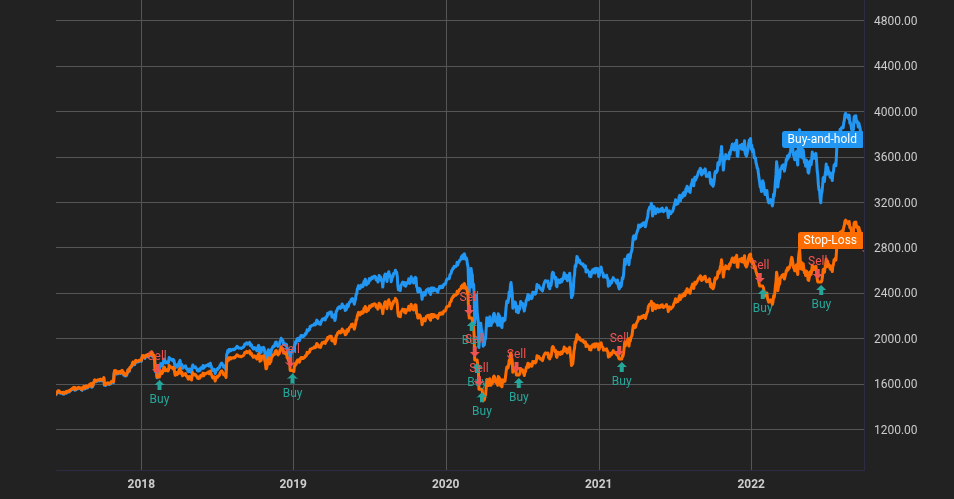
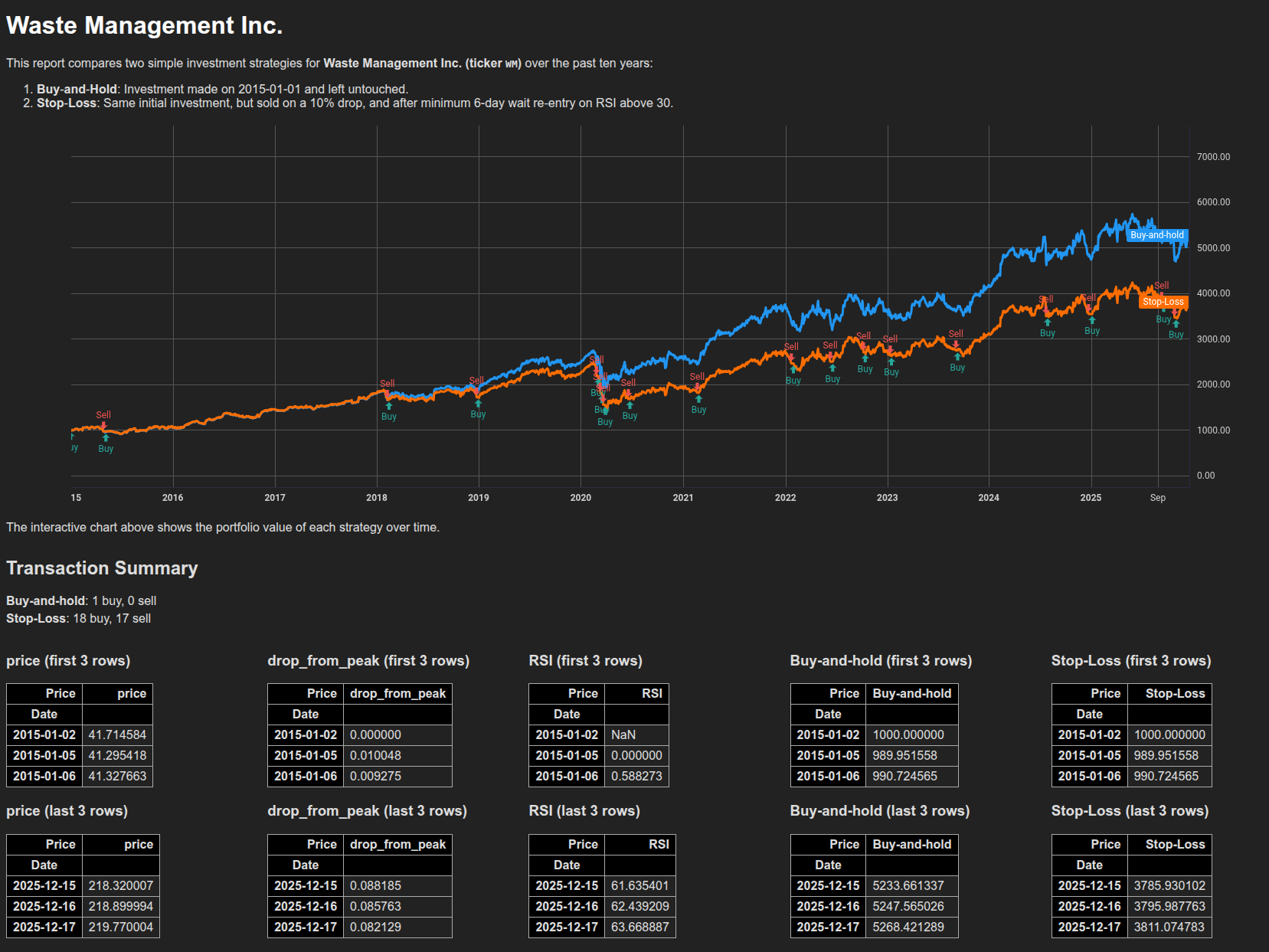
There are also Python libraries built specifically for backtesting investment strategies, such as Backtrader and Zipline, but they do not seem to be actively maintained, and probably have too many features and complexity compared to what I needed for doing this simple test. The screenshot below shows an example of backtesting a strategy on the Waste Management Inc stock from January 2015 to December 2025. The baseline Buy and hold scenario is shown as the blue line and it fully tracks the stock price, while the orange line shows how the strategy would have performed, with markers for the sells and buys along the way. Backtest run example

Results I experimented with multiple strategies and tested them with various parameters, but I don t think I found a strategy that was consistently and clearly better than just buy-and-hold. It basically boils down to the fact that I was not able to find any way to calculate when the crash has bottomed based on historical data. You can only know in hindsight that the price has stopped dropping and is on a steady path to recovery, but at that point it is already too late to buy in. In my testing, most strategies underperformed buy-and-hold because they sold when the crash started, but bought back after it recovered at a slightly higher price. In particular when using narrow margins and selling on a 3-6% drawdown the strategy performed very badly, as those small dips tend to recover in a few days. Essentially, the strategy was repeating the pattern of selling 100 stocks at a 6% discount, then being able to buy back only 94 shares the next day, then again selling 94 shares at a 6% discount, and only being able to buy back maybe 90 shares after recovery, and so forth, never catching up to the buy-and-hold. The strategy worked better in large market crashes as they tended to last longer, and there were higher chances of buying back the shares while the price was still low. For example, in the 2020 crash selling at a 20% drawdown was a good strategy, as the stock I tested dropped nearly 50% and remained low for several weeks; thus, the strategy bought back the stocks while the price was still low and had not yet started to climb significantly. But that was just a lucky incident, as the delta between the trailing stop-loss margin of 20% and total crash of 50% was large enough. If the crash had been only 25%, the strategy would have missed the rebound and ended up buying back the stocks at a slightly higher price. Also, note that the simulation assumes that the trade itself is too small to affect the price formation. We should keep in mind that in reality, if many people have stop-loss orders in place, a large price drop would trigger all of them, creating a flood of sell orders, which in turn would affect the price and drive it lower even faster and deeper. Luckily, it seems that stop-loss orders are generally not a good strategy, and we don t need to fear that too many people will be using them.

Conclusion Even though using a trailing stop-loss strategy does not seem to help in getting consistently higher returns based on my backtesting, I would still say it is useful in protecting from the downside of stock investing. It can act as a kind of insurance policy to considerably decrease the chances of losing big while increasing the chances of losing a little bit. If you are risk-averse, which I think I probably am, this tradeoff can make sense. I d rather miss out on an initial 50% loss and an overall 3% gain on recovery than have to sit through weeks or months with a 50% loss before the price recovers to prior levels. Most notably, the trailing stop-loss strategy works best if used only once. If it is repeated multiple times, the small losses in gains will compound into big losses overall. Thus, I think I might actually put this automation in place at least on the stocks in my portfolio that have had the highest gains. If they keep going up, I will ride along, but once the crash happens, I will be out of those particular stocks permanently. Do you have a favorite open source investment tool or are you aware of any strategy that actually works? Comment below!

18 December 2025

Dirk Eddelbuettel: dang 0.0.17: New Features, Plus Maintenance

dang image A new release of my mixed collection of things package dang package arrived at CRAN earlier today. The dang package regroups a few functions of mine that had no other home as for example lsos() from a StackOverflow question from 2009 (!!), the overbought/oversold price band plotter from an older blog post, the market monitor blogged about as well as the checkCRANStatus() function tweeted about by Tim Taylor. And more so take a look. This release retires two functions: the social media site nobody ever visits anymore shut down its API too, so no way to mute posts by a given handle. Similarly, the (never official) ability by Google to supply financial data is no more, so the function to access data this way is gone too. But we also have two new ones: one that helps with CRAN entries for ORCiD ids, and another little helper to re-order microbenchmark results by summary column (defaulting to the median). Other than the usual updates to continuous integrations, as well as a switch to Authors@R which will result in CRAN nagging me less about this, and another argument update. The detailed NEWS entry follows.

Changes in version 0.0.17 (2025-12-18)
  • Added new funtion reorderMicrobenchmarkResults with alias rmr
  • Use tolower on email argument to checkCRANStatus
  • Added new function cranORCIDs bootstrapped from two emails by Kurt Hornik
  • Switched to using Authors@R in DESCRIPTION and added ORCIDs where available
  • Switched to r-ci action with included bootstrap step; updated updated the checkout action (twice); added (commented-out) log accessor
  • Removed googleFinanceData as the (unofficial) API access point no longer works
  • Removed muteTweeters because the API was turned off

Via my CRANberries, there is a comparison to the previous release. For questions or comments use the the issue tracker at the GitHub repo.

This post by Dirk Eddelbuettel originated on his Thinking inside the box blog. If you like this or other open-source work I do, you can sponsor me at GitHub.

16 December 2025

Freexian Collaborators: Debusine repositories now in beta (by Colin Watson)

We re happy to announce that Debusine can now be used to maintain APT-compatible add-on package repositories for Debian. This facility is available in public beta to Debian developers and maintainers.

Why? Debian developers typically put most of their effort towards maintaining the main Debian archive. However, it s often useful to have other places to work, for various reasons:
  • Developers working on a set of packages might need to check that changes to several of them all work properly together on a real system.
  • Somebody fixing a bug might need to ask affected users to test the fix before uploading it to Debian.
  • Some projects are difficult to package in a way that meets Debian policy, or are too niche to include in Debian, but it s still useful to distribute them in a packaged form.
  • For some packages, it s useful to provide multiple upstream versions for multiple Debian releases, even though Debian itself would normally want to keep that to a minimum.
The Ubuntu ecosystem has had PPAs for a long time to meet these sorts of needs, but people working directly on Debian have had to make do with putting things together themselves using something like reprepro or aptly. Discussions about this have been happening for long enough that people started referring to PPAs for Debian as bikesheds , and users often find themselves trying to use Ubuntu PPAs on Debian systems and hoping that dependencies will be compatible enough for things to more or less work. This clearly isn t ideal, and solving it is one of Freexian s objectives for Debusine. Developers publishing packages to Debusine repositories can take advantage of all Debusine s existing facilities, including a battery of QA tests and regression tracking (coming soon). Repositories are signed using per-repository keys held in Debusine s signing service, and uploads to repositories are built against the current contents of that repository as well as the corresponding base Debian release. All repositories include automatic built-in snapshot capabilities.

Who can use this service? We ve set up debusine.debian.net to allow using repositories. All Debian Developers and Debian Maintainers can log in there and publish packages to it. The resulting repositories are public by default. debusine.debian.net only allows packages with licences that allow distribution by Debian, and it is intended primarily for work that could reasonably end up in Debian; Freexian reserves the right to remove repositories from it.

How can I use it? If you are a Debian contributor, we d be very excited to have you try this out, especially if you give us feedback. We have published instructions for developers on using this. Since this is a beta service, you can expect things to change, but we ll maintain compatibility where we can. If you re interested in using this in a commercial setting, please contact Freexian to discuss what we can do for you.

15 December 2025

Russ Allbery: Review: Brigands & Breadknives

Review: Brigands & Breadknives, by Travis Baldree
Series: Legends & Lattes #3
Publisher: Tor
Copyright: 2025
ISBN: 1-250-33489-6
Format: Kindle
Pages: 325
Brigands & Breadknives is a secondary-world sword-and-sorcery fantasy and a sequel to both Legends & Lattes and Bookshops & Bonedust. It takes place shortly after Legends & Lattes chronologically, but Fern, the protagonist, was introduced in the Bookshops & Bonedust prequel. You may have noticed I didn't describe this as cozy fantasy. That is intentional. When we left Fern at the end of Bookshops & Bonedust, the rattkin was running a bookshop in the town of Murk. As Brigands & Breadknives opens, Fern is moving, for complicated and hard-to-describe personal reasons, to Thune where Viv has her coffee shop. Her plan is to open a new bookstore next door to Legends and Lattes. This is exactly the sort of plot one might expect from this series, and the first few chapters feel like yet another version of the first two novels. Then Fern makes an impulsive and rather inexplicable (even to herself) decision and the plot goes delightfully sideways. Brigands & Breadknives is not, as Baldree puts it in the afterword, a book about fantasy small-business ownership as the answer to all of life's woes. It is, instead, a sword and sorcery story about a possibly immortal elven bounty hunter, her utterly baffling goblin prisoner, and a rattkin bookseller who becomes their unexpected travel companion for reasons she can't explain. It's a story about a mid-life crisis in a world and with supporting characters that I can only describe as inspired by a T. Kingfisher novel. Baldree is not Ursula Vernon, of course. This book does not contain paladins or a romance, possibly to the relief of some readers. It's slower, a bit more introspective, and doesn't have as sharp of edges or the casual eerie unsettlingness. But there is a religious order that worships a tentacled space horror for entirely unexpected reasons, pompous and oleaginous talking swords with verbose opinions about everything, a mischievously chaotic orange-haired goblin who quickly became one of my favorite fantasy characters and then kept getting better, and a whole lot of heart. You may see why Kingfisher was my first thought for a comparison point. Unlike Baldree's previous novels, there is a lot of combat and injury. I think some people will still describe this book as cozy, and I'm not going to argue too strongly because the conflicts are a bit lighter than the sort of rape and murder one would see in a Mercedes Lackey novel. But to me this felt like sword and sorcery in a Dungeons and Dragons universe made more interesting by letting the world-building go feral and a little bit sarcastic. Most of the book is spent traveling, there are a lot of random encounters that build into a connected plot, and some scenes (particularly the defense of the forest village) felt like they could have sold to the Swords and Sorceress anthology series. Also, this was really good! I liked both Legends & Lattes and Bookshops & Bonedust, maybe a bit more than the prevailing opinion among reviewers since the anachronisms never bothered me, but I wasn't sure whether to dive directly into this book because I was expecting more of the same. This is not more of the same. I think it's clearly better writing and world-building than either of the previous books. It helps that Fern is the protagonist; as much as I like Viv, I think Fern is a more interesting character, and I am glad she got a book of her own. Baldree takes a big risk on the emotional arc of this book. Fern starts the story in a bad state and makes some decisions to kick off the plot that are difficult to defend. She beats herself up for those decisions for most of the book, deservedly, and parts of that emotional turmoil are difficult to read. Baldree resists the urge to smooth everything over and instead provides a rather raw sense of depression, avoidance, and social anxiety that some readers are going to have to brace themselves for. I respect the decision to not write the easy series book people probably expected, but I'm not sure Fern's emotional arc quite worked. Baldree is hinting at something that's hard to describe logically, and I'm not sure he was able to draw a clear enough map of Fern's thought process for the reader to understand her catharsis. The "follow your passion" self-help mindset has formed a gravitational singularity in the vicinity of this book's theme, it takes some skillful piloting to avoid being sucked into its event horizon, and I don't think Baldree quite managed to escape it. He made a valiant attempt, though, and it created a far more interesting book than one about safer emotions. I wanted more of an emotional payoff than I got, but the journey, even with the moments of guilt and anxiety, was so worth it. The world-building is funnier and more interesting than the previous books of the series, and the supporting cast is fantastic. If you bailed on the series but you like sword and sorcery and T. Kingfisher novels, consider returning. You do probably need to read Bookshops & Bonedust first, if you haven't already, since it helps to know the start of Fern's story. Recommended, and shortcomings aside, much better than I had expected. Content notes: Bloody sword fights, major injury, some very raw emotions about letting down friends and destroying friendships. Rating: 8 out of 10

8 December 2025

Freexian Collaborators: Debian's /usr-move transition has been completed (by Helmut Grohne)

By now, the /usr-merge is an old transition. Effectively, it turns top-level directories such as /bin into symbolic links pointing below /usr. That way the entire operating system can be contained below the /usr hierarchy enabling e.g. image based update mechanisms. It was first supported in Debian 9, which is no longer in active use at this point (except for users of Freexian s ELTS offer). When it became mandatory in Debian 12, it wasn t really done though, because Debian s package manager was not prepared to handle file system objects being referred to via two different paths. With nobody interested in handling the resulting issues, Freexian stepped in and funded a project lead by Helmut Grohne to resolve the remaining issues. While the initial idea was to enhance the package manager, Debian s members disagreed. They preferred an approach where files were simply tracked with their physical location while handling the resulting misbehavior of the package manager using package-specific workarounds. This has been recorded in the DEP17 document. During the Debian 13 release cycle, the plan has been implemented. A tool for detecting possible problems was developed specifically for this transition. Since all files are now tracked with their physical location and necessary workarounds have been added, problematic behavior is no longer triggered. An upgrade from Debian 12 to Debian 13 is unlikely to run into aliasing problems as a result. This whole project probably consumed more than 1500 hours of work from Debian contributors, of which 700 were sponsored by Freexian through the work of Helmut Grohne. What remains is eventually removing the workarounds.

1 December 2025

Russ Allbery: Review: Forever and a Day

Review: Forever and a Day, by Haley Cass
Series: Those Who Wait #1.5
Publisher: Haley Cass
Copyright: 2020
ISBN: 979-8-5902-5966-3
Format: Kindle
Pages: 101
Forever and a Day is a coda to Haley Cass's self-published sapphic romance novel Those Who Wait. There is no point in reading it unless you have already read and enjoyed the full book and wanted more of a denouement. Given that Those Who Wait is a romance novel, it is definitionally not a spoiler to reveal that Sutton and Charlotte ended up together. This novella is seven scenes sketching out the next few years of their lives, interspersed with press clippings and social media commentary. These tie up loose ends, give the characters a bit more time together, throw in one more conflict and resolution, add one more sex scene, and stick a few exclamation points after the happily ever after. I am the sort of person who likes long denouements in stories, so I'm the target audience for this sort of sequel that's essentially additional chapters to the book. (The funniest version of this I've read is Jacqueline Carey's Saints Astray.) They are usually not great literature, since there are good reasons for not including these chapters in the book. That is exactly what this is: a few more chapters of the characters being happy, entirely forgettable, and of interest only to people who want that. Cass does try to introduce a bit of a plot via some light family conflict, which was sweet and mostly worked, and some conflict over having children, which was very stereotyped and which I did not enjoy as much. I thought the earlier chapters of this novella were the stronger ones, although I do have to give the characters credit in the later chapters for working through conflict in a mature and fairly reasonable way. It does help, though, when the conflict is entirely resolved by one character being right and the other character being happily wrong. That's character conflict on easy mode. I was happy to see that Sutton got a career, although as in the novel I wish Cass had put some more effort into describing Sutton's efforts in building that career. The details are maddeningly vague, which admittedly matches the maddeningly vague description of Charlotte's politics but which left me unsatisfied. Charlotte's political career continues to be pure wish fulfillment in the most utterly superficial and trivialized way, and it bothered me even more in the novella than it did in the novel. We still have absolutely no idea what she stands for, what she wants to accomplish, and why anyone would vote for her, and yet we get endless soft-focus paeans to how wonderful she will be for the country. Her opponents are similarly vague to the point that the stereotypes Cass uses to signal their inferiority to Charlotte are a little suspect. I'm more critical of this in 2025 than I would have been in 2015 because the last ten years have made clear the amount of damage an absolute refusal to stand for anything except hazy bromides causes, and I probably shouldn't be this annoyed that Cass chose to vaguely gesture towards progressive liberalism without muddying her romance denouement with a concrete political debate. But, just, gah. I found the last chapter intensely annoying, in part because the narrative of that chapter was too cliched and trite to sufficiently distract me from the bad taste of the cotton-candy politics. Other than that, this was minor, sweet, and forgettable. If you want another few chapters of an already long novel, this delivers exactly what you would expect. If the novel was plenty, nothing about this novella is going to change your mind and you can safely skip it. I really liked the scene between Charlotte and Sutton's mom, though, and I'm glad I read the novella just for that. Rating: 6 out of 10

30 November 2025

Russ Allbery: Review: The Last Soul Among Wolves

Review: The Last Soul Among Wolves, by Melissa Caruso
Series: The Echo Archives #2
Publisher: Orbit
Copyright: August 2025
ISBN: 0-316-30404-2
Format: Kindle
Pages: 355
The Last Soul Among Wolves is urban high fantasy with strong mystery vibes. It is a direct sequel to The Last Hour Between Worlds. You need the previous book for some character setup (and this book would spoil it badly), but you don't have to remember the first book in detail. Only the main plot outcomes are directly relevant and the characters will remind you of those. Kembrel Thorne is a Hound, the equivalent of a police detective in the medieval-inspired city setting of this series, but this book does not open with an official assignment. Instead, she has been dragged by her childhood friend Jaycel Morningrey as company for a reading of the will of old lady Lovegrace, reclusive owner of a gothic mansion on an island connected to the city by an intermittent sandbar. A surprise reunion with her gang of childhood friends ensues, followed by the revelation that they are all in serious trouble. Shortly after Kem left the group to become a Hound, the remaining four, plus several other apparently random people, got entangled with a powerful Echo artifact. Now that Lovegrace has died, one of them will inherit the artifact and the ability to make a wish, but only one. The rest will be killed at decreasing intervals until only the winner is left alive. The Last Hour Between Worlds was fae fantasy built around a problem that was more of a puzzle than a mystery. The Last Soul Among Wolves is closer to a classic mystery: A cast of characters are brought together and semi-isolated in a rural house, they start dying, and it's up to the detective to solve the mystery of their death before it's too late. In this case, the initial mechanism of death is supernatural and not in doubt the challenge instead is how to stop it from happening again but Kem's problems quickly become more complicated. As mystery plots go, this is more thriller than classical despite the setting. There are a few scenes of analyzing clues, but Kem is more likely to use the time-honored protagonist technique of throwing herself into danger and learning what's going on via the villain monologues. As readers of the previous book would expect, Rika Nonesuch is here too, hired by another of Kem's old friends, and the two navigate their personal feelings and the rivalry between their guilds in much the way that they did in the Last Hour Between Worlds. As in the first book, there is a sapphic romance subplot, but it's a very slow burn asexual romance. The best part of this series continues to be the world-building. The previous book introduced the idea of the Echoes and sent the characters exploring into stranger and stranger depths. This book fleshes out the rules in more detail, creating something that feels partly like a fae realm and partly like high fantasy involving gods, but diverges from both into a logic of its own. The ending satisfyingly passes my test of fantasy mysteries: Resolving the mystery requires understanding and applying the rules of the setting, which are sufficiently strange to create interesting outcomes but coherent enough that the reader doesn't feel like the author is cheating. There are some hissable villains here, but my favorite part of this book was the way Caruso added a lot of nuance and poignancy to the Echoes rather than showing them only as an uncanny threat. That choice made the world feel deeper and richer. It's not yet clear whether that element is setup for a longer-term series plot, but I hope Caruso will develop the story in that direction. It felt to me like Caruso is aiming for an ongoing series rather than a multi-volume story with a definite ending. She avoids a full episodic reset Rika, in particular, gets considerable character development and new complications that bode well for future volumes but it doesn't feel like the series is building towards an imminent climax. This is not a complaint. I enjoy these characters and this world and will happily keep devouring each new series entry. If you liked The Last Hour Between Worlds, I think you will like this. It doesn't have the same delight of initial discovery of the great world-building, but the plot is satisfying and a bit more complex and the supporting characters are even better than those in the first book. Once again, Caruso kept me turning the pages, and I'm now looking forward to a third volume. Recommended. The third book in the series has not yet been announced, but there are indications on social media that it is coming. Rating: 7 out of 10

Otto Kek l inen: DEP-18: A proposal for Git-based collaboration in Debian

Featured image of post DEP-18: A proposal for Git-based collaboration in DebianI am a huge fan of Git, as I have witnessed how it has made software development so much more productive compared to the pre-2010s era. I wish all Debian source code were in Git to reap the full benefits. Git is not perfect, as it requires significant effort to learn properly, and the ecosystem is complex with even more things to learn ranging from cryptographic signatures and commit hooks to Git-assisted code review best practices, forge websites, and CI systems. Sure, there is still room to optimize its use, but Git certainly has proven itself and is now the industry standard. Thus, some readers might be surprised to learn that Debian development in 2025 is not actually based on Git. In Debian, the version control is done by the Debian archive itself. Each commit is a new upload to the archive, and the commit message is the debian/changelog entry. The commit log is available at snapshots.debian.org. In practice, most Debian Developers (people who have the credentials to upload to the Debian archive) do use Git and host their packaging source code on salsa.debian.org the GitLab instance of Debian. This is, however, based on each DD s personal preferences. The Debian project does not have any policy requiring that packages be hosted on salsa.debian.org or be in version control at all.

Is collaborative software development possible without git and version control software? Debian, however, has some peculiarities that may be surprising to people who have grown accustomed to GitHub, GitLab or various company-internal code review systems. In Debian:
  • The source code of the next upload is not public but resides only on the developer s laptop.
  • Code contributions are plain patch files, based on the latest revision released in the Debian archive (where the unstable area is equivalent to the main development branch).
  • These patches are submitted by email to a bug tracker that does no validation or testing whatsoever.
  • Developers applying these patches typically have elaborate Mutt or Emacs setups to facilitate fetching patches from email.
  • There is no public staging area, no concept of rebasing patches or withdrawing a patch and replacing it with a better version.
  • The submitter won t see any progress information until a notification email arrives after a new version has been uploaded to the Debian archive.
This system has served Debian for three decades. It is not broken, but using the package archive just feels well, archaic. There is a more efficient way, and indeed the majority of Debian packages have a metadata field Vcs-Git that advertises which version control repository the maintainer uses. However, newcomers to Debian are surprised to notice that not all packages are hosted on salsa.debian.org but at various random places with their own account and code submission systems, and there is nothing enforcing or even warning if the code there is out of sync with what was uploaded to Debian. Any Debian Developer can at any time upload a new package with whatever changes, bypassing the Git repository, even when the package advertised a Git repository. All PGP signed commits, Git tags and other information in the Git repository are just extras currently, as the Debian archive does not enforce or validate anything about them. This also makes contributing to multiple packages in parallel hard. One can t just go on salsa.debian.org and fork a bunch of repositories and submit Merge Requests. Currently, the only reliable way is to download source packages from Debian unstable, develop patches on top of them, and send the final version as a plain patch file by email to the Debian bug tracker. To my knowledge, no system exists to facilitate working with the patches in the bug tracker, such as rebasing patches 6 months later to detect if they or equivalent changes were applied or if sending refreshed versions is needed. To newcomers in Debian, it is even more surprising that there are packages that are on salsa.debian.org but have the Merge Requests feature disabled. This is often because the maintainer does not want to receive notification emails about new Merge Requests, but rather just emails from bugs.debian.org. This may sound arrogant, but keep in mind that these developers put in the effort to set up their Mutt/Emacs workflow for the existing Debian process, and extending it to work with GitLab notifications is not trivial. There are also purists who want to do everything via the command-line (without having to open a browser, run JavaScript and maintain a live Internet connection), and tools like glab are not convenient enough for the full workflow.

Inefficient ways of working prevent Debian from flourishing I would claim, based on my personal experiences from the past 10+ years as a Debian Developer, that the lack of high-quality and productive tooling is seriously harming Debian. The current methods of collaboration are cumbersome for aspiring contributors to learn and suboptimal to use for both new and seasoned contributors. There are no exit interviews for contributors who left Debian, no comprehensive data on reasons to contribute or stop contributing, nor are there any metrics tracking how many people tried but failed to contribute to Debian. Some data points to support my concerns do exist:
  • The contributor database shows that the number of contributors is growing slower than Debian s popularity.
  • Most packages are maintained by one person working alone (just pick any package at random and look at the upload history).

Debian should embrace git, but decision-making is slow Debian is all about community and collaboration. One would assume that Debian prioritized above all making collaboration tools and processes simpler, faster and less error-prone, as it would help both current and future package maintainers. Yet, it isn t so, due to some reasons unique to Debian. There is no single company or entity running Debian, and it has managed to operate as a pure meritocracy and do-cracy for over 30 years. This is impressive and admirable. Unfortunately, some of the infrastructure and technical processes are also nearly 30 years old and very difficult to change for the same reason: the nature of Debian s distributed decision-making process. As a software developer and manager with 25+ years of experience, I strongly feel that developing software collaboratively using Git is a major step forward that Debian needs to take, in one form or another, and I hope to see other DDs voice their support if they agree.

Debian Enhancement Proposal 18 Following how consensus is achieved in Debian, I started drafting DEP-18 in 2024, and it is currently awaiting enough thumbs up at https://salsa.debian.org/dep-team/deps/-/merge_requests/21 to get into CANDIDATE status next. In summary, the DEP-18 proposes that everyone keen on collaborating should:
  1. Maintain Debian packaging sources in Git on Salsa.
  2. Use Merge Requests to show your work and to get reviews.
  3. Run Salsa CI before upload.
The principles above are not novel. According to stats at e.g. trends.debian.net, and UDD, ~93% of all Debian source packages are already hosted on salsa.debian.org. As of June 1st, 2025, only 1640 source packages remain that are not hosted on Salsa. The purpose of DEP-18 is to state in writing what Debian is currently doing for most packages, and thus express what among others new contributors should be learning and doing, so basic collaboration is smooth and free from structural obstacles. Most packages are also already allowing Merge Requests and using Salsa CI, but there hasn t been any written recommendation anywhere in Debian to do so. The Debian Policy (v.4.7.2) does not even mention the word Salsa a single time. The current process documentation on how to do non-maintainer uploads or salvaging packages are all based on uploading packages to the archive, without any consideration of using git-based collaboration such as posting a Merge Request first. Personally I feel posting a Merge Request would be a better approach, as it would invite collaborators to discuss and provide code reviews. If there are no responses, the submitter can proceed to merge, but compared to direct uploads to the Debian archive, the Merge Request practice at least tries to offer a time and place for discussions and reviews to happen. It could very well be that in the future somebody comes up with a new packaging format that makes upstream source package management easier, or a monorepo with all packages, or some other future structures or processes. Having a DEP to state how to do things now does not prevent people from experimenting and innovating if they intentionally want to do that. The DEP is merely an expression of the minimal common denominators in the packaging workflow that maintainers and contributors should follow, unless they know better.

Transparency and collaboration Among the DEP-18 recommendations is:
The recommended first step in contributing to a package is to use the built-in Fork feature on Salsa. This serves two purposes. Primarily, it allows any contributor to publish their Git branches and submit them as Merge Requests. Additionally, the mere existence of a list of Forks enables contributors to discover each other, and in rare cases when the original package is not accepting improvements, collaboration could arise among the contributors and potentially lead to permanent forks in the general meaning. Forking is a fundamental part of the dynamics in open source that helps drive quality and agreement. The ability to fork ultimately serves as the last line of defense of users rights. Git supports this by making both temporary and permanent forks easy to create and maintain.
Further, it states:
Debian packaging work should be reasonably transparent and public to allow contributors to participate. A maintainer should push their pending changes to Salsa at regular intervals, so that a potential contributor can discover if a particular change has already been made or a bug has been fixed in version control, and thus avoid duplicate work. Debian maintainers should make reasonable efforts to publish planned changes as Merge Requests on Salsa and solicit feedback and reviews. While pushing changes directly on the main Git branch is the fastest workflow, second only to uploading all changes directly to Debian repositories, it is not an inclusive way to develop software. Even packages that are maintained by a single maintainer should at least occasionally publish Merge Requests to allow new contributors to step up and participate.
I think these are key aspects leading to transparency and true open source collaboration. Even though this talks about Salsa which is based on GitLab the concepts are universal and will work also on other forges, like Forgejo or GitHub. The point is that sharing work-in-progress on a real-time platform, with CI and other supporting features, empowers and motivates people to iterate on code collaboratively. As an example of an anti-pattern, Oracle MySQL publishes the source code for all their releases and is license-compliant, but as they don t publish their Git commits in real-time, it does not feel like a real open source project. Non-Oracle employees are not motivated to participate as second-class developers who are kept in the dark. Debian should embrace git and sharing work in real-time, embodying a true open source spirit.

Recommend, not force Note that the Debian Enhancement Proposals are not binding. Only the Debian Policy and Technical Committee decisions carry that weight. The nature of collaboration is voluntary anyway, so the DEP does not need to force anything on people who don t want to use salsa.debian.org. The DEP-18 is also not a guide for package maintainers. I have my own views and have written detailed guides in blog articles if you want to read more on, for example, how to do code reviews efficiently. Within DEP-18, there is plenty of room to work in many different ways, and it does not try to force one single workflow. The goal here is to simply have agreed-upon minimal common denominators among those who are keen to collaborate using salsa.debian.org, not to dictate a complete code submission workflow. Once we reach this, there will hopefully be less friction in the most basic and recurring collaboration tasks, giving DDs more energy to improve other processes or just invest in having more and newer packages for Debian users to enjoy.

Next steps In addition to lengthy online discussions on mailing lists and DEP reviews, I also presented on this topic at DebConf 2025 in Brest, France. Unfortunately the recording is not yet up on Peertube. The feedback has been overwhelmingly positive. However, there are a few loud and very negative voices that cannot be ignored. Maintaining a Linux distribution at the scale and complexity of Debian requires extraordinary talent and dedication, and people doing this kind of work often have strong views, most of the time for good reasons. We do not want to alienate existing key contributors with new processes, so maximum consensus is desirable. We also need more data on what the 1000+ current Debian Developers view as a good process to avoid being skewed by a loud minority. If you are a current or aspiring Debian Developer, please add a thumbs up if you think I should continue with this effort (or a thumbs down if not) on the Merge Request that would make DEP-18 have candidate status. There is also technical work to do. Increased Git use will obviously lead to growing adoption of the new tag2upload feature, which will need to get full git-buildpackage support so it can integrate into salsa.debian.org without turning off Debian packaging security features. The git-buildpackage tool itself also needs various improvements, such as making contributing to multiple different packages with various levels of diligence in debian/gbp.conf maintenance less error-prone. Eventually, if it starts looking like all Debian packages might get hosted on salsa.debian.org, I would also start building a review.debian.org website to facilitate code review aspects that are unique to Debian, such as tracking Merge Requests across GitLab projects in ways GitLab can t do, highlighting which submissions need review most urgently, feeding code reviews and approvals into the contributors.debian.org database for better attribution, and so forth. Details on this vision will be in a later blog post, so subscribe to updates!

27 November 2025

Russ Allbery: Review: A Matter of Execution

Review: A Matter of Execution, by Nicholas & Olivia Atwater
Series: Tales of the Iron Rose #0
Publisher: Starwatch Press
Copyright: 2024
ISBN: 1-998257-08-8
Format: Kindle
Pages: 131
A Matter of Execution is the introductory novella that kicked off the Tales of the Iron Rose series. It is steampunk fantasy with airships. I previously read and reviewed the subsequent novel, Echoes of the Imperium. As noted in that review, I read the novel first. That was a mistake; this is a much better place to start. A Matter of Execution was clearly intended as the introduction of all of these characters. More importantly, I think reading the novella first would have given me enough affinity with the characters to not mind the worst part of Echoes of the Imperium: the extremely slow first half that seemed filled with the protagonist's impostor syndrome. A Matter of Execution opens, fittingly, with Captain William Blair, a goblin, former Imperial soldier, Oathbreaker, and series first-person protagonist being carted to his execution. He is not alone; in the same prison wagon is an arrogant (and racist) man named Strahl, the killer of one of the rulers of Lyonesse. Strahl is rather contemptuous of Blair's claim to be a captain, given that he's both a goblin and an Oathbreaker. Strahl quickly revises that opinion when Blair's crew, somewhat predictably given that he is the series protagonist, creates a daring escape for both of them. The heat of action gives both a chance to gain some respect for the other, which explains why Blair is not only willing to invite Strahl to join his crew, but to go back for Strahl's companion. Breaking out Strahl's companion will be a more difficult, and surprising, problem. Nicholas Atwater is a role-playing game GM, something that you will learn in the "about the author" section at the end of this novella but probably will have guessed by then. Even more than Echoes of the Imperium, this novella feels like a (good) write-up of an RPG adventure. A wildly varied cast of characters come together and form a party with a well-defined objective that has some surrounding mysteries and surprises. Each of those characters get their individual moments to show off their specific skills. Readers with a certain gaming background will know exactly where to insert the Borderlands-style title card with a slightly demented description of each character. This is not a complaint. You may be able to see the bones of the setup adventure for a long-running campaign, but I like this style of character introduction and the story moves right along. There are a ton of varied characters, some interesting villains and maybe-villains, a rather satisfying heist setup, and some good chemistry and a bit of banter. This is not a deep story it's clearly an introductory episode for both the characters and the world background but it's a fun way to spend a few hours. I think the best part of this series is the world-building. If you have read my review of Echoes of the Imperium, you have unfortunately been mildly spoiled for the revelation in this novella. I don't think it hurt the story that much; you will be able to predict what obvious gaps in the novel backstory the novella is going to fill in, but it's just as enjoyable to see how that happens. But the Atwaters aren't going to drop any of the big world-building bombs in the introductory novella, of course. Instead, you get a gradual introduction to the nature of magic in this world, some of the political setup of the recent war, and a quick introduction to the capabilities of Strahl's mysterious companion. If you've not yet read this series, I recommend starting here. It's a quick investment to see if you'll be interested. The novel is heavier and slower, and the pacing of the first half isn't great, but the world-building is even better. If you've already read the novel, this is still worth reading as long as you enjoyed it. You'll have a few moments of "oh, that's how that happened," and it's a fun and fast-moving way to spend a bit more time with the characters. Followed by Echoes of the Imperium. The back matter of the novella says that The Winds of Fortune is supposedly forthcoming. Rating: 7 out of 10

Valhalla's Things: PDF Planners 2026

Posted on November 27, 2025
Tags: madeof:atoms, madeof:bits, craft:bookbinding
A few years ago I wrote some planner generating code to make myself a custom planner; in November 2023 I generated a few, and posted them here on the blog, in case somebody was interested in using them. In 2024 I tried to do the same, and ended up being even more late, to the point where I didn t generate any (uooops). I did, however, start to write a Makefile to automate the generation (and got stuck on the fact that there wasn t an easy way to deduce the correct options needed from just the template name); this year, with the same promptness as in 2023 I got back to the Makefile and finished it, so maybe next year I will be able to post them early enough for people to print and bind them? maybe :) Anyway, these are all of the variants I currently generate, for 2026. The files with -book in the name have been imposed on A4 paper for a 16 pages signature. All of the fonts have been converted to paths, for ease of printing (yes, this means that customizing the font requires running the script, but the alternative also had its drawbacks). In English:
daily-95 186-en.pdf
blank daily pages, 95 mm 186 mm;
daily-A5-en.pdf daily-A5-en-book.pdf
blank daily pages, A5;
daily-A6-en.pdf daily-A6-en-book.pdf
blank daily pages, A6;
daily-graph-A5-en.pdf daily-graph-A5-en-book.pdf
graph paper (4 mm) daily pages, A5;
daily-points4mm-A5-en.pdf daily-points4mm-A5-en-book.pdf
pointed paper (4 mm), A5;
daily-ruled-A5-en.pdf daily-ruled-A5-en-book.pdf
ruled paper daily pages, A5;
week_on_two_pages-A6-en.pdf week_on_two_pages-A6-en-book.pdf
weekly planner, one week on two pages, A6;
week_on_one_page-A6-en.pdf week_on_one_page-A6-en-book.pdf
weekly planner, one week per page, A6;
week_on_one_page_dots-A6-en.pdf week_on_one_page_dots-A6-en-book.pdf
weekly planner, one week per page with 4 mm dots, A6;
week_health-A6-en.pdf week_health-A6-en-book.pdf
weekly health tracker, one week per page with 4 mm dots, A6;
month-A6-en.pdf month-A6-en-book.pdf
monthly planner, A6;
And the same planners, in Italian:
daily-95 186-it.pdf
blank daily pages, 95 mm 186 mm;
daily-A5-it.pdf daily-A5-it-book.pdf
blank daily pages, A5;
daily-A6-it.pdf daily-A6-it-book.pdf
blank daily pages, A6;
daily-graph-A5-it.pdf daily-graph-A5-it-book.pdf
graph paper (4 mm) daily pages, A5;
daily-points4mm-A5-it.pdf daily-points4mm-A5-it-book.pdf
pointed paper (4 mm), A5;
daily-ruled-A5-it.pdf daily-ruled-A5-it-book.pdf
ruled paper daily pages, A5;
week_on_two_pages-A6-it.pdf week_on_two_pages-A6-it-book.pdf
weekly planner, one week on two pages, A6;
week_on_one_page-A6-it.pdf week_on_one_page-A6-it-book.pdf
weekly planner, one week per page, A6;
week_on_one_page_dots-A6-it.pdf week_on_one_page_dots-A6-it-book.pdf
weekly planner, one week per page with 4 mm dots, A6;
week_health-A6-it.pdf week_health-A6-it-book.pdf
weekly health tracker, one week per page with 4 mm dots, A6;
month-A6-it.pdf month-A6-it-book.pdf
monthly planner, A6;
Some of the planners include ephemerids and moon phase data: these have been calculated for the town of Como, and specifically for geo:45.81478,9.07522?z=17, because that s what everybody needs, right? If you need the ephemerids for a different location and can t run the script yourself (it depends on pdfjam, i.e. various GB of LaTeX, and a few python modules such as dateutil, pypdf and jinja2), feel free to ask: unless I receive too many requests to make this sustainable I ll generate them and add them to this post. I hereby release all the PDFs linked in this blog post under the CC0 license. You may notice that I haven t decided on a license for the code dump repository; again if you need it for something (that is compatible with its unsupported status) other than running it for personal use (for which afaik there is an implicit license) let me know and I ll push decide on a license higher on the stack of things to do :D Finishing the Makefile meant that I had to add a tiny feature to one of the scripts involved, which required me to add a dependency to pypdf: up to now I have been doing the page manipulations with pdfjam, which is pretty convenient to use, but also uses LaTeX, and apparently not every computer comes with texlive installed (shocking, I know). If I m not mistaken, pypdf can do all of the things I m doing with pdfjam, so maybe for the next year I could convert my script to use that one instead. But then the planners 2027 will be quick and easy, and I will be able to publish them promptly, right?

19 November 2025

Gunnar Wolf: While it is cold-ish season in the North hemisphere...

Last week, our university held a Mega Vaccination Center . Things cannot be small or regular with my university, ever! According to the official information, during last week 31,000 people were given a total of 74,000 vaccine dosis against influenza, COVID-19, pneumococcal disease and measles (specific vaccines for each person selected according to an age profile). I was a tiny blip in said numbers. One person, three shots. Took me three hours, but am quite happy to have been among the huge crowd. Long, long line ( photo credit: La Jornada, 2025.11.14) Really vaccinated! And why am I bringing this up? Because I have long been involved in organizing DebConf, the best conference ever, naturally devoted to improving Debian GNU/Linux. And last year, our COVID reaction procedures ended up hurting people we care about. We, as organizers, are taking it seriously to shape a humane COVID handling policy that is, at the same time, responsible and respectful for people who are (reasonably!) afraid to catch the infection. No, COVID did not disappear in 2022, and its effects are not something we can turn a blind eye to. Next year, DebConf will take place in Santa Fe, Argentina, in July. This means, it will be a Winter DebConf. And while you can catch COVID (or influenza, or just a bad cold) at any time of year, odds are a bit higher. I know not every country still administers free COVID or influenza vaccines to anybody who requests them. And I know that any protection I might have got now will be quite weaker by July. But I feel it necessary to ask of everyone who can get it to get a shot. Most Northern Hemisphere countries will have a vaccination campaign (or at least, higher vaccine availability) before Winter. If you plan to attend DebConf (hell If you plan to attend any massive gathering of people travelling from all over the world to sit at a crowded auditorium) during the next year, please Act responsibly. For yourself and for those surrounding you. Get vaccinated. It won t absolutely save you from catching it, but it will reduce the probability. And if you do catch it, you will probably have a much milder version. And thus, you will spread it less during the first days until (and if!) you start developing symptoms.

17 November 2025

Valhalla's Things: Historically Inaccurate Hemd

Posted on November 17, 2025
Tags: madeof:atoms, craft:sewing
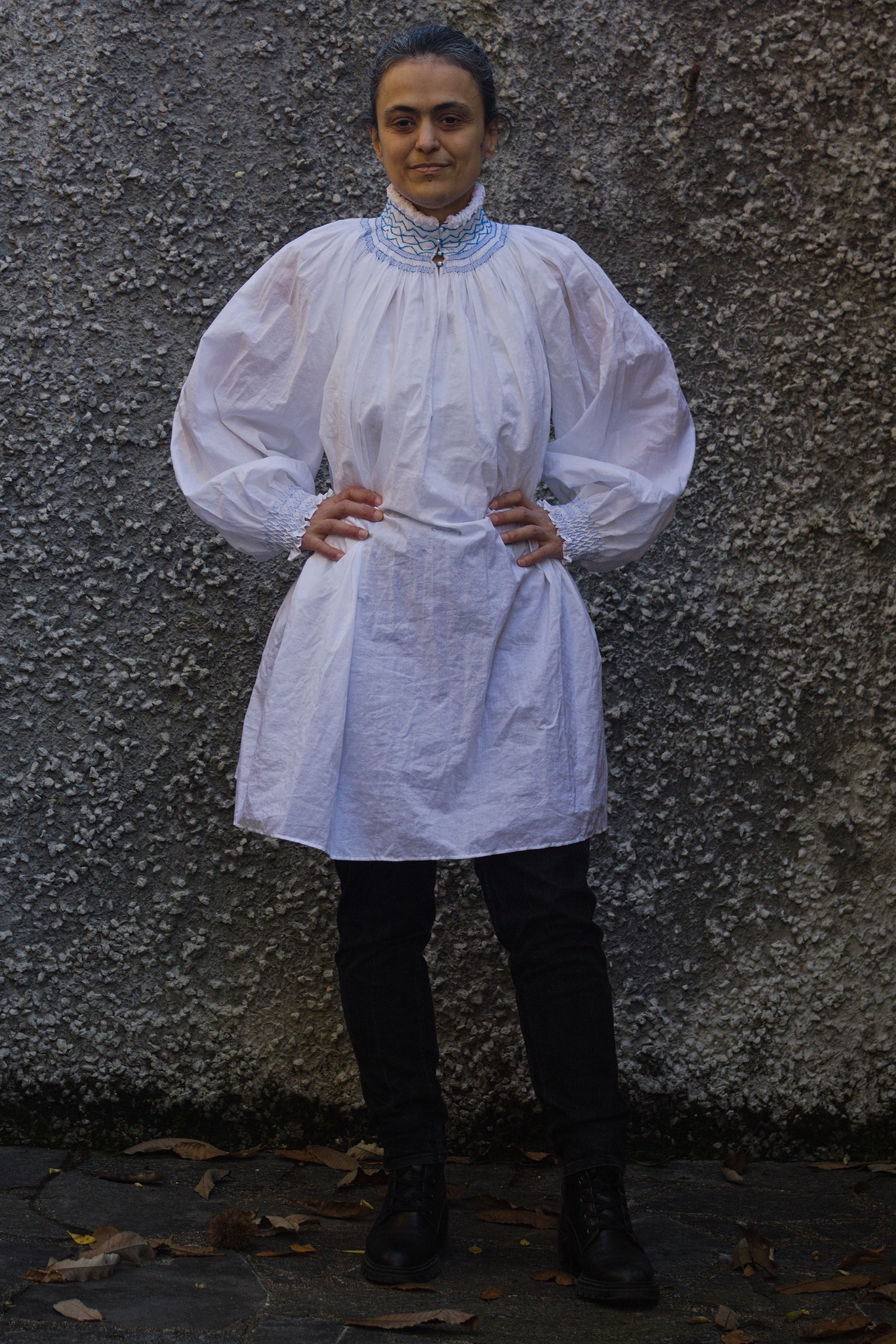
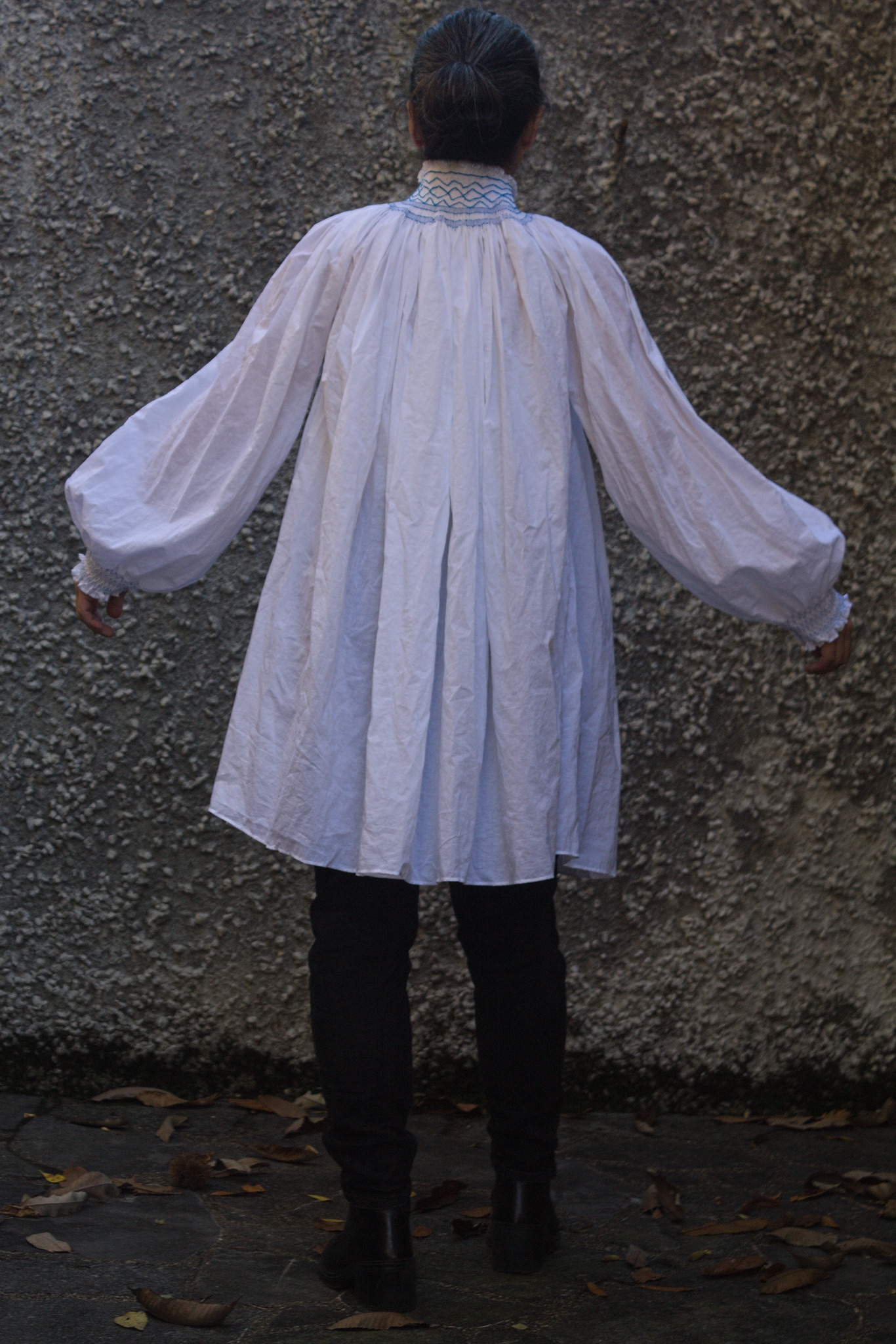
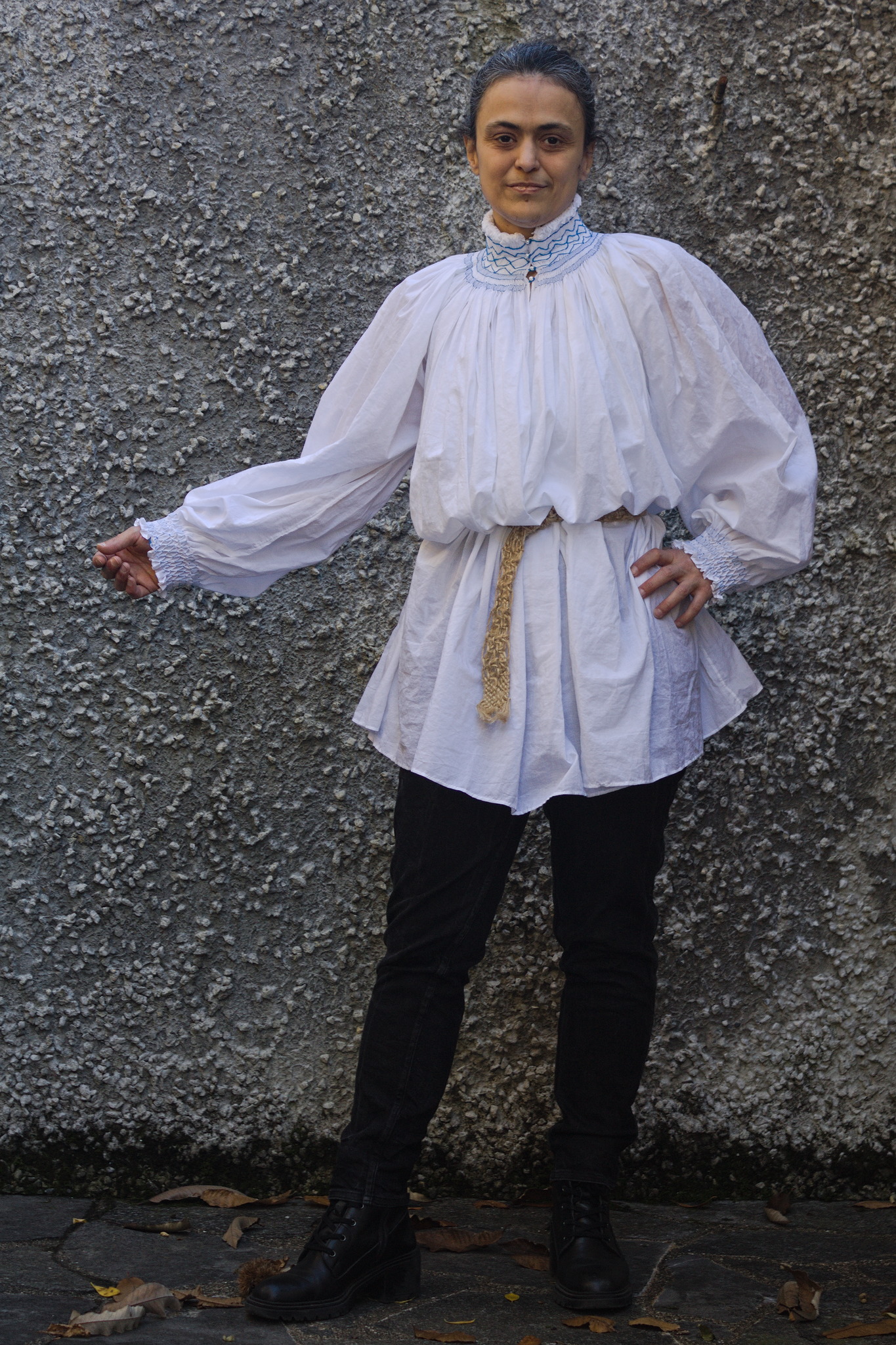
A woman wearing a white shirt with a tall, thick collar with lines of blue embroidery, closed in the front with small buttons; the sleeves are wide and billowing, gathered at the cuffs with more blue embroidery. She's keeping her hands at the waist so that the shirt, which reaches to mid thigh, doesn't look like a shapeless tent from the neck down. After cartridge pleating and honeycombing, I was still somewhat in the mood for that kind of fabric manipulation, and directing my internet searches in that vague direction, and I stumbled on this: https://katafalk.wordpress.com/2012/06/26/patternmaking-for-the-kampfrau-hemd-chemise/ Now, do I want to ever make myself a 16th century German costume, especially a kampfrau one? No! I m from lake Como! Those are the enemies who come down the Alps pillaging and bringing the Black Death with them! Although I have to admit that at times during my day job I have found the idea of leaving everything to go march with the J germonsters attractive. You know, the exciting prospective of long days of march spent knitting sturdy socks, punctuated by the excitement of settling down in camp and having a chance of doing lots of laundry. Or something. Sometimes being a programmer will make you think odd things. Anyway, going back to the topic, no, I didn t need an historically accurate hemd. But I did need a couple more shirts for daily wear, I did want to try my hand at smocking, and this looked nice, and I was intrigued by the way the shaping of the neck and shoulder worked, and wondered how comfortable it would be. And so, it had to be done. I didn t have any suitable linen, but I did have quite a bit of cotton voile, and since I wasn t aiming at historical accuracy it looked like a good option for something where a lot of fabric had to go in a small space. At first I considered making it with a bit less fabric than the one in the blog, but then the voile was quite thin, so I kept the original measurement as is, only adapting the sleeve / sides seams to my size. The same woman, from the back. This time the arms are out, so that the big sleeves show better, but the body does look like a tent. With the pieces being rectangles the width of the fabric, I was able to have at least one side of selvedge on all seams, and took advantage of it by finishing the seams by simply folding the allowances to one sides so that the selvedge was on top, and hemstitching them down as I would have done with a folded edge when felling. Also, at first I wanted to make the smocking in white on white, but then I thought about a few hanks of electric blue floss I had in my stash, and decided to just go with it. The initial seams were quickly made, then I started the smocking at the neck, and at that time the project went on hold while I got ready to go to DebConf. Then I came back and took some time to get back into a sewing mood, but finally the smocking on the next was finished, and I could go on with the main sewing, which, as I expected, went decently fast for a handsewing project. detail of the smocking in progress on the collar, showing the lines of basting thread I used as a reference, and the two in progress zig-zag lines being worked from each side. While doing the diagonal smocking on the collar I counted the stitches to make each side the same length, which didn t completely work because the gathers weren t that regular to start with, and started each line from the two front opening going towards the center back, leaving a triangle with a different size right in the middle. I think overall it worked well enough. Then there were a few more interruptions, but at last it was ready! just as the weather turned cold-ish and puffy shirts were no longer in season, but it will be there for me next spring. I did manage to wear it a few times and I have to say that the neck shaping is quite comfortable indeed: it doesn t pull in odd ways like the classical historically accurate pirate shirt sometimes does, and the heavy gathering at the neck makes it feel padded and soft. The same shirt belted (which looks nicer); one hand is held out to show that the cuff is a bit too wide and falls down over the hand. I m not as happy with the cuffs: the way I did them with just honeycombing means that they don t need a closure, and after washing and a bit of steaming they lie nicely, but then they tend to relax in a wider shape. The next time I think I ll leave a slit in the sleeves, possibly make a different type of smocking (depending on whether I have enough fabric) and then line them like the neck so that they are stable. Because, yes, I think that there will be another time: I have a few more project before that, and I want to spend maybe another year working from my stash, but then I think I ll buy some soft linen and make at least another one, maybe with white-on-white smocking so that it will be easier to match with different garments.

15 November 2025

Andrew Cater: 2025-11-15 17:16 UTC Debian media testing for point release 13.2 of Trixie

*Busy* day in Cambridge. A roomful of people, large numbers of laptops and a lot of parallel installations.

Joined here by Emyr, Chris, Helen and Simon with Isy doing speech installs from her university accommodation. Two Andy's always makes it interesting. Steve providing breakfast, as ever.

We're almost there: the last test install is being repeated to flush out a possible bug. Other release processes are being done in the background.

Thanks again to Steve for hosting and all the hard work that goes into this from everybody.

8 November 2025

Thorsten Alteholz: My Debian Activities in October 2025

Debian LTS This was my hundred-thirty-sixth month that I did some work for the Debian LTS initiative, started by Raphael Hertzog at Freexian. During my allocated time I uploaded or worked on: I also attended the monthly LTS/ELTS meeting. Debian ELTS This month was the eighty-seventh ELTS month. During my allocated time I uploaded or worked on: I also attended the monthly LTS/ELTS meeting. Debian Printing This month I uploaded a new upstream version or a bugfix version of: This work is generously funded by Freexian! Debian Astro This month I uploaded a new upstream version or a bugfix version of: Debian IoT Unfortunately I didn t found any time to work on this topic. Debian Mobcom This month I uploaded a new upstream version or a bugfix version of: misc This month I uploaded a new upstream version or a bugfix version of: On my fight against outdated RFPs, I closed 31 of them in October. I could even close one RFP by uploading the new package gypsy. Meanwhile only 3373 are still open, so don t hesitate to help closing one or another. FTP master This month I accepted 420 and rejected 45 packages. The overall number of packages that got accepted was 423. I would like to remind everybody that in case you don t agree with the removal of a package, please set the moreinfo tag on this bug. This is the only reliable way to prevent processing of that RM-bug. Well, there is a second way, of course you could also achieve this by closing the bug.

7 November 2025

Ravi Dwivedi: A Bad Day in Malaysia

Continuing from where Badri and I left off in the last post. On the 7th of December 2024, we boarded a bus from Singapore to the border town of Johor Bahru in Malaysia. The bus stopped at the Singapore emigration for us to get off for the formalities. The process was similar to the immigration at the Singapore airport. It was automatic, and we just had to scan our passports for the gates to open. Here also, we didn t get Singapore stamps on our passports. After we were done with the emigration, we had to find our bus. We remembered the name of the bus company and the number plate, which helped us recognize our bus. It wasn t there already after we came out of the emigration, but it arrived soon enough, and we boarded it promptly. From the Singapore emigration, the bus travelled a few kilometers and dropped us at Johor Bahru Sentral (JB Sentral) bus station, where we had to go through Malaysian immigration. The process was manual, unlike Singapore, and there was an immigration officer at the counter who stamped our passports (which I like) and recorded our fingerprints. At the bus terminal, we exchanged rupees at an exchange shop to get Malaysian ringgits. We could not find any free drinking water sources on the bus terminal, so we had to buy water. Badri later told me that Johor Bahru has a lot of data centers, which need a lot of water for cooling. When he read about it later, he immediately connected it with the fact that there was no free drinking water, and we had to buy water. Such data centers can lead to scarcity of water for others in the area. From JB Sentral, we took a bus to Larkin Terminal, as our hotel was nearby. It was 1.5 ringgits per person (30 rupees). In order to pay for the fare, we had to put cash in a box near the driver s seat. Around half-an-hour later, we reached our hotel. The time was 23:30 hours. The hotel room was hot as it didn t have air-conditioning. The weather in Malaysia is on the hotter side throughout the year. It was a budget hotel, and we paid 70 ringgits for our room. Badri slept soon after we checked-in. I went out during the midnight at around 00:30. I was hungry, so I entered a small scale restaurant nearby, which was quite lively for the midnight hours. At the restaurant, I ordered a coffee and an omelet. I also asked for drinking water. The unique thing about that was that they put ice in hot water to make its temperature normal. My bill from the restaurant looked like the below-mentioned table, as the items names were in the local language Malay:
Item Price (Malaysian ringgits) Conversion to Indian rupees Comments
Nescafe Tarik 2.50 50 Coffee
Ais Kosong 0.50 10 Water
Telur Dadar 2.00 40 Omelet
SST Tax (6%) 0.30 6
Total 5.30 106
After checking out from the restaurant, I explored nearby shops. I also bought some water before going back to the hotel room. The next day, we had a (pre-booked) bus to Kuala Lumpur. We checked out from the hotel 10 minutes after the check-out time (which was 14:00 hours). However, within those 10 minutes, the hotel staff already came up three times asking us to clear out (which we were doing as fast as possible). And finally on the third time they said our deposit was forfeit, even though it was supposed to be only for keys and towels. The above-mentioned bus for Kuala Lumpur was from the nearby Larkin Bus Terminal. The bus terminal was right next to our hotel, so we walked till there. Upon reaching there, we found out that the process of boarding a bus in Malaysia resembled with taking a flight. We needed to go to a counter to get our boarding passes, followed by reporting at our gate half-an-hour before the scheduled time. Furthermore, they had a separate waiting room and boarding gates. Also, there was a terminal listing buses with their arrival and departure signs. Finally, to top it off, the buses had seatbelts. We got our boarding pass for 2 ringgits (40 rupees). After that, we proceeded to get something to eat as we were hungry. We went to a McDonald s, but couldn t order anything because of the long queue. We didn t have a lot of time, so we proceeded towards our boarding gate without having anything. The boarding gate was in a separate room, which had a vending machine. I tried to order something using my card, but the machine wasn t working. In Malaysia, there is a custom of queueing up to board buses even before the bus has arrived. We saw it in Johor Bahru as well. The culture is so strong that they even did it in Singapore while waiting for the Johor Bahru bus! Our bus departed at 15:30 as scheduled. The journey was around 5 hours. A couple of hours later, our bus stopped for a break. We got off the bus and went to the toilet. As we were starving (we didn t have anything the whole day), we thought it was a good opportunity to get some snack. There was a stall selling some food. However, I had to determine which options were vegetarian. We finally settled on a cylindrical box of potato chips, labelled Mister Potato. They were 7 ringgits. We didn t know how long the bus is going to stop. Furthermore, eating inside buses in Malaysia is forbidden. When we went to get some coffee from the stall, our bus driver was standing there and made a face. We got an impression that he doesn t want us to have coffee. However, after we got into the bus, we had to wait for a long time for it to resume its journey as the driver was taking his sweet time to drink his coffee. During the bus journey, we saw a lot of palm trees on the way. The landscape was beautiful, with good road infrastructure throughout the journey. Badri also helped me improve my blog post on obtaining Luxembourg visa in the bus. The bus dropped us at the Terminal Bersepadu Selatan (TBS in short) in Kuala Lumpur at 21:30 hours. Finally, we got something at the TBS. We also noticed that the TBS bus station had lockers. This gave us the idea of putting some of our luggage in the lockers later while we will be in Brunei. We had booked a cheap Air Asia ticket which doesn t allow check-in luggage. Further, keeping the checked-in luggage in lockers for three days was cheaper than paying the excess luggage penalty for Air Asia. We followed it up by taking a metro as our hotel was closer to a metro station. This was a bad day due to our deposit being forfeited unfairly, and got nothing to eat. We took the metro to reach our hostel, which was located in the Bukit Bintang area. The name of this hostel was Manor by Mingle. I had stayed here earlier in February 2024 for two nights. Back then, I paid 1000 rupees per day for a dormitory bed. However, this time the same hostel was much cheaper. We got a private room for 800 rupees per day, with breakfast included. Earlier it might have been pricier due to my stay falling on weekends or maybe February has more tourists in Kuala Lumpur. That s it for this post. Stay tuned for our adventures in Malaysia!

3 November 2025

Russ Allbery: Review: The Raven Scholar

Review: The Raven Scholar, by Antonia Hodgson
Series: Eternal Path Trilogy #1
Publisher: Orbit
Copyright: April 2025
ISBN: 0-316-57723-5
Format: Kindle
Pages: 651
The Raven Scholar is an epic fantasy and the first book of a projected trilogy. It is Antonia Hodgson's first published fantasy novel; her previous published novels are historical mystery. I would classify this as adult fantasy the main character is thirty-four with a stable court position but it has strong YA vibes because of the generational turnover feel of the main plot. Eight years before the start of this book, Andren Valit attempted to assassinate the emperor and failed. Since then, his widow and three children twins Yana and Ruko and infant Nisthala have been living in disgrace in a cramped apartment, subject to constant inspections and suspicion. As the story opens, they have been summoned to appear before the emperor, escorted by a young and earnest Hound (essentially the state security services) named Shal Worthy. The resulting interrogation is full of dangerous traps. Not all of them will be avoided. The formalization of the consequences of that imperial summons falls to an unpopular Junior Archivist (Third Class) whose one notable skill is her penmanship. A meeting that was disasterous for the Valits becomes unexpectedly fortunate for the archivist, albeit with a poisonous core. Eight years later, Neema Kraa is High Scholar, and Emperor Bersun's twenty-four years of permitted reign is coming to an end. The Festival is about to begin. One representative from each of the empire's eight anats (religious schools) will compete in seven days of Trials, save for the Dragons who do not want the throne and will send a proxy. The victor according to the Trials scoring system will become emperor and reign unquestioned for twenty-four years or until resignation. This is the system that put an end to the era of chaos and has been in place for over a thousand years. On the eve of the Trials, the Raven contender is found murdered. Neema is immediately a suspect; she even has reasons to suspect herself. She volunteers to lead the investigation because she has to know what happened. She is also volunteered to be the replacement Raven contender. There is no chance that she will become emperor; she doesn't even know how to fight. But agnostic Neema has a rather unexpected ally.
As the last chime fades we drop neatly on to the balcony's rusting hand rail, folding our wings with a soft shuffle. Noon, on the ninth day of the eighth month, 1531. Neema Kraa's lodgings. We are here, exactly where we should be, at exactly the right moment, because we are the Raven, and we are magnificent.
The Raven Scholar is a rather good epic fantasy, with some caveats that I'll get to in a moment, but I found it even more fascinating as a genre artifact. I've read my share of epic fantasy over the years, although most of my familiarity of the current wave of new adult fairy epics comes from reviews rather than personal experience. The Raven Scholar is epic fantasy, through and through. There is court intrigue, a main character who is a court functionary unexpectedly thrown into the middle of some problem, civilization-wide stakes, dramatic political alliances, detailed magic and mythological systems, and gods. There were moments that reminded me of a Guy Gavriel Kay novel, although Hodgson's characters tend more towards disarming moments of humanization instead of Kay's operatic scenes of emotional intensity. But The Raven Scholar is also a murder mystery, complete with a crime scene, clues, suspects, evidence, an investigation, a possibly compromised detective, and a morass of possible motives and red herrings. I'm not much of a mystery reader, but this didn't feel like sort of ancillary mystery that might crop up in the course of a typical epic fantasy. It felt like a full-fledged investigation with an amateur detective; one can tell that Hodgson's previous four books were historical mysteries. And then there's the Trials, which are the centerpiece of the book. This book helped me notice that people (okay, me, I'm the people) have been sleeping on the influence of The Hunger Games, Battle Royale, and reality TV (specifically Survivor) on genre fiction, possibly because the more obvious riffs on the idea (Powerless, The Selection) have been young adult or new adult. Once I started looking, I realized this idea is everywhere now: Throne of Glass, Fourth Wing, even The Night Circus to some extent. Competitions with consequences are having a moment. I suspect having a competition to decide the next emperor is going to strike some traditional fantasy readers as sufficiently absurd and unbelievable that it will kick them out of the book. I had a moment of "okay, this is weird, why would anyone stick with this system for so long" myself. But I would encourage such readers to interrogate whether that's only a response from unfamiliarity; after all, strange women lying in ponds distributing swords is no basis for a system of government either. This is hardly the most unrealistic epic fantasy trope, and it has the advantage of being a hell of a plot generator when handled well. Hodgson handles it well. Society in this novel is structured around the anats and the eight Guardians, gods who, according to myth, had returned seven times previously to save the world, but who will destroy the world when they return again. Each Guardian represents a group of characteristics and useful societal functions: the Ox is trustworthy, competent and hard-working; the Fox is a trickster and a rule-bender; the Raven is shrewd and careful and is the Guardian of scholars and lawyers. Each Trial is organized by one of the anats and tests the contenders for the skills most valued by that Guardian, often in subtle and rather ingenious ways. There are flaws here that you could poke at if you wanted to, but I was charmed and thoroughly entertained by how well Hodgson weaves the story around the Trials and uses the conflicting values to create character conflict, unexpected alliances, and engrossing plot. Most importantly for a book of this sort, I liked Neema. She has a charming combination of competence, quirks (she is almost physically unable to not correct people's factual errors), insecurity, imposter syndrome, and determination. She is way out of her depth and knows it, but she has an ethical core and an insatiable curiosity that won't let her leave the central mysteries of the book alone. And the character dynamics are great; there are a lot of characters, including the competition problem of having to juggle eight contenders and give them all sufficient characterization to be meaningful, but this book uses its length to give each character some room to breathe. This is a long book, well over 600 pages, but it felt packed with events and plot twists. After every chapter I had to fight the urge to read just one more. The biggest drawback of this book is that it is very much the first book of a trilogy, none of the other volumes are out yet, and the ending is rather nasty. This is the sort of trilogy that opens with a whole lot of bad things happening, and while I am thoroughly hooked and will purchase the next volume as soon as it's available, I wish Hodgson had found a way to end the book on a somewhat more positive or hopeful note. The middle of the book was great; the end was a bit of an emotional slog, alas. The writing is good enough here that I'm fairly sure the depression will be worth it, but if you need your endings to be triumphant (and who could blame you in this moment in history), you may want to wait on this one until more volumes are out. Apart from that, though, this was a lot of fun. The Guardians felt like they came from a different strand of fantasy than you usually see in epic, more of a traditional folk tale vibe, which adds an intriguing twist to the epic fantasy setting. The characters all work, and Hodgson even pulls off some Game of Thrones style twists that make you sympathetic to characters you previously hated. The magic system apart from the Guardians felt underbaked, but the politics had more depth than a lot of fantasy novels. If you want the truly complex and twisty politics you would get from one of Guy Gavriel Kay's historical rewrites, you will come away disappointed, but it was good enough for me. And I did enjoy the Raven.
Respect, that's all we demand. Recognition of our magnificence. Offerings. Love. Fear. Trembling awe. Worship. Shiny things. Blood sacrifice, some of us very much enjoy blood sacrifice. Truly, we ask for so little.
Followed by an as-yet untitled sequel that I hope will materialize. Rating: 7 out of 10

28 October 2025

Russell Coker: Internode NBN500

I have just converted to the Internode NBN500 plan which is now the same price as the NBN100 plan. I m in a HFC area so they won t let me get fiber to the home (due to Malcolm Turnbull breaking the NBN to help Murdoch) so I m limited to what HFC can do. I first tried it out on a 100mbit card and got speeds of 96/47 mb/s according to speedtest.net. I ve always had the MTU set to 1492 for the PPPoE connection (something I forgot to mention in my blog post about connecting to the Arris CM8200 on Debian [1]) but when run on the 100mbit card I had to set it to 1488. Apparently 1488 is the number because 4 bytes are taken for the VLAN header and 8 bytes for the PPPoE header. But it seems that when using gigabit ethernet it doesn t take 4 bytes for the VLAN (comments explaining that would be appreciated). when connected via gigabit with a MTU of 1492 I got speeds of 534/46 which are quite good. When I tested with my laptop on a Wifi link while sitting next to the main node of my Kogan Wifi6 mesh [2] via 2.4GHz wifi I got 172/45. When using 5GHz I got 514/41. When using 5GHz at the far end of my home over the mesh I got 200/45. Here s a table summarising the speeds. I rounded all speeds off to 1Mbit/s because I don t think that the results are even that accurate. I think that Wifi5 over mesh reporting a faster upload speed than Wifi5 near the AP is because of random factors not an actual benefit to being further away, but I will do more tests later on.
Connection Receive Mbit/s Send Mbit/s
100baseT 96 47
Gigabit 535 46
2.4GHz Wifi 172 45
Wifi5 514 41
Wifi5 Over Mesh 200 45

Russ Allbery: Review: Those Who Wait

Review: Those Who Wait, by Haley Cass
Publisher: Haley Cass
Copyright: 2020
ISBN: 979-8-9884929-1-7
Format: Kindle
Pages: 556
Those Who Wait is a stand-alone self-published sapphic romance novel. Given the lack of connection between political figures named in this book and our reality, it's also technically an alternate history, but it will be entirely unsatisfying to anyone who reads it in that genre. Sutton Spencer is an English grad student in New York City. As the story opens, she has recently realized that she's bisexual rather than straight. She certainly has not done anything about that revelation; the very thought makes her blush. Her friend and roommate Regan, not known for either her patience or her impulse control, decides to force the issue by stealing Sutton's phone, creating a profile on a lesbian dating app, and messaging the first woman Sutton admits being attracted to. Charlotte Thompson is a highly ambitious politician, current deputy mayor of New York City for health and human services, and granddaughter of the first female president of the United States. She fully intends to become president of the United States herself. The next step on that path is an open special election for a seat in the House of Representatives. With her family political connections and the firm support of the mayor of New York City (who is also dating her brother), she thinks she has an excellent shot of winning. Charlotte is also a lesbian, something she's known since she was a teenager and which still poses serious problems for a political career. She is therefore out to her family and a few close friends, but otherwise in the closet. Compared to her political ambitions, Charlotte considers her love life almost irrelevant, and therefore has a strict policy of limiting herself to anonymous one-night stands arranged on dating apps. Even that is about to become impossible given her upcoming campaign, but she indulges in one last glance at SapphicSpark before she deletes her account. Sutton is as far as possible from the sort of person who does one-night stands, which is a shame as far as Charlotte is concerned. It would have been a fun last night out. Despite that, both of them find the other unexpectedly enjoyable to chat with. (There are a lot of text message bubbles in this book.) This is when Sutton has her brilliant idea: Charlotte is charming, experienced, and also kind and understanding of Sutton's anxiety, at least in app messages. Maybe Charlotte can be her mentor? Tell her how to approach women, give her some guidance, point her in the right directions. Given the genre, you can guess how this (eventually) turns out. I'm going to say a lot of good things about this book, so let me get the complaints over with first. As you might guess from that introduction, Charlotte's political career and the danger of being outed are central to this story. This is a bit unfortunate because you should not, under any circumstances, attempt to think deeply about the politics in this book. In 550 pages, Charlotte does not mention or expound a single meaningful political position. You come away from this book as ignorant about what Charlotte wants to accomplish as a politician as you entered. Apparently she wants to be president because her grandmother was president and she thinks she'd be good at it. The closest the story comes to a position is something unbelievably vague about homeless services and Charlotte's internal assertion that she wants to help people and make real change. There are even transcripts of media interviews, later in the book, and they somehow manage to be more vacuous than US political talk shows, which is saying something. I also can't remember a single mention of fundraising anywhere in this book, which in US politics is absurd (although I will be generous and say this is due to Cass's alternate history). I assume this was a deliberate choice and Cass didn't want politics to distract from the romance, but as someone with a lot of opinions about concrete political issues, the resulting vague soft-liberal squishiness was actively off-putting. In an actual politician, this would be an entire clothesline of red flags. Thankfully, it's ignorable for the same reason; this is so obviously not the focus of the book that one can mostly perform the same sort of mental trick that one does when ignoring the backdrop in a cheap theater. My second complaint is that I don't know what Sutton does outside of the romance. Yes, she's an English grad student, and she does some grading and some vaguely-described work and is later referred to a prestigious internship, but this is as devoid of detail as Charlotte's political positions. It's not quite as jarring because Cass does eventually show Sutton helping concretely with her mother's work (about which I have some other issues that I won't get into), but it deprives Sutton of an opportunity to be visibly expert in something. The romance setup casts Charlotte as the experienced one to Sutton's naivete, and I think it would have been a better balance to give Sutton something concrete and tangible that she was clearly better at than Charlotte. Those complaints aside, I quite enjoyed this. It was a recommendation from the same BookTuber who recommended Delilah Green Doesn't Care, so her recommendations are quickly accumulating more weight. The chemistry between Sutton and Charlotte is quite believable; the dialogue sparkles, the descriptions of the subtle cues they pick up from each other are excellent, and it's just fun to read about how they navigate a whole lot of small (and sometimes large) misunderstandings and mismatches in personality and world view. Normally, misunderstandings are my least favorite part of a romance novel, but Sutton and Charlotte come from such different perspectives that their misunderstandings feel more justified than is typical. The characters are also fairly mature about working through them: Main characters who track the other character down and insist on talking when something happens they don't understand! Can you imagine! Only with the third-act breakup is the reader dragged through multiple chapters of both characters being miserable, and while I also usually hate third-act breakups, this one is so obviously coming and so clearly advertised from the initial setup that I couldn't really be mad. I did wish the payoff make-up scene at the end of the book had a bit more oomph, though; I thought Sutton's side of it didn't have quite the emotional catharsis that it could have had. I particularly enjoyed the reasons why the two characters fall in love, and how different they are. Charlotte is delighted by Sutton because she's awkward and shy but also straightforward and frequently surprisingly blunt, which fits perfectly with how much Charlotte is otherwise living in a world of polished politicians in constant control of their personas. Sutton's perspective is more physical, but the part I liked was the way that she treats Charlotte like a puzzle. Rather than trying to change how Charlotte expresses herself, she instead discovers that she's remarkably good at reading Charlotte if she trusts her instincts. There was something about Sutton's growing perceptiveness that I found quietly delightful. It's the sort of non-sexual intimacy that often gets lost among the big emotions in romance novels. The supporting cast was also great. Both characters have deep support networks of friends and family who are unambiguously on their side. Regan is pure chaos, and I would not be friends with her, but Cass shows her deep loyalty in a way that makes her dynamic with Sutton make sense. Both characters have thoughtful and loving families who support them but don't make decisions for them, which is a nice change of pace from the usually more mixed family situations of romance novel protagonists. There's a lot of emotional turbulence in the main relationship, and I think that only worked for me because of how rock-solid and kind the supporting cast is. This is, as you might guess from the title, a very slow burn, although the slow burn is for the emotional relationship rather than the physical one (for reasons that would be spoilers). As usual, I have no calibration for spiciness level, but I'd say that this was roughly on par with the later books in the Bright Falls series. If you know something about politics (or political history) and try to take that part of this book seriously, it will drive you to drink, but if you can put that aside and can deal with misunderstandings and emotional turmoil, this was both fun and satisfying. I liked both of the characters, I liked the timing of the alternating viewpoints, and I believed in the relationship and chemistry, as improbable and chaotic as some of the setup was. It's not the greatest thing I ever read, and I wish the ending was a smidgen stronger, but it was an enjoyable way to spend a few reading days. Recommended. Rating: 7 out of 10

Next.

Previous.