Search Results: "az"

23 October 2025

Russ Allbery: Review: Politics on the Edge

Review: Politics on the Edge, by Rory Stewart
Publisher: Penguin Books
Copyright: 2023, 2025
Printing: 2025
ISBN: 979-8-217-06167-9
Format: Kindle
Pages: 429
Rory Stewart is a former British diplomat, non-profit executive, member of Parliament, and cabinet minister. Politics on the Edge is a memoir of his time in the UK Parliament from 2019 to 2019 as a Tory (Conservative) representing the Penrith and The Border constituency in northern England. It ends with his failed run against Boris Johnson for leader of the Conservative Party and Prime Minister. This book provoked many thoughts, only some of which are about the book. You may want to get a beverage; this review will be long. Since this is a memoir told in chronological order, a timeline may be useful. After Stewart's time as a regional governor in occupied Iraq (see The Prince of the Marshes), he moved to Kabul to found and run an NGO to preserve traditional Afghani arts and buildings (the Turquoise Mountain Foundation, about which I know nothing except what Stewart wrote in this book). By his telling, he found that work deeply rewarding but thought the same politicians who turned Iraq into a mess were going to do the same to Afghanistan. He started looking for ways to influence the politics more directly, which led him first to Harvard and then to stand for Parliament. The bulk of this book covers Stewart's time as MP for Penrith and The Border. The choice of constituency struck me as symbolic of Stewart's entire career: He was not a resident and had no real connection to the district, which he chose for political reasons and because it was the nearest viable constituency to his actual home in Scotland. But once he decided to run, he moved to the district and seems sincerely earnest in his desire to understand it and become part of its community. After five years as a backbencher, he joined David Cameron's government in a minor role as Minister of State in the Department for Environment, Food, and Rural Affairs. He then bounced through several minor cabinet positions (more on this later) before being elevated to Secretary of State for International Development under Theresa May. When May's government collapsed during the fight over the Brexit agreement, he launched a quixotic challenge to Boris Johnson for leader of the Conservative Party. I have enjoyed Rory Stewart's writing ever since The Places in Between. This book is no exception. Whatever one's other feelings about Stewart's politics (about which I'll have a great deal more to say), he's a talented memoir writer with an understated and contemplative style and a deft ability to shift from concrete description to philosophical debate without bogging down a story. Politics on the Edge is compelling reading at the prose level. I spent several afternoons happily engrossed in this book and had great difficulty putting it down. I find Stewart intriguing since, despite being a political conservative, he's neither a neoliberal nor any part of the new right. He is instead an apparently-sincere throwback to a conservatism based on epistemic humility, a veneration of rural life and long-standing traditions, and a deep commitment to the concept of public service. Some of his principles are baffling to me, and I think some of his political views are obvious nonsense, but there were several things that struck me throughout this book that I found admirable and depressingly rare in politics. First, Stewart seems to learn from his mistakes. This goes beyond admitting when he was wrong and appears to include a willingness to rethink entire philosophical positions based on new experience.
I had entered Iraq supporting the war on the grounds that we could at least produce a better society than Saddam Hussein's. It was one of the greatest mistakes in my life. We attempted to impose programmes made up by Washington think tanks, and reheated in air-conditioned palaces in Baghdad a new taxation system modelled on Hong Kong; a system of ministers borrowed from Singapore; and free ports, modelled on Dubai. But we did it ultimately at the point of a gun, and our resources, our abstract jargon and optimistic platitudes could not conceal how much Iraqis resented us, how much we were failing, and how humiliating and degrading our work had become. Our mission was a grotesque satire of every liberal aspiration for peace, growth and democracy.
This quote comes from the beginning of this book and is a sentiment Stewart already expressed in The Prince of the Marshes, but he appears to have taken this so seriously that it becomes a theme of his political career. He not only realized how wrong he was on Iraq, he abandoned the entire neoliberal nation-building project without abandoning his belief in the moral obligation of international aid. And he, I think correctly, identified a key source of the error: an ignorant, condescending superiority that dismissed the importance of deep expertise.
Neither they, nor indeed any of the 12,000 peacekeepers and policemen who had been posted to South Sudan from sixty nations, had spent a single night in a rural house, or could complete a sentence in Dinka, Nuer, Azande or Bande. And the international development strategy written jointly between the donor nations resembled a fading mission statement found in a new space colony, whose occupants had all been killed in an alien attack.
Second, Stewart sincerely likes ordinary people. This shone through The Places in Between and recurs here in his descriptions of his constituents. He has a profound appreciation for individual people who have spent their life learning some trade or skill, expresses thoughtful and observant appreciation for aspects of local culture, and appears to deeply appreciate time spent around people from wildly different social classes and cultures than his own. Every successful politician can at least fake gregariousness, and perhaps that's all Stewart is doing, but there is something specific and attentive about his descriptions of other people, including long before he decided to enter politics, that makes me think it goes deeper than political savvy. Third, Stewart has a visceral hatred of incompetence. I think this is the strongest through-line of his politics in this book: Jobs in government are serious, important work; they should be done competently and well; and if one is not capable of doing that, one should not be in government. Stewart himself strikes me as an insecure overachiever: fiercely ambitious, self-critical, a bit of a micromanager (I suspect he would be difficult to work for), but holding himself to high standards and appalled when others do not do the same. This book is scathing towards multiple politicians, particularly Boris Johnson whom Stewart clearly despises, but no one comes off worse than Liz Truss.
David Cameron, I was beginning to realise, had put in charge of environment, food and rural affairs a Secretary of State who openly rejected the idea of rural affairs and who had little interest in landscape, farmers or the environment. I was beginning to wonder whether he could have given her any role she was less suited to apart perhaps from making her Foreign Secretary. Still, I could also sense why Cameron was mesmerised by her. Her genius lay in exaggerated simplicity. Governing might be about critical thinking; but the new style of politics, of which she was a leading exponent, was not. If critical thinking required humility, this politics demanded absolute confidence: in place of reality, it offered untethered hope; instead of accuracy, vagueness. While critical thinking required scepticism, open-mindedness and an instinct for complexity, the new politics demanded loyalty, partisanship and slogans: not truth and reason but power and manipulation. If Liz Truss worried about the consequences of any of this for the way that government would work, she didn't reveal it.
And finally, Stewart has a deeply-held belief in state capacity and capability. He and I may disagree on the appropriate size and role of the government in society, but no one would be more disgusted by an intentional project to cripple government in order to shrink it than Stewart. One of his most-repeated criticisms of the UK political system in this book is the way the cabinet is formed. All ministers and secretaries come from members of Parliament and therefore branches of government are led by people with no relevant expertise. This is made worse by constant cabinet reshuffles that invalidate whatever small amounts of knowledge a minister was able to gain in nine months or a year in post. The center portion of this book records Stewart's time being shuffled from rural affairs to international development to Africa to prisons, with each move representing a complete reset of the political office and no transfer of knowledge whatsoever.
A month earlier, they had been anticipating every nuance of Minister Rogerson's diary, supporting him on shifts twenty-four hours a day, seven days a week. But it was already clear that there would be no pretence of a handover no explanation of my predecessor's strategy, and uncompleted initiatives. The arrival of a new minister was Groundhog Day. Dan Rogerson was not a ghost haunting my office, he was an absence, whose former existence was suggested only by the black plastic comb.
After each reshuffle, Stewart writes of trying to absorb briefings, do research, and learn enough about his new responsibilities to have the hope of making good decisions, while growing increasingly frustrated with the system and the lack of interest by most of his colleagues in doing the same. He wants government programs to be successful and believes success requires expertise and careful management by the politicians, not only by the civil servants, a position that to me both feels obviously correct and entirely at odds with politics as currently practiced. I found this a fascinating book to read during the accelerating collapse of neoliberalism in the US and, to judge by current polling results, the UK. I have a theory that the political press are so devoted to a simplistic left-right political axis based on seating arrangements during the French Revolution that they are missing a significant minority whose primary political motivation is contempt for arrogant incompetence. They could be convinced to vote for Sanders or Trump, for Polanski or Farage, but will never vote for Biden, Starmer, Romney, or Sunak. Such voters are incomprehensible to those who closely follow and debate policies because their hostile reaction to the center is not about policies. It's about lack of trust and a nebulous desire for justice. They've been promised technocratic competence and the invisible hand of market forces for most of their lives, and all of it looks like lies. Everyday living is more precarious, more frustrating, more abusive and dehumanizing, and more anxious, despite (or because of) this wholehearted embrace of economic "freedom." They're sick of every complaint about the increasing difficulty of life being met with accusations about their ability and work ethic, and of being forced to endure another round of austerity by people who then catch a helicopter ride to a party on some billionaire's yacht. Some of this is inherent in the deep structural weaknesses in neoliberal ideology, but this is worse than an ideological failure. The degree to which neoliberalism started as a project of sincere political thinkers is arguable, but that is clearly not true today. The elite class in politics and business is now thoroughly captured by people whose primary skill is the marginal manipulation of complex systems for their own power and benefit. They are less libertarian ideologues than narcissistic mediocrities. We are governed by management consultants. They are firmly convinced their organizational expertise is universal, and consider the specific business of the company, or government department, irrelevant. Given that context, I found Stewart's instinctive revulsion towards David Cameron quite revealing. Stewart, later in the book, tries to give Cameron some credit by citing several policy accomplishments and comparing him favorably to Boris Johnson (which, true, is a bar Cameron probably flops over). But I think Stewart's baffled astonishment at Cameron's vapidity says a great deal about how we have ended up where we are. This last quote is long, but I think it provides a good feel for Stewart's argument in this book.
But Cameron, who was rumoured to be sceptical about nation-building projects, only nodded, and then looking confidently up and down the table said, "Well, at least we all agree on one extremely straightforward and simple point, which is that our troops are doing very difficult and important work and we should all support them." It was an odd statement to make to civilians running humanitarian operations on the ground. I felt I should speak. "No, with respect, we do not agree with that. Insofar as we have focused on the troops, we have just been explaining that what the troops are doing is often futile, and in many cases making things worse." Two small red dots appeared on his cheeks. Then his face formed back into a smile. He thanked us, told us he was out of time, shook all our hands, and left the room. Later, I saw him repeat the same line in interviews: "the purpose of this visit is straightforward... it is to show support for what our troops are doing in Afghanistan". The line had been written, in London, I assumed, and tested on focus groups. But he wanted to convince himself it was also a position of principle. "David has decided," one of his aides explained, when I met him later, "that one cannot criticise a war when there are troops on the ground." "Why?" "Well... we have had that debate. But he feels it is a principle of British government." "But Churchill criticised the conduct of the Boer War; Pitt the war with America. Why can't he criticise wars?" "British soldiers are losing their lives in this war, and we can't suggest they have died in vain." "But more will die, if no one speaks up..." "It is a principle thing. And he has made his decision. For him and the party." "Does this apply to Iraq too?" "Yes. Again he understands what you are saying, but he voted to support the Iraq War, and troops are on the ground." "But surely he can say he's changed his mind?" The aide didn't answer, but instead concentrated on his food. "It is so difficult," he resumed, "to get any coverage of our trip." He paused again. "If David writes a column about Afghanistan, we will struggle to get it published." "But what would he say in an article anyway?" I asked. "We can talk about that later. But how do you get your articles on Afghanistan published?" I remembered how the US politicians and officials had shown their mastery of strategy and detail. I remembered the earnestness of Gordon Brown when I had briefed him on Iraq. Cameron seemed somehow less serious. I wrote as much in a column in the New York Times, saying that I was afraid the party of Churchill was becoming the party of Bertie Wooster.
I don't know Stewart's reputation in Britain, or in the constituency that he represented. I know he's been accused of being a self-aggrandizing publicity hound, and to some extent this is probably true. It's hard to find an ambitious politician who does not have that instinct. But whatever Stewart's flaws, he can, at least, defend his politics with more substance than a corporate motto. One gets the impression that he would respond favorably to demonstrated competence linked to a careful argument, even if he disagreed. Perhaps this is an illusion created by his writing, but even if so, it's a step in the right direction. When people become angry enough at a failing status quo, any option that promises radical change and punishment for the current incompetents will sound appealing. The default collapse is towards demagogues who are skilled at expressing anger and disgust and are willing to promise simple cures because they are indifferent to honesty. Much of the political establishment in the US, and possibly (to the small degree that I can analyze it from an occasional news article) in the UK, can identify the peril of the demagogue, but they have no solution other than a return to "politics as usual," represented by the amoral mediocrity of a McKinsey consultant. The rare politicians who seem to believe in something, who will argue for personal expertise and humility, who are disgusted by incompetence and have no patience for facile platitudes, are a breath of fresh air. There are a lot of policies on which Stewart and I would disagree, and perhaps some of his apparent humility is an affectation from the rhetorical world of the 1800s that he clearly wishes he were inhabiting, but he gives the strong impression of someone who would shoulder a responsibility and attempt to execute it with competence and attention to detail. He views government as a job, where coworkers should cooperate to achieve defined goals, rather than a reality TV show. The arc of this book, like the arc of current politics, is the victory of the reality TV show over the workplace, and the story of Stewart's run against Boris Johnson is hard reading because of it, but there's a portrayal here of a different attitude towards politics that I found deeply rewarding. If you liked Stewart's previous work, or if you want an inside look at parliamentary politics, highly recommended. I will be thinking about this book for a long time. Rating: 9 out of 10

19 October 2025

Colin Watson: Mistaken dichotomies about dgit

In Could the XZ backdoor have been detected with better Git and Debian packaging practices? , Otto contrasts git-buildpackage managed git repositories with dgit managed repositories , saying that the dgit managed repositories cannot incorporate the upstream git history and are thus less useful for auditing the full software supply-chain in git . Otto does qualify this earlier with a package that has not had the history recorded in dgit earlier , but the last sentence of the section is a misleading oversimplification. It s true for repositories that have been synthesized by dgit (which indeed was the focus of that section of Otto s article), but it s not true in general for repositories that are managed by dgit. I suspect this was just slightly unclear writing, so I don t want to nitpick here, but rather to take the opportunity to try to clear up some misconceptions around dgit that I ve often heard at conferences and seen on mailing lists. I m not a dgit developer, although I m a happy user of it and I ve tried to help out in various design discussions over the years.
dgit and git-buildpackage sit at different layers It seems very common for people to think of git-buildpackage and dgit as alternatives, as the example I quoted at the start of this article suggests. It s really better to think of dgit as a separate and orthogonal layer. You can use dgit together with tools such as git-buildpackage. In that case, git-buildpackage handles the general shape of your git history, such as helping you to import new upstream versions, and dgit handles gatewaying between the archive and git. The advantages become evident when you start using tag2upload, in which case you can just use git debpush to push a tag and the tag2upload service deals with building the source package and uploading it to the archive for you. This is true regardless of how you put your package s git history together. (There s currently a wrinkle around pristine-tar support, so at the moment I personally tend to use dgit push-source for new upstream versions and git debpush for new Debian revisions, since I haven t yet convinced myself that I see no remaining value in pristine upstream tarballs.)
dgit supports complete history If the maintainer has never used dgit, and so dgit clone synthesizes a repository based on the current contents of the Debian archive, then there s indeed no useful history there; in that situation it doesn t go back and import everything from the snapshot archive the way that gbp import-dscs --debsnap does. However, if the maintainer uses dgit, then dgit s view will include more history, and it s absolutely possible for that to include complete upstream git history as well. Try this:
$ dgit clone man-db
canonical suite name for unstable is sid
fetching existing git history
last upload to archive: specified git info (debian)
downloading http://ftp.debian.org/debian//pool/main/m/man-db/man-db_2.13.1.orig.tar.xz...
  % Total    % Received % Xferd  Average Speed   Time    Time     Time  Current
                                 Dload  Upload   Total   Spent    Left  Speed
100 2060k  100 2060k    0     0  4643k      0 --:--:-- --:--:-- --:--:-- 4652k
downloading http://ftp.debian.org/debian//pool/main/m/man-db/man-db_2.13.1.orig.tar.xz.asc...
  % Total    % Received % Xferd  Average Speed   Time    Time     Time  Current
                                 Dload  Upload   Total   Spent    Left  Speed
100   833  100   833    0     0  16322      0 --:--:-- --:--:-- --:--:-- 16660
HEAD is now at 167835b0 releasing package man-db version 2.13.1-1
dgit ok: ready for work in man-db
$ git -C man-db log --graph --oneline   head
* 167835b0 releasing package man-db version 2.13.1-1
*   f7910493 New upstream release (2.13.1)
 \
  *   3073b72e Import man-db_2.13.1.orig.tar.xz
   \
    * 349ce503 Release man-db 2.13.1
    * 0d6635c1 Update Russian manual page translation
    * cbf87caf Update Italian translation
    * fb5c5017 Update German manual page translation
    * dae2057b Update Brazilian Portuguese manual page translation
That package uses git-dpm, since I prefer the way it represents patches. But it works fine with git-buildpackage too:
$ dgit clone isort
canonical suite name for unstable is sid
fetching existing git history
last upload to archive: specified git info (debian)
downloading http://ftp.debian.org/debian//pool/main/i/isort/isort_7.0.0.orig.tar.gz...
  % Total    % Received % Xferd  Average Speed   Time    Time     Time  Current
                                 Dload  Upload   Total   Spent    Left  Speed
100  786k  100  786k    0     0  1772k      0 --:--:-- --:--:-- --:--:-- 1774k
HEAD is now at f812aae releasing package isort version 7.0.0-1
dgit ok: ready for work in isort
$ git -C isort log --graph --oneline   head
* f812aae releasing package isort version 7.0.0-1
*   efde62f Update upstream source from tag 'upstream/7.0.0'
 \
  * 9694f3d New upstream version 7.0.0
*   9cbfe0b releasing package isort version 6.1.0-1
*   5423ffe Mark isort and python3-isort Multi-Arch: foreign
*   5eaf5bf Update upstream source from tag 'upstream/6.1.0'
 \ 
  * edafbfc New upstream version 6.1.0
*     aedfd25 Merge branch 'debian/master' into fix992793
If you look closely you ll see another difference here: the second only includes one commit representing the new upstream release, and doesn t have complete upstream history. This doesn t represent a difference between git-dpm and git-buildpackage. Both tools can operate in both ways: for example, git-dpm import-new-upstream --parent and gbp import-orig --upstream-vcs-tag do broadly similar things, and something like gbp import-dscs --debsnap --upstream-vcs-tag='%(version)s' can be used to do a bulk import provided that upstream s tags are named consistently enough. This is not generally the default because adding complete upstream history requires extra setup: the maintainer has to add an extra git remote pointing to upstream and select the correct tag when importing a new version, and some upstreams forget to push git tags or don t have the sort of consistency you might want. The Debian Python team s policy says that Complete upstream Git history should be avoided in the upstream branch , which is why the isort history above looks the way it does. I don t love this because I think the results are less useful, but I understand why it s there: in a moderately large team maintaining thousands of packages, getting everyone to have the right git remotes set up would be a recipe for frustrating inconsistency. However, in packages I maintain myself, I strongly value having complete upstream history in order to make it easier to debug problems, and I think it makes things a bit more transparent to auditors too, so I m willing to go to a little extra work to make that happen. Doing that is completely compatible with using dgit.

13 October 2025

Wouter Verhelst: RPM and ECDSA GPG keys

Dear lazyweb, At work, we are trying to rotate the GPG signing keys for the Linux packages of the eID middleware We created new keys, and they will be installed on all Linux machines that have the eid-archive package installed soon (they were already supposed to be, but we made a mistake). Running some tests, however, I have a bit of a problem:
[wouter@rhel rpm-gpg]$ sudo rpm --import RPM-GPG-KEY-BEID-RELEASE
[wouter@rhel rpm-gpg]$ sudo rpm --import RPM-GPG-KEY-BEID-RELEASE-2025
fout: RPM-GPG-KEY-BEID-RELEASE-2025: key 1 import failed.
[wouter@rhel rpm-gpg]$ sudo rpm --import RPM-GPG-KEY-BEID-CONTINUOUS
This is on RHEL9. The only difference between the old keys and the new one, apart of course from the fact that the old one is, well, old, is that the old one uses the RSA algorithm whereas the new one uses ECDSA on the NIST P-384 curve (the same algorithm as the one used by the eID card). Does RPM not support ECDSA keys? Does anyone know where this is documented? (Yes, I probably should have tested this before publishing the new key, but this is where we are)

10 October 2025

Louis-Philippe V ronneau: Montreal's Debian & Stuff - September 2025

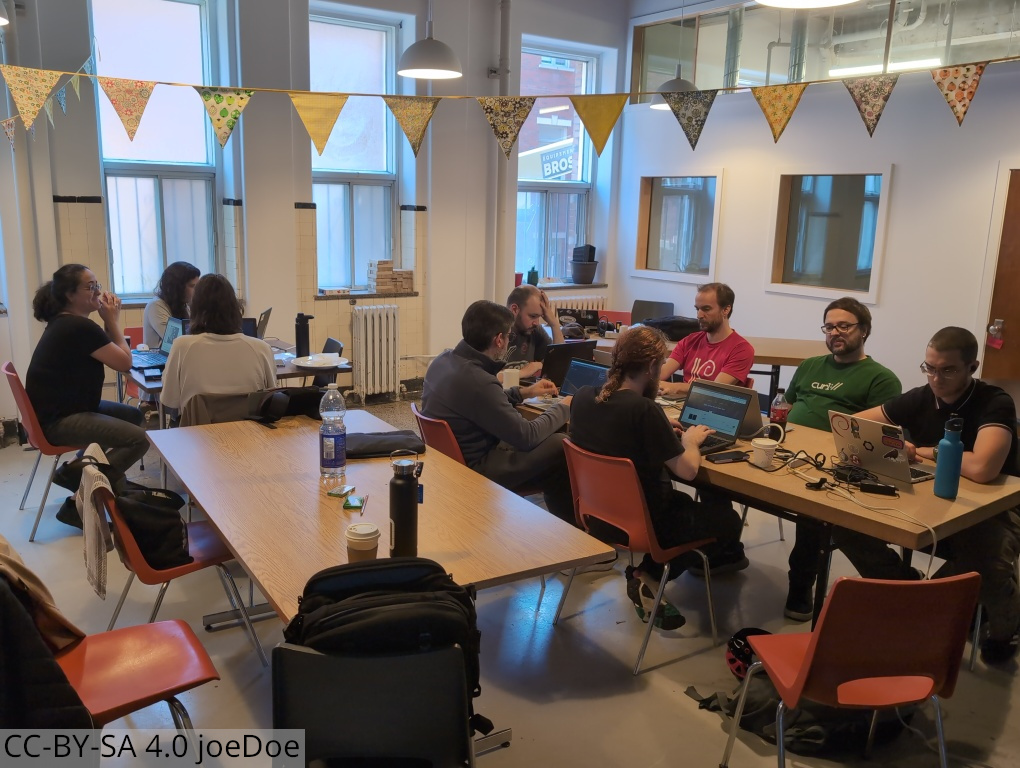
Our Debian User Group met on September 27th for our first meeting since our summer hiatus. As always, it was fun and productive! Here's what we did: pollo: sergiodj: LeLutin: tvaz: viashimo: tassia: Pictures This time again, we were hosted at La Balise (formely ATS ). It's nice to see this community project continuing to improve: the social housing apartments on the top floors should be opening this month! Lots of construction work was also ongoing to make the Espace des Possibles more accessible from the street level. Group photo Some of us ended up grabbing a drink after the event at l'Isle de Garde, a pub right next to the venue, but I didn't take any pictures.
Sergio Cipriano: Avoiding 5XX errors by adjusting Load Balancer Idle Timeout

Avoiding 5XX errors by adjusting Load Balancer Idle Timeout Recently I faced a problem in production where a client was running a RabbitMQ server behind the Load Balancers we provisioned and the TCP connections were closed every minute. My team is responsible for the LBaaS (Load Balancer as a Service) product and this Load Balancer was an Envoy proxy provisioned by our control plane. The error was similar to this:
[2025-10-03 12:37:17,525 - pika.adapters.utils.connection_workflow - ERROR] AMQPConnector - reporting failure: AMQPConnectorSocketConnectError: timeout("TCP connection attempt timed out: ''/(<AddressFamily.AF_INET: 2>, <SocketKind.SOCK_STREAM: 1>, 6, '', ('<IP>', 5672))")
[2025-10-03 12:37:17,526 - pika.adapters.utils.connection_workflow - ERROR] AMQP connection workflow failed: AMQPConnectionWorkflowFailed: 1 exceptions in all; last exception - AMQPConnectorSocketConnectError: timeout("TCP connection attempt timed out: ''/(<AddressFamily.AF_INET: 2>, <SocketKind.SOCK_STREAM: 1>, 6, '', ('<IP>', 5672))"); first exception - None.
[2025-10-03 12:37:17,526 - pika.adapters.utils.connection_workflow - ERROR] AMQPConnectionWorkflow - reporting failure: AMQPConnectionWorkflowFailed: 1 exceptions in all; last exception - AMQPConnectorSocketConnectError: timeout("TCP connection attempt timed out: ''/(<AddressFamily.AF_INET: 2>, <SocketKind.SOCK_STREAM: 1>, 6, '', ('<IP>', 5672))"); first exception - None
At first glance, the issue is simple: the Load Balancer's idle timeout is shorter than the RabbitMQ heartbeat interval. The idle timeout is the time at which a downstream or upstream connection will be terminated if there are no active streams. Heartbeats generate periodic network traffic to prevent idle TCP connections from closing prematurely. Adjusting these timeout settings to align properly solved the issue. However, what I want to explore in this post are other similar scenarios where it's not so obvious that the idle timeout is the problem. Introducing an extra network layer, such as an Envoy proxy, can introduce unpredictable behavior across your services, like intermittent 5XX errors. To make this issue more concrete, let's look at a minimal, reproducible setup that demonstrates how adding an Envoy proxy can lead to sporadic errors.

Reproducible setup I'll be using the following tools: This setup is based on what Kai Burjack presented in his article. Setting up Envoy with Docker is straightforward:
$ docker run \
    --name envoy --rm \
    --network host \
    -v $(pwd)/envoy.yaml:/etc/envoy/envoy.yaml \
    envoyproxy/envoy:v1.33-latest
I'll be running experiments with two different envoy.yaml configurations: one that uses Envoy's TCP proxy, and another that uses Envoy's HTTP connection manager. Here's the simplest Envoy TCP proxy setup: a listener on port 8000 forwarding traffic to a backend running on port 8080.
static_resources:
  listeners:
  - name: go_server_listener
    address:
      socket_address:
        address: 0.0.0.0
        port_value: 8000
    filter_chains:
    - filters:
      - name: envoy.filters.network.tcp_proxy
        typed_config:
          "@type": type.googleapis.com/envoy.extensions.filters.network.tcp_proxy.v3.TcpProxy
          stat_prefix: go_server_tcp
          cluster: go_server_cluster
  clusters:
  - name: go_server_cluster
    connect_timeout: 1s
    type: static
    load_assignment:
      cluster_name: go_server_cluster
      endpoints:
      - lb_endpoints:
        - endpoint:
            address:
              socket_address:
                address: 127.0.0.1
                port_value: 8080
The default idle timeout if not otherwise specified is 1 hour, which is the case here. The backend setup is simple as well:
package main

import (
    "fmt"
    "net/http"
    "time"
)

func helloHandler(w http.ResponseWriter, r *http.Request)  
  w.Write([]byte("Hello from Go!"))
 

func main()  
    http.HandleFunc("/", helloHandler)

    server := http.Server 
        Addr:        ":8080",
        IdleTimeout: 3 * time.Second,
     

    fmt.Println("Starting server on :8080")
    panic(server.ListenAndServe())
 
The IdleTimeout is set to 3 seconds to make it easier to test. Now, oha is the perfect tool to generate the HTTP requests for this test. The Load test is not meant to stress this setup, the idea is to wait long enough so that some requests are closed. The burst-delay feature will help with that:
$ oha -z 30s -w --burst-delay 3s --burst-rate 100 http://localhost:8000
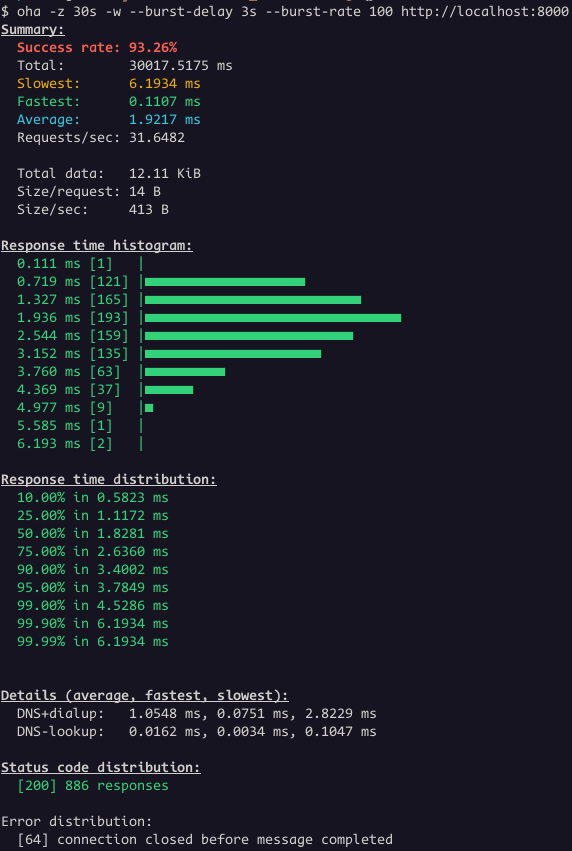
I'm running the Load test for 30 seconds, sending 100 requests at three-second intervals. I also use the -w option to wait for ongoing requests when the duration is reached. The result looks like this: oha test report tcp fail We had 886 responses with status code 200 and 64 connections closed. The backend terminated 64 connections while the load balancer still had active requests directed to it. Let's change the Load Balancer idle_timeout to two seconds.
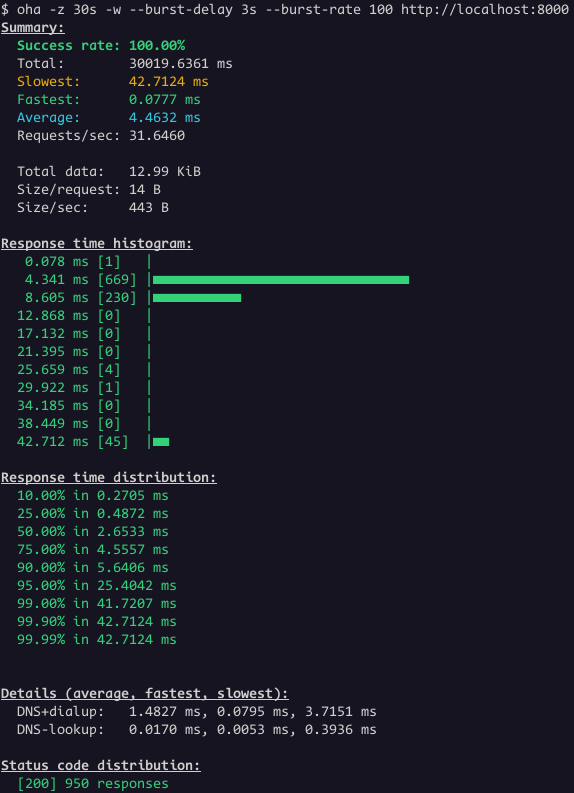
filter_chains:
- filters:
  - name: envoy.filters.network.tcp_proxy
    typed_config:
      "@type": type.googleapis.com/envoy.extensions.filters.network.tcp_proxy.v3.TcpProxy
      stat_prefix: go_server_tcp
      cluster: go_server_cluster
      idle_timeout: 2s # <--- NEW LINE
Run the same test again. oha test report tcp success Great! Now all the requests worked. This is a common issue, not specific to Envoy Proxy or the setup shown earlier. Major cloud providers have all documented it. AWS troubleshoot guide for Application Load Balancers says this: The target closed the connection with a TCP RST or a TCP FIN while the load balancer had an outstanding request to the target. Check whether the keep-alive duration of the target is shorter than the idle timeout value of the load balancer. Google troubleshoot guide for Application Load Balancers mention this as well: Verify that the keepalive configuration parameter for the HTTP server software running on the backend instance is not less than the keepalive timeout of the load balancer, whose value is fixed at 10 minutes (600 seconds) and is not configurable. The load balancer generates an HTTP 5XX response code when the connection to the backend has unexpectedly closed while sending the HTTP request or before the complete HTTP response has been received. This can happen because the keepalive configuration parameter for the web server software running on the backend instance is less than the fixed keepalive timeout of the load balancer. Ensure that the keepalive timeout configuration for HTTP server software on each backend is set to slightly greater than 10 minutes (the recommended value is 620 seconds). RabbitMQ docs also warn about this: Certain networking tools (HAproxy, AWS ELB) and equipment (hardware load balancers) may terminate "idle" TCP connections when there is no activity on them for a certain period of time. Most of the time it is not desirable. Most of them are talking about Application Load Balancers and the test I did was using a Network Load Balancer. For the sake of completeness, I will do the same test but using Envoy's HTTP connection manager. The updated envoy.yaml:
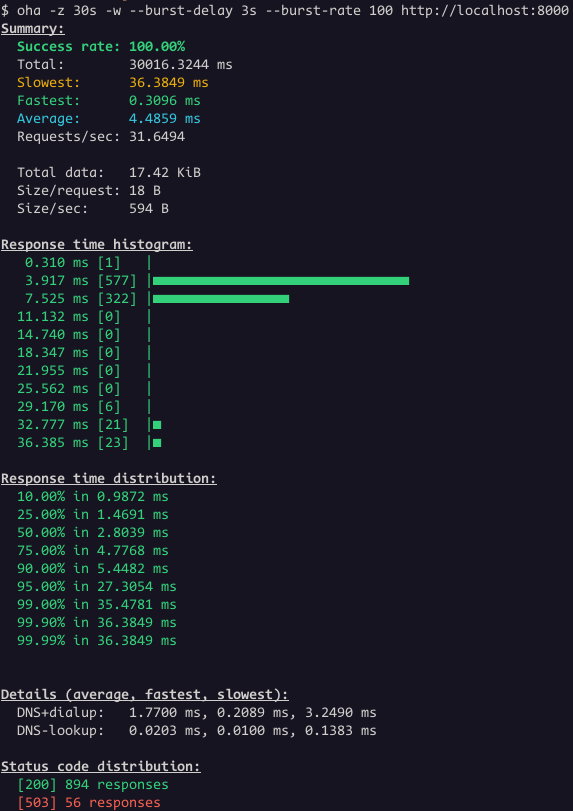
static_resources:
  listeners:
  - name: listener
    address:
      socket_address:
        address: 0.0.0.0
        port_value: 8000
    filter_chains:
    - filters:
      - name: envoy.filters.network.http_connection_manager
        typed_config:
          "@type": type.googleapis.com/envoy.extensions.filters.network.http_connection_manager.v3.HttpConnectionManager
          stat_prefix: go_server_http
          access_log:
          - name: envoy.access_loggers.stdout
            typed_config:
              "@type": type.googleapis.com/envoy.extensions.access_loggers.stream.v3.StdoutAccessLog
          http_filters:
          - name: envoy.filters.http.router
            typed_config:
              "@type": type.googleapis.com/envoy.extensions.filters.http.router.v3.Router
          route_config:
            name: http_route
            virtual_hosts:
            - name: local_service
              domains: ["*"]
              routes:
              - match:
                  prefix: "/"
                route:
                  cluster: go_server_cluster
  clusters:
  - name: go_server_cluster
    type: STATIC
    load_assignment:
      cluster_name: go_server_cluster
      endpoints:
      - lb_endpoints:
        - endpoint:
            address:
              socket_address:
                address: 0.0.0.0
                port_value: 8080
The yaml above is an example of a service proxying HTTP from 0.0.0.0:8000 to 0.0.0.0:8080. The only difference from a minimal configuration is that I enabled access logs. Let's run the same tests with oha. oha test report http fail Even thought the success rate is 100%, the status code distribution show some responses with status code 503. This is the case where is not that obvious that the problem is related to idle timeout. However, it's clear when we look the Envoy access logs:
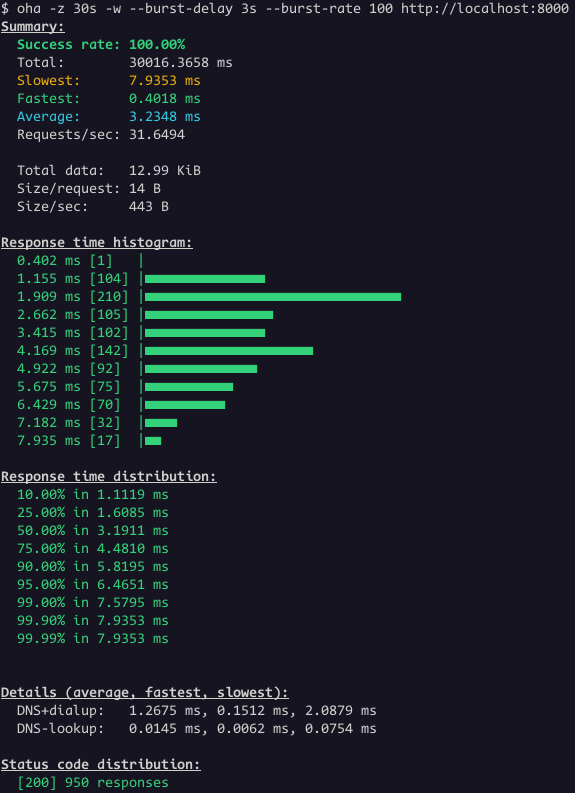
[2025-10-10T13:32:26.617Z] "GET / HTTP/1.1" 503 UC 0 95 0 - "-" "oha/1.10.0" "9b1cb963-449b-41d7-b614-f851ced92c3b" "localhost:8000" "0.0.0.0:8080"
UC is the short name for UpstreamConnectionTermination. This means the upstream, which is the golang server, terminated the connection. To fix this once again, the Load Balancer idle timeout needs to change:
  clusters:
  - name: go_server_cluster
    type: STATIC
    typed_extension_protocol_options: # <--- NEW BLOCK
      envoy.extensions.upstreams.http.v3.HttpProtocolOptions:
        "@type": type.googleapis.com/envoy.extensions.upstreams.http.v3.HttpProtocolOptions
        common_http_protocol_options:
          idle_timeout: 2s # <--- NEW VALUE
        explicit_http_config:
          http_protocol_options:  
Finally, the sporadic 503 errors are over: oha test report http success

To Sum Up Here's an example of the values my team recommends to our clients: recap drawing Key Takeaways:
  1. The Load Balancer idle timeout should be less than the backend (upstream) idle/keepalive timeout.
  2. When we are working with long lived connections, the client (downstream) should use a keepalive smaller than the LB idle timeout.

9 October 2025

Charles: How to Build an Incus Buster Image

It s always nice to have container images of Debian releases to test things, run applications or explore a bit without polluting your host machine. From some Brazilian friends (you know who you are ;-), I ve learned the best way to debug a problem or test a fix is spinning up an incus container, getting to it and finding the minimum reproducer. So the combination incus + Debian is something that I m very used to, but the problem is there are no images for Debian ELTS and testing security fixes to see if they actually fix the vulnerability and don t break anything else is very important. Well, the regular images don t materialize out of thin air, right? So we can learn how they are made and try to generate ELTS images in the same way - shouldn t be that difficult, right? Well, kinda ;-) The images available by default in incus come from images.linuxcontainers.org and are built by Jenkins using distrobuilder. If you follow the links, you will find the repository containing the yaml image definitions used by distrobuilder at github.com/lxc/lxc-ci. With a bit of investigation work, a fork, an incus VM with distrobuilder installed and some magic (also called trial and error) I was able to build a buster image! Whooray, but VM and stretch images are still work in progress. Anyway, I wanted to share how you can build your images and document this process so I don t forget, so here we are

Building Instructions We will use an incus trixie VM to perform the build so we don t clutter our own machine.
incus launch images:debian/trixie <instance-name> --vm
Then let s hop into the machine and install the dependencies.
incus shell <instance-name>
And
apt install git distrobuilder
Let s clone the repository with the yaml definition to build a buster container.
git clone --branch support-debian-buster https://github.com/charles2910/lxc-ci.git
# and cd into it
cd lxc-ci
Then all we need is to pass the correct arguments to distrobuilder so it can build the image. It can output the image in the current directory or in a pre-defined place, so let s create an easy place for the images.
mkdir -p /tmp/images/buster/container
# and perform the build
distrobuilder build-incus images/debian.yaml /tmp/images/buster/container/ \
            -o image.architecture=amd64 \
            -o image.release=buster \
            -o image.variant=default  \
            -o source.url="http://archive.debian.org/debian"
It requires a build definition written in yaml format to perform the build. If you are curious, check the images/ subdir. If all worked correctly, you should have two files in your pre-defined target directory. In our case, /tmp/images/buster/container/ contains:
incus.tar.xz  rootfs.squashfs
Let s copy it to our host so we can add the image to our incus server.
incus file pull <instance-name>/tmp/images/buster/container/incus.tar.xz .
incus file pull <instance-name>/tmp/images/buster/container/rootfs.squashfs .
# and import it as debian/10
incus image import incus.tar.xz rootfs.squashfs --alias debian/10
If we are lucky, we can run our Debian buster container now!
incus launch local:debian/10 <debian-buster-instance>
incus shell <debian-buster-instance>
Well, now all that is left is to install Freexian s ELTS package repository and update the image to get a lot of CVE fixes.
apt install --assume-yes wget
wget https://deb.freexian.com/extended-lts/archive-key.gpg -O /etc/apt/trusted.gpg.d/freexian-archive-extended-lts.gpg
cat <<EOF >/etc/apt/sources.list.d/extended-lts.list
deb http://deb.freexian.com/extended-lts buster-lts main contrib non-free
EOF
apt update
apt --assume-yes upgrade

8 October 2025

Colin Watson: Free software activity in September 2025

About 90% of my Debian contributions this month were sponsored by Freexian. You can also support my work directly via Liberapay or GitHub Sponsors. Some months I feel like I m pedalling furiously just to keep everything in a roughly working state. This was one of those months. Python team I upgraded these packages to new upstream versions: I had to spend a fair bit of time this month chasing down build/test regressions in various packages due to some other upgrades, particularly to pydantic, python-pytest-asyncio, and rust-pyo3: After some upstream discussion I requested removal of pydantic-compat, since it was more trouble than it was worth to keep it working with the latest pydantic version. I filed dh-python: pybuild-plugin-pyproject doesn t know about headers and added it to Python/PybuildPluginPyproject, and converted some packages to pybuild-plugin-pyproject: I updated dh-python to suppress generated dependencies that would be satisfied by python3 >= 3.11. pkg_resources is deprecated. In most cases replacing it is a relatively simple matter of porting to importlib.resources, but packages that used its old namespace package support need more complicated work to port them to implicit namespace packages. We had quite a few bugs about this on zope.* packages, but fortunately upstream did the hard part of this recently. I went round and cleaned up most of the remaining loose ends, with some help from Alexandre Detiste. Some of these aren t completely done yet as they re awaiting new upstream releases: This work also caused a couple of build regressions, which I fixed: I fixed jupyter-client so that its autopkgtests would work in Debusine. I fixed waitress to build with the nocheck profile. I fixed several other build/test failures: I fixed some other bugs: Code reviews Other bits and pieces I fixed several CMake 4 build failures: I got CI for debbugs passing (!22, !23). I fixed a build failure with GCC 15 in trn4. I filed a release-notes bug about the tzdata reorganization in the trixie cycle. I filed and fixed a git-dpm regression with bash 5.3. I upgraded libfilter-perl to a new upstream version. I optimized some code in ubuntu-dev-tools that made O(1) HTTP requests when it could instead make O(n).

2 October 2025

John Goerzen: A Twisty Maze of Ill-Behaved Bots

Like many, bot traffic has been causing significant issues for my hosted server recently. I ve been noticing a dramatic increase in bots that do not respect robots.txt, especially the crawl-delay I have set there. Not only that, but many of them are sending user-agent strings that are quite precisely matching what desktop browsers send. That is, they don t identify themselves. They posed a particular problem on two sites: my blog, and the lists.complete.org archives. The list archives is a completely static site, but it has many pages, so the bots that are ill-behaved absolutely hammer it following links. My blog runs WordPress. It has fewer pages, but by using PHP, doesn t need as many hits to start to bog down. Also, there is a Mastodon thundering herd problem, and since I participate on Mastodon, this hits my server. The solution was one of layers. I had already added a crawl-delay line to robots.txt. It helped a bit, but many bots these days aren t well-behaved. Next, I added WP Super Cache to my WordPress installation. I also enabled APCu in PHP and installed APCu Manager. Again, each step helped. Again, not quite enough. Finally, I added Anubis. Installing it (especially if using the Docker container) was under-documented, but I figured it out. By default, it is designed to block AI bots and try to challenge everything with Mozilla in its user-agent (which is most things) with a Javascript challenge. That s not quite what I want. If a bot is well-behaved, AI or otherwise, it will respect my robots.txt and I can more precisely control it there. Also, I intentionally support non-Javascript browsers on many of the sites I host, so I wanted to be judicious. Eventually I configured Anubis to only challenge things that present a user-agent that looks fully like a real browser. In other words, real browsers should pass right through, and bad bots pretending to be real browsers will fail. That was quite effective. It reduced load further to the point where things are ordinarily fairly snappy. I had previously been using mod_security to block some bots, but it seemed to be getting in the way of the Fediverse at times. When I disabled it, I observed another increase in speed. Anubis was likely going to get rid of those annoying bots itself anyhow. As a final step, I migrated to a faster hosting option. This post will show me how well it survives the Mastodon thundering herd! Update: Yes, it handled it quite nicely now.

1 October 2025

Dirk Eddelbuettel: #052: Running r-ci with Coverage

Welcome to post 52 in the R4 series. Following up on the post #51 yesterday and its stated intent of posting some more here The r-ci setup (which was introduced in post #32 and updated in post #45) offers portable continuous integration which can take advantage of different backends: Github Actions, Azure Pipelines, GitLab, BitBuckets, and possibly as it only requires a basic Ubuntu shell after which it customizes itself and runs via shell script. Portably. Now, most of us, I suspect still use it with GitHub Actions but it is reassuring to know that one can take it elsewhere should the need or desire arise. One thing many repos did, and which stopped working reliably is coverage analysis. This is made easy by the covr package, and made fast, easy, reliable (as we quip) thanks to r2u. But transmission to codecov stopped working a while back so I had mostly commented it out in my repos, rendering the reports more and more stale. Which is not ideal. A few weeks ago I gave this another look, and it turns that that codecov now requires an API token to upload. Which one can generate in the user -> settings menu on their website under the access tab. Which in turn then needs to be stored in each repo wanting to upload. For Github, this is under settings -> secrets and variables -> actions as a repository secret . I suggest using CODECOV_TOKEN for its name. After that the three-line block in the yaml file can reference it as a secret as in the following snippet, now five lines, taken from one of my ci.yaml files:
      - name: Coverage
        if: $  matrix.os == 'ubuntu-latest'  
        run: ./run.sh coverage
        env:
          CODECOV_TOKEN: $  secrets.CODECOV_TOKEN  
It assigns the secret we stored on the website, references it by prefix secrets. and assigns it to the environment variable CODECOV_TOKEN. After this reports flow as one can see on repositories where I re-enabled this as for example here for RcppArmadillo.

This post by Dirk Eddelbuettel originated on his Thinking inside the box blog. If you like this or other open-source work I do, you can now sponsor me at GitHub.

29 September 2025

Russ Allbery: Review: The Incandescent

Review: The Incandescent, by Emily Tesh
Publisher: Tor
Copyright: 2025
ISBN: 1-250-83502-X
Format: Kindle
Pages: 417
The Incandescent is a stand-alone magical boarding school fantasy.
Your students forgot you. It was natural for them to forget you. You were a brief cameo in their lives, a walk-on character from the prologue. For every sentimental my teacher changed my life story you heard, there were dozens of my teacher made me moderately bored a few times a week and then I got through the year and moved on with my life and never thought about them again. They forgot you. But you did not forget them.
Doctor Saffy Walden is Director of Magic at Chetwood, an elite boarding school for prospective British magicians. She has a collection of impressive degrees in academic magic, a specialization in demonic invocation, and a history of vague but lucrative government job offers that go with that specialty. She turned them down to be a teacher, and although she's now in a mostly administrative position, she's a good teacher, with the usual crop of promising, lazy, irritating, and nervous students. As the story opens, Walden's primary problem is Nikki Conway. Or, rather, Walden's primary problem is protecting Nikki Conway from the Marshals, and the infuriating Laura Kenning in particular. When Nikki was seven, she summoned a demon who killed her entire family and left her a ward of the school. To Laura Kenning, that makes her a risk who should ideally be kept far away from invocation. To Walden, that makes Nikki a prodigious natural talent who is developing into a brilliant student and who needs careful, professional training before she's tempted into trying to learn on her own. Most novels with this setup would become Nikki's story. This one does not. The Incandescent is Walden's story. There have been a lot of young-adult magical boarding school novels since Harry Potter became a mass phenomenon, but most of them focus on the students and the inevitable coming-of-age story. This is a story about the teachers: the paperwork, the faculty meetings, the funding challenges, the students who repeat in endless variations, and the frustrations and joys of attempting to grab the interest of a young mind. It's also about the temptation of higher-paying, higher-status, and less ethical work, which however firmly dismissed still nibbles around the edges. Even if you didn't know Emily Tesh is herself a teacher, you would guess that before you get far into this novel. There is a vividness and a depth of characterization that comes from being deeply immersed in the nuance and tedium of the life that your characters are living. Walden's exasperated fondness for her students was the emotional backbone of this book for me. She likes teenagers without idealizing the process of being a teenager, which I think is harder to pull off in a novel than it sounds.
It was hard to quantify the difference between a merely very intelligent student and a brilliant one. It didn't show up in a list of exam results. Sometimes, in fact, brilliance could be a disadvantage when all you needed to do was neatly jump the hoop of an examiner's grading rubric without ever asking why. It was the teachers who knew, the teachers who could feel the difference. A few times in your career, you would have the privilege of teaching someone truly remarkable; someone who was hard work to teach because they made you work harder, who asked you questions that had never occurred to you before, who stretched you to the very edge of your own abilities. If you were lucky as Walden, this time, had been lucky your remarkable student's chief interest was in your discipline: and then you could have the extraordinary, humbling experience of teaching a child whom you knew would one day totally surpass you.
I also loved the world-building, and I say this as someone who is generally not a fan of demons. The demons themselves are a bit of a disappointment and mostly hew to one of the stock demon conventions, but the rest of the magic system is deep enough to have practitioners who approach it from different angles and meaty enough to have some satisfying layered complexity. This is magic, not magical science, so don't expect a fully fleshed-out set of laws, but the magical system felt substantial and satisfying to me. Tesh's first novel, Some Desperate Glory, was by far my favorite science fiction novel of 2023. This is a much different book, which says good things about Tesh's range and the potential of her work yet to come: adult rather than YA, fantasy rather than science fiction, restrained and subtle in places where Some Desperate Glory was forceful and pointed. One thing the books do have in common, though, is some structure, particularly the false climax near the midpoint of the book. I like the feeling of uncertainty and possibility that gives both books, but in the case of The Incandescent, I was not quite in the mood for the second half of the story. My problem with this book is more of a reader preference than an objective critique: I was in the mood for a story about a confident, capable protagonist who was being underestimated, and Tesh was writing a novel with a more complicated and fraught emotional arc. (I'm being intentionally vague to avoid spoilers.) There's nothing wrong with the story that Tesh wanted to tell, and I admire the skill with which she did it, but I got a tight feeling in my stomach when I realized where she was going. There is a satisfying ending, and I'm still very happy I read this book, but be warned that this might not be the novel to read if you're in the mood for a purer competence porn experience. Recommended, and I am once again eagerly awaiting the next thing Emily Tesh writes (and reminding myself to go back and read her novellas). Content warnings: Grievous physical harm, mind control, and some body horror. Rating: 8 out of 10

18 September 2025

Gunnar Wolf: Still use Twitter/X? Consider dropping it...

Many people that were once enthusiast Twitter users have dropped as a direct or indirect effect of its ownership change and the following policy changes. Given Twitter X is getting each time more irrelevant, it is less interesting and enciting for more and more people But also, its current core users (mostly, hate-apologists of the right-wing mindset that finds conspiration theories everywhere) are becoming more commonplace, and by sheer probability (if not for algorithmic bias), every time it becomes more likely a given piece of content will be linked to what their authors would classify as crap. So, there has been in effect an X exodus. This has been reported in media outlets as important as Reuters, or The Guardianresearch institutes such as Berkeley, even media that no matter how hard you push cannot be identified as the radical left Mr. Trump is so happy to blame for everything, such as Forbes Today I read a short note in a magazine I very much enjoy, Communications of the ACM, where SIGDOC (the ACM s Special Interest Group on Design of Communication) is officially closing their X account. The reasoning is crystal clear. They have the mission to create and study User Experience (UX) implementations and report on it, focused on making communication clearer and more human centered . That is no longer, for many reasons, a goal that can be furthered by the means of an X account. (BTW, and How many people are actually angry that Mr. Musk took the X11 old logo and made it his? I am sure it is now protected under too many layers of legalese, even though I am aware of it since at least 30 years ago )

16 September 2025

Raju Devidas: Building Debian 13 Trixie Vagrant Image

I sometimes use Vagrant to deploy my VM&aposs and recently when I tried to deploy one for Trixie, I could see one available. So I checked the official Debian images on Vagrant cloud at https://portal.cloud.hashicorp.com/vagrant/discover/debian and could not find an image for trixie on Vagrant cloud. Also looked at other cloud image sources like Docker hub, and I could see an image their for Trixie. So I looked into how I can generate a Vagrant image locally for Debian to use.
make install-build-deps


Searched on Salsa and stumbled upon https://salsa.debian.org/cloud-team/debian-vagrant-imagesCloned the repo from salsa
$ git clone https://salsa.debian.org/cloud-team/debian-vagrant-images.git
Install the build dependencies
$ make install-build-deps
this will install some dependency packages, will ask for sudo password if need to install something not already installed. Let&aposs call make help
$ make help
To run this makefile, run:
   make <DIST>-<CLOUD>-<ARCH>
  WHERE <DIST> is bullseye, buster, stretch, sid or testing
    And <CLOUD> is azure, ec2, gce, generic, genericcloud, nocloud, vagrant, vagrantcontrib
    And <ARCH> is amd64, arm64, ppc64el
Set DESTDIR= to write images to given directory.
$ make trixie-vagrant-amd64
umask 022; \
./bin/debian-cloud-images build \
  trixie vagrant amd64 \
  --build-id vagrant-cloud-images-master \
  --build-type official
usage: debian-cloud-images build
debian-cloud-images build: error: argument RELEASE: invalid value: trixie
make: *** [Makefile:22: trixie-vagrant-amd64] Error 2
As you can see, trixie is not even in the available options and it is not building as well. Before trying to look at updating the codebase, I looked at the pending MR&aposs on Salsa and found Michael Ablassmeier&aposs pending merge request at https://salsa.debian.org/cloud-team/debian-vagrant-images/-/merge_requests/18So let me test that commit and see if I can build trixie locally from Michael&aposs MR
$ git clone https://salsa.debian.org/debian/debian-vagrant-images.git
Cloning into &aposdebian-vagrant-images&apos...
remote: Enumerating objects: 5310, done.
remote: Counting objects: 100% (256/256), done.
remote: Compressing objects: 100% (96/96), done.
remote: Total 5310 (delta 141), reused 241 (delta 135), pack-reused 5054 (from 1)
Receiving objects: 100% (5310/5310), 629.81 KiB   548.00 KiB/s, done.
Resolving deltas: 100% (2875/2875), done.
$ cd debian-vagrant-images/
$ git checkout 8975eb0 #the commit id of MR 
Now let&aposs see if we can build trixie now
$ make help
To run this makefile, run:
   make <DIST>-<CLOUD>-<ARCH>
  WHERE <DIST> is bullseye, buster, stretch, sid or testing
    And <CLOUD> is azure, ec2, gce, generic, genericcloud, nocloud, vagrant, vagrantcontrib
    And <ARCH> is amd64, arm64, ppc64el
Set DESTDIR= to write images to given directory.
$ make trixie-vagrant-amd64
umask 022; \
./bin/debian-cloud-images build \
  trixie vagrant amd64 \
  --build-id vagrant-cloud-images-master \
  --build-type official
2025-09-17 00:36:25,919 INFO Adding class DEBIAN
2025-09-17 00:36:25,919 INFO Adding class CLOUD
2025-09-17 00:36:25,919 INFO Adding class TRIXIE
2025-09-17 00:36:25,920 INFO Adding class VAGRANT
2025-09-17 00:36:25,920 INFO Adding class AMD64
2025-09-17 00:36:25,920 INFO Adding class LINUX_IMAGE_BASE
2025-09-17 00:36:25,920 INFO Adding class GRUB_PC
2025-09-17 00:36:25,920 INFO Adding class LAST
2025-09-17 00:36:25,921 INFO Running FAI: sudo env PYTHONPATH=/home/rajudev/dev/salsa/michael/debian-vagrant-images/src/debian_cloud_images/build/../.. CLOUD_BUILD_DATA=/home/rajudev/dev/salsa/michael/debian-vagrant-images/src/debian_cloud_images/data CLOUD_BUILD_INFO= "type": "official", "release": "trixie", "release_id": "13", "release_baseid": "13", "vendor": "vagrant", "arch": "amd64", "build_id": "vagrant-cloud-images-master", "version": "20250917-1"  CLOUD_BUILD_NAME=debian-trixie-vagrant-amd64-official-20250917-1 CLOUD_BUILD_OUTPUT_DIR=/home/rajudev/dev/salsa/michael/debian-vagrant-images CLOUD_RELEASE_ID=vagrant CLOUD_RELEASE_VERSION=20250917-1 fai-diskimage --verbose --hostname debian --class DEBIAN,CLOUD,TRIXIE,VAGRANT,AMD64,LINUX_IMAGE_BASE,GRUB_PC,LAST --size 100G --cspace /home/rajudev/dev/salsa/michael/debian-vagrant-images/src/debian_cloud_images/build/fai_config debian-trixie-vagrant-amd64-official-20250917-1.raw
..... continued
Although we can now build the images, we just don&apost see an option for it in the help text, not even for bookworm. Just the text in Makefile is outdated, but I can build and trixie Vagrant box now. Thanks to Michael for the fix.

14 September 2025

Ian Jackson: tag2upload in the first month of forky

tl;dr: tag2upload (beta) is going well so far, and is already handling around one in 13 uploads to Debian. Introduction and some stats We announced tag2upload s open beta in mid-July. That was in the middle of the the freeze for trixie, so usage was fairly light until the forky floodgates opened. Since then the service has successfully performed 637 uploads, of which 420 were in the last 32 days. That s an average of about 13 per day. For comparison, during the first half of September up to today there have been 2475 uploads to unstable. That s about 176/day. So, tag2upload is already handling around 7.5% of uploads. This is very gratifying for a service which is advertised as still being in beta! Sean and I are very pleased both with the uptake, and with the way the system has been performing. Recent UI/UX improvements During this open beta period we have been hard at work. We have made many improvements to the user experience. Current git-debpush in forky, or trixie-backports, is much better at detecting various problems ahead of time. When uploads do fail on the service the emailed error reports are now more informative. For example, anomalies involving orig tarballs, which by definition can t be detected locally (since one point of tag2upload is not to have tarballs locally) now generally result in failure reports containing a diffstat, and instructions for a local repro. Why we are still in beta There are a few outstanding work items that we currently want to complete before we declare the end of the beta. Retrying on Salsa-side failures The biggest of these is that the service should be able to retry when Salsa fails. Sadly, Salsa isn t wholly reliable, and right now if it breaks when the service is trying to handle your tag, your upload can fail. We think most of these failures could be avoided. Implementing retries is a fairly substantial task, but doesn t pose any fundamental difficulties. We re working on this right now. Other notable ongoing work We want to support pristine-tar, so that pristine-tar users can do a new upstream release. Andrea Pappacoda is working on that with us. See #1106071. (Note that we would generally recommend against use of pristine-tar within Debian. But we want to support it.) We have been having conversations with Debusine folks about what integration between tag2upload and Debusine would look like. We re making some progress there, but a lot is still up in the air. We are considering how best to provide tag2upload pre-checks as part of Salsa CI. There are several problems detected by the tag2upload service that could be detected by Salsa CI too, but which can t be detected by git-debpush. Common problems We ve been monitoring the service and until very recently we have investigated every service-side failure, to understand the root causes. This has given us insight into the kinds of things our users want, and the kinds of packaging and git practices that are common. We ve been able to improve the system s handling of various anomalies and also improved the documentation. Right now our failure rate is still rather high, at around 7%. Partly this is because people are trying out the system on packages that haven t ever seen git tooling with such a level of rigour. There are two classes of problem that are responsible for the vast majority of the failures that we re still seeing: Reuse of version numbers, and attempts to re-tag tag2upload, like git (and like dgit), hates it when you reuse a version number, or try to pretend that a (perhaps busted) release never happened. git tags aren t namespaced, and tend to spread about promiscuously. So replacing a signed git tag, with a different tag of the same name, is a bad idea. More generally, reusing the same version number for a different (signed!) package is poor practice. Likewise, it s usually a bad idea to remove changelog entries for versions which were actually released, just because they were later deemed improper. We understand that many Debian contributors have gotten used to this kind of thing. Indeed, tools like dcut encourage it. It does allow you to make things neat-looking, even if you ve made mistakes - but really it does so by covering up those mistakes! The bottom line is that tag2upload can t support such history-rewriting. If you discover a mistake after you ve signed the tag, please just burn the version number and add a new changelog stanza. One bonus of tag2upload s approach is that it will discover if you are accidentally overwriting an NMU, and report that as an error. Discrepancies between git and orig tarballs tag2upload promises that the source package that it generates corresponds precisely to the git tree you tag and sign. Orig tarballs make this complicated. They aren t present on your laptop when you git-debpush. When you re not uploading a new upstream version, the tag2upload service reuses existing orig tarballs from the archive. If your git and the archive s orig don t agree, the tag2upload service will report an error, rather than upload a package with contents that differ from your git tag. With the most common Debian workflows, everything is fine: If you base everything on upstream git, and make your orig tarballs with git archive (or git deborig), your orig tarballs are the same as the git, by construction. We recommend usually ignoring upstream tarballs: most upstreams work in git, and their tarballs can contain weirdness that we don t want. (At worst, the tarball can contain an attack that isn t visible in git, as with xz!) Alternatively, if you use gbp import-orig, the differences (including an attack like Jia Tan s) are imported into git for you. Then, once again, your git and the orig tarball will correspond. But there are other workflows where this correspondence may not hold. Those workflows are hazardous, because the thing you re probably working with locally for your routine development is the git view. Then, when you upload, your work is transplanted onto the orig tarball, which might be quite different - so what you upload isn t what you ve been working on! This situation is detected by tag2upload, precisely because tag2upload checks that it s keeping its promise: the source package is identical to the git view. (dgit push makes the same promise.) Get involved Of course the easiest way to get involved is to start using tag2upload. We would love to have more contributors. There are some easy tasks to get started with, in bugs we ve tagged newcomer mostly UX improvements such as detecting certain problems earlier, in git-debpush. More substantially, we are looking for help with sbuild: we d like it to be able to work directly from git, rather than needing to build source packages: #868527.

comment count unavailable comments

11 September 2025

John Goerzen: Performant Full-Disk Encryption on a Raspberry Pi, but Foiled by Twisty UARTs

In my post yesterday, ARM is great, ARM is terrible (and so is RISC-V), I described my desire to find ARM hardware with AES instructions to support full-disk encryption, and the poor state of the OS ecosystem around the newer ARM boards. I was anticipating buying either a newer ARM SBC or an x86 mini PC of some sort. More-efficient AES alternatives Always one to think, what if I didn t have to actually buy something , I decided to research whether it was possible to use encryption algorithms that are more performant on the Raspberry Pi 4 I already have. The answer was yes. From cryptsetup benchmark:
root@mccoy:~# cryptsetup benchmark --cipher=xchacha12,aes-adiantum-plain64 
# Tests are approximate using memory only (no storage IO).
#            Algorithm         Key        Encryption        Decryption
xchacha12,aes-adiantum        256b       159.7 MiB/s       160.0 MiB/s
xchacha20,aes-adiantum        256b       116.7 MiB/s       169.1 MiB/s
    aes-xts                   256b        52.5 MiB/s        52.6 MiB/s
With best-case reads from my SD card at 45MB/s (with dd if=/dev/mmcblk0 of=/dev/null bs=1048576 status=progress), either of the ChaCha-based algorithms will be fast enough. Great, I thought. Now I can just solve this problem without spending a dollar. But not so fast. Serial terminals vs. serial consoles My primary use case for this device is to drive my actual old DEC vt510 terminal. I have long been able to do that by running a getty for my FTDI-based USB-to-serial converter on /dev/ttyUSB0. This gets me a login prompt, and I can do whatever I need from there. This does not get me a serial console, however. The serial console would show kernel messages and could be used to interact with the pre-multiuser stages of the system that is, everything before the loging prompt. You can use it to access an emergency shell for repair, etc. Although I have long booted that kernel with console=tty0 console=ttyUSB0,57600, the serial console has never worked but I d never bothered investigating because the text terminal was sufficient. You might be seeing where this is going: to have root on an encrypted LUKS volume, you have to enter the decryption password in the pre-multiuser environment (which happens to be on the initramfs). So I started looking. First, I extracted the initrd with cpio and noticed that the ftdi_sio and usbserial modules weren t present. Added them to /etc/initramfs-tools/modules and rebooted; no better. So I found the kernel s serial console guide, which explicitly notes To use a serial port as console you need to compile the support into your kernel . Well, I have no desire to custom-build a kernel on a Raspberry Pi with MicroSD storage every time a new kernel comes out. I thought well I don t stricly need the kernel to know about the console on /dev/ttyUSB0 for this; I just need the password prompt which comes from userspace to know about it. So I looked at the initramfs code, and wouldn t you know it, it uses /dev/console. Looking at /proc/consoles on that system, indeed it doesn t show ttyUSB0. So even though it is possible to load the USB serial driver in the initramfs, there is no way to make the initramfs use it, because it only uses whatever the kernel recognizes as a console, and the kernel won t recognize this. So there is no way to use a USB-to-serial adapter to enter a password for an encrypted root filesystem. Drat. The on-board UARTs? I can hear you know: The Pi already has on-board serial support! Why not use that? Ah yes, the reason I don t want to use that is because it is difficult to use that, particularly if you want to have RTS/CTS hardware flow control (or DTR/DSR on these old terminals, but that s another story, and I built a custom cable to map it to RTS/CTS anyhow). Since you asked, I ll take you down this unpleasant path. The GPIO typically has only 2 pins for serial communication: 8 and 10, for TX and RX, respectively. But dive in and you get into a confusing maze of UARTs. The mini UART , the one we are mostly familiar with on the Pi, does not support hardware flow control. The PL011 does. So the natural question is: how do we switch to the PL011, and what pins does it use? Great questions, and the answer is undocumented, at least for the Pi 4. According to that page, for the Pi 4, the primary UART is UART1, UART1 is the mini UART, the secondary UART is not normally present on the GPIO connector and might be used by Bluetooth anyway, and there is no documented pin for RTS/CTS anyhow. (Let alone some of the other lines modems use) There are supposed to be /dev/ttyAMA* devices, but I don t have those. There s an enable_uart kernel parameter, which does things like stop the mini UART from changing baud rates every time the VPU changes clock frequency (I am not making this up!), but doesn t seem to control the PL011 UART selection. This page has a program to do it, and map some GPIO pins to RTS/CTS, in theory. Even if you get all that working, you still have the problem that the Pi UARTs (all of them of every type) is 3.3V and RS-232 is 5V, so unless you get a converter, you will fry your Pi the moment you connect it to something useful. So, you re probably looking at some soldering and such just to build a cable that will work with an iffy stack. So, I could probably make it work given enough time, but I don t have that time to spare working with weird Pi serial problems, so I have always used USB converters when I need serial from a Pi. Conclusion I bought a fanless x86 micro PC with a N100 chip and all the ports I might want: a couple of DB-9 serial ports, some Ethernet ports, HDMI and VGA ports, and built-in wifi. Done.

Gunnar Wolf: Saying _hi_ to my good Reproducible Builds friends while reading a magazine article

Just wanted to share I enjoy reading George V. Neville s Kode Vicious column, which regularly appears on some of ACM s publications I follow, such as ACM Queue or Communications. Today I was very pleasantly surprised, while reading the column titled Can t we have nice things Kode Vicious answers to a question on why computing has nothing comparable to the beauty of ancient physics laboratories turned into museums (i.e. Faraday s laboratory) by giving a great hat tip to a project stemmed off Debian, and where many of my good Debian friends spend a lot of their energies: Reproducible builds. KV says:
Once the proper measurement points are known, we want to constrain the system such that what it does is simple enough to understand and easy to repeat. It is quite telling that the push for software that enables reproducible builds only really took off after an embarrassing widespread security issue ended up affecting the entire Internet. That there had already been 50 years of software development before anyone thought that introducing a few constraints might be a good idea is, well, let s just say it generates many emotions, none of them happy, fuzzy ones.
Yes, KV is a seasoned free software author. But I found it heart warming that the Reproducible Builds project is mentioned without needing to introduce it (assuming familiarity across the computing industry and academia), recognized as game-changing as we understood it would be over ten years ago when it was first announced, and enabling of beauty in computing. Congratulations to all of you who have made this possible! RB+ACM

9 September 2025

Dirk Eddelbuettel: RcppSMC 0.2.9 on CRAN: Maintenance

Release 0.2.9 of our RcppSMC package arrived at CRAN today. RcppSMC provides Rcpp-based bindings to R for the Sequential Monte Carlo Template Classes (SMCTC) by Adam Johansen described in his JSS article. Sequential Monte Carlo is also referred to as Particle Filter in some contexts. The package now also features the Google Summer of Code work by Leah South in 2017, and by Ilya Zarubin in 2021. This release is again entirely internal. It updates the code for the just-released RcppArmadillo 15.0.2-1, in particular opts into Armadillo 15.0.2. And it makes one small tweak to the continuous integration setup switching to the r-ci action. The release is summarized below.

Changes in RcppSMC version 0.2.9 (2025-09-09)
  • Adjust to RcppArmadillo 15.0.* by setting ARMA_USE_CURRENT and updating two expressions from deprecated code
  • Rely on r-ci GitHub Action which includes the bootstrap step

Courtesy of my CRANberries, there is also a diffstat report detailing changes. More information is on the RcppSMC page and the repo. Issues and bugreports should go to the GitHub issue tracker.

This post by Dirk Eddelbuettel originated on his Thinking inside the box blog. If you like this or other open-source work I do, you can sponsor me at GitHub.

6 September 2025

John Goerzen: Dreams of Late Summer

Here on a summer night in the grass and lilac smell
Drunk on the crickets and the starry sky,
Oh what fine stories we could tell
With this moonlight to tell them by. A summer night, and you, and paradise,
So lovely and so filled with grace,
Above your head, the universe has hung its lights,
And I reach out my hand and touch your face.
I sit outside today, at the picnic table on our side porch. I was called out here; in late summer, the cicadas and insects of the plains are so loud that I can hear them from inside our old farmhouse. I sit and hear the call and response of buzzing cicadas, the chirp of crickets during their intermission. The wind rustles off and on through the treetops. And now our old cat has heard me, and she comes over, spreading tan cat hair across my screen. But I don t mind; I hear her purr as she comes over to relax nearby. Aside from the gentle clack of my keyboard as I type, I hear no sounds of humans. Occasionally I hear the distant drone of a small piston airplane, and sometimes the faint horn of a train, 6 miles away. As I look up, I see grass, the harvested wheat field, the trees, and our gravel driveway. Our road is on the other side of a hill. I see no evidence of it from here, but I know it s there. Maybe 2 or 3 vehicles will pass on a day like today; if they re tall delivery trucks, I ll see their roof glide silently down the road, and know the road is there. The nearest paved road is several miles away, so not much comes out here. I reflect of those times years ago, when this was grandpa s house, and the family would gather on Easter. Grandpa hid not just Easter eggs, but Easter bags all over the yard. This yard. Here s the tree that had a nice V-shaped spot to hide things in; there s the other hiding spot. I reflect on the wildlife. This afternoon, it s the insects that I hear. On a foggy, cool, damp morning, the birds will be singing from all the trees, the fog enveloping me with unseen musical joy. On a quiet evening, the crickets chirp and the coyotes howl in the distance. Now the old cat has found my lap. She sits there purring, tail swishing. 12 years ago when she was a kitten, our daughter hadn t yet been born. She is old and limps, and is blind in one eye, but beloved by all. Perfectly content with life, she stretches and relaxes. I have visited many wonderful cities in this world. I ve seen Aida at the Metropolitan Opera, taken trains all over Europe, wandered the streets of San Francisco and Brussels and Lindos, visited the Christmas markets in the lightly-snowy evenings in Regensburg, felt the rumble of the Underground beneath me in London. But rarely do the city people come here. Oh, some of them think they ve visited the country. But no, my friends, no; if you don t venture beyond the blacktop roads, you ve not experienced it yet. You ve not gone to a restaurant in town , recognized by several old friends. You ve not stopped by the mechanic the third generation of that family fixing cars that belong to yours who more often than not tells you that you don t need to fix that something just yet. You ve not sat outside, in this land where regular people each live in their own quiet Central Park. You ve not seen the sunset, with is majestic reds and oranges and purples and blues and grays, stretching across the giant iMax dome of the troposphere, suspended above the hills and trees to the west. You ve not visited the grocery store, with your car unlocked and keys in the ignition, unconcerned about vehicle theft. You ve not struggled with words when someone asks what city are you from and you lack the vocabulary to help them understand what it means when you say none . Out there in the land of paved roads and bright lights, the problems of the world churn. The problems near and far: a physical and mental health challenges with people we know, global problems with politics and climate. But here, this lazy summer afternoon, I forget about the land of the paved roads and bright lights. As it should be; they ve forgotten the land of the buzzing cicadas and muddy roads.
I believe in impulse, in all that is green,
In the foolish vision that comes out true.
I believe that all that is essential is unseen,
And for this lifetime, I believe in you. All of the lovers and the love they made:
Nothing that was between them was a mistake.
All that we did for love s sake,
Was not wasted and will never fade. All who have loved will be forever young
And walk in grandeur on a summer night
Along the avenue. They live in every song that is sung,
In every painting of pure light,
In every pas de deux. O love that shines from every star,
Love reflected in the silver moon;
It is not here, but it is not far.
Not yet, but it will be here soon.
No two days are alike. But this day comes whenever I pause to let it. May you find the buzzing cicadas and muddy roads near you, wherever you may be. Poetry from A Summer Night by Garrison Keillor

Reproducible Builds: Reproducible Builds in August 2025

Welcome to the August 2025 report from the Reproducible Builds project! Welcome to the latest report from the Reproducible Builds project for August 2025. These monthly reports outline what we ve been up to over the past month, and highlight items of news from elsewhere in the increasingly-important area of software supply-chain security. If you are interested in contributing to the Reproducible Builds project, please see the Contribute page on our website. In this report:

  1. Reproducible Builds Summit 2025
  2. Reproducible Builds and live-bootstrap at WHY2025
  3. DALEQ Explainable Equivalence for Java Bytecode
  4. Reproducibility regression identifies issue with AppArmor security policies
  5. Rust toolchain fixes
  6. Distribution work
  7. diffoscope
  8. Website updates
  9. Reproducibility testing framework
  10. Upstream patches

Reproducible Builds Summit 2025 Please join us at the upcoming Reproducible Builds Summit, set to take place from October 28th 30th 2025 in Vienna, Austria!** We are thrilled to host the eighth edition of this exciting event, following the success of previous summits in various iconic locations around the world, including Venice, Marrakesh, Paris, Berlin, Hamburg and Athens. Our summits are a unique gathering that brings together attendees from diverse projects, united by a shared vision of advancing the Reproducible Builds effort. During this enriching event, participants will have the opportunity to engage in discussions, establish connections and exchange ideas to drive progress in this vital field. Our aim is to create an inclusive space that fosters collaboration, innovation and problem-solving. If you re interesting in joining us this year, please make sure to read the event page which has more details about the event and location. Registration is open until 20th September 2025, and we are very much looking forward to seeing many readers of these reports there!

Reproducible Builds and live-bootstrap at WHY2025 WHY2025 (What Hackers Yearn) is a nonprofit outdoors hacker camp that takes place in Geestmerambacht in the Netherlands (approximately 40km north of Amsterdam). The event is organised for and by volunteers from the worldwide hacker community, and knowledge sharing, technological advancement, experimentation, connecting with your hacker peers, forging friendships and hacking are at the core of this event . At this year s event, Frans Faase gave a talk on live-bootstrap, an attempt to provide a reproducible, automatic, complete end-to-end bootstrap from a minimal number of binary seeds to a supported fully functioning operating system . Frans talk is available to watch on video and his slides are available as well.

DALEQ Explainable Equivalence for Java Bytecode Jens Dietrich of the Victoria University of Wellington, New Zealand and Behnaz Hassanshahi of Oracle Labs, Australia published an article this month entitled DALEQ Explainable Equivalence for Java Bytecode which explores the options and difficulties when Java binaries are not identical despite being from the same sources, and what avenues are available for proving equivalence despite the lack of bitwise correlation:
[Java] binaries are often not bitwise identical; however, in most cases, the differences can be attributed to variations in the build environment, and the binaries can still be considered equivalent. Establishing such equivalence, however, is a labor-intensive and error-prone process.
Jens and Behnaz therefore propose a tool called DALEQ, which:
disassembles Java byte code into a relational database, and can normalise this database by applying Datalog rules. Those databases can then be used to infer equivalence between two classes. Notably, equivalence statements are accompanied with Datalog proofs recording the normalisation process. We demonstrate the impact of DALEQ in an industrial context through a large-scale evaluation involving 2,714 pairs of jars, comprising 265,690 class pairs. In this evaluation, DALEQ is compared to two existing bytecode transformation tools. Our findings reveal a significant reduction in the manual effort required to assess non-bitwise equivalent artifacts, which would otherwise demand intensive human inspection. Furthermore, the results show that DALEQ outperforms existing tools by identifying more artifacts rebuilt from the same code as equivalent, even when no behavioral differences are present.
Jens also posted this news to our mailing list.

Reproducibility regression identifies issue with AppArmor security policies Tails developer intrigeri has tracked and followed a reproducibility regression in the generation of AppArmor policy caches, and has identified an issue with the 4.1.0 version of AppArmor. Although initially tracked on the Tails issue tracker, intrigeri filed an issue on the upstream bug tracker. AppArmor developer John Johansen replied, confirming that they can reproduce the issue and went to work on a draft patch. Through this, John revealed that it was caused by an actual underlying security bug in AppArmor that is to say, it resulted in permissions not (always) matching what the policy intends and, crucially, not merely a cache reproducibility issue. Work on the fix is ongoing at time of writing.

Rust toolchain fixes Rust Clippy is a linting tool for the Rust programming language. It provides a collection of lints (rules) designed to identify common mistakes, stylistic issues, potential performance problems and unidiomatic code patterns in Rust projects. This month, however, Sosth ne Gu don filed a new issue in the GitHub requesting a new check that would lint against non deterministic operations in proc-macros, such as iterating over a HashMap .

Distribution work In Debian this month: Lastly, Bernhard M. Wiedemann posted another openSUSE monthly update for their work there.

diffoscope diffoscope is our in-depth and content-aware diff utility that can locate and diagnose reproducibility issues. This month, Chris Lamb made the following changes, including preparing and uploading versions, 303, 304 and 305 to Debian:
  • Improvements:
    • Use sed(1) backreferences when generating debian/tests/control to avoid duplicating ourselves. [ ]
    • Move from a mono-utils dependency to versioned mono-devel mono-utils dependency, taking care to maintain the [!riscv64] architecture restriction. [ ]
    • Use sed over awk to avoid mangling dependency lines containing = (equals) symbols such as version restrictions. [ ]
  • Bug fixes:
    • Fix a test after the upload of systemd-ukify version 258~rc3. [ ]
    • Ensure that Java class files are named .class on the filesystem before passing them to javap(1). [ ]
    • Do not run jsondiff on files over 100KiB as the algorithm runs in O(n^2) time. [ ]
    • Don t check for PyPDF version 3 specifically; check for >= 3. [ ]
  • Misc:
    • Update copyright years. [ ][ ]
In addition, Martin Joerg fixed an issue with the HTML presenter to avoid crash when page limit is None [ ] and Zbigniew J drzejewski-Szmek fixed compatibility with RPM 6 [ ]. Lastly, John Sirois fixed a missing requests dependency in the trydiffoscope tool. [ ]

Website updates Once again, there were a number of improvements made to our website this month including:

Reproducibility testing framework The Reproducible Builds project operates a comprehensive testing framework running primarily at tests.reproducible-builds.org in order to check packages and other artifacts for reproducibility. In August, however, a number of changes were made by Holger Levsen, including:
  • reproduce.debian.net-related:
    • Run 4 workers on the o4 node again in order to speed up testing. [ ][ ][ ][ ]
    • Also test trixie-proposed-updates and trixie-updates etc. [ ][ ]
    • Gather seperate statistics for each tested release. [ ]
    • Support sources from all Debian suites. [ ]
    • Run new code from the prototype database rework branch for the amd64-pull184 pseudo-architecture. [ ][ ]
    • Add a number of helpful links. [ ][ ][ ][ ][ ][ ][ ][ ][ ]
    • Temporarily call debrebuild without the --cache argument to experiment with a new version of devscripts. [ ][ ][ ]
    • Update public TODO. [ ]
  • Installation tests:
    • Add comments to explain structure. [ ]
    • Mark more old jobs as old or dead . [ ][ ][ ]
    • Turn the maintenance job into a no-op. [ ]
  • Jenkins node maintenance:
    • Increase penalties if the osuosl5 or ionos7 nodes are down. [ ]
    • Stop trying to fix network automatically. [ ]
    • Correctly mark ppc64el architecture nodes when down. [ ]
    • Upgrade the remaining arm64 nodes to Debian trixie in anticipation of the release. [ ][ ]
    • Allow higher SSD temperatures on the riscv64 architecture. [ ]
  • Debian-related:
    • Drop the armhf architecture; many thanks to Vagrant for physically hosting the nodes for ten years. [ ][ ]
    • Add Debian forky, and archive bullseye. [ ][ ][ ][ ][ ][ ][ ]
    • Document the filesystem space savings from dropping the armhf architecture. [ ]
    • Exclude i386 and armhfr from JSON results. [ ]
    • Update TODOs for when Debian trixie and forky have been released. [ ][ ]
  • tests.reproducible-builds.org-related:
  • Misc:
    • Detect errors with openQA erroring out. [ ]
    • Drop the long-disabled openwrt_rebuilder jobs. [ ]
    • Use qa-jenkins-dev@alioth-lists.debian.net as the contact for jenkins.debian.net. [ ]
    • Redirect reproducible-builds.org/vienna25 to reproducible-builds.org/vienna2025. [ ]
    • Disable all OpenWrt reproducible CI jobs, in coordination with the OpenWrt community. [ ][ ]
    • Make reproduce.debian.net accessable via IPv6. [ ]
    • Ignore that the megacli RAID controller requires packages from Debian bookworm. [ ]
In addition,
  • James Addison migrated away from deprecated toplevel deb822 Python module in favour of debian.deb822 in the bin/reproducible_scheduler.py script [ ] and removed a note on reproduce.debian.net note after the release of Debian trixie [ ].
  • Jochen Sprickerhof made a huge number of improvements to the reproduce.debian.net statistics calculation [ ][ ][ ][ ][ ][ ] as well as to the reproduce.debian.net service more generally [ ][ ][ ][ ][ ][ ][ ][ ].
  • Mattia Rizzolo performed a lot of work migrating scripts to SQLAlchemy version 2.0 [ ][ ][ ][ ][ ][ ] in addition to making some changes to the way openSUSE reproducibility tests are handled internally. [ ]
  • Lastly, Roland Clobus updated the Debian Live packages after the release of Debian trixie. [ ][ ]

Upstream patches The Reproducible Builds project detects, dissects and attempts to fix as many currently-unreproducible packages as possible. We endeavour to send all of our patches upstream where appropriate. This month, we wrote a large number of such patches, including:

Finally, if you are interested in contributing to the Reproducible Builds project, please visit our Contribute page on our website. However, you can get in touch with us via:

3 September 2025

Enrico Zini: CAdES signatures on Debian

CAdES is a digital signature standard that is used and sometimes mandated, by the Italian Public Administration. To be able to do my job, I own a Carta Nazionale dei Servizi (CNS) with which I can generate legally binding signatures. Now comes the problem of finding a software to do it. Infocamere Firma4NG InfoCamere are distributing a software called Firma4NG, with a Linux option, which, I'm pleased to say, seems to work just fine. Autofirma AutoFirma is a Java software for digital signatures distributed by the Spanish government, which has a Linux version. It is licensed as GPL-2+ EUPL-1.1, and the source seems to be here. While my Spanish is decent I lack jargon for this specific field, and I didn't manage to make it work with my CNS. Autogram Andrej Shadura pointed me to Autogram, a Slovakian software for digital signatures, licensed under the EUPL-1.2. The interface is still only in Slovakian, so tried it but I didn't go very far in trying to make it work. OpenSSL In trixie, openssl is almost, but not quite, able to do it. Here's as far as I've got. Install opensc
apt install opensc
Test if you can access the smart card with:
pkcs11-tool --list-objects [-l]
You can find other pkcs11-tool examples here Set up a pkcs11 provider for openssl
apt install pkcs11-provider
Edit /etc/ssl/openssl.cnf:
[pkcs11_sect]
module = /usr/lib/x86_64-linux-gnu/ossl-modules/pkcs11.so
pkcs11-module-path = /usr/lib/x86_64-linux-gnu/pkcs11/opensc-pkcs11.so
default_algorithms = ALL
activate = 1
Test with openssl list -providers You can check if openssl can see keys on the card:
openssl pkey -in 'pkcs11:id=%01' -pubin -pubout -text
See PKCS11 URI documentation here. Install the PKCS11 engine for openssl
apt install libengine-pkcs11-openssl
It looks like providers replaced engines, and this would not be needed, but I couldn't find a way to convince openssl to work without this. Sign a document
openssl cms -nodetach -binary -cades -outform DER -in filename -out filename.p7m -sign -signer 'pkcs11:id=%01' -keyform engine -engine pkcs11
It verifies correctly using the Austrian verification system. All the Italian verification systems I tried, however, complain that, although the signature is valid, the certificate is emitted by an unqualified CA and the certificate revocation information cannot be found. PAdES When signing PDF files, the PAdES standard is sometimes accepted. LibreOffice is able to generate PAdES signatures using the "File / Digital signatures " menu, and provided the smart card is in the reader it is able to use it. Both LibreOffice and Okular can verify that the signature is indeed there. However, when trying to validate the signature using Italian validators, I get the same complaints about unqualified CAs and missing revocation information. Wall of shame Dike GoSign Infocert (now Tinexta) used to distribute a software called "Dike GoSign" that worked on Ubuntu, which I used on a completely isolated VM, and it was awful but it worked. I had to regenerate the VM for it, and discovered that the version they distribute now will refuse to work unless one signs in online with a Tinexta account. From the same company that asks you to install their own root certifiactes to use their digital signature system. Gross. Dropped. Aruba Sign Aruba used to distribute a software called Aruba Sign, which also worked on Ubuntu. Ubuntu support has been discontinued, and they now only offer support for Windows or Mac. Yuck. Dropped.

Colin Watson: Free software activity in August 2025

About 95% of my Debian contributions this month were sponsored by Freexian. You can also support my work directly via Liberapay or GitHub Sponsors. Python team forky is open! As a result I m starting to think about the upcoming Python 3.14. At some point we ll doubtless do a full test rebuild, but in advance of that I concluded that one of the most useful things I could do would be to work on our very long list of packages with new upstream versions. Of course there s no real chance of this ever becoming empty since upstream maintainers aren t going to stop work for that long, but there are a lot of packages there where we re quite a long way out of date, and many of those include fixes that we ll need for 3.14, either directly or by fixing interactions with new versions of other packages that in turn will need to be fixed. We can backport changes when we need to, but more often than not the most efficient way to do things is just to keep up to date. So, I upgraded these packages to new upstream versions (deep breath): That s only about 10% of the backlog, but of course others are working on this too. If we can keep this up for a while then it should help. I packaged pytest-run-parallel, pytest-unmagic (still in NEW), and python-forbiddenfruit (still in NEW), all needed as new dependencies of various other packages. setuptools upstream will be removing the setup.py install command on 31 October. While this may not trickle down immediately into Debian, it does mean that in the near future nearly all Python packages will have to use pybuild-plugin-pyproject (note that this does not mean that they necessarily have to use pyproject.toml; this is just a question of how the packaging runs the build system). We talked about this a bit at DebConf, and I said that I d noticed a number of packages where this isn t straightforward and promised to write up some notes. I wrote the Python/PybuildPluginPyproject wiki page for this; I expect to add more bits and pieces to it as I find them. On that note, I converted several packages to pybuild-plugin-pyproject: I fixed several build/test failures: I fixed some other bugs: I reviewed Debian defaults: nftables as banaction and systemd as backend, but it looked as though nothing actually needed to be changed so we closed this with no action. Rust team Upgrading Pydantic was complicated, and required a rust-pyo3 transition (which Jelmer Vernoo started and Peter Michael Green has mostly been driving, thankfully), packaging rust-malloc-size-of (including an upstream portability fix), and upgrading several packages to new upstream versions: bugs.debian.org I fixed bugs.debian.org: misspelled checkbox id uselessmesages , as well as a bug that caused incoming emails with certain header contents to go missing. OpenSSH I fixed openssh-server: refuses further connections after having handled PerSourceMaxStartups connections with a cherry-pick from upstream. Other bits and pieces I upgraded libfido2 to a new upstream version. I fixed mimalloc: FTBFS on armhf: cc1: error: -mfloat-abi=hard : selected architecture lacks an FPU, which was blocking changes to pendulum in the Python team. I also spent some time helping to investigate libmimalloc3: Illegal instruction Running mtxrun generate, though that bug is still open. I fixed various autopkgtest bugs in gssproxy, prompted by #1007 in Debusine. Since my old team is decommissioning Bazaar/Breezy code hosting in Launchpad (the end of an era, which I have distinctly mixed feelings about), I converted Storm to git.

Next.

Previous.