Search Results: "Paul Wise"

7 December 2014

Hideki Yamane: security.debian.org for Asia region

Thanks to DSAs' deployment, now there is security.debian.org mirror in Japan. It means users who live in Asia/Pacific region are not annoyed with slow download speed for stable security update - anymore :)

New security.debian.org mirror is kindly hosted by Sakura Internet, Inc. ( ) as well as debian-mirror.sakura.ne.jp mirror server in Ishikari, Hokkaido ( ).


Kudos to Sakura Internet! (twitter: CEO Kunihiro Tanaka and PR)

note: it's not for Pacific region, only Asia region. Thanks to Paul Wise for pointed out. But still good for our users :)

9 November 2014

Enrico Zini: fun-and-sanity

Fun and Sanity in Debian A friend of mine recently asked: "is there anything happening in Debian besides systemd?" Of course there is. He asked it 2 days after the freeze, which happened in time, and with an amazingly low RC bug count. The most visible thing right now seems to be this endless init system argument, but there are fun and sane things in Debian. Many of them. I think someone should put the spotlight on them, and here's my attempt. Yesterday I set up a gobby document asking "What is now happening in Debian that is exciting, fun and sane?", and passed the link around the Cambridge Miniconf and some IRC channels. Here are a few quotations that I collected:
The armhf and arm64 ports have for me been wonderful and exciting, and were a great time for me to start getting involved. (Jon "Aardvark" Ward) We have a way of tracking random contributors, and as far as I know no other project has anything like it. (Enrico Zini) codesearch.debian.net is an incredibly important resource, not just for us but for the free software community at large. (Ben Hutchings) sources.debian.net is a very useful resource with lots of interested contributors, it received 10 OPW applicants (Stefano Zacchiroli) It has never been easier to work on new infrastructure project thanks to the awesome work of the DSA team. We have dozens of contribution opportunities outside of just plain packaging. (Rapha l Hertzog) The work on reproducible builds has achieved excellent results with 61.3% of packages being reproducible. (Paul Wise) Porting arm64 has been (peversely) great fun. It's remarkably morish and I like nothing more than a tedious argument with autoconf macros. Working with lots of enthusiastic people from other teams, helping getting the port set up and build has been great - thank you everybody. (Wookey)
And here are random exciting things that were listed:

27 September 2014

DebConf team: Wrapping up DebConf14 (Posted by Paul Wise, Donald Norwood)

The annual Debian developer meeting took place in Portland, Oregon, 23 to 31 August 2014. DebConf14 attendees participated in talks, discussions, workshops and programming sessions. Video teams captured a lot of the main talks and discussions for streaming for interactive attendees and for the Debian video archive. Between the video, presentations, and handouts the coverage came from the attendees in blogs, posts, and project updates. We ve gathered a few articles for your reading pleasure: Gregor Herrmann and a few members of the Debian Perl group had an informal unofficial pkg-perl micro-sprint and were very productive. Vincent Sanders shared an inspired gift in the form of a plaque given to Russ Allbery in thanks for his tireless work of keeping sanity in the Debian mailing lists. Pictures of the plaque and design scheme are linked in the post. Vincent also shared his experiences of the conference and hopes the organisers have recovered. Noah Meyerhans adventuring to Debian by train, (Inter)netted some interesting IPv6 data for future road and railwarriors. Hideki Yamane sent a gentle reminder for English speakers to speak more slowly. Daniel Pocock posted of GSoC talks at DebConf14, highlights include the Java Project Dependency Builder and the WebRTC JSCommunicator. Thomas Goirand gives us some insight into a working task list of accomplishments and projects he was able to complete at DebConf14, from the OpenStack discussion to tasksel talks, and completion of some things started last year at DebConf13. Antonio Terceiro blogged about debci and the Debian Continuous Integration project, Ruby, Redmine, and Noosfero. His post also shares the atmosphere of being able to interact directly with peers once a year. Stefano Zacchiroli blogged about a talk he did on debsources which now has its own HACKING file. Juliana Louback penned: DebConf 2014 and How I Became a Debian Contributor. Elizabeth Krumbach Joseph s in-depth summary of DebConf14 is a great read. She discussed Debian Validation & CI, debci and the Continuous Integration project, Automated Validation in Debian using LAVA, and Outsourcing webapp maintenance. Lucas Nussbaum by way of a blog post releases the very first version of Debian Trivia modelled after the TCP/IP Drinking Game. Fran ois Marier s shares additional information and further discussion on Outsourcing your webapp maintenance to Debian. Joachim Breitner gave a talk on Haskell and Debian, created a new tool for binNMUs for Haskell packages which runs via cron job. The output is available for Haskell and for OCaml, and he still had a small amount of time to go dancing. Jaldhar Harshad Vyas was not able to attend DebConf this year, but he did tune in to the videos made available by the video team and gives an insightful viewpoint to what was being seen. J r my Bobbio posted about Reproducible builds in Debian in his recap of DebConf14. One of the topics at hand involved defining a canonical path where packages must be built and a BOF discussion on reproducible builds from where the conversation moved to discussions in both Octave and Groff. New helpers dh_fixmtimes and dh_genbuildinfo were added to BTS. The .buildinfo format has been specified on the wiki and reviewed. Lots of work is being done in the project, interested parties can help with the TODO list or join the new IRC channel #debian-reproducible on irc.debian.org. Steve McIntyre posted a Summary from the d-i / debian-cd BoF at DC14, with some of the session video available online. Current jessie D-I needs some help with the testing on less common architectures and languages, and release scheduling could be improved. Future plans: Switching to a GUI by default for jessie, a default desktop and desktop choice, artwork, bug fixes and new architecture support. debian-cd: Things are working well. Improvement discussions are on selecting which images to make I.E. netinst, DVD, et al., debian-cd in progress with http download support, Regular live test builds, Other discussions and questions revolve around which ARM platforms to support, specially-designed images, multi-arch CDs, and cloud-init based images. There is also a call for help as the team needs help with testing, bug-handling, and translations. Holger Levsen reports on feedback about the feedback from his LTS talk at DebConf14. LTS has been perceived well, fits a demand, and people are expecting it to continue; however, this is not without a few issues as Holger explains in greater detail the lacking gatekeeper mechanisms, and how contributions are needed from finance to uploads. In other news the security-tracker is now fixed to know about old stable. Time is short for that fix as once jessie is released the tracker will need to support stable, oldstable which will be wheezy, and oldoldstable. Jonathan McDowell s summary of DebConf14 includes a fair perspective of the host city and the benefits of planning of a good DebConf14 location. He also talks about the need for facetime in the Debian project as it correlates with and improves everyone s ability to work together. DebConf14 also provided the chance to set up a hard time frame for removing older 1024 bit keys from Debian keyrings. Steve McIntyre posted a Summary from the State of the ARM BoF at DebConf14 with updates on the 3 current ports armel, armhf and arm64. armel which targets the ARM EABI soft-float ARMv4t processor may eventually be going away, while armhf which targets the ARM EABI hard-float ARMv7 is doing well as the cross-distro standard. Debian is has moved to a single armmp kernel flavour using Device Tree Blobs and should be able to run on a large range of ARMv7 hardware. The arm64 port recently entered the main archive and it is hoped to release with jessie with 2 official builds hosted at ARM. There is talk of laptop development with an arm64 CPU. Buildds and hardware are mentioned with acknowledgements for donated new machines, Banana Pi boards, and software by way of ARM s DS-5 Development Studio - free for all Debian Developers. Help is needed! Join #debian-arm on irc.debian.org and/or the debian-arm mailing list. There is an upcoming Mini-DebConf in November 2014 hosted by ARM in Cambridge, UK. Tianon Gravi posted about the atmosphere and contrast between an average conference and a DebConf. Joseph Bisch posted about meeting his GSOC mentors, attending and contributing to a keysigning event and did some work on debmetrics which is powering metrics.debian.net. Debmetrics provides a uniform interface for adding, updating, and viewing various metrics concerning Debian. Harlan Lieberman-Berg s DebConf Retrospective shared the feel of DebConf, and detailed some of the work on debugging a build failure, work with the pkg-perl team on a few uploads, and work on a javascript slowdown issue on codeeditor. Ana Guerrero L pez reflected on Ten years contributing to Debian.

7 April 2014

Holger Levsen: 20140407-some-jenkins-activities

Some jenkins.debian.net activities Yesterday and today I've spent some time time on jenkins.debian.net, so that it's finally only available via https, or so I thought. I quickly learned that it's better still serving via http, but only when queried from localhost :) Second, I've moved the git repo to QA group namespace on alioth and set up IRC notifications using the wonderful KGB client. There is no mailinglist which receives commit diffs yet, but thats also because it's mostly still me working on this. Though since yesterday there are now seven committers in the git history, which is two more than before: Niels Thykier submitted job configuratios for running the lintian testsuite on stable, testing and sid on every commit to the lintian git repo. The test suite passes nicely on testing and unstable but fails for stable as it needs backports and we need to make the job to install those. Gabriele Giacone submitted several patches so that soon hurd wgnu/hurd can be tested too. Currently this fails for two reasons, both of which are very temporarily: the hurd .iso image which was here this morning is gone now, and secondly I haven't installed (the locally build packages for) qemu and qemu-kvm packages with the fixes for #742386 as that .iso ain't there so this is pointless atm ;-) But I'm very happy to have a hopefully soon working job which will regularily test installation of Debian hurd and I do hope that some Debian kfreebsd enthusiasts will pick up and fix the existing jobs for kfreebsd tests. (Hint hint hint! I'm also totally happy to help with that!) This reminds me to mention one last bit: Thanks to Paul Wise, jenkins.d.n bugs are now tracked in the BTS among other Debian QA group bugs!

17 February 2014

Paul Wise: Join the Process Identifier Preservation Society today!

Process Identifiers (PIDs) are a scarce resource. On Linux they are only 15 bits by default. The Process Identifier Preservation Society (PIPS) aims to reduce abuse and wastage of the PID space. To join the society please read the following advice.

Common issues Several languages generally allow you to run all your code in one process. Some of the code that you might want to incorporate or use is not available in the form of ELF libraries or language specific libraries but only in the form of ELF binaries or interpreted scripts. As a result using additional PID space is sometimes unavoidable. Many languages have multiple methods of starting external processes and usually some of them waste PID space by running commands in a shell. You can avoid those methods or use the exec builtin to preserve the shell PID. It might be tempting to explicitly use shell in languages that don't allow implicit shell use but that just wastes extra PIDs. Several languages allow you to fork one process into two, this uses an extra PID and is to be avoided unless necessary.

Shell Programs written in the shell languages use a lot of PIDs. Even shells that have a lot of shell builtins (like busybox sh) appear to use the PID space by forking a child process. To join PIPS you should just stop writing programs in shell or use as many builtins as possible and use exec to preserve PIDs.

Init Several init systems are written in or use shell extensively and thus eat huge bowls of PIDs for breakfast. To join the PIPS you should switch away from sysvinit, openrc, init=/bin/sh etc.

C/C++ The common issues section applies to the C/C++ language. To join PIPS you should rewrite your code to use fork()+exec(), g_spawn*() or libpipeline instead of the g_spawn_command_line*(), system() and popen() functions.

Perl The common issues section applies to the Perl language. To join PIPS you should rewrite your code to avoid backticks and only pass arrays to the system(), open(), open2(), open3() functions.

PHP The common issues section applies to the PHP language. To join PIPS you should rewrite your code to use pcntl_exec() instead of backticks, exec(), system(), passthru(), shell_exec(), popen() and proc_open(). Apparently pcntl_exec() is disabled by default on Debian and pcntl_* are often unavailable so you should just not spawn processes. You could also just drop PHP already.

Python The common issues section applies to the Python language. To join PIPS you should rewrite your code to use the subprocess module and avoid passing shell=True to the subprocess.Popen() function. The os.system(), os.popen() functions and the commands module all run their commands in a shell, wasting PID space. The popen2 module requires passing arrays instead of strings in order to avoid the command being run in a shell.

Java The common issues section applies to the Java language. To join PIPS you should rewrite your code to use ProcessBuilder or only pass arrays of strings to Runtime.getRuntime().exec().

Haskell The common issues section applies to the Haskell language. To join PIPS you should only ever pass a RawCommand to createProcess and never use the shell, system, runCommand or runInteractiveCommand functions from the System.Process and System.Cmd libraries.

OCaml The common issues section applies to the OCaml language. To join PIPS you should rewrite your code to use fork+exec or the create_process* wrappers instead of system, open_process, open_process_in, open_process_out and open_process_full.

Go Go allows running external processes but doesn't allow you to waste PID space by running commands in shell. Avoid explicitly running the shell though.

Rust Rust allows running external processes but doesn't allow you to waste PID space by running commands in shell. Avoid explicitly running the shell though.

Erlang The common issues section applies to the Erlang language. To join PIPS you should rewrite your code to use erlang:open_port( spawn_executable, ... , ...) instead of os:cmd or the other options to erlang:open_port.

Node.js The common issues section applies to the Node.js language. To join PIPS you should rewrite your code to use the child_process.execFile() function (or other child_process functions) instead of child_process.exec().

Julia Julia allows running external processes but doesn't allow you to waste PID space by running commands in shell. It emulates a lot of shell features instead. Avoid explicitly running the shell though.

Dart The common issues section applies to the Dart language. To join PIPS simply do not enable the runInShell parameter of the Process object.

PS Let me know if I missed something in one of these languages. You should also do most of the above to avoid shell metacharacter injection attacks that usually allow arbitrary code execution. Dear language authors, don't allow running external processes in shell, kthxbye!

6 February 2014

Johannes Schauer: botch updates

My last update about ongoing development of botch, the bootstrap/build ordering tool chain, was three months ago with the announcement of bootstrap.debian.net. Since then a number of things happened, so I thought an update was due.

New graphs for port metrics By default, a dependency graph is created by arbitrarily choosing an installation set for binary package installation or source package compilation. Installation set vertices and source vertices are connected according to this arbitrary selection. Niels Thykier approached me at Debconf13 about the possibility of using this graph to create a metric which would be able to tell for each source package, how many other source packages would become uncompilable or how many binary packages would become uninstallable, if that source package was removed from the archive. This could help deciding about the importance of packages. More about this can be found at the thread on debian-devel. For botch, this meant that two new graph graphs can now be generated. Instead of picking an arbitrary installation set for compiling a source package or installing a binary package, botch can now create a minimum graph which is created by letting dose3 calculate strong dependencies and a maximum graph by using the dependency closure.

Build profile syntax in dpkg With dpkg 1.17.2 we now have experimental build profile support in unstable. The syntax which ended up being added was:
Build-Depends: large (>= 1.0), small <!profile.stage1>
But until packages with that syntax can hit the archive, a few more tools need to understand the syntax. The patch we have for sbuild is very simple because sbuild relies on libdpkg for dependency parsing. We have a patch for apt too, but we have to rebase it for the current apt version and have to adapt it so that it works exactly like the functionality dpkg implements. But before we can do that we have to decide how to handle mixed positive and negative qualifiers or whether to remove this feature altogether because it causes too much confusion. The relevant thread on debian-dpkg starts here.

Update to latest dose3 git Botch heavily depends on libdose3 and unfortunately requires features which are only available in the current git HEAD. The latest version packaged in Debian is 3.1.3 from October 2012. Unfortunately the current dose3 git HEAD also relies on unreleased features from libcudf. On top of that, the GraphML output of the latest ocamlgraph version (1.8.3) is also broken and only fixed in the git. For now everything is set up as git submodules but this is the major blocker preventing any packaging of botch as a Debian package. Hopefully new releases will be done soon for all involved components.

Writing and reading GraphML Botch is a collection of several utilities which are connected together in a shell script. The advantage of this is, that one does not need to understand or hack the OCaml code to use botch for different purposes. In theory it also allows to insert 3rd party tools into a pipe to further modify the data. Until recently this ability was seriously hampered by the fact that many botch tools communicated with each other through marshaled OCaml binary files which prevent everything which is not written in OCaml from modifying them. The data that was passed around like this were the dependency graphs and I initially implemented it like that because I didnt want to write a GraphML parser. I now ended up writing an xmlm based GraphML parser so as of now, botch only reads and writes ASCII text files in XML (for the graphs) and in rfc822 packages format (for Packages and Sources files) which can both easily be modified by 3rd party tools. The ./tools directory contains many Python scripts using the networkx module to modify GraphML and the apt_pkg module to modify rfc822 files.

Splitting of tools To further increase the ability to modify program execution without having to know OCaml, I split up some big tools into multiple smaller ones. Some of the smaller tools are now even written in Python which is probably much more hackable for the general crowd. I converted those tools to Python which did not need any dose3 functionality and which were simple enough so that writing them didnt take much time. I could convert more tools but that might introduce bugs and takes time which I currently dont have much of (who does?).

Gzip instead of bz2 Since around January 14, snapshot.debian.org doesnt offer bzip2 compressed Packages and Sources files anymore but uses xz instead. This is awesome for must purposes but unfortunately I had to discover that there exist no OCaml bindings for libxz. Thus, botch is now using gzip instead of bz2 until either myself or anybody else finds some time to write a libxz OCaml binding.

Self hosting Fedora Paul Wise made me aware of Harald Hoyer's attempts to bootstrap Fedora. I reproduced his steps for the Debian dependency graph and it turns out that they are a little bit bigger. I'm exchanging emails with Harald Hoyer because it might not be too hard to use botch for rpm based distributions as well because dose3 supports rpm. The article also made me aware of the tred tool which is part of graphviz and allows to calculate the transitive reduction of a graph. This can help making horrible situations much better.

Dose3 bugs I planned to generate such simplified graphs for the neighborhood of each source package on bootstrap.debian.net but then binutils stopped building binutils-gold and instead provided binutils-gold while libc6-dev breaks binutils-gold (<< 2.20.1-11). This unfortunately triggered a dose3 bug and thus bootstrap.debian.net will not generate any new results until this is fixed in dose3. Another dose3 bug affects packages which Conflicts/Replaces/Provides:bar while bar is fully virtual and are Multi-Arch:same. Binaries of different architecture with this property can currently not be co-installed with dose3. Unfortunately linux-libc-dev has this property and thus botch cannot be used to analyze cross builds until that bug is fixed in dose3. I hope I get some free time soon to be able to look at these dose3 issues myself.

More documentation Since I started to like the current set of tools and how they work together I ended up writing over 2600 words of documentation in the past few days. You can start setting up and running botch by reading the first steps and get more detailed information by reading about the 28 tools that botch makes use of as of now. All existing articles, thesis and talks are linked from the wiki home.

18 January 2014

James Bromberger: Linux.conf.au 2014: LCA TV

The radio silence here on my blog has been not from lack of activity, but the inverse. Linux.conf.au chewed up the few remaining spare cycles I have had recently (after family and work), but not from organising the conference (been there, got the T-Shirt and the bag). So, let s do a run through of what has happened LCA2014 Perth has come and gone in pretty smooth fashion. A remarkable effort from the likes of the Perth crew of Luke, Paul, Euan, Leon, Jason, Michael, and a slew of volunteers who stepped up not to mention our interstate firends of Steve and Erin, Matthew, James I, Tim the Streaming guy and others, and our pro organisers at Manhattan Events. It was a reasonably smooth ride: the UWA campus was beautiful, the leacture theatres were workable, and the Octogon Theatre was at its best when filled with just shy of 500 like minded people and an accomplished person gracing the stage. What was impressive (to me, at least) was the effort of the AV team (which I was on the extreme edges of); videos of keynotes hit the Linux Australia mirror within hours of the event. Recording and live streaming of all keynotes and sessions happend almost flawlessly. Leon had built a reasonably robust video capture management system (eventstreamer on github) to ensure that people fresh to DVswitch had nothing break so bad it didn t automatically fix itself and all of this was monitored from the Operations Room (called the TAVNOC, which would have been the AV NOC, but somehow a loose reference to the UWA Tavern the Tav crept in there). Some 167 videos were made and uploaded most of this was also mirrored on campus before th end of the conference so attendees could load up their laptops with plenty of content for the return trip home. Euan s quick Blender work meant there was a nice intro and outro graphic, and Leon s scripting ensured that Zookeepr, the LCA conference manegment software, was the source of truth in getting all videos processed and tagged correctly. I was scheduled (and did give) a presentation at LCA 2014 about Debian on Amazon Web Services (on Thursday), and attended as many of the sessions as possible, but my good friend Michael Davies (LCA 2004 chair, and chair of the LCA Papers Committee for a good many years) had another role for this year. We wanted to capture some of the hallway track of Linux.conf.au that is missed in all the videos of presentations. And thus was born LCA TV. LCA TV consisted of the video equipment for an additional stream mixer host, cameras, cables and switches, hooking into the same streaming framework as the rest of the sessions. We took over a corner of the registration room (UWA Undercroft), brought in a few stage lights, a couch, coffee table, seat, some extra mics, and aimed to fill the session gaps with informal chats with some of the people at Linux.conf.au speakers, attendees, volunteers alike. And come they did. One or two interviews didn t succeed (this was an experiment), but in the end, we ve got over 20 interviews with some interesting people. These streamed out live to the people watching LCA from afar; those unable to make it to Perth in early January; but they were recorded too and we can start to watch them (see below) I was also lucky enough to mix the video for the three keynotes as well as the opening and closing, with very capable crew around the Octogon Theatre. As the curtain came down, and the 2014 crew took to the stage to be congratulated by the attendees, I couldn t help but feel a little bit proud and a touch nostalgic memories from 11 years earlier when LCA 2003 came to a close in the very same venue. So, before we head into the viewing season for LCA TV, let me thank all the volunteers who organised, the AV volunteers, the Registration volunteers, the UWA team who helped with Octogon, Networking, awesome CB Radios hooked up to the UWA repeated that worked all the way to the airport. Thanks to the Speakers who submitted proposals. The Speakers who were accepted, made the journey and took to the stage. The people who attended. The sponsors who help make this happen. All of the above helps share the knowledge, and ultimately, move the community forward. But my thanks to Luke and Paul for agreeing to stand there in the middle of all this madness and hive of semi structured activity that just worked. Please remember this was experimental; the noise was the buzz of the conference going on around us. There was pretty much only one person on the AV kit my thanks to Andrew Cooks who I ll dub as our sound editor, vision director, floor manager, and anything else. So who did we interview? One or two talks did not work, so appologies to those that are missing. Here s the playlist to start you off! Enjoy.
5 November 2013

Johannes Schauer: announcing bootstrap.debian.net

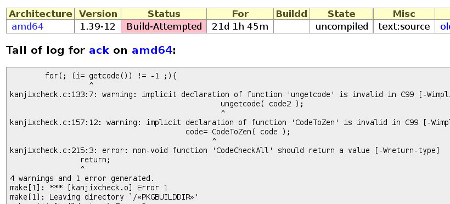
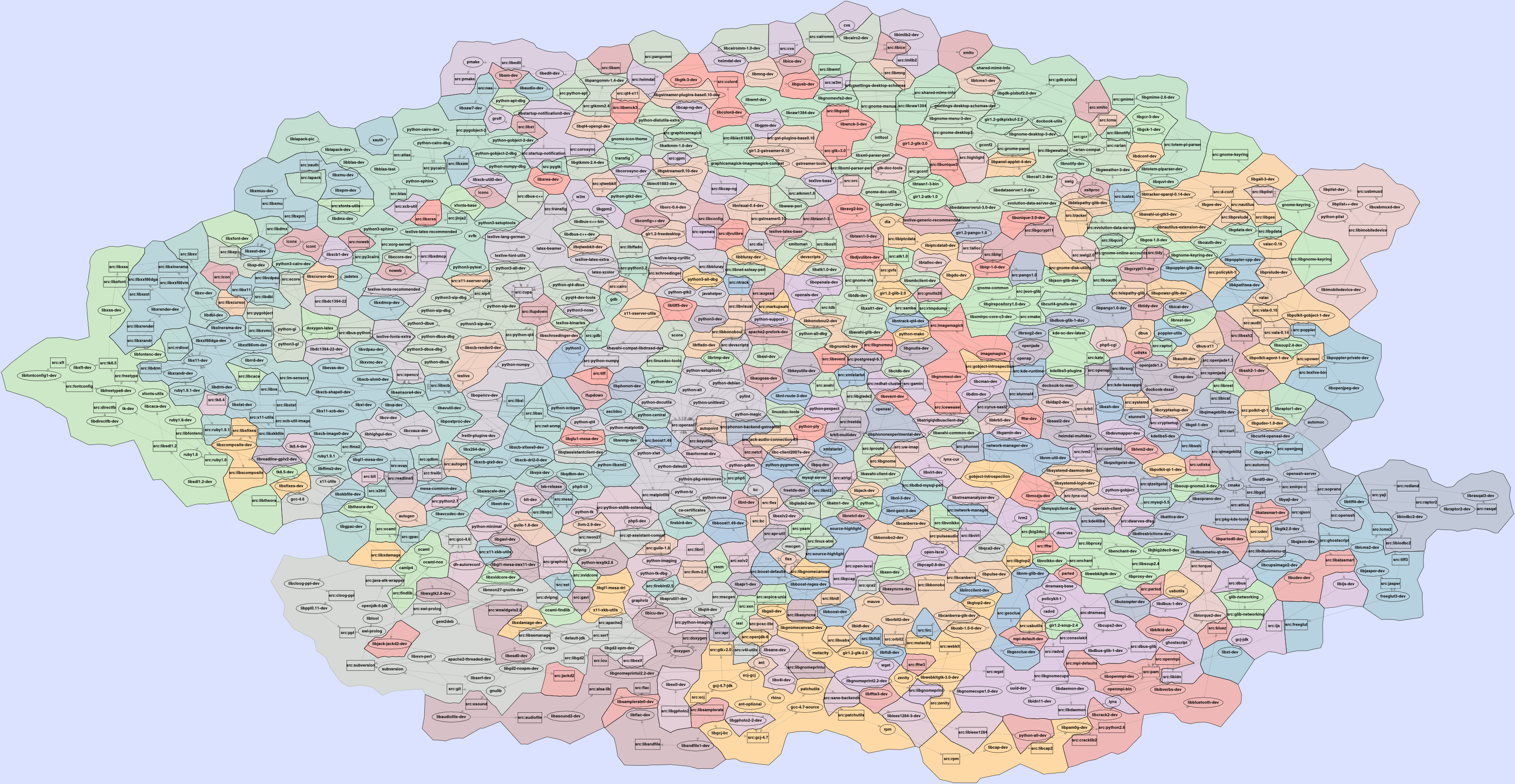
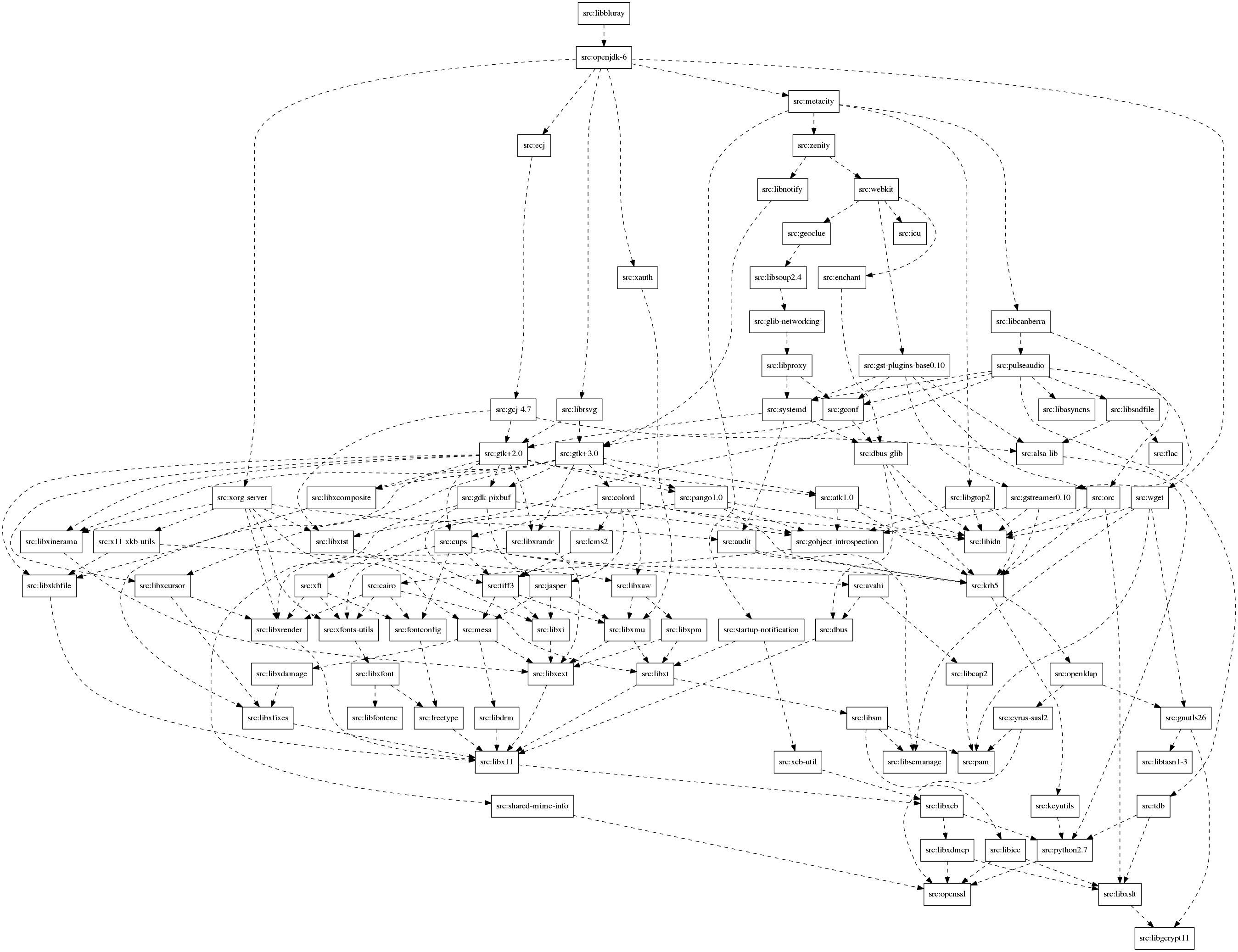
The following post is a verbatim copy of my message to the debian-devel list. While botch produces loads of valuable data to help maintainers modifying the right source packages with build profiles and thus make Debian bootstrappable, it has so far failed at producing this data in a format which is: While human readability is probably still lacking (it's hard to write in a manner understandable by everybody about a complicated topic you are very familiar with), the bootstrapping results are now generated automatically (on a daily basis) and published in a per-source-package-basis as well. Thus let me introduce to you: bootstrap.debian.net Paul Wise encouraged me to set this up and also donated the debian.net CNAME to my server. Thanks a lot! The data is generated daily from the midnight packages/sources records of snapshot.debian.org (I hope it's okay to grab the data from there on a daily basis). The resulting data can be viewed in HTML format (with some javascript for to allow table sorting and paging in case you use javascript) per architecture (here for amd64). In addition it also produces HTML pages per source package for all source packages which are involved in a dependency cycle in any architecture (for example src:avahi or src:python2.7). Currently there are 518 source packages involved in a dependency cycle. While this number seems high, remember that estimations by calculating a feedback arc set suggest that only 50-60 of these source packages have to be modified with build profiles to make the whole graph acyclic. For now it is funny to see that the main architectures do not bootstrap (since July, for different reasons) while less popular ones like ia64 and s390x bootstrap right now without problems (at least in theory). According to the logs (also accessible at above link, here for amd64) this is because gcc-4.6 currently fails compiling due to a build-conflict (this has been reported in bug#724865). Once this bug is fixed, all arches should be bootstrappable again. Let me remind you here that the whole analysis is done on the dependency relationships only (not a single source package is actually compiled at any point) and compilation might fail for many other reasons in practice. It has been the idea of Paul Wise to integrate this data into the pts so that maintainers of affected source packages can react to the heuristics suggested by botch. For this purpose, the website also publishes the raw JSON data from which the HTML pages are generated (here for amd64). The bugreport against the bts can be found in bug#728298. I'm sure that a couple of things regarding understandability of the results are not yet sufficiently explained or outright missing. If you see any such instance, please drop me a mail, suggesting what to change in the textual description or presentation of the results. I also created the following two wiki pages to give an overview of the utilized terminology: Feel also free to tell me if anything in these pages is unclear. Direct patches against the python code producing the HTML from the raw JSON data are also always welcome.

2 July 2013

Bits from Debian: all Debian source are belong to us

This is a verbatim repost from Stefano Zacchiroli's post TL;DR: go to http://sources.debian.net and enjoy.
Debsources is a new toy I've been working on at IRILL together with Matthieu Caneill. In essence, debsources is a simple web application that allows to publish an unpacked Debian source mirror on the Web. You can deploy Debsources where you please, but there is a main instance at http://sources.debian.net (sources.d.n for short) that you will probably find interesting. sources.d.n follows closely the Debian archive in two ways:
  1. it is updated 4 times a day to reflect the content of the Debian archive
  2. it contains sources coming from official Debian suites: the usual ones (from oldstable to experimental), *-updates (ex volatile), *-proposed-updates, and *-backports (from Wheezy on)
Via sources.d.n you can therefore browse the content of Debian source packages with usual code viewing features like syntax highlighting. More interestingly, you can search through the source code (of unstable only, though) via integration with http://codesearch.debian.net. You can also use sources.d.n programmatically to query available versions or link to specific lines, with the possibility of adding contextual pop-up messages (example). In fact, you might have stumbled upon sources.d.n already in the past few days, via other popular Debian services where it has already been integrated. In particular: codesearch.d.n now defaults to show results via sources.d.n, and the PTS has grown new "browse source code" hyperlinks that point to it. If you've ideas of other Debian services where sources.d.n should be integrated, please let me know. I find Debsources and sources.d.n already quite useful but, as it often happens, there is still a lot TODO. Obviously, it is all Free Software (released under GNU AGPLv3). Do not hesitate to report new bugs and, better, to submit patches for the outstanding ones. Acknowledgements PS in case you were wondering: at present sources.d.n requires ~381 GB of disk space to hold all uncompressed source packages, plus ~83 GB for the local (compressed) source mirror

Stefano Zacchiroli: introducing sources.debian.net

all Debian source are belong to us TL;DR: go to http://sources.debian.net and enjoy.
Debsources is a new toy I've been working on at IRILL together with Matthieu Caneill. In essence, debsources is a simple web application that allows to publish an unpacked Debian source mirror on the Web. You can deploy Debsources where you please, but there is a main instance at http://sources.debian.net (sources.d.n for short) that you will probably find interesting. sources.d.n follows closely the Debian archive in two ways:
  1. it is updated 4 times a day to reflect the content of the Debian archive
  2. it contains sources coming from official Debian suites: the usual ones (from oldstable to experimental), *-updates (ex volatile), *-proposed-updates, and *-backports (from Wheezy on)
Via sources.d.n you can therefore browse the content of Debian source packages with usual code viewing features like syntax highlighting. More interestingly, you can search through the source code (of unstable only, though) via integration with http://codesearch.debian.net. You can also use sources.d.n programmatically to query available versions or link to specific lines, with the possibility of adding contextual pop-up messages (example). In fact, you might have stumbled upon sources.d.n already in the past few days, via other popular Debian services where it has already been integrated. In particular: codesearch.d.n now defaults to show results via sources.d.n, and the PTS has grown new "browse source code" hyperlinks that point to it. If you've ideas of other Debian services where sources.d.n should be integrated, please let me know. I find Debsources and sources.d.n already quite useful but, as it often happens, there is still a lot TODO. Obviously, it is all Free Software (released under GNU AGPLv3). Do not hesitate to report new bugs and, better, to submit patches for the outstanding ones. Acknowledgements PS in case you were wondering: at present sources.d.n requires ~381 GB of disk space to hold all uncompressed source packages, plus ~83 GB for the local (compressed) source mirror

28 June 2013

Paul Wise: OpenPGP keysigning: alternate encodings for fingerprint exchange

I think that hexadecimal is a fairly poor pre-encoding for information exchange via data to speech and speech to data engines (aka voice boxes, brains and fingers). Reading out and typing long strings of hexadecimal digits at OpenPGP keysignings is tedious and annoying. There have been some experiments using photography and QR codes for this, which I think is pretty cool but not always practical since not everyone has a camera and QR code software installed. An alternative to this might be to pre-encode using a different scheme that encodes to less words in English speech. Diceware is one possibility that I recently experimented with. Diceware is a password generation scheme that encodes data from a random number generator (aka some dice) using a list of 7776 words. Each word thus represents a 5 digit number in base 6. Diceware is mainly used for generating strong and easier to remember passwords. So Diceware is the coupling between a non-digital random number generator and an interesting encoding scheme. Below are my fingerprints in Diceware and Hexadecimal form. The Diceware form is longer to type at 69 characters, 40 for hex. The Diceware form has the advantage that it is only 16 words to say while the hexadecimal form is 40. I don't know if this will be more practical than hex but I can almost remember my entire fingerprint after reading it a few times so hopefully that will translate to practical use. A rough script for encoding your fingerprint in the Diceware encoding is available but I haven't implemented the reverse yet. I would be glad if someone could check it for correctness.
Diceware:    frame maze bear usgs deter wag prissy bush hoyt mayo upton child indy
Hexadecimal: 610B 28B5 5CFC FE45 EA1B  563B 3116 BA5E 9FFA 69A3
If you want to discuss this topic and try it out in person and attempt to understand my accent, I'll be at DebConf13 and OHM2013. Some downsides that I can think of are accents, multiple spellings and the inclusion of non-words and special characters in the wordlist. These can be solved by using a different wordlist created specifically for OpenPGP fingerprint exchange that only includes suitable words. Update: there is a standard called PGP Word List that is much better than Diceware for this purpose. It maps 256 words to individual bytes, with different lists for odd and even bytes. Unfortunately it doesn't appear to be supported by GnuPG or signing-party. This post was inspired by the screenshots for RedPhone. You can comment on this post on debian-project.

6 May 2013

Sylvestre Ledru: Follow up on Debian & Clang

A week after the Euro LLVM conference, I am glad to share the results I presented and discussed during the event. 1) Parallel building infrastructure using clang instead of gcc Based on the work that Alexander Pashaliyski and I did during the GSoC 2012, we are now able to automatically rebuild each package uploaded in Unstable transparently. Results are published here:
http://buildd-clang.debian.net/
This provides a quick and easy way to any Debian contributors or upstream packaged in Debian to check how the package behaves with clang.
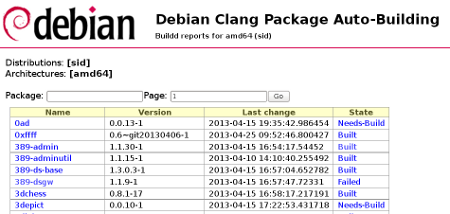
For Debian Developer and maintainer, a per maintainer view is also provided. This will list all packages maintained by a Debian packager. My page as example Here is an example of the list of package:
And an example of package failing:
At time of writing, most of the packages in unstable have been rebuilt (16 % are remaining). However, due to resource constraints, only amd64 packages are built. Contact me if you have resources to share for other architectures. Thanks to Paul Wise, the PTS (Debian package tracking system) proposes a link to the clang build logs (failing or not). A repository will be automatically updated with the results of these builds (once I find the time to get into buildd). 2) clang-built repository
Thanks to the Amazon Cloud, with our new DPL (Debian Project Leader), Lucas Nussbaum, we rebuilt unstable last April and published it at the following address:
deb http://clang.debian.net/repository-2013-04-07/ unstable-clang main
This allows some cool stuff like:
$ echo "deb http://clang.debian.net/repository-2013-04-07/ unstable-clang main">>/etc/apt/sources.list
$ apt-get update
$ apt-get install coreutils/unstable-clang
$ ls
$ awk
Note that this repository was only one-shoot and does not get updated. Quality of the binary produced (performance and size) can be tested thanks to this repository. Feedbacks are welcome!

11 April 2013

Martin Pitt: New fatrace released, Debian package coming

Paul Wise poked me this morning about uploading fatrace ( file access trace , see the original announcement for details) to Debian, thanks for the reminder! So I filed an Intent To Package, and will upload it in a few days, unless some discussion evolves. I also took the opportunity to do some modernization: The power-usage-report script now uses the current PowerTop 2.x instead of the old 1.13, uses Python 3 now, and includes the process device activity in the report. I released this as 0.5. The actual fatrace binary didn t change its behaviour, it just got some code optimizations; thanks to Yann Droneaud for those.

10 April 2013

Paul Wise: Inadequate software

Just 168 of the 4961 packages (3%) I have installed are inadequate. Unfortunately those packages collectively have 3440 inadequacies. How much of the software on your system has these inadequacies? You can find out today by installing Jakub Wilk's software, which is appropriately named adequate. It is now available in Debian unstable. I recommend enabling the apt hook which notifies you when software you are installing is inadequate. Other ways of being notified when you are installing inadequate software include apt-listbugs and debsecan. If you are interested in software quality, Debian's QA activities wiki page provides a good overview of the quality assurance activities that are being worked on within the context of Debian. If you want to provide better quality software for Debian, please keep an eye on the PTS pages for software you maintain. You can also run various automated checks on your software before you make new releases or upload them to the Debian archive. More people are needed to improve and expand upon Debian's existing quality assurance activities and infrastructure. Come join us today!

7 April 2013

Rapha&#235;l Hertzog: My Free Software Activities in March 2013

This is my monthly summary of my free software related activities. If you re among the people who made a donation to support my work (114.19 , thanks everybody!), then you can learn how I spent your money. Otherwise it s just an interesting status update on my various projects. Simple-CDD and debian-cd I tried to use wheezy s version of debian-cd and simple-cdd to generate an automatic installer. In this process, I filed a couple of bugs on simple-cdd (#701963: type-handling package is gone and should not be listed in default.downloads, and #701998: the --keyboard parameter is not working with wheezy s debian-installer) and I commited fixes for a few issues in debian-cd: Debian France I completed the new website for Debian France and I put it online. Later I merged some supplementary enhancements prepared by Tanguy Ortolo (and I gave him commits rights at the same time). I tried to update our Galette installation to the latest upstream version but I reverted to the former version after having encountered two problems (filed here and here). In the process, I created a Debian package for galette (you can grab it on git.debian.org). I also suggested an idea of improvement for Galette s paypal plugin and it has been quickly implemented. Thus I updated the plugin installed on france.debian.net. Kali related work It s been a few months that I have been helping the Kali team to prepare this new Debian derivative. Now that the derivative has gone public, I can attribute some of my Debian work to my collaboration with the Kali team. This month I contributed a few features and fixes to debian-installer and live-build: After the launch, we registered Kali in the derivative census. Paul Wise quickly reported some misfiled bugs from early Kali users and I discovered that reportbug was not behaving properly even though we correctly updated base-files (see #703678 on reportbug and #703677 on lsb-release). Misc packaging work DPL election I also spent quite some time to read and participate to the discussions on debian-vote since it was campaigning time for the DPL candidates Thanks This was a rather active month if you take into account the fact that I got a second son Lucas on March 6th. See you next month for a new summary of my activities.

4 comments Liked this article? Click here. My blog is Flattr-enabled.

21 February 2013

Eugene V. Lyubimkin: DPL game

Inspired by http://blog.zouish.org/posts/dpl_game/. The order is chosen by a fair dice roll.

Wouter Verhelst
Russ Allbery
Bill Allombert
Paul Wise

11 February 2013

Hideki Yamane: checking package with clang

Sylvestre Ledru wrote an article "Rebuild of Debian using clang 3.2". Probably package maintainers want to know about their package status with clang in PTS, Paul Wise has already posted to BTS#699936.

And, today I've hit upon an idea, then created a tiny patch for clang support for pbuilder. It may help you to check your package with clang.

3 December 2012

Paul Wise: Debian on mobile devices

Debian on Samsung Galaxy S It is possible to put Debian on smartphones like the Samsung Galaxy S: Linux mainline doesn't run on any of the mobile devices I have. It probably doesn't run on any of the mobile devices you have either. There has been some effort by the OpenMoko community to merge the gta02 kernel patches but it is not yet complete. I doubt Samsung will spend money on merging support for old devices obsoleted by more recent devices. There is Linaro but they are focused on things the hardware vendors pay them for and probably would not have the resources anyway. Therefore I would guess the timeframe for supporting the OpenMoko FreeRunner and the Samsung Galaxy S in Linux mainline is between many years and never. For better or worse, the Debian Linux kernel maintainers prefer not to include non-mainline stuff and Debian as a whole generally prefers to include one copy of each package instead of 9. The procedures I documented above are not a great way to support mobile devices at all and could break at any moment anyway. So everyone, please become a kernel developer and help merge all of the many many versions of Android Linux into Linux mainline so that you can have your favourite distribution on your devices. You can comment on this post at identi.ca.

Next.

Previous.