Search Results: "Martin"

15 March 2017

Dirk Eddelbuettel: RcppEigen 0.3.2.9.1

A new maintenance release 0.3.2.9.1 of RcppEigen, still based on Eigen 3.2.9 is now on CRAN and is now going into Debian soon. This update ensures that RcppEigen and the Matrix package agree on their #define statements for the CholMod / SuiteSparse library. Thanks to Martin Maechler for the pull request. I also added a file src/init.c as now suggested (soon: requested) by the R CMD check package validation. The complete NEWS file entry follows.

Changes in RcppEigen version 0.3.2.9.1 (2017-03-14)
  • Synchronize CholMod header file with Matrix package to ensure binary compatibility on all platforms (Martin Maechler in #42)
  • Added file init.c with calls to R_registerRoutines() and R_useDynamicSymbols(); also use .registration=TRUE in useDynLib in NAMESPACE

Courtesy of CRANberries, there is also a diffstat report for the most recent release.

This post by Dirk Eddelbuettel originated on his Thinking inside the box blog. Please report excessive re-aggregation in third-party for-profit settings.

5 March 2017

Shirish Agarwal: To say or not to say

Voltaire For people who are visually differently-abled, the above reads To learn who rules over you, simply find out who you are not allowed to criticize Voltaire wrote this either in late 16th century or early 17th century and those words were as apt in those times, as it is in these turbulent times as well. Update 05/03 According to @bla these words are attributable to a neo-nazi and apparently a child abuser. While I don t know the context in which it was shared, it describes the environment in which we are perfectly. Please see his comment for a link and better understanding. The below topic requires a bit of maturity, so if you are easily offended, feel free not to read further. While this week-end I was supposed to share about the recent Science Day celebrations that we did last week Science Day celebrations at GMRT Would explore it probably next week. This week the attempt is to share thoughts which had been simmering at the back of my mind for more than 2 weeks or more and whose answers are not clear to me. My buttons were pressed when Martin f. Kraft shared about a CoC violation and the steps taken therein. While it is easy to say with 20:20 hind-sight to say that the gentleman acted foolishly, I don t really know the circumstances to pass the judgement so quickly. In reality, while I didn t understand the joke in itself, I have to share some background by way of anecdotes as to why it isn t so easy for me to give a judgement call. a. I don t know the topics chosen by stand-up comedians in other countries, in India, most of the stand-up acts are either about dating or sex or somewhere in-between, which is lovingly given the name Leela (dance of life) in Indian mythology. I have been to several such acts over the years at different events, different occasions and 99.99% of the time I would see them dealing with pedophilia, necrophilia and all sorts of deviants in sexuality and people laughing wildly, but couple of times when the comedian shared the term sex with people, educated, probably more than a few world-travelled middle to higher-middle class people were shocked into silence. I had seen this not in once but 2-3 times in different environments and was left wondering just couple of years back Is sex such a bad word that people get easily shocked ? Then how is it that we have 1.25 billion + people in India. There had to be some people having sex. I don t think that all 1.25 billion people are test-tube babies. b. This actually was what lead to my quandary last year when my sharing of My Experience with Debian which I had carefully prepared for newbies, seeing seasoned debian people, I knew my lame observations wouldn t cut ice with them and hence had to share my actual story which involved a bit of porn. I was in two minds whether or not to say it till my eyes caught a t-shirt on which it was said We make porn or something to that effect. That helped me share my point. c. Which brings me to another point, it seems it is becoming increasingly difficult to talk about anything either before apologizing to everyone and not really knowing who will take offence at what and what the repercussions might be. In local sharings, I always start with a blanket apology that if I say something that offends you, please let me know afterwards so I can work on it. As the term goes You can t please everyone and that is what happens. Somebody sooner or later would take offence at something and re-interpret it in ways which I had not thought of. Charlie Chaplin - King of self-deprecating humor From the little sharings and interactions I have been part of, I find people take offence at the most innocuous things. For instance, one of the easy routes of not offending anyone is to use self-deprecating humour (or so I thought) either of my race, caste, class or even my issues with weight and each of the above would offend somebody. Charlie Chaplin didn t have those problems. If somebody is from my caste, I m portraying the caste in a certain light, a certain slant. If I m talking about weight issues, then anybody who is like me (fat) feels that the world is laughing at them rather than at me or they will be discriminated against. While I find the last point a bit valid, it leaves with me no tools and no humour. I neither have the observational powers or the skills that Kapil Sharma has and have to be me. While I have no clue what to do next, I feel the need to also share why humour is important in any sharing.- a. Break When any speaker uses humour, the idea is to take a break from a serious topic. It helps to break the monotony of the talk especially if the topic is full of jargon talk and new concepts. A small comedic relief brings the attendees attention back to the topic as it tends to wander in a long monotonous talk. b. Bridge Some of the better speakers use one or more humourous anecdote to explain and/or bridge the chasm between two different concepts. Some are able to produce humour on the fly while others like me have to rely on tried and tested methods. There is one another thing as well, humour is seems to be a mixture of social, cultural and political context and its very easy to have it back-fired upon you. For instance, I attempted humour on refugees, probably not the best topic to try humour in the current political climate, and predictably, it didn t go down well. I had to share and explain about Robin Williams slightly dark yet humorous tale in Moscow on the Hudson The film provides comedy and pathos in equal measure. You are left identifying with Vladimir Ivanoff (Robin Williams character) especially in the last scene where he learns of his grand-mother dying and he remembers her and his motherland, Russia and plays a piece on his saxophone as a tribute both to his grand-mother and the motherland. Apparently, in the height of the cold war, if a Russian defected to United States (land of Satan and other such terms used) you couldn t return to Russia. The movie, seen some years back left a deep impact on me. For all the shortcomings and ills that India has, even if I could, would and could I be happy anywhere else ? The answers are not so easy. With most NRI s (Non-Resident Indians) who emigrated for good did it not so much for themselves but for their children. So the children would hopefully have a better upbringing, better facilities, better opportunities than they would have got here. I talked to more than a few NRI s and while most of them give standardized answers, talking awhile and couple of beers or their favourite alcohol later, you come across deeply conflicted human beings whose heart is in India and their job, profession and money interests compel them to be in the country where they are serving. And Indian movies further don t make it easy for the Indian populace when trying to integrate into a new place. Some of the biggest hits of yesteryear s were about having the distinct Indian culture in their new country while the message of most countries is integration. I know of friends who are living in Germany who have to struggle through their German in order to be counted as a citizen, the same I guess is true of other countries as well, not just the language but the customs as well. They also probably struggle with learning more than one language and having an amalgamation of values which somehow they and their children have to make sense of. I was mildly shocked last week to learn that Mishi Choudary had to train people in the U.S. to differentiate between Afghan turban styles of wearing and the Punjabi style of wearing the turban. A simple search on Afghani turban and Punjabi turban reveals that there are a lot of differences between the two cultures. In fact, the way they talk, the way they walk, there are lots that differentiate the two cultures. The second shocking video was of an African-American man racially abusing an Indian-American girl. At first, I didn t believe it till I saw the video on facebook. My point through all that is it seems humour, that clean, simple exercise which brings a smile to you and uplifts the spirit doesn t seem to be as easy as it once was. Comments, suggestions, criticisms all are welcome.
Filed under: Miscellenous Tagged: #Elusive, #Fear, #hind-sight, #Humour, #immigrant, #integration, #Mishi Choudary, #refugee, #Robin Williams, #self-deprecating, #SFLC, #two-minds

25 February 2017

Martin Pitt: systemd 233 about to be released, please help testing

systemd 233 is scheduled to be released next week, and there is only a handful of small issues left. As usual there are tons of improvements and fixes, but the most intrusive one probably is another attempt to move from legacy cgroup v1 to a hybrid setup where the new unified (cgroup v2) hierarchy is mounted at /sys/fs/cgroup/unified/ and the legacy one stays at /sys/fs/cgroup/ as usual. This should provide an easier path for software like Docker or LXC to migrate to the unified hiearchy, but even that hybrid mode broke some bits. While systemd 233 will not make it into Debian stretch or Ubuntu zesty, as both are in feature freeze, it will soon be available in Debian experimental, and in the next Ubuntu release after 17.04 gets released. Thus now is another good time to give this some thorough testing! To help with this, please give the PPA with builds from upstream master a spin. In addition to the usual packages for Ubuntu 16.10 I also uploaded a build for Ubuntu zesty, and a build for Debian stretch (aka testing) which also works on Debian sid. You can use that URL as an apt source:
deb [trusted=yes] https://people.debian.org/~mpitt/tmp/systemd-master-20170225/ /
These packages pass our autopkgtests and I tested them manually too. LXC and LXD work fine, docker.io/runc needs a fix which I uploaded to Ubuntu zesty. (It s not yet available in Debian, sorry.) Please file reports about regressions on GitHub, but please also le me know about successes on my Google+ page so that we can get some idea about how many people tested this. Thank you, and happy booting!

6 February 2017

Martin Pitt: Migrated blog from WordPress to Hugo

My WordPress blog got hacked two days ago and now twice today. This morning I purged MySQL and restored a good backup from three days ago, changed all DB and WordPress passwords (both the old and new ones were long and autogenerated ones), but not even an hour after the redeploy the hack was back. (It can still be seen on Planet Debian and Planet Ubuntu. Neither the Apache logs nor the Journal had anything obvious, nor were there any new files in global or user www directories, so I m a bit stumped how this happened. Certainly not due to bruteforcing a password, that would both have shown in the logs and also have triggered ban2fail, so this looks like an actual vulnerability. I upgraded to WordPress 4.7.1 a few days ago, and apparently 4.7.2 fixes a few vulnerabilities, although all of them don t sound like they would match my situation. jessie-backports is still at 4.7.1, so I missed that update. But either way, all WordPress blogs hosted on my server are down for the time being. I took this as motivation to finally migrate to something more robust. WordPress has tons of features that I never need, and also a lot of overhead (dynamic generation, MySQL, its own user/passwords, etc.). I had a look around, and it seems Hugo and Blogofile are nice contenders no privileges, no database, outputting static files, input is Markdown (so much nicer to type than HTML!), and maintaining your blog in git and previewing the changes on my local laptop are straightforward. I happened to try Hugo first, and like it enough to give it an extended try you have plenty of themes to choose from and they are straightforward to customize, so I don t need to spend a lot of time learning and crafting CSS. I ran the WordPress to Hugo Exporter, and it produced remarkable results fairly usable HTML Markdown and metadata conversion, it keeps all the original URLs, and it s painless to use. Nicely done! So here it is, on to a much more secure server now! \o/

Jaldhar Vyas: Don't Believe Everything You Read on Debian Planet

Martin Pitt won the popular vote.

Martin Pitt: Hacked By SA3D HaCk3D


HaCkeD by SA3D HaCk3D
HaCkeD By SA3D HaCk3D

Long Live to peshmarga
KurDish HaCk3rS WaS Here fucked
FUCK ISIS !

28 January 2017

Bits from Debian: Debian at FOSDEM 2017

On February 4th and 5th, Debian will be attending FOSDEM 2017 in Brussels, Belgium; a yearly gratis event (no registration needed) run by volunteers from the Open Source and Free Software community. It's free, and it's big: more than 600 speakers, over 600 events, in 29 rooms. This year more than 45 current or past Debian contributors will speak at FOSDEM: Alexandre Viau, Bradley M. Kuhn, Daniel Pocock, Guus Sliepen, Johan Van de Wauw, John Sullivan, Josh Triplett, Julien Danjou, Keith Packard, Martin Pitt, Peter Van Eynde, Richard Hartmann, Sebastian Dr ge, Stefano Zacchiroli and Wouter Verhelst, among others. Similar to previous years, the event will be hosted at Universit libre de Bruxelles. Debian contributors and enthusiasts will be taking shifts at the Debian stand with gadgets, T-Shirts and swag. You can find us at stand number 4 in building K, 1 B; CoreOS Linux and PostgreSQL will be our neighbours. See https://wiki.debian.org/DebianEvents/be/2017/FOSDEM for more details. We are looking forward to meeting you all!

26 January 2017

Martin Michlmayr: Debian on Jetson TX1

Debian is now working on the NVIDIA Jetson TX1 developer kit, a development board based on the Tegra X1 chip (Tegra 210), a 64-bit ARM chip. We have a pre-built u-boot image in Debian as well as kernel and installer support. There are some minor kernel glitches but NVIDIA is very active upstream and I hope they'll get resolved soon. The Jetson TX1 developer kit makes a pretty good 64-bit ARM development platform. The board is supported in mainline u-boot and the mainline kernel and NVIDIA are pretty responsive to bug reports. Unfortunately, a proprietary blob is required for USB (and Ethernet is connected via USB). If you're interested in a good 64-bit ARM development platform, give Debian on the Jetson TX1 development kit a try.

25 January 2017

Martin-Éric Racine: OpenWRT Backfire on WRT54GL signal strenght

Because I wanted my home router to use at least decently supported software that provides complete out-of-the-box support for native IPv6, I recently got around upgrading my WRT54GL's firmware from White Russian to Backfire, which is the most recent OpenWRT release that fits the hardware's limited amount of flash memory.

One issue remains unanswered:

In GNOME shell's top panel and WiFi menu, the signal strength remains at 2 out of 4 bars. Given how the router sits only a few meters behind me, I would have expected much better signal strength than that.

Would anyone happen to know how to improve on these results? Thanks!

19 October 2016

Reproducible builds folks: Reproducible Builds: week 77 in Stretch cycle

What happened in the Reproducible Builds effort between Sunday October 9 and Saturday October 15 2016: Media coverage Documentation update After discussions with HW42, Steven Chamberlain, Vagrant Cascadian, Daniel Shahaf, Christopher Berg, Daniel Kahn Gillmor and others, Ximin Luo has started writing up more concrete and detailed design plans for setting SOURCE_ROOT_DIR for reproducible debugging symbols, buildinfo security semantics and buildinfo security infrastructure. Toolchain development and fixes Dmitry Shachnev noted that our patch for #831779 has been temporarily rejected by docutils upstream; we are trying to persuade them again. Tony Mancill uploaded javatools/0.59 to unstable containing original patch by Chris Lamb. This fixed an issue where documentation Recommends: substvars would not be reproducible. Ximin Luo filed bug 77985 to GCC as a pre-requisite for future patches to make debugging symbols reproducible. Packages reviewed and fixed, and bugs filed The following updated packages have become reproducible - in our current test setup - after being fixed: The following updated packages appear to be reproducible now, for reasons we were not able to figure out. (Relevant changelogs did not mention reproducible builds.) Some uploads have addressed some reproducibility issues, but not all of them: Some uploads have addressed nearly all reproducibility issues, except for build path issues: Patches submitted that have not made their way to the archive yet: Reviews of unreproducible packages 101 package reviews have been added, 49 have been updated and 4 have been removed in this week, adding to our knowledge about identified issues. 3 issue types have been updated: Weekly QA work During of reproducibility testing, some FTBFS bugs have been detected and reported by: tests.reproducible-builds.org Debian: Openwrt/LEDE/NetBSD/coreboot/Fedora/archlinux: Misc. We are running a poll to find a good time for an IRC meeting. This week's edition was written by Ximin Luo, Holger Levsen & Chris Lamb and reviewed by a bunch of Reproducible Builds folks on IRC.

1 October 2016

Russ Allbery: Review: Sailing to Sarantium

Review: Sailing to Sarantium, by Guy Gavriel Kay
Series: Sarantine Mosaic #1
Publisher: HarperPrism
Copyright: 1998
Printing: January 2000
ISBN: 0-06-105990-0
Format: Mass market
Pages: 533
Crispin is a well-respected mosaicist, a Rhodian, heir to a long tradition of artistic accomplishment. Rhodias is largely in ruins, and the kings that fight over its land are far removed from the emperors of Rhodias at its height, but there's still demand for skilled craftsmanship. Crispin has a partner, assistants, and the opportunity to do at least adequate work. It's not a bad life, or at least wasn't before plague took his wife and daughters while he watched, helpless. Now, he's closed off, angry, and consumed by fatalism and futility. His partner, Martinian, could never say why, when the imperious and obnoxious courier came from the far-off and half-legendary of Sarantium to summon him to assist with the rebuilding of the Sanctuary of Jad, he pretended not to be himself and pointed the courier at Crispin instead. Nor was Crispin entirely sure why he played along, although the courier was so arrogant and officious that he invited such treatment. He had no intention of going in Martinian's place and name until his friends intervened, united in their conviction that he needed something to focus on and a reason to live. But nothing about Sarantium is simple. Even before Crispin leaves, the local queen, precariously balancing between warring factions, reveals her own reason to send Crispin to the capital of the far-off empire: using him as a desperate messenger to propose an alliance through marriage. And when he finally arrives, after unexpected perils on the road, he tumbles immediately into the deep complexities of the Sarantine court and its remarkable rulers. Most of Guy Gavriel Kay's work is historical fiction with the serial numbers partly filed off and some magic added. The degree to which the serial numbers are removed varies by work; here, the history is obvious. Sarantium is Byzantium, fallen Rhodias is Rome, and the emperor Valerius and his former dancer empress Alixana are clearly Justinian and Theodora. Knowing that will provide a lot of context, but can also be distracting, since the temptation to scramble for Wikipedia and line things up with real history is strong. I read this book the first time without knowing the history and this second time knowing it. I think I enjoyed it a bit more on its own terms, instead of as a reflection and reinterpretation. Either way, though, it's one of Kay's best novels, which is saying quite a bit. Sailing to Sarantium has two very different parts: Crispin's journey to Sarantium, and then what happens when he arrives. The first is a fairly linear travel narrative mixed with old religion, magic, and an experience in the woods that's a little disconnected from the rest of the story. The second is the fast-entangling politics and factionalism of the city itself, which wastes no time pulling Crispin into meetings with the most influential people at court. In my memory, I liked the Sarantium narrative the best, and found the travel story less significant. Re-reading, I'm not sure I agree with my earlier self. Kay does write some of the best conversations in fiction; if you want to see careful verbal maneuvering or gut reactions with wide-ranging consequences, I can't think of any author who shows both the words and the nuances as well as Kay. He makes the court maneuvering feel truly epic. Watching Crispin's blunt competence cut through the Sarantine court, and seeing him stay focused on his life work despite all those distractions, is a truly rewarding experience. But that second part of the book also has some structural problems, and a few characterization problems. The structural problem is that Kay wants to tell the same story from multiple angles, viewpoints, and timelines to show the reader every implication of the hornet's nest that Crispin kicks over, since quite a lot happens in the course of one day and night. This mostly works, but it is so laden with flashbacks, foreshadowing, and rewinds that I started losing track of the time relationship between the scenes. Kay is a very skilled author, so he avoids confusing the reader entirely, but I think he still tried too complex of a temporal structure here. The characterization problem is that I previously wasn't paying as close of attention to Kay's portrayal of women and of male sexual reactions to women. It didn't bother me before; this time, it started getting on my nerves. Yes, this is historical fiction (although limitations on roles for women in history is rather overstated in fiction), and to give Kay credit it does feature a very strong female character in Alixana. But the male protector and female seducer dynamic is very strong, and all the women in this book seem to get shoehorned into it. And perhaps I'm missing some weakness that other men have, but I have never had the sort of overwhelming, thought-destroying reaction to the presence of a seductive woman as Kay's men seem to routinely have in this book. To give Crispin credit, he maneuvers his way through those conversations without doing anything stupid. (Kay's characters very rarely do stupid things, which is refreshing.) But the effort required started undermining my suspension of disbelief. Even making allowances for a culture that might consider a woman with her hair down the equivalent of an entirely nude woman, I simply don't believe that a man who had been married with two daughters, had a long career, and had the life experience Crispin had would have that much difficulty with an aggressively seductive woman that he already doesn't trust. As a result, as much as I love Kay's political conversational fencing, I enjoyed the travel portion of the book more on this re-read. Crispin is a type of character Kay writes extremely well: an honest, honorable man trying to navigate unfamiliar waters without a lot of context, but with a firm sense of internal morality, a lot of natural intelligence, and a true passion for something. At one point in this book, another character decides to walk away from his current job and follow Crispin wherever he goes. Kay makes you believe that and want to do it yourself. It's a very rewarding experience as a reader to watch a character you can trust find careful, courageous, and tricky solutions to complicated problems. But I think the best part of this book is Kay's ability to put Crispin's art, the creation of mosaics, on the page in a way that lets the reader viscerally appreciate it. Crispin is passionate about mosaics, about how to make them and how to think about them, and the passion is contagious and forms the heart and soul of this novel. Kay manages to make mosaics overshadow some of the most dramatic politics in history, which says quite a lot. There is almost nothing I love more than reading about talented, passionate people doing things they are extremely good at. I know nothing about mosaic that I haven't read in this book and its sequel, so I have no basis from which to judge the accuracy of Kay's portrayal, but he made me feel like I could appreciate some of the nuance, skill, and design constraints of the art form. It's a wonderful reading experience. Sailing to Sarantium is best thought of half of a long book that was divided for publication reasons, so don't expect much of an ending here. It can only be read in combination with Lord of Emperors, which you'll want to have on hand when you finish this book so that you can continue the story. Followed by Lord of Emperors. Rating: 9 out of 10

30 September 2016

Bdale Garbee: Second Retirement

At the end of August 2012, I announced my Early Retirement from HP. Two years later, my friend and former boss Martin Fink successfully recruited me to return to what later became Hewlett Packard Enterprise, as an HPE Fellow working on open source strategy in his Office of the CTO. I'm proud of what I was was able to accomplish in the 25 months since then, but recent efforts to "simplify" HPE actually made things complicated for me. Between the announcement in late June that Martin intended to retire himself, and the two major spin-merger announcements involving Enterprise Services and Software... well... The bottom line is that today, 30 September 2016, is my last day at HPE. My plan is to "return to retirement" and work on some fun projects with my wife now that we are "empty nesters". I do intend to remain involved in the Free Software and open hardware worlds, but whether that might eventually involve further employment is something I'm going to try and avoid thinking about for a while... There is a rocket launch scheduled nearby this weekend, after all!

3 September 2016

Bits from Debian: New Debian Developers and Maintainers (July and August 2016)

The following contributors got their Debian Developer accounts in the last two months: The following contributors were added as Debian Maintainers in the last two months: Congratulations!

28 August 2016

Mart n Ferrari: On speaking at community conferences

Many people reading this have already suffered me talking to them about Prometheus. In personal conversation, or in the talks I gave at DebConf15 in Heidelberg, the Debian SunCamp in Lloret de Mar, BRMlab in Prague, and even at a talk on a different topic at the RABS in Cluj-Napoca. Since their public announcement, I have been trying to support the project in the ways I could: by packaging it for Debian, and by spreading the word. Last week the first ever Prometheus conference took place, so this time I did the opposite thing and I spoke about Debian to Prometheus people: I gave a 5 minutes lightning talk on Debian support for Prometheus. What blew me away was the response I've got: from this tiny non-talk I prepared in 30 minutes, many people stopped me later to thank me for packaging Prometheus, and for Debian in general. They told me they were using my packages, gave me feedback, and even some RFPs! At the post-conference beers, I had quite a few interesting discussions about Debian, release processes, library versioning, and culture clashes with upstream. I was expecting some Debian-bashing (we are old-fashioned, slow, etc.), instead I had intelligent and enriching conversations. To me, this enforces once again my support and commitment to community conferences, where nobody is a VIP and everybody has something to share. It also taught me the value of intersecting different groups, even when there seems to be little in common. Comment

19 August 2016

Olivier Gr goire: Conclusion Google Summer of Code 2016

SmartInfo project with Debian alt text 1. Me Before getting into the thick of my project, let me present myself:
I am Olivier Gr goire (Gasuleg), and I study IT engineering at cole de Technologie sup rieure in Montreal.
I am an technician in electronics, and I began object-oriented programming just last year.
I applied to GSoC because I loved the concept of the project that I would work on and I really wanted to be part of it. I also wanted to discover the word of the free software. 2. My Project During this GSoC, I worked on the Ring project. Ring is a free software for communication that allows its users to make audio or video calls, in pairs or groups, and to send messages, safely and freely, in confidence. Savoir-faire Linux and a community of contributors worldwide develop Ring. It is available on GNU/Linux, Windows, Mac OSX and Android. It can be associated with a conventional phone service or integrated with any connected object. Under this very easy to use software, there is a combination of technologies and innovations opening all kinds of perspectives to its users and developers. Ring is a free software whose code is open. Therefore, it is not the software that controls you. With Ring, you take control of your communication! Ring is an open source software under the GPL v3 license. Everyone can verify the codes and propose new ones to improve the software s performace. It is a guarantee of transparency and freedom for everyone!
Source: ring.cx The problem is about the typical user of Ring, the one who don t use the terminal to launch Ring. He has no information about what has happened in the system. My goal is to create a tool that display statistics of Ring. 3. Quick Explanation of What My Program Can Do The Code
Here are the links to the code I was working on all throughout the Google Summer of Code (You can see what I have done after the GSoC by clicking on the newest patchs):
Patch Status
Daemon On Review
Lib Ring Client (LRC) On Review
Gnome client On review
Remove unused code Merged
!!!!!CHANGE LINK TO PUT THE LATEST PATCHES BEFORE THE END OF GSOC!!!!! What Can Be Displayed?
This is the final list of information I can display and some ideas on what information we could display in the future:
Information Details Done?
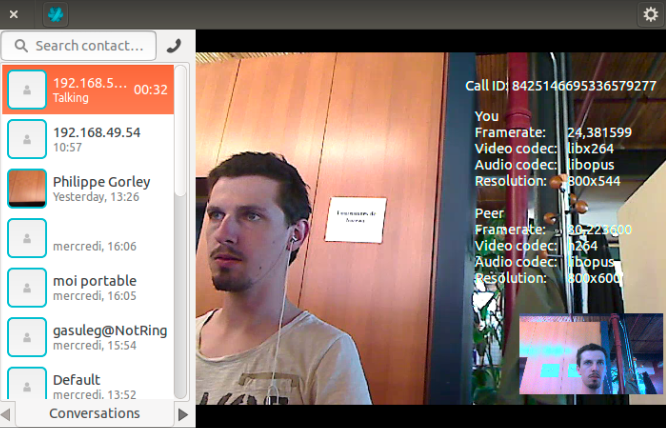
Call ID The identification number of the call Yes
Resolution Local and remote Yes
Framerate Local and remote Yes
Codec Audio and video in local and remote Yes
Bandwidth Download and upload No
Performance use CPU, GPU, RAM No
Security level In SIP call No
Connection time No
Packets lost No

To launch it you need to right click on the call and click on Show advanced information .
alt text
To stop it, same thing: right click on the call and click on Hide advanced information .
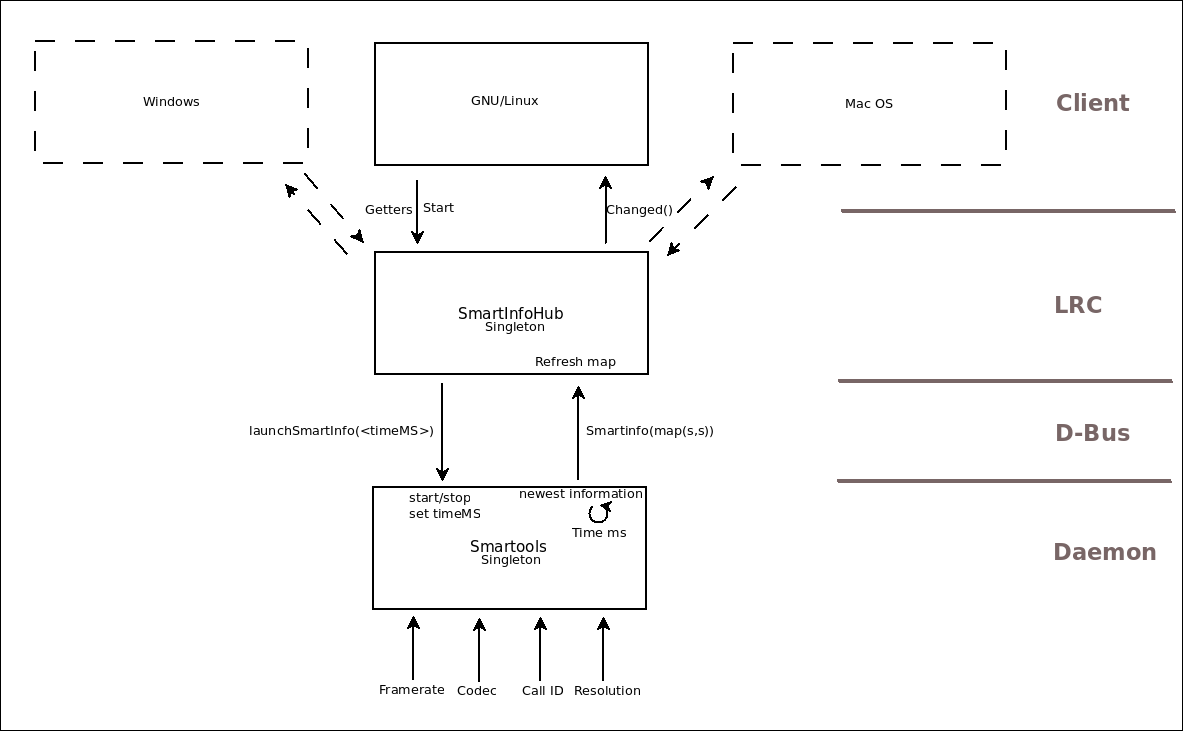
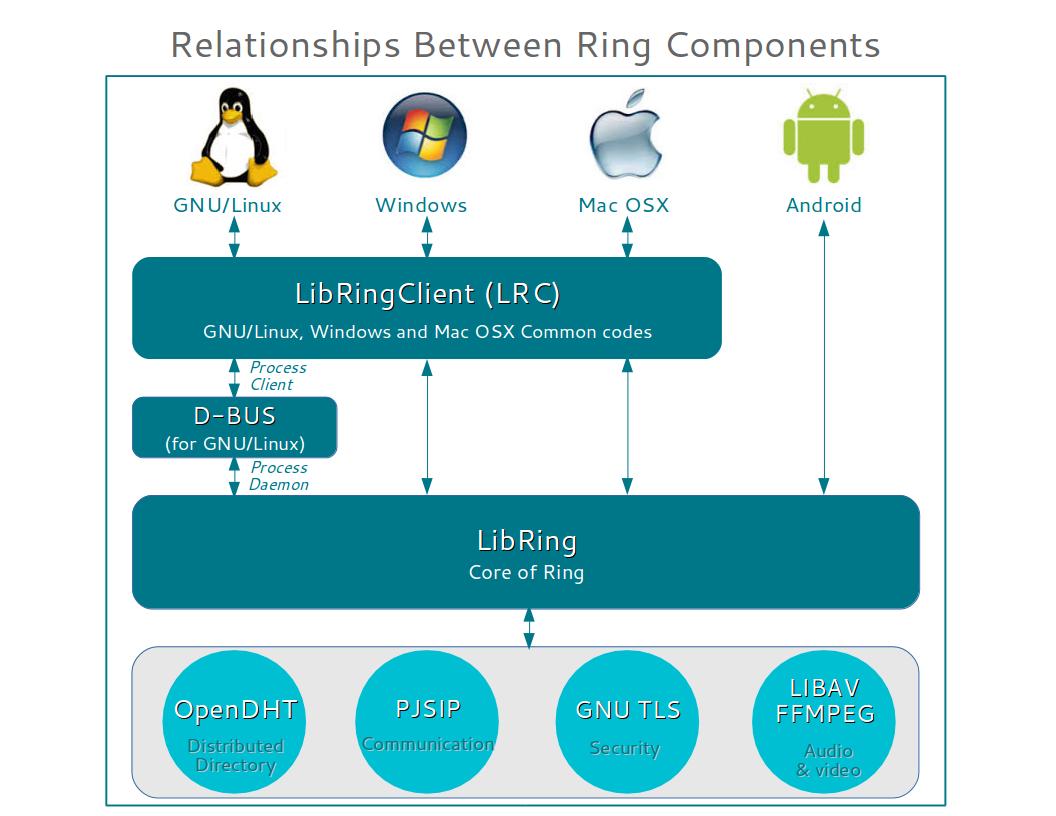
4. More Details About My Project My program needs to retrieve information from the daemon (LibRing) and then display it in gnome client. So, I needed to create a patch for the daemon, the D-Bus layer (in the daemon patch), LibRingClient and the GNU/Linux (Gnome) client.
This is what the architecture of the project looks like.
alt text
source: ring.cx And this is how I implemented my project.
alt text
5. Future of the Project 6. Thanks I would like to thank the following:
- The Google Summer of Code organisation, for this wonderful experience.
- Debian, for accepting my project proposal and letting me embark on this fantastic adventure.
- My mentor, Mr Guillaume Roguez, and all his team, for being there to help me.

Olivier Gr goire: Conclusion Google Summer of Code 2016

SmartInfo project with Debian alt text 1. Me Before getting into the thick of my project, let me present myself:
I am Olivier Gr goire (Gasuleg), and I study IT engineering at cole de Technologie sup rieure in Montreal.
I am a technician in electronics, and I began object-oriented programming just last year.
I applied to GSoC because I loved the concept of the project that I would work on and I really wanted to be part of it. I also wanted to discover the word of the free software. 2. My Project During this GSoC, I worked on the Ring project. Ring is a free software for communication that allows its users to make audio or video calls, in pairs or groups, and to send messages, safely and freely, in confidence. Savoir-faire Linux and a community of contributors worldwide develop Ring. It is available on GNU/Linux, Windows, Mac OSX and Android. It can be associated with a conventional phone service or integrated with any connected object. Under this very easy to use software, there is a combination of technologies and innovations opening all kinds of perspectives to its users and developers. Ring is a free software whose code is open. Therefore, it is not the software that controls you. With Ring, you take control of your communication! Ring is an open source software under the GPL v3 license. Everyone can verify the codes and propose new ones to improve the software s performace. It is a guarantee of transparency and freedom for everyone!
Source: ring.cx The problem is about the typical user of Ring, the one who don t use the terminal to launch Ring. He has no information about what has happened in the system. My goal is to create a tool that display statistics of Ring. 3. Quick Explanation of What My Program Can Do The Code
Here are the links to the code I was working on all throughout the Google Summer of Code (You can see what I have done after the GSoC by clicking on the newest patchs):
Patch Status
Daemon Merged
Lib Ring Client (LRC) On Review
Gnome client On Review
Remove unused code Merged

What Can Be Displayed?
This is the final list of information I can display and some ideas on what information we could display in the future:
Information Details Done?
Call ID The identification number of the call Yes
Resolution Local and remote Yes
Framerate Local and remote Yes
Codec Audio and video in local and remote Yes
Bandwidth Download and upload No
Performance use CPU, GPU, RAM No
Security level In SIP call No
Connection time No
Packets lost No

To launch it you need to right click on the call and click on Show advanced information .
alt text
To stop it, same thing: right click on the call and click on Hide advanced information .
4. More Details About My Project My program needs to retrieve information from the daemon (LibRing) and then display it in gnome client. So, I needed to create a patch for the daemon, the D-Bus layer (in the daemon patch), LibRingClient and the GNU/Linux (Gnome) client.
This is what the architecture of the project looks like.
alt text
source: ring.cx And this is how I implemented my project.
alt text
5. Future of the Project Weekly report link Thanks I would like to thank the following:
- The Google Summer of Code organisation, for this wonderful experience.
- Debian, for accepting my project proposal and letting me embark on this fantastic adventure.
- My mentor, Mr Guillaume Roguez, and all his team, for being there to help me.

Guido G nther: Foreman's Ansible integration

Gathering from some recent discussions it seems to be not that well known that Foreman (a lifecycle tool for your virtual machines) does not only integrate well with Puppet but also with ansible. This is a list of tools I find useful in this regard: There's also support for triggering ansible runs from within Foreman itself but I've not used that so far.
9 August 2016

Reproducible builds folks: Finishing the final variations for reprotest

Author: ceridwen I've been working on getting the last of the variations working. With no responses on the mailing list from anyone outside Debian and with limited time remaining, with Lunar I've decided to deemphasize it.
  1. Build path is done.
  2. Host and domain name use domainname and hostname. This site is old, but it indicates that domainname was available on most OSes and hostname was available everywhere as of 2004. Prebuilder uses a Linux-specific utility (unshare --uts) to run this variation in a chroot, but I'm not doing this for reprotest: if you want this variation, use qemu.
  3. User/group will not be portable, because they'll rely on useradd/groupadd and su. useradd and groupadd work on many but not all OSes, notably not including FreeBSD or MacOS X. su was universal in 2004.
  4. Time is not done but will probably be portable to some systems, because it will rely on date -s. Unfortunately, I haven't been able to find any information on how common date -s is across Unix-like OSes, as the -s option is not part of the POSIX standard.
  5. At the moment, I have no idea how to implement changes for /bin/sh and the login shell that will even work across different distributions of Linux, much less different OSes. There are a couple of key problems, starting with the need to find two different shells to use, because there's no way to find out what shells are installed. This blog post explains why /etc/shells doesn't work well for finding what shells are available: not everything in /etc/shells is necessarily a shell (Ubuntu has /usr/bin/screen) and not all available shells are in /etc/shells. Also, there's no good way to find out what shell is the system default because /bin/sh can be an arbitrary binary, not a symlink,and no good way to identify what it is if it is a binary. I can hard-code shell choices, but which shells? bash is obvious for Linux, but what's the best second choice?
On other topics:
  1. reprotest fails to build properly on jessie: Lunar said, and I agree, that fixing this is not a priority. I need someone with more knowledge of Debian Python packaging to help me. If I'm going to support old versions, I also need some kind of CI server, because I don't have the time or ability to maintain old versions of Debian and Python myself.
  2. libc-bin: ldconfig segfaults when run using "setarch uname26": I don't have a good solution for this, but I don't want to hard-code and maintain an architecture-specific disable. Would changing the argument to setarch work around the segfault? Is there a way to test for the presence of the bug that won't cause a segfault or similar crash?
  3. Please put adt-virt-* binaries back onto PATH: reprotest is not affected by this change because I forked the autopkgtest code rather than depending on it, so that reprotest can be installed through PyPi. At the moment, reprotest doesn't make its versions of the programs in virt/ available on $PATH. This is primarily because of the problems with distributing command-line scripts with setuptools. The approach I'm currently using, including the virt/ programs as non-code data with include reprotest/virt/* in MANIFEST.in, doesn't install them to make them available for other programs. Using one of the other approaches potentially could, but it's difficult to make the imports work with those approaches. (I haven't found a way to do it.) I think the best solution to this approach is to split autopkgtest into the Debian-specific components and the general-purpose virtualization components, but I don't have the time to do this myself or to negotiate with Martin Pitt, if he'd even be receptive. I'm also unsure at this point if it wouldn't be better for reprotest to switch from autopkgtest to using something like Ansible to run the virtualization, because Ansible has some solved some of the portability problems already and is not tied to Debian.
My goal is to finish the variations (finally), though as this has always proved more difficult than I expected in the past, I don't make any guarantees. Beyond that, I want to start working on finishing docstrings in the reprotest-specific (i.e., not inherited from autopkgtest) code, improving the documentation in general, and improving the tests.

7 August 2016

Martin-Éric Racine: Debian within a Windows partition?

A few years ago, I remember that Ubuntu had a trick that allowed the distribution to be installed as one large file within a Windows partition. Does the same thing exist to install Debian?

2 August 2016

Olivier Gr goire: Tenth : SmartInfo is alive!

Hi,
This week, I worked on the gnome client. I wanted to link my right click menu with the call view. That s was difficult because the right click menu is called by a signal. So, I didn t have access to the instance of the menu to send my own signal. I tried a lot of things to implement my signal, but it s just impossible. Then I discovered the GAction. With this technique, I just needed to change the state of my action and connect it with my method in my view and it s done! I had now a complete working solution that I tested to find improvements and bugs.
-Change the 2 buttons who launch and stop the system by one unique button.
-Resolve the bug who crash ring when I tried to use SmartInfo in a new call.
-Some other small bugs See you next week! Daemon
LRC
Client

Next.

Previous.